Introduction
A decade ago, the relations between the climate and trade communities were marked by mutual ignorance at best, and more often by (deep) hostility when dealing with the issue of carbon emissions, on which this paper focuses.Footnote 1 The climate community did not want to be hindered in any way by constraints on trade policy. The trade community was so afraid of the damage that climate policies could do to the world trade regime that it was adamantly opposed to any consideration of such concerns. Mutual destruction looked inevitable.
This negative phase has begun to give way to more positive attitudes on both sides, as illustrated by the recent literature (Charnovitz, Reference Charnovitz2003; Pauwelyn, Reference Pauwelyn2007; WTO, 2007; Houser et al., Reference Houser, Bradley, Childs, Werksman and Heilmayr2008; Antholis, Reference Antholis, Bairnard and Sorkin2009; Hufbauer et al., Reference Hufbauer, Charnovitz and Kim2009; Kommerskollegium, 2009; Horn and Mavroidis, Reference Horn and Mavroidis2010; Hufbauer and Kim, Reference Hufbauer and Kim2010; Low et al., Reference Low, Marceau and Reinaud2010). However, this literature focuses on the existing trade rules as they could be interpreted. Such a precautionary approach makes sense to the extent that relevant trade provisions are often written in a general language not yet tested by robust case law. But it is inevitably biased towards a systematic magnification of the scope of conflict since it examines the many possible conflicts raised by creative trade lawyers, while it underestimates the flexibility of the world trade regime (the main exceptions being Hufbauer et al., Reference Hufbauer, Charnovitz and Kim2009 and Hufbauer and Kim, Reference Hufbauer and Kim2010).
Meanwhile, the 2009 Copenhagen Conference has amply shown that climate negotiators from all countries keep a close eye on their trade interests since trade has become such a substantial share of the economic activity of almost all the countries in the world. This is very different from the situation prevailing in 1997 at the time of the signature of the Kyoto Protocol: then, developing countries were still a small part of global emissions and of global trade as well. By contrast, emerging economies made it clear in Copenhagen (which looks very much like the 1999 WTO Seattle Ministerial) that they do not want to make firm commitments on cutting emissions if they are not reassured about the way their exports to the developed countries will be treated in the future. And developed countries do not want to make firm commitments on cutting emissions if they are not reassured about the way their imports from developing countries could be treated in the future.
Tackling the trade dimension of the world climate regime is thus a necessary condition for a robust treaty on climate. Moreover, it is a key input in solving the other essential political condition for an agreement on climate: how the efforts to cope with emissions ‘inherited’ from past industrialization should be shared between developed and developing countries.
This paper is organized as follows. Section 1 develops the following basic proposition. The climate and trade communities have much more in common than might be perceived at first glance. Hence, they have many reasons and opportunities to serve as a buttress to each other. Sixty years ago, the world trade regime had to solve the very problems the climate community faces today. It would be very unfortunate if the trade community did not share its experience with the climate community. At the same time, the climate community could help the trade community to rectify some of the errors it made 60 years ago when it designed the world trade regime. In short, there are ‘two-way’ benefits. Mutual support is highly desirable.
Sections 2 to 4 examine in detail a number of instruments – important from a trade perspective – that could be introduced into an international climate regime. Since these sections focus on international negotiations, they look for compromises suitable for all countries. Such compromises rarely end up with transparent notions and texts, as is best illustrated by the text of the General Agreement on Trade and Tariffs (GATT), the ambiguity of which has been underlined by many observers (for instance Dam, Reference Dam1970). Section 2 focuses on carbon border taxes. If the introduction of such taxes is felt necessary for a successful outcome of the international negotiations on a climate regime, a great deal of attention should be paid to their precise definition; alternative definitions have significantly different impacts. Section 3 shifts to carbon tariffs, a concept radically different from carbon border taxes (though generally treated as similar by policy makers, negotiators, and observers); indeed, it argues that carbon tariffs should be avoided at any cost from both a trade and a climate perspective. Section 4 turns to a third instrument – carbon conditional measures (hereafter CCMs) – and it argues that they should also be avoided at any cost from both a trade and a climate perspective. The section also explains the gains the world climate regime could offer the trade regime if it succeeds in defining sound adjustment measures, a point the trade regime has failed to address properly so far. A final section concludes.
1. Common problem, common foes, common friends
The climate community has been disappointed, to say the least, by the outcome of the 2009 Copenhagen Conference. It could get some comfort – and, more importantly, some insights on what to do – by looking at how the world trade regime was established 60 years ago.
The La Havana Conference was convened in 1948 in order to design an ambitious treaty for the world trading system. The complete failure of the conference left distressed negotiators with a few provisions with limited scope (the so-called General Agreement on Trade and Tariffs) and a series of commitments on tariff cuts that had already been negotiated and agreed in 1947, but without a wide legal framework to enforce them.Footnote 2 As a result, the GATT and the commitments on tariff cuts entered into force under a ‘protocol of provisional application’, which was not a treaty, which was initially signed by only 19 countries, and which did not include the many substantive chapters of the defunct Havana Charter, such as those on economic development or on business practices. In many respects, the GATT was (still is) a ‘political’ text dominated by good intentions and by loose language dubbed ‘creative ambiguity’.
This short history of the birth of GATT/WTO is so similar to what happened with the 2009 Copenhagen Conference that it raises the following questions. Is there a common problem lying behind such a parallel? Have the climate and trade communities the same foes and friends? What is the value of multilateralism in a climate context?
Common problem
The climate and trade communities face the same basic problem: they deal with a ‘public good’ at the world level. Climate is a public good: countries unwilling to contribute to a climate policy can undermine the results of those making efforts. Freer trade is a public good: its benefits are greater and faster to emerge if all countries move together. These similar basic problems require a similar solution: an adequate multilateral regime.
However, the history of GATT/WTO shows that while a multilateral regime ‘enhances’ national decisions, unilateral policies by individual countries are needed to initiate the process and to keep it rolling.Footnote 3 This is because, despite robust economic analysis, most countries continue to believe that they would be better off imposing tariffs on their imports while getting free access to the markets of the rest of the world. In such a context, countries moving ahead of the others – for instance, Britain in the early 1800s or the United States in the mid-1900s – have shown critical leadership in making the provision of a ‘public good’ easier (a luxury that has not happened so far in the climate domain).Footnote 4 During the past two to three decades, 60% of trade liberalization has been through unilateral decisions made by national governments, with these decisions being (partly) consolidated later in the world trade regime (World Bank, 2005; Martin and Messerlin, Reference Martin and Messerlin2007).
The emerging world climate regime seems to be following the same pattern. The annexes to the Copenhagen Accord rely entirely on unilateral climate commitments. Unilateral movers in climate matters will also be needed because a similar scepticism exists in this domain: most countries believe (correctly in this case) that they could escape most of the effects of climate change if the others took appropriate measures to fight climate change, while avoiding taking measures themselves.
That said, the public good aspects of climate and trade are not valued in exactly similar ways. If freer trade is implemented in an economically sound way (that is, with the appropriate complementary domestic policies), it is a powerful policy for growth and poverty reduction. It is thus an attractive option for countries wanting to catch up (poor countries) and a less attractive option for countries that feel their existing supremacy challenged (rich countries). The converse applies to climate. Concern about climate depends on income level, and poor countries tend to value climate policies less highly than rich countries. The corollary is that a world climate regime that hurts the trade interests of the poor countries runs a high risk of being rejected, as was amply shown during the Copenhagen Conference.
There is thus a need to define efficient climate policies that do not hurt trade, and hence growth perspectives.Footnote 5 In particular, a climate agenda pushed too far may generate a dual world system where developed countries trade among themselves, using carbon efficient technologies, while developing countries further integrate among themselves with ‘dirty’ technologies. This is a perspective that is equally dark for trade policy and climate policy, increasingly so as emerging markets become bigger and bigger.
Common foes: already there
The trade and climate communities also face the same foes. These are mostly vested industrial interests in carbon-intensive activities (aluminium, cement, chemicals, glass, paper, and steel, to name the most important), although the situation is more nuanced than often described. Such vested interests may try to use trade protection as a way to oppose or to slow down changes on the climate front, and to use the climate argument to keep their existing trade protection.
As the trade community has faced similar problems during the last six decades, it is very well aware of the capacity of vested interests to capture and reshape policies to the detriment of the whole country's interests. By contrast, some members of the climate community seem ready to follow those vested interests, hoping that climate policy will benefit from such a coalition. Section 4 argues that this is unlikely to be the case and provides robust evidence on these common foes.
Common friends: emerging
A crucial strength of the world trade regime has been its capacity to mobilize ‘positive’ economic forces against the vested interests mentioned above. These forces are pushing for opening of markets because they are confident they can deliver better products and/or charge cheaper prices. Mobilization of this sort is relatively easy in a context of cutting tariffs (cutting taxes is always popular for exporters and consumers), all the more so because the trade community has been lucky enough to know what level of tariff maximizes economic welfare – zero (completely free trade).Footnote 6
The climate community does not have such a luxury. Climate policies consist of imposing taxes or of introducing prices in order to take into account a public good which has so far been ignored. Indeed, it should be recognized that climate negotiations are moving surprisingly far towards price-based measures (tax or cap-and-trade mechanisms) relative to command and control – making it easier to draw a parallel with the trade regime. Such tools do not look friendly to businesses and consumers, though there are ways to soften this perception.Footnote 7 Moreover, as it is not yet known what level of tax (or price) would ensure that the world global temperature would not increase by more than 2 degrees Celsius, the climate community has to create mechanisms to progressively reveal such a level, a very difficult process.
That said, positive forces are also emerging in the climate context. A rising number of firms are investing in products targeting climate-driven demands. Some countries (Germany, Sweden, but also China or India) are increasingly behaving as if they have positive economic interests in a world climate regime. A concrete illustration of these forces is emerging in the negotiations on a complete liberalization of trade in environmental goods in the Doha Round. If these negotiations are bogged down by disagreements on the list of such goods, it partly reflects the fact that the process is only beginning, and hence that there is not yet a wide enough scope of interests. Eliminating tariffs on such equipment and products would make for more affordable climate policies in the emerging and developing countries.
Still a multilateral world – not yet ‘one world’
The 2009 Copenhagen Conference made it clear that the ideal mechanism of a negotiated world tax (Cooper, Reference Cooper2008) or price (Cramton and Stoft, Reference Cramton and Stoft2009) is very far away. The annexes to the Copenhagen Accord show that countries are not even capable of defining their commitments in identical terms (same base and target years, same criteria for measuring emission cuts, etc.).
What may be within reach is thus a multilateral regime supporting national carbon policies. As mentioned above, such a regime is not without benefits to the extent that it allows ‘willing’ countries to take the lead and go ahead. But these countries may also be tempted to take extraterritorial action by defining the climate norms to be enforced by their partners, as most recently illustrated by the EC Renewable Energy Directive (Schaus and Lendle, Reference Schaus and Lendle2010). A truly multilateral system and individual extraterritorial action are hardly compatible.
This paper thus assumes a truly multilateral regime disciplining national policies: each country imposes its own carbon tax(es) on its domestic emitters, and it takes the climate policies of its partners as given – exactly as it defines its own trade and fiscal policy and takes the trade and fiscal policies of its partners as given. Again, this assumption is adopted for reality's sake (a uniform carbon tax would be optimal), but, as argued below, it does not exclude the possibility of converging national taxes towards the optimal level.
The paper focuses on the mechanism of carbon tax, not of price or cap-and-trade. The main reason for adopting such an approach is convenience (since carbon taxes and tariffs on imports are very similar from a legal and economic point of view, legal and conceptual problems are minimized). That said, it is interesting to note that one of the most recent climate policies (that of Australia) is based on a carbon tax for a transitional period preparing for the introduction of a cap-and-trade system, that the duration of this transitional period has not as yet been defined, and that the conditions for the shift to the cap-and-trade system are also not yet defined.
In such a context, the first key question is: what are the provisions that have been the source of the success of the trade regime and that are absent in the Copenhagen Accord? The answers are ‘national treatment’ and ‘most-favoured nation’.
2. National treatment: a robust framework for carbon border taxes
In 1947, the GATT did not impose the principle of free trade; it was then (and still is) as far out of political reach as a world carbon tax (price) is today. It defined two principles that were more politically acceptable and yet economically sound. The first is ‘national treatment’ (NT):
• a country should impose the same domestic tax(es) on imported goods and on like products produced domestically (GATT Article III);
• any country violating this rule can be exposed to compensation or retaliation by all the GATT/WTO Members concerned.
This principle has created a level playing field between foreign and domestic products credible enough for trade to flourish at an astounding rate during the last 60 years. Transposing the NT principle into the climate regime would ensure the same level playing field. But it also raises serious implementation issues which need careful examination.
The NT principle, taxation and world trade
The NT principle addresses the major concern of the climate community – the fear that trade rules will inhibit the development of stricter climate policies in countries willing to move ahead.
This key point can be illustrated by what has happened in fiscal policies. During the last 60 years, the NT principle has allowed the multilateral trade regime to thrive in a world where different national indirect tax rates have been the rule rather than the exception, as best illustrated by the European Community (EC) with its huge internal trade and many different rates of value-added tax (VAT) in the various EC Member States. Interestingly enough, the current debate on climate and trade largely echoes the debate raging in the 1970s in the United States after the adoption of VAT by the EC Member States.Footnote 8
Managing trade and fiscal policies has required a combination of the NT rule with the principle of applying the taxation of the country of destination (see the review by Horn and Mavroidis, Reference Horn and Mavroidis2010).Footnote 9 The latter states that when country A does not impose the same tax on a given product as country B, the domestic tax imposed by country A on its product should be removed when the product is exported to country B, and replaced by the domestic tax of country B, once the good has entered the country B market. Simultaneously, a ‘border tax adjustment’ (hereafter, border tax, for simplicity's sake) is also applied to products exported from country B to country A. VAT-related border taxes have been the routine procedure to cope with differences in indirect taxes between trading partners for the last three decades.
The NT principle and the climate regime
Transposing the ‘VAT-type’ procedure into the climate context thus imposes two obligations on every country. First, when exporting goods, the country should eliminate its domestic carbon taxes (if any) on the exported products. Second, when importing goods, the country should impose its own domestic carbon tax on the imported products (free of the carbon tax imposed by the exporting country).
This procedure deserves several remarks. First, choosing the appropriate tax rate – a key step in this procedure – requires that the domestically produced and foreign goods are ‘similar’ (or ‘like’). Defining ‘similarity’ has always been a source of serious problems in trade policy. Economic analysis links similarity to price cross-elasticities and relevant markets. Such a view has never prevailed in the trade policy context where similarity is generally defined on arbitrary grounds: two goods are similar if they pertain to the same tariff line, or if they share some precise technical feature, or if they are perceived as similar by the consumers, etc. (Horn and Mavroidis, Reference Horn and Mavroidis2008). In the climate context, these problems are amplified by the fact that similarity involves not only the good per se but also its process of production (some processes for producing a good can be more carbon-intensive than others). This point is so important that the end of this section returns to it.
Second, the VAT-type procedure allows a key distinction to be made between VAT-type carbon border taxes (BTs, for short, in what follows) and ‘carbon tariffs’ – a distinction generally ignored in the current literature. Viewed from an import perspective, BTs subject goods from all origins (foreign and domestic) to the carbon tax prevailing in the country of consumption. By contrast, the current proposals for carbon tariffs would generally impose them only on products imported from ‘some’ foreign countries qualified as ‘non-conforming’. Hence, carbon tariffs are discriminatory in two respects: between imports of different origin (some of them will be subjected to carbon tariffs, some not) and between domestic products and imports from the targeted countries (because the level of the carbon tariff is generally unspecified). Section 3 examines carbon tariffs in detail, and concludes that they should be banned for the sake of climate goals.
Third, viewed from an export perspective, BTs require the elimination of the domestic carbon tax imposed on exported goods by the exporting country. This feature is often seen by the climate community as generating the risk of keeping ‘dirty’ plants operating in a country for export purposes alone. This concern ignores the dynamic interactions between countries' policies. For the sake of simplicity, let us assume that developed country A keeps some dirty domestic output which is exported to developing country B, which is assumed to initially impose no domestic carbon tax. Country B then has a choice between two options. Either it can continue to impose a zero domestic carbon tax. By doing so, it keeps an incentive for dirty production to stay in country A (and hence its size) and creates no incentive for the firms located in country B to become cleaner, so condemning them to facing the highest carbon border tax in country A if they want to export to A. Or developing country B may decide to impose a domestic carbon tax (probably lower than the tax imposed by country A, at least initially). By doing so, it reduces the incentive for dirty production to stay in A (and hence its size), while it sends signals to its own producers to become progressively cleaner, and so to become eligible for a lower carbon border tax in country A. Interestingly, this second option is likely to be attractive to large emerging economies (as already observed in China, India, etc.) and hence may play an important role, suggesting that the link between carbon tax and outsourcing activities is not as strong as alleged by vested industrial interests).
A crude first look at the burden
Before going further, it is important to check whether such an approach would create major disruption in world economies by having a sense of the magnitude of the carbon taxes at stake. For instance, France emitted roughly 0.37 billion tons of CO2 in 2008. A carbon tax of 17 euros per ton (the level chosen by the French government, which is in line with the EC cap-and-trade spot prices during the three last yearsFootnote 10) would bring in a total tax amount of 6.3 billion euros – less than 4% of total VAT collected in 2008. That said, carbon is not uniformly emitted by all sectors. Assuming that carbon-intensive sectors represent 5–10% of French GDP and that the whole amount of carbon tax is paid by these sectors, the carbon tax would amount to 3–6% of the value added of these sectors, compared to the normal rate of French value-added tax of 19.6%.
Many fiscal reforms of such a magnitude have been undertaken in the past without even being noticed by the world trade regime. In addition, such border taxes will be mostly imposed on imports from developed countries, not from emerging and developing economies, for reasons explained below (see Table 3).
In sum, the principle of a BT is thus simple and well tested. Its magnitude does not seem to create severe problems in general – although adjustment problems will certainly occur in some sectors and should be addressed (see below, Section 4). But if enforcing such a regime has been relatively easy in fiscal matters (VAT), this is unfortunately not the case in the climate context. What follows focuses on some key enforcement issues.
Defining carbon border taxes in an international environment
First, carbon border taxes are to be defined in an international context.Footnote 11 In a closed economy, carbon domestic taxes are defined in specific terms, that is, in dollars or euros per physical unit of carbon (or any other mix of greenhouse gases). Such a definition makes a carbon tax equivalent to a price signal, the goal sought after.
Defining carbon border taxes in an international environment is much more complicated because it requires a consensus among very heterogeneous countries. It has to accommodate huge differences in terms of political vision and interests in climate matters – for instance, most poor economies value climate policies less highly than rich economies, and some major emerging economies feel more immediately concerned by sulfur dioxide (SO2) emissions or by water shortages than by CO2 emissions. Ignoring such differences would almost certainly lead to an impasse in negotiations, as illustrated by the 2009 Copenhagen Conference.
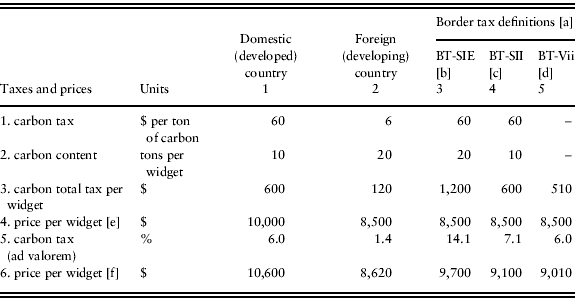
Table 1 aims to illustrate the main options available. It assumes that producing one widget in a developed (domestic) country would cost $10,000 and emit 10 tons of carbon when the carbon tax imposed by the developed country is $60 per ton (column 1), and that producing a similar widget in a developing (foreign) country would cost $8,500 and emit 20 tons of carbon when the carbon tax imposed by the developing country is $6 per ton (column 2). Finally, it is useful, for the discussion below, to note that the ad valorem equivalent of the domestic carbon tax is 6% in the developed country and 1.4% in the developing country – a difference that policy makers and negotiators will interpret as a rough indication of the cost of the climate policy in the two economies.
Alternative definitions of a carbon border tax
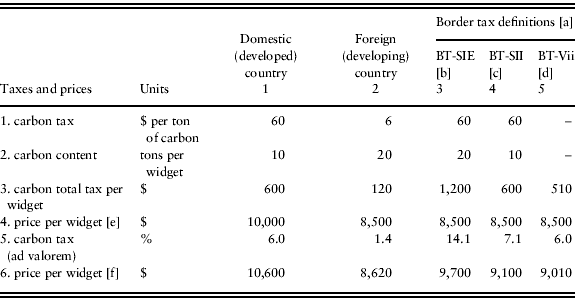
Notes: [a] The three carbon border taxes (BTs) are imposed on the price per widget excluding the exporting country's carbon tax. [b] BT-SIE: BT defined in specific terms (S), based on the tax rate of the importing country (I) and on the carbon content of the exporting country (E). [c] BT-SII: BT defined in specific terms (S) and based on the tax rate and on the carbon content of importing country (I and I). [d] BT-VII: BT defined in ad valorem terms (V) and based on the tax rate and on the carbon content of importing country (I and I). [e] Price excluding the domestic carbon tax. [f] Price including the appropriate carbon tax.
Table 1 focuses on carbon border taxes. Hence, the widgets exported by the developing country land at the border of the importing developed country at a cost of $8,500 for all the possible options defining the carbon border tax (row 4 and columns 3 to 5). By contrast, carbon tariffs (taxes imposed by the developed country on the price of the widget exported by the developing country, including the carbon tax imposed by the developing country) would be imposed on an $8,620 basis.
Three features are needed to define a carbon border tax: the nature of the tax (S if specific, V if ad valorem), the tax rate (I if defined by the tax rate of the importing country, E if defined by the tax rate of the exporting country), and the tax base (I if defined by the carbon content of the importing country, E if defined by the carbon content of the exporting country).
Combining these three features allows three main types of carbon border taxes (BTs) to be defined. Column 3 shows a BT-SIE, which is defined in specific terms (S) and which is based on the tax rate of the importing country (I) and on the carbon content of the exporting country (E). Column 4 shows a BT-SII, which is defined in specific terms (S) and which is based on the tax rate of the importing country (I) and on the carbon content of the importing country (I). Column 5 shows a BT-VII, which is defined in ad valorem terms (V) and is based on the tax rate of the importing country (I) and on the carbon content of the importing country (I) – and this ad valorem equivalent is applied on the price of the imported widget like a tariff.Footnote 12
Negotiating definitions in an international forum
Table 1 shows that the price of the imported product varies significantly depending on the definition used. As this paper focuses on international negotiations, this result suggests that there will be serious reasons to find a pragmatic compromise on the definition to be adopted by the international climate regime. What follows relies on two assumptions shaping such negotiations. First, there is a broad understanding among negotiators that while the climate issue requires a simultaneous solution to an allocational problem (how many carbon emissions should be cut every year) and a distributional problem (how to share the costs of these annual emissions cuts), trade policy can only address the allocational problem, meaning that appropriate transfer policies will be needed for addressing the distributional problem. Absent this broad understanding, there is little chance that climate negotiations could be successful. Second, what follows assumes that there is perfect information on carbon content. This assumption will be re-examined below in looking at the implementation problems.
Developing countries are likely to perceive the BT-SIE definition as imposing a ‘double penalty’ to the extent that their large carbon emissions reflect their pending development problems (dirty production process combined with low valuation of the climate issue). Such a view is illustrated by the ad valorem equivalent of the BT-SIE on widgets imported from developing countries, which amounts to 14%, compared to only 6% for the domestic carbon tax imposed on widgets produced in developed countries. The sharper the erosion of the price advantage of their exported widgets due to the imposition of the carbon border tax, the more vocal developing countries' negotiators will be.
Developing countries will find the BT-SII and BT-VII definitions more acceptable. They generate cost increases that are more affordable than the one generated by the BT-SIE approach (four to five times the cost of the existing carbon tax in the developing country compared to ten times). Table 1 illustrates a situation where the BT-SII and the BT-VII definitions bring very similar cost increases. However, it is easy to show that the larger the difference between the prices of domestic and foreign widgets (row 4), the more costly the BT-SII definition compared to the BT-VII option.Footnote 13 In short, the BT-SII approach would appear systematically biased against the interests of the poorest countries since such countries tend to offer less elaborate, hence cheaper, products than the rest of the developing countries.Footnote 14 As a result, the BT-VII is very likely to emerge as the preferred definition of the carbon border tax for the developing countries.
By contrast, developed countries' negotiators are likely to push for the BT-SIE definition, which has the attraction of generating a ‘world’ price of CO2. But, as has been amply demonstrated since the Copenhagen Conference, they are unlikely to convince developing countries, for the reasons given above.
In such a context, the BT-VII definition has three features which are interesting from the developed countries' perspective.
First, there is nothing in the BT-VII definition to prevent a developing country from adopting a climate policy more stringent than that of the developed countries if the country was willing to set up such a bold climate policy and if it believed that its comparative advantages were strong enough to sustain it.
Second, the BT-VII is a multiple (four times in Table 1) of the domestic carbon tax imposed by the developing countries. Hence, it sends a clear signal to developing countries to start to cut their CO2 emissions – launching a process of convergence among CO2 prices in the world. This ‘progressivity’ has some merit, particularly if the alternative of imposing the BT-SIE immediately would represent such a burden on developing economies that it had the unexpected negative consequence of inducing developing countries to create a dual world economy – that is, a clean economy covering developed countries and some emerging economies' exporters, and a dirty economy in the rest of the world. In such a case, the net impact of the BT-SIE on the world climate regime is hard to predict. The higher the carbon border tax imposed by developed countries, the more likely is the emergence of such a dual world economy, with a correspondingly larger share for the dirty economy in the world and an increasingly harmful and durable impact on the climate (developing countries are growing much faster than developed economies).
Lastly, it is true that BT-VII (and BT-SII) may induce the developing countries to behave as ‘followers’, that is, to let their carbon border taxes be shaped by the climate policy of the importing (developed) countries. This behaviour is often seen as negative from a climate perspective, but it may be more beneficial than it seems at first glance. For instance, let us assume that there are two different production processes for producing widgets existing in the developed country (once again, the implementation problems raised by such a complicated system will be re-examined below). While Table 1 illustrates a relatively carbon-intensive process, another production process operated in the developed country would require only five tons of carbon per widget, and so be subject to lower import-defined and ad valorem-based domestic carbon taxes (respectively $300 and 3%). Developing countries' exporters would thus have an incentive to invest in this cleaner carbon-intensity process in order to be classified in the same category as the cleaner process in the developed country, and hence benefit from the corresponding lower carbon border taxes. In short, there are incentives for the developing countries to follow the most CO2-efficient process in the developed countries (in the same way as emerging economies are induced to quickly adopt the most recent technologies).
To sum up, considerations of equity and development – not trade – suggest that in the current international negotiations, characterized as they are by high heterogeneity among countries, a good compromise would be to define carbon border taxes in ad valorem terms based on the parameters of the importing country. Of course, all the definitions of the carbon border tax above could become acceptable to developing countries if they were to receive appropriate transfers (up to $1,080 per widget in the case of the SIE approach) from developed countries. But negotiating such transfers could impose astronomical transaction costs, and it remains to be seen whether such transfers would be politically acceptable to the public opinion of the developed countries.
Mutual destruction and mutual support: an illustration
Mattoo et al. (Reference Mattoo, Subramanian, van der Mensbrugghe and He2010) provide calculations that could be used to get a sense of the vastly different impacts of the alternative definitions of a carbon border tax. Their results rely on a CGE model assessing the structural impacts on developing countries from climate change and climate policies.Footnote 15 The model relies on assumptions about climate parameters (such as the cost of future technologies, intra-fuel substitution elasticities, carbon tax revenue recycling, etc.). The sensitivity of the results to these assumptions is limited by the fact that the calculations made are about changes (in trade and output) occurring in a relatively short period of time – in 2020 following a unilateral decision taken in 2012 by the developed (OECD) countries to cut their 2005 level of carbon emissions by 17%. It is assumed that developing countries have no climate policy.
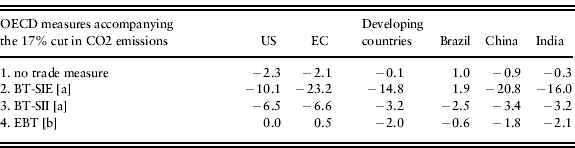
Mattoo et al. envisage four options (see Table 2) characterized by the trade measure adopted (or not) by the OECD countries to accompany their emission cuts. First, the OECD countries could take no trade measure following their decision to cut emissions. Second, they could impose a tax on all their imports from the developing countries which would be based on the carbon content in the developing countries' goods, in other words a BT-SIE. Third, the OECD countries could impose a tax on all their imports from the developing countries based on the carbon content existing in like products produced by the developed countries, in other words a BT-SII. Finally, they could impose a BT-SII on all their imports from the developing countries combined with a rebate on all their exports based on the carbon content of their domestic production – an option often called an efficient border tax (EBT) since it avoids ‘double’ taxation.Footnote 16
Impact in 2020 of alternative border tax regimes on industrial exports of selected countries following a 2012 OECD unilateral cut in CO2 emissions, percentage changes
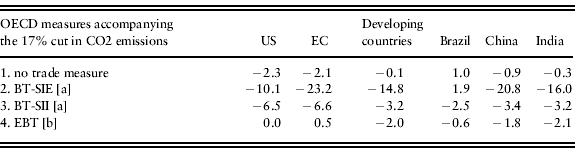
Notes: Developed countries are assumed to unilaterally reduce their emissions by 17%. [a] See definitions in Table 1. [b] The EBT (efficient border tax) combines a BT-SII on all the developed countries' imports from the developing countries combined with a rebate on all the developed countries' exports based on the carbon content of the production in the developed countries.
Source: Mattoo et al. (Reference Mattoo, Subramanian, van der Mensbrugghe and He2010).
Table 2 provides four main results in terms of export flows (the model provides results for output and welfare changes as well). It gives the (percentage) changes in exports in 2020 which would result from a hypothetical 2012 unilateral decision of the OECD countries to cut emissions:
• The no trade measure emerges as the preferable option from the joint point of view of climate (OECD countries do take measures to cut their CO2 emissions), trade and development (the impact on trade flows is small, as in the EBT case, but it is milder for developing countries than in the EBT case): it illustrates mutual support.
• A BT-SIE is clearly much more costly to almost every country than a BT-SII. This result confirms the discussion of Table 1: developing countries are likely to be strongly opposed to a BT-SIE definition of the carbon border tax.
• By contrast, the impact of a BT-SII in terms of changes in developing countries' exports is limited enough to induce developing countries to agree on the introduction of such a border tax – especially if its introduction is combined with international transfers, and/or if developing countries are convinced that they should adopt a climate policy.
• No trade measure and an efficient border tax (EBT) have similar impacts. The difficulty of implementing a complex EBT scheme suggests that the no trade measure may well be the best policy.
Unfortunately, Mattoo et al. do not envisage the case of a BT-VII. The discussion in the previous subsection on the relative ad valorem tax rates of a BT-SII and a BT-VII suggests that the expected impact of a BT-VII would range somewhere between the BT-SII case and the EBT case.
More about implementation problems: mind-boggling complexity
A key implementation problem comes from the fact that the climate community pays a lot of attention to production processes. This attention is legitimate: what counts is not so much the carbon content of an individual product as the whole ‘carbon footprint’ aggregating the carbon emitted at every step of the production process of the good in question.
If this approach makes sense in the climate context, it means that perfectly similar products are different if they have different carbon contents due to the use of different production processes. Such a prospect has made the trade community very nervous because of the sheer complexity generated by adding the dimension of production processes, in particular if importers have the right to calculate the carbon content in the supplying countries. In short, it becomes critically important to strike the right balance between exhaustiveness and simplicity.
Today, there are roughly 10,000 different tariff lines defining ‘products’ in a typical tariff schedule. Taking into account the various production processes capable of generating each of these products would require tariff lines to be defined in terms of ‘products times production processes times firms’. Such a challenge is not new in the world trade regime. ‘Rules of origin’ which determine where a good comes from or ‘export processing zones’ have created very similar problems and the large costs involved are well documented (equivalent to a price increase of 12% in the NAFTA case (Cadot et al., Reference Cadot, Carrère, de Melo and Portugal-Pérez2005)). But the climate context has an unprecedented capacity to generate such problems. Pushed to its extreme, it could easily negate the notion of similar products that is so essential in a world witnessing an endless expansion of varieties of products in order to better satisfy consumers.
The literature revealing the full extent of the problems of implementing climate policies in an international context is relatively recent (Brenton et al., Reference Brenton, Edwards-Jones and Jensen2009; Jensen, Reference Jensen2009; Moore, Reference Moore2010). Too many observers continue to stick to the naive solution according to which each exporter would provide the carbon footprint of its product to the Customs of the importing country. Such a solution faces two problems. First, its logic would require a gigantic database ‘products times production processes times firms’, generating astronomical transaction costs (again assuming the data existed). Second, costs would be compounded by the huge risks of corruption that are inevitably associated with complexity in an international context. These risks and costs would be (much) higher for the emerging and developing countries, precisely the countries that should be induced to participate in a world climate regime, not discouraged from it.
From exhaustiveness to simplicity: dealing with the ‘similarity’ issue
The full conformity of the import-defined approaches (whether in specific or ad valorem terms) with the NT principle has a last crucial consequence: in calculating them, countries rely only on the domestic information they know best. As a result, the huge risks of misinformation on carbon footprint are reduced (Brenton et al., Reference Brenton, Edwards-Jones and Jensen2009; Jensen, Reference Jensen2009; Moore, Reference Moore2010), but they are not completely eliminated.
The remaining delicate step in terms of information is when the importing country ‘maps’ the various production processes operated in exporting countries onto its own domestic processes, that is, when it assesses to which of its own production processes a foreign process is similar. This step is made easier by the fact that developed countries (the most eager to impose carbon taxes) are likely to have knowledge of most of, if not all, the production processes (from the dirtiest to the cleanest) existing in the world and involved in world trade. That said, problems will emerge because the dirtiest processes may disappear faster in developed countries than in developing countries. In such cases, the calculated carbon border tax which was imposed on the domestic process could still be imposed on foreign producers, even though the domestic carbon tax is no longer imposed on domestic processes. Incentives to be inaccurate about techniques may then increase. It will also be difficult to find a satisfactory solution for the converse case – when firms in developing countries adopt cleaner technologies faster than firms in developed countries. The multilateral framework briefly described at this end of this section will be all the more valuable.
This ‘mapping’ exercise should be used as an opportunity to strike the best possible balance between exhaustiveness and simplicity in order to run a manageable system. It is beyond the scope of this paper to examine such simplification schemes in detail (for a recent careful analysis of the legal complexities raised by product related and non product related production processes, see Low et al., Reference Low, Marceau and Reinaud2010). Only a couple of options, ideally to be combined, are briefly described as a possible basis for a workable approach.
A first, obvious, option would be to reduce the number of products to be subjected to strict enforcement of a carbon (domestic and border) tax to those produced by the most carbon-intensive sectors, that is, the ones where risks of carbon leakage may be the highest. The key question is how long such a list would be. The EC debate shows how widely the answers can stretch. At one end of the spectrum, experts suggest only a few sectors (aluminium, cement, some chemicals, steel), based on their results showing limited carbon leakage (OECD, 2006; de Bruyn et al., Reference de Bruyn, Nelissen, Korteland, Davidson, Faber and van de Vreede2008; Graichen et al., Reference Graichen, Schumacher, Matthes, Mohr, Duscha, Schleich and Diekman2008; Gros, Reference Gros2009; Hourcade et al., Reference Hourcade, Demailly, Neuhoff and Sato2008; Kommerskollegium, 2009; Metcalf, Reference Metcalf2007; Monjon and Quirion, Reference Monjon and Quirion2010). At the other end of the spectrum, the list of sectors with an allegedly ‘significant risk of carbon leakage’ set up by the European Commission includes no fewer than 164 sectors or subsectors (European Commission, 2009). Section 4 explains the reasons for such a huge difference, and why the Commission's list massively overestimates such risks – to the point of endangering the emergence of sound climate policies.
A second option would be to aggregate the different processes used for producing a product into as few a number of clusters as possible, and to consider all the production processes included in the same cluster as having the same carbon footprint, and hence being subject to the same carbon (domestic and border) tax. Using the ad valorem-based definition would require the ad valorem-carbon tax to be calculated for each domestic cluster.Footnote 17 This ad valorem carbon tax would then be applied to the imports from the rest of the world, following the same procedures as those used today in the case of VAT adjustment.
Of course, these two options could be defined by each country independently of what the other countries decide to do. However, it would be much better, from both a climate and a trade perspective, for these options to be defined in a multilateral framework; this would lead to the same list of core sectors and clusters, and generate discipline benefiting from lessons arising from the WTO Agreement on sanitary and phytosanitary measures. Such a multilateral approach makes all the more sense because similarity in a climate context should be based on scientific evidence.Footnote 18
3. Most-favoured nation: prohibiting carbon tariffs
Article I of the General Agreement provides the second fundamental principle of the world trade regime, the so-called ‘most-favoured nation’ (MFN):
• a country should impose the same tariff on the imports of a given good regardless of the country of origin;
• any country violating this rule can be exposed to compensation or retaliation by all the GATT/WTO Members concerned.
By contrast with the NT rule, the MFN rule does not echo the immediate concerns of the climate community. However, it could play a crucial role in protecting the climate community from the high risk of climate policies being captured by vested industrial interests trying to impose discriminatory duties on some countries (but not on others).
Often, such duties are called ‘border taxes’ in the existing literature. But it is essential to underline that they are radically different from the border taxes examined in the previous section since they would be imposed exclusively on imports from countries qualified as having ‘non-comparable’ climate policies or on imports from countries ‘that are not part of a global agreement to cut carbon emissions’ (to use the terms of the French–Italian proposal tabled on 15 April 2010).Footnote 19 As a result, this paper uses the term of carbon tariffs, as noted in the introduction.
Carbon tariffs have a feature that is undesirable from both a climate and a trade perspective: they may distort the ranking of foreign competitors in the importing market in ways that only loosely reflect climate concerns but that may be costly from the point of view of the relative efficiencies of the world's economies. (In sharp contrast, the carbon border taxes analysed in the previous section do not modify the ranking of foreign products since their level is independent of the country's origin.) Carbon tariffs may make imports from so-called ‘non-comparable’ countries more expensive than imports from other countries even if the latter are only marginally less carbon-intensive than the former. While gains in terms of carbon emissions may be small, losses in terms of efficiency may be high. This possibility is all the more likely because the carbon tariffs currently proposed clearly target emerging (relatively efficient) economies.
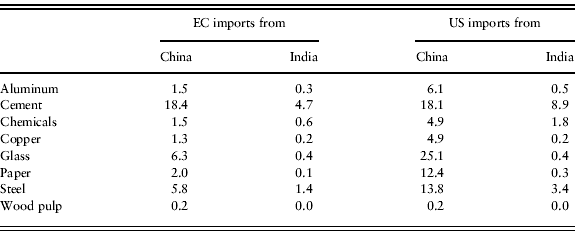
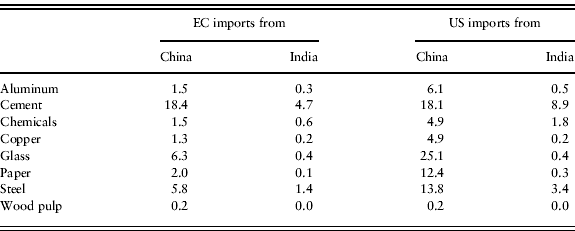
Carbon tariffs reflect a serious misunderstanding of basic facts of climate and trade. They assume that the targeted ‘non-conforming’ emerging economies are exporting greater amounts of carbon-intensive products than developed (‘conforming’) countries. Table 3 shows that only a small share of US and EC imports of carbon-intensive goods come from the emerging economies of China and India. This is largely because most exports from the emerging economies still consist of products or activities that are not very carbon-intensive, such as clothing, shoes, assembling parts, etc.
EC and US imports of carbon-intensive products as a share of their total imports of these products, 2007
Source: Kommerskollegium (2009).
As a result, carbon tariffs are unlikely to achieve their intended goal of ‘convincing’ the emerging economies to join a world climate policy. The same could be said a fortiori about the threat of carbon tariffs. The debate about such threats echoes the decades-long discussions about the efficiency or inefficiency of Section 301 of the US trade statute which ended with its relinquishment in the mid-1990s – a de facto recognition of its failure.
Ironically, Table 3 suggests that since trade of carbon-intensive products occurs mostly between developed countries, carbon tariffs raise trade issues primarily among these developed countries. Such a situation could lead to two negative developments – and it is hard to assess which would be the worst. Either carbon tariffs might degenerate into trade conflicts between developed countries, exacerbating the already substantial difficulties of these countries in working together on a world climate policy, all the more so because some developed countries are much less carbon competitive than they believe themselves to be (Delgado, Reference Delgado2007). Or, alternatively, in order to avoid such conflicts, developed countries might choose ‘reciprocal forgiveness’ on CO2 matters among themselves – but that could only be at the cost of exacerbating North–South conflicts on CO2 issues.
Carbon tariffs would also, almost inevitably, exacerbate the incentives for firms based in these countries (often subsidiaries or joint ventures of firms from developed economies) to divert their ‘dirty’ exports away from the markets of developed countries and towards the markets of developing countries. That would contribute to the ‘dual’ world trade already evoked, with ‘clean’ trade centred around the slow-growing developed economies, and ‘dirty’ trade around the fast-growing emerging and developing countries. It is hard to see what would be the gain from a world climate perspective.
Adopting the MFN rule would make such carbon tariffs impossible. More generally, it would reduce the risks of adopting ‘negative incentives’ as a way to induce countries to enforce climate policies. By the same token, the MFN rule would induce countries with advanced climate policies to look for the positive incentives that could persuade emerging economies to improve their climate policies as quickly as possible.
4. The climate change regime: to the rescue of the world trade regime?
This section focuses on the benefits the climate community could bring to the world trade regime if it made sound decisions.
Pressures for imposing trade barriers on top of carbon border taxes
Domestic carbon taxes are likely to impose substantial industrial adjustment on carbon-intensive sectors. Vested industrial interests in developed countries will argue (they already do) that they are at a severe disadvantage in global markets. Hence, they are likely to request two types of trade barriers on top of VAT-type border taxes. The first is the carbon tariffs examined in Section 3. But the ‘most-favoured nation’ principle will ban them.
The alternative type of trade barrier would consist of requests for protection lodged by individual firms or group of firms following a conditional event allegedly ‘caused’ by the introduction of the climate change policy – such as an alleged loss in terms of output, market share, profit, or any other indicator of competitiveness. These ‘carbon conditional measures’ (CCMs, which are not allowed under WTO rules) differ from carbon tariffs in several respects. They are subject to legal procedures (complaint, inquiry, causation determination, decision to impose a CCM or not, review, etc.) quite different from those required for adopting carbon tariffs. They also tend to focus on products, not on countries (as carbon tariffs do).
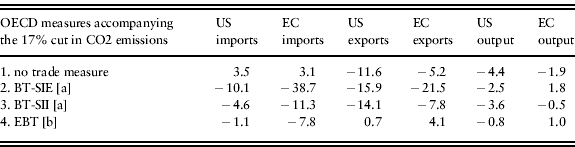
Calculations by Mattoo et al. give a sense of the pressures that would emerge to get CCMs in the four cases in Table 2 following an OECD decision to cut CO2 emissions by 17% (no trade measure, BT-SIE, BT-SII, and EBT). Table 4 focuses on carbon-intensive products (those most concerned by the decision to cut CO2 emissions), unlike Table 2 which deals with all industrial products. It gives the percentage changes (in 2020) in imports, exports, and outputs in the US and EC following a decision of the OECD countries to cut their carbon emissions by 17%.
Impact of US and EC alternative trade measures on their imports, exports, and output of carbon-intensive products following a 2012 OECD unilateral cut in CO2 emissions, percentage changes
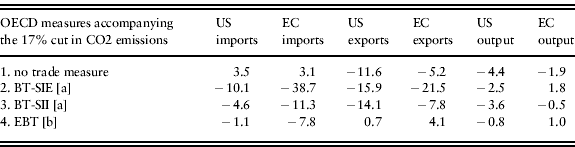
Notes: [a] See Table 1 for definitions of BT-SIE and BT-SII. [b] See Table 2 for the definition of EBT.
Source: Mattoo et al. (Reference Mattoo, Subramanian, van der Mensbrugghe and He2010).
Table 4 shows serious effects on imports and exports, particularly in the case of a BT-SIE, with the exception of a positive effect of the EBT on exports. For instance, the trade contraction created by a SIE border tax has a magnitude close to the trade collapse observed during the 2008–9 crisis.
More importantly, all the regimes show the emergence of negative outputs in the US, and, less systematically, in the EC. This result reveals the magnitude of the pressures for getting CCMs. The US output decline may be substantial enough to induce US carbon-intensive sectors to request trade barriers on top of VAT-type carbon border taxes (despite a slight increase in exports and decline in imports). The situation may look better in the EC, but probably not enough to induce EC carbon-intensive sectors not to follow US industries' requests, and not to argue that they also face ‘unfair’ competition from foreign industries subject to ‘less strict’ climate change policies, and hence that they need additional trade barriers in the form of CCMs.
CCMs: a trap for the climate (and trade) communities
Some members of the climate community have already expressed some sympathy for CCMs. In particular, they fear that pressures on carbon-intensive processes will induce EC-based firms to outsource their dirty plants, generating ‘carbon leakage’. They see CCMs as a way to fend off these pressures, and hence to establish domestic climate change policies more rapidly and/or firmly.
In this context, what lessons can be drawn from the trade side? The current world trade regime has a panoply of trade instruments conditional on some kind of ‘unfair’ event that could be used by the vested interests in carbon-intensive sectors. GATT Articles VI and XIX allow anti-dumping, anti-subsidy, and safeguard measures to eliminate ‘unfair’ practices (dumping and subsidies) or to bring relief in case of import ‘surges’ (safeguard). Sixty years later, an abundant literature provides the following robust evidence on the use of these conditional trade measures:
• The reasons supporting their use are deeply flawed: few believe today that selling cheap steel bars mirrors unfair competition from developing countries or that increased imports of T-shirts from developing countries were an ‘unforeseeable’ event.
• Their use has been grossly distorted: such trade measures are more protective of the firms – including foreign firms in markets prone to collusion and cartelization, such as cement, glass, chemicals, or steel, that such conditional trade instruments promote and nurture – than their workers.
In short, all these instruments have in fine been used in a purely protectionist manner, at huge expense to domestic taxpayers and consumers, and to the detriment of the domestic allocation of resources and of the world trade regime.
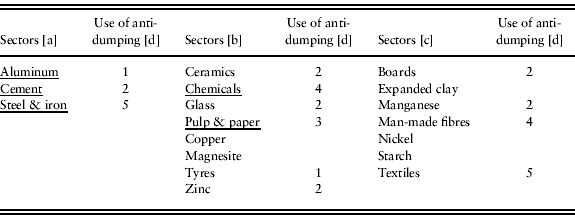
Should these results be taken seriously by the climate community? Table 5 gives a positive answer – sending a strong warning signal to the members of the climate community who may be inclined to join forces with vested industrial interests.
The use of antidumping measures in industrial sectors with a ‘significant risk of carbon leakage’, as established by the European Commission
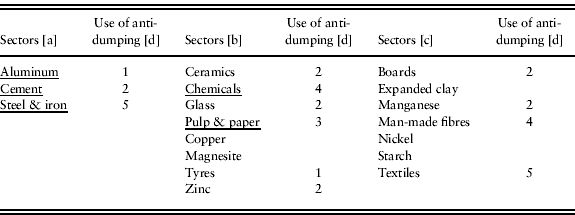
Notes: Sectors underlined are the ones generally considered by environmental experts as carbon intensive sectors. [a] Sectors quoted as ‘currently being analyzed’ in 2009. [b] Sectors quoted as ‘having provided preliminary information’ in 2009. [c] Sectors quoted as ‘having announced that they will provide information’ in 2009. [d] The use of the anti-dumping measures during the period 1987–2010 covered by the database ranges from 1 (between 5 and 10 cases during the whole period) to 2 (between 10 and 20 cases) to 3 (between 20 and 100 cases) to 4 (between 100 and 250 cases) to 5 (between 250 and 1,000 cases).
Source: European Commission 2009 for the list of industrial sectors; World Bank anti-dumping database on anti-dumping cases (1987–2010).
Table 5 provides a summarized presentation of the industrial sectors that the European Commission is considering as being exposed to a ‘significant risk of carbon leakage’ (Annex A gives the detailed list). Only a handful of these sectors (those underlined) are considered to be carbon-intensive emitters by environmental experts. By contrast, most of the sectors the Commission is ready to include in such a list are notable as intensive users of anti-dumping measures (a key conditional trade instrument allowed by the GATT) during the period 1987–2010. Once combined, these two observations show the high risk of the climate issue being captured by long-standing protectionist interests – a conclusion that a detailed analysis of the Commission's full list provided in Annex A confirms.
The true challenge: designing appropriate adjustment measures
The climate community should thus be wise enough to reject the use of carbon conditional measures. But this will not be easy. CCMs will be presented as the price to pay to get a climate change policy, just as conditional trade instruments (anti-dumping in particular) were presented as the price to get trade liberalization. In trade, there is now an abundant literature showing that this rhetoric does not fit the facts. After 20–30 years, conditional trade instruments are still there, reducing trade in the markets in question. It is hard to see why things would be different in the climate change context.
That said, rejecting CCMs does not mean that no attention should be given to the transition period during which carbon-intensive industries will need to restructure their activities in order to adjust to stricter climate change policies.
Rather, rejecting CCMs requires the climate community to make the necessary effort to design much better adjustment instruments than CCMs. The climate community should conceive instruments closely targeted on the efforts to be made by the carbon-intensive sectors along the lines suggested by recent research (OECD, 2005; Richardson, Reference Richardson, Hoekman and Porto2009; Banks, Reference Banks2010).
If the climate community succeeds in achieving such a task, it will have done a huge service to the trade community, which might then be inspired by the adjustment instruments designed in the climate change context, and hence could adapt them to the trade context, ultimately getting the opportunity to abandon (or at least to drastically reduce the use of) conditional trade measures.
Concluding remarks
There is no doubt that trade and climate change policies could be mutually destructive. But this paper underlines the strong reasons why they can be mutually supportive: a common problem, common foes, and common friends. Mutual support would be much stronger if the world regimes for these two policies followed a few common principles (National Treatment and Most-Favoured Nation) and disciplines (adjustment policies, no conditional trade policies) beneficial to them both. In other words, the climate community should feel at ease within the broad WTO principles. If it insists on having its own treaty, it should make sure it builds it on the same basic principles.Footnote 20 Meanwhile, the trade community should grasp the opportunity to benefit from the improved disciplines that the climate community could design in trying to avoid the systemic failures of the trade regime.
This key conclusion should cast the many pending problems in a more – even a much more – positive perspective. The most pressing of these problems from this paper's perspective (production processes, carbon tariffs) have been examined above. But the paper has left aside many other important reasons in favour of mutual support that deserve full attention. Hufbauer et al. (Reference Hufbauer, Charnovitz and Kim2009) and Hufbauer and Kim (Reference Hufbauer and Kim2010) provide the most complete list of these issues, and more importantly, they offer a wide range of potential solutions. As a result, what follows mentions only a couple of them.
The first concerns common negotiating techniques, a point emphasized by Antholis (Reference Antholis, Bairnard and Sorkin2009). The climate community has already begun to negotiate on a ‘plurilateral’ basis (a core of key large countries with a few more countries representing well-defined groups of small countries) which the trade community would have been well advised to adopt for concluding the Doha Round.
The second reason is the treatment of the developing and least developed countries. The trade regime allows ‘special and differentiated treatment’ (SDT) for such countries. But, SDT can be best described as a trap for developing countries: it is not generous when truly needed, and it is generally designed in such terms that it generates perverse impacts (if any) on both the alleged beneficiaries and the developing countries excluded from its scope. Climate change diplomacy has come up with a concept that echoes SDT – the ‘common but differentiated responsibility’ notion. In this respect, it will be crucial that the climate community does not duplicate the mistakes made by the world trade regime, and realizes that the full enforcement of the principles above takes care of this notion (Hoekman et al., Reference Hoekman, Martin and Mattoo2010).
Annex A. The NACE list of industries with a ‘significant risk of carbon leakage’
What follows provides the detailed list of industries with a ‘significant risk of carbon leakage’ published by the Commission. The NACE codes have been selected on the basis of the quantitative criteria set out in Article 10a (13) of Directive 2003/87/EC. The legal basis for their selection is:
• Column 1: codes based on paragraphs 15 and 16, at NACE-4 level.
• Column 2: codes based on paragraph 15, at NACE-4 level.
• Column 3: codes based on paragraph 16, point a, at NACE-4 level.
• Column 4: codes based on paragraph 16, point b, at NACE-4 level.
• Column 5: codes based on paragraphs 15 and 16, at NACE-5 and beyond level.
• Column 6: codes based on paragraphs 17, at NACE-4 level.
Letter T means that the code is considered as having a significant risk in its entirety.
The criteria used by the European Commission to draw up this list confirms the Commission's inability to resist protectionist pressures, leaving little doubt about the ultimate capture of climate change policies by vested industrial interests if the climate community is not vigilant. The drift from climate change concerns (which should be the core ones) to trade concerns became clear when EC Directive 2003/87 was modified by EC Directive 2009/29. These modifications included the definition of criteria for defining sectors with significant risk of carbon leakage. The criteria adopted defined three major groups of sectors (European Commission 2009):
• Sectors with a ‘particularly high’ increase (more than 30%) in the ratio between costs due to carbon regulations and gross value added. Clearly, this group deserves attention from a climate change perspective. But it accounts for only two clearly identified sectors (cement and lime) in the Commission's list.
• Sectors with a high trade intensity (above 30%) defined as the ratio between the sum of imports and exports and the sum of gross value added and imports. Clearly, this group has little to do with climate change concerns – but a lot to do with vested interests eager to use climate change for plainly protectionist purposes, or protection for slowing down climate change policies. This group accounts for a huge number – 117 clearly identified sectors in the Commission's list. The fact that sectors such as manufacture of wines (NACE 1593), clocks (NACE 3350), bicycles (NACE 3542), or underwear (NACE 1823) pertain to the list raises serious questions about the way the list has been established.
• Sectors with a ‘substantial’ increase (more than 5%) in the ratio between costs due to carbon regulations and value added, and with a relatively low (more than 10%) trade intensity (defined as above). The logic of this mix of criteria is unclear. The climate change criterion is the dominant one, but the trade threshold is so low that it is unlikely to bite seriously. This group accounts for 11 clearly identified sectors in the Commission's list.
Note
A supplementary table accompanying this paper is available online at http://journals.cambridge.org/wtr