


Competitive multiparty elections are a hallmark of democratic governance. Because they incentivize office-seeking incumbents to represent and cater to their constituents’ interests, they establish an “electoral connection” between citizen demands and political outcomes (Mayhew Reference Mayhew, Cubbins, Calvert and Sullivan1987). Consequently, the presence of free and fair elections is widely regarded as the single most important characteristic of democratic governance and therefore lies at the core of most modern definitions of democracy (Dahl Reference Dahl1971; Geddes, Wright, and Frantz Reference Geddes, Wright and Frantz2014; Schumpeter Reference Schumpeter1950).
Accordingly, contestation is often seen as a precondition for responsiveness and accountability (Powell Reference Powell2004; Shmuel Reference Shmuel2020). Extant scholarship hence agrees that only some authoritarian elections are able to generate responsiveness. While even in autocracies competition between multiple candidates can lead them to invest heavily in the provision of services to their constituents (Blaydes Reference Blaydes2011; Lust-Okar Reference Lust-Okar2006; Reference Lust-Okar, Lust-Okar and Zerhouni2008; Magaloni Reference Magaloni2006), it is scholarly consensus that autocratic elections do not incentivize political elites to respond to their constituents if these elections are uncontested (Brender and Drazen Reference Brender and Drazen2005; Pepinsky Reference Pepinsky2007; Shmuel Reference Shmuel2020; Veiga, Veiga, and Morozumi Reference Veiga, Veiga and Morozumi2017).
This paper challenges this conventional understanding of authoritarian elections. The focus is on uncontested elections in “closed autocracies,”Footnote 1 where the only choice voters have is whether or not to support the regime’s handpicked candidates. I demonstrate that, despite this lack of contestation, uncontested elections can still generate an “electoral connection” between voters and the government.
I propose that governments in closed regimes improve responsiveness to citizen demands before uncontested elections in an effort to raise popular support. High popular support reduces the risk of elite challengers or opposition mobilization at a time when autocratic regimes are vulnerable. It also enables elections to perform their informational and signaling functions (Bahry and Sliver Reference Bahry and Silver1990; Geddes, Wright, and Frantz Reference Geddes, Wright and Frantz2018; Magaloni Reference Magaloni2006; Malesky and Schuler Reference Malesky and Schuler2011). Responsiveness to citizen grievances is a useful tool for increasing popular support because it demonstrates the regime’s competence (Gorgulu, Sharafutdinova, and Steinbuks Reference Gorgulu, Sharafutdinova and Steinbuks2020), increases subjective political efficacy (Dipoppa and Grossman Reference Dipoppa and Grossman2020; Sjoberg, Mellon, and Peixoto Reference Sjoberg, Mellon and Peixoto2017), and raises trust in the government (Chapman Reference Chapman2021; Truex Reference Truex2017).
Evidence for cycles of responsiveness around uncontested elections comes from an analysis of the petition system of the former German Democratic Republic (GDR). Like other closed regimes—such as the Soviet Union (Dimitrov Reference Dimitrov2014a), Iraq (Walter Reference Walter and Russell2018), China (Distelhorst and Hou Reference Distelhorst and Hou2017; Luehrmann Reference Luehrmann2003), or Saudi Arabia (Pan Reference Pan2020, 166)—the East German socialist regime encouraged citizens to report their grievances directly to the government. East Germans made extensive use of this system. They wrote between half (Class, Kohler, and Krawietz Reference Class, Kohler and Krawietz2018) and one million (Mühlberg Reference Mühlberg2004) petitions every year, equaling up to 8.1% of the country’s electorate. As the breadth of topics covered in these petitions demonstrates, they were not unlike 311 callsFootnote 2 (Christensen and Ejdemyr Reference Christensen and Ejdemyr2020), pothole complaints (Burnett and Kogan Reference Burnett and Kogan2016), or “FixMyStreet” requests (Dipoppa and Grossman Reference Dipoppa and Grossman2020; Sjoberg, Mellon, and Peixoto Reference Sjoberg, Mellon and Peixoto2017) in democracies. And, just like in democracies, petitions were answered faster before elections.
Analyzing a unique dataset of petitions submitted to the central government of the GDR between 1978 and 1990, I show that average response time was 22% to 31% shorter in the three months before elections, decreasing the time between receipt and response by more than one week. Petitions were also more likely to be successful before elections. The probability of success increased by up to 9.1 percentage points, which represents a 63.6% increase relative to an average success rate of 14.3%. This result expands existing conceptualizations of responsiveness. Past work usually asks if and under what conditions citizens receive a response from government officials but does not consider the material consequences of such responsiveness (Chen, Pan, and Xu Reference Chen, Pan and Xu2016; Christensen and Ejdemyr Reference Christensen and Ejdemyr2020; Dipoppa and Grossman Reference Dipoppa and Grossman2020; Distelhorst and Hou Reference Distelhorst and Hou2014; Reference Distelhorst and Hou2017). I instead introduce the concept of “substantive responsiveness” and show that improved responsiveness to citizen demands before the GDR’s uncontested elections also led to tangible improvements in citizens’ livelihoods. To further support this conclusion, data on government expenditures show that government spending increased more strongly before elections on two key social policy issues: housing and price stability.
To explain these results, I demonstrate that the regime was especially responsive to petitions that directly questioned the regime’s competence. Moreover, I show that the main driver of improved preelectoral responsiveness was the central government; petitions answered by central government officials saw a particularly strong decrease in response time before elections.
I rule out several alternative explanations. First, I show that my results are not driven by differences in petition volume or topic. There is little evidence that East Germans submitted more or different petitions before elections or that the regime strategically selected petitions it could answer easily. Second, the results cannot be explained by bureaucratic turnover: petitions were answered more quickly before both local and national elections. Third, there is no evidence that government officials attempted to artificially deflate response times before elections: there is no effect of elections on the number of days between the dates petitions were written and received.
My work makes multiple contributions to scholarship on responsiveness in closed regimes (Manion Reference Manion2015; Truex Reference Truex2016). The finding that even uncontested elections can incentivize government responsiveness calls into question existing assumptions about the unresponsiveness of closed autocracies and the absence of electoral business cycles in these regimes (e.g., Brender and Drazen Reference Brender and Drazen2005; Pepinsky Reference Pepinsky2007; Powell Reference Powell2004; Shmuel Reference Shmuel2020; Veiga, Veiga, and Morozumi Reference Veiga, Veiga and Morozumi2017). It also expands past work on responsiveness in closed regimes, which usually considers nonelectoral incentives, such as informal institutions (Tsai Reference Tsai2007), political connections (Tsai and Xu Reference Tsai and Xu2018), coethnicity (Distelhorst and Hou Reference Distelhorst and Hou2014), threats to contact upper-level officials (Chen, Pan, and Xu Reference Chen, Pan and Xu2016), threats of collective action (Distelhorst and Hou Reference Distelhorst and Hou2017), or leadership succession during party congresses (Bunce Reference Bunce1980; Tao Reference Tao2006; Tsai Reference Tsai2016). I further add to this literature by introducing the distinction between “performative” and “substantive” responsiveness. Last, I emphasize that responsiveness can be driven by the central government. This identifies a little-acknowledged driver of responsiveness, as the existing literature usually explains responsiveness with local bureaucrats’ desire to be promoted (Chen, Pan, and Xu Reference Chen, Pan and Xu2016; Distelhorst and Hou Reference Distelhorst and Hou2017; Jee Reference Jee2021), win local elections (Martinez-Bravo et al. Reference Martinez-Bravo, Miquel, Qian and Yao2020), or preserve their social standing (Tsai Reference Tsai2007).
Electoral Responsiveness in Closed Autocracies
Uncontested Elections in Closed Regimes
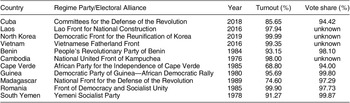
Most autocracies today conduct regular elections for national office. Elections are also routinely held in closed regimes, where they often take the form of referenda: the only choice voters have is whether or not to support the government’s handpicked candidates. Such uncontested elections are carefully orchestrated mass events. Widespread voter mobilization and intimidation, coupled with electoral manipulation, ensure a result that bolsters the government’s claim that it enjoys undivided popular support: regimes ranging from Cuba, Laos, North Korea, and Vietnam today to Cambodia, Ethiopia, Madagascar, Romania, or South Yemen in the past have routinely reported that they achieved near-unanimous support on election day (Table 1).
Parliamentary Election Results in Select Closed Autocracies

Source: Inter-Parliamentary Union (2020).
These election results are certainly exaggerated. However, I propose that closed regimes still seek to secure genuine citizen support—by which I mean that citizens turn out and vote for the regime party, irrespective of whether they do so in compliance with the regime’s expectations or for ideological reasons—in an effort to counteract two election-related threats to their survival. The first reason why autocratic regimes seek to secure genuine citizen support is that such high popular support counteracts the destabilizing effects of elections. Elections are focal points for opposition coordination, which raises the probability of autocratic breakdown (Knutsen, Nygård, and Wig Reference Knutsen, Nygård and Wig2017). A worse-than-expected result tells citizens that support for the government is lower than it claims (Cheibub and Hays Reference Cheibub and Hays2015; Magaloni and Kricheli Reference Magaloni and Kricheli2010), which can encourage dissatisfied citizens to join an opposition movement (Kuran Reference Kuran1991). At the same time, elections can motivate citizens to participate in various forms of collective action, further raising the probability of antiregime mobilization (Baldwin and Mvukiyehe Reference Baldwin and Mvukiyehe2015; Fearon, Humphreys, and Weinstein Reference Fearon, Humphreys and Weinstein2015). Elections pose additional risks because they offer opportunities for splits in the ruling coalition, especially when voters are dissatisfied with the government (Magaloni Reference Magaloni2006).
The second reason is that elections rely on strong popular support to perform their core functions (Gandhi and Lust-Okar Reference Gandhi and Lust-Okar2009; Geddes, Wright, and Frantz Reference Geddes, Wright and Frantz2018). Even uncontested elections provide the dictator with information about public support (Zaslavsky and Brym Reference Zaslavsky and Brym1978), as abstention or a vote against the regime are usually seen as dissent (Bahry and Silver Reference Bahry and Silver1990; Karklings Reference Karklings1986). They further allow the regime to monitor local officials and learn about their ability to mobilize voters in their jurisdiction, which can influence promotion decisions (Geddes, Wright, and Frantz Reference Geddes, Wright and Frantz2018; Guo Reference Guo2009; Malesky and Schuler Reference Malesky and Schuler2011; Reference Malesky and Schuler2013). Last, successful electoral mobilization demonstrates the regime’s capacity to control the population. This signal of invincibility deters challengers (Geddes, Wright, and Frantz Reference Geddes, Wright and Frantz2018; Magaloni Reference Magaloni2006; Magaloni and Kricheli Reference Magaloni and Kricheli2010; Simpser Reference Simpser2013).
To achieve such high electoral support, dictators cannot rely on fraud alone. Citizens are not completely in the dark about the true level of regime support; they know their own vote choice and may have some idea about how their peers feel toward the regime. This limits the regime’s ability to falsify the results in a credible way (Simpser Reference Simpser2013). If the result is too far off from reality, allegations of a “stolen election” can facilitate revolutionary collective action (Kuntz and Thompson Reference Kuntz and Thompson2009; Tucker Reference Tucker2007), as evidenced by the postelection protests following systematic fraud in the 1989 local elections in the GDR. Moreover, an entirely fabricated election result provides the government with little information about regime opposition or the competence of local officials.
Dictators cannot rely solely on coercion either to achieve their preferred election outcome. Forcing the population to vote for the government again undermines the ability of elections to perform their functions because it leaves dictators uncertain about their true level of support (Wintrobe Reference Wintrobe1998). Moreover, recent research has shown that repression before elections can increase the risk of backlash and popular protest afterwards (Esberg Reference Esberg2021; Hafner-Burton, Hyde, and Jablonski Reference Hafner-Burton, Hyde and Jablonski2016). For example, the GDR regime employed so-called degradation measures (Zersetzungsmaßnahmen) to make life harder for opponents. Yet, evidence suggests that these measures might have increased opposition to the socialist regime (Pingel-Schliemann Reference Pingel-Schliemann, Conze, Gajdukowa and Koch-Baumgarten2009).
Electoral Cycles of Responsiveness to Citizen Petitions
I propose instead that even closed regimes seek to generate genuine popular support. To do so, they improve responsiveness to citizen demands in the lead-up to elections. By responsiveness, I mean that the government takes action in response to the preferences of its constituents (Przeworski, Stokes, and Manin Reference Przeworski, Stokes and Manin1999).
Many authoritarian regimes channel citizen demands through petition systems. Petition systems offer citizens a legal avenue through which they can report their grievances to the government. Petitions help solve the “dictator’s dilemma,” whereby the dictator cannot be certain whether the population supports them out of fear or conviction (Wintrobe Reference Wintrobe1998): on the one hand, petitions serve as “barometer of public opinion” (Dimitrov Reference Dimitrov2014b). They are similar to 311 calls (Christensen and Ejdemyr Reference Christensen and Ejdemyr2020), pothole complaints (Burnett and Kogan Reference Burnett and Kogan2016), or “FixMyStreet” requests (Dipoppa and Grossman Reference Dipoppa and Grossman2020; Sjoberg, Mellon, and Peixoto Reference Sjoberg, Mellon and Peixoto2017) in democracies in that they draw the government’s attention to citizens’ everyday grievances. In the aggregate, they generate important information about the public mood and help the government identify and address causes of citizen dissatisfaction early (Dimitrov Reference Dimitrov, Gerschewski and Stefes2017). As such, petitions are a way for the autocratic regime to manage opposition quietly: the regime uses the information contained in petitions to identify and address grievances as they arise and before they encourage open protest. Petitions are better suited to collecting information about ordinary citizen grievances than government surveillance. Using the state security apparatus to collect the same information would require surveillance of virtually the entire population—a task that even the GDR’s Stasi, arguably one of the world’s most effective and largest secret police forces, was unable to accomplish (Pfaff Reference Pfaff2001; Popplewell Reference Popplewell1992).
On the other hand, petitions are an ideal mechanism for raising public support. By responding to and resolving petitions, the autocratic government can prove that it cares about its citizens’ problems and demonstrate its competence.
Responsiveness to petitions can take two forms. Extant scholarship on responsiveness to citizen requests in both democracies and autocracies usually asks if and under what conditions citizens receive a response (Chen, Pan, and Xu Reference Chen, Pan and Xu2016; Christensen and Ejdemyr Reference Christensen and Ejdemyr2020; Dipoppa and Grossman Reference Dipoppa and Grossman2020; Distelhorst and Hou Reference Distelhorst and Hou2014; Reference Distelhorst and Hou2017). Yet, it usually remains unknown whether such a response simply acknowledges or actually resolves the issue—that is, whether the response is “performative” or “substantive.”
“Performative responsiveness” is symbolic. It is characterized by “the state’s theatrical deployment of visual, verbal, and gestural symbols to foster an impression of good governance before an audience of citizens” (Ding Reference Ding2020, 5–6). Although the government responds to citizens’ concerns, it does not resolve them. By contrast, “substantive responsiveness” means that the government responds and resolves the issue. Here, a petition results in tangible improvements in the petitioner’s livelihoods. To the best of my knowledge, I am one of the first to study both forms of responsiveness empirically and explicitly consider substantive responsiveness in my analysis.
Both forms of responsiveness can improve regime support. As Truex (Reference Truex2017) shows, even performative responsiveness can increase popular trust and regime satisfaction, especially in contexts where citizens’ expectations about political access are low. This is because it gives citizens the impression that they have a voice in politics and are more than “being relegated to mere bystanders in the political discourse” (Chapman Reference Chapman2021, 1461). Moreover, it can improve citizens’ subjective political efficacy, making them more likely to engage with the government in the future (Dipoppa and Grossman Reference Dipoppa and Grossman2020; Sjoberg, Mellon, and Peixoto Reference Sjoberg, Mellon and Peixoto2017). Substantive responsiveness, in turn, raises support by directly addressing citizens’ grievances. Because petitions contain everyday grievances, they reveal citizens’ expectations about what the government ought to deliver. Actually delivering on these expectations raises government approval (Gorgulu, Sharafutdinova, and Steinbuks Reference Gorgulu, Sharafutdinova and Steinbuks2020), an effect augmented by the resulting tangible improvements in citizens’ livelihoods (Cho, Lee, and Song Reference Cho, Lee and Song2019; Dickson et al. Reference Dickson, Landry, Shen and Yan2016; Guriev and Treisman Reference Guriev and Treisman2020). Moreover, substantive responsiveness reassures citizens of the regime’s ability to meet their demands and reminds them of the social bargain many authoritarian governments strike with their citizens (Cook and Dimitrov Reference Cook and Dimitrov2017): the government delivers socioeconomic progress in return for popular acquiescence (Dale Reference Dale2005).
Local and central government officials alike have incentives to improve responsiveness before elections. Local officials need popular support to deliver the best possible election outcome in their jurisdiction. Here, local officials improve responsiveness to demonstrate their competence to the central government in an effort to advance their careers (Chen, Pan, and Xu Reference Chen, Pan and Xu2016; Distelhorst and Hou Reference Distelhorst and Hou2017; Jee Reference Jee2021). The central government, in turn, needs strong support to discourage political challengers and ensure a turnout rate high enough for elections to perform their functions. Here, the central government improves responsiveness to demonstrate its competence to voters in an effort to ensure political survival.
Discussion
In sum, I propose that uncontested elections offer powerful incentives for both local and central government officials to improve responsiveness to citizen demands before elections. Improved responsiveness can increase regime support by assuring voters of the regime’s competence and ability to deliver on citizens’ expectations. The implication is that even uncontested elections can generate an “electoral connection” (Mayhew Reference Mayhew, Cubbins, Calvert and Sullivan1987).Footnote 3
This argument builds on extant scholarship on political cycles in autocratic regimes in two ways. On the one hand, I expand past work on budget cycles in closed autocracies surrounding party congresses. Tao (Reference Tao2006) and Tsai (Reference Tsai2016), for instance, document nationally coordinated budget cycles around the quintennial National Congress of the Chinese Communist Party, while Bunce (Reference Bunce1980) presents evidence of budget cycles around communist party congresses in the Soviet Union and other East European communist regimes. However, the crucial difference between party congresses and uncontested elections in closed regimes is that the latter were unrelated to leadership succession. As such, responsiveness around elections was not intended to build popular support for a new leader but instead to secure high citizen support in an electoral ritual that had little effect on the country’s political leadership.Footnote 4
On the other hand, I expand past work on electoral cycles by showing that electoral cycles are not confined to regimes with contested elections. Scholars of electoral cycles tend to believe that electoral cycles do not exist in authoritarian regimes that hold uncontested elections (Brender and Drazen Reference Brender and Drazen2005; Shmuel Reference Shmuel2020; Veiga, Veiga, and Morozumi Reference Veiga, Veiga and Morozumi2017). For instance, Block, Ferree, and Singh (Reference Block, Ferree and Singh2003, 447) argue that “in a world with no uncertainty, the models predict no [electoral] cycles.” Similarly, “in dictatorships where elections are merely a show of force […] this model should not apply” (Pepinsky Reference Pepinsky2007, 141). However, there is little evidence that electoral cycles are indeed absent in closed autocracies. Case studies of authoritarian electoral cycles usually focus on hegemonic or competitive regimes—such as Egypt (Blaydes Reference Blaydes2011), Malaysia (Pepinsky Reference Pepinsky2007), Mexico (Gonzalez Reference Gonzalez2002; Magaloni Reference Magaloni2006), or Russia (Akhmedov and Zhuravskaya Reference Akhmedov and Zhuravskaya2004)—while cross-country analyses routinely omit uncontested elections altogether (Brender and Drazen Reference Brender and Drazen2005; Veiga, Veiga, and Morozumi Reference Veiga, Veiga and Morozumi2017).
Elections and Petitions in Socialist East Germany
Elections
Evidence for my argument comes from the former German Democratic Republic (GDR). The GDR conducted quintennial elections for the country’s legislature—the People’s Chamber (Volkskammer)—and, nonconcurrently, for local councils. Candidates in each multimember electoral district were selected by the regime and represented the ruling Socialist Unity Party of Germany (SED), affiliated (“block”) parties, and mass organizations. All candidates were part of the same electoral list: the National Front. As such, GDR elections were emblematic of uncontested elections. Voters’ only choice was whether to support or oppose the National Front. Elections in the GDR thus stand out as even less competitive than in other closed regimes—such as Cuba (Fonseca Galvis and Superti Reference Fonseca Galvis and Superti2019), Vietnam (Malesky and Schuler Reference Malesky and Schuler2010; Reference Malesky and Schuler2013), or China (Manion Reference Manion2015; Shi Reference Shi1999)—where voters can choose between several regime-aligned candidates. According to the above-referenced models of electoral cycles, we should thus expect no electoral cycles in the GDR.
A vote in favor of the National Front was done in public by folding and depositing the ballot in the ballot box. To vote against the National Front, voters had to strike through every single name on the ballot. Because this act required voters to enter a voting booth—typically placed in the farthest corner of the room—poll workers took immediate notice (Wolle Reference Wolle1998). This and other forms of intimidation effectively deterred most voting against the government (Karklings Reference Karklings1986; Wittenburg Reference Wittenburg2018).
The East German government spent enormous resources on voter mobilization. The period before elections saw an increased supply of consumer goods to create the illusion of social progress (Wittenburg Reference Wittenburg2018). On election day, all government and many apartment buildings displayed flags and propaganda posters. The first voters to cast ballots, as well as first-time voters, were greeted with flowers while the Young Pioneers entertained voters with socialist workers’ and battle songs (Ansorg Reference Ansorg and Kocka1993). Poll workers kept meticulous records of individual turnout and sent hourly updates to the central election committee. During the final voting hours, poll workers paid in-person visits to citizens who had not voted yet (bpb 2019; Wolle Reference Wolle1998). Mobile ballot boxes allowed the sick and elderly to vote at home or in hospitals (Der Spiegel 1990).
According to official records, the GDR government always claimed to have achieved quasi-unanimous support. Reported turnout and votes for the National Front usually exceeded 98% (Table 2). These results were publicly announced across all media, along with a characterization as “overwhelming proof of trust in our socialist state” (1979 elections) or “impressive commitment to our politics of peace and socialism” (1989).Footnote 5 Of course, the true result was unlikely as unanimous. But evidence of some fraud notwithstanding (bpb 2019), scholarly consensus holds that both turnout and support for the National Front was very high (Karklings Reference Karklings1986; Weber and Florath Reference Weber and Florath2019). I propose that improved responsiveness to citizen petitions was one way the regime achieved such high support.
Elections in the GDR

Note: Official election results, taken from the archives of the Neues Deutschland newspaper. Accessed August 13, 2020. https://www.neues-deutschland.de/archiv.
Petitions
Article 103 of the GDR’s Constitution gave every citizen the right to submit petitions (Eingaben) to any branch and level of government. East Germans made extensive use of this system. They submitted between half (Class, Kohler, and Krawietz Reference Class, Kohler and Krawietz2018) and one million (Mühlberg Reference Mühlberg2004) petitions every year, equaling up to 8.1% of the East German electorate. Given that most petitions were written on behalf of households or neighborhood associations, the true share of the population writing a petition was even higher. Improved preelectoral responsiveness was thus a widely applicable strategy.
Petitions provided the government with invaluable information about everyday popular grievances.Footnote 6 They contained information about local supply shortages, public grievances about insufficient government service delivery, and overall sentiment toward the socialist government (Dimitrov Reference Dimitrov, Gerschewski and Stefes2017). The vast majority of petitions sought to achieve an improvement in the petitioner’s living conditions from within the institutional framework (Staadt Reference Staadt1996). My archival research identified only a handful of petitions that openly called for regime change. Accordingly, there is little evidence that citizens faced repercussions for submitting petitions. In fact, as Dimitrov (Reference Dimitrov2014a) argues, the socialist government faced strong incentives not to punish petitioners. Any punishment would have lowered citizen trust and prevented citizens from submitting petitions in the future, thus depriving the regime of the information it sought to collect.
Government agencies created detailed reports about petition volume and content by county and year (Staadt Reference Staadt1996).Footnote 7 The information contained in these reports often informed policy making, as best illustrated by the coffee crisis in the mid-1970s: in an effort to stem a coffee supply shortage, the government had decided to dilute ground coffee with pea flower. Public outcry about the resulting poor coffee quality was so overwhelming that the regime quickly reversed this decision (Mühlberg Reference Mühlberg2004).
Petitions were often successful and improved petitioners’ living conditions, an insight that informs my analysis of substantive responsiveness below. There are numerous examples of petitioners’ obtaining better housing,Footnote 8 a new job,Footnote 9 or access to college education or vocational training,Footnote 10 among many others.
Petitions further allowed the government to monitor local officials (Chen, Pan, and Xu Reference Chen, Pan and Xu2016). Many petitions included a direct criticism of local decisions or a lack of responsiveness.Footnote 11 The central government’s follow-ups with local authorities often confirmed citizens’ critiques and led to revisions of prior decisions.Footnote 12
Research Design
Data
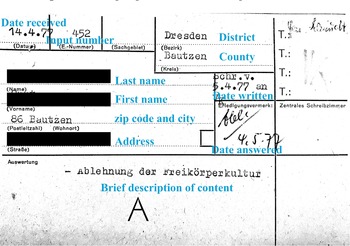
The analysis draws on a unique dataset of more than 70,000 petitions submitted to the central government of the former GDR between 1974 and 1990 (see Lueders Reference Lueders2021 for data and replication files). There are two samples. The first one comprises 10,892 petitions to the People’s Chamber (Volkskammer), the country’s legislature, between 1974 and 1989. I created it by manually reviewing all available People’s Chamber petition files at the German Federal Archives in Berlin.Footnote 13 As most petitions were forwarded to other agencies, the original petition text is often unavailable. But each file contains a summary card with basic information (see Figure 1 for an example). Using these cards, for each petition I manually recorded data on the date it was (1) written, (2) received, and (3) answered, as well as data on (4) the location of the petitioner (zip code, city, county, and district), (5) their gender (coded based on their first name), (6) a brief summary of the content, and (7) a chronological input number. The sample comprises almost all petitions sent to the People’s Chamber surrounding the 1979, 1981, and 1984 elections, which defines the period of analysis for this sample.Footnote 14
Sample Petition to the People’s Chamber
Source: People’s Chamber petition Nr. 452/1977 (BArch DA 1/16893).
Note: Example summary card of a People’s Chamber petition. It was received on April 14, 1977, from the city of Bautzen and contains a complaint about nudist beaches on the Baltic Sea coast.

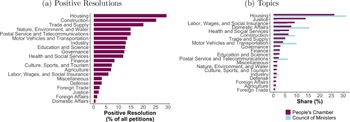
Almost all petitions received a response. These responses could take two forms. Some responses did not resolve the issue but instead acknowledged petitioners’ concerns or explained why the government was unable to help. Successful petitions, in turn, gave petitioners access to the requested government service or even led to a change in government policy. Information on success is available for 1977 to 1984, when summary cards included a handwritten note that an issue was “resolved positively” (positive Erledigung). This information offers me a unique opportunity to research substantive responsiveness in the GDR. The share of successful petitions in my sample is 14.3%, ranging from close to 0% (domestic or foreign affairs) to 30% (housing) (Figure 2a). The true success rate was likely even higher, as not all petitions asked for government action. Thus, the success rate in my sample matches that reported in other contexts. Fitzpatrick (Reference Fitzpatrick2005, 177), for instance, finds that between 15% and 30% of petitions in the USSR received a response.
Distribution of Positive Resolutions and Topics
Note: Left panel: share of successful People’s Chamber petitions by topic. Data restricted to 1978–1983. Right panel: distribution of topics (in % of all petitions) by petition sample. Data restricted to the three months before and after elections.

The second sample comprises 60,491 petitions to the Council of Ministers (Ministerrat)—the ministerial cabinet—between July 1988 and October 1990. They come from an electronic database created by Council of Ministers staff. To the best of my knowledge, this sample contains the universe of all petitions submitted during that period.
Figure 2b depicts the distribution of topics for both samples. It emphasizes the breadth of issues covered.Footnote 15 An examination of the content of petitions shows that the vast majority of petitions were about everyday citizen grievances. The main topics were housing (e.g., complaints about poor living conditions or requests for better apartments); justice (e.g., requests for legal assistance or advice); and labor, wages, or social insurance (e.g., requests for a better job, inquiries about pay raises, or questions about welfare eligibility). Other petitions included requests for renovations, automobiles, or phone lines; complaints about neighbors, supply shortages, or pollution; questions about school curricula or the GDR’s relations with other countries; or suggestions about public policy changes, among many others. That is, petitions resemble what Harris and Hern (Reference Harris and Hern2019) call “valence protests” in African countries: citizen attempts to change government action but not the government itself. By and large, petitions demanded competence from the government. As such, petitions were not unlike citizen requests or complaints in democracies, which draw political attention to ordinary issues and ask officials for help in access to basic services.
The Council of Ministers data contain three additional variables (see the Appendix for details). The first variable codes the petition’s reference, which I use below as additional control variable. This information is only available for about one third of petitions. Most petitions referred to a specific law (21%), followed by elections (8%), and decisions made at the local level (2%), the Council of Ministers (1%), or the politburo (0.2%). The second variable codes information about who answered the petition: 27% of petitions were answered by the central government, and the remaining petitions were forwarded to county (22%), district (14%), or municipal governments (14%), or companies (6%). I use this variable below to test for differences in preelectoral responsiveness across levels of government.
The third variable codes the petition’s character. Of particular interest are the 38% of petitions that were critical of the government. These critical petitions contained either a criticism of a government decision (Kritik an Entscheidungen) or the functioning of the government more broadly (Kritik an der Arbeitsweise). Critical petitions accused the government of not observing a previous commitment or failing to respond altogether. For example, some claimed that a local government did not provide better housing despite the petitioner’s eligibility, whereas others criticized inefficient resource allocation, excessive wait times for cars, or discrimination in the job search process. In critical petitions, the government’s failure to live up to its promises was framed as an infringement upon core socialist principles. Importantly, critical petitions rarely contained an open critique of the socialist system itself. In fact, my fieldwork identified only a handful of petitions that called for regime change. This finding points to an important limitation to the petition system: the government could only respond to and address its citizens’ grievances as long as they remained within the institutional framework provided by the regime itself; petitions were not a mechanism for citizens to have their systemic opposition heard.
Below, I use the distinction between critical and other petitions to provide evidence that the regime used preelectoral responsiveness to assure citizens of its competence. Critical petitions directly questioned the regime’s ability to deliver material well-being to its citizens. I thus expect the government to respond particularly quickly to these petitions in order to prevent disillusionment among the population. That internal reports about petition content and volume routinely mentioned the number of critical petitions underscores the regime’s attention to these petitions.
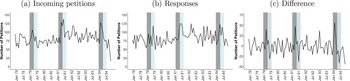
Figure 3 reports the monthly volume of petitions to the People’s Chamber: the number of (a) incoming petitions, (b) responses, and (c) the difference between both (the corresponding Figure for Council of Ministers petitions is reported in the Appendix). The data provide some evidence that the volume of both incoming petitions and government responses was higher around elections. Citizens may write more petitions either because election proximity raises the salience of the government or because they strategically time their petitioning. Increased incoming petition volume may allow the government to select petitions it could answer quickly before elections. If true, these concerns may make petitions submitted before elections less comparable to those submitted in other periods. However, as discussed in more detail below, I find few qualitative differences in incoming petitions or government responses over time.
People’s Chamber Petition Volume over Time
Note: Monthly number of (a) incoming People’s Chamber petitions, (b) responses to petitions, and (c) the difference between both. Gray and light blue mark the 90 days before and after elections.

Empirical Strategy
The empirical analysis considers two outcomes. The first one is the natural logarithm of 1 plus the number of days between the date a petition was received and answered (“response time”).Footnote 16 This variable was top-coded at the 99th percentile. It is the standard measure of responsiveness to citizen requests used in existing research (Christensen and Ejdemyr Reference Christensen and Ejdemyr2020; Dipoppa and Grossman Reference Dipoppa and Grossman2020). However, as discussed above, it does not allow me to distinguish between performative and substantive responsiveness. To measure the latter, I use a dichotomous indicator of whether a petition was successful (“positive resolution”; People’s Chamber sample only). I expect response time to be shorter before elections, whereas the probability of success should be higher.
I test this expectation in two ways. As the People’s Chamber petitions are available for election and nonelection years, they allow for a difference-in-differences design that exploits temporal variation before vs. after elections and between election vs. nonelection years. To do so, each election was matched with the same period in the two adjacent, nonelection years (“pseudo-election”), with pseudo-election dates in nonelection years corresponding to the actual election date in election years. I estimate the following equation using ordinary least squares (OLS) regression:
 $$ {\mathrm{y}}_{icdy}\hskip1.5pt =\hskip1.5pt {\alpha}_1{\mathrm{pre}}_{dy}+{\alpha}_2{\mathrm{pre}}_{dy}\times {\mathrm{election}\ \mathrm{year}}_y+{\phi}_d+{\delta}_y+{\mu}_c+{\varepsilon}_{icdy}. $$
Here, yicdy
denotes response time or success of petition i submitted from county or zip code area c and answered on day d in year y. Values for predy
indicate whether day d in year y is before or after a (pseudo-)election, and election yeary
indicates election years. All models include fixed effects for day d (
 $ {\phi}_d $
), year y (δy
), and county or zip code c (μc
). Standard errors are clustered by county or zip code, respectively. In one model, I additionally cluster standard errors by month-year (i.e., unique combination of month and year). Of interest is the coefficient on the interaction term (α2). It reflects how the difference in the outcome between the pre-and postelection periods changes between election and nonelection years.
Council of Ministers petitions are unavailable for the corresponding pseudo-election periods. I thus estimate a simpler model:
 $$ {\displaystyle \begin{array}{l}{\mathrm{y}}_{icd}\hskip1.5pt =\hskip1.5pt {\beta}_1{\mathrm{pre}}_d+{\mu}_c+{\varepsilon}_{icd}.\end{array}} $$
In Equation 2, yicd is the response time for petition i submitted from county or zip code area c and answered on day d and pred indicates whether day d is before or after the election. The coefficient of interest is β 1, which represents the difference in average response times between the pre- and postelection periods. All models include fixed effects for county or zip code (μc ). Standard errors are clustered accordingly.
Response time may be a function of the number of petitions awaiting response (“pending petitions”). Increasing backlog may constrain the government’s ability to respond to petitions in a timely manner, while low petition volume may make responses easier. All models therefore control for the number of pending petitions each day.Footnote 17
Data availability restricts the analysis to four elections. The People’s Chamber petitions are analyzed around the local elections on May 20, 1979, and May 6, 1984, and the legislative elections on June 14, 1981. The Council of Ministers data are available for the local elections on May 7, 1989. I consider the 90 days before and after each (pseudo-)election.Footnote 18
My empirical strategy relies on three identifying assumptions (see the Appendix for evidence). First, I assume that the timing of elections is unrelated to responsiveness. This assumption is plausible because the elections considered here were held at the end of their regular five-year terms. Second, difference-in-differences designs assume no spillovers. There are no differences in response time between election and nonelection years during the postelection period: the fact that responsiveness changed before elections did not affect responsiveness thereafter. There are also no differences in responsiveness between the pseudo-pre- and pseudo-postelection periods in nonelection years. Third, I assume parallel trends: election and nonelection years should move in parallel outside of elections. I substantiate this assumption by showing that there were no differences in response times when considering petitions answered outside the 180-day window around elections.Footnote 19
Results
Shorter Response Times before Elections
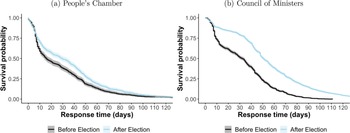
Figure 4 visualizes average response times before (gray) and after (light blue) elections using survival analysis. Each point reports the share of petitions with a response time of at least as many days as indicated on the horizontal axis. The curve for the preelection period is consistently below that for the postelection period; as hypothesized, petitions were answered more quickly before elections.
Response Times before and after Elections: Kaplan–Meier Estimates
Note: Distribution of response times (in days) for People’s Chamber (left) and Council of Ministers petitions (right) for the three months before (gray) and after (light blue) elections. Estimated using survival analysis. Each point reports the share of petitions with a response time of at least as many days as indicated on the horizontal axis.

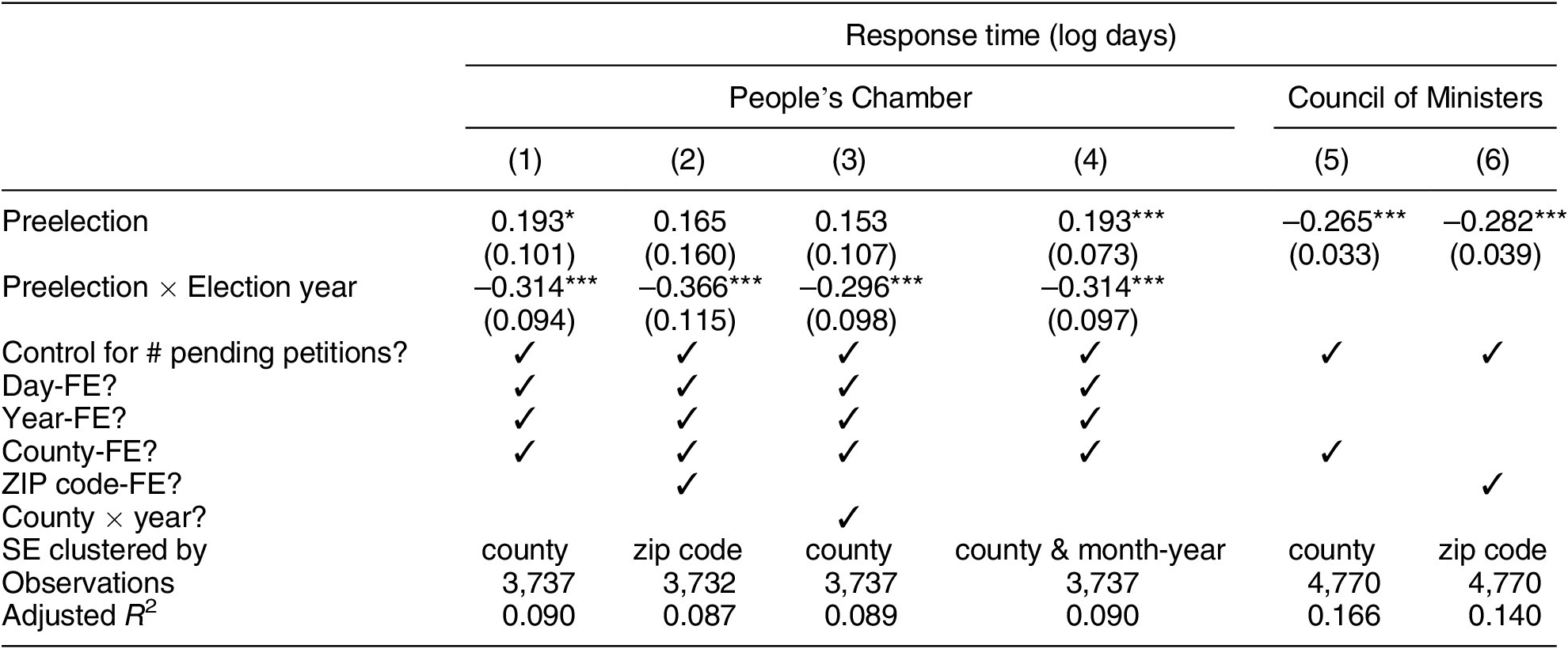
Table 3 probes this conclusion. Models 1 through 4 analyze the People’s Chamber petitions using Equation 1. Models 5 and 6 analyze the Council of Ministers petitions using Equation 2. All models control for the number of pending petitions. Models 1 through 4 include day- and year-fixed effects. I add county-fixed effects to Models 1, 3, 4, and 5 and zip code-fixed effects to Models 2 and 6. Standard errors are clustered accordingly. The exception is Model 4, which clusters standard errors by county and month-year.
Petitions Were Answered Faster before Elections

Note: Difference in response time to People’s Chamber (Models 1 to 4) and Council of Ministers (Models 5 to 6) petitions between the pre- and postelection periods. Robust standard errors in parentheses. *p < 0.1, ** p < 0.05, *** p < 0.01.
The estimated difference in response times is negative, statistically significant at p < 0.01, and substantively similar across all models, both samples, and both estimation strategies. It implies that response time was between 23.3% (Model 5)Footnote 20 and 30.6% (Model 2)Footnote 21 shorter before elections. Outside the 180 days around elections, the mean (median) response time to a People’s Chamber or Council of Ministers petition was 37.39 (23) and 38.51 (32) days, respectively. It follows that responsiveness improved by between 8.7 (37.39 × 0.233) and 11.8 days (38.51 × 0.306) relative to the mean, or between 5.4 (23 × 0.233) and 9.8 days (32 × 0.306) relative to the median.Footnote 22
These effects exceed those documented in democracies. Christensen and Ejdemyr (Reference Christensen and Ejdemyr2020, 469), for instance, find that response times to 311 calls in San Francisco and New York decrease by about four days as elections approach. Responsiveness to “FixMyStreet” requests in the United Kingdom, in turn, improves by about 11%, or six days, before elections (Dipoppa and Grossman Reference Dipoppa and Grossman2020, 15–6).
Evidence on Substantive Responsiveness
Past scholarship on responsiveness to citizen requests usually focuses exclusively on whether and when citizens receive a response. My data offer me a unique opportunity to move beyond the conventional focus on response times and additionally ask whether improved responsiveness to petitions before elections led to tangible improvements in petitioners’ livelihoods.
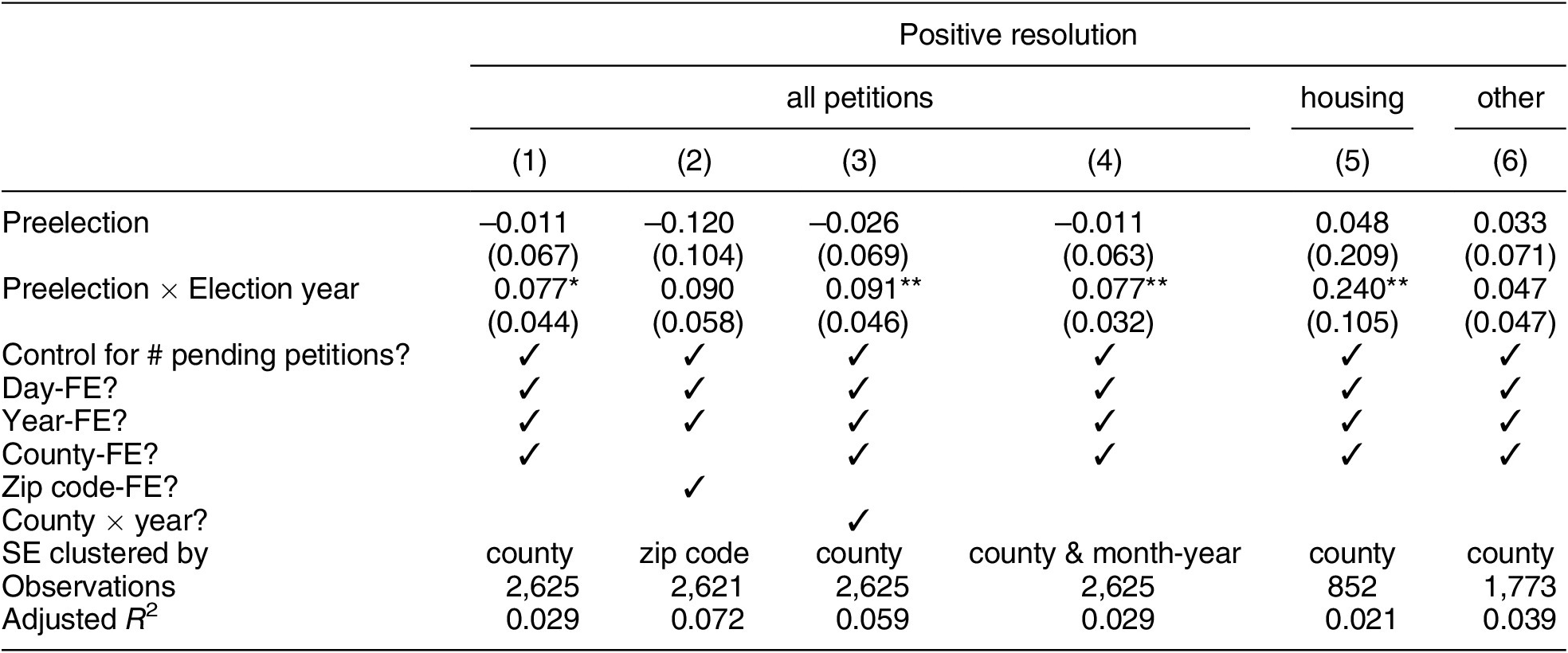
To do so, Table 4 explores whether the probability that a People’s Chamber petition was successful (i.e., positive resolution) varied around elections. Models 1 through 4 mirror those in Table 3. The coefficient of interest is positive across all four models (albeit insignificant in Model 2), implying that petitions were more likely to be successful before elections. I compute that the probability of success increased by between 7.7 (Models 1 and 4) and 9.1 percentage points (Model 3), or up to 63.6% relative to the mean (14.3%) of this variable (0.091 / 0.143).
Petitions Were More Likely to Be Successful before Elections

Note: Difference in the probability that a People’s Chamber petition was successful between the pre- and postelection periods. Robust standard errors in parentheses. *p < 0.1, ** p < 0.05, *** p < 0.01.
Increased success rates were a costly signal of regime competence. I show this by distinguishing between petitions about housing and petitions about other topics. Due to the scarcity of housing, resolving housing petitions was costly. Still, the effect of elections on positive resolutions is concentrated among these petitions (Model 5), whereas there is no difference in success rates for all other petitions (Model 6).
In sum, I find that improved responsiveness to citizen petitions before the GDR’s uncontested elections was more than lip service. The preelection period saw not only a decrease in average response times but also an increase in the probability that petitioners were successful. I thus conclude that preelectoral responsiveness was substantive.
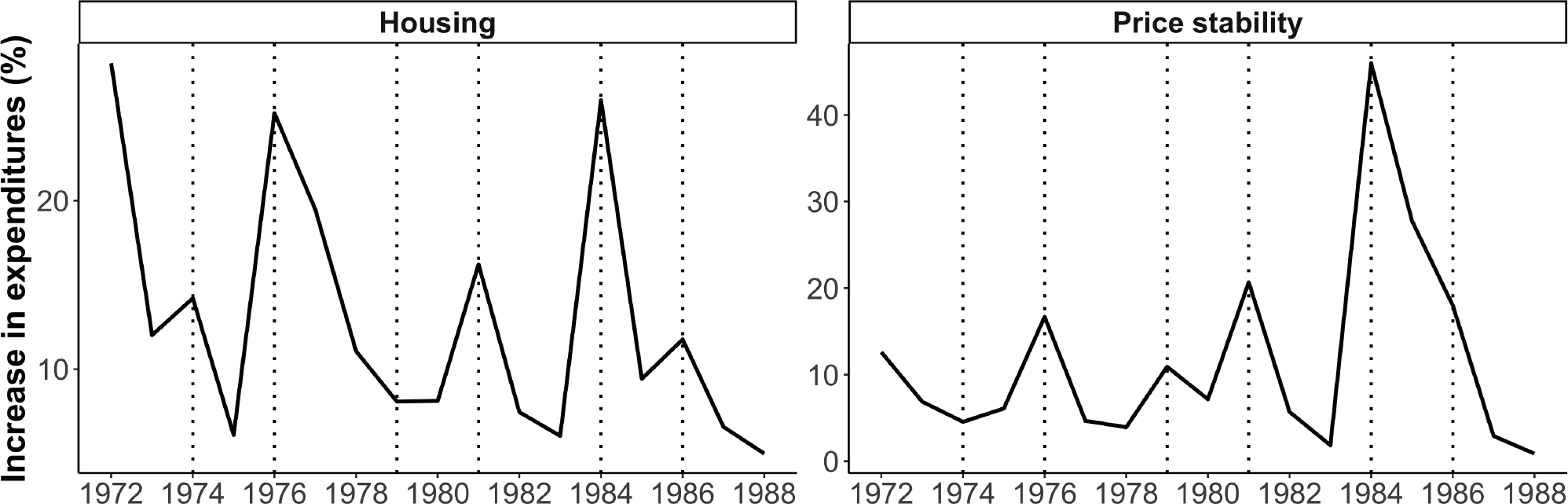
Figure 5 supports this conclusion further. It plots the annual increase in government expenditures on two primary social policy issues: housing and price stability (source: Staatliche Zentralverwaltung für Statistik 1989). Expenditures on these two categories increased particularly strongly in election years (indicated by vertical dotted lines), which implies that the GDR regime strategically spent more resources on citizen concerns before elections. As shown in the Appendix, I calculate that expenditures on housing increased by an additional 6.1 percentage points, whereas expenditures on price stability rose by an additional 12.1 points.
Government Expenditures on Housing and Price Stability Increased More Strongly in Election Years
Note: Annual increase in government expenditures on housing (left) and price stability (right). Vertical dotted lines indicate election years.

Responsiveness as a Signal of Competence
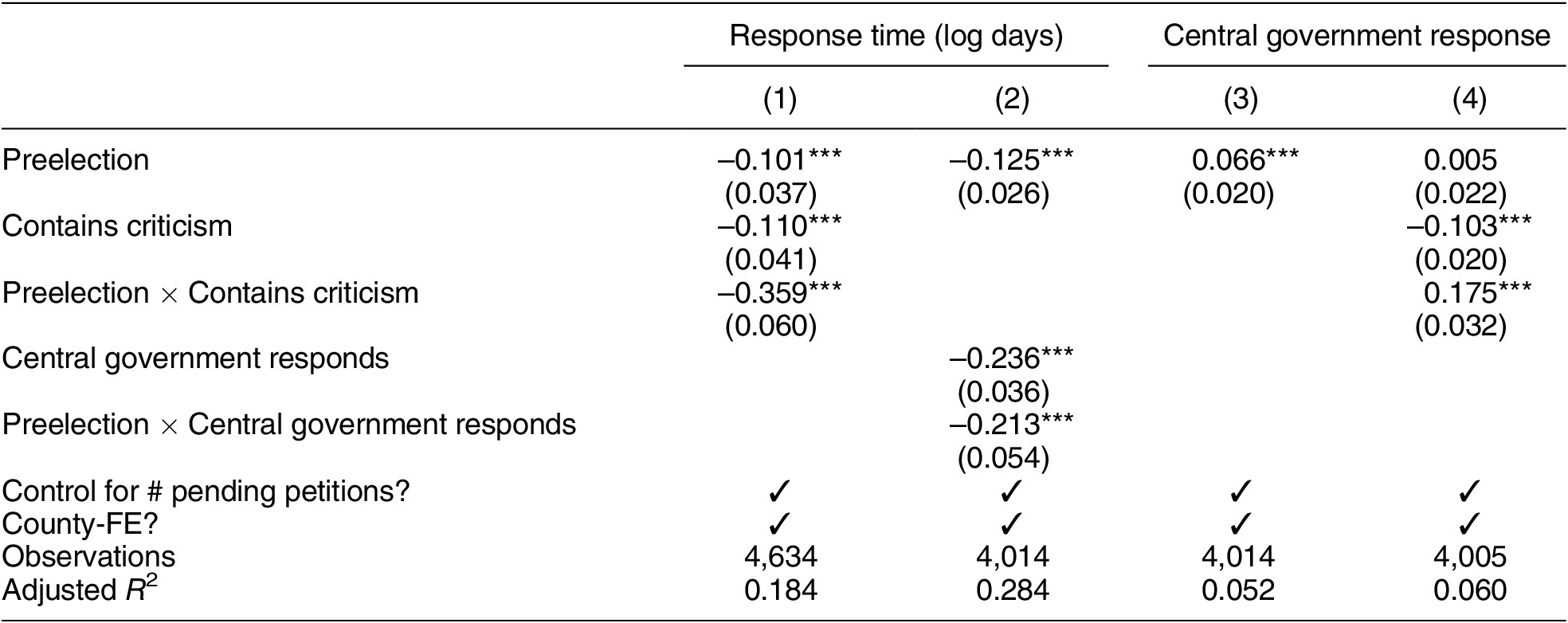
I propose that the goal of improved responsiveness was to signal competence to voters. To support this argument, I exploit the distinction between critical and other petitions in the Council of Ministers data. Critical petitions contained a direct criticism of a government decision or the functioning of the government more broadly. Writers of these petitions directly questioned the competence of the regime by claiming that the failure of the government to live up to its promises violated the socialist social contract. I thus expect that response times for critical petitions decreased particularly strongly before elections.
Model 1 in Table 5 supports this argument by adding an interaction between critical petitions and the preelection period to Equation 2. The point estimates imply that, while critical petitions received a faster response than other petitions throughout the period examined, this difference was more than three times as large before the election (p < 0.01). The average response time for critical petitions was about 37.4%Footnote 23 shorter than for noncritical petitions before elections, compared with 10.4% Footnote 24 in the three months thereafter.
Critical Petitions and Petitions Answered by the Central Government Saw Particularly Strong Decreases in Response Times before Elections

Note: Difference in responsiveness among critical petitions (Model 1) or petitions answered by the central government (Model 2). Models 3 and 4 explore the correlates of central government responses. Robust standard errors, clustered by county, in parentheses. *p < 0.1, ** p < 0.05, *** p < 0.01.
The Role of Central Government
In theory, both local officials—to advance their careers—or the central government—to deter challengers and gather information—had incentives to improve responsiveness before elections. However, I find that improved responsiveness was driven primarily by the central government. Model 2 in Table 5 adds an interaction between the preelection period and central government response to Equation 2. The resulting coefficient is negative and significant at p < 0.01: petitions answered by the central government usually had a 21.0% shorter response timeFootnote 25 than those answered by other entities during the postelection period. This difference rose to 36.2% before elections Footnote 26 .
Models 3 and 4 show that these faster response times are not driven by increased selectivity of which petitions were answered by the central government. They use linear probability models to show that petitions were actually more likely to be answered by the central government, whose propensity to respond rose by 6.6 percentage points (or 25% relative to the mean) before elections (Model 3; p < 0.01). Including an interaction between the preelection period and critical petitions shows that the central government paid particular attention to critical petitions (Model 4): while critical petitions were about 10.3 percentage points less likely to receive a central government response after the election, they were 7.2 points (–0.103 + 0.175) more likely to receive a central government response before the election (p < 0.01).
Taken together, my results provide strong evidence that even uncontested elections incentivize government officials to respond to citizen requests. The motivation is to assure voters of the government’s competence. This effect is primarily driven by the central government.
Alternative Explanations
This section rules out multiple alternative explanations for my findings. First, it is possible that my results are driven by differences in the volume or content of petitions. As shown in Figure 3a above, citizens submitted slightly more petitions before elections. Higher incoming petition volume may have made it easier for bureaucrats to strategically respond to the petitions they could answer quickly, thus artificially inflating the difference in response times between the pre- and postelection periods.
Yet, the data do not support this concern. More incoming petitions were usually met with concomitant increases in the volume of government responses. By law, government officials had only four weeks to submit an initial response, which significantly curtailed the regime’s ability to strategically select “easy” petitions. Second, the spikes in petition volume seem to be driven by seasonality effects instead of the electoral cycle. I support this conclusion in the Appendix, where I test for differences in the number of incoming petitions and responses between the pre- and postelection periods. Using the empirical strategy defined in Equation 1, which explicitly accounts for seasonality effects by including day-fixed effects, I find no differences in petition volume before and after elections.
I also find little evidence that citizens strategically submitted different kinds of petitions in anticipation of better government responsiveness, nor was the regime more selective in choosing which petitions to answer before elections. As shown in the Appendix, there were few differences in the topics of incoming petitions or responses between the pre- and postelection periods. The one exception is incoming Council of Ministers petitions, which were more often about domestic affairs before elections. However, this increase was accompanied by a concomitant increase in responses about domestic affairs. Moreover, I show in the Appendix that controlling for petition topic, character, and reference leaves the coefficients of interest unaltered.
Last, it is possible that the regime’s increased efforts during the preelection period reduced its resources to respond to petitions afterwards. If true, my results may be driven by a postelection slowdown in responsiveness instead of a preelection improvement. In the Appendix, I conduct the analysis of responsiveness to People’s Chamber petitions separately for the pre- and postelection periods. I find improved responsiveness in election years in the preelection sample, but no differences in the postelection data.
A second alternative explanation emphasizes bureaucratic or legislative turnover after elections. Outgoing officials may have wanted to finalize pending petitions before leaving their position. Alternatively, new officials who started after the election may require some time to familiarize themselves with the job, which would slow down initial response times. The data are again inconsistent with this argument. Responsiveness to Council of Ministers petitions improved before the 1989 local elections, even though this election did not alter the Council’s composition. I further show in the Appendix that response times to People’s Chamber petitions decreased before both local and national legislative elections, even though only the latter affected the composition of the People’s Chamber.
It is further possible that petitions were assigned a later receipt date before elections, potentially in an effort to artificially deflate response times. I provide evidence against this idea in the Appendix: there were few differences in the number of days between the dates a petition was written and received.
Discussion
Many closed autocracies hold uncontested elections in which a citizen’s only choice is whether or not to support the regime’s handpicked candidates. According to conventional models of accountability, the absence of contestation in these elections should preclude any meaningful government responsiveness to citizen preferences. With the election outcome a foregone conclusion, officials are theorized to lack the incentive to cater to their constituents’ demands.
Yet, the petition system of the former German Democratic Republic is at odds with this model of autocratic unresponsiveness. My paper instead describes a regime that spent significant resources on both responding to and addressing citizen demands. That responsiveness varied systematically around elections is evidence of an “electoral connection” (Mayhew Reference Mayhew, Cubbins, Calvert and Sullivan1987) in one of the least democratic regimes.
The analysis of the GDR’s petition system informs our understanding of contemporary authoritarianism more broadly. The electoral cycles of responsiveness documented in this paper likely exist in a variety of autocracies. Petition systems are employed widely across autocracies that vary with respect to their ideology, state capacity, and level of electoral contestation. Just like the former GDR, autocracies ranging from the Soviet Union (Dimitrov Reference Dimitrov2014a), Bulgaria (Dimitrov Reference Dimitrov2014b), and Iraq (Walter Reference Walter and Russell2018) in the past to China (Chen, Pan, and Xu Reference Chen, Pan and Xu2016; Distelhorst and Hou Reference Distelhorst and Hou2017; Jee Reference Jee2021, Luehrmann Reference Luehrmann2003), Saudi Arabia, and Vietnam (Pan Reference Pan2020, 166) today use petition systems. Petition volume is high in these countries. East Germans wrote up to one million (Mühlberg Reference Mühlberg2004) petitions to all levels and branches of government every year, which equaled about 81 petitions per 1,000 voters. Similarly, up to 700,000 petitions were written in communist Bulgaria every year (Dimitrov Reference Dimitrov2014b), corresponding to 10.6% of the electorate, and the central committee of the Communist Party of the Soviet Union alone received about half a million petitions annually (Dimitrov Reference Dimitrov2014a). Thus, the paper draws attention to an important electoral mobilization strategy in autocracies that has received little scholarly attention to date.
Moreover, I expect autocracies with more contested elections than the GDR to have similar incentives to engage in electoral cycles of responsiveness. On the one hand, multicandidate elections in closed autocracies (e.g., Cuba and Vietnam), in which multiple regime-aligned candidates run against each other, bear the same risks of elite splits and antiregime mobilization surrounding “stolen elections” as completely uncontested elections. These elections also inform the regime about the quality and competence of local political candidates (Fonseca Galvis and Superti Reference Fonseca Galvis and Superti2019; Malesky and Schuler Reference Malesky and Schuler2013), which requires strong citizen support. On the other hand, competition can be fierce in multiparty autocratic elections such that the regime needs high support to deter challengers and secure electoral victory. These elections are thus likely to structure not just government spending (Blaydes Reference Blaydes2011; Magaloni Reference Magaloni2006; Pepinsky Reference Pepinsky2007; Shmuel Reference Shmuel2020) but also responsiveness to citizen demands.
My research emphasizes the importance of competence in generating political order in authoritarian regimes (Huntington Reference Huntington1968). One reason for the stability of the former GDR was the government’s ability to forge and uphold an implicit social contract with the population (Cook and Dimitrov Reference Cook and Dimitrov2017; Dale Reference Dale2005; Dickson et al. Reference Dickson, Landry, Shen and Yan2016). The petition system played a crucial role in this process. Petitions allowed the government to identify and address popular concerns and demonstrate its competence (Gorgulu, Sharafutdinova, and Steinbuks Reference Gorgulu, Sharafutdinova and Steinbuks2020). However, it also generated popular expectations about what the government ought to deliver. The extent to which the government was able to meet these expectations determined its stability. It remains an open question to what extent low-state-capacity regimes are similarly able to use petition systems as strategically as the former GDR. The existence of petition systems in such contexts casts some doubt on the idea that high state capacity is a precondition for the dynamics described in this paper (Walter Reference Walter and Russell2018).
The paper’s results have implications for our theorizing about authoritarianism more broadly. Most work on authoritarian responsiveness considers the incentives of local officials (Chen, Pan, and Xu Reference Chen, Pan and Xu2016; Distelhorst and Hou Reference Distelhorst and Hou2017; Jee Reference Jee2021). My finding that the central government may have stronger incentives and capacities to respond than local governments calls for more research on the role of the central government in service delivery and responsiveness. Moreover, I identify a mechanism by which citizens can hold their government accountable in contexts without electoral contestation. This result adds to an emerging research agenda on how citizens can influence political outcomes even in nondemocratic regimes (Williamson and Magaloni Reference Williamson and Magaloni2020). While past work on authoritarianism usually focuses on how dictators manage elites and opponents (Gandhi Reference Gandhi2008; Malesky and Schuler Reference Malesky and Schuler2011, Reference Malesky and Schuler2013; Truex Reference Truex2014), more research is needed on the interactions between autocratic governments and ordinary citizens to better understand how citizens can influence politics even in some of the most repressive regimes in the world.
Supplementary Materials
To view supplementary material for this article, please visit http://doi.org/10.1017/S0003055421001386.
Data Availability Statement
Data and replication files that support the findings of this study are openly available at the American Political Science Review Dataverse: https://doi.org/10.7910/DVN/YLCN5E.
Acknowledgments
I thank Aala Abdelgadir, Feyaad Allie, Binio Binev, Lisa Blaydes, Alberto Díaz-Cayeros, Martin Dimitrov, Valentín Figueroa, Vicky Fouka, Anna Grzymala-Busse, Jens Hainmueller, Roman Hlatky, Haemin Jee, Jiwon Kim, Elisabeth van Lieshout, Ellen Lust, Nic Lyon, Rachel Myrick, Jonathan Rodden, Rose Shaber-Twedt, Sarah Thompson, Henry Thomson, Matt Tyler, participants at MPSA 2021 and APSA 2021, three anonymous reviewers, and the editors for their valuable comments and suggestions. I am grateful for financial support from The Europe Center at Stanford, the Center for Philanthropy and Civil Society, Stanford’s Graduate Research Opportunity Fund, the Freeman Spogli Institute, and the Shultz Fellowship for Economic Policy.
Conflict of Interest
The author declares no ethical issues or conflicts of interest in this research.
Ethical Standards
The author affirms this research did not involve human subjects.








Comments
No Comments have been published for this article.