Introduction
The tribe Paropsieae (Passifloraceae) consists of 22 species in six genera, 21 of which are confined to Africa. One species of Paropsia Noronha ex Thouars occurs in SE Asia (i.e. P. vareciformis (Griff.) Mast.). The group consists of trees, treelets and shrubs lacking the tendrils and climbing habit that is characteristic of other Passifloraceae. Within Paropsieae, the genus Barteria Hook.f. has been revised by Breteler (Reference Breteler1999) and Paropsia by Sleumer (Reference Sleumer1970). The genera Androsiphonia Stapf and Viridivia J.H.Hemsl. & Verdc. are monotypic and morphologically amply characterised. Identification of species within Paropsiopsis Engl., as well as delimitation of the genus against Smeathmannia R.Br., has been problematic and provided the spur for the current treatment. This study clarifies limits between all genera of Paropsieae and provides a taxonomic revision of the genera Paropsiopsis and Smeathmannia. It is based on the study of herbarium specimens and alcohol collections from the herbaria BM, BR, C, COI, K, LBV, LISC, MO, P, WAG and Z.
Systematic Position
Previously, some authors placed the tribe Paropsieae in the former Flacourtiaceae (e.g. Pellegrin, Reference Pellegrin1952; Sleumer & Bamps, Reference Sleumer, Bamps and Bamps1976) while others accommodated it in Passifloraceae (Keay, Reference Keay, Hutchinson and Dalziel1954; Sleumer, Reference Sleumer1970; de Wilde, Reference Wilde1971). Molecular studies (e.g. Chase et al., Reference Chase, Zmarzty, Lledó, Wurdack, Swensen and Fay2002) suggest an evolutionary affinity with Passifloraceae, Turneraceae and Malesherbiaceae (Malpighiales), rather than an affinity with Salicaceae or Achariaceae (in which most of the former Flacourtiaceae is now placed; Chase et al., Reference Chase, Zmarzty, Lledó, Wurdack, Swensen and Fay2002). Bernard (Reference Bernard1999) found support for a strong affinity of the tribe with Passifloraceae, based on floral (micro-)morphology and development. Presting (Reference Presting1965) and Keating (Reference Keating1973) concluded the same based on pollen morphology. Therefore, the tribe is here considered part of Passifloraceae.
History
Paropsiopsis was described in 1892 with P. africana Engl. from Gabon as the type species (Engler, Reference Engler1892). It was regarded as similar to Paropsia, differing in having a double corona and more stamens. Baillon (Reference Baillon1882) had already described a species confusingly referred to as ‘S. decandra’ (see below), and erected the section Diploparopsia in Paropsia to accommodate it. Gilg (Reference Gilg1908) suggested that the material mentioned by Baillon (Reference Baillon1882) belonged to Paropsiopsis but did not make the combination. Gilg (Reference Gilg1908) also described five additional species based on only seven collections from Cameroon and Gabon. Based on material later collected in Cabinda, Angola, Exell (Reference Exell1929) described Paropsiopsis ferruginea. Sleumer (Reference Sleumer1970), in his treatment of Paropsia, combined Paropsiopsis africana Engl. with the aforementioned Smeathmannia decandra Baill. to Paropsiopsis decandra (Baill.) Sleumer. The validity of this combination is discussed under Paropsiopsis decandra. Sleumer & Bamps (Reference Sleumer, Bamps and Bamps1976) later treated Paropsieae for the Flora of Central Africa in which they treat one species of Paropsiopsis. They state that the whole genus contains four closely related species, rather than the seven described at that time, but omitted which species should be recognised.
Brown (Reference Brown1821) described Smeathmannia in a footnote of an article otherwise concerning the description of the genus Rafflesia R.Br. He mentioned affinities with the genus Paropsia, which differs in having a smaller number of stamens. The genus is named after the Dane Henry Smeathman, who collected the genus in 1771 or 1772 whilst working in Sierra Leone (Hepper & Neate, Reference Hepper and Neate1971). Brown had previously mentioned the genus (Brown, Reference Brown and Tuckey1818), with a different spelling, as Smeathmania (i.e. with one ‘n’). That publication, however, is invalid because it provides only a character shared with another genus and therefore does not meet the requirements for a valid diagnosis under the International Code of Botanical Nomenclature (McNeill et al., Reference McNeill, Barrie, Burdet, Demoulin, Hawksworth and Marhold2006, Art. 32.2). Brown (Reference Brown1821) based the genus on material from Sierra Leone that he and Solander studied in the herbarium of Joseph Banks. Three species were described: Smeathmannia pubescens Sol. ex R.Br., S. laevigata Sol. ex R.Br. and S. media R.Br., the last intended as a ‘varietas’ of S. laevigata (Brown, Reference Brown1821). Endlicher (Reference Endlicher1839) merged the monotypic genus Buelowia Schumach. & Thonn. with Smeathmannia and Lemaire (Reference Lemaire1851) described two additional species (S. emarginata and S. rosea). Masters (Reference Masters and Oliver1871) noted in the Flora of Tropical Africa that leaves are variable in form and therefore merged Smeathmannia media with S. pubescens. However, he ignored the species described by Lemaire (Reference Lemaire1851). Baillon (Reference Baillon1882) proposed that Smeathmannia should be a section of Paropsia. This was accepted until Gilg (Reference Gilg1908) argued that Smeathmannia deserved recognition at the genus level but suggested that it contained only two species. Chevalier (Reference Chevalier1920) described two varieties, Smeathmannia pubescens var. cordifolia and S. laevigata var. nigerica, of which the first has not been recognised since the first edition of the Flora of West Tropical Africa (Hutchinson & Dalziel, Reference Hutchinson and Dalziel1927).
Taxonomic Treatment
Generic delimitation within Paropsieae
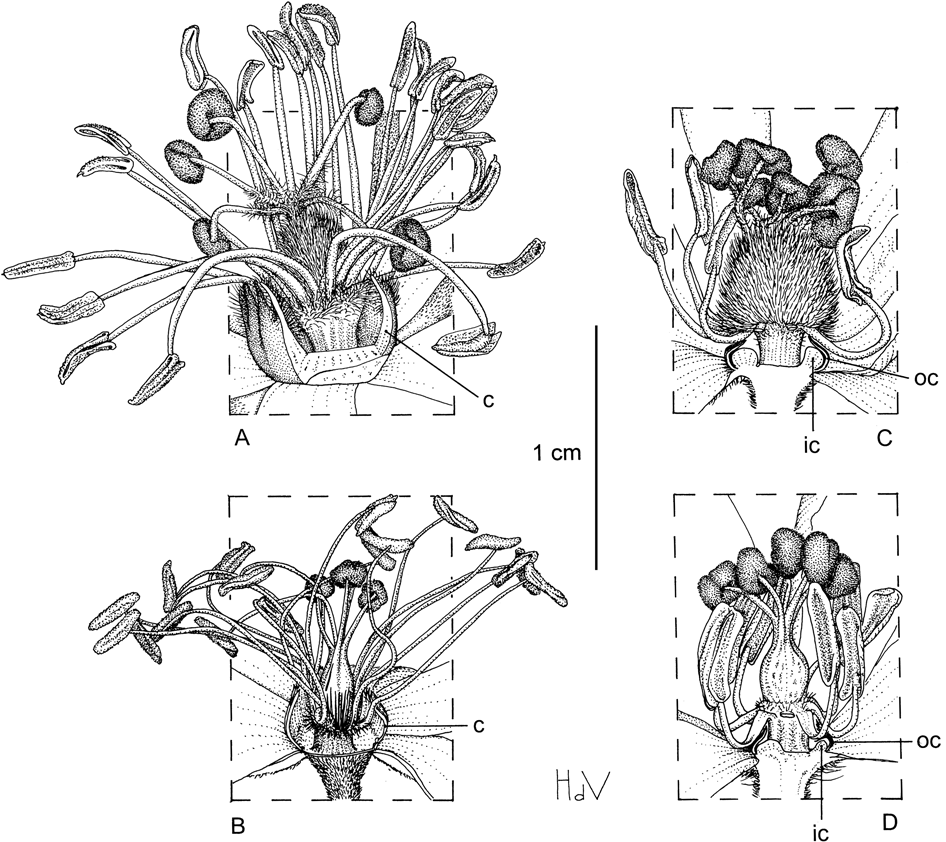
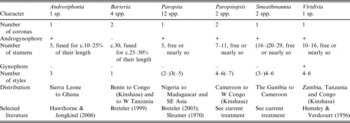
The most important morphological characters to distinguish all genera of Paropsieae are listed in Table 1. A key to the genera based on these and other characters is provided below. Although most of the characters are in the flowers, most fruiting specimens can also be determined with this key as stamens and styles are usually persistent in fruit. The delimiting characters of Paropsiopsis and Smeathmannia are illustrated (Fig. 1).
A comparison of dissected flowers of Smeathmannia R.Br. and Paropsiopsis Engl., indicating the single corona of Smeathmannia (A, B; c: corona) and the double corona of Paropsiopsis (C, D; ic: inner corona; oc: outer corona): A, Smeathmannia pubescens Sol. ex R.Br. (spirit collection W.J.J.O. de Wilde s.n. (16 vii 1963), WAG); B, Smeathmannia laevigata Sol. ex R.Br. (J.W.A. Jansen 1596, WAG); C, Paropsiopsis decandra (Baill.) Sleumer (Zenker 413, WAG); D, Paropsiopsis atrichogyna J.M.de Vos & Breteler (holotype T. van Andel et al. 4220, WAG). Note that the filaments of Paropsiopsis (C, D) are at base ± perpendicular to the androgynophore and curve gradually upward, whereas the filaments of Smeathmannia (A, B) are straighter. Drawing by Hans de Vries.

Important morphological characters (in rows) to differentiate between the genera of Paropsieae (in columns). Number of species in each genus is indicated. +: structure present; –: structure absent. Compiled from selected literature and confirmed by observations on herbarium material

Key to the genera of Paropsieae
1a. Androgynophore present; styles (2–)3 or more; second corona present or not 2
1b. Androgynophore absent; style 1; second corona present (Benin to Congo (Kinshasa) and to W Tanzania) Barteria
2a. Stamens 5 3
2b. Stamens 7 or more 4
3a. Stamens free or nearly so (Nigeria to Madagascar and SE Asia) Paropsia
3b. Stamens united in a tube around the lower third of the ovary (W Africa) Androsiphonia
4a. Gynophore absent or very poorly developed; petiole without two glands near leaf base (but glands present on leaf margin and on branches near petiole) (Upper and Lower Guinea) 5
4b. Gynophore present; petiole with two glands near leaf base (as well as on leaf margin and on branches near petiole) (Zambia, Tanzania and Congo (Kinshasa)) Viridivia
5a. Annuliform second corona present inside outer corona; stamens 7–12; filaments at base ± perpendicular to androgynophore, gradually curving upward (Cameroon to W Congo (Kinshasa)) Paropsiopsis
5b. Annuliform second corona absent; stamens (16–)20 or more; filaments not gradually curving upward (The Gambia to Cameroon) Smeathmannia
Species delimitation within Paropsiopsis and Smeathmannia
In the current treatment all previously described species of Paropsiopsis are lumped into the type species P. decandra (Baill.) Sleumer. The five species described by Gilg (Reference Gilg1908) were, in his opinion, distinguishable in leaf shape, flower size or size of the androgynophore. Exell (Reference Exell1929) added a species differing by its ferruginous hairs. However, these characters do not define discrete entities that deserve recognition as taxa because intermediate states are present in other collections. Moreover, we observed that the variation between duplicates of a single collection can be larger than the differences between two previously recognised species. Nevertheless, recent collections revealed a new species which appears to be endemic in the Campo Ma'an area of S Cameroon. It is named Paropsiopsis atrichogyna, after its glabrous pistil. The current treatment confirms specific differences in Smeathmannia, but infraspecific taxa are abandoned. These were based on variations in leaf shape, which is variable in Smeathmannia. Since the circumscription of these two species is unaltered, descriptions are provided in brief and focus on differentiating characters. Differences between these two and the two species of Paropsiopsis are illustrated (Fig. 1).
Notes on descriptions
In previous descriptions of species of Paropsieae the perianth was usually divided into calyx (sepals) and corolla (petals). In Paropsiopsis, however, the change from sepals to petals is gradual and some intermediate segments can, therefore, not be referred to as either sepal or petal. For instance, only segments exposed in bud have long hairs on the outside and differ slightly in colour from unexposed segments which are devoid of long hairs. Segments that are partly exposed in bud are partly hairy. Therefore, the current treatment uses the less specific term tepal. In Smeathmannia the difference between outer and inner tepals is more evident – there are two ± distinct whorls. For the sake of consistency, however, the term tepal is used throughout all descriptions. Whenever relevant, a distinction is made between outermost and innermost tepals.
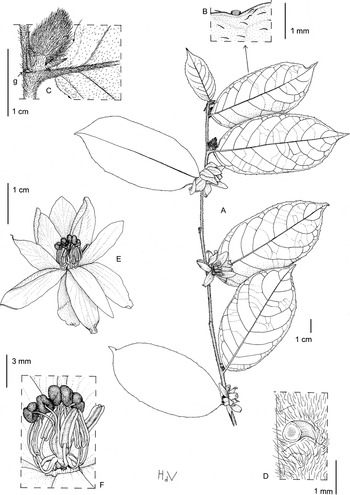
Several authors considered Paropsiopsis to be stipulate (Gilg, Reference Gilg1908; Exell, Reference Exell1929; Sleumer & Bamps, Reference Sleumer, Bamps and Bamps1976). Gilg (Reference Gilg1908) states in the protologue of Paropsiopsis leucantha that 2 stipules are present. Exell (Reference Exell1929), while describing Paropsiopsis ferruginea, gives a description of stipules. Sleumer & Bamps (Reference Sleumer, Bamps and Bamps1976) mention that stipules are early caducous. However, careful observations did not reveal stipules, nor scars, even on young branches. We conclude that true stipules are absent, but 1–3 glands in the stipule position are almost always present. The structures referred to by Gilg (Reference Gilg1908) and Exell (Reference Exell1929) are most likely the (usually 4) persistent sessile floral bracts. Glands and floral bracts are illustrated (Fig. 2C–D).
Paropsiopsis atrichogyna J.M.de Vos & Breteler: A, flowering branch; B, gland on leaf margin; C, leaf axil with flower bud (g: gland near petiole base; also note the floral bracts supporting the bud); D, gland near petiole base, magnified from C; E, open flower; F, androgynoecium (A–F holotype T. van Andel et al. 4220, WAG). Drawing by Hans de Vries.

Paropsiopsis Engl., Bot. Jahrb. Syst. 14: 391 (1892); Warb. in Engl. & Prantl, Nat. Pflanzenfam. 3(6a): 27 (1895); Gilg in Engl. & Prantl, Nat. Pflanzenfam. ed. 2, 21: 415 (1925); Pellegr., Bull. Soc. Bot. Fr., Mémoires 33: 115 (1952); Sleumer & Bamps, Fl. Afr. Centr., Flacourtiaceae 2: 32 (1976); Feuillet & J.M.MacDougal, Passifloraceae in Kubitzki, Fam. Gen. Vasc. Pl. 9: 279 (2007). – Paropsia sect. Diploparopsia Baill., Bull. Mens. Soc. Linn. Paris 1: 304 (1882); Warb. in Engl. & Prantl, Nat. Pflanzenfam. 3(6a): 27 (1895). – Type species: Paropsiopsis africana Engl. (= Paropsiopsis decandra (Baill.) Sleumer).
Small trees with spreading plagiotropic branches mostly from the top, rarely trees > 5 m, shrubs (or lianas?Footnote 1); indumentum of simple hairs, rarely branched hairs present. Leaves alternate, shortly petiolate; lamina with glands along margin and at the apex; venation pinnate, camptodromous, prominent below, midrib slightly raised above. Flowers hermaphrodite, in leaf axils of plagiotropic branches, 1–2(–3) per axil, pedicellate or subsessile; floral bracts usually 4, persistent, apex acute with gland; tepals 8–12, imbricate, outermost tepals with small glands on the margin and apex, tepals persistent in fruit; extrastaminal corona double, outer one thin, 1–3 mm high, inner one annular, c.1 mm high and adnate to outer corona; androgynophore present; stamens 7–11, in one whorl, filaments broadening towards base and there adnate to one another and ± perpendicular to the androgynophore, gradually curving upward; anthers basifixed, oblong, c.3 mm long; ovary unilocular with (3–)4–6(–7) parietal placentae; styles (3–)4–6(–7), fused at base or free, stigmas subcapitate. Fruits subglobose to ovoid to obovoid, opening by slits in between the placentae, many-seeded. Seeds ovoid to ellipsoid, areolate.
Key to the species
1a. Ovary glabrous; base of the ovary smaller than the top of the androgynophore, filaments therefore not adnate to ovary; longest hairs on the midrib beneath generally subappressed, never densely pubescent (S Cameroon) 1. P. atrichogyna
1b. Ovary tomentose to villose; base of the ovary as large as the top of the androgynophore, filaments therefore adnate to ovary or nearly so; longest hairs on the lamina midrib beneath generally erect, rarely only recurved hairs of ≤ 0.5 mm present, if all hairs subappressed on young leaves, then these densely pubescent (Cameroon to W Congo (Kinshasa)) 2. P. decandra
1. Paropsiopsis atrichogyna J.M.de Vos & Breteler, sp. nov.Figs 1D,2,3.
Paropsiopsis atrichogyna a Paropsiopse decandra (Baill.) Sleumer gynoecio glabro, basi ovarii apice androgynophori minore, staminibus 7 ad 9, pilis longioribus in costa folii faciei inferioris maximam partem adpressis vel subadpressis differt. – Type: Cameroon, South Province, Campo Ma'an area, Boussebeliga creek, 2°43′N, 9°52′E, in disturbed primary forest with Sacoglottis gabonensis, 40 m, 26 x 2001, T. van Andel et al. 4220 (holo WAG!; iso SCA, U, YA?).
Treelet 4 m high with bole of 1 cm wide and umbrella-shaped crown. Branches with 0–2 glands near petiole base, glands stalked or not; branches, petiole, pedicel and exposed parts of perianth sparsely hispid with 1.5–2 mm long straight hairs, subappressed or not, intermixed with c.0.2 mm long appressed or recurved hairs. Petiole decurrent onto the branches, semi-terete to terete, 2–6 mm long. Leaf blade elliptic to narrowly elliptic or slightly obovate, 2–3 times as long as wide, 7.6–14 × 3.2–5.4 cm, rounded at base, acuminate to rarely acute at apex, acumen acute, 3–13(–17) mm long; leaf margin nearly entire to very shallowly dentate to serrate; midrib above with hairs appressed or subappressed towards leaf apex, beneath with 1–2 mm long hairs which are mostly appressed or subappressed and with c.0.2 mm long, scattered, recurved hairs, extending onto the 6–10(–11) pairs of lateral nerves. Flowers solitary. Floral bracts triangular to broadly ovate, 3–4 mm long, outside hairy with appressed straight hairs, nearly glabrous inside. Pedicel terete, 1–4 mm long. Tepals 8–11, minutely tomentose with hairs ≤ 0.3 mm, ovate (outermost tepals) to elliptic to oblong (innermost tepals), 12–20 × 4–8 mm, whitish green to creamy white (outermost tepals) or yellow to creamy white (innermost tepals). Outer corona glabrous, 1–1.8 mm high, upper third irregularly fringed. Inner corona glabrous, c.0.7 mm high. Androgynophore terete, slightly enlarged towards base and apex, c.1 mm in diameter, c.2 mm long. Stamens 7–9, glabrous; filaments c.3 mm long. Pistil 4.5–7 mm long, glabrous. Ovary subglobose, 1.8–2.2 mm in diameter; base of ovary smaller than top of the androgynophore, sparsely tomentose around base of the ovary. Styles 4–5, 3–4.5 mm long, shortly united at base; stigmas 1.8–2.5 mm in diameter. Fruits unknown.
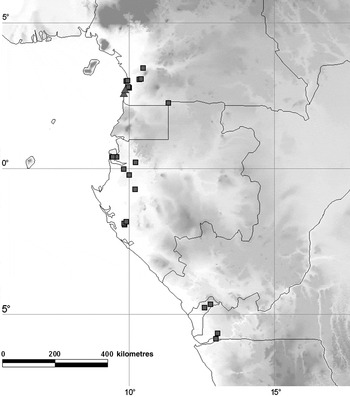
Distribution and ecology. In the Campo Ma'an area in S Cameroon, in disturbed primary, evergreen forest, not far from the Atlantic coast (Fig. 3).
Distribution map of Paropsiopsis decandra (Baill.) Sleumer (squares) and Paropsiopsis atrichogyna J.M.de Vos & Breteler (triangles).

Uses. The label of the holotype mentions ‘crushed leaves mixed with black palm oil are rubbed on the body against fever with trembling; some is drunk as well’.
Etymology. The species is named after its glabrous pistil, the character by which it is distinct from Paropsiopsis decandra.
Additional specimen examined. Cameroon. South Province, c.2 km N of the village of Ebodjé, in understorey of mature, but selectively logged, evergreen forest, 2°34′N, 9°50′E, 5 iv 2002, D.B. McKey 2002/1 (WAG!).
At present, fruits are unknown for Paropsiopsis atrichogyna. These are, however, expected to be glabrous given that in the three other species in this study the indumentum of the ovary is persistent in fruit and Paropsiopsis atrichogyna has a glabrous ovary. Therefore, it is expected that the glabrous fruits of Paropsiopsis atrichogyna can be distinguished from the pubescent fruits of P. decandra.
2. Paropsiopsis decandra (Baill.) Sleumer, Bull. Jard. Bot. Natl. Belg. 40: 74 (1970). – Smeathmannia decandra Baill., Bull. Mens. Soc. Linn. Paris 1: 304 (1882). – Paropsia decandra Gilg in Engl. & Prantl, Nat. Pflanzenfam. ed. 2, 21: 415 (1925), nom. illeg. – Type: Gabon, Duparquet s.n. (holo P!). Figs 1C,3.
Paropsiopsis africana Engl., Bot. Jahrb. Syst. 14: 392 (1892). – Type: Gabon, Munda, ‘im Wald am Maweli, bei der Sibange-Farm’, 6 i 1882, H. Soyaux 366 (holo B†; lecto Z!, designated here, see notes; isolecto K (scan seen), Z!).
Paropsiopsis leucantha Gilg, Bot. Jahrb. Syst. 40: 475 (1908). – Paropsiopsis africana var. leucantha (Gilg) Pellegr., Bull. Soc. Bot. Fr., Mémoires 33: 115 (1952). – Type: Cameroon, South Province, ‘in den Urwaldbergen zwischen Kribi und Bipinde’, vi 1902, Zenker 2434 (holo B†; lecto BR!, designated here, see notes; isolecto BM!, K (scan seen), L (scan seen), Z (scan seen)), syn. nov.
Paropsiopsis jollyana Gilg, Bot. Jahrb. Syst. 40: 475 (1908). – Type: Gabon, Estuaire, Libreville, v? 1891, Jolly 15 (holo P!), syn. nov.
Paropsiopsis zenkeri Gilg, Bot. Jahrb. Syst. 40: 476 (1908). – Type: Cameroon, South Province, ‘im Bijoka-Urwald bei den Fällen des Lokundje’, v 1898, Zenker 2043 (holo B†; lecto K (scan seen), designated here, see notes; isolecto BM!), syn. nov.
Paropsiopsis bipindensis Gilg, Bot. Jahrb. Syst. 40: 477 (1908). – Type: Cameroon, South Province, ‘bei Nkuambe im Urwald’, vi 1907, Zenker 3300 (holo B†; lecto BR!, designated here, see notes; isolecto BM!, K (scan seen), L (scan seen), MO!, P!), syn. nov.
Paropsiopsis pulchra Gilg, Bot. Jahrb. Syst. 40: 477 (1908). – Type: Cameroon, South Province, ‘bei Bipinde-hof’, iii 1904, Zenker 2908 (holo B†; lecto WAG!, designated here, see notes; isolecto BM!, BR!, K (scan seen), L (scan seen), P!), syn. nov.
Paropsiopsis ferruginea Exell, J. Bot. 67 suppl. 1: 191 (1929); Gossw. & Mendonça, Cart. Fitogeogr. Angol. 56 (1939); Sleumer & Bamps, Fl. Afr. Centr., Flacourtiaceae 2: 33 (1976). – Type: Angola, Cabinda, Hombe region, Rio Lufo, Caio, Mayumbe, sporadic in shady humid situations amongst new thickets on abandoned native plantation-grounds, i 1919, Gossweiler 7693 (holo BM!; iso COI!, K (scan seen), LISC!), syn. nov.
Treelet 3–6 m high, bole c.4(–10) cm dbh, rarely a shrub, tree to 15 m (or liana? – see footnote above). Branches with 1–3 usually stalked, 1–2.5 mm long glands on each side of petiole base; branches hispid to densely hispid with 1.5–2 mm long straight erect hairs, these rarely branched, or rarely with only c.0.5 mm long appressed or recurved hairs, usually a combination of both types, indumentum extending onto pedicel, petiole and midrib of lower leaf surface. Petiole decurrent onto the branches, semi-terete to terete, 1–7 mm long. Leaf blade ovate to elliptic or narrowly ovate to narrowly elliptic, 2–3.5(–4) times as long as wide, 4–26 × 2.5–6.5(–8.5) cm, rounded or cuneate at base, acuminate to rarely acute at apex, acumen acute, (2–)5–30 mm long, upper surface nearly glabrous to puberulous, lower surface densely to sparsely hispid, denser on main and secondary nerves, hairs erect to rarely subappressed; leaf margin entire to dentate to serrate, usually shallowly so; midrib above glabrous to hispid, hairs erect to subappressed towards leaf apex; lateral nerves 7–12(–15) pairs, rarely sunken in upper surface. Flowers 1–2(–3) per axil. Floral bracts broadly to narrowly triangular, 3–9 mm long, outside hairy with appressed straight hairs or partly so, sparsely so to nearly glabrous inside. Pedicel terete, 3–11 mm long. Tepals 8–12, minutely tomentose with hairs ≤ 0.3 mm, ovate to narrowly ovate (outermost tepals) or elliptic to narrowly elliptic (innermost tepals), 15–29 × 5–12 mm, pale green to creamy white (outermost tepals) or pale ochre-coloured to pale orange-red to white (innermost tepals). Outer corona glabrous to sparsely ciliate, 2–3 mm high, upper half to upper quarter irregularly fringed. Inner corona glabrous, 0.5–1 mm high. Androgynophore terete, slightly enlarged towards base and apex, c.1 mm in diameter, c.2 mm long, at top sparsely tomentose or glabrous. Stamens 8–11, usually tomentose at base; filaments 3–4 mm long. Pistil (5–)6.5–9 mm long, (densely) tomentose to villose. Ovary subglobose to ellipsoid, 3–4 mm long, 2–3 mm in diameter. Styles (3–)4–6(–7), 2.5–5 mm long, united at base for up to 2 mm, pubescent or glabrous; stigmas 1.2–2.5 mm in diameter. Fruit subglobose to ovoid to obovoid, 1.8–2.5 cm long, 1.2–2.5 cm in diameter, densely to sparsely tomentose. Seed 4–5(–7) × 2–3(–4) × 1–2 mm, yellowish brown in sicco.
Distribution and ecology. From S Cameroon to W Congo (Kinshasa). It is likely that this species also occurs in Equatorial Guinea (Fig. 3). Found in primary or secondary lowland rainforest, also along roadside; rarely in fairly dry littoral forest, but well away from the shore; up to 300 m altitude.
Selected specimens examined. Angola.Cabinda: Hombe region, Mayumbe, Belize, 4°39′S, 12°48′E, 1 iii 1917, J. Gossweiler 7011 (BM).
Cameroon.Central Province: 40 km S of Badjob, 50 km SW of Eséka, near the Nyong river, 3°28′N, 10°30′E, 18 xii 1963, W.J.J.O. de Wilde & B.E.E. de Wilde-Duyfjes 1527 (BR, K, P, WAG). South Province: 8 km from Kribi, Edea road, sec. forest edge, shade, roadside, 3°00′N, 9°56′E, 24 xii 1968, J.J. Bos 3499 (WAG); 15 km N of Kribi, fairly dry littoral forest, slightly sec., well away from seashore, 3°01′N, 9°58′E, 4 ii 1969, J.J. Bos 3853 (WAG); E crest of Mt Elephant, SE of Kribi, 2°47′N, 10°00′E, 200–300 m, 4 xii 1969, J.J. Bos 5770 (BR, C, K, LISC, MO, P, WAG, YA, Z); Summit of Mt Elephant, SE of Kribi, 2°47′N, 10°01′E, 300 m, 14 i 1970, J.J. Bos 6135 (P, WAG); Summit of Mt Elephant, high forest, SE of Kribi, 2°48′N, 10°00′E, 300 m, 13 iii 1970, J.J. Bos 6556 (WAG); Bipinde, 3°05′N, 10°25′E, vi 1913, G.A. Zenker 412 (C, COI, MO, WAG); Bipinde, Als unterholz am wege nach Songlepem, 3°05′N, 10°25′E, 1904, G.A. Zenker 3128 (BM); Bipinde, 3°05′N, 10°25′E, 1908, G.A. Zenker 3614 (BM, MO); Mimfia, 3°04′N, 10°23′E, iii 1913, G.A. Zenker 262 (C, COI, WAG); Bipinde, 3°05′N, 10°25′E, ix 1913, G.A. Zenker 413 (C, COI, MO, WAG); Ngoasik (10 km SSE Ambam), dans les cacaoyères pres du village, 2°15′N, 11°22′E, 1 iii 1963, J. Raynal & A. Raynal 10134 (YA); Bipinde, 3°05′N, 10°25′E, 1913, G.A. Zenker 4790 (MO); Bipinde, 3°05′N, 10°25′E, 1913, G.A. Zenker 4721 (COI, MO).
Congo (Kinshasa).Bas-Congo: Around Luki, 5°38′S, 13°04′E, 22 x 1958, J. Hombert 485 (BR, MO, WAG); 5°50′S, 13°00′E, 1947, A. Flamigni 10079 (BR).
Gabon.Estuaire: Angoni, 70 miles E of Gaboon, 0°13′N, 10°14′E, 28 x 1897, G.L. Bates 560 (BM, P, Z); Env. de Libreville, 0°25′N, 9°27′E, 26 ix 1901, T.-J. Klaine 2409 (P, WAG); S of Estuaire du Gabon along Remboué River, British Gas oil exploration site, 0°00′N, 9°50′E, 10 m, 25 x 1991, G.D. McPherson 15458 (LBV, MO, WAG); South of Estuaire du Gabon along Remboué River, British Gas site, 0°12′S, 10°01′E, 10 m, 4 i 1991, G.D. McPherson 15069 (LBV, MO, WAG); Remboué I, sur ligne 01, 0°12′S, 10°01′E, 21 i 1991, A.M. Louis & A. Moungazi 3302 (BR, LBV, MO, WAG); Libreville, 0°25′N, 9°27′E, 1896, T.-J. Klaine 389 (BM, BR, P, WAG); environs de Libreville, 0°25′N, 9°27′E, 26 xi 1898, T.-J. Klaine 194a (P, WAG); 18 km Est de Libreville, 0°24′N, 9°35′E, x 1961, G. de Saint Aubin SRFG2074 (P). Moyen-Ogooué: Lambaréné sur l'Ogooué, 0°42′S, 10°13′E, 18 vii 1912, A.J.B. Chevalier 26119 (P). Ogooué-Maritime: Rabi-Kounga, about 4 km from Divangui, in forest, 1°55′S, 9°52′E, 24 xi 1991, J. Schoenmaker 203 (LBV, WAG); Rabi-Kounga, near Rabi 10, 1°54′S, 9°51′E, 25 xi 1991, J. Schoenmaker 210 (WAG); c.20 km NE of Rabi, 1°50′S, 9°55′E, 25 m, 24 xi 1989, J.J.F.E. de Wilde et al. 9697 (WAG).
All previously described species have been united here under Paropsiopsis decandra for reasons discussed above. The indumentum of the branches, pedicel, petiole and midrib of the lower leaf surface may consist of two types of hairs: a longer erect type of up to 3 mm and a short recurved or appressed type. The amount of both types is variable; most collections show a combination of both types. Collections in which the longer type of hairs is present can be distinguished vegetatively from Paropsiopsis atrichogyna, as that species usually has subappressed hairs of similar length on the midrib of the lower leaf surface (Fig. 2C). Several synonyms were based on Zenker collections, and one on a Soyaux collection. The holotypes of these were located in B during World War II and destroyed there. Lectotypes have to be chosen for these names and their selection is explained here. Paropsiopsis africana Engl. was based on the collection Soyaux 366 of which two sheets were traced in Z, and one in K. One of the specimens in Z is chosen as the lectotype as it contains the most developed flowers. Paropsiopsis leucantha Gilg was based on Zenker 2434; the BR isotype was chosen as the lectotype because it is the only one that contains developed flowers. For Paropsiopsis bipindensis Gilg, based on Zenker 3300, the BR material was chosen as the lectotype because it contains ample developed flowers and displays the largest variation in leaf size. Paropsiopsis pulchra Gilg was based on Zenker 2908, and the WAG isotype was chosen as the lectotype because it represents comparatively complete material having several developed flowers, flower buds and leaves. Paropsiopsis zenkeri Gilg was described based on two syntypes: Zenker 2043 (flowering) and Zenker 3128 (fruiting). Here, a flowering collection is preferred to function as lectotype because it most clearly displays the characters distinguishing the species from Paropsiopsis atrichogyna. The K duplicate of the collection Zenker 2043 is, therefore, chosen as the lectotype because it is the only sheet studied with an open flower.
The holotype of Paropsiopsis decandra in P is of very poor quality as it consists only of one incomplete leaf, a few seeds and two incomplete flowers. However, it can be identified without doubt, as it displays the characteristic curvature of the stamens and a pubescent ovary.
The publication of the name Smeathmannia decandra by Baillon (Reference Baillon1882) is confusing, but its validity is nevertheless confirmed. Baillon (Reference Baillon1882) refers to the species as ‘S. decandra’, in a short paper on Paropsia and Smeathmannia, and gives a description and cites a collection (Duparquet s.n. (P!)). Subsequently he says that he is hesitant to confirm its status and expresses the opinion that he thinks the genus Smeathmannia (in which he just described the species) is no longer a good genus. He makes Smeathmannia a section of Paropsia, in which he also proposes two other sections: Euparopsia and Diploparopsia. However, based on Baillon's description of what he refers to as ‘S. decandra’, it should not be placed in section Smeathmannia but in section Diploparopsia! According to the International Code of Botanical Nomenclature (McNeill et al., Reference McNeill, Barrie, Burdet, Demoulin, Hawksworth and Marhold2006), expressing taxonomic doubt is no cause for invalidity of a publication (Art. 32.1). The fact that Baillon contradicts himself in referring to the new species as Smeathmannia decandra (rather than Paropsia decandra) does not invalidate the publication. In the Code, no comments are made about describing a species in a genus that is no longer accepted. Therefore, it cannot be a cause for invalidating the publication of Smeathmannia decandra Baill. The recombination of Smeathmannia decandra Baill. to Paropsiopsis decandra (Baill.) Sleumer is thus also valid.
Smeathmannia R.Br., Trans. Linn. Soc. London 13: 220 (1821); DC., Prodr. 3: 322 (1828); Meisn., Gen.: tabl. diagn. 124, comm. 89 (1838); Endl., Gen. Pl. 925 (1839); Walp., Repert. Bot. Syst. 2: 218 (1843); ibid. 5: 770 (1846); Hook., Niger Fl. 364 (1849); Benth. & Hook.f., Gen. Plant. 1: 812 (1865); Mast. in Oliv., Fl. Trop. Afr. 2(2): 506 (1871); Gilg, Bot. Jahrb. Syst. 40: 474 (1908); Gilg in Engl. & Prantl, Nat. Pflanzenfam. ed. 2, 21: 415 (1925); Hutch. & Dalziel, Fl. W. Trop. Afr. ed. 1, 1(1): 171 (1927); Keay in Hutch. & Dalziel, Fl. W. Trop. Afr. ed. 2, 1(1): 200 (1954); Nyananyo, Feddes Repert. 99: 98 (1988); Hawthorne & Jongkind, Woody Pl. W. Afr. Forests 200 (2006); Feuillet & J.M.MacDougal in Kubitzki, Passifloraceae, Fam. Gen. Vasc. Pl. 9: 279 (2007). – Paropsia sect. Smeathmannia (R.Br.) Baill., Bull. Mens. Soc. Linn. Paris 1: 304 (1882); Warb. in Engl. & Prantl, Nat. Pflanzenfam. 3(6a): 27 (1895). – Type species: Smeathmannia pubescens Sol. ex R.Br.
Buelowia Schumach. & Thonn., Beskr. Guin. Pl. 246 (1827). – Type species: Buelowia illustris Schumach. & Thonn.
Shrubs or treelets usually attaining 6 m in height, rarely trees with bole to 30 cm diameter. Branches with glands near petiole base. Leaves bearing 1–2(–3) flowers in leaf axils, shortly petiolate or subsessile, elliptic or obovate or round, less often ovate; leaf margin entire to serrate to dentate, with glands on the apices of teeth and on leaf apex. Flowers hermaphrodite, pedicellate, usually with 2 persistent bracts (sometimes 4 in Smeathmannia laevigata). Tepals c.10, in two, ± distinct whorls, persistent in fruit; the outer whorl with broader base, exposed parts outside tomentose to velutinous; inner whorl with smaller base. Corona single, fringed. Androgynophore present. Stamens (16–)20–29, in one whorl, tomentose to velutinous or glabrous at base. Ovary with (3–)4–6(–7) parietal placentae and equal number of styles; stigmas capitate. Fruit subglobose to ellipsoid, many-seeded, white to yellow to reddish. Seeds ellipsoid to obovate, areolate.
Key to the species
1a. Ovary glabrous or sparsely pubescent only on lower half; corona ± glabrous; fruits 1.5–2 times longer than the perianth; glands near petiole base sessile or nearly so (gland ± as high as wide); flowering and fruiting usually on lower side of branches; leaf blade usually decurrent along petiole; exposed parts of outer tepals often golden green and inner tepals often light reddish in sicco (The Gambia to Côte d'Ivoire) 1. S. laevigata
1b. Ovary densely pubescent; corona ciliate; fruit as long as the perianth or slightly smaller; glands near petiole base usually stalked (gland ≥ 2 times higher than wide); flowering and fruiting usually on upper side of branches; leaf blade not decurrent along petiole; exposed parts of outer tepals often rather dark brown and inner tepals often medium orange-brown in sicco (Guinea-Bissau to Cameroon) 2. S. pubescens
1. Smeathmannia laevigata Sol. ex R.Br., Trans. Linn. Soc. London 13: 221 (1821); Hook., Bot. Mag. 71: t.4194 (1845); Lem., Jard. Fleur. 1: Misc. 70 (1851); Pobég., Essai Fl. Guinée Franç. 298 (1906); Stapf in Johnston, Liberia 2: 606 (1906); Hutch. & Dalziel, Fl. W. Trop. Afr. ed. 1, 1(1): 171 (1927); Keay in Hutch. & Dalziel, Fl. W. Trop. Afr. ed. 2, 1(1): 200 (1954). – Paropsia laevigata (Sol. ex R.Br.) Warb. in Engl. & Prantl, Nat. Pflanzenfam. 3(6a): 27 (1895). – Type: Sierra Leone, Smeathman s.n. (holo BM!). Figs 1B,4.
Smeathmannia laevigata var. nigerica A.Chev., Explor. Bot. Afrique Occ. Franç. 285 (1920); Hutch. & Dalziel, Fl. W. Trop. Afr. ed. 1, 1(1): 171 (1927); Keay in Hutch. & Dalziel, Fl. W. Trop. Afr. ed. 2, 1(1): 200 (1954). – Type: Mali, Sangorola, 22 ii 1899, Chevalier 345 (lecto P!, designated here, see notes; isolecto BR!), syn. nov.
Shrubs, less often treelets. Branches with glands near petiole base that are usually sessile (i.e. gland ± as high as wide); flowering and fruiting usually on lower side of branches. Leaf blade elliptic to obovate, to c.12 cm long, usually to 9 cm long and decurrent onto the petiole; margin entire to serrate to dentate, usually shallowly so; apex acuminate. Floral bracts 2–4, persistent. Flowers to c.3.5 cm in diameter, white to cream in vivo, exposed parts of outermost tepals often golden green and inner tepals often light reddish in sicco. Corona rather thin, glabrous to very sparsely ciliate. Filaments glabrous or pubescent at base. Pistil glabrous or sparsely pubescent on lower half of ovary. Fruit 1.5–2 times as long as the perianth, ± glabrous.
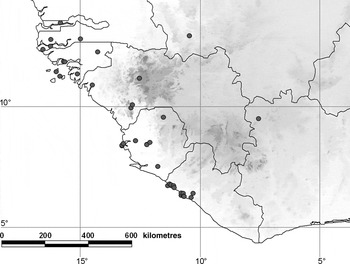
Distribution and ecology. From the Gambia and Senegal to Liberia, also in SW Mali and NE Côte d'Ivoire (Fig. 4); in coastal savannah, gallery forest, primary or secondary rainforest, often in swampy areas or along streams up to 360 m altitude.
Distribution map of Smeathmannia laevigata Sol. ex R.Br.

Selected specimens examined. Côte d'Ivoire.Odienné: Savanna near Odienne, Barrage of Logohasso, 9°31′N, 7°35′W, 19 x 1974, J. de Koning 4158 (WAG).
Gambia.Basse: Sutukoba, 13°30′N, 15°50′W, T. Whitfield 1846 (BM).
Guinea.Boké: Dans les lieux aquatique près du Rio-Nunez, 10°55′N, 14°30′W, 1837, J. Heudelot 655 (K, MO, P, WAG). Kindia: Friguiagbé, 9°58.80′N, 12°54.00′W, 3 iii 1937, J. Chillou 58 (COI, K); Foulayah, 10°05′N, 12°50′W, 16 iii 1993, L. Aké Assi 18814 (MO); Road de la frontiere de Senegal a Kindia (gangan) Bafing, Timbis, 9 iv 1956, J.G. Adam 11822b (MO). Pita: Timbi – Madina, 11°12′N, 12°32′W, 9 iv 1956, J.G. Adam 11822 (MO). Kankan: Kouroussa, 10°39′N, 9°53′W, C.H.O. Pobéguin (Guinea series) 222 (K).
Guinea-Bissau. Bubaque, 11°17′N, 15°51′W, 19 ii 1963, J. Alves Pereira 3727 (C); Bubaque, Ancamone, 11°28′N, 16°00′W, 23 i 1961, A.R.F. Raimundo & J.A. Guerra 963 (C); Bissau, between Tór and Bijimita, 11°53.50′N, 15°41.00′W, 29 iii 1945, J.V.G. do P. Espirito Santo 1897 (COI, K, WAG); Bissau, Brene, 11°53′N, 15°39′W, 1 ii 1945, J.V.G. do P. Espirito Santo 1724 (COI, WAG); Gabu, 12°17′N, 14°17′W, iii 1933, J.V.G. do P. Espirito Santo 489 (COI); Bedanda, 11°22′N, 15°07′W, 12 i 1962, J. Alves Pereira 2762 (C).
Liberia.Grand Cape Mount: Bendu, 10 miles N of Robertsport, low forest on border of lagoon, 6°46′N, 11°13′W, 30 i 1970, J.W.A. Jansen 1768 (WAG); about 5 miles east of Robertsport in hilly country, 6°43′N, 11°21′W, 12 i 1978, A. de Gier & W. Goll 131 (WAG); Near intersection of Mano River Road and Robertsport Road, 6°43′N, 11°06′W, 12 i 1978, A. de Gier & W. Goll 147 (WAG); north of Lake Piso, 6°48.17′N, 11°17.27′W, 20 m, 20 vii 2004, C.C.H. Jongkind et al. 6036 (WAG); Fombah, 6°39′N, 11°05′W, 30 xii 1947, J.T. Baldwin jr. 10957 (MO). Montserrado: Monrovia, 6°19′N, 10°48′W, 1 xii 1961, G. Kunkel 226 (WAG); ‘Devil Bush’, about 15 km E of Monrovia, between Paynesville and Duport, 6°16′N, 10°40′W, 21 iii 1962, J.J.F.E. de Wilde & A.G. Voorhoeve 3621 (WAG); Near Monrovia, 6°19′N, 10°48′W, 1 xii 1961, G. Kunkel 245 (WAG); Duport, about 8 miles E of Monrovia, former Porroh bush, 6°16′N, 10°40′W, 21 x 1966, J.J. Bos 2296 (BR, WAG); About 10 miles S of Monrovia, Division 33, near school, sec. vegetation, 6°24′N, 10°18′W, 13 v 1971, J.W.A. Jansen 2333 (WAG); Savanna area, about 10 miles N of Monrovia, 6°24′N, 10°43′W, 19 ii 1969, J.W.A. Jansen 1596 (WAG); Duport, 8 miles E of Monrovia, former Porrobush, 6°16′N, 10°40′W, 30 iii 1966, J.J. Bos 1851 (BR, K, WAG); Duport, 8 miles E of Monrovia, former Porrobush, 6°16′N, 10°40′W, 23 iv 1966, J.J. Bos 1886 (BR, K, P, WAG); Arboretum Paynesville, 5 miles E of Monrovia, 6°17′N, 10°41′W, 10 m, 23 x 1960, A.G. Voorhoeve 89 (WAG); Near Paynesville on coastal savanna, 6°17′N, 10°41′W, 31 viii 1965, P.P.C. van Meer 164 (WAG); Brewerville, 6°25′N, 10°47′W, 28 ix 1950, W.J. Harley 1661 (WAG); Monrovia, 6°19′N, 10°48′W, 1 xii 1961, G. Kunkel 225 (WAG); Monrovia, 6°19′N, 10°48′W, 16 viii 1962, G. Kunkel 511 (WAG); Monrovia, 6°19′N, 10°48′W, 20 ii 1962, G. Kunkel 499 (WAG); Road to Cooper's Beach, 6°15′N, 10°22′W, 24 v 1970, F.S.C. Stoop - v.d. Kasteele 166 (WAG).
Mali. Kayes: Cercle de Bafoulabé, Arrondissement de Bamafélé, 25.3 km S of Manantali, 12°58.54′N, 10°26.79′W, 280–320 m, 17 xi 1999, C.S. Duvall 388 (MO); c.2 km NW of old Solo, at seepage area along base of sandstone cliff, in seasonal drainage channel, 12°58.54′N, 10°26.79′W, 340–360 m, 12 vi 2003, C.S. Duvall 402 (MO).
Senegal. Bignona, 12°49′N, 16°13′W, 22 v 1957, J.G. Adam 13546 (MO); Kolda, 12°50′N, 15°00′W, 1827, G.S. Perrottet 345 (BM); Ziguinchor, Bayottes, 12°32′N, 16°15′W, 25 v 1957, J.G. Adam 13658 (MO); Parc National de la Basse Casamance, 12°24′N, 16°33′W, 26 xi 1984, P.R.J. Bamps 7787 (MO, WAG).
Sierra Leone. Heddle's farm and Regent, 10 xii 1891, G.F. Scott Elliot 3912 (BM); Sangasange, Benna, Scarcies river, 3 i 1892, G.F. Scott Elliot 4414 (BM); 1914, N.W. Thomas 4022 (K); 1794, A. Afzelius s.n. (BM, C); 1912, J.M. Dalziel s.n. (MO); Koinadugu, Kabala N.P., 9°35′N, 11°33′W, 10 iv 1968, E.A. Cole 165 (K, WAG); Yonibana, 8°26.41′N, 12°14.42′W, 30 x 1914, N.W. Thomas 4079 (BM); Magbile, 8°36′N, 12°42′W, 30 m, 6 xii 1915, N.W. Thomas 6237 (BM); Kumrabai, 8°32′N, 12°06′W, 15 m, 31 xii 1914, N.W. Thomas 4098 (K); Yele, 8°26′N, 12°14′W, 11 xi 1914, N.W. Thomas 5064 (K); Yonibana, 8°36′N, 12°42′W, 12 xi 1914, N.W. Thomas 4849 (C); Jala, 7°32.01′N, 11°45.43′W, 8 i 1914, R.H. Bunting s.n.? (BM); Fourah Bay college, Freetown, 8°29.29′N, 13°12.49′W, 29 vi 1965, J.K. Morton & A.S. Jarr SL2052 (WAG); near Laka, Peninsular, By stream between Milton Margai Training College and Lakka, 8°24′N, 13°16′W, 25 ii 1964, J.K. Morton & A.S. Jarr SL891a (WAG); Hamilton, Peninsular, 8°23′N, 13°16′W, 5 ii 1964, J.K. Morton & A.S. Jarr SL741 (WAG); Freetown, Kortright, Fourah Bay college and Havelock on compound, 8°29.29′N, 13°12.49′W, 9 xi 1963, J.K. Morton SL106 (WAG).
The variety Smeathmannia laevigata var. nigerica A.Chev. was validly published in the original publication (Chevalier, Reference Chevalier1920). Therefore, the author citation A.Chev. ex Hutch. & Dalziel in the second edition of the Flora of West Tropical Africa is incorrect. In the original publication four collections are mentioned: Chevalier 345, 568, 2999 and 15713. From these, Chevalier 345 from P is chosen as the lectotype because it is the most complete material. As the variety was described with a combination of leaf characters of Smeathmannia laevigata and S. pubescens, Keay (Reference Keay, Hutchinson and Dalziel1954) suggested a hybrid origin for this variety. However, after having studied many collections, we conclude that the variation in leaf shape, in both Smeathmannia laevigata and S. pubescens, is such that no discrete entities below species level can be based on these characters.
Smeathmannia laevigata was based on material collected by Smeathman, Afzelius and Purdie. From these the Smeathman collection is chosen as the lectotype because it is the most complete material.
2. Smeathmannia pubescens Sol. ex R.Br., Trans. Linn. Soc. London 13: 221 (1821); Hook., Bot. Mag. 74: t.4364 (1848); Lem., Jard. Fleur. 1: Misc. 70 (1851); Stapf in Johnston, Liberia 2: 606 (1906); F.Irvine, Pl. Gold Coast 385 (1930); Aubrév., Fl. Forest. Côte d'Ivoire 3: 29, t.254 (1936); ibid. ed. 2, 3: 38, t.266 (1959); F.Irvine, Woody Pl. Ghana 86 (1961). – Paropsia pubescens (Sol. ex R.Br.) Warb. in Engl. & Prantl, Nat. Pflanzenfam. 3(6a): 27 (1895). – Type: Sierra Leone, Smeathman s.n. (lecto BM!, designated here, see notes). Figs 1A,5.
Smeathmannia media Sol. ex R.Br., Trans. Linn. Soc. London 13: 221 (1821); Lem., Jard. Fleur. 1: Misc. 70 (1851). – Type: Sierra Leone, Smeathman s.n. (holo BM, n.v.).
Smeathmannia rosea Lem., Jard. Fleur. 1: Misc. 71 (1851). – Type: Sierra Leone (no material traced, see notes).
Smeathmannia emarginata Lem., Jard. Fleur. 1: Misc. 71 (1851). – Type: Sierra Leone (no material traced, see notes).
Smeathmannia pubescens var. cordifolia A.Chev., Explor. Bot. Afrique Occ. Franç. 285 (1920). – Type: Côte d'Ivoire, Vallée de l'Agniéby, a Voguié, 21 i 1907, Chevalier 17132 (holo P!).
Smeathmannia pubescens var. parvifolia A.Chev., Explor. Bot. Afrique Occ. Franç. 285 (1920), nomen nudum.
Buelowia illustris Schumach. & Thonn., Beskr. Guin. Pl. 247 (1827). – Smeathmannia illustris (Schumach. & Thonn.) Endl. ex Walp., Repert. Bot. Syst. 2: 218 (1843); Lem., Jard. Fleur. 1: Misc. 70 (1851). – Type: Ghana, Thonning 85 (holo C†); Mouth of Ancoba River in view of the sea, 4°54.12′N, 2°16.12′W, 27 ii 1995, C.C.H. Jongkind & D.K. Abbiw 2064 (neo WAG!, designated here, see notes; isoneo MO!).
Buelowia insignis Schumach. & Thonn. in Hook., Niger Fl. 364 (1849), nomen nudum; Lem., Jard. Fleur. 1: Misc. 70, 71 (1851).
Shrubs or treelets, rarely trees. Branches with glands near petiole base that are usually stalked (i.e. gland > 2 times higher than wide); flowering and fruiting usually on upper side of branches. Leaf blade elliptic to round to obovate, to c.30 cm long, usually to c.12 cm long; margin serrate to dentate or shallowly so; apex acuminate to acute, less often round. Floral bracts usually 2, persistent. Flowers to c.6 cm in diameter, white to cream or rarely light reddish in vivo; exposed parts of outer tepals often rather dark brown and inner tepals often medium orange-brown in sicco. Corona rather firm at base, pubescent. Filaments pubescent at base. Pistil densely pubescent on ovary, extending to the styles. Fruit as large as the persistent perianth or slightly shorter, pubescent.
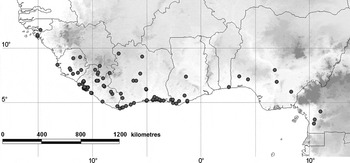
Distribution and ecology. Frequently encountered from Guinea-Bissau to SW Ghana, rather rare from Benin to Cameroon (Fig. 5); in coastal savannah, forest edges, secondary rainforest, or occasionally in primary rainforest; usually at low altitudes, occasionally to 770 m.
Distribution map of Smeathmannia pubescens Sol. ex R.Br.

Selected specimens examined. Benin. Ouémé: Sèmè-Kpodji, Goho (Kétonou), 6°26′N, 2°34′E, 15 m, 10 vii 2001, A. Akoègninou 4958 (BENIN).
Cameroon.Central Province: 50 km S of Badjob, SW of Eséka, along the Nyong river, near the large bridge, 3°28′N, 10°30′E, 29 i 1964, W.J.J.O. de Wilde & B.E.E. de Wilde-Duyfjes 1742 (BR, P, WAG, YA). Littoral Province: 70 km SSW of Bafia, left bank of Sanaga river stream upwards from bridge called Kikot (on Douala-Bafia road), 4°11′N, 11°02′E, 3 i 1970, R. Letouzey 9808 (WAG). South Province: Bipinde, Rainforest, 3°05′N, 10°25′E, 1902, G.A. Zenker 2450 (BM, COI, MO, WAG).
Cote d'Ivoire.Abidjan: In region of Dabou, 22 v 1969, M.T. Thijssen 53 (WAG); 10 km south east of Dabou, direction lagune, 5°18′N, 4°21′W, 21 v 1969, C. Versteegh & R.W. den Outer 92 (MO, U, WAG); Along Agnéby R., 30 km new road Abidjan-Ndouci, 5°30′N, 4°15′W, 29 v 1979, A.P.M. de Kruif 111 (WAG); near the ferry from Grand Bassam to Bingerville, 5°12′N, 3°44′W, 1 m, 28 v 1969, C. Versteegh & R.W. den Outer 153 (MO, U, WAG); Border of the lagoon Adiopodoumé, 5°20′N, 4°09′W, 9 viii 1956, J.J.F.E. de Wilde 194 (WAG); Adiopodoumé, 5°20′N, 4°09′W, 24 vii 1967, C. Geerling & J. Bokdam 347 (WAG); Fôret d'I.D.E.R.T., c.17 km West of Abidjan, 5°20′N, 4°08′W, 2 vii 1963, W.J.J.O. de Wilde 366 (WAG); In region of Dabou, 5°18′N, 4°21′W, 9 ix 1969, M.T. Thijssen 367 (WAG); bank of Comoé River, opposite Grand Bassam, 5°14′N, 3°43′W, 15 vii 1963, W.J.J.O. de Wilde 477 (WAG); 200 m N of Anna, lagoon border, along road, 5°19′N, 3°52′W, 5 m, 23 vi 1975, H.J. Beentje 524 (WAG); 4 km NNW of Jaqueville, near lagoon Ebrié, 5°13′N, 4°26′W, 5 m, 4 viii 1975, H.J. Beentje 663 (WAG); E of Dabou, 5°20′N, 4°22′W, 30 viii 1967, C. Geerling & J. Bokdam 795 (WAG); Adiopodoumé, 5°20′N, 4°09′W, 17 vii 1968, G. Cremers 871 (MO); Forêt de l'Abouabou, between Abidjan and Grand Bassam, 5°17′N, 3°54′W, 2 m, 12 ii 1959, A.J.M. Leeuwenberg 2698 (WAG); Banco Forest Reserve, in Western central part, older secondary forest, 5°23′N, 4°04′W, 21 xi 1973, J. de Koning 2767 (WAG); Adiopodoume, secondary forest, 5°21′N, 4°08′W, 27 viii 1974, J. de Koning 3880 (WAG); near Adiopodoumé, 17 km W of Abidjan, 5°20′N, 4°08′W, 0–40 m, 17 v 1962, A.J.M. Leeuwenberg 4189 (MO, WAG); Forêt d'Audouin, Lagune d'Adupododoumé, 5°16′N, 4°11′W, 24 viii 1955, H.C.D. de Wit 5679 (WAG); Songon - Alari - Layo, near Adiopodoumé, 5°20′N, 4°07′W, 20 viii 1955, H.C.D. de Wit 5680 (WAG); Abouabou, 5°17′N, 3°55′W, 16 x 1949, J.G. Adam 6546 (MO); Banco Forest Reserve, in the South part of the forest, on humid place, 5°22′N, 4°03′W, 26 iv 1976, J. de Koning 6815 (WAG); In vicinioribus ORSTOM, id est loci Adiopoudoumé nuncupati, 5°20′N, 4°09′W, 24 ii 1962, L. Bernardi 8258 (MO, WAG); Banco Forest Reserve, 5°23′N, 4°03′W, 26 vi 1975, W.J. van der Burg 625a (WAG). Aboisso: Botanical reserve Nganda-Nganda, 5 km S of Adiaké, savanna-primary forest, sandy soil, 5°12′N, 3°26′W, 30 m, 25 iv 1970, J. de Koning 386 (WAG). Bouaflé: Parc National de la Marahoué, 7°00.54′N, 5°57.53′W, 17 viii 2000, J. Assi Yapo 413 (WAG). Grand-Lahou: About 500 m before the ferry-boat to Grand-Lahou, 5°10′N, 4°59′W, 3 viii 1978, A.J.F.M. Dekker 110 (WAG); Riverbank, right bank of R. Bandama, near N'Zida 5°14.0′N, 4°57.0′W, 5 m, 30 vii 1975, H.J. Beentje 650 (WAG). Korhogo: 50 km SE of Korhogo, at river Bandama-Blanc, 9°13′N, 5°25′W, 17 vii 1969, C. Versteegh & R.W. den Outer 540 (WAG). Odienné: Odienné, 9°30′N, 7°34′W, 10 x 1943, J.G. Adam 27086 (MO, WAG). San Pedro: Savanne de Néro-Mer, c.6 km E and 5 km inland of Béréby, 4°41′N, 6°55′W, 7 xi 1963, R.A.A. Oldeman 531 (WAG); From Tabou 30 km to Bereby, along the road, 4°34′N, 7°10′W, 11 x 1973, J. de Koning 2378 (WAG). Sassandra: Victorie, 4°49′N, 6°26′W, 2 iv 1968, C. Geerling & J. Bokdam 2435 (MO, WAG); In regions of Sassandra, 4°58′N, 6°10′W, 2 vii 1969, M.T. Thijssen 114 (WAG). Tabou: Along the road from Olodio to Clodio, 4°43.8′N, 7°29.1′W, 7 iv 2000, C.C.H. Jongkind & J. Assi Yapo 4962 (WAG); about 15 km E of Tabou along road to San Pedro, 4°31′N, 7°15′W, 11 vii 1978, A.J.F.M. Dekker 92 (WAG); About 6 km W of Yaka, about 15 km NW of Tabou, 4°28′N, 7°26′W, 30 viii 1975, W.J. van der Burg 814 (WAG); Lamto, 6°13.50′N, 5°01.00′W, 12 vii 1968, M. Dugerdil 414 (WAG); Tai, 5°50′N, 7°21′W, 8 xii 1987, A. de Rouw 432 (WAG); W part of Marahoue National Park, just east from western border, 6°59.2′N, 6°10.9′W, 18 v 1999, C.C.H. Jongkind & H. Diomaudé 4607 (WAG); Lamto Station, 6°15′N, 5°03′W, 12 vii 1968, F.J. Breteler 5268 (BR, C, K, L, MO, P, WAG); Beoumi, 7°40′N, 5°34′W, xii 1922, W.P. Lowe s.n. (BM).
Ghana.Ashanti: Ejura, 7°23′N, 1°22′W, vi 1930, C. Vigne 2036 (BM, MO); ‘Vineba’, 5°10′N, 1°15′W, 1787, A.P. Hove s.n. (BM). Central Region: Foso, Bimpong Forest Reserve, 5°39′N, 1°30′W, 15 ii 1972, A.A. Enti SP577 (MO). Western Region: Near Marupong (?), Cape Coast Dist., vii 1921, W.C. Fishlock 38 (BM); along the Takoradi-Elubo highway, between 7–30 km east of Elubo, 5°15.4′N, 2°44.3′W, iii 1996, M.C. Merello et al. 1451 (MO); Atuabo, 4°58′N, 2°33′W, 16 x 1978, A.A. Enti FE1892 (MO, WAG); Axim, near mouth of Ancobra River, 4°54′N, 2°16′W, iv 1952, J.K. Morton GC6578 (WAG); Ankasa Forest Reserve, 5°13′N, 2°38′W, 6 x 1973, A.A. Enti & P.K. Awnah R1146 (MO); Ankana Forest Reserve, Aiyenase, 5°17′N, 2°35′W, xi 1972, A.A. Enti R896 (MO); Tarkwa district, Neung Forest Reserve, 5°07′N, 2°02′W, 7 i 1972, A.A. Enti SP504 (WAG); c.1781, Brass s.n. (BM).
Guinea. Macenta: Seredou, 8°23′N, 9°18′W, 7 iv 1949, J.G. Adam 4261 (MO); Nzérékoré: between Mifergui camp and Zougué, 7°41.8′N, 8°23.7′W, 770 m, 18 vi 2007, C.C.H. Jongkind et al. 7730 (WAG).
Guinea-Bissau.Bafatá: Cacine, 11°07′N, 15°01′W, ix 1933, J.V.G. do P. Espirito Santo 166 (COI); Between Saltinho and Chitole, 11°41′N, 14°46′W, J.V.G. do P. Espirito Santo 3825 (BR, COI, MO, WAG). Tombali: Estrata do Cantanhez, a 3 km, do entroncamento com a estrada de Quiledje, 11°13′N, 15°03′W, 3 iv 1954, J.D. D'Orey 362 (COI).
Liberia.Bong: Gbarnga, 3 miles NE of Suacoco, 6°60.50′N, 9°34.00′W, 12 viii 1950, L.C. Okeke 8 (COI, MO); Gbarnga district, Suakoko, Cen. Exp. Sta., 6°60′N, 9°35′W, 15 viii 1952, M.L. Blickenstaff 74 (COI, MO); 3 miles NE of Suacoco, Gbarnga, Central Province, 6°59′N, 9°28′W, 13 v 1951, P.V. Konneh 167 (BM, C, COI, MO). Grand Bassa: Buchanan, 5°53′N, 10°03′W, 2 vii 1896, M.J. Dinklage 1691 (BM); Buchanan, 5°53′N, 10°03′W, 22 ix 1971, J.G. Adam 26078 (MO); Buchanan, 5°53′N, 10°03′W, 24 xi 1974, J.G. Adam 29097 (MO); Buchanan, 5°53′N, 10°03′W, 25 ix 1975, J.G. Adam 29545 (MO); Buchanan, 5°53′N, 10°03′W, 25 ix 1975, J.G. Adam 29568 (MO). Grand Cape Mount: Near Bendu, coastal thickets, 6°38′N, 11°11′W, 26 viii 1968, F.J. Breteler et al. 5439 (WAG). Grand Gedeh: 20 miles from Tchien, along the road to Cap Palmas, High forest, 5°48′N, 8°09′W, 23 vii 1970, J.W.A. Jansen 2128 (WAG); Gletown, 5°59′N, 8°15′W, 30 vii 1947, J.T. Baldwin jr. 6914 (MO). Lofa: Zorzor area, 7°47′N, 9°26′W, 5 iii 1969, C. Woelfel 27 (WAG); Zorzor, S of town, on the road to Gbarnga (Banga), near rivercrossing, 7°36′N, 9°29′W, 26 vii 1966, J.J. Bos 2135 (K, WAG); North Lorma National Forest, 8°02′N, 9°44′W, 20 xi 2005, C.C.H. Jongkind et al. 6738 (WAG). Maryland: 20 miles N of Harper, along sec. road, 4°39′N, 7°41′W, 22 vii 1971, J.W.A. Jansen 2497 (WAG). Montserrado: 1 mile east of Kle, 6°42′N, 10°53′W, 7 x 1972, J.D. Lemckert 4 (WAG); Division 16, Firestone Plantations, Harbel, 6°24′N, 10°26′W, 11 ix 1965, J. Kokulo 6 (WAG); Vicinity of Firestone Plantations along Dubwai River, Monrovia, 6°23′N, 10°22′W, 1 x 1928, G.P. Cooper 51 (BM); Along road from Robertsfield to Monrovia, near coast, 6°13′N, 10°35′W, 10 viii 1969, F.S.C. Stoop - v.d. Kasteele 53 (WAG); Bifurcation Bomi Hills - ‘Small Bopolu’ and Bomi Hills - Yoma, along the road, 6°56′N, 10°45′W, 24 vii 1965, P.P.C. van Meer 69 (WAG); New University Site, Careysburgh, 35 km from Monrovia, 6°24′N, 10°34′W, 13 ix 1963, A.M. van Harten 82 (WAG); Near Paynesville on coastal savanna, 6°17′N, 10°41′W, 31 viii 1965, P.P.C. van Meer 163 (WAG); Bomi Hills, 6°54′N, 10°49′W, 1969, F.S.C. Stoop - v.d. Kasteele 183 (WAG); Arboretum Paynesville, 6°17′N, 10°41′W, 29 iv 1961, A.G. Voorhoeve 267 (WAG); Devilbush, Paynesville, 6°17′N, 10°41′W, vii 1961, A.G. Voorhoeve 361 (WAG); Devilbush, 6°16′N, 10°40′W, viii 1961, A.G. Voorhoeve 385 (WAG); Ganta University Plantation, lateritic soil, 6°26′N, 10°42′W, 50 m, 8 v 1970, J. de Koning 418 (WAG); Monrovia, Dukwai River, 6°18.38′N, 10°48.17′W, 17 v 1929, G.P. Cooper 442 (BM); New Site, 18 miles from Monrovia, near nursery of University, 6°24′N, 10°39′W, 10 viii 1968, J.W.A. Jansen 938 (WAG); Savanna area, about 16 km N of Monrovia, 6°24′N, 10°43′W, 19 ii 1969, J.W.A. Jansen 1593 (WAG); Camp Shefflin, 20 miles E of Monrovia along road Monrovia to Roberts International Airport, coastal savanna, 6°13′N, 10°32′W, 11 viii 1969, J.W.A. Jansen 1667 (WAG); Duport, 8 miles E of Monrovia, former Porrobush, 6°16′N, 10°40′W, 23 iv 1966, J.J. Bos 1879 (BR, K, P, WAG); Mano road NW of Bomi Hills, on the outskirts of the Gola forest, 6°58′N, 10°47′W, 21 vii 1966, J.J. Bos 2076 (WAG); Monrovia, 6°19′N, 10°48′W, 4 iii 1975, W.H. Lewis 7982 (MO); near Monrovia, 6°19′N, 10°48′W, 1 xi 1947, J.T. Baldwin jr. 9200 (MO); c.20 miles east of Monrovia, 6°14′N, 10°30′W, 22 ii 1948, J.T. Baldwin jr. 11089 (MO); Monrovia, 6°19′N, 10°48′W, 24 viii 1949, J.T. Baldwin jr. 13059 (MO); Begwai, 5°55′N, 10°05′W, 1910, R.H. Bunting s.n. (BM). Nimba: 2 miles S of Tapita, along road, 6°28′N, 8°50′W, 18 vii 1968, J.W.A. Jansen 880 (WAG); Sanokwele district, Ganta, 7°12′N, 8°59′W, 15 xi 1947, J.T. Baldwin jr. 9271 (MO). Sino: Road from Greenville to African Fruit Company, 5°06′N, 9°04′W, 27 vii 1977, A. de Gier & W. Goll 8 (WAG).
Nigeria.Cross River State: Obubra District, Iyamoyong Forest Reserve, 5°58′N, 8°21′E, 28 iv 1959, A. Binuyo FHI41277 (WAG). Enugu State: Nsukka district, Ngurugu, near Anambia River, 6°54′N, 7°00′E, 4 viii 1966, J.C. Okafor FHI60364 (MO). Kogi State: Kabba Province, Kotokerifi District, on the way to Adanjere in the high forest, 8°00′N, 6°50′E, 10 ix 1958, B.O. Daramola & J.K. Adebusuyi FHI38410 (WAG). Ogun State: Ijebu District, Sunmoge, Shasha Forest Reserve, 7°08′N, 4°20′E, 5 iv 1935, R. Ross & G.C. Evans 221 (BM, MO). Oyo State: Abeokuta Province, Olokemeji Forest Reserve, banks of the Ogun, 7°25′N, 3°32′E, xi 1945, A.P.D. Jones et al. FHI14522 (BM, MO).
Sierra Leone. 1782, W. Brass s.n. (BM); 1792, A. Afzelius s.n. (BM). Eastern Province: Gberia, Iotombu(?), 8°00′N, 11°00′W, 25 ix 1951, D. Small 282 (MO); near Bambavo in Kambui Hills, 7°44′N, 11°18′W, 4 viii 1966, J.K. Morton & A.S. Jarr SL3758 (WAG). Northern Province: Buntrina (= Bumbuna?), 9°03′N, 11°44′W, 20 x 1914, N.W. Thomas 3826 (C); Mt Loma, 9°10′N, 11°07′W, 20 i 1966, J.G. Adam 23211 (MO). Southern Province: Njala, 8°07′N, 12°05′W, 21 ix 1926, F.C. Deighton 74 (BM); 7°38′N, 11°47′W, 1891, G.F. Scott Elliot 4387b (BM). Western Area: Leicester, above Freetown, 8°28′N, 13°13′W, 28 iii 1958, F.N. Hepper 2480 (MO).
In the protologue of Smeathmannia pubescens Brown (Reference Brown1821) cites two collections from Sierra Leone: Smeathman and Afzelius, both without number, collected for Banks. One sheet from BM bears both an Afzelius and Smeathman collection (as well as a collection from Hove, who also collected for Banks, but only in Ghana (Hepper & Neate, Reference Hepper and Neate1971)). This is most likely the material that Solander and Brown have studied. The Smeathman and Afzelius collections are the syntypes of Smeathmannia pubescens. From these the Smeathman collection is chosen as the lectotype because it is the most complete material. The specimen Brass s.n. (BM!) incorrectly bears a note ‘TYPE’ as Brass collected only in Ghana (Hepper & Neate, Reference Hepper and Neate1971).
The names Smeathmannia emarginata Lem. and S. rosea Lem. were published by Lemaire (Reference Lemaire1851), when he worked in Belgium. They are based on material ‘of very poor quality’, collected in Sierra Leone for ‘Belgian horticulturists’, probably in 1844 (Lemaire, Reference Lemaire1851). Lemaire's herbarium was scattered when he sold it before he moved to Paris where he died in poverty (Stafleu & Cowan, Reference Stafleu and Cowan1979). No material could be traced.
Buelowia illustris Schumach. & Thonn. was described by Schumacher (as Bülowia illustris) based on the notes that Thonning made on the collection Thonning 85 (in C); the name was published in 1827. The bombardment of Copenhagen by the British in 1807 destroyed most of Thonning's collection, probably including number 85, which caused Thonning to give up on botany altogether. Schumacher published Thonning's notes, but did not cite a specimen, nor a precise type locality for Buelowia illustris. Therefore, designation of a neotype is necessary. The collection Jongkind 2064 (WAG) is chosen because it fits the description in the protologue, it is complete material, and it has been collected in an area occupied by the Danish around the time that Thonning collected in Ghana.
Acknowledgements
Hans de Vries is kindly acknowledged for his skilful preparation of the drawings, Miguel Leal and an anonymous reviewer helped with the Latin diagnosis, and Julien Bachelier assisted in formatting the figures. The first author thanks Marc Sosef for his helpful comments on an early version of the manuscript as well as his advice during various stages of the revision. We are grateful to the herbaria BM, BR, C, COI, K, LBV, LISC, MO and P for sending specimens on loan. We thank the reviewers for their constructive comments.