None of the four Constitutions of the People’s Republic of China has ever been treated by the Party-state as law binding upon itself in any practical sense.Footnote 1 The current Constitution of 1982 “has not become the standard for judging the behaviour of state organs”;Footnote 2 is not “living” in the sense of being applied by the courts to legal cases;Footnote 3 “lacks legal effect in reality”;Footnote 4 and does not actively protect constitutionally enumerated rights.Footnote 5 Moreover, whatever constitutional review competence that does exist in the Standing Committee (NPCSC) of the National People’s Congress (NPC) is “ineffective”: the NPCSC has never once declared any law or regulation unconstitutional.Footnote 6 Consequently, no publicly available legal remedy for any breach of the Constitution by the state exists.Footnote 7
Constitutionalism “has remained dead or, at best, dormant”,Footnote 8 even whilst the Party leadership under General Secretary Xi Jinping has, in its rhetoric, increasingly emphasized the importance to the nation’s future of implementing the Constitution.Footnote 9 Over time, a broad consensus has emerged within the Chinese legal academy that a Constitutional Supervision Committee (宪法监督委员会) should be established within the NPCSC to facilitate genuine constitutional enforcement amid upholding the NPC’s sovereignty and conserving the Constitution’s text intact.Footnote 10 Despite broad academic acceptance and the legal feasibility of this proposal, the Party leadership has so far resisted it.Footnote 11
This article demonstrates how the origins, evolution, and fate of the Committee for the Basic Law of the Hong Kong Special Administrative Region under the Standing Committee of the National People’s Congress (全国人民代表大会常务委员会香港特别行政区基本法委员会), informally known as the Basic Law Committee (BLC), may shed light on the possibilities for constitutional enforcement in mainland China. Since 1997, the BLC has been described as an “integral element”Footnote 12 of the framework of the Basic Law of the Hong Kong Special Administrative Region of the People’s Republic of China (Basic Law) – that fundamental national law of the NPC which functions as the constitutional charter of the former British dependency,Footnote 13 as well as a “bridge”Footnote 14 between the antithetical legal traditions of the two jurisdictions that is “self-evidently important”.Footnote 15 Initially designed as a “high-powered” institution,Footnote 16 the BLC is to be consulted by the NPCSC whenever the latter intends to invalidate Hong Kong legislation; make or unmake a Chinese national law applicable to Hong Kong; interpret the Basic Law; or even amend the Basic Law – the four significant domains of possible conflict between Hong Kong and the central government of China.Footnote 17
The BLC is thus a most anomalous institution in the universe of constitutional bodies and at the least a “major modification” of the Chinese system of constitutional interpretation.Footnote 18 It deserves recognition as the prototype of constitutional supervision institutions in China. Vested with “quasi-judicial” powers,Footnote 19 the BLC seemed destined to evolve into an exemplar of the future of constitutionalism in all of China – an authoritative constitutional supervisory body mitigating disputes of capital importance between Hong Kong and its sovereign.Footnote 20 In the event, however, the BLC was to be censured for its failure to harmonize legal relations between the mainland and Hong Kong;Footnote 21 its incapacity to play more than “a decorative role” in the politics of constitutional interpretation;Footnote 22 and its passivity in resolving actual legal disputes.Footnote 23 Indeed, the protracted interpretive impasse between Beijing and Hong Kong over the proper meaning of the Basic Law provisions on electoral reform has become a source of political instability, injecting a streak of uncertainty into the Special Administrative Region’s future.Footnote 24 Discontent with the pace of constitutional developments boiled over when tens of thousands of protestors defied riot police to take part in the so-called “Umbrella Movement” that occupied the streets of Hong Kong for almost eighty days in late 2014.Footnote 25
This article fills a gap in the Chinese constitutional law and politics literature by undertaking an original analysis of the BLC’s evident impotence to defuse mainland-Hong Kong tensions. Its intuitive thesis is straightforward: Beijing and the pro-democratic social and political forces in Hong Kong are locked in a coordination dilemma.Footnote 26 Both share an interest in finding common ground so as to avoid extra-constitutional conflict and chaos, but rank available alternatives divergently.Footnote 27 In situations like this, where payoffs alone do not rationally determine expectations,Footnote 28 a focal point or psychological cue enjoying “prominence, uniqueness, simplicity, precedent, or some rationale that makes [it] qualitatively differentiable from the continuum of possible alternatives”, could exert “the intrinsic magnetism of particular outcomes”.Footnote 29 Interdisciplinary-minded legal scholars have deployed this “focal point” insight to explain the immense influence wielded by constitutional and international courts despite their lack of any power to enforce compliance.Footnote 30 It would follow that no future Chinese Constitutional Supervision Committee could expect to make any real difference unless it can generate “focal points” – viz. authoritative, unambiguous, widely publicized opinions on the Basic Law’s meaning – which induce a convergence of expectations between disputants as to what should be chosen in a given situation.
This article makes three main points. First, an examination of the Basic Law’s drafting process reveals that there had been a real possibility for the BLC to become a generator of influential focal points in post-1997 Hong Kong. Second, the main reason why the BLC failed to attain a consequential role was not necessarily because of any lack of authority to make binding opinions, but because of the tight secrecy which the NPCSC imposed on its proceedings and reports, and because the NPCSC and some of the BLC’s own members stifled any autonomous corporate identity that might have emerged. Neither outcome was entailed in the Basic Law or its framework. Third, the BLC experience exposes the obstacles to creating a genuine constitutional supervisory body, even within the four walls of the Party-state establishment.
I. DESIGNING THE BASIC LAW COMMITTEE
Running to 160 articles, the Hong Kong Basic Law is a document detailed and exact enough to merit being regarded as a pre-commitment device aimed at restoring confidence in a Hong Kong without British administration. The drafters of the Basic Law would have sought to mitigate the credibility problem of Deng Xiaoping’s “One Country, Two Systems” formulaFootnote 31 in light of the cynicism that greets promises made by the Chinese Communist Party, which are widely assumed to be binding on them only so long as they find it advantageous in any particular instance to be thus constrained.Footnote 32
The document looks designed to accommodate the expectations of Hong Kong residents for more autonomy and, eventually, electoral democracy. It provides that the Special Administrative Region shall exercise “a high degree of autonomy and enjoy executive, legislative and independent judicial power, including that of final adjudication”Footnote 33; avows that in Hong Kong the “socialist system and policies shall not be practiced’”Footnote 34 and prohibits any department of the Chinese State Council, or any mainland Chinese province, autonomous region, or municipality, to intervene in the region’s internal affairs.Footnote 35
Nevertheless, from early on, the mainland insisted that the Basic Law was no more than a national statute enacted under the Constitution of the People’s Republic of China.Footnote 36 This was reflected in China’s approach to the future resolution of the Basic Law’s inevitable ambiguities in the provisions on electoral reform towards universal suffrage,Footnote 37 according to which the NPCSC must be the supreme interpretive authority. The power of the NPCSC to issue “Interpretations” of the Basic Law under Article 158 entitles it to intervene in virtually every matter concerning Hong Kong, in unqualified terms, whenever it deems fit. Beijing’s insistence in this regard stirred much controversy, especially in Hong Kong, during the Basic Law’s five-year drafting process.Footnote 38 Even several Hong Kong drafters apprehended a need to prevent the NPCSC interpreting the Basic Law at will, lest Hong Kong’s autonomy be compromised.Footnote 39
China’s lack of a constitutional court moved Hong Kong intellectuals to seek out an independent institution that could fulfil such a role.Footnote 40 Victor Sit, then-senior lecturer of Geography at the University of Hong Kong, was in January 1986 among the first Hong Kong public figures expressly to propose to Lu Ping, Deputy Secretary General of the Drafting Committee, the establishment of a “Hong Kong Basic Law Committee” to participate in interpreting Basic Law provisions relating to the Chinese central government with finality.Footnote 41 By April the same year, the relevant subgroup of the Drafting Committee had begun to conceive of a “special committee” consisting of Hong Kong members but under the National People’s Congress to do just that.Footnote 42
By December 1987 a consensus appears to have emerged amongst the drafters that the NPCSC should be obliged to consult the Basic Law Committee (as it had come to be known) before rendering important decisions regarding the Basic Law.Footnote 43 The Draft Basic Law published in April 1988 had settled on the principle that the NPCSC “shall consult” the BLC “before giving an interpretation” of the Basic Law.Footnote 44 According to Rayson Huang, Convenor of the Subgroup on Central-Local Relations of the Basic Law Drafting Committee, the BLC was meant to countervail, in case of conflict, the Basic Law’s overarching emphasis on “One China”.Footnote 45
The perception became ascendant in Hong Kong that the BLC was a means to protect the region’s autonomy through the rule of law and with a new jurisprudence that would join up the divergent common law and socialist traditions of both sides.Footnote 46 Within the broad contours of this ideal, concerned Hong Kong residents relayed to Beijing a number of concrete ideas about the BLC’s proper role: that it should be vested with the authority to review the Basic Law-consistency of Hong Kong laws and to allocate jurisdiction between the NPCSC and the Hong Kong Court of Final Appeal in cases that impinged on China’s sovereignty.Footnote 47 Eminent pro-Beijing educator and Hong Kong NPC deputy Ng Hong-mun publicly advocated more powers for, and that Hong Kong members make up the majority on the BLC.Footnote 48 Enthusiasm in Hong Kong for the BLC waxed so great that mainland drafters were forced to reject explicitly the most aggressive proposal of all, to legally obligate the NPCSC to adopt each and every recommendation made by the BLC.Footnote 49 Calls for the BLC’s empowerment strengthened after the Tiananmen Square crackdown of 1989, which dealt a blow to the credibility of China’s precommitment to Hong Kong’s post-1997 autonomy, causing waves of mass migrations from the dependency. There emerged suggestions for the BLC to function as a European-style constitutional court consisting of an equal number of mainland Chinese and Hong Kong judges.Footnote 50
The final text of the Basic Law vests the BLC with four formal competences: to be consulted before the NPCSC invalidates any enactment of the Hong Kong Legislative Council for incompatibility with the Basic Law’s provisions respecting the central authorities’ responsibilities or relationship with the Region;Footnote 51 to be consulted before the NPCSC adds or deletes legislation on defence, foreign affairs and the like to be made applicable through Annex III of the Basic Law;Footnote 52 to be consulted before the NPCSC interprets the Basic Law;Footnote 53 and to submit its views prior to the NPC deciding on a bill for the amendment of the Basic Law.Footnote 54
On 4 April 1990 the NPC issued a very rudimentary organic instrument for the BLC as a “working committee” under the NPCSC, to consist of twelve members, “including persons from the legal profession”, appointed by the NPCSC for a period of five years, and charged with the responsibility to “study questions arising from the implementation of Articles 17, 18, 158, and 159 of the Basic Law” and to “submit its views” to the NPCSC.Footnote 55 Whilst no provision specified how the six mainland members might be chosen, the six from Hong Kong were to be drawn from amongst permanent residents who held no foreign passports, and who had received the joint nomination of the Chief Executive, the President of the Legislative Council, and the Chief Justice. The document left unspecified the BLC’s internal procedure.Footnote 56
Scholars have noted the similarities between the BLC and central-local coordinating bodies in other countries, such as Finland’s Åland Delegation, a joint commission consisting of an equal number of representatives from the autonomous islands and the national government. It plays an essentially consultative role and lacks the power to take final decisions.Footnote 57 Additionally, the broadly worded provisions of the Basic Law left open the question whether the BLC might be endowed with the powers of an arbitration panel, thus assimilating it to the Judicial Committee of the Privy Council whose technically non-final opinion, and thus not a judgment, by constitutional convention had to be adopted by the sovereign: the Queen in Privy Council – the NPCSC mutatis mutandis. Because the Judicial Committee consisted only of judges, it was understandable that there were views, especially from Hong Kong, favouring the appointment of impartial, neutral experts to the BLC. Of course, unlike the Queen in Council, the NPCSC could issue binding interpretations of Hong Kong’s constitutional document outside litigation of concrete cases.Footnote 58 The fact that the BLC’s design might have been influenced by the Privy Council should not be surprising. After all, the Basic Law was ratified in part to memorialize China’s promise to conserve the status quo of the former British Dependency to the farthest extent possible.Footnote 59
The discussions about the BLC in Hong Kong occurred simultaneously with the undertaking of momentous constitutional reforms in the Soviet Union, a factor not lightly to be ignored in an analysis of the BLC, given the enduring Soviet influence over Chinese law and legal scholarship.Footnote 60 The amendment to the Soviet Constitution on 1 December 1988 provided for the establishment of a Committee of Constitutional Supervision for the Union of Soviet Socialist Republics.Footnote 61 Very much in the spirit of the Constitutional Supervision Committee found in mainland academic circles, the Soviet Committee was vested only with such non-binding advisory powers as to identify constitutional transgressions, and was carefully crafted to conserve the sovereignty of the Supreme Soviet.Footnote 62 Nevertheless, it was staffed by legal specialists and paved the way to a modern and effective system of constitutional review in Russia.
The BLC clearly had the potential to become a significant coordinator of disputes over the Basic Law’s meaning, even though China’s persistent authoritarianism meant that it would probably never become an activist, Western-style, constitutional court. It garnered much publicity throughout the drafting process: there was widespread speculation in Hong Kong, even amongst pro-Beijing figures, that it would play an important role in post-1997 Hong Kong. Nothing in the final text of the Basic Law forbade the BLC to produce “focal points” that would have been settled-on through the due process of deliberate, public, and transparent hearings; or prevented the evolution of a constitutional convention nudging the NPCSC toward endorsing each and every BLC recommendation;Footnote 63 or prohibited the BLC from being staffed with the most esteemed legal experts from Hong Kong and mainland China; or barred it from becoming a consequential legitimator of China’s latest policy regarding Hong Kong. On the eve of the resumption of sovereignty, Lau Siu-kai, member of the Preparatory Committee, stated his belief that the BLC would be a “very important” body.Footnote 64
II. THE BASIC LAW COMMITTEE IN ACTION
A. The Committee’s Role in Early Basic Law Interpretations
To secure disputants’ acquiescence in a given Basic Law interpretation, the BLC would have to be a publicly visible body whose acts were common knowledge to all interested parties;Footnote 65 however, the BLC’s visibility, at least in Hong Kong, was low from the very start. In the first year after China resumed sovereignty, it met only twice. The first time was in July 1997, when the members agreed trivial amendments to three national laws of China listed in Annex III. The second time was in October 1997, when it adopted a few very general principles into its Rules of Procedure, such as a requirement for members to participate in BLC meetings in person in accordance with a prescribed quorum.Footnote 66 Even so, hopes that the BLC would play a substantial role in modulating constitutional tensions were then still considered by some insiders to be achievable. For instance, Hong Kong member Albert Chen suggested that the Committee would eventually establish more substantive rules and precedents that would regulate hearings such that lawyers might represent clients before the BLC and cross-examine witnesses prior to the NPCSC issuing a Basic Law Interpretation.Footnote 67
The BLC was at last activated in 1999 when the NPCSC chose to issue an Interpretation in response to Ng Ka Ling v. Director of Immigration,Footnote 68 the first major Basic Law decision rendered by the nascent Hong Kong Court of Final Appeal, which unanimously invalidated the immigration law enacted by the handpicked Provisional Legislative Council. The ruling had triggered the Special Administrative Region Government’s fears of a spate of children from mainland China seeking to settle in the Region, estimated at 1.675 million in the ten years to follow, who would have precipitated severe social and economic crises.Footnote 69
In June 1999 the Hong Kong Chief Executive Tung Chee-hwa took the constitutional shortcut of inviting the NPCSC – via the State Council, controversially – to reverse the decision with an Interpretation. The BLC was summoned to Beijing to be “consulted”. The Committee was only given two and a half days to comprehend a “very thick” document dump – excluding submissions from the adverse parties; the BLC’s report was presented to the NPCSC anonymously and kept away from public scrutiny, “even though there is no secret in it”, reportedly in Hong Kong member Anthony Neoh’s words.Footnote 70 The InterpretationFootnote 71 dutifully reinstated the original anti-immigration policy on behalf of the Chief Executive.
Disquieted by the political movement that erupted after half a million people stormed the streets of Hong Kong on 1 July 2003 to oppose a Beijing-backed National Security Bill, the NPCSC took the offensive by announcing on 26 March 2004 that in its next meeting, to be held a week later, it would consider issuing an Interpretation on the Special Administrative Region’s political development. Again, the BLC was given just two days to remit a report to the NPCSC that never became public information.Footnote 72 The upshot was an Interpretation uttered sua sponte in less than ten days that imposed on the transitional regime of gradual democratization provided for in the Basic Law a further hurdle: a vetting process by the NPCSC before the promised liberalization of the most important electoral arrangements in the Region might be permitted.
Another Interpretation, issued just one year later, exposed the BLC’s impotence yet again. Tung’s resignation as Chief Executive in March 2005 ignited a constitutional controversy over the lawful length of his successor’s term of office. The NPCSC Legal Affairs Work Committee pre-empted public debate in Hong Kong by issuing a detailed statement concluding that the term should be no more than the two-year remainder of his predecessor’s term, an interpretation the plain language of the Basic Law cannot bear. Its rationale was widely suspected to be that Beijing was determined to keep Acting Chief Executive Donald Tsang, a British-trained civil servant with few connections to the local pro-China establishment, on a “short leash” during which he would have to prove his loyalty before being rewarded with a full five-year term.Footnote 73
Three weeks after Tsang petitioned for an Interpretation, the NPCSC ruled that whenever the office of Chief Executive becomes vacant, the successor’s term of office shall be the remainder of the predecessor’s; but conceded that this succession method might be amended after 2007.Footnote 74 The BLC’s role in this Interpretation was even more minimal than in the previous two. Departing from established precedent, the NPCSC suppressed the date of its meeting, frustrating Hong Kong journalists in interviewing the BLC’s members.Footnote 75 The fait accompli of a mainland legal opinion that had already been conclusively rendered by the Legislative Affairs Commission left the BLC no room for manoeuvre. Mainland BLC member Wang Zhenmin, himself an ardent advocate for a mainland Constitutional Supervision Committee,Footnote 76 admitted the NPCSC seemed to find more value in consulting the Hong Kong legal community directly, by holding “discussion sessions” with them in Shenzhen that bypassed the BLC.Footnote 77 The BLC was marginalized throughout the process, in the teeth of its salience in the Basic Law.
B. The Rise and Fall of Empowerment Proposals
There has been no shortage of proposals for empowering the BLC from prominent personalities in both Hong Kong and mainland China. In December 1999 Albert Chen reiterated his conviction that future Basic Law petitions addressed to the NPCSC should be entertained by the BLC in the manner of a law court, by adopting transparent judicial procedures and allowing both sides to present their submissions and arguments before delivering an impartial recommendation to the NPCSC.Footnote 78 His proposal was resolutely rejected by Hong Kong Secretary for Justice Elsie Leung, a future Deputy Director of the BLC, who argued that the Basic Law never intended the Committee to be a “court” or anything more than merely a consultative body. Leung’s reproof was an accurate prediction of the NPCSC’s upcoming attitudes toward the Committee.
In the aftermath of the 2005 Interpretation Cheng Yiu-tung, Deputy to the NPC from Hong Kong as well as a member of the elitist Hong Kong Executive Council and an influential figure in Hong Kong’s pro-establishment bloc, recommended that the NPCSC ought to consult the BLC even before deciding whether to interpret the Basic Law at all. He was immediately refuted by BLC director Qiao Xiaoyang, who insisted that the NPCSC cannot be bound by any convention or custom whatsoever.Footnote 79 It was not the first time Cheng had advocated empowering the BLC. In March 1999 he had recommended that the BLC should become a proactive body in established relation to the Court of Final Appeal, a stand publicly rebuked by Hong Kong member Raymond Wu, who asseverated that the BLC was meant to be a passive body under the Basic Law.Footnote 80
Whilst dismissing proposals to turn the BLC into an arbitral tribunal within the broad parameters of the Basic Law’s language, the NPCSC did make some efforts howbeit little-known, to develop the BLC’s role since 2006. The BLC Director was upgraded from deputy ministerial to full ministerial rank, co-equal to the directors of the various work committees of the NPCSC, thus elevating the BLC’s status to that of the NPC’s other permanent committees.Footnote 81 One of the mainland members was also elevated to the rank of Deputy Director, a position previously solely held by a Hong Kong member, presumably entailing greater mainland control over the BLC’s operations. The number of legally trained members was also raised from three to seven – slightly over half of the Committee – in a reshuffling of mainland members.Footnote 82 Two divisions within the Committee were set up – a General Office and a Research Office – which, ironically, became a permanent secretariat to a non-permanent body. Consisting of 25 full-time staff each, both offices were ranked official departments of the NPCSC and located in the same building that houses the better-known Legal Affairs Work Committee; the BLC’s Research Office thus becoming the first official body on the mainland to specialize in research on the Hong Kong Basic Law.Footnote 83
These reforms, however, did not substantially raise the salience or importance of the BLC in resolving constitutional tensions. Doubtlessly, the BLC participated in shaping the fourth NPCSC Interpretation, delivered in response to the Court of Final Appeal’s petition in a case relating to foreign state immunity policy in the Hong Kong courts. BLC members were present as observers when the NPCSC solicited the opinions of various members of the Hong Kong legal profession. Dissenting opinions within the BLC were communicated to the NPCSC,Footnote 84 and its research staff provided technical assistance in crafting out an Interpretation expressly intended to guide a common law court’s decision-making. Nevertheless, the BLC’s report to the NPCSC was kept confidential, as in all three previous Interpretations. There were no consultations. There was no way for any outsider to assess the content, let alone the meaningfulness of the BLC’s contribution. Any development of the BLC’s relevance did not exceed involving its members in making minor or procedural changes to the wording of Interpretations.
C. The Committee’s Corporate Identity
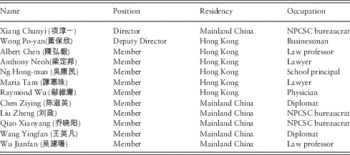
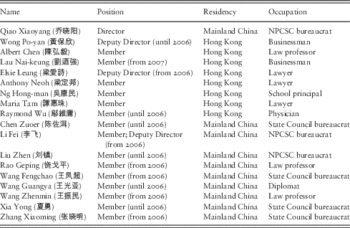
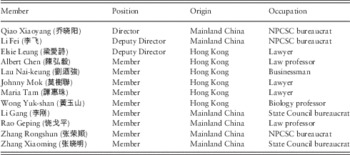
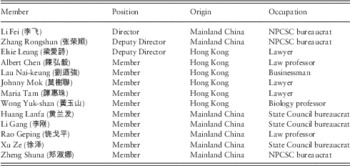
Together with the Macau Basic Law Committee patterned after it, the BLC is unique among Chinese State institutions in including an equal number of local and mainland Chinese members; its Hong Kong members must be endorsed by the heads of all three branches of the Hong Kong government. All members are appointed by the NPCSC. Contrary to the expectations initially raised, in practice the BLC’s composition (see Tables1-4) subverted its ability to cast for itself an independent corporate identity. Under the jealous guard of Beijing, the BLC has yet to see lawyers preponderate on either side. The mainland members of the Committee have continuously been drawn from the NPCSC Secretariat, the NPCSC Legal Affairs Committee, and the State Council Hong Kong-Macau Office. The BLC Directorship, always held by a mainland member, falls to functionaries engaged full-time in running the NPC Law Committee, the NPCSC Secretariat, or the NPCSC Legal Affairs Work Committee.Footnote 85 It is in one of these capacities, not in that of their BLC Directorship, that Qiao Xiaoyang and Li Fei have pronounced important NPCSC decisions affecting Hong Kong.Footnote 86 Several Hong Kong members concurrently served as NPC Hong Kong deputies, thereby perpetuating the blurring of the BLC’s corporate identity. According to Ng Hong-mun, the Chief Executive plays the leading role, in practice, in selecting and nominating BLC members, with the President of the Legislative Council and the Chief Justice merely acceding to his choice.Footnote 87
First Hong Kong Basic Law Committee (1997-2003)

Second Hong Kong Basic Law Committee (2003-2006)

Third Hong Kong Basic Law Committee (2008-2013)

Fourth Hong Kong Basic Law Committee (2013-2018)

In stark contrast to judges, or members of constitutional supervision committees elsewhere, many BLC members have never sought to distinguish themselves from partisan politicians or NPCSC bureaucrats. No introspective understanding is in evidence that they ought to abstain from taking part in controversial public debates, lest they be drawn into taking sides. The inability to keep aloof has forfeited the presumption of impartiality that was initially expected of the BLC,Footnote 88 enfeebling its capacity to produce focal and influential opinions.
The Hong Kong Court of Final Appeal justified its decision in Ng Ka Ling on grounds that unequivocally amounted to a claim of judicial supremacy. This aroused eminent mainland scholars, including BLC member Wu Jianfan, to launch into a sustained assault on the Court, going so far as to denounce it for seeking to make Hong Kong over into an “independent political entity”.Footnote 89 Within a month of that decision, Raymond Wu, BLC member from Hong Kong chimed in, famously excoriating his fellow residents for “superstitiously worshipping” common law judges; and describing opponents of the supremacy of NPCSC Interpretations as “patients” of an insane asylum.Footnote 90 Wu labelled the widely respected Chief Justice Andrew Li an “ignorant toddler”, and foreboded that the NPCSC, being so jealous of its sovereignty, would intervene to right the Ng Ka Ling wrong.Footnote 91
Similar examples abound. In October 2012 Elsie Leung, now Deputy Director of the BLC, apparently denounced Hong Kong judges for misconceiving the “true” relationship the Special Administrative Region has with the central government, and for making mistakes that had usurped Beijing’s sovereignty.Footnote 92 This sort of behaviour has raised concerns within the local legal profession that judicial independence may be at stake, compromised by senior politicians pressurizing judges.Footnote 93 Kemal Bokhary, a judge of the Court of Final Appeal, described Leung’s denunciation as unleashing “a storm of unprecedented ferocity [that dealt] a blow against the rule of law” in Hong Kong.Footnote 94
In April 2014, newly appointed BLC director Li Fei, acting in his capacity as NPCSC Deputy Secretary-General, nixed a reform proposal favoured by a substantial proportion of Hong Kong society to allow citizens to nominate candidates for Chief Executive.Footnote 95 Two months later nearly 800,000 Hong Kong residents participated in an unofficial electronic referendum, voting overwhelmingly for citizens’ nominations as the preferred method of electing Chief Executives.Footnote 96 Defying these sentiments, Li insisted that the Chief Executive must be “someone who loves the country and loves Hong Kong”.Footnote 97 On 31 August 2014 the NPCSC issued a contentious decision that vetoed citizens’ nominations for the Chief Executive election in 2017; imposed nomination thresholds hobbling pan-democratic politicians who seek candidacy; and ruled out universal suffrage for the Legislative Council general election of 2016.Footnote 98
Li justified this decision on the basis of China’s “sovereignty, security and development interests”: China could not afford to let Hong Kong be governed by a Chief Executive who might not be loyal to Beijing’s perception of Chinese national interests; there is no evidence that the BLC was substantially involved in the decision but for a perfunctory reference to it as among the many mainland bodies that the NPCSC “listen[ed] to”.Footnote 99 Elsie Leung, among other BLC members, lauded this decision as “reasonable”, “not conservative”, “unambiguous”, and “conducive to consensus-building”.Footnote 100
Individual BLC members took it upon themselves to lecture tens of thousands of defiant Hong Kong citizens discontent with the NPCSC decision who had begun to occupy busy streets on Hong Kong Island and Kowloon Peninsula in late September 2014. The tear gas and pepper spray inflicted by the riot police on peaceful protestors who had nothing but umbrellas to defend themselves with doubtlessly only galvanized people to participate all the more in the “Umbrella Movement”, which turned out to be the largest and longest pro-democracy rally in Hong Kong history, lasting seventy-nine days, and involving an estimated of 1.2 million participants at various times.Footnote 101 In November, Zhang Rongshun, Deputy Director of the NPCSC Legal Affairs Work Committee, who doubled as the mainland Deputy Director of the BLC, controversially denounced the Movement, in a meeting with 200 Hong Kong community leaders, as a Ukraine-style, foreign-backed “Colour Revolution” launched to undermine China’s national sovereignty.Footnote 102 Zhang even made what many considered a highly provocative remark, that the people of Hong Kong must be “re-enlightened” so as to embrace the Chinese national identity more fully.Footnote 103
The BLC, as a body, was uninvolved in mitigating issues throughout the whole conflict. Consistent with the socialist legal tradition, which regards the law as a political instrument of class oppression, the Committee made no attempt to project even so much as the appearance that legal considerations should prevail over political ones in determining the Basic Law’s meaning within the Chinese legislative system. Unsurprisingly, individual members seemed to value identities alternative to the BLC when expressing their views publicly.
III. IMPLICATIONS
Constitutional interpretation in China is thoroughly politicized. Expounding the meaning of the Constitution implicates unresolved political questions at the intersection of the Party leadership, the rights of citizens, and the authority of law.Footnote 104 No less politicized is the NPCSC’s Interpretation of a Basic Law that had incorporated many liberal provisions stemming from Hong Kong’s common law heritage.Footnote 105 It has increasingly been exploited as an instrument to ward off China’s long-standing fears that an electorally democratic Hong Kong would not only become uncontrollable, but would also trigger wealthier provinces and municipalities across China to demand greater autonomy.Footnote 106 The Party cannot risk the loss of de facto control over the Basic Law’s meaning.
The BLC experience has two major ramifications for the future of constitutional enforcement in China. First, with regard to legal matters of constitutional significance, Beijing is insistent on highly secretive internal discussions over against even cosmetic public participation and consultation.Footnote 107 This explains why the BLC has been denied every opportunity to make recommendations that could have meaningfully shaped the way Beijing approaches to the Basic Law. Anything short of maximal discretion in the interpretation of the Basic Law is misunderstood by Beijing as detrimental to national sovereignty, hence the NPCSC has yet to promulgate any transparent methodology for arriving at its Interpretations.Footnote 108
The evidence also indicates that the NPCSC itself is not a material actor when it comes to the most politicized matters concerning national security and sovereignty,Footnote 109 which are almost always at stake in Basic Law Interpretations – notwithstanding that it has made some real gains in power and autonomy over more routine policy domains in mainland politics in the past three decades.Footnote 110 After all, the selection of all of its members is controlled by the Organizational Department of the Communist Party.Footnote 111 The Chairman of the NPCSC, since 1993, has always been a member ex officio of the ultra-elite, seven-member Standing Committee of the Politburo.
The second major ramification of the BLC experience is that it redounds little to the support of the recurrent calls, at least since 1985,Footnote 112 by Chinese scholars for the establishment of a Constitution Supervision Committee within the National People’s Congress and/or for the NPCSC to exercise the power of constitutional supervision on behalf of the sovereign legislature.Footnote 113 A specialized body with a clear constitutional mandate would function better than the NPCSC, which is burdened by the massive workload assigned to it,Footnote 114 yet BLC atrophy indicates just how reluctant Beijing is to allow any kind of supervisory committee officially charged with quasi-constitutional functions to operate transparently, even a body staffed by people already politically vetted by the Party-state. And it appears that even NPCSC officials have an interest in preventing the BLC from developing a corporate identity apart from their own. As we have seen above, many BLC members have become the most zealous and publicly visible supporters of all positions taken by Beijing, blurring any differentiability between the BLC and other mainland government bodies.Footnote 115
The BLC experience echoes the fate of the abortive attempt by the Supreme People’s Court to “judicialize” the Constitution.Footnote 116 And the BLC shares the obscurity of the Filing and Review Office for Regulation, established in 2004 as a sub-unit within the Legal Affairs Work Committee and consisting of 13 staff members who review select legislation.Footnote 117 The Office is responsible for conducting preliminary research into constitutional review petitions lodged by public or private entities so as to decide whether they were eligible for consideration by appropriate NPCSC committees.Footnote 118 The Office, however, keeps a very low profile, lacks any formal competences of constitutional supervision, and operates in a way consistent with Beijing’s preference for resolving legal conflicts through informal consultation and opaque bargaining.Footnote 119
In this political climate the Party-state is unlikely to open what it considers the Pandora’s Box of judicial autonomy by vouchsafing to the NPCSC real constitutional supervisory powers pursuant to the Constitutional text, let alone the establishment of a Constitutional Supervisory Committee playing a salient, transparent role in enforcing the constitution under NPCSC auspices. Indeed, state leaders talking up the need for greater respect for the Constitution constantly reaffirm the Party’s immutable role in determining its meaning.Footnote 120 In a 2013 opinion article, for instance, Zhou Qian, the incumbent President of the Supreme People’s Court, stated, “the Party should operate within the bounds of the Constitution and the laws so as to truly realize the Party’s leadership over law-making, law enforcement, and law-abiding”.Footnote 121
IV. CONCLUSION
This article demonstrated that the Hong Kong Basic Law Committee epitomizes a prototypic form of constitutional supervision in the People’s Republic of China. Being closest to a constitution supervision committee within China’s existing constitutional framework, which prioritizes the legal supremacy of the People’s Congresses within the legal system and the political supremacy of the Communist Party, a detailed case study of the BLC has allowed us to glimpse, albeit imperfectly, the tolerance level of the Chinese Party-state towards such contentious issues as the constitutional enforcement and the rule of law.
The BLC originally had the potential to become a consequential constitutional body in Hong Kong’s post-British political framework. It was destined to participate in each and every Interpretation or Amendment of the Basic Law by Beijing. Nothing in the law prevented it from becoming an arbiter of constitutional disagreements, equipped with the ability to announce opinions on the Basic Law’s meaning in a rational and authoritative way that could coordinate the expectations of Hong Kong people and provide useful advice to the Chinese leadership on its policy towards the Special Administrative Region, as initially thought by many, including some of its members.
It turned out that China’s top leadership and senior NPCSC officials have taken the narrowest interpretation of the legal provisions on the BLC, seeing the Committee as nothing more than an ordinary non-permanent work committee. And yet such narrow interpretation of the BLC’s role, as well as full control over its composition, has yet to prevent state leaders from delegating greater discretion to the Committee. Being barred from conducting public hearings, publishing its proceedings, and staffed by individuals most of whom are not full-timers, the BLC has not been given any opportunity to produce any focal opinions on the Basic Law as a cohesive corporate actor. And the Committee appeared to have never been given the requisite time and resources to hammer out substantial opinions separately from drafts already prepared by the NPCSC. Indeed, the lack of public visibility, a cohesive corporate identity, and dedicated full-time members are key obstacles that must be addressed and eradicated by any serious proposal for a workable Constitutional Supervision Committee in China. Consequently, there was no room for the emergence of any custom tilting the NPCSC towards endorsing every recommendation made by the BLC.
Whilst a minimalist role is not indefensible as a matter of black-letter law, the marginal position of the BLC in mitigating mainland China-Hong Kong constitutional tensions in many ways represented a lost opportunity for experimenting with constitutional supervision: the BLC has not even been used as a device to give politically motivated Basic Law Interpretations greater procedural and legal legitimacy. And if China is unwilling to experiment with constitutional enforcement with the BLC in Hong Kong, there is a strong possibility that it will not, in the foreseeable future, be willing to entertain any proposals for a specialized constitutional body, even one with highly circumscribed powers. After all, the ‘One Country, Two Systems’ arrangement in the Hong Kong Special Administrative Region has long been utilized by Beijing as a field laboratory to test novel ideas and policies before they are applied to mainland China.