

Introduction
Traumatic brain injury (TBI) is a significant public health issue in New Zealand; $83.5 million in claims for TBI were made to the New Zealand Accident Compensation Corporation (ACC) in 2015 (Corporation, Reference Corporation2017). Lifetime prevalence of TBI in New Zealand’s general population is reported to be as high as 31.7% for men, and 21.9% for women (McKinlay et al., Reference McKinlay, Grace, Horwood, Feldman, Ridder and MacFarlane2008), and 14,000 people are treated each year for a TBI (Corporation, Reference Corporation2017). Men and women serving prison sentences have a higher prevalence of TBI than non-incarcerated populations (Durand et al., Reference Durand, Chevignard, Ruet, Dereix, Jourdan and Pradat-Diehl2017; Perkes, Schofield, Butler, & Hollis, Reference Perkes, Schofield, Butler and Hollis2011), with a meta-analysis concluding over half of incarcerated men (59.3%) and women (55.4%) had sustained a TBI with loss of consciousness (LOC) in their lifetime (Shiroma, Ferguson, & Pickelsimer, Reference Shiroma, Ferguson and Pickelsimer2010). Two recent New Zealand studies found that 60.0% of incarcerated men and 94.7% of incarcerated women reported experiencing a TBI with LOC at some point in their lives (Mitchell, Theadom, & du Preez, Reference Mitchell, Theadom and du Preez2017; Woolhouse, McKinlay, & Grace, Reference Woolhouse, McKinlay and Grace2018). The consequences of a TBI can be temporary, persistent or lifelong depending in large part on the manner of the injury, such as severity or age at injury (Anderson, Brown, Newitt, & Hoile, Reference Anderson, Brown, Newitt and Hoile2011; Fleminger & Ponsford, Reference Fleminger and Ponsford2005; Silver, McAllister, & Arciniegas, Reference Silver, McAllister and Arciniegas2018; Theadom et al., Reference Theadom, Parag, Dowell, McPherson, Starkey and Barker-Collo2016). A TBI at a younger age may disrupt attainment of typical developmental milestones (Anderson et al., Reference Anderson, Brown, Newitt and Hoile2011), and more severe injuries usually result in the greatest long-term impairment (Silver et al., Reference Silver, McAllister and Arciniegas2018). While the majority of those with mild TBI recover relatively quickly (1-3 months), there is evidence that a significant minority may have persistent symptoms, including poor neuropsychological functioning, for up to 12 months post injury (Barker-Collo et al., Reference Barker-Collo, Jones, Theadom, Starkey, Dowell and McPherson2015; Theadom et al., Reference Theadom, Parag, Dowell, McPherson, Starkey and Barker-Collo2016), and delayed recovery is particularly evident in those who have sustained repeated injuries (Theadom et al., Reference Theadom, Parmar, Jones, Barker-Collo, Starkey and McPherson2015).
The neurobehavioral consequences following a TBI (Riggio & Wong, Reference Riggio and Wong2009) provide some explanation as to why those with TBI are overrepresented among incarcerated populations. TBI can have a number of deleterious effects on cognitive, affective and behavioural functioning related to decision-making, including impairments in memory and attention (Arciniegas, Held, & Wagner, Reference Arciniegas, Held and Wagner2002), elevated levels of anger (Demark & Gemeinhardt, Reference Demark and Gemeinhardt2002; Lezak, Reference Lezak1987; Rosenbaum & Hoge, Reference Rosenbaum and Hoge1989) and increased impulsivity (Bechara & Van Der Linden, Reference Bechara and Van Der Linden2005; Prigatano, Reference Prigatano1986). Other factors common among offending populations, including adverse childhood experiences (Malarbi, Abu-Rayya, Muscara, & Stargatt, Reference Malarbi, Abu-Rayya, Muscara and Stargatt2017), mental illness (Ellwart, Rinck, & Becker, Reference Ellwart, Rinck and Becker2003; Vasterling, Brailey, Constans, & Sutker, Reference Vasterling, Brailey, Constans and Sutker1998) and substance use problems (Ramey & Regier, Reference Ramey and Regier2019), also contribute to poor neuropsychological function. Likewise, many co-occurring factors exist for both sustaining a TBI and offending, including substance use problems, unemployment and lower educational achievement. However, determining the individual contributions of each of these factors is challenging. Still, there is evidence that the neuropsychological performance of incarcerated samples who report a history of TBI is poor (O’Rourke, Linden, Lohan, & Bates-Gaston, Reference O’Rourke, Linden, Lohan and Bates-Gaston2016; Pitman, Haddlesey, Ramos, Oddy, & Fortescue, Reference Pitman, Haddlesey, Ramos, Oddy and Fortescue2015) – falling in the low average range. Poor neuropsychological performance in incarcerated samples has been linked to more admissions to segregation (Stewart, Wilton, & Sapers, Reference Stewart, Wilton and Sapers2016), poorer treatment outcomes (Cornet, van der Laan, Nijman, Tollenaar, & de Kogel, Reference Cornet, van der Laan, Nijman, Tollenaar and de Kogel2015) and recidivism (Seruca & Silva, Reference Seruca and Silva2015; Tuominen et al., Reference Tuominen, Korhonen, Hämäläinen, Katajisto, Vartiainen and Joukamaa2017). Compared to incarcerated samples with no history of TBI, those with a history of TBI are more likely to be involved in disciplinary charges and violent infractions while in prison (Matheson et al., Reference Matheson, McIsaac, Fung, Stewart, Wilton and Keown2020; Shiroma, Pickelsimer, et al., Reference Shiroma, Pickelsimer, Ferguson, Gebregziabher, Lattimore and Nicholas2010), and to have a higher rate of recidivism at 12 months post release after controlling for covariates such as age, ethnicity, education and offence (Ray & Richardson, Reference Ray and Richardson2017). Although these studies demonstrate the increased interest in examining the effects of TBI in individuals serving custodial sentences, there have been no published studies examining the association between TBI and recidivism with individuals who serve criminal sentences in the community.
Compliance for community sentenced individuals includes two broad concepts: compliance with sentence conditions and compliance with criminal law (Bottoms, Reference Bottoms2001). In New Zealand, people commonly serve community sentences with a condition that requires that they report regularly to a probation officer, either after a prison sentence – referred to here for convenience as “parole” – or because a judge imposes a community-based supervision sentence. In either circumstance, alongside reporting regularly to their probation officer, they are often required to comply with a number of other sentence conditions (e.g., to live and work in particular places, to attend assessment or treatment for alcohol and drugs; Corrections, Reference Corrections2016). While community and prison populations overlap, we cannot assume that the rate and impact of TBI is the same for individuals in each setting. With reference to the latter, compliance in the community can be more complex than in prison; community life is both less structured and more demanding. Sentence conditions can be complex and are undertaken in tandem with the duties, responsibilities and difficulties of everyday life (e.g., family, work and social commitments).
Given the nature of community-based sentences, neuropsychological impairments in this setting may manifest as compliance and engagement issues which can result in a number of costly outcomes (e.g., new criminal charges, returning to prison; McMurran & Theodosi, Reference McMurran and Theodosi2007). Individuals with mild TBI (n = 341) completed a computerised neuropsychological assessment (CNS-Vital signs) at baseline and 12 months post injury. At 12 months post injury, just over 10% of the sample obtained scores in the very low range (>70; Theadom et al., Reference Theadom, Parag, Dowell, McPherson, Starkey and Barker-Collo2016), with complex attention having the highest proportion of participants (16.3%) remaining in the very low range at 12 months post injury (Barker-Collo et al., Reference Barker-Collo, Jones, Theadom, Starkey, Dowell and McPherson2015). Furthermore, no significant improvements in functioning were found in memory domains between baseline and 12 months post mild TBI injury, with 15.6% remaining in the very low range at 12 months post injury (Barker-Collo et al., Reference Barker-Collo, Jones, Theadom, Starkey, Dowell and McPherson2015). Neuropsychological consequences from a mild TBI can persist for a year or more (Barker-Collo et al., Reference Barker-Collo, Jones, Theadom, Starkey, Dowell and McPherson2015), particularly when other factors like less time in school, a history of mental illness and substance abuse, prior TBIs and psycho-social stress are present (Hardman & Manoukian, Reference Hardman and Manoukian2002; Schofield et al., Reference Schofield, Butler, Hollis, Smith, Lee and Kelso2006). Incarcerated offenders with TBI have increased recidivism rates and convictions (Piccolino & Solberg, Reference Piccolino and Solberg2014; Pitman et al., Reference Pitman, Haddlesey, Ramos, Oddy and Fortescue2015; Ray & Richardson, Reference Ray and Richardson2017; Ray, Sapp, & Kincaid, Reference Ray, Sapp and Kincaid2014; Williams et al., Reference Williams, Mewse, Tonks, Mills, Burgess and Cordan2010) and poorer neuropsychological functioning (Pitman et al., Reference Pitman, Haddlesey, Ramos, Oddy and Fortescue2015) than non-TBI affected offenders. Still, the prevalence of TBI and the relationship between TBI and compliance is poorly understood among those serving community-based (i.e., non-custodial) sentences.
While there is evidence that a history of TBI is predictive of prison misconduct (Shiroma, Pickelsimer, et al., Reference Shiroma, Pickelsimer, Ferguson, Gebregziabher, Lattimore and Nicholas2010) and re-arrest (Ray & Richardson, Reference Ray and Richardson2017) and neuropsychological consequences resulting from a TBI can last up to 12 months (Theadom et al., Reference Theadom, Parag, Dowell, McPherson, Starkey and Barker-Collo2016), there is no empirical research on how a recent TBI relates to higher risk of non-compliance (with the law or conditions) while on community supervision sentences. Previous research has focused on incarcerated samples and histories of TBI, with no investigations into how a recent TBI and its neuropsychological consequences relate to disciplinary infractions in prison let alone the compliance of those serving their criminal sentences in the community. Therefore, to fill this gap in the literature we investigated whether a TBI in the last 12 months is related to participants’ compliance with their sentence conditions and the law, and also how current neuropsychological functioning relates to compliance.
The present study aimed to answer three research questions about the relationship between a recent TBI (i.e., last 12 months), neuropsychological functioning and community compliance – defined as compliance with sentence conditions and compliance with the law (i.e., avoiding arrest) – among those serving community supervision sentences. First, was a recent TBI associated with poorer neuropsychological functioning? Second, is there a relationship between recent TBI and community non-compliance? We expected that those with a TBI in the last year would be less likely to comply and have more instances of non-compliance with sentence conditions and would be more likely to be arrested. Third, is there a relationship between neuropsychological performance and community non-compliance? We expected that lower scores on the neuropsychological assessments would be associated with more non-compliance.
Method
Study design and setting
The study was approved by the Human Ethics Committee at the University of Waikato (Ethics Approval Reference Number is HREC[Health] 2018#69) and by the New Zealand Department of Corrections.
A convenience sample of individuals serving community sentences was recruited from two sites in New Zealand during a 6-month period (February-August) in 2019. Probation officers told their supervisees about the study when they came into the office for routine reporting. Supervisees who were interested in the study were introduced to the primary researcher (EMN) by their probation officer.
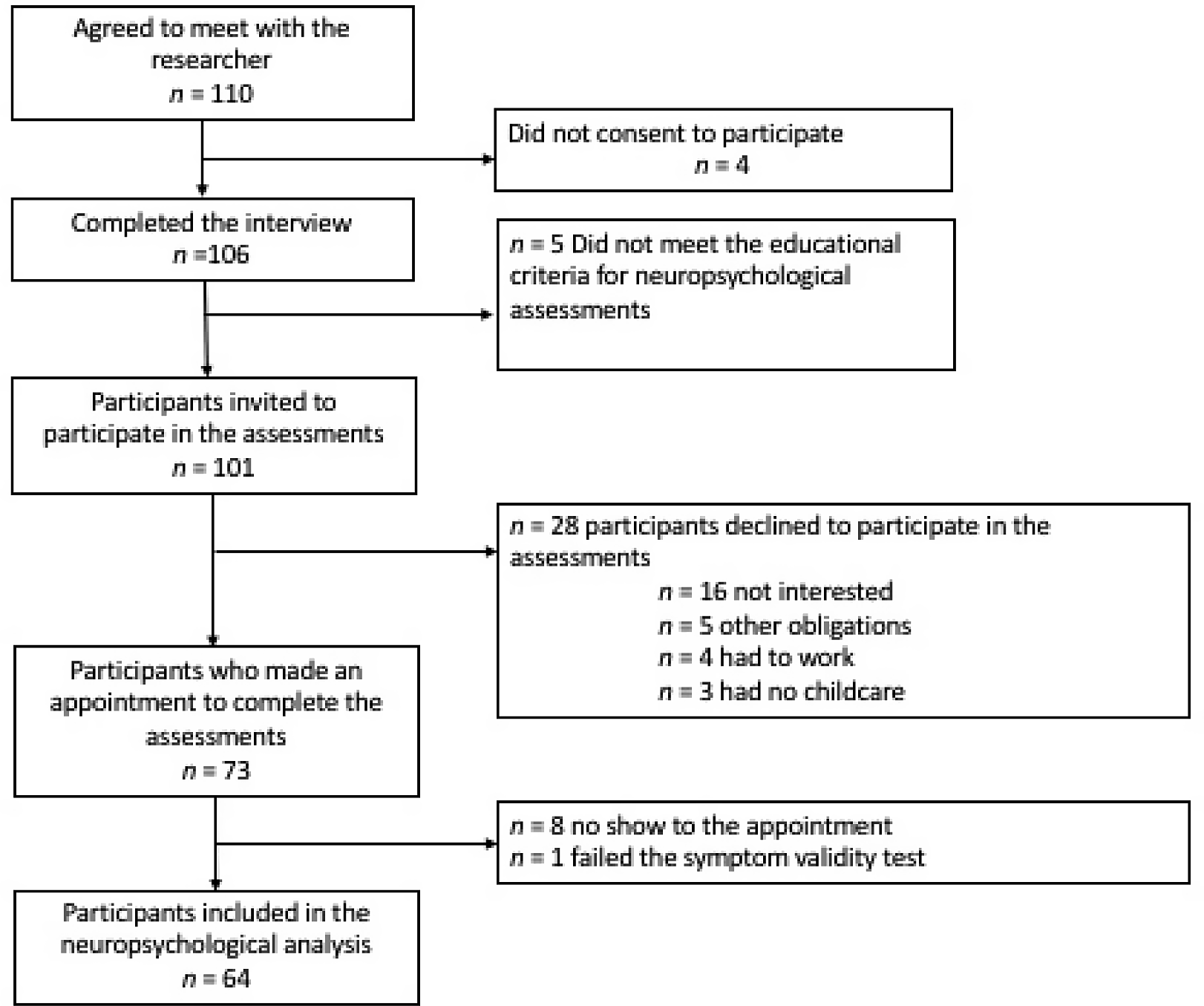
There were two parts to this study: an initial interview and a neuropsychological assessment session. Information on TBI history and compliance was collected for each participant who completed the initial interview (N = 106). Following the initial interview, participants were invited to return to complete neuropsychological assessments. Neuropsychological data for 64 participants were available for analysis (see Figure. 1).
Participant flowchart.

Participants
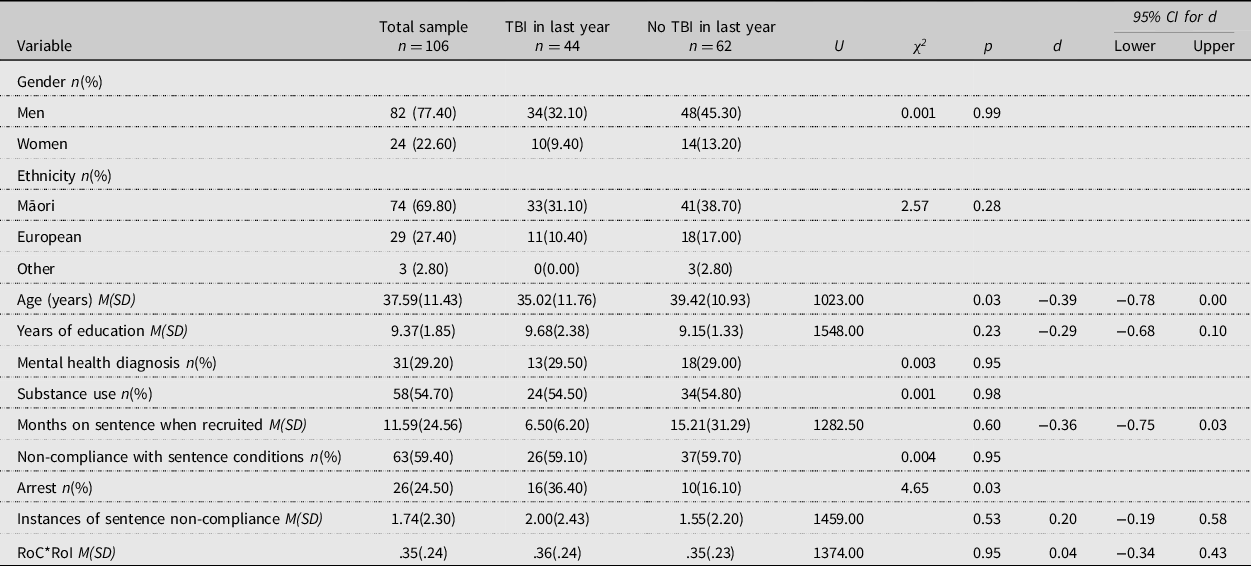
The sample included 82 men and 24 women (Table 1) serving a community supervision sentence of 6 months or more. Participants (N = 106) had a mean age of 37.59 years and predominately identified as New Zealand Māori. Forty-four participants reported sustaining a TBI in the year prior to entering the study. Over half had at least one incident of non-compliance with their sentence conditions, and a quarter had at least one arrest during the 6-month review period. On average, this sample was considered at low risk for reconviction (mean likelihood of reconviction leading to re-incarceration within the next five years of 35% based on the RoC*RoI: see Table 1).
Demographic and other characteristics for the sample overall and those with and without TBI in last 12 months

Note. CI = Confidence Interval, TBI = Traumatic brain injury, RoC*RoI = Actuarial risk of re-conviction leading to re-imprisonment (Low = 0.00-0.40, Medium = 0.41-0.70, High = 0.71-1.00).
Procedure
During group meetings with the primary researcher, probation officers were informed about the purpose of the research and asked to pass on information about the study to people they were supervising on community-based sentences (i.e., supervisees) during routine reporting. If supervisees indicated they were interested, the probation officer introduced the primary researcher and the potential participant. The probation officer then left the meeting room. The primary researcher read the information sheet to the potential participant and asked if they had any questions and if they agreed to continue with the interview. Those who agreed to participate were then given a consent form to sign, which included consent to access their information in the New Zealand Corrections’ electronic database (the Integrated Offender Management System [IOMS]).
Participants completed a semi-structured interview, and following the interview, eligible participants – those who had remained in school beyond 11 years old, and did not report any neurodevelopmental disorders or hearing or sight impairment that would impede their ability to complete the neuropsychological measures – were invited to return and participate in the neuropsychological assessment session at a mutually convenient time. At the start of this second session, the primary researcher briefly explained what the session would encompass and answered any questions the participant had. Next, participants gave written informed consent. The assessments (see Sources of information) were administered in the same order for each participant and took approximately two hours to complete.
Sources of information
Semi-structured interview
A semi-structured interview was used to gather information from participants about their demographic characteristics, education level, psycho-social histories, TBI histories and community compliance. Participants were asked if they had a mental health diagnosis for a number of different mental health disorders, and questions related to the pattern of substance use (e.g., how often, for how long), including current problematic (e.g., unable to quit, interferes with obligations) substance use for a number of different substances (e.g., alcohol, marijuana, methamphetamine, opiates, hallucinogens, inhalants).
Traumatic brain injury screen
The Ohio State University Traumatic Brain Injury Identification Method-Short Form (OSU-TBI-ID) was administered to assess for lifetime history of TBI (Corrigan & Bogner, Reference Corrigan and Bogner2007). The OSU-TBI-ID is a structured interview based on US Center of Disease Control and Prevention definitions and best practices in identifying and diagnosing TBI (Corrigan & Bogner, Reference Corrigan and Bogner2007). Questions cover injury aetiology, including cause of injury, age at incident and any LOC, and its duration. We used this information to identify those who had or had not sustained a TBI in the year prior to their recruitment into the study.
Neuropsychological assessments
Overall neuropsychological functioning was measured using The Repeatable Battery for the Assessment of Neuropsychological Status (RBANS; Randolph, Reference Randolph1998). The RBANS produces index scores for five domains: Immediate Memory, Language, Visuo-Spatial Constructional, Attention and Delayed Memory. A total score is calculated using these five domains. During the initial validation of the RBANS, a group of individuals with TBIs (of mixed severity) were assessed. Results indicated significant deficits across all indices, with the TBI population obtaining the lowest scores on the attention index and the total score (Randolph, Reference Randolph1998). In a study that compared a TBI population with a control group, the researchers demonstrated the clinical utility, and sensitivity of the RBANS with a TBI population, with the attention index showing the greatest sensitivity to TBI (McKay, Wertheimer, Fichtenberg, & Casey, Reference McKay, Wertheimer, Fichtenberg and Casey2008). Furthermore, individuals who have recently been concussed have obtained significantly lower scores on the RBANS total score and attention index than healthy controls, indicating that the RBANS is useful for assessing the effects of concussion (Moser & Schatz, Reference Moser and Schatz2002).
Two tests from the Delis Kaplan Executive Function System (Delis, Kaplan, & Kramer, Reference Delis, Kaplan and Kramer2001) were administered to assess areas of executive functioning. The Color-Word Interference Test (CWIT) inhibition and inhibition switching trials assessed participants’ inhibitory control, and The Comprehensive Trail Making Test (CTMT), number letter switching trial assessed participants’ mental flexibility and behavioural inhibition. The Word Memory Test (WMT; Green, Allen, & Astner, Reference Green, Allen and Astner1996) was used to assess symptom validity.
Correctional data
New Zealand Corrections’ electronic database, the IOMS, holds information important to managing people on current sentences. Compliance data, amount of time on sentence and estimated risk of re-conviction/re-imprisonment (RoC*RoI) scores were obtained from the supervising probation officer’s notes in IOMS.
Non-compliance information from probation officer notes and police records was collected for each participant over a 6-month period: typically 3 months before and 3 months after enrolment in the study. Any instance of non-compliance with sentence conditions, whether or not it resulted in formal action was recorded, and the total instances of non-compliance with sentence conditions for each person was calculated. Any record of an arrest was also recorded as “non-compliant with the law.”
Participants’ actuarial risk of recidivism was estimated using the Department of Corrections’ RoC*RoI algorithm (Bakker, Riley, & O’Malley, Reference Bakker, Riley and O’Malley1999). The RoC*RoI estimates an offender’s five-year probability of a conviction serious enough to lead to a new prison sentence. The automatically generated score is based on static criminal history and demographic variables – not dependent on clinical judgements or the offender’s current behaviours – with scores ranging from 0 to 1. It has very good predictive validity (Bakker et al., Reference Bakker, Riley and O’Malley1999).
Statistical analysis
Data were entered into SPSS 25 for statistical analysis. One participant’s data weres excluded from the neuropsychological analysis due to exceeding symptom validity cut-offs for the WMT; another participant was excluded from the CTMT analysis as they exceeded the test time limit. All neuropsychological scores were transformed into standard scores (M = 100, SD = 15). Prior to any further analysis, Kolmogorov-Smirnov and Shapiro-Wilk tests were performed on the neuropsychological test scores, age, instances of non-compliance with sentence conditions, length of time on sentence, years of education and RoC*RoI, to assess for normality. For the variables that were not normally distributed, non-parametric tests were used (e.g., Mann-Whitney U test).
Next, univariate statistical analyses were used to compare those who only participated in the interview (n = 42) and those who participated in both the interview and neuropsychological assessments (n = 64; see Appendix 1) on demographic characteristics, TBI histories and compliance variables. Sample characteristics for the total sample (N =106) and those with or without a TBI in the last year were calculated. Univariate statistical analyses were used to compare those who sustained a TBI in the last year and those who did not on demographic characteristics and compliance variables (Table 1). Then, for those completing the neuropsychological assessments, univariate statistical analyses were used to compare those with a TBI in the last year and those without on compliance and neuropsychological function, and to compare neuropsychological functioning of compliant and non-compliant participants. To investigate if other factors were related to neuropsychological scores, univariate statistical analyses were used to compare those with a current substance use problem with those without, and those with or without a current mental health diagnosis. Bivariate correlations were used to explore the association between years of education and neuropsychological function. Kendall’s Tau (τ) was used for correlations involving the count of instances of non-compliance with sentence conditions and years of education, due to the small sample size and large number of tied ranks within these variables. Cohen’s criteria (Cohen, Reference Cohen1988) were applied to interpret the effect size (d qualitatively described as small (.20), medium (.50), and large (≥ .80; Cohen, Reference Cohen1988). Effect sizes for univariate analyses of continuous variables were estimated by means of Cohen’s d (Cohen, Reference Cohen1988), and the 95% confidence intervals around the effect size estimates were also computed (Cumming, Reference Cumming2013).
Results
We first compared those who only participated in the interview (n = 42) and those who completed both the interview and neuropsychological assessments (n = 64; see Appendix 1). There were no statistically significant differences with regard to demographic characteristics, TBI histories or compliance with sentence conditions or the law.
Traumatic brain injury
Eighty-four percent of participants reported sustaining a TBI with LOC in their lifetime (M = 6.01, SD = 15.60, range = 0-104). Four participants reported never having sustained a TBI, while 13 reported experiencing a TBI but without LOC. Characteristics for those with and without a TBI in the last year and for the total sample are presented in Table 1; 41% (n = 44) of the participants reported sustaining a TBI in the year prior to entering the study and 25% (n = 11) of those sustained a TBI with LOC – nine participants reported a mild TBI (LOC = < 30 minutes), one reported a moderate TBI (LOC = 30 minutes to 24 hours), and one participant reported sustaining a severe TBI (LOC = > 24 hours). Those who sustained a TBI in the last year were significantly younger than those who did not sustain a TBI in the last year. The most common cause of a TBI in the last year reported by this sample was fighting (n = 28), followed by motor vehicle crash (n = 9), banging head on an object (self-harm; n = 8), sports (rugby, n = 5), interpersonal partner abuse (IPV; n = 5) and being struck by an object (e.g., scaffolding; n = 5).
Neuropsychological performance
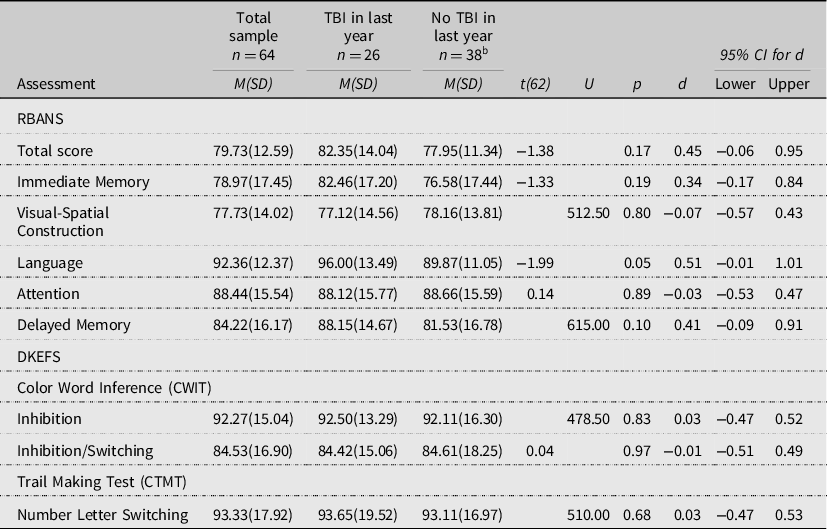
For the 64 participants assessed, overall neuropsychological performance was poor (Table 2). Performance on the RBANS was in the ‘borderline’ range as indicated by a mean total score of 79. Scores on the immediate memory domain and visual spatial construction domains were also in the borderline category. Performance on the attention and delayed memory domains were slightly higher, falling into the low average range. In contrast, the mean score on the language domain was in the average score range. Standard scores on the executive functioning measures were mixed, falling into the ranges qualitatively described as average (90-110) and low average (80-89). The CWIT – inhibition and inhibition switching trials – were in the average and low average categories, respectively, while mean scores on the CTMT number letter switching were in the average range. There were no statistically significant differences in neuropsychological test scores between those with or without a current substance use problem or between those with or without a mental health diagnosis (data not shown for brevity). More years of education were significantly associated with better scores on RBANS total score (τ = 0.23, p = .01), immediate memory (τ = 0.27, p = .004), language (τ = 0.21, p = .02) and CTMT number letter switching (τ = 0.22, p = .03). Years of education was not significantly associated with the other domains measured (data not shown for brevity).
Mean neuropsychological scores for the subsample and by those with a TBI in the last year and those without

Note. CI = Confidence Interval, RBANS = Repeatable Battery for the Assessment of Neuropsychological Status, DKEFS = Delis Kaplan Executive Function System.
Scores are qualitatively described based on their ranges: < 69 = impaired, 70-79 = borderline, 80-89 = low average, 90-110 = average, > 111 = high average [35].
b n = 37 for Trail Making Test (CTMT) Number Letter Switching trial
There were no statistically significant differences between those with and without a TBI in the last year on the neuropsychological assessments; in fact, on some measures those who had a recent TBI performed slightly (albeit non-significantly) better than those who had not sustained a TBI in the last year (Table 2).
Compliance
Next, we compared the neuropsychological test scores of those who were non-compliant with sentence conditions or the law to those who were compliant. We found no statistically significant differences between the groups (data not shown for brevity). Additionally, there were no significant correlations between the total instances of non-compliance with sentence conditions and scores on the neuropsychological assessments. Therefore, as neuropsychological performance did not appear to be related to non-compliance, the whole sample (N = 106) was used for the remaining analyses.
Over half of the sample had at least one instance of non-compliance with sentence conditions (range 0-14), and a quarter had non-compliance with the law (i.e., arrest; see Table 1). With regard to sentence compliance, the most common non-compliant activity was failure to report to the probation officer, with 89% of those who were non-compliant with their sentence conditions having at least one instance of failure to report.
Chi-square tests showed no significant association between TBI in the last year and non-compliance with sentence conditions, nor was there a significant difference between those with and without TBI in the last year and the mean instances of non-compliance with sentence conditions. In contrast, there was a significant association between TBI in the last year and arrest; the proportion of those participants who experienced a TBI in the last year and were arrested (36%) was significantly higher than the proportion of those without a recent TBI who were arrested (16%). Given the association between TBI in the last year and arrest we decided to undertake a logistic regression to further examine the ability of TBI in the last year to predict arrest while controlling for variables shown in previous research to be associated with an increased risk of criminal behaviour (Bonta & Andrews, Reference Bonta and Andrews2016). The first step was to explore potential covariates using bivariate correlations and chi-square analysis, to decide what to include in the logistic regression to predict arrest. We planned to include all variables significantly correlated with arrest at p ≤ 0.05 in the regression.
The univariate analyses revealed that age (U = 816, p = .10), years of education (U = 1095, p = .68) and length of time on sentence (U = 826, p = .12) were not significantly associated with arrest; however, the actuarial risk score (RoC*RoI; U = 1348, p =.02) was significantly associated with arrest. Those with an arrest had a significantly higher RoC*RoI score (M = 0.44, SD = .24) than those without an arrest (M = 0.32, SD = .23). Chi-square analysis showed that current substance use was also significantly associated with arrest (χ2 = 12.43, p = <.001), and current mental health diagnosis (χ2 = 1.41, p = .23) was not. Based on these results, TBI in the last year, current substance use and RoC*RoI score were entered into the logistic regression to predict arrest.
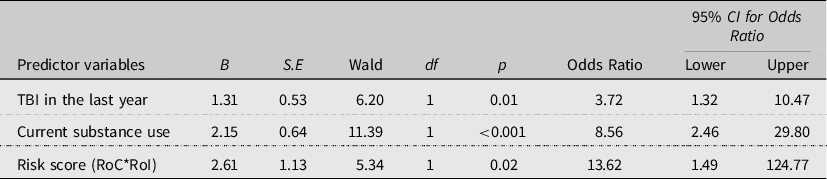
Prior to conducting the logistic regression, we checked that the data met all assumptions. The sample size was large enough to provide adequate power for the number of predictor variables used, to detect medium to large effects (Field, Reference Field2013). The final regression model incorporating TBI in the last year, current substance use and risk of re-conviction/re-imprisonment score (RoC*RoI) was significant in predicting arrest, χ2 = 25.79, p = < .001(Table 3). Each predictor made a significant unique contribution to the model. For those with a TBI in the last year, the odds of being arrested increased by a factor of 3.72, for those who reported current substance use the odds increased by a factor of 8.56, and for every one-unit increase on the RoC*RoI score, there was 13.62 times increase in risk of arrest.
Logistic regression coefficients for independent variables used to predict arrest

Note. CI = Confidence Interval, RoC*RoI = Actuarial risk of re-conviction leading to re-imprisonment.
Discussion
This is the first study to investigate the associations between a TBI in the last 12 months, neuropsychological functioning and three indices of non-compliance in those serving community sentences. Contrary to our expectations, recent TBI was not associated with poorer neuropsychological functioning, and neuropsychological functioning was not significantly related to any of the non-compliance indices. As predicted, TBI in the last year was significantly associated with an increased likelihood of non-compliance with the law (i.e., arrest) even after controlling for the covariates static estimate of risk of re-conviction/re-imprisonment score (RoC*RoI) and current substance use. However, there was no significant association between recent TBI and either of the indices for non-compliance with sentence conditions.
Consistent with the literature examining prevalence of TBI among incarcerated samples, the lifetime rate of TBI in this sample was high. Nearly, all participants reported at least one incident of TBI in their lifetime, with 84% reporting at least one incident of TBI with LOC. In the year prior to entering the study, nearly half of our sample experienced a TBI, and 10% experienced a TBI with LOC. Compared to the general population in New Zealand, where it is estimated – based on medical records – that 0.79% experience a TBI with LOC each year (Feigin et al., Reference Feigin, Theadom, Barker-Collo, Starkey, McPherson and Kahan2013), our sample’s self-reported prevalence of TBI with LOC over a period of one year is notably higher. The most common cause of TBI in the last year for this sample was assault (fights, interpersonal partner violence victimisation). Assault is the most common cause of TBI among individuals with substance use problems, no employment and lower educational achievement (Lezak, Howieson, Loring, & Fischer, Reference Lezak, Howieson, Loring and Fischer2004), shared risk factors for offending.
Overall, our sample’s performance on the neuropsychological measures was poor. Apart from language, inhibition and mental flexibility, the sample’s average performance fell in the ranges qualitatively described as low average and borderline. These findings are consistent with research that shows that offender populations with TBI perform poorly on neuropsychological measures including the RBANS (Pitman et al., Reference Pitman, Haddlesey, Ramos, Oddy and Fortescue2015), and specifically on immediate memory tasks (Nagele, Vaccaro, Schmidt, & Keating, Reference Nagele, Vaccaro, Schmidt and Keating2018). However, language appeared to be a relative strength for our sample; in contrast with other studies which have found language performance – particularly on verbal fluency tasks – to be poor among criminally sentenced samples (LaDuke, DeMatteo, Heilbrun, Gallo, & Swirsky-Sacchetti, Reference LaDuke, DeMatteo, Heilbrun, Gallo and Swirsky-Sacchetti2017; LaVigne & Van Rybroek, Reference LaVigne and Van Rybroek2011). Similarly, our sample performed relatively well on the cognitive inhibition task measured by the CWIT and mental flexibility task measured by the CTMT, both of which require the participant to ignore task irrelevant information (i.e., inhibit cognitive interference). Meta-analyses investigating the association between executive function measures, including the CWIT and the CTMT, and antisocial behaviour have reported mixed results (Morgan & Lilienfeld, Reference Morgan and Lilienfeld2000; Ogilvie, Stewart, Chan, & Shum, Reference Ogilvie, Stewart, Chan and Shum2011). The more recent meta-analysis showed small effect sizes for the CWIT inhibition task (d = .35) and the CTMT number letter switching task (d = .38; Ogilvie et al., Reference Ogilvie, Stewart, Chan and Shum2011). Inhibiting cognitive interference is one "type" of impulsivity, an umbrella term with a number of distinct constructs (Dolan & Fullam, Reference Dolan and Fullam2004; Strickland & Johnson, Reference Strickland and Johnson2021). How impulsivity is defined in the clinical and criminal literature (non-reflective or quick to action when reacting to situations or provocations; Andrews, Bonta, & Wormith, Reference Andrews, Bonta and Wormith2000; Wong & Gordon, Reference Wong and Gordon2000) is not necessarily well related to what is assessed by executive function measures of cognitive inhibition (e.g., ability to control reacting to irrelevant stimuli in a formal assessment setting).
Although the overall performance on neuropsychological tests was poor, there was no significant difference between the scores of those who had and had not received a TBI in the previous 12 months, suggesting that the current neuropsychological functioning of this sample is not influenced by a recent TBI, but by other factors. We did find that more years of education were significantly associated with better performance in immediate memory, language, the RBANS total score and number letter switching. Poorer scores on neuropsychological tasks that require language abilities, as each of the above mentioned tests did, have been associated with lower education attainment (Lam et al., Reference Lam, Eng, Rapisarda, Subramaniam, Kraus, Keefe and Collinson2013). However, the weak correlations found in our study indicate that education is only a part of a larger group of factors contributing to the poorer neuropsychological functioning found in this sample. This sample presented with a constellation of risk factors for poor neuropsychological functioning, including adverse childhood experiences (Malarbi et al., Reference Malarbi, Abu-Rayya, Muscara and Stargatt2017), mental illness (Ellwart et al., Reference Ellwart, Rinck and Becker2003; Vasterling et al., Reference Vasterling, Brailey, Constans and Sutker1998) and substance use (Ramey & Regier, Reference Ramey and Regier2019). Still, there were no statistically significant differences in neuropsychological test scores between those with a or without a current substance use problem or mental health diagnosis. It would be difficult to attribute poor neuropsychological test scores reported in this sample to a single variable. Nonetheless, regardless of the cause, cognitive deficits, particularly poor immediate memory, can have important consequences for a person engaged with the criminal justice system. For example, interactions with police, the courts and corrections staff often involve verbal instructions, but without functional immediate memory the expectation that these individuals could follow such requests might be unrealistic. This can lead to non-compliant responses, which may then be misconstrued as “antisocial,” particularly if people are reluctant to reveal their difficulties to the relevant staff or sufficient language skills mask these less observable cognitive deficits (e.g., memory, attention).
The overall poor neuropsychological performance for many of our participants – with and without recent TBIs – brings into question the capability of some individuals serving community sentences to engage with and benefit from correctional services in their current forms. An interesting finding was that there was no significant difference in the neuropsychological performance between those with non-compliance – with the law or sentence conditions – and those who were compliant, nor was a recent TBI associated with compliance with sentence conditions. In some jurisdictions, including those in the study, probation officers use various strategies to increase their supervisees’ compliance, including text messages, making home visits and being flexible with appointment times, particularly when they are aware that the supervisee has problems (e.g., substance use, cognitive problems; Norman, Wilson, Starkey, & Polaschek, Reference Norman, Wilson, Starkey and Polaschek2021; Ugwudike, Reference Ugwudike, McNeill, Raynor and Trotter2010). These strategies employed by the probation officer are one aspect of probation services that may make compliance particularly difficult to attribute to the supervisee’s neuropsychological functioning.
Even so, our results did show that those with a recent TBI were more than three times more likely to be arrested than those without a recent TBI, even when controlling for a static estimate of risk of re-conviction/re-imprisonment (RoC*RoI) and current substance use, and despite arrest not being associated with neuropsychological functioning. It is possible that the severity of the injuries sustained by this sample in the year prior to entering the study – 75% sustained a TBI without LOC and 20% sustained a mild TBI with LOC, 5% a moderate or severe TBI – mean that for the majority of the participants the effects of the injury might have been resolved by the time of the assessment (Silver et al., Reference Silver, McAllister and Arciniegas2018). It is also likely that involvement in violence and crime is a risk factor for head injuries (Raine, Reference Raine1997), and that a TBI in the last year is an indicator of more aggressive and riskier lifestyles vulnerable to police contact and arrest. The most common cause of TBI in the last year was assault, which is associated with other risk factors for offending (e.g., substance use, antisocial peers, antisocial attitudes). Additionally, a number of sequelae of TBI that are known risk factors for crime are not captured directly in typical neuropsychological assessments – for example, increases in irritability, emotional lability, and decreased self-regulation – but could exacerbate existing antisocial behaviour and make ongoing offending more likely. Perhaps it is these factors that account for the more than three-fold increase in the odds of arrest that we found. This argument, although speculative, is strengthened by the finding that the presence of a recent TBI uniquely predicted increased odds of arrest, even when the RoC*RoI and current substance use were included in the regression. A body of research has established a relationship between substance use problems and increased risk of re-arrest (Baillargeon et al., Reference Baillargeon, Penn, Knight, Harzke, Baillargeon and Becker2010; DeLisi, Drury, & Elbert, Reference DeLisi, Drury and Elbert2021; Wilson, Draine, Hadley, Metraux, & Evans, Reference Wilson, Draine, Hadley, Metraux and Evans2011; Yukhnenko, Blackwood, & Fazel, Reference Yukhnenko, Blackwood and Fazel2020); however, the RoC*RoI’s ability to predict arrest has not been investigated. The RoC*RoI score is a probability estimate of an individual’s risk of reconviction that will result in reimprisonment over the next five years in the community (Bakker et al., Reference Bakker, Riley and O’Malley1999) and is widely used in the New Zealand correctional system as a triage instrument for making sentencing decisions. Although it has shown in multiple studies to be highly predictive both of reimprisonment and even reconviction that does not lead to imprisonment, it was not designed to predict arrest. This study demonstrates that it is highly predictive of arrest, and despite that, the recent TBI indicator was still itself a strong predictor.
Studies of relationships between TBI and official criminal outcomes (arrest, conviction, sentencing) to date tend to overlook the importance of controlling for the conglomeration of other factors that covary with TBI and are themselves also predictive of criminal outcomes (Mitchell et al., Reference Mitchell, Theadom and du Preez2017). People who are involved in crime for any length of time have many lifestyle factors that increase the risk of TBIs, as well as the risk of crime due to other causal factors. A static risk instrument based on criminal history and demographic variables arguably serves as a proxy for all of those factors, including any crime-resulting consequences of previous TBIs for the person, since these are high-frequency experiences for people with criminal histories. But the RoC*RoI would be relatively insensitive to recent changes in risk such as those that may follow from a recent TBI. Adding in the recent TBI variable after controlling for previous history and current substance use creates a slightly stronger argument that the TBI itself may be influencing criminal behaviour, although of course substantial further investigation of changes in lifestyle and other sequelae are needed to test this idea thoroughly.
Implications
Our findings indicate that individuals serving community sentences who sustained a TBI in the previous 12 months are at increased risk for being arrested. A TBI in the last year is an independent predictor of arrest beyond that associated with New Zealand’s current static measure of risk (RoC*RoI) and substance use. Together these findings highlight that individuals with a recent TBI serving a community sentence may need additional monitoring and support, possibly including referral to TBI services in order to reduce the likelihood of rearrests. A practical option would be for probation services to implement a TBI screen and a referral procedure designed to access appropriate support services in the community for those who report recent head injuries or current TBI symptoms.
Future research
Future research should include assessments that capture real world scenarios, or how a person is functioning on a daily basis, rather than the typically abstract tasks used in standard neuropsychological assessments. Self-reports from those serving community sentences describing why they are non-compliant could expand on understanding the mechanisms that influence compliance with community sentence outcomes. Future research could also explore the rate of those arrested who report sustaining a recent brain injury and the current symptoms they are experiencing to gain a better understanding of how consequences of TBIs are associated with increased arrest.
Study limitations
This study has a number of limitations, including the use of a convenience sample and the reliance on self-report of TBI. While many studies rely on medical records to determine the incidence of TBI, many people do not seek medical attention for mild injuries (Bazarian et al., Reference Bazarian, Mcclung, Shah, Ting Cheng, Flesher and Kraus2005; Ribbers, Reference Ribbers2007; Vink & Nimmo, Reference Vink and Nimmo2002), and our sample rarely reported seeking medical attention for a TBI particularly when the cause of the injury was fighting or IPV.
In terms of generalising our results to other community based correctional clients, limitations include (1) the small sample size and non-representative nature of the sample, (2) the limited nature of the neuropsychological assessment (e.g., does not include an ecological measure) and (3) the scope for discretion of probation officers in how they manage their supervisees, and report issue of non-compliance (Sorsby, Shapland, & Robinson, Reference Sorsby, Shapland and Robinson2017). In addition, we acknowledge that there may be differences in demographics and socio-economic status between our sample and the RBANS normative sample which may exaggerate the cognitive deficits observed (Ogden & McFarlane-Nathan, Reference Ogden and McFarlane-Nathan1997). Recruitment of a healthy (TBI-free) comparison group from the same population would be ideal, but given the high rates of TBI, this was not feasible.
Lastly, the study’s cross-sectional design does not allow us to do more than speculate about the potential underlying mechanisms in the relationship between a recent TBI and being arrested. As we noted, those who repeatedly break the law share a number of characteristics/risk factors with those who sustain TBIs, including a history of low educational attainment, unstable employment and problematic substance use (Bonta & Andrews, Reference Bonta and Andrews2007; Parry-Jones, Vaughan, & Miles, Reference Parry-Jones, Vaughan and Miles Cox2006; Ponsford, Olver, & Curran, Reference Ponsford, Olver and Curran1995). Effort to disentangling the putative effects of TBI either cumulatively, over the person’s lifetime, or even for recent injuries simply may not be possible, particularly when one understands that common TBI sequelae are already identified as risk factors for crime, regardless of whether they are caused by TBIs or other factors (e.g., impulsivity, emotional volatility; Bonta & Andrews, Reference Bonta and Andrews2016).
Conclusions
This study contributes to a large gap in the correctional sentence compliance literature by investigating associations between TBI, neuropsychological functioning, and three indices of non-compliance in those serving community sentences. The results suggest that supervisees who sustain a TBI or continue to abuse alcohol or drugs while under community supervision may need additional supports, monitoring and services to reduce the risk of re-offending. Our study confirms that people serving community sentences have deficits in some areas of neuropsychological functioning and high rates of TBI, but in contrast to our expectations and previous research, recent TBI and neuropsychological performance were not related, and although TBI in the last 12 months was predictive of arrests, overall neuropsychological performance was not. Future investigation is needed into whether the importance of TBI in the criminal justice system is due to its effects on neuropsychological performance or to other potential sequelae that are more directly related to compliance outcomes (e.g., changes in emotional and self-regulation).
Financial Support
This work was supported by the University of Waikato Doctoral Scholarship.
Conflict of Interest
None
Ethical Standards
The authors assert that all procedures contributing to this work comply with the ethical standards of the relevant national and institutional committees on human experimentation and with the Helsinki Declaration of 1975, as revised in 2008.
Appendix 1. A comparison of the demographic characteristics of participants completing the interview only and the subsample, those who completed both the interview and the neuropsychological assessment

Note. CI = Confidence Interval, RoC*RoI = Actuarial risk of re-conviction leading to re-imprisonment