Introduction
Social cognitive deficits represent a particularly incapacitating feature in patients with schizophrenia (Fett et al. Reference Fett, Shergill and Krabbendam2014); and are intimated by the smaller social networks and reduced employment rates of affected individuals (Erickson et al. Reference Erickson, Beiser, Iacono, Fleming and Lin1989; Marwaha & Johnson, Reference Marwaha and Johnson2004). Comprehensively characterizing these impairments is warranted on the basis that they often predate positive symptoms and predict poor functional outcome (Monte et al. Reference Monte, Goulding and Compton2008).
Effective interpersonal communication depends on the entwined abilities of understandably conveying one's intentions and reciprocally inferring the intentions of others. While verbal communication in schizophrenia is clearly critical and has been widely investigated, with observed deficits in behavioural and functional imaging indices of language generation, perception and comprehension (DeLisi, Reference DeLisi2001; Li et al. Reference Li, Branch and DeLisi2009; Simons et al. Reference Simons, Tracy, Sanghera, O'Daly, Gilleen, Dominguez, Krabbendam and Shergill2010), non-verbal communication is equally important but has received less interest. Non-verbal communication – comprising gesture, posture, head and body movement, and facial expression – contributes extensively to interpersonal interactions (Burgoon et al. Reference Burgoon, Buller and Woodall1989), and takes on heightened importance when linguistic communication is compromised by situational circumstance or personal difficulty. In terms of gestural output, ethographic and motion-based approaches have suggested that individuals with schizophrenia exhibit reduced variability and complexity of facial movements (Troisi et al. Reference Troisi, Pompili, Binello and Sterpone2007); reduced temporal coordination between facial expression and speech (Ellgring, Reference Ellgring1986); and fewer hand gestures compared to healthy individuals and those with depression (Annen et al. Reference Annen, Roser and Brune2012). It has also been shown that individuals with schizophrenia are less able to imitate viewed gestures, and that working-memory deficits specifically exacerbate these deficits (Matthews et al. Reference Matthews, Collins, Thakkar and Park2014). In terms of gestural decoding, Bucci and colleagues reported that when required to assess short, silent video-clips, individuals with schizophrenia perform similarly to controls in the identification of archetypal gestures but are more likely to judge incidental movements as communicative. This perceptual anomaly was subsequently reported to be evident to a greater degree in patients with delusions of communication (Bucci et al. Reference Bucci, Startup, Wynn, Baker and Lewin2008a , Reference Bucci, Startup, Wynn, Heathcote, Baker and Lewin b ).
Inferring the intended recipient of a particular gesture is critically important, since it governs the manner and extent to which the viewer acts upon its message. Several lines of indirect evidence suggest related judgements may be disrupted in schizophrenia. A self-referential bias, whereby environmental events are incorrectly believed to be personally directed, is fundamental to delusions of communication; and impairments in self-reflective processing have been shown experimentally (Bedford & David, Reference Bedford and David2014; Shad et al. Reference Shad, Keshavan, Steinberg, Mihalakos, Thomas, Motes, Soares and Tamminga2012). Inappropriate self-referential processing could arise as a consequence of a dysfunction at several different perceptual, cognitive or metacognitive levels. At an elementary level, perceptual dysfunction such as a loss of visual or auditory acuity could evoke hallucinatory experience. At an intermediate level, an enhanced inclination towards self-reference could arise through inappropriate attentional or contextual processing. High-level, metacognitive judgements, such as convictions associated with a self-referential judgement, could break down when schema influencing the persistence or extinction of related beliefs are predicated on incorrect evaluation of corroborative or contrary evidence. This staged approach has been used in understanding symptoms such as auditory hallucinations and delusions of control which emphasize dysfunctional self-monitoring (Frith & Done, Reference Frith and Done1988).
This study aimed to investigate gesture perception at multiple inferential levels. Gestures are complex perceptual stimuli, whose identification relies upon fine-grained processing of localized hand movements, pattern matching to a learned gestural vocabulary despite variation in performance, and inferring the intentionality of the actor (Crais et al. Reference Crais, Douglas and Campbell2004). Nevertheless, within this framework, gestural recognition – as the most fundamental requirement of processing – can be considered low level. Contextual refinement of gestural meaning, which alters factors such as the intended recipient of a communicative movement, builds on gestural identification and is therefore a mid-level process. Finally, related metacognitive judgements, such as confidence ratings, are accessible representations of high-level processing. Additional motivation for investigating metacognitive evaluation in relation to social cognition is provided by recent suggestions that these processes share anatomical substrates (Timmermans et al. Reference Timmermans, Schilbach, Pasquali and Cleeremans2012; Schilbach et al. Reference Schilbach, Timmermans, Reddy, Costall, Bente, Schlicht and Vogeley2013).
Previous null differences between individuals with schizophrenia and controls in their sensitivity to identify gestures (Bucci et al. Reference Bucci, Startup, Wynn, Heathcote, Baker and Lewin2008 b), drove our first hypothesis that patients would proficiently identify archetypal gestures. Our second hypothesis was that individuals with schizophrenia would be less able than controls to modify gestural comprehension by context. More specifically, it was hypothesized that the schizophrenia group would exhibit a self-referential bias (Gallagher, Reference Gallagher and Zahavi2000), inferring that gestures were personally directed irrespective of the weight of evidence in favour of this conclusion. This latter effect was predicted on the basis of self-related attributional biases (Daprati et al. Reference Daprati, Franck, Georgieff, Proust, Pacherie, Dalery and Jeannerod1997; Knoblich et al. Reference Knoblich, Stottmeister and Kircher2004; Werner et al. Reference Werner, Trapp, Wustenberg and Voss2014) and compromised probabilistic reasoning in schizophrenia in conditions of uncertainty – most replicably manifest as a jumping-to-conclusions bias (Huq et al. Reference Huq, Garety and Hemsley1988; Joyce et al. Reference Joyce, Averbeck, Frith and Shergill2013; Moritz & Woodward, Reference Moritz and Woodward2005) – in turn explicable in terms of increased acceptance of a hypothesis-evidence match. It was also hypothesized that individuals with schizophrenia would display less robust relationships between communicable, metacognitive judgements made in association with gesture perception, the veracity of gesture perception and their self-ratings of metacognitive traits. Breakdown of these relationships has the potential to impact an individual's ability to appropriately modify their own behaviour in terms of received gestural content and also their capability to usefully contribute to multi-personal communication, which could precipitate their social isolation. Finally, on account of the fundamental role of salience attribution and its aberrance in contextual modification of processing and cardinal symptoms of psychosis respectively (Gray, Reference Gray1995; Kapur, Reference Kapur2003), and theorized disturbance between low-level processing and its metacognitive representation in delusional states (Moritz & Woodward, Reference Moritz and Woodward2005), it was hypothesized that the severity of positive psychotic symptoms would be related to the predicted impairments in individuals with schizophrenia.
Method
Participants
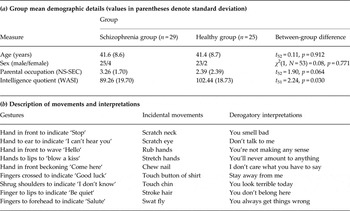
Twenty-nine right-handed individuals satisfying DSM-IV (APA, 1994) criteria for schizophrenia or schizoaffective disorder [age (mean ± s.d.) 41.6 ± 8.6 years, four females] and 25 right-handed control subjects (age 41.4 ± 8.7 years, two females) group-matched for age, sex and socioeconomic background calculated on the basis of National Statistics Socio-Economic Classification (Rose & Pevalin, Reference Rose and Pevalin2001), were recruited to take part in this behavioural study. Ethical approval was provided by Bromley Research and Ethics Committee. All participants provided informed written consent and were given a monetary inconvenience allowance for participation in the study.
Patients were excluded if presenting evidence of co-morbid Axis I diagnosis, significant medical illness or an intelligence quotient (IQ) < 85. Symptom severity and classification were assessed in the schizophrenia group using the Positive and Negative Syndrome Scale (PANSS; Kay et al. Reference Kay, Fiszbein and Opler1987) for schizophrenia. They scored 15.74 ± 4.10 for the positive subscale (including a score of 2.87 ± 1.30 for hallucinations and 2.50 ± 1.56 for delusions); 18.00 ± 5.44 for the negative subscale; and 30.78 ± 6.22 for the general psychopathology subscale.
All individuals with schizophrenia were medicated at time of study. Twenty-seven of these were prescribed atypical antipsychotic medications [clozapine (n = 10), olanzapine (n = 8), quetiapine (n = 1), risperidone (n = 1), aripiprazole (n = 1), risperdal consta (n = 4), paliperidone (n = 1), pipothiazine palmitate (n = 1)] and two were prescribed typical antipsychotic medications [flupenthixol (n = 2)] at time of participation. Chlorpromazine equivalent of antipsychotic medication dosage was calculated according to published conversion tables (Woods, Reference Woods2003) and observed to be a mean of 624.8 ± 478.3 mg chlorpromazine daily.
Healthy volunteers were recruited by local poster advertisement. Respondents were excluded from the study if they reported a personal history of psychiatric or neurological illness; exhibited a major current physical illness or an IQ < 85; had a recent history of illicit substance use; or a history of psychotic illness in a first-degree relative. IQs were calculated for each subject using the Wechsler Abbreviated Scale of Intelligence (WASI; Wechsler, Reference Wechsler1999), and were lower in individuals with schizophrenia than in control subjects. Each participant also completed the 30-item Metacognitions Questionnaire (MCQ-30; Wells & Cartwright-Hatton, Reference Wells and Cartwright-Hatton2004), which evaluates subjective beliefs concerning five dimensions of explicit metacognitive function. Table 1 provides further demographic characteristics of the sample.
Demographic information and description of viewed actions

NS-SEC, National Statistics Socio-economic Classification (Rose & Pevalin, Reference Rose and Pevalin2001); WASI, Wechsler Abbreviated Scale of Intelligence (Wechsler, Reference Wechsler1999); PANSS, Positive and Negative Syndrome Scale (Kay et al. Reference Kay, Fiszbein and Opler1987).
Experimental task
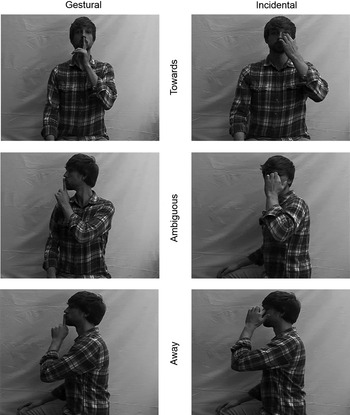
All participants completed an amended version of the gesture perception task developed by Bucci et al. (Reference Bucci, Startup, Wynn, Baker and Lewin2008a ), run using the Cogent toolbox (http://www.vislab.ucl.ac.uk/cogent_2000.php) in Matlab (version 7.12; Mathworks Inc., USA). This self-paced version probed perceptions of self-reference and related confidence ratings in addition to gesture identification. In each of 60 trials the participant viewed a 3-s video clip in which a male actor made either a communicative gesture or an incidental movement (see Fig. 1 and Table 1), directed either: (a) fully towards the observer; (b) ambiguously – some non-verbal cues were directed towards the observer (for instance, gaze) but others were not (for instance, body posture); or (c) away from the observer – movements were clearly visible but directed perpendicularly to the observer.
Experimental stimuli, showing example gestural video-clips in the left column, and example incidental movements in the right column. Movements were performed towards (top row), ambiguously (middle row) or perpendicularly (away; bottom row) in relation to the viewer.

After each video-clip the participants were required to make a four-alternative forced choice of the actor's movement. For gestural movements the four options included (in random order): the intended gesture; another, incorrect gesture selected randomly (from the full list); a derogatory interpretation of the gesture; and no intended gesture. For incidental movements the presented options were: two randomly selected gestural interpretations; a derogatory interpretation; and no intended gesture. After each report, the participants were additionally required to judge their subjective confidence in relation to this judgement using a visual analogue scale (VAS) ranging from 0 (not confident) to 10 (confident). Participants were next required to judge whether or not they were the targeted recipient of any movement. Finally, they provided a VAS confidence rating in relation to this judgement. The order in which the videos were played was randomized for each participant; and participants were given unlimited time to make each judgement.
Statistical analysis
Summary performance data were evaluated using Matlab and exported to the Statistical Package for Social Sciences (SPSS; version 21; IBM Inc., USA) for statistical evaluation. To investigate between-group differences in the correct identification of movements and their modification by the direction in which the gesture was performed and the type of movement, a 2 × 3 repeated-measures analysis of variance (ANOVA) was used, including movement type (gestural/incidental) and movement direction (towards/ambiguous/away) as within-subject factors and study group as the between-subject factor.
To investigate between-group differences in the extent to which gestures were perceived to be intended for the participant and their modification by direction, a 1 × 3 repeated-measures ANOVA was used in which the three directions of movement made up within-subject levels and group was the between-subject factor.
Confidence ratings were categorised by task performance since this better enables evaluation of their adaptive value. However, this approach – coupled with the performance distribution of the current sample (as shown by number of participants contributing to each measure in Table 3) – precluded investigation of modulation of confidence ratings via omnibus tests. Instead, exploratory analyses of within- and between-subject effects were conducted using t tests on confidence measures for which the majority of both study groups contributed to the mean. The significance threshold for these tests was calculated via Bonferroni correction reflecting the number of confidence-rating measures assessed. The corrected α of 9 × 10⁻⁴ was prohibitive; as such, findings significant at an uncorrected α of 0.05 are additionally reported for illustration.
Relationships between self-ratings of metacognitive traits and task performance were evaluated in a series of multiple regression analyses, which included subscale total scores for each MCQ-30 dimension as independent variables and task performance (in terms of rate at which movements were correctly identified, rate at which gestures were personally intended, and related confidence judgements for each type of video clip) as dependent variables. The threshold for ascribing significance in these tests was Bonferroni corrected to 0.002 on account of the number of tests conducted.
The extent to which the severity of current hallucinatory experience and delusional belief in the schizophrenia group predicted task performance and related confidence ratings was investigated with a series of multiple regression analyses, in which PANSS scores for hallucinations and delusions were included as independent variables and task performance/confidence was included as the dependent variable. The threshold for significance in these analyses was Bonferroni corrected to 0.002.
Results
Gestural identification
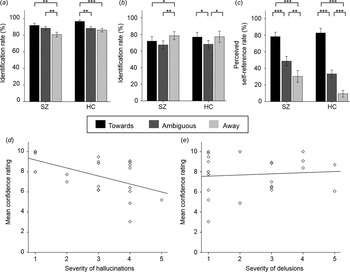
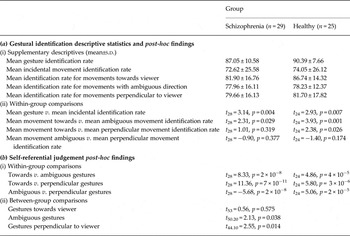
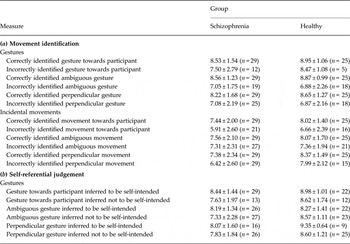
Significant main effects of movement type (gestural v. incidental) (F 2,53 = 18.50, p = 7 × 10⁻⁵, effect size R = 0.51) and direction (F 2,53 = 8.83, p = 3 × 10⁻⁴, effect size R = 0.38) were observed in identification judgements (Table 2). Post-hoc tests revealed better identification of communicative gestures than incidental movements (Table 2). Similarly, actions performed in the direction of the viewer were more successfully identified than those performed in an ambiguous or perpendicular direction. A significant type×direction interaction was also observed. These findings are presented in Fig. 2. No significant main effect of group or interaction between group and any within-subject factor was observed.
(a–c) Task performance by study group, for (a) identification of gestures, (b) identification of incidental movements, and (c) inferences of intentionality. In (a) mean performance rate denotes the percentage of trials in which the intended gesture was correctly identified; in (b) mean performance rate denotes the percentage of trials in which the participant reported that the action had no intended communicative meaning; and in (c) the mean performance rate denotes the percentage of trials in which the participant reported that the gesture was intended for them. Legend shows direction in which movement was performed. Error bars show 1 standard error of the mean. * Denotes within-group effect significant at p < 0.05; ** denotes within-group effect significant at p < 0.01; *** denotes within-group effect significant at p < 0.001. (d) Scatterplot depicting the inverse relationship between current PANSS score for hallucinations and confidence ratings when judging perpendicularly performed gestures as not personally intended (R 2 = 0.301). (e) Scatterplot depicting the non-significant relationship between current PANSS score for delusions and the same confidence ratings (R 2 = 0.007).

Performance in identification and contextual judgements

Self-referential judgements
Movement direction robustly modulated the extent to which participants inferred that an action was personally intended (F 2,53 = 102.38, p = 5 × 10⁻¹⁸, effect size R = 0.81). Furthermore, effects of direction interacted with study group (F 2,53= 4.79, p = 0.010, effect size R = 0.29). Post-hoc tests demonstrated that individuals with schizophrenia were more likely than controls to judge that gestural movements were meant for them when the gesture was performed in an ambiguous or perpendicular direction; but that they did not perform significantly differently compared with controls when evaluating gestures performed towards them (Fig. 2 and Table 2).
Metacognitive appraisal of performance
Table 3 presents task-related confidence ratings categorized by movement type and group. On account of a highly conservative correction for multiple comparisons, the only significant effect in terms of confidence rating was a significant reduction in confidence when identifying incidental movements compared with communicative gestures performed towards the viewer (t 23 = 4.43, p = 2 × 10⁻⁴, effect size R = 0.68). Supplementary Table S1 presents results significant at an uncorrected α threshold. Supplementary Table S2 displays all significant relationships between metacognitive traits and task performance, including the finding that ratings of cognitive self-consciousness predicted patients’ confidence when reporting that an ambiguous gesture was not personally intended; and that in controls cognitive-confidence ratings negatively predicted confidence that perpendicularly-performed gestures were self-intended.
Task-related confidence ratings

Values are mean ± s.d.
Values in parentheses denote number of participants contributing to confidence rating measure.
Symptom-behaviour relationships
The severity of current hallucinatory experience inversely predicted the confidence ratings of individuals with schizophrenia when judging that perpendicularly performed gestures were not personally intended (B = −0.96 ± 0.27, t 28 = 3.56, p = 0.002, effect size R = 0.34). Fig. 2d is a scatterplot relating to this observation. Hallucinations did not, however, predict any other measure of task or metacognitive performance. Furthermore, current delusional severity did not significantly predict task performance or related metacognitive judgements (Fig. 2e ). Supplementary Tables S3 and S4 report these results in full.
Discussion
Deficits in social cognition impact functional outcome in individuals with schizophrenia. Because non-verbal cues crucially shape communication but remain understudied with respect to the disorder, this behavioural investigation was conducted with focus on gestural perception, related inferences of self-reference, and the relationship between these functions and their metacognitive appraisal in a sample of individuals with psychotic illness and matched controls. A principal finding of this work was that individuals with schizophrenia can decode gestural meaning at similar performance levels to controls – both in terms of identifying gestures and incidental movements. By contrast, significant between-group performance differences were noted in the extent to which gestures were perceived as being personally directed. Individuals with schizophrenia displayed a greater tendency than controls to report ambiguously and perpendicularly performed gestures as self-referential. These observations suggest a modular organisation to theory-of-mind-related function, which in schizophrenia is preserved in terms of its capacity to infer intentionality in terms of low-level communicative messages but disrupted in its (mid-level) ability to glean related contextual cues (Frith, Reference Frith2004).
In demonstrating that the schizophrenia group did not inappropriately infer intentional meaning from incidental movements but did report heightened self-referential feelings, the current study provides evidence for a specific mentalizing impairment in schizophrenia. Hyper-mentalizing, whereby intent is falsely inferred from others’ actions, has been suggested to underlie self-referential, persecutory delusions (Frith & Frith, Reference Frith and Frith1999; Abu-Akel & Bailey, Reference Abu-Akel and Bailey2000) but experimental evidence for this putative deficit is mixed: Individuals with schizophrenia have been found previously to infer cooperation when none is intended (Backasch et al. Reference Backasch, Straube, Pyka, Klohn-Saghatolislam, Muller, Kircher and Leube2013), but to rate theory-of-mind and goal-directed visual scenes lower for intentionality than controls (Horan et al. Reference Horan, Nuechterlein, Wynn, Lee, Castelli and Green2009), and to have specific difficulties understanding visual jokes regarding others’ intentions (Corcoran et al. Reference Corcoran, Cahill and Frith1997). The current findings imply an inability to fully comprehend the mental states of others, which is particularly impaired in situations necessitating judgements of self-reference.
Theoretical accounts have suggested that successfully interpreting gestures potentially relies on a mirror mechanism, whereby the actions of others are understood when viewed because they elicit activity in the systems responsible for their performance (Ortigue et al. Reference Ortigue, Sinigaglia, Rizzolatti and Grafton2010; Rizzolatti & Sinigaglia, Reference Rizzolatti and Sinigaglia2010). In line with this idea, the finding that individuals with schizophrenia can recognise gestures but display disturbances in associated self-judgements of self-relevance implies that the putative mirror mechanism is intact in these individuals but that its monitoring is impaired. The recently-observed association between proficiency at non-verbal perception and gestural production in a sample of schizophrenia patients (Walther et al. Reference Walther, Stegmayer, Sulzbacher, Vanbellingen, Muri, Strik and Bohlhalter2015) also supports the notion of action-acquired cognition and its aberrance in the disorder. Furthermore, there is robust and diverse evidence of misattribution abnormalities in schizophrenia: patients have been found to be more likely to infer self-agency of an alien hand's actions (Daprati et al. Reference Daprati, Franck, Georgieff, Proust, Pacherie, Dalery and Jeannerod1997); and to exhibit difficulties in discriminating self- and other-produced vocal and tactile sensations (Allen et al. Reference Allen, Johns, Fu, Broome, Vythelingum and McGuire2004; Shergill et al. Reference Shergill, Samson, Bays, Frith and Wolpert2005, Reference Shergill, White, Joyce, Bays, Wolpert and Frith2014), with these findings supportive of defective corollary discharge in schizophrenia (Frith & Done, Reference Frith and Done1988).
Conversely, understanding gestures may depend purely on action semantics – the knowledge of particular actions and their meaning (Buxbaum & Kalenine, Reference Buxbaum and Kalenine2010). In this case, our findings feasibly represent incomplete knowledge of archetypal gestures in schizophrenia, such that their basic message is understood but cues relating to its contextual refinement are not accurately processed. This may be a manifestation of a deficit in theory-of-mind or working-memory processes. Alternatively, the impairment may be perceptual. Whereas high-resolution, local visual information is encoded by the ventral pathway, global features are resolved by the dorsal pathway. The current contextual manipulation affected macro-scale visual features such as body direction and posture. Individuals with schizophrenia have been shown to exhibit preferential deficits to dorsal-stream processing (King et al. Reference King, Christensen and Westwood2008; Kim et al. Reference Kim, Norton, McBain, Ongur and Chen2013). A scale-specific perceptual deficit is also implied by patients’ poor detection of low compared with high spatial frequency gratings (Slaghuis, Reference Slaghuis1998). There is also strong evidence that patients are less able than healthy individuals to integrate local information across space to form unified, global concepts (Uhlhaas & Silverstein, Reference Uhlhaas and Silverstein2005), which may in turn reflect reduced attentional resources in schizophrenia, whereby their putative attentional spotlight has reduced scope. This notion is supported by observations that patients have reduced visual span and are less efficient at detecting targets, especially when presented in crowded displays (Elahipanah et al. Reference Elahipanah, Christensen and Reingold2011), which in turn seems related to findings that these individuals spend less time viewing salient face features when judging emotions (Loughland et al. Reference Loughland, Williams and Gordon2002).
Across multiple processing levels, individuals with schizophrenia fail to appropriately modulate brain function according to context (Must et al. Reference Must, Janka, Benedek and Keri2004; Dakin et al. Reference Dakin, Carlin and Hemsley2005; Roiser et al. Reference Roiser, Stephan, den Ouden, Barnes, Friston and Joyce2009; White et al. Reference White, Gilleen and Shergill2013), and it is possible that these failures contribute to their characteristic discontinuities of conscious experience (Hemsley, Reference Hemsley2005). Disruption to gain control – inhibition-controlled amplification of relevant features and dampening of irrelevant features by selective tuning of neuronal driving inputs – provides a strong candidate mechanism for disturbed context-sensitive, salience enhancement in these individuals (Phillips & Silverstein, Reference Phillips and Silverstein2013). Indeed, abnormal salience attribution has been influentially proposed to generate cardinal psychotic symptoms (Gray, Reference Gray1995; Kapur, Reference Kapur2003). While the current dataset did not present strong evidence that impairments of context processing were associated with psychosis severity, individuals with more prevalent hallucinations exhibited reduced confidence during contextual judgements, which can perhaps be interpreted as an adaptive diminution of perceptual confidence in relation to a sub-optimally performing sensorimotor system.
At odds with previous work (Bucci et al. Reference Bucci, Startup, Wynn, Baker and Lewin2008a , Reference Bucci, Startup, Wynn, Heathcote, Baker and Lewin b ), no association was observed between delusional severity and gesture perception or its metacognitive representation (see, for instance, Fig. 2e ). It is possible that the current null findings result from our use of the PANSS (Kay et al. Reference Kay, Fiszbein and Opler1987), which does not dissociate delusions of reference or persecutory delusions from other forms of delusion. Furthermore, delusions were predominantly low in the current sample (PANSS P1 score: 2.50 ± 1.56). This may have limited our sensitivity to detect associations between perceptual proficiency and clinical severity.
It has been recently demonstrated that humans have an expectation that gaze is directed towards them, and that this bias dominates perception in conditions of naturalistic uncertainty, such as when the viewed target is in dim light or wearing sunglasses, or conditions of synthetically induced uncertainty, such as when images are noise degraded (Mareschal et al. Reference Mareschal, Calder and Clifford2013). As such, over-attribution of self-reference in schizophrenia when viewing ambiguously or perpendicularly viewed gestures (but not those performed unambiguously towards the viewer) are most readily interpreted as evidence that ineffective probabilistic reasoning intensifies a pre-existing cognitive bias. This finding is not unexpected on account of the sizeable body of proof that probabilistic inference often breaks down in schizophrenia (Moritz & Woodward, Reference Moritz and Woodward2005; Averbeck et al. Reference Averbeck, Evans, Chouhan, Bristow and Shergill2011; Evans et al. Reference Evans, Almahdi, Sultan, Sohanpal, Brandner, Collier, Shergill, Cregg and Averbeck2012; Adams et al. Reference Adams, Stephan, Brown, Frith and Friston2013; Joyce et al. Reference Joyce, Averbeck, Frith and Shergill2013), and fits well with findings that patients over-attribute intentionality when viewing ambiguous visual stimuli (Blakemore et al. Reference Blakemore, Boyer, Pachot-Clouard, Meltzoff, Segebarth and Decety2003), and exhibit a more pronounced intentionality bias (that actions were meant or planned) as compared with healthy individuals (Moore & Pope, Reference Moore and Pope2014; Peyroux et al. Reference Peyroux, Strickland, Tapiero and Franck2014).
In terms of metacognition, (across the full study sample) participants were more confident when identifying gestures than incidental movements, and the schizophrenia group were less confident when stating that ambiguous gestures were not self-directed. This latter finding further suggests a greater inclination for patients to perceive ambiguous gestures as personally directed. Patients self-rating highly for cognitive self-consciousness (as assessed by the MCQ-30) were more confident in this judgement, which perhaps intimates that this aspect of metacognitive function facilitates perceptual decision making. Furthermore, healthy individuals that rated themselves low on cognitive confidence were more confident when rating perpendicularly performed gestures as personally intended. This relationship was not evident in patients with schizophrenia suggesting that self-ratings of confidence in this group bear less relation to event-related confidence.
Our study has several limitations. The use of a clinically relevant, validated tool that has been used frequently in the literature encouraged our use of the PANSS interview. However, the broad scope of PANSS resulted in a somewhat blunted investigation of the many multifaceted features of schizophrenia. Second, a strength of the current stimuli was their naturalistic plausibility. However, this came at the expense of some experimental control of several potentially important factors. For instance, it has been shown that deviation between head orientation and eye gaze moderates their relative impact on social decision-making, with the proportion of the sclera visible playing a key role (Otsuka et al. Reference Otsuka, Mareschal, Calder and Clifford2014).
The recent advent of adaptable virtual-reality technology provides a means of investigating the psychophysical effects of specific aspects of gestural communication with greater flexibility of stimulus presentation, and may prove a boon for our future understanding of social deficits in schizophrenia. In particular, it will be important to establish whether the phenomena reported here are evident in dyadic interactions. An elegant case has recently been put forward for a shift to studying social cognition via a second-person neuroscience (Schilbach et al. Reference Schilbach, Timmermans, Reddy, Costall, Bente, Schlicht and Vogeley2013), under the rationale that social interactions are fundamentally different in face-to-face situations on account of the emotional engagement and constant reciprocity of inference associated with social immersion. These factors are likely to be strong modulators of social decisions. Given that self-related and self-directed events provoke distinct emotional responses (Gusnard et al. Reference Gusnard, Akbudak, Shulman and Raichle2001; Fossati et al. Reference Fossati, Hevenor, Graham, Grady, Keightley, Craik and Mayberg2003; Schilbach et al. Reference Schilbach, Wohlschlaeger, Kraemer, Newen, Shah, Fink and Vogeley2006), it is possible that the schizophrenia group's abnormally high feelings of self-reference in response to ambiguously and perpendicularly performed gestures reflect heightened emotional responses to these stimuli (Damasio, Reference Damasio1996). It would therefore be useful to establish whether the observed schizophrenia-related differences persist in dyadic encounters, in which the baseline of emotional engagement has been shifted.
Conclusions
This work provides evidence that individuals with schizophrenia are able to decode gestures but are more likely than controls to judge viewed gestures as personally intended in the face of ambiguous or contradictory evidence. An inappropriately imbued sense of reference feasibly contributes not just to marked clinical symptoms such as hallucinations and delusions, but also to more subtle misunderstanding of social stimuli, which in turn can render interpersonal communication more difficult for these individuals. In light of previous reports that social cognition mediates the effects of (other) cognitive deficits on functional outcome (Schmidt et al. Reference Schmidt, Mueller and Roder2011), psychotherapeutic interventions that aim to improve proficiency of communication are warranted. Behavioural therapies incorporating performance and perception of gestures, and emphasizing the role of archetypal contextual refinements, have the potential to lessen attributional biases in individuals with schizophrenia.
Supplementary material
For supplementary material accompanying this paper visit http://dx.doi.org/10.1017/S0033291715001622.
Acknowledgements
This work was supported by a Medical Research Council New Investigator award to S.S.S, and developed by the National Institute for Health Research (NIHR) Mental Health Biomedical Research Centre at South London and Maudsley NHS Foundation Trust and King's College London, and a joint infrastructure grant from Guy's and St Thomas’ Charity and the Maudsley Charity. We thank Tracy Collier, Anastasia Burelmova and Caroline Caddy for their assistance with data collection; and all the volunteers for their participation in the study.
Declaration of Interest
None.