The importance of the stigma suffered by people with HIV has been extensively documented (Herek, Reference Herek1999; Li, Liang, Wu, Lin, & Wen, Reference Li, Liang, Wu, Lin and Wen2009; Sullivan et al., Reference Sullivan, Xu, Feng, Su, Xu, Ding and Gao2010). At the individual level, prejudice and discrimination have a serious impact on the psychological health of the people affected (Steward et al., Reference Steward, Chandy, Singh, Panicker, Osmand, Heylen and Ekstrand2011), impairing their physical and psychosocial coping with the health process (Li et al., Reference Li, Lin, Wu, Guan, Jia and Yan2011; Logie & Gadalla., Reference Logie and Gadalla2009). At the social level, fear of rejection foments concealing the infection and such concealment hinders the diagnosis and treatment (Young & Bendavid, Reference Young and Bendavid2010), often leading these people to continue to perform risk practices (Clum, Chung, & Ellen, Reference Clum, Chung and Ellen2009).
In Spain, two studies related to the social perspective of HIV have been carried out in recent years. The first one, conducted by Spanish Aids Research and Prevention Foundation (FIPSE, 2005), analyzes the discrimination towards people with HIV in diverse areas of social life. The second (Agirrezabal, Fuster, & Valencia, Reference Agirrezabal, Fuster and Valencia2009) analyzes the occupational integration of people with HIV. The results of the first study show that, although there is no discrimination in the legislation of Spain, discrimination is nevertheless present in daily life, where there are negative practices in diverse areas such as health care, employment, justice, or education. The study of occupational integration shows that discrimination is also one of the main difficulties for the integration of people with HIV. In addition to these studies, the survey on sexual habits (INE & SPNS, 2003) reports that one out of three Spaniards would not study or work with a person with HIV.
However, and despite the many signs of more or less covert rejection of people with HIV in Spain, till now, there have been no studies carried out with a representative sample of the Spanish population that assess the degree of stigma and rejection of people with HIV and that analyze the factors that contribute to it.
Therefore, this work has two main objectives. The first one is exploratory and consists of describing how Spanish society perceives several issues related to HIV and AIDS. The second goal is to analyze some variables that may help to understand why some individuals reject people with HIV. The determination of the variables related to stigma and/or the sectors of the population most prone to stigmatize is very useful in order to design future campaigns to prevent rejection of people with HIV.
Prejudice emerges when one group feels threatened by another group, and infection by HIV has various threatening characteristics. On the one hand, it is perceived as a tangible threat to health, because it is a serious infection, and closely associated with death ever since its origin. Moreover, it is a transmittable infection that is perceived as “contagious,” that is, easily acquired through social contact. In fact, there is empirical evidence of the association of fear of transmission by casual contact with the stigma against people with HIV (Cao et al., Reference Cao, He, Jiang, Yang, Liu, Gao and Detels2010; Sullivan et al., Reference Sullivan, Xu, Feng, Su, Xu, Ding and Gao2010) Therefore, we expect that:
Hypothesis 1: People who perceive HIV to be more threatening, that is, people who believe that HIV can be transmitted by casual or social contact, will tend to reject people with HIV.
Controllability of stigma has been considered particularly important by various authors (i.e., Crocker, Major, & Steele, Reference Crocker, Major, Steel, Fiske, Gilbert and Lindzey1998) and the literature shows that the more responsible a person or group is held for their stigma, the greater the degree of rejection and the less empathy they evoke (Decety, Echols, & Correl, Reference Decety, Echols and Correl2010). In this sense, the above-mentioned studies (Cao et al., Reference Cao, He, Jiang, Yang, Liu, Gao and Detels2010; Sullivan et al., Reference Sullivan, Xu, Feng, Su, Xu, Ding and Gao2010) also found an association between blaming people with HIV and the degree of stigma expressed against them. Therefore, we expect that:
Hypothesis 2: The interviewees who believe that people with HIV are responsible for their condition will tend to reject them to a greater extent.
There are numerous studies in the literature on prejudice (contact hypothesis) that note that, under certain circumstances, a relationship with people from the stigmatized group improves individuals’ opinion of them (i.e., Pettigrew & Tropp, Reference Pettigrew and Tropp2006). In the specific case of HIV, the literature has shown that, in effect, scarce contact with people with HIV is associated with more rejection (Genberg et al., Reference Genberg, Hlavka, Konda, Maman, Chariyalertsak, Chingono and Celentano2009). Therefore, in this case, we expect that:
Hypothesis 3: People who feel closer to people with HIV will have more positive attitudes towards this collective.
Diverse studies have found differences in the magnitude of expressed prejudice as a function of some sociodemographic characteristics and the socialization process. It was found that older people express more rejection towards people with HIV (Cao et al., Reference Cao, He, Jiang, Yang, Liu, Gao and Detels2010). There are also studies that have revealed the association of a low educational level with attitudes of prejudice towards people with HIV (Cao et al., Reference Cao, He, Jiang, Yang, Liu, Gao and Detels2010; Sullivan et al., Reference Sullivan, Xu, Feng, Su, Xu, Ding and Gao2010). Lastly, the literature shows that people who were socialized with certain authoritarian values and traditional beliefs express more prejudice towards certain groups, such as, for example, people of other ethnic groups and homosexuals (Haddock, Zanna, & Esses, Reference Haddock, Zanna and Esses1993; Wylie & Forest, Reference Wylie and Forest1992). The influence of political ideology has also emerged in the concrete case of HIV-associated stigma (Li et al., Reference Li, Liang, Wu, Lin and Wen2009). Therefore, we expect that:
Hypothesis 4: The more advanced the age of the people interviewed, the greater their degree of rejection of people with HIV.
Hypothesis 5: Low educational level will be positively related to rejection of people with HIV.
Hypothesis 6: Conservative attitudes will be positively related to rejection of people with HIV.
Method
Sample and Procedure
The sample, representative of the Spanish population, comprises 1607 people, providing a margin of error of approximately 2.51% for a 95.5% confidence level (CI) in a scenario of maximum dispersion. The age range of the people interviewed was between 16 and 90 years (M = 41.60, SD = 16.69). Among them, 49% were men and 51% were women (the distribution of sample was based on the National Statistics Institute from Spain). With regard to the participants’ educational level, 4.36% had no studies, 22.65% had primary studies, 39.45% had secondary studies and 32.74% had university studies. The data from the Instituto Nacional de Estadística [National Statistics Institute] (2010) on the educational level of the population displays a similar distribution in the diverse categories. Thus, the largest percentage of the population falls in the category of secondary studies (45.21%), followed by higher studies (23.38%), primary studies (20.22%), and lastly, people with no studies (8.87%), and illiterate people (2.32%). However, we observed that the percentage of people with higher studies was larger in this study, and that the percentage of people with secondary studies or without any studies was slightly lower.
With regard to the socio-economic level of the participants, 35% reported having a high or medium-high level, almost 40% had a medium level, and 25% had a low or medium-low level. With regard to political ideology, somewhat more than 31% reported a left-wing ideology, 33.5% said they were central, and 21.3% informed they were right-wing. Of the people interviewed, 58% did not know anybody with HIV.
The data were collected in the last quarter of 2008. A two-stage semi-proportional stratified random sampling was carried out. In the first stage, we selected the home where we requested permission to perform the survey. The homes were selected according to the population by autonomous community—that is, 17 strata—and the size of the habitat or residence as a function of 5 strata. In the second stage, we selected the individual within the home as a function of the quotas of sex and age. We never carried out more than one interview per home. We performed computer-assisted telephone interviews (CATI). A random system dialed telephone numbers of homes from the municipalities included in each sample cell. Footnote 1
When the person selected was not at home, we tried to contact them three more times (on different days and time slots) before marking them as “negative.” At that time, a new home was selected. A maximum of ten contacts was established with the selected people for each interview performed. With regard to non-responders, in general, the people contacted did not explicitly refuse to be interviewed, but instead, they usually postponed it several times or provided some other excuse.
Instruments
The survey used in this investigation was mainly based on the instrument used by Herek (Herek, Reference Herek1999; Herek & Capitanio, Reference Herek and Capitanio1993; Herek, Capitanio, & Widaman, Reference Herek, Capitanio and Widaman2002). We also adapted items from surveys carried out in the USA by the Kaiser Family Foundation (2006).
Firstly, in view of the fact that stigma is expressed in different ways, the questionnaire measures diverse facets of stigma. Thus, we included issues concerning: The degree of discomfort concerning people with HIV and the avoidance of contact with them in three hypothetical situations (sending a child to a school where there are students with HIV; working in an office where one of the coworkers has HIV; shopping regularly in a store in which an employee has HIV).
Discomfort in these three types of situations was measured with a 4-point response scale, ranging from 1 (not at all uncomfortable) to 4 (extremely uncomfortable). For the inferential analyses, we used the average score resulting from discomfort in the three types of situations (M = 1.6, SD = .63, α = .78).
Next, if the interviewees had admitted some degree of discomfort, they were asked about their avoidance intention through an item applied to the three above-mentioned scenarios. In the shop scenario “And would you try to shop in another store?”, in the school scenario “And would you change your child’s school”, and in the work scenario “And would you ask for your coworker with HIV to be transferred to another place at work, or would you ask to be transferred yourself? All questions were answered ‘yes’ or ‘no’.
The advocacy of discriminatory policies
This variable was measured by means of the following items: “In some places, people with HIV or AIDS should be segregated by Law to protect public health” and “The names of people infected with HIV or AIDS should be made public so people who wish to could avoid them.” These items had a 4-point Likert-type response format, ranging from 1 (strongly disagree) to 4 (strongly agree). Both items were significantly correlated (r =.39, p < .001), so for the analyses we used the average score of both items (M = 1.64, SD = .83).
Social categories that are perceived in risk of HIV
To measure this variable, the interviewer read aloud a series of target groups, asking interviewees to choose up to the three they thought could more easily be infected with HIV. The following response categories were provided: homosexuals, men, drug consumers, rich people, “promiscuous” people who practice sex with various partners, women, immigrants, young people, poor people, prostitutes; the response option “none of the above” was also provided.
Secondly, we measured some variables that, according to the literature, are relevant to the study of stigma. The questionnaire measured:
Beliefs about the transmission of HIV through social contact
We measured the beliefs about the probability of becoming infected by HIV by sharing a glass with a person with HIV, using public toilets, or if a person with HIV coughs or sneezes nearby. All three items had a 4-point Likert-type response format, ranging from 1 (not at all likely) to 4 (very likely). For the inferential analyses, we used the score resulting from adding the three beliefs about the transmission of HIV (M = 1.73, SD = .70, α = .73).
The attributions of responsibility and blame to people with HIV
This variable was measured by means of the items: “People with HIV or with AIDS are to blame for their disease” and “People who have caught HIV through sexual relations or through the use of drugs get what they deserve”. These items had a 4-point Likert-type response format, ranging from 1 (strongly disagree) to 4 (strongly agree). As both items were significantly correlated (r = .41, p < .001), we used the average score in the analyses (M = 1.77, SD = .81).
Degree of proximity to people with HIV
We measured the degree of proximity of the interviewees to people with HIV by means of an item with a 10-point Likert-type response format, ranging from 0 (no relationship at all) to 10 (close relationship) (M = 2.26, SD = 3.7).
Political ideology
This variable was measured with an item on a 10-point Likert-type response format, ranging from 1 (extreme left-wing) to 10 (extreme right-wing) (M = 4.95, SD = 2.48).
Lastly, the questionnaire included a section with questions about age, sex, educational level, and occupation of the interviewee.
Data Analysis
In accordance with the goals of the study, the data analysis includes descriptive and inferential techniques. The descriptive results are given in weighted percentages. In order to study the variables that contribute the most to HIV-related stigma, we selected as indicators of stigmatization two criterion variables: avoidance intention and advocacy of discriminatory policies. Given the different nature of the measurement of these variables, to study the variables related to advocacy of discriminatory policies, we carried out linear regression analysis and to study the variables related to avoidance intention, we applied the technique of binary logistic regression. The independent variables were: socio-structural variables (sex and age), variables related to the socialization process (educational level and political ideology), and variables related to the characteristics of HIV-related stigma (perceived severity of AIDS, proximity to people with HIV, beliefs about the transmission of HIV through social contact, and blaming people with HIV for having the infection).
Results
The results are presented taking into account the proposed goals. Thus, firstly, we present the descriptive results of the survey. Secondly, the results about the variables that influence HIV-related stigma
Spanish population’s perception of people with HIV
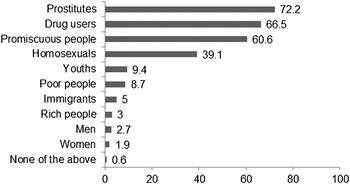
Results show that 19.3% of the people interviewed consider that people with HIV are to blame for their infection, and 17% think that people who have contracted HIV via sexual relations or drug consumption get what they deserve, 95% CIs [17%, 21%] and [15%, 18%], respectively. Besides, people think that prostitutes (72.2%), drug users (66.5%), “promiscuous” people (60.6%) and, to a lesser extent, homosexuals (39.1%) are the social groups with most possibilities of becoming infected by HIV (Figure 1).
percentages of the population that think that diverse social groups are at risk of acquiring the HIV infection.

Regarding beliefs about the transmission of HIV, the results showed that 15.1% of the population thinks that it is fairly or very probable for a person to become infected with HIV by sharing a glass with someone who has the virus, 17.3% believes that they could become infected with HIV by sharing public toilets with someone who is infected with the virus, and 14.9% hold the belief that they can be infected with HIV if a person with HIV coughs or sneezes nearby, 95% CIs [13%, 16%], [15%, 19%] and [13%, 16%], respectively.
Results also show that 58.8% of the population would feel between “somewhat” and “completely” uncomfortable if a classmate of their child had HIV, 30.8% would be uncomfortable if one of their coworkers had HIV, and 44.5% if would feel discomfort if an employee who worked in a store where they bought regularly had HIV, 95% CIs [56%, 61%], [28%, 33%] and [42%, 46%], respectively. We also observed that, among the people who express discomfort, 40% would change their child’s school if they could, 31.1% would ask for the coworker with HIV to be transferred to another place at work, or they would ask for a transfer if they could, and 52.3% would try to buy at another store if possible, 95% CIs [36%, 43%], [27%, 35%] and [48%, 56%], respectively.
Finally, the study reveals that 20% of the population believes that, in some places, the law should oblige people with HIV to be separated to protect public health, and 18.1% of the population thinks that the names of persons with HIV should be made public so that the people who wish to avoid them can do so, 95% CIs [18%, 22%] and [16%, 20%], respectively.
Variables related to HIV-associated stigma: predictors of advocacy of discriminatory policies for people with HIV and of the intention to avoid them
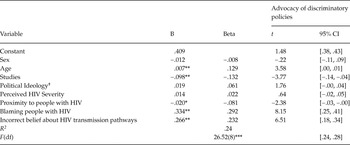
Firstly, the results of the lineal regression analysis showed that beliefs about transmission of HIV through social contact, blaming people with HIV, the perceived distance from them, higher age, and lower educational level were the variables that significantly predicted the advocacy of discriminatory policies for people with HIV. Likewise, we found that right-wing political ideology had marginally significant influence (Table 1). The model explained 24% of the variance and had a medium-high effect size (f 2 = .31) and very high power (λ = 207.08). These results confirm all the hypotheses of the study, except for the sixth one, which achieves partial support.
Linear regression analysis showing the predictors of advocacy of discriminatory policies against people with HIV

Note:
N = 667. CI = Confidence interval.
*p < .05; **p < .01; ***p < .001; † p < .1.
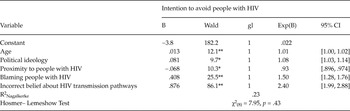
Secondly, the results of the binary logistic regression showed that higher age, right-wing political ideology, perceived distance from people with HIV, blaming people with HIV, and beliefs about the transmission of HIV were the variables that predicted the intention to avoid people with HIV in the diverse daily life scenarios reflected in the survey (work, shop, school). The model of predictors obtained explained 23% of the variance of the intention to avoid people with HIV and presented a good fit to the data (see table 2). The results of the classification showed that 72% of the interviewees were correctly classified, which indicates that prediction from the variables of the model is useful for future classification. These results again confirm the first, second, third, fourth, and sixth hypotheses.
Binary logistic regression analysis showing the predictors of the intention to avoid people with HIV in diverse daily life scenarios (work, shop, school)

Note:
N = 1351. CI = Confidence interval.
*p < .01; **p < .001.
Discussion
The results of this study carried out with a representative sample of Spanish society show the existence of some level of negative and prejudiced view of people with HIV in the population. The results reveal that a large number of people interviewed feel discomfort concerning possible contact with people with HIV in diverse situations of daily life. As expected, this discomfort is also translated into a behavioral intention to avoid contact. In addition we observed more serious discriminatory attitudes expressed through the support of discriminatory policies seeking social or even physical segregation of people with HIV. The percentages found, although apparently shared by a minority of the population, turn into many millions when we consider the entire Spanish population. Ultimately, in Spain, about 10 million people would currently agree with the adoption of grossly discriminatory and clearly unconstitutional policies towards people with HIV. The percentages found in Spain are higher than those obtained in the latest research conducted by Herek in 1999 (2002). These authors, in their analysis of the changing attitudes of American society, report a decrease in negative attitudes towards people with HIV from 1991 to 1999. Unfortunately, in the case of Spain, we do not have previous studies to compare the evolution of attitudes toward people with HIV, although we assume that these attitudes have become less negative in the last few years because of the work carried out by institutions and organizations to respond to HIV-related stigma.
Our investigation also analyzed the extent to which some characteristics and ideologies that define HIV-related stigma occur in the population. We observed that HIV is considered a health threat by the population because it is perceived as an infection that is easily contracted by casual or social contact. This is seen in the interviewees’ erroneous beliefs about the possibility of contracting the infection by sharing a glass or the public toilets with a person with HIV, or if this person coughs or sneezes nearby. The association of fear of casual transmission and public attitudes of rejection has been revealed by previous research (Cao et al., Reference Cao, He, Jiang, Yang, Liu, Gao and Detels2010; Herek et al., Reference Herek, Capitanio and Widaman2002; Sullivan et al., Reference Sullivan, Xu, Feng, Su, Xu, Ding and Gao2010). In Spain, the survey of health and sexual habits (INE & SPNS, 2003) found percentage lower than 9% for these beliefs. However, the populational sphere included people between 18 and 49 years of age. In this sense, it is important to note that, in the present study, approximately one third of the people interviewed were older than 49 years, and it is precisely in older people where more negative attitudes were found.
The people interviewed thought that the people at higher risk of acquiring the infection were prostitutes, people who used drugs, “promiscuous” people, and homosexuals. These responses do not coincide with the current epidemiological data and could indicate the persistence of stereotypes associated with the infection. The data of the system of information about new diagnoses of HIV in Spain during the 2003-2009 period (Ministerio de Sanidad, Política Social e Igualdad [Ministry of Health, Social Policy, and Equality] and Ministerio de Ciencia e Innovación [Ministry of Science and Innovation], 2010), reveal a decrease in the diagnoses of female prostitutes, which dropped from 4.6% in the year 2000 to 3.5% in 2009. Likewise, a progressively decreasing tendency was observed in the new diagnoses of HIV in people who use drugs. In fact, in 2009, the incidence in this collective of people was only 8%. This report also shows that 77% of the new diagnoses of HIV are sexual in origin, with a higher incidence in men’s homosexual relations than in heterosexual relations (42.5 and 34.5%, respectively). Lastly, although the group of immigrants was only mentioned in 5% in the surveys, the data from the new diagnoses reveal that people from other countries make up a relevant part of the new diagnoses (37.6%).
The association between HIV and stigmatized groups may lead part of the population to blame people with HIV for having contracted the infection or to consider it as punishment for certain behaviors, such as drug consumption or sexual promiscuity. The percentage of blame found in this study is similar to that found in China in recent research by Sullivan et al. (Reference Sullivan, Xu, Feng, Su, Xu, Ding and Gao2010) but much lesser to the found in the United States some years ago (Herek et al., Reference Herek, Capitanio and Widaman2002).
Beliefs about the transmission of HIV through social contact and blaming people with HIV for their infection play an important role in the existence of stigma and discrimination. In this sense, as we predicted in the first and second hypothesis, these two variables are predictors of the intention to avoid people with HIV and of the advocacy of discriminatory policies.
Moreover, in addition to these variables, results showed that other variables related to certain sociodemographic characteristics and to the socialization process play a relevant role in the existence of prejudices. Higher age and right-wing political ideology emerged as predictors, both of the intention to avoid people with HIV and to advocate discriminatory policies towards this collective, and low educational level predicts higher degree of agreement with this type of policies. These results coincide with those obtained by Díez Nicolás (2005), who found that, in the case of immigrants, xenophobic attitudes were higher among older people, people with a low educational level, and people who self-identified as right-wing. Li and collaborators (2009) also found a relation between political ideology and HIV-associated stigma.
Lastly, the results have shown that social distance from people with HIV affects the existence of prejudice. Besides the psychosocial theories, which reveal the essential role of increasing contact with the stigmatized groups in general (Pettigrew & Tropp, Reference Pettigrew and Tropp2006), there are also studies specifically carried out with people with HIV that have shown that proximity to these people is a predictor of feelings of sympathy towards them and a source of reduction of prejudice (Norman, Carr, & Jiménez, Reference Norman, Carr and Jiménez2006).
These results confirm the rest of the study hypotheses and they coincide with previous investigations in other countries (Cao et al, Reference Cao, He, Jiang, Yang, Liu, Gao and Detels2010; Herek et al., Reference Herek, Capitanio and Widaman2002; Sullivan et al., Reference Sullivan, Xu, Feng, Su, Xu, Ding and Gao2010).
The image that Society holds of people with HIV has important repercussions for them. Among them are social isolation and the difficulty to embark on a family or occupational life project in the same conditions as the rest of the population. In this sense, the study shows that very few people would become involved in a couple relation (6.5%) or an occupational relation (7%) with a person with HIV, and almost 20% of the interviewees even declared that they would not have any kind of relation with them.
An exceptional effort is needed to reduce stigma. In the line of the results shown by this study, we need to correct the erroneous beliefs about the transmission pathways, change the population’s stereotyped image of HIV, decrease the attributions of responsibility and blame to people with HIV, and increase contact with them (Yiu, Mak, Ho, & Chui, Reference Yiu, Mak, Ho and Chui2010). These interventions should particularly target older people, people with a low educational level, and with a more conservative political ideology.
The present study represents an important step forward by showing which variables are contributing to the stigma and discrimination of people with HIV and which groups of people in Spain express it to a greater extent. Knowing towards what and whom interventions should be aimed is an essential step in order to reduce stigma.
The discussion of the results may be qualified by some methodological considerations. The analysis reported were performed under the assumption of simple random sampling procedures, which may somehow constraint some of the interpretations we make in this study.
Also, as usual in studies employing surveys, this study may have limitations derived from the rate of non-responders. This may have repercussions in the sense that some sociodemographic characteristics of the surveyed people differ from the population and, therefore, they reduce the representativeness of the sample. According to the literature, these differences consist of the fact that the responders usually have a higher educational level, higher socioeconomic status, are women, single, etc. Some of these issues were observed in the characteristics of the sample of this study, such as the fact that the percentage of people who had higher studies was larger than the datum reported by the Instituto Nacional de Estadistica, ([National Statistics Institute], 2010). This difference could affect the results because, in this and in other studies (Cao et al., Reference Cao, He, Jiang, Yang, Liu, Gao and Detels2010; Sullivan et al., Reference Sullivan, Xu, Feng, Su, Xu, Ding and Gao2010), it was found that the people with a higher educational level express a lower degree of rejection. For this reason, the data provided should be interpreted in the light of these limitations.