Health technology assessment (HTA) decisions have traditionally been made on the basis of effectiveness, safety and cost-effectiveness evidence. Increasingly preferences and values of patients are being sought by decision makers alongside this more conventional evidence. Such patient-centered evidence can include consideration of ethical and moral issues or other preference and/or willingness to pay data not normally supplied by cost-effectiveness analysis (Reference Gray1;Reference Ryan2).There are many methods to elicit preferences and values, ranging from qualitative methods such as focus groups to more quantitative approaches such as discrete choice experiments (DCEs).
The use of DCEs in HTA was proposed over 10 years ago as a means to quantify community and patient preferences to inform decision making (Reference Ryan2). DCEs, sometimes referred to as conjoint analysis studies, are an attribute-based measure of benefit or utility where a good or service is described in terms of a number of key characteristics/attributes. In a DCE, an individual is presented with a set of two or more alternative options for policy, treatment etc. The individual then makes a choice between the alternatives based on the combination of attributes (Reference Lancsar and Louviere3) that reflects their preference for the good or service. As the method assumes that there is more than one attribute influencing decision making, this choice process is repeated over a series of questions to infer the relative importance of each attribute, the interaction between attributes and the extent to which an individual trades-off between the attributes. Most DCEs in health have sought to evaluate patient preferences and assess the trade-offs between process aspects and health outcomes. However, DCEs can be used to address issues such as healthcare prioritization and individual preferences on various health topics (Reference de Bekker Grob, Ryan and Gerard4) and provide policy makers with quantitative evidence on the importance of factors that may influence individuals’ decision making beyond that provided by other methods that often only look at factors in isolation (Reference Stafinski, Menon, Marshall and Caulfield5). DCEs, therefore, have the advantage that they can provide both preference information as well as quantifiable data on the value of health outcomes that can be used to inform cost-effectiveness analyses. Despite these advantages, DCEs are yet to gain much real traction with policy makers in HTA.
Discrete Choice Studies and HTA
As mentioned above DCEs have a wide range of applications yet, remain underused as a means of informing healthcare policy decisions. In the HTA process, there are two main avenues through which DCEs can inform decision making: first, as a part of the evidence review on a particular topic; and, second, as a public engagement mechanism on the evidence review or draft decision. A recent study of 50 HTA reports that incorporated organizational and/or patient issues found that only one used data from preference instruments (Reference Lee, Skött and Hansen6), with the majority using qualitative methods. For most HTA agencies, preference type information to inform decision making is obtained through engagement methods such as patient stories, web based surveys, focus groups, or citizens’ juries (Reference Whitty7;Reference Ho, Gonzalez and Lerner8). It has been suggested that the public engagement approach taken by a HTA agency is based on a range of contextual factors such as the complexity of the technology, the interests and potential impact on stakeholders and the time and resources available to the HTA agency (Reference Gauvin, Abelson, Giacomini, Eyles and Lavis9).
This latter point may partly explain the lack of consideration given to DCEs in HTA decision making. Unlike other methods of eliciting preferences that have community engagement origins, DCEs initially gained traction in disciplines such as marketing, transport, and environmental economics, and only more recently in health. As a result many published DCEs in health have focused on methodological issues rather than policy issues (Reference Lancsar and Louviere3). Healthcare decision makers are, therefore, less likely to have been exposed to DCEs and to be more familiar with qualitative methods as a means to elicit preference information. DCEs also require expertise in design, analysis and interpretation. Given that most HTA agencies undertake public engagement activities themselves (Reference Whitty7), it may be that the required expertise has not available within the HTA agency to undertake such methods and such studies have been initiated outside the HTA agency. In what is reported as a first, the Food and Drug Administration in the United States recently conducted a DCE to help inform medical device approval in field of obesity (Reference Ho, Gonzalez and Lerner8). The results of this study were used as a means to quantify the risks individuals were willing to tolerate to lose weight which gave decision makers further information on preferences than that supplied by patient stories (Reference Ho, Gonzalez and Lerner8).
Systematically reviewing the literature around patient preferences and values is also a relatively new activity in HTA and is an area of growing methodological interest (Reference Gabriel and Normand10). Unlike other areas of the HTA process, where there is agreement on the methodological approach (Reference Drummond11), there is no single gold standard approach for synthesis of preference data and the optimal approach is likely to vary with the question being asked. Some concern has been expressed by those involved in healthcare decision making that patient values, which decision makers are interested in understanding, may not mirror preferences (Reference Shiell, Hawe and Seymour12). Much has been written on the discrepancies between the values individuals hold; those they espouse verbally, and those they demonstrate with their behavior (Reference Giacomini, Hurley, Gold, Smith and Abelson13). Similar debate exists around stated preferences, such as those obtained through DCEs, and data from revealed preference studies of observed behavior (Reference Lancsar and Louviere3). Regardless of this debate, there is general recognition of the important contribution preference information can make, particularly when a decision involves multiple technologies, and/or patient management strategies that require consideration of both benefits and harms.
Given the above, evidence from DCEs are well suited to informing decisions made by HTA agencies This study focuses on colorectal screening as an example of such a decision. To determine their use in this policy area, we examined DCE studies of colorectal cancer (CRC) screening in countries where primary research was undertaken citing a national or local review of CRC screening.
Colorectal Cancer Screening
Colorectal cancer is a leading cause of cancer related mortality worldwide, but death from this disease is preventable if detected early. Several screening tests exist for CRC, including fecal occult blood tests (FOBTs), flexible sigmoidoscopy, colonoscopy, and virtual colonoscopy. Each test varies in terms of the benefit to harm trade-off, mainly in respect to the degree of invasiveness (and hence possible harms), the accuracy of detecting CRC, and, ultimately, the cost of the procedure and subsequent management. Given the differences between the available tests, preference studies examining the trade-offs patients are willing to accept are ideally suited to decisions around CRC screening (Reference Marshall, McGregor and Currie14).
In the last 10 years many countries have implemented national screening programs, or at least considered how a program would operate (Reference Center, Jemal, Smith and Ward15). Most national screening programs have recommended the use of FOBTs following local feasibility studies and/or evidence from cost-effectiveness studies and budget impact analysis. Nonetheless uptake of the technology has been relatively low.
Uptake is influenced by a range of factors including individual preferences (Reference Marshall, McGregor and Currie14). DCEs could be used to estimate uptake based on preferences such as screening frequency, age of first screen, choice to test, acceptable trade-offs between mortality benefits and potential downsides, or to highlight potential barriers to implementation to improve communication messages. In doing so, policy makers could potentially model test uptake depending on various combinations of these factors to identify which screening tests would best align with community preferences and optimize informed uptake within budget constraints (Reference Marshall, McGregor and Currie14) and be most cost-effective.
This study focuses on whether preference information, specifically from DCEs, has been used to inform CRC policy, and if so how. As such, we sought to determine the extent of inclusion of DCE or preference information in countries where DCE studies have been conducted citing a national or local CRC review. The rationale for choosing studies which identified a policy question was that these studies would be more likely to have an impact at a policy level as they would have the advantage of understanding context (Reference Brownson, Kreuter, Arrington and True16). Furthermore, rather than reviewing all HTAs on CRC screening, we chose to focus on scholarly publications as our initial interest was from the perspective of the health researcher (Reference Buxton17).
METHODS
We conducted a systematic review based on the standard methods and reporting in accordance with the Preferred Reporting Items for Systematic Reviews and Meta-Analyses statement (Reference Moher, Liberati, Tetzlaff and Altman18). This review was undertaken to identify discrete choice studies of preferences for CRC screening. These studies were then assessed to determine if the research sought to contribute to an underlying policy question regarding colorectal screening.
Search Strategy
Medline, Embase, EconLit, and PreMedline were searched from their inception to April 2013, for studies that documented the attributes of, and outcomes from, DCEs in screening populations. Medical Subject Heading (MeSH) terms and text words for screening were used for all databases and combined with methodology terms such as “stated preference” and “choice experiment” (Reference Wortley, Wong, Kieu and Howard19). As DCEs have a relatively recent history in health, the search was deliberately broad to capture as many potential studies as possible. These results were combined with text and MesH terms around preferences and decision making. Google Scholar was searched using text words from the search.
The titles and abstracts of potentially relevant studies were scanned for studies pertaining to CRC screening and full text publications were retrieved for detailed assessment if relevant. The reference lists of the retrieved publications were also checked to identify any additional relevant studies.
Inclusion and Exclusion Criteria
Studies were included if they were full text discrete choice studies, published in English and reported on available tests for CRC screening (Reference Wortley, Wong, Kieu and Howard19) and referenced local or national review or policy discussion on CRC screening. Studies were excluded if they used contingent valuation surveys (willingness to pay), were non-English publications, or if they only reported on methodological outcomes.
Data Extraction
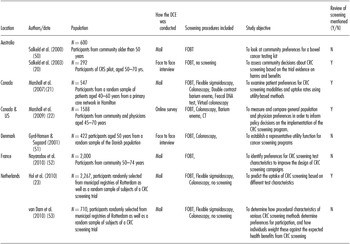
For those studies that met the above criteria, the following information was extracted: country, authors, year of publication, population, included screening technologies, study objective, and concurrency with a local or national review of CRC screening (Table 1).
CRC DCE Studies Identified from Systematic Search

Reports of national or local reviews were assessed to determine the extent to which preference information was incorporated into the decision-making process. This included a review of the Web sites of the relevant Ministry/Department of Health and local health technology assessment (HTA) agencies (see Supplementary Table). Relevant guidelines and other documents were analyzed for information on public or community preferences in regards to CRC screening.
RESULTS
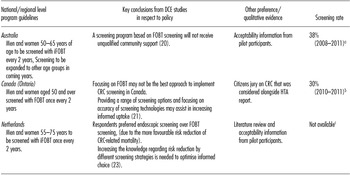
The search identified 776 articles on cancer screening and preferences. We retrieved thirty-eight full-text articles on CRC screening, and eight satisfied the inclusion criteria for the systematic review (Table 1). Four studies referred to reviews of screening programs in three countries: Australia, Canada, and the Netherlands (Reference Salkeld, Solomon, Short, Ryan and Ward20–Reference Hol, de Bekker-Grob and van Dam23); these are discussed below and in the context of the published DCE literature (Table 2).
CRC Screening Recommendations and DCE Evidence

Australia
In Australia, the National Bowel Cancer Screening Program (NBCSP) is one of three national population screening programs. The introduction of the NBCSP followed a pilot study that sought to assess the acceptability, feasibility, and cost-effectiveness of bowel cancer screening using FOBT (Reference Flitcroft, Salkeld, Gillespie, Trevena and Irwig24) as well as a HTA undertaken by the Medical Services Advisory Committee (MSAC) of the relative performance (safety, effectiveness, and cost-effectiveness) of different FOBTs (25). In 2005, the results of the pilot study were published as six reports, including a qualitative evaluation of opinions, attitudes, and behaviors (acceptability) (26), and an analysis of knowledge, attitudes and practices of people living in the pilot sites (27).
None of the documents associated with the NBCSP included a review of the literature around community attitudes or preferences for CRC screening. The 2004 MSAC report did include a section on the “Psychiatric morbidity associated with colorectal cancer screening”; it outlined selected literature touching on patient trade-offs but concluded that detailed exploration would require a dedicated systematic review which was outside the scope of the report (25). Similarly, while the qualitative evaluation report used mini group discussions and one-on-one interviews to assess opinions and attitudes, the results were not interpreted in the context of published literature.
Canada
Colorectal cancer screening in Canada is implemented on a provincial rather than national basis (Reference Marshall, Johnson and Phillips21). In 2008, Ontario was the first province to implement such a program, overseen by the Ministry of Health and Long-Term Care and Cancer Care Ontario. Before implementation, the Ontario Health Technology Advisory Committee (OHTAC) evaluated the safety, effectiveness and cost-effectiveness of various tests used for CRC screening (28). Tests evaluated by OHTAC included computed tomography colonography (CTC), magnetic resonance colonography, wireless capsule endoscopy, FOBT, and flexible sigmoidoscopy.
Preference literature was not included in this report despite the existence of local studies (Reference Marshall, Johnson and Phillips21). Preferences and values, however, were debated using the Citizens’ Reference Panel of Health Technologies. In 2008, the Panel had its inaugural meeting at which patient information and choice of screening technologies for the early detection of CRC were discussed (29). These views were used to inform the OHTAC evaluation. OHTAC's final recommendation was to implement FOBT as the primary screening test for CRC, but to retain colonoscopy and flexible sigmoidoscopy as options for opportunistic screening. It further recommended, based on the Panel's debate, that people who do not wish to undergo CRC screening should be able to decline it without fear that this will affect their relationship with their physician (30).
The Netherlands
A national population screening program for bowel cancer was recommended in the Netherlands in 2011. It followed a report from the Health Council of the Netherlands which recommended immunochemical FOBT (iFOBT) based screening once every 2 years for men and women aged 55–75 years (31). The recommendation was primarily based on data from CRC feasibility studies. The aim of these studies was to undertake, at a population level, additional research into alternatives to the less accurate, but cheaper, guaiac FOBT (gFOBT). Tests evaluated in the studies included gFOBT, iFOBT, colonoscopy, flexible sigmoidoscopy, and colonography. As in Australia, the final report included both data on the pilot results and information on public acceptance of screening (Reference McCaffery, Borril and Williamson32;Reference Van Rijn, van Rossum and Deutekom33). Unlike the Australian report, however, the information on acceptance and attitudes was drawn from both published literature and information from participants in feasibility studies.
Results from the local discrete choice studies were not included in the final report, although other preference type studies were included (Reference DeBourcy, Lichtenberger and Felton34;Reference van Gelder, Birnie and Florie35). Both these studies were limited in the technologies that they evaluated. Of the three discrete choice studies citing national reviews, the study by Hol et al. is the most generalizable and applicable (Reference Hol, de Bekker-Grob and van Dam23). Hol et al. covered the tests included in the feasibility studies as well as a comparison of results between screening naïve individuals and a sample of those included in the Dutch CRC screening feasibility study. However, results of this study were published after the report by the Health Council and it is not known whether the Health Council had knowledge of this study.
DISCUSSION
Despite the evidence on CRC screening preferences, it appears to have not been incorporated into formal consideration as part of the HTA decision-making process at a national level. In the three countries where CRC screening policy was being reviewed at the same time, or following, primary research on preferences, data from the primary studies were not included in the formal review. Getting evidence into policy is complicated and is not just a matter of knowledge translation (Reference Liverani, Hawkins and Parkhurst36). Many factors are involved, often of a political or organizational nature. For example, Nutbeam and Boxall argue that for evidence to have an impact on health policy, it needs to be available in time to inform decision making, communicated in terms that fit with policy direction, and point to practical actions (Reference Nutbeam and Boxall37). While data from local preference studies was available at the time of decision making in two of the three cases reviewed here and some discussion on policy implications was included, it is likely that the other factors played a part in whether the research translated into policy practice (Reference Cohen, Schroeder and Newson38). Brownson (Reference Brownson, Kreuter, Arrington and True16) argues that for a new method to be accepted it has to have advantages over what is currently in place. As noted in a recent review of DCE colorectal studies (Reference Wortley, Wong, Kieu and Howard19), evidence from one preference elicitation method may not be as a helpful to decision makers as a review of preference literature pertinent to the particular policy issue.
Some may argue that this is what has happened in the current example: in all three countries, commissioned qualitative research was undertaken on CRC screening and incorporated into the final report. In Australia and the Netherlands this qualitative research focused on acceptability of a specific test rather than elicitation of preferences and values for CRC more broadly. This is an important distinction to make as acceptability is often framed around a particular option rather than individuals’ preferences for different options and the relative importance attached to different test characteristics of these options. Reviews of preference studies in CRC have found that individuals prefer a test that is accurate, short in duration and that requires no preparation and has no complications (Reference Wortley, Wong, Kieu and Howard19). A significant number of individuals would also prefer no screening to the currently recommended tests for CRC. This is important information for decision makers to know because it will affect the uptake of screening, which in turn will impact upon the extent of population level benefit that may be obtained with a program. Overlooking individuals’ preferences for no screening also could partly explain why, despite current recommendations, CRC screening participation and uptake remains low in many western countries (Table 2). While many preference elicitation approaches are available (Reference Rowe and Frewer39) there is currently no consensus about which is best under different circumstances. The context and purpose of the research question will clearly influence the choice; however, it is acknowledged that there are also other factors beyond these that drive these decisions (Reference Gauvin, Abelson, Giacomini, Eyles and Lavis9). Such questions are beginning to be explored in the field of HTA (Reference Whitty, Burton and Kendall40), and we hope that this article will contribute to those discussions.
Given the increase in discrete choice studies and growing interest in public and patient preferences, systematic reviews of preference information, including data from DCEs, are beginning to be published (Reference Frederiksen, Lynge and Rebolj41–Reference Joy, Little, Maruthur, Purnell and Bridges43) and provide an important first step in knowledge translation (Reference Grimshaw, Eccles, Lavis, Hill and Squires44). They also offer a pragmatic approach when it is not feasible to undertake new qualitative or quantitative studies of patients’ experiences and preferences to inform a specific decision (Reference Ziebland and Hunt45). Cervical cancer screening has been reviewed recently in Canada and Australia and both reviews incorporated preference literature, including DCE data (Reference Peirson, Fitzpatrick-Lewis, Ciliska and Warren46); however, this information was provided as contextual or background information rather than as answers to specific research questions. In doing so, it gives a message that preference information still does not carry the same importance, or warrant the same attention or considerations as safety, effectiveness, and cost-effectiveness evidence. The risk with this approach is that important factors that influence individuals’ decisions (including the decision not to be screened) are being omitted, and are, therefore, left unconsidered by decision makers. As mentioned earlier this may be partly due to the lack of guidance in this area. In addition, decisions around screening programs are often made by bodies (such as health departments) independent of more formal HTA agencies that evaluate pharmaceuticals or medical technologies. Hence, it is not unusual for screening programs in the same country to be evaluated and reviewed differently (Reference Dowling, Klabunde, Patnick and Ballard-Barbash47) and without reference to HTA methodology.
POLICY IMPLICATIONS
While methodology exists for the incorporation of effectiveness and cost-effectiveness evidence in decision making (Reference Drummond11), methods for incorporating patient-centered data in decision making is still in its infancy (Reference Selby, Beal and Frank48). Dissemination and consideration of such important data does not appear to occur spontaneously. While the absence of universally agreed upon synthesis methods does not preclude a discussion of this literature being included in evidence based HTA reports, the benefits of preference information, including DCEs, for assessing patient preferences needs to be more formally acknowledged and incorporated into HTA methodology. In doing so, HTA reports, and ultimately the HTA decision-making process, will be more relevant, more transparent and more likely to reflect the social values of the target population as well as the broader community.
LIMITATIONS
This review included only those countries in which primary DCE research referred to local or national reviews of CRC screening. It is possible that other countries where primary research has not been published have included information on community preferences into policy documents. We also relied on published documents to ascertain whether evidence from DCEs informed decision making in relation to CRC screening. It is possible that decision makers were aware of preference studies, and results were discussed as part of the decision-making process, but were not explicitly included in any formal documents or implemented at a more local level. As mentioned our interest was from the perspective of the health researcher (Reference Buxton17;Reference Chalmers, Bracken and Djulbegovic49).
CONCLUSIONS
We are now entering an age of patient-centered outcomes research. Just as evidence-based medicine drove the inclusion and consideration of cost-effectiveness analysis, patient-centered research requires the inclusion and analysis of community preferences data which DCEs provide. Evidence from such studies can provide valuable information for decision makers but it is unclear at present how this information is considered. DCEs have an important role to play in bolstering the evidence base for HTAs, including CRC screening, and they can be used to evaluate existing evidence about the preference of options to the individuals they are designed to help. This vital information may assist us to understand why participation rates in CRC screening are so low and to inform decision makers about the likelihood of success of different options for addressing low uptake such as education programs or advertising campaigns. It is important to appreciate that there are various methodologies to elicit preferences and values and these need not be seen as alternative options, but rather as complementary tools for better understanding a given policy issue.
SUPPLEMENTARY MATERIAL
Supplementary Table 1 http://dx.doi.org/10.1017/S0266462315000367
CONFLICTS OF INTEREST
The authors declare that they have no conflicts of interest.