Introduction
Family carers of people with dementia are at greater risk of developing depression (Joling et al., Reference Joling, van Hout, Schellevis, Knol and van Marwijk2010), and are more likely to experience high levels of burden compared to the general population or caregivers of relatives affected by other chronic illnesses (Draper et al., Reference Draper, Poulos, Cole, Poulos and Ehrlich1992). Approximately a quarter of family carers of people with dementia meet diagnostic criteria for clinically significant anxiety (Parks and Pilisuk, Reference Parks and Pilisuk1991; Russo et al., Reference Russo, Vitaliano, Brewer, Katon and Becker1995; Mahoney et al., Reference Mahoney, Regan, Katona and Livingston2005), and are prone to experiencing clinical symptoms of depression (Schultz and Wiliamson, Reference Schultz and Wiliamson1991; Gallant and Connell, Reference Gallant and Connell1997; Song et al., Reference Song, Biegel and Milligan1997).
Depression in family carers of people with dementia often results from a complex interplay of patient, caregiver characteristics, as well as cultural factors which expose carers at a greater risk for both clinical and sub-clinical depression (Proctor et al., Reference Proctor, Martin and Hewison2002; Papastavrou et al., Reference Papastavrou, Kalokerinou, Papacostas, Tsangari and Sourtzi2007). The term “caregiver burden” has been used to define and explain the negative consequences of caring on caregivers’ mental and physical health, which often results in social and/or financial strain (Butcher et al., Reference Butcher, Holkup and Buckwalter2001; Pinquart and Sorensen, Reference Pinquart and Sorensen2007).
Despite the large number of studies dedicated to investigating predictors of depression in carers, current knowledge of personality determinants in dementia caregiving is lacking. For example, most studies have focused on identifying the effects of specific patient, and caregiver characteristics (i.e. functional health status, cognition, and activities of daily living), with less studies investigating the influence of personality factors, despite evidence showing that personality can play an important role in the development of both anxiety and depression (Matsudaira and Kitamura, Reference Matsudaira and Kitamura2006; Klein et al., Reference Klein, Kotov and Bufferd2011).
Caregiver burden has been consistently linked to patient behavioral and psychological symptoms (Van Den Wijngaart et al., Reference Van Den Wijngaart, Vernooij-Dassen and Felling2007; Machnicki et al., Reference Machnicki, Allegri, Dillon, Cerrano and Taragano2009), cognition, ability in activities of daily living (Covinsky et al., Reference Covinsky2003; Papastavrou et al., Reference Papastavrou, Kalokerinou, Papacostas, Tsangari and Sourtzi2007), and rates of institutionalization (Vernooij-Dassen et al., Reference Vernooij-Dassen, Felling and Persoon1997; Gaugler et al., Reference Gaugler, Roth, Haley and Mittelman2008). Caregiver characteristics, most likely to be associated with high levels of burden, are low levels of social support, decreasing physical health, and low socioeconomic status (Proctor et al., Reference Proctor, Martin and Hewison2002; Mahoney et al., Reference Mahoney, Regan, Katona and Livingston2005). On the basis of these findings, treatment of caregiver burden and caregiver psychological distress are currently considered as integral aspects of the care of people with dementia.
Sense of coherence has been identified as a useful individual resource for carers of people with dementia (Andren and Elmstahl, Reference Andren and Elmstahl2008b), that equips an individual with the capacity to use recourses available efficiently (Lindström and Eriksson, Reference Lindström and Eriksson2005). Sense of coherence is often described as a personality characteristic consisting of aspects such as comprehensibility (cognitive), manageability (instrumental), and meaningfulness (Antonovsky, Reference Antonovsky1993). Current studies highlight that sense of coherence is best described as a continuous process as opposed to a stable characteristic through which individuals cope better with stressors (Eriksson and Lindstrom, Reference Eriksson and Lindstrom2005; Hanaken et al., Reference Hanaken, Feldt and Leskinen2007; Volanen et al., Reference Volanen, Suominen, Lahelma, Koskenvuo and Silventoinen2007). How an individual interprets events to cope successfully with a situation has been shown to be related to both physical and psychological health (Antonovsky, Reference Antonovsky1993; Eriksson and Lindstrom, Reference Eriksson and Lindstrom2007). For example, individuals exhibiting high levels of sense of coherence are able to cope successfully with stressful situations (Antonovsky, Reference Antonovsky1993) by choosing adaptive and successful coping strategies (Eriksson and Lindstrom, Reference Eriksson and Lindstrom2007).
Sense of coherence can be a strong predictor of carers’ quality of life, and therefore a useful concept in understanding negative consequences of caring (Ekwall et al., Reference Ekwall, Sivberg and Hallberg2007). This is in line with data showing that carers who experience lower burden report higher levels of sense of coherence (Andren and Elmstahl, Reference Andren and Elmstahl2008b). Despite evidence indicating that caregivers with a low sense of coherence may be a vulnerable group (Andren and Elmstahl, Reference Andren and Elmstahl2008a; Valimaki et al., Reference Valimaki, Vehvilainen-Julkunen, Pietila and Pirttila2009), there are currently no studies investigating whether sense of coherence could mediate well-being in family caregivers of people with dementia, such as depressive or anxiety symptomatology. Understanding the mediation influences of sense of coherence in dementia caregiving is likely to increase our understanding of the risk factors that are more likely to be associated with depressive effect, and thus inform etiology of caregiver depression.
To our knowledge, this is the first study to examine associations between caregiver stress specific to the caregiving situation, sense of coherence, and affective symptoms in carers of people with dementia. The aim of the present study was to examine the relationship between stress associated with caregiving, sense of coherence, and self-reported depression and anxiety in family carers of people with dementia. We hypothesized that carers experiencing increasing levels of anxiety and depression will be more likely to report low levels of coherence, and that the relationship between caregiver stress and affective symptoms will be mediated by carers’ sense of coherence.
Method
Participants
Participants were contacted through local voluntary sector organizations in the United Kingdom offering support services to carers of people with dementia. Inclusion criteria included providing at least four hours of care to a relative with dementia, being directly involved in the patient's care, and sufficient understanding of the English language. All potential participants signed an informed consent form and completed the questionnaires. A total of 230 carers were invited to participate, of whom 198 agreed to participate. Six participants were excluded, as the carer no longer provided care to their relative. Twenty-two carers, who had more than three items missing on each questionnaire, were excluded from the analyses. One hundred and seventy family carers of people with dementia took part in the present study ranging in age from 24 to 88 years (138 females and 32 males).
Procedure
After providing informed consent, the participants answered a series of questionnaires. We collected information on age, gender, level of education, relationship to the patient, marital status, and number of hours per day spent giving care. In the second part, carers were asked to complete the self-report measures. This study was approved by the UCL Ethics Committee.
Measures
Sense of Coherence
The Sense of Coherence Scale (SOC – 29 items) developed by Antonovsky (Reference Antonovsky1993) was used. The scale measures perceived comprehensibility (11 items), manageability (10 items), and meaningfulness (8 items). Each item in the scale is answered by choosing the number on a scale from 1 to 7, which best represents the carer's view at that moment. Thirteen of the items are formulated negatively and are reversed in the scoring so that a high total score indicates strong SOC. A typical item is as follows: “Has it happened that people whom you counted on disappointed you?.” In previous studies the Cronbach's α for the SOC scale ranges from 0.70 to 0.95 (Eriksson and Lindstrom, Reference Eriksson and Lindstrom2005). In the present study Cronbach's α for the SOC scale was 0.83 (α = 0.61 for Meaningfulness, 0.66 for Comprehensibility, and 0.58 for Manageability).
Hospital and Anxiety Depression Scale
Anxiety and depressive symptoms were measured with the Hospital and Anxiety Depression Scale (HADS; Zigmond and Snaith, Reference Zigmond and Snaith1983). The HADS is a 14-item self-report questionnaire designed to assess anxiety (e.g. “I get a sort of frightened feeling as if something awful is about to happen”) and depression (e.g. “I look forward with enjoyment to things”) as two distinct dimensions in non-psychiatric populations. Recent studies have shown that scoring the HADS as two separate subscales of anxiety and depression is appropriate in non-clinical populations of older men and women, validated throughout the age range to identify clinically significant anxiety and depression (Mykletun et al., Reference Mykletun, Stordal and Dahl2001). The HADS assesses how the person has been feeling within the past week, consisting of two seven-item subscales, each scored on a four-point response scale (from 0, representing absence of symptoms, to 3, representing maximum symptomatology), which generates scores for generalized anxiety and depression (0–21). In the present sample, a Cronbach's α of 0.81 was observed for HADS-Anxiety and a Cronbach's α of 0.86 for HADS-Depression (Zigmond and Snaith, Reference Zigmond and Snaith1983).
Relative Stress Scale
The Relative's Stress Scale (RSS; Greene et al., Reference Greene, Smith, Gardiner and Timbury1982) measures stress specific to caregiving by asking the caregiver to complete 15 five-point Likert items (not at all/never, a little/rarely, moderately/sometimes, quite a lot/frequently, considerably/always). Items are scored from 0–4 and summed to give a total scale scored ranging from 0–60. Factor analytic studies show that the RSS comprises three factors, which are personal distress experienced by the relative in relation to the patient, life upset related to caring, and negative feelings towards the person with dementia. A Cronbach's α of 0.89 was observed for the scale (α = 0.85 for Personal Distress, 0.79 for Life Upset, and 0.74 for Negative Feelings), similar to previous studies.
Physical Health
Physical health status was measured by the EuroQol-Visual Analogue Scale (EQ-VAS) of the EQ-5D, commonly used to measure self-reported health status (EuroQol, 1990). The EQ-VAS records the respondent's self-rated health on a vertical VAS, providing a quantitative measure of health outcome as judged by the individual respondents. The VAS has been successfully used by previous research in estimating physical health in older adults (Hulme et al., Reference Hulme, Long, Kneafsey and Reid2004).
Statistical analysis
Descriptive statistics (means and standard deviations) were calculated for all variables, including demographic and clinical characteristics of both patient and caregiver. Distribution checks for continuous variables were performed using the Kolmogorov–Smirnov tests. The relationship between caregiver and patient characteristics and caregiver sense of coherence scores was investigated via ANOVA, two-tailed Student's t-tests, or correlation coefficients. In order to examine whether sense of coherence mediated the relationship between well-being and caregiver burden, mediation analysis was performed (Baron and Kenny, Reference Baron and Kenny1986). According to Baron and Kenny (Reference Baron and Kenny1986), to establish mediation, several conditions must hold. The independent variable must affect the mediator, the independent variable must be shown to affect the dependent variable, and finally the mediator must affect the dependent variable in the third equation (as described by Baron and Kenny, Reference Baron and Kenny1986). We conducted the following four multiple linear regression analyses to determine the mediating relationship: (1) RSS and caregiver depression, (2) RSS and sense of coherence, and (3) sense of coherence and caregiver depression. In the fourth regression analysis we included both depression and sense of coherence as predictors of RSS. If the relationship between RSS and depression was no longer significant, then full mediation would have been observed. If this relationship was reduced but still significant, this would indicate partial mediation. In order to determine significance in the reduction of the relationship, the Sobel test was used (Sobel, Reference Sobel and Leinhardt1982). We repeated the same analysis for anxiety symptoms. The level of statistical significance was set at p = 0.05.
Results
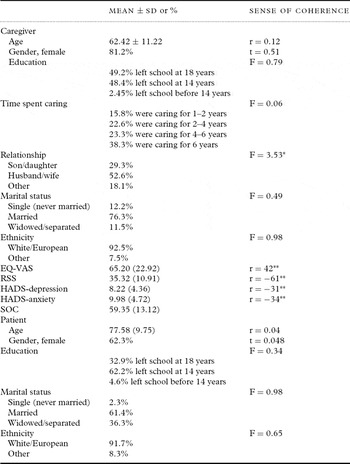
Demographics and clinical characteristics of the sample and their correlations with sense of coherence are presented in Table 1. According to previous cut-offs in the literature, providing optimal balance between sensitivity and specificity for clinically significant depression (Snaith and Zigmond, Reference Snaith and Zigmond1994; Bjelland et al., Reference Bjelland, Dahl, Haug and Neckelmann2002), 45.1% of the participants scored between 0–7 (indicating no clinically relevant symptoms, or mild symptom intensity), 45.2% scored between 8 and 14 (suggestive of moderate symptoms), and 9.7% scored 15 or above (indicative of severe symptom intensity).
Characteristics of the sample and their relationship with sense of coherence

Notes. EQ-VAS: EQ Visual Analogue Scale (EuroQoL, 1990); RSS: The Relative Stress Scale (Greene et al., Reference Greene, Smith, Gardiner and Timbury1982); SOC: Sense of Coherence (Antonovsky, Reference Antonovsky1993); HADS: The Hospital Anxiety and Depression Scale (Zigmond and Snaith, Reference Zigmond and Snaith1983).
*p < 0.01; **p < 0.001.
Among the demographic variables, only type of caregiving relationship was correlated with self-reported levels of sense of coherence. Analyses of variance with Bonferonni post hoc tests showed that spousal caregivers (mean (M) = 63.24, standard deviation (SD) = 13.71) reported higher levels of SOC compared with caregivers who were daughters/sons (M = 55.97, SD = 11.18, p < 0.05). Consistent with prior research, SOC was negatively correlated with stress related to caregiving, anxiety and depression, and positively with self-reported physical health.
Results of the first regression analysis between RSS and SOC showed that RSS was negatively associated with caregiver SOC (β = –0.61); p < 0.001. RSS was a predictor of caregiver depression (β = 0.38); p < 0.001, and self-reported caregiver SOC was negatively associated with depressive affect (β = –0.30); p < 0.001. In the final regression model, which included both SOC and caregiver depression scores as predictors of RSS, β-scores for HADS-Depression were reduced to non-significance by adding SOC (β = 0.15; p = 0.13, Sobel z-value = 2.83; p < 0.01).
The regression analysis between RSS and caregiver anxiety showed that these were significantly associated (β = –0.50); p < 0.001, whereas caregiver anxiety symptoms predicted self-reported SOC (β = –0.30); p < 0.01. Adding SOC to the regression analysis of caregiver anxiety and RSS showed that the effect of HADS-Anxiety was reduced (β = –0.28); p < 0.01; Sobel z-value = 2.76; p < 0.01.
Discussion
The present study is the first one to examine sense of coherence within the context of affective symptoms in carers of people with dementia. We found evidence to support the hypothesis that carers reporting high levels of stress specific to the caregiving situation are likely to experience high levels of anxiety and depression. Results showed that this relationship was mediated by sense of coherence, indicating that the relation between burden and emotional well-being in carers is influenced by sense of coherence. Moreover, our results indicate that SOC is not associated with demographic characteristics of carers, although it is likely to be much higher in spousal caregivers.
Current findings add to previous research by demonstrating that carers experiencing high levels of stress are less likely to experience high SOC, and that this factor contributes to higher anxiety and depression levels. Previous studies have shown that better individual resources empower individuals to cope more effectively with stress (Schwarzer, Reference Schwarzer and Locke2000), indicating that SOC is pertinent to the understanding of burden among carers of patients with dementia. A consistent finding is that depression is a major consequence of care (MaloneBeach and Zarit, Reference MaloneBeach and Zarit1995; Teri et al., Reference Teri, Logsdon and Uomoto1997; Clyburn et al., Reference Clyburn, Stones, Hadjistavropoulos and Tuokko2000; Marriott et al., Reference Marriott, Donaldson, Tarrier and Burns2000; Gallicchio et al., Reference Gallicchio, Siddiqi, Langenberg and Baumgarten2002), which remains even after the institutionalization or death of the patient (Zarit and Whitlatch, Reference Zarit and Whitlatch1992; Bodnar and Kiecolt-Glaser, Reference Bodnar and Kiecolt-Glaser1994; Aneshensel et al., Reference Aneshensel, Pearlin, Mullam, Zarit and Whitlatch1995; Gallagher-Thompson et al., Reference Gallagher-Thompson, Dal Canto, Jacob and Thompson2001). In the present study, approximately half of the carers tested experienced moderate depressive symptoms.
Caregiver burden has been defined as a negative reaction to the impact of providing care on carers’ social, occupational, and personal roles (Given et al., Reference Given, Stommel, Given, Osuch, Kurtz and Kurtz1993). Past studies have suggested that carers commonly face chronic, profound, and complicated stress associated with caregiving, which affects their mental and physical health both directly and indirectly (Kiecolt-Glaser et al., Reference Kiecolt-Glaser, Dura, Speicher, Trask and Glaser1991; Hooker et al., Reference Hooker, Monahan, Shifren and Hutchinson1992). Current findings are consistent with previous research showing that lower SOC scores are associated with high levels of anxiety and likely to be associated with negative psychological outcomes (Kivimaki et al., Reference Kivimaki2002). The results of the present study showed that sense of coherence explained incremental variance in relative stress specific to caregiving beyond the variance explained by depressive and anxiety symptoms.
Many studies have described which individual patient and caregiver characteristics may predispose carers to high levels of stress. The present study shows that depressive symptoms are strongly related to SOC experienced by carers of patients with dementia, and suggest that subjective variables may be powerful determinants of caregiver stress. For example, sense of coherence may be highly useful for identifying carers who are at risk of experiencing high levels of stress. By establishing SOC, identification of carers who are at risk of negative consequences for health could be identified.
A significant implication of the current findings is that greater stress related to caregiving is likely to hamper the use of effective problem-solving strategies, and therefore influence family carers. SOC refers to a caregiver's ability to feel that he/she can cope with different situations, with a strong SOC likely to help carers take better advantage of resources. Carers that are likely to adopt an optimistic meaning to caring may be better able to resolve a stressful situation. Low sense of coherence, on the other hand, may predispose carers to interpret the caregiving situation as less comprehensible, more difficult to manage, and less meaningful, and therefore introduce greater caregiver strain.
It is significant to acknowledge the limitations of the present study. Larger studies with longitudinal designs might explore relationships between stress specific to caregiving, sense of coherence, and affective symptoms. The present study is limited in the non-representativeness of the sample, as most carers and people with dementia were well educated. It should also be noted that other factors that may have affected carers’ well-being were not measured in this study such as experiencing medical problems, or personality traits such as neuroticism. Measures of socioeconomic status were not included in the assessment, which limits the conclusions of the present study regarding the confounding impact of exposure to negative life events and their effect on experiencing psychological distress.
Low SOC has often been described as a personality trait that is associated with depressive symptoms and psychological distress. The challenges of caring for a family member with dementia can result in high levels of stress and psychological morbidity (Morris et al., Reference Morris, Morris and Britton1988). Developing a thorough understanding of the factors that determine caregiver stress is an important priority, as high levels of stress are often linked to increased use of primary care and higher rates of institutionalization (Schulz et al., Reference Schulz, Visintainer and Williamson1990). Sense of coherence is a useful construct in understanding burden and stress in family carers of people with dementia. Carers reporting high levels of stress specific to caregiving experience high levels of anxiety and depression. Results showed that the relationship between burden and emotional well-being in carers is influenced by sense of coherence.
Conflicts of interest
None.
Description of authors’ roles
Vasiliki Orgeta designed the study and wrote the research proposal. Both authors searched and drafted the literature searches and analyses. Vasiliki Orgeta undertook the statistical analysis, and Elena Lo Sterzo contributed to data collection and writing parts of the manuscript. All authors contributed to and have approved the final manuscript.
Acknowledgments
The authors would like to thank those who kindly volunteered to participate in the study.