INTRODUCTION
The goal of the present study is twofold: we wish to provide a comprehensive picture of children's pragmatic abilities, which have generally been researched separately in the literature using different theoretical frameworks and experimental protocols, and to outline a theoretical explanation for the developmental pathways observed.
Communicative/pragmatic ability refers to the use of an expressive means to convey meaning in specific contexts. This human ability allows us to realize different pragmatic phenomena, for example indirect speech acts, i.e., acts through which the speaker communicates to the partner more than what he actually says (Searle, Reference Searle, Cole and Morgan1975), deceit, i.e., intentional attempts to manipulate the listener's mental state in order to induce her/him to believe something untrue about the reality (Perner, 1991), and irony, i.e., communicative acts expressing the opposite of what is meant by the speaker (Grice, Reference Grice1989). The main expressive means used to produce pragmatic phenomena are: (a) linguistic, i.e., the systematic use of written and spoken words; (b) extralinguistic, for example the use of gestures and facial expressions; and (c) paralinguistic, for example the tone and the rhythm of the voice. All these aspects can be expressed and tested, from an empirical perspective, in both comprehension and production. To the best of our knowledge no overall assessment of how children's pragmatic abilities are displayed across all these aspects exists in the current literature.
Although there are numerous excellent experimental studies investigating children's communicative ability, as a rule these have focused on a single pragmatic phenomenon, such as, for example, indirect speech acts (e.g., Bernicot & Legros, Reference Bernicot and Legros1987), deceit (e.g., Sodian, Reference Sodian1991; London & Nunez, Reference London and Nunez2002; Talwar & Lee, Reference Talwar and Lee2008), irony (e.g., Dews et al., Reference Dews, Winner, Kaplan, Rosenblatt, Hunt, Lim, McGovern, Qualter and Smarsh1996; Creusere, Reference Creusere2000; Pexman & Glenwright, Reference Pexman and Glenwright2007), and sarcasm (Glenwright & Pexman, Reference Glenwright and Pexman2010). Moreover, even when they have considered more than one pragmatic phenomenon at the same time (e.g., Winner & Leekman, Reference Winner and Leekman1991; Giora & Fein, Reference Giora and Fein1999; Airenti & Angeleri, Reference Airenti and Angeleri2011), they focused on a single expressive means at a time, usually the linguistic one, with few exceptions (e.g., Bucciarelli, Colle & Bara, Reference Bucciarelli, Colle and Bara2003). In the clinical context, a variety of exhaustive clinical tools have been developed, such as standardized tests (Adams, Cooke, Crutchley, Hesketh & Reeves, 2001), checklists and profiles (Dewart & Summers, Reference Dewart and Summers1997; Bishop, Reference Bishop1998), and tasks assessing referential communication (Lloyd, Peers & Foster, Reference Lloyd, Peers and Foster2001). However, these tools typically focus on language, neglecting extralinguistic and paralinguistic communicative modalities.
Thus, existing studies tend to focus on just one pragmatic phenomenon at a time, and/or consider only one expressive means – usually the linguistic one – limiting the investigation to comprehension, and overlooking the production side. In the present paper we aim to bridge this gap by providing a unified picture of children's abilities to understand and produce three different types of pragmatic phenomena – standard communication acts, deceit, and irony – at three levels – linguistic, extralinguistic, and paralinguistic. We investigated these abilities in 390 Italian-speaking children aged five to eight years.
We use Cognitive Pragmatics theory (Bara, Reference Bara2010) as the theoretical framework of the present study. Cognitive Pragmatics theory focuses on the mental processes underlying human communication. It offers a coherent and unified framework for explaining the comprehension and production of the different kinds of pragmatic phenomena investigated, expressed by linguistic, extralinguistic, and paralinguistic means (see also Bara, Bosco & Bucciarelli, Reference Bara, Bosco and Bucciarelli1999a). We used the Cognitive Pragmatics theory, details of which are provided in the next section, as the basis for formulating our theoretical hypotheses. This same theory was also the basis for developing the Assessment Battery of Communication (ABaCo; Sacco, Angeleri, Bosco, Colle, Mate & Bara, Reference Sacco, Angeleri, Bosco, Colle, Mate and Bara2008), parts of which we used to test the participants in the present study. More specifically, we used an experimental protocol consisting of three of the five scales that make up the ABaCo (namely the linguistic, extralinguistic, and paralinguistic scales).
The next section provides details of the experimental hypotheses concerning the comprehension and production of different kinds of pragmatic task expressed by linguistic, extralinguistic, and paralinguistic means, that will enable us to provide an extensive picture of the development of communicative abilities in children. Following the tenets of the Cognitive Pragmatics theory, we argue that the increasing length of the inferential chain and the increasing complexity of the mental representations involved in various types of pragmatic phenomena explain the different levels of accuracy with which children comprehend and produce such different phenomena. Children's abilities to deal with inferential chains of different lengths, as well as with mental representations of increasing complexity, develop with age (Bara, Bucciarelli & Johnson-Laird, Reference Bara, Bucciarelli and Johnson-Laird1995), and this contributes to explaining the development of their pragmatic competence.
COGNITIVE PRAGMATICS THEORY
Linguistic and extralinguistic communication
Cognitive Pragmatics (Bara, Reference Bara2010) is a theory focused on the cognitive processes underlying human communication. Its assumptions hold for pragmatic phenomena expressed through both linguistic and extralinguistic means, i.e., gestures. Cognitive Pragmatics theory assumes that a common communicative competence – independent of the linguistic or extralinguistic gestural means – is instantiated at the level at which a communicative intention is formed or inferred, and comprehended within a specific social context, i.e., at the pragmatic level (Bosco, Bucciarell & Bara, Reference Bosco, Bucciarelli and Bara2004). In an fMRI study, Enrici, Adenzato, Cappa, Bara, and Tettamanti (Reference Enrici, Adenzato, Cappa, Bara and Tettamanti2011) showed that a common neural network is engaged in communicative intention processing independently of the modality used. In this section we therefore postulate identical hypotheses for the same pragmatic phenomenon independently of whether it is produced through language or gesture. In line with such perspective, throughout the paper we have used the term ‘communication acts’ instead of ‘speech acts’, and the terms ‘actor’ and ‘partner’ instead of the classical ‘speaker’ and ‘listener’.
According to Cognitive Pragmatics theory, when two people communicate they are acting on the basis of a plan, named ‘behavioral game’, that is at least partially shared by the participants in the dialogue: a behavioral game should be defined as an expected pattern of interaction shared by the participants to the dialogue. Consider for example, the following communicative exchange:
(1) ann: “Could you take the children this morning?”
ben: “Sorry, I'm late already.”
In order to fully understand Ben's communicative intention, Ann has to recognize the behavioral game she bids through the communication act, that is in our example:
(2) [BEHAVIORAL GAME: FAMILY-MANAGEMENT]:
• Mother or father takes the children to school in the morning
• Depending on the respective engagements, mother and father agree on who can more easily take children to school
A crucial assumption of the theory is that the comprehension of the communicative meaning of any kind of utterance depends on the recognition of the behavioral game bid by the actor; participants in a dialogue interpret the communication acts of the interlocutor on a basis he/she assumes to be shared between them.
Behavioral games are an indirect manner of transmitting the culture in which the infant – and later the child – is immersed. From a developmental perspective, until the knowledge of a certain behavioral game is acquired (or sufficiently strengthened), the communicative meaning of the utterance that makes reference to it cannot be understood (Airenti, Reference Airenti, Cmejrkovà, Hoffmannovà and Svetlà1998).
Length of the inferential chain: simple and complex communication acts
Within the theoretical framework offered by the Cognitive Pragmatics theory, Bara, Bosco, and Bucciarelli (Reference Bara, Bosco, Bucciarelli, Hahn and Stoness1999b) proposed abandoning the distinction between direct and indirect speech acts (Searle, Reference Searle, Cole and Morgan1975) and adopting the distinction between simple and complex communication acts. Direct and conventional indirect speech acts are called ‘simple communication acts’; they immediately make reference to a behavioral game. Non-conventional indirect speech acts are called ‘complex communication acts’; they do not make direct reference to a behavioral game and require a more complex inferential process. The authors showed that children from two-and-a-half to three years old understand direct speech acts, like ‘Please close the door’, and conventional indirect speech acts, such as ‘Would you like to sit down?’ with the same level of accuracy. By contrast, they comprehend non-conventional indirect speech acts less accurately, showing difficulty, for example, in understanding that the answer ‘It's raining’ to the proposal ‘Let's go out to play’ corresponds to a refusal.
To summarize, the length of the inferential chain necessary to connect the communication act to the behavioral game shared between the interlocutors is the factor determining the different levels of difficulty children find in comprehending simple and complex communication acts. This cognitive factor may explain why, considering the same type of pragmatic phenomenon, children understand specific utterances, i.e., simple communicative acts, more accurately than others, i.e., complex communicative acts, even though they are of comparable semantic and syntactic complexity (see also Bosco, Vallana & Bucciarelli, Reference Bosco, Vallana and Bucciarelli2012).
The following videotaped interaction is an example of a simple and complex standard linguistic communication act investigated in our protocol:
(3) Alex comes home, Sara meets him in the doorway.
Sara says: “Did you remember to buy my train ticket?”
Alex replies…
(a) Simple: “Sure, I bought it this morning.”
(b) Complex: “You can still count on my memory.”
In our example, the standard communication act (3a) is simple because it immediately refers to the game [TO-GO-ON-AN-ERRAND] and can therefore immediately be interpreted as a positive answer to the actor's question. By contrast, in order to comprehend that (3b) is a positive answer it is necessary to infer that people with a good memory do not forget to run their errands. Thus a longer inferential chain must be built in order to comprehend (3a) with respect to (3b).
As noted by Bosco and Bucciarelli (Reference Bosco and Bucciarelli2008) a further advantage of the concept of simple and complex communication acts is that it also applies to other pragmatic phenomena besides standard communication. On the basis of the length of the inferential chain involved, the authors investigated children's ability to comprehend simple and complex deceit and irony, showing that, in the linguistic domain, children from six-and-a-half to ten years old comprehend simple forms of deceit and irony more accurately than complex ones. In the present paper, we extend the difference between simple and complex ironic and deceitful acts to extralinguistic communication, which is conceived with respect to the linguistic communication as an alternative expressive modality of the same underlying communicative competence (Bara, Reference Bara2010).
The developmental literature reveals that, as they mature during childhood, children are able to comprehend deceit of increasing difficulty. Children start to use simple forms of deceit, i.e., lies, which are false utterances made with the intention to deceive (Sodian, Reference Sodian1991). Lewis, Stanger, and Sullivan (Reference Lewis, Stanger and Sullivan1989) found that children start to use lies as a means of escaping a disagreeable consequence from the age of three years. The same comparison can be extended to irony. Children do not find that all forms of deceit have the same levels of difficulty (Russell, Jarrold & Potel, Reference Russell, Jarrold and Potel1995). The authors claim that the factor that seems to best explain such diversified performance is the increasing cognitive load that the comprehension of complex deceit requires.
In line with Cognitive Pragmatics theory, some deceitful communication acts are simple because they consist of an utterance that denies something that would allow the partner to immediately refer to the game the actor wishes to conceal. By contrast, a complex deceitful communication act consists of a communication act that implies a belief, which leads the partner to a different game from the game that would be reached if the partner had access to the actor's private belief. The following videotaped interaction is an example of a simple and complex linguistic deceit we investigated in our protocol:
(4) Andrew is eating some biscuits. He hears Kate arriving, he pushes the empty plate away. Kate sees the empty plate and asks: “Who has finished my biscuits?”
Andrew answers …
(a) Simple: “I don't have the slightest idea.”
(b) Complex: “I'm on a diet.”
In our example, (4a) is simple because it consists of an utterance which denies the actor's private (and true) belief, which immediately refers to the game [FOOD-STEALING] the actor wishes to conceal. Instead, a complex deceitful speech act, such as (4b), consists of an utterance which leads to the inference ‘If I am on a diet, I cannot eat biscuits’, which is inconsistent with the game [FOOD-STEALING] the actor wishes to deny. Thus, the partner needs to process a longer inferential chain to comprehend a complex deceit.
Moreover, children do not find all forms of irony equally difficult to comprehend. For example young children are able to comprehend simple forms of humor: Dunn (Reference Dunn, Frye and Moore1991) analyzed children's jokes and found that starting from two and three years of age children are able to understand what their relatives will find funny. As they mature, children learn to perform more subtle inferences until they reach the levels of complex irony. Lucariello and Mindolovich (Reference Lucariello and Mindolovich1995), for example, carried out a study on the ability of six- and eight-year-olds to provide ironic endings to unfinished stories. The authors suggested that the recognition and construction of ironic events involve the metarepresentational skill of manipulating event representations. According to their model, it is possible to make a distinction between simple and complex forms of irony; their results show that older children construct more complex ironic endings for the stories from the representational base than younger children do. Finally, Dews et al. (Reference Dews, Winner, Kaplan, Rosenblatt, Hunt, Lim, McGovern, Qualter and Smarsh1996) found that young children, contrary to adults, ranked those ironic comments that explicitly state the opposite of what is meant (direct irony) as funnier than ironic comments that imply something that is the opposite of what is said (indirect irony). In our terminology, children comprehend direct irony better than indirect irony because the former is a simple communication act and the latter is a complex one.
According to the speech act approach, in the case of simple irony, the meaning of the utterance immediately contrasts with a belief shared by the actor and the partner. In particular, in simple irony á laGrice (Reference Grice1989), the actor proffers an utterance with the intention of meaning exactly the contrary of what he says. It follows that simple irony immediately contrasts with the belief given as shared between the interlocutors. On the other hand, comprehension of complex irony always involves the detection of its contrast with the shared belief but, in this case, the partner has to go through a complex inferential chain to detect such a contrast. The following videotaped interaction is an example of the simple and complex extralinguistic irony we investigated in our protocol:
(5) Helen is knitting a woolen scarf and realizes she has made a big hole, which she is looking at disconsolately. Sitting in an armchair next to her, is David who …
(a) Simple: Makes an OK gesture, as if to say “Well done!”
(b) Complex: Looks around him, sees a trophy and gives it to her.
Our example (5a) is a simple irony because the ‘OK’ gesture immediately contrasts with the evidence, shared by the interlocutors, that Helen has not done a good job. On the other hand, (5b) is a complex irony because it implies the knowledge that ‘Only the best receive trophies’, contrasting with the evidence shared by actor and partner that Helen has not done a good job.
To summarize, we hypothesized that, on the basis of the length of inferential chain involved:
Hypothesis 1. In both linguistic and extralinguistic communication within each category – standard, ironic, and deceitful acts – children comprehend a simple communication act more accurately than a complex one.
Complexity of mental representations: standard, deceitful, and ironic communication acts
Within the framework of Cognitive Pragmatics theory, Bucciarelli et al. (Reference Bucciarelli, Colle and Bara2003) provided a theoretical explanation based on the increasing complexity of the mental representations involved, underlying the comprehension of standard, deceitful, and ironic communication acts. This cognitive factor, i.e., the complexity of mental representation, allows to explain why children are more accurate at comprehending communication acts realizing a specific pragmatic phenomenon with respect to others, having a comparable semantic and syntactic complexity.
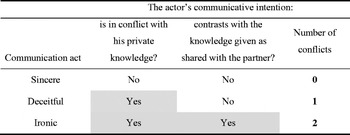
The term ‘complexity of mental representations’ refers to the existence and to the number of conflicts involved in comprehending/producing sincere, deceitful, and ironic communication acts (see Figure 1). In standard communication, default rules of inference are used to produce and understand each other's communication acts. Default rules are always valid unless their consequences are explicitly denied (cf. Reiter, Reference Reiter1980). Indeed, in standard communication, what the actor says is in line with his/her private knowledge: there are no conflicts. Simple and complex communication acts (direct and indirect) are all examples of standard communication. In terms of mental representations, to generate a standard communication act the actor has merely to produce an utterance that is in line with his private knowledge and with the behavioral game s/he shares with the partner. Thus, in terms of the complexity of the mental representations involved, this is the simplest case we analyzed. By contrast, non-standard communication, such as deceit and irony, involves the violation of default rules and the occurrence of conflicting mental representations. It follows that non-standard phenomena are more difficult to produce than standard ones. In addition, among non-standard phenomena, representations involving knowledge expressed by an actor, which is in conflict with knowledge shared with the partner, are more difficult to handle than representations that do not involve such a conflict. In particular, in the case of the production of a deceitful communication act, the actor has to take into consideration the difference between what s/he privately knows and what s/he expresses to the partner. In addition, along with the above-mentioned difference, a statement becomes ironic when the actor also produces a contrast between the expressed mental states and the scenario provided by the knowledge he shares with the partner. This makes an ironic utterance the most difficult phenomenon to produce, in terms of the complexity of the mental representations and number of conflicts involved (see Figure 1).
Conflicts involved comprehending/producing sincere, deceitful, and ironic communication acts (adapted from Bosco et al., Reference Bosco, Vallana and Bucciarelli2009).

The existence of an increasing trend of difficulty in the comprehension of standard speech acts, deceit, and irony, has been experimentally validated in children from six-and-a-half to ten years of age (Bucciarelli et al., Reference Bucciarelli, Colle and Bara2003; De Marco, Colle & Bucciarelli, Reference De Marco, Colle and Bucciarelli2007; Bosco & Bucciarelli, Reference Bosco and Bucciarelli2008). In the present study, we extend these findings to production, empirically investigating the existence in children of an increasing trend of difficulty in producing standard, deceitful, and ironic communication acts in both the linguistic and extralinguistic domains.
According to the literature on the development of human cognition, the ability to detect conflicts between representations is not fully developed in children: it increases with age and correlates with the ability to reason (Bara et al., Reference Bara, Bucciarelli and Johnson-Laird1995). Based on the assumptions of Cognitive Pragmatics theory, along with data from the developmental literature, we expected to find that the ability to comprehend and produce communication acts involving conflicting mental representations improves with age. Thus we expected that:
Hypothesis 2. In both linguistic and in extralinguistic communication there is a trend of difficulty in the comprehension and production of different kinds of pragmatic phenomena, starting from the simplest to the most complex: standard, deceitful, and ironic communication acts.
Hypothesis 3. Children both comprehend and produce standard, deceitful, and ironic communication acts more accurately as their age increases.
Paralinguistic communication
The pragmatic meaning of communication acts also derives from paralinguistic elements such as tone, intonation, rhythm, and prosody, which represent sorts of tributary aspects of language. From the perspective of Cognitive Pragmatics theory (Bara, Reference Bara2010), paralinguistic aspects do not have an autonomous status but belong to a connotative dimension. The connotative dimension of paralinguistic cues integrates communication acts, highlighting, reinforcing, and eventually modifying the expressed content, typically in an emotional way.
Thus, information about the actor's feelings can be derived not only from the propositional content, but also from paralinguistic elements such as alternations in his speaking rate, pitch level, pitch contours, and voice quality.
Such emotional features are subsidiary both of language and of communicative gestures. They are parasitical in the sense that they are not autonomous, although by contrast they improve the effectiveness of communication acts, whether expressed using linguistic or extralinguistic modalities.
Paralinguistic components can be used to express both the actor's propositional attitude and his emotional status. The former refers to the relation between the speaker and the proffered utterance; in this particular context, we have used propositional attitude to indicate the relation between the actor and the communication act expressed (for example, an assertion implies a propositional attitude of belief). To empirically investigate the propositional dimension, we considered four specific types of standard communication acts – assertions, questions, requests, and commands – which correspond to the basic speech acts (BSAs; Kasher, Reference Kasher and Kasher1991). According to Kasher, BSAs are prototypical types of speech acts and they are generally performed by uttering a specific kind of sentence, which is linguistically marked as appropriate for it. In our protocol we investigated BSAs produced using paralinguistic cues and expressing different propositional attitudes.
As regards emotional status, we considered items in which paralinguistic elements transmit emotional conditions. We focused only on basic emotions such as anger, fear, happiness, and sadness. The developmental literature has shown that even prelinguistic listeners are sensitive to the emotional tinge of communicative interaction (Ekman & Oster, Reference Ekman and Oster1979). Infants can recognize emotional facial expressions early on in life and regulate their behavior accordingly (Striano & Vaish, Reference Striano and Vaish2006), and by three to four years of age are able to recognize and name emotions on the basis of various expressive cues (Pons, Harris & de Ronsey, Reference Pons, Harris and de Ronsey2004). Furthermore, studies have shown that children's ability to interpret speaker's affect from paralinguistic cues (Friend & Bryant Reference Friend and Bryant2000), and to recognize facial emotional expressions (Herba & Phillips, Reference Herba and Phillips2004), improves with age.
To the best of our knowledge, nobody has investigated emotional aspects from the perspectives of both comprehension and production, and nobody has compared the ability to recognize emotion with the ability to recognize paralinguistic aspects, which also transmit propositional attitudes. In the present study we aim to assess such abilities on a global basis, in order to obtain a comprehensive picture of the pathway of development of paralinguistic components after the preschool period. We also wish to explore the development of paralinguistic aspects linked to propositional attitudes vs. emotional content, in order to further understand how these phenomena interact (for a detailed description of the tasks see the ‘Material: Paralinguistic scale’ section). In particular, we expect the results to reflect the fact that children master the ability to recognize and generate emotions earlier than the capacity to understand and follow social rules.
Hypothesis 4. Children recognize and produce paralinguistic aspects referring to emotional states more accurately than paralinguistic aspects referring to propositional attitudes.
Furthermore, paralinguistic elements are usually in line with the expressed content proffered, reinforcing the same meaning. However, in everyday conversation there is sometime a mismatch between paralinguistic indicators and expressed content: for example, a woman could say ‘So nice to see you here again’ with a cold tone and attitude to the ex-husband she hates and has met by chance. We have labeled this phenomenon ‘paralinguistic contradiction’, in order to indicate those situations in which paralinguistic cues reveal mental states different from the expressed semantic content.Footnote 1
We introduced this communicative case in our experimental protocol in order to verify whether children pay more attention to verbal content or to paralinguistic cues when these are conflicting. In children, once language acquisition is under way, the principal source of information about other people's feelings becomes the linguistic input, mostly because they learn the specific meaning of words, in particular emotional words referring to mental states (e.g., Bretherton, Fritz, Zahn-Waxler & Ridgeway, Reference Bretherton, Fritz, Zahn-Waxler and Ridgeway1986). From this stage forward, children seem more sensitive to the expressed content rather than to paralinguistic cues (Ross, Reference Ross and Marsel Mesulam2000). In a study investigating children's understanding of emotion in speech, Morton and Trehub (Reference Morton and Trehub2001) used a protocol where cues conflicted (i.e., a happy situation was described with sad paralinguistic elements), and they found that children relied primarily on the expressed content: the children could interpret the paralinguistic cues but they simply accorded greater weight to the propositional elements until eight years of age, whereas older children and adults considered all available cues and relied primarily on paralinguistic aspects (Mehrabian & Wiener, Reference Mehrabian and Wiener1967). In particular, Friend and Bryant (Reference Friend and Bryant2000) showed that, when paralinguistic cues and semantic content are discrepant, children of four and seven years of age favor the interpretation based on semantic content, whereas children of ten years of age favor the interpretation based on paralinguistic cues (for a detailed description of the task see the ‘Material – Paralinguistic scale’ section).
Thus, we hypothesize that:
Hypothesis 5. In the case of paralinguistic contradiction, younger children focus their attention more on linguistic content than on paralinguistic cues whereas older children focus their attention more on paralinguistic cues than on linguistic content.
Finally, in line with the relevant literature, we expected that:
Hypothesis 6. Children's ability to master paralinguistic aspects referring to an emotional state, propositional attitude, and paralinguistic contradiction increases with their age.
Socioeconomic status and pragmatic development
Family socioeconomic status (SES) is a predictor of many aspects of child development, particularly language development: the children of more educated and advantaged parents have greater vocabulary skills and faster vocabulary growth than those of less educated and advantaged parents (e.g., Row, Reference Row2008). Few studies have investigated whether socioeconomic aspects can also affect the development of social–pragmatic skills. However, some differences have been reported, for example high-SES parents seem to more often verbally encourage and provide feedback to their children than low-SES parents (Hart & Risley, Reference Hart and Risley1995).
In the present study, for explorative purposes, we examine the relation between SES and children's pragmatic development after the preschool period, in order to identify some possible influences of SES on pragmatic performance. To the best of our knowledge, no study has investigated the relation between SES and pragmatic ability during middle childhood: SES impact on language skills during early childhood seems robust, and the same pattern has emerged in studies focused on academic achievement (for a critical review see White, Reference White1982). Pragmatic performance represents a complex skill, which requires a wide range of cognitive abilities – i.e., attention, memory, planning, and Theory of Mind (Tirassa, Bosco & Colle, Reference Tirassa, Bosco and Colle2006a, Reference Tirassa, Bosco and Colle2006b); since several studies have shown that family SES is associated with a wide array of cognitive outcomes in children (Bradley & Corwyn, Reference Bradley and Corwyn2002), the role of SES should also be present in pragmatic development. However, SES effects play a role at multiple levels and are mediated by the children's personal disposition, family characteristics, and external resources, such as the multiple contexts that children experience during the schooling period.
Hypothesis 7. We explore the influence of SES in all the pragmatic phenomena investigated, expecting a moderate overall effect on children's performance.
The present study
To summarize, the goals of the present are: (i) to provide a comprehensive picture of children's pragmatic abilities; and (ii) to outline a theoretical explanation for the developmental pathways observed. To achieve these goals we formulate a series of experimental hypotheses:
1. In both linguistic and extralinguistic communication within each category – standard, ironic, and deceitful acts – children comprehend a simple communication act more accurately than a complex one.
2. In both linguistic and in extralinguistic communication there is a trend of difficulty in the comprehension and production of different kinds of pragmatic phenomena, starting from the simplest to the most complex: standard, deceitful, and ironic communication acts.
3. Children both comprehend and produce standard, deceitful, and ironic communication acts more accurately as their age increases.
4. Children recognize and produce paralinguistic aspects referring to emotional states more accurately than paralinguistic aspects referring to propositional attitudes.
5. In the case of paralinguistic contradiction, younger children focus their attention more on linguistic content than on paralinguistic cues whereas older children focus their attention more on paralinguistic cues than on linguistic content.
6. Children's ability to master paralinguistic aspects referring to an emotional state, propositional attitude, and paralinguistic contradiction increases with their age.
7. We explore the influence of SES in all the pragmatic phenomena investigated, expecting a moderate overall effect on children's performance.
We explore these hypotheses by administering the Linguistic, Extralinguistic, and Paralinguistic scales, which are part of the Assessment Battery for Communication (ABaCo; Sacco et al., Reference Sacco, Angeleri, Bosco, Colle, Mate and Bara2008; Bosco, Angeleri, Zuffranieri, Bara & Sacco, Reference Bosco, Vallana and Bucciarelli2012), to 390 Italian-speaking children divided into three age groups from five through eight years of age. Cognitive Pragmatics theory (Bara, Reference Bara2010) has been the basis for developing ABaCo, and we also use this theory to develop our hypotheses.
Method
Participants
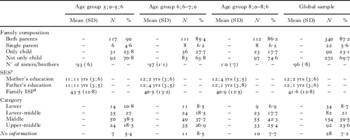
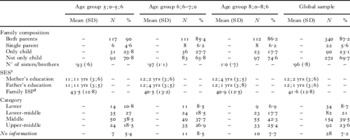
A total of 390 children aged five to eight years participated in the study. We investigated these abilities in children aged five to eight because previous research showed that this is the age range in which children are developing the relevant skills (Bucciarelli et al., Reference Bucciarelli, Colle and Bara2003; Bosco & Bucciarelli, Reference Bosco and Bucciarelli2008). They were divided into three age groups: 130 children ranging from 5;0 to 5;6 (M=5;3, SD=2 months), 130 children ranging from 6;6 to 7;0 (M=6;8, SD=3 months), and 130 children ranging from 8;0 to 8;6 (M=8;2, SD=2 months). Within each age group, there were an equal number of males and females. Children were recruited through public and private nursery and elementary schools in the Turin area of northern Italy. During an initial visit to the schools, a research assistant described the study in detail to the teachers, who then selected the children according to their age and sex. A letter was sent to the parents of the children deemed suitable to take part in the study, together with the informed consent form, which they were asked to fill in. The children whose parents gave their consent were included in the sample. All were Italian native speakers. Socioeconomic status was measured by family composition, parental educational level, and occupation, and was obtained using a questionnaire filled out by the participants' parents. The SES index was derived from the Two-Factor Index of Social Status (Hollingshead, Reference Hollingshead1975);Footnote 2 we updated the employment categories included in the Hollingshead procedure with reference to the current Italian social context. The highest percentage of children were from the middle social class (39·5%), but they were also distributed among the other classes (lower: 8·7%; lower-middle: 21%; and upper-middle: 23·6%). More detailed information about family composition and socioeconomic factors integrating the information on SES with age are shown in Table 1.
Family composition and socioeconomic details of children's sample
notes:
1 SES=Socioeconomic status.
2 ISP=Index of Social Position.
Material
The Assessment Battery for Communication (ABaCo) is a clinical instrument for the evaluation of pragmatic abilities in patients affected by neurological or psychiatric disorders involving communication impairments. It has been developed for both adults and children: some items were thus created in two different forms. Experts' judgment provided an independent validation of the content of the battery and confirmed its suitability for both children and adults. ABaCo showed the validity of the underlying theoretical construct, high inter-rater agreement, and good internal consistency (Sacco et al., Reference Sacco, Angeleri, Bosco, Colle, Mate and Bara2008; Angeleri, Bosco, Gabbatore, Bara & Sacco, Reference Angeleri, Bosco, Gabbatore, Bara and Sacco2012; Bosco, Angeleri, Zuffranieri, Bara & Sacco, Reference Bucciarelli, Colle and Bara2012).
The experimental protocol consists of three of the five scales composing the ABaCo: (1) Linguistic, (2) Extralinguistic, and (3) Paralinguistic.
The whole protocol included five evaluation scales for a total of 88 items: 16 in vivo items based on the examiner's prompts and 72 items based on videotaped scenes. Each evaluation scale was subdivided into comprehension and production sections (see ‘Appendix A’ for a description of the structure of the experimental protocol). The videotaped scenes observed by participants were performed and recorded for the purpose of the present study. Each lasted 20–25 seconds, and comprised a controlled number of words (range: 7±2). The scenes were designed to represent communicative interactions between two people. In comprehension scenes, the participant saw a complete interaction (i.e., actor A produces a communicative act and partner B replies). In production scenes, the participants saw only the initial part of the interaction (i.e., actor A produces a communicative act) and were asked to respond appropriately. To better illustrate, we provide an example of a ‘simple standard – extralinguistic comprehension’ scene:
(6) Francesco is talking on the phone. Luisa comes in and makes a gesture as if to say: ‘Shall we go?’ Question to the participant: ‘In your opinion, what could the boy answer to the girl?’
Other examples of items, and participants' responses, are reported in ‘Appendix B’.
In the following sections we describe the three evaluation scales and the specific pragmatic phenomena included in each one.
Linguistic and extralinguistic scales
The linguistic scale included tasks aimed at investigating the comprehension and production of communication acts expressed primarily through linguistic means. The extralinguistic scale also assessed the comprehension and production of communication acts, but expressed only through extralinguistic means. Since the two scales include the same communication acts, they are described together.
The pragmatic phenomena investigated here are standard communication acts, deceit, and irony (both simple and complex). The subject watched short videos where two characters were engaged in a communicative interaction.
Comprehension
The actor asked his/her partner a question and the partner replied. The subject had to understand the communication act produced by the partner in reply. In the linguistic scale, the characters communicated verbally, whereas in the extralinguistic scale, they communicated through gestures alone.
Production
In this case the actor said something to the partner and the video stopped. The subject was requested to answer the actor, assuming the partner's perspective. In the linguistic scale, the communicative interaction occurred in the linguistic modality and the subject had to reply verbally. In the extralinguistic scale, the actor performed communicative gestures without any language support and the subject had to reply using gestures alone.
Paralinguistic scale
The paralinguistic scale included the comprehension and production of those aspects that generally accompany a communication act, such as proxemics and prosody.
Comprehension
The pragmatic phenomena investigated here are basic speech acts (BSAs; Kasher, Reference Kasher and Kasher1991: assertions, questions, requests, and commands), basic emotions (anger, fear, happiness, and sadness), and paralinguistic contradiction.
Basic speech acts: the examiner showed the subject short videos where an actor, speaking an invented language, makes an assertion, asks a question, makes a request, or gives a command. The subject had to understand the type of communication act proffered by the actor, focusing only on paralinguistic indicators, since the language was purposely semantically meaningless. The examiner provided four possible answers, only one of which was correct. For example, the actor in the scene gave a command and the subject was requested to choose from among the following alternatives: ‘The actor wants: (1) to make a request (2) to say something that he believes true (3) to give a command (4) to joke.’Footnote 3
Basic emotions: the examiner showed the subject short videos where an actor, once again speaking in an invented language, expressed a basic emotion. The subject had to recognize the emotion, focusing on the paralinguistic indicators. The examiner provided four possible answers, only one of which was correct. For example, the actor expressed anger using paralinguistic elements and the subject was requested to choose the correct answer from among the following: ‘In your opinion, how does the actor feel? (1) sad, (2) angry, (3) happy, (4) scared.’
Paralinguistic contradiction: the examiner showed the subject short videos in which two characters were engaged in a communicative interaction: one of the actors verbally expressed something that is in contrast with the paralinguistic indicators (i.e., the actor says ‘I like this present very much!’ while his voice and attitude reveal that he does not like it at all). The subject had to grasp the inconsistency between expressed content and paralinguistic indicators, saying, for instance, in the example that the actor really does not like that present.
Production
The pragmatic phenomena investigated here are basic communication acts and basic emotions.
Basic speech acts: the examiner asked the subject to produce assertions, questions, requests, and commands, paying special attention to the paralinguistic indicators. For example, the examiner told the subject to ‘Ask me whether it is sunny today’ or ‘Tell me that it is sunny today’.
Basic emotions: the examiner asked the subject to produce communication acts colored by a specific emotion or mood; the examiner provided the semantic content of the requested act and the emotion with which it has to be expressed. For example, the examiner asked the subject to ‘Tell me that you have received a letter. Tell me that in a happy way.’
Content validity
In order to assess whether the items of our protocol were appropriate for children ranging in age from five to eight-and-a-half years old, four developmental psychologists (authors of at least one international publication focused on child development) were recruited. The experts were given an electronic form to fill in individually, in which they were required to evaluate each item included in the experimental protocol. For each item, they had to rate a statement of appropriateness, focusing on item suitability for children aged 5;0 to 8;6, on a five-point Likert scale. The mean value was 4·9 (SD=·1), showing that the experts judged the items to be adequate.
Procedure
The children completed the protocol tasks individually with one of the authors or a research assistant in a quiet room at their school. They were video-recorded during the experimental sessions, in order to enable post-test scoring. The average time required to administer the entire protocol ranged from 45 to 60 minutes. Two independent judges rated the children's responses; the raters were blind to the aims of the present research.
We divided the experimental protocol into two versions (A and B), each containing the same number of items. The items were randomized differently in the two versions and simple and complex comprehension items were allocated equally. Each standard and non-standard scene was recorded in two versions: given the same context and the same characters, one version showed a communicative interaction in which the partner answered the actor with a simple communication act, whereas the second one showed a complex communication act (see examples in ‘Appendix B’). Thus each version of the protocol (A or B) contained only one version (simple or complex) of the same scene; the total number of simple and complex scenes was balanced in protocols A and B. Half of the participants dealt with protocol A, while the other half dealt with protocol B. Each child was randomly assigned to protocol A or B.
Coding procedure
Scoring was kept on specific score sheets by two independent judges, while watching the children's video-recorded experimental sessions. For each task it was possible to obtain a score of 0 or 1, depending on whether the answer was correct (1 point) or incorrect (0 points) (see examples in ‘Appendix B’). The level of agreement for the ratings assigned by the two independent judges was calculated using Cohen's kappa coefficient. The kappa values could range between 0 and 1. Kappa values of ·20 or less indicate a slight compliance, ·21 to ·40 a fair agreement, ·41 to ·60 a moderate agreement, ·61 to ·80 a substantial agreement, and ⩾ ·80 an almost perfect agreement. Cohen's kappa was calculated for 60 participants, representing more than 15% of the total sample. The kappa coefficient was ·95, indicating an almost perfect agreement (Landis & Koch, Reference Landis and Koch1977).
All discrepancies were resolved by a discussion in order to reach a final resolution accepted by both coders.
Results
Linguistic and extralinguistic scale
We hypothesized that:
• In both linguistic and extralinguistic communication within each category – standard, ironic, and deceitful acts – children would comprehend a simple communication act more accurately than a complex one (Hypothesis 1).
• In both linguistic and in extralinguistic communication there would be a trend of difficulty in the comprehension and production of different kinds of pragmatic phenomena, starting from the simplest to the most complex: standard, deceitful, and ironic communication acts (Hypothesis 2).
• Children would both comprehend and produce standard, deceitful, and ironic communication acts more accurately as their age increases (Hypothesis 3).
We tested all three hypotheses together using one ANOVA to analyze the comprehension results on the linguistic and extralinguistic scales, and a second ANOVA to analyze the production results. In reporting our results we first of all consider those concerning the comprehension of the linguistic and extralinguistic scales and then those concerning the production of the linguistic and the extralinguistic scales.
Comprehension of simple and complex communication acts: standard, deceitful, and ironic
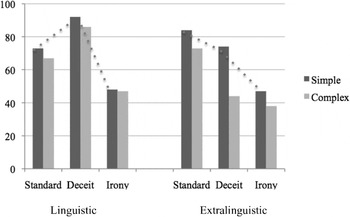
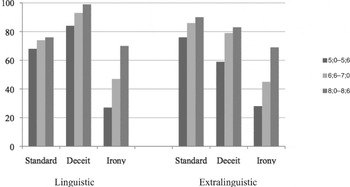
To investigate children's performance in the comprehension of simple and complex standard, deceitful, and ironic communication acts, data were entered into the ANOVA with one between-participants factor (age group, with three levels, corresponding to the three different age groups) and two within-participants factors (type of phenomenon, with three levels: standard, deceitful, and ironic; and type of inference, with two levels: simple and complex), for both the linguistic and extralinguistic scales. A Bonferroni correction of α/3 was applied for the post-hoc pairwise comparisons between age groups. Data are shown in Figures 2 and 3.
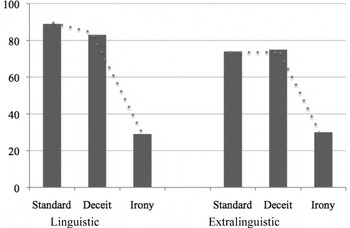
Children's comprehension of linguistic and extralinguistic communication acts (global sample). The spotted line indicates the general trend of difficulty of the different pragmatic phenomena.

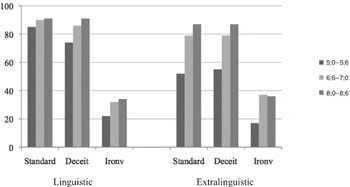
Percentage of correct answers obtained by the different age groups in the comprehension of standard, deceitful, and ironic communication acts.

In the comprehension of the linguistic scale, the ANOVA revealed a main effect of the type of inference (F (1,364)=14·9; p<·0001; η2=·04): children in all three age groups understood simple communication acts more accurately than complex ones. A t-test analysis revealed that the difference between simple and complex communication acts was significant only in the case of standard acts and deceit (t-test: 2·59<t<4·8; ·0001<p<·01), whereas the difference between simple and complex irony was not significant (t-test: t=·2; p=·84, see Figure 2).
In all three age groups there was also a main effect of the type of pragmatic phenomenon (F (2,728)=267·57; p<·0001; η2=·42). We introduced a linear contrast to test whether there is a linear increase (or decrease) in the scores; the analysis revealed a linear decrease depending on the type of pragmatic phenomenon (F (1,364)=117; p<·0001; η2=·24): contrary to our expectation children overall and within each age group understood deceit most accurately, followed by standard communication acts and lastly irony, which they understood least accurately (see Figure 3).
The ANOVA also revealed a main effect of the age group (F (2,364)=80·87; p<·0001; η2=·31), indicating that children's performance improved with age in all tasks. Post-hoc analysis using the Bonferroni multiple comparison correction revealed that the difference in performance was significant in each pair of age groups (p<·0001).
Data concerning the comprehension of the extralinguistic scale were also entered into the ANOVA, with age group as the between-participants factor. The ANOVA revealed a main effect of type of inference (F (1,306)=102·1; p<·0001; η2=·3): in extralinguistic comprehension, children understood simple communication acts more accurately than complex ones in all pragmatic phenomena (t-test: 3·87<t<11·46; p<·0001, see Figure 2).
There was also a main effect of the type of pragmatic phenomenon (F (2,612)=156·37; p<·0001; η2=·34). The linear contrast revealed a linear decrease in scores depending on the type of pragmatic phenomenon (F (1,306)=333·52; p<·0001; η2=·5): children overall and within each age group understood standard communication acts most accurately, followed by deceit and irony, which they understood least accurately.
We also found a main effect of the age group (F (2,306)=63·1; p<·0001; η2=·3): performance improved with the children's age. A post-hoc comparison revealed that the difference in performance was significant in each pair of age groups (·0001<p<·001, see Figure 3).
Production of standard, deceitful, and ironic communication acts
To investigate children's performance in the production of standard, deceitful, and ironic communication acts, data were entered into the ANOVA with one between-participants factor (age group, with three levels, corresponding to the three different age groups) and one within-participants factor (type of phenomenon, with three levels: standard, deceitful, and ironic), for both the linguistic and extralinguistic scales.
The ANOVA revealed a pattern of differences among types of pragmatic phenomena, both in the linguistic scale (F (2,742)=833·47; p<·0001; η2=·7) and extralinguistic scale (F (2,702)=465·55; p<·0001; η2=·6). In more detail, we found the following trend of difficulty in linguistic production: standard communication acts were produced most accurately, followed by deceit and finally by ironic communication acts, which were produced least accurately (Linear Contrast: F (1,371)=1367·01; p<·0001; η2=·8). For the extralinguistic scale, the linear contrast revealed the same trend of difficulty (F (1,351)=613·75; p<·0001; η2=·6, see Figure 4).
Percentage of correct answers obtained by children in the production of linguistic and extralinguistic communication acts (global sample). The spotted line indicates the general trend of difficulty of the different pragmatic phenomena.

For the linguistic scale, the ANOVA revealed a pattern of differences among age groups (F (2,371)=17·3; p<·0001; η2=·1). Post-hoc comparison showed significant differences in performance between the following age groups: 5;0–5;6 vs. 6;6–7;0 (p<·0001) and 5;0–5;6 vs. 8;0–8;6 (p<·0001), whereas the difference between the 6;6–7;0 and 8;0–8;6 age groups was not significant (p=·63).
In the extralinguistic scale, we found the same trend in differences among age groups (F (2,351)=79·47; p<·0001; η2=·3). Also, in this case, post-hoc comparisons revealed significant differences in performance between the 5;0–5;6 vs. 6;6–7;0 and 5;0–5;6 vs. 8;0–8;6 age groups (p<·0001), whereas the difference between the 6;6–7;0 and 8;0–8;6 age groups was not significant (p=·11). These data are shown in Figure 5.
Percentage of correct answers obtained by the different age groups in the production of standard, deceitful, and ironic communication acts.

Paralinguistic scale
We hypothesized that children would recognize and produce paralinguistic aspects referring to emotional states more accurately than paralinguistic aspects referring to propositional attitudes (Hypothesis 4).
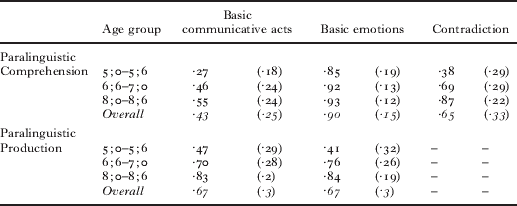
We also expected that in the case of paralinguistic contradiction, younger children would focus their attention more on linguistic content than on paralinguistic cues whereas older children would focus their attention more on paralinguistic cues than on linguistic content (Hypothesis 5). Finally we expected that children's ability to master paralinguistic aspects referring to an emotional state, propositional attitude, and paralinguistic contradiction would increase with their age (Hypothesis 6). Children's performance on the paralinguistic scale is displayed in Table 2.
Mean (SD) of children's performance on paralinguistic scale (range 0–1)
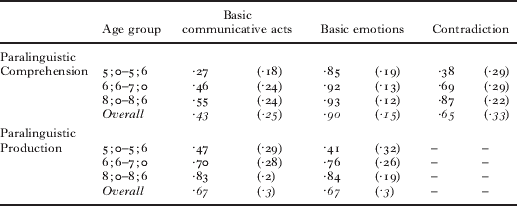
To investigate children's performance in the comprehension of paralinguistic aspects, data were entered into the ANOVA with one between-participants factor (age group, with three levels, corresponding to the three different age groups) and one within-participants factor (type of phenomenon, with two levels: basic emotions and basic communication acts). The ANOVA analysis revealed a significant difference among age groups (F (2,367)=56·67; p<·0001; η2=·24) in the comprehension of basic emotions, and basic communication acts; the post-hoc comparison revealed significant differences in performance between each pair of age groups (p<·0001). Children in all three age groups understood basic emotions more accurately than basic communication acts (F (2,367)=1260·5; p<·0001; η2=·77).
To investigate performance in the production of paralinguistic elements, we conducted an ANOVA with one between-participants factor (age group) and one within-participants factor (type of element, with two levels: basic communication acts and basic emotion). The analysis revealed a significant difference among the age groups (F (2,367)=30·6; p<·0001; η2=·41). The post-hoc comparison revealed significant differences in performance between the 5;0–5;6 vs. 6;6–7;0 age groups and the 5;0–5;6 vs. 8;0–8;6 age groups (p<·0001), whereas the difference between the 6;6–7;0 and 8;0–8;6 age groups was not significant (p=·16). The analysis revealed no main effect of type of element (F (1,306)=2·46; p=·12; η2=·03).
In line with the expectation that in the case of paralinguistic contradiction younger children would focus their attention more on linguistic content than on paralinguistic cues, whereas older children would focus their attention more on paralinguistic cues than on linguistic content, we found that younger children, aged five years, were more sensitive to the content of the utterance than to paralinguistic indicators (binomial test: p<·0001), whereas the two groups of older children were more sensitive to paralinguistic cues than to content (6;6–7;0 age group: ·01<p<·03; 8;0–8;6 age group: p<·0001).
Finally, we hypothesized that the ability to solve paralinguistic contradiction would increase with children's age and we found that children's performance improved in the three different age groups (one-way: ANOVA F (2,374)=108·73; p<·0001; η2=·37); the post-hoc comparison showed that the difference was significant between each pair of age groups (p<·0001).
Pragmatic performance and socioeconomic status
A final explorative goal of the study was to investigate a possible relation between children's pragmatic abilities and their socioeconomic background (Hypothesis 7). We wished to explore the influence of socioeconomic status on all the pragmatic phenomena investigated, expecting it to have a moderate overall effect on children's performance.
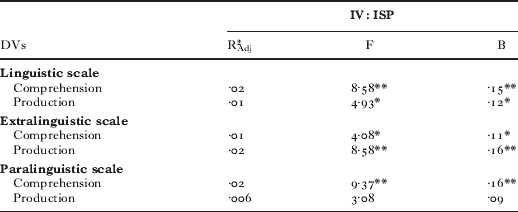
We used the Index of Social Position (ISP) value as the indicator of children's family socioeconomic status, i.e., the continuous value obtained from parental educational level and occupation following the Hollingshead's procedure (1975). As shown in Table 3, the ISP scores in this sample were significantly related to most of the scales in our protocol. In particular, the ISP was correlated to linguistic comprehension and production, to extralinguistic comprehension and production, and, lastly, to paralinguistic comprehension (see Table 3). We should point out that r values were very small, thus indicating a slight correlation between the variables; nevertheless, the relation was permanently present, showing that high-SES children achieve moderately higher pragmatic scores than low-SES children. To better understand the nature of this correlation, we performed a regression model in order to clarify the predictive role of the ISP in children's pragmatic performance: the ISP proved to be a significant predictor of linguistic comprehension and production, extralinguistic comprehension and production, and paralinguistic comprehension (4·09<F (1,360)<9·37; ·002<p<·04), even though the amount of explained variance was very small, ranging from 1% to 2%. Thus, the SES effect was constant in children's performance throughout our tasks, although its effect was very slight.
Relation between children's pragmatic performance and socioeconomic components
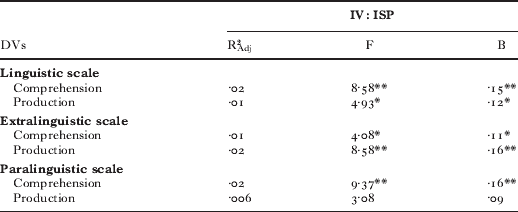
notes: * significant at level ·01; ** significant at level ·05.
Discussion
The aim of the present study was to investigate the communicative abilities of children to comprehend and produce a wide set of pragmatic phenomena – ranging from very easy ones, such as simple standard communication acts, to the most difficult ones, such as complex ironic communication acts – produced through different expressive modalities. In the current literature they have been investigated through different empirical protocols and non-comparable experimental procedures. To achieve our goal we derived a series of empirical hypotheses from a coherent theoretical framework, i.e., Cognitive Pragmatics theory, we used a similar protocol for linguistic and extralinguistic communicative acts, and we provided additional data on paralinguistic aspects.
For this reason our protocol was made up of three scales, each evaluating a specific expressive means, namely the linguistic, extralinguistic, and paralinguistic one. All scales investigate children's ability to both comprehend and produce different types of pragmatic task. We shall now discuss our results concerning each single scale in detail. The results are discussed in the same order of presentation as the hypotheses and data.
Linguistic and extralinguistic scale
In line with our hypothesis, children understood simple communication acts more accurately than complex communication acts on both the linguistic and extralinguistic scales, with regard to all the pragmatic phenomena considered, namely standard, deceitful, and ironic communication acts, with the only exception of linguistic irony, where the difference was not significant.
Our explanation for this unexpected result is that irony is the most difficult pragmatic phenomenon among those we investigated: children younger than seven years of age performed poorly both with simple and complex ironies and thus no significant difference emerged. By contrast, the oldest children of eight years of age performed as predicted (simple irony 70% of correct answers, complex irony 66% of correct answers). We conclude that irony comprehension is a difficult task to solve for children younger than seven years of age. Such results are in line with Bosco and Bucciarelli (Reference Bosco and Bucciarelli2008), who found that children are only good at understanding ironic communication acts after the age of seven years, and that starting from eight years of age they find it easier to comprehend simple (linguistic) irony rather than complex (linguistic) irony.
Taken globally, the results concerning simple and complex communication acts extend and support previous findings (Bosco & Bucciarelli, Reference Bosco and Bucciarelli2008) on simple and complex deceit and irony expressed in the linguistic modality: the present results show that such a difference applies also to the same pragmatic phenomena investigated through the extralinguistic modality. In line with Cognitive Pragmatic theory (Bara, Reference Bara2010), the length of the inferential chain necessary to connect the communication act to the behavioral game shared between the interlocutors is the factor determining the different levels of difficulty children find in comprehending simple and complex communication acts. We conclude that the difference in the increasing inferential chain required by different examples of the same pragmatic task is a factor influencing children's communicative performance.
Focusing now on the difference between different pragmatic phenomena, we found that the difficulty in manipulating mental representations of increasing complexity also plays a role in influencing children's pragmatic performance. The result is in line with our expectations: we found that children both understood and produced standard communication acts more accurately than deceit, followed by irony, which they understood and produced least accurately, in both linguistic and extralinguistic modality production. The comprehension of speech acts was an exception where, contrary to our expectation, deceit was understood most accurately, followed by standard and then by ironic acts, which were once again understood least accurately.
Our explanation for such an unexpected result is that half of our tasks concerning deceit were represented by a behavioral game the children were familiar with. It consisted of situations in which the protagonist of the interaction ‘is up to a trick’ and the partner asks him to explain what is happening. These scenarios were so conventional for our participants that they often gave the correct answers before the end of the interaction represented in the scene, which they did not do for the standard or ironic scenarios. Thus, solving such specific tasks did not involve an increase in the mental representations usually necessary to comprehend deceit.
Despite this exception, on the whole, the result concerning the existence of an increasing trend of difficulty is in line with previous studies concerning children's linguistic (Bosco & Bucciarelli, Reference Bosco and Bucciarelli2008; Bosco, Vallana & Bucciarelli, Reference Bosco, Vallana and Bucciarelli2009) and extralinguistic comprehension (Bucciarelli et al., Reference Bucciarelli, Colle and Bara2003). In our study we extended this result to the linguistic and extralinguistic production of these three kinds of pragmatic act.
Our result for comprehension is in line with previous studies (e.g., Demorest, Meyer, Phelps, Gardner & Winner, Reference Demorest, Meyer, Phelps, Gardner and Winner1984; Winner & Leekman Reference Winner and Leekman1991), which found that irony is more difficult than deceit. Winner and Leekman (Reference Winner and Leekman1991) interpreted this discrepancy between irony and deceit within the Theory of Mind (ToM) framework, that is, the ability to ascribe mental states to oneself and to others and to use this knowledge to predict and explain the relevant actions and behaviors (Premack & Woodruff, Reference Premack and Woodruff1978). Winner and Leekman (Reference Winner and Leekman1991) assume that irony comprehension is more difficult because it requires second-order ToM, whereas deceit requires only first-order ToM. First-order ToM requires the understanding of another person's belief about a state of the world, while second-order ToM requires ascribing nested mental states, that is, understanding a person's belief about the beliefs of another person (Perner & Winner Reference Perner and Winner1985).
Also in line with Bosco and Bucciarelli (Reference Bosco and Bucciarelli2008), we suggest that our results cannot be explained in terms of the role played by second-order ToM. Our eight-year-old children performed better with deceit than with irony (see ‘Appendix C’), although we assume, in line with the literature, that at eight years of age they have no problem in inferring second-order ToM (Perner & Winner, Reference Perner and Winner1985). Furthermore, Filippova and Astington (Reference Filippova and Astington2008) showed that in a group of twenty-four healthy adults, only nine were found to fully comprehend the investigated irony. Since we can assume that a healthy adult person has a fully developed second-order ToM, it is difficult to explain adults' poor performance on the irony comprehension task as being due to ToM capacity alone.
In conclusion, while not wishing to deny the role played by Theory of Mind in understanding deceit and irony, in our opinion the capacity to deal with second-order ToM cannot be the only factor explaining the different levels of difficulty involved in comprehending and producing deceit and irony (see also Bosco, Bucciarelli & Bara Reference Bosco, Bucciarelli and Bara2006). According to Cognitive Pragmatics theory, an additional and crucial cognitive factor explains the different levels of difficulty for deceit and irony, that is, the increasing complexity of the mental representations involved, i.e., the existence and number of conflicts involved in comprehending/producing sincere, deceitful, and ironic communication acts.
Finally, as hypothesized, we detected an improvement in children's ability both to comprehend and to produce standard, deceitful, and ironic communication acts as their age increased, in both the linguistic and extralinguistic modality.
Paralinguistic scale
On the comprehension side (see Table 2) our results show, in line with our hypotheses, that all three age groups of children comprehended basic emotions – happiness, sadness, anger, and fear – more accurately than basic communication acts – assertions, questions, commands, and requests – when expressed through an invented language and thus detectable only by paralinguistic cues. We also found a difference in performance among age groups in both tasks. Our data are in line with Filippova and Astington (Reference Filippova and Astington2008), who showed a similar pattern of results for children ranging from five to nine years of age.
Furthermore, in line with our hypothesis we found that in the case of paralinguistic contradiction younger children focused more on the linguistic content, while older children focused more on paralinguistic cues. In line with such a result, children's ability to interpret paralinguistic cues gradually increased among different age groups. This means that, with age, children became more able to appreciate the correct mental states of their interlocutors from paralinguistic cues rather than referring only to propositional content. Our result is also in line with Morton and Trehub (Reference Morton and Trehub2001) and Friend and Bryant (Reference Friend and Bryant2000), showing that as they grow up children accord greater weight to paralinguistic elements.
By contrast, on the production side we did not find any significant difference in children's ability to produce a paralinguistic intonation to express a specific emotion vs. a specific basic communication act: children are equally good at both tasks (see Table 2). To the best of our knowledge no study in the literature has empirically compared such aspects. Finally, children's performance in both tasks improved with their age.
Socioeconomic effect
Although children's communicative performance was the primary focus for the current study, previous research within the language development domain indicates that other factors should be considered in terms of their contribution to individual differences in performance. In order to better interpret findings related to individual differences, we explored the role played by the family's socioeconomic status in children's pragmatic performance. SES impacts the lives of children in numerous ways and affects many outcomes, including social development (Wood, Reference Wood1988) and cognitive abilities (Perner, Ruffman & Leekam, Reference Perner, Ruffman and Leekam1994). The complex nature of the associations with SES makes the implications for the role of SES in impacting pragmatic development interesting to investigate, as a possible proximal factor able to explain individual differences. Our results showed that socioeconomic features had a small effect in predicting children's pragmatic ability, but this small effect was constant throughout our different tasks. Whereas several studies have examined socioeconomic influences on language acquisition during early childhood (e.g., Pungello, Iruka, Dotterer, Mills-Koonce & Reznick, Reference Pungello, Iruka, Dotterer, Mills-Koonce and Reznick2009), less attention has been paid to the development of pragmatic skills during the schooling period; our study showed that the influence of the socioeconomic effect is still present, albeit quite small, in children during middle childhood, from five to eight-and-a-half years of age. This is in line with a fairly recent study (Magnuson, Reference Magnuson2007) that pointed to the important role of family socioeconomic status in the academic achievement of children in the intermediate age group. More research is still necessary to better understand the possible implications of those factors in children's communicative development, and for the possible promotion of specific types of policy and intervention for their families.
Conclusions
Within the framework of Cognitive Pragmatics theory, we identified two cognitive factors that affect the different levels of accuracy with which children comprehend and produce different sorts of pragmatic phenomena: (i) the length of the inferential chain; and (ii) the complexity of the mental representations. The length of the inferential chain explains the different levels of accuracy with which children discriminate between various examples of the same pragmatic phenomenon, i.e., simple and complex communicative acts. The increasing complexity of the mental representations involved explains the difference in children's performance in relation to the various pragmatic phenomena, i.e., standard, deceitful, and ironic communicative acts.
Our results concerning the comprehension and production of standard and non-standard communication acts follow the same pattern of results on both the linguistic and extralinguistic scales. We interpret such data as supporting our assumption that linguistic and extralinguistic communication acts share the same relevant cognitive factors in each specific pragmatic phenomenon investigated. Such data support a unified theoretical framework in which linguistic and extralinguistic modalities are different aspects of a single communicative competence (Bara, Reference Bara2010).
Our results also showed an increase in children's paralinguistic ability, in particular in their ability to focus on paralinguistic cues in the case of contradiction with the expressed linguistic content.
Our study attempts to support a coherent framework for describing communicative abilities, in which language and gestures, in addition to paralinguistic aspects, are two parallel modalities of expression, and comprehension and production are two aspects that can be investigated separately. Within this framework, we advanced an explanation for the differences children showed in mastering the main pragmatic phenomena we investigated: standard communication acts, irony, and deceit. To the best of our knowledge no other empirical study in the literature has ever tried to construct a similar systematic account.
Appendix A
Structure of the experimental protocol

Appendix B
Examples of ABaCo items and children's answers
LINGUISTIC SCALE
[1] COMPREHENSION – SIMPLE DECEIT
Andrew is eating some biscuits. He hears Kate arriving, and then he pushes away the empty plate in front of him. Kate sees the empty plate and asks: ‘Who has finished my biscuits?’
Andrew answers: ‘I don't have the slightest idea.’
Question: In your opinion, why did the boy answer to the girl: ‘I don't have the slightest idea’?
Example of correct answer:
‘He's telling a lie to his sister.’
Example of wrong answer:
‘Because he doesn't know.’
[2] COMPREHENSION – COMPLEX DECEIT
Andrew is eating some biscuits. He hears Kate arriving, and then he pushes away the empty plate in front of him. Kate sees the empty plate and asks: ‘Who has finished my biscuits?’
Andrew answers: ‘I'm on a diet.’
Question: In your opinion, why did the boy answer to the girl: ‘I'm on diet’?
Example of correct answer:
‘Because he couldn't eat the biscuits, so he said he's on a diet.’
Example of wrong answer:
‘Because he is on a diet.’
EXTRALINGUISTIC SCALE
[3] COMPREHENSION – SIMPLE IRONY
Piero and Alice are in the kitchen. Alice gets up to fetch a pan, which she brings to the table, and pours a ladle of soup into the dishes. They taste a spoonful and both pull a disgusted face. Alice looks questioningly at Piero who …:
Takes his fingers to his mouth and kisses his fingertips with an expression as if to say ‘Delicious!’
Question: In your opinion, why did the boy speak to the girl with that gesture?
Example of correct answer:
‘He was joking! He doesn't like the soup!’
Example of wrong answer:
‘Because he liked the soup!’
[4] COMPREHENSION–COMPLEX IRONY
Piero and Alice are in the kitchen. Alice gets up to fetch a pan, which she brings to the table, and pours a ladle of soup into the dishes. They taste a spoonful and both pull a disgusted face. Alice looks questioningly at Piero that:
Lifts his plate with one hand and with the other, looking amused, indicates that he would like some more.
Question: In your opinion, why did the boy say to the girl with that gesture?
Example of correct answer:
‘Because the soup was awful, so he's joking about having a little more!’
Example of wrong answer:
‘Because he wants some more soup.’
[5] PRODUCTION – STANDARD
Francesco is talking on the phone. Luisa comes in and makes a gesture as if to say: ‘Shall we go?’
Question: In your opinion, what could the boy answer to the girl?
Example of correct answer:
Child moves the head as to say ‘yes’.
Example of wrong answer:
Child performs no gesture.
PARALINGUISTIC SCALE
[6] PRODUCTION – BASIC EMOTIONS
Ask me where the teacher is. Ask me as if you were sad.
Ask me where the teacher is. Ask me as if you were scared.
Example of correct answer:
The child uses the appropriate intonation in proffering the utterance.
Example of wrong answer:
The child does not use the appropriate intonation in proffering the utterance.
Appendix C
Performance of children aged 8;0–8;6 on deceit and irony, correct answers expressed in percentage and t-test values