INTRODUCTION
Polychaetes of the family Spionidae are one of the most important taxa in marine benthic assemblages. They are adapted to a wide array of habitats ranging from muddy or sandy bottoms to calcareous substrates. They are worldwide in distribution and often represent the dominant taxa in benthic habitats from the intertidal to slope depths (Blake, Reference Blake, Blake, Hilbig and Scott1996). Spionids have been found on seamounts and in hydrothermally active regions (Blake & Kudenov, Reference Blake and Kudenov1978; Maciolek, Reference Maciolek1981; Grassle, Reference Grassle1985; Levin et al., Reference Levin, McCann and Thomas1991; Sigvaldadóttir & Desbruyères, Reference Sigvaldadóttir and Desbruyères2003). A new species of spionid of the genus Malacoceros has been collected from the hydrothermally active crater of Kick'em Jenny, a submarine volcano in the Lesser Antilles Arc (Wishner et al., Reference Wishner, Graff, Martin, Carey, Sigurdsson and Seibel2005). Species of Malacoceros are well known from tropical waters, some specifically from the Caribbean, as well as more temperate and Arctic waters (Foster, Reference Foster1971a, Reference Fosterb; Blake & Kudenov, Reference Blake and Kudenov1978). An unusual species of Malacoceros was recently described from active hydrothermal vents along the East Pacific Rise by Hourdez et al. (Reference Hourdez, Desbruyères and Laubier2006).
Kick’em Jenny, located north-east of Grenada, is the most active submarine volcano in the Caribbean last erupting in December 2001 (Sigurdsson & Shepherd, Reference Sigurdsson and Shepherd1974; Watlington et al., Reference Watlington, Wilson, Johns and Nelson2002). Rising from the sea floor, the peak of the volcano is at a depth of about 174 m, with the deepest regions of the crater at nearly 285 m (Watlington et al., Reference Watlington, Wilson, Johns and Nelson2002).
At the time of collection, there was diffuse hydrothermal venting through cracks and fissures within the crater. Few animals occurred within the crater, except near venting regions of shimmering or bubbling water where bacterial mats, shrimp aggregations and spionid polychaete worms were abundant (Martin et al., Reference Martin, Wishner and Graff2005; Wishner et al., Reference Wishner, Graff, Martin, Carey, Sigurdsson and Seibel2005). Hundreds of specimens of the new spionid species were collected as a result of their locally dense distribution near the venting. Virtually no fish or other predatory animals were seen in the crater of the volcano. A full survey of the volcano's biology has not been completed; thus the ecological importance of this locally abundant polychaete has not been evaluated. The new species of Malacoceros described herein is the second species of this genus to be reported from active hydrothermal vents after M. samurai from the East Pacific Rise (Hourdez et al., 2006) and is the first to be reported from such habitats in the Atlantic. The new species closely resembles two congeners from the Caribbean but differs with respect to its prominent lateral frontal horns, eyes, neurosetae and pygidium.
MATERIALS AND METHODS
Samples were collected in March 2003 aboard the RV ‘Ronald H. Brown’ using the Eastern Oceanics remotely operated vehicle (ROV). Sample material was collected from three separate venting regions within the crater of Kick'em Jenny using a suction sampler at depths of 256, 259, and 262 m. Water temperatures were collected just above the sample site. Samples were preserved in 4% buffered formaldehyde. In the laboratory, worms were picked by hand or sieved (1 mm mesh size) from bacteria mat samples and preserved in 4% buffered formaldehyde. Holotype and paratypes were deposited in the Smithsonian Museum of Natural History (USNM No. 1086647 and USNM No. 1086649).
R. McKinney at the Narragansett, RI EPA laboratory measured stable isotope values for 13C and 15N. Isotope values were corrected for formaldehyde effects by adding 1.65‰ to δ13C and subtracting 0.08‰ from δ15N values (Sarakinos et al., 2002). Photographs were taken using a Nikon Coolpix mounted on a Wild dissecting scope or Wild compound scope. Drawings for Figure 1 were created from pictures using Macromedia Freehand and all images were transferred to Adobe Photoshop for arrangement and print preparation.
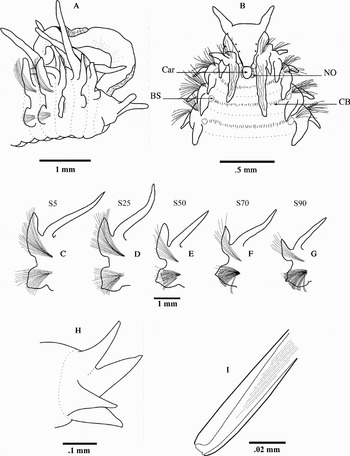
Malacoceros jennicus, sp. nov.: (A–B) anterior end; (C–G) setigers 5, 25, 50, 70 and 90 showing changes in lamellae and setae structure moving dorsally; (H) pygidium with 4 anal cirri; (I) hooded hook. Car, caruncle; NO, nuchal organs; BS, branchial scars; CB, ciliary bands.

SYSTEMATICS
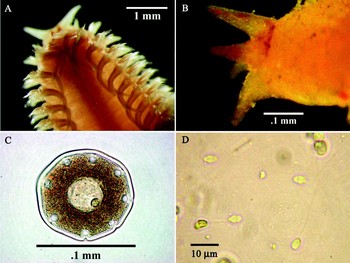
Malacoceros jennicus, sp. nov.: (A) anterior end without palps; (B) pygidium with cirri; (C) egg; (D) sperm.

TYPE MATERIAL
Holotype: 25 mm long, missing palps, collected from 262 m (12°18.076′N 61°38.256′W) by Dr Karen Wishner. Material was preserved in 4% buffered formaldehyde and later transferred to 70% ethanol by the Smithsonian Museum of Natural History (USNM No. 1086647).
Paratypes: 12 specimens (12–30 mm long), one retaining a palp, collected from 262 m (12°18.076′N 61°38.256′W) by Dr Karen Wishner. Material preserved in 4% buffered formaldehyde and later transferred to 70% ethanol by the Smithsonian Museum of Natural History (USNM No. 1086649).
DESCRIPTION
Specimens up to 39 mm long, 2.8 mm wide at setiger 5, with 104 setigers. Prostomium bearing very prominent lateral frontal horns. Body widest near anterior segments 5–12, then gradually tapering posteriorly and sharply tapering in last 10–15 setigers. Parapodia biramous; branchiae on all setigers. From setiger 2, dorsal ciliated organs extend across dorsum between bases of branchiae. Simple capillary setae present in noto- and neuropodia. In neuropodia, sabre setae and bidentate hooded hooks present in posterior segments, these lacking in notopodia. Pygidium with four digitiform anal cirri of equal size surrounding anus. When alive, worms bright red, active, crawling in and out of sediment in containers. Some with mucus tubes. Colour in formalin, pinkish-brown.
Prostomium broadly rounded along anterior margin, sometimes with weak terminal notch; very prominent lateral horns present, directed frontally; prostomium continuing posteriorly as short caruncle to setiger 2; 4 small black eyespots arranged in 2 pairs along lateral margin of prostomium, with anterior pair more widely separated than posterior pair (Figures 1 A, B & 2A); caruncle small, button-like, with small, lateral nuchal organs consisting of two small rounded patches of cilia (Figure 1B). Palps readily lost in preservation, but some specimens retaining a single grooved palp that extended to setigers 5–7; no specimens retained both palps. Cirriform branchiae from setiger 1, continuing on all segments to posterior end; branchiae basally fused to notopodial lamellae, usually overlapping at dorsal midline in anterior segments, reduced in length and thickness in middle and posterior segments.
Setiger 1 well developed, but smaller than subsequent segments and shifted somewhat dorsally with slightly reduced parapodia and simple setae. Setiger 2 larger, slightly reduced and shifted dorsally relative to subsequent segments (Figure 1A). Dorsal lamellae distally tapered throughout body (Figure 1C–G; setigers 5–90). Neuropodia broad, rounded to cordiform in shape with a nipple-like projection distally, becoming more pronounced in posterior setigers (Figure 1 C–G). Parapodia slightly reduced in size toward posterior end with a dramatic reduction in the last 10–15 setigers.
Simple capillary notosetae present throughout body, becoming reduced in number in posterior segments (Figure 1C–G). Notosetae arranged in two rows: anterior row setae longer, and project dorsally; posterior row setae more numerous, arranged in a broad array, and originating from slightly more distal position. Capillary neurosetae present throughout, with 2–3 inferior sabre setae from setiger 25 and bidentate hooded hooks from setigers 35–40. Two rows of neurosetae in anterior segments arise from a single fascicle with posterior row longer in length. Capillaries, sabre setae, and hooks originating from distinct regions of parapodia in a layered fashion. Sabre setae originating posterior and distal to capillaries and hooks, with origination point becoming more distal and ventral in posterior segments. Hooks numbering up to 17 per fascicle; each with striated shaft and a primary hood with apical opening through which teeth are visible. Secondary tooth of hooded hooks very small, at right angle to larger and more prominent main fang (Figure 1I). Capillary setae originating slightly distal to and behind hooks, thus hooks and capillaries in an alternating arrangement; capillaries may be companion setae to hooks.
Pygidium terminal with four anal cirri (Figures 1H & 2B).
COMPARISON
The dominant polychaete sampled from the crater of Kick’em Jenny, at or near venting regions, is a new species of spionid worm here referred to the genus Malacoceros based on the morphological characteristics of having prominent horns and branchiae present from setiger 1 (see Blake & Kudenov, Reference Blake and Kudenov1978). A related genus, Rhynchospio has branchiae from setiger 2 (Blake & Kudenov, Reference Blake and Kudenov1978). Hooded hooks begin around setiger 40 and at their maximum range between 14 and 17 per neuropodial fascicle. Two or three sabre setae are present from setiger 25. Nipple-like projections on the neuropodia become more prominent in posterior segments, similar to those reported for Malacoceros indicus (Fauvel Reference Fauvel1928; Foster, Reference Foster1971a).
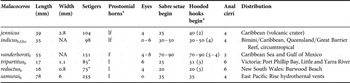
Malacoceros jennicus sp. nov. most closely resembles Malacoceros vanderhorsti (Augener, Reference Augener1927) and M. indicus in morphological characteristics and regional settings (Table 1). The new species possesses prominent lateral horns that are directed frontally. Malacoceros jennicus has up to 17 hooded hooks whereas M. indicus exhibits up to eight (Foster, Reference Foster1971a). Eyespots are present in both M. vanderhorsti and M. indicus but they are more numerous in these species and are irregularly arranged instead of limited to two pairs along lateral margins of the prostomium (Foster Reference Foster1971b; Blake & Kudenov, Reference Blake and Kudenov1978). Malacocerus jennicus also appears to have fewer apical teeth on the hooded hooks than most members of this genus: two in comparison to three or four, but this trait is cautiously used as a defining characteristic as this can vary in some species (Foster Reference Foster1971b; Blake & Kudenov, Reference Blake and Kudenov1978). Malacocerus jennicus has four anal cirri in comparison to two or six present in most species of the genus; six for M. vanderhorsti. Both M. vandershorsti and M. indicus are well known from the Caribbean (Foster, Reference Foster1971a, Reference Fosterb). Malacocerus jennicus is thus the third species from the region, but is the first to be collected from a hydrothermally active setting.
Comparison of Malacoceros jennicus with other members of the genus.

1 l = lateral, f = frontal, lf = lateral horns directed frontally; 2(number of teeth); b = Blake & Kudenov Reference Blake and Kudenov1978; f = Foster 1971; hs = Hartmann-Schröder Reference Hartmann-Schröder, Hartmann-Schröeder and Hartmann1965; h = Hourdez et al. Reference Hourdez, Desbruyères and Laubier2006; *not total number of setigers.
NOTE ON REPRODUCTION AND SURVIVABILITY
Worms were abundant in the bacterial mats and sediment near the diffuse venting regions in the crater. Due to the method of sampling, densities of the worms could not be calculated. The size-range of the worms collected range from 9–39 mm in length.
Reproductive females and males were observed. Eggs with a diameter of approximately 100 µm have thick, yet smooth egg envelopes with prominent cortical alveoli. The egg envelopes have surficial depressions that connect with the subsurficial cortical alveoli by cytoplasmic connections (Figure 2C). Fertilized eggs were not observed, but in related spionids the fertilization membrane and cortical alveoli contract inwardly upon fertilization. Connections with the egg envelope are retained by thick cytoplasmic connections. With development, the egg envelope is eventually incorporated into the developing larval cuticle (Blake & Arnofsky, Reference Blake and Arnofsky1999). It is likely that M. jennicus follows the same pattern. Sperm are short-headed ect-aquasperm and have a small acrosome, large middle piece, mitochondrial region, and long tail (Figure 2D). These sperm are similar to reports for other Malacoceros species (Blake & Arnofsky, Reference Blake and Arnofsky1999).
STABLE ISOTOPES
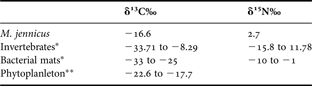
Stable isotope analysis of M. jennicus resulted in values of −16.6‰ and 2.7% for 13C for 15N respectively. Stable isotope analysis of bacterial mats was not conducted due to insufficient material and samples for plankton and other particulate material were not collected. A discussion of potential food sources and expected stable isotope signatures is included below.
DISCUSSION
The paucity of other macrofauna and the abundance of M. jennicus near the venting regions of the Kick'em Jenny crater may indicate a high tolerance for a hostile temperature and/or chemical environment. In one region of venting, a PVC core tube (melting temperature of approximately 270°C) melted in the sediment while taking a push core. However, water temperatures just above the sediment were only a few degrees above ambient (14–17°C). Thus, the worms may be subjected to a steep gradient in temperature.
The bacterial mats associated with the hydrothermal venting in the crater of Kick'em Jenny could serve as a food source for this species. Stable isotope analysis of M. jennicus shows that δ13C and δ15N values of the new species fall within the ranges of stable isotope measurements for invertebrates from hydrothermal settings on the Mid-Atlantic Ridge (Colaco et al., Reference Colaco, Dehairs and Desbruyères2002). However, given the isotopic signatures of potential food sources and assuming enrichment values of 1‰ for 13C and 3–4‰ for 15N, a clear distinction between food sources cannot be made (Table 2). It is likely that organic matter from both photosynthetic and chemosynthetic sources is available to the worms given the volcano crater's shallow depth.
Stable isotope signatures for Malacoceros jennicus sp. nov. compared to other invertebrates from hydrothermal settings and values for potential food sources.
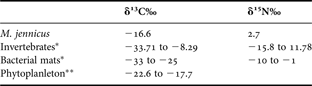
* Mid-Atlantic Ridge study of invertebrates and food sources (Colaco et al., Reference Colaco, Dehairs and Desbruyères2002); **from the Caribbean region (Woodworth et al., Reference Woodworth, Goni, Tappa, Tedesco, Thunell, Astor, Varela, Diaz-Ramos and Muller-Karger2004).
A study of polychaetes on seamounts in the eastern Pacific found that the highest overall densities were found in the pit craters of calderas, while the lowest density was found immediately at hydrothermal fields along the edge of the calderas (Levin et al., Reference Levin, McCann and Thomas1991). At Kick'em Jenny, M. jennicus occurs in high abundance at or near the hydrothermally active regions but was not found away from hydrothermal settings. This new species adds to the growing list of spionid polychaetes and species of the genus Malacoceros found at hydrothermally active regions.
ACKNOWLEDGEMENTS
We would like to thank the captain and crew of the RV ‘Ronald H. Brown’, the Eastern Oceanics ROV team, Haraldur Sigurdsson, Steve Carey, David Smith, Andrew Staroscik and Scott Lundin for their assistance in sampling the biology of Kick'em Jenny as part of the NOAA Ocean Exploration Program (NOAA Grant No. NA030AR46000009 to H. Sigurdsson and S. Carey). This study was supported in part by the National Science Foundation under Grant No. DEB-0118693 (PEET) to James A. Blake, University of Massachusetts, Boston. Thanks to the University of Rhode Island for student funding. Special thanks to Rick McKinney for work on stable isotopes and to William Macy for microscopy assistance. Much gratitude is given to the three referees, particularly Nancy Maciolek, who provided highly constructive insight and guidance in her review.