For typically developing children, spoken language skills are learned incidentally at an early age and mastered throughout the formal schooling process. Children who are deaf or hard of hearing (DHH) do not ‘overhear’ language to the same extent and often are not exposed to a fully developed language model, resulting in a period of language deprivation and potentially a delay in overall language development. While hearing aids and cochlear implants continue to make spoken language more accessible, many DHH children still experience difficulty developing overall language skills, including vocabulary, grammar, word order, idiomatic expressions, and reading comprehension, on a par with their peers who have typical hearing (TH), even after controlling for intrinsic factors such as non-verbal IQ and etiology, and treatment variables such as age of identification, early intervention services, and mode of communication (Blamey et al., Reference Blamey, Sarant, Paatsch, Barry, Bow, Wales and Tooher2001; Dawson, Busby, McKay, & Clark, Reference Dawson, Busby, McKay and Clark2002; Geers, Nicholas, & Moog, Reference Geers, Nicholas and Moog2007; Harris, Kronenberger, Gao, Hoen, Miyamoto, & Pisoni, Reference Harris, Kronenberger, Gao, Hoen, Miyamoto and Pisoni2013; Johnson & Goswami, Reference Johnson and Goswami2010; Lederberg, Schick, & Spencer, Reference Lederberg, Schick and Spencer2013; Pisoni, Reference Pisoni1999; Pisoni & Geers, Reference Pisoni and Geers2000; Willstedt-Svensson, Löfqvist, Almqvist, & Sahlén, Reference Willstedt-Svensson, Löfqvist, Almqvist and Sahlén2004).
Research suggests that some of the language delays and variability in outcomes observed in DHH children could be due to individual differences in sequential processing (Deocampo, Smith, Kronenberger, Pisoni, & Conway, Reference Deocampo, Smith, Kronenberger, Pisoni and Conway2018; Edwards & Anderson, Reference Edwards and Anderson2014; Pisoni, Kronenberger, Chandramouli, & Conway, Reference Pisoni, Kronenberger, Chandramouli and Conway2016; Uddén & Bahlmann, Reference Uddén and Bahlmann2012). Sequential processing itself can refer to two types of skills. ‘Sequence memory’ is the ability to encode, remember, and reproduce a given sequence of items, and includes psychological research tasks such as immediate serial recall for order information (e.g., Marshuetz, Reference Marshuetz2005) and nonword repetition (Gathercole, Willis, Baddeley, & Emslie, Reference Gathercole, Willis, Baddeley and Emslie1994). ‘Sequential learning’ refers to the ability to learn underlying structured patterns governing multiple sequences (or the same sequence presented multiple times) (Conway, Reference Conway and Seel2012), often occurring in an implicit and automatic fashion (Kaufman, DeYoung, Gray, Jimenez, Brown, & Mackintosh, Reference Kaufman, DeYoung, Gray, Jimenez, Brown and Mackintosh2010; Perruchet & Pacton, Reference Perruchet and Pacton2006; Reber, Reference Reber1967). Examples include the serial reaction time task (Nissen & Bullemer, Reference Nissen and Bullemer1987), statistical-sequential learning tasks (Saffran, Johnson, Aslin, & Newport, Reference Saffran, Johnson, Aslin and Newport1999), and the Hebb repetition effect (Page, Cumming, Norris, Hitch, & McNeil, Reference Page, Cumming, Norris, Hitch and McNeil2006). The crucial distinction between sequence memory and sequential learning is the fact that sequence memory tasks involve randomly generated sequences on each trial, whereas sequential learning tasks involve an underlying pattern or structure in the sequences that can be learned.
Not surprisingly, numerous studies have revealed poorer auditory sequence memory ability in DHH children compared to TH children (Dawson et al., Reference Dawson, Busby, McKay and Clark2002; Ling, Reference Ling1975; Pisoni, Reference Pisoni1999; Pisoni & Geers, Reference Pisoni and Geers2000; Watson, Titterington, Henry, & Toner, Reference Watson, Titterington, Henry and Toner2007). However, studies comparing the visual sequence memory capability of these two groups have revealed varied findings (Dawson et al., Reference Dawson, Busby, McKay and Clark2002; Johnson & Goswami, Reference Johnson and Goswami2010; Logan, Maybery, & Fletcher, Reference Logan, Maybery and Fletcher1996; MacSweeney, Campbell, & Donlan, Reference MacSweeney, Campbell and Donlan1996; McDaniel, Reference McDaniel1980; Parasnis, Samar, Bettger, & Sathe, Reference Parasnis, Samar, Bettger and Sathe1996; Sterritt, Camp, & Lipman, Reference Sterritt, Camp and Lipman1966). In studies utilizing stimuli that did not lend themselves to verbal labeling, such as design copying (Parasnis et al., Reference Parasnis, Samar, Bettger and Sathe1996), a computerized version of the Corsi visual-spatial memory task (Logan et al., Reference Logan, Maybery and Fletcher1996), or hand movement imitation (Dawson et al., Reference Dawson, Busby, McKay and Clark2002), no differences in sequential memory ability emerged between groups of TH children and those who were DHH. In contrast, however, for tasks utilizing visually displayed stimuli that could be easily labeled, e.g., pictures of familiar objects such as ‘dog’ and ‘fish’ (Dawson et al., Reference Dawson, Busby, McKay and Clark2002) or intrinsically language-based symbols such as numerals (Parasnis et al., Reference Parasnis, Samar, Bettger and Sathe1996), performance was significantly worse for DHH children compared to age-matched TH groups.
Turning next to sequential learning, Conway, Pisoni, Anaya, Karpicke, and Henning (Reference Conway, Pisoni, Anaya, Karpicke and Henning2011) examined a group of TH children and an age-matched group of cochlear implant users on a visual sequential learning task employing an artificial grammar. They found that only about one third (34%) of the DHH children displayed learning of the grammatical regularities (i.e., better recall for sequences consistent with the grammar compared to sequences inconsistent with the grammar), while roughly half (53%) of the TH children demonstrated such learning. Additionally, a significant correlation emerged between sequential learning performance and a clinical measure of spoken language ability. Other research appears to support the notion that DHH children exhibit difficulties with sequential processing abilities (e.g., Bharadwaj, Matzke, & Daniel, Reference Bharadwaj, Matzke and Daniel2012; Bharadwaj & Mehta, Reference Bharadwaj and Mehta2016; Conway, Karpicke, Anaya, Henning, Kronenberger, & Pisoni, Reference Conway, Karpicke, Anaya, Henning, Kronenberger and Pisoni2011; Ulanet, Carson, Mellon, Niparko, & Ouellette, Reference Ulanet, Carson, Mellon, Niparko and Ouelette2014), yet two recent studies have not found sequencing impairments in DHH children (Hall, Eigsti, Bortfeld, & Lillo-Martin, Reference Hall, Eigsti, Bortfeld and Lillo-Martin2017; Torkildsen, Arciuli, Haukedal, & Wie, Reference Torkildsen, Arciuli, Haukedal and Wie2018). Why do some studies reveal that DHH children have difficulties on non-auditory (visual) sequence memory and learning tasks while others do not? One possible explanation for poorer performance by DHH children could be related to delayed acquisition of verbal labeling and verbal rehearsal strategies (Bebko & McKinnon, Reference Bebko and McKinnon1990) to facilitate sequence memory and learning performance. If so, then visual input that is relatively easy to name (e.g., pictures of familiar objects or color distinctions between stimuli) would confer an advantage to memory and learning for TH children who may be more experienced with verbal rehearsal and the manipulation of verbal information in memory relative to DHH children. On the other hand, studies that involve stimuli that are not as easy to verbally label are expected to show very little differences between DHH and TH performance. This explanation seems to be consistent with some visual processing findings reviewed above (Conway, Pisoni, et al., Reference Conway, Pisoni, Anaya, Karpicke and Henning2011; Dawson et al., Reference Dawson, Busby, McKay and Clark2002; Parasnis et al., Reference Parasnis, Samar, Bettger and Sathe1996; Torkildsen et al., Reference Torkildsen, Arciuli, Haukedal and Wie2018). However, few studies have explicitly attempted to control for ease of nameability of stimuli, and for those that have (e.g., Dawson et al., Reference Dawson, Busby, McKay and Clark2002; Parasnis et al., Reference Parasnis, Samar, Bettger and Sathe1996), the output requirements differed for nameable stimuli (pressing buttons, clicking a mouse) versus stimuli less verbal in nature (drawing, copying hand movements), thus confounding the effects of input nameability with the nature of the response requirements.
Therefore, further research is needed to test the effect of input nameability on sequential processing in DHH children using the same response output for all tasks. Furthermore, it is currently not clear whether input nameability interacts with the type of sequential processing task, i.e., memory for a randomly presented sequence (‘sequence memory’) versus learning of underlying grammars or repeated patterns within a set of sequences (‘sequential learning’).
To better understand the nature of potential sequence processing difficulties in DHH children and the possible association with spoken language outcomes, the current study examined performance by TH and DHH children on visual sequencing tasks that explicitly controlled for the type of input (‘easily nameable’ vs. ‘difficult-to-name’) and the type of task (sequence memory vs. learning of repeated sequences). Importantly, all tasks required the same physical response (replication of a sequence on a touch-screen computer). In this way, the current study sought to answer three key questions: (1) Do DHH children differ from TH children on all types of visual sequential processing tasks or just on ones that promote verbal rehearsal? (2) Similarly, do DHH children differ from TH children for both memory of individual sequences as well as learning of repeated patterns, and if so, how does task type interact with ease of nameability tasks? Finally, (3) Is sequential processing ability related to language performance as measured by PPVT receptive vocabulary scores?
Method
Participants
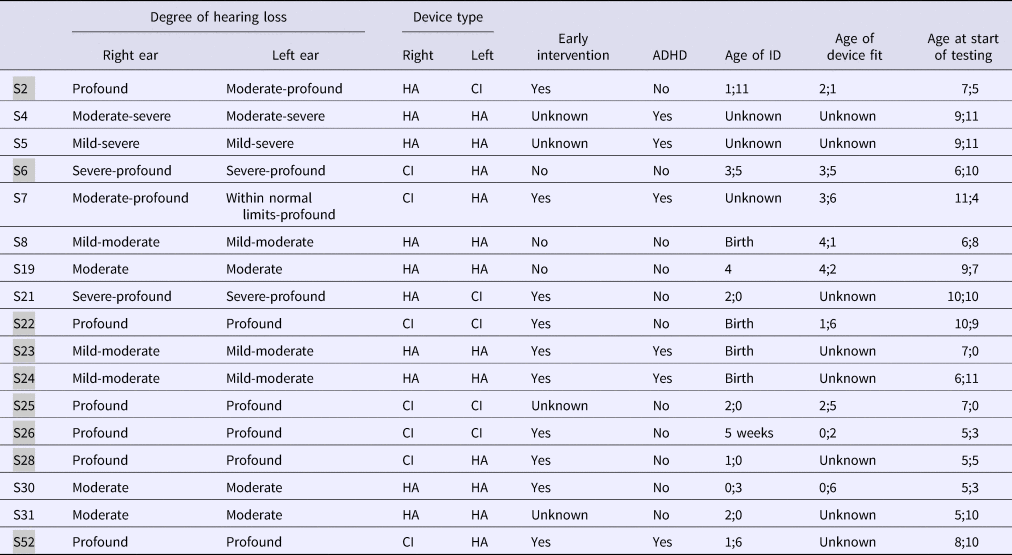
Seventeen DHH children (8 male and 9 female, M = 7;9, SD = 2;1, range 5;3–11;5) were recruited from two private oral schools for the deaf (American Sign Language (ASL) instruction not provided). All were diagnosed with a hearing loss at or before age 3;5 and fitted with hearing devices for both ears, resided in primarily English-speaking environments, had no other reported neuropsychological, motor, or sensory impairment (except for 6 reported by parents as having Attention Deficit Hyperactivity Disorder (ADHD); see discussion below), and tested within normal limits for non-verbal cognition. DHH group characteristics are summarized in Table 1.
Demographic data for children in the DHH group

Note. Shaded subject numbers indicate male participants.
Nineteen TH children (5 male and 14 female, M = 7;7, SD = 1;1, range 6;7–9;8) were recruited from a parochial school in a nearby metropolitan area. They resided in primarily English-speaking environments and had no other reported motor, sensory, speech, or cognitive impairments.
All procedures complied with Institutional Review Board guidelines.
Stimulus materials
A touch-screen monitor displayed the sequential processing tasks. Responses were made by taps on the monitor to replicate each sequence. Computer programs and response data were managed via E-Prime 2.0 software program and stored on a laptop computer.
Sequential processing tasks were similar to those used in previous studies (Conway, Bauernschmidt, Huang, & Pisoni, Reference Conway, Bauernschmidt, Huang and Pisoni2010; Conway, Pisoni, et al., Reference Conway, Pisoni, Anaya, Karpicke and Henning2011; Karpicke & Pisoni, Reference Karpicke and Pisoni2004) that in turn were based on the ‘Simon’ game created by Milton Bradley. In order to manipulate input nameability, each sequencing task incorporated either colored circles or black squares. The colored circles were categorized as ‘easily nameable’ because they can be easily labeled by color (i.e., ‘red’, ‘blue’, etc.), whereas black squares were considered ‘difficult-to-name’. While it is possible to attach a verbal label to the black (monochromatic) stimuli, it is much more difficult to do so as it requires the creation of a labeling scheme that is non-obvious and is less likely to occur in children who have not achieved a certain level of language mastery (Bebko & McKinnon, Reference Bebko and McKinnon1990).
Stimuli are displayed in Figure 1. Red, yellow, green, and blue circles were fixed in top, left, right, and bottom positions. Black squares were positioned on a white background in an upper right, upper left, lower right, and lower left spatial orientation. The physical layout of the two tasks differed to minimize learning of a particular spatial or motor response pattern for one task that might interfere with (or facilitate) learning on subsequent tasks.
Graphical depiction of the stimuli used for the easily nameable (color) and the difficult-to-name (black and white) sequencing tasks. Note that the actual task used stimuli of different color hues without the printed words.

Procedure
Receptive vocabulary scores were obtained from the Peabody Picture Vocabulary Test 4 (PPVT 4; Dunn & Dunn, Reference Dunn and Dunn2007) for all children.
For each sequencing task, one of the four stimuli (a colored circle or a black square) appeared on the touch-screen monitor for a period of 700 ms in one of the four previously mentioned specified locations. This was followed by an inter-stimulus interval of 500 ms during which the monitor was blank. Following each complete sequence presentation, there was a 500 ms blank screen delay, after which all four stimuli appeared on the screen at once along with the word ‘Done’ displayed in a box in the lower right corner of the monitor, signaling to the child that it was time to respond. As a child tapped one of the four stimuli on the touch-screen, that item flashed for 100 ms to provide visual verification of the response. Children continued to tap individual stimuli to replicate the sequence just displayed and indicated they had completed their response by tapping the ‘Done’ box. The computer then presented the next sequence. No other feedback was provided.
A total of 20 sequences was presented for each type of sequencing task. All tasks began with a one-item sequence and were adaptive, meaning that sequence length increased or decreased according to a one-up, one-down rule. For example, an incorrect response to a sequence length of one resulted in the repetition of the same sequence until it was replicated correctly. For sequences that were two or more items in length, the sequence increased or decreased by one based upon the accuracy of the response. This adaptive procedure was used because it allows for the difficulty of the task to match each child's current memory span on a trial-by-trial basis.
Each sequencing task ended following the twentieth sequence presentation and response, regardless of the number of items presented in each sequence. Each task was scored according to the longest sequence replicated correctly. Thus, if the participant never made a mistake, the longest sequence reached, and therefore the participant's score, would be 20. However, if the longest sequence a child correctly reproduced on a particular task had a length of 8, then the score recorded at the end of that task was 8. This method was believed to be more sensitive than merely counting the number of correct replications because it considered the child's best (i.e., longest) trial performance.
Factors of task type (learning, memory) and input type (easily nameable, difficult-to-name) were crossed in a 2 × 2 design. The two sequential learning tasks (sequential learning–easily nameable and sequential learning–difficult-to-name) were administered first, followed by several other non-computerized psychological assessments (with only the PPVT analyzed for this study). The two sequence memory tasks with color and black stimuli were administered next. Because the primary focus was discovering possible group differences on tasks rather than task differences within groups, the order of tasks remained the same for each child. While carry-over effects may occur from one task to the other, these effects are systematic (i.e., consistent for all individuals) rather than contributing to unwanted variance, which can occur in a counterbalanced design.
Sequential learning tasks
The crucial characteristic of the sequential learning tasks is that the sequences repeated and built upon themselves from trial to trial. A correct response on the first presentation resulted in the repetition of the first stimulus along with the addition of a new stimulus (randomly determined), with subsequent sequences continuing to build from previous presentations with an increase or decrease of one based upon the accuracy of the response. For instance, in the easily nameable sequential learning condition, if a sequence of blue–red was correctly reproduced, the next sequence presented might be blue–red–green. If this sequence was correctly reproduced as well, then the next sequence would continue to build on the previous one and might be blue–red–green–red. The actual color that occurred next in the sequence was randomly determined by the computer program but remained consistent for future trials. If a sequence was incorrectly reproduced, the next presentation of the sequence would be reduced in length by 1 but would present the same repeating sequence that was previously produced correctly. Following from the earlier example, if blue–red–green–red was incorrectly reproduced, then the next sequence presented would revert to the last successfully replicated sequence: blue–red–green. Note that this task did not incorporate sequences generated from artificial grammars, as used in previous studies (e.g., Conway, Pisoni et al., Reference Conway, Pisoni, Anaya, Karpicke and Henning2011); instead, the paradigm more closely resembles the Hebb serial repetition learning effect (Page et al., Reference Page, Cumming, Norris, Hitch and McNeil2006; Pisoni & Cleary, Reference Pisoni, Cleary, Zeng, Popper and Fay2004), in which the same sequence is repeated on multiple trials.
Sequence memory tasks
For the sequence memory tasks, each sequence presented on a given trial was new and randomly determined rather than building upon the previously generated sequence. As with the sequential learning tasks, each sequence decreased or increased in length based upon the one-up, one-down rule. However, in contrast to the repeated nature of the sequence in the previous example, if a sequence of blue–red was correctly reproduced, the next sequence in the sequence memory task might be yellow–green–blue, completely unrelated to the previous trial. Correct reproduction of this sequence would be followed by a longer, yet again completely different, sequence, such as green–yellow–blue–green. Thus, for the sequence memory tasks no sequence-specific learning can occur and therefore sequence memory performance is measured rather than learning per se.
Results
The sample of children who were DHH consisted of two subgroups: those with at least one cochlear implant (CI; n = 9) and those with hearing aids only (HA; n = 8). Initial independent samples Mann–Whitney tests on the scores of these two groups indicated no significant differences on any of the sequencing tasks or the PPVT (learning difficult-to-name: U = 23.5, p = .236, r = –0.296; memory difficult-to-name: U = 35.0, p = .963, r = –0.024; learning easily nameable: U = 34.0, p = .888, r = –0.047; memory easily nameable: U = 31.5, p = .673, r = –0.109; PPVT: U = 28; p = .481, r = –0.187). Therefore, CI and HA groups were combined in subsequent analyses.
Similarly, independent samples Mann–Whitney tests were performed to compare DHH children with (n = 6) and without (n = 11) parent-reported ADHD on each sequencing task and the PPVT. Again, no significant group differences emerged (learning difficult-to-name: U = 32.0, p = .961, r = –0.025; memory difficult-to-name: U = 23.5, p = .350, r = –0.238; learning easily nameable: U = 19.0, p = .180, r = –0.344; memory easily nameable: U = 32.5, p = .961, r = –0.013; PPVT: U = 31.0, p = .884, r = –0.049). Thus, DHH children with and without ADHD were combined into a single DHH group for further analyses.
Sequential processing tasks
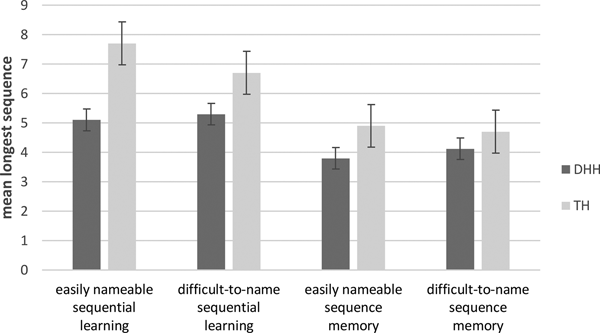
Mean lengths of longest correct sequences for both groups on each of the tasks are displayed in Figure 2. An a-priori power analysis in G*Power 3.1 for a 2 × 2 × 2 mixed measures analysis of variance (ANOVA) with hearing status (DHH, TH) as a between subjects factor and task type (learning, memory) and input type (easily nameable, difficult-to-name) as within subjects factors using a moderately low effect size of .25, an alpha of .05, and a power level of .8 indicated that 24 total participants was sufficient to detect an interaction. ANOVA results revealed an overall effect of hearing status (F(1,34) = 8.83, p = .005, η p2 = .21, TH (M = 5.99, SD = 1.43); DHH (M = 4.57, SD = 1.43) and a significant main effect of task type (F(1,34) = 34.75, p = .0001, η p2 = .51), with higher scores for sequential learning (M = 6.18, SD = 2.17) than sequence memory (M = 4.38, SD = 1.02), as well as a significant interaction of input type × hearing status (F(1,34) = 4.50, p = .041, η p2 = .12). Follow-up Sidak-adjusted pairwise comparisons indicated a marginally significant difference between easily nameable and difficult-to-name input for the TH group (p = .06) but not for the DHH group (p = .33). The interaction of input type by hearing status appears to be driven by better overall performance of the TH group on the easily nameable stimuli regardless of task type, but no effect of nameability for the DHH group. No other effects were significant. Figure 3 displays individual performance for these two tasks.
Mean longest sequence replicated correctly on each of the four sequencing tasks for both groups of children (standard error bars indicated).

Longest individual sequence replications for each group on the easily nameable sequential learning and memory tasks.

Results highlight the presence of group differences on certain aspects of sequential processing of visual input, with DHH children performing worse overall and exhibiting especially poor performance on the easily nameable (i.e., color) tasks.
Association with vocabulary scores
Not unexpectedly, the groups differed significantly on both PPVT raw scores (t(34) = 5.82, p < .001, d = 1.95) and standard scores (t(34) = 7.71, p < .001, d = 2.58), with significantly higher performance for TH (M raw = 139.58, SD = 24.70; M standard = 113.63, SD = 11.95) compared to DHH (M raw = 92.18, SD = 23.98; M standard = 83.65, SD = 11.31).
A Kendall's Tau correlationFootnote 1 between standard PPVT scores and scores on each of the four sequential processing tasks for all children revealed that only performance on the easily nameable sequential learning task was significantly correlated with PPVT performance (τ = .299, p = .014).
To confirm the significant correlation and to investigate easily nameable sequential learning performance as a viable predictor of language as measured by PPVT, a hierarchical linear regression analysis was performed separately for each group, with PPVT standard scores as the outcome measure. An a-priori power analyses for the 2-predictor hierarchical linear regression was done in G*Power 3.1 using a Cohen's f of .6416 as the effect size estimate based on results from Conway, Pisoni et al. (Reference Conway, Pisoni, Anaya, Karpicke and Henning2011), as well as an alpha level of .05. Results indicated the minimum sample size to reach a power of .8 was 16. Both DHH and TH samples met this criterion; however, given the small sample size, results regarding specific predictors should be interpreted with caution. Plots of standardized residuals against standardized predicted values for DHH and TH groups indicated no violations of regression assumptions including linear relationships between predictor and outcome variables, independent errors, homoscedasticity, and normally distributed errors. The outcome variable was also normally distributed, as demonstrated by non-significant Shapiro–Wilk's tests (DHH p = .566, TH p = .915). Multicollinearity was not indicated as Kendall's Tau correlations did not reach τ ⩾ .8. Finally, no outliers were found as all Cook's Distance scores were below 1 (minimum = 0, maximum = .344).
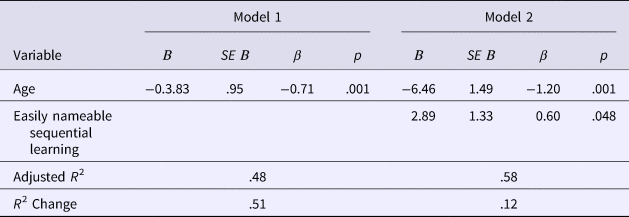
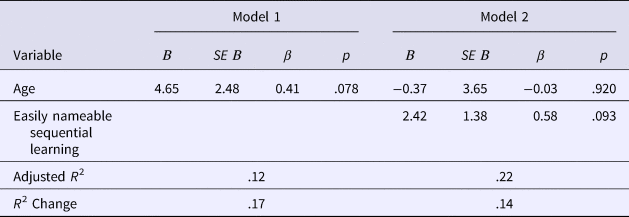
Age was entered as the predictor in the first step, followed by performance on the easily nameable sequential learning task in the second step. For the DHH group, the model containing only age as the predictor (R 2 = .51) was a good fit. Adding easily nameable sequential learning performance as a predictor significantly increased the model fit (R 2 = .63). Both age (β = –1.20, p =.001) and easily nameable sequential learning (β = 0.60, p = .048) significantly predicted PPVT score in the second model (see Table 2). For the TH group, neither model was a good fit, nor did any independent variables significantly predict PPVT score, although there was a trend toward age being significant in the first model and toward easily nameable sequential learning being significant in the second (see Table 3).
Regression analysis for variables predicting PPVT standard score in the DHH group

Regression analysis for variables predicting PPVT standard score in the TH group

In the model with age alone as predictor, the relationship between age and PPVT standard score was negative for the DHH group (β = –0.71, p = .001) and positive for the TH group (β = 0.41, p = .078), providing evidence that vocabulary development remains a major challenge for DHH children.
Discussion
Sequential processing tasks in DHH children
Investigation of performance on visual sequential processing tasks by DHH and TH children revealed an overall main effect of hearing status, with lower performance by DHH children on all four sequencing tasks. This suggests differences between the two groups in the processing, encoding, learning, and/or reproduction of both random and repeating sequences. In addition, there was a significant interaction between input type (easily nameable versus difficult-to-name stimuli) and hearing status. While follow-up comparisons indicated a marginally significant difference between easily nameable and difficult-to-name input for the TH group, there was not a significant difference in performance on the two types of stimuli for the DHH children, suggesting that group differences were most pronounced on the easily nameable tasks specifically. Figure 3 clearly reveals this trend; well over half (n = 11) of the TH children produced a longest easily nameable sequence equal to or greater than that of the highest performer in the DHH group. Likewise, for the easily nameable sequence memory task, nearly two-thirds of the TH children correctly replicated a sequence length of 5 or greater, while less than one-quarter of the DHH children achieved that level. Additionally, 3 was the maximum sequence length for 8 DHH children, while all but one TH child exceeded this level. Given the difference in performance between the two groups, it is plausible that the DHH children did not benefit to the same degree from the nameable quality of the stimuli as those with TH.
On the other hand, because the tasks do not directly require a verbal naming strategy, it is possible that the differences between the color and black-and-white tasks were due to some other task differences. For instance, the combination of color and position might lend an advantage. Although this is possible, it is unclear why the DHH children would not show the same advantage as the TH group for the color tasks. As such, we believe the nameable nature of the stimuli is the most parsimonious explanation for group differences.
It appears, then, that children who were DHH in this study had difficulty with visual sequential processing in general, but were particularly disadvantaged on tasks with easily nameable stimuli, not gaining the same benefit from nameability as children with TH. This finding provides additional support that DHH children have difficulties with non-auditory sequencing functions (Bharadwaj & Mehta, Reference Bharadwaj and Mehta2016; Conway, Pisoni, & Kronenberger, Reference Conway, Pisoni and Kronenberger2009; Ulanet et al., Reference Ulanet, Carson, Mellon, Niparko and Ouelette2014), but offers a slightly more nuanced view focused on verbal sequencing (cf. Dawson et al., Reference Dawson, Busby, McKay and Clark2002; Torkildsen et al., Reference Torkildsen, Arciuli, Haukedal and Wie2018).
Association with vocabulary scores
Although our small sample size indicates the need to use caution when interpreting hierarchical regression results, we believe that their compatibility with previous research and the potential insight they give into language development for DHH children make discussion of them worthwhile. Analyses revealed that both age and easily nameable sequential learning performance were predictors of PPVT only for the children who were DHH, indicating a relationship between sequential learning ability (for nameable stimuli) and language performance. Furthermore, the negative relationship between age and PPVT standard score for the DHH group illustrates the struggle many of these children face in learning vocabulary at an expected yearly rate. It is possible that an underlying difficulty with sequential processing ability may contribute to overall differences in spoken language ability, and specifically to delayed vocabulary development. Consistent with Conway et al. (Reference Conway, Bauernschmidt, Huang and Pisoni2010) and other work, these findings suggest that the development of language skills may depend upon, or be facilitated by, sensitivity to the underlying sequential structure of environmental patterns.
It is also possible that the relationship between cause and effect flows in the opposite direction: improved spoken language ability might lead to greater facility in learning sequential patterns with easily nameable stimuli for DHH children. The repetition in the sequential learning task is especially amenable to verbal rehearsal, a memory strategy which generally develops with increased language proficiency and would logically lead to better sequential learning performance. Likewise, an incomplete mastery of language may reduce the use of cognitive strategies and could explain differences in performance on the easily nameable sequential learning task (Bebko & McKinnon, Reference Bebko and McKinnon1990).
An important remaining question, then, is whether difficulties with sequential processing are due to a period of auditory deprivation versus differences in language experiences. A child with a hearing loss is deprived, at least for some period of time, of naturally occurring auditory temporal patterns, possibly leading to difficulties in sequential processing (Conway et al., Reference Conway, Pisoni and Kronenberger2009; Pisoni et al., Reference Pisoni, Kronenberger, Chandramouli and Conway2016). There may also be a benefit from earlier access to sound that extends beyond the recognized language component to more general cognitive functions (Conway et al., Reference Conway, Pisoni and Kronenberger2009; Conway, Karpicke et al., Reference Conway, Karpicke, Anaya, Henning, Kronenberger and Pisoni2011 Kral, Kronenberger, Pisoni, & O'Donoghue, Reference Kral, Kronenberger, Pisoni and O'Donoghue2016). If a lack of early auditory stimulation has a cascading effect on a variety of perceptual and cognitive processes beyond those related to audition, then perhaps the difficulty with sequential processing can, in part, help to explain the delayed language skills often displayed by DHH children.
On the other hand, it is possible that delayed language development is the reason for the difficulties with sequence processing. Since the children in this study were enrolled in a spoken language program, the amount of early exposure to sign language, if any, is unknown. In addition, there is considerable variability in age of first amplification. Therefore, it is plausible that language deprivation – not auditory deprivation per se – may lead to higher-order cognitive deficits related to executive functioning and sequence processing (Hall et al., Reference Hall, Eigsti, Bortfeld and Lillo-Martin2017). Additional studies investigating the sequencing ability of deaf native signers are needed to determine whether deafness or language deprivation underlies the observed effects.
Limitations and further research
Our sample size was relatively small due to the requirement that children be enrolled in listening and spoken language schools (although a-priori power analyses indicated that the sample sizes were acceptable for the analyses performed). This focused selection criterion was intentional to exclude variability based on sign-language proficiency. At the same time, heterogeneity and variability among the sample of children who were DHH were present, as children across a broad age-range were included to obtain a sufficient sample size. While the broader age-range in the DHH group further highlights the delays of this group when it comes to both vocabulary and sequencing ability, future research should include two TH groups, one matched by chronological age and one by language age to children in the DHH group to examine those sources of variability. Longitudinal research could also provide valuable information regarding the developmental trajectory of sequence processing and its relationship to language based on hearing status. Additional demographic information such as socioeconomic status should also be included in future studies.
Finally, roughly one-third of the DHH children were reported to have ADHD, so it is possible that the presence of ADHD contributed to some of the observed group differences. However, in addition to an absence of significant differences in performance between participants with and without ADHD in our sample, Rosas et al. (Reference Rosas, Ceric, Tenorio, Mourgues, Thibaut, Hurtado and Aravena2010) found that children with ADHD learned more quickly and performed more accurately on an artificial grammar learning task (a more complex form of sequential learning than used here) compared to typically developing children. Thus, rather than artificially magnifying learning impairments in the DHH children, the inclusion of ADHD may have served to obscure such impairments. Future research is needed to explore the contribution of attention and attention disorders in sequential processing.
Conclusion
Deficits in the ability to learn and remember sequential patterns among DHH children may provide insight into cognitive factors contributing to variability in language performance. Early exposure to the sequential nature of sound may be important to the development of normal central processes in the sensory systems (Sharma & Dorman, Reference Sharma and Dorman2006) and in providing a ‘scaffold’ (Conway et al., Reference Conway, Pisoni and Kronenberger2009) upon which central cognitive processes such as sequential learning and memory are supported. The current findings support the theory that a period of auditory (and/or linguistic) deprivation early in development may lead to domain-general deficits in sequential processing skills, especially for stimuli lending themselves to verbal representations. Interventions providing explicit instruction in memory strategies and sequential learning practice could provide improvements to the processing mechanisms necessary for acquiring language.
Acknowledgements
This project was supported by the following grant from the National Institute on Deafness and Other Communication Disorders: R01DC012037. The sponsor had no role in any of the following aspects of this study: the study design; collection, analysis, or interpretation of data; writing of the report; decision to submit the paper for publication. We wish to thank the children and parents at the Central Institute for the Deaf, the Moog Center for Deaf Education, and Immaculate Conception School for their participation in this study.