



The global population is experiencing a demographic shift, with rapid population ageing projected to increase the proportion of people more than 60 years old from 12% in 2015 to 22% by 2050. Reference Rubinsztein, Willis, Birgi, Sachdev, Southwell and Stewart1 As a result, older-age bipolar disorder (OABD), typically defined as bipolar disorder in individuals aged 60 years and older, is an increasingly important clinical challenge, with more than half of all people with bipolar disorder expected to be over 60 years of age by 2030. Reference Soh, Drori and Rej2 A recent guest editorial in the British Journal of Psychiatry reaffirmed that lithium is the gold-standard maintenance treatment for bipolar disorder across all age groups. Reference Shivakumar, Szymaniak, Bell, Boyce, Porter and Malhi3 Despite this, in the UK and several other countries, rates of lithium prescriptions seem to be declining, even though lithium remains the first-line maintenance treatment recommended by most clinical guidelines. Reference Soh, Drori and Rej2,4,Reference Shivakumar, Szymaniak, Bell, Boyce, Porter and Malhi3 In this article, we explore potential reasons for this prescribing gap, with a particular focus on older adults, and provide potential approaches to addressing them.
Decline in prevalence of lithium prescriptions in older adults
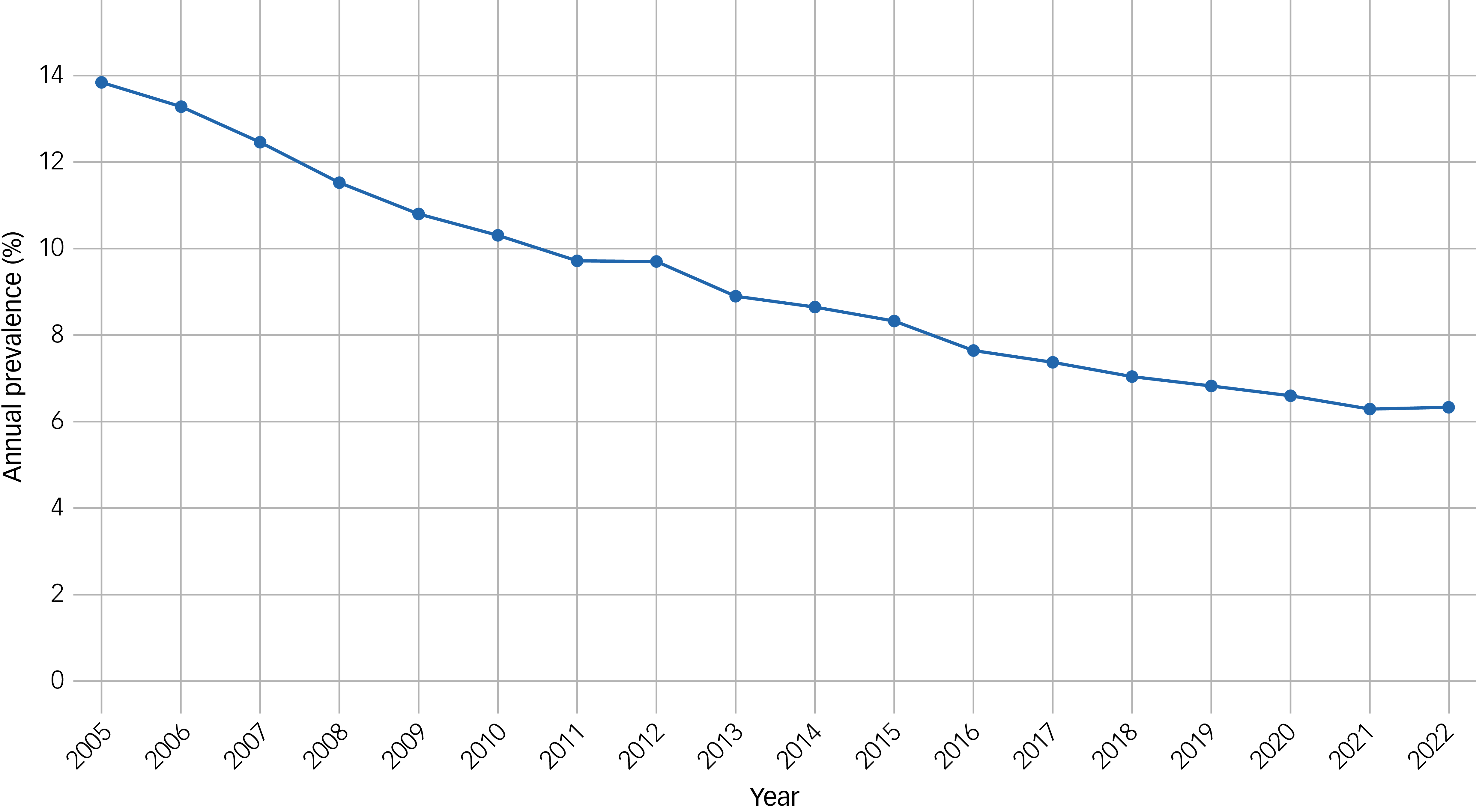
Little is known about patterns of lithium prescribing to older adults. To illustrate age-specific prescribing trends, we analysed routinely collected UK primary care data from the Clinical Practice Research Datalink (CPRD) Gold and Aurum databases, which together cover 15–20% of the UK population and are broadly representative in terms of age, sex, ethnicity and deprivation. Reference Sanchez-Santos, Axson, Dedman and Delmestri5 Adults aged 65–100 years with any record of a bipolar disorder episode or diagnostic code between 2005 and 2022 were identified using validated diagnostic codes. Reference Launders, Richards-Belle, Hardoon, Osborn and Hayes6 A total of 25 954 patients were included in the cohort. Of these, 2441 patients (9.4%) had at least 1 lithium prescription during follow-up. The annual prevalence of lithium prescribing fell steadily from 13.8% in 2005 to 6.3% in 2022, roughly halving over this period (Fig. 1).
Annual prevalence of lithium prescribing among adults aged 65–100 years with a recorded bipolar disorder diagnosis in the UK from 2005 to 2022. Annual prevalence of lithium prescribing was calculated for each calendar year as the number of patients with at least one lithium prescription that year (numerator), divided by the number of patients with at least one day of follow-up in that year (denominator), expressed as a percentage. Follow-up began on 1 January 2005, the date of registration plus 365 days, the year the patient turned 65 years old or the date of the first bipolar disorder code recorded within the study period (whichever was latest); follow-up ended on 31 December 2022, the year the patient turned 100 years old, or upon Clinical Practice Research Datalink deregistration, practice last collection date or death (whichever was earliest).

The evidence gap
Lithium remains the gold-standard treatment for bipolar affective disorder. However, there is a paucity of studies in OABD, in part because older adults are underrepresented in randomised controlled trials (RCTs) and often excluded from trials because of comorbidity, frailty or concomitant medication use. The 2017 GERI-BD (Acute Pharmacotherapy in Late-Life Mania) study represents the only RCT conducted in older people with bipolar disorder. Reference Young, Mulsant, Sajatovic, Gildengers, Gyulai and Al Jurdi7 This double-blind RCT compared the efficacy and tolerability of lithium and valproic acid in 224 individuals aged over 60 years with mania or hypomania. Lithium demonstrated superior efficacy in reducing mania symptoms at 9 weeks, and the two drugs were similarly well tolerated. However, GERI-BD was a trial in individuals with acute mania with a follow-up of only 9 weeks. Reference Soh, Drori and Rej2 Dedicated RCTs evaluating maintenance treatment in OABD are lacking, and current recommendations are inferred from RCTs conducted in younger adults. 4
The risk gap
Lithium has a narrow therapeutic window in terms of serum concentration. However, there remains limited evidence to determine recommendations regarding the optimal age-specific therapeutic range in older adults. An expert consensus from the International Society for Bipolar Disorder Older Adults Task Force recommended maintenance serum lithium levels of 0.4–0.8 mmol/L for patients aged 60–79 years and 0.4–0.7 mmol/L for those aged 80 years and over. Reference Rubinsztein, Willis, Birgi, Sachdev, Southwell and Stewart1 An International Society for Bipolar Disorder Task Force systematic review of serum lithium concentrations in OABD reported mean or median lithium concentrations ranging from 0.47 to 0.67 mmol/L. Reference Nunes, Olagunju, Zittema, Dhyani, Fu and Chen8 Similarly, a survey study conducted by the Royal College of Psychiatrists’ Faculty of Old Age Psychiatry recommended an initial target serum lithium concentration of between 0.4 and 0.6 mmol/L for adults aged 65 years and older. Reference Rubinsztein, Willis, Birgi, Sachdev, Southwell and Stewart1 However, these recommendations were derived from observational data, a Delphi study and survey data rather than higher-quality forms of evidence.
Elevated lithium levels are associated with acute toxicity, which may present with neurological symptoms including delirium and cerebellar dysfunction, as well as gastrointestinal disturbance. Reference Nunes, Olagunju, Zittema, Dhyani, Fu and Chen8 Other common adverse effects include polydipsia, polyuria and weight gain, whereas longer-term treatment may be associated with hypothyroidism and hypoparathyroidism. Older adults are considered to be at greater risk of lithium toxicity, but there is a lack of data showing direct age comparisons. Older patients are also more likely to experience polypharmacy, increasing the risk of drug interactions with lithium. These potential adverse effects may disproportionately influence prescribing decisions in older adults, despite the fact that many can be monitored and managed safely within routine clinical practice.
The impact of long-term lithium exposure on renal function is also a common concern when prescribing lithium in older adults. In a Swedish cohort study, long-term lithium exposure was found to be associated with a steeper decline in renal function. However, the magnitude of this effect was modest: the estimated glomerular filtration rate declined by 0.57 mL/min/1.73 m2 per year in the general population, compared with 0.99 mL/min/1.73 m2 per year among individuals exposed to lithium for more than 10 years. Reference Fransson, Werneke, Harju, Öhlund, de Man Lapidoth and Jonsson9 Further, there was considerable inter-individual variation, with some individuals maintaining preserved renal function after several decades of treatment. Comorbidities such as hypertension and diabetes also contributed to kidney disease. Regular monitoring of renal function and serum lithium concentrations may help to mitigate this risk and facilitate earlier identification of individuals with accelerated renal decline. Reference Soh, Drori and Rej2 Additional strategies include once-daily lithium dosing and pro-active management of comorbid conditions such as hypertension and diabetes. Reference Shivakumar, Szymaniak, Bell, Boyce, Porter and Malhi3
In older adults, in whom a decline in renal function with age may be further affected by comorbidities, determining when lithium should be discontinued is a challenge. Notably, there is no universally accepted threshold for when discontinuation should occur. The National Institute for Health and Care Excellence (NICE) advises consultation with a nephrologist when the baseline estimated glomerular filtration rate is <60 mL/min/1.73 m2 or when there is a clinically significant sustained decline in renal function. 4
The system gap
System-level barriers to lithium prescribing are likely to vary among healthcare systems. The healthcare pathway must be able to facilitate physical health investigations required before commencing lithium treatment and ongoing monitoring requirements. Monitoring requirements may be more challenging in older adults, for whom more frequent surveillance of serum levels is recommended (typically every 3 months compared with every 6 months in younger adults). 4
In the UK, responsibility for lithium prescribing and monitoring is frequently shared between primary and secondary care, and there may be uncertainty regarding which clinician or service assumes overall responsibility. These shared-care agreements also vary by geographical region and local commissioning arrangements, creating additional complexity around ownership of monitoring and prescribing decisions. Consequently, clinicians may be reluctant to initiate lithium unless they are confident that robust systems are in place to support safe long-term follow-up.
Although NICE recommends using lower lithium doses in older adults, the absence of lithium carbonate 50 mg and 100 mg tablet formulations in the UK can make this difficult to achieve in practice. 4 Whereas lithium citrate liquid may provide an alternative means of achieving lower doses, liquid formulations may be less practical for some older adults, particularly those with visual, cognitive or manual dexterity difficulties. Whether this represents a wider international prescribing barrier is unclear, as lithium formulations vary among countries.
Given the practical challenges in initiating and maintaining lithium safely, it is perhaps not surprising that clinicians have increasingly turned towards alternative treatments such as second-generation antipsychotics or alternative mood stabilisers. Reference Shivakumar, Szymaniak, Bell, Boyce, Porter and Malhi3 These do not require the same intensity of monitoring. Newer medications may also be more prominently marketed and advertised. The majority of acute mania episodes are treated with antipsychotics. Furthermore, most acute mania episodes are now treated with second-generation antipsychotics rather than lithium. This may present an additional barrier to subsequent lithium use, as patients who respond well to an antipsychotic during the acute phase may be more likely to continue the same treatment into the maintenance phase rather than switching to lithium.
Future research
NICE recommends that clinicians ‘ensure that older people with bipolar disorder are offered the same range of treatments and services as younger people with bipolar disorder.’ 4 It is therefore striking that in a growing population with increasing clinical complexity, multimorbidity, susceptibility to adverse side-effects and greater monitoring requirements, the evidence base guiding lithium treatment in older adults is so limited. Published data describing age-specific longitudinal trends in lithium prescribing among older adults with bipolar disorder remain scarce. Improved epidemiological data on lithium prescribing, including incidence, prevalence, discontinuation rates and monitoring practices are needed to understand current patterns of use. Dedicated RCTs are needed to strengthen the evidence base for lithium treatment in older adults. Further research should also identify barriers to and enablers of use in older adults, alongside developing policy and service-level recommendations to support safe, consistent and equitable access to lithium for older adults.
Acknowledgments
All authors were involved in the conception and design of the article. J.H. drafted the initial manuscript, and all authors participated in subsequent revision and editing.
Funding
J.H. is supported by the UCL ADAPT study (Blood Biomarker Challenge) and an Alzheimer’s Research UK Clinical Research Training Fellowship (CRTF2023B-003). S.M.W. is supported by the National Institute for Health Research (NIHR) UCLH Biomedical Research Centre Mental Health Theme (BRC1105/MH/JH/110360). J.F.H. is supported by the UK Research and Innovation (grant MR/V023373/1) and the University College London Hospitals NIHR Biomedical Research Centre. R.H. is supported by the NIHR University College London Hospitals Biomedical Research Centre.
Declaration of interest
J.F.H. has received consultancy fees from the Wellcome Trust, Swiss Re and juli Health. J.F.H. is a member of the British Journal of Psychiatry editorial board but did not take part in the review or decision-making process for this paper. R.H. reports unpaid advisory board work for Synaptogenix in the past 5 years.
Ethical standards
All procedures contributing to this work comply with the ethical standards of the relevant national and institutional committees on human experimentation, and with the Helsinki Declaration of 1975 as revised in 2008. Procedures involving patients were approved by the East Midlands–Derby Research Ethics Committee (reference no. 21/EM/0265). This study was reviewed by CPRD’s Independent Scientific Advisory Committee (protocol no. 21_000729). All data sent to CPRD are anonymised; individual consent was not required.



eLetters
No eLetters have been published for this article.