Introduction
Jatropha curcas L. is a shrub in the Euphorbiaceae family and is known for its high seeds oil content, which is suitable for the production of biodiesel (Montes and Melchinger, Reference Montes and Melchinger2016). Jatropha exhibits considerable resistance to drought, being easy to establish, and proliferate (Endelevu Energy et al., 2009; Maes et al., Reference Maes, Trabucco, Achten and Muys2009; Montes and Melchinger, Reference Montes and Melchinger2016). Jatropha cultivation has been introduced to semi-arid regions to promote renewable energy production, prevent desertification, conserve soils and water, and for CO2 sequestration (Endelevu Energy et al., 2009; Maes et al., Reference Maes, Trabucco, Achten and Muys2009). Adequately managed Jatropha plantations can improve local livelihoods, e.g. by intercropping with beneficial plants, such as groundnuts (Singh et al., Reference Singh, Kumar and Haider2007) and pasture grasses (Bailis and Kavlak, Reference Bailis and Kavlak2013).
Yield decrease by insect pests is one of the most critical factors affecting agricultural production. Terren et al. (Reference Terren, Mignon, De Clerck, Jijakli, Savery, Jacquet de Haveskercke, Winandy and Mergeai2012), Habou et al. (Reference Habou, Adam, Haubruge, Mergeai and Verheggen2014), and Sawadogo et al., (Reference Sawadogo, Nagalo, Nacr, Rouamba and Kenis2015) have reported that many insect species attack Jatropha. However, these reports have mostly come from areas of higher rainfall; thus knowledge on Jatropha insect pests in arid and semi-arid zones is limited.
Botswana is located in the centre of southern Africa and has a predominantly sub-tropical climate. The country is mainly arid to semi-arid, and the rainfall season is in the summer months of October to March (Central Statistics Office, 2008). The average annual rainfall is about 500 mm per annum in the extreme northeast of Botswana and less than 250 mm per annum in other parts of the country. The average daily minimum and maximum temperature in summer is approximately 18 and 32 °C in January, although the extreme can reach about 7 °C in winter and 42 °C in summer (Central Statistics Office, 2008; Manthe-Tsuaneng, Reference Manthe-Tsuaneng2014).
A co-research project was initiated to research on the cultivation management of Jatropha in Gaborone, Botswana since 2011, to establish the best agronomic practices for Jatropha suitable for this region (Inafuku-Teramoto et al., Reference Inafuku-Teramoto, Mazereku, Coetzee, Gwafila, Lekgari, Ketumile, Fukuzawa, Yabuta, Masukujane, George, Chite, Ueno, Kawamitsu and Akashi2013). In the present study, we set out to examine the diversity and seasonal variation of insect pests for Jatropha in this region, to expand our knowledge on their behaviour in the semi-arid region in southern Africa.
Materials and methods
The pest diversity and seasonal survey was carried out at Sebele Content farm in the Department of Agricultural Research in Gaborone (altitude 992 m, latitude 24.33.40 S and longitude 25.56.37 E). A field nursery was prepared in July 2011, consisting of Jatropha accessions from Botswana, designated as accession numbers from 1 to 28, and 30 to 86, and an accession from Ghana, which was designated as accession number 29. The seedlings were transplanted in the experimental blocks in December 2011, with a maximum replication of 10 trees per accession, at a spacing of 2 m × 2 m (Inafuku-Teramoto et al., Reference Inafuku-Teramoto, Mazereku, Coetzee, Gwafila, Lekgari, Ketumile, Fukuzawa, Yabuta, Masukujane, George, Chite, Ueno, Kawamitsu and Akashi2013). Trees were grown with supplementary irrigation and agronomic practices, such as weeding and pruning (Inafuku-Teramoto et al., Reference Inafuku-Teramoto, Mazereku, Coetzee, Gwafila, Lekgari, Ketumile, Fukuzawa, Yabuta, Masukujane, George, Chite, Ueno, Kawamitsu and Akashi2013).
Dead trees caused by winter frost were eliminated, and two-year-old trees from 77 accessions were used in this study. Three trees per accession were selected at random and tagged, representing 231 trees in total. The incidence of insect pests was measured on all tagged plants on a monthly basis from July 2013 to June 2016. Insect pest occurrence was examined as described previously (Sawadogo et al., Reference Sawadogo, Nagalo, Nacr, Rouamba and Kenis2015) by visually inspecting whole aerial tissues of the plants (stems, branches, flowers, fruits, upper, and underneath of leaves) and counting the number of insects on each tree. Identification of the insects was confirmed using the insect database in the Department of Agricultural Research of the Ministry of Agriculture, Botswana.
Results and Discussion
Insect pests of Jatropha
During the first one and half years (from December 2011 to June 2013) after transplanting to the experimental farm, we observed several insect pest species on Jatropha trees (unpublished observation), which prompted us to examine the diversity of insect pests. Consequently, we frequently observed the following insect pests in the farm:
Strabala rufa: One of the most frequently observed insect pests was Strabala rufa (golden flea beetle, Chrysomelidae family). The insect sometimes occurred in clusters on a leaf to feed, and made multiple small round holes on the leaf. We frequently observed defoliation of the attacked leaves. However, additional data needs to be collected to establish whether the leaf shedding is due to insect damage.
Gnathamitermes tubiformans: We also frequently observed G. tubiformans (desert termite, Rhinotermitidae family). This insect foraged on underground tissues and aboveground stems of Jatropha. Occasionally, it built an earthen tube alongside the stems of the infected tree, promoting further feeding damage. Attacked Jatropha trees appeared fragile.
Pempelia morosalis: Larvae of P. morosalis (webbing worm, Pyralidae family), also known as Morosaphycita morosalis, were also observed. We mainly observed damage caused by this insect on top of sprouting stems. The invaded tissue was easy to find because of the nest and black droppings from the caterpillars. Terren et al. (Reference Terren, Mignon, De Clerck, Jijakli, Savery, Jacquet de Haveskercke, Winandy and Mergeai2012) have reported that the larvae of this insect damage the flowers and young fruits of Jatropha.
Acanthoplus discoidalis: We sporadically observed A. discoidalis (armoured bush cricket, Tettigoniidae family), also known as corn cricket. The species is native to parts of Namibia, Botswana, Zimbabwe, and South Africa, and is reported to be abundant during seasons with high rainfall, feeding on many food crops and wild plants (Mosupi, Reference Mosupi2003).
Others: Other insect pests observed in the experimental farm included Zonocerus elegans (elegant grasshopper, Pyrgomorphidae family), Calidea dregii (rainbow shield bug, Scutelleridae family), Phymateus viridipes (green milkweed locust, Pyrgomorphidae family), and Antonina graminis (mealybug, Pseudococcidae family).
Seasonal variation
Since S. rufa, G. tubiformans, and P. morosalis appeared to occur in high numbers, we set out to examine their frequency and seasonal variations over the three years from July 2013. We added A. discoidalis in this survey, because this species is native to southern Africa, and interaction of this insect with Jatropha is unknown.
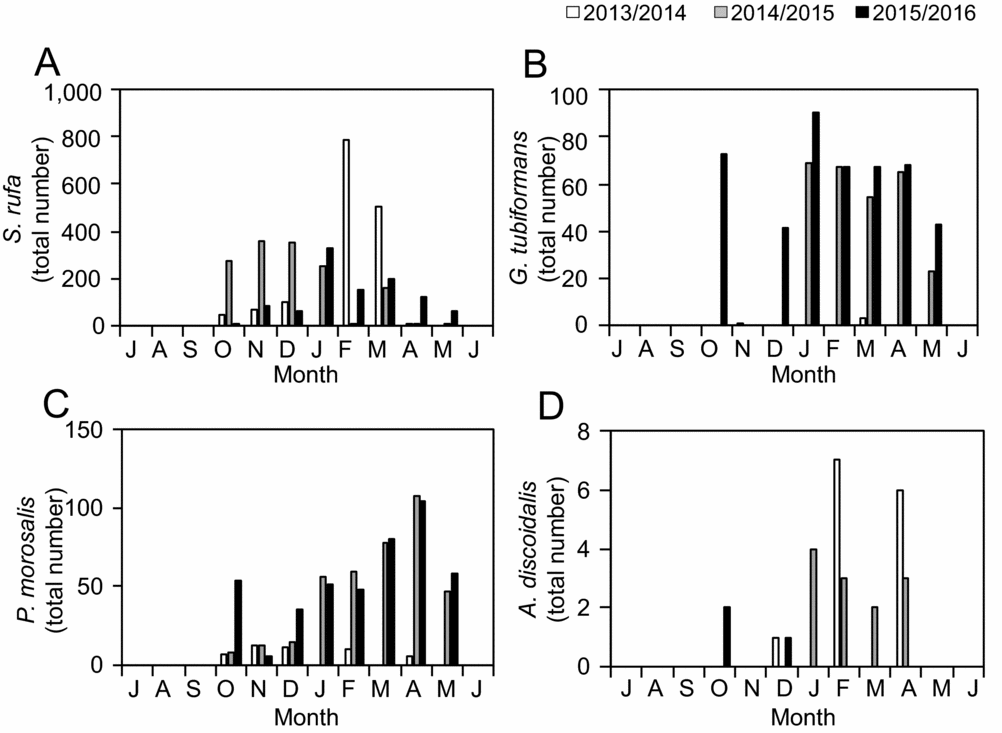
In the period 2013–2016, the total number of S. rufa individuals observed in the 237 trees was 3958. In the first year, large numbers of the insect were observed in February and March, whereas the peak months changed to November and December in the second year, and changed again to January–March in the third year (Fig. 1A). Reasons for this seasonal shift remain to be investigated. In April and May, as the temperature fell towards winter, the observed number of S. rufa dropped. In contrast, we rarely observed G. tubiformans in the first year, but more frequently observed it in the second and third years, especially in the later months of summer (Fig. 1B). We observed a similar seasonal pattern for P. morosalis, as we observed only a smaller number in the first year, and these increased significantly in the second and third years, especially in the late summer and early autumn (Fig. 1C). The occurrence of A. discoidalis was less frequent and mainly observed in the late summer and early autumn seasons (Fig. 1D).
Seasonal changes in the abundance of four insect pests in Jatropha trees. Total number of each insect pest observed in all monitored trees was recorded on a monthly basis from July 2013 to June 2016. Data for the 2013/2014, 2014/2015, and 2015/2016 seasons are shown using open, gray, and closed bars, respectively. Letters along the horizontal axis denote the initials of each month, starting from July on the left to June on the right. (A) Strabala rufa, (B) Gnathamitermes tubiformans, (C) Pempelia morosalis, (D) Acanthoplus discoidalis.

The occurrence of insect pests among Jatropha accessions
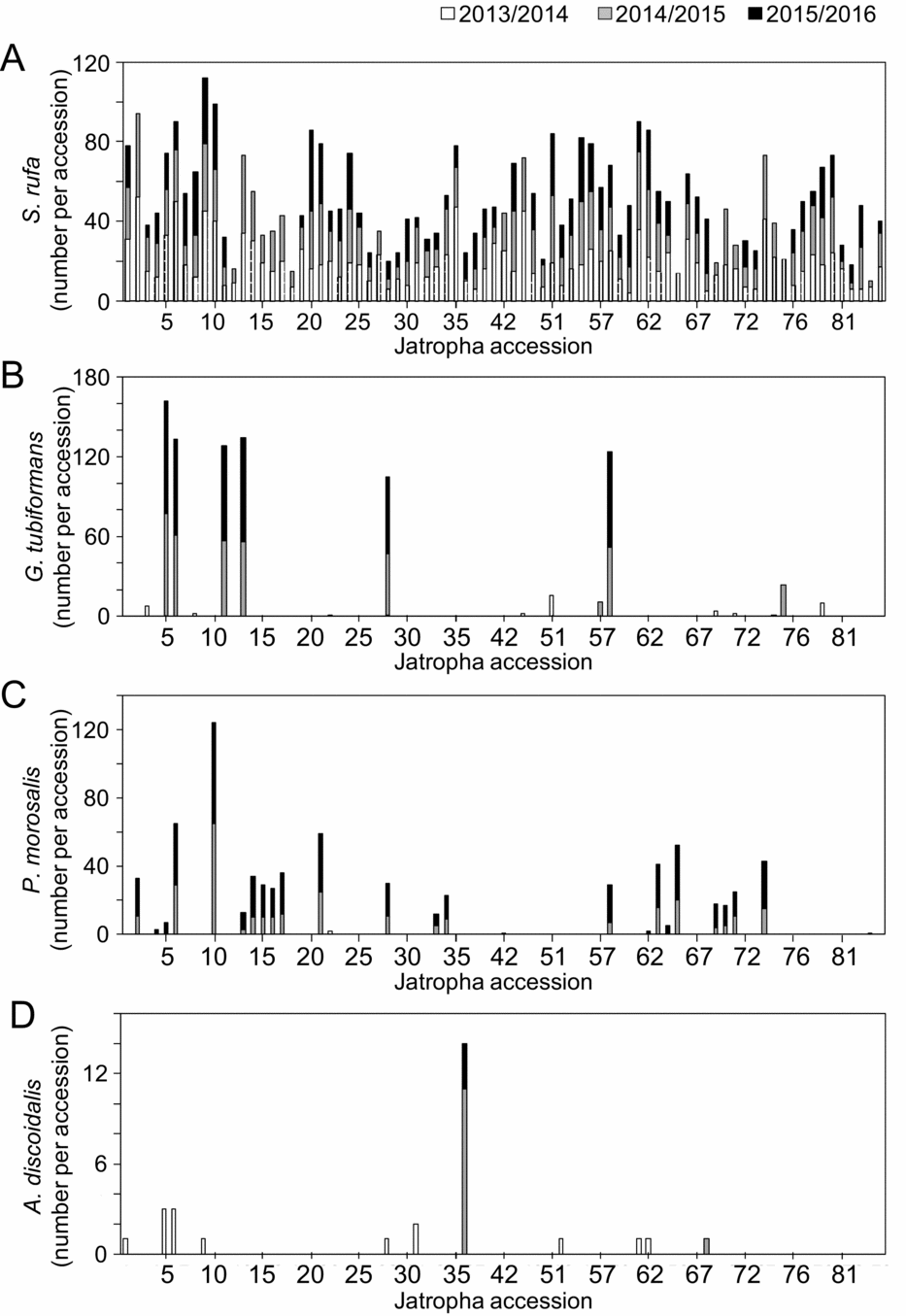
We also investigated the relationships between different Jatropha accessions and the frequency of the four insect pests. Consequently, a considerable variation in the individual number of S. rufa was observed among different Jatropha accessions (Fig. 2A). Accession 9 was the accession in which we most frequently observed S. rufa. We observed 112 individual beetles during the three-year study period. The accession with the smallest occurrence of S. rufa was accession 85, in which we observed only 10 individual insects during the three-year period. In the case of G. tubiformans, infected Jatropha accessions were limited in number and notably occurred in the accessions 5, 6, 11, 13, 28, and 58 (Fig. 2B). Pempelia morosalis infected 26 Jatropha accessions in total, and it propagated vigorously in some of the accessions, notably in accession 10 (Fig. 2C). We failed to observe this insect on the remaining 53 Jatropha accessions. Concerning A. discoidalis, we observed a strong bias concerning the susceptibility of the Jatropha accessions, in that accession 36 was preferentially attacked in the 2014/2015 and 2015/2016 seasons (Fig. 2D). Collectively, these observations may indicate varietal differences in the pest resistance. However, more investigation will be needed to clarify the possible relationships between the occurrence of insect pests and genetic factors among Jatropha accessions.
Quantitative differences in the occurrence of four insect pests among Jatropha accessions. The accession numbers from 1 to 86, with vacant numbers 32, 37, 40, 46, 48, 49, 50, 54, and 84, are presented on the horizontal axis. In each accession, three trees were selected at random, and individual number of insects was recorded on a monthly basis from July 2013 to June 2016. The subtotal figures for the 2013/2014, 2014/2015, and 2015/2016 seasons are shown as open, gray, and closed bars, respectively, and are presented as stack bars on an accession basis. (A) S. rufa, (B) G. tubiformans, (C) P. morosalis, (D) A. discoidalis.

Almost all the Jatropha accessions used in this survey originated from Botswana, except for accession number 29, which originated from Ghana. An insect survey showed that this accession had a total of 24 individuals of S. rufa during the three-year period, which was lower than the average number of 50.1 per accession.
Conclusion
In this three-year survey in an experimental field in Gaborone, Botswana, we identified several insects belonging to different families as potential insect pests of Jatropha. Notably, S. rufa, G. tubiformans, and P. morosalis were abundant. We observed annual cycles in their occurrence, in which these insects were more abundant in the warm, rainy summer season, whereas numbers diminished in the colder winter. We observed a considerable variation in the occurrence of insect pests among Jatropha accessions, which may reflect differences in genetic factors responsible for their susceptibility. In the future, it will be necessary to develop effective phytosanitary protection programmes that include management of these insect pests by chemical treatments or by breeding tolerant Jatropha varieties suitable for their local contexts, with the aim of increasing and stabilizing Jatropha production in arid regions.
Acknowledgements
We thank Mr Galelemoge Khutshwane in the Department of Agricultural Research for helping with cultivation management, Mrs Marea Radikgomo for arranging irrigation of the Jatropha fields, and Mr Takafumi Konaka at the Botswana Office of the Japan International Cooperation Agency for assistance with this research. This study was funded by the SATREPS programme from the Japan International Cooperation Agency and Japan Science and Technology Agency, by the Joint Research Programme and the MRA Project of the Arid Land Research Center, Tottori University, and by the Government of Botswana.