Introduction
Recruitment of tree species in tropical forests is often influenced by the seed consumption and hoarding behaviour of small mammals (Forget Reference Forget1994, Jansen et al. Reference Jansen, Visser, Wright, Rutten and Muller-Landau2014, Vander Wall et al. Reference Vander Wall, Kuhn and Beck2005). Scatterhoarding, a behaviour whereby single seeds are stored in depots for later consumption, is an important dispersal mechanism for many large-seeded tropical tree species (Aliyu et al. Reference Aliyu, Adamu, Moltchanova, Forget and Chapman2014, Reference Aliyu, Thia, Moltchanova, Forget and Chapman2018, Forget Reference Forget1992, Jansen et al. Reference Jansen, Bongers and Hemerik2004, Reference Jansen, Hirsch, Emsens, Zamora-Gutierrez, Wikelski and Kays2012, Kuprewicz Reference Kuprewicz2013). Scatterhoarding is widespread among rodents (Forget & Vander Wall Reference Forget and Vander Wall2001). From the plant’s perspective, scatterhoarding additionally provides the opportunity for recolonization of sites and escape from density-dependent mortality (Vander Wall Reference Vander Wall2010). Although a high proportion of seeds are predated during seed handling by scatterhoarding rodents, oftentimes a sufficient number of seeds survive in their caches so that the advantages of dispersal outweigh the costs of predation (Forget Reference Forget1994, Haugaasen et al. Reference Haugaasen, Haugaasen, Peres, Gribel and Wegge2010, Jansen et al. Reference Jansen, Bongers and Hemerik2004, Reference Jansen, Hirsch, Emsens, Zamora-Gutierrez, Wikelski and Kays2012 but see Bogdziewicz et al. Reference Bogdziewicz, Crone and Zwolak2019 for contrasting evidence).
For every seed encountered, scatterhoarding rodents are faced with two basic choices, immediate consumption or hoarding for future consumption (Lichti et al. Reference Lichti, Steele and Swihart2017). Their decision is influenced by many factors including seed characteristics and environmental variables. Influential seed traits include seed size, nutrient content, defensive secondary chemicals, durability and hardness of seed coat (Forget et al. Reference Forget, Milleron, Feer, Newbery, Brown and Prins1998, Jansen et al. Reference Jansen, Bartholomeus, Bongers, Elzinga, Den Ouden, Van Wieren, Levey, Silva and Galetti2002, Vander Wall Reference Vander Wall1990, Wang & Chen Reference Wang and Chen2009, Yi et al. Reference Yi, Wang, Liu and Liu2015). Environmental factors include rodent density, seasonal fruit crop and/or availability of alternative food source (Forget et al. Reference Forget, Milleron, Feer, Newbery, Brown and Prins1998, Reference Forget, Hammond, Milleron, Thomas, Levey, Silva and Galletti2002; Hallwachs Reference Hallwachs, Estrada and Fleming1986, Hoshizaki & Hulme Reference Hoshizaki, Hulme, Levey, Silva and Galetti2002, Jansen et al. Reference Jansen, Bongers and Hemerik2004, Lichti et al. Reference Lichti, Steele, Zhang and Swihart2014). Two seed characteristics that influence both seed removal and the distances to which the seeds are taken are seed size and nutrient content (Vander Wall Reference Vander Wall2010, Wang & Chen Reference Wang and Chen2009, Wang et al. Reference Wang, Ye, Cannon and Chen2013). In the neotropics, and to some extent in temperate forests, larger seeds are preferentially removed for caching and transported over longer distances by rodents than smaller seeds (Jansen et al. Reference Jansen, Bartholomeus, Bongers, Elzinga, Den Ouden, Van Wieren, Levey, Silva and Galetti2002, Lang & Wang Reference Lang and Wang2016, Moore et al. Reference Moore, McEuen, Swihart, Contreras and Steele2007, Muñoz & Bonal Reference Muñoz and Bonal2008, Wang et al. Reference Wang, Wang and Chen2012). However, in Africa, an investigation at our study site into a large-seeded species (Carapa oreophila) revealed that the differences in intraspecific seed size did not affect seed fate or removal distance (Yadok et al. Reference Yadok, Gerhard, Forget and Chapman2018). In cases where size makes a difference, size is likely a proxy for nutrient content (Wang & Chen Reference Wang and Chen2009, Xiao et al. Reference Xiao, Wang, Harris and Zhang2006). Fats and proteins are key seed nutrients influencing rodent foraging behaviour (Lewis et al. Reference Lewis, Clark and Derting2001, Takahashi & Shimada Reference Takahashi and Shimada2008, Wang & Chen Reference Wang and Chen2009, Reference Wang, Wang and Chen2012). Small mammals prefer seeds with higher protein and fat content because these nutrients aid in digestion and assimilation of dietary tannins from seeds (Chung-MacCoubrey et al. Reference Chung-MacCoubrey, Hagerman and Kirkpatrick1997, Wang & Chen Reference Wang and Chen2011). Fat can favour seed caching in rodents. For example, Wang & Chen (Reference Wang and Chen2009) showed that seeds with high fat content in a temperate forest in China are more likely to be removed and cached.
Seed size and nutrient content can also influence the survival of cached seeds. In neotropical forests, smaller seeds are recovered and consumed at higher rates than larger seeds (Forget et al. Reference Forget, Milleron, Feer, Newbery, Brown and Prins1998; Jansen et al. Reference Jansen, Bartholomeus, Bongers, Elzinga, Den Ouden, Van Wieren, Levey, Silva and Galetti2002, Wang et al. Reference Wang, Chen and Corlett2014).
The African giant pouched rat (Cricetomys spp.) and the African brush-tailed porcupine (Atherurus africanus) are currently considered to be the most important large seed-caching rodents in tropical African forests (Aliyu et al. Reference Aliyu, Adamu, Moltchanova, Forget and Chapman2014, Moupela et al. Reference Moupela, Doucet, Daïnou, Tagg, Bourland and Vermeulen2014, Nyiramana et al. Reference Nyiramana, Mendoza, Kaplin and Forget2011, Rosin & Poulsen Reference Rosin and Poulsen2017, Seltzer et al. Reference Seltzer, Kremer, Ndangalasi and Cordeiro2015, Yadok et al. Reference Yadok, Gerhard, Forget and Chapman2018, Reference Yadok, Pech and Chapman2019a). However, to what extent seed and environmental characteristics influence African rodents’ scatterhoarding behaviour has only been studied in a few species (Aliyu et al. Reference Aliyu, Adamu, Moltchanova, Forget and Chapman2014, Rosin & Poulsen Reference Rosin and Poulsen2017). Of note is that African scatterhoarding rodents are large-bodied rodents and tend to interact only with large seeds (≥15 mm).
Here we tested four hypotheses around seed characteristics influencing scatterhoarding behaviour based on evidence from previous studies in different locales and from our own study site. More specifically, we hypothesized that (1) the probability of seed caching would be higher for larger seed species than smaller seed species (Aliyu et al. Reference Aliyu, Adamu, Moltchanova, Forget and Chapman2014; Forget et al. Reference Forget, Milleron, Feer, Newbery, Brown and Prins1998; Galetti et al. Reference Galetti, Donatti, Steffler, Genini, Bovendorp and Fleury2010); (2) seed species with higher nutrient reward (fat and protein content) will have a higher probability of being cached relative to less nutritious seeds because they provide a greater energetic reward when retrieved and consumed in periods of food scarcity (Xiao et al. Reference Xiao, Wang, Harris and Zhang2006); (3) larger seeds will be dispersed across greater distances than small seeds because rodents prefer to hoard larger, nutrient-rich seed species (Galetti et al. Reference Galetti, Donatti, Steffler, Genini, Bovendorp and Fleury2010; Wang & Chen Reference Wang and Chen2009, but see Yadok et al. Reference Yadok, Gerhard, Forget and Chapman2018 for contrasting evidence using only Carapa oreophila); and (4) larger seeds will have a higher probability of survival than smaller seeds because they will be dispersed farther away from where they are discovered and may be harder for rodents to find (Jansen et al. Reference Jansen, Bartholomeus, Bongers, Elzinga, Den Ouden, Van Wieren, Levey, Silva and Galetti2002).
Methods
Study site
The current work was carried out in Ngel Nyaki Forest Reserve (7°5′01″N, 11°3′01″E), Taraba State, Nigeria in March–September 2014. Details of the study site and the general environment are presented in Yadok et al. (Reference Yadok, Gerhard, Forget and Chapman2018).
Seed removal experiment
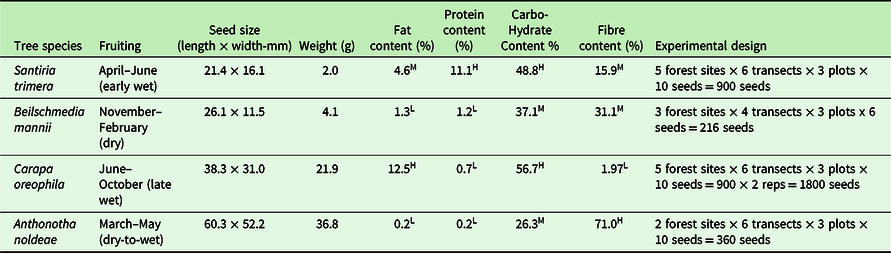
To carry out our seed removal experiment we used seeds of four large-seeded (>15 mm in diameter; Smythe Reference Smythe1970) tree species: Anthonotha noladeae (Rossberg.) Exell & Hillcoat (Fabaceae), Beilschmedia mannii (Meisn.) Benth. & Hook (Lauraceae), Carapa oreophila Kenfack (Meliaceae) and Santiria trimera (Oliv.) Aubrév (Burseraceae) (herein simply referred to as Anthonotha, Beilschmedia, Carapa and Santiria). The seed species ranged in size from 2 g (Santiria) to 36 g (Anthonotha) and in nutrient content (see Table 1 for seed characteristics). We collected seeds from a minimum of five individual adult trees for each of the four species, sampling from across the forest, except in the case of Anthonotha that is more abundant toward the forest edge (Abiem et al. Reference Abiem, Arellano, Kenfack and Chapman2020).
Characteristics of seed species used in the different experiments in 2014. Wet and dry seasons occur only once in a year. Mean values for seed size, weight and nutrient contents of 20 seeds of each species are shown in the table. The superscripts H, M and L represent high, moderate and low categories respectively.

Nutrient content of 20 seeds from each of the four focal tree species was analysed for proximate composition of fats, proteins, fibre and carbohydrate content at the chemistry laboratory of Gombe State University, Nigeria (see Table 1). All analyses followed the protocols described in AOAC (1990). Fat content was determined by a lipid extraction, crude protein by the Kjeldahl method, fibre was obtained by ashing and carbohydrate content determined as the remaining content after the subtraction of fats, proteins and fibre.
To determine the probability of a seed being predated or cached we established five experimental sites (for more information see Yadok et al. Reference Yadok, Gerhard, Forget and Chapman2018). Each site was at least 400 m apart. Within each site we marked out 18 small plots (1 m × 1 m) on 3 × 6 grid format. The plots were spaced 75 m and 25 m on the vertical and horizontal axes, respectively. The number of sites and seeds used for each species varied according to the availability of seeds in 2014 (Table 1). All seeds were marked using the thread tagging technique (Forget Reference Forget1990). Briefly, each seed was marked by drilling a 1 mm hole through the seed through which one end of a 70 cm nylon thread was tied. A 7 cm long pink flagging tape with the seed identification details was tied to the other free end of the nylon thread attached to each seed.
We carried out our experiments during the fruiting season of each focal species (Table 1), and because this varied among the species, plots comprised single species at a time. We observed seed fate on the second, fifth and tenth day after seeds were placed in the plots by physically searching for removed seeds within a 25 m radius around each plot. Fates were recorded as: (i) ‘predated’ when consumed; (ii) ‘cached’ when seeds were removed and found buried in the soil or under litter; and (iii) ‘missing’ when seeds and their attached thread-tags could not be found. To observe the animal visitors in our experimental plots we randomly stationed four motion-triggered camera traps (Bushnell® Trophy cam) at each site. We recorded four microhabitat variables within a 10 m radius of each plot to account for other variables that may affect the fate of seeds (e.g. percentage dead logs, distance to nearest stream, percentage litter cover and percentage understorey herb density). We monitored all the cached seeds in our experiment on a weekly basis for 2 months. We recorded signs of seed predation when seeds were no longer in caches and signs of sprouting when apical germination was observed among the mostly shallow-cached seeds.
Data analyses
We analysed the probability of a seeds being predated or cached in each of the four seed species within a Bayesian framework using Stan (Gelman et al. Reference Gelman, Lee and Guo2015) interfaced with R (R Core Team 2016). The Bayesian binomial logistic regression models allowed us to control for the differences in the number of seeds, sites and spatial variability of plots in our experimental design. Moreover, our models accounted for the hierarchical order of the plots within the grids in each site and the measured habitat variables. Our accepted posterior probability values were sampled with four chains, which converged in 5000 iterations. To test for the effect of seed size on the probability of seed caching, our response variable was set as ‘cached’ vs ‘other fate categories’ while our main explanatory variables were the four seed species that differed in size. The same model was used to test for the effect of seed size on seed predation by setting the response variable as ‘predated’ vs ‘other fate categories’. The first step in investigating the effect of nutrient content on the probability of a seed being cached or predated was to categorize seed nutrient content based on the percentage of nutrients. For the fat content, we categorized seeds as low (≤1.9%), moderate (>1.9% <10%) and high (≥10%); for proteins, low (≤1.9%) and high (≥10%) since there was no intermediate value; for fibre content, low (≤10%), moderate (>10 <40) and high (≥40). Given the high levels of carbohydrates in tropical seeds (Ezeagu Reference Ezeagu2009), we categorized seeds into two carbohydrate categories; moderate (>10% <40%) and high (≥40%). All seeds of the same species were classified in the same nutrient category. The categories of each nutrient (i.e. fat, protein, fibre and carbohydrates) were used as explanatory variables for the nutrient content models. For models used in testing the effect of seed nutrient content on the probability of seed caching, the response variables were set as ‘cached’ vs ‘other fate categories’ while ‘predation’ vs ‘other fate categories’ were used as the response variables for the probability of seed predation. We used a Bayesian logistic regression to determine the difference in removal distance among the seed species. We also controlled for the effect of the measured habitat variables in all the models above by including them in our explanatory variables. Additionally, we controlled for background food availability by including monthly fruit abundance (i.e. food availability index calculated from tree density, tree diameter and fruiting from NMFP tree phenology data; see Yadok Reference Yadok2018) in each model. For each model, the main effects were considered as significantly different from each other when the median credible intervals (difference in credible intervals, DIC) were at the level DIC > 0.05. Finally, we used a Kaplan–Meier survival analysis to investigate seed survival for dispersed seed of the different species. Seed survival was investigated over a period of 10 weeks following the 10-day observation for each seed species.
Results
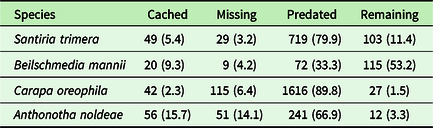
Of the 3276 seeds from the four different species used in our experiments, 92% were removed after 10 days. Of the removed seeds 81% were predated, 6% were missing and the remaining 5% were cached. Anthonotha had the highest percentage of cached seeds while Carapa had the least (Table 2). Conversely, Carapa had the highest percentage of predated seeds while Beilschmedia had the least (Table 2). Images from the camera traps revealed that Cricetomys and Atherurus were the dominant seed removers in the plots because they occupied 93% of the overall images. Although images of other animals (e.g. duikers, doves and squirrels) were also captured, these animals had little or no interaction with the seeds placed.
Seed fate of four large-seeded species used in seed removal experiment in Ngel Nyaki forest reserve. Percentages are shown in parentheses.

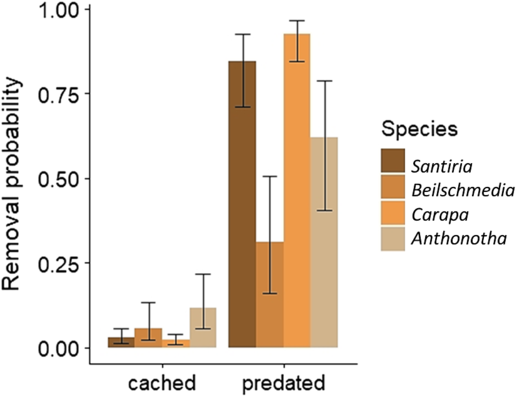
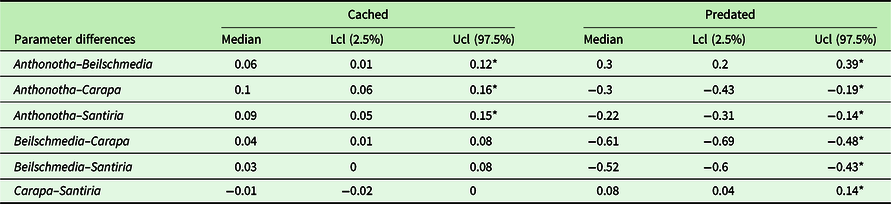
For all seed species, the probability of being predated when encountered by a rodent was higher than the probability of being cached. Although there were differences among species, these differences were not related to seed size (Figure 1). However, multiple comparisons showed that the probability of being cached was significantly higher for Anthonotha than the other three species (median DIC ≥6%; Table 3). Conversely, Carapa being the second largest seed species, had the highest probability of being predated and a multiple comparison of the median posterior distributions showed differences among the species in the following order: Carapa > Santiria > Anthonotha > Beilschmedia. These differences in the probability of predation were all significant (median DIC >8%) (Table 3).
Estimated probability of seeds being predated or cached with respect to seed species. Species varied in size in the order Santria trimera < Beilschmedia mannii < Carapa oreophila < Anthonotha noldeae (see Table 1 for details). Probability values were obtained by transforming (1/(1+e(−β)) posterior distributions from a Bayesian binomial logistic regression. Anthonotha consistently had a significantly higher probability of being cached than all the other species while Carapa consistently had a higher probability of being predated than all the other species. See Table 3 for details on pairwise differences in probabilities.

Pairwise posterior probability differences of being predated and cached for four (Anthonotha, Beilschmedia, Carapa and Santiria) different seed species.

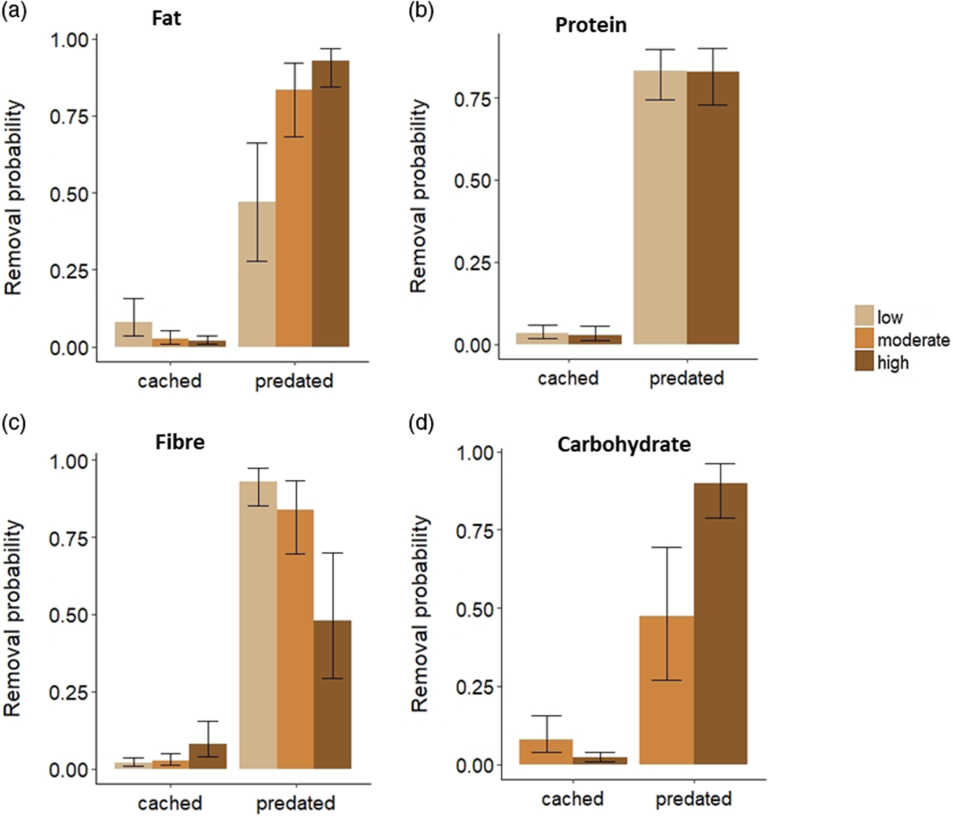
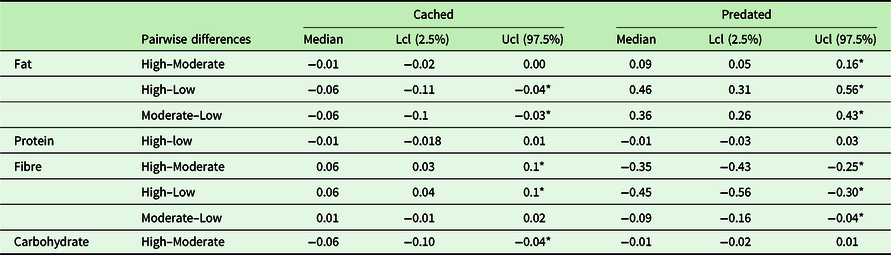
With respect to nutrient content of the seed species, the species of seeds with higher fat content consistently had a higher probability of being predated (Figure 2a) than those with the seeds with low fat content (Table 4). Species of seeds with low fat content had a significantly higher probability of being cached (median DIC > 6%; Table 4). There was no effect of seed protein content on the probability of seeds being predated or cached (median DIC < 5%; Table 4). The species of seeds with high fibre content were prone to lower predation and higher caching probability (median DIC ≥ 6%; Table 4) than those with lower fibre contents. While seeds with lower carbohydrate contents had a higher probability of being cached (median DIC = 6%), there was no difference in the probability of predation between species of seeds with high and moderate carbohydrate contents (Table 4).
Estimated probability of seeds being cached or predated with respect to (a) fat (b) protein (c) fibre and (d) carbohydrate content levels. Probability values were obtained by transforming (1/(1+e(−β)) posterior distributions from a Bayesian binomial logistic regression. See Table 1 for categorization of seed species into nutrient classes.

Pairwise differences in posterior probability distribution of seeds being cached or predated based on levels of fat, protein, fibre and carbohydrate contents.

Significant differences (DIC > 0.05) are indicated with the asterisks.
Fruit abundance consistently had a significant effect where high fruiting periods were associated with slight increases in seed caching and decreases in seed predation (Supplementary Appendices 1–10). Understorey herb density and percentage dead logs had significant effects on caching probabilities (Supplementary Appendices 1, 3, 5, 7 and 9).
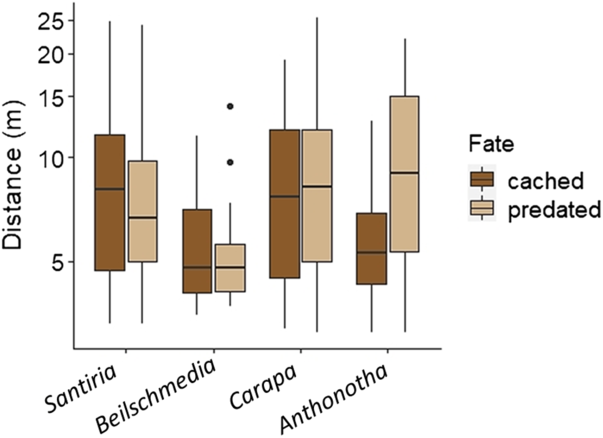
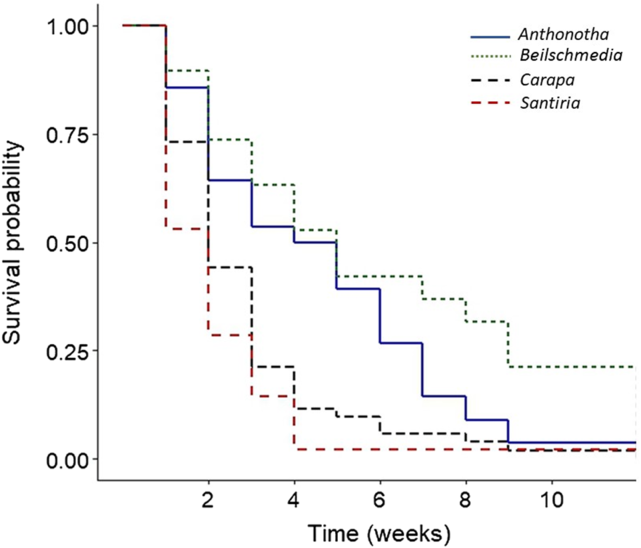
Dispersal kernels were not significantly different between the species (median DIC <5%). Interestingly, Anthonotha, being the largest of the four seed species was not cached across a farther distance than Santiria which is the smallest among the four seed species (Figure 3). The probability of survival after being cached for 10 weeks differed significantly by species (χ2=35.2, df = 3, P < 0.01), but not by size (Figure 4). Anthonotha and Beilschmedia, with higher fibre contents survived longer than Carapa and Santiria, which were high in fat content.
Observed distances of different seed species moved removed by large rodents in NNFR. The distances shown here are in log10 scale. Box plots show median values (solid horizontal line), 50th percentile values (box outline), 90th percentile values (whiskers) and outlier values (closed circles).

Survival probability for seeds 10 weeks after being dispersed. Using a Kaplan–Meier survival test, Beilschmedia had a higher probability of survival compared with other species and Santiria had the lowest probability of survival.

Discussion
We designed our study to test four hypotheses around seed fate for four large-seeded African tree species when seeds were exposed to scatterhoarding rodents. Our hypotheses were based on findings from forests elsewhere (Galetti et al. Reference Galetti, Donatti, Steffler, Genini, Bovendorp and Fleury2010, Jansen et al. Reference Jansen, Bartholomeus, Bongers, Elzinga, Den Ouden, Van Wieren, Levey, Silva and Galetti2002, Wang & Chen Reference Wang and Chen2009, Xiao et al. Reference Xiao, Wang, Harris and Zhang2006) and on a previous study of different species at our study site (Aliyu et al. Reference Aliyu, Adamu, Moltchanova, Forget and Chapman2014). Contrary to our first hypothesis that the larger seed species would be cached more frequently than smaller seed species, we found no evidence for this. That our findings are contrary to those of Aliyu et al. (Reference Aliyu, Adamu, Moltchanova, Forget and Chapman2014), which details a similar study conducted on different seed species at our study site, was unexpected. Aliyu et al. (Reference Aliyu, Adamu, Moltchanova, Forget and Chapman2014) found that Garcinia, which has larger seeds than Pouteria, had a higher caching frequency and a lower probability of being predated. Given our findings, an explanation for the results of Aliyu et al. (Reference Aliyu, Adamu, Moltchanova, Forget and Chapman2014) may more likely be nutrient content than seed size. Another explanation could be inter-annual difference in fruit abundance, which is known to influence the predation/caching ratio in scatterhoarding rodents (Jansen et al. Reference Jansen, Bongers and Hemerik2004, Yadok et al. Reference Yadok, Forget, Gerhard and Chapman2019b). However, this study does agree with our previous work in which we report no effect of intraspecific seed size in caching of Carapa seeds in our study area (Yadok et al. Reference Yadok, Gerhard, Forget and Chapman2018); Carapa seeds range in size from ~1 g to ~46 g. Retrospectively, measuring each individual seed of the four species used in this study may have provided more support for our findings.
Our second hypothesis, that seeds with high nutrient content will be more likely to be cached than predated was again unsupported by our findings. In contrast, we found that seeds with lower fat and carbohydrate contents had a higher probability of being predated. However, an important caveat to note is that the high rate of seed predation in this study does not allow the establishment of a strong link between seed fate and seed nutrient content. The extremely high probability of C. oreophila predation relative to the other seed species is most likely attributable to a combination of large size and high fat content. These are traits that have been shown to attract seed scatterhoarding rodents (Wang & Chen Reference Wang and Chen2009, Wang et al. Reference Wang, Chen and Corlett2014). Additionally, scarcity of seeds on the forest floors of Afrotropical montane forests (Chapman et al. Reference Chapman, Cordeiro, Dutton, Wenny, Kitamura, Kaplin, Melo and Lawes2016) may also contribute to the high rate of large nutrient-rich seed predation. However, these same traits should theoretically have made Carapa more prone to being dispersed than predated (Wang et al. Reference Wang, Chen and Corlett2014). Although seeds with high fat content may be useful in compensating for the negative effects of dietary tannins in rodents (Chung-MacCoubrey et al. Reference Chung-MacCoubrey, Hagerman and Kirkpatrick1997), relatively little is known about tannins in Afrotropical plants to support this assumption. An inclusion of dietary tannins among the seed variables might have provided further clarification on seed selection in relation to nutrient content (Wang & Chen Reference Wang and Chen2009); it could be one explanation as to why the Anthonotha and Beilschmedia were cached at the highest frequency of all seed species in the experiment – Anthonotha and Beilschmedia seeds have the lowest fat content of all the seed species we investigated.
We found no evidence to support our third hypothesis ‘seed size and dispersal distance’, that larger seed species have a higher probability of being moved farther distances. In contrast to many studies (Jansen et al. Reference Jansen, Bartholomeus, Bongers, Elzinga, Den Ouden, Van Wieren, Levey, Silva and Galetti2002, Reference Jansen, Bongers and Hemerik2004; Xiao et al. Reference Xiao, Zhang and Wang2005, Wang & Chen Reference Wang and Chen2009, Wang et al. Reference Wang, Wang and Chen2012, Reference Wang, Chen and Corlett2014) our results show that Afrotropical scatterhoarding rodents in montane forests do not carry larger seed species over greater distances than smaller seed species. In the Neotropics most seeds are moved over relatively short distances before they are consumed or cached (Forget et al. Reference Forget, Wenny, Lambert, Hulme, Vander Wall, Forget, Lambert, Hulme and Vander Wall2005). This concurs with our findings; most (>90%) of the removed seeds we found were within the 25 m search radius. However, our hierarchical experimental design allowed us to inadvertently discover a few seeds that were taken over longer distances than our search radius. In fact, one of the seeds was carried up to 50 m away from its initial point before consumption. It is possible that Atherurus, which have larger home ranges than Cricetomys, and which have been observed moving seeds over long distances (up to 46 m) in Gabon (Rosin & Poulsen Reference Rosin and Poulsen2017) may have been responsible and this needs further investigation. While secondary caching (whereby a cached seed is dug up and moved to another cache) of seeds can increase seed dispersal distances in China (Wang et al. Reference Wang, Chen and Corlett2014) and the Neotropics (Jansen et al. Reference Jansen, Bongers and Hemerik2004), we infrequently found evidence of secondary caching. We observed only four secondary caching events of the 167 seeds cached, and all of these seeds were consumed by our third observation date.
Cached seed survival differed among species, but not according to size. While this finding apparently contrasts with previous studies (Jansen et al. Reference Jansen, Bartholomeus, Bongers, Elzinga, Den Ouden, Van Wieren, Levey, Silva and Galetti2002, Wang et al. Reference Wang, Chen and Corlett2014, Xiao et al. Reference Xiao, Zhang and Wang2005), it does corroborate the observations of Holl & Lulow (Reference Holl and Lulow1997), who found that neotropical rodents may preferentially retrieve some dispersed seed species over others. However, because the different seeds used in this experiment were available in different seasons, it is possible that the frequent retrieval of some seed species was more a consequence of the season in which the seed species was available (Forget et al. Reference Forget, Hammond, Milleron, Thomas, Levey, Silva and Galletti2002), rather than the inherent seed traits of the species.
While most neotropical tropical scatterhoarding rodents recover cached seeds within a short period, most of the recovered seed are re-cached rather than consumed (Jansen et al. Reference Jansen, Hirsch, Emsens, Zamora-Gutierrez, Wikelski and Kays2012, Vander Wall & Jenkins Reference Vander Wall and Jenkins2003). In contrast, our study showed that in Afromontane habitats most recovered seeds are predated upon immediately, rather than being dispersed further. We suggest that food scarcity in Afrotropical montane forests (Chapman et al. Reference Chapman, Cordeiro, Dutton, Wenny, Kitamura, Kaplin, Melo and Lawes2016) is the major driver of this behaviour. Another contributory explanation could be the level of defensive chemical content present in the seed species. Seed species that are more likely to be cached may have higher levels of defensive chemicals, and this needs further investigation.
The process of germination may use up food reserves in seeds (Bradbeer Reference Bradbeer1988), thereby reducing the likelihood of frequent retrieval of some seed species by scatterhoarding rodents (Steele et al. Reference Steele, Knowles, Bridle and Simms1993, Yi et al. Reference Yi, Wang, Liu and Liu2015). This may explain the infrequent seed retrieval of Anthonotha and Beilschmedia by rodents in this study. High germination rate may be important in countering rodent seed predation (Cao et al. Reference Cao, Wang, Yan, Chen, Guo and Zhang2016) but the high frequency of seed removal by the scatterhoarding rodents in our study area limited our observation of seed germination. However, observations of seeds planted in the NMFP seedling nursery revealed that all the four seed species used in this study often germinate within a month.
The high rates of seed removal observed in this study (>90%) were similar to those recorded from other tropical studies (e.g. Forget Reference Forget1990, Reference Forget1996; Nyiramana et al. Reference Nyiramana, Mendoza, Kaplin and Forget2011). Moreover, the high seed predation frequencies in this study (up to 98% in Carapa) were also equivalent to the study by Nyiramana et al. (Reference Nyiramana, Mendoza, Kaplin and Forget2011) in a montane forest in Nyungwe National Park, Rwanda. This suggests that the foraging behaviour of scatterhoarding rodents in Afrotropical montane forests may be consistent.
Although scatterhoarding rodents are often attracted to seeds with high fat and protein content (Vander Wall Reference Vander Wall2001, Wang et al. Reference Wang, Wang and Chen2012), our study showed that protein was not important. The results from our experiment suggest that nutrient content rather than size is the seed trait which most influences the predation and dispersal probabilities of large-seeded species by scatterhoarding rodents in our study area. We recommend that further study using 10 or more seed species should be considered in future experiments in order to ascertain the strength of our results. Additionally, cafeteria experiments, which are designed to investigate the removal of different seed species at the same place and time, may provide further clarification on the factors affecting seed choice by rodents and the fate of removed seeds. Cricetomys and Atherurus may have different effects on seed fate in montane forests, and understanding their differential effects may further elucidate our findings. However, we could not tease apart their individual effects on seed fate in this study.
Conclusion
This study has shown that seed nutrient content rather than seed size is more likely to influence the dispersal of seeds by scatterhoarding rodents in Afrotropical montane forests. It also suggests that in seed-poor years, seeds with lower nutritional reward may have more chances of being dispersed by scatterhoarding rodents than nutrient-rich seed species. Finally, our work suggests that if hoarded seeds offer low energy rewards, they are less likely be retrieved.
Supplementary material
To view supplementary material for this article, please visit https://doi.org/10.1017/S0266467420000127
Acknowledgements
We are grateful to Adam Hassan, Yusuf Tongbuin, Ali Abdu, Ibrahim Umaru and Muhammed Jalike for their kind assistance in the field. We also thank Taraba State Ministry of Forestry for granting us access into Ngel Nyaki Forest Reserve and Dr Renée Firman for comments on the manuscript draft.
Financial support
This research was made possible by the support of Chester Zoo (UK), CNOCK Nexen Nigeria, A.G. Leventis Foundation to the Nigerian Montane Forest Project (NMFP), Rufford Foundation (Grant No. 18801-1) and Ideawild support to BY and Rtd General T.Y. Danjuma (Fellowship to BY).