Environmental adversity has long been implicated in the development of mental health problems in adults. Severe life events, particularly those involving loss, humiliation, or rejection (such as the breakdown of a relationship) are particularly depressogenic and contribute to the onset of a depressive disorder (Brown & Harris, Reference Brown and Harris1978; Kendler, Hettema, Butera, Gardner, & Prescott, Reference Kendler, Hettema, Butera, Gardner and Prescott2003; Slavich, Thornton, Torres, Monroe, & Gotlib, Reference Slavich, Thornton, Torres, Monroe and Gotlib2009). However, while severe stressful life events (e.g., loss of a family member) are common, they usually lead only to psychological disorders in a small proportion of those exposed to them. In other words, while some people develop psychological problems in response to negative life events, most people do not.
One of several plausible explanations for such uneven effects is that individuals may differ in their sensitivity to environmental influences (for an integrative review on environmental sensitivity, see Pluess, Reference Pluess2015). It has been acknowledged for a long time that some people are more likely affected than others by the negative effects of adverse experiences due to some inherent vulnerability (e.g., a family history of mental health problems). This observation has been conceptualized in the well-known diathesis–stress or dual-risk model (Monroe & Simons, Reference Monroe and Simons1991; Zuckerman, Reference Zuckerman and Zuckerman1999) according to which vulnerable individuals develop psychological problems when faced with adversity while those without vulnerability remain resilient. Over the last decade, it has been proposed by several authors that individuals may differ in their susceptibility to environmental influences more generally. These theories include the concept of sensory processing sensitivity (Aron & Aron, Reference Aron and Aron1997; Aron, Aron, & Jagiellowicz, Reference Aron, Aron and Jagiellowicz2012), differential susceptibility theory (Belsky, Reference Belsky1997, Reference Belsky, Ellis and Bjorklund2005; Belsky, Bakermans-Kranenburg, & van IJzendoorn, Reference Belsky, Bakermans-Kranenburg and van IJzendoorn2007; Belsky & Pluess, Reference Belsky and Pluess2009, Reference Belsky and Pluess2013), and biological sensitivity to context (Boyce & Ellis, Reference Boyce and Ellis2005; Ellis & Boyce, Reference Ellis and Boyce2008). Probably the most significant contribution shared across these theoretical frameworks is the notion that environmentally sensitive individuals differ not only in their response to adverse influences but also in response to positive supportive aspects of the environment. Such individual differences in response to positive exposures have recently been theorized in more detail in the vantage sensitivity model (Pluess & Belsky, Reference Pluess and Belsky2013), which reflects the counterpart to the diathesis–stress model. Given the various observed interaction patterns, it may be more helpful to consider individual differences in response to environmental influences from the broader perspective of environmental sensitivity (Pluess, Reference Pluess2015) rather than exclusively vulnerability, resilience, susceptibility, or vantage sensitivity. Twin studies on resilience (Amstadter, Myers, & Kendler, Reference Amstadter, Myers and Kendler2014) as well as sensory processing sensitivity (Assary, Zavos, Krapohl, Keers, & Pluess, Reference Assary, Zavos, Krapohl, Keers and Pluess2017) suggest that sensitivity to the environment is most likely the result of both environmental and genetic factors. The aim of the current report is to investigate the role of childhood environment and multiple sensitivity genes in the development of environmental sensitivity in adulthood, applying a life-course perspective in a large-scale cohort study ranging from birth to 50 years.
Early Experiences and Environmental Sensitivity in Adulthood
In addition to proximal stressors in adulthood such as bereavement or job loss, more distal factors, such as childhood maltreatment, have also been robustly associated with the development of psychopathology later in life (Dougherty, Klein, & Davila, Reference Dougherty, Klein and Davila2004). These findings also extend to more common stressors such as low socioeconomic status and financial difficulties (Amone-P'Olak et al., Reference Amone-P'Olak, Burger, Ormel, Huisman, Verhulst and Oldehinkel2009), parental divorce (Amato, Reference Amato2010), and factors affecting family functioning (McLaughlin, Conron, Koenen, & Gilman, Reference McLaughlin, Conron, Koenen and Gilman2010). One mechanism by which childhood adversity may have long-lasting effects on psychopathology is through a process of stress sensitization. The stress-sensitization hypothesis suggests that the experience of childhood adversity impacts upon adult outcomes by increasing sensitivity to later stressors (Hammen, Reference Hammen2005). Empirical evidence for stress sensitivity was initially reported by Hammen, Henry, and Daley (Reference Hammen, Henry and Daley2000) in a small prospective population sample of 121 women. In this study, the onset, or exacerbation, of depression was predicted by an interaction between self-reported childhood adversity and proximal stressful life events in adulthood. Specifically, adults who had experienced adversities in childhood such as the death of a parent or family violence required fewer stressful life events in adulthood to trigger an episode of depression. Similar findings were reported by Harkness, Bruce, and Lumley (Reference Harkness, Bruce and Lumley2006), who found that individuals with a history of childhood abuse or neglect appeared to be more sensitive to the effects of stress in adulthood, again requiring fewer severe life events at the onset of the disorder.
Similar interactions between childhood and adulthood stress on psychopathology have been replicated by several larger studies of major depression, posttraumatic stress disorder, and anxiety disorders (Kendler, Kuhn, & Prescott, Reference Kendler, Kuhn and Prescott2004; McLaughlin et al., Reference McLaughlin, Conron, Koenen and Gilman2010; Power et al., Reference Power, Lecky-Thompson, Fisher, Cohen-Woods, Hosang, Uher and McGuffin2013) as well as depression symptoms (Dougherty et al., Reference Dougherty, Klein and Davila2004; Shapero et al., Reference Shapero, Black, Liu, Klugman, Bender, Abramson and Alloy2014; Starr, Hammen, Conway, Raposa, & Brennan, Reference Starr, Hammen, Conway, Raposa and Brennan2014). In line with Hammen et al. (Reference Hammen, Henry and Daley2000), each of these studies suggests that the combination of both childhood and adult adversity is associated with the highest risk of psychopathology. In other words, adversity in childhood may program vulnerability to adversity in adulthood or, in terms of environmental sensitivity (Pluess, Reference Pluess2015), the quality of childhood experience may shape environmental sensitivity in adulthood. Nevertheless, these programming effects do not appear to apply equally to all children. While many individuals exposed to high levels of maltreatment as children develop increased vulnerability to adverse environments in adulthood, a significant minority appears to remain resilient to these programming effects of early adversity (Cicchetti, Reference Cicchetti2013). One potential reason for such differences is that environmental factors in childhood shape adult environmental sensitivity only in people characterized by a predisposition for the development of heightened sensitivity, for example due to carrying gene variants associated with environmental sensitivity (Pluess, Reference Pluess2015).
Genes and Environmental Sensitivity
Gene × Environment (G × E) interaction studies suggest that specific genotypes influence the degree of environmental sensitivity. A large and growing number of variants in candidate genes including the serotonin transporter linked polymorphic region (5-HTTLPR) in solute carrier family C6, member 4 (SLC6A4; Caspi et al., Reference Caspi, Sugden, Moffitt, Taylor, Craig, Harrington and Poulton2003), rs6265 in brain-derived neurotrophic factor (BDNF; Hosang et al., Reference Hosang, Uher, Keers, Cohen-Woods, Craig, Korszun and Farmer2010), rs4680 in catechol-O-methyltransferase (COMT; Drury et al., Reference Drury, Theall, Smyke, Keats, Egger, Nelson and Zeanah2010), rs1800497 in dopamine receptor D2 (DRD2; Elovainio et al., Reference Elovainio, Jokela, Kivimaki, Pulkki-Raback, Lehtimaki, Airla and Keltikangas-Jarvinen2007), rs6313 in 5-hydroxytryptamine receptor 2A (HTR2A; Jokela et al., Reference Jokela, Keltikangas-Jarvinen, Kivimaki, Puttonen, Elovainio, Rontu and Lehtimaki2007), rs1360780 in FK506 binding protein 5 (FKBP5; Binder et al., Reference Binder, Bradley, Liu, Epstein, Deveau, Mercer and Ressler2008), rs6330 in nerve growth factor (NGF; Lester et al., Reference Lester, Hudson, Tropeano, Creswell, Collier, Farmer and Eley2012), rs5522 in nuclear receptor subfamily 3, group C, member 2 (NR3C2; Bogdan, Williamson, & Hariri, Reference Bogdan, Williamson and Hariri2012), and rs1799971 in μ-opioid receptor M1 (OPMR1; Troisi et al., Reference Troisi, Frazzetto, Carola, Di Lorenzo, Coviello, Siracusano and Gross2012) have each been shown to moderate the effects of distal or proximal environments on psychopathology. For example, individuals with one or two copies of the short allele of the serotonin transporter gene polymorphism 5-HTTLPR have been shown to be at a greater risk of mood disorders following childhood maltreatment or stressful life events than those homozygous for the long allele (Caspi et al., Reference Caspi, Sugden, Moffitt, Taylor, Craig, Harrington and Poulton2003).
Nevertheless, G × E findings have often failed to replicate, even in high-quality studies with very similar methodologies (e.g., Fergusson, Horwood, Miller, & Kennedy, Reference Fergusson, Horwood, Miller and Kennedy2011) resulting in negative meta-analyses (Munafo, Durrant, Lewis, & Flint, Reference Munafo, Durrant, Lewis and Flint2009; Risch et al., Reference Risch, Herrell, Lehner, Liang, Eaves, Hoh and Merikangas2009). For the most extensively investigated variants, findings appear to be more robust for distal rather than proximal stressors and for objectively reported environmental influences (Uher & McGuffin, Reference Uher and McGuffin2010; Zannas & Binder, Reference Zannas and Binder2014). The most comprehensive meta-analysis of the 5-HTTLPR suggested that G × E effects at this locus were considerably more robust for childhood maltreatment than stressful life events (Karg, Burmeister, Shedden, & Sen, Reference Karg, Burmeister, Shedden and Sen2011). These findings are in line with multiple lines of animal and human research, which suggest that environmental influences on the brain and subsequent G × E effects are greatest during critical periods of brain development such as early childhood (Daskalakis, Bagot, Parker, Vinkers, & de Kloet, Reference Daskalakis, Bagot, Parker, Vinkers and de Kloet2013; Uher, Reference Uher2008). The specific and long-lasting effects of early environments in G × E has led researchers to speculate that the role of G × E in mental illnesses may only be elucidated through large life-course studies considering both the early and late environment (Uher, Reference Uher2014).
Although many G × E studies were originally conceptualized in diathesis–stress terms where genotypes are understood to dispose individuals to the negative effects of adversity leading to mental illness, a growing number of more recent studies suggest that the identified gene variants function as sensitivity or plasticity factors rather than vulnerability factors (Belsky & Pluess, Reference Belsky and Pluess2009). In line with this hypothesis, individuals with one or two copies of the short allele of the 5-HTTLPR have been shown to benefit more from the protective effects of positive environmental influences such as supportive parenting (Hankin et al., Reference Hankin, Nederhof, Oppenheimer, Jenness, Young, Abela and Oldehinkel2011), positive life events (Pluess, Belsky, Way, & Taylor, Reference Pluess, Belsky, Way and Taylor2010), or social support (Taylor et al., Reference Taylor, Way, Welch, Hilmert, Lehman and Eisenberger2006). These associations have also been shown to extend to the moderation of the positive effects of various interventions including psychosocial training on depression (Kohen et al., Reference Kohen, Cain, Buzaitis, Johnson, Becker, Teri and Mitchell2011), high-quality foster care on disturbances of attachment (Drury et al., Reference Drury, Gleason, Theall, Smyke, Nelson, Fox and Zeanah2012) and externalizing behavior (Brett et al., Reference Brett, Humphreys, Smyke, Gleason, Nelson, Zeanah and Drury2015), as well as the efficacy of cognitive behavioral therapy in children with anxiety disorders (Eley et al., Reference Eley, Hudson, Creswell, Tropeano, Lester, Cooper and Collier2012). In addition to findings from G × E studies involving the 5-HTTLPR, differential susceptibility results have been reported for several further genetic markers (Belsky & Pluess, Reference Belsky and Pluess2013) with results from intervention studies showing particular promise (van IJzendoorn & Bakermans-Kranenburg, Reference van IJzendoorn and Bakermans-Kranenburg2015).
Genetic Moderation of Stress Sensitization
It has been suggested that genetic factors and early environments do not work in isolation to influence environmental sensitivity. Rather, both factors operate synergistically to shape sensitivity to the environment in later life (Ellis, Boyce, Belsky, & Bakermans-Kranenburg, Reference Ellis, Boyce, Belsky, Bakermans-Kranenburg and van IJzendoorn2011; Pluess, Reference Pluess2015; Pluess & Belsky, Reference Pluess and Belsky2011; Pluess, Stevens, & Belsky, Reference Pluess, Stevens, Belsky, Legerstee, Haley and Bornstein2013). Several biological mechanisms have been proposed to mediate the effects of early life stress on later adult environmental sensitivity, including atrophy of the hippocampus, atypical development of the hypothalamus–pituitary–adrenal (HPA) axis, and amygdala hyperactivity (McCrory, De Brito, & Viding, Reference McCrory, De Brito and Viding2010). Given that each of these systems are, at least in part, under genetic control, it is plausible that the developmental process of stress sensitization is moderated by genotype. In line with this hypothesis, several studies suggest that genotypes implicated in G × E studies moderate the effects of early adversity on HPA axis reactivity (Cicchetti, Rogosch, & Oshri, Reference Cicchetti, Rogosch and Oshri2011; Heim et al., Reference Heim, Bradley, Mletzko, Deveau, Musselman, Nemeroff and Binder2009; Tyrka et al., Reference Tyrka, Price, Gelernter, Schepker, Anderson and Carpenter2009) and hippocampal and amygdala volumes (Frodl et al., Reference Frodl, Reinhold, Koutsouleris, Donohoe, Bondy, Reiser and Meisenzahl2010; Gatt et al., Reference Gatt, Nemeroff, Dobson-Stone, Paul, Bryant, Schofield and Williams2009). In each of these studies the effects of early stress resulted in significant biological changes, but only in genetically sensitive individuals.
Genetic moderation of stress sensitization would manifest as a three-way interaction between childhood and adulthood environment and genotype on adult outcomes. However, few studies have investigated such a G × E × E interaction. One of the first to do so suggested that individuals exposed to severe early institutional deprivation were more sensitive to the effects of later life stress on the development of psychopathology in adolescence, demonstrating stress sensitization (Kumsta et al., Reference Kumsta, Stevens, Brookes, Schlotz, Castle, Beckett and Sonuga-Barke2010). However, these effects were specific to those with genotypes conferring greater sensitivity to environmental influences (i.e., the short allele of the 5-HTTLPR). Similar G × E × E interactions have been reported in two further studies measuring depression symptoms in population cohorts. The first of these studies included a cross-sectional sample of 1,974, measured for childhood maltreatment, adult traumatic experiences, and depression symptoms (Grabe et al., Reference Grabe, Schwahn, Mahler, Schulz, Spitzer, Fenske and Freyberger2012). Consistent with the stress-sensitivity hypothesis, there was a significant interaction between childhood and adult trauma in the prediction of depression. However, there was also evidence for G × E × E. In line with Kumsta et al. (Reference Kumsta, Stevens, Brookes, Schlotz, Castle, Beckett and Sonuga-Barke2010), the interaction between childhood and adulthood environment on depression was only significant in carriers of the short allele of the 5-HTTLPR. A more recent longitudinal study replicated these findings for the 5-HTTLPR and reported similar findings pertaining to a further candidate gene proposed to moderate HPA axis reactivity, the corticotrophin releasing hormone receptor 1 gene (CRHR1; Starr et al., Reference Starr, Hammen, Conway, Raposa and Brennan2014). However, despite these intriguing results, at least one study has failed to replicate similar G × E × E findings for the 5-HTTLPR using a case-control sample of major depression (Power et al., Reference Power, Lecky-Thompson, Fisher, Cohen-Woods, Hosang, Uher and McGuffin2013).
The Current Study
Taken together, the reviewed studies suggest that sensitivity to the environment in adulthood may be the result of both early experience and specific genetic variants. These factors may operate synergistically, such that the sensitizing effects of early life stress are more pronounced in individuals who are more genetically sensitive. While multiple studies provide empirical evidence for E × E and G × E × E effects in adults, several important questions remain unexplored.
It is well established that in addition to childhood maltreatment and adult stressful life events, less severe and more common environmental influences such as low socioeconomic status during childhood and adulthood are positively correlated with psychopathology. Nevertheless, studies exploring E × E and G × E × E focus exclusively on severely negative environmental influences including childhood maltreatment and trauma and major stressful life events in adulthood. It therefore remains unknown whether these findings extend to less severe and more common environmental influences.
Recently, it has been suggested that in genetically more sensitive individuals, the quality of the early environment may shape later environmental sensitivity to both negative and positive influences (Pluess, Reference Pluess2015). Specifically, genetically sensitive children exposed to adversity may develop greater sensitivity to threat and therefore show increased vulnerability to later adverse events. Genetically sensitive children exposed to positive environments, in contrast, may develop vantage sensitivity (Pluess & Belsky, Reference Pluess and Belsky2013), and therefore benefit more from positive environments in adulthood. Nevertheless, as previous studies of E × E and G × E × E have focused exclusively on negative rather than positive aspects of the environment, the role of positive environmental influences regarding the programming of later environmental sensitivity remains unknown.
A large number of G × E studies provide evidence of individual differences in susceptibility to both negative and positive environmental exposures as a function of single candidate genes (Belsky & Pluess, Reference Belsky and Pluess2009). However, genetic sensitivity to the environment is likely a complex polygenic trait, due to the aggregate effects of multiple genetic variants. Several studies have considered polygenic environmental sensitivity both using candidate gene (Belsky & Beaver, Reference Belsky and Beaver2011) and genome-wide (Keers et al., Reference Keers, Coleman, Lester, Roberts, Breen, Thastum and Eley2016) approaches. Nevertheless, these approaches are yet to be applied to studies of G × E × E.
In the current study we aimed to address each of these questions using a large prospective cohort followed from birth to 50 years old. We tested the effects of both childhood and concurrent environment, measured with a cumulative score of the quality of the material environment ranging from poor to good, on psychological distress at four time points during adulthood and whether these effects were moderated by a polygenic score of multiple candidate genes associated in former work with heightened environmental sensitivity. In line with previous studies of stress sensitivity, we hypothesized that children exposed to a poor material environment would be more vulnerable to the negative effects of concurrent low material environment quality on adult psychopathology. We further hypothesized that these effects would be moderated by a polygenic score with more genetically sensitive individuals being more vulnerable to poor environments in adulthood if they experienced a poor environment in childhood and less vulnerable when having had a history of a good childhood, compared to less genetically sensitive individuals.
Method
Data are taken from the 1958 National Child Development Study (NCDS; Power & Elliott, Reference Power and Elliott2006). The NCDS is a continuing, multidisciplinary longitudinal British birth cohort study. It began when data were collected on 18,558 babies born in Great Britain (England, Scotland, and Wales) in 1 week in 1958. To date, there have been nine attempts to trace all members of the birth cohort. The follow-ups were undertaken when the cohort members were aged 7, 11, 16, 23, 33, 42, 46, 50, and 55 years. Detailed information on ethics approval and informed consent across the different data collection waves is available elsewhere (Shepherd, Reference Shepherd2012).
Measures
Psychological distress
Psychological distress was measured at ages 23, 33, 42, and 50 using the Malaise Inventory (Rutter, Tizard, & Whitmore, Reference Rutter, Tizard, Whitmore, Rutter, Tizard and Whitmore1970). Nine of the original 24 items (Items 2, 3, 5, 9, 12, 14, 16, 20, and 21) were available at each of the included ages and cover typical symptoms of emotional disturbance and associated physical symptoms (e.g., “Do you feel tired most of the time?” “Do you often feel depressed?” “Are you easily upset or irritated?”). Items were rated as 0 = no and 1 = yes, and summed up for the total score as a measure of overall psychological distress. The scale showed acceptable reliability at all ages (Cronbach αs = 0.70, 0.74, 0.74, and 0.79 at 23, 33, 42, and 50 years, respectively).
Material environment
The quality of the material environment was measured as composite score including questions on social class, employment status, financial hardship, and tenure of accommodation taken at ages 7, 11, 16, 23, 33, 42, and 50. At ages 7, 11, and 16, families indicated whether the head of the household was currently employed and whether they were currently experiencing financial problems. They also provided information on the tenure of their current accommodation (owner occupied or rented). The social class of the family (I, II, III, IV, and V) was derived using the current (or most recent) occupation of the father. At ages 23, 33, 42, and 50 participants indicated their own employment status, the tenure of their current accommodation (owner occupied or rented). The same classification system was used to define social class of the participants based on their current or most recent occupation.
Social class was rescaled to provide a score ranging from 0 to 1, while the rest of the items were scored 0/1, with high scores representing the least favorable environment. All items were then summed up to create a total score for each age with higher scores reflecting a poorer material environment. The scores were subsequently standardized to a mean of 0 and a SD of 1. The childhood material environmental score was calculated as a mean of standardized scores at ages 7, 11, and 16.
Genetic data
The 5-HTTLPR was genotyped by KBiosciences using a well-validated TaqMan assay. Full details of the protocol are available elsewhere (Covault et al., Reference Covault, Tennen, Armeli, Conner, Herman, Cillesson and Kranzler2007). In brief, polymerase chain reaction (PCR) amplification was carried out using 200 nM of the forward and reverse primers (GCAACCTCCCAGCAACTCCCTGTA and GAGGTGCAGGGGGATGCTGGAA), 1 mol/l Betaine TaqMan Universal master mix (ABI-Applied Biosystems Inc.), and 25 ng of genomic DNA. The PCR also contained 120 nM of a long-allele specific FAM-labeled probe, and 60 nM of a VIC-labeled internal control probe whose target is present in the PCR amplicon for long alleles and short alleles. To activate, Taq DNA polymerase samples were heated to 95 °C for 10 min. This was followed by 40 thermal cycles including 15 s at 98 °C and 90 s at 62.5 °C. Genotypes for each individual were determined by visualizing the scatter plots of levels of FAM versus VIC florescence captured using an ABI 7500 Sequence Detection System.
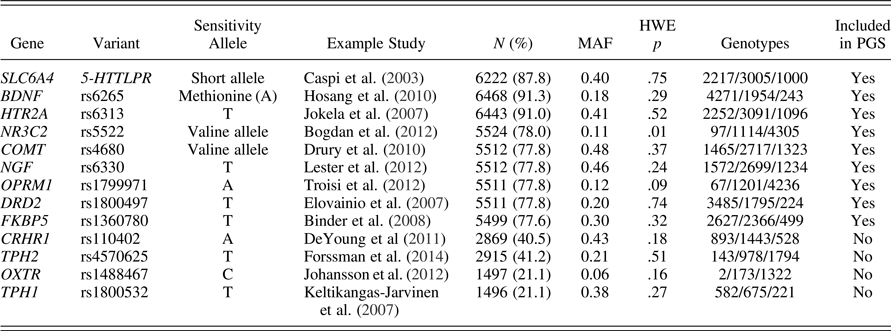
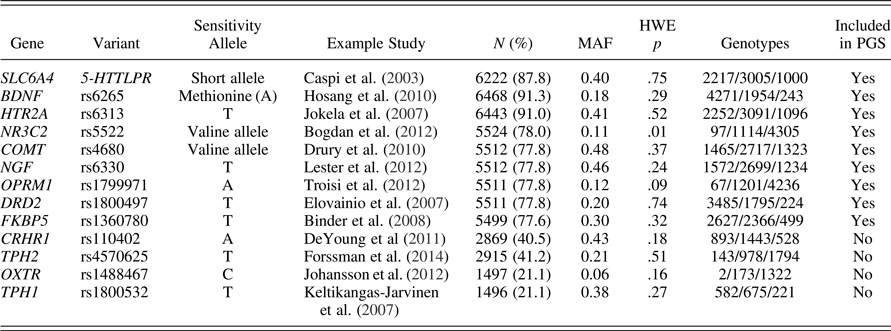
In addition to the 5-HTTLPR, genetic data was also available through several genome-wide association studies of different subsamples of the NCDS cohort. These included the Wellcome Trust Case Control Consortium's Wave 1 and 2 controls and the Type 1 Diabetes Genetics Consortium study genotyped on Illumina and Affymetrix platforms. Of the single nucleotide polymorphisms (SNPs) previously identified in G × E studies as sensitivity genes, 12 were available on at least one of the studies described above and were extracted (see Table 1). Eight SNPs were available for more than 75% of the sample and were selected to construct the polygenic score (PGS) together with the 5-HTTLPR. All of the selected SNPs showed no major deviations from Hardy–Weinberg equilibrium (all ps > .01). All alleles were coded 0 or 1, with positive scores reflecting greater environmental sensitivity according to previous findings. The resulting PGS was calculated as total score of the number of sensitivity alleles divided by the number of available alleles available for a given individual in order to reduce the effects of biases caused by missing data. All scores were standardized prior to analyses. Full details on the variants selected for the PGS are provided in Table 1.
Descriptive statistics of included genetic variants
Data analysis
We investigated the effects of childhood and concurrent material environment and the PGS on psychological distress across adulthood using linear mixture models. By modeling the relatedness between repeated measures in the same individual as random intercepts, these models allowed data from each time point to be included simultaneously and to estimate overall effects of the childhood predictor across adulthood.
Initially we investigated the effects of gender and time (in decades) on psychological distress by including these factors as fixed effects. Next, we investigated the main effects of childhood and concurrent material environment on adult psychological distress by including these factors in separate models containing gender and time as covariates. By comparing these models with models containing both factors, we were able to explore whether the effects of childhood material environment were mediated by concurrent material environment and formally tested these effects using a Sobel test for multilevel mediation. Next, to investigate the effects of cumulative stress, we tested for interaction between childhood and concurrent material environment on psychological distress in models containing the main effects of both factors.
The main effect of the PGS on psychological distress was tested in similar models. We also tested two- (G × E) and three-way (G × E × E) interactions between the material environment measures and the PGS. Finally, we tested for gene–environment correlation between the PGS and both environmental measures. Significant interactions were followed up with simple slopes (±1 SD from the mean).
The level of significance for all analyses was set at α = 0.05. All statistical analyses were carried out using STATA 12 (StataCorp, 2011).
Results
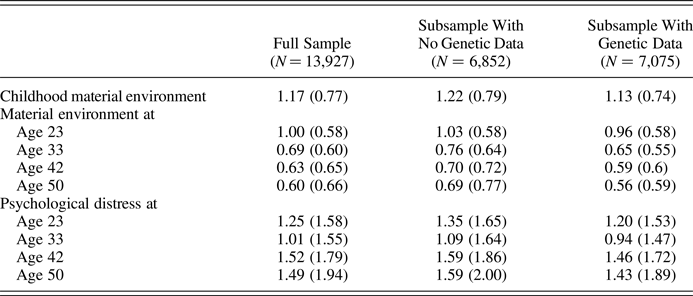
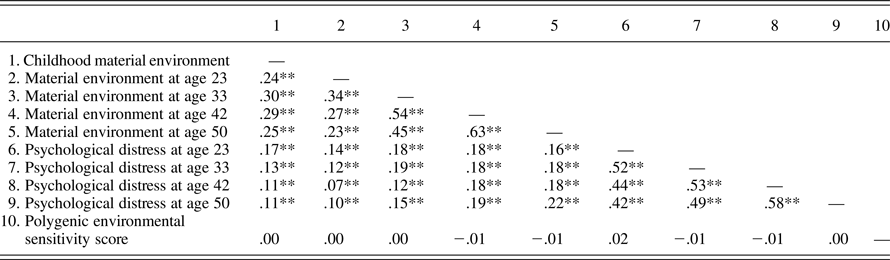
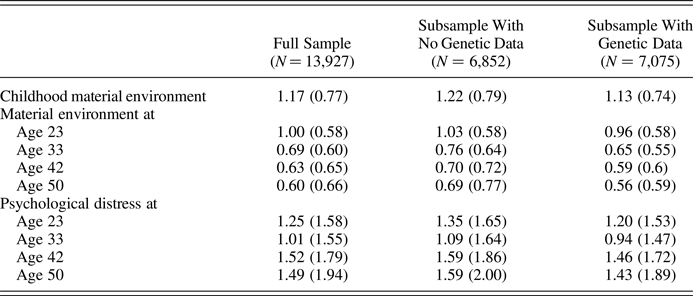
In total, 13,927 participants had complete data for at least one time point during childhood and adulthood and were included in the phenotypic analyses. Of these, 6,361 (45.7%) provided data for all four time points while 2,324 (16.7%), 3,029 (21.8%), and 2,213 (15.9%) provided data at three, two, and one time point, respectively. Gender was significantly associated with psychological distress across adulthood with females reporting greater psychological distress than men, b = 0.63, 95% confidence interval (CI) [0.58, 0.68], p < .001. Time (in decades) was also significantly positively associated with psychological distress, b = 0.14, 95% CI [0.13, 0.15], p < .001, with malaise scores increasing across the life course. Both gender and time were therefore included as covariates in all subsequent models. Descriptive statistics of all included variables are provided in Table 2 and bivariate correlations in Table 3.
Descriptive statistics for childhood and adult material environment measures and psychological distress in the full sample and those with and without genetic data
Bivariate correlations between childhood and adult material environment, psychological distress and polygenic environmental sensitivity score
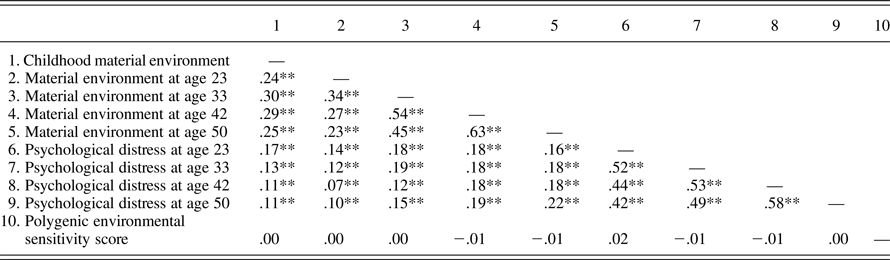
**p < 0.001.
Childhood and concurrent material environment
We tested the effects of the childhood material environment score on adult psychopathology by including it as a fixed effect in models described above. The score was associated with psychological distress in adulthood, b = 0.24, 95% CI [0.22, 0.26], p < .001, in the expected direction. Those with a poor-quality material environment during childhood reported greater psychological distress scores across the adulthood time points. We tested the effects of the concurrent material environment by including it as a time-varying predictor in similar models. The effects of concurrent material environment were weaker, but in the same direction as those recorded during childhood, b = 0.20, 95% CI [0.19, 0.22], p < .001. Specifically, a poor concurrent environment was associated with higher concurrent psychological distress scores.
Mediating effects of material environment
Childhood environment scores were moderately positively correlated with adult environment scores at each time point (age 23: r = .24, p < .001; age 33: r = .30, p < .001; age 42: r = .29, p < .001; age 50: r = .25, p < .001). These effects were confirmed in linear mixture models controlling for gender and time in decades, b = 0.29, 95% CI [0.28, 0.30], p < .001. We tested whether concurrent material environment mediated the effects of childhood material environment on psychological distress by including both child and concurrent environment scores simultaneously in the model. Both factors made a significant independent contribution to psychological distress: childhood material environment, b = 0.19, 95% CI [0.16, 0.21], p < .001; concurrent material environment, b = 0.18, 95% CI [0.16, 0.19], p < .001. However, there was a moderate decrease in the effects of childhood environment scores on psychological distress, suggesting that these effects were partially mediated by the concurrent environment. According to multilevel mediation analyses, the concurrent environment was a significant mediator of the childhood environment and accounted for 21% of the total effects of this factor.
Moderating effects of material environment
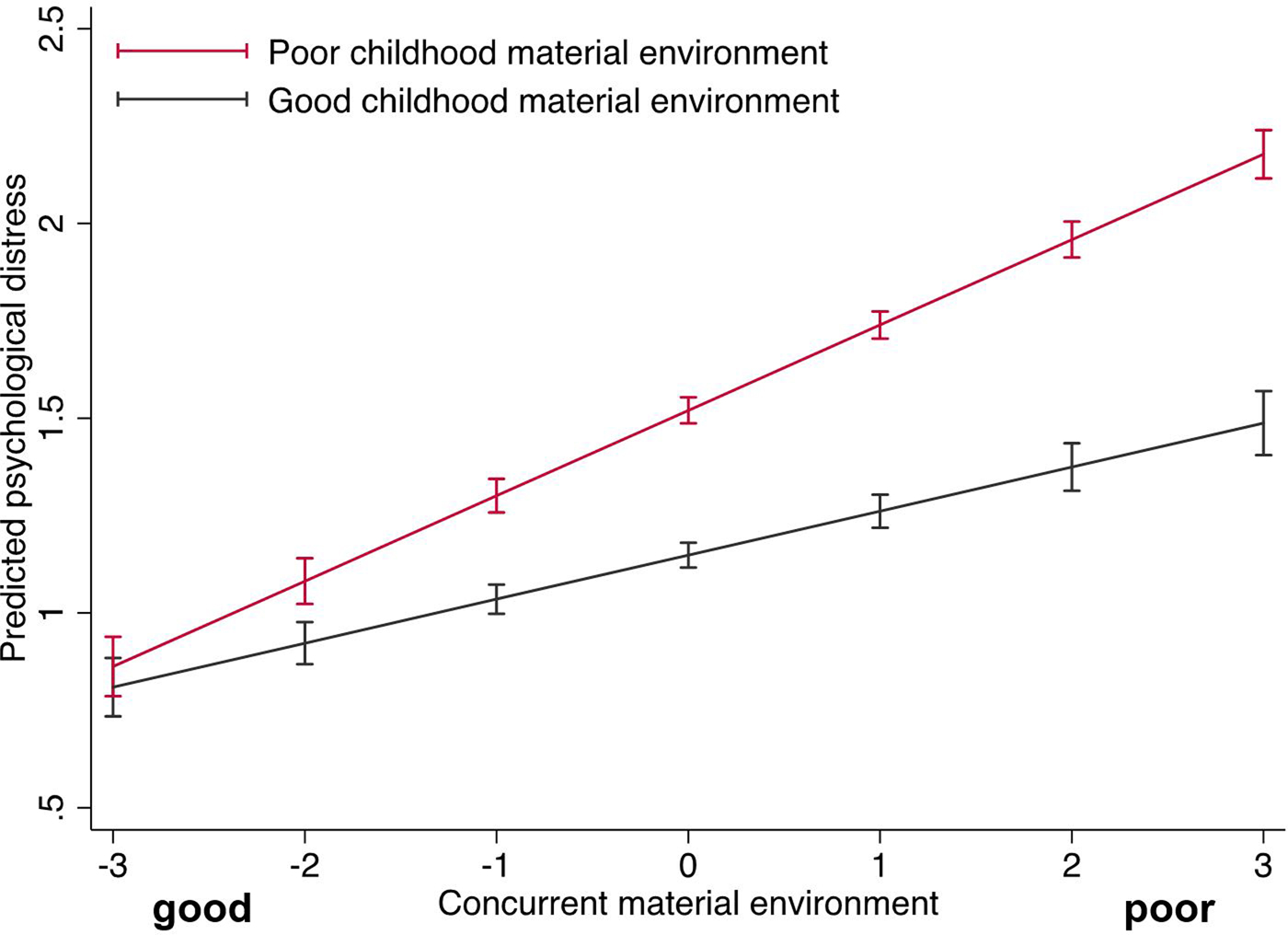
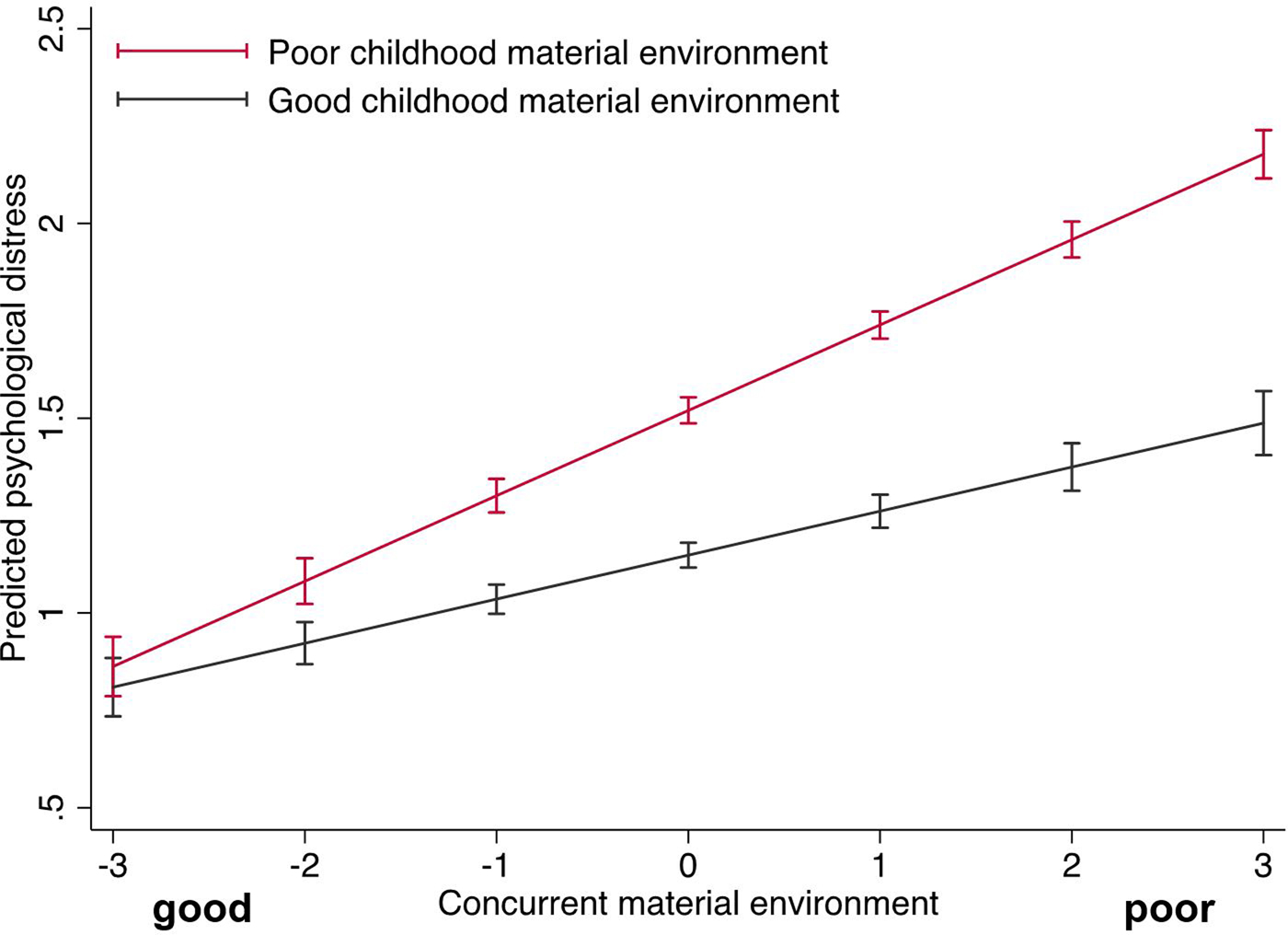
Finally, we tested whether the effects of concurrent material environment were moderated by childhood material environment by testing an interaction term between these factors on psychological distress. Interactions between childhood and concurrent material environment scores were significant, b = 0.05, 95% CI [0.04, 0.07], p < .001. In order to probe these interaction effects, we separated the sample into those with poor (i.e., 1 SD below the mean), moderate (i.e., between 1 SD below and 1 SD above the mean), and high (i.e., 1 SD above the mean) environmental quality scores. Analyses of simple slopes using these categories suggested that the effects of the concurrent material environment on psychological distress increased linearly by childhood environment quality. Specifically, the effects of the concurrent environmental quality were strongest in those with a poor childhood environment, b = 0.24, 95% CI [0.20, 0.28], p < .001, weaker in those with a moderate childhood environment, b = 0.18, 95% CI [0.16, 0.20], p < .001, and weakest in those with a good childhood environment, b = 0.11, 95% CI [0.07, 0.15], p < .001). Wald tests confirmed that the coefficients of concurrent environment differed significantly for those with a poor, moderate, and good childhood environment (χ2 = 19.44, p < .001). These findings are further illustrated in Figure 1, which shows the predicted psychological distress scores for those with a poor and good childhood environment as defined above.
(Color online) Predicted psychological distress score by concurrent material environment score in those with a poor childhood material environment (1 SD above the mean) and those with a good childhood material environment (1 SD below the mean). Error bars represent 95% confidence intervals for the prediction.
Genetic moderation of material environment
In total, 7,075 individuals had genetic data for at least one of the variants included in the PGS and were included in the genetic analyses. The PGS was not associated with either childhood or current environmental environment, β = –0.01, 95% CI [–0.07, 0.06], p = .91, and β = –0.01, 95% CI [–0.07, 0.04], p = .67, respectively, suggesting that there was no evidence for gene–environment correlation. There was also no main effect of the PGS on psychological distress, b = –0.02, 95% CI [–0.05, 0.01], p = .25, over adulthood. The PGS did not significantly moderate the effects of childhood material environment on psychological distress, b = 0.01, 95% CI [–0.03, 0.04], p = .76. Similarly, the PGS did not significantly moderate the effects of the concurrent material environment on psychological distress, b = –0.01, 95% CI [–0.03, 0.01], p = .49.
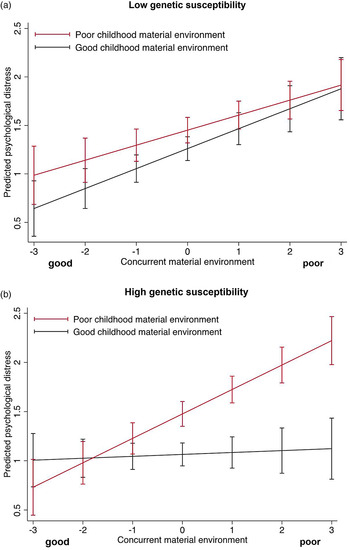
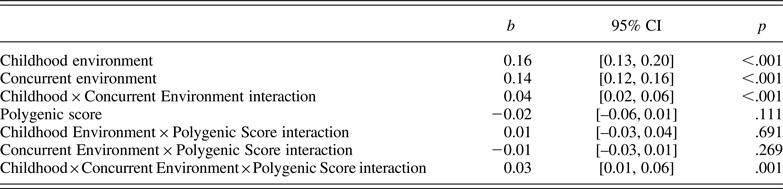
However, the three-way interaction between PGS, childhood, and concurrent material environment was significant, b = –0.03, 95% CI [0.01, 0.06], p < .001; see Table 4 and Figure 2. In order to probe the detected interaction effects further, we separated the sample into those with low (1 SD below the mean) and high (1 SD above the mean) PGS. Analyses of the interaction between childhood and concurrent environmental quality in these categories suggested that there was a significant interaction in those with a high PGS, b = 0.08, 95% CI [0.03, 0.12], p < .001, but not in those with a low PGS, b = 0.01, 95% CI [–0.04, 0.04], p = .82. These effects are illustrated in Figure 2, which shows the interaction between childhood and concurrent environmental quality on psychological distress for those with a high or low PGS as defined above.
(Color online) Predicted psychological distress score by concurrent material environment score in those with a poor childhood material environment (1 SD above the mean) and those with a good childhood material environment (1 SD below the mean). The results are presented for (a) those with a low polygenic environmental sensitivity score (1 SD below the mean) and (b) those with a high polygenic environmental sensitivity score (1 SD above the mean). Error bars represent 95% confidence intervals for the prediction.

Summary of the final linear mixture model exploring predictors of psychological distress across adulthood
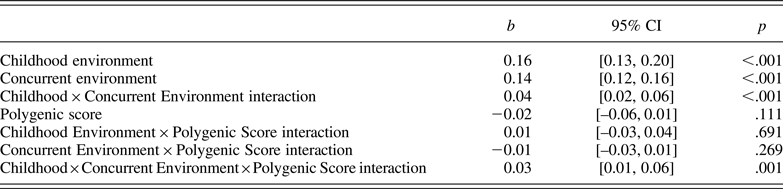
Note: All models also contained the fixed effects of gender and time (in decades).
Discussion
Using a large representative sample and a prospective design with objectively measured material environmental quality, we find strong evidence for the cumulative effects of child and adulthood adversity on psychological distress across adulthood. Individuals with a poor material environment during childhood were significantly more vulnerable to the negative effects of a poor material environment as adults. These effects were further moderated by a PGS including genetic variants previously implicated in G × E studies. This suggested that the effects of childhood environment on later sensitivity were greater in those with a genetic sensitivity to environmental influences.
Effects of childhood and concurrent environment on psychological distress
Consistent with our hypothesis, both childhood and concurrent material environmental quality scores were associated with psychological distress across adulthood. These findings are in line with a large body of research showing that both severe and more common, milder forms of adversity, such as low socioeconomic status, increase risk of psychopathology (Amato, Reference Amato2010; Dougherty et al., Reference Dougherty, Klein and Davila2004). Research in both clinical and population-based samples has shown that childhood adversity is associated with an increased risk of adversity in adulthood (Amato, Reference Amato2010; McLaughlin et al., Reference McLaughlin, Conron, Koenen and Gilman2010). In addition, proximal stressors experienced during adulthood have been shown to mediate the relationship between childhood stress and the development of depression (Brown, Craig, & Harris, Reference Brown, Craig and Harris2008). We found that childhood and concurrent environmental quality were moderately positively correlated in the NCDS cohort. The concurrent environment explained approximately 20% of the association between childhood environment and psychological distress. While these findings suggested partial mediation, they also showed that the majority of the negative effects of a poor childhood environment were not simply due to a correlated negative environment in adulthood.
Effects of childhood environmental quality on adult environmental sensitivity
We found a significant interaction between childhood and concurrent material environment on psychological distress. This suggested that individuals who experienced a poor material environment as children were more vulnerable to the effects of a poor environment during adulthood. These findings are in line with several previous studies of clinical and population samples focusing on severe and acute adversity such as childhood maltreatment (Kendler et al., Reference Kendler, Kuhn and Prescott2004; McLaughlin et al., Reference McLaughlin, Conron, Koenen and Gilman2010; Power et al., Reference Power, Lecky-Thompson, Fisher, Cohen-Woods, Hosang, Uher and McGuffin2013). However, our results extend these findings to suggest that the cumulative effects of the environment also apply to more moderate and chronic forms of adversity caused by low socioeconomic status, unemployment, and financial difficulties.
Previous studies exploring the cumulative effects of child and adult environments have focused exclusively on negative environmental influences (e.g., childhood maltreatment). While these studies suggest that unexposed individuals are consistently more resilient to later life stress, it remains unclear whether this resilience is due to a truly positive childhood environment or merely the absence of childhood adversity. In contrast to previous studies, our measure of the environment was continuous and extended from poor to good quality. This allowed us to examine the effects of a wider range of childhood environmental quality on adult environmental sensitivity. Examination of simple slopes suggested that the quality of the childhood environment was linearly related to environment sensitivity in adulthood. That is, those with a better childhood environment were the most resilient to adversity as adults, followed by those with a moderate and a poor childhood environment. Each of these groups of childhood environment quality vary significantly in their resilience to adversity as adults. This suggests that resilience in adulthood is not simply the result of the absence of adversity in childhood, but may be built up, at least partly, by positive childhood experiences.
Genetic moderation of cumulative environmental quality
Consistent with our hypothesis, we identified a significant three-way G × E × E interaction between child and adult environmental quality and a polygenic sensitivity score on psychological distress. In individuals with low genetic sensitivity scores, differences in childhood environmental quality did not predict differences in sensitivity to the environment in adulthood. However, in those with high genetic sensitivity scores, childhood environmental quality was significantly associated with adult environmental sensitivity. Our findings for the negative aspects of the environment are consistent with previous predictions that more negative experiences in childhood would promote vulnerability to adversity in later life in those that are genetically more sensitive (Ellis et al., Reference Ellis, Boyce, Belsky, Bakermans-Kranenburg and van IJzendoorn2011; Pluess, Reference Pluess2015). They also replicate several empirical studies showing that childhood adversity significantly increases sensitivity to adversity in adulthood, but only in individuals with genotypes proposed to increase sensitivity to the environment (e.g., the short allele of the 5-HTTLPR: Grabe et al., Reference Grabe, Schwahn, Mahler, Schulz, Spitzer, Fenske and Freyberger2012; Kumsta et al., Reference Kumsta, Stevens, Brookes, Schlotz, Castle, Beckett and Sonuga-Barke2010; Starr et al., Reference Starr, Hammen, Conway, Raposa and Brennan2014; and the T allele of rs110402 in CRHR1: Starr et al., Reference Starr, Hammen, Conway, Raposa and Brennan2014).
Our findings for the life-course effects of positive childhood environmental influences were more intriguing, however. It has been speculated that genetically sensitive individuals exposed to a positive environment during childhood would develop a propensity for vantage sensitivity (Pluess & Belsky, Reference Pluess and Belsky2013) and therefore be more likely to benefit from positive influences in adulthood (Pluess, Reference Pluess2015). While we found little evidence for the developmental programming of vantage sensitivity in these individuals, they were significantly less sensitive to the detrimental effects of negative environments in adulthood. Hence, these findings suggest that sensitivity genes in combination with a good early environment seem to offset the “dark side of susceptibility,” that is, the disproportionate vulnerability to negative environments. In other words, a good childhood promotes the development of resilience, but only in individuals that are genetically more sensitive. It may appear counterintuitive that genetically more sensitive individuals are the most resilient in the face of poor environmental quality in adulthood when they experienced a good childhood. However, these findings do certainly make sense from a developmental perspective: children who are genetically more sensitive may benefit disproportionately from supportive aspects of a high-quality environment in the early years of development, which allows them to accumulate psychological resources that strengthen their resilience across the adult life. Consequently, we would like to argue that the reported findings of individual differences in environmental sensitivity are consistent with a perspective of differential susceptibility (Belsky & Pluess, Reference Belsky and Pluess2009). That is, individuals with a genetic sensitivity to the environment were disproportionately affected by negative childhood environments, developing increased vulnerability to adversity later in life (although visual inspection of Figure 2 implies that there may be some suggestive evidence for a crossover interaction) but also disproportionately benefited from a positive childhood environment, developing significantly greater resilience to adversity in adulthood.
Our results are consistent with those previously reported by Cicchetti and Rogosch (Reference Cicchetti and Rogosch2012), who found a significant interaction between childhood maltreatment and a genetic sensitivity score on a measure of resilient functioning. Specifically, in those with a low genetic sensitivity score, a history of childhood maltreatment had little effect on later resilience. Children with a high genetic sensitivity score who were maltreated had the lowest resilient functioning, while children with a high genetic sensitivity score who were not exposed to maltreatment showed the greatest resilience in the sample. Our findings suggest that these effects extend well beyond childhood and effect sensitivity to the environment across early and late adulthood.
Implications
If replicated, our findings have important implications for understanding the role of G × E in the development of psychopathology and in the prevention of mental health problems. Our findings provide further evidence that genes moderate both positive and negative effects of the environment. However, they suggest that a life-course approach is essential to understanding G × E results in mental health problems. In our sample, psychological distress in adults was the result of a three-way G × E × E interaction between a genetic propensity to sensitivity, and child and adult environment. These findings may be one potential explanation for the inconsistent findings reported thus far in G × E studies, which focus separately on childhood or adulthood factors.
In our sample, children with a high genetic propensity for sensitivity were more affected by a poor-quality childhood environment, developing later sensitivity to adversity. However, children with the same genotypes also benefited the most from a positive environment, developing a significant resilience to adversity that persisted well beyond childhood. If replicated, these findings suggest that interventions to improve the childhood material environment may lead to significant improvements in resilience in later life, particularly when targeted at those with a high genetic sensitivity.
Strengths and limitations
There were a number of clear strengths to the current report. The use of the large NCDS sample meant that our sample size was more than three times greater than the largest study to date to investigate G × E × E (Grabe et al., Reference Grabe, Schwahn, Mahler, Schulz, Spitzer, Fenske and Freyberger2012) and therefore considerably better powered to detect three-way interaction effects. Unlike previous analyses of G × E × E, which focused on a single adult outcome, our study estimated effects simultaneously for four adult time points, 30 years apart. The inclusion of data across multiple time points boosted our effective sample size, and therefore further improved the power of our sample. A further strength of our study was that, unlike previous studies that focused on retrospective reports of psychosocial stressors (Power et al., Reference Power, Lecky-Thompson, Fisher, Cohen-Woods, Hosang, Uher and McGuffin2013), we used prospectively collected, objective measures of the environment. While prospectively collected data are less likely to be affected by recall bias, objective measures (such as employment status) are less open to interpretation and therefore less prone to reporter biases. Finally, in contrast to previous studies of G × E × E, which focus on one or two candidate genes (Starr et al., Reference Starr, Hammen, Conway, Raposa and Brennan2014), our analysis included a PGS of genetic sensitivity of the environment that comprised the aggregate effects of genetic variants across nine candidate genes.
However, our findings should be considered in the context of several important limitations. First, we used a short self-report measure of psychological distress. While the scale has been extensively validated, it is essentially a checklist of a very broad range of psychological and somatic symptoms of emotional disorders that collects no information on the duration or severity of problems. Our findings therefore require replication using more detailed measures of psychopathology from multiple informants. Second, our study focused exclusively on the presence or absence of maladaptive outcomes by measuring symptoms of mental health disorders. While we found that positive environments were associated with an absence of psychopathology, it remains unknown whether they also enhance positive outcomes such as flourishing or well-being. The limited range of our outcome measure may also explain why genetically sensitive individuals did not appear to benefit more from positive environments in adulthood. Further studies exploring the full range of outcomes from psychopathology to well-being are required to examine the effects of genes and environments as well on positive outcomes. Third, while the association between childhood environment and adult psychopathology was measured longitudinally, the relationship between concurrent environment and psychological distress essentially combined multiple cross-sectional observations. This means it is unclear whether concurrent environmental quality impacted upon psychological distress, or psychological distress resulted in a poor-quality environment. While previous longitudinal analyses suggest that the material environment does play a causal role in the development of psychopathology, further G × E × E studies with more intensive follow-up periods would be required to confirm the causal relationships between the concurrent material environment and psychopathology. Fourth, our PGS of environmental sensitivity measured the aggregate effects of nine variants previously shown to moderate the effects of the environment on psychopathology. This approach is a considerable improvement to previous G × E × E studies, which explored the effects of single variants (Starr et al., Reference Starr, Hammen, Conway, Raposa and Brennan2014). Nevertheless, as we used existing genome-wide data SNP, we were unable to include all of the genetic variants previous implicated in G × E studies in our PGS such as the variable number tandem repeats in the monoamine oxidase A (MAOA) gene and the dopamine receptor D4 (DRD4) gene. Environmental sensitivity is likely a polygenic trait caused by multiple genetic variants (Keers et al., Reference Keers, Coleman, Lester, Roberts, Breen, Thastum and Eley2016). Future G × E × E studies should therefore extend these findings using PGS of genetic variants from across the entire genome in addition to those in known candidate genes.
Conclusion
Our findings provide further support for the hypothesis that childhood experiences and genetic factors act synergistically to shape sensitivity to the environment in adulthood. This suggests that G × E interaction studies should consider not only concurrent environmental adversity or childhood experiences but, adopting a life-course perspective, also the complex interplay between both over time. Furthermore, the current study provides empirical evidence showing that the genetically most sensitive children are the ones most likely to display resilience across adulthood if they experienced a supportive childhood. In other words, given the right environment in childhood, genetically sensitive individuals can develop into particularly resilient adults. This emphasizes further that many of the gene variants that have been considered “vulnerability genes” may reflect a propensity for environmental sensitivity with the potential for particularly positive and adaptive development across life when growing up in a supportive environment.