Introduction
The use of improvised explosive devices in contemporary warfare has put military personnel at enhanced risk of traumatic brain injury. Prevalence estimates of mild traumatic brain injury (mTBI) in large non-clinical samples of Iraq and Afghanistan veterans range from 12% (Schneiderman, Braver, & Kang, Reference Schneiderman, Braver and Kang2008) to 23% (Terrio et al., Reference Terrio, Brenner, Ivins, Cho, Helmick, Schwab and Warden2009). Not surprisingly, rates of TBI are considerably higher in clinical samples, but here as well, the percentage classified as mild has increased in recent years (Bryant, Castro, & Iverson, Reference Bryant, Castro and Iverson2012). Thus, there is a great need to understand the long-term consequences of mTBI in veterans, both in terms of residual symptoms and impact on physical and psychosocial functioning.
In civilian samples, the sequelae of mTBI are transient in a vast majority of patients (Caroll et al., Reference Caroll, Cassidy, Peloso, Borg, von Holst, Holm and Pepin2004), with recovery to pre-injury functioning typically occurring within days to weeks. In a minority of patients, however, symptoms persist at 3 months post-injury. These symptoms include a constellation of physical (e.g., headaches, dizziness), cognitive (e.g., slowed thinking, difficulties with concentration) and emotional (e.g., irritability, anxiety) symptoms, sometimes referred to as postconcussion syndrome (American Psychiatric Association, 2000). While postconcussion symptoms (PCS) are associated with the acute, transient neurologic effects of mTBI, psychological, social, and motivational factors are thought to play an important role in the maintenance of these symptoms (McCrae, Reference McCrae2008). PCS are non-specific, and although some symptoms in the chronic stage may be correlated with neuropathology (Bigler & Maxwell, Reference Bigler and Maxwell2012), many symptoms are also associated with chronic pain and psychiatric conditions (Bigler, Reference Bigler2008; Ponsford et al., Reference Ponsford, Willmott, Rothwell, Cameron, Kelly, Nelms and Ng2000; Smith-Seemiller, Fow, Kant, & Franzen, Reference Smith-Seemiller, Fow, Kant and Franzen2003).
Terrio et al. (Reference Terrio, Brenner, Ivins, Cho, Helmick, Schwab and Warden2009) reported that soldiers with clinician-confirmed mTBI endorsed PCS at a higher rate post-deployment than those who were injured but did not sustain mTBI. Interpretation of such findings is difficult, however, because co-morbid psychiatric conditions are prevalent in this population and may lead to similar symptoms (Fear et al., Reference Fear, Jones, Groom, Greenberg, Hull, Hodgetts and Wesseley2009; Iverson, Reference Iverson2006; Luis, Vanderploeg, & Curtiss, Reference Luis, Vanderploeg and Curtiss2003; McCauley, Boake, Levin, Contant, & Song, Reference McCauley, Boake, Levin, Contant and Song2001; Vanderploeg, Belanger, & Curtiss, Reference Vanderploeg, Belanger and Curtiss2009). Furthermore, the civilian concussion literature typically includes samples whose injuries are a result of impact injury or other non-blast mechanisms. As such, civilian trajectories of cognitive recovery and PCS may not generalize to military samples who sustained blast-related injury. Despite this concern, some researchers have found that rates of PCS do not necessarily differ by injury mechanism, whether blast-induced or otherwise (Belanger et al., Reference Belanger, Proctor-Weber, Kretzmer, Kim, French and Vanderploeg2011; Lippa, Pastorek, Benge, & Thornton, Reference Lippa, Pastorek, Benge and Thornton2010; Wilk et al., Reference Wilk, Thomas, McGurk, Riviere, Castro and Hoge2010). Finally, because many service members are exposed to multiple blasts, potential effects of cumulative injury also need to be considered (Belanger, Spiegel, & Vanderploeg, Reference Belanger, Spiegel and Vanderploeg2010).
Several recent studies in OEF/OIF veterans have concluded that the presence of PCS in the chronic stage is strongly related to PTSD or depression (Hoge et al., Reference Hoge, McGurk, Thomas, Cox, Engel and Castro2008; Schneiderman et al., Reference Schneiderman, Braver and Kang2008), although in some studies PTSD and mTBI were independently associated with PCS endorsement (Brenner et al., Reference Brenner, Ivins, Schwab, Warden, Nelson, Jaffee and Terrio2010; Hill, Mobo, & Cullen, Reference Hill, Mobo and Cullen2009; Schneiderman et al., Reference Schneiderman, Braver and Kang2008). Two other studies have evaluated the severity of such symptoms in patients with a clinical diagnosis of mTBI. Belanger, Kretzmer, Vanderploeg, and French (Reference Belanger, Kretzmer, Vanderploeg and French2010) found that, after adjusting for PTSD, symptom complaints did not differ among patients with mild and moderate TBI. Lippa et al. (Reference Lippa, Pastorek, Benge and Thornton2010) found that posttraumatic stress symptoms accounted for a large portion of the variance in PCS across patients with self-reported histories of blast-related and nonblast-related mTBI, but loss of consciousness (LOC) independently accounted for a small portion of the variance. Thus, it appears that PCS were largely related to emotional distress. Neither of these studies, however, included a control group without TBI, thus leaving open the possibility of an effect of remote TBI on current symptoms.
Much less is known about the association between mTBI and long-term subjective wellbeing of OEF/OIF veterans, and this area deserves closer attention. In the civilian population, a minority of individuals with mTBI report difficulties in community integration and life satisfaction. Such difficulties may reflect various factors in addition to concussion that serve to reinforce reported difficulties (Stalnacke, Reference Stalnacke2007; Vanderploeg, Curtiss, Luis, & Salazar, Reference Vanderploeg, Curtiss, Luis and Salazar2007). Of relevance to the military context, PTSD also has a significant impact on quality of life (Schnurr, Lunney, Bovin, & Marx, Reference Schnurr, Lunney, Bovin and Marx2009), but there is limited information about how the combination of PTSD and mTBI affects functional adjustment following deployment. In one study (Pietrzak, Johnson, Goldstein, Malley, & Soutwick, Reference Pietrzak, Johnson, Goldstein, Malley and Soutwick2009), OEF/OIF veterans 2 years post-deployment who screened positive for mTBI were more likely to report poor overall health and unmet psychological needs than those who screened negative for mTBI, and they reported more psychosocial and work difficulties. PTSD largely explained these relationships, but LOC made an independent contribution to work difficulties and reports of unmet psychological needs. In another study (Polusny et al., Reference Polusny, Kehle, Nelson, Erbes, Arbisi and Thuras2011), history of concussion was no longer associated with social adjustment or perceived quality of life once PTSD was taken into account. Both of these studies were limited, however, by their reliance on a brief TBI screen rather than a clinical diagnosis of TBI. Furthermore, they did not consider the possible impact of depression, even though its effect on PCS is well documented (Hoge et al., Reference Hoge, McGurk, Thomas, Cox, Engel and Castro2008).
In light of these gaps in the literature, the current study examined PCS and functional outcomes in OEF/OIF veterans who report a history of blast exposure, with the goal of evaluating (1) the association between these outcomes and a clinical diagnosis of mTBI with or without LOC; and (2) the influence of PTSD and depression symptoms on PCS reporting and perceived functional limitations.
Method
Participants
Participants were 95 OEF/OIF veterans recruited through the VA Boston Polytrauma Network who reported being exposed to a blast within 100 m. All participants were seen at least 6 months following blast exposure. Participants volunteered to take part in a larger research study that took place in a research context and was unrelated to diagnostic or treatment purposes. The study consisted of clinical interviews, neuropsychological testing, and self-report measures. As part of the study, participants were given a symptom validity test (Test of Memory Malingering; Tombaugh, Reference Tombaugh1996). Four individuals were excluded from the study because they scored below 45 on the retention trial, demonstrating questionable effort. The remaining participants were assigned to one of three groups (no TBI, TBI without LOC, TBI with LOC), using the definition of mTBI put forth by the American Congress of Rehabilitation Medicine (1993).
Evaluation of TBI was based on an extensive clinical interview that queried participants about their blast exposure(s). The interview was structured in four parts: (1) determination of the index event: Participants who reported multiple blast exposures were probed about the three most significant events, and the most severe event was taken as the index event; (2) in depth description of the index event, based on questions regarding the participant's memory for the events preceding the blast, experience of the blast itself, and memories of events subsequent to the blast. This portion of the interview was used to infer the presence and duration of alteration of consciousness (i.e., disorientation, posttraumatic amnesia, LOC) and to reconstruct details of the event (e.g., distance from the explosives, use of protective gear, debris or shrapnel projected to the individual); (3) questions pertaining to the presence of neurological symptoms immediately after the blast that are consistent with TBI; and (4) inquiry regarding medical examination or reports by a witness. Collateral reports were rarely available; therefore, information about injury characteristics depended on participant report. In all but three instances, information regarding the presence and duration of LOC was based on what participants were told by a medic or combat peers who witnessed the event and often were the first to assess the participant's responsiveness.
Participant interviews were transcribed and evaluated by two of the investigators who then sought consensus as to whether a minimal biomechanical threshold for concussion had plausibly been met, and any reported disorientation was the result of concussion rather than situational chaos and confusion. Such decisions are challenging, but are unavoidable given that assessment of mTBI in this population is overwhelmingly based on self-report (Nelson et al., Reference Nelson, Hoelzle, McGuire, Ferrier-Auerbach, Charlesworth and Sponheim2011).
Of the 91 veterans included in the analysis, 24 were in the no TBI group, 43 in the TBI without LOC group, and 24 in the TBI with LOC group. LOC was estimated to be <2 min in 17 participants and 2–5 min in 7 participants.
Procedures
Postconcussion symptoms were evaluated using the Rivermead Postconcussion Questionnaire (RPQ; King, Crawford, Wenden, Moss, & Wade, Reference King, Crawford, Wenden, Moss and Wade1995). The RPQ is a 16-item checklist on which participants rate the severity of their symptoms on a scale from 0 to 4 in comparison to pre-injury functioning (not experienced, no more of a problem, mild, moderate, or severe problem). Symptoms assessed include cognitive, emotional, and somatic symptoms. Items in each category were summed, omitting scores of “1” (King et al., Reference King, Crawford, Wenden, Moss and Wade1995). To make scores for each category comparable, we divided the total score for each category by the number of items in that category, resulting in scores ranging from 0 to 4. The measure has high test–retest (r = .90) and inter-rater reliability (r = .87; King et al., Reference King, Crawford, Wenden, Moss and Wade1995).
As the primary measure of functional outcome, we used the Sickness Impact Profile. The SIP is a comprehensive measure of health-related quality of life that has been used in several TBI studies (Dikmen, McLean, & Temkin, Reference Dikmen, McLean and Temkin1986; Friedland & Dawson, Reference Friedland and Dawson2001; Ponsford et al., Reference Ponsford, Willmott, Rothwell, Cameron, Kelly, Nelms and Ng2000). It assesses perceived health status in terms of injury-related changes in 12 areas of living. A physical factor score (consisting of ambulation, mobility, and body care and movement), a psychosocial factor score (consisting of communication, alertness behavior, emotional behavior, and social interaction), and a total score are calculated. The total score is based on the physical and psychosocial factor scores and five additional subscales (sleep and rest, eating, work, home management, recreation and pastimes). Higher scores represent higher dysfunction (range, 0–100). Because of the high correlation between the total score and the psychosocial score, only physical and psychosocial scores were included in the analysis. The SIP has high internal consistency (Cronbach's alpha = .94) and high test–retest reliability (r = .88 to .92; McDowell & Newell, Reference McDowell and Newell1996). To obtain a measure of occupational functioning, we inquired about participants’ educational or work status.
Participants were administered the Clinician Administered PTSD scale (CAPS) for DSM-IV (Blake et al., Reference Blake, Weathers, Nagy, Kaloupek, Gusman, Charney and Keane1995) by a trained clinician. The CAPS is a structured interview assessing PTSD symptoms corresponding to the Diagnostic and Statistical Manual of Mental Disorders 4th Edition (DSM-IV-TR; American Psychiatric Association, 2000). Continuous CAPS scores were used as a measure of PTSD severity. The SCID overview module was used to determine predeployment psychiatric history (First, Spitzer, Gibbon, & Williams, Reference First, Spitzer, Gibbon and Williams2002).
The Beck Depression Inventory (Beck, Reference Beck1996) was used to assess current depressive symptoms. Pain was assessed using the McGill Pain Questionnaire (Melzack, Reference Melzack1975). Participants were additionally asked whether they had ever been diagnosed with a learning disability and/or ADHD. BARONA regression equation (Barona, Reynolds, & Chastain, Reference Barona, Reynolds and Chastain1984) was used to estimate pre-morbid intelligence.
All data were obtained in compliance with regulations of the institutional review boards of VA Boston Healthcare System and Boston University School of Medicine.
Statistical Analyses
Differences among groups in demographic, injury, and clinical characteristics were evaluated using one-way analysis of variance (ANOVA) and Duncan post hoc follow-up comparisons (for continuous data) or χ 2 contingency analyses (for categorical data).
To assess whether post-concussion symptoms (as measured by the RPQ) or quality of life (as measured by the SIP) differed among the three TBI groups, we used a repeated-measures analysis of variance. Analyses were conducted using SAS Proc Mixed using maximum likelihood estimation, separately for the two sets of outcomes; in the first, the dependent variables were cognitive, somatic, and emotional PCS cluster scores; in the second, SIP physical and psychosocial scores.Footnote 1 The several PCS or SIP scores were treated as the repeated measures factor, and an unstructured covariance matrix was assumed among these repeated measures. For each set of outcomes, several analyses were conducted; the first was unadjusted and tested whether the outcome set differed among the TBI groups; the second adjusted for PTSD symptom severity (using CAPSFootnote 2 scores); the third additionally adjusted for depression symptom severity (using Beck Depression Inventory [BDI] scores). We used the Akaike Information Criterion (AIC) to compare successive models, to determine whether adjusting for the covariates improved the fit of the model to the data. Whenever an effect was significant, follow-up analyses examined pair-wise differences in means among TBI groups, adjusted for all other variables in the model.
Work/educational status was examined using logistic regression, with TBI group, PTSD, and depression scores as predictors.
Finally, in a separate set of analyses, we evaluated whether symptom reports and functional outcomes were related to injury variables. Two mixed-model repeated-measures analyses of variance were performed, one with number of blast exposures (blast load:1, 2–4, 5, or more) and the other with distance from the index blast (≤5 m, >5–50 m, >50–100 m) as the independent variables. The same covariates were entered as above.
All analyses were performed on the total sample, as well as excluding the three individuals for whom LOC was not witnessed. Because the results were identical, only analyses based on the full sample are reported.
Results
Demographic and Injury Characteristics
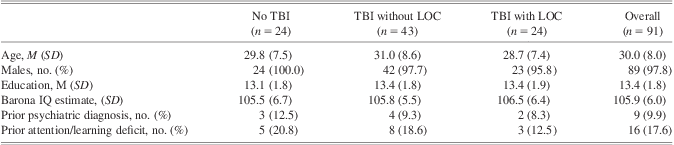
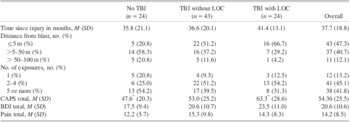
There were no significant differences in age, education, and estimate of pre-morbid intelligence across the three groups (see Table 1; all F's <1). The presence of prior psychiatric diagnosis and learning/attentional disability did not differ across groups, χ 2,s < 1. With regard to injury and clinical characteristics (see Table 2), the groups did not differ on time since index blast, F < 1, or blast load, χ 2 = 5.8; p = .21. There was a difference in distance from the blast, χ 2 = 11.1, p < .03, with individuals in the no TBI group more likely to have been at a greater distance from the blast. Although there was no difference in prevalence of PTSD diagnosis across groups, χ 2 = 2.0, p = .36, level of PTSD symptoms was marginally different, F(2,87) = 2.4, p = .09, as reflected in higher scores in the LOC group than the other two groups. There were no significant differences across groups in depression, F(2,88) = 2.0, p > .10, or pain scores, F(2,88) = 1.
Demographic information
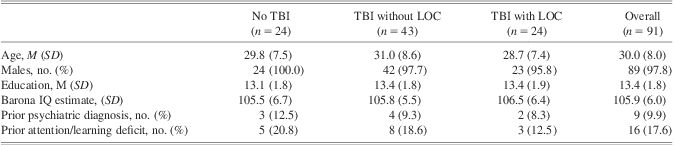
Note. TBI = traumatic brain injury; LOC = loss of consciousness.
Injury and clinical characteristics

Note. TBI = traumatic brain injury; LOC = loss of consciousness; CAPS = Clinician Administered PTSD scale; BDI = Beck Depression Inventory.
*p < .05.
Outcomes as a Function of TBI
A mixed-model repeated-measures ANOVA on PCS cluster scores revealed a significant main effect of PCS cluster, F(2,88) = 28.7, p < .001, and follow-up analysis indicated higher cognitive and emotional scores than physical scores. There was also a main effect of group, F(2,88) = 3.7, p < .05, but no group × PCS cluster interaction, F(4,88) = 1.4. Individuals in the TBI with LOC group had higher PCS reports than those in either the TBI without LOC or the no TBI group. This model accounted for 12.7% of the variance in PCS reports, based on a pseudo-R2 obtained by squaring the correlation between model-based predicted values and observed values.
Entering CAPS scores as a covariate in the model yielded a better model fit (AIC difference = 35.1). CAPS scores were significantly associated with PCS reports, F(1,87) = 49.9, p < .001. Once CAPS scores were included in the model as a covariate, the effect of group was no longer significant, F(2,87) = 1.7; p = .18. Adding CAPS scores increased the pseudo-R2 for this model to 33.5%.
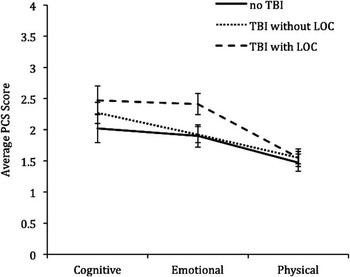
Entering BDI scores as an additional covariate in the model further enhanced the model fit (AIC difference = 14.1). Both CAPS score, F(1,86) = 5.4, p < .05, and BDI score, F(1,86) = 19.2, p < .001, were significantly associated with PCS reports, but group was not, F(2,86) = 1.5, p = .24 (see Figure 1). The pseudo-R2 for this model was 42.4%.
Mean postconcussion symptoms (PCS) reports (converted mean scores range from 0–4) as a function of symptom cluster after accounting for Clinician Administered PTSD scale (CAPS) and Beck Depression Inventory (BDI) scores. TBI = traumatic brain injury; LOC = loss of consciousness.

Because three symptoms on the RPQ overlap with symptoms of PTSD (poor concentration, sleep disturbance, and irritability), we reanalyzed PCS reports eliminating these items. The results for the adjusted PCS scores were similar to those described above.Footnote 3
A mixed-model repeated-measures ANOVA on SIP scores revealed a significant main effect of SIP scores, F(1,87) = 213.9, p < .001, reflecting that the psychosocial factor score was higher than the physical factor score. There was a significant group × score interaction, F(2,87) = 4.8, p = .01. Follow-up tests revealed that there were no differences among TBI groups in physical factor scores, t's < 1, but there was a significant difference among TBI groups in psychosocial factor score, with the TBI group with LOC (mean = 33.8) endorsing more dysfunction than the TBI group without LOC (mean = 23.8), t(87) = 2.4, p < .05, or the no TBI group (mean = 22.6), t(87) = 2.4, p < .05. This model had a pseudo-R2 of 45.7%.
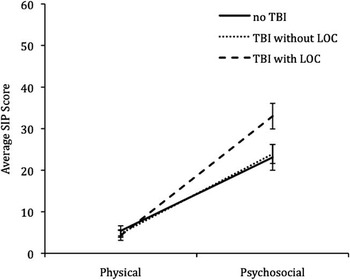
Including CAPS scores as a covariate in the model enhanced the model fit (AIC difference = 5.4), and the pseudo-R2 increased to 53.3%. CAPS scores were significantly associated with SIP scores, F(1,86) = 11.41, p < .005. The effect of SIP score, F(1,86) = 213.9, p < .001, and group × SIP score, F(2,86) = 4.8, p = .01, remained significant. Follow-up tests again revealed a significant difference among groups only for the psychosocial score, with the LOC group performing worse than the other two groups, t's > 2.2, p's < .05 (see Figure 2). Adding BDI scores as a covariate in the model did not enhance the model fit (AIC difference = −0.2).
Percent dysfunction on the SIP (mean scores range from 0–100) after accounting for Clinician Administered PTSD scale (CAPS) scores. TBI = traumatic brain injury; LOC = loss of consciousness.

In terms of occupation-related functioning, 67% of individuals in the no TBI group were working or in school; the corresponding percentage was 65% for the TBI group without LOC, and 71% for the TBI group with LOC. Logistic regression did not reveal a significant association between TBI group and occupation status, χ 2 < 1. Adding CAPS and BDI scores to the model also did not yield a significant association, χ 2 = 2.2.
Outcomes as a Function of Injury Variables
Repeated measures ANOVA of PCS reports with blast load as the independent variable revealed no effect of blast load or interaction between PCS cluster and blast load, both F's < 2, p > .14. Adding CAPS and BDI scores as covariates again did not reveal any effects involving blast load, both F's < 1.2, p > .30. Results for SIP scores were analogous, with no effects of blast load, whether or not analyses were adjusted for CAPS and BDI scores, F's < 1.9; p > .15.
Distance from the blast also did not impact outcomes. Repeated measures ANOVA of PCS reports revealed no effect of distance on endorsement of PCS symptoms and no cluster × distance interaction, both F's < 2, p > .10 Adding CAPS and BDI scores as covariates to the model again did not reveal any effects involving distance, F's < 2, p's > .10. Analogous analyses on SIP scores, whether or not CAPS and BDI were entered as a covariates, also failed to reveal any effects involving distance, F's < 1.6, p's > .2.
Discussion
In this cross-sectional study of OEF/OIF veterans with self-reported history of blast exposure, we observed that PCS symptoms, and especially cognitive and emotional symptoms, were common even years after blast exposure. Participants at this chronic stage also endorsed considerable limitations in different realms of functioning, and these were particularly prominent in the psychosocial domain. This study extends previous work in this area by examining PCS and functional outcomes in the same individuals, and by directly comparing individuals without mTBI with those who reported injury characteristics judged by a clinician to be indicative of mTBI. Consistent with previous work, our findings highlight a significant association between mental health symptoms and both of these outcomes. Adding to this literature in a novel way, our findings also point to the impact of mTBI with LOC on psychosocial adjustment.
In interpreting these findings, it is important to consider limitations inherent in the study of mTBI suffered in the context of combat. Given that medical records are rarely available, assessment of TBI by necessity depends on retrospective self-report and is therefore subject to possible misremembering or reporting bias. This is particularly concerning when initial assessment of TBI occurs well after sustaining the injury, as is commonly the case in the OEF/OIF veteran population. Within the context of these limitations, participant report was guided by an in-depth structured interview, which is considered the gold standard for diagnosis (Corrigan & Bogner, Reference Corrigan and Bogner2007). Nonetheless, it should be kept in mind that our study concerns a comparison of groups with self-reported histories of mTBI with or without LOC, as it was impossible to obtain independent verification of injury characteristics.
Individuals with mTBI and LOC had greater PCS complaints than individuals with mTBI without LOC or individuals without mTBI, but this group difference disappeared after adjusting for PTSD and depression symptoms, and only these mental health symptoms were significantly associated with greater PCS reporting. The impact of PTSD and depression was not limited to emotional symptoms, but held equally for cognitive and physical symptoms. PTSD remained associated with PCS even when symptom overlap between PCS and PTSD was eliminated.
These findings are in accord with several studies of OEF/OIF military personnel that have concluded that mental health symptoms are the main predictor of PCS complaints, both in terms of prevalence (Hoge et al., Reference Hoge, McGurk, Thomas, Cox, Engel and Castro2008; Polusny et al., Reference Polusny, Kehle, Nelson, Erbes, Arbisi and Thuras2011; Schneiderman et al., Reference Schneiderman, Braver and Kang2008) and severity (Belanger, Kretzmer, Vanderploeg, & French, Reference Belanger, Kretzmer, Vanderploeg and French2010; Lippa et al., Reference Lippa, Pastorek, Benge and Thornton2010). Our findings show that comparison to a group of individuals with self-reported exposure to blast without mTBI did not change this outcome. Furthermore, while a majority of studies have focused selectively on PTSD symptoms, we examined the contribution of both PTSD and depression to PCS. PTSD and depression were highly correlated in our population. This likely reflects symptom overlap between the two disorders, but is also consistent with the notion that PTSD and depression in the aftermath of trauma are best thought of as a single, general traumatic stress response (O'Donnell, Creamer, & Pattison, Reference O'Donnell, Creamer and Pattison2004). Nonetheless, our findings suggest that depressive symptoms independently contribute to PCS symptoms. Hoge et al. (Reference Hoge, McGurk, Thomas, Cox, Engel and Castro2008) have likewise drawn attention to the contribution of both PTSD and depression to PCS symptoms.
One interesting exception to this general pattern of results comes from a study by Brenner and colleagues (2010), who evaluated military personnel immediately following deployment and found that the combination of mTBI and PTSD was more strongly associated with prevalence of PCS than either condition alone. Of note, these additive effects were observed in individuals evaluated in closer proximity to their deployment. Taken together with our results in a more chronic group of blast-exposed individuals, these findings raise the possibility that the respective contributions of mTBI and PTSD change across a longitudinal course. Consistent with this possibility, results in a civilian sample of trauma admissions (Meares et al., Reference Meares, Shores, Taylor, Batchelor, Bryant, Baguley and Marosszeky2011) suggest that the association between PCS and PTSD strengthens over time. Thus, while temporary disruption of brain function associated with mTBI may account for some of the symptoms in the acute or post-acute stage, the maintenance, and occasionally worsening (Belanger et al., Reference Belanger, Proctor-Weber, Kretzmer, Kim, French and Vanderploeg2011; Meares et al., Reference Meares, Shores, Taylor, Batchelor, Bryant, Baguley and Marosszeky2011; Terrio et al., Reference Terrio, Brenner, Ivins, Cho, Helmick, Schwab and Warden2009) of these symptoms over time appears to be linked to PTSD.
The absence of an effect of mTBI on PCS in this study seems difficult to reconcile with a recent report (Peskind et al., Reference Peskind, Petrie, Cross, Pagulayan, McCraw, Hoff and Minsohima2011) that posited that chronic PCS in Iraq combat veterans are related to metabolic abnormalities in midbrain, cerebellar, and medial temporal brain regions that may be vulnerable to the effects of blast. However, 10 of the 12 participants in that study also had PTSD, and thus it remains unknown whether the observed metabolic changes were related to blast-induced mTBI or the confounding effects of PTSD. Our findings suggest that the latter possibility needs to be examined more closely.
PTSD also accounted for a substantial portion of the variance in functional adjustment and overall quality of life, but here depression symptoms did not make an additional contribution beyond that accounted for by PTSD. Our finding accords with extensive evidence reflecting the impact of PTSD on social role functioning and quality of life (Kehle et al., Reference Kehle, Reddy, Ferrier-Auerbach, Erbes, Arbisi and Polusny2011; Schnurr et al., Reference Schnurr, Lunney, Bovin and Marx2009). However, LOC was independently associated with limitations in psychosocial functioning. Similar findings have been reported in the civilian literature (Friedland & Dawson, Reference Friedland and Dawson2001), but evidence in the military context has been limited. Pietrzak and colleagues (2009) assessed a group of veterans 2 years post-deployment, and using screening measures of PTSD and TBI, they found that PTSD and LOC were independently associated with several aspects of psychosocial functioning, including work-related difficulties and unmet psychological needs. The only other study to examine functional outcomes in OEF/OIF veterans (Polusny et al., Reference Polusny, Kehle, Nelson, Erbes, Arbisi and Thuras2011) did not assess the effect of LOC. Our findings establish more firmly that PTSD and LOC may be cumulative risk factors for long-term psychosocial adjustment difficulties in veterans with mTBI (Brenner, Vanderploeg, & Terrio, Reference Brenner, Vanderploeg and Terrio2009).
It is of interest to contrast the results discussed above, which reveal the association of PTSD to self-reported role functioning, to objective measures of work and educational status. Approximately two-thirds of participants were employed or in school, and neither TBI nor PTSD were associated with occupational status. These findings are not necessarily inconsistent, as the SIP assesses changes in functioning, whereas occupational status simply indicates whether an individual is currently employed or in school. Although actively engaged in the workforce or in an educational program, participants nonetheless may experience more problems than they did pre-deployment. Alternatively, and not mutually exclusive, this discrepancy may reflect the fact that self-reported functional limitations and actual performance are poorly correlated, in a similar manner as is seen for PCS symptoms and actual neuropsychological performance (e.g., Spencer, Drag, Walker, & Bieliauskas, Reference Spencer, Drag, Walker and Bieliauskas2010).
While highlighting the effect of PTSD on symptom presentation and functional outcomes, our study also brings to the fore important questions about the relationship between mTBI and PTSD. The finding that PTSD symptomatology was greater in the mTBI with LOC group than in the other two groups may appear counterintuitive given that LOC is thought to interfere with formation of traumatic memories (for discussion, see Sbordone & Ruff, Reference Sbordone and Ruff2010; Vasterling, Verfaellie, & Sullivan, Reference Vasterling, Verfaellie and Sullivan2009). However, in patients with limited duration of LOC, amnesia for the event is unlikely to be complete, and sights and sounds upon regaining consciousness can be traumatic in their own right, as can subsequent medical procedures. Moreover, blast exposure in the context of ongoing combat operations may be only one of an ongoing series of events that is perceived as being life threatening.
While the above considerations explain the co-existence of PTSD and mTBI with LOC, what may account for the greater PTSD symptom severity in this group? On one hand, the physical and emotional impact of a blast event may be correlated, with more powerful events independently leading to a greater risk of LOC and emotional trauma. On the other hand, it has been shown that TBI confers additional risk for adverse mental health outcomes, including PTSD (Bryant et al., Reference Bryant, O'Donnell, Creamer, McFarlane, Clark and Silove2010; Molica, Henderson, & Tor, Reference Molica, Henderson and Tor2002), and several neurocognitive mechanisms whereby mTBI may affect the development and expression of PTSD symptoms have been proposed (for discussion, see Verfaellie, Amick, & Vasterling, Reference Verfaellie, Amick and Vasterling2012). In this way, PTSD may mediate the relationship between mTBI and symptom reports observed in this study.
Finally, given that assessment of mTBI was based on retrospective self-report, one needs to consider the possibility that our measure of mTBI does not reliably index the injury event itself (as historical antecedent to the observed outcomes), but instead may be a reflection of an individual's current status. For instance, is it possible that the presence of significant symptoms (whether psychosocial, cognitive, or emotional) leads to reporting of a history of mTBI with LOC? In some individuals who endorsed high levels of symptomatology and functional difficulties, psychosocial or personality variables might be responsible for a nonspecific reporting bias that leads to endorsement of questions, not only on questionnaires, but also when queried about LOC during the TBI interview. Arguing against such a reporting bias is the fact that groups did not differ in the endorsement pain symptoms. Alternatively, participants may engage in the misattribution of symptoms to an identifiable physical event (i.e., “given my symptoms, I must have lost consciousness”), a logical fallacy recently discussed by Iverson and colleagues (Iverson, Langlois, McCrea, & Kelly, Reference Iverson, Langlois, McCrea and Kelly2009). Although such reasoning could potentially lead to the observed relationship between mTBI and the outcome measures, it is less obvious how it could account for the relationship between mTBI and PTSD, or the relationship between mTBI and distance from the blast. Furthermore, the fact that all but three individuals whose report was consistent with presence of LOC provided information conveyed by a witness alleviates concern that such misattribution had a significant impact on group assignment.
Given the limited contribution of self-reported mTBI to outcomes in this study, it may not be surprising that characteristics of the blast, such as number of exposures or distance, had no effect on PCS reporting or functional outcome (see also Lippa et al., Reference Lippa, Pastorek, Benge and Thornton2010). The finding regarding number of exposures appears inconsistent with results from the sports literature in which repeated injury has been associated with increased PCS report and reduced cognitive performance (Belanger, Spiegel, et al., Reference Belanger, Spiegel and Vanderploeg2010; Collins et al., Reference Collins, Grindel, Lovell, Ded, Moser, Phalin and McKeag1999; Iverson, Gaetz, Lovell, & Collins, Reference Iverson, Gaetz, Lovell and Collins2004). However, it is important to keep in mind that not every blast-exposure necessarily results in concussion. With regard to distance, experimental studies in animals suggest that distance from the blast (or its correlates, intensity, and duration of the blast wave) impact on physiological and cognitive changes (Cernak & Noble-Haeusslein, Reference Cernak and Noble-Haeusslein2010), but these outcomes are measured much more proximal to the time of injury. Furthermore, experimental and clinical findings may not be directly comparable because of the complexity of blast waves in-theater and the variable nature of the injury. In this regard, it should be noted that while all brain injuries were blast-induced, we were unable to differentiate primary blast effects from secondary and tertiary injuries. Finally, it is possible that reliance on self-reports of distance contributed to the null effect, although distance was meaningfully related to severity of mTBI.
Our study recruited veterans through a VA Polytrauma Network, a majority of whom were referred to that service because they screened positive on a TBI screen, which means that they endorsed symptoms at the time of the screen. To the extent that this may be a sample of veterans with greater health concerns, the findings may not generalize to a non-clinical sample. At the same time, while participants were recruited through a clinical service, participation in the study occurred outside the clinical setting and was not related to diagnostic or clinical purposes, alleviating the concern about symptom exaggeration (Nelson et al., Reference Nelson, Hoelzle, McGuire, Ferrier-Auerbach, Charlesworth and Sponheim2010). Nonetheless, it needs to be kept in mind that PCS and functional outcome reports in the current study were interpreted at face value, and we cannot exclude the possibility that some participants may have engaged in symptom magnification or exaggeration that could not be detected on the basis of the current methodology. Future studies might benefit from the inclusion of an atypical symptoms scale designed for the detection of symptom over-reporting (Cooper, Nelson, Armistehad-Jehle, & Bowles, Reference Cooper, Nelson, Armistehad-Jehle and Bowles2011).
Our findings provide important information that may guide the care of treatment-seeking OEF/OIF veterans exposed to blast. Given the association of PTSD with both PCS and functional outcomes, early intervention for stress-reactions and prevention of escalation of PTSD is paramount. Furthermore, educating individuals early following mTBI with regard to the expectation of recovery and positive outcome can reduce symptoms (Ponsford et al., Reference Ponsford, Willmott, Rothwell, Cameron, Kelly, Nelms and Curran2002), but it remains to be evaluated whether such educational efforts can be effective months or years after injury. This may critically depend on the ability to change veterans’ perception regarding their symptoms (Whittaker, Kemp, & House, Reference Whittaker, Kemp and House2007). Our findings suggest that such may be particularly relevant to individuals who report having suffered brief LOC.
Acknowledgments
This research was supported by the Clinical Science Research and Development and the Rehabilitation Research and Development Services of the Department of Veterans Affairs. The authors thank Laura Grande, Ph.D. and Susan McGlynn, Ph.D. for facilitating participant recruitment. The authors have no conflict of interest affecting this manuscript.