


Introduction
Panic disorder with agoraphobia (PDA) is associated with greater functional impairment (Grant et al., Reference Grant, Hasin, Stinson, Dawson, Goldstein, Smith, Huang and Saha2006) and greater disability (Uhlenhuth, Leon and Matuzas, Reference Uhlenhuth, Leon and Matuzas2006) than is panic disorder (PD) alone. The presence of agoraphobic avoidance is also associated with increased risk of relapse following treatment (Katschnig and Amering, Reference Katschnig and Amering1998). Accordingly, determining the factors that contribute to the development of agoraphobic avoidance in PD is important.
In people with PD, agoraphobic avoidance is generally considered to arise after a person has experienced one or more panic attacks (e.g. Turner, Williams, Beidel and Mezzich, Reference Turner, Williams, Beidel and Mezzich1986). The issue of which factors or combinations of factors may give rise to agoraphobic avoidance among people with PD remains unclear. Previous studies suggest that reduced tolerance to hyperventilation (Telch, Jacquin, Smits and Powers, Reference Telch, Jacquin, Smits and Powers2003), reduced perceived panic-coping self-efficacy (Williams, Kinney and Falbo, Reference Williams, Kinney and Falbo1989), inflated expectation of the likelihood and consequences of panic (Telch, Brouillard, Telch, Agras and Taylor, Reference Telch, Brouillard, Telch, Agras and Taylor1989), and co-occurring Axis II disorders (Reich, Noyes and Troughton, Reference Reich, Noyes and Troughton1987) increase the likelihood of individuals with PD also developing agoraphobic avoidance. However, the possibility that particular constellations of panic sensations (henceforth referred to as “symptoms”) indicate increased likelihood of current or future agoraphobic avoidance remains only partially understood.
Some evidence suggests that dizziness and faintness may be more prevalent in PDA (Telch et al., Reference Telch, Brouillard, Telch, Agras and Taylor1989; Turner et al., Reference Turner, Williams, Beidel and Mezzich1986) and in PD patients with phobic avoidance (Noyes, Clancy, Garvey and Anderson, Reference Noyes, Clancy, Garvey and Anderson1987) than in PD. An exception to these findings is a study by Starcevic, Kellner, Uhlenhuth and Pathak (Reference Starcevic, Kellner, Uhlenhuth and Pathak1993), which found that patients with moderate to severe PDA did not report greater dizziness or faintness than patients with PD. Although vestibular problems appear to be more common in PD/PDA compared to the population at large (Yardley, Britton, Lear, Bird and Luxon, Reference Yardley, Britton, Lear, Bird and Luxon1995), there does not appear to be a greater frequency of vestibular problems in PDA than in PD (Tecer, Tükel, Erdamar and Sunay, Reference Tecer, Tükel, Erdamar and Sunay2004), suggesting that complaints of dizziness and faintness may be independent of actual vestibular abnormalities.
The findings are even more ambiguous for other panic symptoms. Whilst de Jong and Bouman (Reference de Jong and Bouman1995) found that extensive avoiders reported almost all sensations (including dizziness, faintness, palpitations or accelerated heart rate and choking, but not numbness or tingling) more frequently than minimal avoiders, it is important to note that their sample consisted mostly of PDA patients (87.5%), precluding comparisons between PDA patients and PD patients with no avoidance at all. Some studies (e.g. de Ruiter and Garssen, Reference de Ruiter and Garssen1989) found only a minority of assessed symptoms to be more frequent or intense in PDA compared with PD. Starcevic et al. (Reference Starcevic, Kellner, Uhlenhuth and Pathak1993) reported that choking sensations, throbbing of vessels, nausea, abdominal distress/pain, headache, blushing, blurred vision, paresthesias, trembling/shaking, depersonalization and derealization were more prevalent in PDA than PD. Meuret et al. (Reference Meuret, White, Ritz, Roth, Hofmann and Brown2006) reported that a cardio-respiratory symptom cluster (consisting of palpitations, shortness of breath, choking, chest pain and numbness) predicted agoraphobic avoidance, which stands in contrast to other research in which these symptoms have not been found to be more frequent in PDA compared with PD (e.g. Telch et al., Reference Telch, Brouillard, Telch, Agras and Taylor1989).
It is thus difficult to draw conclusions regarding the patterns of symptoms that may especially characterize PDA as distinct from PD, although there is partial consistency in the findings for dizziness and faintness. Previous studies have for the most part compared diagnoses of PDA with PD (typically using DSM-III or DSM-III-R criteria) rather than considered agoraphobic avoidance as a dimensional variable.
Cognitive models of PD place an emphasis not on the symptoms but on the interpretation of symptoms (e.g. Beck, Emery and Greenberg, Reference Beck, Emery and Greenberg1985; Clark, Reference Clark1986). In Clark's model, panic symptoms only have utility in describing the development and maintenance of PD/PDA to the extent that they are paired with particular catastrophic misinterpretations: without a misinterpretation, they lose their relevance for PD. In a similar vein, particular symptom-interpretation relationships may in turn be associated with the extent of agoraphobic avoidance. Insofar as agoraphobic avoidance represents a “safety-seeking behaviour” whose purpose is to reduce the likelihood or severity of a feared catastrophe (Casey, Oei and Newcombe, Reference Casey, Oei and Newcombe2004; Salkovskis, Clark and Gelder, Reference Salkovskis, Clark and Gelder1996), one could hypothesize that certain symptom-interpretation combinations might be associated with agoraphobic avoidance.
Many symptom-interpretation associations have been demonstrated in PD/PDA patients (Hoffart, Friis, Strand and Olsen, Reference Hoffart, Friis, Strand and Olsen1994; Rachman, Levitt and Lopatka, Reference Rachman, Levitt and Lopatka1987; Street, Craske and Barlow, Reference Street, Craske and Barlow1989), but recent studies of these relationships appear to be lacking. Street et al. reported that at least 20 of their combinations between symptoms and interpretations were correlated above 0.5, with faintness and concern about passing out showing the strongest association (r = 0.83). Similarly, Rachman et al. reported that faintness was highly correlated (r = 0.86) with concern about passing out. It is noteworthy that the significant associations between symptoms and interpretations in these studies were generally intuitive and sensible (e.g. nausea and fear of throwing up, r = 0.70; lump in throat and fear of choking, r = 0.57; Street et al.). The study by Hoffart et al., which investigated symptoms and the corresponding interpretations during a behavioural avoidance task and provoked hyperventilation exercise, found that the authors’ hypothesized symptom-interpretation relationships were more likely to be statistically significant than the less intuitive symptom-interpretation relationships, which the authors did not predict.
Although a number of studies have investigated associations between symptom interpretations and agoraphobic avoidance (e.g. Fleming and Faulk, Reference Fleming and Faulk1989; Starcevic et al., Reference Starcevic, Kellner, Uhlenhuth and Pathak1993; Telch et al., Reference Telch, Brouillard, Telch, Agras and Taylor1989), we are not aware of any that have investigated links between symptoms and corresponding symptom interpretations on the one hand, and agoraphobic avoidance on the other. Smits, Powers, Cho and Telch (Reference Smits, Powers, Cho and Telch2004), reported that “fear of fear” partially mediated changes in agoraphobic avoidance related to cognitive-behavioural therapy (CBT), but they did not investigate whether symptom interpretations mediated the relationship between symptoms and agoraphobic avoidance. In another study, Williams et al. (Reference Williams, Kinney and Falbo1989) reported that the association between subjective anxiety symptoms and approach behaviour on a behavioural task no longer remained after perceived self-efficacy was controlled for. However the “subjective anxiety” measure in this study was a crude 0 to 100 visual analogue scale that did not necessarily capture panic-specific physical symptoms. Finally, Hofmann et al. (Reference Hofmann, Meuret, Rosenfield, Suvak, Barlow, Gorman, Shear and Woods2007) found that cognitive factors mediated improvement in PD symptoms during a course of cognitive-behavioural therapy (CBT); however, this study did not examine whether symptom interpretations mediated changes in agoraphobic avoidance in particular. An investigation of a possible mediating role of the symptom interpretations in the relationship between symptoms and agoraphobic avoidance might therefore shed more light on the symptoms–agoraphobia relationship.
The purpose of the present study was therefore threefold. First, we wanted to clarify previous findings regarding the relationship between symptoms and agoraphobic avoidance. Although there have been inconsistent findings in this area, a partial consensus in the literature led us to expect that dizziness and faintness might be likely to be related to agoraphobic avoidance. We also wanted to confirm previous findings that meaningful relationships exist between symptoms and interpretations in PD/PDA patients. In this regard, we expected that we could predict meaningful symptom-interpretation associations consistent with catastrophic misinterpretation accounts of PD/PDA. Finally, we wanted to establish whether these associations would be related to the extent of agoraphobic avoidance, and whether symptom interpretations would mediate the effect of their corresponding symptoms on agoraphobic avoidance. Although these mediating relationships have not been researched before, we predicted that the catastrophic misinterpretation model of panic could be extended to explain the degree of agoraphobic avoidance in this way, such that catastrophic symptom interpretations would be found to mediate symptom-avoidance relationships.
Method
Participants
The sample comprised 117 participants with a diagnosis of PD or PDA who were recruited from patients attending a specialist outpatient anxiety disorders service. Clinic attendees were eligible to participate if the condition for which they sought help was PD/PDA, or if this was causing them the most distress or impairment in functioning. Patients with a history of psychosis or bipolar disorder, as well as patients with current psychosis, bipolar disorder, substance abuse or dependence, severe depression, severe personality disorder, self-harming behaviour and suicidality, are not treated in the clinic, and consequently did not participate in the study. Patients with a current depressive disorder (major depressive disorder or dysthymic disorder) were eligible to participate, provided that PD or PDA was considered their primary diagnosis. The study was explained to participants who then signed consent forms and participated voluntarily.
Assessments
The Mini International Neuropsychiatric Interview (MINI; Sheehan et al., Reference Sheehan, Janavs, Baker, Harnett-Sheehan, Knapp, Sheehan, Lecrubier, Weiller, Hegueta, Amorim, Bonora and Lépine1999) was used to establish the primary and co-occurring DSM-IV diagnoses. The MINI, a semi-structured diagnostic interview, has been validated against other widely used structured diagnostic interviews, and has been found to have good psychometric properties (Lecrubier et al., Reference Lecrubier, Sheehan, Weiller, Amorim, Bonora, Sheehan, Janavs and Dunbar1997; Sheehan et al., Reference Sheehan, Lecrubier, Sheehan, Janavs, Weiller, Keskiner, Schinka, Knapp, Sheehan and Dunbar1997, Reference Sheehan, Lecrubier, Sheehan, Amorim, Janavs, Weiller, Hergueta, Baker and Dunbar1998). For example, the concordance (kappa value) between the MINI and the Structured Clinical Interview for DSM-IIIR, Patient Version, was 0.76 for PD (Sheehan et al., Reference Sheehan, Lecrubier, Sheehan, Janavs, Weiller, Keskiner, Schinka, Knapp, Sheehan and Dunbar1997). Lecrubier et al. reported a test-retest reliability of 0.76 for MINI-based diagnoses of PD or PDA.
The following self-report instruments were also administered: the Agoraphobic Cognitions Questionnaire (ACQ; Chambless, Caputo, Bright and Gallagher, Reference Chambless, Caputo, Bright and Gallagher1984), the Mobility Inventory (MI; Chambless, Caputo, Jasin, Gracely and Williams, Reference Chambless, Caputo, Jasin, Gracely and Williams1985), and the Symptom Checklist 90-Revised (SCL-90R; Derogatis, Reference Derogatis1994).
The Agoraphobic Cognitions Questionnaire (ACQ; Chambless et al., Reference Chambless, Caputo, Bright and Gallagher1984) is a 14-item instrument comprising thoughts concerning the negative consequences of experiencing anxiety. The ACQ includes two subscales: physical concerns (seven items) and loss of control (seven items), which are scored by calculating the mean response to the respective items. Each item is rated on a 5-point scale from 1 (thought never occurs) to 5 (thought always occurs when I am nervous). The ACQ has adequate internal consistency (Cronbach α = 0.80; Chambless et al., Reference Chambless, Caputo, Bright and Gallagher1984) and good test-retest reliability across 31 days (0.86; Chambless et al., Reference Chambless, Caputo, Bright and Gallagher1984). It can discriminate between PDA and other anxiety disorders (Chambless and Gracely, Reference Chambless and Gracely1989), and the original factor structure of Chambless et al. has been replicated by Arrindell (Reference Arrindell1993).
The Mobility Inventory for Agoraphobia (MI; Chambless et al., Reference Chambless, Caputo, Jasin, Gracely and Williams1985) assesses the degree to which respondents avoid 27 typical agoraphobic situations, when alone and when accompanied. Each situation is rated on a 5-point scale from 1 (never avoid) to 5 (always avoid). Separate mean item scores are generated for each situation when “alone” and when “accompanied”. The MI has excellent internal consistency, ranging from 0.94 to 0.96 for the “alone” scale and from 0.91 to 0.97 for the “accompanied” scale (Chambless et al., Reference Chambless, Caputo, Jasin, Gracely and Williams1985). Test-retest reliability varies from 0.62 to 0.90 across a 31-day period (Chambless et al., Reference Chambless, Caputo, Jasin, Gracely and Williams1985). Agoraphobic individuals score higher on the MI scales than individuals from nonclinical and socially phobic samples (Chambless et al., Reference Chambless, Caputo, Jasin, Gracely and Williams1985; Craske, Rachman and Tallman, Reference Craske, Rachman and Tallman1986). The MI subscales are correlated (r = 0.44 for “accompanied” and 0.68 for “alone”; Chambless et al., Reference Chambless, Caputo, Jasin, Gracely and Williams1985) with the agoraphobia items of the Fear Questionnaire (Marks and Matthews, Reference Marks and Matthews1979).
The Symptom Checklist 90-Revised (SCL-90R; Derogatis, Reference Derogatis1994) is a 90-item instrument that assesses overall distress and psychopathology during the preceding 7 days. Each item is rated on a 5-point Likert scale (0–4), yielding scores on nine subscales (Somatization, Obsessive-Compulsive, Interpersonal Sensitivity, Depression, Anxiety, Hostility, Phobic Anxiety, Paranoid Ideation and Psychoticism). Scores for each subscale are calculated by obtaining the mean of the corresponding item responses. For the present study, we chose to focus on items that corresponded to common panic attack symptoms: faintness or dizziness (item 4), pains in the heart or chest (item 12), trembling (item 17), heart pounding or racing (item 39), nausea or upset stomach (item 40), trouble getting breath (item 48), hot or cold spells (item 49), and numbness or tingling in parts of the body (item 52). Together, these symptoms correspond to 8 of the 11 physical symptoms included in the DSM-IV criteria for panic attack (American Psychiatric Association, 1994). We also included the item “nervousness or shakiness inside” (item 2), as this symptom is frequently reported by PD patients.
Procedure
Participants were initially screened by telephone to determine their suitability for the clinic. Every case was then discussed at an intake meeting, and patients were subsequently assigned for full assessment to one of the clinicians, often not the same one who did the initial telephone screen. At the assessment appointment, all participants were administered the MINI by one of the clinical psychologists trained in the use of diagnostic interviews. Participants were then administered the SCL-90R, ACQ, and MI.
Data analysis
Analyses were performed using the Statistical Package for Social Sciences (SPSS 17.0). Inspection of the skewness, kurtosis and Kolmogorov-Smirnov statistics for the sample indicated that the use of parametric statistics was appropriate. The SPSS expectation-maximization algorithm was used to impute data for participants missing 15% or less data on either the ACQ or the SCL-90R (i.e. 0.06% of the total number of ACQ responses and 0.34% of the total number of SCL-90R responses were imputed). Pearson's correlation coefficients were calculated between each of the selected SCL-90R symptoms and the MI alone scores.
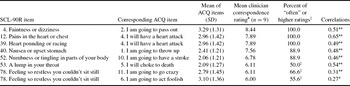
To test the hypothesis that symptom interpretations mediate the relationship between symptoms and agoraphobic avoidance, we established eight separate symptom-interpretation item pairs. These pairings were empirically derived from the administration of a self-report questionnaire to nine clinical psychologists with experience in the assessment and treatment of panic disorder (mean years of experience since completing post-graduate qualifications = 9.00, SD = 8.97). The questionnaire contained a list of 35 possible symptom-interpretation associations for which clinicians were asked to rate, based on their experience, how often they would expect to see a given interpretation in a patient who presents with each given symptom. Ratings were provided on a scale of 0 to 10, where 0 corresponded to “never” and 10 corresponded to “in every case”. We chose to analyse pairings with a mean rating of six or greater (corresponding to a rating of “often”), which provided eight pairings for further analysis (see Table 2).
Mediation analyses
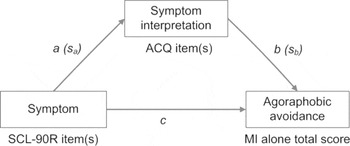
We conducted analyses to establish whether each of the symptom interpretations mediated the corresponding symptom-agoraphobic avoidance relationships (see Figure 1). Given that the reliability of individual items cannot be estimated, we also conducted a further mediation analysis to investigate whether a composite (sum) score of interpretations mediated the relationship between the composite (sum) score of symptoms and MI alone.
Mediational model

Although the Baron and Kenny (Reference Baron and Kenny1986) causal steps approach to establishing mediation is commonly used in the clinical psychology literature, we chose instead to use a bootstrap approach, as advocated by Shrout and Bolger (Reference Shrout and Bolger2002), to develop path co-efficients (a and b in Figure 1), estimates of the standard error of each co-efficient (sa and sb in Figure 1), and confidence intervals for the indirect effect of each model. Unlike product of co-efficient tests (e.g. Sobel, Reference Sobel1982) that are typically calculated from regression co-efficients established using the Baron and Kenny approach, non-symmetric confidence intervals established using a bootstrap approach do not rely on the unlikely assumption that the product of co-efficients a and b are normally distributed, and bootstrap methods are considered to have greater power, especially for small samples (where n < 400; MacKinnon, Fairchild and Fritz, Reference MacKinnon, Fairchild and Fritz2007; Shrout and Bolger, Reference Shrout and Bolger2002).
To test each symptom-interpretation-agoraphobic avoidance model for a mediation relationship, we used AMOS 17.0 to create 2000 bootstrap samples from the original data set (n = 117) using random sampling with replacement. Co-efficients for the estimates of indirect effects, estimates of the standard error of each co-efficient, and 95% unbiased confidence intervals (i.e. where the denominator value is n-1, rather than n) were then obtained from the AMOS output. Given that some agoraphobic individuals may still be relatively mobile if accompanied and that the MI alone scale is therefore considered to be a more useful measure of agoraphobic avoidance than is MI accompanied (Rush et al., Reference Rush, Pincus, First, Blacker, Endicott, Keith, Phillips, Ryan, Smith, Tsuang, Widiger and Zarin2000), we only discuss the correlation results for MI alone and we only conducted and report the mediation analyses for MI alone. We chose to focus on MI alone as the dependent variable, rather than a diagnosis of PDA compared with PD, as recent studies have suggested that the underlying latent structure of agoraphobic avoidance may be continuous rather than discrete (Slade and Grisham, Reference Slade and Grisham2009) and also because recent research suggests that there are inconsistencies in how the DSM-IV diagnostic criteria for PDA are applied (Schmidt, Salas, Bernert and Schatschneider, Reference Schmidt, Salas, Bernert and Schatschneider2005).
Results
Participant characteristics
Ninety participants were female (76.9%), 79 (67.5%) were living in a married or de facto relationship, 19 (16.2%) had a post-secondary school education, and 59 (50.4%) were engaged in paid employment. The mean age of the sample was 37.0 years (SD = 11.1) and the median age was 36 years.
Eighty-three participants (70.9%) were diagnosed with PDA. With regard to current co-occurring diagnoses, there were 39 (33.3%) with major depressive disorder or dysthymia, 12 (10.3%) with social anxiety disorder, 34 (29.1%) with generalized anxiety disorder, 26 (22.2%) with specific phobia, 7 (6.0%) with obsessive-compulsive disorder, and 1 (0.9%) with posttraumatic stress disorder. Five (4.3%) had either past alcohol abuse or past alcohol dependence and six (5.1%) had past substance abuse.
Correlation analyses
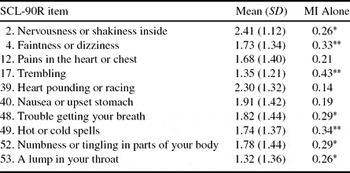
The means and standard deviations of each of the selected SCL-90R symptom items, as well as their correlations with the MI alone scores, are reported in Table 1. The majority of symptom items showed medium to large strength and statistically significant correlations with the MI subscales, particularly trembling, hot or cold spells, faintness or dizziness and trouble getting one's breath. Notable exceptions to this pattern included cardiac symptoms and nausea.
SCL-90R symptom item means and correlations with the measure of agoraphobic avoidance (N = 117)

*p < 0.01, **p < 0.001 (two-tailed).
SCL-90R = Symptom Checklist 90-Revised, MI = Mobility Inventory.
Table 2 summarises the correlations between ACQ items and SCL-90R items for the eight most closely associated symptom-interpretation pairings according to the results from the self-report questionnaire administered to the clinicians. All correlations were significant and medium to large in magnitude.
Correlations between the SCL-90R and corresponding ACQ items (N = 117)

*p < 0.01, **p < 0.001
#Clinician rating of frequency of the SCL-90R-ACQ item correspondence on the scale from 0 to 10, where 0 = “Never” and 10 = “In every case”.
†Percentage of raters providing a rating of 6 (i.e. “often”) or higher than 6 (indicating greater frequency).
‡The lower agreement on these ratings reflects the proximity to our “cut-off” mean score of 6.
ACQ = Agoraphobic and Cognitions Questionnaire, SCL-90R = Symptom Checklist 90-Revised.
Mediation analyses
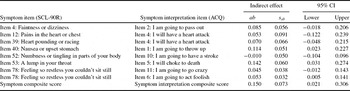
The results of the mediation analyses are reported in Table 3. Three of the interpretations (“I am going to throw up”, “I will choke to death” and “I am going to act foolish”) were found to significantly mediate the relationship between their corresponding symptoms (“Nausea or upset stomach”, “A lump in your throat” and “Feeling so restless you couldn't sit still” respectively) and MI alone.
Indirect (mediation) effects for each symptom-interpretation-MI alone model

*p < 0.01, **p < 0.001
ab = standardized indirect effect (of path a*b), sab = standard error of standardized indirect effect, 95% CI = 95%
bias-corrected confidence interval for the unstandardized indirect effect, SCL-90R = Symptom Checklist 90-Revised, ACQ = Agoraphobic and Cognitions Questionnaire
Finally, we wanted to know whether the composite (sum) score of the seven separate interpretation items from Table 2 (Cronbach's α = 0.69; “I will have a heart attack” included once) mediated the relationship between the composite (sum) score of the seven separate symptoms items in Table 2 (Cronbach's α = 0.86; “Feeling so restless you couldn't sit still” included once) and MI alone. The 95% confidence interval suggested that this was indeed the case (see lower section of Table 3).
Discussion
The first aim of our study pertained to the relationship between symptoms and agoraphobic avoidance. In this regard, we found small to medium strength associations between most symptoms and the degree of agoraphobic avoidance. This result is broadly consistent with the finding that in comparison with PD, PDA was associated with greater frequency and severity of panic attack symptoms (Starcevic et al., Reference Starcevic, Kellner, Uhlenhuth and Pathak1993) and that extensive avoiders exceeded minimal avoiders in the frequency of all symptoms except for numbness or tingling sensations (de Jong and Bouman, Reference de Jong and Bouman1995).
Our prediction that faintness and dizziness would be associated with agoraphobic avoidance was confirmed, consistent with the findings of previous research (Telch et al., Reference Telch, Brouillard, Telch, Agras and Taylor1989; Turner et al., Reference Turner, Williams, Beidel and Mezzich1986). However, our results do not suggest that faintness or dizziness is unique in this regard, as we found that almost all physical symptoms were associated with agoraphobic avoidance. This may suggest that higher levels of distress associated with any given physical symptom in a PD patient indicate an increased likelihood of agoraphobic avoidance, and provides support to the view that PDA is a symptomatically more severe condition than PD (Noyes et al., Reference Noyes, Clancy, Garvey and Anderson1987).
One of the few non-significant symptom–agoraphobic avoidance associations in our study – that between heart pounding or racing and MI alone – is consistent with some research results (e.g. Telch et al., Reference Telch, Brouillard, Telch, Agras and Taylor1989), but is inconsistent with the findings of Meuret et al. (Reference Meuret, White, Ritz, Roth, Hofmann and Brown2006). This discrepancy may in part be explained by the different instruments used in the Meuret et al. study (where clinician ratings rather than self-reports were used for collection of symptom and agoraphobic avoidance data), and by the small sample of our study, which was unable to detect small sized correlations (such as r of 0.20) as significant.
The second aim of our study was to confirm the existence of meaningful associations between symptoms of PD/PDA on the one hand and certain symptom interpretations on the other. The medium to strong correlations for each of our symptom–interpretation pairs are suggestive of this and lend support to the notion that, in the presence of particular symptoms, PD and PDA patients are also likely to interpret such symptoms in a catastrophic way. These findings are consistent with previous research (Hoffart et al., Reference Hoffart, Friis, Strand and Olsen1994; Rachman et al., Reference Rachman, Levitt and Lopatka1987; Street et al., Reference Street, Craske and Barlow1989) and with predictions of the catastrophic misinterpretation model of PD/PDA.
It is noteworthy that although the eight symptom-interpretation pairings that clinicians rated as most common included most of the core physical symptoms of PD/PDA, shortness of breath (or on this case the SCL-90R item “Trouble getting your breath”) did not feature in the eight most highly rated pairings. This may be a consequence of the fact that the ACQ did not include any items that directly corresponded to this symptom (such as the interpretation that one will suffocate or “run out of air”). Investigation of this pairing may be important for further studies.
Of crucial importance as to whether the catastrophic misinterpretation model of panic can be extended to account for agoraphobic avoidance is whether particular symptom interpretations mediate the previously discussed symptom–agoraphobic avoidance associations. This was the third aim of our study. Three of the eight symptom-interpretation pairings were found to mediate the symptom-agoraphobic avoidance relationships. One of these was the expectation that one “is going to throw up”, which mediated the association between the corresponding symptom (nausea or upset stomach) and agoraphobic avoidance. A possible explanation for this finding is that people resort to avoidance behaviour if they assume that feelings of nausea indicate imminent vomiting, which may be perceived as socially costly if it occurs in the “wrong” situation. The interpretation that one might “act foolish”, another socially costly outcome, was found to mediate the relationship between feeling restless and agoraphobic avoidance, suggesting perhaps that perceived social consequences might contribute to agoraphobic avoidance. The third significant mediator, between “a lump in your throat” and agoraphobic avoidance, was the interpretation that one will “choke to death”. The concern about choking may be associated with agoraphobic avoidance because the person may anticipate being unable to reach a hospital or help before choking to death.
We did not find that the interpretations that one will “pass out” and that one will “have a heart attack” mediated the relationships between their corresponding symptoms and agoraphobic avoidance. Several possibilities may account for this. For instance, other interpretations that were not investigated in the present study (e.g. experiencing a symptom as dangerous only when being outside of one's “comfort zone”) may mediate between these symptoms and agoraphobic avoidance. Additionally, there may be further appraisals arising subsequent to an initial interpretation that act as mediators (e.g. the mediating interpretation between dizziness and agoraphobic avoidance might not be a concern that dizziness predicts passing out, but rather that if one were to pass out during a spell of dizziness, it would be embarrassing). Also, there might be a great degree of variability from one individual to another in how a given symptom is interpreted, which may not have been reflected in significant findings in the overall sample for the pairings that we analyzed.
The composite interpretation score was found to mediate the relationship between the composite symptom score and agoraphobic avoidance. This suggests that, on the whole, multiple interpretations of symptoms (and of combinations of symptoms) might be associated with agoraphobic avoidance. However, this finding does not allow for a determination of precisely which combinations of symptoms might be mediated by which combinations of interpretations in the association with agoraphobic avoidance. For example, it might be that only a combination of chest pain and tingling sensations, rather than chest pain in isolation, leads to an interpretation that one will have a heart attack, which in turn might contribute to avoidance. Identifying these more complex relationships will be important in gaining a better understanding of the possible role of interpretations in agoraphobic avoidance, as “real life” panic attacks are typically characterized by more than one physical symptom and potentially by more than one interpretation of those symptoms. Nonetheless, the present study provides a preliminary test of the more straightforward and intuitive of these relationships.
Other limitations of the present study need to be acknowledged. First, for the symptom interpretations measure (ACQ), the responses of participants may have been affected by biased recall of their symptom interpretations that have occurred during anxiety episodes. One way of addressing this limitation would be to collect symptom and interpretation information from participants in vivo, when participants are in or about to enter situations that they typically avoid. However, the clinical setting of the present study precluded us from adopting such a design. Second, aside from the mediation analyses of the composite item scores, all other mediation analyses were conducted using single item scores for symptoms and interpretations, which may have lacked reliability. Third, we relied on self-report measures of symptoms, interpretations and agoraphobic avoidance, so it is possible that shared method effects may to some extent explain some of the associations. Finally, our methodology did not allow a causal and temporal order to be established among the variables. This will be necessary to comprehensively demonstrate any mediating relationships.
With replication of these findings, the correlations and mediating relationships found here may prove clinically useful. Smits et al. (Reference Smits, Powers, Cho and Telch2004), for instance, found that change in “fear of fear” with CBT was associated with reductions in agoraphobic avoidance, so perhaps reductions in unhelpful symptom interpretations might lead to similar changes. Reducing within situation safety-seeking behaviours that maintain agoraphobic avoidance by preventing disconfirmation of particular symptom interpretations may be critical in this regard (Salkovskis, Clark, Hackmann, Wells and Gelder, Reference Salkovskis, Clark, Hackmann, Wells and Gelder1999). Thus, the treatment of agoraphobia might be seen as involving a combination of cognitive and behavioural approaches, rather than almost exclusively relying on behavioural approaches. Alternatively, to the extent that some of these relationships may be bi-directional, decrease in agoraphobic avoidance as a result of behavioural treatment may reduce catastrophic misinterpretation of symptoms (e.g. the person may reason “I have been to the shopping centre 10 times, often felt nauseous and never actually vomited, so there is no reason to interpret nausea as a sign of imminent vomiting”). Increased understanding of these relationships and the extent to which cognitive models can be applied to agoraphobic avoidance may add to well-established behavioural conditioning accounts of the development and maintenance of agoraphobia and consequently advance cognitive treatment approaches for agoraphobia.
Further studies will also need to control for other possible factors that may explain the relationships reported here. For example, variance in symptoms may be partly accounted for by depressive symptoms (Chambless, Reference Chambless1985). Gender, co-occurring disorders or overall psychopathology may also influence these relationships. Investigation of all of these possibilities was beyond the scope of the present study.
To the best of our knowledge, this is the first mediation analysis of panic symptom interpretations in the relationship between these symptoms and agoraphobic avoidance. Our findings suggest that, the more prominent symptoms are the more likely it is that agoraphobic avoidance will be present. Certain symptom interpretations mediated the relationship between symptoms and agoraphobic avoidance, thereby providing some support to the extension of the catastrophic misinterpretation model of panic disorder to agoraphobia. Further research aiming to replicate these findings and investigating other possible associations and mediators may help to clarify these relationships.
Acknowledgements
We are grateful to the clinical psychologists who completed the panic disorder symptoms and interpretations questionnaire.



Comments
No Comments have been published for this article.