Highlights
(1) The combined release of O. similis and E. formosa could enhance the biological control effect on B. tabaci.
(2) The optimal release ratio of O. similis and E. formosa for the control of B. tabaci was 1:3.
Introduction
Several natural enemies contribute to controlling the pest population in nature. The combined application of natural enemies as a pest control strategy has piqued the interest of the scientific community (Acevedo-Alcalá Myint et al., Reference Acevedo-Alcalá, Rodríguez-Leyva, Lomeli-Flores, Guzmán-Franco and Velázquez-González2025). The simultaneous release of different natural enemies can indirectly increase community stability and mitigate the natural decline of natural enemy populations by increasing the biodiversity in the same food chain (Monticelli et al., Reference Monticelli, Bishop, Desneux, Gurr, Jaworski, McLean, Thomine and Vanbergen2021). Most pests often have a variety of natural enemies including predators and parasitoids, and predators (e.g. a wide range of feeding habits and a long generation cycle) (Snyder and Evans, Reference Snyder and Evans2006) and parasitoids (e.g. narrow feeding range, similar generation time to the host, and high fecundity) (Murdoch et al., Reference Murdoch, Chesson and Chesson1985) have different characteristics in controlling pests. Therefore, predators and parasitoids can potentially use complementary strategies to achieve effective pest control (Chailleux et al., Reference Chailleux, Droui, Bearez and Desneux2017; Dainese et al., Reference Dainese, Schneider, Krauss and Steffan-Dewenter2017).
Bemisia tabaci Gennadius (Hemiptera: Aleyrodidae), a major agricultural pest worldwide, has a wide range of hosts and strong reproductive capacity (Kavallieratos et al., Reference Kavallieratos, Wakil, Eleftheriadou, Ghazanfar, El-Shafie, Simmons, Dimase, Smith and Chandler2024; Perier et al., Reference Perier, Cremonez, Champagne, Simmons and Riley2022). Currently, the incidence of pest resistance among B. tabaci is increasing, and which has resulted in the suboptimal control of B. tabaci with chemical application (Erdogan et al., Reference Erdogan, Toprak and Gurkan2024). Therefore, there is an urgent need to develop environmentally friendly control methods, such as biological control (Roda et al., Reference Roda, Castillo, Allen, Urbaneja, Pérez-Hedo, Weihman and Stansly2020). Orius similis Zheng (Hemiptera: Anthocoridae), a predatory natural enemy of B. tabaci, is one of the dominant predatory natural enemy groups in the farmland ecosystem of southern China (Zhang et al., Reference Zhang, Yang, Zhang, Yang, Kong, Hu, Liu, Liu, Chen and Zhang2024). Additionally, O. similis has a wide range of diets and can effectively control pests belonging to various orders, including Lepidoptera and Hemiptera (Zhang et al., Reference Zhang, Kong, Zhang, Yuan, Xiong, Chen and Zhang2025). Encarsia formosa Gahan (Hymenoptera: Aphelinidae) is the predominant parasitoid of B. tabaci, which is mainly killed by parasitising B. tabaci nymphs (Milenovic et al., Reference Milenovic, Ripamonti, Eickermann, Rapisarda and Junk2023).
The combination of multiple natural enemies may effectively control B. tabaci rather than a single natural enemy (Dou et al., Reference Dou, Yang, Liu, Chen and Zhang2020). The simultaneous release of multiple natural enemies promotes interspecific competition leading to different effects, such as synergistic inhibitory or antagonistic effects on the pests (Heinz and Nelson, Reference Heinz and Nelson1996; Kalinkat et al., Reference Kalinkat, Schneider, Digel, Guill, Rall and Brose2013). Ma et al. (Reference Ma, Zhang and Liu2018) revealed that the simultaneous release of Serangium japonicum Chapin (Coleoptera: Coccinellidae) and E. formosa synergistically controlled the B. tabaci population. Zang and Liu (Reference Zang and Liu2007) demonstrated that the simultaneous release of Delphastus catalinae (Horn) (Coleoptera: Coccinellidae) and Encarsia sophia (Girault & Dodd) (Hymenoptera: Aphelinidae) under caged conditions decreased the B. tabaci population.
The predator O. similis prefers to prey on the younger instar nymphs of B. tabaci (Zhang et al., Reference Zhang, Yang, Zhang, Yang, Kong, Hu, Liu, Liu, Chen and Zhang2024), while the parasitoid E. formosa prefers to parasitize the older instar nymphs of B. tabaci (Boisclair et al., Reference Boisclair, Brueren and van Lenteren1990; Walia et al., Reference Walia, Verma, Sharma, Chandel, Palial and Sharma2022). Therefore, the simultaneous release of these two natural enemies of B. tabaci can overcome the limitations associated with the release of a single natural enemy. This approach leverages the complementary demands of natural enemies for host resources across different instars, achieving the maximum prevention and control of B. tabaci. Recent studies have evaluated the control effects of the combined release of predatory natural enemies, such as Nesidiocoris tenuis (Reuter) (Heteroptera: Miridae) (Wu et al., Reference Wu, Chen, Shao, Wang, Zhu, Zhang and Dai2024), S. japonicum (Ma et al., Reference Ma, Zhang and Liu2018), Orius sauteri (Poppius) (Hemiptera: Anthocoridae) (Li et al., Reference Li, Lao, Wang, Guo and Zhang2014), and E. formosa on whitefly pests. However, these studies focused on the short-term control of pest after a single release of natural enemy insects and did not consider the long-term population dynamics and pest control effects of natural enemy insects. In this study, the effects of the release of O. similis or E. formosa alone or in combination in different ratios (4 times) on the population of B. tabaci under greenhouse conditions during the growth period of crops were investigated. This study aimed to elucidate the pest control effect of the combined release of O. similis and E. formosa on B. tabaci, providing a theoretical basis and scientific evidence for the combined application of O. similis and E. formosa in the fields.
Materials and methods
Insects, host plants, and insect-rearing device
O. similis was collected from Capsicum annuum L. (Solanales: Solanaceae) (varieties: screw pepper) in Dabai Village (102°78′E, 25°27′N), Kunming City, Yunnan Province. E. formosa was collected from the fields of Phaseolus vulgaris L. (Rosales: Fabaceae) (varieties: safflower white pod) (102°40′E, 25°11′N) in the northern suburb of Kunming, Yunnan Province. The populations of the two insects were reared in separate rearing rooms for more than 20 generations using B. tabaci MED cryptic species (provided by the Biotechnology and Germplasm Resources Institute, Yunnan Academy of Agricultural Sciences) as a food source and P. vulgaris as a host plant. All insect feeding conditions were set at a temperature of 25 ± 1°C, a relative humidity (RH) of 70 ± 5%, and a photoperiod of 14:10 hours light to dark (L:D). In all treatments, 3-day-old female adults of O. similis that had been fully mated, and E. formosa were newly emerged 24 hour. The size of the greenhouse cage (120 mesh) was 40 cm long × 40 cm wide × 120 cm deep.
Establishment of caged population of Bemisia tabaci and release method of Orius similis and Encarsia formosa
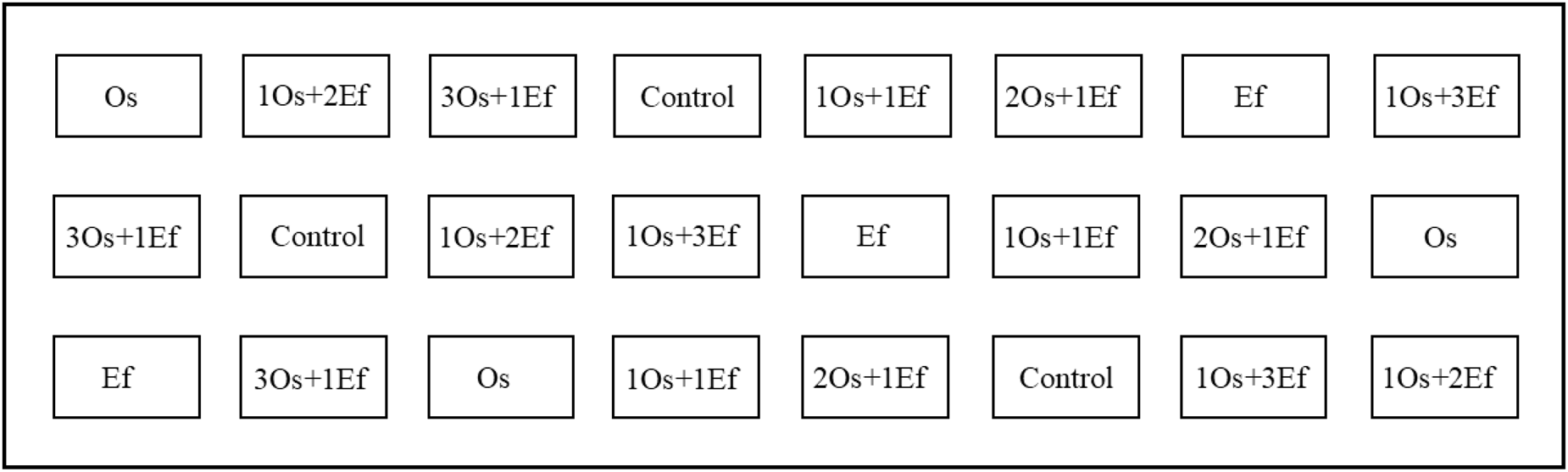
The experiment was conducted from June to October 2024 (102°45′E, 25°07′N). In this study, 8 treatment groups were established. Each treatment was repeated 3 times. The number of cages used for treatment was 24 which were randomly arranged (fig. 1).
Joint release diagram of Orius similis and Encarsia formosa.

The kidney beans with good germination were planted in flowerpots (15.30 cm in diameter and 10.80 cm in height), with two plants in each pot and four pots in each cage. Inoculations of B. tabaci began when kidney bean reached the first pair of true leaves stage. From subsequent inoculations took place at an interval of five days (June 29, July 4, July 9, and July 14) for 4 times. During each inoculation, 120 B. tabaci were inoculated in each cage. The ratio of male to female was approximately 1:1. The total number of B. tabaci was 480. Different ratios of O. similis and E. formosa were released in the cage from 5 days after the last inoculation of B. tabaci, and released four times in a row (July 19, July 29, August 8, and August 18). In this study, both natural enemies survived under greenhouse conditions. Conventional agricultural practices such as pinching the tops and removing excess lateral branches, were adopted when the height of the plants reached the top of the cage. No pesticides and other chemicals were applied during the experimental period (Yang et al., Reference Yang, Zhang, Tian, Lu, Chen and Zhang2024).
Data collection
The experiment of B. tabaci, O. similis, and E. formosa population began on the day of the initial release of natural enemies (July 19). The growth of beans was recorded once every 5 days until the natural death of the host plant. The experiment was performed in the morning when the activity of the tested insects was weak. One leaf was randomly selected from the upper, middle and lower parts of each plant in each canopy. The pests and natural enemies present on each sampled leaf were counted in situ. Next, the area of each sampled leaf was measured using the square method. The area of each square was 0.25 cm2. The raw count data for each species were then standardised to the number of individuals per 100 cm2 of leaf area as follows: Individuals per 100 cm2 = (raw count/measured leaf area) × 100 (Guzmán-Pedraza et al., Reference Guzmán-Pedraza, Martínez, Rebollar-Alviter, Palma-Castillo, Morales-Alonso, Chavarrieta-Yáñez, Figueroa and Pineda2024; Li et al., Reference Li, Zhang, Liu, Yang, Shang, Jiang, Li, Chen and Zhang2022b). This study defined the 1–2 instar and 3–4 instar nymphs of B. tabaci as early and late nymphs. This study defined the 1–3 instar and 4–5 instar nymphs of O. similis as early and late nymphs. We did not find any eggs and very few numbers (<2 ind. per leaf) of O. similis on leaves so we did not count them. The growth cycle of the kind bean plants was categorised into the following three distinct stages: (i) Seeding stage (19–29 July): defined as the period from the expansion of the first pair of true leaves to the initiation of vine running; (ii) Podding stage (03 August to 02 September): spanned from vine running to the flowering process until pod maturation; (iii) Maturation stage (07–17 September): extended from full pod maturity to the natural senescence of the plants.
Statistical analysis
Census data were initially subjected to a one-way ANOVA (repeated measures) after tests of normality (Shapiro-Wilk) and homoscedasticity (Bartlett). The population differences of B. tabaci, O. similis, and E. formosa among different treatments was analysed by Tukey’s HSD multiple comparison method (P < 0.05). Data analyses were performed using SPSS 27.0 (Chicago, USA). All figures were generated using Origin 2024 (Washington D.C., USA).
The temporal niche correlation index was calculated using the Levins and Hurlbert formula (Hurlbert, Reference Hurlbert1978; Levins, Reference Levins1969) as follow:
Temporal niche breadth, where Pi is the proportion of species in unit i in a resource set and S is the total number of units in the resource set. Niche breadth reflects the state of the adaptation of a species or a population to the environment or the extent of resource utilisation. A species with a broad niche breadth typically exhibits a competitive advantage in resource competition (Sexton et al., Reference Sexton, Montiel, Shay, Stephens and Slatyer2017).
Temporal niche overlap:  ${a_{ij}} = \mathop \sum \limits_{h = 1}^n {P_{ih}}{P_{jh}}\left( {{B_i}} \right)$, where Pih and Pjh represent the proportions of species i and j in unit h. Bi is the width of the temporal niche of speciesi. Niche overlap can reflect the frequency of encounters (predation or parasitism) between natural enemies and pests in the same resource state, indicating the effect of natural enemies on pests (Murray et al., Reference Murray, Gobin, Scully and Thornton2023).
Grey correlation analysis: The correlation degree between natural enemies and changes in B. tabaci population was calculated using the Grey correlation analysis method. The correlation degree between a certain natural enemy and B. tabaci is directly proportional to the spatial relationship between them (Deng, Reference Deng1990; Li et al., Reference Li, Zhang, Liu, Yang, Shang, Jiang, Li, Chen and Zhang2022b). The main pests and their main natural enemies are considered an intrinsic system, shile the number of pests (Yi) of the system. The whitened values representing the effect of the pests (Yi) and natural enemies (Xj) at each observation point (k) were analysed as follows using double sequence relationship analysis after data averaging:  ${Y_i} = \left\{ {{y_i}\left( 1 \right),{\text{ }}{y_i}\left( 2 \right), \ldots ,{y_i}\left( n \right)} \right\}{\text{ }}i = 1,2 \ldots M$;
 ${X_j} = \left\{ {{x_j}\left( 1 \right),{\text{ }}{x_j}\left( 2 \right), \ldots ,{x_j}\left( n \right)} \right\}{\text{ }}j = 1,{\text{ }}2 \ldots M$. The correlation coefficient between Yi and Xj at point k:
 ${r_{ij}}\left( k \right) = \frac{{\begin{array}{*{20}{c}}
{min} \\
j
\end{array}\begin{array}{*{20}{c}}
{min} \\
k
\end{array}\left| {{y_i}\left( k \right) - {x_j}\left( k \right)} \right| + \rho \begin{array}{*{20}{c}}
{max} \\
j
\end{array}\begin{array}{*{20}{c}}
{max} \\
k
\end{array}\left| {{y_i}\left( k \right) - {x_j}\left( k \right)} \right|}}{{\left| {{y_i}\left( k \right) - {x_j}\left( k \right)} \right| + \rho \begin{array}{*{20}{c}}
{max} \\
j
\end{array}\begin{array}{*{20}{c}}
{max} \\
k
\end{array}\left| {{y_i}\left( k \right) - {x_j}\left( k \right)} \right|}},{\text{ }}k = 1,2 \ldots n{\text{ }}$, where
 $\rho $ is the distinguishing coefficient (
 $\rho $=0.1).
 $R\left( {{Y_i},{X_j}} \right) = \frac{1}{{n{{\mathop \sum \nolimits }}{r_{ij}}\left( k \right)}}{\text{ }}$, represents the degree of association between the jth natural enemy (Xj) and the pest population. This value quantifies the extent of influence or linkage that Xj exerts on Yi.
Results
Population dynamics of Bemisia tabaci, Orius similis, and Encarsia formosa under different release modes and ratios
Population dynamics of Bemisia tabaci
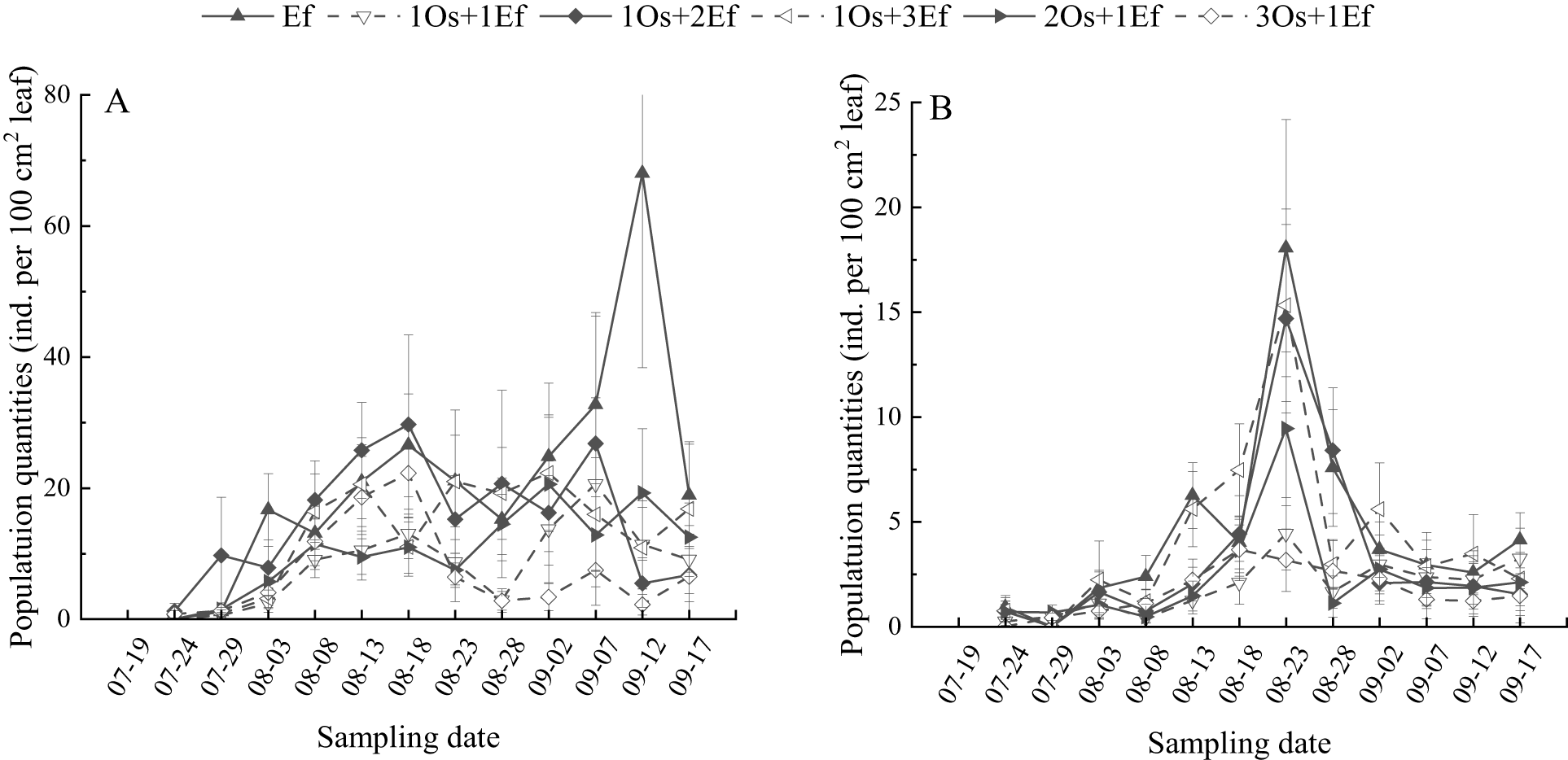
The occurrence of B. tabaci in different treatment groups was inconsistent. From August 13 to 28, the number of B. tabaci eggs in the O. similis and E. formosa groups was lower than that in the control group (fig. 2A). B. tabaci early-instar nymphs exhibited decreased numbers from August 8 to 23 in the O. similis + E. formosa groups with release ratios of 1:2 and 1:3 (fig. 2B). The number of B. tabaci late-instar nymphs on July 29 and August 3 was 166.20 and 156.27 individuals per 100 cm2 of leaves, respectively, in the O. similis + E. formosa group with a release ratio of 1:3, which was significantly lower than that in the other treatment groups (fig. 2C). From September 7 to the end of the experiment, the number of B. tabaci adults in the O. similis + E. formosa group was lower than that in the O. similis and E. formosa groups (fig. 2D).
Population dynamics of Bemisia tabaci under different release modes and ratios of Orius similis and Encarsia formosa.

Population dynamics of Orius similis
In the O. similis + E. formosa group with a release ratio of 3:1, the population of O. similis early-instar nymphs peaked on August 18 (3.41 individuals per 100 cm2 of leaves). From August 18 to 28, the population density in the O. similis + E. formosa group with a release ratio of 3:1 was consistently higher than that in the other treatment groups (fig. 3A). In the O. similis group, the number of late-instar nymphs of O. similis was the highest from August 8 to 13, from August 23 to 28, and on September 7 (fig. 3B). From September 2 to 12, the O. similis adults decreased in O. similis + E. formosa groups with release ratios of 1:1 and 1:3 (fig. 3C).
Population dynamics of Orius similis under different release modes and ratios of Orius similis and Encarsia formosa.

Population dynamics of Encarsia formosa
In the O. similis + E. formosa groups with a release ratio of 1:3, E. formosa black pupae exhibited increased numbers (10.00–22.50 individuals per 100 cm2 of leaves) from August 8 to the end of the experiment. Meanwhile, E. formosa black pupae peaked on August 18 (22.26 individuals per 100 cm2 of leaves) in the O. similis + E. formosa group with a release ratio of 3:1. The number of black pupae in the O. similis + E. formosa group with a release ratio of 3:1 was significantly lower than that in other treatment groups from August 23 to the end of the experiment (fig. 4A). From August 8 to September 2, E. formosa adults was maintained at a high level in the E. formosa group and the O. similis + E. formosa group with release ratios of 1:2 and 1:3 (fig. 4B).
Population dynamics of Encarsia formosa under different release modes and ratios of Orius similis and Encarsia formosa.

Populations of Bemisia tabaci, Orius similis and Encarsia formosa in different crop growth stages

Note: Data are presented as mean ± standard error. Different lowercase letters in the same column indicated that the population number of O. similis, E. formosa, and B. tabaci at different treatments in the same crop period was significantly different by Tukey’s HSD test (P < 0.05).
Populations of Bemisia tabaci, Orius similis, and Encarsia formosa in different crop periods
During the podding and maturation stages, the number of B. tabaci adults in the O. similis and E. formosa groups was lower than that in the control group. Meanwhile, the number of B. tabaci adults in the O. similis + E. formosa group was lower than that in the O. similis and E. formosa group. During the maturation stage, the numbers of B. tabaci eggs, early-instar nymphs, late-instar nymphs, and adults were the lowest in the O. similis + E. formosa group with a release ratio of 1:3 (eggs: F 7,16 = 2.19, P = 0.0423; early-instar nymphs: F 7,16 = 1.82, P = 0.0417; late-instar nymphs: F 7,16 = 5.57, P = 0.0022; adults: F 7,16 = 7.06, P = 0.0006). During the podding stage, the number of O. similis early-instar nymphs was the lowest in the O. similis + E. formosa group with a release ratio of 3:1 (2.13 individuals per 100 cm2 of leaves), which was significantly higher than that in the other treatment groups (F 5,36 = 4.47, P = 0.0029). During the maturation stage, the numbers of E. formosa black pupae and adults were the highest in the E. formosa group (black pupae: F 5,12 = 2.93, P = 0.0489; adults: F 5,12 = 6.34, P = 0.0042) (table 1).
The temporal niches of Orius similis, Encarsia formosa, and Bemisia tabaci under different release modes and ratios
The niche breadth of O. similis in the O. similis + E. formosa groups with release ratios of 1:1, 1:2, and 1:3 was lower than in the O. similis group. Compared with that in the O. similis group, the niche breadth was higher in the O. similis + E. formosa groups with release ratios of 2:1 and 3:1. The niche breadth of E. formosa in the O. similis + E. formosa group with a release ratio of 3:1 was lower than in the E. formosa group. Meanwhile, the niche breadth of E. formosa in the O. similis + E. formosa group with other release ratios was higher than that in the E. formosa group. The niche breadth of B. tabaci eggs (6.62), early-instar nymphs (8.95), and adults (8.05) was the lowest in the O. similis + E. formosa group with a release ratio of 1:3 (table 2).
The temporal niches of Orius similis and Encarsia formosa under different release modes and ratios

Note: The niche overlap index indicated the degree between O. similis and B. tabaci eggs, early and late instar nymphs under different release modes and ratios, and the degree between E. formosa and B. tabaci early and late instar nymphs under different release modes and ratios.
The niche overlap index of O. similis with B. tabaci eggs, early-instar nymphs, and late-instar nymphs in the O. similis + E. formosa groups was lower than that in the O. similis group. Compared with that in the E. formosa group, the niche overlap index of E. formosa with B. tabaci early-instar nymphs and late-instar nymphs was higher in the O. similis + E. formosa groups. The niche overlap index of E. formosa with B. tabaci early-instar nymphs (0.82) and late-instar nymphs (0.88) was the highest in the O. similis + E. formosa group with a release ratio of 1:3 (table 2).
Correlation between Orius similis, Encarsia formosa, and Bemisia tabaci
In the O. similis group, the correlation between O. similis and B. tabaci was 0.27, which was lower than in the O. similis + E. formosa with release ratios of 1:3 and 3:1 (0.30 and 0.28, respectively). The correlation between E. formosa and B. tabaci was 0.31, 0.28, and 0.39 in the O. similis + E. formosa with release ratios of 1:1, 1:2, and 1:3 groups, which was higher than in the E. formosa group (0.28) (table 3).
Correlation degree between natural enemies and Bemisia tabaci population

Discussion
Since the emergence of modern biological control strategies at the end of the nineteenth century, the possibility of releasing one or more natural enemy species to control pests has been explored (DeBach, Reference DeBach1964; Han et al., Reference Han, Lavoir, Rodriguez-Saona and Desneux2022). Several potentially effective natural enemy species can be identified based on some evaluation criteria. However, the species type and combinations must be determined (Bueno et al., Reference Bueno, Montes, Costaz, de Jong Pw, Parra and van Lenteren Jc2023). It is necessary to consider whether the multi-natural enemy species can complement each other when they are applied in combination, so as to enhance the downward effect and achieve effective pest control (Dainese et al., Reference Dainese, Schneider, Krauss and Steffan-Dewenter2017). This study demonstrated that the combined release of O. similis and E. formosa could effectively control the population of B. tabaci. The B. tabaci control efficiency in the O. similis + E. formosa group was higher than in the O. similis and E. formosa groups. The population density of B. tabaci at the podding and maturation stages in the O. similis + E. formosa group was significantly lower than in the O. similis and E. formosa groups. Ma et al.(Reference Ma, Zhang and Liu2018) revealed that the combined release of S. japonicum and E. formosa resulted in enhanced control of B. tabaci. Guzmán-Pedraza et al. (Reference Guzmán-Pedraza, Martínez, Rebollar-Alviter, Palma-Castillo, Morales-Alonso, Chavarrieta-Yáñez, Figueroa and Pineda2024) demonstrated that the simultaneous release of Engytatus varians (Distant) (Hemiptera: Miridae) and Tamarixia triozae (Burks) (Hymenoptera: Eulophidae) significantly reduced the nymphs and adult population densities of Bactericera cockerelli (Sulcer) (Hemiptera: Triozidae), protecting the crops. Yu et al. (Reference Yu, Feng, Liu and Qiu2023) revealed that when Harmonia axyridis Pallas (Coleoptera: Coccinellidae) and Aphidius gifuensis Ashmead (Hymenoptera: Braconidae) coexist, A. gifuensis will increase the frequency of each behaviour and the number of offspring. This indicates that the presence of predators in the multi-natural enemy biocontrol system stimulates the ability of parasitoids to control pests. Our results also showed that B. tabaci population control efficiency in the O. similis + E. formosa group with a release ratio of 1:3 for most of the experiment time was higher than that in the O. similis + E. formosa groups with other release ratios. However, this study was performed in small-scale greenhouses. Further studies are needed to examine the application in commercial greenhouses and fields, considering the cost and other factors, including environments factors (such as temperature, humidity, and host plant species).
On August 18 (podding stage), the number of early and late instar nymphs of O. similis in the O. similis + E. formosa groups with release ratios of 2:1 and 3:1 was higher than in the O. similis group. When co-existed with E. formosa, O. similis may reduce the processing time of B. tabaci to pursue the occupation, absorb more energy from the prey resources, and promote its reproduction and growth and development when facing interspecific competition (Ma et al., Reference Ma, Zhang and Liu2018). In addition, our study found that the number of E. formosa adults and black pupae in the O. similis + E. formosa groups with different release ratios was lower than in the E. formosa group. Predators may not always exhibit a harmonious relationship with parasitoids when they are released together. Several species of omnivorous predators feed on obligate parasitoids, which is termed intraguild predation (IGP) (Gontijo et al., Reference Gontijo, Beers and Snyder2015; Polis et al., Reference Polis, Myers and Holt1989). Sohrabi et al. (Reference Sohrabi, Enkegaard, Shishehbor, Saber and Mosaddegh2013) revealed that Orius majusculus (Reuter) (Hemiptera: Anthocoridae) exhibited IGP on E. formosa, and preferred to prey on parasitised nymphs rather than non-parasitised nymphs. Zhang et al. (Reference Zhang, Kong, Zhang, Yuan, Xiong, Chen and Zhang2025) revealed that O. similis exhibited IGP on E. formosa. Additionally, O. similis preferred to prey on B. tabaci nymphs parasitised by E. formosa. Thus, the population of E. formosa decreased when O. similis and E. formosa. Although IGP occurs between O. similis and E. formosa, the pest control efficiency in the O. similis + E. formosa group was higher than that in the O. similis and E. formosa groups. To further improve the biocontrol efficiency of O. similis and E. formosa, future studies must will focus on temporal release strategy and spatial isolation strategy to reduce the IGP intensity of O. similis on E. formosa.
Temporal niche refers to the sum of resources that an organism in the ecosystem can use in time (Bloxham et al., Reference Bloxham, Lee and Gore2024). Analysing ecological niche provides an improved understanding of the competitive relationships among pest species and the regulatory effects of natural enemies on pests (Li et al., Reference Li, Yang, Chen, Dou, Shang and Zhang2022a). In the farmland ecosystem, predatory natural enemies are omnivorous. At low pest density, predatory natural enemies feed on plant juice and persist for prolonged periods. Thus, the niche width of predatory natural enemies is higher than that of parasitic natural enemies (Li et al., Reference Li, Zhang, Liu, Yang, Shang, Jiang, Li, Chen and Zhang2022b). In this study, the niche breadth of E. formosa was higher than that of O. similis in the O. similis + E. formosa group. This can be attributed to experimental location, which was a greenhouse. Greenhouse conditions cannot accurately simulate the field conditions. Thus, O. similis cannot obtain prey resources other than B. tabaci and E. formosa. Furthermore, this study indicated that the combined release of O. similis and E. formosa increased the niche overlap between E. formosa and B. tabaci nymphs. The niche overlap index peaked in the O. similis + E. formosa group with a release ratio of 1:3. Concurrently, grey correlation analysis revealed the closest association between the parasitoid and the pest under this condition, demonstrating a strong following effect. This also indirectly reflects that although O. similis will prey on E. formosa, E. formosa may adopt the survival strategy of reducing the treatment time of the host to parasitize more B. tabaci nymphs, increasing its niche overlap index and correlation with B. tabaci.
In conclusion, the combined release of O. similis and E. formosa can effectively control the population of B. tabaci. The pest control efficiency in the O. similis + E. formosa group was higher than that in the O. similis and E. formosa group. Additionally, the pest control efficiency in the O. similis + E. formosa group with a release ratio of 1:3 was higher than that in the O. similis + E. formosa groups with other release ratios. Therefore, the combined use of O. similis and E. formosa can be used to construct a multi-natural enemy biocontrol system for B. tabaci, which opens a door to testing this ratio (O. similis-to-E. formosa ratio of ∼1:3) in the field. This study was performed in a small range of cage experiments, which can only reveal the effects of different natural enemy release treatments on the population of B. tabaci to a certain extent, and only provide a reference for the development of field release techniques for predatory and parasitic natural enemies. The pest control efficiency of this combination in the field must be verified in the future.
Author contributions
Bo Zhang (Methodology, Investigation, Formal analysis, Writing-original draft), Weijun Han (Methodology, Formal analysis), Jinlong Zhang (Investigation, Formal analysis), Jiao Kong (Investigation, Formal analysis), Xuefeng Fu (Investigation), Yuhan Li (Investigation), and Xiaoming Zhang (Conceptualisation, Resources, Writing-review & editing).
Funding
This research was supported by the Yunnan Basic Research Project (202201AT070269), the Yunnan Province Foreign Expert Program (202505AP120017), the Yunnan Xingdian Talent Support Program (YNWRQNBJ2020291), the Reserve Talent Project of Yunnan’s Young and Middle-aged Academic and Technical Leaders (202105AC160071).
Competing interests
The authors declare that they have no conflict of interest.
Consent for publication
Not applicable.
Ethics approval and consent to participate
Not applicable.
Availability of data and material
Not applicable.