The geography of the Skandapurāṇa: the Thanesar Cycle
Bisschop noticed the large number of sacred places mentioned in SP 167 that are to be found in the north of India. This is not only true of the list of āyatanas which is the SP 167, but also for the whole of the Skandapurāṇa.Footnote 4 I would like to suggest that the large proportion of sacred places from the region around Thanesar – the ancient land of Kurukṣetra –, especially in the first series of chapters, indicates the place of origin of at least parts of the text. The first 33 chapters consist of several stories all connected with a specific place, of which often a māhātmya is given (the grand māhātmya of Vārāṇasī is a special case, to which I will return). Not all of these places can be localised in a straightforward manner, for example the tīrtha Mahākapāla that is the setting of the Kapālin cycle in SP 5–7. Other places, such as Sthāneśvara (= Thanesar) in SP 31, are easier to find on the map. I will now review all the major localities that are mentioned in these chapters and argue for their localisation in the area around Thanesar (again, Vārāṇasī is a special case).
The first cycle centring around a tīrtha is the Kapālin cycle, consisting of Chapters 5 to 7. The relevant tīrtha is called both Kapālasthāna, Mahākapāla and ŚivataḍāgaFootnote 5, and is associated with Nīlalohita. It has now been conclusively shown to be identical to Brahmasaras/Brahma Sarovar in Kurukṣetra.Footnote 6 The figure of Nīlalohita is especially interesting here: because of the great role he has in the SP and the scarcity of attention he receives elsewhereFootnote 7, it is of special significance that in Chapter Seven of the Harṣacarita Harṣa worships Nīlalohita before his consecration at Thanesar.Footnote 8 This suggests a certain importance of this deity for Harṣa and maybe for Thanesar in his time; I will return to this later on.
The Devī cycle, consisting of Chapters 8 to 14, does not concern itself with one specific locality. There are, however, two places that receive special attention. The first is mount Maināka, which becomes a holy place under the names Svarṇaśṛṅga and Svarṇākṣa.Footnote 9 The editors’ note about its location refers to SP 32.27, in which Svarṇaśṛṅga is located “in the region of Gaṅgādvāra”, i.e. about 150 kilometres from Thanesar.Footnote 10 This internal evidence seems convincing to me and would indicate that the place probably lay within the borders of the Thanesar kingdom.
The other location of importance is Citrakūṭa, but its localisation is more problematic. The fact that it is described as Devī’s dwellingFootnote 11 would suggest that it should be somewhere in the Himālayas. Indeed, in Pāli literature one finds a mount Cittakuṭa in the HimālayasFootnote 12, but the Rāmāyana speaks of a Citrakūṭa in the neighbourhood of Allahabad.Footnote 13 Although the evidence is inconclusive, a location in the Himālayas to the northeast of Thanesar is by no means impossible, especially since the river Mandākinī – a river supposed to flow near Citrakūṭa according to the Rāmāyana – is located in the neighbourhood of Kedāra in some Puranic literature.Footnote 14
The Vasiṣṭha cycle consists of the Chapters 15 to 19. This is a myth connected with Kuru-kṣetra. also in other texts. The SP indeed connects it specifically with the river Sarasvatī in KurukṣetraFootnote 15 and there can therefore be no doubt about the location the authors had in mind.
The Nandin cycle consists of the Chapters 20 to 25 and centres around the tīrtha Japyeśvara, in the neighbourhood of Pañcanada.Footnote 16 Also in this case there are no further indications as to its location, except for the names of the five rivers that make up Pañcanada. These names have led the editors to suggest a localisation in Assam, based on the evidence of the Kālikāpurāṇa.Footnote 17 I think however that there are good reasons to disregard the Kālikāpurāṇa in this matter, first of all because it is a much later text (centring around Assam) and as such not authoritative for the sixth and seventh centuries. The most important reason however is the evidence given by SP 167, as edited by Bisschop. He argues convincingly that the āyatanas mentioned in this chapter are ordered geographicallyFootnote 18, and according to this order Japyeśvara should be located somewhere between Gaṅgādvāra and Sthāneśvara (the actual order of sanctuaries given is: Gaṅgādvāra – Japyeśvara – Mahābhairava – Rudrakoṭi – Devadāruvana – Sthāneśvara).Footnote 19 It should also be noted that the Mahābhārata does include a Pañcanada in its tīrthayātra chapter about Kurukṣetra,Footnote 20 which would support the location indicated by SP 167.
All the central tīrthas of the first twenty five chapters can therefore be located in Kurukṣetra – which in our timeframe was the Thanesar kingdom – or its surroundings.Footnote 21 Before continuing with the connections between the SP and this kingdom, I will first look at the Chapters 26 till 31.14, which deal with Vārāṇasī.
It is my impression that these chapters were added to the Skandapurāṇa at a later date; after the conception of the text and its Thanesar chapters. First of all, if my conclusions about the first 25 chapters are correct, the excursion to Vārāṇasī would fit poorly between several accounts of the Kurukṣetra area (SP 31–33 also deal with this area; I will come back to this.). Secondly, the anukramaṇikā – the list of contents which takes up SP 2 – suggests that the Vārāṇasī cycle may have been a later inclusion. Although the anukramaṇikā does not correspond very well to the text of the later chapters of the SP, for the early chapters it is more reliable.Footnote 22 My argument is that the anukramaṇikā mentions the Vārāṇasīmāhātmya in the wrong place, namely between the Vasiṣṭha cycle and the Nandin cycle.Footnote 23 This suggests that the chapters were added to the text after the reference in the anukramaṇikā was made, reflecting a change of mind on the part of the redactors as to the best place for the māhātmya. There is indeed a possibility that the end of Chapter 25 and the part of Chapter 31, starting with verse 15 originally followed one another.Footnote 24 If one looks at the endings of the Nandin cycle and the Vārāṇasīmāhātmya, one finds that both end with the return of Śiva to his dwellings. The difference is that at the end of the Nandin cycle he is accompanied by Devī, while at the end of the Vārāṇasīmāhātmya he is accompanied by Harikeśa.Footnote 25 In SP 31.15 however, Śiva, on seeing Mandara practicing aestheticism, addresses Devī – a verse that would more naturally follow on from Chapter 25, in which Śiva was travelling together with Devī.Footnote 26 One notices also that Harikeśa is out of the picture immediately from SP 31.15 onward. The transition between SP 31.14 and SP 31.15 is of course not an impossible one, but combined with the other evidence I think it likely that the māhātmya was edited in later on.
There are also some indications that Chapter 167 is later than the chapters dealing with the holy places around Thanesar. This is relevant because this chapter contains the other māhātmya of Vārāṇasī, giving it special importance by placing it last in the series of āyatanas of which it gives a description. My argument is that its descriptions of the holy places in the Thanesar area do not always fit with the descriptions given in the chapters devoted to them. This was already noted by Bisschop, who notes in reference to Japyeśvara:
Note that – contrary to the story narrated in SP 21–22 – it is not Nandin who is said to have practised tapas at Japyeśvara, but an anonymous twice-born. … nowhere in SP 21–22 it is said that Nandin installed a liṅga; he merely performed japa at Japyeśvara. … The myth of Nandins performance of japa is in fact referred to in connection with another place: Rudrakoṭi (SPS 70–71).Footnote 27
Therefore, I do not think SP 167 and the chapters centring around Thanesar could have been a product of the same environment,Footnote 28 and seeing the importance given to Vārāṇasī in SP 167 I think it not unlikely that this chapter was added in the same environment (although possibly at a later time) as the longer Vārāṇasīmāhātmya.
In Chapter 31 (from verse 15) the māhātmya of Thanesar itself is given. It is the first time the name Sthāneśvara for this place is attested in literature,Footnote 29 a fact which may point to the authors’ familiarity with the local situation. Also the next two chapters give māhātmyas of places in the neighbourhood, although not belonging to Kurukṣetra proper.Footnote 30 So, with the exception of the Vārāṇasī cycle, the first 33 chapters of the Skandapurāṇa can be said to circle around Thanesar and its surroundings.
On the cycles following Chapter 33 I will only make some short observations. Two cycles are started: one about the Goddess consisting of SP 34 and SP 53–69, the other about Sukeśa consisting of SP 35–52. It is interesting that the first cycle is mentioned in detail in the anukramaṇikā, while the other is not mentioned at all. Only the cycle about the goddess can be connected with specific localities. Yokochi divides this cycle into three layers.Footnote 31 In layer A a māhātmya is given of Gaurīśikhara (SP 69); Yokochi says about the location that a combination of external (MBh) and internal evidence
… may suggest that the redactors of the Skandapurāṇa did not know or were not concerned with any precise location of the place in the Himālaya range,Footnote 32
since the evidence from the MBh suggests a place near Mount Everest, while SP 34 suggests the western Himālayas. In SP 34 Pārvatī’s itinerary before reaching Gaurīśikhara is given. The last place specifically mentioned before the destination is Devadāruvana, which in the earlier mentioned order of sanctuaries in SP 167 is given directly before Sthāneśvara. This suggests that, whether a specific place was intended or more vaguely some unspecified mountain in the Himālayas, the mountain was to be imagined in the part of the Himālayas near Thanesar.
Layer B is connected to the Vindhya mountains, and tells the myth of Vindhyavāsinī. This locality is unquestionably far away from Thanesar, and it contains the māhātmyas of Maṇḍaleśvara and Piṇḍareśvara.Footnote 33 The final chapter in this layer (SP 68), however, brings us back to the Thanesar region; it concerns Svarnākṣa, which, as we have seen earlier, can be equated with Mount Maināka/Svarṇaśṛṅga. It even tells how Vindhyavāsinī visits this place, connecting the goddess with the region.
Having reviewed the cycles starting from SP 5, let us now take a closer look at the very beginning of the Skandapurāṇa and the first māhātmya in our text: that of the Naimiṣa forest in SP 4. Of course, one could ascribe this locality to literary convention, going as far as to say that it does not reflect any real-world location at all. HiltebeitelFootnote 34 does indeed take this position when speaking about Naimiṣa in the epics and the purāṇas in general. However, after discussing MBh 9.36-37 on Bālarāma's pilgrimage along the Sarasvatī, featuring two tīrthas connected with Naimiṣa, he also notes:
… there is no reason to think that the original Naimiṣa Forest had no location at all. With the allusions now noted to Vedic linkages of Naimiṣa Forest with Kurukṣetra and the Sarasvatī, not to mention older Vedic traditions themselves that do the same, one might gravitate toward the position of P. V. Kane (1930–62, 4: 783) and O. P. Bhardwaj (1986: 130–34) that (in Bhardwaj's terms) the earliest references are to a Naimiṣa Forest that was only a part of Kurukṣetra, or of Michael Witzel that it was somewhere in (Eastern?) Kuru-Pañcāla country (1987: 191). For Bhardwaj, such a position allows for numerous later purāṇic references to the two sites as interchangeable.Footnote 35
There is every reason to believe that the authors of the SP were familiar with such a connection between Naimiṣa and Kurukṣetra, since this passage (and another story connecting the Sarasvatī with Naimiṣa in MBh 9.39-40)Footnote 36 feature in the Mahābhārata immediately before the māhātmya of Sthāṇutīrtha and the story of the birth and consecration of Skanda from which the SP cites extensively.Footnote 37
Internal evidence might also suggest that the authors of the SP had a specific place in mind when talking about Naimiṣa, for they speak specifically about its origin and localisation.Footnote 38 It is also in Naimiṣa that Vāyu tells the story of Sarasvatī, establishing the connection also found in the Mahābhārata. The māhātmya of Naimiṣa, then, might be seen as the first in the series of māhātmyas of tīrthas around Kurukṣetra – and a significant one, for it is a place of the telling of tales.Footnote 39 How curious, then, that the SP is not told there, but in Prayāga! Bakker suggests that this location might be inspired by king Harṣa's ‘Arena of Charitable Offerings’, a grand assembly and festival held in Prayāga every five years.Footnote 40 That seems plausible to me, but it would mean that this localisation was a late adjustment.Footnote 41 Such an adjustment would not be difficult to imagine, since one could easily change the location of SP 1 just by substituting the one śloka SP 1.3. If this is indeed the case, the original location is unknown. We could of course speculate that, in accordance with tradition, it was indeed Naimiṣa, although this would require a more extensive revision of SP 1 – e.g. purā … naimiśāraṇyavāsinām in SP 1.8 would be out of place. On the other hand, not having the SP told in Naimiṣa, but then giving its māhātmya in the very beginning of the main narrative seems like a nice play with tradition and I think it is original. Perhaps locating the telling of the māhātmyas of the tīrthas in Kurukṣetra at some distant holy place – whether in Prayāga or somewhere else – gave it the appearance of ‘outside authority’, emphasizing the importance of the Śaiva tīrthas of the Thanesar region to the wider world.
Skanda and Harṣa
The chapters about the birth and consecration of Skanda (SP 163–164Footnote 42) might give us some clues that the text may indeed be connected with the person of Harṣa. There are some striking parallels between the consecration of Skanda as senāpati and the consecration of the young Harṣa before he goes to battle with Śaśāṅka, of which a description is given at the beginning of chapter seven of the Harṣacarita. To begin with, both consecrations take place at the same place: the surroundings of Thanesar (or, as the Skandapurāṇa calls it, SamantapañcakaFootnote 43). Secondly, the situations are comparable: both Skanda and Harṣa are consecrated in response to the threat of an enemy that has recently celebrated a victory and in order to lead an army against that enemy. Thirdly, the SP includes some details in the story that are not found in other renditions of the same story, but might be significant when compared with Harṣa's situation. Finally, there is some archaeological evidence that might suggest a special importance of the story of Skanda's consecration for Harṣa.
The fact that Skanda's consecration is situated at Kurukṣetra is not a new feature of the SP, but is already known from the Mahābhārata. The story would therefore be a fitting one for a purāṇa text focusing on this area. The location of Harṣa's consecration however is more problematic. Although the Harṣacarita situates it at Thanesar, Xuanzang speaks of a coronation at Kanauj and does not mention any connection between Harṣa and Thanesar at all.Footnote 44 I think it most probable that there were in fact two ceremonies: one in Thanesar before Harṣa went to war against Śaśāṅka, and another one in Kanauj when he assumed power there. Xuanzang may have had political motives for obscuring the connection between Harṣa, his ideal Buddhist king, and the region of Thanesar, which he described as being strongly associated with Śaivism.Footnote 45 However, be that as it may, I think we can at least believe Bāṇa that there was a ceremony at Thanesar in which Harṣa assumed command of the army.
Let us now compare the two consecrations in detail. Besides the location there are more similarities. As already mentioned, both assume command under the threat of a powerful enemy. In Harṣa's case this is the Gauḍa king Śaśāṅka, who had murdered Harṣa's brother Rājyavardhana and had by way of his alliance with the king of Mālava been responsible for the imprisonment of his sister Rājyaśrī. Kanauj was occupied at the time.Footnote 46 In the case of Skanda the enemy is the asura Tāraka, who is unassailable for the gods.Footnote 47 The situation is described in SP 163.66-72 – I will analyse this passage in more detail later on.
There are also some indications that the comparison between Harṣa and Kumāra was not only made in the Skandapurāṇa. Harṣa, who was consecrated at the age of sixteen, did not – according to Xuanzang – assume the title of king, but called himself Kumāra/Prince.Footnote 48 Indeed there is a passage in SP 163 in which Indra and Skanda have a discussion in which Skanda asserts that he does not desire kingship.Footnote 49 There is yet another way in which Harṣa may have been a Kumāra – Bāṇa mentions that he was celibate: gṛhītabrahmacaryam.Footnote 50
Bāṇa even makes the comparison between Harṣa and Skanda explicitly. In Chapter 3, Bāṇa's cousin Śyāmala, when extolling the virtues of Harṣa's reign, gives a list of comparisons between Harṣa and several gods. One of the comparisons is the following: atra devenābhiṣiktaḥ kumāraḥ.Footnote 51 A problem with equating Harṣa with Kumāra in this comparison is the fact that in the other eight comparisons Harṣa is compared with the god in the instrumental case. Cowell and Thomas therefore give the following translation: “In him a ‘Lord’ has anointed a young prince.” and give the following footnote: “Ref. to the god of war, Kumāra, and to Harṣa's young son”.Footnote 52 However, there is no grammatical reason not to equate Harṣa with the nominative case in this instance – we could then translate: “In him a prince/Kumāra has been consecrated by the Lord”. This would make the meaning much clearer: the consecration of Harṣa was certainly a major milestone in his life, while nothing is known about a son (and did Bāṇa not just mention that Harṣa was celibate?) Also, being consecrated is by nature a passive action that would be unnatural to express with Harṣa in the instrumental case. The next comparison in the list is also relevant in this regard: atra svāminaikaprahārapātitārātinā prakhyāpitā śaktiḥ.Footnote 53 Cowell and Thomas translate: “In him a ‘Master’ has signalized his power by laying low his enemy at one stroke” and give in a footnote: “There is a pun on Arāti, ‘king of the demons’, slain by Kumāra”. This king of the demons is identified in the commentary by Śaṅkara: tārakaś cāsurādhipatiḥ.Footnote 54 Here Harṣa is clearly compared to Kumāra – and his military campaign with Skanda's against Tāraka – and the fact that this comparison immediately follows the one concerning the consecration implies that also there Harṣa is meant to be compared to Kumāra, since the two events are closely linked. In fact, it might help explain the variation in the grammatical pattern, since Bāṇa might have wanted to avoid two references to Skanda in the instrumental case after another.
Śyāmala makes his speech after hearing a recitation of a purāṇa by the reader Sudṛṣṭi – a passage which has been discussed by Bakker,Footnote 55 who raises the possibility that the pavamānaproktaṃ purāṇaṃ Footnote 56 refers to SP 5–7, which are spoken by Vāyu.Footnote 57 Some more immediate context will clarify the importance of this passage for our subject: while Sudṛṣṭi recites, Sūcīvāṇa accompanies him by singing the following stanza:
Itself sung by sages, itself widespread, embracing the world, cleansing from sin,
Methinks this Purāṇa differs not from the achievements of Harṣa!
Following the law of heredity, free from discord,Footnote 58 noised abroad by its deeds, including all India under its sway,
Issuing from a Śrīkaṇṭha, this chant resembles the sovereignty of Harṣa!Footnote 59
A direct comparison is thus made between the reign of Harṣa and a purāṇa, possibly the SP. In fact, this purāṇa is explicitly called a harṣacarita. Moreover, it is said of this purāṇa that śrīkaṇṭhaviniryātaṃ gītam idaṃ. If the purāṇa in question is indeed the SP, this verse could confirm my conclusion from the first part of this paper – i.e. that the origins of the SP lay in Thanesar (Śrīkaṇṭha).Footnote 60
Later on in his speech, Śyāmala calls the story of Harṣa “a second Mahā-Bhārata”;Footnote 61 this echoes SP 1.11, in which the story of the birth of Kārttikeya is called bhāratākhyānasadṛśaṃ. We can conclude that the idea of a mythological text representing the deeds of Harṣa is attested in his own times, opening up the possibility that there indeed was such a mythological text that doubled as a harṣacarita. That such a text would focus on Skanda would be the logical choice.
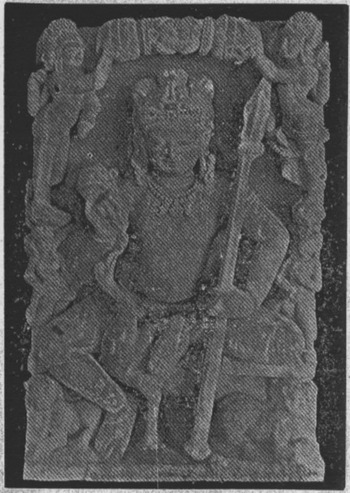
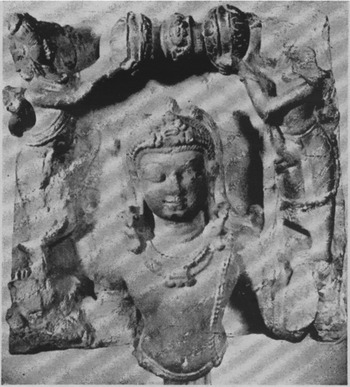
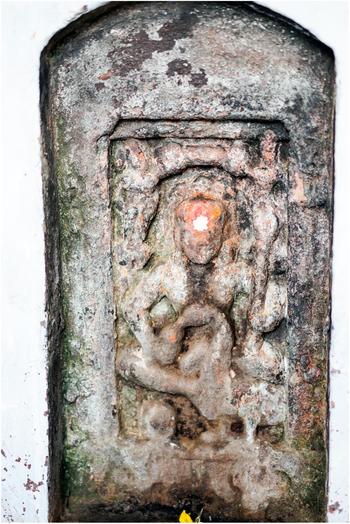
Archaeological evidence might even support the comparison between Harṣa and Skanda. From literature, there are three known depictions of Skanda's consecration.Footnote 62 One is from the Gupta age, but the other two are dated to about the seventh century. Of these two one stems from KanaujFootnote 63 and the other from a not specified place in Uttar PradeshFootnote 64 – that is, one from Harṣa's capital and the other from some place inside his realm.Footnote 65 In addition, during fieldwork in Kanauj the Skandapurāṇa team discovered a number of hitherto unknown depictions of the consecration of Skanda from the seventh century,Footnote 66 one of which is shown in Plate III. The scarcity of the subject elsewhere suggests that it might have had some special significance in Harṣa's time – my suggestion is that Skanda was especially associated with the emperor.
The most famous description of the birth of Skanda is the one by Kālidāsa in his Kumārasambhava.Footnote 67 It might therefore be fruitful to compare the story in the Skandapurāṇa with this celebrated earlier representation. In the second canto of the epic we find a passage that seems to have been the model for the earlier mentioned corresponding passage in SP 163.66-72. These passages concern the coming of the gods to Brahmā (KS)/Śiva (SP) and their plea for help against Tāraka. Bakker has already noted a similar turn of phrase in SP 163.66ab and Kumārasambhava 2.31Footnote 68 (although these verses do not describe the exact same event), but there are many more correspondences.Footnote 69 In both texts the weapons of the gods are said to be ineffectual against Tāraka: Indra's lightning bolt, Varuṇa's noose, Yama's rod and Kubera's arm (KS) or Viṣṇu's cakra (SP, but mentioned in a later passage in the KS). There are striking similarities in wording between the texts in the descriptions of the weaponsFootnote 70 and the replacement of Kubera with Viṣṇu in this passage can be interpreted in the light of the Śaiva-Vaiṣṇava rivalry that permeates the SP.Footnote 71 Also in the description of the effects that Tāraka has on the world there are correspondences. Only some of the effects mentioned by Kālidāsa – those concerning the Wind, the Seasons and Tāraka's stealing of offerings – are seen in the SP, but also here the wording is very similar, bordering on direct citations.Footnote 72 All these correspondences leave little doubt that the author(s) of Skanda's story in the SP were very familiar with Kālidāsa's poem and indeed used it as a model in this passage.
The clear similarities between the two texts make the differences all the more interesting and, I would say, significant. I already mentioned SP 163.66ab for its similarity in wording to KS 2.31; the SP, however, talks explicitly about the taking of Lakṣmī, something not described in the KS. The correspondence between this verse and the imprisonment of Harṣa's sister Rājyaśrī is mentioned by Bakker, who also notes the likeness between Skanda's and Indra's discussion about the kingship of the godsFootnote 73 (which Indra offers but Skanda refuses) and Rājyavardhana's offer of kingship to Harṣa in the Harṣacarita.Footnote 74
Bakker deems it likely that there was a rivalry between the brothers for the throne and that this rivalry is euphemistically reflected in the dialogue in the HarṣacaritaFootnote 75 – a euphemism that uses a literary convention that also appears in the SP.Footnote 76 In this scenario there is no direct relationship between the two texts. I will posit an alternative scenario: the real-world rivalry between Rājyavardhana and Harṣa is reflected similarly in both texts. A more overt reference to the rivalry is then to be found in the SP, which describes Indra initially attacking Skanda because he sees in him a danger to his own powerFootnote 77 and only offering him the kingship when he recognises his superiority.Footnote 78 Although the whole passage is heavily modelled on MBh 3.215-216, 218 (which also describes Indra first sending the Mothers, then attacking himself and finally offering kingship to Skanda, who refuses), we find significant differences in the final discussions between Indra and Skanda about kingship. In the MBh, Skanda, after having the ṛṣis tell how capable Indra is, simply states that he does not desire to take over Indra's roleFootnote 79 and that Indra is the king. In the SP, however, the discussion takes a more philosophical turn – kingship is described as something that brings with it harm, as the abode of sin,Footnote 80 which has never been desired by Skanda.Footnote 81 This is similar to the considerations of Harṣa as described by XuanzangFootnote 82 and the disparaging terms which Harṣa and Rājyavardhana use about kingship in their discussion in the Harṣacarita.Footnote 83 In this scenario then, the composers of the SP would have used the MBh passage as a means to describe the real world rivalry in mythological terms,Footnote 84 highlighting at the same time Skanda's (Harṣa's) superiority and humility, elaborating on the discussion about kingship as a means to provide a more philosophical (and probably official) reason for not (yet) assuming the title of king.Footnote 85
Bāṇa uses a similar, but more euphemistic, narrative scheme in his idealised description of real history – I think it is important to note here that one cannot really speak of a literary convention, since the taking of Lakṣmī is not a part of the Skanda myth in any other version known to me;Footnote 86 most significantly it is absent in the KS. This would suggest that Bāṇa probably had direct knowledge of the SP, using it as a model in this passage.Footnote 87 Incidentally, this would throw new light on our earlier discussion of the purāṇa-reading passage.
The crimes of Tāraka are described in two verses in SP 163: the first is the already mentioned SP 163.66ab about Lakṣmī, the other is SP 163.70.Footnote 88 It is noteworthy that these are the only two verses where ideas and wording from KS 2 are used, but where the original meaning is altered and new information is added. For the destruction of trees in Nandana, Indra's paradise garden, is also described in KS 2.41Footnote 89, although the details are very different; the wording of SP 163.70, however, is more similar to KS 2.43, which describes how Tāraka breaks the peaks of Meru and brings them to his home.Footnote 90 This is the only instance where the SP combines the ideas of two verses of the KS in this way. It should also be noted that in both SP 163.66ab and SP 163.70 the word prasabhaṃ is added.
It may be assumed, therefore, that if SP 163.66ab refers to a crime committed by Śaśāṅka,Footnote 91 SP 163.70 may refer to another one. I propose that it refers to the killing of Rājyavardhana and Grahavarman and the taking of sovereignty over Kanauj. The kalpapādapa in Nandana is Pārijāta,Footnote 92 born at the churning of the ocean, just like Lakṣmī. This makes them siblings,Footnote 93 just like Rājyavardhana and Rājyaśrī. As for Grahavarman, at the occasion of his wedding Bāṇa compares him directly to Pārijāta:
Joyous with the low hum of bee tribes delirious with pride in the fragrance of the flowers he resembled a Tree of Paradise born and descended with Śrī upon the earth.Footnote 94
At the same occasion, the bride Rājyaśrī is described in the following manner:
Compounded of all gem-like natures, brilliancy, loveliness, intoxication, fragrance and sweetness, the product of the Kaustubha jewel, the moon, wine, the tree of paradise, and ambrosia, she seemed a second Śrī formed by the ocean in his rage with gods and asuras.Footnote 95
In addition, one of Grahavarman's courtiers is named as follows:
“A betel-bearer, your majesty, by name Pārijātaka, arrived from the bridegroom's presence”.Footnote 96
The association of Grahavarman and Rājyaśrī with Pārijāta and Śrī seems thus well established, at least by Bāṇa. The equation of the kalpapādapas from SP 163.70 with Rājyavardhana and Grahavarman therefore does not seem too far-fetched to me, especially in conjunction with the equation of Śrī and Rājyaśrī in SP 163.66ab. We can now interpret the bringing of these trees to Tāraka's own gardens (SP 163.70cd) as Śaśāṅka's taking of sovereignty over Kanauj, after having uprooted the royal lines of the Maukharis and the Puṣyabhūtis by killing their most prominent members. This works especially well since the association between Indra and kingship has been emphasized earlier in the chapter; the use of Indra's trees as symbols of sovereignty fits well within this context.
I am fully aware that a reading such as the one presented here might seem tenuous and an overinterpretation of the text, looking for meanings that are not really there. Nevertheless, considering that SP 163.66ab and SP 163.70 are the only two verses that bring new information into the adaptation of the Kumārasambhava passage, and that this exact new information can be interpreted as representing Śaśāṅka's main crimes against Harṣa's family, I think that there is value to it.Footnote 97
Of course, looking for specific historical references in the Skanda story in the SP is only useful if it really was modelled on historical realities. Bakker does not believe that this is the case: “… the pseudo-historic style of the Purāṇa, in which historical details are eschewed as far as possible”,Footnote 98 and ascribes any parallels between the SP and the Harṣacarita (he explicitly compares the SP to the kāvya, not to the historical life of Harṣa!) to their both being “idealized, comprehensive, literary imaginations, products of the same cultural soil”.Footnote 99 There is however, one particular irregularity in the Skanda story as told in the SP that convinces me that it indeed was written with the person of Harṣa in mind. While comparing the SP account with the Kumārasambhava – which we have already shown to have been a model for the author(s) – Mann notices the following: “… the gods’ need for a general is a constant point of reference in the Kumārasambhava. The early Skandapurāṇa does not, however, introduce the divine need for a Senāpati until well after the birth of Kumāra”.Footnote 100 Not only does the SP differ here from Kālidāsa's poem, but as far as I know this is the only account of the story that presents the events in this way – that is, the Tāraka problem only arises after Skanda's birth and Skanda's consecration as senāpati is a reaction to it.Footnote 101 The parallel with Harṣa's situation is obvious: not his birth, but his consecration was the solution to the threat. It seems to me, then, that the story of Skanda's birth, consecration and fight with Tāraka was adapted from its models to fit more closely to the realities of its time – and in so doing to give these realities a Śaiva mythological grandeur.
SP 164, which describes the consecration itself, provides us with a further clue that it is indeed Harṣa who is alluded to here. Staiger notes the royal overtones in this chapter, in contrast with its model in the Mahābhārata (MBh 9.43-45): “Skanda is consecrated as general of the gods, but the rite appears rather like the anointment of a king”;Footnote 102 having read an earlier version of this paper, he also observes that this does, “at least slightly”, support my view.Footnote 103 Specific elements added by the SP are: Kṣiti (EarthFootnote 104) makes her appearance at the consecration (SP 164.5), a royal throne (siṃhāsana) is brought (SP 164.8)Footnote 105, the oceans, Gaṅgā and Pārvatī bring water jars (SP 164.9-15), the LokapālasFootnote 106 present royal insignia to Skanda (SP 164.16-22) and there is another passage in which several gods (among whom the Lokapālas) give Skanda royal insignia (SP 164.54-60).Footnote 107 Again we see here the tension between Skanda's role as general and the ideas of kingship that was also present in SP 163 (the discussion between Skanda and Indra); again we find the ambivalence towards the role of king that we can discern in the Harṣacarita and Xuanzang.
In SP 165 the gods prepare for battle and meet the army of Tāraka. Although the battle is described in grand language and makes use of a metre more elaborate than the śloka used for the earlier parts of the story, this chapter is characterised by a remarkable lack of detail. No locality is mentioned at all and no specific combatant is singled out as having had any particular (heroic) role or even having performed a specific action. Only Skanda decides the battle at last, casting a spear that kills the complete enemy army, including Tāraka.Footnote 108 I would suggest that the generic character of this chapter can be explained by supposing that the battle between Harṣa and Śaśāṅka had not taken place yet and that SP 165 contains the expectations of the campaign Harṣa was about to undertake. Indeed, in this campaign Śaśāṅka would be defeated, but not killed.Footnote 109
There may, however, be one exception to the generic character of this chapter. In SP 165.6-12 a catalogue of gods and their battle preparations is given. This list contains the exact same gods as the earlier discussed passage KS 2.20-26, except for the inclusion of the MoonFootnote 110 instead of the Maruts. Now the Moon is called ŚaśāṅkaFootnote 111 and he is said not to have abandoned his natural gentleness (saumyatām, a pun on Soma). I propose that this verse is intended to be a contrast to that other Śaśāṅka, who indeed had left all gentleness behind.Footnote 112
That the consecration of Skanda, together with his fight with Tāraka, is the climax of the whole text can also be inferred from the Kauśikī-Vindhyavāsinī Cycle. Yokochi has shown that layers A and B of this cycle are linked to the main story of the SP leading to Skanda's birth and that layer B (about Vindhyavāsinī’s fight against Sumbha and Nisumbha) functions as a preparation of the story of Skanda's fight with Tāraka.Footnote 113 Especially interesting are her observations about the consecration of Kauśikī after she has won the battle, showing textual correspondences between this consecration and Skanda's consecraton.Footnote 114 In addition to these two abhiṣekas, there is also the consecration of Nandin as leader of the Gaṇas in SP 24Footnote 115, showing a clear theme in the text. We can conclude that there is a building up toward the consecration of Skanda throughout the SP, that it is indeed the focal point of the narrative.
It seems likely to me, then, that a version of the SP was prepared by a group of Thanesar Pāśupatas in the context of Harṣa's consecration ceremony, couching the proceedings in a mythological framework that was finetuned to be applicable to the present occasion. This could also explain the extended quotation of the Mahābhārata in SP 164Footnote 116, namely to give the consecration and the coming expedition some epic grandeur – the quotation does after all describe the armies present at the consecration of Skanda –, thus making it, quite literally, a second Mahābhārata.Footnote 117 The text would at this stage have consisted of at least the Thanesar chapters, layers A and B of the Goddess chapters, and the chapters concerning Skanda's birth and his battle with Tāraka.Footnote 118 Skanda's victory would have been an appropriate conclusion for such a text, stating the intended outcome of the campaign that was to follow. Perhaps some parts of the text were finished in time to be recited at the consecration itselfFootnote 119, or perhaps the idea to celebrate Harṣa's consecration in a purāṇic text was not conceived – and realized – until after the fact.Footnote 120 However this may be, it would have been a chance for the local Pāśupatas to connect themselves with the new ruler and obtain his favour. By providing a Śaiva mythological parallel to current events, while at the same time highlighting the eminence of the Śaiva holy places of the region, the Pāśupatas could provide an ambitious young ruler with a vision of the importance of his position in the world and the sense of destiny that surrounded it – a vision which, of course, was inextricably entwined with Śaivism. It seems that the Pāśupatas may have been rewarded for their efforts, since – although the exact role of the Skandapurāṇa in this cannot be determined – it should be noted that, unlike his brother, father, grandfather and great-grandfather before him, Harṣa declares himself to be a paramamāheśvara in his inscriptions.Footnote 121
Such a scenario could also account for the earlier mentioned prominent role the SP gives to Nīlalohita, a figure that Bāṇa connects with Harṣa in the specific context of his consecration. As Harṣa's consecration begins with worship to Nīlalohita, so the narrative of the Skandapurāṇa begins with the story of the same deity, in which is included the māhātmya of the place where the consecration was to take place: the Sarasvatī riverFootnote 122 – or, as the author of these chapters calls it, maybe with some local pride: deśe śreṣṭhe.Footnote 123
The “core Skandapurāṇa” and its expansion
In order to support the existence of such an earlier, much shorter version we can turn to SP 72, the chapter in which the story of the birth of Skanda begins. There is a problem associated with the narrative in this chapter: in the first part of the chapter it is told how the gods visit Śiva, how Agni receives Śiva's semen and how the gods leave again; then, from verse 142c forward, the gods return – but now they are all pregnant.Footnote 124 They complain that they cannot bear Śiva's semenFootnote 125 and also introduce the new danger posed by Andhaka.Footnote 126 Śiva promises that he will kill Andhaka himself and advises the gods to go to Śaravaṇa on Mount Meru and open their bellies there – his semen will then come out.Footnote 127 The gods do this and many wondrous phenomena announce the birth of Skanda.
The problem is that, when the story of Skanda's birth continues in SP 163, Agni still carries Śiva's semen. In fact, Vyāsa explicitly asks what Agni did after receiving Śiva's semen.Footnote 128 In his reply, Sanatkumāra gives an account of Skanda's birth that has nothing to do with the last part of SP 72. This is a logical inconsistency, but one that can be easily explained by assuming that the last part of SP 72 was added later – so that SP 163 originally followed upon the gods leaving Śiva after Agni has received his semen, making the story perfectly logical.Footnote 129 The reason for the inclusion seems to be the incorporation of the Andhaka cycle at this point of the text – this cycle starts in SP 73. We see here the hand of a redactor trying to smooth out the transition between the main story and the added material, but in the process sacrificing the consistency of the main story.Footnote 130 We saw something similar when discussing the insertion of the Vārāṇasīmāhātmya, although there the transitions were much smoother.
We might suspect, therefore, that everything between SP 72 and SP 163 – or at least most of it – is a later addition. This leads us to the question of the redaction of the SP. The only other time that a cycle that is part of the main story of the SP is interrupted for an extended period of time is when the Naraka cycle (SP 35–51) is inserted into layer A of the Vindhyavāsinī cycle. Yokochi has already shown the hand of a redactor in the linking of the Naraka and Vindhyavāsinī cycles when discussing the story of the seven Brahmins (SP 56–57).Footnote 131 She concludes that this story originally was meant to be a supplement to the Naraka cycle, but was reassigned to the Vindhyavāsinī cycle on thematic grounds (to provide a backstory for the tiger Somanandin). A linking passage was written to connect the two stories (SP 57.48-104), but some inconsistencies remained.
Although Yokochi seems to think that the Vindhyavāsinī cycle was written after the Naraka cycleFootnote 132, I see no reason to assume this; on the contrary, the Vindhyavāsinī cycle being connected to the main story of the SP seems to me to be primary. The Naraka cycle as a whole is an interruption of the Vindhyavāsinī cycle, as also the Andhaka cycle is an interruption of the main story. The editors have also noted the distinctly different style of the Naraka cycle and its non-Śaiva characterFootnote 133 – all this makes it likely that it was not part of the original conception. A problem with this interpretation is that the Sukeśa story is already told earlier, in SP 11Footnote 134 – that is, in a chapter that is very much a part of the main story. I think, however, that rather than proving that the Naraka cycle belongs to the same layer as the main story, SP 11 shows that this cycle was added later on; for it is a repetition, an elaboration probably inspired by SP 11 (there are textual correspondences), which gave the redactors the opportunity to introduce the Naraka material.
There are indications that much of the material that falls outside the main story has an internal coherence and interrelation and therefore probably belongs to the same layer. I propose that at least the following stories/cycles belong to this layer: the stories of Hiraṇyakaśipu, Hiraṇyākṣa, Andhaka and Prahlāda. Besides the familial relationships between these asurasFootnote 135, there is a thematic relationship: Granoff has discussed the role of Viṣṇu's incarnations in three of these stories (all except Andhaka). She also quotes an interesting passage from SP 172, which I repeat here in her translation:
There was no demon equal to Prahlāda in terms of his scriptural learning, his strength, heroism or valour; nor in terms of this intelligence and righteousness. Even the great king Hiraṇyakaśipu was not his equal, nor were Andhaka and Hiraṇyākṣa a match for him in strength. For he was Viṣṇu Himself, who had been cursed by Bhṛgu to become a demon.Footnote 136
This passage is as interesting for the asuras it does mention as for the ones it does not. For besides confirming the association between the mentioned asuras in the minds of the composers it puts up a divide between these and the other important asuras in the SP: primarily Tāraka, Sumbha, Nisumbha and Mahiṣāsura – all of whom are part of the main story. Most conspicuous is the absence of Tāraka, whose story after all is more recently told (SP 163–165).
Supposing this analysis is correct, the chapters concerning Hiraṇyakaśipu (SP 70–71) would not belong to the core SP, while the chapters immediately preceding and following them would.Footnote 137 We can indeed see that the end of SP 69 and the beginning of SP 72 would follow quite logically upon each other if we would assume that SP 72.1-3b is a linking passage added by the redactorsFootnote 138: at the end of SP 69 Śiva and Devī return to mount Mandara and at the beginning of SP 72 they are described as dwelling there.Footnote 139 I propose that also SP 70.1-24 is a linking passage, for the following reasons:
• Granoff has noticed a difference in the character of Viṣṇu's Narasiṃha form between this passage and SP 71: while he is described as being a threat in SP 70, this aspect is not mentioned in SP 71.Footnote 140 In fact, the danger is explicitly said to be over and Indra and the other gods are said to return to their own realms in SP 71.47.Footnote 141 Then, in SP 71.48, Śiva appears, “requested by the gods, Vyāsa, as I told you before”.Footnote 142 This must refer to the episode told in SP 70, but is in contradiction with the safety of the gods mentioned just one verse before. I think that SP 71.48c-49b was inserted at the same moment as SP 70.1-24, in order to make the linking passage fit in with the story. SP 71.48ab can be read together with SP 71.49cd.Footnote 143
• SP 70.1-24 contains many similarities with SP 72. The description of the mind-created dwelling of Śiva and Pārvatī on mount Mandara is consistent with the one in SP 31.34-36, but it is here called a pura Footnote 144, as is the dwelling Śiva creates with his mind in the Vindhya mountains in SP 72.22. The situations described are also similar: the dwelling is approached by a (group of) god(s) wanting to ask Śiva to avert a threat, who encounter Nandin who guards the door. In SP 70, however, Nandin standing there has no real function in the narrative; he does not try to stop the gods from seeing Śiva. In SP 72, by contrast, Nandin stands there on the explicit order of Pārvatī.Footnote 145 Also in SP 69 Nandin has a role as a door guard; he welcomes and praises Pārvatī when she returns to mount Mandara and he obtains a boon.Footnote 146 There seems thus to be an effort to create a thematic link between the Hiraṇyakaśipu story and the preceding and following chapters. Another thematic link between the Hiraṇyakaśipu story (but this time SP 71) and those chapters is the occurrence of stutis.Footnote 147 In addition, the Hiraṇyakaśipu story contains a māhātmya of a mountain peak (Śrīparvata in SP 70.42-59), just like SP 69 (Gaurīśikhara) and SP 72 (the Golden Peak of the Vindhya).
Looking at the nature of the identified redactional activities, we can make the following observations about their characterictics:
• They concern the connection of inserted material with the main story.
• They are generally limited to the beginning and end of the inserted material. The text of the main story seems to be left mostly unchanged.
• Effort has been made to make the contents of the linking passages consistent with the inserted materials, but they sometimes produce inconsistencies/contradictions with the main story.
• The inserted stories seem to have some thematic relationship with the main story at the point of insertion; the thematical relationship may be elaborated upon in the linking passage. Some examples of this besides the ones already mentioned are:
- The placing of the Vārāṇasīmāhātmya right before the māhātmya of Sthāneśvara.
- The Upamanyu story (SP 34.62–122), which connects the Vindhyavāsinī and Naraka cycles by the theme of tapas.Footnote 148
- The birth of Andhaka (SP 73) right after the origin (and, in the linking passage, one version of the birth) of Skanda (SP 72)
- The inclusion of the story of the adoption of the aśoka tree as a son by Devī (SP 158–162) right before the chapter about the birth of Skanda (SP 163).
What role would the other chapters concerning Skanda play in this scenario? In fact, there are not that many of them, the only ones being SP 109–110 and 171. There seems to be a connection between the Kokavaktra/Kokāmukha chapters (SP 109–110) and one or more temples mentioned in an inscription found in Bengal. This Damodarpur inscription from the time of Budhagupta mentions how
an inhabitant of northern Bengal, a merchant named Ṛbhu-pāla, went on a pilgrimage to the shrines of Ṣvetavarāhasvāmin and Kokāmukhasvāmin in the Himalayas and on his return established two temples in his native district, installing therein two images of Varāha that were copies of the originals.Footnote 149
The originals can be located at Varāhachatra (Varāhakṣetra) in Nepal.Footnote 150 Also in the Skandapurāṇa there is a connection with Varāha, as it is with Varāha that Skanda and Kokavaktra fight, so there is probably some relation between the myth and the sanctuaries.Footnote 151 Although it is impossible to say whether the sanctuary in question is the one in Nepal or the one in the Koṭivarṣa district in Bengal – or even both –, the chapters could in both cases reflect an increase in geographical scope in the SP. For it is highly probable that these chapters are a later addition, since Skanda figures here in a chapter placed before the chapter about his birth. While such an illogical order can be explained by textual revisions, it is improbable that it would have been part of the initial conception. Since SP 109-110 are part of the Andhaka cycle, they provide further support for considering this cycle to be a later addition.
In SP 171 the story of Skanda's killing of Mount Krauñca is told. It starts with an argument between Skanda and Indra about who of them both is the greatest (v. 5-13). I think that also this chapter is a later addition, but I am somewhat less sure here than in the case of SP 109-110. My argument is the following: Indra's pride in SP 171Footnote 152 does not fit very well with the resolution of the discussion between Skanda and Indra in SP 163, in which Indra repeatedly tries to convince Skanda to take over the kingship of the gods and Skanda refuses; Indra then praises Skanda.Footnote 153 Although of course not impossible, such a discontinuity does not seem to be congruous with a unified conception. On the other hand, one could say that the chapter elaborates on the theme of Skanda's ‘superiority without kingship’ – an appropriate theme if the authors had Harṣa in mind.
The issue of SP 171 is connected with another question: where did the core SP end? Did it, like the second half of the Kumārasaṃbhava, end with Skanda's victory over Tāraka? This would be a logical conclusion to the main story and it would certainly be fitting for a text celebrating Harṣa at the moment of his consecration.
The chapters from SP 166 to SP 173 seem to be a rather loose collection of largely unrelated material.Footnote 154 Only one cycle can be indentified: the Tripura cycle (SP 168–170), and the chapter about Prahlāda (SP 172) can be said to be connected with the Andhaka cycle. The beginning of SP 166 seems to indicate that some conclusion has been reached: śrutam etan mayā kṛtsnaṃ skandasya caritaṃ mahat (SP 166.1cd)Footnote 155; and indeed, from here on out nothing more is added to the main story. SP 167 was already discussed in the first part of this paper. The Tripura cycle seems to belong to the same layer as the Andhaka cycle (it connects itself to it explicitlyFootnote 156 and contains some more references to Andhaka); it may have been placed here, closely after the Skanda cycle, because two of the main asuras in the story are Tārakākṣa and Vidyutprabha, who in the MBh are said to be Tāraka's sonsFootnote 157 – this is notably not mentioned in the SP, which makes it unlikely that the Tripura cycle belongs to the same layer as the Skanda cycle.Footnote 158 SP 171 and SP 172 seem to be coordinated here because of their thematical similarity: in both chapters a god strikes (a) mountain(s); this connection is already indicated in Vyāsa's question in SP 171.Footnote 159 In SP 173 the Krauñca story is referred to by Vyāsa, but it does not seem to have any other connection to it.
In conclusion, then, these chapters probably did not belong to the core SP and seem rather to be a collection of shorter stories that had not found a place in the previous parts of the SP. Four of the chapters can be connected to the Andhaka cycle, and it seems likely to me that most of the material here was added at the same time as that cycle – also because the redactors here seem to show some of the same attention to connecting stories thematically that is found in the rest of the SP.
The last chapters (SP 174–183), however, may be a different case. They form a cycle explaining the Pāśupata Yoga and stand apart from the rest of the text both in content and style. In the question that introduces the cycle, Vyāsa asks about the Pāśupata Yoga that the gods received after the destruction of Dakṣa's sacrifice.Footnote 160 This was told in SP 32, which is part of the core SP. However, in SP 122 another account is given of how the gods acquire the Pāśupata Yoga; it is clear, though, that Vyāsa refers to the story that was told first.Footnote 161 This might indicate that the Pāśupata Yoga cycle either was a part of the original SP, or at least was added to it before the Andhaka cycle. Such an assumption is corroborated by SP 183, which sums up the text in two verses.Footnote 162 These verses seem to describe a text concerned mainly with two topics: skandasambhavam Footnote 163 and śivayogodbhavaṃ, i.e. the main story/core SP and the Pāśupata Yoga.
Some verses later on, however, we see an interesting discrepancy with the opening chapter. While in SP 1 our text is described as purāṇād yad viśiṣyate (SP 1.11) – suggesting a single text called “The Purāṇa” from which our text is different –, in SP 183 it is said: tathā sarvapurāṇānāṃ purāṇo ‘yaṃ paraḥ smṛtaḥ (SP 183.70) – placing our text as a purāṇa among other purāṇas. This might reflect a new stage in the development of the SP; I propose, therefore, that the Pāśupata Yoga cycle was one of the earliest additions to the core SP.
There is a parallel between the list of āyatanas given in SP 183.47-49 and the one in SP 29.82–85.Footnote 164 The parallel is strong enough not to be a coincidence, but not strong enough that one of the passages necessarily must be an adaptation of the other one. Perhaps both passages are derived from a common source, perhaps they were simply written by the same person. However this may be, the parallel suggests a connection between SP 29 and SP 183, and therefore between the Vārāṇasīmāhātmya and the Pāśupata Yoga cycle. This makes it likely that also the Vārāṇasīmāhātmya was added to the SP at an early stage of the expansion process – this would fit very well indeed if we assume that Vārāṇasī was the place where the expansion took place.
The editors of the SP have proposed Vārāṇasī as the place of composition for the whole SP.Footnote 165 As will be clear from the first part of this paper, I disagree when it comes to what I call the “core SP”. Nevertheless, given the prominence of Vārāṇasī in the SP, I consider it likely that the composition of the later parts of the SP took place in this city. After the campaigns following Harṣa's consecration as senāpati, Vārāṇasī now fell within his realm – it would make sense for the Vārāṇasī Pāśupatas to take a text that connected the Pāśupata faith with the new emperor and reimagine it for their own purposes.Footnote 166
We may find some evidence in SP 167 that, also at this stage of the composition, the connection of the text with Harṣa was still on the mind of the authors. In a passage recounting the origins of the Pāśupata tradition, the four disciples of Lāguḍi, an incarnation of Śiva, are described (SP 167.119-132). Referring to images of Lakulīśa surrounded by four students, Cecil notes about this passage:
It is possible that the SP authors could have had this kind of visual archetype in mind as cultural agents drawing upon a larger set of shared images to express their particular ideology. To suggest this is not to say that historical persons did not inspire the model of the four students, but that the rhetorical force of the textual account did not depend upon such a historicity. Moreover, it is curious that the fourth student is not explicitly named; he is simply introduced as a brahmacārin from the Kuru land and established in Kanyakubja. Might it be that this fourth student was thought to be necessary in order to complete the picture and fulfill the ‘totality’ of tradition that the authors had in mind?Footnote 167
The verses specifically concerning this fourth student read as follows:
The fourth was a celibate student who was born in an excellent family among the Kurus. (123cd)
…
and having welcomed another in Kanyakubja after that, the Lord of the World … (129ab)Footnote 168
It seems to me that this description bears a remarkable similarity to the figure of Harṣa. The word brahmacārin calls to mind Bāṇa's description of Harṣa as gṛhītabrahmacarya Footnote 169, there is no doubt that the Puṣyabhūtis were considered to be an excellent family and the geography corresponds to Harṣa's perfectly: although he was originally from Kurukṣetra, he ascended the throne in Kanauj. It should be remarked that none of the three other students mentioned in the passage change places; instead, the same locality is mentioned twice for each of them. All of this, combined with the fact that the fourth student is the only one unnamed, strongly suggests that a reference to Harṣa was intended.Footnote 170 I do not mean to say that Harṣa really was the fourth disciple of Lāguḍi, or even that this was the intended meaning of the authors of the SP.Footnote 171 Rather, I think that this was yet another way in which they meant to connect their tradition with worldly power, adapting the representation of the history of their own lineage to the personal history of the king.
Finally, some words about the anukramaṇikā (SP 2). The list of contents as given corresponds reasonably well with the actual contents of the SP in the first part of the “Thanesar māhātmya” (SP 3–25) and layer A and B of the Vindhyavāsinī cycle. When it comes to the rest of the SP, it is far less reliable – both the topics mentioned and the chronology often do not match the text. To solve this problem, I propose that SP 2 was written at the start of the process of expansion of the core SP; a detailed index of the already existing parts could be writtenFootnote 172, but of the planned additions only a blueprint could be sketched.Footnote 173 This would for example explain the mention of the Vārāṇasīmāhātmya at the wrong placeFootnote 174 and the jumbling of the topics from the latter part of the SP. A difficulty for this theory is the omission of SP 31–33 in the list of contents; I can provide no better explanation than a possible loss of some pādas early in the transmission of the text – however, I would imagine that the omission of these crucial chapters would be problematic for any explanation of the anukramaṇikā.
That the addition of the anukramaṇikā signalled a new stage in the development of the text may be gleaned from the terms it uses for it: it is a purāṇākhyāna, which describes skandodbhavaṃ (SP 2.3cd). This is similar to the terms used in SP 183, and it might strengthen the idea that both chapters were added at around the same time (i.e. early on in the expansion process).Footnote 175
Conclusion
Yokochi has dated the first redaction of the Skandapurāṇa – by this she means the original composition and editorial work leading to a version of the text largely, but not completely, conforming to the S recension – to the period between 550 and 650. This process would have taken place over a time period of one or two generations.Footnote 176 Bakker agrees, and proposes the period between 570 and 620, spanning from Maukhari reign to the rule of HarṣaFootnote 177; he identifies the centre of composition to be Vārāṇasī.Footnote 178 My own dating would be slightly later than Bakker's: I would confine the whole process to the reign of king Harṣa in the first half of the seventh century, i.e. the latter part of the time limits set by Yokochi. Composition started out with a “core Skandapurāṇa”: a much shorter text, composed in Thanesar and consisting mostly of local māhātmyas of a Śaiva character, culminating in the story of Skanda. Although perhaps using and incorporating some pre-existing elements, this text was essentially composed for the occasion of the consecration of Harṣa and used intertextuality to place the proceedings of that day in a larger divine framework – a framework established previously in both itihāsa and kāvya. The text may not have been called purāṇa yet; after all, it contrasts itself with a text it calls the purāṇa in SP 1.11. It was composed in Pāśupata circles, with the intention of cementing their relationship with the rising star in the North-Indian power struggles and gaining a position of influence.
At this stage, the text consisted of at least the “Thanesar māhātmya” (SP 3–25; SP 31.15-SP 33), layers A and B of the Vindhyavāsinī cycle (SP 34.1–61; SP 53–55; SP 58–59; SP 60.14-21, 72–132; SP 61–69) and the Skanda cycle (SP 72.1–142b; SP 163–165); it also must have contained (some version of) the introductory chapter.
Later, when Harṣa's battles had proven successful and he had established a great empire, the Pāśupatas again turned to this text, which already constituted a connection between themselves and the king and therefore would be an opportune vehicle for furthering their ideas. Work was begun to expand the text; the centre of this new activity was Vārāṇasī, which now was a part of Harṣa's realm. An outline for the expansion was written (the anukramaṇikā) and among the first things to be added were the Vārāṇasīmāhātmya – claiming the holy city for Śaivism – and the chapters on Pāśupata Yoga. While these were significant additions, the text could at this point still be described as a purāṇaṃ skandasambhavam.
Work on the text continued, however, and more material was added; among this new material were the Andhaka cycle and related stories. While adding the new material, it seems that the outline as given in the anukramaṇikā was not followed too closely.
The new additions changed the character of the SP drastically. The balance was shifted away from the main story (i.e. the narrative leading to the birth of Skanda) towards the Andhaka cycle. In many cases, the new material consisted of Śaiva retellings of Vaiṣṇava myths, probably reflecting a preoccupation on the part of the Vārāṇasī Pāśupatas with asserting Śaivism vis-à-vis Vaiṣṇavism.Footnote 179 Nonetheless, care was taken to preserve some unity in the text; we can in many cases identify the hand of the editor making thematical connections and smoothing out transitions.
The final product may have been presented at the “Arena of Charitable Offerings” at PrayāgaFootnote 180, sometime during Harṣa's reign. Although the text had now grown to become an all-encompassing compendium of Śaiva mythology, the original central role of Skanda in the narrative was still reflected in its name: the Skandapurāṇa.
Appendix
The chart below is not meant to be a summary of the SkandapurāṇaFootnote 181, but rather a summary of my argument concerning its development. As such, comments have been limited to short references to the passages that represent the central points of this argument; they are discussed in more detail in the main text of this paper. The chapters marked with light grey belong to what I call the “core Skandapurāṇa”; those marked with a darker grey were – in my reconstruction – added in the first phase of expansion in Vārāṇasī.