1. Introduction
Echinoderms are one of the main components of Phanerozoic marine benthic communities. In spite of recent major discoveries (e.g. Smith, Zamora & Alvaro, Reference Smith, Zamora and Alvaro2013), their initial diversification in Cambrian times, and the phylogenetic relationships between major clades remain largely unresolved (Ubaghs, Reference Ubaghs1975; Paul & Smith, Reference Paul and Smith1984; Sprinkle, Reference Sprinkle, Lipps and Signor1992; David et al. Reference David, Lefebvre, Mooi and Parsley2000; Zamora et al. Reference Zamora, Lefebvre, Alvaro, Clausen, Elicki, Fatka, Jell, Kouchinsky, Lin, Nardin, Parsley, Rozhnov, Sprinkle, Sumrall, Vizcaïno, Smith, Harper and Servais2013a; Zamora & Rahman, Reference Zamora and Rahman2014). Definitive echinoderm remains can be identified as early as in Cambrian Epoch 2 (Age 3), based on the typical microstructure (stereom) of their high-magnesium calcitic skeletal elements (Kouchinsky et al. Reference Kouchinsky, Bengtson, Runnegar, Skovsted, Steiner and Vendrasco2012; Zamora et al. Reference Zamora, Lefebvre, Alvaro, Clausen, Elicki, Fatka, Jell, Kouchinsky, Lin, Nardin, Parsley, Rozhnov, Sprinkle, Sumrall, Vizcaïno, Smith, Harper and Servais2013a). However, it is very likely that their first appearance in the fossil record only reflects the acquisition of a key innovation: the ability to produce a mineralized endoskeleton (Kouchinsky et al. Reference Kouchinsky, Bengtson, Runnegar, Skovsted, Steiner and Vendrasco2012; Zamora & Rahman, Reference Zamora and Rahman2014). This interpretation is supported by their initial relatively high diversity in Cambrian Epoch 2 (with representatives of, at least, three classes: Edrioasteroidea, Eocrinoidea and Helicoplacoidea) and their almost synchronous first occurrences on the shores of all main palaeocontinents (Gondwana, Laurentia and Siberia; Smith, Zamora & Alvaro, Reference Smith, Zamora and Alvaro2013; Zamora et al. Reference Zamora, Lefebvre, Alvaro, Clausen, Elicki, Fatka, Jell, Kouchinsky, Lin, Nardin, Parsley, Rozhnov, Sprinkle, Sumrall, Vizcaïno, Smith, Harper and Servais2013a). A putative yet unrecorded latest Precambrian – earliest Cambrian origin and initial diversification of echinoderms would also be in good agreement with both molecular clock estimates (e.g. Peterson et al. Reference Peterson, Cotton, Gehling and Pisani2008) and the interpretation of some Ediacaran fossils (e.g. Arkarua) as early, uncalcified echinoderms (Gehling, Reference Gehling1987; Smith & Jell, Reference Smith and Jell1990; Sprinkle & Guensburg, Reference Sprinkle and Guensburg1997; Mooi & David, Reference Mooi and David1998).
In middle Cambrian times, echinoderms underwent a major diversification, with the appearance of four new classes around the boundary between Cambrian Epochs 2 and 3 (Cincta, Ctenocystoidea, Stylophora) and, slightly later, during the Drumian (Soluta; Lefebvre & Fatka, Reference Lefebvre and Fatka2003; Smith, Zamora & Alvaro, Reference Smith, Zamora and Alvaro2013; Zamora et al. Reference Zamora, Lefebvre, Alvaro, Clausen, Elicki, Fatka, Jell, Kouchinsky, Lin, Nardin, Parsley, Rozhnov, Sprinkle, Sumrall, Vizcaïno, Smith, Harper and Servais2013a). This second diversification pulse coincides with a major ecological change, characterized by the replacement of firm, Proterozoic-like sea floors by soft, more intensively bioturbated substrates (‘Cambrian Substrate Revolution’; Dornbos, Bottjer & Chen, Reference Dornbos, Bottjer and Chen2005; Dornbos, Reference Dornbos2006; Kloss, Dornbos & Chen, Reference Kloss, Dornbos and Chen2015). All four echinoderm clades originating during the middle Cambrian are characterized by relatively similar, convergent, flatfish, fundamentally asymmetrical ‘homalozoan’ morphologies, strongly departing from the radial body plans of early Cambrian taxa (Sprinkle, Reference Sprinkle, Lipps and Signor1992; Lefebvre & Fatka, Reference Lefebvre and Fatka2003; Lefebvre, Nardin & Fatka, Reference Lefebvre, Nardin, Fatka, Zamora and Rabano2015). Most homalozoan taxa are generally interpreted as snowshoe strategists, well-adapted for lying atop soft, soupy substrates (Jefferies & Prokop, Reference Jefferies and Prokop1972; Parsley, Reference Parsley, Paul and Smith1988; Sprinkle & Guensburg, Reference Sprinkle and Guensburg1997; Lefebvre, Reference Lefebvre2003; Lefebvre & Fatka, Reference Lefebvre and Fatka2003; Noailles, Reference Noailles2016). In contrast, most early Cambrian echinoderms are considered either as shallow sediment stickers (e.g. helicoplacoids) or as sediment attachers (e.g. early edrioasteroids), better adapted to life on firm, Proterozoic-like sea floors (Dornbos & Bottjer, Reference Dornbos and Bottjer2000; Parsley & Prokop, Reference Parsley and Prokop2004; Dornbos, Reference Dornbos2006; Schlottke & Dornbos, Reference Schlottke and Dornbos2007; Domke & Dornbos, Reference Domke and Dornbos2010). It is thus very likely that the middle Cambrian diversification of echinoderms was driven by innovative adaptive strategies and the colonization of new ecological niches, in response to changing environmental conditions.
The diversification of Cambrian echinoderms is particularly well documented in Laurentia and some (peri-)Gondwanan areas (e.g. Australia, South China, southwestern and central Europe, Morocco), possibly for historical reasons (Sprinkle, Reference Sprinkle, Lipps and Signor1992; Lefebvre & Fatka, Reference Lefebvre and Fatka2003; Zamora et al. Reference Zamora, Lefebvre, Alvaro, Clausen, Elicki, Fatka, Jell, Kouchinsky, Lin, Nardin, Parsley, Rozhnov, Sprinkle, Sumrall, Vizcaïno, Smith, Harper and Servais2013a). These two palaeocontinents show relatively comparable regional diversity patterns for Cambrian echinoderms, with a first peak in Cambrian Epoch 3 (Age 5 – Drumian) and a second in the late Furongian (Jiangshanian – Age 10; Zamora et al. Reference Zamora, Lefebvre, Alvaro, Clausen, Elicki, Fatka, Jell, Kouchinsky, Lin, Nardin, Parsley, Rozhnov, Sprinkle, Sumrall, Vizcaïno, Smith, Harper and Servais2013a). The late Furongian increase in diversity is associated with the appearance and early diversification of two typical ‘post-Cambrian’ clades: glyptocystitid rhombiferans and mitrate stylophorans (Ubaghs, Reference Ubaghs1998; Lefebvre & Fatka, Reference Lefebvre and Fatka2003; Zamora et al. Reference Zamora, Lefebvre, Alvaro, Clausen, Elicki, Fatka, Jell, Kouchinsky, Lin, Nardin, Parsley, Rozhnov, Sprinkle, Sumrall, Vizcaïno, Smith, Harper and Servais2013a; Zamora, Zhu & Lefebvre, Reference Zamora, Zhu and Lefebvre2013b). Conversely, the drop in echinoderm diversity observed during the Guzhangian–Paibian time interval possibly results from the extinction of two classes (cinctans and ctenocystoids) at the end of the Drumian. However, the possibility that this decrease in echinoderm diversity also results from a sampling bias cannot be excluded: in most areas, the Guzhangian–Paibian time interval is characterized by shallower deposits, less favorable for the preservation of echinoderms (Smith, Reference Smith1988; Lefebvre & Fatka, Reference Lefebvre and Fatka2003; Zamora et al. Reference Zamora, Lefebvre, Alvaro, Clausen, Elicki, Fatka, Jell, Kouchinsky, Lin, Nardin, Parsley, Rozhnov, Sprinkle, Sumrall, Vizcaïno, Smith, Harper and Servais2013a).
In this context, the Cambrian deposits in the central House Range of western Utah (USA) offer a rare opportunity to document successive echinoderm assemblages ranging from the early Drumian to the Guzhangian. The Drumian deposits of this region have yielded some of the most abundant and diverse Cambrian echinoderm faunas from Laurentia. Four distinct echinoderm classes were documented in the upper part of the Wheeler Formation (early Drumian): ctenocystoids (Ctenocystis colodon; Ubaghs & Robison, Reference Ubaghs and Robison1988), eocrinoids (Gogia spiralis; Robison, Reference Robison1965; Sprinkle, Reference Sprinkle1973), solutans (Coleicarpus sprinklei; Ubaghs & Robison, Reference Ubaghs and Robison1988; Daley, Reference Daley1996) and stylophorans (Archaeocothurnus bifida; Ubaghs & Robison, Reference Ubaghs and Robison1988). The Drumian part of the overlying Marjum Formation (late Drumian) has yielded four echinoderm taxa belonging to three clades: edrioasteroids (Totiglobus? lloydi; Sprinkle, Reference Sprinkle1985), eocrinoids (Gogia spiralis, Marjumicystis mettae; Robison, Reference Robison1965; Sprinkle, Reference Sprinkle1973; Ubaghs & Robison, Reference Ubaghs and Robison1985) and solutans (Castericystis vali; Ubaghs & Robison, Reference Ubaghs and Robison1985; Daley, Reference Daley1995). The Wheeler and Marjum formations have both yielded ecologically comparable echinoderm faunas, well adapted to life on soft, fine-grained siliciclastic substrates, in relatively deep and quiet environmental conditions (Miller, Evans & Dattilo, Reference Miller, Evans, Dattilo, Derby, Fritz, Longacre, Morgan and Sternbach2012).
Two distinct modes of life can be documented in the two Drumian echinoderm assemblages from the House Range. Several taxa (e.g. ctenocystoids, cornute stylophorans) were probably free-living, epibenthic, deposit- or suspension-feeders (‘homalozoan’ mode of life; Ubaghs & Robison, Reference Ubaghs and Robison1985, Reference Ubaghs and Robison1988; Sprinkle, Reference Sprinkle, Lipps and Signor1992; Sprinkle & Guensburg, Reference Sprinkle and Guensburg1997; Lefebvre & Fatka, Reference Lefebvre and Fatka2003). All the other taxa (e.g. edrioasteroids, eocrinoids) were suspension-feeders, permanently attached to any hard items (e.g. large trilobite fragments, sponges, other echinoderms) available on the soft sea-bottom (‘pelmatozoan’ mode of life; see Sprinkle, Reference Sprinkle1973, p. 87, pl. 12 figs 1–4; Ubaghs & Robison, Reference Ubaghs and Robison1985; Daley, Reference Daley1995, fig. 14D). An alternative lifestyle (sediment sticking) was sometimes proposed for Gogia spiralis (see e.g. Dornbos, Reference Dornbos2006; Schlottke & Dornbos, Reference Schlottke and Dornbos2007; Kloss, Dornbos & Chen, Reference Kloss, Dornbos and Chen2015). However, the absence of any discoidal attachment disc at the distal extremity of the holdfast in most individuals of G. spiralis does not necessarily imply that they were sediment stickers. The detailed sedimentologic and taphonomic analysis of the beds yielding most fully articulated specimens of eocrinoids rather suggests that they were probably transported over a short distance by distal turbidity or storm currents (Brett et al. Reference Brett, Allison, DeSantis, Liddell and Kramer2009, p. 23, fig. 17).
The two solutan taxa described from the Drumian strata of the central House Range, Coleicarpus sprinklei (Wheeler Formation) and Castericystis vali (Marjum Formation), are not only the two oldest known representatives of their class, but they also illustrate a major ecological transition in early solutans. While C. sprinklei possessed a pelmatozoan lifestyle throughout life, this condition was only observed in juveniles in C. vali, the larger individuals being unattached and free-living (Ubaghs & Robison, Reference Ubaghs and Robison1985, Reference Ubaghs and Robison1988; Daley, Reference Daley1995, Reference Daley1996). This homalozoan mode of life was the rule in most (stratigraphically) younger and more derived solutans (Caster, Reference Caster and Moore1968; Ubaghs, Reference Ubaghs1970, Reference Ubaghs1975; Daley, Reference Daley1996; Rozhnov & Jefferies, Reference Rozhnov and Jefferies1996; Sprinkle & Guensburg, Reference Sprinkle and Guensburg1997; Rahman & Lintz, Reference Rahman and Lintz2012; Noailles, Lefebvre & Kašička, Reference Noailles, Lefebvre and Kašička2014).
In the Cambrian succession of the House Range, the stratigraphically youngest echinoderm remains were briefly described by Ubaghs & Robison (Reference Ubaghs and Robison1985). In the upper part of the Weeks Formation (Guzhangian), they reported the presence of several fragments of solutan thecae and appendages. Their preservation, however, prevented any formal description of this limited material, which was left in open nomenclature (‘genus and species undetermined’). In the early 21st century, intensive collecting in the upper part of the Weeks Formation yielded abundant new specimens of fossil invertebrates, consisting mostly of arthropods (e.g. aglaspidids, trilobites), some of them with exceptionally preserved soft parts (Lerosey-Aubril et al. Reference Lerosey-Aubril, Hegna, Kier, Bonino, Habersetzer and Carré2012, Reference Lerosey-Aubril, Ortega-Hernández, Kier and Bonino2013, Reference Lerosey-Aubril, Hegna, Babcock, Bonino and Kier2014), but also four relatively complete, fully articulated individuals of solutan echinoderms. Consequently, the aims of this paper are: (1) to describe the morphology of the sole echinoderm as-yet recovered from the Weeks Formation, based on this new material; and (2) to discuss the evolutionary, palaeoecological and palaeobiogeographic significance of the Weeks solutan.
2. Geological setting
The Weeks Formation is a c. 370 m-thick succession of carbonates and shales exposed in the central House Range of Utah (USA). It accumulated within a fault-controlled trough known as the House Range Embayment, which locally developed within the carbonate platform during Cambrian Epochs 2 and 3 (Rees, Reference Rees1986). More specifically, it represents the final stage of the infilling of this local basin, which started with the deposition of the Wheeler Formation, continued with that of the Marjum Formation and ended with that of the Weeks Formation. These three lithostratigraphic units form a continuous sequence c. 900 m thick of relatively deep-water deposits, except in the uppermost part of the Weeks Formation, in which a notable shallowing is recorded (Miller, Evans & Dattilo, Reference Miller, Evans, Dattilo, Derby, Fritz, Longacre, Morgan and Sternbach2012). The conformably overlying Big Horse Member of the Orr Formation, predominantly composed of limestone, definitely marks the return to shallow-water high-energy settings typical of the carbonate plateform.
The upper part of the Weeks Formation has yielded a rich shelly fauna, which is dominated by trilobites and lingulid brachiopods in terms of diversity and abundance, respectively (Lerosey-Aubril et al. Reference Lerosey-Aubril, Hegna, Babcock, Bonino and Kier2014; Robison, Babcock & Gunther, Reference Robison, Babcock and Gunther2015). Agnostids, bradoriids, hyolithids, monoplacophorans and the solutan echinoderm described herein represent rarer components. The Weeks Formation has recently attracted much attention, because it also preserves c. 30 species of non-biomineralizing or weakly biomineralizing organisms (Lerosey-Aubril et al. Reference Lerosey-Aubril, Hegna, Kier, Bonino, Habersetzer and Carré2012, Reference Lerosey-Aubril, Ortega-Hernández, Kier and Bonino2013, Reference Lerosey-Aubril, Hegna, Babcock, Bonino and Kier2014; Lerosey-Aubril, Reference Lerosey-Aubril2015; Ortega-Hernández et al. Reference Ortega-Hernández, Lerosey-Aubril, Kier and Bonino2015). According to trilobites, the upper part of the Weeks Formation is Guzhangian in age (Cambrian Series 3, Cedaria Zone) and was deposited in an open-marine environment (Robison & Babcock, Reference Robison and Babcock2011).
3. Material and methods
The two slabs containing the original specimens described by Ubaghs & Robison (Reference Ubaghs and Robison1985) were collected in the early 1980s by K. D. Kehrberg ‘just above the small abandoned quarries along the north side of the road in North Canyon’, House Range. Associated trilobites typical of the upper part of the Weeks Formation indicate a Guzhangian age (Cedaria zone; Ubaghs & Robison, Reference Ubaghs and Robison1985). This material is deposited in the collections of the Smithsonian National Museum of Natural History, Washington, USA (USNM).
The new material consists of four more or less complete individuals distributed on three thin slabs. Two of the thin slabs originated from the splitting of a thicker slab and therefore bear individuals initially present on the same bedding plane. Each preserves the remains of two individuals, one exclusively present on this slab and the other common to both (part and counterpart). The third slab bears the remains of a fourth individual; whether this specimen was on the same bedding plane as the others is unknown. These fossils were collected by Marcus Donovan, an amateur palaeontologist from Salt Lake City, in an abandoned quarry on the southern flank of North Canyon, House Range, Utah, USA (39°12′39.46″N, 113°21′6.59″W). This quarry exposes c. 15 m of section within the upper part of the Weeks Formation, which is c. 5 m below the beds exposed in the type locality 1.5 km to the east (locality 824 of Robison & Babcock, Reference Robison and Babcock2011; R. Gaines, 2017, pers. com.).
The new specimens were prepared manually with a needle. They were photographed immersed under dilute ethanol using a Leica DFC420 digital camera mounted on a Leica MZ12.5 microscope, and dry using cross-polarized light with a Nikon D3X digital camera equipped with a Micro-Nikkor AF 60mm f/2.8 D macro lens. Photographs were taken with manual focusing through the focal plane and stacked using Adobe Photoshop CS 5. The new specimens are deposited at the University of Utah, Salt Lake City, USA (UU).
4. Systematic palaeontology
Remarks: Solutans are considered here as relatively derived blastozoan echinoderms (see e.g. David et al. Reference David, Lefebvre, Mooi and Parsley2000; Lefebvre & Fatka Reference Lefebvre and Fatka2003; Sprinkle & Guensburg Reference Sprinkle, Guensburg, Webby, Paris, Droser and Percival2004; Nardin et al. Reference Nardin, Lefebvre, David and Mooi2009; Noailles, Lefebvre & Kašička, Reference Noailles, Lefebvre and Kašička2014; but see e.g. Jefferies, Reference Jefferies1990; Daley, Reference Daley1995; Smith, Reference Smith2005, Reference Smith2008; Zamora & Rahman, Reference Zamora and Rahman2014 for alternative interpretations). The terminology used here follows Lefebvre, Derstler & Sumrall, (Reference Lefebvre, Derstler, Sumrall, Kroh and Reich2012) and Noailles, Lefebvre & Kašička (Reference Noailles, Lefebvre and Kašička2014).
Phylum ECHINODERMATA Bruguière, Reference Bruguière1791 (ex Klein, Reference Klein1734)
Subphylum BLASTOZOA Sprinkle, Reference Sprinkle1973
Class SOLUTA Jaekel, Reference Jaekel1901
Order SYRINGOCRINIDA Parsley & Caster, Reference Parsley and Caster1965
Remarks: As defined by Noailles, Lefebvre & Kašička (Reference Noailles, Lefebvre and Kašička2014), the order Syringocrinida comprises all solutans with a flattened dististele consisting of opposite (left and right) series of skeletal elements. This architecture is distinct from that of dendrocystitids, characterized by narrower, more cylindrical dististeles made of opposite (upper and lower) series of plates (but see discussion below). Most syringocrinid genera have been traditionally assigned to various families (e.g. Iowacystidae, Minervaecystidae, Plasiacystidae). The monophyly of the family Iowacystidae is relatively well established, and supported by both morphological and phylogenetic analyses (see e.g. Kolata, Strimple & Levorson, Reference Kolata, Strimple and Levorson1977; Parsley, Reference Parsley1997; Parsley & Sumrall, Reference Parsley and Sumrall2007; Parsley, Rozhnov & Sumrall, Reference Parsley, Rozhnov and Sumrall2012). As argued by Noailles, Lefebvre & Kašička (Reference Noailles, Lefebvre and Kašička2014), it is very likely that all other, more basal syringocrinids (e.g. Castericystis, Minervaecystis, Plasiacystis) form a paraphyletic assemblage. In this context, the new solutan from the Weeks Formation is not assigned to any family. Its morphology suggests close affinities with both Castericystis and Minervaecystis (see discussion below).
Genus Pahvanticystis gen. nov.
Type species: Pahvanticystis utahensis sp. nov. (by monotypy).
Derivation of name: from ‘Pahvant’, the name of the Native American tribe that originally lived in this part of Utah.
Diagnosis: A small syringocrinid with a moderately inflated, ovoid to pear-shaped theca. Preanal lobe weakly to moderately prominent. Thecal surfaces consisting of numerous, unorganized, smooth, polygonal platelets. Short and robust brachiole laterally inserted, along antanal thecal margin, not far from apex. Elongate anal plates forming small, cone-shaped pyramid, on opposite, lateral edge of the theca, close to homoiostele insertion. Proxistele, highly flexible, short and consisting of about eight to ten imbricated rings. Transition zone (mesistele) relatively short, bearing a twisted keel. Distal part of homoiostele long, gently arched, made of two opposite series of polygonal plates separated by intercalated elements. Dististele strongly flattened, almost perpendicularly to thecal extensiplane. Short and narrow, spike-like process at distal extremity of dististele.
Discussion: The general morphology of the Weeks solutan appears relatively similar to that of the two older solutans from Utah. Pahvanticystis shares with both Coleicarpus and Castericystis the possession of (1) a relatively inflated theca; (2) unorganized thecal plating with some large skeletal elements; and (3) a similar, protruding anal pyramid made of long, lath-shaped platelets. However, Pahvanticystis markedly differs from Coleicarpus by the possession of (1) a laterally inserted (rather than apically inserted), shorter and stouter brachiole; (2) pyriform, rather than ovoid thecal outlines; (3) well-differentiated proxistele and dististele; and (4) the absence of any distal discoidal attachment disc. The morphology of Pahvanticystis is, in many respects, much closer to that of Castericystis, especially with regard to the organization of the homoiostele. However, the new taxon differs from Castericystis by the presence of (1) a laterally inserted, shorter and more robust brachiole; (2) more lobate, pyriform thecal outlines; (3) a proportionately much shorter proxistele; and (4) the different orientation of its dististele (see Section 5 below).
The morphology of Pahvanticystis is also strongly reminiscent of that of stratigraphically younger solutans, such as Minervaecystis vidali (late Tremadocian, Montagne Noire; Thoral, Reference Thoral1935; Ubaghs, Reference Ubaghs1970) and Plasiacystis mobilis (late Tremadocian – late Darriwilian of Bohemia, Montagne Noire (France), Morocco and Shropshire; Prokop & Petr, Reference Prokop and Petr2003; Lefebvre, Derstler & Sumrall, Reference Lefebvre, Derstler, Sumrall, Kroh and Reich2012; Lefebvre et al. Reference Lefebvre, Allaire, Guensburg, Hunter, Kouraïss, Martin, Nardin, Noailles, Pittet, Sumrall and Zamora2016). Pahvanticystis shares with both Minervaecystis and Plasiacystis the possession of (1) a short, robust brachiole, laterally inserted onto the antanal thecal margin; (2) a relatively inflated theca, consisting of numerous, unorganized, skeletal elements; (3) a cone-shaped anal pyramid made of elongate plates; and (4) a twisted dististele (see discussion below). However, the morphology of both Minervaecystis and Plasiacystis appears clearly distinct from that of Pahvanticystis: in both genera (1) the brachiole is inserted in a more posterior position, farther away from the apex; and (2) thecal outlines are less lobate and more ovoid. Moreover, the homoiostele of Minervaecystis is characterized by a proportionately longer proximal region (c. 25 telescopic rings), a much shorter transition zone (mesistele) and a dististele consisting of narrower, more elongate elements. The homoiostele of Plasiacystis is markedly different from that of both Minervaecystis and Pahvanticystis: (1) it is proximally unorganized (no telescopic rings); and (2) the dististele is modified into a short and wide paddle-like structure, with a rounded posterior extremity.
Consequently, the morphology of the Weeks solutan shows a unique combination of characters previously known from older and more primitive taxa (e.g. morphology of the mesistele–dististele, aspect of the anal pyramid) and from younger and presumably more derived genera (e.g. lateral migration of the brachiole insertion). In many respects, the morphology of the Weeks solutan appears relatively intermediate between those of Castericystis (e.g. similar dististele) and Minervaecystis (e.g. laterally inserted brachiole), thus justifying its assignment to a distinct genus, Pahvanticystis.
Comparison with subcontemporaneous or slightly younger solutans is difficult, because none of them has been formally described. In the Secret Canyon Formation of central Nevada (latest Drumian – basal Guzhangian), Sprinkle (Reference Sprinkle1973) figured a specimen of the eocrinoid Eustypocystis minor possibly attached to the isolated dististele of a syringocrinid solutan (‘undescribed carpoid-like form’ in Sprinkle Reference Sprinkle1973, p. 113; see also Sprinkle, Reference Sprinkle, Lipps and Signor1992; Zamora et al. Reference Zamora, Lefebvre, Alvaro, Clausen, Elicki, Fatka, Jell, Kouchinsky, Lin, Nardin, Parsley, Rozhnov, Sprinkle, Sumrall, Vizcaïno, Smith, Harper and Servais2013a). This dististele is markedly short and wide, club-shaped, and its morphology appears much more similar to that of the distal appendage of Plasiacystis than to the more Castericystis-like dististele of Pahvanticystis. A spike-like distal process is apparently present at the distal extremity of the homoiostele of the Secret Canyon solutan (Sprinkle, Reference Sprinkle1973, pl. 28 fig. 4). This plesiomorphic feature is shared with several other solutans (e.g. Castericystis, Pahvanticystis), but absent (probably lost) in Plasiacystis.
The occurrence of possibly two distinct, well-preserved solutan taxa was also briefly reported from terminal Guzhangian (Cedaria or Crepicephalus Zones)–basal Paibian (Glyptagnotus stolidotus or G. reticulatus zones) beds of the Conasauga Formation in NE Alabama, USA (Bell & Sprinkle, Reference Bell and Sprinkle1980; Zamora et al. Reference Zamora, Lefebvre, Alvaro, Clausen, Elicki, Fatka, Jell, Kouchinsky, Lin, Nardin, Parsley, Rozhnov, Sprinkle, Sumrall, Vizcaïno, Smith, Harper and Servais2013a). The morphology of one of these two yet undescribed solutans shows some possible similarities with Pahvanticystis: the possession of a homoiostele, which is obliquely inserted into a large, ovoid theca consisting of smooth plates, resembles the situation in some specimens of P. utahensis (Fig. 1a–c). However, the absence of any published figures and proper description of the Alabama material makes it difficult to compare it more closely with Pahvanticystis.
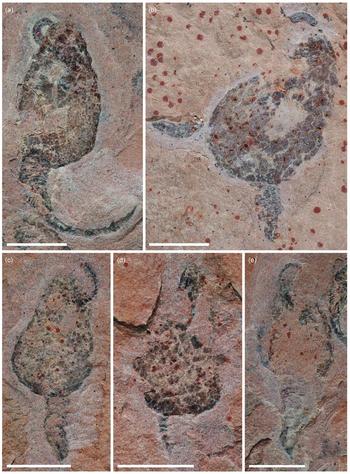
Pahvanticystis utahensis gen. et sp. nov., upper part of the Weeks Formation, Guzhangian (Cedaria Zone), House Range, Utah, USA. (a) Holotype UU05072.02_01, fully articulated specimen in upper aspect showing ovoid theca, recurved brachiole and gently curved homoiostele. (b) Paratype UU05072.03, relatively complete specimen in lower aspect, with pear-shaped theca, a distal portion of brachiole preserved close to thecal apex, and laterally inserted proxistele; a second, larger, isolated brachiole stump, probably belonging to another individual, lying close to well-developed preanal lobe. (c) Paratype UU05072.01_01, largely complete specimen in lower aspect, with pear-shaped theca, well-preserved, fully articulated brachiole, and partly disrupted proximal portion of homoiostele. (d) Paratype UU05072.01_02, incomplete specimen in lower aspect showing poorly preserved theca and part of proxistele. (e) Paratype UU05072.02_02, counterpart of specimen UU05072.01_02; poorly preserved theca with rounded apex and proximal(?) part of homoiostele. Scale bar: 5 mm. All specimens photographed dry, using cross-polarized light.

A single specimen of a yet undescribed solutan was also figured from the Guole Formation (Furongian, Jiangshanian) of South China (Zamora, Zhu & Lefebvre, Reference Zamora, Zhu and Lefebvre2013b, fig. 2D). Its morphology is clearly distinct from that of Pahvanticystis: (1) its brachiole is in apical position; (2) the theca was apparently less inflated, more quadrangular in shape and composed of a reduced number of enlarged plates; and (3) the anal pyramid is particularly large, rounded and located away from the homoiostele insertion, on the upper thecal surface. Although the homoiostele is absent in the single known specimen of the late Cambrian Chinese solutan, the morphology of its periproct suggests dendrocystitid rather than syringocrinid affinitites. If this interpretation is correct, the Guole solutan may thus represent the oldest known member of the order Dendrocystitida.
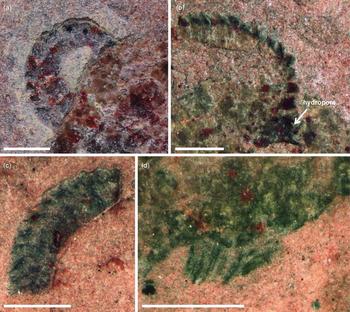
Pahvanticystis utahensis gen. et sp. nov., upper part of the Weeks Formation, Guzhangian (Cedaria Zone), House Range, Utah, USA: (a–c) morphology of the brachiole and (d) of the periproct. (a) Holotype UU05072.02_01, recurved portion of brachiole in upper aspect showing left and right series of brachiolar plates. (b) Paratype UU05072.01_01, recurved portion of brachiole in lower aspect, with well-exposed right series of elongate cover plates; arrow showing hydropore. (c) Paratype UU05072.03, isolated fragment of brachiole lying just above apex of specimen. (d) Paratype UU05072.03, very well-preserved anal cone, consisting of elongate, acicular anal platelets. Scale bar: 1 mm. Specimens photographed (a, b) dry, using cross-polarized light, or (c, d) immersed under dilute ethanol.

Finally, several isolated homoiosteles were figured from the Whipple Cave Formation (Furongian, Cambrian Stage 10) of eastern Nevada (Ubaghs, Reference Ubaghs1963; Sumrall, Sprinkle & Guensburg, Reference Sumrall, Sprinkle and Guensburg1997) and tentatively assigned to Minervaecystis? sp. (Sumrall, Sprinkle & Guensburg, Reference Sumrall, Sprinkle and Guensburg1997; Zamora et al. Reference Zamora, Lefebvre, Alvaro, Clausen, Elicki, Fatka, Jell, Kouchinsky, Lin, Nardin, Parsley, Rozhnov, Sprinkle, Sumrall, Vizcaïno, Smith, Harper and Servais2013a). Clearly, the morphology of these appendages shows more similarities with the homoiostele of M. vidali than with that of Pahvanticystis. Their proximal region is longer (it consists of at least 15 tetrameric rings), the transition zone (mesistele) is shorter and Minervaecystis-like, and the distal region consists of regular, elongate opposite elements (they are stouter and shorter in P. utahensis, with frequent intercalated platelets).
Pahvanticystis utahensis sp. nov.
Figures 1–3
1985 genus and species undetermined; Ubaghs & Robison, p. 17, figs 13.1–13.2, 14.1–14.2
1988 unnamed solutan in the Weeks Formation; Ubaghs & Robison, p. 6
2015 homoiostelean, gen. and sp. undetermined; Robison, Babcock & Gunther, p. 96
Derivation of name. From the state of Utah, where all specimens were collected.
Diagnosis. As for genus.
Material, locality and horizon. Holotype (UU05072.02_01; Figs 1a, 2a, 3a, c), an almost complete flattened individual. Paratypes, three almost complete flattened individuals only missing distal part of homoiostele and some plates on theca: UU05072.01_01 (Figs 1c, 2b), UU05072.01_02 (counterpart; Fig. 1d) and UU05072.02_02 (part; Fig. 1e), and UU05072.03 (Figs 1b, 2c, d, 3b). Silty lime mudstone of the upper part of the Weeks Formation, Cedaria Zone, Guzhangian, Cambrian Series 3, abandoned quarry on the southern flank of North Canyon (39°12′39.46″N, 113°21′6.59″W), House Range. Additional material tentatively assigned to P. utahensis includes disarticulated individuals (part of a theca, a dististele and two brachioles): USNM 393393 and USNM 393394 (see Ubaghs & Robison, Reference Ubaghs and Robison1985, figs 13.1–13.2, 14.1–14.2). Silty lime mudstone of the upper part of the Weeks Formation, Cedaria Zone, Guzhangian, Cambrian Series 3, small abandoned quarry located along the northern side of the road in North Canyon, House Range.
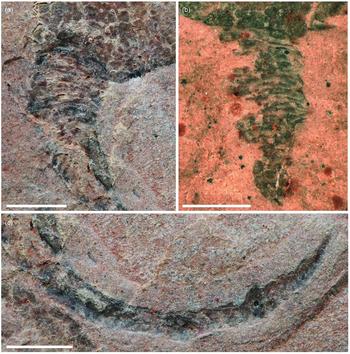
Pahvanticystis utahensis gen. et sp. nov., upper part of the Weeks Formation, Guzhangian (Cedaria Zone), House Range, Utah, USA: morphology of the homoiostele. (a) Holotype UU05072.02_01, proxistele and mesistele in upper aspect; proxistele, relatively short and consisting of imbricated telescopic rings; mesistele with well-preserved keel. (b) Paratype UU05072.03, proxistele in lower aspect. (c) Holotype UU05072.02_01, fully preserved twisted dististele, with sharp (keeled) edge directed upwards, and possible spike-shaped structure at distalmost sharp extremity. Scale bar: 2 mm. Specimens photographed (a, c) dry, using cross-polarized light, or (b) immersed under dilute ethanol.

Description: Thecal shape ovoid (UU05072.02_01; Fig. 1a) to pyriform (UU05072.01_01, UU05072.03; Fig. 1b, c). Theca more or less bilaterally symmetrical along an oblique axis extending from the apex to the anal opening, right of the homoiostele insertion. Maximum thecal length (TL) measured along apico-anal axis of symmetry, and maximum thecal width (TW) estimated perpendicularly to it. All specimens showing relatively elongate thecal outlines, with a ratio TL/TW ranging between 1.5 and 1.7. In the new material, TL varying from c. 10 mm (UU05072.01_01 and UU05072.01_02; Fig. 1c, d) to 12.5 mm (UU05072.02_01; Fig. 1a) and 14.5 mm (UU05072.03; Fig. 1b). Largest specimen corresponding to incomplete individual USNM 393393 (Ubaghs & Robison, Reference Ubaghs and Robison1985, figs 13.1, 14.1): estimated TW (17.8 mm) suggesting a TL of c. 28.5 mm (±1.7 mm).
Theca narrower anteriorly and broader posteriorly. Interindividual variations in thecal outlines suggesting flattening of an originally moderately inflated, pear-shaped body. However, preferential preservation of all individuals into two main, opposite orientations (lower vs upper aspect) suggesting original compression of the theca, perpendicularly to an extensiplane (sensu Caster, Reference Caster and Moore1968). In all specimens, presence of a regular, relatively narrow marginal rim along thecal edges probably taphonomic (post-mortem compression), rather than original (marginal frame or keeled lateral edges; but see Ubaghs & Robison, Reference Ubaghs and Robison1985). Anterior portion of theca forming a relatively narrow lobe, with lateral edges converging anteriorly and forming a rounded apical margin (Fig. 1a–c, e). Left (antanal) thecal margin moderately convex, relatively straight (UU05072.02_01; Fig. 1a) to more angular (UU05072.03; Fig. 1b), much shorter than right (anal) one. Preanal lobe moderately (UU05072.02_01; Fig. 1a) to strongly developed (UU05072.03; Fig. 1b), forming a more or less extensive outgrowth on right thecal margin. Posterior thecal edge strongly curved, with a short neck around homoiostele insertion. Neck apparently overlapping proximal-most rings of proxistele on upper thecal surface (UU05072.02_01; Figs 1a, 3a). Homoiostele insertion not in central position on posterior thecal edge, but clearly displaced towards antanal (left) margin: homoiostele insertion thus clearly oblique to longitudinal (apico-anal) axis of symmetry of theca.
Both thecal surfaces made of numerous, polygonal, adjacent (non-imbricate) plates forming a regular, tessellated pavement (Fig. 1). Size of thecal plates apparently relatively homogeneous and comparable on both surfaces. Exact number and precise boundaries of skeletal elements often difficult to establish, because of poor preservation caused by coarse-grained lithology. All thecal plates apparently smooth; their finely granular aspect probably resulting from the associated lithology. Homoiostele insertion framed by numerous, relatively small, unspecialized thecal plates (Fig. 3a, b). Base of brachiole similarly surrounded by undifferentiated skeletal elements, except on lower thecal surface, where two relatively large skeletal elements are present, one of them (the smaller one, on the left) clearly bearing a notch associated with an orifice (hydropore; UU05072.01_01, Fig. 2b). A second orifice (gonopore) possibly present(?) on larger, associated plate, on the right. No evidence of any node or orifice at base of brachiole on opposite (upper) thecal surface both in UU05072.02_01 (Fig. 2a) and in USNM 393393, in which this region is largely covered by a trilobite cranidium (Ubaghs & Robison, Reference Ubaghs and Robison1985, figs 13.1, 14.1).
Anal opening located at thecal extremity opposite to apical pole, close to and right of homoiostele insertion. Tiny anal pyramid protruding out of a small re-entrant (0.3–0.7 mm wide) along lateral wall of posterior margin of preanal lobe. Because of its lateral position, anal pyramid visible both in specimens in upper (UU05072.02_01; Figs 1a, 3a) and in lower aspects (UU05072.01_01, UU05072.03; Figs 1b, c, 2d). Anal cone best preserved in individual UU05072.03, and consisting of several (at least six are clearly distinct) elongate and narrow, acicular anal platelets, each c. 0.4 mm long and 0.1 mm wide (Fig. 2d).
Short and stout brachiole inserted laterally along antanal (left) thecal margin, at about one-fifth of distance between apical pole and homoiostele insertion. Brachiole consisting of four series of plates: two opposite, tightly sutured sets of pentagonal, moderately elongate, alternating brachiolar plates; and two opposite series of movable cover plates, rapidly decreasing in height distally. One cover plate articulated to each brachiolar plate. Specimen UU05072.01_01 showing complete, fully articulated, flexed brachiole, c. 4.3 mm long (Fig. 2b). Brachiole regularly decreasing in width from its base (c. 0.9 mm) to its distal-most extremity (0.5 mm), and exposing 14 successive cover plates (right series). Cover plates narrow, transversally elongate, more or less quadrangular to subtrapezoidal in shape, with a short, straight contact with associated brachiolar plate and a spine-like process on their free, opposite edge. Holotype (UU05072.02_01) with strongly recurved, well-preserved brachiole (in upper aspect), inserted into the theca (Fig. 2a). Brachiole c. 3 mm long, with both its proximal and distal extremities hidden under lower thecal surface. Brachiole width regularly decreasing from c. 0.8 (proximally) to 0.4 mm (distally). Exposed portion of brachiole showing two biseries of alternating brachiolar plates (each consisting of at least 14 elements), and part of associated left series of cover plates. Isolated portion of brachiole also present close to, though not connected to, theca in specimen UU05072.03 (Fig. 2c). Brachiole stump c. 2.3 mm long and 0.5 mm wide, consisting of c. 12 successive segments. Two longer brachiole fragments (8 and 12 mm long) preserved on slab USNM 393393 (Ubaghs & Robison, Reference Ubaghs and Robison1985, figs 13.1, 14.1).
Transition between theca and homoiostele abrupt. Homoiostele consisting of two well-distinct parts (proxistele and dististele) separated by a transition zone (mesistele). Almost complete, articulated homoiostele preserved in holotype (UU05072.02_01; Figs 1a, 3a, c), showing all three regions, and forming a flexed, delicate appendage slightly longer than the theca. Proxistele and mesistele of comparable length, and together about one-third the total length of the homoiostele.
Proxistele extremely short, relatively wide, consisting of eight to ten more or less regular, telescopic rings forming a highly flexible cylindrical structure, with an almost constant width along its length. Each transverse ring probably made of several skeletal elements, but their precise number (four?) and relative size difficult to establish, because of poor preservation. Holotype (UU05072.02_01; Fig. 3a) with gently flexed, slightly compressed fully articulated broad proxistele, almost as long as wide (2.5 mm). Specimen UU05072.03 (Fig. 3b) showing straight, extended, well-preserved proxistele, slightly longer (2.5 mm) than wide (2.2 mm). Proxistele also present in two other specimens (UU05072.01_01 and UU05072.02_02), but not so well preserved (Fig. 1c, e).
Mesistele cone-shaped, relatively short, made of tightly sutured plates forming a transition zone between wide, flexible proxistele, and narrower, rigid dististele. In the holotype (UU05072.02_01; Fig. 3a, c), mesistele c. 2.5 mm long, regularly tapering in width from 2 mm (anteriorly) to c. 0.8 mm (posteriorly). Upper surface of mesistele crossed by sharp oblique keel extending from about the appendage midline (proximally) to the right posterior edge of the transition zone (distally; Fig. 3a, c).
Dististele strongly flattened, curved and longest region of homoiostele. Morphology of distal part of homoiostele known from two specimens: USNM 393394 (see Ubaghs & Robison, Reference Ubaghs and Robison1985, figs 13.2, 14.2) and holotype (UU05072.02_01; Figs 1a, 3c). USNM 393394 corresponding to isolated dististele in lateral aspect, consisting of two main longitudinal series of short, broad and blocky elements, separated by irregularly arranged intercalated platelets (Ubaghs & Robison, Reference Ubaghs and Robison1985). Concave margin of dististele forming a thin, keeled edge. Convex margin of dististele made of smaller, thicker elements. Proximal part of dististele and connection with mesistele not preserved. Elongate narrow spike, at distal extremity of dististele (Ubaghs & Robison, Reference Ubaghs and Robison1985). No other obvious ornamentation (e.g. spines, comb-like structures) on lateral margins of dististele in USNM 393394. In holotype, well-preserved, 9 mm long, strongly curved dististele in upper aspect, articulated to mesistele (Fig. 3c). Distal part of homoiostele flattened perpendicularly to extensiplane, i.e. plane of maximum flattening of the theca and probably, proxistele. In holotype, narrow aspect of dististele resulting from its original, twisted orientation, compared to proxistele and theca, so that upper edge of dististele in UU05072.02_01 corresponds to concave, keeled margin of USNM 393394. In holotype, keeled (upper, concave), sharp margin of dististele in physical continuity with strong oblique keel on mesistele. Opposite (lower, convex) margin of dististele not visible in holotype. In UU05072.02_01, dististele moderately decreasing in width (thickness) along most of its length (from 0.8 to 0.4 mm), except in its distalmost sharp extremity, which possibly corresponds to a distal spike-shaped structure, as in USNM 393394.
5. Discussion
5.a. Palaeoecology of early solutans
Although solutans are extremely rare components of faunal assemblages in the Weeks Formation, their occurrence in small clusters suggests the probable existence of local aggregations of individuals. The three individuals of Pahvanticystis preserved on a same bedding plane (slabs UU05072.01–02) are all aligned in the same direction and similarly orientated, all exhibiting their lower surfaces on slab UU05072.01 and their upper surfaces on slab UU05072.02. However, as the up-direction of the slabs UU05072.01–02 was not recorded in the field, it is not possible to determine if the three associated solutans are preserved in their presumed life orientation or upside-down. Consequently, this material does not bring any further argument to the ongoing debate about the life orientation of solutans, and its implications on their putative feeding behaviour: suspension-feeding (ambulacral food groove facing away from the sea floor; e.g. Bather, Reference Bather1913; Gill & Caster, Reference Gill and Caster1960; Caster, Reference Caster and Moore1968; Ubaghs, Reference Ubaghs1970; Parsley, Reference Parsley1997; Rahman & Lintz, Reference Rahman and Lintz2012) or deposit-feeding (ambulacral groove facing the substrate; e.g. Kolata, Reference Kolata1973; Jefferies, Reference Jefferies1990; Daley, Reference Daley1996; Guensburg & Sprinkle, Reference Guensburg, Sprinkle, Zhuravlev and Riding2000; Lefebvre, Derstler & Sumrall, Reference Lefebvre, Derstler, Sumrall, Kroh and Reich2012; Noailles, Lefebvre & Kašička, Reference Noailles, Lefebvre and Kašička2014). The limited number of specimens preserved on the same bedding plane precludes the determination of whether their similar, unidirectional, orientation is purely fortuitous, related to ecology (e.g. all individuals facing the current for feeding) or indicative of a post-mortem transport.
A putative gregarious mode of life is generally inferred for many Early Palaeozoic echinoderms and, in particular, for solutans and other homalozoan taxa (see e.g. Ubaghs & Robison, Reference Ubaghs and Robison1988; Lefebvre, Reference Lefebvre2007; Noailles, Lefebvre & Kašička, Reference Noailles, Lefebvre and Kašička2014; Martin, Lefebvre & Vaucher, Reference Martin, Lefebvre, Vaucher, Zamora and Rabano2015; Zamora & Rahman, Reference Zamora, Rahman, Zamora and Rabano2015). In both Coleicarpus and Castericystis, gregarious behavior might have been related to their life-history strategy: a hard substrate was necessary for the settlement of the larvae and the fixosessile lifestyle of juveniles (see Ubaghs & Robison, Reference Ubaghs and Robison1985, Reference Ubaghs and Robison1988; Daley, Reference Daley1995, Reference Daley1996). The clustered adults might have represented islands of hard ‘substrate’, ideal for larval settlement, on an otherwise essentially soft sea floor, as suggested by the frequent observation of juveniles attached to larger individuals by the distal tip of their homoiostele in Coleicarpus and Castericystis (Ubaghs & Robison, Reference Ubaghs and Robison1985; Daley, Reference Daley1995, Reference Daley1996). Such aggregations of juveniles attached to adults were alternatively interpreted as evidence for asexual reproduction (budding) in basal solutans, thus supporting putative affinities with hemichordates (Smith, Reference Smith2008; but see Daley, Reference Daley1995, Reference Daley1996). However, it seems highly unlikely that the origin of juveniles in Coleicarpus and Castericystis involved budding, for (1) they are found attached virtually anywhere (brachiole, theca and homoiostele) on the body of larger specimens (Ubaghs & Robison, Reference Ubaghs and Robison1985; Daley, Reference Daley1995, Reference Daley1996), which is unlike the situation in colonial hemichordates; (2) they are also found fixed to various other hard items (e.g. brachiopod shells, sponges, pieces of disarticulated trilobites; see Daley, Reference Daley1996); and (3) other echinoderms (e.g. eocrinoids) are also attached to large individuals of Castericystis (Daley, Reference Daley1995, fig. 14D).
Unlike in Coleicarpus and Castericystis, no juveniles attached to large specimens have been observed so far in Pahvanticystis, but this may be due to the limited amount of material available (5 specimens vs >200 for Coleicarpus and >1000 for Casterocystis; Ubaghs & Robison, Reference Ubaghs and Robison1985, Reference Ubaghs and Robison1988). The morphology of the distal extremity of the dististele in Pahvanticystis resembles the situation in Castericystis and, indeed, in many other solutans with either a distal spike or a distal hook at the tip of their homoiostele (e.g. Dendrocystoides scoticus, Maennilia estonica, the Secret Canyon undescribed solutan; Sprinkle, Reference Sprinkle1973; Jefferies, Reference Jefferies1990; Rozhnov & Jefferies, Reference Rozhnov and Jefferies1996; Noailles, Lefebvre & Kašička, Reference Noailles, Lefebvre and Kašička2014). This small distal process suggests that an attached, post-larval pelmatozoan stage was probably not restricted to primitive solutans (e.g. Castericystis), but probably the rule in most taxa, including Pahvanticystis.
As in some other, more derived syringocrinids (e.g. Minervaecystis, Plasiacystis), the dististele of Pahvanticystis is twisted, so that it is flattened perpendicularly to the thecal extensiplane (sensu Caster, Reference Caster and Moore1968). A comparable, though weaker, torsion of the distal homoiostele may also occur in Castericystis (see Ubaghs & Robison, Reference Ubaghs and Robison1985, p. 12; but see Daley, Reference Daley1995). From a functional point of view, a strongly flattened locomotory posterior device is more efficient for crawling atop soft substrates, if it is oriented obliquely (or perpendicularly) to the sea floor, than if it is parallel to it. It is thus possible that the acquisition of a progressively more twisted dististele in middle to late Cambrian solutans from Utah (Castericystis, Pahvanticystis) might have been associated with increased mobility. In some syringocrinids, the modification of such a flattened, relatively elongate and oblique dististele (e.g. Minervaecystis, Pahvanticystis) into a short and broad paddle (e.g. Plasiacystis, unnamed Secret Canyon solutan) possibly represents a further adaptation for active crawling on soft substrates. It is thus unlikely that syringocrinids could use their flattened appendages for swimming (Ubaghs & Robison, Reference Ubaghs and Robison1985; Daley, Reference Daley1995; Prokop & Petr, Reference Prokop and Petr2003; but see Ubaghs, Reference Ubaghs1970).
5.b. Evolution of homoiostele morphology and phylogenetic implications
Noailles, Lefebvre & Kašička (Reference Noailles, Lefebvre and Kašička2014) recently proposed the subdivision of the class Soluta into two orders, the Syringocrinida and the Dendrocystitida, based on the morphology of the dististele. In syringocrinids, this region of the homoiostele is fundamentally wide, flattened and consists of two opposite (left and right) series of elements, whereas in dendrocystitids it is narrow, cylindrical and made of two opposite (upper and lower) series of plates. This distinction is relatively clear, if one considers syringocrinids with a non-twisted homoiostele: in both Castericystis and iowacystids, the plane of maximum flattening of the dististele coincides with the thecal extensiplane, and their dististele actually consists of two series of left and right elements (Parsley & Caster, Reference Parsley and Caster1965; Kolata, Strimple & Levorson, Reference Kolata, Strimple and Levorson1977; Ubaghs & Robison, Reference Ubaghs and Robison1985). However, in some other syringocrinids (e.g. Minervaecystis, Pahvanticystis, Plasiacystis), the torsion of the flattened dististele results in the rotation of its two series of elements, which form two files of overlying (upper and lower) plates. The resulting plate pattern is thus comparable to the situation in dendrocystitids. This observation questions the origin of the dendrocystitids, and the possibility that the twisted orientation of their dististele is inherited from a syringocrinid ancestor close to Pahvanticystis or Minervaecystis. At present, this hypothesis remains difficult to test, largely because of the limited amount of data available on the early diversification of dendrocystitids.
Dendrocystitids are relatively well known and locally abundant from the Middle Ordovician to the Early Devonian (Bather, Reference Bather1913; Gill & Caster, Reference Gill and Caster1960; Caster, Reference Caster and Moore1968; Jefferies, Reference Jefferies1990; Daley, Reference Daley1992; Rozhnov & Jefferies, Reference Rozhnov and Jefferies1996; Parsley & Sumrall, Reference Parsley and Sumrall2007; Rahman & Lintz, Reference Rahman and Lintz2012; Noailles, Lefebvre & Kašička, Reference Noailles, Lefebvre and Kašička2014). Older records of putative dendrocystitids are extremely scarce. A yet undescribed taxon from the Guole Formation (Furongian) of South China (Zamora, Zhu & Lefebvre, Reference Zamora, Zhu and Lefebvre2013b, fig. 2D) may represent the oldest known member of this solutan order. This identification relies chiefly on the large, rounded morphology of the periproct and on its location on the upper thecal surface. A definitive assignment of this single specimen to the dendrocystitids so far remains highly speculative, as the morphology of its dististele is unknown. A single specimen from the Saint-Chinian Formation (late Tremadocian) of Montagne Noire figured by Thoral (Reference Thoral1935, pl. 11 fig. 2; see also Ubaghs, Reference Ubaghs1970, pl. 16 fig. 5a, b) might also represent a basal dendrocystitid. The overall, quadrangular thecal morphology of this solutan, as well as the morphology and location of its periproct both suggest possible affinities with the slightly older solutan from the Guole Formation. This small individual was interpreted by Thoral (Reference Thoral1935) and Ubaghs (Reference Ubaghs1970) as a juvenile specimen of Minervaecystis vidali. This identification makes sense, as M. vidali is relatively common in the same levels and locality. If this interpretation is correct, it could suggest that dendrocystitids may derive from a Minervaecystis-like syringocrinid ancestor by paedomorphosis. Alternatively, the small dendrocystitid-like solutan from Montagne Noire may also belong to a new, yet undescribed species, possibly related to the Guole solutan.
5.c. A Laurentian origin for solutans?
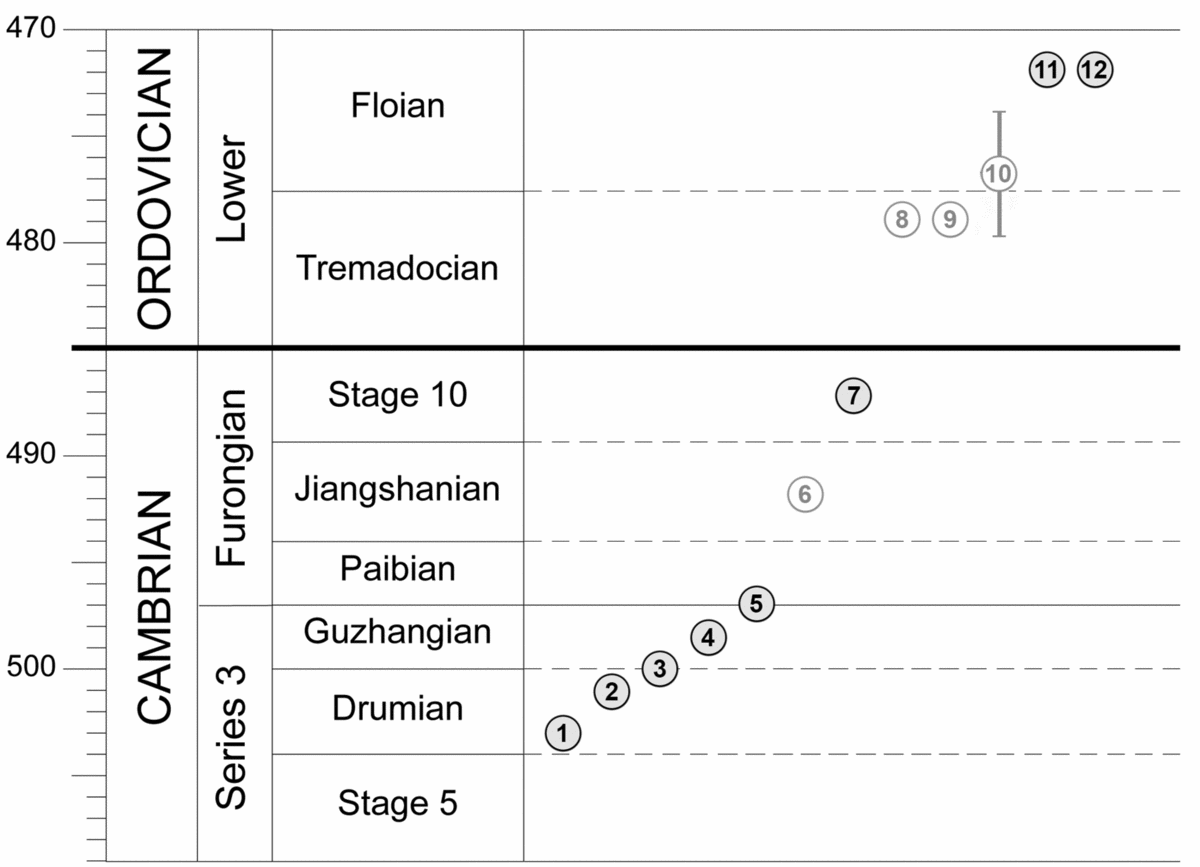
The Cambrian succession of the central House Range provides a unique and relatively continuous record of the early diversification of the class Soluta, with three occurrences of the group within a 5 Ma long time interval (Fig. 4): Coleicarpus sprinklei (upper Wheeler Formation, early Drumian), Castericystis vali (middle Marjum Formation, late Drumian) and Pahvanticystis utahensis (Weeks Formation, Guzhangian). Several other occurrences of Cambrian Series 3 – Early Ordovician solutans have been reported in Laurentia, mostly from the Great Basin region (Fig. 4): in late Drumian – early Guzhangian strata of the Secret Canyon Formation of Nevada, USA (solutan indet.; Sprinkle, Reference Sprinkle1973, Reference Sprinkle, Lipps and Signor1992; Zamora et al. Reference Zamora, Lefebvre, Alvaro, Clausen, Elicki, Fatka, Jell, Kouchinsky, Lin, Nardin, Parsley, Rozhnov, Sprinkle, Sumrall, Vizcaïno, Smith, Harper and Servais2013a), in the latest Guzhangian – basal Paibian Conasauga Formation of NE Alabama (solutan indet.; Bell & Sprinkle, Reference Bell and Sprinkle1980; Zamora et al. Reference Zamora, Lefebvre, Alvaro, Clausen, Elicki, Fatka, Jell, Kouchinsky, Lin, Nardin, Parsley, Rozhnov, Sprinkle, Sumrall, Vizcaïno, Smith, Harper and Servais2013a), in the Furongian (Cambrian Age 10) Whipple Cave Formation of Nevada (Minervaecystis? sp.; Ubaghs, Reference Ubaghs1963; Sumrall, Sprinkle & Guensburg, Reference Sumrall, Sprinkle and Guensburg1997; Zamora et al. Reference Zamora, Lefebvre, Alvaro, Clausen, Elicki, Fatka, Jell, Kouchinsky, Lin, Nardin, Parsley, Rozhnov, Sprinkle, Sumrall, Vizcaïno, Smith, Harper and Servais2013a) and in the late Floian lower WahWah Formation of Utah (minervaecystid indet. and possibly Drepanocystis dubius; Sprinkle & Guensburg, Reference Sprinkle, Guensburg and Taylor1993; Hintze & Davis, Reference Hintze and Davis2003; Sumrall et al. Reference Sumrall, Sprinkle, Guensburg and Dattilo2012). This relatively continuous record of solutans in Laurentia from the middle Cambrian to the Early Ordovician contrasts with the situation in other palaeocontinents (Lefebvre & Fatka, Reference Lefebvre and Fatka2003; Zamora et al. Reference Zamora, Lefebvre, Alvaro, Clausen, Elicki, Fatka, Jell, Kouchinsky, Lin, Nardin, Parsley, Rozhnov, Sprinkle, Sumrall, Vizcaïno, Smith, Harper and Servais2013a). In the Cambrian, the only occurrence of the class outside Laurentia is the single specimen recovered from the Jiangshanian Sandu Formation in South China (Zamora et al. Reference Zamora, Lefebvre, Alvaro, Clausen, Elicki, Fatka, Jell, Kouchinsky, Lin, Nardin, Parsley, Rozhnov, Sprinkle, Sumrall, Vizcaïno, Smith, Harper and Servais2013a; Zamora, Zhu & Lefebvre, Reference Zamora, Zhu and Lefebvre2013b). In the Early Ordovician, non-Laurentian occurrences are again solely from (peri)Gondwanan areas, such as the Montagne Noire, France (Saint-Chinian Formation, late Tremadocian; Thoral, Reference Thoral1935; Ubaghs, Reference Ubaghs1970), and the Anti-Atlas, Morocco (Fezouata Shale, late Tremadocian – middle Floian; Lefebvre & Fatka, Reference Lefebvre and Fatka2003; Lefebvre et al. Reference Lefebvre, Allaire, Guensburg, Hunter, Kouraïss, Martin, Nardin, Noailles, Pittet, Sumrall and Zamora2016). In both Avalonia and Baltica, solutans are not recorded before the Middle Ordovician (Darriwilian; see e.g. Jaekel, Reference Jaekel1901; Rozhnov & Jefferies, Reference Rozhnov and Jefferies1996; Lefebvre, Derstler & Sumrall, Reference Lefebvre, Derstler, Sumrall, Kroh and Reich2012; Botting, Muir & Lefebvre, Reference Botting, Muir and Lefebvre2013). Although the fossil record of solutans remains patchy, the currently available data strongly speak to a Laurentian origin for this class, in middle Cambrian times (Fig. 4). Even the only putative older occurrence is from the Cambrian Epoch 2 Kinzers Formation of Pennsylvania (Derstler, Reference Derstler1975; Paul & Smith, Reference Paul and Smith1984), and therefore from Laurentia also. However, the original interpretation of the single specimen as a solutan is extremely dubious and it more likely represents a crushed ostracod instead (Fortey in Daley, Reference Daley1996, p. 406).
Fossil record of Cambrian to Early Ordovician solutan echinoderms. Most occurrences are known from Laurentia (black numbers), except for a few, mostly Ordovician (peri-)Gondwanan ones (grey numbers). 1, Coleicarpus sprinklei, upper Wheeler Formation, Utah, USA. 2, Castericystis vali, middle Marjum Formation, Utah, USA. 3, solutan indet., Secret Canyon Formation, Nevada, USA. 4, Pahvanticystis utahensis, upper Weeks Formation, Utah, USA. 5, solutan indet., Conasauga Formation, Alabama, USA. 6, solutan indet., Sandu Formation, Guangxi, South China. 7, Minervaecystis? sp., Whipple Cave Formation, Nevada, USA. 8, Minervaecystis vidali, Saint-Chinian Formation, France. 9, minervaecystid indet., Fezouata Shale, Morocco. 10, Plasiacystis mobilis, Saint-Chinian Formation, France and Fezouata Shale, Morocco. 11, 12, minervaecystid indet. and Drepanocystis dubius, lower WahWah Formation, Utah, USA. Left columns based on the 2015 international chronostratigraphic chart (updated from Cohen et al. Reference Cohen, Finney, Gibbard and Fan2013). Stratigraphic data on solutans extracted from relevant literature on France (Thoral, Reference Thoral1935; Ubaghs, Reference Ubaghs1970; Vizcaïno & Lefebvre, Reference Vizcaïno and Lefebvre1999), Morocco (Lefebvre et al. Reference Lefebvre, Allaire, Guensburg, Hunter, Kouraïss, Martin, Nardin, Noailles, Pittet, Sumrall and Zamora2016), South China (Zhu et al. Reference Zhu, Peng, Zamora, Lefebvre and Chen2016), and western and southern USA (Ubaghs, Reference Ubaghs1963; Sprinkle, Reference Sprinkle1973, Reference Sprinkle, Lipps and Signor1992; Bell & Sprinkle, Reference Bell and Sprinkle1980; Ubaghs & Robison, Reference Ubaghs and Robison1985, Reference Ubaghs and Robison1988; Sprinkle & Guensburg, Reference Sprinkle, Guensburg and Taylor1993; Daley, Reference Daley1995, Reference Daley1996; Sumrall, Sprinkle & Guensburg, Reference Sumrall, Sprinkle and Guensburg1997; Hintze & Davis, Reference Hintze and Davis2003; Sumrall et al. Reference Sumrall, Sprinkle, Guensburg and Dattilo2012; Zamora et al. Reference Zamora, Lefebvre, Alvaro, Clausen, Elicki, Fatka, Jell, Kouchinsky, Lin, Nardin, Parsley, Rozhnov, Sprinkle, Sumrall, Vizcaïno, Smith, Harper and Servais2013a).

In this context, the description of Pahvanticystis documents a key transition in the early diversification of solutans, with two major innovations possibly related to the adoption of a vagile mode of life: (1) the absence (or extreme reduction?) of the attached (pelmatozoan) juvenile stage; and (2) the torsion of its dististele, perpendicularly to the thecal extensiplane. As a consequence, the morphology of Pahvanticystis appears in many respects to be somewhat intermediate between those of Castericystis and Minervaecystis.
Acknowledgements
We are particularly indebted to M. Donovan (Salt Lake City), who found the specimens described herein and generously donated them to UU, and Q. Sahratian (UU), who made these specimens available for study. This work is a contribution to the RALI (‘Rise of Animal Life’) project, which was funded by the ANR (Agence Nationale de la Recherche, France; grant number ANR-11-BS56-0025). This paper is also a contribution to IGCP project 653 ‘The onset of the Great Ordovician Biodiversification Event’. The work of R.L.-A. was supported by the Committee for Research and Exploration of the National Geographic Society (Grant #9567). The authors are also particularly grateful to J. Sprinkle for information on the age of the unnamed Cambrian solutans from the Conasauga Shale and the Secret Canyon Formation, and to both an anonymous reviewer and J. Sprinkle for their critical and constructive comments.