Introduction
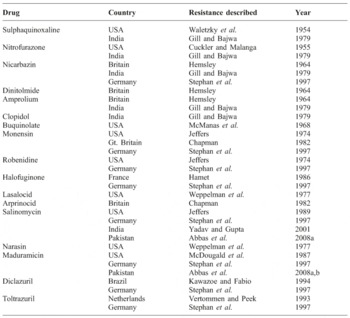
Control of coccidiosis chiefly depends upon prophylactic chemotherapy with anticoccidial drugs (McDougald and Reid, Reference MCDOUGALD and REID1994). With the passage of time, a large number of anticoccidial drugs have been introduced but resistance to all of them has been described in different parts of the world (Table 1). Periodic monitoring of coccidia for development of resistance against commonly used prophylactics is, therefore, imperative for economical poultry production. Better awareness and socio-economic conditions of farmers and state-sponsored animal health facilities in industrialised or developed countries have led to frequent reports on anticoccidial resistance (Stephan et al., Reference STEPHAN, ROMMEL, DAUGSCHIES and HABERKORN1997; Weber, Reference WEBER1997; Li et al., Reference LI, KANU, XIANG, XIAO, ZHANG, CHEN and YE2004). In the case of poultry reared for meat production, anticoccidial drugs are frequently included in the feed for the maintenance of the bird, and this ensures that few parasites escape the effects of medication. This practise has persistently resulted in the development of resistance (Chapman, Reference CHAPMAN1997). This paper discusses the different aspects of the drug resistance in the following sections for the better understanding and control of resistant Eimeria species.
Reports of resistance in fowl coccidia against anticoccidial drugs.

What is resistance?
Resistance is generally first recognised as a failure of drugs to control parasitism but the formal definition of resistance is a shift in susceptibility to a drug (Sangster and Dobson, Reference SANGSTER and DOBSON2001). A number of different methods are used for the measurement of drug resistance. Mostly, it is expressed in terms of survival of parasites following a drug administration that would be expected to be effective, or in other words, it may be accepted as a reduction in the sensitivity of a parasite for a specific drug. The World Health Organization Scientific Group (World Health Organization, Reference WORLD HEALTH ORGANIZATION1965) developed the definition of resistance in broad terms as ‘the ability of a parasite strain to survive and/or to multiply despite the administration and absorption of a drug given in doses equal to or higher than those usually recommended but within the limits of tolerance of the subject’. Such a general definition could be accepted as a basis for the discussions on coccidiosis.
Types of resistance
acquired resistance
Acquired resistance is defined as ‘a resistance that results from heritable decreases in sensitivity of certain strains and species of Eimeria to drugs with the passage of time’. For example, resistance to sulfaquinoxaline may be induced in E. acervulina and E. tenella (Cuckler and Malanga, Reference CUCKLER and MALANGA1955). There are two types of acquired resistance, partial or complete. These types depend upon the extent of sensitivity lost. There is a direct relationship between concentration of the drug and degree of resistance. A strain controlled by one dose of a drug may show resistance when a lower concentration of the same drug is administered. This may allow for the selection of initially resistant mutants to low levels of drug (Chapman, Reference CHAPMAN1982). Slight differences have been reported in the efficacy of various polyether ionophores (McDougald, Reference MCDOUGALD1993). Ryley and Wilson (Reference RYLEY and WILSON1972) suggested that these type of differences in activity might be due to two reasons 1) a true variation in species response or 2) differences in the metabolism and distribution of drugs. However, a previous sub-lethal exposure may be the third reason for the differential anticoccidial susceptibility.
cross resistance
Cross-resistance is the sharing of resistance among different compounds with a similar mode of action. This, however, may not always occur (Chapman, Reference CHAPMAN1997). For example, Smith et al. (Reference SMITH, GALLOWAY and WHITE1981) reported inconsistent results of cross-resistance in isolates of Eimeria to different ionophorous anticoccidials (lasalocid, monensin, narasin and salinomycin) having similar mode of action. Differences in efficacy between lasalocid or maduramicin and other ionophores have also been reported by Weppelman et al. (Reference WEPPELMAN, OLSON, SMITH, TAMAS and VAN IDERSTINE1977) and Bedrnik et al. (Reference BEDRNIK, JURKOVIC, KUCERA and FIRMANOVA1989). In contrast, investigations (Ruff et al., Reference RUFF, CHUTE and MCLOUGHLIN1985; Ryley, Reference RYLEY1980; Abbas et al., Reference ABBAS, IQBAL, SINDHU, KHAN and ARSHAD2008a, Reference ABBAS, IQBAL and KHAN2009) indicate that Eimeria isolates resistant to one ionophore are resistant to the others. A high degree of cross resistance has been reported among maduramicin, monensin, salinomycin, narasin, and lasalocid (Raether and Paeffgen, Reference RAETHER and PAEFFGEN1989), but a number of reports (McDougald et al., Reference MCDOUGALD, WANG, KANTOR, SCHENKEL and QUARLES1987; Bedrnik et al., Reference BEDRNIK, JURKOVIC, KUCERA and FIRMANOVA1989; Yadav and Gupta, Reference YADAV. A. and GUPTA2001; Abbas et al., Reference ABBAS, IQBAL, SINDHU, KHAN and ARSHAD2008a) are available stating that maduramicin was effective in controlling isolates of Eimeria resistant to other ionophores. McDougald (Reference MCDOUGALD1993) suggested that the knowledge of differences in efficacy of different ionophores might be useful for the proper control of coccidiosis. In a study conducted by Abbas et al. (Reference ABBAS, IQBAL, SINDHU, KHAN and ARSHAD2008a), it has been found that field isolates of Eimeria tenella resistant to ionophores can be controlled in a better way by using the synthetic drugs such as clopidol (having different mode of action). Therefore, if the routinely used anticoccidial is ineffective, it is preferable to use other anticoccidial that does not share a similar mode of action.
multiple resistance
Multiple resistance is a resistance to more than one drug, even though they have different modes of action (Chapman, Reference CHAPMAN1993). So, it is important to clarify that cross resistance and multiple resistance are not similar. Abbas et al. (Reference ABBAS, IQBAL, SINDHU, KHAN and ARSHAD2008a) investigated the occurrence of multiple resistance in three field isolates of E. tenella, obtained from broiler farms in Pakistan. Out of the three field isolates only one isolate showed multiple resistance to the ionophores salinomycin and maduramicin as well as clopidol. There may be many reasons for the development of multiple resistance in field isolates of Eimeria strains. Multiple resistance may arise as a result of sequential exposure to the compounds in question in successive flocks (Joyner and Norton, Reference JOYNER and NORTON1978). Most likely, genetic recombination is one mechanism by which multiple resistance arise in the field (Stephan et al., Reference STEPHAN, ROMMEL, DAUGSCHIES and HABERKORN1997).
Factors involved in resistance development
A number of factors are involved which may contribute in the development of resistance. These factors can be broadly divided into genetic, operational and biological factors (Georghiou and Taylor, Reference GEORGHIOU and TAYLOR1977). The understanding of these factors is fundamental to understand the wide spread development of resistance.
Parasite genetic factors include dominance of resistance alleles, number of genes involved, initial frequency of resistance genes, genetic diversity of population, relative fitness of resistant organisms, chance of linkage disequilibrium and opportunity for genetic recombination. It may be dictated by the ploidy of the organism during selection (Chapman, Reference CHAPMAN1997). The degrees of dominance of resistance genes are absent in Eimeria because the asexual stages are haploid. Resistant mutants will, therefore, be immediately selected in the presence of a drug at the expense of sensitive forms. Emergence and spread of resistance is very rapid in case of field isolates of Eimeria because the multiplication of coccidian is very fast as one sporulated oocyst of Eimeria can give rise to more than 2.1 million oocysts. Therefore, resistance can quickly become the dominant phenotype and spread throughout the parasite population in a particular area (Chapman, Reference CHAPMAN1997). Selection for some organisms may involve a single gene for resistance or several genes may be selected, often sequentially, but unfortunately, these factors are not under human control.
Operational aspects include the chemical nature of drug, possibility of cross resistance, drug persistence in the host and drug clearance kinetics. Drug application factors include application and selection threshold, life stage(s) selected, mode of application, frequency of treatment, timing of treatments, spatial use of treatments and use of the other forms of coccidiosis control. Other possible reason for resistance may involve inadequate mixing or under-dosing of these drugs. In case of poor mixing, a proportion of the flock will ingest inadequate and ineffective concentrations of the drug. Under-dosing can occur with the use of inferior quality drugs. This will allow for the selection of mutants initially resistant to low levels of treatment (Chapman, Reference CHAPMAN1982). Drug-resistant parasites are more likely to be selected if parasite populations are exposed to sub-therapeutic drug concentrations through (1) unregulated drug use, (2) use of inadequate drug regimens, and (3) the use of long half-life drugs. However, in case of ionophores, it may be possible to initiate selection for resistance even where the recommended concentrations of the drug has been applied. This is because ionophores do not completely suppress oocyst production (Chapman, Reference CHAPMAN1984).
Among operational factors, the most important is the frequent use of the same anticoccidials for a long period of time within a flock or between the flocks. This highlights the point that choice of anticoccidials is very important. Usually there is some degree of cross-resistance to anticoccidials within the same class. However, this problem of cross resistance can be addressed by using the combination of anticoccidials having different modes of action (Abbas et al., Reference ABBAS, IQBAL, SINDHU, KHAN and ARSHAD2008a). It has also been found that, if a drug, for which the parasite has developed resistance, is withdrawn from use for some time, or if it is combined with another effective drug, the sensitivity to that drug may return (Chapman, Reference CHAPMAN1997).
Generally, resistance to good quality drugs occurs more rapidly than that to the poor quality forms. Here, ‘good’ is defined as easily available, effective and affordable. Therefore, increased and unregulated use of effective anticoccidial drugs is a risk factor for the emergence of drug resistance.
Although not strictly true, it has been postulated that in case of a better control of coccidial species using drugs (excluding where eradication occurs), there is more likelihood for the development of resistance (Sangster, Reference SANGSTER2001). Unlike genetic factors, operational factors can be controlled by proper management by producers, particularly by educating poultry farmers regarding the correct use of the anticoccidial drugs.
Biological factors are classified as biotic or behavioural. Biotic factors include generation time, offspring per generation and breeding patterns. Behavioural aspects are those that affect gene flow and the chance of selection (Sangster, Reference SANGSTER2001). These include isolation, mobility, migration, monophagy or polyphagy (host range), fortuitous survival and refugia.
The biological aspects, mainly involved in the host–parasite relationship, also influence the mechanism of selection for resistance. For example, parasites which induce effective immunity in their hosts will be under weaker selection pressure for resistance because immunity selects parasites irrespective of drug-resistance status and this reduces the chance of resistant parasites surviving and reproducing. The predilection of organisms for certain environmental conditions influences the likelihood that resistance will develop. The pathogenicity of the parasite will influence how many parasites are required to affect production and, therefore, how often treatments are given. Sangster (Reference SANGSTER2001) is of the opinion that higher the proportion of population in refugia, the slower the selection for resistance. Refugia are populations of organisms within the total population which escape the effects of drug treatment. Oocysts present in the litter which remain unexposed to drug are in refugia. Early developmental stages of the coccidian life cycle which are not susceptible to the effects of some drugs also fall under the definition of refugium.
Mechanisms of resistance development
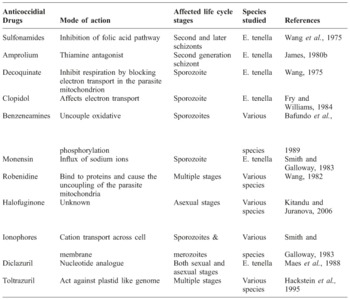
It is impossible to understand the mechanisms involved in the development of resistance in Eimeria isolates without understanding basic knowledge of mode of action of anticoccidial drugs. There is a diverse range of the mode of action of anticoccidial drugs (summarised in Table 2), e.g., effects upon membrane function (ionophores), energy metabolism (quinolones, clopidol, nicarbazin and robenidine), co-factor synthesis (amprolium, sulphonamides) and DNA synthesis (arprinocid).
The common anticoccidial drugs with their mode of action.

resistance against ionophores
There is a considerable variation in the uptake of ionophores in sensitive and resistant lines of Eimeria (Augustine et al., Reference AUGUSTINE, SMITH, DANFORTH and RUFF1987). For example, uptake of monensin by sporozoites of a drug resistant line of E. tenella is significantly less than by the sporozoites of a more sensitive line. The exact mechanism involved in the development of resistance is unknown, but differences in ionophore accumulation in sensitive and resistant lines of Eimeria may be involved in the expression of resistance. Protein differences in sporozoites in resistant and sensitive lines of Eimeria may be involved in the acquisition of resistance to monensin (Zhu et al., Reference ZHU, JOHNSON and MCDOUGALD1994). According to Smith and Strout (Reference SMITH and STROUT1979), ionophores such as narasin are accumulated by extra cellular sporozoites and the coccidial effect may be expressed prior to penetration of the cells (Itagaki et al., Reference ITAGAKI, TSUBOKURA and OTSUKI1974; Smith and Strout, Reference SMITH and STROUT1979). Differences in the biochemical composition of the parasite membrane may also be involved in the development of resistance to ionophores in Eimeria.
It is clear from this discussion that the development of resistance in Eimeria strains against ionophores may be due to alteration in the permeability of their cell membrane and for this purpose, elementary changes in the biophysical properties of the cell wall of the parasite would be required to handle the diverse range of cellular processes dependent upon ion transport.
resistance against sulfa drugs
Sulphonamides were the first drugs to be extensively used for the control of coccidiosis and have long been recognised as important in antimicrobial chemotherapy. These drugs act by inhibiting the folic acid pathway and prevent the synthesis of dihydrofolate by inhibiting the enzyme dihydropteroate synthase, which is not present in the host (Wang et al., Reference WANG, STOTISH and POE1975). The development of resistance against pyrimethamine/sulphadoxine has been studied (Peterson et al., Reference PETERSON, WALLIKER and WELLEMS1988; Triglia and Cowman, Reference TRIGLIA and COWMAN1994) and has been associated with mutations in two genes, the dhfr (dihydrofolate reductase) and the DHPS (dihydropteroate synthase) loci. Furthermore, selection of mutations in these genes during in vivo studies has also been mentioned (Curtis et al., Reference CURTIS, DURAISINGH and WARHURST1998).
resistance against thiamine mimics
Like sulphonamides, amprolium is principally used for the treatment of coccidiosis. Many field strains show reduced sensitivity to amprolium but resistance to this drug is difficult to develop in the laboratory. Amprolium competes for the uptake of thiamine by second generation schizonts of E. tenella (James, Reference JAMES1980a). Thiamine is converted to thiamine pyrophosphate in the cell and this coenzyme is involved in many important reactions of carbohydrate metabolism. According to Rogers (Reference ROGERS1962), amprolium cannot be pyrophosphorylated because it lacks the hydroxyethyl group of thiamine and therefore, these reactions cannot take place. Thiamine transport in the parasite is more sensitive to amprolium than thiamine transport in the host (James, Reference JAMES1980b). The amprolium resistant line showed decreased sensitivity to the inhibitory effects of the drug and this was thought to reflect changes at the molecular level in the unknown target receptor.
resistance against quinolones
Quinolones block electron transport in the parasite mitochondrion and ultimately inhibit the respiration of the coccidia (Wang, Reference WANG1975). Ryley and Betts (Reference RYLEY and BETTS1973) demonstrated that coccidia showed sensitivity even at extremely low concentrations of quinolones and it was suggested that the parasites might concentrate these drugs from the surrounding medium. Therefore, Wang (Reference WANG1975) proposed that a selection of parasites having inability to take up or concentrate the drug could be a mechanism for the development of resistance. Based on the mode of action of the quinolones, the use of an alternative biochemical pathway may be the possible mechanism for the development of resistance in Eimeria isolates against this class of anticoccidials.
resistance against pyridone
The pyridones such as clopidol also affects electron transport in coccidia, but has a different mode of action from the quinolones. The Eimeria strains sensitive to the pyridones may be resistant to the quinolones or vice versa. This difference of activity may be due to the effect of these drugs at different points to block the electron transport but exact mechanism involved is unknown (Fry and Williams, Reference FRY and WILLIAMS1984).
resistance against guanidine
The anticoccidial toltrazuril (a member of guanidine class) is applied via inclusion in the drinking water. NADH oxidase and succinate cytochrome reductase obtained from the mitochondria in mouse livers have been shown to be inhibited by toltrazuril, suggesting a possible effect upon mitochondrial respiration (Harder and Haberkorn, Reference HARDER and HABERKORN1989). The drug is now thought to inhibit the function of Dl protein (a vital component of PSII). These components may be involved in electron transport at low oxygen concentrations, or possibly provide oxygen radicals to facilitate entry of parasites into host cells (Hackstein et al., Reference HACKSTEIN, MACKENSTEDT, MEHLHORN, MEIJERINK, SCHUBERT and LEUNISSEN1995). Toltrazuril causes swelling in the endoplasmic reticulum of developmental stages of Eimeria species at drug concentrations that do not affect cells of the host (Mehlhorn et al., Reference MEHLHORN, ORTMANN-FALKENSTEIN and HABERKOM1984). Therefore, drug is now considered to act against plastid—like organelles that are present in the parasite (Hackstein et al., Reference HACKSTEIN, MACKENSTEDT, MEHLHORN, MEIJERINK, SCHUBERT and LEUNISSEN1995).
In summary, a number of mechanisms are known by which coccidia become resistant to anticoccidial drugs. Resistance may involve altered permeability of the cell membrane so that the drug is no longer taken up or is rapidly pumped out of the cell (ionophores), use of an alternative biochemical pathway (clopidol, quinolones), and modification of the target sites in the coccidia parasites (amprolium).
Geographical variation in resistance development
To evaluate the development of resistance against anticoccidial drugs, it is necessary to use more than one field isolate of the Eimeria species because only one isolate is insufficient to give conclusive information about resistance in field conditions. Eimeria field isolates of one species consists of several strains. Environmental selection pressures in different geographical locations, as well as the history of drug use, may differ with each other. Therefore, strains resistant in one area may be sensitive in the other area. These strain variants may express different epitopes, leading to immunological diversity as evidenced by lack of cross protection (Martin et al., Reference MARTIN, DANFORTH, BARTA and FERNANDO1997). Resistance tests give an overview of the combined effects of all these strains, and sensitive, partially resistant and resistant strains contribute to this conclusive picture. Therefore, it is not necessary that every resistant strain must show all resistances detected in the isolate (Stephan et al., Reference STEPHAN, ROMMEL, DAUGSCHIES and HABERKORN1997). Abbas et al. (Reference ABBAS, IQBAL, SINDHU, KHAN and ARSHAD2008a) reported similar results while testing sensitivity of three field isolates of E. tenella against salinomycin, maduramicin and clopidol. All three field isolates of E. tenella exhibited partial resistance only against salinomycin. Varying levels of susceptibility to maduramicin and clopidol were noted. Isolate 2 was the most susceptible, followed by isolates 3 and 1, respectively, for maduramicin. Clopidol showed good efficacy against isolates 2 and 3, but isolate 1 showed partial resistance. None of the E. tenella field isolates showed complete sensitivity or complete resistance to these anticoccidials. Isolate 1, however, showed cross-resistance between salinomycin and maduramicin (polyether ionophore antibiotics) and multiple resistance for salinomycin, maduramicin and clopidol (Abbas et al., Reference ABBAS, IQBAL, SINDHU, KHAN and ARSHAD2008a).
Resistance management
controlling the multiplication and spread of resistant strains of Eimeria
Control of multiplication and spread of resistant strains/isolates of Eimeria may be carried out by following the general recommendations for the control of coccidiosis. Under intensive poultry rearing conditions, coccidial oocysts are ubiquitous and easily disseminated in the poultry house environment and have large reproduction potential. In litter, sporulation of coccidial oocysts is very rapid, especially in the presence of 60-80% humidity. Although, sporulated oocysts begin to decline in numbers after three weeks in the presence of bacteria, other organisms, and ammonia (Williams, Reference WILLIAMS1995), further steps can be taken to reduce the birds’ exposure to them. It is recommended that litter around water drinkers should be removed and a fresh top layer applied before housing the chicks. It is also useful if watering facilities and ventilation are improved to the point where conditions inhibit sporulation (Ruff, Reference RUFF1999). The main factors of consideration in the environmental management are good ventilation, thorough clean out between flocks, removal of moisture sources and keeping the litter dry, optimum bird density, low stress and good feed and water management. Leaving the shed empty for a period between flocks will allow the destruction of oocysts. Furthermore, the biocontrol measures also play an important role to minimise the spread of resistant oocysts. Therefore, strict biosecurity measures are essential particularly in the case of broiler breeders. Care takers should change the complete dress before visiting the new poultry house to minimise the spread of resistant oocysts (Allen and Fetterer, Reference ALLEN and FETTERER2002).
introducing shuttle and/or rotational programmes
In spite of the rotation of coccidiostats, the poultry industry has been challenged by the development of Eimeria resistance to multiple drugs (Daugschies et al., Reference DAUGSCHIES, GASSLEIN and ROMMEL1998). Shuttle programmes are used widely for the control of coccidiosis with a good success rate. In this programme, two or more drugs belonging to different classes of anticoccidials are used within a single flock e.g. use of one class of drug in starter feed, another in growers, returning to the first for the finisher diet, followed by a withdrawal diet. The value of shuttle programmes to reduce the selection for resistance has not been fully evaluated (Chapman, Reference CHAPMAN1997) and the short period of use of each class probably provides insurance against one drug class failing.
As seen for shuttle programmes, rotational programmes have also been widely practiced. In this programme, drug classes are rotated from one crop to another, not within a single crop. Such programmes may also be chosen for its convenience in feed mills rather than as a scientifically based method for reducing selection for resistance. ‘Step down’ programmes have been promoted where concentrations of the drugs are reduced as the birds get older. This may be helpful in the development of immunity in the older birds, but on the other hand, this practise can cause selection for drug resistance.
the integrated approach
Immunity enhancement and reduction in the ingestion of coccidial oocysts are two important tools of coccidiosis control. Birds have opportunities to develop immunity against coccidia because many anticoccidial drugs act late in the cycle, have less than complete efficacy or are already resisted (Chapman, Reference CHAPMAN2000). Vaccination is another valid approach. In the field, promising results have been obtained by applying anticoccidial drugs and vaccination in combination. A typical programme is to use one drug (or a shuttle programme) for several flocks followed by vaccination for several flocks, then a drug from a different class for subsequent flocks (Chapman, Reference CHAPMAN2000). Live vaccines provide assistance in diluting resistant genotypes present in sheds with the susceptible genotypes of the vaccine isolate. Thus, longer phase before come back to a drug class, control of Eimeria by non-chemical means and dilution of resistance genes will counter-select for resistance. Non-chemical control may involve the integration of botanical anticoccidials with vaccination and chemical control of coccidiosis.
Use of botanical anticoccidals and other natural products may be provide a novel approach for the control of coccidiosis, whilst meeting the urgent need for control due to increasing emergence of drug-resistant parasite strains in commercial poultry production (Allen and Fetterer, Reference ALLEN and FETTERER2002). Feeding natural dietary supplements or probiotics to animals to enhance their innate defence mechanisms could effectively reduce or eliminate the need for therapy of these enteric infections (Alfaro et al., Reference ALFARO, SILVA, BORGES, MAIORKA, VARGAS and SANTIN2007). Botanical use is an appealing area that can be used in antiparasitic therapy (Anthony et al., Reference ANTHONY, FYFE and SMITH2005). A number of plant-derived compounds (Alfaro et al., Reference ALFARO, SILVA, BORGES, MAIORKA, VARGAS and SANTIN2007; Naidoo et al., Reference NAIDOO, MCGAW, BISSCHOP, DUNCAN and ELOFF2008; Abbas et al., Reference ABBAS, IQBAL, KHAN, ZAFAR and ZIA2010) and natural products (Allen and Fetterer, Reference ALLEN and FETTERER2002) appear to have anticoccidial activities against Eimeria species commonly found in poultry. Therefore, in some countries plant-based formulations, such as Apacox (Apa-CT, s.r.l. Italy) and NatustatTM (Alltech Inc., KY, USA), are used for the control of coccidiosis in chickens (Christaki et al., Reference CHRISTAKI, FLOROU-PANERI, GIANNENEA, PAPZAHARIADOU, BOTSOGLOU and SPAIS2004; Duffy et al., Reference DUFFY, MATHIS and POWER2005). Most of ethnoveterinary bioactive products and plant essential oils are extensively being tested to establish the efficacy of their parasiticide activity, their mechanism of action and their target parasite species (Athanasiadou et al., Reference ATHANASIADOU, GITHIORI and KYRIAZAKIS2007).
improving genetic resistance in birds
Improving genetic resistance of birds to coccidiosis represents an attractive alternative to drug therapy. Different strains of domestic poultry have been assessed for their capability to resist coccidial infections (Pinard-Van Der Laan et al., Reference PINARD-VAN DER LAAN, MONVOISIN, PERY, HAMET and THOMAS1998). Large genetic variation for resistance to E. tenella has been demonstrated by comparing several outbred lines. The importance of the host genetics on the outcome of the disease has been demonstrated by comparisons of inbred lines (Bumstead and Millard, Reference BUMSTEAD and MILLARD1987; Lillehoj et al., Reference LILLEHOJ, RUFF, BACON, LAMONT and JEFFERS1989) or more infrequently of outbred lines. Johnson and Edgar (Reference JOHNSON and EDGAR1986) were successful in divergently selecting for survival to acute infection with E. tenella. Significant genetic variability of resistance to coccidiosis has been assessed by population analysis (Mathis et al., Reference MATHIS, WASHBURN and MCDOUGALD1984). Innate resistance is measured in individual birds by measures of lesion score, mortality, and body weight gain at slaughter, and plasma coloration post-inoculation.
regular monitoring for drug resistance
Ideally, to reduce the development of resistance, knowledge of the Eimeria species present and resistance status should be determined before the selection of anticoccidial drugs. Unfortunately, tools to determine resistance status rapidly are not available. Development of in vitro tests for this purpose would be very useful. The extension of mathematical models (Henken et al., Reference HENKEN, PLOEGER, GRAAT and CARPENTER1994) to help understand coccidia dynamics, drug resistance and production systems would be a valuable advance.
Conclusions
Regular monitoring of Eimeria species for development of resistance against different anticoccidial groups has a crucial role in the management of resistance and making a correct choice of an effective drug. Use of vaccines, synthetic and botanical anticoccidials in combination and educating the farmers about recommended coccidiosis control practices as strategic and/or tactic measures for the control of coccidiosis would be rewarding. Integration of currently available options for the management of drug resistance and control of coccidiosis is suggested. It would be worthwhile in future for researchers to focus on evaluation of such integrated programmes.