





1 Introduction
This paper is a contribution to the theory of integral models of certain Shimura varieties. In particular, we will give a concrete description of their basic loci. These problems have important applications to Kudla’s programme, which relates arithmetic intersection numbers of special cycles on integral models of certain Shimura varieties to Eisenstein series (see [Reference Kudla and RapoportKR11] and [Reference Kudla and RapoportKR14a]), and the Arithmetic Gan-Gross-Prasad conjecture (see [Reference ZhangZha12], [Reference Rapoport, Smithling and ZhangRSZ18], [Reference Rapoport, Smithling and ZhangRSZ20] and [Reference Rapoport, Smithling and ZhangRSZ17]). In this paper, we study the basic locus of the special fibre of a certain unitary Shimura variety at an inert prime with parahoric level structure. Let
$(\tilde {G},h_{\tilde {G}})$
 be a Shimura datum and let
$K_{\tilde {G}}$
 be an open compact subgroup in
$\tilde {G}({\mathbb A}_{f})$
 . We refer to Section 4 for the precise definition. This Shimura variety has a moduli interpretation
$M_{K_{\tilde {G}}}(\tilde {G})$
 as a moduli space of abelian varieties with additional structure. This Shimura variety is a variant of the Shimura variety which appears in [Reference Gan, Gross and PrasadGGP12], and its integral model
${\mathcal M}_{K_{\tilde {G}}}(\tilde {G})$
 is defined in [Reference Rapoport, Smithling and ZhangRSZ20]. The basic locus of the special fibre of
${\mathcal M}_{K_{\tilde {G}}}(\tilde {G})$
 can be studied using the uniformization theorem of Rapoport and Zink, [Reference Rapoport and ZinkRZ, Theorem 6.30] (more precisely, see Theorem 4.3). Therefore, we can study the corresponding Rapoport–Zink space and use its explicit description to study the basic locus of the special fibre of the Shimura variety.
We will now describe our main results in more detail. First, let us consider the Rapoport–Zink spaces, which are local analogues of Shimura varieties.
1.1 The local result: relative Rapoport–Zink spaces
Let F be a finite unramified extension of
${\mathbb Q}_p$
 , and let E be a quadratic unramified extension of F with ring of integers
$O_E$
 and residue field
${\mathbb F}_{q^2}$
 . Let
$\breve {E}$
 be the completion of a maximal unramified extension of E. Fix integers n and
$0 \leq h,r \leq n$
 . Here, h is related to a certain self-dual lattice chain, and r is related to the determinant condition. We define a moduli space
${\mathcal N}^h_{E/F}(r,n-r)$
 over
$\operatorname {\mathrm {Spf}} O_E$
 of quasi-isogenies of strict formal
$O_F$
 -modules with additional structure (see Section 2 for its definition). If
$h=0$
 ,
$r=1$
 ,
$F={\mathbb Q}_p$
 and
$E={\mathbb Q}_{p^2}$
 , then this moduli space coincides with the Rapoport–Zink space that is studied by Vollaard and Wedhorn ([Reference Vollaard and WedhornVW11]). This case corresponds to the hyperspecial level structure case. In their paper, they proved that the irreducible components of the induced reduced scheme of
${\mathcal N}^0_{{\mathbb Q}_{p^2}/{\mathbb Q}_p}(1,n-1)$
 are Deligne–Lusztig varieties, and their intersection behaviour is controlled by a certain Bruhat-Tits building. When h is not equal to 0, we have a parahoric level structure. When
$h=1$
 ,
$n=2$
 , the moduli space
${\mathcal N}^1_{E/F}(1,1)$
 is studied in [Reference Kudla and RapoportKR14b]. In that paper, Kudla and Rapoport proved that the moduli space is represented by a Drinfeld p-adic half-plane. Furthermore, they studied
${\mathcal N}^1_{{\mathbb Q}_{p^2}/{\mathbb Q}_p}(1,n-1)$
 in their unpublished notes [Reference Kudla and RapoportKR]. They showed that its reduced scheme has two kinds of Bruhat-Tits strata: one consists of projective spaces and the other consists of Deligne–Lusztig varieties. Our result is the generalization of theirs to arbitrary h and F.
The cases where E is a ramified extension of F are also studied in the literature. For example, we refer to [Reference Rapoport, Terstiege and WilsonRTW14] and [Reference WuWu16] (also, see [Reference Rapoport, Smithling and ZhangRSZ18], [Reference Rapoport, Smithling and ZhangRSZ20] and [Reference Rapoport, Smithling and ZhangRSZ17] for their connection to the Arithmetic Gan-Gross-Prasad conjecture).
We now state our main result in the local situation. Let
$({\mathbb X},i_{{\mathbb X}},\lambda _{{\mathbb X}})$
 be a framing object of
${\mathcal N}_{E/F}^h(1,n-1)$
 :
${\mathbb X}$
 is a supersingular strict formal
$O_F$
 -module of F-height
$2n$
 over
${\mathbb F}_{q^2}$
 ;
$i_{{\mathbb X}}$
 is an
$O_E$
 -action on
${\mathbb X}$
 ; and
$\lambda _{{\mathbb X}}$
 is a polarization. We note that the integer h is related to this polarization. For this triple, there is an associated hermitian E-vector space
$N_{k,0}^{\tau }$
 . An
$O_E$
 -lattice
$\Lambda $
 in
$N_{k,0}^{\tau }$
 is called a vertex lattice of type
$t(\Lambda )$
 if
$p^{i+1}\Lambda ^{\vee } \subset \Lambda \subset p^i\Lambda ^{\vee }$
 for some i and the dimension of
$\Lambda / p^{i+1}\Lambda ^{\vee }$
 is
$t(\Lambda )$
 as an
${\mathbb F}_{q^2}$
 -vector space. Here,
$\Lambda ^{\vee }$
 is the dual lattice of
$\Lambda $
 . For each
$i=0,1$
 , we denote by
${\mathcal L}_i$
 the set of vertex lattices. We also define the following sets of vertex lattices:

Note that there is a bijection between
${\mathcal L}_1^+$
 and
${\mathcal L}_0^-$
 via the map sending
$\Lambda \in {\mathcal L}_1^+$
 to
$p \Lambda ^{\vee } \in {\mathcal L}_0^-$
 . In this way, the union
${\mathcal L}_0^+ \sqcup {\mathcal L}_1^+$
 can be identified with
${\mathcal L}_0^+ \sqcup {\mathcal L}_0^-$
 and then this can be identified with the set of vertices of a certain Bruhat-Tits building. For each vertex lattice
$\Lambda $
 in
${\mathcal L}_0^+ \sqcup {\mathcal L}_1^+$
 , we define a projective subscheme
${\mathcal N}_{\Lambda }$
 of the reduced subscheme of
${\mathcal N}_{E/F}^h(1,n-1)_{O_{\breve {E}}}$
 .
For
$i=0,1$
 and
$\Lambda \in {\mathcal L}_i^+$
 with
$t(\Lambda )\neq h+1, n-h+1$
 , we define the set

If
$\Lambda \in {\mathcal L}_0^+$
 with
$t(\Lambda )=h+1$
 , we define the set

If
$\Lambda \in {\mathcal L}_1^+$
 with
$t(\Lambda )=n-h+1$
 , we define the set

We define the subscheme
${\mathcal N}_{\Lambda }^0:={\mathcal N}_{\Lambda } \backslash \bigcup _{\Lambda ' \in {\mathcal L}_{\Lambda }^+} {\mathcal N}_{\Lambda '}$
 . The schemes
${\mathcal N}_{\Lambda }$
 and
${\mathcal N}_{\Lambda }^0$
 have the following properties (see Theorem 3.17 and Section 3.7).
Theorem 1.1. The following properties of
${\mathcal N}_{E/F}^h(1,n-1)$
 hold.
-
(1) For $\Lambda \in {\mathcal L}_0^+$
 (resp.
$\Lambda \in {\mathcal L}_1^+$
),
${\mathcal N}_{\Lambda }$
is isomorphic to the closure of a Deligne–Lusztig variety
$Y_{\Lambda }'$
(Theorem 3.17). Here,
$X_{I_{\Lambda }}(w_{\Lambda })$
is smooth (Proposition 3.4), and
${\mathcal N}_{\Lambda }$
is projective (Lemma 3.1), normal (Theorem 3.17) and geometrically irreducible of dimension
$\frac {1}{2}(t(\Lambda )-h-1)+h$
(resp.
$\frac {1}{2}(t(\Lambda )-(n-h+1))+n-h$
) (Proposition 3.12).
-
(2) For $i=0,1$
, consider
$\Lambda \in {\mathcal L}_i^+$
. Then,
${\mathcal N}_{\Lambda }^0$
is open and dense in
${\mathcal N}_{\Lambda }$
and we have a stratification
$({\mathcal N}_{\Lambda }^0)_{\Lambda \in {\mathcal L}_i^+, i=0,1}$
of
${\mathcal N}_{E/F}^h(1,n-1)_{O_{\breve {E}}}$
, which is called the Bruhat-Tits stratification. The closed subschemes
${\mathcal N}_{\Lambda }$
of
${\mathcal N}_{E/F}^h(1,n-1)_{O_{\breve {E}}}$
are called the closed Bruhat-Tits strata. -
(3) For $i=0,1$
, consider two vertex lattices
$\Lambda ' \subset \Lambda $
in
${\mathcal L}_i^+$
. Then, we have
${\mathcal N}_{\Lambda '} \subset {\mathcal N}_{\Lambda }$
. -
(4) For $i=0,1$
, consider two vertex lattices
$\Lambda ', \Lambda $
in
${\mathcal L}_i^+$
. Then, the two closed Bruhat-Tits strata
${\mathcal N}_{\Lambda }$
and
${\mathcal N}_{\Lambda '}$
have nonempty intersection if and only if
$\Lambda \cap \Lambda ' \in {\mathcal L}_i^+$
, and in this case
${\mathcal N}_{\Lambda } \cap {\mathcal N}_{\Lambda '}={\mathcal N}_{\Lambda \cap \Lambda '}$
. -
(5) For vertex lattices $\Lambda _0 \in {\mathcal L}_0^+$
,
$\Lambda _1 \in {\mathcal L}_1^+$
, the two closed Bruhat-Tits strata
${\mathcal N}_{\Lambda _0}$
and
${\mathcal N}_{\Lambda _1}$
have nonempty intersection if and only if
$p \Lambda _1^{\vee } \subset \Lambda _0$
.


We also have the following properties of
${\mathcal N}_{E/F}^h(1,n-1)_{O_{\breve {E}}}$
 .
Theorem 1.2. The following assertions hold.
-
(1) In the case $h \neq 0,n$
, the formal scheme
${\mathcal N}_{E/F}^h(1,n-1)_{O_{\breve {E}}}$
has semistable reduction. If
$h=0,n$
,
${\mathcal N}_{E/F}^h(1,n-1)_{O_{\breve {E}}}$
is formally smooth over
$\operatorname {\mathrm {Spf}} O_{\breve {E}}$
. In particular, it is regular for all h. -
(2) There exists a Rapoport–Zink space ${\mathcal N}^h_{E/{\mathbb Q}_p}(1,n-1)_{O_{\breve {E}}}$
of PEL type that is isomorphic to
${\mathcal N}^h_{E/F}(1,n-1)_{O_{\breve {E}}}$
.


Remark 1.3. In [Reference Görtz, He and NieGHN19], the authors provide the list of Shimura varieties such that we have a simple description of the perfection of the basic locus as a union of the perfection of Deligne–Lusztig varieties. Our cases can be regarded as the cases of
$(^2A^{\prime }_n,w_1^{\vee })$
 and
$(^2A^{\prime \prime }_{2m-1},w_1^{\vee })$
 (we use the notation in [Reference Görtz, He and NieGHN19, 2.7]) with specific parahoric level structures up to perfection (see Section 4.2 for our parahoric level structure). Their method does not rely on a direct analysis of lattices, and works for an arbitrary parahoric level structure. Therefore, it is better to study broad classes of Shimura varieties. Also, Theorem 1.2 (1) is already obtained in [Reference He, Pappas and RapoportHPR20].
We now describe Sections 2–3 in more detail. In Section 2, we study the k-points of
${\mathcal N}^h_{E/F}(1,n-1)$
 by using the relative Dieudonné theory, where k is an algebraic closure of the residue field of E. In Section 3, we define a subscheme
${\mathcal N}_{\Lambda }$
 for each vertex lattice
$\Lambda $
 and prove that this is isomorphic to a Deligne–Lusztig variety. Furthermore, we prove the regularity of
${\mathcal N}^h_{{\mathbb Q}_{p^2}/{\mathbb Q}_p}(1,n-1)$
 via the theory of local models. Also, we prove that there is a stratification of
${\mathcal N}_{E/F}^h(1,n-1)$
 , the so-called Bruhat-Tits stratification. Finally, we relate
${\mathcal N}_{E/F}^h(1,n-1)$
 to a certain PEL-type Rapoport–Zink space as Mihatsch did in [Reference MihatschMih22]. By using this result, we prove the regularity of
${\mathcal N}_{E/F}^h(1,n-1)$
 .
1.2 The global result: non-archimedean uniformization
In the global situation, we write F for a CM field,
$F^+$
 for its totally real subfield of index
$2$
 and
$\Phi $
 for a CM type. We fix an embedding
$\tau _1^- \in \Phi $
 and an embedding
$\tilde {v}:\bar {{\mathbb Q}} \rightarrow \bar {{\mathbb Q}}_p$
 . These two determine places
$v_0$
 of
$F^+$
 and
$w_0$
 of F. We assume further that
$v_0$
 is unramified over p and inert in F. We denote by
$S_p$
 the set of places of
$F^+$
 over p. We will define three Shimura data:
$(G,h_G), (Z,h_Z), (\tilde {G},h_{\tilde {G}})$
 . The first Shimura datum is associated to a unitary group
$\operatorname {\mathrm {Res}}_{F^+/{\mathbb Q}}U(V)$
 for a hermitian space V. This Shimura variety is of abelian type and appears in [Reference Gan, Gross and PrasadGGP12]. The second Shimura datum is associated to a torus Z. The third Shimura datum is the product of the first two Shimura data, and is our main interest. This Shimura variety is studied in [Reference Rapoport, Smithling and ZhangRSZ20], and the authors formulate a moduli problem
$M_{K_{\tilde {G}}}(\tilde {G})$
 of abelian varieties with additional structure. Here,
$K_{\tilde {G}}$
 is a certain open compact subgroup of
$\tilde {G}({\mathbb A}_f)$
 . We should note that an integer
$0 \leq h \leq n$
 also appears in the global situation, and this is closely related to
$K_{\tilde {G}}$
 . In particular, if
$h=0$
 ,
$K_{\tilde {G}}$
 gives a hyperspecial level structure, and if
$h \neq 0$
 ,
$K_{\tilde {G}}$
 gives a parahoric level structure. This h is also closely related to the h in the local situation. The moduli problem
$M_{K_{\tilde {G}}}(\tilde {G})$
 gives a model over the reflex field E of the Shimura variety
$\operatorname {\mathrm {Sh}}_{K_{\tilde {G}}}(\tilde {G})$
 . We write u for the place of E that is determined by
$\tilde {v}$
 . In [Reference Rapoport, Smithling and ZhangRSZ20], the authors define global integral models of
$M_{K_{\tilde {G}}}(\tilde {G})$
 over
$\operatorname {\mathrm {Spec}} O_E$
 and semi-global integral models over
$\operatorname {\mathrm {Spec}} O_{E,(u)}$
 in the case
$h=0$
 , and in the case
$h=1$
 ,
$F^+_{v_0}={\mathbb Q}_p$
 . In our paper, we construct semi-global integral models
${\mathcal M}_{K_{\tilde {G}}}(\tilde {G})$
 over
$\operatorname {\mathrm {Spec}} O_{E,(u)}$
 for arbitrary h.
Now, we can formulate the following proposition.
Proposition 1.4 (Proposition 4.1, Proposition 4.2)
We can formulate a moduli problem that is representable by a Deligne–Mumford stack
${\mathcal M}_{K_{\tilde {G}}}(\tilde {G})$
 flat over
$\operatorname {\mathrm {Spec}} O_{E,(u)}$
 . For
$K^p_{G}$
 small enough,
${\mathcal M}_{K_{\tilde {G}}}(\tilde {G})$
 is relatively representable over
${\mathcal M}_0^{{\mathfrak a},W}$
 . The generic fibre
${\mathcal M}_{K_{\tilde {G}}}(\tilde {G}) \times _{\operatorname {\mathrm {Spec}} O_{E,(u)}} \operatorname {\mathrm {Spec}} E$
 is canonically isomorphic to
$M_{K_{\tilde {G}}}(\tilde {G})$
 and
$M_{K_{\tilde {G}}}(\tilde {G})$
 is naturally isomorphic to the canonical model of
$\operatorname {\mathrm {Sh}}_{K_{\tilde {G}}}(\tilde {G})$
 . Furthermore, if
$h=0, n$
 , then
${\mathcal M}_{K_{\tilde {G}}}(\tilde {G})$
 is smooth over
$\operatorname {\mathrm {Spec}} O_{E,(u)}$
 . If
$h \neq 0,n$
 , then
${\mathcal M}_{K_{\tilde {G}}}(\tilde {G})$
 has semistable reduction over
$\operatorname {\mathrm {Spec}} O_{E,(u)}$
 provided that
$E_{u}$
 is unramified over
${\mathbb Q}_p$
 .
Now, we will state the non-archimedean uniformization theorem of Rapoport and Zink in our situation. By this theorem, we can relate the basic locus of
${\mathcal M}_{K_{\tilde {G}}}(\tilde {G})$
 and the Rapoport–Zink space
${\mathcal N}_{F_{w_0}/F^+_{v_0}}^h(1,n-1)$
 . In order to simplify notation, we write
${\mathcal M}$
 for
${\mathcal M}_{K_{\tilde {G}}}(\tilde {G})$
 and
${\mathcal N}$
 for
${\mathcal N}_{F_{w_0}/F^+_{v_0}}^h(1,n-1)$
 . Let
$\breve {E}_u$
 be the completion of a maximal unramified extension of
$E_u$
 , and let k be the residue field of
$O_{\breve {E}_u}$
 . Let
$\widehat {{\mathcal M}^{ss}}$
 be the completion of
${\mathcal M}_{O_{\breve {E}_u}}$
 along the basic locus of
${\mathcal M}_{O_{\breve {E}_u}} \otimes k$
 . Then, we have the following non-archimedean uniformization theorem.
Theorem 1.5 (Theorem 4.3)
There is a non-archimedean uniformization isomorphism

where

Here, I is an inner twist of
$\tilde {G}$
 . We refer to Section 4.3 for the notation above and the details.
1.3 Special cycles
In this subsection, we use the notation in Section 1.1. In [Reference Kudla and RapoportKR], Kudla and Rapoport defined the special cycles
${\mathcal Z}(x)$
 in
${\mathcal N}^1_{{\mathbb Q}_{p^2}/{\mathbb Q}_p}(1,n-1)$
 and computed its reduced scheme as in their other paper [Reference Kudla and RapoportKR11]. By following their work, we define special cycles
${\mathcal Z}(x)$
 and special cycles
${\mathcal Y}(y)$
 in
${\mathcal N}^h_{E/F}(1,n-1)_{O_{\breve {E}}}$
 . We also study their reduced schemes and arithmetic intersection numbers in some cases. In order to simplify notation, we write
${\mathcal N}^0$
 for
${\mathcal N}^0_{E/F}(0,1)_{O_{\breve {E}}}$
 and
${\mathcal N}$
 for
${\mathcal N}^h_{E/F}(1,n-1)_{O_{\breve {E}}}$
 .
Let k be the residue field of
$O_{\breve {E}}$
 , and let
$(\overline {{\mathbb Y}},i_{\overline {{\mathbb Y}}},\lambda _{\overline {{\mathbb Y}}})$
 (resp.
$({\mathbb X},i_{{\mathbb X}},\lambda _{{\mathbb X}})$
 ) be the framing object of
${\mathcal N}^0$
 (resp.
${\mathcal N}$
 ). The space of special homomorphisms
${\mathbb V}$
 is the E-vector space

with an E-valued hermitian form h such that for all
$x,y \in {\mathbb V}$
 ,

For each
$x \in {\mathbb V}$
 , we define the special cycle
${\mathcal Z}(x)$
 to be the closed formal subscheme of
${\mathcal N}^0 \times {\mathcal N}$
 with the following property: for each
$O_{\breve {E}}$
 -scheme S such that p is locally nilpotent,
${\mathcal Z}(x)(S)$
 is the set of all points
$(\overline {Y},i_{\overline {Y}},\lambda _{\overline {Y}},\rho _{\overline {Y}},X,i_X,\lambda _X,\rho _X)$
 in
${\mathcal N}^0\times {\mathcal N}(S)$
 such that

extends to a homomorphism from
$\overline {Y}$
 to X.
For each
$y \in {\mathbb V}$
 , we define the special cycle
${\mathcal Y}(y)$
 in a similar way, but here we use the isomorphism
${\mathcal N}^h_{E/F}(1,n-1)_{O_{\breve {E}}} \simeq {\mathcal N}^{n-h}_{E/F}(1,n-1)_{O_{\breve {E}}}$
 to define the cycle. We refer to Definition 5.3 for the precise definition. All of these cycles are Cartier divisors in
${\mathcal N}^h_{E/F}(1,n-1)_{O_{\breve {E}}}$
 . Therefore, we can consider the arithmetic intersections of these cycles as in [Reference Kudla and RapoportKR11].
We prove the following theorem.
Theorem 1.6 (Theorem 5.15)
Let
$\lbrace x_1, \dots ,x_{n-h}, y_1, \dots , y_h\rbrace $
 be an orthogonal basis of
${\mathbb V}$
 . Assume that

and write
$a:=val(h(x_1,x_1))$
 ,
$b:=val(h(x_2,x_2))$
 . We assume that
$a \leq b$
 and
$a \not \equiv b \mod 2$
 . Then, we have

More generally, consider another basis
$[\tilde {\textbf {x}},\tilde {\textbf {y}}]:=[ \tilde {x}_1, \dots ,\tilde {x}_{n-h}, \tilde {y}_1, \dots , \tilde {y}_h]$
 of
${\mathbb V}$
 such that
$\tilde {\textbf {x}}=\tilde {x} g_1, \tilde {\textbf {y}}=\tilde {y} g_2$
 for
$g_1 \in \text {GL}_{n-h}(O_E)$
 and
$g_2 \in \text {GL}_h(O_E)$
 . Then, we have

In this case, the reduced scheme of the intersection has dimension
$0$
 . Therefore, we can use the deformation theory as in [Reference Kudla and RapoportKR11] for
$F={\mathbb Q}_p$
 and [Reference LiuLiu11] in general.
Recently, we formulated conjectural formulas for the arithmetic intersection numbers of special cycles in
${\mathcal N}^h_{E/F}(1,n-1)$
 in [Reference ChoCho22]. See Remark 5.11 and Remark 5.17. These conjectures are compatible with the Kudla-Rapoport conjecture and its variant in the almost self-dual case, which are proved in [Reference Li and ZhangLZ22].
2 The moduli space
$\mathcal {N}$
of strict formal
$O_F$
-modules


In this section, we will define the moduli problem
$\mathcal {N}$
 and study its structure.
2.1 The moduli space
${\mathcal N}_{E/F}^h(r,n-r)$

We fix a prime
$p>2$
 . Let F be a finite extension of
${\mathbb Q}_p$
 , with ring of integers
$O_F$
 and residue field
${\mathbb F}_q$
 . We fix a uniformizer
$\pi $
 . Let E be a quadratic unramified extension of F, with ring of integers
$O_E$
 and residue field
${\mathbb F}_{q^2}$
 . Let
$\breve {E}$
 be the completion of a maximal unramified extension of E. Denote by
$^*$
 the nontrivial Galois automorphism of E over F. We recall the definition of a strict formal
$O_F$
 -module from [Reference Rapoport and ZinkRZ17].
Definition 2.1. Let S be a scheme such that p is locally nilpotent in
$O_S$
 . A formal
$O_F$
 -module over a scheme S is a formal p-divisible group X over S with an
$O_F$
 -action

Let X be a formal
$O_F$
 -module over an
$O_F$
 -scheme S. We call X a strict formal
$O_F$
 -module if
$O_F$
 acts on
$\operatorname {\mathrm {Lie}} X$
 via the structure morphism
$O_F \rightarrow O_S$
 . For
$S=\operatorname {\mathrm {Spec}} k$
 , where k is a field of characteristic p, a strict formal
$O_F$
 -module X over S is called supersingular if all slopes of X as a strict
$O_F$
 -module are
$1/2$
 .
Let h be an integer with
$0 \leq h \leq n$
 . We fix a triple
$(\mathbb {X}, i_{{\mathbb X}}, \lambda _{{\mathbb X}})$
 consisting of the following data:
(1)
$\mathbb {X}$
 is a supersingular strict formal
$O_F$
 -module of F-height
$2n$
 over
${\mathbb F}_{q^2}$
 ;
(2)
$i_{{\mathbb X}}:O_E \rightarrow \operatorname {\mathrm {End}} {\mathbb X}$
 is an
$O_E$
 -action on
${\mathbb X}$
 that extends the
$O_F$
 -action on
${\mathbb X}$
 ;
(3)
$\lambda _{{\mathbb X}}$
 is a polarization

such that the corresponding Rosati involution induces the involution
$^*$
 on
$O_E$
 .
We also assume that
$({\mathbb X},i_{{\mathbb X}},\lambda _{{\mathbb X}})$
 satisfies the following conditions.
(a) For all
$a \in O_E$
 , the action
$i_{{\mathbb X}}$
 satisfies

Here, we view
$(T-a)^r(T-a^*)^{n-r}$
 as an element of
${\mathbb F}_{q^2}[T]$
 via the structure morphism. We call this condition the determinant condition of signature
$(r,n-r)$
 .
(b) We assume that
$\operatorname {\mathrm {Ker}} \lambda _{{\mathbb X}} \subset {\mathbb X}[\pi ]$
 and its order is
$q^{2h}$
 .
Now, we can define our moduli problem.
Let (Nilp) be the category of
$O_E$
 -schemes S such that
$\pi $
 is locally nilpotent on S. Let
${\mathcal N}_{E/F}^h(r,n-r)$
 be the set-valued functor on (Nilp) which sends a scheme
$S \in $
 (Nilp) to the set of isomorphism classes of tuples
$(X,i_X,\lambda _X,\rho _X)$
 .
Here, X is a formal
$O_F$
 -module of F-height
$2n$
 over S and
$i_X$
 is an
$O_E$
 -action on X satisfying the determinant condition of signature
$(r,n-r)$


Here, we view
$(T-a)^r(T-a^*)^{n-r}$
 as an element of
$O_S[T]$
 via the structure morphism
$O_E \rightarrow O_S$
 .
Furthermore,
$\rho _X$
 is an
$O_E$
 -linear quasi-isogeny

of height 0, where
$\overline {S}=S\otimes _{O_E}{\mathbb F}_{q^2}$
 and
$X_{\overline {S}}$
 is the base change
$X\times _S\overline {S}$
 .
Finally,
$\lambda _X:X \rightarrow X^{\vee } $
 is a polarization such that its Rosati involution induces the involution
$^*$
 on
$O_E$
 , and locally on S the following diagram commutes up to a constant in
$O_F^{\times }$
 :

Two quadruples
$(X,i_X,\lambda _X,\rho _X)$
 and
$(X',i_{X'},\lambda _{X'},\rho _{X'})$
 are isomorphic if there exists an
$O_E$
 -linear isomorphism
$\alpha :X \rightarrow X'$
 such that
$(\alpha \times _S \overline {S})\circ \rho _{X'}=\rho _X$
 and
$\alpha ^{\vee } \circ \lambda _{X'} \circ \alpha $
 is an
$O_F^{\times }$
 -multiple of
$\lambda _{X}$
 .
The functor
${\mathcal N}_{E/F}^h(r,n-r) \otimes O_{\breve {E}}$
 is representable by a formal scheme over
$\operatorname {\mathrm {Spf}} O_{\breve {E}}$
 which is locally formally of finite type. This is explained in [Reference MihatschMih22]. Indeed, we can use [Reference Rapoport and ZinkRZ, Theorem 2.16], and the fact that the condition that the
$O_F$
 -action on X lifts from
${\mathbb X}$
 and the condition that the lifted action is strict are closed conditions.
Furthermore, when F is an unramified extension of
${\mathbb Q}_p$
 , we will fix a triple
$({\mathbb X},i_{{\mathbb X}},\lambda _{{\mathbb X}})$
 in Remark 2.13. Then,
${\mathcal N}_{E/F}^h(r,n-r)$
 is representable by a formal scheme over
$\operatorname {\mathrm {Spf}} O_E$
 which is locally formally of finite type.
From now on, we will restrict ourselves to the case
$r=1$
 . Note that the case
$(r=1, h=0, F={\mathbb Q}_p)$
 is studied in [Reference Vollaard and WedhornVW11]. For simplicity, denote by
${\mathcal N}$
 the moduli problem
${\mathcal N}_{E/F}^h(1,n-1)$
 .
Remark 2.2. For a fixed triple
$({\mathbb X},i_{{\mathbb X}},\lambda _{{\mathbb X}})$
 , we do not need the unramifiedness of
$F/{\mathbb Q}_p$
 , except in Section 2.2, Section 4 and Section 5. We use the unramifiedness to prove the regularity of
${\mathcal N}_{E/F}^h(r,n-r) \otimes O_{\breve {E}}$
 in Proposition 2.15 via the comparison between relative and absolute Rapoport–Zink spaces in Section 2.2. The comparison between the two Rapoport–Zink spaces will be used in Section 4 and the regularity of
${\mathcal N}_{E/F}^h(r,n-r) \otimes O_{\breve {E}}$
 will be used in Section 5.
2.2 The moduli space
${\mathcal N}_{E/K}^h(r,n-r)$

Let K be a finite extension of
${\mathbb Q}_p$
 contained in F, with ring of integers
$O_K$
 and residue field
${\mathbb F}_s$
 . In this subsection, we will define the moduli space
${\mathcal N}_{E/K}^h(r,n-r)$
 . For this, we imitate the construction in [Reference MihatschMih22]. We will use the notation in Section 2. Also, we will use the theory of O-displays in [Reference Ahsendorf, Cheng and ZinkACZ16].
Let
$[F:K]=f$
 . We denote by
$\breve {K}$
 the completion of a maximal unramified extension of K, and
$^F:\breve {K} \rightarrow \breve {K}$
 the Frobenius automorphism. We choose a decomposition
$\Psi :=\operatorname {\mathrm {Hom}}_K(E,\breve {K})=\Psi _0 \sqcup \Psi _1$
 such that
$(\Psi _0)^{*}=\Psi _1$
 , where
$^{*}$
 is the nontrivial Galois automorphism of E over F. We fix an element
$\psi _0 \in \Psi _0$
 , and
$\breve {E}:=E \otimes _{E,\psi _0} \breve {K}$
 .
Definition 2.3 [Reference MihatschMih22, Definition 2.7]
For
$a \in E$
 , we define the following polynomials:

Definition 2.4 (cf. [Reference MihatschMih22, Definition 2.2])
Let S be a scheme over
$\operatorname {\mathrm {Spf}}{O_E}$
 . A (supersingular) hermitian
$O_E \text {-} O_K \text {-} h$
 -module over S is a triple
$(X,i_X,\lambda _X)$
 , where
$X/S$
 is a supersingular strict formal
$O_K$
 -module,
$i_X$
 is an
$O_E$
 -action on X, and
$\lambda _X:X \rightarrow X^{\vee }$
 is a polarization such that its Rosati involution induces the involution
$^{*}$
 on
$O_E$
 . Also,
$\operatorname {\mathrm {Ker}}{\lambda _X} \subset X[p]$
 and the order of
$\operatorname {\mathrm {Ker}}{\lambda _X}$
 is
$s^{2fh}=q^{2h}$
 .
An isomorphism (resp. quasi-isogeny) of two hermitian
$O_E \text {-} O_K \text {-} h$
 -modules
$(X,i_X,\lambda _X)$
 and
$(Y, i_{Y},\lambda _Y)$
 is an
$O_E$
 -linear isomorphism (resp. quasi-isogeny)
$\alpha :X \rightarrow Y$
 of the underlying strict formal
$O_K$
 -modules and
$\alpha ^{\vee } \circ \lambda _Y \circ \alpha $
 differs locally on S from
$\lambda _X$
 by a scalar in
$O_K^{\times }$
 .
We say that a hermitian
$O_E \text {-} O_K \text {-} h$
 -module
$(X,i_X,\lambda _X)$
 is of rank n if the K-height of X is
$n[E:K]$
 .
Let X be a hermitian
$O_E \text {-} O_K \text {-} h$
 -module over a
$\operatorname {\mathrm {Spf}}{O_E}$
 -scheme S. Then, by the
$O_E$
 -action, we have the grading

Here,
$\operatorname {\mathrm {Lie}}_{\psi }(X)$
 is the direct summand on which
$O_{E}$
 acts via
$\psi $
 . We define the following determinant condition.
Definition 2.5 (cf. [Reference MihatschMih22, Definition 2.8])
Let S be a scheme over
$\operatorname {\mathrm {Spf}}{O_E}$
 . A hermitian
$O_E \text {-} O_K \text {-} h$
 -module
$(X,i_X,\lambda _X)$
 of rank n over S is of signature
$(r,n-r)$
 if for all
$a \in O_E$
 ,


Here, we view
$P^{E/K}_{(r,n-r)}(a;t)$
 as an element of
$O_S[t]$
 via the structure morphism. The second equation means that
$O_E$
 acts on
$\operatorname {\mathrm {Lie}}_{\psi _0}(X)$
 via the structure morphism. Note that (2.2.1) implies (2.2.2) since E is unramified over
${\mathbb Q}_p$
 .
Let
$({\mathbb X},i_{{\mathbb X}},\lambda _{{\mathbb X}})$
 be a hermitian
$O_E \text {-} O_K \text {-} h$
 -module of signature
$(r,n-r)$
 over
${\mathbb F}_{q^2}$
 . Let
${\mathcal N}_{E/K}^h(r,n-r)$
 be the set-valued functor on (Nilp) which sends a scheme
$S \in $
 (Nilp) to the set of isomorphism classes of tuples
$(X,i_X,\lambda _X,\rho _X)$
 . Here,
$(X,i_X,\lambda _X)$
 is a hermitian
$O_E \text {-} O_K \text {-} h$
 -module of signature
$(r,n-r)$
 over S and
$\rho _X$
 is an
$O_E$
 -linear quasi-isogeny

of height 0.
Furthermore, we require that locally on S the following diagram commutes up to a constant in
$O_K^{\times }$
 :

Two quadruples
$(X,i_X,\lambda _X,\rho _X)$
 and
$(Y,i_Y,\lambda _Y,\rho _Y)$
 are isomorphic if there exists an
$O_E$
 -linear isomorphism
$\alpha :X \rightarrow Y$
 with
$\rho _Y \circ (\alpha \times _S \overline {S})=\rho _X$
 .
The functor
${\mathcal N}_{E/K}^h(r,n-r) \otimes O_{\breve {E}}$
 is representable by a formal scheme which is locally formally of finite type over
$\operatorname {\mathrm {Spf}}{O_{\breve {E}}}$
 (see [Reference MihatschMih22]).
Remark 2.6. Let us fix a hermitian
$O_E \text {-} {\mathbb Z}_p \text {-} h$
 -module
$({\mathbb X},i_{{\mathbb X}},\lambda _{{\mathbb X}})$
 of signature
$(r,n-r)$
 over
${\mathbb F}_{q^2}$
 such that its rational Dieudonné module
$(N,{\mathcal F})$
 is generated by elements
$\eta \in N$
 satisfying
${\mathcal F}^{2f}\eta =p^f \eta $
 , where f is the inertia degree of
$F/{\mathbb Q}_p$
 . Such a triple exists by [Reference MihatschMih22, Lemma 2.14] with a slight modification of the polarization and the base field. This is decent in the sense of [Reference Rapoport and ZinkRZ, Definition 2.13], and hence we can use [Reference Rapoport and ZinkRZ, Theorem 2.16]. Therefore, if we fix such a triple, then the functor
${\mathcal N}_{E/{\mathbb Q}_p}^h(r,n-r)$
 is representable by a formal scheme which is locally formally of finite type over
$\operatorname {\mathrm {Spf}} O_E$
 .
Remark 2.7. One can see that there is a unique hermitian
$O_E \text {-} {\mathbb Z}_p \text {-} h$
 -module
$({\mathbb X},i_{{\mathbb X}},\lambda _{{\mathbb X}})$
 of signature
$(r,n-r)$
 over k up to quasi-isogeny, where k is an algebraic closure of
${\mathbb F}_{q^2}$
 . This can be proved by using [Reference MihatschMih22, Proposition 2.5] and [Reference MihatschMih22, Lemma 2.14] with a slight modification of the polarization.
Remark 2.8. The definition of
${\mathcal N}_{E/F}^h(r,n-r)$
 in Section 2 coincides with the definition in this section.
Definition 2.9 (cf. [Reference MihatschMih22, Definition 3.2])
We denote by
$O_E \text {-} O_K \text {-} h$
 -Herm the stack of hermitian
$O_E \text {-} O_K \text {-} h$
 -modules
$(X,i_X,\lambda _X)$
 over
$\operatorname {\mathrm {Sch}} / \operatorname {\mathrm {Spf}} O_E$
 such that locally for the Zariski topology, it is of signature
$(r,n-r)$
 for some r. The morphisms in this category are the
$O_E$
 -linear morphisms of p-divisible groups.
Now, let
$S=\operatorname {\mathrm {Spec}}{R}$
 be an affine scheme over
$\operatorname {\mathrm {Spf}}{O_E}$
 and
$(X,i_X,\lambda _X)$
 be a hermitian
$O_E \text {-} O_K \text {-} h$
 -module of signature
$(r,n-r)$
 over S. Let
$(P,Q,F,F_1)$
 be the
$O_K$
 -display (i.e., an
$O_K$
 -window over
$W_{O_K}(R)$
 ) of
$(X,i_X,\lambda _X)$
 . We denote by
$\langle \cdot , \cdot \rangle : P \times P \rightarrow W_{O_K}(R)$
 the
$W_{O_K}(R)$
 -bilinear alternating form induced by
$\lambda _X$
 . From the
$O_E$
 -action, we have the decomposition

This decomposition gives gradings

Note that our pairing satisfies

Therefore, we can define

Let
$P_{\psi }=L_{\psi } \oplus T_{\psi }$
 ,
$Q_{\psi }=L_{\psi }+I_{O_K}(R)T_{\psi }$
 be a normal decomposition. From the normal decomposition, we get a
$^F$
 -linear isomorphism

Now, we have the following lemma.
Lemma 2.10.
$\langle \Phi _{\psi }(\cdot ), \Phi _{\psi }(\cdot ) \rangle |_{^F\psi }=^F\langle \cdot , \cdot \rangle |_{\psi }$
 ,
$\forall \psi \in \Psi \backslash \lbrace \psi _0,\psi _0^*\rbrace $
 .
Proof. This is essentially from the proof of [Reference MihatschMih22, Proposition 3.4]. By the signature condition, we have

Therefore, we have

Note that
$\Phi _{\psi }$
 is a
$^F$
 -linear isomorphism; hence,

First, assume that
$^{F^i}\psi _0^* \in \Psi _0 \backslash \lbrace \psi _0 \rbrace $
 . Then,
$^{F^i}\psi _0 \in \Psi _1 \backslash \lbrace \psi _0^* \rbrace $
 . This implies that
$\Phi =F_1$
 on
$P_{^{F^{i}}\psi _0^*}$
 and
$\Phi =F$
 on
$P_{^{F^{i}}\psi _0}$
 . Therefore, for
$x \in P_{^{F^{i}}\psi _0}$
 ,
$y \in P_{^{F^{i}}\psi _0^*}$
 , we have

Here, we used the fact that
$\langle F \cdot , F_1 \cdot \rangle = \langle F_1 \cdot , F \cdot \rangle =^F\langle \cdot , \cdot \rangle $
 .
In the case that
$^{F^i}\psi _0^* \in \Psi _1 \backslash \lbrace \psi _0^* \rbrace $
 , we can prove the lemma in the same way.
Since
$\Phi _{\psi }$
 is a
$^F$
 -linear isomorphism and there is a unique way to extend this pairing to the whole of
$P_{^F\psi } \times P_{^F\psi ^*}$
 , one could get all the information about the pairing on
$P_{^F\psi } \times P_{^F\psi ^*}$
 from the pairing on
$P_{\psi } \times P_{\psi ^*}$
 . With this lemma, we can follow all the steps in [Reference MihatschMih22, Chapter 3]. Indeed, the only difference is the polarization. The polarization
$\lambda _X$
 induces our alternating form
$\langle \cdot , \cdot \rangle :P \times P \rightarrow W_{O_K}(R)$
 , and by taking
$\langle \cdot , \cdot \rangle _{\psi _0}$
 , we get a polarization of the corresponding
$O_E \text {-} O_{F} \text {-} h\text {-}$
 module. The only thing we need to check is if the order of the kernel of this polarization is
$s^{2h}$
 . Note that the order of the kernel of
$\lambda _X$
 is Zariski locally constant; therefore, we can check this at the geometric points of S. Since the order of the kernel of
$\lambda _X$
 is
$q^{2h}=s^{2fh}$
 , we can check the above claim by using Lemma 2.10 at geometric points. This proves the following analogue of [Reference MihatschMih22, Proposition 3.4]. Let
$Sch / \operatorname {\mathrm {Spf}} O_E$
 (resp.
$Sch'/ \operatorname {\mathrm {Spf}} O_E$
 ) be the category of schemes (resp. locally noetherian schemes) over
$\operatorname {\mathrm {Spf}} O_E$
 together with the Zariski topology.
Proposition 2.11 (cf. [Reference MihatschMih22, Proposition 3.4])
There is an isomorphism of stacks over
$\operatorname {\mathrm {Sch}}/\operatorname {\mathrm {Spf}} O_E$


that is equivariant for the Rosati involutions and sends objects of signature
$(r,n-r)$
 to objects of signature
$(r,n-r)$
 .
Proof. One can follow the proof of [Reference MihatschMih22, Proposition 3.4] with Lemma 2.10. Also, see [Reference MihatschMih22, Remark 3.5].
The following proposition is an analogue of [Reference MihatschMih22, Theorem 3.1].
Proposition 2.12 (cf. [Reference MihatschMih22, Theorem 3.1])
The isomorphism
${\mathcal C}_{K,F}$
 induces an isomorphism

Proof. This follows from the above proposition by fixing framing objects. See the proof of [Reference MihatschMih22, Theorem 3.1].
Remark 2.13. Let
$({\mathbb X},i_{{\mathbb X}},\lambda _{{\mathbb X}})$
 be a hermitian
$O_E \text {-} {\mathbb Z}_p \text {-} h$
 -module as in Remark 2.6 and consider the hermitian
$O_E \text {-} O_F \text {-} h$
 -module
${\mathcal C}_{{\mathbb Q}_p,F}(({\mathbb X},i_{{\mathbb X}},\lambda _{{\mathbb X}}))$
 by using Proposition 2.11. By Remark 2.6, we have that
${\mathcal N}_{E/{\mathbb Q}_p}^h(r,n-r)$
 is representable by a formal scheme over
$\operatorname {\mathrm {Spf}} O_E$
 which is locally formally of finite type, with the framing object
$({\mathbb X},i_{{\mathbb X}},\lambda _{{\mathbb X}})$
 . Therefore, by Proposition 2.12,
${\mathcal N}_{E/F}^h(r,n-r)$
 is representable by a formal scheme over
$\operatorname {\mathrm {Spf}} O_E$
 which is locally formally of finite type with the framing object
${\mathcal C}_{{\mathbb Q}_p,F}(({\mathbb X},i_{{\mathbb X}},\lambda _{{\mathbb X}}))$
 .
Remark 2.14. One can see that there is a unique hermitian
$O_E \text {-} O_K \text {-} h$
 -module
$({\mathbb X},i_{{\mathbb X}},\lambda _{{\mathbb X}})$
 of signature
$(r,n-r)$
 over k up to quasi-isogeny, where k is an algebraic closure of
${\mathbb F}_{q^2}$
 . This can be proved by using Remark 2.7 and Proposition 2.11.
Proposition 2.15. If
$h=0, n$
 , the formal scheme
${\mathcal N}_{E/F}^h(1,n-1)_{O_{\breve {E}}}$
 is formally smooth over
$\operatorname {\mathrm {Spf}} O_{\breve {E}}$
 . If
$1 \leq h \leq n-1$
 , then
${\mathcal N}_{E/F}^h(1,n-1)_{O_{\breve {E}}}$
 has semistable reduction. In particular, it is regular for all h.
Proof. When
$h=0$
 , it is proved in [Reference MihatschMih22, Proposition 2.17]. Since
${\mathcal N}_{E/F}^0(1,n-1)_{O_{\breve {E}}}$
 and
${\mathcal N}_{E/F}^n(1,n-1)_{O_{\breve {E}}}$
 are isomorphic (see Definition 5.2),
${\mathcal N}_{E/F}^n(1,n-1)_{O_{\breve {E}}}$
 is also formally smooth over
$\operatorname {\mathrm {Spf}} O_{\breve {E}}$
 . Now, assume that
$1 \leq h \leq n-1$
 . By Proposition 2.12, it suffices to show that
${\mathcal N}_{E/{\mathbb Q}_p}^h(1,n-1)_{O_{\breve {E}}}$
 has semistable reduction. Since this moduli problem is of PEL type, it suffices to show that its local model has semistable reduction ([Reference Rapoport and ZinkRZ, Proposition 3.33]). To define the local model
${\mathcal N}^{loc}$
 in our case, we need to use the notation in [Reference Rapoport, Smithling and ZhangRSZ20, Appendix B]. Let
$l (\cdot , \cdot )$
 be an
$E/F$
 -hermitian form on
$E^n$
 given by the matrix

Fix an element
$\delta \in O_E^{\times }$
 such that
$\delta ^*=-\delta $
 . Let
$\theta ^{-1}_{F/{\mathbb Q}_p}$
 be a generator of the inverse different of
$F/{\mathbb Q}_p$
 . Let
$(\cdot , \cdot )$
 be the
${\mathbb Q}_p$
 -bilinear alternating form

Let
$\Lambda _0=O_E^n$
 and
$\Lambda _1=p^{-1}O_E^h \oplus O_E^{n-h}$
 . Then, the dual
$\Lambda _1^{\vee }$
 of the lattice
$\Lambda _1$
 with respect to
$(\cdot , \cdot )$
 is
$\Lambda _0$
 . Now, let
${\mathcal L}$
 be the self-dual lattice chain

Then,
${\mathcal N}^{loc}$
 is the functor which sends each
$O_{\breve {E}}$
 -scheme S to the set of isomorphism classes of families
$(\Lambda \otimes _{{\mathbb Z}_p} O_S \twoheadrightarrow {\mathcal P}_{\Lambda })_{\Lambda \in {\mathcal L}}$
 such that
$\bullet $
 For each
$\Lambda $
 ,
${\mathcal P}_{\Lambda }$
 is an
$O_E \otimes _{{\mathbb Z}_p} O_S$
 -linear quotient of
$\Lambda \otimes _{{\mathbb Z}_p} O_S$
 , locally free on S as an
$O_S$
 -module.
$\bullet $
 For each inclusion
$\Lambda \subset \Lambda '$
 in
${\mathcal L}$
 , the arrow
$\Lambda \otimes _{{\mathbb Z}_p} O_S \rightarrow \Lambda ' \otimes _{{\mathbb Z}_p} O_S$
 induces an arrow
${\mathcal P}_{\Lambda } \rightarrow {\mathcal P}_{\Lambda '}$
 .
$\bullet $
 For each
$\Lambda $
 , the isomorphism
$\Lambda \otimes _{{\mathbb Z}_p} O_S \xrightarrow {p \otimes 1} (p \Lambda ) \otimes _{{\mathbb Z}_p} O_S$
 identifies
${\mathcal P}_{\Lambda } \overset {~}{\rightarrow } {\mathcal P}_{p\Lambda }$
 .
$\bullet $
 For each
$\Lambda $
 , the perfect pairing
$(\Lambda \otimes _{{\mathbb Z}_p} O_S) \times (\Lambda ^{\vee } \otimes _{{\mathbb Z}_p} O_S) \xrightarrow {(\cdot , \cdot ) \otimes O_S} O_S$
 identifies
$(\operatorname {\mathrm {Ker}}(\Lambda \otimes _{{\mathbb Z}_p} O_S \twoheadrightarrow {\mathcal P}_{\Lambda }))^{\perp }$
 with
$\operatorname {\mathrm {Ker}}(\Lambda ^{\vee } \otimes _{{\mathbb Z}_p} O_S \twoheadrightarrow P_{\Lambda ^{\vee }})$
 .
We need to impose one more condition.
By the
$O_E$
 -action on S, there is a natural identification

This induces a decomposition

$\bullet $
 For each
$\Lambda $
 ,
${\mathcal P}_{\Lambda }$
 satisfies


Here,
$P_{\Lambda , \psi _0}$
 is the direct summand on which
$O_{E}$
 acts via
$\psi _0$
 . These two conditions follow from the conditions (2.2.1) and (2.2.2).
Now, fix a scheme S over
$O_{\breve {E}}$
 , and let
$(\Lambda \otimes _{{\mathbb Z}_p} O_S \twoheadrightarrow {\mathcal P}_{\Lambda })_{\Lambda \in {\mathcal L}} \in {\mathcal N}^{loc}(S)$
 . By the signature condition (2.2.3), we have

Therefore,
$(\Lambda \otimes _{{\mathbb Z}_p} O_S \twoheadrightarrow {\mathcal P}_{\Lambda })_{\Lambda \in {\mathcal L}}$
 is determined by
$({\mathcal P}_{\Lambda ,\psi _0})_{\Lambda \in {\mathcal L}}$
 .
Also, by the condition (2.2.4),
$O_E$
 acts on
${\mathcal P}_{\Lambda , \psi _0}$
 via the structure morphism; therefore,
${\mathcal P}_{\Lambda , \psi _0}$
 is a quotient of

which is locally free of rank n over
$O_S$
 .
It follows that the map
$(\Lambda \otimes _{{\mathbb Z}_p} O_S \twoheadrightarrow {\mathcal P}_{\Lambda })_{\Lambda \in {\mathcal L}} \mapsto (A_{\Lambda } \twoheadrightarrow {\mathcal P}_{\Lambda , \psi _0})_{\Lambda \in {\mathcal L}}$
 is an isomorphism from
${\mathcal N}^{loc}$
 to the standard local model over
$\operatorname {\mathrm {Spec}} O_{\breve {E}}$
 in [Reference GörtzGör01] (for the group
$GL_n$
 , the cocharacter
$\mu =(1^{(n-1)},0)$
 and the lattice chain
${\mathcal L}$
 ). Therefore, by [Reference GörtzGör01, 4.4.5] (in the case
$k=h, r=1$
 ), this local model has semistable reduction.
2.3 Description of the points of
$\mathcal {N}$

Let k be a fixed algebraic closure of
$O_E/\pi O_E={\mathbb F}_{q^2}$
 . In this subsection, we will study the set
${\mathcal N}(k)$
 . For this, we need to use relative Dieudonné theory in the sense of [Reference Rapoport and ZinkRZ, Proposition 3.56]. We use the following notation.
Let
$\breve {F}$
 be the completion of a maximal unramified extension of F containing E and
$O_{\breve {F}}$
 its ring of integers. Let
$F^u$
 be the maximal unramified extension of
${\mathbb Q}_p$
 in F and
$O_{F^u}$
 its ring of integers. Let L be a perfect field with an
${\mathbb F}_q$
 -algebra structure
$\alpha _0: {\mathbb F}_q \rightarrow L$
 . Then, we get a map
$O_{F^u} \rightarrow W(L)$
 induced from
$\alpha _0: {\mathbb F}_q \hookrightarrow L$
 . We define
$W_{O_F}(L)=O_F \otimes _{O_{F^u},\alpha _0}W(L)$
 . This is the ring of relative Witt vectors of L. In particular,
$W_{O_F}(k)=O_{\breve {F}}$
 .
Let
$\sigma $
 be the Frobenius element in
$\operatorname {\mathrm {Gal}}(\breve {F}/F)$
 .
We recall from [Reference Rapoport and ZinkRZ, Proposition 3.56] (or [Reference Kudla and RapoportKR14b, Notation]) the definition of the relative Dieudonné module. Let X be a formal
$O_F$
 -module of F-height
$2n$
 over L. Let
$(\tilde {M}, \tilde {{\mathcal V}})$
 be the (absolute) Dieudonné module of X. Consider the decomposition

Here,
$\alpha $
 runs over the set of
${\mathbb F}_p$
 -embeddings
$\alpha :{\mathbb F}_{q} \rightarrow L$
 . Via this decomposition, the action of
$O_F$
 on
$\tilde {M}$
 induces the decomposition

We define the relative Dieudonné module of X as

where
$f=[ F^u : {\mathbb Q}_p ]=[ {\mathbb F}_{q}:{\mathbb F}_p ]$
 .
Now, let
$(\mathbb {M},{\mathcal V})$
 be the relative Dieudonné module of
$\mathbb {X}$
 , and let
$N=\mathbb {M} \otimes _{{\mathbb Z}}{\mathbb Q}$
 be its relative Dieudonné isocrystal. Denote by
$N_k=\mathbb {M} \otimes _{O_E}\breve {F}$
 its base change. The
$O_E$
 -action
$i_{{\mathbb X}}$
 on
${\mathbb X}$
 induces an E-action on
$N_k$
 . Let
${\mathcal F}$
 be the Frobenius of
${\mathbb M}$
 . The polarization
$\lambda _{{\mathbb X}}$
 of
${\mathbb X}$
 induces a nondegenerate
$\breve {F}$
 -bilinear alternating form on
$N_k$


such that for all
$x,y \in N_k, a \in E$
 , it satisfies


Since we have the decomposition
$E \otimes _F \breve {F} \simeq \breve {F} \times \breve {F}$
 , the E-action
$i_{{\mathbb X}}$
 on
$N_k$
 induces a
${\mathbb Z}/2{\mathbb Z}$
 -grading

Note that by (2.3.2), each
$N_{k,i}$
 is totally isotropic with respect to
$\langle \cdot , \cdot \rangle $
 . Also, for
$i=0,1$
 , we have that
${\mathcal F}:N_{k,i} \rightarrow N_{k,i+1}$
 and
${\mathcal V}:N_{k,i} \rightarrow N_{k,i+1}$
 are homogeneous of degree 1 with respect to the decomposition.
For an
$O_{\breve {F}}$
 -lattice
$M=M_0 \oplus M_1$
 , we define the dual lattice
$M_i^{\perp }$
 of
$M_i$
 as

For
$O_{\breve {F}}$
 -lattices
$M_i \subset M^{\prime }_i \subset N_{k,i}$
 , we denote by
$[M^{\prime }_i:M_i]$
 the index of
$M_i$
 in
$M^{\prime }_i$
 , i.e., the length of the
$O_{\breve {F}}$
 -module
$M^{\prime }_i/M_i$
 . If
$[M^{\prime }_i:M_i]=t$
 , we write
$M_i \overset {t}{\subset} M^{\prime }_i$
 .
By the relative Dieudonné theory, we have the following proposition.
Proposition 2.16. There is a bijection between the set
${\mathcal N}(k)$
 and the set of
$O_{\breve {F}}$
 -lattices M in
$N_k$
 such that
$\bullet \ M$
 is stable under
${\mathcal F}$
 ,
${\mathcal V}$
 and the
$O_E$
 -action;
$\bullet \ \operatorname {\mathrm {Charpol}}_k(i_{X}(a),M/{\mathcal V} M)=(T-a)(T-a^{*})^{n-1}$
 for all
$ a\in O_E$
 ;
$\bullet \ M_0 \overset {h}{\subset} M_1^{\perp } \overset {n-h}{\subset} \pi ^{-1} M_0$
 .
Proof. The first condition is from the relative Dieudonné theory. The condition on the characteristic polynomial follows from the determinant condition of signature
$(1,n-1)$
 . Also, the polarization condition implies that

We will use the following lemma in the next subsection.
Lemma 2.17 [Reference VollaardVol10, Lemma 1.5]
Let
$M=M_0 \oplus M_1$
 be an
$O_E$
 -invariant lattice in
$N_k$
 . Assume that M is invariant under
${\mathcal F}$
 and
${\mathcal V}$
 . Then, M satisfies the determinant condition of signature
$(1,n-1)$
 if and only if

Proof. See [Reference VollaardVol10, Lemma 1.5].
2.4 Description of the points of
$\mathcal {N}$
II

In this subsection, we will describe the set
$\mathcal {N}(k)$
 as the set of lattices in
$N_{k,0}$
 . We use the following notation.
Let
$\tau $
 be the
$\sigma ^2$
 -linear operator
${\mathcal V}^{-1}{\mathcal F}$
 on
$N_k$
 , and let
$N_{k,0}^{\tau }$
 be the set of
$\tau $
 -invariant elements in
$N_{k,0}$
 . Then,
$N_{k,0}^{\tau }$
 is an E-vector space. Note that
$\tau $
 is isoclinic of slope
$0$
 and hence there exists a
$\tau $
 -invariant lattice in
$N_{k,0}$
 . For every
$\tau $
 -invariant lattice A in
$N_{k,0}$
 , there exists a
$\tau $
 -invariant basis of A (see [Reference VollaardVol10, 1.10]). Therefore, we have
$N_{k,0}=N_{k,0}^{\tau } \otimes _E \breve {F}$
 .
We define
$\lbrace x, y \rbrace :=\langle x, {\mathcal F} y \rangle $
 . This is a nondegenerate form on
$N_{k,0}$
 which is linear in the first variable and
$\sigma $
 -linear in the second variable.
Also, this form
$\lbrace \cdot , \cdot \rbrace $
 satisfies the following properties (see [Reference VollaardVol10, 1.11]):

For an
$O_{\breve {F}}$
 -lattice A in
$N_{k,0}$
 , we define
$A^{\vee }$
 the dual lattice of A with respect to the form
$\lbrace \cdot , \cdot \rbrace $
 as

For an
$O_{\breve {F}}$
 -lattice
$A \subset N_{k,0}$
 , we have

We can now state the following description of
$\mathcal {N}(k)$
 .
Proposition 2.18. There is a bijection between
$\mathcal {N}(k)$
 and the set

Proof. For
$M=M_0 \oplus M_1 \in {\mathcal N}(k)$
 , let
$A=M_0$
 ,
$B=M_1^{\perp }$
 . Then, by Proposition 2.16, we have
$\pi B \subset A \overset {h}{\subset} B$
 . Now, we will show the following equality:

Indeed, we have

Therefore, by multiplying by
$\pi $
 , we get the equality (2.4.1).
By Lemma 2.17 and (2.4.1), we have
$\pi B^{\vee } \overset {1}{\subset} A \overset {n-1}{\subset} B^{\vee }$
 .
Similarly, we have
${\mathcal V} M_1 \overset {1}{\subset} M_0 \Longleftrightarrow M_1 \overset {1}{\subset} {\mathcal V}^{-1}M_0 \Longleftrightarrow {\mathcal F} M_1 \subset {\mathcal V}^{-1}{\mathcal F}(M_0) \Longleftrightarrow \pi (M_1^{\perp })^{\vee } \overset {1}{\subset} \tau (M_0) \Longleftrightarrow \pi M_0^{\vee } \overset {1}{\subset} M_1^{\perp }$
 . Therefore, we have
$\pi A^{\vee } \overset {1}{\subset} B \overset {n-1}{\subset} A^{\vee }$
 .
Conversely, if we have
$O_{\breve {F}}$
 -lattices
$A,B$
 satisfying the above conditions, then one can easily show that
$A \oplus B^{\perp }$
 is an element in
${\mathcal N}(k)$
 . Indeed, for
$M_0=A$
 and
$M_1=B^{\perp }$
 , it satisfies

and

From now on, we identify
${\mathcal N}(k)$
 with the set defined in Proposition 2.18.
2.5 The sets
$R_{\Lambda }$
,
$S_{\Lambda }$
indexed by vertex lattices
$\Lambda $


In this section, we will define the sets
$R_{\Lambda }$
 and
$S_{\Lambda }$
 indexed by the lattices
$\Lambda $
 which are called vertex lattices. First, we start with the definition of the vertex lattices.
Definition 2.19. Let
${\mathcal L}_i$
 be the set of all lattices
$\Lambda $
 in
$N_{k,0}^{\tau }$
 (hence,
$\tau $
 -invariant) satisfying
$\pi ^{i+1}\Lambda ^{\vee } \subset \Lambda \subset \pi ^i\Lambda ^{\vee }$
 . An element in
${\mathcal L}_i$
 is called a vertex lattice. We say that a vertex lattice
$\Lambda \in {\mathcal L}_i$
 is of type t if
$\pi ^{i+1}\Lambda ^{\vee } \overset {t}{\subset} \Lambda $
 . We denote by
$t(\Lambda )$
 the type of the vertex lattice
$\Lambda $
 .
Definition 2.20. For
$(A \overset {h}{\subset} B)$
 a pair in
${\mathcal N}(k)$
 (via Proposition 2.18), we define

By [Reference Rapoport and ZinkRZ, Proposition 2.17], there exist positive integers
$c,d$
 such that
$T_c(A)$
 and
$T_d(B)$
 are
$\tau $
 -invariant. Now, we will show the following lemma.
Lemma 2.21. Let
$(A \overset {h}{\subset} B)$
 be a pair in
${\mathcal N}(k)$
 (via Proposition 2.18). Let
$c, d$
 be the smallest positive integers such that
$T_cA, T_dB$
 are
$\tau $
 -invariant, and write
$\Lambda _A:=T_c(A)$
 ,
$\Lambda _B:=T_d(B)$
 . Then, at least one of the following assertions holds.
(1)
$\Lambda _B$
 is a vertex lattice in
${\mathcal L}_0$
 , and

(2)
$\Lambda _A$
 is a vertex lattice in
${\mathcal L}_1$
 , and

To prove Lemma 2.21, we need the following lemma.
Lemma 2.22. For
$(A \overset {h}{\subset} B)$
 in Lemma 2.21, we have the following properties. For
$1 \leq i <c$
 ,
$1 \leq j<d$
 ,


Proof. We will show (2.5.1) and (2.5.2). The proof of (2.5.3) and (2.5.4) is similar.
Note that we have


Therefore, we have
$\pi B^{\vee } \overset {1}{\subset} A$
 and
$\pi B^{\vee } \overset {1}{\subset} \tau (A)$
 by taking the dual of (2.5.6). If A is
$\tau $
 -invariant, then
$c=0$
 , and hence there is nothing to prove. Now, assume that A is not
$\tau $
 -invariant. Since
$\pi B^{\vee } \subset A \cap \tau (A) \subsetneq A$
 and
$\pi B^{\vee }$
 is of index 1 in A,
$A \cap \tau (A)$
 must be
$\pi B^{\vee }$
 . Since
$A \neq \tau (A)$
 ,
$A \cap \tau (A) \overset {1}{\subset} A$
 and
$A \cap \tau (A) \overset {1}{\subset} \tau (A)$
 , we have that A and
$\tau (A)$
 should have index 1 in
$T_1A=A+\tau (A)$
 . This shows (2.5.2) when
$i=1$
 .
For (2.5.1), note that
$\tau (A) \overset {1}{\subset} T_1A$
 and
$\tau (A) \overset {1}{\subset} \tau (T_1A)$
 . If
$T_1A$
 is
$\tau $
 -invariant, then
$c=1$
 . Therefore, there is nothing to show. Assume that
$T_1A$
 is not
$\tau $
 -invariant. Then,
$T_1A \cap \tau (T_1A)=\tau (A)$
 . This shows (2.5.1) for
$i=1$
 .
For arbitrary i, we use induction on i. Assume that (2.5.1) and (2.5.2) are true for
$1 \leq i \leq k-1 <c$
 . If
$k=c$
 , then there is nothing to show. Therefore, assume that
$k <c$
 .
Since
$T_{k-2}A \overset {1}{\subset} T_{k-1}A$
 , we have
$\tau (T_{k-2}A) \overset {1}{\subset}\tau (T_{k-1}A)$
 . Also,
$T_{k-1}A \cap \tau (T_{k-1}A)=\tau (T_{k-2}A)$
 implies that
$\tau (T_{k-2}A) \overset {1}{\subset} T_{k-1}A$
 . Since
$k-1 <c$
 , we have
$T_{k-1}A\neq \tau (T_{k-1}A)$
 . Therefore,
$T_{k-1}A$
 and
$\tau (T_{k-1}A)$
 are both of index
$1$
 in
$T_kA=T_{k-1}A+\tau (T_{k-1}A)$
 . This proves (2.5.1) for
$i=k$
 .
Also, note that
$\tau (T_{k-1}A) \overset {1}{\subset} T_kA$
 and
$\tau (T_{k-1}A) \overset {1}{\subset} \tau (T_kA)$
 . Since
$k<c$
 ,
$T_kA \neq \tau (T_kA)$
 , and hence
$T_kA \cap \tau (T_kA)=\tau (T_{k-1}A)$
 . This proves (2.5.2) for
$i=k$
 .
We now go back to the proof of Lemma 2.21.
Proof of Lemma 2.21
We will prove this lemma by dividing the proof into six cases and their subcases.
Case 1. If
$B \in {\mathcal L}_0$
 , then (1) holds.
Case 2. If
$A \in {\mathcal L}_1$
 , then (2) holds.
Case 3. Assume that A is
$\tau $
 -invariant, but not a vertex lattice in
${\mathcal L}_1$
 . Then,
$A \nsubseteq \pi A^{\vee }$
 . Since
$\pi A^{\vee }$
 is of index 1 in B, and
$A \subset B$
 , we have
$B=A+\pi A^{\vee }$
 . Since A is
$\tau $
 -invariant, B is also
$\tau $
 -invariant. Therefore, if
$B \subset B^{\vee }$
 , then
$B \in {\mathcal L}_0$
 , and hence (1) holds. Therefore, it suffices to show that
$B \subset B^{\vee }$
 . Assume that
$B \nsubseteq B^{\vee }$
 . Since
$\pi B^{\vee }$
 is of index 1 in A and
$\pi B \subset A$
 , we have
$A=\pi B + \pi B^{\vee }$
 . However,
$\pi B^{\vee } \subset \pi A^{\vee }$
 and
$\pi B \subset \pi A^{\vee }$
 imply that
$A=\pi B + \pi B^{\vee } \subset \pi A^{\vee }$
 , which contradicts our assumption that A is not a vertex lattice.
Case 4. This is almost identical to Case 3. Assume that B is
$\tau $
 -invariant, but not a vertex lattice in
${\mathcal L}_0$
 . Then,
$B \nsubseteq B^{\vee }$
 . Since
$\pi B^{\vee }$
 is of index 1 in A and
$\pi B \subset A$
 , we have that
$A=\pi B+ \pi B^{\vee }$
 . In particular, A is also
$\tau $
 -invariant. Also,
$\pi B^{\vee } \subset \pi A^{\vee }$
 and
$\pi B \subset \pi A^{\vee }$
 imply that
$A \subset \pi A^{\vee }$
 . Therefore, A is a vertex lattice in
${\mathcal L}_1$
 and (2) holds in this case.
Case 5. Assume that
$A,B$
 are not
$\tau $
 -invariant and
$B \subset B^{\vee }$
 . In this case, we have


Also, note that

Therefore, we have

and

Case 5-1. Assume that
$d-1 < c$
 . Since
$T_dB$
 is
$\tau $
 -invariant, (2.5.9) implies that

The last equality is induced by

and the fact that
$(T_dB)^{\vee }$
 is
$\tau $
 -invariant. Therefore, (1) holds in this case.
Case 5-2. Assume that
$d-1 \geq c$
 . Then,
$T_cA \subset T_cB$
 and
$T_cA$
 is
$\tau $
 -invariant. Therefore, we have

The last equality is induced by

and the fact that
$(T_cA)^{\vee }$
 is
$\tau $
 -invariant. Therefore, (2) holds in this case.
Case 6. Assume that
$A,B$
 are not
$\tau $
 -invariant and
$B \nsubseteq B^{\vee }$
 . In this case, (2.5.7) and (2.5.8) hold and we have
$A=\pi B + \pi B^{\vee } \subset \pi A^{\vee }$
 (see Case 4). By (2.5.8), we have
$A \subset B$
 and
$A \subset \tau (B)$
 . Therefore,
$T_1A \subset \tau (B)$
 and

Case 6-1. Assume that
$c \leq d$
 . Then, we have

Therefore, (2) holds in this case.
Case 6-2. Assume that
$d<c$
 . Then,
$B \subset \pi ^{-1}A$
 implies that
$T_dB \subset \pi ^{-1}T_dA$
 . Therefore, we have

This is a contradiction, since
$B \nsubseteq B^{\vee }$
 and
$B \subset T_dB \subset (T_dB)^{\vee } \subset B^{\vee }$
 .
This completes the proof of Lemma 2.21.
Now, let us give the definition of the sets
$R_{\Lambda }(k), S_{\Lambda }(k)$
 .
Definition 2.23. (1) For a vertex lattice
$\Lambda \in {\mathcal L}_1$
 , we define the subset
$R_{\Lambda }(k)$
 of
${\mathcal N}(k)$
 as

(2) For a vertex lattice
$\Lambda \in {\mathcal L}_0$
 , we define the subset
$S_{\Lambda }(k)$
 of
${\mathcal N}(k)$
 as

Remark 2.24.
-
(1) For a vertex lattice $\Lambda \in {\mathcal L}_1$
, we have $$ \begin{align*} R_{\Lambda}(k)=\left\{\begin{array}{@{}c@{}} O_{\breve{F}}-lattices\\ A \overset{h}{\subset} B \subset N_{k,0}\\ \end{array} \middle| \begin{array}{cccccccc} (i)&\pi B^{\vee} &\overset{1}{\subset} &A &\subset& \Lambda &\subset &\pi \Lambda^{\vee} \\ &\cup & &\cup & &&&\\ \pi^2 \Lambda^{\vee} \subset&\pi^2 A^{\vee}&\overset{1}{\subset}& \pi B& & &&\\ (ii)&\pi B&\overset{n-h}{\subset}& A & \overset{h}{\subset}&B& \end{array} \right\}. \end{align*} $$
-
(2) For a vertex lattice $\Lambda \in {\mathcal L}_0$
, we have $$ \begin{align*} S_{\Lambda}(k)=\left\{\begin{array}{@{}c@{}} O_{\breve{F}}-lattices\\ A \overset{h}{\subset} B \subset N_{k,0} \end{array} \middle| \begin{array}{cccccccc} (i)&\pi A^{\vee} &\overset{1}{\subset} &B &\subset& \Lambda &\subset &\Lambda^{\vee} \\ &\cup & &\cup & &&&\\ \pi \Lambda^{\vee} \subset&\pi B^{\vee}&\overset{1}{\subset}&A & & &&\\ (ii)&\pi B&\overset{n-h}{\subset}& A & \overset{h}{\subset}&B& \end{array} \right\}. \end{align*} $$


Proposition 2.25. We have
${\mathcal N}(k)=\bigcup _{\Lambda \in {\mathcal L}_1} R_{\Lambda }(k) \cup \bigcup _{\Lambda \in {\mathcal L}_0} S_{\Lambda }(k)$
 .
Proof. This is clear from Lemma 2.21.
Proposition 2.26. If
$\Lambda \in {\mathcal L}_0$
 and
$S_{\Lambda }(k)$
 is not empty, then
$h+1 \leq t(\Lambda ) \leq n$
 , and
$t({\Lambda }) \equiv h+1 \mod 2$
 .
Proof. This is clear from Remark 2.24.
Proposition 2.27. If
$\Lambda \in {\mathcal L}_1$
 and
$R_{\Lambda }(k)$
 is not empty, then
$n-h+1 \leq t(\Lambda ) \leq n$
 , and
$t({\Lambda }) \equiv n-h+1 \mod 2$
 .
Proof. This is clear from Remark 2.24.
Definition 2.28. We write
${\mathcal L}_0^+$
 for the set of lattices in
${\mathcal L}_0$
 with
$t(\Lambda ) \geq h+1$
 and
${\mathcal L}_0^-$
 for the set of lattices in
${\mathcal L}_0$
 with
$t(\Lambda ) \leq h-1$
 . Similarly, we denote by
${\mathcal L}_1^+$
 the set of lattices in
${\mathcal L}_1$
 with
$t(\Lambda ) \geq n-h+1$
 and
${\mathcal L}_1^-$
 the set of lattices in
${\mathcal L}_1$
 with
$t(\Lambda ) \leq n-h-1$
 .
Remark 2.29. For
$\Lambda _1 \in {\mathcal L}_1^+$
 , we have
$\pi (\pi \Lambda _1^{\vee })^{\vee }=\Lambda _1 \subset \pi \Lambda _1^{\vee } \subset \pi ^{-1} \Lambda _1=(\pi \Lambda _1^{\vee })^{\vee }$
 . Therefore, we can regard
$\pi \Lambda _1^{\vee }$
 as an element of
${\mathcal L}_0$
 . By this identification, we have a bijection from
${\mathcal L}_0^+ \sqcup {\mathcal L}_0^-$
 to
${\mathcal L}_0^+ \sqcup {\mathcal L}_1^+$
 by sending
$\Lambda \in {\mathcal L}_0^+$
 to
$\Lambda $
 , and
$\Lambda \in {\mathcal L}_0^-$
 to
$\pi \Lambda ^{\vee }$
 .
Remark 2.30. When
$h=0$
 (the case in [Reference Vollaard and WedhornVW11]),
$R_{\Lambda }(k)$
 does not occur in
${\mathcal N}(k)$
 (by Proposition 2.27). When
$h=1$
 , for any pair
$(A,B) \in R_{\Lambda }(k)$
 , A should be
$\Lambda $
 and
$t(\Lambda )=n$
 (since
$\pi ^2 \Lambda ^{\vee } \overset {0}{\subset} \pi ^2A^{\vee } \overset {1}{\subset}\pi B \overset {n-1}{\subset} A \overset {0}{\subset} \Lambda $
 ). In this case, B can be any lattice satisfying
$\Lambda \overset {1}{\subset} B \subset \pi ^{-1} \Lambda $
 . Hence, we have
$R_{\Lambda }(k) \simeq {\mathbb P}^{n-1}(k)$
 . We should note that Kudla and Rapoport already proved this result in their unpublished notes [Reference Kudla and RapoportKR].
Proposition 2.31. Let
$\Lambda _1, \Lambda _2$
 be elements in
${\mathcal L}_0^+$
 .
(1) If
$\Lambda _1 \subset \Lambda _2$
 , then
$S_{\Lambda _1}(k) \subset S_{\Lambda _2}(k)$
 .
(2) If
$\Lambda _1 \cap \Lambda _2$
 is in
${\mathcal L}_0^+$
 , then
$S_{\Lambda _1}(k) \cap S_{\Lambda _2}(k)=S_{\Lambda _1 \cap \Lambda _2}(k)$
 . Otherwise, it is empty.
Proof. (1) is clear from the definition.
For (2), we will show that
$S_{\Lambda _1}(k) \cap S_{\Lambda _2}(k) \subset S_{\Lambda _1 \cap \Lambda _2}(k)$
 . Let
$(A,B)$
 be an element in
$S_{\Lambda _1}(k) \cap S_{\Lambda _2}(k)$
 . Note that
$(A,B)$
 satisfies the following diagrams:

and

These two diagrams imply that

Therefore,
$\Lambda _1 \cap \Lambda _2$
 is in
${\mathcal L}_0^+$
 , and
$(A,B)$
 should be contained in
$S_{\Lambda _1 \cap \Lambda _2}(k)$
 .
Conversely,
$ S_{\Lambda _1 \cap \Lambda _2}(k)\subset S_{\Lambda _1}(k) \cap S_{\Lambda _2}(k)$
 is obvious from (1). This completes the proof of the proposition.
Proposition 2.32. Let
$\Lambda _1, \Lambda _2$
 be elements in
${\mathcal L}_1^+$
 .
(1) If
$\Lambda _1 \subset \Lambda _2$
 , then
$R_{\Lambda _1}(k) \subset R_{\Lambda _2}(k)$
 .
(2) If
$\Lambda _1 \cap \Lambda _2$
 is in
${\mathcal L}_1^+$
 , then
$R_{\Lambda _1}(k) \cap R_{\Lambda _2}(k)=R_{\Lambda _1 \cap \Lambda _2}(k)$
 . Otherwise, it is empty.
Proof. The proof is the same as the proof of Proposition 2.31.
Now, let us consider the intersection
$R_{\Lambda _1}(k) \cap S_{\Lambda _0}(k)$
 .
Proposition 2.33. Let
$\Lambda _1 \in {\mathcal L}_1^+, \Lambda _0 \in {\mathcal L}_0^+$
 .
(1) If
$\pi \Lambda _1^{\vee } \nsubseteq \Lambda _0$
 , then
$R_{\Lambda _1}(k) \cap S_{\Lambda _0}(k)=\emptyset $
 .
(2) If
$\pi \Lambda _1^{\vee } \subset \Lambda _0$
 , then

Proof. This is clear from the definition.
Remark 2.34. Let
$h=1$
 ,
$\Lambda _1 \in {\mathcal L}_1^+, \Lambda _0 \in {\mathcal L}_0^+$
 and
$\pi \Lambda _1^{\vee } \subset \Lambda _0$
 . For any
$(A,B) \in R_{\Lambda _1}(k)$
 , we have
$A=\Lambda _1$
 by Remark 2.30. Therefore,

This is isomorphic to
${\mathbb P}^{m-1}(k)$
 , where
$m=[\Lambda _0 : \pi \Lambda _1^{\vee }]$
 .
Remark 2.35. We can apply our method to
${\mathcal N}_{E/F}^0(2,2)$
 , which has been studied in [Reference Howard and PappasHP14]. We should note that all of the following descriptions of k-points are already obtained in loc. cit. with a different method.
By using the relative Dieudonné theory and steps similar to those in Section 2, we can show that there is a bijection between
$\mathcal {N}(k)$
 and the set

We can divide the set into three cases.
Case 1.
$B \cap \tau (B) \overset {1}{\subset} B$
 .
Case 2.
$B \cap \tau (B)=\pi B^{\vee }$
 and
$B \overset {1}{\subset} T_1B$
 .
Case 3.
$B \cap \tau (B)=\pi B^{\vee }$
 and
$T_1B=B^{\vee }$
 .
In Case 1, let
$\pi A^{\vee }=B \cap \tau (B)$
 . Then, the pair
$(A,B)$
 satisfies

Therefore, in a similar way to the proof of Lemma 2.21, we can show that at least one of the following is true.
-
(1) A is $\tau $
-invariant and
$A=\pi A^{\vee }$
. -
(2) $\Lambda _B \subset \Lambda _B^{\vee }$
.


In Case 2, one can prove that
$\Lambda _B \subset \Lambda _B^{\vee }$
 .
In Case 3, since
$B \cap \tau (B) =\pi B^{\vee }$
 , we have
$B^{\vee } + \tau (B^{\vee }) =\pi ^{-1} \tau (B)$
 by taking the dual. Since
$B^{\vee }=B+\tau (B)$
 , we have

Let d be the smallest integer such that
$T_dB$
 is
$\tau $
 -invariant. Then,
$T_dB=\pi ^{-1}\tau (T_{d-2}B)$
 is
$\tau $
 -invariant, and this means that
$T_{d-2}B$
 is also
$\tau $
 -invariant. This is possible only when B is
$\tau $
 -invariant.
In summary,
$B \cap \tau (B)$
 is a vertex lattice of type
$0$
 , or
$\Lambda _B \subset \Lambda _B^{\vee }$
 (hence,
$\Lambda _B$
 is a vertex lattice). This is the analogue of Lemma 2.21.
Therefore, for each vertex lattice
$\Lambda $
 , we can attach the following set.
(1) If
$\Lambda =\pi \Lambda ^{\vee }$
 , then we attach the set

This is the set of k-points of a Fermat hypersurface.
(2) If
$\pi \Lambda ^{\vee } \overset {2}{\subset} \Lambda $
 , then we attach the set

This is one k-point.
(3) If
$\pi \Lambda ^{\vee } \overset {4}{\subset} \Lambda $
 , then we attach the set

This is the set of k-points of a Fermat hypersurface.
${\mathcal N}(k)$
 is the union of the above sets and this is the same result as in [Reference Howard and PappasHP14].
3 Subschemes
${\mathcal N}_{\Lambda }$
of
${\mathcal N}$


In this section, we will first define the subscheme
${\mathcal N}_{\Lambda }$
 for each vertex lattice
$\Lambda $
 , and prove that
${\mathcal N}_{\Lambda }$
 is isomorphic to a generalized Deligne–Lusztig variety. Also, we will prove the regularity of
${\mathcal N}^h_{E/F}(1,n-1) \otimes O_{\breve {E}}$
 . From now on, we assume that F is a finite unramified extension of
${\mathbb Q}_p$
 . Therefore, in this section,
$\pi =p$
 .
3.1 Strict formal
$O_F$
-modules
$X_{\Lambda ^+}$
and
$X_{\Lambda ^-}$


In this subsection, we fix a vertex lattice
$\Lambda \in {\mathcal L}_i^+$
 , for
$i=0,1$
 . We will define the strict formal
$O_F$
 -modules
$X_{\Lambda ^+}$
 ,
$X_{\Lambda ^-}$
 over
${\mathbb F}_{q^2}$
 with
$O_E$
 -action, polarizations
$\lambda _{\Lambda ^{\pm }}$
 and quasi-isogenies
$\rho _{\Lambda ^{\pm }}:X_{\Lambda ^{\pm }} \rightarrow {\mathbb X}$
 . For this, we will construct the following two Dieudonné submodules of N.
First, if
$\Lambda \in {\mathcal L}_0^+$
 , we define the lattices
$\Lambda ^+$
 and
$\Lambda ^-$
 by

Then, one can easily show that
$\Lambda ^-=\Lambda _0^- \oplus \Lambda _1^-=(\Lambda _1^+)^{\perp } \oplus (\Lambda _0^+)^{\perp }=(\Lambda ^+)^{\perp }$
 . Since
${\mathcal F}={\mathcal V}$
 on
$\Lambda ^+$
 and
$\Lambda ^-$
 , we have that
$\Lambda ^+$
 and
$\Lambda ^-$
 are Dieudonné submodules of N.
In the case
$\Lambda \in {\mathcal L}_1^+$
 , we define the lattices
$\Lambda ^+$
 and
$\Lambda ^-$
 by

Then, we have
$\Lambda ^-=\Lambda _0^- \oplus \Lambda _1^-=p(\Lambda _1^+)^{\perp } \oplus p(\Lambda _0^+)^{\perp }=p(\Lambda ^+)^{\perp }$
 . Again, these
$\Lambda ^+$
 and
$\Lambda ^-$
 are Dieudonné submodules of N.
For
$\Lambda \in {\mathcal L}_i^+$
 , we have
$\Lambda \subset p^i \Lambda ^{\vee }$
 . Therefore, the pairing
$p^{-i+1} \langle \cdot , \cdot \rangle $
 on N induces a
$W_{O_F}({\mathbb F}_{q^2})$
 -pairing on
$\Lambda ^+$
 and
$\Lambda ^-$
 , respectively.
Now, let
$X_{\Lambda ^+}$
 and
$X_{\Lambda ^-}$
 be the strict formal
$O_F$
 -modules over
${\mathbb F}_{q^2}$
 associated to
$\Lambda ^+$
 and
$\Lambda ^-$
 with quasi-isogenies
$\rho _{\Lambda ^{\pm }}:X_{\Lambda ^{\pm }} \rightarrow {\mathbb X}$
 .
We will use these two strict formal
$O_F$
 -modules to define the subschemes
${\mathcal N}_{\Lambda }$
 of
${\mathcal N}$
 .
3.2 Subschemes
$\widetilde {{\mathcal N}}_{\Lambda }$
attached to vertex lattices
$\Lambda $


We fix
$\Lambda \in {\mathcal L}_i^+$
 , for
$i=0,1$
 . Let S be an
${\mathbb F}_{q^2}$
 -scheme. For
$(X,i_X,\lambda _X,\rho _X) \in {\mathcal N}(S)$
 , consider

For
$\Lambda $
 in
${\mathcal L}_0^+$
 (resp.
${\mathcal L}_1^+$
 ), we define
$\widetilde {{\mathcal N}}_{\Lambda }$
 as the subfunctor of
${\mathcal N} \otimes _{O_E}{\mathbb F}_{q^2}$
 consisting of tuples
$(X,i_X,\lambda _X,\rho _X) \in {\mathcal N}(S)$
 such that
$\rho _{X,\Lambda ^-}$
 (resp.
$\rho _{X,\Lambda ^+}$
 ) is an isogeny.
We have the following lemma.
Lemma 3.1. The functor
$\widetilde {{\mathcal N}}_{\Lambda }$
 is representable by a projective
${\mathbb F}_{q^2}$
 -scheme and the monomorphism
$\widetilde {{\mathcal N}}_{\Lambda } \hookrightarrow {\mathcal N}\otimes {\mathbb F}_{q^2}$
 is a closed immersion.
Proof. See [Reference Vollaard and WedhornVW11, Lemma 4.2].
Lemma 3.2. If
$\Lambda \in {\mathcal L}_0^+$
 , then
$\widetilde {{\mathcal N}}_{\Lambda }(k)=S_{\Lambda }(k)$
 , and if
$\Lambda \in {\mathcal L}_1^+$
 , then
$\widetilde {{\mathcal N}}_{\Lambda }(k)=R_{\Lambda }(k)$
 .
Proof. This is clear from the definition of
$\widetilde {{\mathcal N}}_{\Lambda }$
 . For
$\Lambda \in {\mathcal L}_1^+$
 , a point
$(A,B^{\perp }) \in \widetilde {{\mathcal N}}_{\Lambda }(k)$
 satisfies
$A \subset \Lambda _0^+$
 and
$B^{\perp } \subset \Lambda _1^+$
 . This is contained in
$R_{\Lambda }(k)$
 if and only if
$ A \subset \Lambda $
 . The condition
$A \subset \Lambda $
 is
$A \subset \Lambda _0^{+}$
 . The condition
$B^{\perp } \subset \Lambda _1^+={\mathcal V}^{-1}\Lambda $
 is equivalent to
$p\Lambda ^{\vee }\subset B$
 , which is a redundant condition.
For
$\Lambda \in {\mathcal L}_0^+$
 , a point
$(A,B^{\perp }) \in \widetilde {{\mathcal N}}_{\Lambda }(k)$
 satisfies
$\Lambda _0^- \subset A$
 and
$\Lambda _1^- \subset B^{\perp }$
 . This is contained in
$S_{\Lambda }(k)$
 if and only if
$ B \subset \Lambda $
 . Note that

In this case, the condition
$p\Lambda ^{\vee }=\Lambda _0^- \subset A$
 is a redundant condition.
3.3 Deligne–Lusztig varieties
In this subsection, we will recall some results about Deligne–Lusztig varieties.
Let G be a connected reductive group over a finite field
${\mathfrak K}$
 . Denote by
$G_{\overline {{\mathfrak K}}}$
 the base change of G over
$\overline {{\mathfrak K}}$
 , where
$\overline {{\mathfrak K}}$
 is a fixed algebraic closure of
${\mathfrak K}$
 . Let
${\mathcal F}:G \rightarrow G$
 be the Frobenius morphism with respect to
${\mathfrak K}$
 , and let
$(W,S)$
 be the Weyl system of
$G_{\overline {{\mathfrak K}}}$
 . Then,
${\mathcal F}$
 gives an automorphism of W. By Lang’s theorem, G is quasi-split, and hence
${\mathcal F}(S)=S$
 .
For
$I \subset S$
 , let
$W_I$
 be the subgroup of W generated by I, and let
$P_I=BW_IB$
 be the corresponding standard parabolic subgroup of G.
For I,
$J \subset S$
 , we denote by
$^IW^J$
 the set of minimal length representatives
$w\in W$
 in the double coset
$W_I \backslash W / W_J$
 .
Now, we define the generalized Deligne–Lusztig varieties as follows.
Definition 3.3. Let
$I \subset S$
 . For each
$w \in W$
 , we define the generalized Deligne–Lusztig variety
$X_I(w)$
 by

We will need the following two results later.
Proposition 3.4 [Reference HoeveHoe10, Lemma 2.1.3]
For
$w\in ^IW^{{\mathcal F}(I)}$
 , the Deligne–Lusztig variety
$X_I(w)$
 is smooth of dimension
$l(w)+l(W_{{\mathcal F}(I)})-l(W_{I \cap ^w{\mathcal F}(I)})$
 , where
$l(w)$
 is the length of w,
$l(W_I)=\max \lbrace l(w') \vert w' \in W_I \rbrace $
 and
$^w{\mathcal F}(I)=w{\mathcal F}(I)w^{-1}$
 .
Proposition 3.5 [Reference Bonnafe and RouquierBR06]
The following assertions are equivalent.
(1)
$X_I(w)$
 is geometrically irreducible.
(2)
$X_I(w)$
 is connected.
(3) There exists no
$J\subsetneq S$
 with
${\mathcal F}(J)=J$
 such that
$W_Iw \subset W_J$
 .
3.4 The Deligne–Lusztig variety
$Y_{\Lambda }$

In this subsection, we will define the Deligne–Lusztig variety
$Y_{\Lambda }$
 . For
$i=0,1$
 , we fix a vertex lattice
$\Lambda \in {\mathcal L}_i^+$
 . We use the following notation.
$\bullet $
 Let
$V_{\Lambda }$
 be
$\Lambda _0^+/\Lambda _0^-$
 and let
$(\cdot , \cdot )$
 be the skew-hermitian form on
$V_{\Lambda }$
 induced by
$p^{-i}\lbrace \cdot , \cdot \rbrace $
 . Note that
$V_{\Lambda }$
 is an
${\mathbb F}_{q^2}$
 -vector space of dimension
$d:=t(\Lambda )$
 . Here, we fix
$\overline {\delta } \in {\mathbb F}_{q^2}^{\times }$
 such that
$\overline {\delta }^*=-\overline {\delta }$
 . Then, we can choose a basis of
$V_{\Lambda }$
 such that the form
$(\cdot , \cdot )$
 with respect to this basis is given by the matrix

$\bullet $
 Let
$J_{\Lambda }$
 be the special unitary group associated to
$(V_{\Lambda }, (\cdot , \cdot ))$
 . This is a connected reductive group over
${\mathbb F}_q$
 .
$\bullet $
 Let
${\mathcal F}:J_{\Lambda } \rightarrow J_{\Lambda }$
 be the Frobenius morphism over
${\mathbb F}_q$
 and
$(W,S)$
 be the Weyl system of
$J_{\Lambda }$
 .
Note that

Therefore, we can identify W with the symmetric group
$S_d$
 , and S with
$\lbrace s_1, \dots , s_d \rbrace $
 , where
$s_i$
 is the transposition of i and
$i+1$
 .
The Frobenius
${\mathcal F}$
 induces an automorphism of W, and this is given by the conjugation with
$w_0 \in S_d$
 , where
$w_0(i)=d+1-i$
 for all i.
$\bullet $
 For an
${\mathbb F}_{q^2}$
 -algebra R, we denote by
$V_{\Lambda , R}$
 the base change
$V_{\Lambda } \otimes _{{\mathbb F}_{q^2}}R$
 . Let
$\sigma $
 be the Frobenius of R. For an R-module M, denote by
$M^{(\sigma )}=M \otimes _{R,\sigma }R$
 the Frobenius twist, and denote by
$M^*=Hom_R(M,R)$
 . Let U be a locally direct summand of
$V_{\Lambda ,R}$
 of rank m. We define its dual module
$U^{\curlyvee }$
 as follows. Since
$(\cdot ,\cdot )$
 induces an R-linear isomorphism

$\psi (U^{(\sigma )})$
 is a locally direct summand of
$(V_{\Lambda ,R})^*$
 of rank m. Let
$U^{\curlyvee }$
 be the kernel of the composition

This is a locally direct summand of
$V_{\Lambda ,R}$
 of rank
$d-m$
 .
In particular, if
$R=k$
 , then

Remark 3.6. Let
$R=k$
 . For a lattice A such that
$p^{i+1}\Lambda ^{\vee } \subset A \subset \Lambda $
 , the quotient
$A/p^{i+1}\Lambda ^{\vee }$
 is a subspace of
$V_{\Lambda ,k}$
 . Then, by definition, we have

We will need the following lemma.
Lemma 3.7 [Reference VollaardVol10, Lemma 2.12]
Fix
$I \subset S$
 , and let
${\mathfrak F} {\mathfrak l}$
 be a flag in
$J_{\Lambda }/P_I$
 . Then, the Frobenius
${\mathcal F}$
 and the duality morphism
${\mathfrak F} {\mathfrak l} \mapsto {\mathfrak F} {\mathfrak l}^{\curlyvee }$
 define the same morphism
$J_{\Lambda }/P_I \rightarrow J_{\Lambda }/P_{{\mathcal F}(I)}$
 , i.e., the dual flag
${\mathfrak F} {\mathfrak l}^{\curlyvee }$
 is equal to
${\mathcal F}({\mathfrak F} {\mathfrak l})$
 .
Definition 3.8. For each
$\Lambda \in {\mathcal L}_0^+ \cup {\mathcal L}_1^+$
 , we define the set
$I_{\Lambda }$
 as follows.
-
(1) For $\Lambda \in {\mathcal L}_0^+$
such that
$t(\Lambda )=d=2l+h+1$
, we define $$ \begin{align*} I_{\Lambda}=\left\lbrace \begin{array}{@{}ll} \lbrace s_1, \dots, s_l,s_{l+2},\dots,s_{l+h},s_{l+h+2},\dots,s_{2l+h} \rbrace & \text{ if } h>1, l>1;\\ \lbrace s_2, \dots, s_{h} \rbrace & \text{ if } l=0;\\ \lbrace s_1, s_3,\dots,s_{h+1} \rbrace & \text{ if } l=1;\\ \lbrace s_1, \dots, s_l,s_{l+2},\dots,s_{2l} \rbrace & \text{ if } h=0;\\ \lbrace s_1, \dots, s_l,s_{l+2},\dots,s_{2l+1} \rbrace & \text{ if } h=1.\\ \end{array}\right. \end{align*} $$
Then, the elements in $J_{\Lambda }/P_{I_{\Lambda }}$
parametrize flags $$ \begin{align*} 0 \overset{l+1}{\subset} \overline{A} \overset{h}{\subset} \overline{B} \overset{l}{\subset} V_{\Lambda}, \end{align*} $$
where $\overline {A}, \overline {B}$
are subspaces of
$V_{\Lambda }$
. -
(2) For $\Lambda \in {\mathcal L}_1^+$
such that
$t(\Lambda )=d=2l+(n-h)+1$
, we define $$ \begin{align*} I_{\Lambda}=\left\lbrace \begin{array}{@{}ll} \lbrace s_1, \dots, s_l,s_{l+2},\dots,s_{l+n-h},s_{l+n-h+2},\dots,s_{2l+n-h} \rbrace & \text{ if } n-h, l>1;\\ \lbrace s_2, \dots, s_{n-h} \rbrace & \text{ if } l=0;\\ \lbrace s_1, s_3,\dots,s_{n-h+1} \rbrace & \text{ if } l=1;\\ \lbrace s_1, \dots, s_l,s_{l+2},\dots,s_{2l} \rbrace & \text{ if } n-h=0;\\ \lbrace s_1, \dots, s_l,s_{l+2},\dots,s_{2l+1} \rbrace & \text{ if } n-h=1.\\ \end{array}\right. \end{align*} $$
Then, the elements in $J_{\Lambda }/P_{I_{\Lambda }}$
parametrize flags $$ \begin{align*} 0 \overset{l+1}{\subset} \overline{p B} \overset{n-h}{\subset} \overline{A} \overset{l}{\subset} V_{\Lambda}, \end{align*} $$
where $\overline {p B}, \overline {A}$
are subspaces of
$V_{\Lambda }$
.


Definition 3.9. In the case
$h=0, n$
 , we define
$w_{\Lambda }=id$
 . In the case
$1 \leq h \leq n-1$
 , we define
$w_{\Lambda }$
 as follows. If
$\Lambda \in {\mathcal L}_0^+$
 , we define
$w_{\Lambda }=s_{l+1}s_{l+2}\dots s_{l+h}$
 or
$w_{\Lambda }=(l+1,l+h+1)$
 , the transposition of
$l+1$
 and
$l+h+1$
 . Note that these two
$w_{\Lambda }$
 give the same coset in
$W_{I_{\Lambda }} w_{\Lambda } W_{{\mathcal F}(I_{\Lambda })}$
 . In the case
$\Lambda \in {\mathcal L}_1^+$
 , we define
$w_{\Lambda }=s_{l+1}s_{l+2}\dots s_{l+n-h}$
 .
Then, we have the following proposition.
Proposition 3.10. We have the following bijections.
-
(1) For $1 \leq h \leq n-1$
and
$\Lambda \in {\mathcal L}_0^+$
, we have a bijection $$ \begin{align*} S_{\Lambda}(k)\rightarrow X_{I_{\Lambda}}(id)(k) \sqcup X_{I_{\Lambda}}(w_{\Lambda})(k). \end{align*} $$
-
(2) For $1 \leq h \leq n-1$
and
$\Lambda \in {\mathcal L}_1^+$
, we have a bijection $$ \begin{align*} R_{\Lambda}(k)\rightarrow X_{I_{\Lambda}}(id)(k) \sqcup X_{I_{\Lambda}}(w_{\Lambda})(k). \end{align*} $$
-
(3) For $h=0$
and
$\Lambda \in {\mathcal L}_0^+$
, we have a bijection $$ \begin{align*} S_{\Lambda}(k)\rightarrow X_{I_{\Lambda}}(id)(k). \end{align*} $$
-
(4) For $h=n$
and
$\Lambda \in {\mathcal L}_1^+$
, we have a bijection $$ \begin{align*} R_{\Lambda}(k)\rightarrow X_{I_{\Lambda}}(id)(k). \end{align*} $$


Proof. (1) For any
$(A \subset B) \in S_{\Lambda }(k)$
 , it satisfies

Therefore, the map
$(A,B) \rightarrow (A/p \Lambda ^{\vee } \subset B/ p \Lambda ^{\vee })=:(\overline {A},\overline {B})$
 is a bijection from
$S_{\Lambda }(k)$
 to the set of flags
${\mathfrak F}=(\overline {A},\overline {B})$
 satisfying

Now, it suffices to show that
$X_{I_{\Lambda }}(id)(k) \sqcup X_{I_{\Lambda }}(w_{\Lambda })(k)$
 is the set of all flags
${\mathfrak F}=(\overline {A},\overline {B})$
 satisfying the above condition.
We fix a standard basis
$\lbrace e_1,\dots , e_d \rbrace $
 of
$V_{\Lambda ,k}$
 such that the hermitian form
$(\cdot ,\cdot )$
 on
$V_{\Lambda ,k}$
 is given by the matrix

Let
$\overline {A}_0=\text {span}\lbrace e_1,\dots ,e_{l+1}\rbrace $
 ,
$\overline {B}_0=\text {span}\lbrace e_1,\dots , e_{l+h+1}\rbrace $
 , and let
${\mathfrak F}_0$
 be the flag
$(\overline {A}_0,\overline {B}_0)$
 . Then,
$P_{I_{\Lambda }}$
 is the stabilizer of
${\mathfrak F}_0$
 , and we have

First, if
$A \subset pA^{\vee } \Longleftrightarrow \overline {A} \subset \overline {A}^{\curlyvee }$
 , then we have that

By the transitivity of the
$J_{\Lambda ,k}$
 -action on flags of the same type, we can choose an element g such that

In particular, we have that

By Lemma 3.7, we have that

Therefore, we have
${\mathcal F}(g)P_{{\mathcal F}(I_{\Lambda })}=gP_{{\mathcal F}(I_{\Lambda })}$
 , and hence
$g^{-1}{\mathcal F}(g) \in P_{I_{\Lambda }} id P_{{\mathcal F}(I_{\Lambda })}$
 , which is equivalent to
$gP_{I_{\Lambda }} \in X_{I_{\Lambda }}(id)(k)$
 .
Conversely, if
$g P_{I_{\Lambda }} \in X_{I_{\Lambda }}(id)(k)$
 , then we have
${\mathcal F}(g){\mathcal F}(P_{I_{\Lambda }})=g{\mathcal F}(P_{I_{\Lambda }})$
 . We define
${\mathfrak F}=(\overline {A},\overline {B})=g(\overline {A}_0,\overline {B}_0)$
 . Then, by Lemma 3.7 again, we have

This implies (3.4.2) and (3.4.1), and hence
${\mathfrak F}=(\overline {A}, \overline {B})$
 gives a point in
$S_{\Lambda }(k)$
 .
Now, assume that
$A \nsubseteq pA^{\vee } \Longleftrightarrow \overline {A} \nsubseteq \overline {A}^{\curlyvee }$
 . Then, the flag
${\mathfrak F}=(\overline {A} \subset \overline {B})$
 satisfies

Since
$\overline {A}^{\curlyvee }+\overline {A}=\overline {B}$
 , we can choose a basis
$\lbrace e_1',e_2',\dots ,e_{l+h+1}'\rbrace $
 of
$\overline {B}$
 satisfying the following properties:
-
(1) $\lbrace e_1',\dots ,e_l'\rbrace $
is a basis of
$\overline {B}^{\curlyvee }$
. -
(2) $e_{l+1}' \in \overline {A} \backslash \overline {A}^{\curlyvee }$
. -
(3) $\lbrace e_1',\dots ,e_l',e_{l+2}',\dots ,e_{l+h+1}'\rbrace $
is a basis of
$\overline {A}^{\curlyvee }$
.


Choose an element
$g \in J_{\Lambda ,k}$
 such that

Then, we have that

Then, we can prove (1) by following the previous case.
Similarly, for any
$(A \subset B) \in R_{\Lambda }(k)$
 , it satisfies

Therefore, the map
$R_{\Lambda }(k)\rightarrow X_{I_{\Lambda }}(id)(k) \sqcup X_{I_{\Lambda }}(w_{\Lambda })(k)$
 is given by
$(A,B) \rightarrow (pB/p^2 \Lambda ^{\vee } \subset A/ p^2 \Lambda ^{\vee })$
 . The remaining proofs of (2), (3) and (4) are similar.
Definition 3.11. For
$i=0,1$
 , let
$\Lambda \in {\mathcal L}_i^+$
 . If
$1 \leq h \leq n-1$
 , then we define an
${\mathbb F}_{q^2}$
 -scheme

The second equality is from the property of the Bruhat order (see [Reference Howard and PappasHP14, Lemma 3.7]). If
$h=0$
 and
$\Lambda \in {\mathcal L}_0^+$
 , then we define
$Y_{\Lambda }:=X_{I_{\Lambda }}(id)$
 . Similarly, if
$h=n$
 and
$\Lambda \in {\mathcal L}_1^+$
 , then we define
$Y_{\Lambda }:=X_{I_{\Lambda }}(id)$
 .
By Proposition 3.4 and Proposition 3.5, we have the following proposition.
Proposition 3.12. For
$\Lambda \in {\mathcal L}_i^+$
 (
$i=0,1$
 ),
$Y_{\Lambda }$
 is irreducible, and
(1) if
$\Lambda \in {\mathcal L}_0^+$
 , the dimension of
$Y_{\Lambda }$
 is

(2) if
$\Lambda \in {\mathcal L}_1^+$
 , the dimension of
$Y_{\Lambda }$
 is

Proof. Let
$\Lambda \in {\mathcal L}_0^+$
 . By Proposition 3.4, we have that

We can compute that

Also, we can compute that

Therefore,

To prove that
$Y_{\Lambda }$
 is irreducible, we use Proposition 3.5. It suffices to show that there is no
$J \subsetneq S$
 such that
${\mathcal F}(J)=J$
 and
$W_{I_{\Lambda }}w_{\Lambda } \subset W_J$
 . Assume that J is a partial subset of S satisfying the above properties. Since
$w_{\Lambda }=s_{l+1}\dots s_{l+h}$
 is a reduced expression,
$w_{\Lambda } \in W_J$
 implies that
$s_{l+1},\dots , s_{l+h} \in J$
 . Therefore, we also have
$I_{\Lambda } \subset W_J$
 . This means that
$W_J$
 contains all
$s_1,\dots , s_l,s_{l+1}, s_{l+2},\dots ,s_{l+h},s_{l+h+2}, \dots , s_{2l+h}$
 . Also, note that
${\mathcal F}(s_l)=s_{l+h+1}$
 and
${\mathcal F}(J)=J$
 . This implies that J contains all
$s_i$
 ’s, i.e.,
$J=S$
 . This is a contradiction.
The case
$\Lambda \in {\mathcal L}_1^+$
 is similar.
3.5 Description of the points of
$\widetilde {{\mathcal N}}_{\Lambda }$

In this subsection, we will use the theory of
$O_F$
 -windows in [Reference Ahsendorf, Cheng and ZinkACZ16] and [Reference AhsendorfAhs11] to obtain a description of
$\widetilde {{\mathcal N}}_{\Lambda }(k)$
 for an arbitrary field extension k of
${\mathbb F}_{q^2}$
 (for a perfect field k, we can use the relative Dieudonné theory as in Sections 2.3 and 2.4). This will be used to prove Theorem 3.17. For simplicity, we denote by O the ring of integers
$O_F$
 . Let k be an arbitrary field extension of
${\mathbb F}_{q^2}$
 , and let
${\mathfrak A}$
 be the Cohen ring of k. Let
${\mathcal A}=({\mathfrak A},p{\mathfrak A}, k, ^{\sigma },^{{\mathcal V}^{-1}})$
 and
$W_{{\mathbb F}_{q^2}}=(W({\mathbb F}_{q^2}), p W({\mathbb F}_{q^2}), {\mathbb F}_{q^2}, ^{\sigma },^{{\mathcal V}^{-1}})$
 be frames. Also, recall that
$f=[F:{\mathbb Q}_p]$
 .
Let
$({\mathbb M} ,{\mathcal F},{\mathcal V})$
 be the relative Dieudonné module of
${\mathbb X}$
 defined in Section 2.3. Then,
$({\mathbb M},{\mathcal V} {\mathbb M}, {\mathcal F}, {\mathcal V}^{-1})$
 is the f-
${\mathbb Z}_p$
 -window of
${\mathbb X}$
 over the frame
$W_{{\mathbb F}_{q^2}}$
 . The inclusion
$W({\mathbb F}_{q^2}) \hookrightarrow {\mathfrak A}$
 induces a morphism of frames
$W_{{\mathbb F}_{q^2}} \rightarrow {\mathcal A}$
 . Then, by base change, we get the f-
${\mathbb Z}_p$
 -window
$({\mathbb M}_k,{\mathbb M}_k',{\mathcal F}_k,{\mathcal V}_k^{-1})$
 of
${\mathbb X} \otimes k$
 over the frame
${\mathcal A}$
 . More precisely,
$\bullet \ {\mathbb M}_k={\mathfrak A} \otimes _{W({\mathbb F}_{q^2})} {\mathbb M}$
 .
$\bullet \ {\mathbb M}_k'= \operatorname {\mathrm {Ker}} (w_0 \otimes \operatorname {\mathrm {pr}})$
 , where
$w_0$
 is the 0-th Witt polynomial, and
$\operatorname {\mathrm {pr}}:{\mathbb M} \rightarrow {\mathbb M}/{\mathcal V} {\mathbb M}$
 .
$\bullet \ {\mathcal F}_k=^{\sigma ^f} \otimes {\mathcal F}$
 .
$\bullet \ {\mathcal V}_k^{-1}$
 is the unique
$^{\sigma ^f}$
 -linear morphism which satisfies

for all
$w \in {\mathfrak A}$
 ,
$x \in {\mathbb M}$
 and
$y\in {\mathcal V} {\mathbb M}$
 .
Let
$N_k={\mathbb M}_k \otimes _{{\mathfrak A}} \operatorname {\mathrm {Frac}}({\mathfrak A})$
 . The
$O_E$
 -action on
${\mathbb M}$
 induces an
$O_E$
 -action on
$N_k$
 .
The polarization
$\lambda \otimes k$
 on
${\mathbb X} \otimes _{{\mathbb F}_{q^2}} k$
 induces a nondegenerate
$\operatorname {\mathrm {Frac}}({\mathfrak A})$
 -bilinear alternating form
$\langle \cdot , \cdot \rangle $
 on
$N_k$


such that for all
$x,y \in N_k$
 and
$a\in E$
 , it satisfies

The
$O_E$
 -action on
$N_k$
 induces a
${\mathbb Z}/2{\mathbb Z}$
 -grading

Each
$N_{k,i}$
 is totally isotropic with respect to
$\langle \cdot , \cdot \rangle $
 , and
$F_k$
 is homogeneous of degree 1 with respect to the decomposition. For an
${\mathfrak A}$
 -lattice
$M=M_0 \oplus M_1 \subset N_k$
 , we define the dual lattice
$M^{\perp }=M_1^{\perp } \oplus M_0^{\perp }$
 as

Let
$(\Lambda _k^{\pm },{\mathcal V}\Lambda _k^{\pm },{\mathcal F}_k,{\mathcal V}_k^{-1})$
 be the f-
${\mathbb Z}_p$
 -windows of
$X_{\Lambda ^{\pm }}\otimes k$
 over
${\mathcal A}$
 . Then, by the theory of O-windows, we have the following proposition.
Proposition 3.13. There is a bijection between the set
$\widetilde {{\mathcal N}}_{\Lambda }(k)$
 and the set of
${\mathfrak A}$
 -lattices
$M=M_0 \oplus M_1$
 in
$N_k$
 such that
(1) M is
${\mathcal F}_k$
 - and
$O_E$
 -invariant.
(2)
$M_0 \overset {h}{\subset} M_1^{\perp } \overset {n-h}{\subset} p^{-1}M_0$
 .
(3)
$p M_0 \overset {n-1}{\subset} M^{\prime }_0 \overset {1}{\subset} M_0$
 ,
$p M_1 \overset {1}{\subset} M^{\prime }_1 \overset {n-1}{\subset} M_1$
 , where
$M'=M^{\prime }_0 \oplus M^{\prime }_1=\operatorname {\mathrm {Ker}} (M \rightarrow \Lambda ^+_k/{\mathcal V}_k\Lambda ^+_k)$
 .
(4)
$\Lambda _k^- \subset M \subset \Lambda _k^+$
 .
Proof. The first condition is obvious. Condition (2) is from the condition on the polarization since it implies that
$M \overset {h}{\subset} M^{\perp } \overset {n-h}{\subset} p^{-1}M \Longleftrightarrow M_0 \overset {h}{\subset} M_1^{\perp } \overset {n-h}{\subset} p^{-1}M_0$
 . Condition (3) is from the determinant condition and Lemma 2.17 since
$pM_0 \overset {n-1}{\subset} {\mathcal F} M_1 \Longleftrightarrow {\mathcal V} M_0 \overset {n-1}{\subset} M_1$
 and
$ {\mathcal F} M_1 \overset {1}{\subset} M_0 \Longleftrightarrow pM_1 \overset {1}{\subset} {\mathcal V} M_0$
 . The last condition is from the definition of
$\widetilde {{\mathcal N}}_{\Lambda }$
 .
3.6 The isomorphism between
${\mathcal N}_{\Lambda }$
and
$Y_{\Lambda }'$


Let
$\Lambda \in {\mathcal L}^+_i$
 . In this subsection, we will prove that the reduced subscheme
${\mathcal N}_{\Lambda }$
 of
$\widetilde {{\mathcal N}}_{\Lambda }$
 and
$Y_{\Lambda }'$
 (Definition 3.14) are isomorphic. Here, we follow the proof of [Reference Liu, Tian, Xiao, Zhang and ZhuLTX+22, Theorem 5.4.4]. Let S be an
${\mathbb F}_{q^2}$
 -scheme, and let X be a strict formal
$O_F$
 -module over S. We denote by
$D(X)$
 the Lie algebra of the universal extension of X in the sense of [Reference Ahsendorf, Cheng and ZinkACZ16]. Recall that
$X \mapsto D(X)$
 is a functor from the category of p-divisible formal O-modules over S to the category of locally free
$O_S$
 -modules. This is compatible with base change.
Let S be an
${\mathbb F}_{q^2}$
 -scheme, and
$(X,i_X,\lambda _X,\rho _X)\in {\mathcal N}_{\Lambda }(S)$
 . By definition of
${\mathcal N}_{\Lambda }$
 , we have two isogenies

We denote by
$\breve {\rho }_{X,\Lambda ^+}:X_{\Lambda ^+,S} \rightarrow X_S$
 the unique isogeny such that
$\rho _{X,\Lambda ^+} \circ \breve {\rho }_{X,\Lambda ^+}=p$
 . Let
${\mathbb B}_{\Lambda }=\Lambda ^+/p \Lambda ^+=D(X_{\Lambda ^+})$
 , and let
$V={\mathbb B}_{\Lambda ,0}=\Lambda /p\Lambda $
 . We write
$\langle \cdot , \cdot \rangle '$
 for the alternating form
$p^{-i+1}\langle \cdot , \cdot \rangle $
 on
${\mathbb B}_{\Lambda }$
 . We denote by
$^{\perp '}$
 the dual with respect to
$\langle \cdot , \cdot \rangle '$
 . Note that we have the Hodge filtration

Definition 3.14 [Reference Liu, Tian, Xiao, Zhang and ZhuLTX+22, Definition A.2.1]
For
$i=0,1$
 , we fix a vertex lattice
$\Lambda \in {\mathcal L}_i^+$
 with
$t(\Lambda )=2l+h+1$
 if
$i=0$
 and
$t(\Lambda )=2l+n-h+1$
 if
$i=1$
 . Let V be
$\Lambda _0^+/p\Lambda _0^+=\Lambda /p\Lambda $
 and let
$(\cdot ,\cdot )$
 be the skew-hermitian form on V induced by
$p^{-i}\lbrace \cdot , \cdot \rbrace $
 .
We define the Deligne–Lusztig variety
$Y_{\Lambda }'$
 as the presheaf such that for any
${\mathbb F}_{q^2}$
 -scheme S,
$Y_{\Lambda }'(S)$
 is the set of pairs
$(H_2,H_1)$
 of subbundles of
$V_S$
 of ranks
$n-l-h-1$
 and
$n-l-1$
 , respectively, if
$i=0$
 , and of ranks
$h-l-1$
 and
$n-l-1$
 , respectively, if
$i=1$
 , satisfying the following conditions:

Here,
$H_2 \overset {h}{\subset} H_1$
 ,
$0 \overset {n-2l-h-1}{\subset} V_s^{\curlyvee }$
 if
$\Lambda \in {\mathcal L}_0^+$
 . Also,
$H_2 \overset {n-h}{\subset} H_1$
 ,
$0 \overset {h-2l-1}{\subset} V_s^{\curlyvee }$
 if
$\Lambda \in {\mathcal L}_1^+$
 .
In the proof of Theorem 3.17, we will show that
$Y_{\Lambda }'$
 is represented by a smooth projective scheme over
${\mathbb F}_{q^2}$
 .
By sending
$(H_2,H_1)$
 to
$(H_2/V_S^{\curlyvee }, H_1/V_S^{\curlyvee })$
 , we have that
$Y_{\Lambda }'$
 is isomorphic to
$\overline {X_{{\mathcal F}(I_{\Lambda })}({\mathcal F}(w_{\Lambda }))}$
 if
$1 \leq h \leq n-1$
 , and to
$X_{{\mathcal F}(I_{\Lambda })}(id)$
 if
$h=0$
 or
$h=n$
 .
If
$\Lambda \in {\mathcal L}^+_0$
 , then we define
$d_1=n-l-h-1$
 and
$d_2=n-l-1$
 .
If
$\Lambda \in {\mathcal L}^+_1$
 , then we define
$d_1=h-l-1$
 and
$d_2=n-l-1$
 .
For each
$d_i$
 , we define
$\operatorname {\mathrm {Grass}}_{d_i}(V)$
 as the functor on the category of
${\mathbb F}_{q^2}$
 -algebras, such that for each
${\mathbb F}_{q^2}$
 -algebra R,
$\operatorname {\mathrm {Grass}}_{d_i}(V)(R)$
 is the set of locally direct summands U of
$V \otimes R$
 of rank
$d_i$
 . This is representable by an
${\mathbb F}_{q^2}$
 -scheme.
We consider a map
$\tilde {f}:{\mathcal N}_{\Lambda } \rightarrow \operatorname {\mathrm {Grass}}_{d_1}(V) \times \operatorname {\mathrm {Grass}}_{d_2}(V)$
 by sending
$(X,i_X,\lambda _X,\rho _X)$
 to
$(H_2,H_1)$
 , where

if
$\Lambda \in {\mathcal L}_0^+$
 , and

if
$\Lambda \in {\mathcal L}_1^+$
 .
Since the definitions of
$H_1$
 and
$H_2$
 commute with base change, this map is functorial in S and hence gives a well-defined morphism.
Remark 3.15. Let
$R=k$
 be an algebraically closed field. Let
$M(X)=M_0 \oplus M_1=A \oplus B^{\perp }$
 be the Dieudonné module of X. With notation as in the proof of Proposition 3.10, if
$\Lambda \in {\mathcal L}_0^+$
 , then
$H_1=\tau ^{-1}(pA^{\vee })/p\Lambda $
 and
$H_2=\tau ^{-1}(pB^{\vee })/p\Lambda $
 . If
$\Lambda \in {\mathcal L}_1^+$
 , then
$H_1=\tau ^{-1}(pB^{\vee })/p\Lambda $
 and
$H_2=\tau ^{-1}(p^2A^{\vee })/p\Lambda $
 . Therefore, we have
$H_2 \subset H_1$
 .
Lemma 3.16. The image of
$\tilde {f}$
 lies in
$Y_{\Lambda }'$
 . Therefore,
$\tilde {f}$
 induces a morphism
$f:{\mathcal N}_{\Lambda } \rightarrow Y_{\Lambda }'$
 .
Proof. Note that
${\mathcal N}_{\Lambda }$
 is reduced. Therefore, Proposition 3.10 and Proposition 3.13 (after replacing
$I_{\Lambda }$
 and
$w_{\Lambda }$
 by
${\mathcal F}(I_{\Lambda })$
 and
${\mathcal F}(w_{\Lambda })$
 , respectively) imply that the image of the map
$\tilde {f}$
 lies in
$Y_{\Lambda }'$
 . Hence, the map
$\tilde {f}$
 induces a map
$f:{\mathcal N}_{\Lambda } \rightarrow Y_{\Lambda }'$
 .
Theorem 3.17. The morphism f is an isomorphism.
Proof. By the isomorphism
$\theta $
 of Definition 5.2, the cases
$\Lambda \in {\mathcal L}_0^+$
 and
$\Lambda \in {\mathcal L}_1^+$
 are dual to each other. Therefore, it suffices to prove the theorem for
$\Lambda \in {\mathcal L}_0^+$
 . As in the proof of [Reference Liu, Tian, Xiao, Zhang and ZhuLTX+22, Proposition A.2.2],
$Y_{\Lambda }'$
 is a closed subpresheaf of
$\operatorname {\mathrm {Grass}}_{d_1}(V) \times \operatorname {\mathrm {Grass}}_{d_2}(V)$
 , and hence is represented by a projective scheme over
${\mathbb F}_{q^2}$
 . As in the proof of [Reference Liu, Tian, Xiao, Zhang and ZhuLTX+22, Theorem 5.4.4], it suffices to show that for every algebraically closed field k, f induces a bijection on k-valued points and an isomorphism on tangent spaces at every k-valued point. By Lemma 3.2, Proposition 3.10, we have that f gives a bijection on k-valued points, where k is an algebraically closed field. Now, by the proof of [Reference Liu, Tian, Xiao, Zhang and ZhuLTX+22, Theorem 5.4.4], which uses Grothendieck-Messing theory, we have that the tangent space
$T_{{\mathcal N}_{\Lambda },x}$
 of
${\mathcal N}_{\Lambda }$
 at the k-valued point
$x=(X,i_X,\lambda _X,\rho _X)$
 is given by

Similarly, by [Reference Liu, Tian, Xiao, Zhang and ZhuLTX+22, Proposition A.2.2], the tangent space
$T_{Y_{\Lambda }',f(x)}$
 of
$Y_{\Lambda }'$
 at
$f(x)=(H_2,H_1)$
 is given by

In particular, Zariski locally, there is no obstruction to lifting
$(H_2,H_1)$
 across square-zero thickenings. Therefore,
$Y_{\Lambda }'$
 is smooth over
${\mathbb F}_{q^2}$
 .
The map from
$T_{{\mathcal N}_{\Lambda },x}$
 to
$T_{Y_{\Lambda }',f(x)}$
 is given by the isomorphisms

and

Therefore, the map from
$T_{{\mathcal N}_{\Lambda },x}$
 to
$T_{Y_{\Lambda }',f(x)}$
 is an isomorphism. This finishes the proof of the theorem.
3.7 The global structure of
${\mathcal N}$
: the Bruhat-Tits stratification

In this section, we will study the global structure of
${\mathcal N}={\mathcal N}^h_{E/F}(1,n-1)$
 . Let
${\mathcal N}_{red}$
 be the underlying reduced subscheme of
${\mathcal N}$
 . We define

Let
${\mathcal A}$
 be the set of lattices in
${\mathcal L}_0$
 of type
$t_{\text {min}}$
 , and
${\mathcal B}$
 the set of lattices in
${\mathcal L}_0$
 of type
$t_{\text {max}}$
 . By Remark 2.29, we have a bijective map from
${\mathcal L}_0^+ \sqcup {\mathcal L}_0^-$
 to
${\mathcal L}_0^+ \sqcup {\mathcal L}_1^+$
 . This map sends an element
$\Lambda \in {\mathcal A}$
 to
$p \Lambda ^{\vee }$
 , which is an element of
${\mathcal L}_1^+$
 of type
$n-t_{\text {min}}$
 . We have the following theorem.
Theorem 3.18. The map sending
$\Lambda \in {\mathcal A}$
 to
${\mathcal N}_{p \Lambda ^{\vee }}$
 and
$\Lambda \in {\mathcal B}$
 to
${\mathcal N}_{\Lambda }$
 is a bijective map from
${\mathcal A} \cup {\mathcal B}$
 to the set of irreducible components of
${\mathcal N}_{red}$
 . For
$\Lambda \in {\mathcal A}$
 ,
${\mathcal N}_{ p \Lambda ^{\vee }}$
 is an irreducible component of dimension

For
$\Lambda \in {\mathcal B}$
 ,
${\mathcal N}_{\Lambda }$
 is an irreducible component of dimension

Remark 3.19. Note that
${\mathcal N}_{red}$
 is not necessarily equi-dimensional when h is not equal to
$0$
 .
Let
$\tilde {J}=SU(N_0,\lbrace \cdot , \cdot \rbrace )$
 (recall that
$N=N_0 \oplus N_1$
 is the rational relative Dieudonné module of
${\mathbb X}$
 and
$\lbrace \cdot , \cdot \rbrace $
 is the form defined in Section 2.4). This is an algebraic group over F. We denote by
${\mathcal B}(\tilde {J},F)$
 the abstract simplicial complex of the Bruhat-Tits building of
$\tilde {J}$
 . By [Reference VollaardVol10, Theorem 3.6] and [Reference Vollaard and WedhornVW11, Section 4.1], we can identify
${\mathcal L}_0$
 with the set of vertices of
${\mathcal B}(\tilde {J},F)$
 . Proposition 2.31, Proposition 2.32 and Lemma 3.2 show that the intersection behaviour of
${\mathcal N}_{\Lambda }$
 (
$\Lambda \in {\mathcal L}_0^+$
 ),
${\mathcal N}_{ p \Lambda ^{\vee }}$
 (
$\Lambda \in {\mathcal L}_0^-$
 ) is closely related to the Bruhat-Tits building structure of
${\mathcal B}(\tilde {J},F)$
 . For example, let

be a chain in
${\mathcal L}_0$
 , where
$\Lambda _{\text {min}}, \Lambda , \Lambda ', \Lambda _{\text {max}}$
 are of type
$t_{\text {min}}, h-1, h+1, t_{\text {max}}$
 , respectively. Then, we have

By Theorem 3.18,
${\mathcal N}_{p \Lambda _{\text {min}}^{\vee }}, {\mathcal N}_{\Lambda _{\text {max}}}$
 are irreducible components of
${\mathcal N}_{red}$
 . For an algebraically closed field k containing
${\mathbb F}_{q^2}$
 , we have

Also, we have the following proposition.
Proposition 3.20. Let
$\Lambda _0, \Lambda _0' \in {\mathcal L}_0^+$
 ,
$\Lambda _1, \Lambda _1' \in {\mathcal L}_1^+$
 .
-
(1) The following assertions are equivalent.
-
(a) ${\mathcal N}_{\Lambda _0} \cap {\mathcal N}_{\Lambda _0'} \neq \emptyset $
. -
(b) $\Lambda _0 \cap \Lambda _0' \in {\mathcal L}_0^+$
.
In this case, we have
$$ \begin{align*} {\mathcal N}_{\Lambda_0} \cap {\mathcal N}_{\Lambda_0'}={\mathcal N}_{\Lambda_0 \cap \Lambda_0'}. \end{align*} $$
-
-
(2) The following assertions are equivalent.
-
(a) ${\mathcal N}_{\Lambda _1} \cap {\mathcal N}_{\Lambda _1'} \neq \emptyset $
. -
(b) $\Lambda _1 \cap \Lambda _1' \in {\mathcal L}_1^+$
.
In this case, we have
$$ \begin{align*} {\mathcal N}_{\Lambda_1} \cap {\mathcal N}_{\Lambda_1'}={\mathcal N}_{\Lambda_1 \cap \Lambda_1'}. \end{align*} $$
-
-
(3) The following assertions are equivalent.
-
(a) ${\mathcal N}_{\Lambda _0} \cap {\mathcal N}_{\Lambda _1} \neq \emptyset $
. -
(b) $p \Lambda _1^{\vee } \subset \Lambda _0$
.
-
-
(4) For an algebraically closed field k containing ${\mathbb F}_{q^2}$
, we have $$ \begin{align*} {\mathcal N}(k)= \bigcup_{\Lambda \in {\mathcal L}_0^+ \cup {\mathcal L}_1^+} {\mathcal N}_{\Lambda}(k). \end{align*} $$
-
(5) The scheme ${\mathcal N}_{red}$
is connected.


Proof. (1), (2) and (3) are clear from Proposition 2.31, Proposition 2.32 and Proposition 2.33. (4) is clear from Proposition 2.25 and Lemma 3.2. The proof of (5) is similar to [Reference Vollaard and WedhornVW11, Theorem 5.2]. Note that the Bruhat-Tits building is connected and for all neighbouring vertices
$\Lambda $
 and
$\Lambda '$
 , the intersection of the corresponding irreducible Deligne–Lusztig varieties
${\mathcal N}_{\Lambda }$
 and
${\mathcal N}_{\Lambda '}$
 is not empty. Therefore,
${\mathcal N}_{red}$
 is connected.
For
$i=0,1$
 and
$\Lambda \in {\mathcal L}_i^+$
 , we define a set

and let

We have the following analogue of [Reference Vollaard and WedhornVW11, Proposition 5.3].
Proposition 3.21. The subset
${\mathcal N}^0_{\Lambda }$
 is open and dense in
${\mathcal N}_{\Lambda }$
 .
Proof. The proof is the same as the proof of [Reference Vollaard and WedhornVW11, Proposition 5.3].
By definition, we have a disjoint union of locally closed subschemes

This gives a locally finite stratification
$({\mathcal N}^0_{\Lambda })_{\Lambda \in {\mathcal L}_i^+,i=0,1}$
 of
${\mathcal N}$
 .
Definition 3.22. The stratification
$({\mathcal N}^0_{\Lambda })_{\Lambda \in {\mathcal L}_i^+,i=0,1}$
 of
${\mathcal N}$
 is called the Bruhat-Tits stratification. The closed subschemes
${\mathcal N}_{\Lambda }$
 are called the closed Bruhat-Tits strata.
4 Uniformization of unitary Shimura varieties
In this section, we will define a Shimura variety and study its basic locus. This Shimura variety is studied in [Reference Rapoport, Smithling and ZhangRSZ20]. In this section, we use the notation
${\mathbb A}$
 for the adele rings,
${\mathbb A}_f$
 for the ring of finite adeles and
${\mathbb A}_f^p$
 for the finite adeles away from the prime p.
Let F be a CM field over
${\mathbb Q}$
 and
$F^+$
 be its totally real subfield of index
$2$
 . We fix a presentation
$F=F^+(\sqrt {\Delta })$
 . Denote by d the dimension of
$F^+$
 over
${\mathbb Q}$
 . We denote by
$a \mapsto \bar {a}$
 the nontrivial automorphism of
$F/F^+$
 . Denote by
$\Phi _{F^+}$
 (resp.
$\Phi _F$
 ) the set of real (resp. complex) embeddings of
$F^+$
 (resp. F). We define
$\Phi $
 as the CM type of F determined by
$\sqrt {\Delta }$
 , i.e.,

We have a natural projection
$\pi :\Phi _F \rightarrow \Phi _{F^+}$
 . For every
$\tau \in \Phi _{F^+}$
 , denote by
$\tau ^-$
 (resp.
$\tau ^+$
 ) the unique element in
$\Phi $
 (resp.
$\Phi _F \backslash \Phi $
 ) whose image under
$\pi $
 is
$\tau $
 . We fix a distinguished element
$\tau _1 \in \Phi _{F^+}$
 (resp.
$\tau _1^- \in \Phi $
 ).
4.1 The Shimura data
We first define the Shimura data
$(G,\lbrace h_G \rbrace )$
 as follows. Let V be an
$F/F^+$
 -hermitian vector space of dimension n with the hermitian form

that is F-linear in the first variable. Let
$U(V)$
 be the unitary group of V. This is a reductive group over
$F^+$
 such that for every
$F^+$
 -algebra R,

We assume that for
$\tau _1$
 , the signature of
$V\otimes _{F^+,\tau _1} {\mathbb R}$
 is
$(1,n-1)$
 and for
$\tau \in \Phi _{F^+}\backslash \lbrace \tau _1 \rbrace $
 , the signature of
$V \otimes _{F^+,\tau } {\mathbb R}$
 is
$(0,n)$
 .
Let
$G := \operatorname {\mathrm {Res}}_{F^+/{\mathbb Q}} U(V)$
 . We define the Hodge map

by the map sending
$z \in {\mathbb C}^{\times }=\operatorname {\mathrm {Res}}_{{\mathbb C}/{\mathbb R}}{\mathbb G}_{m,{\mathbb C}}({\mathbb R})$
 to

where we identify
$G_{{\mathbb R}}({\mathbb R})$
 with a subgroup of
$GL_n({\mathbb C})^d$
 via
$\lbrace \tau _1^-, \ldots ,\tau _d^- \rbrace = \Phi $
 . Then, we have a Shimura datum
$(G, \lbrace h_G \rbrace )$
 .
Now, we will define the second Shimura datum
$(Z,\lbrace h_Z \rbrace )$
 . Let Z be the torus

We define the Hodge map

by the map sending
$z \in {\mathbb C}^{\times }=\operatorname {\mathrm {Res}}_{{\mathbb C}/{\mathbb R}}{\mathbb G}_{m,{\mathbb C}}({\mathbb R})$
 to

where we identify
$Z_{{\mathbb R}}({\mathbb R})$
 with

via
$\lbrace \tau _1^-, \ldots ,\tau _d^- \rbrace $
 .
Then, we have the second Shimura datum
$(Z,h_Z)$
 .
Now, we consider the reductive group
$\tilde {G}=G\times Z $
 over
${\mathbb Q}$
 . We define its Hodge map

Then,
$(\tilde {G}, \lbrace h_{\tilde {G}} \rbrace )$
 is the product Shimura datum, which is defined in [Reference Rapoport, Smithling and ZhangRSZ20] (with the same notation). Denote by E its reflex field. This is the fixed field of the following subgroup:

This Shimura variety has a moduli interpretation over
$\operatorname {\mathrm {Spec}} E$
 . We recall this moduli problem from [Reference Rapoport, Smithling and ZhangRSZ20, Section 3.2]. First, we need to define an auxiliary moduli problem
${\mathcal M}_0^{{\mathfrak a}}$
 over
$O_E$
 , where
${\mathfrak a}$
 is a fixed nonzero ideal of
$O_{F^+}$
 . We denote by
$M^{{\mathfrak a}}_0$
 its generic fibre. For a locally noetherian
$O_E$
 -scheme S, we define
${\mathcal M}_0^{{\mathfrak a}}(S)$
 to be the groupoid of triples
$(A_0,i_0,\lambda _0)$
 such that
$\bullet \ A_0$
 is an abelian scheme over S with an
$O_F$
 -action
$i_0:O_F \rightarrow \operatorname {\mathrm {End}}(A_0)$
 , which satisfies the Kottwitz condition of signature
$((0,1)_{\tau \in \Phi _{F^+}})$
 , i.e.,

$\bullet \ \lambda _0$
 is a polarization of
$A_0$
 such that
$\operatorname {\mathrm {Ker}} \lambda _0 =A_0[{\mathfrak a}]$
 . Also,
$\lambda _0$
 ’s Rosati involution induces on
$O_F$
 , via
$i_0$
 , the nontrivial Galois automorphism of
$F/{F^+}$
 .
A morphism between two objects
$(A_0,i_0,\lambda _0)$
 and
$(A_0',i_0',\lambda _0')$
 is an
$O_F$
 -linear isomorphism
$\mu _0:A_0 \rightarrow A_0'$
 under which
$\lambda _0'$
 pulls back to
$\lambda _0$
 .
This
${\mathcal M}_0^{{\mathfrak a}}$
 is a Deligne–Mumford stack, finite and étale over
$\operatorname {\mathrm {Spec}} O_E$
 . Also, we can choose an ideal
${\mathfrak a}$
 such that
${\mathcal M}_0^{{\mathfrak a}}$
 is nonempty [Reference Rapoport, Smithling and ZhangRSZ20, Remark 3.3].
Let
$K_Z \subset Z({\mathbb A}_{f})$
 be the unique maximal compact subgroup
$Z(\hat {{\mathbb Z}})$
 .
If
$F^+={\mathbb Q}$
 , then
${\mathcal M}_0^{{\mathfrak a}} \otimes {\mathbb C}$
 is isomorphic to the Shimura variety
$Sh_{K_Z}(Z,h_Z)$
 . In general,
${\mathcal M}_0^{{\mathfrak a}} \otimes {\mathbb C}$
 is copies of
$Sh_{K_Z}(Z,h_Z)$
 and each copy corresponds to a similarity class of a certain 1-dimensional hermitian space. More precisely, we define
${\mathcal R}^{{\mathfrak a}}_{\Phi }(F)$
 as the set of isomorphism classes of pairs
$(W,\langle \cdot , \cdot \rangle )$
 , where W is a 1-dimensional F-vector space and
$\langle \cdot , \cdot \rangle $
 is a nondegenerate alternating form
$\langle \cdot , \cdot \rangle :W \times W \rightarrow {\mathbb Q}$
 such that
$\bullet \ \langle ax, y \rangle = \langle x, \bar {a}y \rangle $
 for all
$x,y \in W$
 ,
$a \in F$
 ;
$\bullet \ x \rightarrow \langle \sqrt {\Delta }x,x \rangle $
 is a negative definite quadratic form on W;
$\bullet \ W$
 contains an
$O_F$
 -lattice
$\Lambda $
 whose dual
$\Lambda ^{\perp }$
 with respect to
$\langle \cdot , \cdot \rangle $
 is
${\mathfrak a}^{-1}\Lambda $
 .
We denote by
${\mathcal R}^{{\mathfrak a}}_{\Phi }(F)/_{\sim }$
 the set of similarity classes of elements of
${\mathcal R}^{{\mathfrak a}}_{\Phi }(F)$
 by a factor in
${\mathbb Q}^{\times }$
 .
Then, we have a disjoint union decomposition

and each
${\mathcal M}_0^{{\mathfrak a},W} \otimes {\mathbb C}$
 is isomorphic to the Shimura variety
$Sh_{K_Z}(Z,h_Z)$
 . We denote by
$M_0^{{\mathfrak a},W}$
 the generic fibre of
${\mathcal M}_0^{{\mathfrak a},W}$
 .
From now on, we fix an element
$W \in {\mathcal R}^{{\mathfrak a}}_{\Phi }/_{\sim }$
 .
Now, we consider an open compact subgroup
$K_{\tilde {G}} \subset \tilde {G}({\mathbb A}_{f})$
 of the form

where
$K_G$
 is an open compact subgroup of
$G({\mathbb A}_{{F^+},f})$
 .
We now define a moduli functor
$M_{K_{\tilde {G}}}(\tilde {G})$
 on the category of locally noetherian schemes over E as follows. For every such scheme S, let
$M_{K_{\tilde {G}}}(\tilde {G})(S)$
 be the groupoid of tuples
$(A_0,i_0,\lambda _0,A,i,\lambda ,\bar {\eta })$
 , where
$\bullet \ (A_0,i_0,\lambda _0)$
 is an object of
${\mathcal M}_0^{{\mathfrak a},W}(S)$
 ;
$\bullet \ A$
 is an abelian scheme over S with an F-action
$i:F \rightarrow \operatorname {\mathrm {End}}(A)_{{\mathbb Q}}$
 satisfying the Kottwitz condition of signature
$((1,n-1)_{\tau _1}, (0,n)_{\tau \in \Phi _{F^+} \backslash \lbrace \tau _1 \rbrace })$
 , i.e., for all
$a \in F$
 ,

$\bullet \ \lambda $
 is a polarization of A, whose Rosati involution induces on F, via i, the nontrivial Galois automorphism of
$F/{F^+}$
 ;
$\bullet \ \bar {\eta }$
 is a
$K_{\tilde {G}}$
 -level structure. This is a
$K_G$
 -orbit of
${\mathbb A}_{F,f}$
 -linear isometries

Here,
$-V$
 is the same E-vector space as V, but with its hermitian form multiplied by
$-1$
 . We write
$\hat {V}(A)$
 for the full rational Tate module of A. Also, we consider
$\operatorname {\mathrm {Hom}}_F(\hat {V}(A_0), \hat {V}(A)) $
 as a hermitian space with the hermitian form
$h_A$
 ,

A morphism between two objects

is given by an isomorphism
$\mu _0:(A_0, i_0, \lambda _0) \simeq (A_0',i_0',\lambda _0')$
 in
$M_0^{{\mathfrak a},W}$
 and an F-linear isogeny
$\mu :A\rightarrow A'$
 pulling
$\lambda '$
 back to
$\lambda $
 and
$\bar {\eta }'$
 back to
$\bar {\eta }$
 .
Now, we can state the following proposition.
Proposition 4.1 [Reference Rapoport, Smithling and ZhangRSZ20, Proposition 3.5]
$M_{K_{\tilde {G}}}(\tilde {G})$
 is a Deligne–Mumford stack smooth of relative dimension
$n-1$
 over
$\operatorname {\mathrm {Spec}} E$
 . The coarse moduli scheme of
$M_{K_{\tilde {G}}}(\tilde {G})$
 is a quasi-projective scheme over
$\operatorname {\mathrm {Spec}} E$
 , naturally isomorphic to the canonical model of
$Sh_{K_{\tilde {G}}}(\tilde {G},\lbrace h_{\tilde {G}} \rbrace )$
 . For
$K_{\tilde {G}}$
 sufficiently small, the forgetful morphism
$M_{K_{\tilde {G}}}(\tilde {G}) \rightarrow M_0^{{\mathfrak a},W}$
 is relatively representable.
4.2 Integral models
In this subsection, we will imitate the semi-global integral model in [Reference Rapoport, Smithling and ZhangRSZ20, Section 4]. Our case is related to AT parahoric level. We use the following notation. Fix a prime
$p \neq 2$
 and an embedding
$\tilde {v}:\bar {{\mathbb Q}} \rightarrow \bar {{\mathbb Q}}_p$
 . This embedding determines places u of E,
$v_0$
 of
${F^+}$
 and
$w_0$
 of F via
$\tau _1^-$
 . Denote by
$S_p$
 the set of places v of
${F^+}$
 over p. Let
$F_v:= F \otimes _{F^+} F^+_v$
 . Then,
$F_v$
 is a quadratic field extension of
$F_v^+$
 (resp.
$F_v \simeq F^+_v \times F^+_v$
 ), if v is nonsplit (resp. split). Denote by
$\pi _v$
 a uniformizer in
$F_v$
 (when v splits, this uniformizer is an ordered pair of uniformizers on the right side of the isomorphism
$F_v \simeq F^+_v \times F^+_v$
 ). Assume that
$v_0$
 is unramified over p and inert in F. We assume that the ideal
${\mathfrak a}$
 in the definition of
${\mathcal M}_0^{{\mathfrak a}}$
 is prime to p and we fix an element
$W \in {\mathcal R}^{{\mathfrak a}}_{\Phi }/_{\sim }$
 .
Now, we choose lattices
$\Lambda _{v} \subset V_v$
 such that

where
$\Lambda _v^{\perp }$
 means the dual lattice of
$\Lambda _v$
 with respect to the hermitian form. Let h be the index of
$\Lambda _{v_0}$
 in
$\Lambda _{v_0}^{\perp }$
 , i.e.,
$[\Lambda _{v_0}^{\perp }:\Lambda _{v_0}]=h$
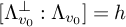 .
We take the open compact subgroup
$K_{\tilde {G}} \subset \tilde {G}({\mathbb A}_{f})$
 as follows.

where
$K_G^p \subset G({\mathbb A}^p_{F^+,f})$
 is arbitrary, and

where
$K_{G,v}$
 is the stabilizer of
$\Lambda _v$
 in
$G(F^+_v)$
 .
Now, we can formulate a moduli problem over
$\operatorname {\mathrm {Spec}} O_{E,(u)}$
 as follows. To a locally noetherian scheme S over
$\operatorname {\mathrm {Spec}} O_{E,(u)}$
 , we associate the set of isomorphism classes of tuples
$(A_0,i_0,\lambda _0,A,i,\lambda ,\bar {\eta }^p)$
 , where
$\bullet \ (A_0,i_0,\lambda _0)$
 is an object of
${\mathcal M}_0^{{\mathfrak a},W}(S)$
 ;
$\bullet \ A$
 is an abelian scheme over S;
$\bullet \ i$
 is an
$O_F \otimes {\mathbb Z}_{(p)}$
 -action satisfying the Kottwitz condition of signature
$((1,n-1)_{\tau _1}, (0,n)_{\tau \in \Phi _{F^+} \backslash \lbrace \tau _1 \rbrace })$
 , i.e., for all
$a \in F$
 ,

$\bullet \ \lambda $
 is a polarization of A, whose Rosati involution induces on
$O_F \otimes {\mathbb Z}_{(p)}$
 the nontrivial Galois automorphism of
$F/F^+$
 . Also, we impose the following condition. The action of
$O_{F^+} \otimes {\mathbb Z}_p \simeq \prod _{v \in S_p} O_{F^+,v}$
 induces a decomposition of the p-divisible group

Since the Rosati involution of
$\lambda $
 fixes
$O_{F^+}$
 ,
$\lambda $
 induces a polarization
$\lambda _v:A[v^{\infty }] \rightarrow A^{\vee }[v^{\infty }] \simeq A[v^{\infty }]^{\vee }$
 for each v. We impose the condition that
$\operatorname {\mathrm {Ker}} \lambda _v$
 is contained in
$A[i(\pi _v)]$
 of rank
$\vert \Lambda _v^{\perp }/\Lambda _v \vert $
 for each
$v \in S_p$
 ;
$\bullet \ \bar {\eta }^p$
 is a
$K_G^p$
 -orbit of
${\mathbb A}^p_{F,f}$
 -linear isometries

Here,
$-V$
 is the same E-vector space as V, but with its hermitian form multiplied by
$-1$
 . We write
$\hat {V}^p(A)$
 for the rational prime-to-p Tate module of A. Also, we consider
$\operatorname {\mathrm {Hom}}_F(\hat {V}^p(A_0), \hat {V}^p(A)) $
 as a hermitian space with the hermitian form
$h_A^p$
 ,

For
$v \neq v_0$
 , we impose the Eisenstein condition and the sign condition. Before we explain these conditions, we define a function
$r:\operatorname {\mathrm {Hom}}(F,{\mathbb C}) \rightarrow \lbrace 0,1,n-1,n \rbrace $
 such that

First, we recall the Eisenstein condition from [Reference Rapoport, Smithling and ZhangRSZ20, Section 4.1]. We impose the Eisenstein condition only when the base scheme S has nonempty special fibre. In this case, we may base change via
$\tilde {v}:O_{E,(u)} \rightarrow \bar {{\mathbb Z}}_p$
 (the ring of integers of
$\bar {{\mathbb Q}}_p$
 ), and pass to completions and assume that S is a scheme over
$\operatorname {\mathrm {Spf}} \bar {{\mathbb Z}}_p$
 . We have a decomposition of the p-divisible group

where w runs over the places of F over p. Since we assume that p is locally nilpotent on S, there is a natural isomorphism

By using the embedding
$\tilde {v}:\bar {{\mathbb Q}} \rightarrow \bar {{\mathbb Q}}_p$
 , we can identify

and this gives an identification

For each place w, by the Kottwitz condition (4.2.1), the p-divisible group
$A[w^{\infty }]$
 is of height
$n[F_w:{\mathbb Q}_p]$
 and dimension

For each place w such that
$w \vert v$
 and
$v\neq v_0$
 , the action of F on
$A[w^{\infty }]$
 is of a banal signature type in the sense of [Reference Rapoport, Smithling and ZhangRSZ20, Appendix B]. In other words,
$r_{\tau }$
 is
$0$
 or n for all
$\tau \in \operatorname {\mathrm {Hom}}_{{\mathbb Q}}(F_w,\bar {{\mathbb Q}}_p)$
 . Let
$\pi =\pi _w$
 be a uniformizer in
$F_w$
 and let
$F_w^u$
 be the maximal unramified extension of
${\mathbb Q}_p$
 in
$F_w$
 . For each
$\psi \in \operatorname {\mathrm {Hom}}_{{\mathbb Q}}(F_w^u, \bar {{\mathbb Q}}_p)$
 , let

Let

Then, the Eisenstein condition at
$v (\neq v_0)$
 is as follows. For each place w that divides v, and for all
$\psi \in \operatorname {\mathrm {Hom}}_{{\mathbb Q}}(F_w^u,\bar {{\mathbb Q}}_p)$
 ,

Now, we will define the sign condition at
$v (\neq v_0)$
 . We impose this condition only when v does not split in F. The sign condition at v is the condition that for every point s of S,

We need to explain these two factors. For the left one, we refer to [Reference Rapoport, Smithling and ZhangRSZ20, Appendix A]. Also, we define

where
$\det ({-V_v}) \in F_v^{+,\times }/\operatorname {\mathrm {Nm}} F_v^{+,\times }$
 is the class of the determinant of any hermitian matrix of the hermitian space
$-V_v$
 .
A morphism between two objects

is given by an isomorphism
$(A_0,i_0,\lambda _0) \simeq (A_0',i_0',\lambda _0')$
 in
${\mathcal M}_0^{{\mathfrak a},W}(S)$
 and a quasi-isogeny
$A \rightarrow A'$
 which induces an isomorphism

compatible with i and
$i'$
 , with
$\lambda $
 and
$\lambda '$
 , and with
$\bar {\eta }^p$
 and
$\bar {\eta }^{\prime {p}}$
 .
Proposition 4.2. The moduli problem defined above is representable by a Deligne–Mumford stack
${\mathcal M}_{K_{\tilde {G}}}(\tilde {G})$
 flat over
$\operatorname {\mathrm {Spec}} O_{E,(u)}$
 . For
$K^p_{G}$
 small enough,
${\mathcal M}_{K_{\tilde {G}}}(\tilde {G})$
 is relatively representable over
${\mathcal M}_0^{{\mathfrak a},W}$
 . The generic fibre
${\mathcal M}_{K_{\tilde {G}}}(\tilde {G}) \times _{\operatorname {\mathrm {Spec}} O_{E,(u)}} \operatorname {\mathrm {Spec}} E$
 is canonically isomorphic to
$M_{K_{\tilde {G}}}(\tilde {G})$
 . Furthermore, if
$h=0, n$
 , then
${\mathcal M}_{K_{\tilde {G}}}(\tilde {G})$
 is smooth over
$\operatorname {\mathrm {Spec}} O_{E,(u)}$
 . If
$h \neq 0,n$
 , then
${\mathcal M}_{K_{\tilde {G}}}(\tilde {G})$
 has semistable reduction over
$\operatorname {\mathrm {Spec}} O_{E,(u)}$
 provided that
$E_{u}$
 is unramified over
${\mathbb Q}_p$
 .
Proof. The representability, the statement for the generic fibre and the smoothness when
$h=0$
 (and hence when
$h=n$
 ) are proved in [Reference Rapoport, Smithling and ZhangRSZ20, Theorem 4.1]. Therefore, it suffices to show that this has semistable reduction over
$\operatorname {\mathrm {Spec}} O_{E,(u)}$
 when
$h \neq 0,n$
 and
$E_{u}$
 is unramified over
${\mathbb Q}_p$
 . To prove this, we need to use the theory of local models as in [Reference Rapoport, Smithling and ZhangRSZ20, Theorem 4.10]. The local model corresponding to
$A_0$
 is étale because
${\mathcal M}_0^{{\mathfrak a},W}$
 is. Let M be the local model corresponding to A. Before we prove that M has semistable reduction, we introduce some notation. By the identification (4.2.2), we have

Let
$r\vert _v : \operatorname {\mathrm {Hom}}_{{\mathbb Q}}(F_v,\bar {{\mathbb Q}}_p) \rightarrow \lbrace 0,1,n-1,n \rbrace $
 be the restriction of the function r to
$\operatorname {\mathrm {Hom}}_{{\mathbb Q}}(F_v,\bar {{\mathbb Q}}_p)$
 . Let

which is an element of
${\mathbb N}[\Phi _F]$
 , the commutative monoid freely generated by
$\Phi _F$
 . Note that the Galois group
$\operatorname {\mathrm {Gal}}({\mathbb C}/{\mathbb Q})$
 acts on
$\Phi _F$
 and hence on
${\mathbb N}[\Phi _F]$
 . Let
$E_{{r\vert v}}$
 be the fixed field of the stabilizer in
$\operatorname {\mathrm {Gal}}({\mathbb C}/{\mathbb Q})$
 of the element
$\operatorname {\mathrm {sig}}_{r\vert _v}$
 .
Then, we have a decomposition

which is induced from (4.2.3).
For
$v \neq v_0$
 , by our Kottwitz condition,
$M_v$
 is a banal local model as in [Reference Rapoport, Smithling and ZhangRSZ20, Appendix B]. Therefore,
$M_v = \operatorname {\mathrm {Spec}} O_{E_{r\vert v}}$
 . Also,
$M_{v_0}$
 is a local model which appears in the proof of Proposition 2.15 (here, we used the condition that
$v_0$
 is unramified, and therefore the condition (2.2.2) follows from the condition (2.2.1), which follows from the Kottwitz condition). Therefore, it has semistable reduction over
${\operatorname {\mathrm {Spec}} O_{E_{r\vert v}}}$
 . Since
$E_u$
 is unramified over
${\mathbb Q}_p$
 (hence, over
$E_{r\vert v}$
 ) and semistable reduction is stable under an unramified base change, M has semistable reduction over
$\operatorname {\mathrm {Spec}} O_{E_u}$
 .
4.3 The uniformization theorem
In this subsection, we will relate the basic locus of the special fibre of
${\mathcal M}_{K_{\tilde {G}}}(\tilde {G})$
 to the (relative) Rapoport–Zink space
${\mathcal N}_{F_{w_0}/F^+_{v_0}}^h(1,n-1)$
 in Section 2 via the non-archimedean uniformization theorem of Rapoport and Zink. We will follow the proof of [Reference Rapoport, Smithling and ZhangRSZ20, Theorem 8.15]. In order to simplify notation, we write
${\mathcal M}$
 for
${\mathcal M}_{K_{\tilde {G}}}(\tilde {G})$
 and
${\mathcal N}$
 for
${\mathcal N}_{F_{w_0}/F^+_{v_0}}^h(1,n-1)$
 .
Let
$\breve {E}_u$
 be the completion of a maximal unramified extension of
$E_u$
 , and k be the residue field of
$O_{\breve {E}_u}$
 . Let
${\mathcal M}_{O_{\breve {E}_u}} = {\mathcal M} \otimes _{O_{E,(u)}} O_{\breve {E}_u}$
 . We denote by
${\mathcal M}^{ss}$
 the basic locus of
${\mathcal M} \otimes _{O_{E,(u)}} k$
 and by
$\widehat {{\mathcal M}^{ss}}$
 the completion of
${\mathcal M}_{O_{\breve {E}_u}}$
 along
${\mathcal M}^{ss}$
 .
Choose a point
$(\boldsymbol {A}_0,\boldsymbol {i}_0,\boldsymbol {\lambda }_0,\boldsymbol {A},\boldsymbol {i},\boldsymbol {\lambda },\boldsymbol {\bar {\eta }})$
 of
${\mathcal M}^{ss}(O_{\breve {E}_u})$
 . Let

and
$i_{{\mathbb X}_{0}},\lambda _{{\mathbb X}_{0}}, i_{{\mathbb X}},\lambda _{{\mathbb X}}$
 be the induced
$O_{F} \otimes {\mathbb Z}_p$
 -actions and polarizations. This choice gives us the following non-archimedean uniformization morphism along the basic locus by [Reference Rapoport and ZinkRZ, Theorem 6.30]:

Here, the group I is an inner form of
$\tilde {G}$
 associated to the hermitian space
$V'$
 , where
$V'$
 is negative definite at all archimedean places and isomorphic to V at all non-archimedean places except at
$v_0$
 (hence, by the product formula and the Hasse principle,
$V'$
 is determined), and
${\mathcal N}'$
 is the corresponding Rapoport–Zink space whose framing object is
$({\mathbb X}_{0}, i_{{\mathbb X}_{0}},\lambda _{{\mathbb X}_{0}},{\mathbb X}, i_{{\mathbb X}},\lambda _{{\mathbb X}})$
 .
By [Reference Rapoport, Smithling and ZhangRSZ20, Lemma 8.16], we have

Also, by Proposition 2.12,
${\mathcal N}_{O_{\breve {E}_u}} \simeq ({\mathcal N}_{F_{w_0}/{\mathbb Q}_p}^h(1,n-1))_{O_{\breve {E}_u}}$
 .
The following theorem summarizes the above discussion.
Theorem 4.3. There is a non-archimedean uniformization isomorphism

where

Proof. This is essentially the same as the proof of [Reference Rapoport and ZinkRZ, Theorem 6.30]. For the convenience of the reader, we will construct the inverse morphism of
$\Theta $
 . Let S be an
$O_{\breve {E}_u}$
 -scheme such that p is locally nilpotent. Let s be a geometric point of S. Choose a point
$P=(A_0,i_0,\lambda _0,A,i,\lambda ,\bar {\eta }) \in {\mathcal M}^{ss}(S)$
 . By [Reference Rapoport and ZinkRZ, Proposition 6.29], we can choose
$O_{F}$
 -linear quasi-isogenies

compatible with polarizations. Then, we have the induced quasi-isogenies

The tuple
$(A_0[p^{\infty }], A[p^{\infty }], \rho _{0}, \rho )$
 (with the induced
$O_{F} \otimes {\mathbb Z}_p$
 -actions and the induced polarizations) gives an element in
${\mathcal N}'(S)$
 and this is the
${\mathcal N}'$
 part of
$\Theta ^{-1}(P)$
 .
Now, we should find an element
$(z, g) \in Z({\mathbb A}_f^p) \times G({\mathbb A}_f^p)=\tilde {G}({\mathbb A}_f^p)$
 such that
$\Theta ^{-1}(P)=((A_0[p^{\infty }], A[p^{\infty }], \rho _{0}, \rho ), (z, g))$
 .
The element z in
$Z({\mathbb A}_f^p)$
 comes from the moduli space
${\mathcal M}_0^{{\mathfrak a},W}$
 . More precisely, by definition of
${\mathcal M}_0^{{\mathfrak a},W}$
 , we have two
$O_E \otimes {\mathbb A}_f^p$
 -linear similitudes

Therefore, the composite

gives an element z in
$Z({\mathbb A}_f^p)$
 .
For the element g, consider the composite

This is an isometry which gives rise to an element g in
$G({\mathbb A}_f^p)$
 .
The construction of
$\Theta $
 is identical to the arguments in [Reference Rapoport and ZinkRZ, Chapter 6].
5 Special cycles and arithmetic intersection numbers
In this section, we use the notation in Section 2 and assume that F is a finite unramified extension over
${\mathbb Q}_p$
 . Also, we denote by
$k=\bar {{\mathbb F}}_p$
 and by
$val$
 the valuation of E. We will define the special cycles and study their intersections.
Let
$(\overline {{\mathbb Y}},i_{\overline {{\mathbb Y}}},\lambda _{\overline {{\mathbb Y}}})$
 be a strict formal
$O_F$
 -module of F-height 2 over k, with an action
$i_{\overline {{\mathbb Y}}}:O_E \rightarrow \operatorname {\mathrm {End}}(\overline {{\mathbb Y}})$
 and with a principal polarization
$\lambda _{\overline {{\mathbb Y}}}$
 . Also, we assume that it satisfies the determinant condition of signature
$(0,1)$
 . Let
${\mathcal N}^0(0,1)$
 be the corresponding moduli space. To simplify notation, we write
${\mathcal N}^0$
 for
${\mathcal N}^0(0,1)_{O_{\breve {E}}}$
 ,
${\mathcal N}$
 for
${\mathcal N}^h_{E/F}(1,n-1) _{O_{\breve {E}}}$
 and
$\widehat {{\mathcal N}}$
 for
${\mathcal N}^{n-h}_{E/F}(1,n-1)_{O_{\breve {E}}}$
 .
Definition 5.1. The space of special homomorphisms is the E-vector space

For
$x,y \in {\mathbb V}$
 , we define a hermitian form h on
${\mathbb V}$
 as

We often omit
$i_{\overline {{\mathbb Y}}}^{-1}$
 via the identification
$\operatorname {\mathrm {End}}_{O_E}(\overline {{\mathbb Y}}) \otimes {\mathbb Q} {\simeq } E$
 .
Definition 5.2. We write
$\theta :{\mathcal N} \rightarrow \widehat {{\mathcal N}}$
 for the following isomorphism. For each
$O_{\breve {E}}$
 -scheme S such that p is locally nilpotent, the isomorphism sends
$(X,i_X,\lambda _X,\rho _X) \in {\mathcal N}(S)$
 to

Here,
$\lambda ^{\prime }_X : X^{\vee } \rightarrow X$
 is the unique polarization such that
$\lambda ^{\prime }_X \circ \lambda _X =i_X(p)$
 , and for
$a \in O_E$
 , we define
$\overline {i}_X^{\vee }(a):=i_X(\overline {a})^{\vee }$
 .
Definition 5.3.
-
(1) For a given special homomorphism $x \in {\mathbb V}$
, we define the special cycle
${\mathcal Z}(x)$
to be the closed formal subscheme of
${\mathcal N}^0 \times {\mathcal N}$
with the following property: for each
$O_{\breve {E}}$
-scheme S such that p is locally nilpotent,
${\mathcal Z}(x)(S)$
is the set of all points
$\xi =(\overline {Y},i_{\overline {Y}},\lambda _{\overline {Y}},\rho _{\overline {Y}},X,i_X,\lambda _X,\rho _X)$
in
$({\mathcal N}^0 \times {\mathcal N})(S)$
such that the quasi-homomorphism $$ \begin{align*} \rho_X^{-1}\circ x \circ \rho_{\overline{Y}}:\overline{Y} \times_S \overline{S} \rightarrow X \times_S \overline{S} \end{align*} $$
extends to a homomorphism from $\overline {Y}$
to X. -
(2) For a given special homomorphism $y \in {\mathbb V}$
, we define the special cycle
${\mathcal Y}(y)$
to be the closed formal subscheme of
${\mathcal N}^0 \times {\mathcal N}$
with the following property: for each
$O_{\breve {E}}$
-scheme S such that p is locally nilpotent,
${\mathcal Z}(\lambda _{{\mathbb X}}\circ y)(S)$
is the set of all points
$\xi =(\overline {Y},i_{\overline {Y}},\lambda _{\overline {Y}},\rho _{\overline {Y}},X,i_X,\lambda _X,\rho _X)$
in
$({\mathcal N}^0 \times {\mathcal N})(S)$
such that the quasi-homomorphism $$ \begin{align*} \rho_X^{\vee}\circ \lambda_{{\mathbb X}}\circ y \circ \rho_{\overline{Y}}:\overline{Y} \times_S \overline{S} \rightarrow X^{\vee} \times_S \overline{S} \end{align*} $$
extends to a homomorphism from $\overline {Y}$
to
$X^{\vee }$
. Note that
${\mathcal Y}(y)=(id \times \theta ^{-1})({\mathcal Z}(\lambda _{{\mathbb X}}\circ y))$
, where
${\mathcal Z}(\lambda _{{\mathbb X}}\circ y)$
is the special cycle attached to
$\lambda _{{\mathbb X}}\circ y$
in
${\mathcal N}^0 \times \widehat {{\mathcal N}}$
.


We note that
${\mathcal N}^0$
 can be identified with
$\operatorname {\mathrm {Spf}} O_{\breve {E}}$
 ; hence,
${\mathcal Z}(x), {\mathcal Y}(y)$
 can be identified with closed formal subschemes of
${\mathcal N}$
 . Also, by abuse of notation, we often write
$x:\overline {Y} \rightarrow X$
 for the extension of the quasi-homomorphism
$\rho _X^{-1}\circ x \circ \rho _{\overline {Y}}$
 .
Let
$\overline {{\mathbb M}}^0=\overline {{\mathbb M}}^0_0 \oplus \overline {{\mathbb M}}^0_1$
 be the Dieudonné module of
$\overline {{\mathbb Y}}$
 . As in [Reference Kudla and RapoportKR11, Remark 2.5], it is easy to see that
$\overline {{\mathbb M}}^0_0= O_{\breve {F}} \overline {1}_0$
 and
$\overline {{\mathbb M}}^0_1=O_{\breve {F}} \overline {1}_1$
 , where
${\mathcal F} \overline {1}_1=\overline {1}_0$
 ,
${\mathcal F} \overline {1}_0=p \overline {1}_1$
 and
$\lbrace \overline {1}_0, \overline {1}_0 \rbrace = pt$
 for some
$t \in O_E^{\times }$
 such that
$t=-t^*$
 . We write
$N^0$
 for
$\overline {{\mathbb M}}^0 \otimes {\mathbb Q}$
 .
Consider the skew-hermitian E-vector space
$N_{k,0}^{\tau }$
 with the skew-hermitian form
$\lbrace \cdot , \cdot \rbrace $
 in Section 2.4. By taking
$t^{-1} \lbrace \cdot , \cdot \rbrace $
 , we have a hermitian form on
$N_{k,0}^{\tau }$
 . We denote by
$\overline {N_{k,0}^{\tau }}$
 the hermitian E-vector space obtained in this way and let
$\overline {\lbrace \cdot , \cdot \rbrace }$
 be the hermitian form
$t^{-1}\lbrace \cdot ,\cdot \rbrace $
 . Note that
$\overline {N_{k,0}^{\tau }}$
 and
$N_{k,0}^{\tau }$
 are the same as sets.
Now, let
$x \in {\mathbb V}$
 . This induces a homomorphism from
$N^0$
 to
$N_k$
 . We also write x for the induced homomorphism. Note that we can write
$x=x_0 + x_1$
 , where
$x_0:N^0_0 \rightarrow N_{k,0}$
 and
$x_1:N^0_1 \rightarrow N_{k,1}$
 , since the morphism x has degree
$0$
 with respect to the decompositions
$N^0_0 \oplus N^0_1$
 and
$N_{k,0} \oplus N_{k,1}$
 .
We have the following analogue of [Reference Kudla and RapoportKR11, Lemma 3.9].
Lemma 5.4 (cf. [Reference Kudla and RapoportKR11, Lemma 3.9])
There is an isomorphism of hermitian spaces

such that
$h(x,y)=p^{-1}\overline {\lbrace x_0(\overline {1}_0), y_0(\overline {1}_0) \rbrace }$
 .
Proof. The proof is identical to the proof of [Reference Kudla and RapoportKR11, Lemma 3.9].
To study the sets of k-points
${\mathcal Z}(x)(k), {\mathcal Y}(y)(k)$
 for
$x,y \in {\mathbb V}$
 , recall that we have a bijection between
${\mathcal N}(k)$
 and the set of lattices
$(A,B)$
 in
$N_{k,0}$
 (see Proposition 2.18). Now, we can state the following analogue of [Reference Kudla and RapoportKR11, Proposition 3.10].
Proposition 5.5 (cf. [Reference Kudla and RapoportKR11, Proposition 3.10])
For
$x, y \in {\mathbb V}$
 , we have the following bijections.
-
(1)
$$ \begin{align*} {\mathcal Z}(x)(k)= \left\{\begin{array}{@{}c@{}} O_{\breve{F}} \text{-lattices} \\ A \overset{h}{\subset} B \subset N_{k,0} \end{array} \middle| \begin{array}{c} p B^{\vee} \overset{1}{\subset} A \overset{n-1}{\subset} B^{\vee},\\ p A^{\vee} \overset{1}{\subset} B \overset{n-1}{\subset} A^{\vee},\\ p B \subset A \subset B,\\ x_0(\overline{1}_0) \in p B^{\vee} \end{array}\right\}. \end{align*} $$
-
(2)
$$ \begin{align*} {\mathcal Y}(y)(k)= \left\{\begin{array}{@{}c@{}} O_{\breve{F}} \text{-lattices} \\ A \overset{h}{\subset} B \subset N_{k,0} \end{array} \middle| \begin{array}{c} p B^{\vee} \overset{1}{\subset} A \overset{n-1}{\subset} B^{\vee},\\ p A^{\vee} \overset{1}{\subset} B \overset{n-1}{\subset} A^{\vee},\\ p B \subset A \subset B,\\ y_0(\overline{1}_0) \in p A^{\vee} \end{array}\right\}. \end{align*} $$


Proof. The proof of (1) is identical to the proof of [Reference Kudla and RapoportKR11, Proposition 3.10]. Indeed, for a special homomorphism
$x \in {\mathbb V}$
 , it extends to
$\overline {Y} \rightarrow X$
 if and only if
$x(\overline {{\mathbb M}}^0) \subset M$
 (here, M is the relative Dieudonné module of X). This is equivalent to
$x_0(\overline {1}_0) \in M_0$
 and
$x_1(\overline {1}_1) \in M_1$
 . By the identification in Proposition 2.18, we have that
$M_0=A$
 and
$M_1=B^{\perp }$
 . Also, note that
${\mathcal F} B^{\perp }=p B^{\vee }$
 ,
${\mathcal F} (\overline {1}_1)=\overline {1}_0$
 and
$x_0 {\mathcal F}= {\mathcal F} x_1$
 . Therefore,
$x_0(\overline {1}_0) \in M_0 \Longleftrightarrow x_0(\overline {1}_0) \in A$
 and
$x_1(\overline {1}_1) \in M_1 \Longleftrightarrow {\mathcal F} x_1(\overline {1}_1)=x_0 ({\mathcal F} \overline {1}_1) \in {\mathcal F} B^{\perp } \Longleftrightarrow x_0(\overline {1}_0)\in pB^{\vee }$
 . Here,
$x_0(\overline {1}_0) \in A$
 is a redundant condition.
For (2), note that for the Dieudonné module
$M=A\oplus B^{\perp }$
 of
$(X,i_X,\lambda _X,\rho _X) \in {\mathcal N}(k)$
 , its dual
$M^{\perp }=B\oplus A^{\perp }$
 is the Dieudonné module of
$X^{\vee }$
 (here,
$^\perp $
 means the dual with respect to
$\langle \cdot , \cdot \rangle $
 in Section 2.3). Therefore, (2) can be proved in the same way.
Lemma 5.6 [Reference VollaardVol10, Lemma 1.16]
Let
$t \in O_E^{\times }$
 with
$t^*=-t$
 and let V be an E-vector space of dimension n. Let
$I_n$
 be the identity matrix of rank n and let
$J_n$
 be the matrix

There exist two perfect skew-hermitian forms on V up to isomorphism. These forms correspond to
$t I_n$
 and to
$t J_n$
 , respectively. Furthermore, if M is a lattice in V and
$i \in {\mathbb Z}$
 with

then
$n-r \equiv ni \ \mod 2$
 in the first case and
$n-r \not \equiv ni \ \mod 2$
 in the second case.
Proof. See [Reference VollaardVol10, Lemma 1.16]. Note that F is a finite unramified extension of
${\mathbb Q}_p$
 ; therefore, the above statement is more general. But the proof is identical.
Remark 5.7. Recall that the E-vector space
$N_{k,0}^{\tau }$
 in Section 2.4 has a lattice M with

This fact follows from Lemma 2.21. Therefore, by the above lemma, the form
$\lbrace \cdot , \cdot \rbrace $
 is isomorphic to
$t I_n$
 if
$n-h-1 \equiv 0 \ \mod 2$
 and is isomorphic to
$t J_n$
 if
$n-h-1 \not \equiv 0 \ \mod 2$
 .
We need the following analogue of [Reference Kudla and RapoportKR11, Lemma 3.7].
Lemma 5.8. Assume that
$h \neq 0, n$
 . Then, we have

where
$\Lambda $
 runs over all vertex lattices of type
$h+1$
 .
-
(1) First, assume that $n=h+1+2k$
for some integer
$k \geq 0$
, and
$h+1$
is odd. Then, by Remark 5.7, the form
$\lbrace \cdot , \cdot \rbrace $
is isomorphic to
$t I_n$
. Choose a basis
$\lbrace e_1, \dots , e_n \rbrace $
such that
$\lbrace e_i, e_j \rbrace = t\delta _{ij}$
. Choose any
$h+1$
elements
$\lbrace f_1, \dots , f_{h+1} \rbrace $
in
$\lbrace e_1, \dots , e_n \rbrace $
and rename
$\lbrace e_1, \dots , e_n \rbrace $
to
$\lbrace f_1, \dots , f_n \rbrace $
.Let $\alpha $
,
$\beta $
be elements in E such that
$\alpha \alpha ^*=-1$
and
$\beta \beta ^*=1/2$
.We define
$$ \begin{align*} \begin{array}{ll} g_{h+1}:=f_{h+1},&\\ g_{2i+1}:= \beta(f_{2i+1} + \alpha f_{2i+2}),&\\ g_{2i+2}:=\beta(f_{2i+1} - \alpha f_{2i+2}), & \forall 0 \leq i \leq \frac{h}{2}-1. \end{array} \end{align*} $$
Then, we have
$$ \begin{align*} \begin{array}{ll} \lbrace g_{2i+1}, g_{2i+1} \rbrace=0,&\lbrace g_{2i+2}, g_{2i+2} \rbrace=0, \\ \lbrace g_{2i+1}, g_{2i+2} \rbrace=t, & \forall 0 \leq i \leq h/2-1. \end{array} \end{align*} $$
Now, consider an element $\gamma \in E$
such that
$1+\gamma \gamma ^*=p$
, and define $$ \begin{align*} \begin{array}{ll} h_{h+1+2i+1}:=f_{h+1+2i+1} + \gamma f_{h+1+2i+2},&\\ h_{h+1+2i+2}:=\gamma^* f_{h+1+2i+1} - f_{h+1+2i+2},& \forall 0 \leq i \leq k-1. \end{array} \end{align*} $$
Also, we define
$$ \begin{align*} \begin{array}{ll} g_{h+1+2i+1}:=\beta(h_{h+1+2i+1} + \alpha h_{h+1+2i+2}),&\\ g_{h+1+2i+2}:=\beta(h_{h+1+2i+1} - \alpha h_{h+1+2i+2}),& \forall 0 \leq i \leq k-1. \end{array} \end{align*} $$
Then, we have
$$ \begin{align*} \begin{array}{ll} \lbrace g_{h+1+2i+1}, g_{h+1+2i+1} \rbrace=0,&\lbrace g_{h+1+2i+2}, g_{h+1+2i+2} \rbrace=0, \\ \lbrace g_{h+1+2i+1}, g_{h+1+2i+2} \rbrace=tp, & \forall 0 \leq i \leq k-1. \end{array} \end{align*} $$
For $I:=(a_1,\dots ,a_{h/2},b_1, \dots , b_k) \in {\mathbb Z}^{h/2} \times {\mathbb Z}^k$
, we set $$ \begin{align*} \begin{array}{lll} \Lambda_{\lbrace g_1,\dots, g_n\rbrace, I}:=&[p^{a_1}g_1,p^{-a_1}g_2,\dots,&p^{a_{h/2}}g_{h-1},p^{-a_{h/2}}g_{h},\\ & &g_{h+1}, p^{b_1}g_{h+2}, \dots, p^{-b_k}g_n ]. \end{array} \end{align*} $$
Then, this is a vertex lattice of type $h+1$
and we have $$ \begin{align*} \bigcap_{\lbrace g_1,\dots, g_n\rbrace, I} \Lambda_{\lbrace g_1,\dots, g_n\rbrace, I}=(0), \end{align*} $$
where $\lbrace g_1,\dots , g_n\rbrace $
runs over all choices and I runs through
${\mathbb Z}^{h/2} \times {\mathbb Z}^k$
.This proves the lemma in the case that $n=h+1+2k$
for some integer
$k \geq 0$
, and
$h+1$
is odd. -
(2) Now, assume that $n=h+1+2k$
for some integer
$k \geq 0$
, and
$h+1$
is even. Then, by Remark 5.7, the form
$\lbrace \cdot , \cdot \rbrace $
is isomorphic to
$t I_n$
. Choose a basis
$\lbrace e_1, \dots , e_n \rbrace $
such that
$\lbrace e_i, e_j \rbrace = t\delta _{ij}$
. We define $$ \begin{align*} \begin{array}{ll} g_{2i+1}:= \beta(f_{2i+1} + \alpha f_{2i+2}),&\\ g_{2i+2}:=\beta(f_{2i+1} - \alpha f_{2i+2}), & \forall 0 \leq i \leq \frac{h+1}{2}-1. \end{array} \end{align*} $$
Then, we have
$$ \begin{align*} \begin{array}{ll} \lbrace g_{2i+1}, g_{2i+1} \rbrace=0,&\lbrace g_{2i+2}, g_{2i+2} \rbrace=0, \\ \lbrace g_{2i+1}, g_{2i+2} \rbrace=t, & \forall 0 \leq i \leq \frac{h+1}{2}-1. \end{array} \end{align*} $$
Then, we define the elements $h_{h+1+2i+1}, h_{h+1+2i+2}, g_{h+1+2i+1}, g_{h+1+2i+2}, 0 \leq i \leq k-1$
as above. For
$I:=(a_1,\dots ,a_{(h+1)/2},b_1, \dots , b_k) \in {\mathbb Z}^{(h+1)/2} \times {\mathbb Z}^k$
, we set $$ \begin{align*} \begin{array}{lll} \Lambda_{\lbrace g_1,\dots, g_n\rbrace, I}:=&[p^{a_1}g_1,p^{-a_1}g_2,\dots,&p^{a_{(h+1)/2}}g_{h},p^{-a_{(h+1)/2}}g_{h+1},\\ & &g_{h+1}, p^{b_1}g_{h+2}, \dots, p^{-b_k}g_n ]. \end{array} \end{align*} $$
Then, this is a vertex lattice of type $h+1$
and we have $$ \begin{align*} \bigcap_{\lbrace g_1,\dots, g_n\rbrace, I} \Lambda_{\lbrace g_1,\dots, g_n\rbrace, I}=(0), \end{align*} $$
where $\lbrace g_1,\dots , g_n\rbrace $
runs over all choices and I runs through
${\mathbb Z}^{(h+1)/2} \times {\mathbb Z}^k$
. -
(3) Now, assume that $n=h+1+2k+1$
,
$k \geq 0$
, and
$h+1=$
odd. Then, by Remark 5.7, the form
$\lbrace \cdot , \cdot \rbrace $
is isomorphic to
$t J_n$
. Choose a basis
$\lbrace e_1, \dots , e_{n-1},g \rbrace $
such that
$\lbrace e_i, e_j \rbrace = t\delta _{ij}$
,
$\lbrace e_i, g \rbrace =0$
and
$\lbrace g,g \rbrace =tp$
. Then, as in case (1), we can choose
$\lbrace g_1, \dots , g_{h+1}\rbrace $
such that $$ \begin{align*} \begin{array}{ll} \lbrace g_{2i+1}, g_{2i+1} \rbrace=0,&\lbrace g_{2i+2}, g_{2i+2} \rbrace=0, \\ \lbrace g_{2i+1}, g_{2i+2} \rbrace=t, & \forall 0 \leq i \leq h/2-1, \end{array} \end{align*} $$
and $g_{h+2},\dots , g_{n-1}$
such that $$ \begin{align*} \begin{array}{ll} \lbrace g_{h+1+2i+1}, g_{h+1+2i+1} \rbrace=0,&\lbrace g_{h+1+2i+2}, g_{h+1+2i+2} \rbrace=0, \\ \lbrace g_{h+1+2i+1}, g_{h+1+2i+2} \rbrace=tp, & \forall 0 \leq i \leq k-1. \end{array} \end{align*} $$
For $I:=(a_1,\dots ,a_{h/2},b_1, \dots , b_k) \in {\mathbb Z}^{h/2} \times {\mathbb Z}^k$
, we set $$ \begin{align*} \begin{array}{lll} \Lambda_{\lbrace g_1,\dots, g_n\rbrace, I}:=&[p^{a_1}g_1,p^{-a_1}g_2,\dots,&p^{a_{h/2}}g_{h-1},p^{-a_{h/2}}g_{h},\\ & &g_{h+1}, p^{b_1}g_{h+2}, \dots, p^{-b_k}g_{n-1},g]. \end{array} \end{align*} $$
Then, this is a vertex lattice of type $h+1$
and we have $$ \begin{align*} \bigcap_{\lbrace g_1,\dots, g_n\rbrace, I} \Lambda_{\lbrace g_1,\dots, g_n\rbrace, I}=(g), \end{align*} $$
where $\lbrace g_1,\dots , g_{n-1}\rbrace $
runs over all choices and I runs through
${\mathbb Z}^{h/2} \times {\mathbb Z}^k$
.But we can start from a different basis like $\lbrace e_1, \dots , \xi ^{-1}(e_{n-1}+g), \xi ^{-1}(g-pe_{n-1}) \rbrace $
, where
$\xi \xi ^*=(1+p)$
. Then, the intersection of the vertex lattices of type
$h+1$
generated by the above steps with the new basis is
$(\xi ^{-1}(g-pe_{n-1}))$
. The intersection of
$O_{E} g$
and
$O_{E}(\xi ^{-1}(g-pe_{n-1}))$
is zero, and hence this proves the lemma in the case that
$n=h+1+2k+1$
for some integer
$k \geq 0$
, and
$h+1$
is odd. -
(4) Now, assume that $n=h+1+2k+1$
,
$k \geq 0$
, and
$h+1=$
even. Then, by Remark 5.7, the form
$\lbrace \cdot , \cdot \rbrace $
is isomorphic to
$t J_n$
. Choose a basis
$\lbrace e_1, \dots , e_{n-1},g \rbrace $
such that
$\lbrace e_i, e_j \rbrace = t\delta _{ij}$
,
$\lbrace e_i, g \rbrace =0$
and
$\lbrace g,g \rbrace =tp$
. Then, as in case (2), we can choose
$\lbrace g_1, \dots , g_{h+1}\rbrace $
such that $$ \begin{align*} \begin{array}{ll} g_{2i+1}:= \beta(f_{2i+1} + \alpha f_{2i+2}),&\\ g_{2i+2}:=\beta(f_{2i+1} - \alpha f_{2i+2}), & \forall 0 \leq i \leq \frac{h+1}{2}-1. \end{array} \end{align*} $$
Then, we have
$$ \begin{align*} \begin{array}{ll} \lbrace g_{2i+1}, g_{2i+1} \rbrace=0,&\lbrace g_{2i+2}, g_{2i+2} \rbrace=0, \\ \lbrace g_{2i+1}, g_{2i+2} \rbrace=t, & \forall 0 \leq i \leq \frac{h+1}{2}-1. \end{array} \end{align*} $$
Then, we define the elements $h_{h+1+2i+1}, h_{h+1+2i+2}, g_{h+1+2i+1}, g_{h+1+2i+2}, 0 \leq i \leq k-1$
as above. For
$I:=(a_1,\dots ,a_{(h+1)/2},b_1, \dots , b_k) \in {\mathbb Z}^{(h+1)/2} \times {\mathbb Z}^k$
, we set $$ \begin{align*} \begin{array}{lll} \Lambda_{\lbrace g_1,\dots, g_n\rbrace, I}:=&[p^{a_1}g_1,p^{-a_1}g_2,\dots,&p^{a_{(h+1)/2}}g_{h},p^{-a_{(h+1)/2}}g_{h+1},\\ & &g_{h+1}, p^{b_1}g_{h+2}, \dots, p^{-b_k}g_{n-1},g ]. \end{array} \end{align*} $$
Then, this is a vertex lattice of type $h+1$
and we have $$ \begin{align*} \bigcap_{\lbrace g_1,\dots, g_n\rbrace, I} \Lambda_{\lbrace g_1,\dots, g_n\rbrace, I}=(g), \end{align*} $$
where $\lbrace g_1,\dots , g_{n-1}\rbrace $
runs over all choices and I runs through
${\mathbb Z}^{(h+1)/2} \times {\mathbb Z}^k$
.But we can start from a different basis like $\lbrace e_1, \dots , \xi ^{-1}(e_{n-1}+g), \xi ^{-1}(g-pe_{n-1}) \rbrace $
, where
$\xi \xi ^*=(1+p)$
. Then, the intersection of the vertex lattices of type
$h+1$
generated by the above steps with the new basis is
$(\xi ^{-1}(g-pe_{n-1}))$
. The intersection of
$O_{E} g$
and
$O_{E}(\xi ^{-1}(g-pe_{n-1}0)$
is zero, and hence this proves the lemma in the case that
$n=h+1+2k+1$
for some integer
$k \geq 0$
, and
$h+1$
is even.


Proposition 5.9. The functors
${\mathcal Z}(x)$
 and
${\mathcal Y}(y)$
 are represented by closed formal subschemes of
${\mathcal N}^0 \times {\mathcal N}$
 . In fact,
${\mathcal Z}(x)$
 and
${\mathcal Y}(y)$
 are Cartier divisors in
${\mathcal N}^0 \times {\mathcal N}$
 (or empty) for any
$x, y \in {\mathbb V} \backslash \lbrace 0 \rbrace $
 .
Proof. If
$h=0$
 (resp.
$h=n$
 ), then we have
${\mathcal Z}(x)={\mathcal Y}(x)$
 (resp.
${\mathcal Z}(p x)={\mathcal Y}(x)$
 ). Therefore, the case where
$h=0$
 is proved in [Reference Kudla and RapoportKR11, Proposition 3.5] (the case that
$h=n$
 is the same since we have the isomorphism
$\theta $
 ). For the other cases, we can follow the proof of [Reference Kudla and RapoportKR11, Proposition 3.5] with Lemma 5.8. Indeed, as in [Reference Kudla and RapoportKR11, Proposition 3.5], we can prove that
${\mathcal Z}(x)$
 is locally defined by the vanishing of one equation f. We only need to show that this element is nontrivial. By [Reference Kudla and RapoportKR11, Lemma 3.6] with
$g=0$
 , we only need to show that
${\mathcal Z}(x)(k)$
 cannot be
${\mathcal N}(k)$
 . If
${\mathcal N}(k) \subset {\mathcal Z}(x)(k)$
 , then we have

where
$\Lambda $
 runs over all vertex lattices of type
$h+1$
 . This fact follows from Lemma 2.21 and Proposition 5.5. Now, since we have

by Lemma 5.8, we have that x should be
$0$
 . This finishes the proof of the proposition.
We have the following analogue of the remarks after [Reference Kudla and RapoportKR11, Lemma 5.2] (and also in [Reference Kudla and RapoportKR]).
Proposition 5.10.
-
(1) If $val(h(x,x))=0$
and
$h\neq n$
, then
${\mathcal Z}(x) \simeq {\mathcal N}^{h}_{E/F}(1,n-2)_{O_{\breve {E}}}$
. If
$val(h(x,x))=0$
and
$h=n$
, then
${\mathcal Z}(x)=\emptyset $
. -
(2) If $val(h(y,y))=-1$
and
$h \neq 0$
, then
${\mathcal Y}(y) \simeq {\mathcal N}^{h-1}_{E/F}(1,n-2)_{O_{\breve {E}}}$
. If
$val(h(y,y))=-1$
and
$h=0$
, then
${\mathcal Y}(y)=\emptyset $
.


Proof. (1) For an
$O_{\breve {E}}$
 -scheme S, assume that
$(X,i_X,\lambda _X,\rho _X) \in {\mathcal Z}(x)(S)$
 . We can take a rescaled x by an element in
$O_E^{\times }$
 such that
$h(x,x)=1$
 . We denote by
$x^*$
 the element
$\lambda _{\overline {Y}}^{-1} \circ x^{\vee } \circ \lambda _{X}$
 . Then, we have that
$e:=x \circ x^*$
 is an idempotent in
$\operatorname {\mathrm {End}}_{O_E}(X)$
 , so that
$X = e(X) \times (1-e)(X)$
 . Via this decomposition, we have the decomposition of the action
$i_X=i_1 \times i_2$
 . Also, note that we have the canonical isomorphisms
$e^{\vee }(X^{\vee })=(eX)^{\vee }$
 and
$(1-e^{\vee })(X)=((1-e)(X))^{\vee }$
 . By this identification, we have that the polarization
$\lambda _X$
 decomposes into the product of polarizations
$\lambda _1=\lambda _X \circ e$
 and
$\lambda _2=\lambda _X \circ (1-e)$
 of
$eX$
 and
$(1-e)(X)$
 , respectively. Let
$\rho _1=e \circ \rho _X$
 ,
$\rho _2=(1-e) \circ \rho _X$
 be the quasi-isogenies of
$e(X)$
 and
$(1-e)X$
 , respectively. Then, x defines an isomorphism
$\overline {Y} \simeq e(X)$
 compatible with polarizations, and
$((1-e)(X), i_2, \lambda _2,\rho _2)$
 gives an element in
${\mathcal N}^{h}_{E/F}(1,n-2)_{O_{\breve {E}}}(S)$
 . Note that if
$h=n$
 ,
${\mathcal N}^{h}_{E/F}(1,n-2)_{O_{\breve {E}}}(S)$
 is an empty set, and therefore there is no element in
${\mathcal Z}(x)(S)$
 in the first place. Therefore,
${\mathcal Z}(x)=0$
 if
$h=n$
 .
Conversely, for an element
$(X_2,i_2,\lambda _2,\rho _2) \in {\mathcal N}^{h}_{E/F}(1,n-2)_{O_{\breve {E}}}(S)$
 , we can take
$X=\overline {Y} \times X_2$
 with
$x=\operatorname {\mathrm {inc}}_1:\overline {{\mathbb Y}} \rightarrow {\mathbb X}$
 , the action
$i_X=i_{\overline {Y}} \times i_2$
 , the polarization
$\lambda _{\overline {Y}} \times \lambda _2$
 and the quasi-isogeny
$\rho _{\overline {Y}} \times \rho _2$
 . Then, this gives an element in
${\mathcal Z}(x)(S)$
 . This construction gives the inverse of the previous one up to isomorphism.
(2) For an
$O_{\breve {E}}$
 -scheme S, let
$(X,i_X,\lambda _X,\rho _X) \in {\mathcal Y}(y)(S)$
 . Consider

For
$z=\lambda _X \circ y$
 , let
$z^*=\lambda ^{-1}_{\overline {Y}} \circ z^{\vee } \circ \lambda _X'$
 . Then, we have

Therefore,
$val(z^*\circ z)=0$
 . We can take rescaled y by an element in
$O_E^{\times }$
 such that
$z^* \circ z=1$
 . Then, we have that
$e:=z \circ z^*$
 is an idempotent in
$\operatorname {\mathrm {End}}_{O_E}(X^{\vee })$
 . Now, as in the proof of (1), we have that

Here, if
$h=0$
 , then
${\mathcal N}^{n-h}_{E/F}(1,n-2)_{O_{\breve {E}}}(S)$
 is an empty set, and therefore there is no element in
${\mathcal Y}(y)$
 in the first place. Therefore,
${\mathcal Y}(y)=\emptyset $
 . If
$h \neq 0$
 , by taking
$\theta ^{-1}((1-e)X^{\vee },\overline {i}_X^{\vee },(1-e^{\vee })\lambda _X',(1-e)(\rho _X^{\vee })^{-1}))$
 , we have an element of
${\mathcal N}^{h-1}_{E/F}(1,n-2)_{O_{\breve {E}}}$
 .
Now, let
$(X_2,i_2,\lambda _2,\rho _2) \in {\mathcal N}^{h-1}_{E/F}(1,n-2)_{O_{\breve {E}}}$
 . We will construct the inverse of the above construction. First, consider

Then, we define

This
$(X^{\vee },\overline {i}_X^{\vee },\lambda _X',(\rho _X^{\vee })^{-1})$
 is an element of
${\mathcal N}^{n-h}_{E/F}(1,n-1)_{O_{\breve {E}}}$
 .
Now, we define
$(X,i_X,\lambda _X,\rho _X)=\theta ^{-1}((X^{\vee },\overline {i}_X^{\vee },\lambda _X',(\rho _X^{\vee })^{-1}))$
 , with

Then, this
$(X,i_X,\lambda _X,\rho _X)$
 gives an element in
${\mathcal Y}(y)$
 and this construction inverts the previous one up to isomorphism.
Remark 5.11. Note that
${\mathcal Y}(y)$
 is not empty when y has
$-1$
 valuation. This fact and the dual relation between special cycles
${\mathcal Z}$
 and
${\mathcal Y}$
 are important to formulate conjectural formulas for the intersection numbers of special cycles in
${\mathcal N}^h_{E/F}(1,n-1)$
 . For more details, see [Reference ChoCho22].
Proposition 5.12. Assume that
$val(h(x,x))=0, val(h(y,y))=-1$
 . Assume further that by rescaling as in Proposition 5.10,
$x^*\circ x=1, (\lambda _{{\mathbb X}} \circ y)^*\circ (\lambda _{{\mathbb X}} \circ y)=1$
 . We define
$e_x:=x \circ x^*$
 and
$e_y:=(\lambda _{{\mathbb X}} \circ y) \circ (\lambda _{{\mathbb X}} \circ y)^*$
 . Fix isomorphisms

as in Proposition 5.10. Then, the following statements hold.
-
(1) For $z\in {\mathbb V}$
such that
$h(x,z)=0$
, let
$z':=(1-e_x)\circ z$
. Then, we have
$\Phi ({\mathcal Z}(x) \cap {\mathcal Z}(z))={\mathcal Z}(z')$
in
${\mathcal N}^h_{E/F}(1,n-2)$
and
$h(z',z')=h(z,z)$
. -
(2) For $w\in {\mathbb V}$
such that
$h(x,w)=0$
, let
$w':=(1-e_x)\circ w$
. Then, we have
$\Phi ({\mathcal Z}(x) \cap {\mathcal Y}(w))={\mathcal Y}(w')$
in
${\mathcal N}^h_{E/F}(1,n-2)$
and
$h(w',w')=h(w,w)$
. -
(3) For $z\in {\mathbb V}$
such that
$h(y,z)=0$
, let
$z':=(1-e_y^{\vee })\circ z$
. Then, we have
$\Psi ({\mathcal Y}(y) \cap {\mathcal Z}(z))={\mathcal Z}(z')$
in
${\mathcal N}^{h-1}_{E/F}(1,n-2)$
and
$h(z',z')=h(z,z)$
. -
(4) For $w\in {\mathbb V}$
such that
$h(y,w)=0$
, let
$w':=(1-e_y^{\vee })\circ w$
. Then, we have
$\Psi ({\mathcal Y}(y) \cap {\mathcal Y}(w))={\mathcal Y}(w')$
in
${\mathcal N}^{h-1}_{E/F}(1,n-2)$
and
$h(w',w')=h(w,w)$
.


Proof. We will prove (3). Similar arguments work for (1), (2) and (4). For an element
$(X,i_X,\lambda _X,\rho _X)$
 in
${\mathcal Y}(y) \cap {\mathcal Z}(z)$
 , we denote by
$(X_2,i_{X_2},\lambda _{X_2},\rho _{X_2})$
 the element
$\Psi ((X,i_X,\lambda _X,\rho _X))$
 in
${\mathcal N}^{h-1}_{E/F}(1,n-2)_{O_{\breve {E}}}$
 . Also, we denote by
$({\mathbb X}_2, i_{{\mathbb X}_2}, \lambda _{{\mathbb X}_2})$
 the framing object of
${\mathcal N}^{h-1}_{E/F}(1,n-2)_{O_{\breve {E}}}$
 . By definition of
${\mathcal Y}(y)$
 and
${\mathcal Z}(z)$
 , we have that
$e_y$
 can be extended to a morphism in
$\operatorname {\mathrm {End}}(X^{\vee })$
 , and
$z:\overline {{\mathbb Y}} \rightarrow {\mathbb X}$
 can be extended to a morphism
$z:\overline {Y} \rightarrow X$
 . Therefore,
$z'=(1-e_y^{\vee }) \circ z$
 can be extended to a morphism
$\overline {Y} \rightarrow X_2=(1-e_y^{\vee })X$
 . This proves that
$\Psi ({\mathcal Y}(y) \cap {\mathcal Z}(z))\subset {\mathcal Z}(z')$
 .
Conversely, for a given element
$(X_2,i_{X_2},\lambda _{X_2},\rho _{X_2})$
 in
${\mathcal Z}(z')$
 , we can use the construction in Proposition 5.10, with

This construction gives an element in
${\mathcal Y}(y) \cap {\mathcal Z}(z)$
 , and it is the element
$\Psi ^{-1}((X_2,i_{X_2},\lambda _{X_2},\rho _{X_2}))$
 . Therefore, we have
$\Psi ({\mathcal Y}(y) \cap {\mathcal Z}(z))={\mathcal Z}(z')$
 .
Now, it remains to show that
$h(z',z')=h(z,z)$
 . We have

Here, we used
$e_y \circ \lambda _{{\mathbb X}} = \lambda _{{\mathbb X}} \circ (e_y^{\vee })$
 . Now, it remains to show that

Note that

Therefore, we have

The last equality follows from our assumption
$h(y,z)=0$
 . This finishes the proof of (3).
Lemma 5.13. Assume that
$x_1,x_2,y_1,y_2$
 are linearly independent special homomorphisms in
${\mathbb V}$
 and

Then, we have the following assertions.
-
(1) $O_{{\mathcal Z}(x_1)} \otimes ^{{\mathbb L}}_{O_{{\mathcal N}}} O_{{\mathcal Z}(x_2)}=O_{{\mathcal Z}(x_1)} \otimes _{O_{{\mathcal N}}} O_{{\mathcal Z}(x_2)}$
. -
(2) $O_{{\mathcal Z}(x_1)} \otimes ^{{\mathbb L}}_{O_{{\mathcal N}}} O_{{\mathcal Y}(y_2)}=O_{{\mathcal Z}(x_1)} \otimes _{O_{{\mathcal N}}} O_{{\mathcal Y}(y_2)}$
. -
(3) $O_{{\mathcal Y}(y_1)} \otimes ^{{\mathbb L}}_{O_{{\mathcal N}}} O_{{\mathcal Z}(x_2)}=O_{{\mathcal Y}(y_1)} \otimes _{O_{{\mathcal N}}} O_{{\mathcal Z}(x_2)}$
. -
(4) $O_{{\mathcal Y}(y_1)} \otimes ^{{\mathbb L}}_{O_{{\mathcal N}}} O_{{\mathcal Y}(y_2)}=O_{{\mathcal Y}(y_1)} \otimes _{O_{{\mathcal N}}} O_{{\mathcal Y}(y_2)}$
.


Here, we write
$\otimes ^{{\mathbb L}}$
 for the derived tensor product of
$O_{{\mathcal N}}$
 -modules.
Proof. (1) By Terstiege’s proof in [Reference TerstiegeTer13, Lemma 3.1], it suffices to show that
${\mathcal Z}(x_1)$
 and
${\mathcal Z}(x_2)$
 have no common component. By Proposition 5.10,
${\mathcal Z}(x_1) \simeq {\mathcal N}^{h}_{E/F}(1,n-2)_{O_{\breve {E}}}$
 , and by Proposition 5.12,
${\mathcal Z}(x_1) \cap {\mathcal Z}(x_2)={\mathcal Z}(x_2')$
 in
${\mathcal N}^{h}_{E/F}(1,n-2)_{O_{\breve {E}}}$
 . Therefore, by Proposition 5.9,
${\mathcal Z}(x_1) \cap {\mathcal Z}(x_2)$
 is a divisor in
${\mathcal N}^{h}_{E/F}(1,n-2)_{O_{\breve {E}}}$
 . This implies that
${\mathcal Z}(x_1) \cap {\mathcal Z}(x_2)$
 has codimension
$2$
 in
${\mathcal N}$
 , and hence
${\mathcal Z}(x_1)$
 and
${\mathcal Z}(x_2)$
 have no common component.
The proofs of (2), (3) and (4) are similar.
Remark 5.14. Let
$\lbrace x_1, \dots ,x_{n-h}, y_1, \dots , y_h\rbrace $
 be an orthogonal basis of
${\mathbb V}$
 . If
$val(h(x_1,x_1)) =0$
 , then by the above lemma, we have

In the last line, we regard the special cycles
${\mathcal Y}(y_1'), \dots {\mathcal Z}(x_h')$
 as cycles in
${\mathcal N}^h(1,n-2)$
 via the identification
${\mathcal Z}(x_1)={\mathcal N}^h(1,n-2)$
 as in Proposition 5.12.
Similarly, we can do the same reduction when
$val(h(y_1,y_1))=-1$
 . In this case, we have an intersection in
${\mathcal N}^{h-1}(1,n-2)$
 .
Let
$[\textbf {x},\textbf {y}]:=[ x_1, \dots ,x_{n-h}, y_1, \dots , y_h]$
 be an orthogonal basis of
${\mathbb V}$
 . We will compute the intersection number

in some special cases. Here, we write
$\chi $
 for the Euler-Poincaré characteristic ([Reference Kudla and RapoportKR00], [Reference ZhangZha12]). More precisely, for the structure morphism
$\omega :{\mathcal N} \rightarrow \operatorname {\mathrm {Spf}} O_{\breve {E}}$
 and for a sheaf of
$O_{{\mathcal N}}$
 -modules
${\mathcal H}$
 , we define

For a bounded complex of sheaves
${\mathcal H}^{\bullet }$
 of
$O_{{\mathcal N}}$
 -modules, we define

Theorem 5.15. Let
$\lbrace x_1, \dots ,x_{n-h}, y_1, \dots , y_h\rbrace $
 be an orthogonal basis of
${\mathbb V}$
 . Assume that

and write
$a:=val(h(x_1,x_1))$
 ,
$b:=val(h(x_2,x_2))$
 . We assume that
$a \leq b$
 and
$a \not \equiv b \mod 2$
 . Then, we have

More generally, consider another basis
$[\tilde {\textbf {x}},\tilde {\textbf {y}}]:=[ \tilde {x}_1, \dots ,\tilde {x}_{n-h}, \tilde {y}_1, \dots , \tilde {y}_h]$
 of
${\mathbb V}$
 such that
$\tilde {\textbf {x}}=\tilde {x} g_1, \tilde {\textbf {y}}=\tilde {y} g_2$
 for
$g_1 \in \text {GL}_{n-h}(O_E)$
 and
$g_2 \in \text {GL}_h(O_E)$
 . Then, we have

Proof. By applying Remark 5.14 repeatedly, the problem reduces to the case of
$n=2$
 and we need to compute the intersection number

This intersection number is computed in [Reference LiuLiu11, Theorem 4.13]. Indeed,

For the general case, first we need to show that
$({\mathcal Y}(\tilde {y}_1)\cap \dots \cap {\mathcal Z}(\tilde {x}_h))(k)$
 is a single point. By Proposition 5.5,
$({\mathcal Y}(\tilde {y}_1)\cap \dots \cap {\mathcal Z}(\tilde {x}_h))(k)$
 is

It is easy to see that this is the same as
$({\mathcal Y}({y}_1)\cap \dots \cap {\mathcal Z}(x_h))(k)$
 , since the above conditions in (5.0.1) are invariant under the linear combination
$\tilde {\textbf {x}}=\tilde {x} g_1, \tilde {\textbf {y}}=\tilde {y} g_2$
 . Also, by Remark 5.14, we know that this is a single point. Therefore, we can use the length of a deformation ring to compute our intersection number as in [Reference Kudla and RapoportKR11, Section 5], and this is invariant under the linear combination
$[\tilde {\textbf {x}},\tilde {\textbf {y}}]=[\textbf {x} g_1,\textbf {y} g_2]$
 . Therefore, we have

Theorem 5.16. Let
$\lbrace x_1, \dots ,x_{n-h}, y_1, \dots , y_h\rbrace $
 be an orthogonal basis of
${\mathbb V}$
 . Assume that

and write
$a:=val(h(y_1,y_1))$
 ,
$b:=val(h(y_2,y_2))$
 . We assume that
$a \leq b$
 and
$a \not \equiv b \mod 2$
 . Then, we have

More generally, consider another basis
$[\tilde {\textbf {x}},\tilde {\textbf {y}}]:=[ \tilde {x}_1, \dots ,\tilde {x}_{n-h}, \tilde {y}_1, \dots , \tilde {y}_h]$
 of
${\mathbb V}$
 such that
$\tilde {\textbf {x}}=\tilde {x} g_1, \tilde {\textbf {y}}=\tilde {y} g_2$
 for
$g_1 \in \text {GL}_{n-h}(O_E)$
 and
$g_2 \in \text {GL}_h(O_E)$
 . Then,

Proof. By applying Remark 5.14 repeatedly, the problem reduces to the case of
$n=2$
 and we need to compute the intersection number

By applying
$\theta $
 , we can change our problem to the problem of computing the intersection number

Note that
$\lambda _{{\mathbb X}} \circ y_1$
 and
$\lambda _{{\mathbb X}} \circ y_2$
 have orders
$a+1$
 and
$b+1$
 , respectively. Therefore, by [Reference LiuLiu11, Theorem 4.13], we have

The proof of the general case is the same as Theorem 5.15.
Remark 5.17. Assume that

In this case, by the above remark, we can reduce the problem to the intersection problem in
${\mathcal N}^1(1,1)$
 , which is the Drinfeld upper half-plane. In this case, all intersection numbers of special cycles (even in the case of improper intersection) can be computed explicitly (see [Reference SankaranSan17] or [Reference Kudla and RapoportKR00]). For more details, see [Reference ChoCho22, Section 4].
Acknowledgement
I want to heartily thank my adviser Yifeng Liu for suggesting this problem, for his advice, and for many helpful discussions and comments. I would like to thank Stephen S. Kudla and Michael Rapoport for their very helpful unpublished notes. I would like to thank Xuhua He for helpful comments.
Competing interests
The authors declare that they have no competing interests.
Data Availability Statement
None.


 Open access

