


Introduction
Increasing CBT treatment gains
An important goal for therapy is to increase treatment gains whilst minimizing treatment costs. One of the psychological treatment approaches that has been most extensively researched is cognitive-behavioural therapy (CBT; Butler, Chapman, Forman and Beck, Reference Butler, Chapman, Forman and Beck2006). Large effect sizes are generally reported for CBT treatment of anxiety disorders with young people; with a mean pre to posttreatment effect size for active CBT being 0.86 compared to 0.13 for waitlist controls (In-Albon and Schneider, Reference In-Albon and Schneider2007).Treatment outcomes from treatment manuals have been reported to be significantly better than the effect obtained when providing “treatment as usual” (Hunsley and Lee, Reference Hunsley and Lee2007), the former most often being provided at specialized clinics in university settings and the latter in everyday clinics. For example, for anxious youth aged 6–17 years, the mean effect size from pre to post CBT treatment has been reported to be 0.77 at university clinics compared to 0.37 in real-life practices (Ishikawa, Okajima, Matsuoka and Sakano, Reference Ishikawa, Okajima, Matsuoka and Sakano2007). These findings would initially point to the need to transport empirically based manualized treatments from the universities to the everyday clinical practice. However, closer inspection has shown that the differences in effectiveness may primarily be due to marked differences in the administration of treatments. Specialist clinics are more likely to provide a higher treatment dose and employ specialist therapists receiving more supervision and training than everyday clinics (Spielmans, Gatlin and McFall, Reference Ishikawa, Okajima, Matsuoka and Sakano2010). Another problem is that real-life patients are more likely to have multiple difficulties than patients in research settings (Persons, Reference Persons2005). This has led some to conclude that the evidence is insufficient to justify the transportation of specified evidence-based treatment protocols for anxiety from university clinics to real-life clinics (Wampold et al., Reference Wampold, Budge, Laska, Del Re, Baardseth and Flückiger2011). Furthermore, even with effect sizes as high as 0.77, research should continue to search for ways to improve treatment outcomes, as anxiety places a significant burden on society as well as the individual (Bodden, Dirksen and Bögels, Reference Bodden, Bögels, Nauta, Haan, Ringrose and Appelboom2008).
A case-formulation driven approach, which is often used in everyday clinical settings, has been suggested as a way to increase treatment gains (Persons, Reference Persons2008). In case-formulation driven treatments, the therapy is principle driven (Persons, Reference Persons2005), and it is adjusted to the needs of the client based on the cognitive conceptualization of their problems (Kuyken, Padesky and Dudley, Reference Kuyken, Padesky and Dudley2008). Based on the theory of the underlying psychopathology, an individualized understanding of the presented problems is established, and therapy is monitored and adjusted accordingly (Persons, Reference Persons2005). Despite controversy regarding the “scientific nature” (e.g. the reliability and validity) of cognitive case-formulations (Bieling and Kuyken, Reference Bieling and Kuyken2003), the quality of formulations has been found to increase with clinical experience and training (Kuyken, Fothergill, Musa and Chadwick, Reference Kuyken, Fothergill, Musa and Chadwick2005). For instance, in a study by Persons, Roberts, Zalecki and Brechwald (Reference Persons, Roberts, Zalecki and Brechwald2006), the results of case-formulation driven treatments of adults suffering from depression and anxiety disorders were generally comparable to those found in randomized controlled trials using treatment manuals. It has also been suggested that including cognitive case-formulations in treatment may provide a way forward for children receiving CBT; however, studies are lacking and further research within this area should be conducted (Drinkwater, Reference Drinkwater and Graham2005).
In childhood anxiety disorders, manualized CBT protocols have typically been used that focus on traditional CBT treatment components, e.g. psycho-education, identifying emotions, thought restructuring in combination with behavioural experiments and exposure to the feared objects or situations (e.g. Coping Cat; Kendall and Hedtke, Reference Kendall and Hedtke2006). Case-formulation driven treatments of anxious children involve the same type of components; however, individual differences occur. For instance, the number of sessions spent on a particular subject, e.g. exposure, may vary as a result of the child's needs and the understanding of the mechanisms underlying the problem behaviour.
A Cochrane review of manualized CBT treatments reported a remission rate for all anxiety diagnoses to be 56% in samples of youth aged 6 to 18 years receiving at least 8 sessions compared to 28% for control children, e.g. on a waitlist condition (James, Soler and Weatherall, Reference James, Soler and Weatherall2009). These results strengthen previous findings reporting 56.5% of youth to be free of their anxiety at posttreatment and 63.7% to have remitted at follow-up (Cartwright-Hatton, Roberts, Chitsabesan, Fothergill and Harrington, Reference Cartwright-Hatton, Roberts, Chitsabesan, Fothergill and Harrington2004). In a meta-analysis, assessing intent-to-treat samples, 54.4% of children receiving child-focused therapy were free of their primary anxiety disorder at posttreatment, compared to 65.2% of children who had received treatment where the parents had been actively involved in at least four therapy sessions (In-Albon and Schneider, Reference In-Albon and Schneider2007). Finally, the described treatments are highly acceptable to the families, and most of the children and parents enrolled in the studies completed treatment (82.9% for family focused treatment and 84.9% for child focused treatments (In-Albon and Schneider, Reference In-Albon and Schneider2007).
Individual child treatment versus parental involvement for childhood anxiety
Attempts to increase treatment outcomes in children have involved adding a parental component as theory has consistently pointed to the potential role of parents in the development and maintenance of childhood anxiety (Ginsburg, Siqueland, Masia-Warner and Hedtke, Reference Ginsburg, Siqueland, Masia-Warner and Hedtke2004; Manassis and Bradley, Reference Manassis and Bradley1994; Murray, Creswell and Cooper, Reference Murray, Creswell and Cooper2009). Study designs differ in parental involvement in both form and content, and most prior studies do not specify which theoretical components are incorporated into treatment or at what level the parents are involved (for a review see Breinholst, Esbjørn, Reinholdt-Dunne and Stallard, Reference Breinholst, Esbjørn, Reinholdt-Dunne and Stallard2012).
The lack of unambiguous findings may be due to methodological differences between studies, but it may also be due to the bi-directional nature of the development and maintenance of anxiety (Murray et al., Reference Murray, Creswell and Cooper2009). Although parental behaviour may affect child anxiety, child anxiety may also elicit specific parental behaviours. Another reason for the lack of superiority of involving parents may be that the studies are all conducted as randomized trials based on established treatment protocols, and therefore do not adjust the theoretical knowledge to the individual characteristics of the family as done in a case-formulation based approach to treatment. A case-formulation driven approach, where treatment is guided by theory and individualized to fit the child's and parent's needs, may provide a way forward when attempting to increase treatment outcomes.
Purpose of the present study
The present study presents data on a stage I study of a case-formulation driven approach to treating childhood anxiety. First, we describe our therapy and therapist training. Key uncertainties in our treatment approach are the effect of parental involvement in treatment, and the identification of the parental role in a case-formulation of the child's anxiety. As the literature does not provide clear guidelines as to whether parents should be involved in treatment or not, the children were randomly assigned to one of two treatment conditions with a similar treatment dose, to explore the best format of treatment. Parents were involved as either co-facilitators (involved only as the child's assistants) or as co-clients (treating parental behaviours and thoughts that might maintain the child's anxiety; Stallard, Reference Stallard2009). We based the treatment of parents in the co-client group on existing theoretical models of childhood anxiety disorders in which parents are viewed as a maintaining and/or contributing factor (e.g. Murray et al., Reference Murray, Creswell and Cooper2009).
Second, we conducted a pilot testing of the feasibility of the case-formulation based approach to treating anxiety in children aged 7–12 years. As there is no gold standard regarding control groups in stage I studies (Rounsaville, Carroll and Onken, Reference Rounsaville, Carroll and Onken2001), and as research has consistently shown CBT to provide better outcomes than waitlist controls (James et al., Reference James, Soler and Weatherall2009), we did not include a waitlist control condition, but opted for comparing our treatment effect with reported findings from systematic reviews and meta-analyses of manualized CBT for anxious youth. Feasibility would be established if our treatment did not yield markedly poorer outcomes for anxious children than those obtained with evidence based manualized treatment protocols. Our primary outcome measures were a) percentage of treatment completers; and b) diagnostic status of the child, which was assessed prior to treatment, after termination of treatment, and at 6-month follow-up.
Method
Participants and procedures
Participants were referred to an anxiety research clinic in a university setting. Contrary to many other university clinics, the therapists were partly new psychologists who had just begun their training as CBT therapists, and partly experienced psychotherapists who were specialists in child CBT. Parents contacted the clinic directly. Some of them had been informed about the clinic and encouraged to attend by general practitioners, school psychologists, psychiatrists or others. Following a standard screening, the families participated in formal assessment to determine whether inclusion criteria were met. Inclusion criteria were: i) the child had one of four anxiety disorders (generalized anxiety disorder (GAD), separation anxiety disorder (SAD), specific phobia (SP) or social phobia (SoP)) as their primary diagnosis; ii) the child had a full scale IQ ≥ 70; and iii) at least one of the parents was a native speaker of Danish. The treatment was followed by a posttreatment assessment and 6-month follow-up. Assessors were blinded to the diagnostic status, symptom level, and type, process and progression of treatment.
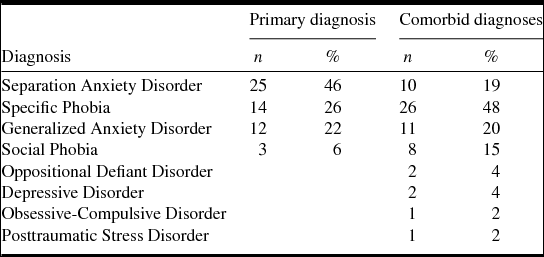
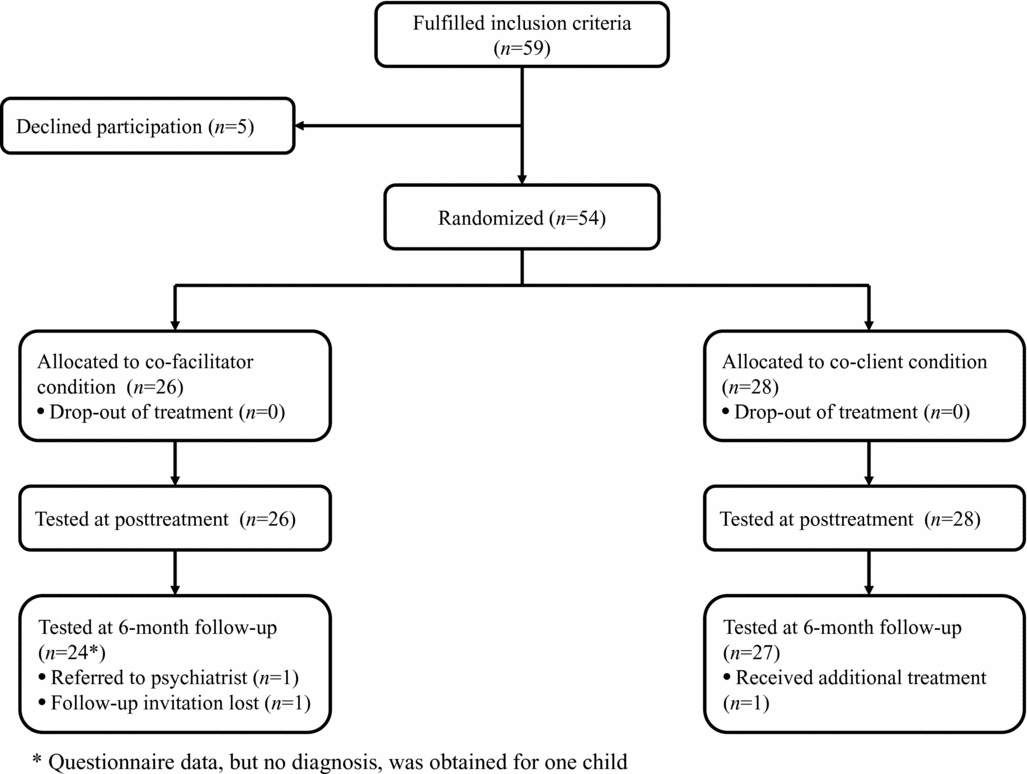
At intake, 59 children were eligible for enrolment (see Figure 1). Of these, five families declined participation in the study. A total of 54 children and their parents were enrolled from 1 March 2009 to 1 September 2010 and randomly allocated to one of two treatment conditions; parents as co-clients and co-facilitators. Randomization was stratified for age (younger: 7–9 years vs. older: 10–12 years) and gender. In 49 (91%) cases, both mothers and fathers participated in the study. In four (7%) cases, the mother participated alone, and in one (2%) case, the father was the only participating adult. The children had a mean age of 9.59 ± 1.7 years (age span: 7–12 years) and 26 (48%) were female. There were no significant differences in age distribution, gender or mean severity level of the primary diagnosis at intake (Mean CSRprimary: co-faciliator 7.23 (SD = .86) vs. co-client 7.64 (SD = .73); p = .063) or number of diagnoses per child (χ2 = .852, df: 2; p = .653) between the two groups. In the present study, only the three most impairing diagnoses were recorded per child. Thirteen children had only one diagnosis, 21 children had two, and 20 children had three diagnoses. The distribution of diagnoses at intake is shown in Table 1.
Primary and comorbid diagnoses of the children (n = 54) at intake

Note: Combined parent and child Anxiety Disorder Interview Schedule diagnoses
Flowchart of the inclusion process

Ethical statement
The study was approved by the Institutional Ethical Review Board, at the Department of Psychology, University of Copenhagen. It complies with Danish ethical standards regarding assessment and treatment for children enrolled in psychological research studies, and written informed consent to participate was obtained from all parents of participating youth.
Treatment
Families were randomly allocated to a co-facilitator or co-client treatment condition. Both conditions consisted of a total of 14 sessions. The first and last sessions were family sessions of 90 minutes duration; these were identical in the two treatment conditions. In the co-facilitator condition, session 2 through to 13 consisted of 12 individual child sessions where parents were briefly informed about homework at the end of the sessions. In the co-client condition, the child received six individual child sessions, and both parents attended six sessions. All sessions were of 45 minutes duration. The treatments were guided by case-formulations and were conducted by specialists in CBT for children and/or new therapists attending a 2-year certified training program in CBT for children and adolescents. All new therapists received on-going weekly or fortnightly supervision by a specialist in CBT. A total of eight therapists were involved. Four of the therapists were experienced, and five were present throughout the study. To minimize therapist effects, a crossed design was applied where all therapists were involved in both treatment conditions.
Treatment goals were identified with child and parents at the first family session. Furthermore, the first family session consisted of the following components; creating a case-formulation, psycho-education on anxiety, and socialization to CBT. The case-formulation identified the child's thoughts, emotions and behaviours in anxiety provoking situations, and also important family factors prior to the development/identification of the anxiety and during the anxiety provoking situations. The final family session included relapse prevention. Knowledge of family dynamics and life events had been collected during the pretreatment assessment. Also, information on the interactions between parent and child was obtained by interviewing the family members and through direct observations during the testing sessions. All of this information was incorporated into a case-formulation of the origination and maintenance of the child's problems. This formulation set a joint understanding of the anxiety and informed the intervention. An individualized treatment plan was developed, which targeted emotions, thoughts and behaviours using standard CBT techniques. Duration of each component was based on the individual child's needs. In the co-facilitator condition, the parents attended the family sessions and they received brief information on homework assignments during treatment, but they were not otherwise involved in the treatment.
Families who were enrolled in the co-client condition received six parallel parent sessions incorporating the following components: cognitive restructuring and modification of dysfunctional parental beliefs that would prevent the parent from providing optimal support to the child rather than being over-involved/intrusive; teaching the parents problem solving and conflict management strategies to minimize negative parent-child interactions resulting in lack of warmth in the interaction; and supporting the child to exhibit ongoing courageous behaviour by employing a contingency management strategy. The parent treatment thus targets: a) over-involved behaviour; b) lack of warmth in the parent-child interaction; and c) reinforcement of avoidant behaviour. All of these are established risk factors known to contribute to the development and maintenance of anxiety in childhood. Also, in this treatment condition, the case-formulation provided a conceptualization upon which an individualized parent treatment plan was conducted. The time spent on the components varied between the families according to their identified needs.
Measures
Parents and the child were assessed with interviews and completed various tests and questionnaires. The child was interviewed and completed the tests and questionnaires individually, whereas, the parents were interviewed together. Both parents completed the questionnaires separately. In the present study, diagnostic data are reported.
Anxiety Disorders Interview Schedule for DSM-IV, Child and Parent Versions (ADIS-IV-C/P; Silverman and Albano, Reference Silverman and Albano1996). The ADIS-IV-C/P measures DSM-IV symptoms of anxiety and other disorders. It consists of two independent semi-structured interviews that are administered to either child or parents. Symptoms are rated on a clinical severity rating (CSR) scale ranging from 0–8 by both child and parents. A score of ≥4 indicates a clinical level of difficulties for the disorder in question. In addition to the individual diagnoses derived from the child and parent interviews, a composite diagnosis may be created based on a combination of child and parent information. In case of discrepancy between parent and child, a diagnosis was given if it emerged in either of the two interviews and the highest CSR was given. In the present study, the composite diagnoses were used. All interviews were administered by staff trained in administering and scoring the ADIS-IV-C/P. To ensure reliability, on-going supervision was provided throughout the project. Furthermore, workshops were held where interviews were viewed together and discussed to ensure a similar approach to administration and scoring. In difficult/ambiguous interviews, the videotapes were viewed together and a consensus-score reached. All interviewers were blinded to the treatment condition and prior diagnoses of the child. Studies of the reliability of the ADIS-IV-C/P have overall shown a good to excellent reliability (Silverman, Saavedra and Pina, Reference Silverman, Saavedra and Pina2001).
In the present study, the composite ADIS diagnoses provided two outcome measures. One being “free of primary diagnosis”, which describes the number of children who no longer fulfilled criteria for their primary diagnosis at assessment posttreatment (either posttreatment or 6-month follow-up). The second being “free of all anxiety”, which describes the number of children who did not fulfil criteria for SAD, GAD, SoP or SP at assessment posttreatment (either posttreatment or 6-month follow-up).
Results
Feasibility of case-formulation driven CBT
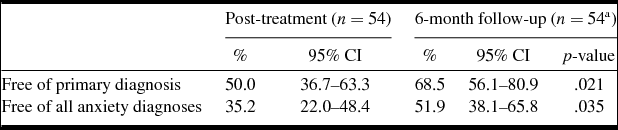
All families who started treatment completed the intervention. Diagnostic data were analysed using the intent-to-treat principle with last observation carried forward in cases where presence of diagnoses was not assessed at follow-up (n = 4).Possible treatment gains from posttreatment to follow-up were analysed using McNemar's test. Overall, the percentage of children free of their primary diagnosis at posttreatment was 50.0 % and at 6-month follow-up it was 68.5%. Similar figures for free of all anxiety diagnoses at posttreatment were 35.2% and 51.9% at 6-month follow-up. A significant improvement was found for both outcome measures from posttreatment to 6-month follow-up (see Table 2).
Treatment gains from posttreatment to follow-up of case-formulation driven CBT

Notes: a four diagnosis carried forward from posttest; CI = confidence interval
Differences between treatment conditions
Diagnostic data were also analysed by comparing the two treatment conditions using Pearson's chi-square. Possible treatment gains from posttreatment to follow-up were calculated using McNemar's test with all reported confidence intervals set to the 95th percentile. We found no significant differences between the percentage of children free of primary diagnosis at posttreatment between the co-facilitator and co-client condition; nor were there any significant differences at 6-month follow-up. Similar results were found for the percentage of children free of all anxiety diagnoses in the two conditions at posttreatment and at 6-month follow-up (see Table 3).
Differences on self-rated anxiety levels and diagnostic status between the two groups

Notes: a four diagnosis carried forward from posttest; Free of primary and all anxiety reported as percentage and 95% confidence intervals
Discussion
Acceptability of case-formulation driven CBT
The study set out to explore the feasibility of treating anxiety disordered children with case-formulation driven CBT in a clinic employing both new therapists and specialists. Acceptability was high and we had no drop-outs from either condition. This compared well with results from meta-analysis of manualized protocols, which found completion rates of between 83% and 86% depending on format of delivery and method of evaluation (In-Albon and Schneider, Reference In-Albon and Schneider2007). This suggests that providing an individualized treatment plan, based on a case-formulation, may be highly acceptable to families, and further exploration of this type of treatment should be encouraged.
Treatment effect of the feasibility study
The meta-analysis reported 55.4% of all children who had been enrolled in manualized CBT to be free of their primary anxiety disorder at posttreatment (In-Albon and Schneider, Reference In-Albon and Schneider2007). In our study, the corresponding number was 50%. Our findings of 35.2% of the children being free of all anxiety disorders at posttreatment and 51.9% at 6-month follow-up are lower than the corresponding 56.5% and 63.7% free of their anxiety reported by Cartwright-Hatton et al. Reference Cartwright-Hatton, Roberts, Chitsabesan, Fothergill and Harrington(2004) and the 56% reported by James et al. Reference James, Soler and Weatherall(2009). However, it is largely in agreement with the 41% of clinically referred children in a partial effectiveness study who were free of all anxiety disorders after CBT treatment (Bodden, Bögels et al., Reference Bodden, Dirksen and Bogels2008). In most other studies conducted at university clinics (e.g. Cobham, Dadds and Spence, Reference Cobham, Dadds and Spence1998; Wood, Piancentini, South-Gerow, Chu and Sigman, Reference Wood, Piancentini, South-Gerow, Chu and Sigman2006; Wood, McLeod, Piacentini and Sigman, Reference Wood, McLeod, Piacentini and Sigman2009), therapists will have received extensive training and be experienced CBT therapists prior to providing treatments in the trials. Our study incorporated newly educated psychologists who had just begun to practise and train as therapists and this lack of experience may have reduced effectiveness (Spielmans et al., Reference Spielmans, Gatlin and McFall2010). Similarly, this limited level of therapists training may also have affected the validity of case-formulations and thereby the effectiveness of our interventions (Kuyken et al., Reference Kuyken, Fothergill, Musa and Chadwick2005).
Studies have also shown treatment dosage to be related to outcome (Wampold et al., Reference Wampold, Budge, Laska, Del Re, Baardseth and Flückiger2011). In our study, the two treatment conditions varied in treatment dose to the child, although not to the family overall. The treatment dose provided to the child in most manualized protocols is 12 to 16 hours (i.e. 12 session of 60–80 minutes duration; Barrett, Dadds and Rapee, Reference Barrett, Dadds and Rapee1996). This is markedly more than that provided to children in the co-client condition in our study who received 7.5 hours of therapy (2 family and 6 individual sessions) but similar to the co-facilitator condition, where children received a total of 12 hours of treatment (12 individual and 2 family sessions). At 6-month follow-up, 62% of the children receiving the high dose of treatment were free of all anxiety. The corresponding figure reported in a systematic review of manualized treatments is 64% (Cartwright-Hatton et al., Reference Cartwright-Hatton, Roberts, Chitsabesan, Fothergill and Harrington2004).
In contrast to most manualized treatment trials, some of our therapists were still receiving training whilst delivering CBT, a situation that resembles most every-day clinics. Our findings, although exploratory, indicate that case-formulation driven CBT as provided in everyday clinics may be a feasible treatment in a childhood population suffering from anxiety disorders; a hypothesis that is corroborated by findings from the adult literature (Persons et al., Reference Persons, Roberts, Zalecki and Brechwald2006).
Exploring the format of treatment delivery
Existing studies on the effect of involving parents in treatment are ambiguous. The key question in our study was which format of parental involvement would provide the best outcome. The results showed no significant differences between involving parents as co-clients or co-facilitators at any of the assessment (posttreatment and 6-month follow-up). Our findings of similar effect in both groups are supported by most studies (e.g. Bodden, Bögels et al., Reference Bodden, Dirksen and Bogels2008; Nauta, Scholing, Emmelkamp and Minderaa, Reference Nauta, Scholing, Emmelkamp and Minderaa2001, Reference Nauta, Scholing, Emmelkamp and Minderaa2003; Wood et al., Reference Wood, Piancentini, South-Gerow, Chu and Sigman2006, Reference Wood, McLeod, Piacentini and Sigman2009) and do not suggest that one format of delivery was better than the other.
Limitations of the study
Our findings should be seen in light of the methodological limitations of the study. First, our study is exploratory in nature as it is the first of its kind to apply case-formulation driven CBT to anxious children. This stage I study was designed to develop our treatment method and to compare our results with previously reported results from meta-analyses. Further studies including a control group receiving manualized CBT and using sample sizes that allow for detection of smaller differences between treatment conditions should be conducted before any firm conclusions regarding the comparability between case-formulation driven CBT and manualized CBT for young anxious persons can be drawn.
We randomly allocated families to the co-client or the co-facilitator treatment condition. In a truly case-formulation driven approach, selection of treatment should also be based on the assessment of family functioning and the identified role of the parents in maintaining the anxiety in the child. We only enrolled 54 families, which compromises our statistical power, thereby reducing the chances of significant findings. Our lack of difference in effect between types of parental involvement in treatment is none the less consistent with most other studies.
Acknowledgements
The study was supported by grants to the Copenhagen Child Anxiety Project from the Egmont and Helse Foundation. We wish to thank Associate Professor Theis Lange for lending us his statistical expertise, all participating children and parents for contributing to this study, as well as all staff and students who have assisted in the process.




Comments
No Comments have been published for this article.