INTRODUCTION
Temporal fluctuations in marine macrophyte production are determined by interactions among several abiotic and biotic factors (Littler et al., Reference Littler, Murray and Arnold1979; Jernakoff et al., Reference Jernakoff, Brearley and Nielsen1996; Thomsen et al., Reference Thomsen, Wernberg, Staehr and Pedersen2006). For example, differences in water temperature and light intensity related to variation in the incidence of solar radiation throughout the year and to attenuation caused by suspended material in the water column can affect macrophyte photosynthetic rates, with effects on growth and survival rates (Moore et al., Reference Moore, Wetzel and Orth1997; Moore & Wetzel, Reference Moore and Wetzel2000; Ateweberhan et al., Reference Ateweberhan, Bruggemann and Breeman2005). Water nutrient concentration, especially of nitrogen and phosphorus compounds, could also represent an important regulation factor on macrophyte production (Neckles et al., Reference Neckles, Koepfler, Haas, Wetzel and Orth1994). In general, increased nutrient availability favours algal development (Korpinen et al., Reference Korpinen, Jormalainen and Honkanen2007) and some species can colonize large areas with high nutrient concentrations, influencing the composition and diversity of established macrophyte communities (McGlathery et al., Reference McGlathery, Sundbäck and Anderson2007). However, these effects may depend on herbivore pressure, and complex top-down and bottom-up effects can influence algal establishment and dynamics (Diaz-Pulido & McCook, Reference Diaz-Pulido and McCook2003).
Many species of growing algae are epiphytes, and their growth can negatively affect host macrophytes, by directly reducing available light and nutrients for the hosts or indirectly through chemical mediation (Borum, Reference Borum1987; Beach et al., Reference Beach, Walters, Borgeas, Smith, Coyer and Vroom2003), or increasing drag under intense hydrodynamic conditions, resulting in loss of macrophyte tissue (Borowitzka & Lethbridge, Reference Borowitzka, Lethbridge, Larkum, McComb and Sheppard1989; Littler & Littler, Reference Littler and Littler1999). Grazing can also influence host macrophyte dynamics and distribution, either negatively by direct consumption of the macrophytes or positively through consumption of their epiphytes (Hay, Reference Hay1981; Jernakoff et al., Reference Jernakoff, Brearley and Nielsen1996; Duffy et al., Reference Duffy, Macdonald, Rhode and Parker2001; Viejo & Aberg, Reference Viejo and Aberg2003). Further, large grazers such as fish and sea urchins are commonly noted for controlling host and epiphyte species (Tomas et al., Reference Tomas, Turon and Romero2005), although the importance of mesograzers such as amphipods is being increasingly recorded (Duffy & Hay, Reference Duffy and Hay2000).
Sargassum species are brown macroalgae that commonly occur in tropical and subtropical regions, and may represent more than 80% of algal biomass in shallow communities of south-eastern Brazilian algal beds (Paula & Oliveira-Filho, Reference Paula and Oliveira Filho1980). The studies that evaluated temporal variation of Sargassum populations in this region found different patterns, with the largest algal mass in summer (Széchy et al., Reference Széchy, Galliez and Marconi2006), late summer and mid-spring (Leite & Turra, Reference Leite and Turra2003), and spring (Paula & Oliveira-Filho, Reference Paula and Oliveira Filho1980; Schenkman, Reference Schenkman1989). Suggested factors responsible for this variation include temperature and nutrient availability (Széchy et al., Reference Széchy, Galliez and Marconi2006), mortality due to daytime low tides (Schenkman, Reference Schenkman1989), grazing by sea urchins (Paula & Oliveira-Filho, Reference Paula and Oliveira Filho1980) and effects of epiphytes (Leite & Turra, Reference Leite and Turra2003). However, the influence of abiotic factors such as hydrodynamism and suspended solids, and biotic factors such as the effect of mesograzers were never investigated. Thus, factors responsible for the temporal variation of Sargassum species on these shores are not yet fully understood. In the present study, we explore the effects of several biotic and abiotic factors on temporal fluctuations of Sargassum filipendula C. Agardh 1824 on a subtropical Brazilian shore.
MATERIALS AND METHODS
Study area
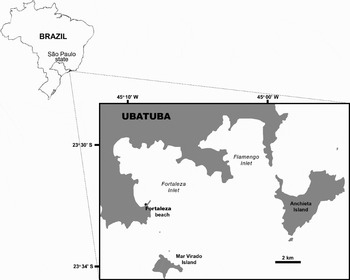
This study was carried out at Fortaleza Beach (23°32′S 45°10′W), located in Fortaleza inlet, on the northern coast of São Paulo state, south-eastern Brazil (Figure 1). Samples were obtained from a Sargassum bed in a sheltered part of the rocky shore, at a depth of 2.5 m. The brown alga Sargassum filipendula dominated the algal bed, although Galaxaura stupocaulon Kjellman 1900 (Rhodophyta), Padina gymnospora (Kützing) Sonder 1871 (Phaeophyta) and Caulerpa racemosa (Chlorophyta) (Forsskal) J. Agardh 1873 were also present with low cover. The brown algae Dictyopteris delicatula J.V. Lamouroux 1809 and Dictyota cervicornis Kützing 1859, and the red alga Hypnea musciformis (Wulfen) J.V. Lamouroux 1813 are the main epiphytes occurring on the upper parts of S. filipendula, as also observed by Széchy & Paula (Reference Széchy and Paula1997). There were no sea urchins in this area, since they occur mainly in exposed parts of the shore, within holes and fissures in the rock, as also observed by Paula & Oliveira-Filho (Reference Paula and Oliveira Filho1980).
Study area and location of the Sargassum bed sampled.

Sampling procedure and processing
From June 2000 to May 2001, monthly samples of Sargassum filipendula fronds were collected from a 50 m transect line laid parallel to the shore, at 2.0 depth. The transect line had numbered marks in intervals of 0.5 m. Each month fifteen numbered marks were sorted and the samples directly below those marks were collected. Each sample consisted of an individual frond that was carefully enclosed within a bag of 0.2 mm mesh size and separated from the substrate at its holdfast. The bags were kept in plastic bottles with seawater for transport. Samples were collected by snorkelling and SCUBA diving.
In the laboratory, each frond was washed successively in four buckets containing a 4% formalin solution to detach the associated animals from algae. The remaining epifauna in the buckets was carefully washed through a 0.2 mm mesh sieve. All amphipods were identified to species level and counted under a stereomicroscope. The epiphytes associated with each frond were removed by hand and the dry mass of total epiphytes, H. musciformis (the most frequent epiphyte and with the highest biomass) and S. filipendula were determined after drying at 60°C for 48 hours. Although several epiphyte species were found in each sample, each contributed with very low biomass values separately, and also presented low incidence during the study; thus, we analysed separately only the dominant species, H. musciformis.
Temporal changes in S. filipendula density were assessed by counting the number of holdfasts in ten 0.25 m2 quadrats randomly established along the transect line. Monthly fluctuations in the biomass of S. filipendula and epiphytes were determined as described above.
Surface water temperature was measured with a thermometer on three successive days, during each sampling trip. Water movement was estimated through loss of mass of four plaster balls, made with fast drying material (70% plaster:30% water). The balls were pre-dried at 70°C for 24 hours, maintained for 12 hours in dryers and their mass determined. Two plastic plates with two plaster balls on each were fixed on the rock at the edges of the sampling transect. The plaster balls were removed after 24 hours and processed as described above. The differences in ball mass provided an estimate of hydrodynamics through the loss of material in g.h−1. The amount of suspended solids in the water column was determined by filtering three samples of 1l each, obtained on three consecutive days. Water samples were collected in the centre and edges of the sampling transect. Water was filtered through a 0.22 µm membrane (Millipore), and the suspended solids content was determined by the difference of membrane mass before and after filtering. To estimate water concentration of total phosphate, ammonium, nitrite and nitrate, samples were collected in the centre and edges of the sampling transect in the last field working day; we assumed that nutrient values would not change along the 3-day period of each sampling trip. Nutrient concentrations were determined using standard methods (Greenberg et al., Reference Greenberg, Clesceri and Eaton1992).
Data analysis
To verify whether Sargassum filipendula density and algal dry mass varied during the sampling period, we used a one-way ANOVA. When significant differences were detected, we used the HSD Tukey test for post-hoc pairwise comparisons. To evaluate which factors influenced variation of algal mass and S. filipendula density, we ran a stepwise multiple regression on mean monthly values. The independent variables for S. filipendula analyses were temperature, water movement, suspended solids, total phosphate, ammonium, nitrite, nitrate, total epiphyte dry mass and abundance of amphipod grazers. Independent variables for epiphyte analyses included all those cited above, also including S. filipendula dry mass and density. Data normality and homoscedasticity were verified; square-root and logarithm transformations were applied when necessary (Zar, Reference Zar1999).
RESULTS
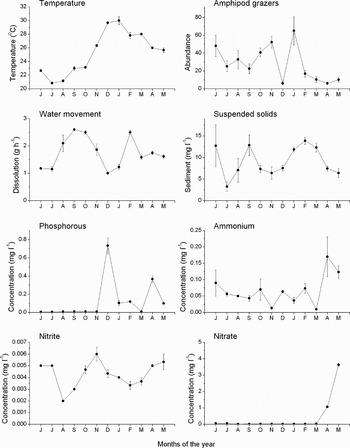
Surface water temperature varied from 20.8°C in July 2000 to 29.3°C in January 2001 (Figure 2). The erosion rate of plaster balls indicated a trend of increased water movement in late winter and early spring, with another peak in February. Three peaks of suspended solids were noted, in June, September and February. No single pattern was detected for the nutrients analysed, with two peaks of total phosphate (in December and April), an increase in the concentration of ammonium and nitrate in early autumn and lower values of nitrite in August–September and January–March (Figure 2). Amphipod grazers presented low variation, with a large peak in abundance in January (Figure 2). Five species of grazers were found, the ampithoids Ampithoe ramondi Audouim, 1826, Cymadusa filosa Savigny, 1816, and Sunampithoe pelagica (Milne-Edwards, 1830), the hyalid Hyale nigra Haswell, 1879, and the melitid Dulichiella anisochir (Krøyer, 1845).
Temporal variation in abiotic and biotic factors at Fortaleza Beach, south-eastern Brazil. Values are means±standard errors.

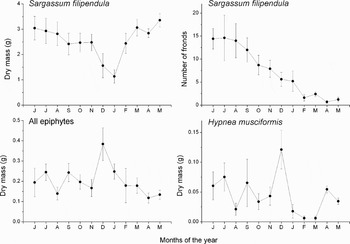
Density of Sargassum filipendula fronds decreased continuously throughout the sampling period, with significant differences between the study periods (F11,93 = 8.37; P < 0.001) (Figure 3). There was no correlation between S. filipendula density and dry mass, with significant variation of the latter among sampling periods (F11,166 = 5.91; P < 0.001), but with a noticeable reduction in December 2000 and January 2001 (Figure 3). Epiphyte dry mass also showed a significant variation (F11,166 = 2.16; P = 0.019), with the highest value recorded in December 2000 (Figure 3). Hypnea musciformis was the most frequent epiphyte on S. filipendula, occurring in all sampling periods, with significant temporal variation (F11,166 = 3.11; P = 0.001). The highest value of dry mass was recorded in December, and lowest values between January and March (Figure 3).
Temporal variation in density and dry mass of Sargassum filipendula, and epiphyte dry mass at Fortaleza Beach, south-eastern Brazil. Values are means±standard errors.

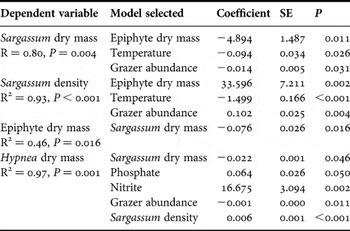
Stepwise multiple regressions indicated that both S. filipendula density and dry mass were influenced by epiphyte dry mass, temperature, and amphipod grazers, but with different effects of each variable (Table 1). Sargassum filipendula dry mass was negatively influenced by all factors, with the strongest effect due to epiphyte dry mass, which peaked one month before the lowest S. filipendula dry mass value (Figure 3). Lowest S. filipendula biomass was also observed in the summer (January), when highest grazer abundance was recorded (Figure 3). On the other hand, S. filipendula density was negatively influenced by temperature, with lowest densities during the warmer months, but positively influenced by epiphyte dry mass and grazer abundance (Table 1). In fact, the lowest density values were recorded in periods when both amphipods and epiphytes were decreasing to their lowest values (Figure 3).
Results of stepwise multiple regression on factors influencing variation of Sargassum filipendula dry mass, density, and epiphyte dry mass.

Different factors influenced epiphyte biomass: S. filipendula biomass negatively influenced total epiphyte biomass, whereas H. musciformis biomass was positively influenced by phosphate, nitrite, and S. filipendula density and negatively influenced by S. filipendula dry mass and amphipod grazer abundance (Table 1).
DISCUSSION
Temporal fluctuations of S. filipendula and epiphytic algae can be related to local abiotic and biotic factors, but the variation observed in the biomass of the host macrophyte and epiphytes suggest that these factors have quite distinct effects for these algae. Biomass variation observed throughout the year is the result, at least in part, of net algal growth, which results from the difference between the addition of new vegetative and reproductive tissue and loss of senescent tissue. Before the period of biomass loss, an increase in Sargassum biomass is expected, due to the production of reproductive structures (Paula & Oliveira-Filho, Reference Paula and Oliveira Filho1980), but we did not observe this pattern in our study. Temporal variation of S. filipendula biomass was negatively influenced by temperature, epiphytes, and amphipod grazers, since lowest biomass values were observed in the summer.
Water temperature can strongly influence macroalgal photosynthetic rates. Although we recorded a narrow range of temperatures throughout our study, maximum values in the summer were close to values that were observed to inhibit S. filipendula growth in laboratory experiments (Prince, Reference Prince1974). Studies on other shores in the region, however, recorded different patterns depending on wave exposure. For example, Paula & Oliveira-Filho (Reference Paula and Oliveira Filho1980) found maximum biomass values for S. cymosum in the summer (sheltered shore) or in the spring (exposed shore), whereas Schenkman (Reference Schenkman1989) found maximum values in late spring in an exposed shore, and Leite & Turra (Reference Leite and Turra2003) found higher values in the summer (February) and autumn (May) in a protected shore. The greater tidal range observed in exposed shores can help to explain the lower biomass values in the colder months, since during these times there are more days of occurrence of diurnal low tides, resulting in higher mortality rates (Schenkman, Reference Schenkman1989). Our results, from a moderately protected shore, suggest that biotic factors can be more important in influencing Sargassum biomass.
The strongest factor influencing S. filipendula biomass was the variation in total epiphyte biomass, which peaked one month before the lowest Sargassum biomass was observed. Epiphyte growth can negatively influence the algal host by increasing drag and thus the loss of host branches (Buschmann & Gomez, Reference Buschmann and Gomez1993; Littler & Littler, Reference Littler and Littler1999), although low incidence values can facilitate host survival by supplying food to herbivores (Hay, Reference Hay1986). Both effects were possibly observed in our study. The increased epiphyte load, combined with senescence of Sargassum laterals after the reproductive period (Paula & Oliveira-Filho, Reference Paula and Oliveira Filho1980; Széchy et al., Reference Széchy, Galliez and Marconi2006), possibly resulted in great loss of S. filipendula biomass as predicted for other algal hosts (Littler & Littler, Reference Littler and Littler1999). Further decreases of epiphytes were observed possibly as a result of mesograzer action, enabling the re-growth of S. filipendula to pre-summer levels. This positive effect of Hypnea musciformis on Sargassum spp. was previously proposed by Hay (Reference Hay1986), and confirmed by Reis et al. (Reference Reis, Leal, Yoneshigue-Valentin and Belluco2003) with S. cymosum, whereas Schenkman (Reference Schenkman1989) also suggested that mesograzers could have a negative impact on H. musciformis in a nearby shore.
A different pattern was observed for epiphytes, since only S. filipendula biomass influenced general epiphyte biomass, possibly due to the increased support provided by the host species for epiphyte growth. It is difficult to evaluate which factors influence general epiphyte biomass, because several species can be epiphytes on Sargassum in this region (Széchy & Paula, Reference Széchy and Paula1997), and each species could have a characteristic demand for resources and resistance to herbivores and other stress factors (Moore & Wetzel, Reference Moore and Wetzel2000). For example, the biomass of the dominant epiphyte species (H. musciformis) was positively influenced by nutrients and S. filipendula density, and negatively by S. filipendula biomass and amphipod grazers. Hypnea musciformis occurred in all sampling periods, but with large biomass differences throughout the year. No seasonal pattern was recorded, confirming the results obtained by Faccini & Berchez (Reference Faccini and Berchez2000), although they found a positive influence of phosphate concentration on H. musciformis biomass, a result similar to our findings. On the other hand, nitrite concentration in the water positively influenced H. musciformis in our study, although no effect of nitrogenous compounds was observed by Berchez & Oliveira (Reference Berchez, Oliveira, de Oliveira and Kautsky1990) and Faccini & Berchez (Reference Faccini and Berchez2000). As suggested above, these differences in regional patterns could be strongly related to exposure differences between the studied shores, and more studies comparing the relative effects of these factors on different shores are warranted.
The reduction in S. filipendula density observed throughout the study suggests a long-term trend in temporal variation, a result also found for other populations of Sargassum studied elsewhere. For example, Paula & Oliveira-Filho (Reference Paula and Oliveira Filho1980) found a decreasing trend in S. cymosum density during 19 months of study in an exposed shore, whereas Ateweberhan et al. (Reference Ateweberhan, Bruggemann and Breeman2005) found a decreasing pattern for S. ilicifolium during 23 months of study of a subtidal reef flat; however, both studies also found a seasonal pattern in density variation. Our study lasted 12 months, and we were not able to detect this variation. Suggested explanations in these studies include the effects of large grazers (Paula & Oliveira-Filho, Reference Paula and Oliveira Filho1980) and intraspecific density-dependent mortality (Ateweberhan et al., Reference Ateweberhan, Bruggemann and Breeman2005). Our study site had no sea urchins, preventing the effect of large grazers, but gaps opened in the S. filipendula bed were occupied by other epilythic species, mainly Galaxaura stupocaulon (G.B. Jacobucci, personnal observation). Eston & Bussab (Reference Eston and Bussab1990) evaluated succession patterns on S. stenophyllum beds in a nearby shore, concluding that S. stenophyllum eventually dominates gaps opened in shallow subtidal coasts, but there may be an intermediate dominance by brown algae of the genus Dictyopteris. Our results suggest an interaction between S. filipendula senescence and epiphytes causing mortality of Sargassum fronds, releasing space for other competitors, but the eventual reestablishment of S. filipendula as a dominant species remains to be evaluated.
The presence of epiphytes increases macroalgal habitat complexity, increasing the availability of attachment sites, food and shelter for the epifauna (Hall & Bell, Reference Hall and Bell1988; Martin-Smith, Reference Martin-Smith1993). In the present study, grazing amphipods negatively influenced the biomass of both the host macroalga and the epiphyte H. musciformis, suggesting they can have a strong impact in this system, as noted in other communities (Duffy & Hay, Reference Duffy and Hay2000). However, the effects of these grazers can be scale-dependent, since their distribution varies within algal patches (Tanaka & Leite, Reference Tanaka and Leite2003), and could contribute to a more homogeneous effect at larger spatial scales. The dynamics of this interaction can be complex (D'Antonio, Reference D'Antonio1985), and more studies are necessary to better understand how patchy distributions of consumers influence local dynamics of macrophytes, and whether variation in abiotic factors interact to influence these results.
ACKNOWLEDGEMENTS
We thank D.F.C. Jacobucci for help in the field. This work was partially funded by FAPESP (Proc. 99/11325-9)