Introduction
Social scientists have long been analysing the relationship between environment and individuals’ behaviours (House Reference House1977), particularly with regard to older adults (Lawton Reference Lawton, Birren and Schaie1977). The residential environment, including whom people live with and where they live, has significant relevance for individuals’ mental health (Wirth Reference Wirth1938). As a key element of the residential environment, living arrangements have been demonstrated to have strong implications for family relations, which influence the elderly's subjective wellbeing (SWB) (Hays Reference Hays2002).
Because of the rapid demographic and social transitions taking place in China, there is great interest in living arrangements and their effect on SWB among elderly Chinese. On the one hand, China is ageing rapidly and has the largest number of older people in the world.Footnote 1 On the other hand, the promotion of ageing well in later life is a key strategy of public health policy in many countries, including China. The key characteristic of successful ageing, health, does not merely mean the absence of disease, but a subjective experience of wellbeing (e.g. HM Government 2010). When considering health in later life, it is important not only to think of more objective measures of health, such as functional limitation or chronic disease, but psychological health and measures of wellbeing (Martinson and Berridge Reference Martinson and Berridge2015). Understanding how living arrangements affect elderly people's SWB is important for academic and political circles.
In recent decades, scholars have expressed such concerns with regard to China, as well as other Asian countries such as the Philippines, Thailand, Indonesia and Bangladesh, where studies have observed sharp reductions in parent–child co-residence (Knodel and Ofstedal Reference Knodel, Ofstedal and Hermalin2002; Schroder-Butterfill Reference Schroder-Butterfill2003; Zeng and Wang Reference Zeng and Wang2003). It is commonly understood that the elderly's living arrangements are determined by both constraints and preferences. For example, the increasing prevalence of independent living (living alone or only with a spouse) among elderly Chinese has been explained in terms of a growing demand for ‘privacy’ which has accompanied increasing housing availability (Meng and Luo Reference Meng, Luo, Gustafsson, Li and Sicular2008) and income growth (Palmer and Deng Reference Palmer, Deng, Gustafsson, Li and Sicular2008). In addition, Zeng and Wang (Reference Zeng and Wang2003) argued that changes in social norms related to preference for co-residence play a significant role in living independently among elderly Chinese. However, while many studies discuss preferences, few explicitly measure them, and instead assume that actual living arrangements are a partial consequence of preference (Wilmoth Reference Wilmoth2001). Without data on actual living arrangement preference, our knowledge is limited, and questions about the dynamics of living arrangements and their impact on SWB go unanswered.
Defining subjective wellbeing
George (Reference George2010: 331) conducted an extensive literature review and found that the construct of SWB was measured as psychological wellbeing, happiness, positive affect and morale, with these often used interchangeably. In general, the academic literature measures SWB by three broad approaches: evaluative, eudemonic and affective (Dolan and Metcalfe Reference Dolan and Metcalfe2012; Tinkler and Hicks Reference Tinkler and Hicks2011). The evaluative approach is based on a global appraisal of one's life and is measured in its crudest form by simply asking people how satisfied they are with their life (Diener Reference Diener1994). The eudemonic approach can be defined as the self-assessed worth of an individual's life, how much control they feel they have over it and whether they are able to plan for the future (Ryff and Singer Reference Ryff and Singer1998). Affective wellbeing can be defined as the degree of negative or positive emotions an individual has experienced, including feelings of sadness, anxiety, happiness or excitement (Tinkler and Hicks Reference Tinkler and Hicks2011). This could be in terms of frequency or intensity within a given time-frame or at a certain point in time. The data used in this article allow for two different measures of the affective approach to SWB: depression and happiness. Depression is defined as the older person's level of depressive symptoms as measured by an index of eight questions. Happiness is defined as their perception of how often they feel ‘happy’.
Living arrangements affecting subjective wellbeing
It is difficult to compare studies in this field because of different measures of possible living arrangements and SWB, as well as potential regional differences. What has been firmly established is that living alone is an undesirable condition. For example, studies of various older populations in Hong Kong, Japan, the Netherlands and the United States of America (USA) have reported that elderly people living alone were more likely to be depressed (Cheng et al. Reference Cheng, Lee Coty, Chan, Leung and Lee2009; Chou and Chi Reference Chou and Chi2000; Chou, Ho and Chi Reference Chou, Ho and Chi2006; Dean et al. Reference Dean, Kolody, Wood and Matt1992; Mui Reference Mui1998) and have poorer quality of life and mental health status (Iwasa et al. Reference Iwasa, Kawaai, Gondo, Inagaki and Suzuki2006) than their counterparts.
Studies from China focusing on the association between actual living arrangements and SWB have found in several cases that older adults co-residing with family members generally have better SWB than those living independently (living alone or only with a spouse). For example, Silverstein, Cong and Li (Reference Silverstein, Cong and Li2006) found that in rural areas, older parents who lived in three-generation households had greater life satisfaction and lower levels of depression than those who lived independently. Older adults who lived with other family members also had lower levels of depression than those who lived alone (Sun et al. Reference Sun, Lucas, Meng and Zhang2011; Ye and Chen Reference Ye and Chen2014). Compared to independent living, co-residence (with a child) was associated with better life satisfaction (Wang, Chen and Han Reference Wang, Chen and Han2014). Conversely, non-co-residence (with a child) and living alone have been demonstrated to be negatively associated with life satisfaction and overall psychological wellbeing for elderly Chinese (Chen and Short Reference Chen and Short2008; Liu and Guo Reference Liu and Guo2008). A few studies, on the other hand, have reported negative impacts of parent–child co-residence, such as lack of privacy and intergenerational conflict (Hermalin and Yang Reference Hermalin and Yang2004; Yang and Chandler Reference Yang and Chandler1992).
In fact, embedded in a traditional culture where the Confucian norm of filial piety was honoured, living with adult children had once been the most prevalent living arrangement and the best option for Chinese elderly people (Zeng et al. Reference Zeng, Vaupel, Xiao, Zhang and Liu2002). This tradition is attributed to Confucian doctrines, which emphasise not only respect for older generations but also the obligation of children to live with and take care of their elderly parents (Cheng and Chan Reference Cheng and Chan2006). Intergenerational co-residence remains an important sign of respect accorded to the elderly which represents the most complete fulfilment of a cultural ideal, filial piety, and may directly protect the wellbeing of older Chinese parents (Chen and Silverstein Reference Chen and Silverstein2000). In addition, co-residence implies more exchange of instrumental support between older parents and adult children (Agree et al. Reference Agree, Biddlecom, Chang and Perez2002), which is influential in preventing depression in older adults (Chi and Chou Reference Chi and Chou2001).
Our understanding is as yet incomplete. One issue is that a potential factor, living arrangement preference, was not taken into account. The discrepancy theories argue that, at any age, one's SWB will be highest when the discrepancy between one's aspirations and achievements is small. In contrast, SWB will be lower if our achievements fall significantly below our aspirations. Whether, or how much, an individual is able to ‘match’ preferences and realities is related to self-assessed worth of an individual's life and how much control they feel they have over it, which studies have long recognised as an important measure of SWB (Ryff and Singer Reference Ryff and Singer1998). George (Reference George2010: 332) noted that ‘Substantial evidence has supported discrepancy theory for more than three decades’. Perhaps some elderly Chinese do not have the opportunity to change their living arrangements, but their preference may change in the context of demographic and social transitions. If they are not able to maximise concordance between preference and reality, it may lead to negative consequences for health and wellbeing.
Personal characteristics affecting subjective wellbeing
Many factors have demonstrated effects on SWB, among which personal characteristics have received the most attention (Yeatts et al. Reference Yeatts, Cready, Pei, Shen and Luo2014). For example, studies have provided persistent findings of a positive age effect on SWB (Das et al. Reference Das, Do, Friedman, McKenzie and Scott2007; Lee and Browne Reference Lee and Browne2008; Pinquart and Sörensen Reference Pinquart and Sörensen2000), while gender difference in SWB is less clear. Married persons are more likely to report higher SWB than widows/widowers and those living alone (Diener et al. Reference Diener, Gohm, Suh and Oishi2000). Having a larger number of children is also associated with better SWB (Pei and Pillai Reference Pei and Pillai1999).
Financial status or economic resources have been held to be directly related to obtaining services for basic needs in later life (Slivinske, Fitch and Morawski Reference Slivinske, Fitch and Morawski1996), and have been proposed as significant factors in SWB (La Barbera and Gürhan Reference La Barbera and Gürhan1997). Having more education, which engenders efficacy and the ability to cope with adversity (Mirowsky and Ross Reference Mirowsky and Ross2003), tended to increase SWB (Wang, Chen and Han Reference Wang, Chen and Han2014). Among personal characteristics, physical health may be the strongest predictor of SWB in later life and has a demonstrated positive effect on SWB (Cho, Martin and Poon Reference Cho, Martin and Poon2014).
This article explores how intergenerational arrangements with children influence the SWB of older parents in China. It contributes to knowledge about living arrangements among the elderly in a developing country setting by examining the individual's preferences in addition to actual living arrangements. If discrepancy does matter, we expect individuals who successfully match preferred and actual living arrangements to have better SWB than those who do not. Few data-sets are able to actually capture preference, but the interesting and surprising results shown here will hopefully encourage other surveys of the elderly to include a question about preference. Specifically, I addressed the following questions:
• Research question 1: What types of older adults prefer co-residence with children?
• Research question 2: Does living arrangement concordance influence the SWB of older adults?
• Research question 3: Would controlling for living arrangement concordance change the estimated effect of the actual living arrangements on older adults’ SWB?
Methods
Sample
Data for this investigation derived from the China Health and Retirement Longitudinal Study (CHARLS) national baseline conducted between June 2011 and March 2012. The CHARLS is a Chinese version of the US Health and Retirement Study, and consists of a nationally representative sample of adults aged 45 and older and their spouses from 28 provinces and autonomous regions in China.Footnote 2 The survey instruments and procedures were developed by a team of researchers from Peking University, the University of Southern California and Oxford University. The sample was identified through a multi-stage random sampling procedure that targeted adults living in households throughout China and was stratified by rural–urban status (for details, see Zhao et al. Reference Zhao, Strauss, Yang, Giles, Hu and Park2012). The total sample size was 17,705 individuals in 10,257 households. The response rate among eligible households was 85 per cent: 91 per cent among rural households and 79 per cent for urban households.
This article focused on 7,196 respondents to the CHARLS who were 60 years and older at the time of the survey, who are considered old by Chinese standards, and who had at least one surviving child.Footnote 3 Among these respondents, I included only those who do not have missing values in living arrangement preference, yielding an effective sample size of 6,742 valid samples.
Dependent variables
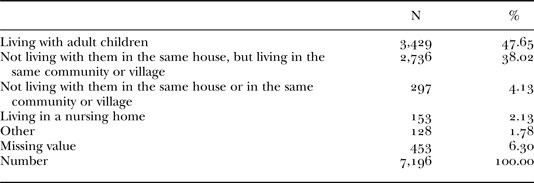
There are several dependent variables in this article. The first dependent variable is living arrangement preference. The CHARLS asks, ‘Suppose an elderly person has a spouse and adult children/has no spouse but has adult children, and has a good relationship with them, what do you think is the best living arrangement for the elderly person?’Footnote 4 Respondents had a choice of five possible answers (Table 1): (a) living with adult children (47.65%), (b) not living with them in the same house, but living in the same community or village (38.02%), (c) not living with them in the same house or in the same community or village (4.13%), (d) living in a nursing home (2.13%), and (e) other (1.78%). A dummy variable was created to indicate preference for co-residence with children (1 = if prefer co-residence, 0 = if otherwise).
Preferred living arrangement for full sample, age 60+

Following Yeatts et al. (Reference Yeatts, Cready, Pei, Shen and Luo2014), who also used the CHARLS data, and as discussed in the previous section, this article uses two different measures of SWB: depression and happiness. Each of these was constructed from the respondent's report of how often an experience occurred ‘in the last week’. For example, happiness was a four-point scale and was measured with the statement: ‘In the last week I was happy: (1) rarely or none of the time (<1 day), (2) some or a little of the time (1–2 days), (3) occasionally or a moderate amount of the time (3–4 days), or (4) most or all of the time (5–7 days)’. Therefore, a higher scale of ‘happiness’ indicated a happier elderly person.
I measured depression by using the following eight ‘experiences’: ‘I was bothered by things that don't usually bother me’; ‘I had trouble keeping my mind on what I was doing’; ‘I felt depressed’; ‘I felt everything I did was an effort’; ‘I felt fearful’; ‘My sleep was restless’; ‘I felt lonely’; and ‘I could not ‘get going’’. I coded the frequency with which the participant had experienced each symptom in the past week as 0 (rarely or none of the time), 1 (some of the time) or 2 (most of the time). The reliability coefficient (Cronbach's α) was 0.801, indicating that the eight ‘depressive symptoms’ items measured a single factor. I combined the effects of the eight ‘experiences’ using factor analysis and obtained the principal component.Footnote 5 I then used the average principal component of the elderly as a single control for depressive symptoms. Though this index itself is dimensionless, it is increasing with higher depressive symptoms.
Independent variables
The key independent variable in this article is living arrangement concordance. Concordance is defined as having a match between preferred and actual living arrangements. I first created a multiple living arrangement concordance variable which has six categories: respondents who preferred to co-reside with children, and did so, are considered as ‘co-residence concordance’; those who preferred to co-reside with children and did not live with children are considered as ‘co-residence discordance’; those who preferred not to co-reside with but to live near children, and did so, are considered as ‘living near concordance’; those who preferred not to co-reside with but to live near children, but either lived with children or lived away from children, are considered as ‘living near discordance’; those who preferred not to co-reside with and not to live near children, and did so, are considered as ‘living away concordance’; those who preferred not to co-reside with and not to live near children, but either lived with or lived near children, are considered as ‘living away discordance’. I also created a dummy variable of living arrangement concordance (1 = if living arrangement preference matched the reality, 0 = if otherwise).
Other independent variables included demographic, socio-economic status and health. Demographic variables included age, gender, marital status and total number of children. Age was measured in years, while gender (1 = male) and marital status (1 = married) were dummy variables. I also created two dummy variables to capture cultural effect: ‘urban upbringing’ (1 = if one mainly lived in urban areas before the age of 16) and ‘currently living in urban areas’ (1 = if yes). Provincial dummy variables were included in all the regressions to control for any possible fixed effects (not shown).
Respondents’ education levels were grouped into five categories: illiterate, less than elementary education, completed elementary school, junior high, and senior high and above. In particular, the second category – less than primary education – includes those who did not complete primary school but were capable of reading or writing, or those who reported to have been in Sishu.Footnote 6 The lowest education level, illiterate, was treated as the reference. Following previous studies of China (Huang et al. Reference Huang, Lei, Ridder, Strauss and Zhao2013) and other developing countries (Herrin, Amaral and Balihuta Reference Herrin, Amaral and Balihuta2013), I used household per capita expenditures (pce) as a proxy for household income to measure respondents’ economic wellbeing.Footnote 7 In the regression analyses, I took the natural logarithm of pce. Respondents were asked, ‘Overall, how would you rate your own standard of living? Is it very high, relatively high, average, relatively poor or poor?’ I created a dummy variable, self-rated high standard of living, coded as 1 if one reported ‘very high’ or ‘relatively high’. Another dummy variable, indicating whether the respondent lived in his or her own property (1 = yes), was included to control for possible wealth effect.
Health was measured by functional difficulties. Respondents were asked about difficulties with six activities of daily living (ADLs; dressing, bathing or showering, eating, getting into or out of bed, using the toilet, and controlling urination and defecation) and five instrumental activities of daily living (IADLs; household chores, preparing hot meals, shopping for groceries, managing money and taking medication). The original response set was coded as follows: 1 (‘No, I don't have any difficulty’), 2 (‘I have difficulty but can still do it’), 3 (‘Yes, I have difficulty and need help’) or 4 (‘I cannot do it’). I computed two additive scales ranging from 6 to 24 and from 5 to 20 to indicate the number of ADLs and IADLs with which the older adult reports experiencing difficulty and the severity of that difficulty, respectively.
To test whether actual living arrangements had a different impact on SWB when they occurred with concordance, I controlled for both factors in the regressions. To make this study comparable with others, I followed Silverstein, Cong and Li (Reference Silverstein, Cong and Li2006) and grouped actual living arrangements into five categories: (a) lives with adult children and grandchildren (stem family); (b) lives only with adult children (truncated stem family); (c) lives with grandchildren but not with children (skipped-generation family); (d) lives with neither children nor grandchildren, but at least one child lives in the same county/city (network family); and (e) lives with neither children nor grandchildren, and all children live beyond the county/city (isolated family). I used four dichotomous variables to represent each of the last four categories, with the stem family as the reference group.Footnote 8 I created interaction terms by multiplying the dummy variable of concordance with each of the dummy variables signifying actual living arrangement type, resulting in four interaction terms.
Missing data
Since several variables used in this analysis have missing data, including the measures of depression (536 missing values), happiness (333 missing values), functional difficulties (100 missing values) and household pce (nine missing values), I imputed all missing values using Stata 13's multiple imputation (MI) procedures (StataCorp 2013).Footnote 9 Specifically, I applied the multivariate imputation by chained equations technique (MICE), carrying out 20 imputations, and conducted the analysis using MI procedures. Many of the initially developed MI procedures assumed a large joint model for all of the variables, which is rarely appropriate for large data-sets. In the MICE procedure, each variable can be modelled according to its distribution, with, for example, binary variables modelled using logistic regression and continuous variables modelled using linear regression (Azur et al. Reference Azur, Stuart, Frangakis and Leaf2011). Therefore, the MICE approaches provide more flexibility to the joint model for all of the variables, compared with other MI procedures. My analysis is based on 6,742 completed cases.
MICE (and other MI procedures) operates under the assumption that missing values for the variables to be imputed are ‘missing at random’ (MAR) (Little and Rubin Reference Little and Rubin2002), which means there is no correlation between the true value of the variable and the likelihood that the value is missing in the data-set. This is problematic with respect to depression and happiness since those who are more depressive or who are less happy are less likely to answer the ‘experience’ questions because of the discomfort involved in admitting the fact to themselves (and to the interviewer). I used logistic regression in order to identify the salient characteristics of the missing-data cases; the results (not shown) demonstrate that factors indicating a higher level of depression (lower pce, not having a self-rated high standard of living) were positively associated with the likelihood of missing information on depression, while factors indicating a lower level of happiness (functional difficulties) were positively associated with the likelihood of missing information on happiness. None of the explanatory variables associated with actual living arrangements or with living arrangement concordance were significantly related to the absence of depression or happiness. From these results I conclude that the hypothesis that those who are more depressive or those who are less happy are less likely to respond to the ‘experience’ question is unlikely. Since I have no other hypotheses regarding the possibility that the SWB variables are not MAR, I treat them as MAR and impute the missing cases. I also conducted analyses excluding the missing-data cases (not reported), which does not make a significant difference to my findings.
Results
Descriptive statistics
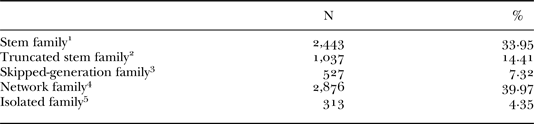
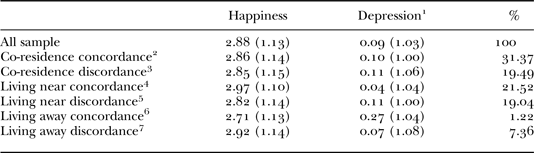
As seen from Table 2, half of those aged 60 years and older (48.36%) co-resided with children, 33.95 per cent of the sample lived in three-generation families and 14.41 per cent of the sample lived in two-generation families. These data are similar to those from the 2010 Chinese census, which show 51.69 per cent of elders lived with children and 35.25 per cent lived in multigenerational households (Wang Reference Wang2014).Footnote 10 Table 3 reports living arrangement concordance for the elderly as well as SWB stratified by living arrangement concordance. The last column of Table 3 indicates that concordance among Chinese older persons was not high (54.11%), with nearly half of respondents having preferred and actual living arrangements which did not match. It seems that those who preferred not to co-reside with but to live near children and did so were psychologically healthier – lower level of depression and happier – than those with any other living arrangement concordance types.
Actual living arrangement for full sample, age 60+
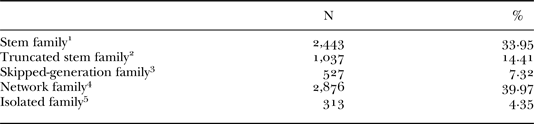
Notes: N = 7,196. 1. Co-resides with adult children and grandchildren. 2. Co-resides only with adult children. 3. Co-resides with grandchildren but not with children. 4. Lives with neither children nor grandchildren, but at least one child lives in the same county/city. 5. Lives with neither children nor grandchildren, and all children live beyond the county/city.
Living arrangement concordance and subjective wellbeing for the analysis sample
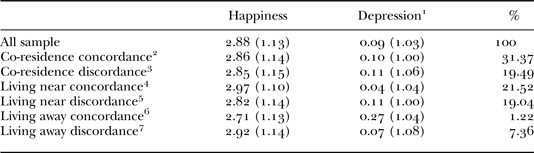
Notes: N = 6,742. Standard deviations are in parentheses. 1. Measured by the principal component of eight depressive symptoms. 2. Prefers to co-reside with children and does so. 3. Prefers to co-reside with children but does not live with them. 4. Prefers not to co-reside with but to live near children and does so. 5. Prefers not to co-reside with but to live near children, but actually either lives with or lives away from children. 6. Prefers not to co-reside with and not to live near children and does so. 7. Prefers not to co-reside with and not to live near children, but actually either lives with or lives near children.
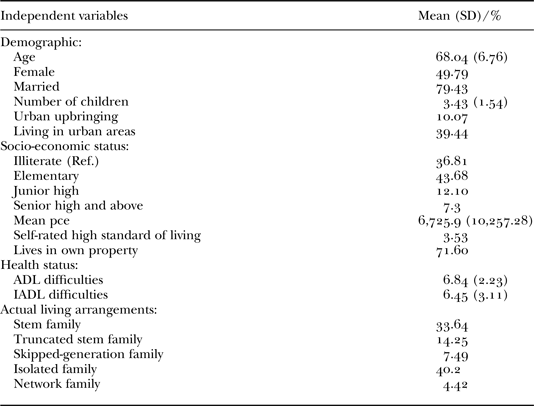
Characteristics of the sample used in this analysis (shown in Table 4) reveal that the average age of older adults in the sample was 68.04 years. Half of the sample (49.79%) were female, most of the sample (79.43%) were currently married, 36.81 per cent were illiterate and the majority (71.6%) were living in their own property. Mean respondent pce was 6,725.9 RMB, while a small proportion of respondents (3.53%) reported their standard of living was high. Less than half (39.44%) of the sample were living in urban areas, only 10.07 per cent were brought up in urban areas. The average respondent had 3.43 living children.
Summary of descriptive statistics for the analysis sample
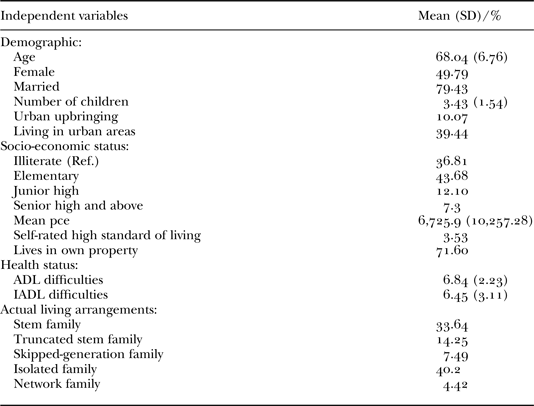
Notes: N = 6,742. SD: standard deviation. Ref.: reference group. pce: per capita expenditures. ADL: activities of daily living. IADL: instrumental activities of daily living.
Determinants of preference for co-residence with children
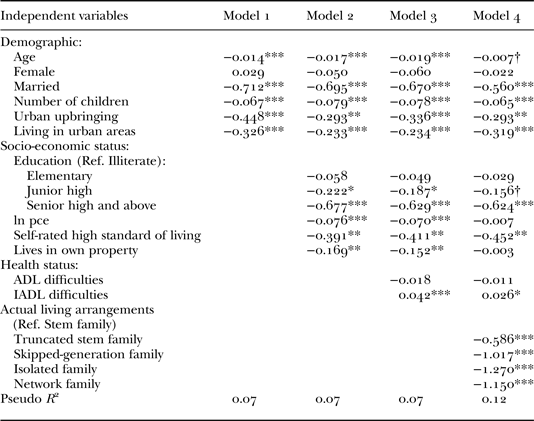
Table 5 sheds light on the first research question: What types of older adults prefer co-residence with children? A binary logistic regression was applied to predict preference to co-reside with children (compared to preferring non-co-residence with children) with a set of hierarchical equations. I added sequentially four blocks of variables to the equations, representing, in order of entry, demographic characteristics, socio-economic status, health status and actual living arrangements. The purpose is to observe how variables added in later blocks explained variables entered earlier.
Binary logistic regression predicting elderly people's preference for co-residence with children, in China in 2011
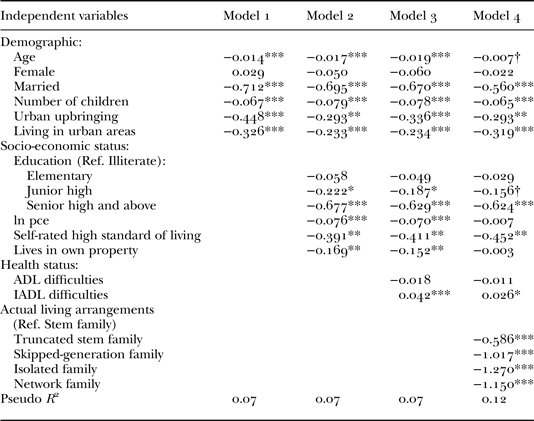
Notes: N = 6,742. Provincial dummies in all models are included but not presented. Ref.: reference group. pce: per capita expenditures. ADL: activities of daily living. IADL: instrumental activities of daily living.
Significance levels: † p ⩽ 0.1, * p ⩽ 0.05, ** p ⩽ 0.01, *** p ⩽ 0.001.
In every model, each additional year of age and additional child decreases the likelihood of preferring co-residence. Having more children may make it easier for older parents to engage in quasi-residence – not co-residing with children, but visiting them frequently. Older adults who were married, brought up in urban areas and were living in urban areas were more likely to prefer living independently than their counterparts, respectively. The second equation, which added socio-economic variables, shows that the elderly who were better educated (indicated by completing junior high, and senior high and above), and had higher income or wealth (indicated by pce, self-rated high standard of living and living in own property) were more likely to prefer to live independently. Model 3 reveals that poor health (indicated by IADL difficulties) was positively associated with likelihood of preferring co-residence. Adding actual living arrangements in Model 4 does little to change the significance or magnitude of previously important coefficients. Actual living arrangements are highly predictive of preference, with those who actually lived with both adult children and grandchildren (the reference group of actual living arrangement in Model 4) more likely to prefer co-residence, compared to older parents in any other household structure. I am not able to demonstrate any causal relationships by using cross-sectional data because reversed causality that creates endogenous bias may exist: living arrangement preference may influence people's actual living arrangement as people tend to make their preferred living arrangements come true. Nevertheless, the data provide some evidence that people do not merely match their preference to their reality, but that there may be personal characteristics that make them more disposed to prefer one living arrangement type to another.
Determinants of older adult subjective wellbeing
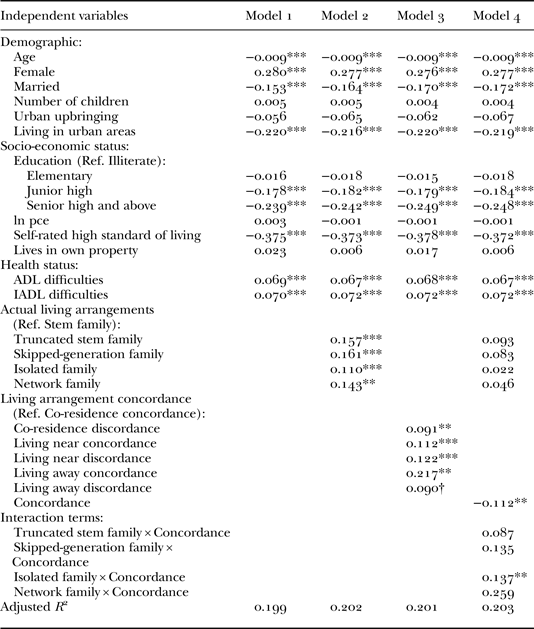
I used ordinary least squares (OLS) and ordered logistic model to regress depression (measured by a numeric variable) and happiness (measured by a four-category variable), respectively, on living arrangement concordance and other control variables.Footnote 11 Table 6 presents four hierarchical regression equations predicting depression. The first equation reveals that older parents who were married, lived in urban areas, had received better education or had a self-rated high standard of living tended to have lower depressive symptoms than their counterparts. Conversely, women and elderly in poorer health tended to have higher depressive symptoms than their counterparts. The significant effects of demographic, socio-economic and health variables remained meaningful when I controlled for extra variables in the following equations.
Ordinary least squares regression estimates predicting depressive symptoms
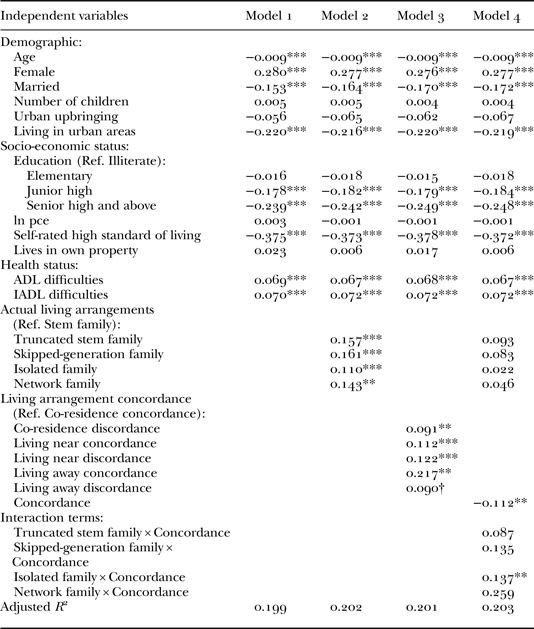
Notes: N = 6,742. Provincial dummies in all models are included but not presented. Ref.: reference group. pce: per capita expenditures. ADL: activities of daily living. IADL: instrumental activities of daily living.
Significance levels: † p ⩽ 0.1, ** p ⩽ 0.01, *** p ⩽ 0.001.
The second equation added actual living arrangements. I found that older parents living with both adult children and grandchildren (the reference group of actual living arrangements in Model 2) were less depressed than those in any other household structure. Instead of actual living arrangements, I added living arrangement concordance – a categorical variable with six groups: co-residence concordance/discordance, living near concordance/discordance, living away concordance/discordance – in the third equation. Compared to older adults who preferred to co-reside with children and did so (the reference group of living arrangement concordance in Model 3), those who were in other living arrangement concordance categories tended to have higher levels of depression.
The final equation added actual living arrangements, a dummy variable of living arrangement concordance (1 = if preferred living arrangement is the same as actual living arrangement, 0 = if otherwise), and interactions between these two variables. The reason why I used a two-category variable of concordance is that the multiple living arrangement concordance variables already contain information on actual living arrangements. Including actual living arrangements and the multiple living arrangement concordance variables will generate co-linearity issues.
A notable finding from Model 4 is that the previously predictive effects of actual living arrangement lost significance when I added actual living arrangement and concordance simultaneously. The effect of concordance is significant and negative, indicating that having a match between preferred and actual living arrangement reduces depression. Finally, the statistically significant interaction terms show that, conditional on having concordance, older adults living in isolated family households had higher levels of depression than those who lived with both adult children and grandchildren.
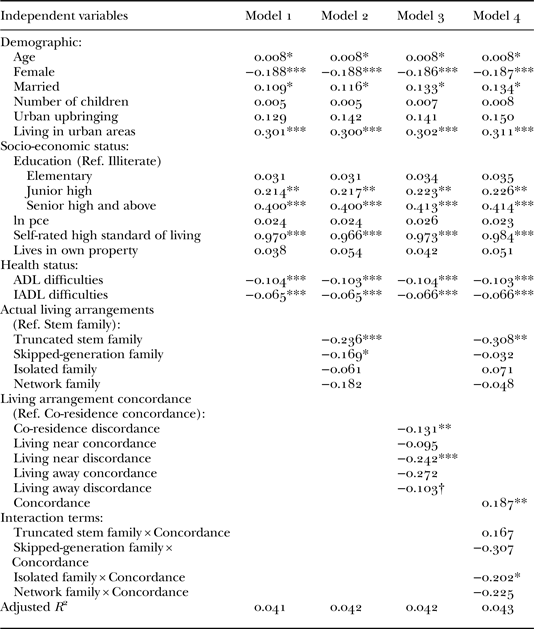
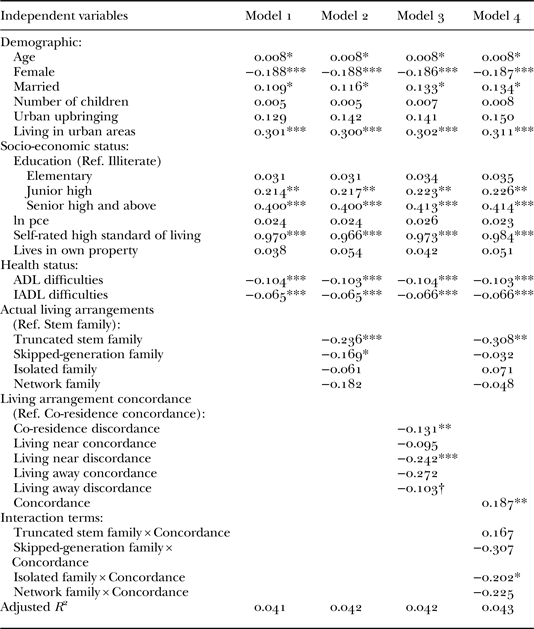
The examination of happiness followed the same hierarchical sequence used to predict depression. Table 7 presents estimates of the regression equations. The first model shows that living in urban areas, education and high standard of living tended to increase happiness. Women and older adults in poorer health tended to be less happy. In addition, the effect of personal characteristics changed little as additional variables were added to the model.
Ordered logistic regression estimates predicting happiness
Notes: N = 6,742. Provincial dummies in all models are included but not presented. Ref.: group category. pce: per capita expenditures. ADL: activities of daily living. IADL: instrumental activities of daily living.
Significance levels: † p ⩽ 0.1, * p ⩽ 0.05, ** p ⩽ 0.01, *** p ⩽ 0.001.
Model 2, which added actual living arrangements, demonstrates that respondents living with children only in truncated stem households and respondents living with grandchildren only in skipped-generation households had lower levels of happiness than did those in a stem family structure. When I added variables representing living arrangement concordance into the third model, I found that older adults whose preferred living arrangement did not match the reality were less happy than the elderly who preferred co-residence and co-resided.
In the fourth equation, I added actual living arrangements, a dummy variable of living arrangement concordance and their interaction terms. In this model, the effect of truncated stem households was less statistically significant than its counterpart in Model 2, while the remaining actual arrangement variables were not significant. On the other hand, older adults living in the preferred living arrangement are predicted to be happier than those whose actual living arrangements did not match preference. The results also reveal that, conditional on having concordance, older adults living in isolated family households were less happy than those who lived with both adult children and grandchildren.
Discussion
Rapid economic growth, demographic ageing and changing family preferences in China have altered the traditional living arrangements of older adults, possibly jeopardising intergenerational relations and compromising their wellbeing. This article focuses on factors associated with preference for co-residence with children, and the relationship between living arrangement concordance and SWB among older adults in China. My study is important because very little research has looked at these two issues in the extant literature.
The logistic regressions suggest that living arrangement preference is indicative of need, with those in worse health being more likely to prefer co-residence. By contrast, respondents with greater family care resources (more children and a living spouse), those with greater economic resources and those with better access to old-age supports (living in urban areas) tended to prefer non-co-residence.
The results also pointed to the possibility that holding traditional norms about living arrangements enhances preference for intergenerational co-residence. Older adults who were brought up in urban areas, where cultural prescriptions and expression tend to be less traditional (Zhang Reference Zhang and Ikels2004), were less likely to prefer co-residence. Education was negatively correlated with preferences for co-residence as well. In general, the education levels of older adults are regarded as an indicator of their ability to live independently. Also, a higher education level is usually associated with a higher degree of openness concerning traditional norms.
Actual living arrangements are highly predictive of preference. Older adults living with children and grandchildren were more likely to prefer co-residence than those who lived with children only, those who lived with grandchildren only or those who lived independently. This may reflect older parents’ reaffirmation of expectations that comes from their actual co-residence experience. Alternatively, living in stem family households may strengthen belief in multigenerational living as a social norm (Takagi and Silverstein Reference Takagi and Silverstein2006), in which case it enhances the preference for co-residence.
The second focus of this article is the relationship between living arrangements and SWB of older adults. A review of the literature showed that historically the majority of research in this field has focused on the impact of actual living arrangements. If a social scientist chose to consider only actual living arrangements and personal characteristics to explain SWB, my analysis suggests that living with one's adult children and grandchildren is the preferred arrangement from the point of view of SWB, measured by depression and happiness (Tables 6 and 7, Model 2). These findings support those of Silverstein, Cong and Li (Reference Silverstein, Cong and Li2006), who proposed that traditional living arrangements are beneficial to older adults’ psychological wellbeing as they represent the fulfilment of a cultural ideal. Another possible explanation for such positive correlation is that older parents living in a multigenerational household are more likely to receive both instrumental and emotional support from their children or other younger members of the family, therefore they are more likely to report higher SWB compared to those in other types of living arrangements.
In addition, a host of significant personal characteristic variables were identified and worth mentioning. Depressive symptoms decreased as elderly people's number of functional difficulties (proxy for health) decreased, and as age and educational level increased. Happiness increased as functional difficulties decreased, and as age and educational level increased. Men, older adults who were married, those who lived in urban areas and those with a self-rated high standard of living were associated with lower levels of depressive symptoms and higher levels of happiness.
The least amount of research has focused on the relationship between living arrangement concordance and SWB. In general, I found that older adults reap the rewards of living arrangement concordance – having a match between preferred and actual living arrangements. Elderly people co-residing with children and preferring to do so experienced better SWB (measured by lower levels of depression and higher levels of happiness) than elderly in any other living arrangement concordance categories. This finding gives some backing to the hypothesis, informed by discrepancy theories, that an individual's SWB will be higher when the discrepancy between his or her aspirations and achievements is small. However, it may be actual living arrangements that drive the results, but not preference and concordance.
In the final analysis, I controlled for actual living arrangements and concordance simultaneously. On the one hand, the results support the hypothesis of discrepancy theories even after controlling for actual living arrangements and personal characteristics. Respondents were less likely to have depressive symptoms and were more likely to feel happy if they were able to match preferred and actual living arrangements. On the other hand, the previously predictive effects of actual living arrangement lost significance when I added actual living arrangement and concordance simultaneously. Living in a preferred arrangement appears to be more important than living in a specific arrangement from the point of view of SWB.
The CHARLS reveals that 48 per cent of elderly Chinese were actually co-residing with their adult children. This confirms earlier research that reported a growing acceptance of living separately from children (Logan and Bian Reference Logan and Bian1999). However, I was somewhat surprised that in this traditional society, where Confucianism originated, only 48 per cent of parents preferred to live with children. I speculate about two possible reasons for the low prevalence observed. On one hand, even if elderly parents living with children are more likely to receive support from their children, intergenerational conflict and lack of privacy may lower their wellbeing (Yang and Chandler Reference Yang and Chandler1992). Hermalin and Yang (Reference Hermalin and Yang2004) noted that older parents in multigenerational households were usually taking on substantial responsibility for meal preparation and grandchild care to assist their sons and daughters-in-law. Thus, although elders might have been satisfied with a traditional arrangement, some of them may prefer to live separately from their children and enjoy a better quality of life.
On the other hand, cultural values and norms, which influence preference, are dynamic, particularly in a rapidly changing social environment such as China. Indeed, in traditional Chinese culture, the majority of elderly co-resided with their adult children and they preferred to do so (Logan and Bian Reference Logan and Bian1999; Pei and Pillai Reference Pei and Pillai1999). Swidler (Reference Swidler1986) proposed that cultural values are closely linked with actions when there is stability in the cultural life of a nation. However, when rapid social change alters the cultural landscape, traditional values begin to be questioned and are no longer treated as ‘common sense’. Viewed in this context, the rapid rate of modernisation achieved by China since the ‘reform and open up’ policy launched three decades ago should have shaken the coercive power of core cultural norms regarding traditional family arrangements.
I am not able to provide concrete evidence of changes in living arrangement preference because of lack of panel data. Nevertheless, it is very likely the case that these older Chinese were undergoing an equilibrating process, in which younger cohorts, as they advance through the lifecycle, were adjusting their preferences and expectations to the emerging norms and trends in the larger society and the tastes and constraints facing them and their children. Overall, elderly Chinese were experiencing relatively successful concordance between their preferred and actual living conditions. Yet, constraints such as housing shortages, insufficient old-age support, rural to urban migration and government policies limiting residential choice may have created difficulties in matching preference and reality, which are harmful to elders’ SWB.
Several limitations to this investigation deserve mention. First, subjective measures of the elderly in China remain a relatively unexplored area. This article only measured the affective approach of SWB, including one item for happiness and eight items for depressive symptoms. These items are not perfect indicators of SWB because the CHARLS was not designed to study the SWB of elderly Chinese. Second, data-based multicollinearity between independent variables may bias the results reported here. If the variances of the estimated coefficients are inflated by multicollinearity, then the confidence intervals for the estimates are wider and therefore less useful. In my analysis, multicollinearity exists between living arrangement concordance and personal characteristics, as both actual living arrangements and living arrangement preferences are determined by personal characteristics such as education, health, economic status, etc.
Another important limitation is that the study is cross-sectional in design, and, consequently, there is the possibility of endogeneity with respect to living arrangement concordance and SWB. In my analysis, endogeneity may have occurred if the reasons that an individual cannot match preferences and realities, e.g. the nature of the intergenerational relationship, also affect his or her SWB. In this case, the estimated effects of living arrangement concordance on SWB actually capture the effects of the unobserved intergenerational relationship and are biased.
Endogeneity problems could also occur when SWB influences living arrangements such that the causal direction ascribed to estimated effects may be incorrectly inferred. For example, depressive older parents may be more likely to be in certain forms of living arrangements. On the one hand, adult children with families of their own may perceive depressed parents as potentially unpleasant living partners. On the other hand, adult children may view depressed parents as having needs that would be best served by living with extended family. Because either scenario is theoretically plausible, I acknowledge that both are possible sources of specification bias in my analysis. For these reasons I am restricted in addressing causality between living arrangement concordance and SWB, and I encourage caution in drawing causal inferences from the relationships reported in Tables 6 and 7.
Despite these limitations, this article makes contributions to the literature. Few data-sets are actually able to capture preference; this study strives to shed light on the role of living arrangement preference and concordance. I hope this investigation encourages other researchers to include preference on their survey questionnaires and sets the stage for future longitudinal designs that are better able to account for the above-mentioned potential biases.
In conclusion, this article provides support to the notion that older adults with concordance between preferred and actual living arrangements will have better subjective wellbeing than those who do not. Concordance itself could serve as an indicator of wellbeing and quality of life. In addition, although the traditional arrangement was beneficial for elders’ SWB, its effect appears to be less important than that of concordance. Actual living arrangements have changed over time. If attitudes are indeed changing, programmes designed to promote successful ageing and to improve wellbeing in later life should not assume that there is a one-size-fits-all model for all; instead, older adults should be given more choices of living arrangements, as the capacity to match preference and reality may improve quality of life and overall wellbeing.
Supplementary material
To view supplementary material for this article, please visit https://doi.org/10.1017/S0144686X18000041.
Acknowledgements
An early version of this paper was presented at the Gerontological Society of America's 67th Annual Scientific Meeting in Washington DC, on 6 November 2014. I would like to thank Merril Silverstein and Feinian Chen for helpful comments and suggestions. All errors are mine.