I. Introduction
When a common-law judge decides a case, she does more than settle the dispute between the litigants in front of her. Under the doctrine of precedent, she also constrains the ability of judges to decide later cases as they see fit. The basic idea is that similar disputes arising in the future should be resolved as the precedent was. But this idea can be specified in different ways. On one simple picture, precedents lay down strict rules (“If A, B, and C, then plaintiff wins”) with the force of legislation: Whenever a later case falls within the scope of the rule, the judge must decide accordingly.Footnote 1 However elegant, this model misconstrues the doctrine of precedent actually at work in most common-law countries.Footnote 2 There are also good normative reasons to give judges some flexibility to depart from precedent rules when they believe applying them to a new set of facts would be unwise or unjust.Footnote 3 The challenge is to find the right balance, giving courts some freedom to deal with unforeseen circumstances without sacrificing altogether the benefits of precedential constraint.
The reason model and the result model strike this balance differently. According to the result model, precedential constraint is very weak.Footnote 4 The only thing that counts about a precedent case, on this minimalist picture, is the facts and the outcome. Future disputes with the same facts must be decided the same way.Footnote 5 The reason model, by contrast, insists that courts are also constrained by the reasoning in precedent opinions.Footnote 6 On this view, when a court decides for the plaintiff because the case was one of A and B, despite the fact that it was also one of C, future courts must accept the precedent court’s judgment that A and B provided stronger reasons to decide for the plaintiff than C provided to decide for the defendant—indeed, they must treat A and B as outweighing C in their own future decisions. In this way, the reason model envisions a stricter form of precedential constraint than the result model, such that, given a body of precedents, courts have less freedom to decide new cases as they think best.
Both the reason model and the result model were first formalized in what we’ll call the standard setting. Footnote 7 Developed in the field of artificial intelligence and law, this framework represents the facts of precedent cases as sets of legal factors, generic fact-types favoring the plaintiff or the defendant in a particular area of the law.Footnote 8 When a company sues a former employee for misappropriating valuable trade secrets, for example, it counts in the company’s favor if it adopted strict security protocols to protect the information, since this suggests that it was both genuinely valuable and genuinely secret. If the information was freely accessible, on the other hand, then this favors the defendant. Other factors concern whether the information can be reverse-engineered, whether the employee signed a non-disclosure agreement, and so on. Any given dispute is characterized by a constellation of different factors, each providing a reason to decide the case one way or the other. The job of the judge is to weigh these reasons against each other and come to a decision.
Subject, of course, to whatever constraints the doctrine of precedent imposes based on the decisions of earlier courts. As we have already seen, however, there are different forms the doctrine of precedent in a particular jurisdiction might take. One of the core advantages of using a precise framework like the standard setting to study the doctrine of precedent is that it allows us to examine more concretely how different models relate to one another. (These relationships can be hard to make out on the basis of informal descriptions, which tend to be underspecified, rely on metaphors to varying degrees, and so on.) When the informal ideas behind the reason model and the result model are specified precisely in the standard setting, what we find is that the models impose distinctive patterns of constraint.Footnote 9 While the reason model requires a decision for a particular side whenever the result model does, the reason model sometimes requires a decision when the result model does not. Given the motivations behind the models, this is exactly what we should expect.
Recently, however, the standard setting has come in for criticism.Footnote 10 The worry is that while a great deal of legal reasoning and argumentation can be represented using simple Boolean factors, there are also contexts in which factors seem inadequate. Consider a dispute over whether a defendant who has spent time abroad has changed her domicile for tax purposes. One relevant consideration in this sort of case is just how long the defendant has been gone, with longer periods favoring change of domicile more strongly than shorter ones. We could try to represent this information using factors, perhaps by positing a pro-defendant factor long-duration and a pro-plaintiff factor short-duration. Footnote 11 But how are we to determine which, if either, characterizes a particular case?Footnote 12 There is also a problem about how the length of time abroad trades off against other considerations, since one defendant may have been gone longer than another even while long-duration applies to both. These considerations suggest an adequate representation of legal information requires not just factors but dimensions, where, very roughly, a dimension is an ordering of legally relevant values reflecting the extent to which each value favors one side or the other.Footnote 13
While the reason model and the result model are distinct in the standard setting, John Horty has recently shown that when they are generalized to the richer dimensional setting in the most natural way, the models collapse.Footnote 14 They impose precisely the same pattern of constraint. This result, Horty suggests, is not just surprising but disturbing. For while the result model has had its defenders over the years, the consensus view in legal theory is that precedential constraint does, in fact, depend, in some way, on how judges try to justify their decisions. The reasons judges give, the principles they cite—these things play a role in determining what future courts are required to do. What the collapse of the reason model and the result model in the dimensional setting suggests, however, is that this orthodoxy is dead wrong. In reality, “it makes no difference at all how courts attempt to justify their decisions, what reasons they offer. All that matters is the decision itself, along with the strength of the underlying fact situation for a particular side.”Footnote 15
Several attempts have already been made to revise the models in order to avoid this result and recover a distinction between them in the dimensional setting.Footnote 16 Missing from this discussion, however, is a satisfying explanation of the initial collapse. Why does the distinction between the reason model and the result model disappear in the dimensional setting? Why should dealing with this kind of ordered information eliminate the difference between a model of precedent that looks to the reasoning in precedent opinions and one that looks only to the underlying facts? One contribution of the present paper is to provide such an explanation.
Here’s the plan. First, I want to consider more carefully what separates the reason model and the result model in the standard setting. What characterizes the situations in which the reason model requires a decision that the result model does not? Absolutely crucial to the distinction, as I will show, is the possibility of starting with a precedent case and then generating a new fact situation by removing reasons to decide for the winning side without adding any new reasons to decide for the losing side. If the removal of a reason to decide for the plaintiff were somehow automatically linked with the addition of a reason to decide for the defendant, then any daylight between the reason model and the result model would disappear.
Second, I show that this is precisely what happens in the dimensional setting. In that context, it is impossible to remove a reason to decide for one side without adding a reason to decide for the other. Accordingly, the two models collapse. Now that we have a better understanding of what separates the two models in the standard setting, however, collapse in the dimensional setting is precisely what we should expect. This diagnosis of the collapse also sheds light on efforts to rehabilitate the reason model in the dimensional setting, since these can usefully be seen as attempts to restore, in different ways, the ability to weaken the case for one side without strengthening the case for the other.
Finally, I consider how this ability might be undermined even in the simpler standard setting. It turns out that one additional assumption will suffice, specifically, the assumption that whenever the presence of a particular factor favors the plaintiff, the absence of that factor favors the defendant. If every “positive” factor favoring one side is associated with a contradictory “negative” factor favoring the other, the reason model and the result model again collapse. While this assumption is probably a bit too strong to be realistic, the equivalence result remains significant. Even if not all “positive” factors have “negative” counterparts, many of them—perhaps even most of them—do. In that case, what the result suggests is that in areas of the law where the assumption holds to a high degree—in areas where lots of “positive” factors have “negative” counterparts, in other words—constraint under the reason model is liable to resemble the result model’s brand of mere a fortiori constraint more closely than comparisons of those models in the standard setting would suggest.
II. The Standard Setting
We begin with a brief introduction to the standard setting and Horty’s definitions for the reason model and the result model. As expected, the reason model and the result model come apart in this context. Although constraint under the result model entails constraint under the reason model, the converse entailment fails: Sometimes the reason model requires a decision for a particular side when the result model is happy for the decision to go either way. My primary aim in this section is to home in on precisely what separates the two models in the standard setting. Given a particular precedent decision in the background, the two models turn out to differ only over disputes that involve, from the perspective of the precedent case, removing a reason to decide for the winner without adding any new reasons to decide for the loser. This claim is sharpened up and demonstrated in what follows.Footnote 17
We begin by positing a set
 $ {F}^{\pi } $
= {
 $ {f}_1^{\pi },\dots, {f}_n^{\pi } $
} of legal factors favoring the plaintiff, and a set
 $ {F}^{\delta } $
= {
 $ {f}_1^{\delta },\dots, {f}_n^{\delta } $
} of legal factors favoring the defendant, in some area of the law. (We take
 $ \pi $
and
 $ \delta $
to be the parties to a legal dispute, the plaintiff and the defendant, respectively. Where
 $ s $
is a party, we let
 $ \overline{s} $
represent the opposing party.) Any legal factor favors either the plaintiff or the defendant, but not both, so that
 $ F= $
 $ {F}^{\pi}\hskip0.3em \cup \hskip0.3em {F}^{\delta } $
is the entire set of legal factors for the area. A fact situation, or a dispute, is a set of factors X ⊆ F. Where
 $ X $
is a fact situation and
 $ s $
a side,
 $ {X}^s $
is the set of factors in
 $ X $
favoring
 $ s $
, so that
 $ {X}^s=X\hskip0.3em \cap \hskip0.3em {F}^s $
.
We now use factors to define reasons, and reasons to define rules. A reason for a side
 $ s $
is a set of factors
 $ {R}^s\hskip0.3em \subseteq \hskip0.3em {F}^s $
favoring
 $ s $
. A reason is a reason for one side or the other. So, for example,
 $ \left\{{f}_1^{\pi },{f}_2^{\pi}\right\} $
is a reason for the plaintiff, while
 $ \left\{{f}_1^{\pi },{f}_2^{\pi },{f}_1^{\delta}\right\} $
is not a reason at all, because it contains countervailing factors. Reasons are read conjunctively; for instance, the reason
 $ \left\{{f}_1^{\pi },{f}_2^{\pi}\right\} $
is understood as the proposition that both
 $ {f}_1^{\pi } $
and
 $ {f}_2^{\pi } $
are present. Finally, we define rules in terms of reasons. A rule for
 $ s $
has the form
 $ R\to s $
, where the premise of the rule (
 $ R $
) is a reason to decide the case for the party identified in its conclusion (
 $ s $
). We assume functions Premise and Conclusion that, when given a rule as argument, return as value its premise and its conclusion, respectively. A rule is a rule for one side or the other.
We say that a particular factor
 $ f $
holds in a fact situation
 $ X $
, or that
 $ X $
satisfies
 $ f $
, just in case
 $ f $
belongs to
 $ X $
. More formally,
 $$ X\hskip0.64em \models \hskip0.64em f\hskip0.64em \mathrm{iff}\hskip0.64em f\in \hskip0.34em X. $$
Now we lift this notion of satisfaction from legal factors to legal reasons (sets of legal factors with uniform polarity) by stipulating that a fact situation
 $ X $
satisfies a reason
 $ R $
just in case it satisfies every factor belonging to R:
 $ X\hskip0.3em \models \hskip0.3em R $
iff
 $ X\hskip0.3em \models \hskip0.3em f $
for every
 $ f\in R $
. Finally, we use this account of reason satisfaction to specify when a precedent rule applies to a dispute. A precedent rule
 $$ r=R\to s $$
applies to a dispute
 $ X $
just in case
 $ X $
satisfies the reason
 $ R $
constituting its premise, i.e., just in case
 $ X\hskip0.3em \models $
Premise
 $ (r) $
.
A precedent case is a triple
 $ c=\left\langle X,r,s\right\rangle $
such that
 $ X $
is a fact situation,
 $ r $
is a rule, and
 $ s\in \left\{\pi, \delta \right\} $
, all such that (1)
 $ X\hskip0.3em \models \hskip0.3em $
Premise
 $ (r) $
and (2) Conclusion
 $ (r)=s $
. Given a case
 $ c=\left\langle X,r,s\right\rangle $
, we say the court was presented with a dispute
 $ X $
and decided for
 $ s $
on the basis of
 $ r $
. Where
 $ s=\pi $
, the decision was for the plaintiff; where
 $ s=\delta $
, it was for the defendant. Conditions (1) and (2) are coherence constraints on the notion of a case. They say that a court must decide each dispute on the basis of an applicable rule, and the court must decide for the side favored by the rule it applies. Finally, we represent the common law in some area using the notion of a case base, which we define as a set
 $ \Gamma =\left\{{c}_1,\dots, {c}_n\right\} $
of precedent cases.
Having dealt with the nuts and bolts of the standard setting, we turn now to the task of defining the reason model and the result model, starting with the latter. Consider a concrete case:
 $$ {\displaystyle \begin{array}{l}{c}_1=\left\langle {X}_1,{r}_1,{s}_1\right\rangle \\ {}{X}_1=\left\{{f}_1^{\pi },{f}_2^{\pi },{f}_3^{\pi },{f}_1^{\delta },{f}_2^{\delta}\right\}\\ {}{r}_1=\left\{{f}_1^{\pi },{f}_2^{\pi}\right\}\to \pi \\ {}{s}_1=\pi \end{array}} $$
This dispute presented three factors favoring the plaintiff (
 $ {f}_1^{\pi },{f}_2^{\pi },{f}_3^{\pi } $
) and two favoring the defendant (
 $ {f}_1^{\delta },{f}_2^{\delta } $
), and the court decided in favor of the plaintiff. In doing so, the court evidently found the pro-plaintiff factors
 $ {f}_1^{\pi } $
and
 $ {f}_2^{\pi } $
especially compelling, since it cited them in the premise of the rule on which it rested its decision. According to the result model, however, this is simply irrelevant to the constraint that
 $ {c}_1 $
places on future courts—all that matters about a precedent case, on this picture, is the underlying facts and the ultimate result. While a precedent court can declare a rule as emphatically as it likes, such a declaration can never have more than persuasive force in the deliberations of future courts. What later courts must respect is just the judgment that
 $ {X}_1 $
presented stronger reasons to decide for the plaintiff than to decide for the defendant. Future disputes that favor the plaintiff at least as strongly must be decided the same way.
To make these ideas precise, we first define an appropriate notion of the strength of the reasons presented by a fact situation for a side.Footnote 18
Definition 1. (strength of the facts for a side) Let
 $ X $
and
 $ Y $
be fact situations. Then
 $ X{\le}_sY $
iff
 $ {X}^s\hskip0.3em \subseteq \hskip0.3em {Y}^s $
and
 $ {Y}^{\overline{s}}\hskip0.3em \subseteq \hskip0.3em {X}^{\overline{s}} $
.
This says that
 $ Y $
is as strong as
 $ X $
for s just in case
 $ Y $
contains all of the
 $ s $
-factors that
 $ X $
does and
 $ X $
contains all of the
 $ \overline{s} $
-factors that
 $ Y $
does. With this definition in hand, the appropriate notion of precedential constraint is straightforward.
Definition 2. (precedential constraint: the result model) Let
 $ \Gamma $
be a case base and
 $ Y $
a new dispute confronting a court. Then, given
 $ \Gamma $
, the court is required to decide
 $ Y $
for
 $ s $
iff there is a case
 $ c=\left\langle X,r,s\right\rangle \in \hskip0.3em \Gamma $
such that
 $ X\;{\le}_s\hskip0.3em Y $
.
To get a feel for the model, suppose
 $ {c}_1 $
is the only relevant precedent and a court is now faced with the dispute
 $ {X}_2=\left\{{f}_1^{\pi },{f}_2^{\pi },{f}_3^{\pi },{f}_1^{\delta}\right\} $
. Must the court decide for the plaintiff? According to the result model, yes. Since
 $ {X}_2 $
has all of the pro-plaintiff factors in
 $ {X}_1 $
and no new pro-defendant factors to overcome them, we have
 $ {X}_1{\le}_{\pi}\hskip0.3em {X}_2 $
. The fact situation
 $ {X}_2 $
is at least as strong for the plaintiff as the earlier situation
 $ {X}_1 $
, which, of course, was itself decided for the plaintiff. Under these circumstances, the result model holds that the court is required to decide for the plaintiff as well. Suppose, however, that the new dispute is not
 $ {X}_2 $
but
 $ {X}_3=\left\{{f}_1^{\pi },{f}_2^{\pi },{f}_1^{\delta}\right\} $
. In this case, according to the result model, the court is not required to decide for the plaintiff. For while
 $ {X}_3 $
is weaker than
 $ {X}_1 $
for the defendant, it is also weaker than
 $ {X}_1 $
for the plaintiff. This means
 $ {X}_3 $
is not as strong as
 $ {X}_1 $
for the plaintiff overall. Since
 $ {X}_1{\hskip0.3em \nleqq}_{\pi}\hskip0.3em {X}_3 $
, the court is free to decide
 $ {X}_3 $
for either side. This last result, as we will see, is one that the reason model rejects.
While the result model ignores the rule
 $ {r}_1=\left\{{f}_1^{\pi },{f}_2^{\pi}\right\}\to \pi $
in its definition of precedential constraint, the reason model proposes to take it seriously. But what exactly is the
 $ {c}_1 $
court telling us by deciding for the plaintiff on this particular basis? Certainly that
 $ \left\{{f}_1^{\pi },{f}_2^{\pi}\right\} $
is a sufficient reason to decide for the plaintiff. According to the reason model, however, it’s also telling us that
 $ \left\{{f}_1^{\pi },{f}_2^{\pi}\right\} $
is stronger than the strongest pro-defendant reason presented by
 $ {X}_1 $
.Footnote
19 We can cash out this latter notion of comparative strength among reasons for the same side by stipulating that, where
 $ {R}_1 $
and
 $ {R}_2 $
are reasons for
 $ s $
,
 $ {R}_2 $
is at least as strong as
 $ {R}_1 $
, written
 $ {R}_1\hskip0.3em \Vdash \hskip0.3em {R}_2 $
, iff every dispute satisfying
 $ {R}_1 $
also satisfies
 $ {R}_2 $
. Given our definition of satisfaction, this means
 $ {R}_1\hskip0.3em \Vdash \hskip0.3em {R}_2 $
just in case every factor belonging to
 $ {R}_1 $
belongs to
 $ {R}_2 $
, so that
 $ {R}_1\hskip0.3em \subseteq \hskip0.3em {R}_2 $
.Footnote
20 Since
 $ {X}_1^{\delta }=\left\{{f}_1^{\delta },{f}_2^{\delta}\right\} $
, this is the strongest reason for the defendant presented by
 $ {X}_1 $
. What the
 $ {c}_1 $
court is telling us, then, according to the reason model, is that
 $ \left\{{f}_1^{\pi },{f}_2^{\pi}\right\} $
is stronger than
 $ \left\{{f}_1^{\delta },{f}_2^{\delta}\right\} $
, which means that it’s stronger than the weaker pro-defendant reasons
 $ \left\{{f}_1^{\delta}\right\} $
and
 $ \left\{{f}_2^{\delta}\right\} $
as well.
This suggests the following definition of the priority relation on reasons derived from a precedent case (along with its straightforward generalization to case bases).
Definition 3. (priority relations) Where
 $ \Gamma $
is a case base,
 $ c=\left\langle X,r,s\right\rangle $
is a precedent case, and
 $ {R}_1 $
and
 $ {R}_2 $
are reasons, we have:
-
(i)
 $ {R}_1{>}_c\hskip0.3em {R}_2 $
iff Premise
$ (r)\hskip0.3em \subseteq \hskip0.3em {R}_1 $
and
$ {R}_2\hskip0.3em \subseteq \hskip0.3em {X}^{\overline{s}} $
; and
-
(ii)
$ {R}_1{>}_{\Gamma}\hskip0.3em {R}_2 $
iff
$ {R}_1{>}_{c\ast}\hskip0.3em {R}_2 $
for some
$ {c}^{\ast}\in \Gamma $
.


When a judge decides a dispute
 $ X $
for a side
 $ s $
on the basis of a rule
 $ r=R\to s $
, she expresses the judgment that
 $ R $
provides a weightier reason to decide for
 $ s $
than
 $ {X}^{\overline{s}} $
provides to decide for
 $ \overline{s} $
. This is the judgment, according to the reason model, that future courts are required to respect. They must decide new cases in a way that is consistent with the precedent court’s judgment, which means deciding in a way that does not treat
 $ {X}^{\overline{s}} $
as weightier than
 $ R $
. This idea is captured in the following definition of a consistent case base:
Definition 4. (consistent case base) Let
 $ \Gamma $
be a case base with
 $ {>}_{\Gamma} $
its derived priority relation. Then
 $ \Gamma $
is inconsistent iff there are reasons
 $ {R}_1 $
and
 $ {R}_2 $
such that
 $ {R}_1{>}_{\Gamma}\hskip0.3em {R}_2 $
and
 $ {R}_2{>}_{\Gamma}\hskip0.3em {R}_1 $
.
 $ \Gamma $
is consistent iff it is not inconsistent.
What precedential constraint requires, on the reason model, is just that a court faced with a new dispute decides in such a way that adding this new decision to the case base does not introduce inconsistency.
Definition 5. (precedential constraint: the reason model) Let
 $ \Gamma $
be a consistent case base and
 $ X $
a new fact situation confronting a court. Then the court is required to decide
 $ X $
for
 $ s $
iff Outcome
 $ (c)=s $
for every case
 $ c $
based on
 $ X $
such that
 $ \Gamma \hskip0.3em \cup \hskip0.3em c $
is a consistent case base.
Suppose again that a court is faced with the dispute
 $ {X}_2=\left\{{f}_1^{\pi },{f}_2^{\pi },{f}_3^{\pi },{f}_1^{\delta}\right\} $
, with
 $ {c}_1 $
the only relevant precedent in the case base.Footnote
21 Is the court required to decide for the plaintiff? We’ve seen that the result model says that it is. Now we can confirm that the reason model agrees. For suppose the court were to do otherwise, deciding
 $ {X}_2 $
on the basis of
 $ \left\{{f}_1^{\delta}\right\}\to \delta $
, as in:
 $$ {\displaystyle \begin{array}{l}{c}_2=\left\langle {X}_2,{r}_2,{s}_2\right\rangle \\ {}{X}_2=\left\{{f}_1^{\pi },{f}_2^{\pi },{f}_3^{\pi },{f}_1^{\delta}\right\}\\ {}{r}_2=\left\{{f}_1^{\delta },\right\}\to \delta \\ {}{s}_2=\delta \end{array}} $$
By deciding
 $ {X}_2 $
for the defendant on this basis, the court would be saying that
 $ \left\{{f}_1^{\delta}\right\} $
outweighs
 $ \left\{{f}_1^{\pi },{f}_2^{\pi },{f}_3^{\pi}\right\} $
. And if
 $ \left\{{f}_1^{\delta}\right\} $
outweighs {
 $ {f}_1^{\pi },{f}_2^{\pi },{f}_3^{\pi}\Big\} $
, then it certainly outweighs the weaker pro-plaintiff reason
 $ \left\{{f}_1^{\pi },{f}_2^{\pi}\right\} $
as well, producing the priority ordering
 $ \left\{{f}_1^{\delta}\right\}{>}_{c_2}\left\{{f}_1^{\pi },{f}_2^{\pi}\right\} $
. But the
 $ {c}_1 $
court already decided that {
 $ {f}_1^{\pi },{f}_2^{\pi}\Big\} $
outweighs
 $ \left\{{f}_1^{\delta },{f}_2^{\delta}\right\} $
. And if {
 $ {f}_1^{\pi },{f}_2^{\pi}\Big\} $
outweighs
 $ \left\{{f}_1^{\delta },{f}_2^{\delta}\right\} $
, then it outweighs
 $ \left\{{f}_1^{\delta}\right\} $
too, giving us
 $ \left\{{f}_1^{\pi },{f}_2^{\pi}\right\}{>}_{c_1}\left\{{f}_1^{\delta}\right\} $
. Plainly, adding
 $ {c}_2 $
to the case base would render it inconsistent. Accordingly, the reason model follows the result model in requiring a decision for the plaintiff.
This pattern holds in general: Whenever the result model requires a decision, the reason model always agrees. Requirement under the result model entails requirement under the reason model.Footnote
22 The converse entailment fails, however. To see this, we can again imagine a court faced with
 $ {X}_3=\left\{{f}_1^{\pi },{f}_2^{\pi },{f}_1^{\delta}\right\} $
. Given
 $ {c}_1 $
, is the court required to decide for the plaintiff? Not according to the result model, as we have seen. According to the reason model, however, the court is required to decide for the plaintiff. For suppose the court does otherwise, deciding
 $ {X}_3 $
for the defendant, as in:
 $$ {\displaystyle \begin{array}{l}{c}_3=\left\langle {X}_3,{r}_3,{s}_3\right\rangle \\ {}{X}_3=\left\{{f}_1^{\pi },{f}_2^{\pi },{f}_1^{\delta}\right\}\\ {}{r}_3=\left\{{f}_1^{\delta}\right\}\to \delta \\ {}{s}_3=\delta \end{array}} $$
From the perspective of the reason model, this decision is no less impertinent than
 $ {c}_2 $
. By deciding for the defendant on the basis of
 $ {r}_3 $
, the court says that
 $ \left\{{f}_1^{\delta}\right\} $
is weightier than
 $ \left\{{f}_1^{\pi },{f}_2^{\pi}\right\} $
. But
 $ {c}_1 $
already established that
 $ \left\{{f}_1^{\pi },{f}_2^{\pi}\right\} $
is weightier than
 $ \left\{{f}_1^{\delta },{f}_2^{\delta}\right\} $
, which means that it’s also weightier than
 $ \left\{{f}_1^{\delta}\right\} $
. Even though
 $ {X}_3 $
is not a fortiori for the plaintiff in the context of
 $ \Gamma =\left\{{c}_1\right\} $
, then, deciding for the defendant would still render the case base inconsistent. According to the reason model, this means a decision for the plaintiff is required.
So the reason model and the result model diverge in the standard setting. While the reason model requires a decision whenever the result model does, the reason model sometimes requires a decision when the result model does not. Since the reason model was motivated, in part, by the sense that precedential constraint under the result model is too weak, this is precisely what we should expect. In the remainder of this section, however, I would like to drill down on precisely what separates the two models in the standard setting. When, exactly, does the reason model require a decision that the result model does not?
Take another look at
 $ {c}_1 $
:
 $$ {\displaystyle \begin{array}{l}{c}_1=\left\langle {X}_1,{r}_1,{s}_1\right\rangle \\ {}{X}_1=\left\{{f}_1^{\pi },{f}_2^{\pi },{f}_3^{\pi },{f}_1^{\delta },{f}_2^{\delta}\right\}\\ {}{r}_1=\left\{{f}_1^{\pi },{f}_2^{\pi}\right\}\to \pi \\ {}{s}_1=\pi \end{array}} $$
We have just seen that, when
 $ {c}_1 $
is the only case in the background case base, the reason model and the result model differ over
 $ {X}_3=\left\{{f}_1^{\pi },{f}_2^{\pi },{f}_1^{\delta}\right\} $
, with the reason model requiring a decision for the plaintiff and the result model permitting a decision either way. I would like to call attention to the following feature of the move from
 $ {X}_1 $
to
 $ {X}_3 $
: It involves removing a pro-plaintiff factor (namely,
 $ {f}_3^{\pi } $
) without adding any new pro-defendant factors. It involves, we might say, weakening the plaintiff’s case without strengthening the defendant’s.
Other cases that pull the models apart in the standard setting share this same feature. Suppose, for example, that, again with only
 $ {c}_1 $
in the background case base, a court is called upon to decide
 $ {X}_4=\left\{{f}_1^{\pi },{f}_2^{\pi },{f}_5^{\pi },{f}_1^{\delta },{f}_2^{\delta}\right\} $
. From the perspective of the result model, since
 $ {X}_1^{\pi}\hskip0.3em \nsubseteq \hskip0.3em {X}_4^{\pi } $
, the new case is not a fortiori for the plaintiff. So the result model is happy for
 $ {X}_4 $
to be decided either way. For the reason model, however, the
 $ {c}_1 $
court has already established that
 $ \left\{{f}_1^{\pi },{f}_2^{\pi}\right\} $
outweighs
 $ \left\{{f}_1^{\delta },{f}_2^{\delta}\right\} $
, and there is no way to decide
 $ {X}_4 $
for the defendant without expressing the inconsistent judgment that
 $ \left\{{f}_1^{\delta },{f}_2^{\delta}\right\} $
outweighs
 $ \left\{{f}_1^{\pi },{f}_2^{\pi}\right\} $
. So the models diverge here as well. When we consider the move from
 $ {X}_1 $
to
 $ {X}_4 $
, however, we see that it once again involves removing pro-plaintiff factors without adding pro-defendant ones.
On reflection, we can see why this should be necessary for the two models to come apart. For it is plain, first, that with just
 $ {c}_1 $
in the case base, the two models will agree about any dispute
 $ Y $
that includes new pro-defendant factors that
 $ {X}_1 $
lacks. For if
 $ Y $
contains a new reason to decide for the defendant—some pro-defendant factor
 $ {f}_n^{\delta } $
not included in
 $ {X}_1 $
—then both models will tolerate a decision for the defendant. The result model will do so because, given the presence of
 $ {f}_n^{\delta } $
, the case is not a fortiori for the plaintiff. And the reason model will do so because there is nothing in
 $ {c}_1 $
to establish that
 $ \left\{{f}_1^{\pi },{f}_2^{\pi}\right\} $
outweighs a set of pro-defendant factors that includes
 $ {f}_n^{\delta } $
. So the only disputes that can pry these models apart are cases in which
 $ {Y}^{\delta}\hskip0.3em \subseteq \hskip0.3em {X}_1^{\delta } $
. Assuming that
 $ {Y}^{\delta}\hskip0.3em \subseteq \hskip0.3em {X}_1^{\delta } $
, however, suppose that no plaintiff factors are lost in the move from
 $ {X}_1 $
to
 $ Y $
. In that case, we will have
 $ {X}_1^{\pi}\hskip0.3em \subseteq \hskip0.3em {Y}^{\pi } $
. But if we have both
 $ {Y}^{\delta}\hskip0.3em \subseteq \hskip0.3em {X}_1^{\delta } $
and
 $ {X}_1^{\pi}\hskip0.3em \subseteq \hskip0.3em {Y}^{\pi } $
, then
 $ Y $
is a fortiori for the plaintiff. This means the result model requires a decision for the plaintiff, which means the reason model does too. Evidently, this is crucial to the distinction between the reason model and the result model in the standard setting: The models only differ in cases where we remove a reason for one side without adding a reason for the other.
Talk of “removing a reason for one side without adding a reason for the other” makes sense when we are dealing with a single precedent case
 $ c=\left\langle X,r,s\right\rangle $
. Then the idea is that for any new dispute
 $ Y $
, it will only be the case that the reason model—but not the result model—requires
 $ Y $
to be decided for
 $ s $
if (i)
 $ Y $
lacks some of the pro-
 $ s $
factors that
 $ X $
includes, and (ii) Y includes no new pro-
 $ \overline{s} $
factors that X lacks. The problem is to generalize this idea to case bases with multiple cases, where it’s not immediately clear which fact situations of which precedents we are to compare with
 $ Y $
. We can work our way to a solution as follows.
Whenever the reason model requires Y to be decided for
 $ s $
in the context of
 $ \Gamma $
, this is because supplementing
 $ \Gamma $
with any case based on Y but decided for
 $ \overline{s} $
would render it inconsistent. Although there may be several possible cases that are based on Y and decided for
 $ \overline{s} $
, with different rules cited in favor of the decision, it turns out that, for present purposes, we only need to pay attention to one of them. We only need to consider the case that cites the strongest available reason in favor of a decision for
 $ \overline{s} $
, the case:
 $$ c=\left\langle \mathrm{Y},{Y}^{\overline{s}}\to \overline{s},\overline{s}\right\rangle . $$
Because it turns out that the reason model requires Y to be decided for
 $ s $
if and only if supplementing
 $ \Gamma $
with this case, invoking the rule
 $ {Y}^{\overline{s}}\to \overline{s} $
, would render it inconsistent.
Observation 1. Let
 $ \Gamma $
be a consistent case base and
 $ Y $
a new dispute facing a court. Then the reason model requires the court to decide
 $ Y $
for
 $ s $
iff adding
 $ {c}^{\ast }=\left\langle \mathrm{Y},{Y}^{\overline{s}}\to \overline{s},\overline{s}\right\rangle $
to
 $ \Gamma $
would render it inconsistent.
This result is verified in an appendix along with other key results from the paper. But it also makes sense intuitively. On the one hand, if the court could consistently decide
 $ Y $
for
 $ \overline{s} $
on any grounds at all, then clearly the reason model would not demand a decision for
 $ s $
. On the other hand, if the reason model prohibits deciding
 $ Y $
for
 $ \overline{s} $
on the strongest possible grounds, then surely it prohibits doing so on weaker grounds as well.
If adding
 $ c=\left\langle \mathrm{Y},{Y}^{\overline{s}}\to \overline{s},\overline{s}\right\rangle $
to
 $ \Gamma $
would produce inconsistency, it follows that there is some
 $ {c}_i=\left\langle {X}_i,{r}_i,s\right\rangle \in \Gamma $
such that the simple case base
 $ \left\{{c}_i,c\right\} $
is inconsistent, because (i) Premise
 $ \left({r}_i\right){>}_{c_i}{Y}^{\overline{s}} $
and (ii)
 $ {Y}^{\overline{s}}{>}_c $
Premise
 $ \left({r}_i\right) $
.Footnote
23 Intuitively, this means that adding
 $ c $
to
 $ \Gamma $
makes it inconsistent iff there is some particular case in
 $ \Gamma $
that is itself inconsistent with
 $ c $
. The cases in Γ cannot somehow conspire to generate inconsistency with
 $ c $
where no individual case in Γ clashes with
 $ c $
all by itself. This suggests the following notion of a forcing case for
 $ Y $
in the context of Γ.
Definition 6. (forcing case) Let Γ be a case base and
 $ Y $
a new dispute facing a court. A forcing case for
 $ Y $
in the context of Γ is any case
 $ {c}_i\in \Gamma $
such that the case base
 $ \left\{{c}_i,\left\langle \mathrm{Y},{Y}^{\overline{s}}\to \overline{s},\overline{s}\right\rangle \right\} $
is inconsistent.
Intuitively, a forcing case for
 $ Y $
is one that forces
 $ Y $
to be decided for
 $ s $
, by conflicting with the strongest case that could possibly be made for
 $ \overline{s} $
on those facts.Footnote
24
The notion of a forcing case allows us to generalize the ideas sketched above beyond single-membered case bases. For now, we can say that if the reason model but not the result model requires
 $ Y $
to be decided for
 $ s $
in the context of Γ, then every forcing case
 $ c=\left\langle X,r,s\right\rangle $
for
 $ Y $
in Γ is such that (i)
 $ Y $
lacks some of the pro-
 $ s $
factors that
 $ X $
includes, and (ii)
 $ Y $
includes no pro-
 $ \overline{s} $
factors that
 $ X $
lacks. Every forcing case for
 $ Y $
is such that moving from the forcing case to
 $ Y $
involves weakening the case for
 $ s $
without strengthening the case for
 $ \overline{s} $
.
Observation 2. Let
 $ \Gamma $
be a case base and
 $ Y $
a new dispute such that the reason model requires the court to decide
 $ Y $
for a particular side
 $ s $
but the result model permits
 $ Y $
to be decided either way. Then every forcing case
 $ {c}_i=\left\langle {X}_i,{r}_i,s\right\rangle $
for
 $ Y $
in the context of
 $ \Gamma $
is such that:
-
(i)
; and -
(ii)
.


This result raises a number of interesting questions. For now, though, I want to emphasize the following point. Observation 2 says that the reason model and the result model come apart only if we can remove reasons to decide for the winner of a precedent case without generating any new reasons to decide for the loser. This suggests that if it were somehow impossible to weaken the plaintiff’s case without strengthening the defendant’s—if removing a reason to decide for the plaintiff somehow automatically generated a reason to decide for the defendant—then the reason model and the result model would collapse. In the remainder of the paper, we will consider two different ways in which something like this might happen.
III. The Dimensional Setting
While a great deal of legal reasoning and argumentation can be represented using factors, there are also contexts in which factors seem inadequate to capture what’s really going on in a case, or in an area of the law more generally. In “Reasoning with Dimensions and Magnitudes,” Horty develops a framework for representing precedents using not Boolean factors but many-valued dimensions, which come with an ordering over those values to reflect the extent to which they favor one side or the other. When the reason model and the result model are extended to this new dimensional setting, however, the models collapse, in the sense that they impose precisely the same pattern of constraint. For fans of the reason model, this is not just unexpected but unacceptable, since it was dissatisfaction with the result model, among other things, that motivated the reason model in the first place. A number of possible revisions to the reason model have accordingly been proposed in the hope of restoring its distinctiveness in the dimensional setting.Footnote 25
My purpose in this section is not to defend another variation on the reason model for the dimensional setting but to provide an illuminating explanation of the initial collapse. Why, exactly, does the distinction between the reason model and the result model disappear in the dimensional setting? The models collapse, I suggest, because the dimensional setting is built in such a way that it is impossible to subtract a reason to decide for one side without adding a reason to decide for the other. As we will see, this diagnosis also sheds light on the modifications to the reason model and the underlying dimensional setting, now being developed and evaluated.
We can start by quickly reviewing the elements of the dimensional setting, which begins with a set
 $ D=\left\{{d}_1,\dots, {d}_n\right\} $
of dimensions relevant to some area of the law.Footnote
26 For each dimension, we posit an ordered set of possible values, ranging from those favoring the plaintiff to those favoring the defendant. Where
 $ p $
and
 $ q $
are possible values of a dimension
 $ d $
,
 $ p{\succcurlyeq}_sq $
means that
 $ p $
favors
 $ s $
at least as much as
 $ q $
does. We stipulate that this ordering is reflexive, transitive, and antisymmetric. It also satisfies a duality condition, so that
 $ p\hskip0.35em {\succcurlyeq}_s\hskip0.35em q $
just in case
 $ q\hskip0.35em {\succcurlyeq}_{\overline{s}}\hskip0.35em p $
. Where
 $ p $
is a value along
 $ d $
, the pair
 $ \left\langle d,p\right\rangle $
is a value assignment, on which
 $ d $
takes the value
 $ p $
. A dimensional fact situation is a set of value assignments
 $$ X=\left\{\left\langle d,p\right\rangle :d\in D\right\}, $$
one for each dimension. Equivalently, it’s a function mapping each dimension to a value. We take
 $ X(d) $
to be the value assigned to
 $ d $
in
 $ X $
:
 $$ X(d)=p\hskip0.42em \mathrm{iff}\hskip0.42em \left\langle d,p\right\rangle \in X. $$
While the simple factors employed in the standard setting favor the same side whenever present, the central problem with dimensions, Horty tells us, is that a given value assignment need not favor any particular side.Footnote
27 His solution is to posit two factors for each point
 $ X(d)=p $
on a dimension
 $ d $
, one favoring the plaintiff and one favoring the defendant. To see what he has in mind, let’s again consider a dispute over a change of fiscal domicile. Suppose the defendant has been abroad for two and a half years, and the case hangs on whether this counts as a long duration. How could a court decide, and how could it justify its decision? Horty suggests the court might focus on some salient value
 $ p $
along the dimensional scale and then make and justify its decision by comparing the value of the dimension in the dispute to
 $ p $
. A period of one year might strike the court as a long duration, for instance. It might then rule for a change of fiscal domicile, and so in favor of the defendant, on the grounds that she has been gone for at least a year.Footnote
28
The proposition that the defendant has been gone at least a year is a kind of factor: it either holds in a situation or it doesn’t, and it always favors the defendant when it holds.Footnote
29 Generalizing from the example, then, where
 $ p $
is a value along
 $ d $
, Horty introduces the notion of a magnitude factor favoring
 $ s $
, as a statement of the form
 $$ {M}_{\left\langle d,\hskip0.2em p\right\rangle}^s. $$
This means the actual value of
 $ d $
in the dispute is at least as favorable to
 $ s $
as the value
 $ p $
. If we let
 $ {d}_1 $
represent time abroad, the magnitude factor cited in our example is
 $$ {M}_{\left\langle {d}_1,12\mathrm{m}\right\rangle}^{\delta }, $$
the proposition that the value of
 $ {d}_1 $
favors the defendant at least as much as the value of 12 months (i.e., the defendant has been abroad for at least 12 months).Footnote
30
A dimensional fact situation
 $ X $
satisfies a magnitude factor
 $ {M}_{\left\langle d,p\right\rangle}^s $
just in case
 $ X(d) $
favors
 $ s $
at least as strongly as the value
 $ p $
. We say that
 $$ X\hskip0.3em \models \hskip0.3em {M}_{\left\langle d,p\right\rangle}^s, $$
in other words, just in case
 $ X(d){\succcurlyeq}_sp $
. A reason for s is a set of magnitude factors favoring s, and the notion of satisfaction is lifted to reasons by stipulating that
 $ X $
satisfies a set of magnitude factors iff it satisfies each factor in the set. As in the standard setting, one reason entails another just in case any dispute that satisfies the former satisfies the latter. So, for example, still thinking of
 $ {d}_1 $
as the length of time abroad, the magnitude factor
 $ {M}_{\left\langle {d}_1,12\mathrm{m}\right\rangle}^{\delta } $
entails the magnitude factor
 $ {M}_{\left\langle {d}_1,6\mathrm{m}\right\rangle}^{\delta } $
, written
 $$ {M}_{\left\langle {d}_1,12\mathrm{m}\right\rangle}^{\delta}\Vdash {M}_{\left\langle {d}_1,6\mathrm{m}\right\rangle}^{\delta }, $$
because you can’t spend 12 months abroad without spending six. As before, this entailment relation corresponds to a strength ordering over reasons favoring the same side. Where
 $ {R}_1 $
and
 $ {R}_2 $
are reasons to decide for
 $ s $
,
 $ {R}_1 $
is at least as strong as
 $ {R}_2 $
just in case
 $ {R}_1\hskip0.3em \Vdash \hskip0.3em {R}_2 $
. Where
 $ R $
is a magnitude reason favoring
 $ s $
,
 $ R\to s $
is a magnitude rule for
 $ s $
. A dimensional case is a triple
 $ c=\left\langle X,r,s\right\rangle $
such that
 $ X $
is a dimensional dispute,
 $ r $
is a magnitude rule, and
 $ s\in \left\{\pi, \delta \right\} $
, again all such that (1)
 $ X\hskip0.3em \models \hskip0.3em $
Premise
 $ (r) $
and (2) Conclusion
 $ (r)=s $
. A dimensional case base is a set of dimensional cases.
We have been thinking of
 $ {d}_1 $
as the length of time the defendant has been abroad. Now we might let
 $ {d}_2 $
be the percentage of the defendant’s income earned from foreign companies in the relevant period, with higher percentages counting increasingly in the defendant’s favor. If we make the simplifying assumption that these are the only relevant dimensions in this area, then a precedent case might look like this:
 $$ {\displaystyle \begin{array}{l}{c}_6=\left\langle {X}_6,{r}_6,{s}_6\right\rangle \\ {}{X}_6=\left\{\left\langle {d}_1,30\mathrm{m}\right\rangle, \left\langle {d}_2,60\%\right\rangle \right\}\\ {}{r}_6=\left\{{M}_{\left\langle {d}_1,12\mathrm{m}\right\rangle}^{\delta}\right\}\to \delta \\ {}{s}_6=\delta \end{array}} $$
This defendant spent two and a half years in a foreign country while earning 60 percent of her income there. The court decided for the defendant, and against the plaintiff tax authority, on the grounds that she had been abroad for at least a year.
With the basics of the dimensional setting now on the table, it is time to define the reason model and the result model for this context.Footnote
31 The result model, recall, is built on an ordering over fact situations in terms of their strength for a side. In the standard setting, where fact situations are sets of simple factors, this ordering is spelled out in terms of set inclusion. Unfortunately, this won’t work here, since disputes are no longer sets of magnitude factors but sets of value assignments. Instead, for dimensional disputes X and
 $ Y $
, we say that
 $ X $
is at least as strong as
 $ Y $
for
 $ s $
just in case, for every dimension
 $ d $
,
 $ X $
assigns
 $ d $
a value at least as favorable to
 $ s $
as
 $ Y $
does.
Definition 7. (strength of a dimensional fact situation for a side) Let
 $ X $
and
 $ Y $
be dimensional fact situations. Then
 $ X\hskip0.3em {\ge}_s\hskip0.3em Y $
iff
 $ X(d)\hskip0.3em {\succcurlyeq}_s\hskip0.3em Y(d) $
for every dimension
 $ d\in D $
.
The previous definition of precedential constraint under the result model can now be carried over without change. The model still embodies the simple idea that a court is required to decide a new dispute
 $ Y $
for
 $ s $
just in case
 $ Y $
is stronger for
 $ s $
than a precedent dispute that was itself decided for
 $ s $
.
To get a feel for the result model in the dimensional setting, suppose
 $ {c}_6 $
is the only relevant precedent and the tax authority now seeks to collect from a defendant who has been away for three years while earning 70 percent of her income from foreign companies. When we compare
 $ {X}_7=\left\{\left\langle {d}_1,36\mathrm{m}\right\rangle, \left\langle {d}_2,70\%\right\rangle \right\} $
to
 $ {X}_6=\left\{\left\langle {d}_1,30\mathrm{m}\right\rangle, \left\langle {d}_2,60\%\right\rangle \right\} $
, we can see that
 $$ {X}_7\left({d}_1\right)=36\mathrm{m}{\hskip0.35em \succcurlyeq}_{\unicode{x03B4}}\hskip0.35em {X}_6\left({d}_1\right)=30\mathrm{m} $$
and
 $$ {X}_7\left({d}_2\right)=70\%\hskip0.35em {\succcurlyeq}_{\unicode{x03B4}}\hskip0.35em {X}_6\left({d}_2\right)=60\%. $$
Since
 $ {X}_7 $
is stronger for the defendant on both dimensions, it is at least as strong overall. Under the result model, it follows that the court must decide
 $ {X}_7 $
for the defendant.
With the reason model, the most natural approach is to leave the original definition precisely as it was, subject only to the stipulation that the cases mentioned in Definition 5 must now be dimensional cases, the rules must now be magnitude rules, and so on.Footnote
32 Still, it will be helpful to see that definition at work in this new setting. So let’s again assume a case base
 $ \Gamma =\left\{{c}_6\right\} $
, and let’s imagine a new dispute
 $ {X}_8=\left\{\left\langle {d}_1,36\mathrm{m}\right\rangle, \left\langle {d}_2,15\%\right\rangle \right\} $
. In this case, the court might be struck by how much this defendant continues to earn from companies in the old jurisdiction. It might then wish to rule for the government, on the grounds that the defendant has failed to earn more than 40 percent of her income abroad:
 $$ {\displaystyle \begin{array}{l}{c}_8=\langle {X}_8,{r}_8,{s}_8\rangle \\ {}{X}_8=\{\langle {d}_1,36\mathrm{m}\rangle, \langle {d}_2,15\%\rangle \}\\ {}{r}_8=\{{M}_{\langle {d}_2,40\%\rangle}^{\pi}\}\to \pi \\ {}{s}_8=\pi \end{array}} $$
Is the court permitted to decide for the plaintiff on this basis? The reason model says that it is, since the updated case base
 $ {\Gamma}^{\prime }=\left\{{c}_6,{c}_8\right\} $
is consistent. To confirm this, we can suppose otherwise and derive a contradiction. So suppose that
 $ \left\{{c}_6,{c}_8\right\} $
is inconsistent. It follows that (i) Premise
 $ \left({r}_6\right) $
 $ {\succcurlyeq}_{c_6} $
Premise
 $ \left({r}_8\right) $
and (ii) Premise
 $ \left({r}_8\right){\succcurlyeq}_{c_8} $
Premise
 $ \left({r}_6\right) $
.Footnote
33 But now it follows from (i) that
 $ {X}_6\hskip0.3em \models \hskip0.3em $
Premise
 $ \left({r}_8\right) $
, which means that
 $ {X}_6\left({d}_2\right){\succcurlyeq}_{\pi }40\% $
. Since
 $ {X}_6\left({d}_2\right)=60\% $
, this means that
 $ 60\%{\succcurlyeq}_{\pi }40\% $
. In the present domain, however, the lower the percentage of a defendant’s income earned abroad, the better it is for the plaintiff tax authority. Since the assumption that
 $ {c}_8 $
introduces inconsistency leads to absurdity, we reject the assumption and conclude that the reason model permits the instant court to distinguish
 $ {c}_6 $
and decide for the plaintiff tax authority.
Unsurprisingly, constraint under the result model continues to entail constraint under the reason model in the dimensional setting. Remarkably, however, while the converse fails in the standard setting, it holds in this new context: Constraint under the reason model now entails constraint under the result model as well.Footnote
34 To see why this might be, let’s suppose that
 $ {c}_8 $
is now the only case in the case base. In this context, if we wanted to construct a fact situation
 $ Y $
for which the reason model but not the result model would require a decision for the plaintiff, how might we go about it? Well, intuitively, the value of
 $ {d}_1 $
in
 $ {X}_8 $
favors the defendant, since three years abroad is a bit long for a vacation. By contrast, the value of
 $ {d}_2 $
seems to favor the government, since it entails that the vast majority of the defendant’s income is still being earned back in the old jurisdiction. So we might expect that the two models could be pried apart by a dispute such as
 $ {X}_9=\left\{\left\langle {d}_1,36\mathrm{m}\right\rangle, \left\langle {d}_2,25\%\right\rangle \right\} $
, in which the defendant spends no more than three years abroad but earns a bit more of her income from foreign companies. This involves weakening the government’s case along
 $ {d}_2 $
without strengthening the defendant’s case along
 $ {d}_1 $
. Can the court decide for the defendant on these facts?
Of course, the result model has no problem with a decision for the defendant. Since
 , we do not have
 $ {X}_9{\ge}_{\pi}\hskip0.35em {X}_8 $
, which means that the result model permits a decision either way. It might seem that the reason model should be more demanding, however. Since the defendant in
 $ {X}_9 $
earns less than 40 percent of her income abroad, the rule of
 $ {c}_8 $
plainly applies. Meanwhile, this new defendant hasn’t been gone any longer than the old one. Nevertheless, the reason model permits
 $ {X}_9 $
to be decided for the defendant. For instance, the reason model permits the court to decide as in:
 $$ {\displaystyle \begin{array}{l}{c}_9=\left\langle {X}_9,{r}_9,{s}_9\right\rangle \\ {}{X}_9=\left\{\left\langle {d}_1,36\mathrm{m}\right\rangle, \left\langle {d}_2,25\%\right\rangle \right\}\\ {}{r}_9=\left\{{M}_{\left\langle {d}_2,25\%\right\rangle}^{\delta}\right\}\to \delta \\ {}{s}_9=\delta \end{array}} $$
To verify this, suppose that
 $ {c}_9 $
violates the reason model. It follows that (i) Premise
 $ \left({r}_8\right){\succcurlyeq}_{c_8} $
Premise
 $ \left({r}_9\right) $
and (ii) Premise
 $ \left({r}_9\right) $
 $ {\succcurlyeq}_{c_9} $
Premise
 $ \left({r}_8\right) $
. But for (i) to hold, it must be the case that
 $ {X}_8\hskip0.3em \models \hskip0.3em $
Premise
 $ \left({r}_9\right) $
, which means we must have
 $ {X}_8\left({d}_2\right){\succcurlyeq}_{\delta }25\% $
. Since
 $ {X}_8\left({d}_2\right)=15\% $
, then, we must have
 $ 15\%{\succcurlyeq}_{\delta }25\% $
. In this domain, however, the higher the percentage of a defendant’s income earned abroad, the better it is for the defendant. So we must reject the assumption and acknowledge that adding
 $ {c}_9 $
to the case base would not render it inconsistent after all. Of course, this means that, initial appearances notwithstanding, the reason model permits the court to decide
 $ {X}_9 $
for the defendant.
We’ve already seen, however, that the reason model and the result model only come apart when we remove a reason to decide for
 $ s $
without adding a reason to decide for
 $ \overline{s}. $
If we keep this result firmly in mind, then collapse in the dimensional setting is precisely what we should expect. Recall how Horty understands the notion of a magnitude factor in the dimensional setting. The crucial point is that any given value assignment to a dimension
 $ d $
is associated with both a pro-plaintiff factor and a pro-defendant factor. Take the assignment
 $ X\left({d}_1\right)=30\mathrm{m} $
. Here we have the pro-plaintiff factor
 $$ {M}_{\left\langle {d}_1,30\mathrm{m}\right\rangle}^{\pi }, $$
the proposition that the defendant was gone for no longer than 30 months, and the pro-defendant factor
 $$ {M}_{\left\langle {d}_1,30\mathrm{m}\right\rangle}^{\delta }, $$
the proposition that the defendant was gone for at least 30 months. In the dimensional setting, then, the fact that a dimension takes some particular value—the fact that
 $ X(d)=n $
for some particular
 $ n $
—is never a reason to decide for either the plaintiff or the defendant. Instead, the fact that
 $ X(d)\ge n $
is a reason to decide for one side, and the fact that
 $ X(d)\le n $
is a reason to decide for the other. Moreover, on this approach, there is no switching point on a dimension, where the values stop favoring one side and start favoring the other. Instead, “reasons favoring each side of a dispute can be found all along any given dimension, varying only in strength.”Footnote
35
This prevents us from weakening the case for one side without strengthening the case for the other. Recall the move from
 $ {c}_8 $
, a decision for the plaintiff on the facts
 $ {X}_8=\left\{\left\langle {d}_1,36\mathrm{m}\right\rangle, \left\langle {d}_2,15\%\right\rangle \right\} $
, to the new dispute
 $ {X}_9=\left\{\left\langle {d}_1,36\mathrm{m}\right\rangle, \left\langle {d}_2,25\%\right\rangle \right\} $
. Intuitively, this case looked like it might split the reason model and the result model apart, with the reason model requiring a decision for the plaintiff and the result model permitting a decision either way. We can now see, however, that the move from
 $ {X}_8\left({d}_2\right)=15\% $
to
 $ {X}_9\left({d}_2\right)=25\% $
not only weakens the government’s case, it also generates new reasons to decide for the defendant, including
 $$ {M}_{\left\langle {d}_2,25\%\right\rangle}^{\delta }, $$
the proposition that the defendant earned at least 25 percent of her income from foreign companies. Since this reason was absent in
 $ {X}_8 $
, there is nothing in
 $ {c}_8 $
to establish that
 $$ Premise\left({r}_8\right)={M}_{\left\langle {d}_2,40\%\right\rangle}^{\pi } $$
outweighs a pro-defendant reason that includes it. And this holds quite generally in the dimensional setting: It is simply not possible to remove a reason for one side without adding a reason for the other. As a result, the reason model and the result model collapse.
This diagnosis of collapse in the dimensional setting also sheds light on subsequent proposals to modify the reason model (or the underlying dimensional setting) in order to recover a distinction between the two models. For these proposals can usefully be seen as aimed at recovering the ability to remove reasons to decide for
 $ s $
without adding reasons to decide for
 $ \overline{s} $
. Consider Horty’s first proposed refinement of the reason model.Footnote
36 On this approach, when the rule
 $ r $
of a precedent case decided for
 $ s $
applies to a new dispute, then it is no longer the case, as in the original development of the reason model, that the court can decide for
 $ \overline{s} $
so long as this does not introduce inconsistency into the case base. In addition, the new court intent on deciding for
 $ \overline{s} $
must now be able to do so on the basis of a rule that is separated from
 $ r $
, in the sense that it cites some new dimension unaddressed by Premise
 $ (r) $
.
To illustrate, we can return to
 $ {c}_8 $
and
 $ {c}_9 $
. As mentioned earlier, the precedent rule
 $ {r}_8 $
applies to the new fact situation
 $ {X}_9 $
and points to a decision for the plaintiff. On this refinement of the reason model, then, a court can only decide
 $ {X}_9 $
for the defendant on the basis of a rule that does not appeal to
 $ {d}_2 $
, the percentage of income earned abroad, since this dimension provides the basis for the pro-plaintiff precedent rule. As it turns out, however, any rule for the defendant based on
 $ {d}_1 $
that actually applies in
 $ {X}_9 $
would be inconsistent with
 $ {c}_8 $
. As a result, the court is required to decide
 $ {X}_9 $
for the plaintiff, as desired. The reason model and the result model are once again distinct.
The point is that this refinement effectively allows us to remove reasons to decide for
 $ s $
without adding reasons to decide for
 $ \overline{s} $
. By moving from
 $ {X}_8=\left\{\left\langle {d}_1,36\mathrm{m}\right\rangle, \left\langle {d}_2,15\%\right\rangle \right\} $
to
 $ {X}_9=\left\{\left\langle {d}_1,36\mathrm{m}\right\rangle, \left\langle {d}_2,25\%\right\rangle \right\} $
, we obviously lose reasons to decide for the plaintiff tax authority. We saw earlier that we also gain reasons to decide for the defendant, including the reason that the defendant earned at least 25 percent of her income abroad. Technically, this new pro-defendant reason still holds in
 $ {X}_9 $
even once we assume Horty’s refinement of the reason model. What that refinement ensures, however, is that the court presented with
 $ {X}_9 $
is prohibited from actually appealing to that new reason to justify a decision for the defendant. And a reason to decide for the defendant that can’t actually be counted in favor of deciding for the defendant is not much of a reason at all. Effectively, then, this refinement recovers the possibility of removing reasons to decide for one side without adding reasons to decide for the other. As a result, the reason model can once again be differentiated from the result model.Footnote
37
We can understand Adam Rigoni’s proposal along similar lines: Although the modifications are now aimed at the underlying dimensional setting rather than the reason model itself, the upshot is still that we regain the ability to remove reasons for one side without adding reasons for the other.Footnote
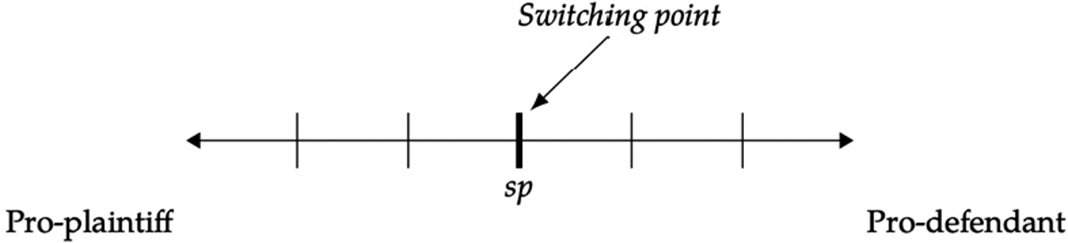
38 For reasons of space, I will need to treat Rigoni’s proposal in very broad strokes. We can get a sense of what he is up to, however, by returning to the intuitive idea of a dimension as an ordered range, where the further we travel in one direction, the better it is for the plaintiff, and the further we travel in the other direction, the better it is for the defendant. On Horty’s conception, no matter how far we travel in the pro-plaintiff direction, we never reach a value
 $ X(d)=n $
such that the fact that the dimension takes on that value is itself a reason to decide for the plaintiff. Instead, at every possible point up and down the dimension, there is a reason to decide for the plaintiff and a reason to decide for the defendant. Rigoni favors a more straightforward reduction of dimensions to standard factors, along the following lines:
Each point on the line in Figure 1—with the possible exception of the switching point—is a factor and thus favors either a decision for the plaintiff or for the defendant. At the far right, the factors favor the defendant. At the far left, they favor the plaintiff. At a certain point, the polarity of the factors switches from one side to the other. For any points on the dimension
 $ m $
and
 $ n $
, if
 $ m<n $
, then
 $ n $
favors the defendant more than
 $ m $
does, or
 $ n $
favors the plaintiff less than
 $ m $
does.
A dimension, on one construal.

Once this basic picture is on the table, Rigoni can define the reason model in the usual way, by identifying the priority ordering on reasons associated with a precedent case, lifting this definition to case bases, and finally requiring courts to decide new cases without introducing inconsistency into the case base.Footnote 39 For present purposes, the key point is that this conception of the dimensional setting allows us to remove reasons to decide for one side without adding reasons to decide for the other.
To illustrate, let’s once again think of
 $ {d}_1 $
as the length of time the defendant has spent abroad in a dispute over fiscal domicile. Now, the more time the defendant has spent abroad, the better this is for the defendant. On Rigoni’s approach, however, there is some shortest period of time such that the fact that the defendant has been gone for that long not only favors the defendant more than a shorter period would, it also favors the defendant overall, full stop. Suppose this period is one year, so that if a defendant spends 12 months abroad, this is a reason to decide in her favor, and longer and longer periods constitute stronger and stronger pro-defendant reasons. If she spends less than a year abroad, on the other hand, then this fact is a reason to decide for the plaintiff tax authority, with shorter and shorter periods abroad constituting stronger and stronger reasons to decide for the plaintiff.
This picture makes it possible to remove reasons to decide for
 $ s $
without adding reasons to decide for
 $ \overline{s} $
. Suppose that the defendant in a precedent dispute
 $ X $
, decided in her favor, spent 36 months abroad. Given our stipulations, this gave the court a reason, of a particular strength, to decide that dispute for the defendant. (Of course, we can allow that any number of other considerations were at issue.) With this case in the background, then, a court may be presented with a new dispute
 $ Y $
in which the defendant has been gone for two years. The move from
 $ X $
to
 $ Y $
clearly involves removing reasons to decide for the defendant. We can’t say that
 $ Y $
should be decided for the defendant for the reason that she spent three years abroad, for instance. And yet—at least as far as
 $ {d}_1 $
is concerned—no new reason to decide for the plaintiff has been generated. Given our stipulations, the fact that the defendant in
 $ Y $
spent 24 months abroad is still a reason to decide for the defendant. It’s just that this reason is weaker than the one presented by the precedent case. Since Rigoni’s conception of the dimensional setting makes it possible to remove reasons for one side without adding reasons to decide for the other, we should expect the reason model and the result model to be distinct in this context. Indeed, this is exactly what we find.Footnote
40
In the last section, we learned that the distinction between the reason model and the result model in the standard setting depends on the possibility of starting with a precedent case and generating a new fact situation by removing reasons to decide for the winner without adding reasons to decide for the loser. We have just seen that this result both explains the initial collapse of the reason model and the result model in the dimensional setting, and also illuminates subsequent proposals to modify either the models or the underlying dimensional setting in order to recover a distinction. In the next section, we will see how this same result opens the door to collapse even in the simpler standard setting.
IV. “Negative” Factors
As far as the standard setting is concerned, the legal factors at work in any given area of the law might all be logically independent, so that the presence or absence of one factor never entails the presence or absence of another, and any combination of factors is possible.Footnote
41 In reality, many legal reasons are not like this. In a trade-secrets case, for example, while implementing reasonable security measures to protect the relevant information counts in favor of the plaintiff, failing to implement reasonable security measures counts in favor of the defendant. Plainly, the pro-plaintiff factor reasonable-security-measures and the pro-defendant factor
 $ \neg $
reasonable-security-measures are not logically independent. We might call the latter a “negative” factor, since it indicates the absence of the former.Footnote
42
In fact, lots of intuitively “positive” legal factors come with “negative” counterparts. In a slip-and-fall case, it counts in favor of the plaintiff if the defendant property-owner had notice of the dangerous condition that caused the fall; it counts in favor of the defendant if she did not.Footnote 43 In a dispute over fiscal domicile, it counts in favor of the defendant if she sold her house in the old jurisdiction; it counts in favor of the plaintiff tax authority if she did not.Footnote 44 In an equal-protection suit, it counts in favor of the plaintiff if the challenged law was passed for a discriminatory purpose; it counts in favor of the government if it was not.Footnote 45 And so on.
In this section, I show that if we supplement the standard setting with the assumption that every “positive” factor
 $ f $
for one side is associated with a “negative” factor
 $ \neg f $
for the other, then the reason model and the result model collapse. This assumption might seem suspicious, however, despite the examples just cited. Isn’t it unreasonable to assume that every “positive” factor for
 $ s $
comes with a corresponding “negative” factor for
 $ \overline{s} $
? In the domain of trade secrets, HYPO took the view that “the defendant’s case is weakened if he bribed an employee, but the absence of bribery does not really help the defendant.”Footnote
46 Later, in representing that same domain, “CATO did not…create…a No-Secrets-Disclosed-Outsiders [factor], because Ashley and Aleven could not find any court cases where a judge had said that an absence of disclosures was a positive strength for the plaintiff.”Footnote
47 Are these not perfectly good examples of “positive” factors whose presence favors one side but whose absence provides no reason to decide for the other?
In the case of disclosure to outsiders, at least, I submit that courts do count the absence of disclosures in favor of the plaintiff. In a Seventh Circuit case called Matter of Innovative Construction Systems, Inc.,Footnote 48 for example, Innovative Construction sued a former employee for misappropriating the formula for “Panl Brick,” a kind of faux-brick paneling marketed for home construction. To prevail, Innovative needed to show, inter alia, that its formula was a genuine secret. In deciding that it was—or, more precisely, that a jury could reasonably have determined that it was—the Court of Appeals cited the fact that, when discussing the possible sale of the business to potential buyers at one point, Innovative “either obtained oral pledges of confidentiality from interested parties or did not divulge confidential information to them.”Footnote 49 The court also noted, in support of its judgment, the fact that a particular report sent to a potential buyer “did not disclose the exact proportion of raw materials used to produce Panl Brick.”Footnote 50 On the most natural reading of the case, the Seventh Circuit counted these “negative” facts about nondisclosure in favor of the conclusion that the formula for Panl Brick was a genuine trade secret, and thus in favor of an ultimate decision for the plaintiff.Footnote 51
Whatever we say about nondisclosure, though, I am happy to allow that not all “positive” factors come with “negative” counterparts. Bribery in a trade-secrets case may well serve as an example.Footnote 52 I submit, however, that this does not deprive the equivalence result of interest. Even if it is not the case that all “positive” factors have “negative” counterparts, it remains the case that many of them—perhaps even most of them—do. (I mentioned several examples at the start of this section, but if you open a casebook at random and start reading, you will quickly find more.) If we accept this modest point, as I think we must, then the equivalence result remains significant. What it says, strictly speaking, is that if every “positive” factor has a “negative” counterpart, then the reason model and the result model collapse. What it suggests, however, is that in areas of the law where this assumption holds to a high degree—in areas where lots of “positive” factors have “negative” counterparts—constraint under the reason model is liable to resemble mere a fortiori constraint much more closely than comparisons of those models in the traditional standard setting would lead us to believe.
Let me conclude these preliminaries by clarifying that I do not take any of the definitions or results in this section to depend on a metaphysically robust distinction between positive and negative properties or facts. In a fiscal-domicile case, for example, I said that it favors the defendant if she sold her house and the government if she did not. On this construal, the pro-defendant factor sold-house seems to be the “positive” factor and the pro-plaintiff factor
 $ \neg $
sold-house the “negative” one. But we could easily shuffle this around. We might say that it favors the government if the defendant kept her house, and favors the defendant if she did not. Now the pro-defendant factor looks “positive” and the pro-plaintiff factor “negative.” Either approach is fine. What matters is just that the two factors are logical contradictories with opposite polarity.
Recall that, in the standard setting, the set of all legal factors
 $ F $
for a given area of the law is the union of the set
 $ {F}^{\pi } $
of pro-plaintiff factors and the set
 $ {F}^{\delta } $
of pro-defendant factors. Now let’s stipulate that
 $ F $
does not contain both a factor and its negation, so that we can think of
 $ F $
as containing just the “positive” factors in the area. We now define the negative extension of
 $ {F}^s $
as the set:
 $$ \hat{F^s}={F}^s\hskip0.3em \cup \hskip0.3em \left\{\neg f:f\in {F}^{\overline{s}}\right\}. $$
The negative extension of
 $ F $
, in turn, is
 $$ \hat{F}=\hat{F^{\pi }}\hskip0.3em \cup \hskip0.3em \hat{F^{\delta }}. $$
For present purposes,
 $ \hat{F} $
represents the set of all legal factors.
We also tweak our understanding of legal reasons and legal rules. A reason for
 $ s $
is no longer defined as a set
 $ R\hskip0.3em \subseteq \hskip0.3em {F}^s $
but as a set
 $ R\hskip0.3em \subseteq \hskip0.3em \hat{F^s} $
. As before, a reason is a reason for one side or the other. So, for example,
 $ \left\{{f}_1^{\pi },\neg {f}_1^{\delta}\right\} $
is a reason to decide for the plaintiff, while
 $ \left\{{f}_1^{\pi },\neg {f}_2^{\pi}\right\} $
is not a reason at all, because
 $ {f}_1^{\pi } $
favors the plaintiff while
 $ \neg {f}_2^{\pi } $
favors the defendant. A rule for
 $ s $
continues to have the form
 $ R\to s $
, where
 $ R $
is a reason to decide for
 $ s $
. It’s just that now we understand this definition to incorporate our new account of legal reasons, so that
 $ R $
is not necessarily a subset of
 $ {F}^s $
but rather a subset of
 $ \hat{F^s} $
. A rule is still just a rule for one side or the other.
In the standard setting, if a (“positive”) factor “is not listed as present in a fact situation, it must be regarded as absent.”Footnote
53 If there is no record of
 $ f $
in
 $ X $
, we conclude that
 $ \neg f $
holds in
 $ X $
. In the standard setting, however, we stop short of assuming that
 $ \neg f $
is itself a factor for
 $ \overline{s} $
. This is the assumption we are now taking on board. If this assumption is going to be of any consequence, however, then we need to make sure that the reason model and the result model pay attention to these “negative” factors in addition to the more familiar “positive” ones.
Two strategies suggest themselves. On the first, we continue to understand the notion of a fact situation as a set of (“positive”) factors
 $ X\hskip0.3em \subseteq \hskip0.3em F $
, but we define the negative extension of a fact situation so that it includes not just the factors that belong to
 $ X $
but all of the factors, whether “positive” or “negative,” that
 $ X $
entails. We then modify our definitions for the reason model and the result model, so that they are oriented toward the negative extensions of fact situations rather than the fact situations themselves. There is nothing wrong with this approach in principle, but I prefer to keep the definitions of the reason model and the result model as they were.
On the second strategy, which we adopt, we leave the models alone and modify the definition of a fact situation instead. The basic idea is that when we combine (i) the new assumption that every “positive” factor has a “negative” counterpart with (ii) the old assumption that
 $ X\hskip0.3em \models \hskip0.3em \neg f $
iff
 $ f\hskip0.35em \notin \hskip0.35em X $
, the upshot is that for every fact situation
 $ X $
, and every “positive” factor
 $ f\in F $
, either
 $ f $
or
 $ \neg f $
(but not both) holds in
 $ X $
. In that case, however, we can just incorporate this requirement directly into our notion of a fact situation.
Definition 8. (fact situation: alternative definition) A fact situation is a set of factors
 $ X\hskip0.3em \subseteq \hskip0.3em \hat{F} $
such that, for every factor
 $ f\in F $
, either
 $ f $
or
 $ \neg f $
(but not both) belongs to
 $ X $
.
Given this account of a fact situation, a precedent case can be defined in the usual way, as a triple
 $ c=\left\langle \mathrm{X},r,s\right\rangle $
such that
 $ X $
is a fact situation,
 $ r $
is a rule, and
 $ s\in \left\{\pi, \delta \right\} $
, all such that (1)
 $ X\hskip0.3em \models \hskip0.3em $
Premise(
 $ r $
) and (2) Conclusion(
 $ r $
)
 $ =s $
. As desired, the definitions for the reason model and the result model can be carried over from the standard setting without change.
To get a sense for this new environment, let’s suppose that, for some particular area of the law, we have just the “positive” factors
 $ {F}^{\pi }=\left\{{f}_1^{\pi },{f}_2^{\pi },{f}_3^{\pi}\right\} $
and
 $ {F}^{\delta }=\left\{{f}_1^{\delta },{f}_2^{\delta },{f}_3^{\delta}\right\} $
. The negative extensions of
 $ {F}^{\pi } $
and
 $ {F}^{\delta } $
are then
 $$ \hat{F^{\pi }}=\left\{{f}_1^{\pi },{f}_2^{\pi },{f}_3^{\pi },\neg {f}_1^{\delta },\neg {f}_2^{\delta },\neg {f}_3^{\delta}\right\} $$
and
 $$ \hat{F^{\delta }}=\left\{{f}_1^{\delta },{f}_2^{\delta },{f}_3^{\delta },\neg {f}_1^{\pi },\neg {f}_2^{\pi },\neg {f}_3^{\pi}\right\}, $$
and the complete set of factors is
 $$ \hat{F}=\hat{F^{\pi }}\hskip0.3em \cup \hskip0.3em \hat{F^{\delta }}. $$
In the standard setting, we saw cases like
 $ {c}_1=\left\langle {X}_1,{r}_1,{s}_1\right\rangle $
, where
 $ {X}_1=\left\{{f}_1^{\pi },{f}_2^{\pi },{f}_3^{\pi },{f}_1^{\delta },{f}_2^{\delta}\right\} $
,
 $ {r}_1=\left\{{f}_1^{\pi },{f}_2^{\pi}\right\}\to \pi $
, and
 $ {s}_1=\pi $
. But
 $ {c}_1 $
does not qualify as a precedent case in the present framework, because
 $ {X}_1 $
does not qualify as a fact situation. The problem is that it contains neither
 $ {f}_3^{\delta } $
nor
 $ \neg {f}_3^{\delta } $
. Suppose, then, that we add
 $ \neg {f}_3^{\delta } $
to
 $ {X}_1 $
, giving us:
 $$ {\displaystyle \begin{array}{l}{c}_{10}=\left\langle {X}_{10},{r}_{10},{s}_{10}\right\rangle \\ {}{X}_{10}=\left\{{f}_1^{\pi },{f}_2^{\pi },{f}_3^{\pi },\neg {f}_3^{\delta },{f}_1^{\delta },{f}_2^{\delta}\right\}\\ {}{r}_{10}=\left\{{f}_1^{\pi },{f}_2^{\pi}\right\}\to \pi \\ {}{s}_{10}=\pi \end{array}} $$
The set
 $ {X}_{10} $
is a subset of
 $ \hat{F} $
such that, for every factor
 $ f\in F $
, either
 $ f $
or
 $ \neg f $
(but not both) belongs to
 $ {X}_{10} $
. Accordingly,
 $ {X}_{10} $
qualifies as a fact situation under our new definition. Since we also have
 $ {X}_{10}\hskip0.3em \models \hskip0.3em $
Premise
 $ \left({r}_{10}\right) $
and Conclusion
 $ \left({r}_{10}\right)={s}_{10} $
,
 $ {c}_{10} $
is a precedent case.
In the standard setting, we saw that, with just
 $ {c}_1 $
in the case base, the reason model and the result model come apart regarding
 $ {X}_3=\left\{{f}_1^{\pi },{f}_2^{\pi },{f}_3^{\delta}\right\} $
, with the reason model requiring a decision for the plaintiff and the result model permitting a decision either way. We can now consider whether, with
 $ {c}_{10} $
the only case in the case base, the two models come apart regarding
 $ {X}_{11} $
, which is just like
 $ {X}_3 $
except that the appropriate “negative” factor has been added for each missing “positive” factor:
 $$ {X}_{11}=\left\{{f}_1^{\pi },{f}_2^{\pi },\neg {f}_2^{\delta },\neg {f}_3^{\delta },{f}_1^{\delta },\neg {f}_3^{\pi}\right\}. $$
It’s easy to see that the result model continues to permit a decision for either side. For the result model requires a decision for the plaintiff just in case
 $ {X}_{10}{\le}_{\pi}\hskip0.35em {X}_{11} $
, which holds just in case (i)
 $ {X}_{10}^{\pi}\hskip0.3em \subseteq \hskip0.3em {X}_{11}^{\pi } $
and (ii)
 $ {X}_{11}^{\delta}\hskip0.3em \subseteq \hskip0.3em {X}_{10}^{\delta } $
. But since
 $ {X}_{10}^{\pi } $
contains a factor
 $ {f}_3^{\pi } $
that does not belong to
 $ {X}_{11}^{\pi } $
,
 $ {X}_{10}^{\pi } $
is not a subset of
 $ {X}_{11}^{\pi } $
. And since
 $ {X}_{11}^{\delta } $
contains a factor
 $ \neg {f}_3^{\pi } $
not found in
 $ {X}_{10}^{\delta } $
,
 $ {X}_{11}^{\delta } $
is not a subset of
 $ {X}_{10}^{\delta } $
. Since neither condition is met, the result model permits
 $ {X}_{11} $
to be decided either way.
What, though, about the reason model? Does it continue to require a decision for the plaintiff? Well, since
 $ {c}_{10} $
establishes the priority ordering
 $$ \left\{{f}_1^{\pi },{f}_2^{\pi}\right\}{>}_{c_{10}}\left\{{f}_1^{\delta },{f}_2^{\delta}\right\}, $$
it is clear that the reason model at least prohibits the court from deciding
 $ {X}_{11} $
for the defendant on the basis of the rule
 $$ \left\{{f}_1^{\delta}\right\}\to \delta, $$
since this would express the inconsistent judgment that
 $ \left\{{f}_1^{\delta}\right\} $
is weightier than
 $ \left\{{f}_1^{\pi },{f}_2^{\pi}\right\} $
. But the reason model has no objection to a decision for the defendant based on the rule
 $$ \left\{\neg {f}_3^{\pi}\right\}\to \delta . $$
Because the pro-defendant factor
 $ \neg {f}_3^{\pi } $
was not present in
 $ {X}_{10} $
, the
 $ {c}_{10} $
court did not establish that
 $ \left\{{f}_1^{\pi },{f}_2^{\pi}\right\} $
outweighs any set of pro-defendant factors that includes it. Since it is possible for the court to decide
 $ {X}_{11} $
for the defendant without introducing inconsistency into the case base, the reason model does not require a decision for the plaintiff in this new context.
So the reason model and the result model agree on
 $ {X}_{11} $
in the context of the case base
 $ \Gamma =\left\{{c}_{10}\right\} $
. In fact, the reason model and the result model agree on everything in this variation on the standard setting.
Observation 3. Let
 $ \Gamma $
be a case base and
 $ Y $
a new dispute facing a court. Then the court is required to decide
 $ Y $
for
 $ s $
according to the reason model only if it is required to decide
 $ Y $
for
 $ s $
according to the result model as well.
To verify this, suppose the reason model requires a decision for
 $ s $
. It follows that
 $ \Gamma \hskip0.3em \cup \hskip0.3em \left\{{c}^{\ast}\right\} $
is inconsistent, where
 $ {c}^{\ast }=\left\langle Y,{Y}^{\overline{s}}\to \overline{s},\overline{s}\right\rangle $
. So there is some precedent
 $ c=\left\langle X,r,s\right\rangle $
in
 $ \Gamma $
such that (i)
 $ {Y}^{\overline{s}}{<}_c $
Premise
 $ (r) $
and (ii) Premise
 $ (r){<}_{c^{\ast }}{Y}^{\overline{s}} $
. From (i), we have that
 $ {Y}^{\overline{s}}\hskip0.3em \subseteq \hskip0.3em {X}^{\overline{s}} $
. Now suppose for reductio that
 $ {X}^s\hskip0.35em \nsubseteq \hskip0.35em {Y}^s $
. Then there is some factor
 $ {f}^s\in {X}^s $
such that
 $ {f}^s\hskip0.35em \notin \hskip0.35em {Y}^s $
. Since
 $ {f}^s\in X $
, it follows from Definition 8 that
 $ \neg {f}^s\hskip0.35em \notin \hskip0.35em X $
. But since
 $ {f}^s\hskip0.35em \notin \hskip0.35em Y $
, it follows from Definition 8 that
 $ \neg {f}^s\in Y $
. So
 $ \neg {f}^s\in {Y}^{\overline{s}} $
but
 $ \neg {f}^s\hskip0.35em \notin \hskip0.35em {X}^{\overline{s}} $
. So
 $ {Y}^{\overline{s}}\hskip0.35em \nsubseteq \hskip0.35em {X}^{\overline{s}} $
. Contradiction. We reject the assumption, then, and conclude that
 $ {X}^s\hskip0.3em \subseteq \hskip0.3em {Y}^s $
. Of course, it follows that the court is forced to decide
 $ Y $
for
 $ s $
according to the result model.
Given Observation 2, however, Observation 3 should not come as a surprise. For Definition 8 makes it impossible, in this variation on the standard setting, to remove a reason for one side without adding a reason for the other. To illustrate, consider again the precedent case
 $ {c}_{10} $
, with its fact situation
 $ {X}_{10}=\left\{{f}_1^{\pi },{f}_2^{\pi },{f}_3^{\pi },\neg {f}_3^{\delta },{f}_1^{\delta },{f}_2^{\delta}\right\} $
. The only way to weaken these facts for the plaintiff is to remove one or more of the pro-plaintiff factors. But if we were to remove
 $ {f}_1^{\pi } $
, for example, in constructing a new dispute
 $ Y $
, then we would be forced to add the new pro-defendant factor
 $ \neg {f}_1^{\pi } $
. If we were to remove
 $ \neg {f}_3^{\delta } $
instead, then we would be forced to add
 $ {f}_3^{\delta } $
. Regardless of which factor we choose, we are prevented from removing a reason to decide for the plaintiff without adding a reason to decide for the defendant. As a result, the reason model and the result model once again collapse.
I began this section by addressing some concerns about the assumption that every “positive” factor has a “negative” counterpart. Let me conclude by addressing another worry, this time about the assumption that whenever there is no record in a precedent opinion regarding whether a “positive” factor was present or absent, it is always permissible for a later court to assume that it was absent. To be sure, this sort of closed-world reasoning is condoned in the standard setting; it’s not something I’ve added to the mix in order to generate a result. But you might think this is a simplifying assumption that we should in some sense regret making.Footnote 54 At the very least, Ashley and Aleven’s suggestion that closed-world reasoning is appropriate for some factors but not for others, and that we must look to judicial opinions for guidance, continues to strike many people as sensible. In that case, however, a result that relies on the global availability of closed-world reasoning in the standard setting may seem dubious.
In response, I want to point out that while the standard setting explicitly assumes that closed-world reasoning is appropriate for all (“positive”) factors across the board, the alternative definition of a fact situation offered in this section can also be given a more sophisticated interpretation. Recall that, according to Definition 8, for every “positive” factor
 $ f $
, a fact situation is always characterized by either
 $ f $
or
 $ \neg f $
(but not both). It is certainly possible to see this sort of fact situation as the product of closed-world reasoning regarding all “positive” factors: We just imagine taking a precedent opinion identifying only the “positive” factors present in a dispute and then annotating it with “negative” factors for all the “positive” ones that are missing. A fact situation in the style of Definition 8 is the result.
While Definition 8 tolerates this interpretation, however, it does not demand it. For we might imagine something like the following instead. We start with a precedent opinion that identifies various factors, whether “positive” or “negative,” as present or absent in a case. On a number of issues, however, the judge does not say either that it is a case of
 $ f $
or that it is one of
 $ \neg f $
. This is where closed-world reasoning is supposed to come in, but we don’t actually need to assume that the appropriate response to judicial silence is always to treat the “positive” factor as absent and the “negative” factor as present. In some cases, it may be more reasonable to assume that the intuitively “positive” factor is present.Footnote
55 Definition 8 is consistent with a more nuanced practice, on which the appropriate response to silence on an issue depends on the nature of the issue. What the definition assumes is just that, for each pair of “positive” and “negative” factors, there is a default position, either
 $ f $
or
 $ \neg f $
, such that, in the absence of any relevant information in the precedent opinion, future courts are to assume that the default applies.Footnote
56
V. Conclusion
In this paper I showed that the distinction between the reason model and the result model in the standard setting depends on the possibility of starting with a precedent case and generating a new fact situation by removing reasons to decide for the winning side without adding any new reasons to decide for the losing side. I used this result to explain the initial collapse of the reason model and the result model in the dimensional setting, and to illuminate some proposals to modify either the models or the underlying dimensional setting in order to recover a distinction. I then showed how this same result opens the door to collapse even in the standard setting, given the assumption that every “positive” factor has a “negative” counterpart. Finally, I argued that the interest of this last result does not depend on our fully accepting the assumption that generates it.
Acknowledgements
For helpful feedback and discussion, my thanks to Alexia Brancato, Liz Harman, Jeff Horty, Gideon Rosen, and an anonymous referee for this journal.
Appendix: Observations and proofs
Observation 1. Let
 $ \Gamma $
be a case base and
 $ Y $
a new dispute facing a court. Then the reason model requires the court to decide
 $ Y $
for
 $ s $
iff adding
 $ {c}^{\ast }=\left\langle Y,{Y}^{\overline{s}}\to \overline{s},\overline{s}\right\rangle $
to
 $ \Gamma $
would render it inconsistent.
Proof.
For the left-to-right direction, suppose the reason model requires the court to decide
 $ Y $
for
 $ s $
. Then, by Definition 5, Outcome
 $ (c)=s $
for every case
 $ c $
based on
 $ Y $
such that
 $ \Gamma \hskip0.3em \cup \hskip0.3em \left\{\mathrm{c}\right\} $
is consistent. Since Outcome
 $ \left({c}^{\ast}\right)=\overline{s} $
, it follows that
 $ \Gamma \hskip0.3em \cup \hskip0.3em \left\{{\mathrm{c}}^{\ast}\right\} $
is inconsistent. For the right-to-left, suppose
 $ \Gamma \hskip0.3em \cup \hskip0.3em \left\{{\mathrm{c}}^{\ast}\right\} $
is inconsistent. Then there is some
 $ c=\left\langle X,r,s\right\rangle \in \Gamma $
such that (i) Premise
 $ (r){>}_c\hskip0.35em {Y}^{\overline{s}} $
and (ii)
 $ {Y}^{\overline{s}}{>}_{c^{\ast }} $
Premise
 $ (r) $
.Footnote
57 Suppose for reductio that the reason model permits the court to decide
 $ Y $
for
 $ \overline{s} $
. Then there is a case
 $ {c}^{\star }=\left\langle Y,{r}^{\star },\overline{s}\right\rangle $
such that
 $ \Gamma \hskip0.3em \cup \hskip0.3em \left\{{c}^{\star}\right\} $
is consistent. From
 $ {c}^{\star }=\left\langle Y,{r}^{\star },\overline{s}\right\rangle $
, we have Premise
 $ \left({r}^{\star}\right){>}_{c^{\star }} $
Premise
 $ (r) $
. By the definition of a case, Premise
 $ \left({r}^{\star}\right)\hskip0.3em \subseteq \hskip0.3em {Y}^{\overline{s}} $
. We already know that Premise
 $ (r){>}_c\hskip0.35em {Y}^{\overline{s}} $
. So, by the definition of the priority relation on reasons, Premise
 $ (r){>}_c $
Premise
 $ \left({r}^{\star}\right) $
. So
 $ \Gamma \hskip0.3em \cup \hskip0.3em \left\{{c}^{\star}\right\} $
is inconsistent. Contradiction. ∎
Observation 2. Let
 $ \Gamma $
be a case base and
 $ Y $
a new dispute such that the reason model requires the court to decide
 $ Y $
for a particular side
 $ s $
but the result model permits
 $ Y $
to be decided either way. Then every forcing case
 $ {c}_i=\left\langle {X}_i,{r}_i,s\right\rangle $
for Y in the context of
 $ \Gamma $
is such that:
-
(i)
; and -
(ii)
.


Proof.
Start with (i). By the definition of a forcing case,
 $ \left\{{c}_i,{c}^{\star}\right\} $
, where
 $ {c}^{\star }=\left\langle Y,{Y}^{\overline{s}}\to \overline{s},\overline{s}\right\rangle $
, is inconsistent. It follows that (1) Premise
 $ \left({r}_i\right){>}_{c_i}{Y}^{\overline{s}} $
and (2)
 $ {Y}^{\overline{s}}{>}_{c^{\ast }} $
Premise
 $ \left({r}_i\right) $
.Footnote
58 From (1) and Definition 3,
 $ {Y}^{\overline{s}}\hskip0.3em \subseteq \hskip0.3em {X}_i^{\overline{s}} $
. So
 , as desired. To prove (2), we suppose for reductio that
 . It follows that
 $ {X}_i^s\hskip0.3em \subseteq \hskip0.3em {Y}^s $
. But then, since
 $ {X}_i^s\hskip0.3em \subseteq \hskip0.3em {Y}^s $
and
 $ {Y}^{\overline{s}}\hskip0.3em \subseteq \hskip0.3em {X}_i^{\overline{s}} $
, it follows from Definition 1 that
 $ {X}_i{\le}_sY $
. So, by Definition 5, the court is required to decide
 $ Y $
for
 $ s $
, in contradiction of our initial stipulation. ∎
Observation 3. Let
 $ \Gamma $
be a case base and
 $ Y $
a new dispute facing a court. Then the court is required to decide
 $ Y $
for
 $ s $
according to the reason model only if it is required to decide
 $ Y $
for
 $ s $
according to the result model as well.
Proof.
Suppose the reason model requires the court to decide
 $ Y $
for
 $ s $
. It follows that
 $ \Gamma \hskip0.3em \cup \hskip0.3em \left\{{c}^{\ast}\right\} $
is inconsistent, where
 $ {c}^{\ast }=\left\langle Y,{Y}^{\overline{s}}\to \overline{s},\overline{s}\right\rangle $
. So there is some
 $ c=\left\langle X,r,s\right\rangle \in \Gamma $
such that (1)
 $ {Y}^{\overline{s}}{<}_c $
Premise
 $ (r) $
and (2) Premise
 $ (r){<}_{c^{\ast }}{Y}^{\overline{s}} $
.Footnote
59 From (1), we have that
 $ {Y}^{\overline{s}}\hskip0.3em \subseteq \hskip0.3em {X}^{\overline{s}} $
. Now suppose for reductio that
 $ {X}^s\hskip0.35em \nsubseteq \hskip0.35em {Y}^s $
. Then there is some
 $ {f}^s\in {X}^s $
such that
 $ {f}^s\hskip0.35em \notin \hskip0.35em {Y}^s $
. Since
 $ {f}^s\in X $
, it follows from Definition 8 that
 $ \neg {f}^s\hskip0.35em \notin \hskip0.35em X $
. But since
 $ {f}^s\hskip0.35em \notin \hskip0.35em Y $
, it follows from Definition 8 that
 $ \neg {f}^s\in Y $
. So
 $ \neg {f}^s\in {Y}^{\overline{s}}-{X}^{\overline{s}} $
. So
 $ {Y}^{\overline{s}}\hskip0.35em \nsubseteq \hskip0.35em {X}^{\overline{s}} $
. Contradiction. ∎