Introduction
Cases of borderline personality disorder (BPD) occur with some frequency in general psychiatric practices, but are also commonly seen in emergency rooms and inpatient psychiatric facilities (Segal et al., Reference Segal, Coolidge and Rosowsky2006). The nine diagnostic criteria for the disorder include instability in interpersonal relationships, in self-image, and in affective states, together with notably high impulsivity (American Psychiatric Association, 2000). Prominent among the diagnostic signs are the intense and unstable interpersonal relationships (Modestin, Reference Modestin1987) and the often dramatic expressions of emotional distress. The three cases of older people with BPD reported by Trappler and Backfield (Reference Trappler and Backfield2001) all had histories of parental abuse and comorbid affective disorder, with the presentation of somatic symptoms as one area of difference from younger cases of BPD. Here we report on the behavioral and neuropsychological test results of a 59-year-old woman who referred herself for psychological assessment of her memory as she was questioning whether she was in the early stages of dementia. This can represent one presentation of somatic symptoms in a less typical health care context than an emergency department. The patient has given written informed consent for the publication of this material in International Psychogeriatrics.
Case report
Medical and personal history
Ms. X. had a long history of diagnosed anxiety and mood disorders and had been diagnosed with borderline personality disorder several years previously while being treated in an inpatient psychiatric unit for distress apparently arising from childhood sexual abuse. Her medical history included chronic asthma and bronchitis, hiatus hernia, diabetes, arthritis, hypertension, migraine headaches, and a mastectomy for breast cancer. Her respiratory problems were a source of continued distress, leading to multiple visits to the local Emergency Department in the months following the present assessment. She denied any significant history of alcohol use, although she had taken an overdose while prescribed a narcotic analgesic (morphine) approximately a year prior to being assessed. She claimed to have suffered right-sided weakness and tingling since that time, together with memory loss and “jumbling words”. A consultation with a geriatric psychiatrist around the same time as the assessment concluded that she had “no clinical relevant signs of cognitive decline or dementia”. She now used a wheelchair for getting around and had moved into a residential care facility because her intellectually handicapped daughter reported being no longer able to care for her mother. As her weight increased, she acquired an electric powered wheelchair.
Neuropsychological assessment
Neuropsychological assessment was carried out over three sessions. She initially presented at the first appointment with symptoms of asthma, coughing and wheezing. These resolved rapidly over the course of a few minutes when Ms. X was informed that she could not undergo testing while having an asthma attack. During the period of the three weeks over which the five testing sessions were completed, Ms. X changed her general practitioner from the one who had suggested her placement in a residential care facility. She did not show any clear signs of word-finding difficulty during the testing, and she obviously remembered events in detail from prior testing sessions on subsequent days.
The tests administered included the Wechsler Abbreviated Scales of Intelligence (WASI; Psychological Corp., 1999), Wechsler Memory Scale, third edition (WMS-III; Wechsler, Reference Wechsler1997), Rey Complex Figure Test (RCFT; Meyers and Meyers, Reference Meyers and Meyers1995), selected subtests from the Delis-Kaplan Executive Function System (D-KEFS; Delis et al., Reference Delis, Kaplan and Kramer2001), and the Personality Assessment Inventory (PAI; Morey, Reference Morey1991), which was administered to determine the nature and extent of psychological disturbance.
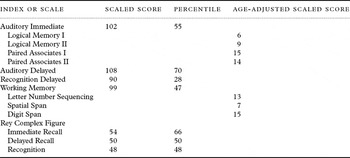
The Full Scale IQ was estimated with the WASI to lie at the 84th percentile, with the Verbal IQ substantially higher than the Performance IQ. There was no suggestion of any notable decline from previously higher levels of functioning. Performance on both immediate and delayed recall sections of the WMS-III was in the average range, as noted in Table 1. Subtest scores for auditory immediate memory were in the low average range for narrative material, while scores were in the very superior range for learning and recalling unrelated pairs of words. Delayed recall for the stories of Logical Memory was better than immediate recall. Her performance on the single trial learning measure was very good, and she learned all of the word pairs on the second of four trials. At the same time, her scores on the WMS-III Working Memory Index were in the average range.
Memory test scores for Ms X. (Wechsler Memory Scale, 3rd edition)

Performance on the RCFT for both copying and immediate recall was within the average range, at odds with her prediction that she “would not remember this in 20 minutes”. Her drawings on the RCFT were very rushed, with clear signs of lack of planning and care in the results. Her performance on the memory tests raised the question of possible malingering, and so the Test of Memory Malingering (TOMM; Tombaugh, Reference Tombaugh1997) was administered. The results suggested a very good memory with no evidence of atypical performance.
While most of her scores on the tests of executive functioning were within the average range, several inconsistencies were noted in her performance on the card sorting task. There were no signs of difficulties with inhibiting responses or in general problem-solving on the Color Word Interference Test or the Tower Test, as well as with the Proverbs Test.
The PAI results indicated a high level of defensiveness about personal shortcomings as well as an exaggeration of current problems in her life. She consistently endorsed items that portrayed herself in particularly negative or pathological ways, including frequent physical complaints, distrust of others, tension, preoccupation with physical function, poor sense of identity, the physical symptoms of anxiety, and irrational phobias. The profile was consistent with several distinct disorders, including major depression, somatization disorder, anxiety with panic disorder, post-traumatic stress disorder (PTSD), and bipolar disorder. Indeed, the profile was marked by extreme elevations on multiple scales, with four scales exceeding the PAI “skyline” of two standard deviations above the norms for the clinical normative sample. These elevated scales were Negative Impression Management, Somatization, Anxiety, Anxiety Related Disorders, and Suicidal Tendencies. The T-score for the Borderline scale was 81, exceeded only by the four extremely elevated scales and that of the Depression scale.
When provided with feedback on the results of the PAI, Ms. X seized on the mention of PTSD and was happy to use this diagnosis to validate her symptoms. She congratulated the psychologist for picking up the condition, saying that she had just been re-diagnosed with PTSD and had heard that the disorder had a very long course of treatment. She added that she was happy to take as long as it took in order to be treated by her new psychotherapist. This relationship to deal with the symptoms of PTSD lasted for at least a further six months, until that therapist resigned from the service. She continued with a private therapist and remained on Lexapro and diazepam.
Following the provision of feedback to Ms. X and her daughter, written reports were provided with Ms. X's consent to her new general practitioner.
Follow-up
Ms. X died 32 months following the assessment from respiratory complications, possibly secondary to H1N1 influenza. Her medical chart contains reports of over 50 admissions to the Emergency Department of the hospital over a period of four years prior to her death. The majority of these admissions were for reported shortness of breath, which usually resolved within two hours after she was given a bed. She was described in the files as “being prescriptive” in that “she demanded certain medications and treatment” even before an initial examination could be completed.
Relationships between Ms X, the nursing staff, and other residents at the residential care facility became strained and it appears from various items of correspondence in the files that she had developed a reputation for being demanding and manipulative there. An example of this was seen when her GP referred Ms X to the local psychiatric emergency management team as he deemed her to be actively suicidal after seeing her in his surgery. According to the GP, the patient reported that when she “leaves his surgery she is going back to the home to kill herself”. He reported that she had told him that her method would be to eat copious amounts of peanuts, identifying to him that she had a severe allergy to these nuts. She underwent a mental health assessment by the psychiatric registrar at the emergency department and a clinical nurse from the acute mental health service. Their notes indicated a thorough psychiatric assessment that did not suggest active suicidal intent; in fact Ms. X did not have a documented allergy to peanuts and on questioning her she denied making this statement.
Her distress was compounded by experiences at the nursing home. She had to share a bathroom, which was often locked on the other side, meaning that she was unable to access the toilet when she needed. She felt that she was not adequately consulted about changes to her nursing care plan, which she felt failed to incorporate the true complexity of her health problems. Her complaint to the external complaints commission had not been dealt with by the time of her death. Notes in her file were consistent with her behaviour at the assessment in that her physical complaints were reduced along with her anxiety levels whenever the health care professional listened to her issues and responded with appropriate sympathy. Notes suggested that her handicapped daughter was her only visitor at the nursing home, and nursing staff expressed concern with the snack foods brought in by the daughter in light of Ms. X's escalating weight.
Discussion
The psychological profile of Ms. X is concordant with the three cases described by Trappler and Backfield (Reference Trappler and Backfield2001) in showing both high levels of somatic concerns and comorbid depression. The difference lay in the use of failing memory as the focus of her elevated health concerns. The PAI also reflected the high level of anxiety and exaggeration that can be characteristic of people with BPD. Her high levels of anxiety were also evident at the nursing home and in her encounters with health care practitioners. Her scores on the measures of executive functioning were within normal limits. This is at odds with the recent report of impaired frontolimbic functions in people with BPD (Silbersweig et al., Reference Silbersweig, Clarkin, Goldstein, Kernberg, Tuescher and Levy2007) and with the possible diagnosis of frontotemporal dementia. Her memory was also intact upon formal testing, also arguing against the presence of any form of dementia. Her symptoms did have some somatoform features, but she did not exhibit the signs of disinhibition or bizarre symptoms associated with frontotemporal dementia. The observed pattern of symptoms is more consistent with BPD, but it is clear that distinguishing the two conditions can be difficult, particularly in older people who may not have had the early diagnosis of BPD that Ms. X carried.
The value of this case lies in its presentation of one pattern of performance on neuropsychological measures of memory and other cognitive functions of an older person with BPD that can be contrasted with the performance of other older people with BPD (Trappler and Backfield, Reference Trappler and Backfield2001). The case also shows that at least some people with borderline symptoms remain symptomatic in their later years (Paris and Zweig-Frank, Reference Paris and Zweig-Frank2001; Paris, Reference Paris2009). The profile of scores also suggests that a basic screening test with limited time spent with the client could well result in a false positive attribution of cognitive dysfunction. However, the present detailed assessment and the psychogeriatric consultation both found her to be cognitively unimpaired.
An interesting note in this case was the self referral for investigation of possible dementia, which could be related to her recent admission to a nursing home where she was surrounded by other residents with various degrees of dementia. The changes in interpersonal behavior over the assessment sessions and the erratic performance both within and between tests are characteristic of people with BPD. The particular pattern of test scores in this case may not be repeated by another person with this disorder, but it does provide one example of how the particular personality characteristics and emotional distress seen in BPD can be reflected in the form of somatization, which in turn can influence the profile of neuropsychological test scores.
Conflict of interest
None.
Description of authors’ roles
E. Helmes provided clinic supervision and did most of the writing. L. Steward conducted the interview and assessment, and reviewed and wrote up the medical history.