1. Introduction
The acquisition of grammatical gender in child bilingualism has attracted considerable attention in the literature with pairs of languages where only one is a grammatical gender language (e.g., Unsworth, Argyri, Cornips, Hulk, Sorace & Tsimpli, Reference Unsworth, Argyri, Cornips, Hulk, Sorace and Tsimpli2014) as well as with pairs in which both languages are gender languages (e.g., Eichler, Jansen & Müller, Reference Eichler, Jansen and Müller2013). In the latter context, cross-language variation can be found depending on differences and similarities between the two gender systems in terms of the number of gender values and the frequency and transparency of the morphological cues for gender which can in turn lead to acceleration or delay effects (cf. Kupisch, Reference Kupisch2007; Paradis & Genesee, Reference Paradis and Genesee1996; Yip & Matthews, Reference Yip and Matthews2000).
The notion of acceleration or delay can also be applied to the comparison between bilingual children's language development and monolingual children acquiring that same language. Thus, acceleration effects of crosslinguistic influence in simultaneous bilingual development have been suggested for phenomena such as determiner acquisition in German. For instance, Kupisch's (Reference Kupisch2007) study with German–Italian bilinguals showed that the simultaneous acquisition of a language like Italian accelerates the acquisition of determiners in German. The lower complexity of the determiner system and the higher token-frequency of determiner-noun sequences in Italian incur a facilitation effect on German in that the bilingual children showed lower determiner omission rates than German monolingual children (Kupisch, Reference Kupisch2007). Crucially, this influence in the form of facilitation is indirect in that properties of the Italian determiner system in the input lead to an increased awareness of articles in German, rather than being manifested as direct transfer where they overuse articles in contexts in which they are obligatory in Italian but ungrammatical in German (Kupisch, Reference Kupisch2007).
One of the aims of the present study is to explore the effects of crosslinguistic influence, if any, on the bilingual development of two grammatical gender languages differing in the frequency and transparency of gender cues. The study also aims at examining acceleration or delay effects in comparison to monolingual acquisition of gender in each of the two languages controlling for lexical skills which are usually lower in bilingual children (Bialystok, Luk, Peets & Yang, Reference Bialystok, Luk, Peets and Yang2010) and amount of input which is known to vary greatly. The languages of the bilingual children are Dutch and Greek, two grammatical gender languages with very different properties in the domain of morphophonological cues regarding the frequency and transparency of markers of gender distinction (Blom, Polišenská & Weerman, Reference Blom, Polišenská and Weerman2008b; Tsimpli & Hulk, Reference Tsimpli and Hulk2013; Unsworth et al., Reference Unsworth, Argyri, Cornips, Hulk, Sorace and Tsimpli2014; Vasić, Chondrogianni, Marinis & Blom, Reference Vasić, Chondrogianni, Marinis, Blom, Biller, Chung and Kimball2012).
The present study is based on the direct comparison between the gender systems of Greek and Dutch and the monolingual acquisition patterns attested in each language (Tsimpli & Hulk, Reference Tsimpli and Hulk2013). The contrast between a precocious and successful acquisition of grammatical gender in monolingual Greek children and a gradual and slow development in monolingual Dutch children, repeatedly reported in previous studies (e.g., Mastropavlou, Reference Mastropavlou2006 for Greek; Polišenská, Reference Polišenská2010 for Dutch) has been attributed to a learnability problem for Dutch (Tsimpli & Hulk, 2013). This problem is associated with the poor cues for gender discovery in Dutch noun phrases and is further aggravated by the inconsistency between gender marking in nouns and pronouns. Specifically, whereas a two-gender distinction (common vs. neuter) is found in the nominal context, personal pronouns mark gender three-ways (masculine-feminine-neuter). Thus, the learnability problem arises due to the scarcity of gender cues from syntax (agreement) and the lexicon (noun endings) as well as the contradictory cues from the gender distinctions across nominal and pronominal paradigms.
According to Tsimpli and Hulk (2013), two stages are followed by child language learners in monolingual language acquisition of grammatical gender languages. In the first stage, the learner discovers that the target language is a grammatical gender language. In the second stage, the learner knows that grammatical gender is a classifying feature of nouns and can arrive at generalizations based on the accumulation of syntactic and lexical cues in order to acquire different gender values for individual nouns and form predictions for novel or unknown nouns encountered in the input.
The learnability problem that Tsimpli and Hulk (2013) suggested for the Dutch monolingual learner is associated with the first stage of gender acquisition, namely gender discovery; the child resorts to a default form for determiner-noun sequences, namely de, which is, however, not based on gender. Instead, de constitutes a default determiner choice encoding definiteness and possibly count-mass distinctions (Hulk & Cornips, Reference Hulk, Cornips, Costa, Castro, Lobo and Pratas2010). As soon as gender is discovered as a classifying feature for nouns, the learner moves to the second stage where neuter starts being marked consistently with the appropriate nouns and in agreement contexts with attributive adjectives, despite errors in lexical gender attribution (see Unsworth, Reference Unsworth2013). This stage, however, is only reached around age 6.
In contrast to Dutch, the frequency and transparency of gender cues in Greek ensure that the first stage of gender discovery is short-lived and hardly noticeable in production data. As the Greek gender cues are highly salient, the learner identifies grammatical gender as a relevant classificatory feature of Greek nouns very early on. The second stage where productive and consistent use and agreement of all genders is acquired is achieved with final, adult-like outcomes by age 3;6Footnote 1 (Mastropavlou, Reference Mastropavlou2006).
Given the stark contrast between the two gender systems, Greek–Dutch bilingual children offer an excellent test case for disentangling any possible crosslinguistic influence (acceleration or delay) in bilingual performance. Finally, a comparison between Greek–Dutch bilinguals in their performance on Dutch gender with English–Dutch bilinguals and monolingual Dutch children from Unsworth (Reference Unsworth2013) allows us to investigate the role of the ‘other’ language in the two stages of gender acquisition in Dutch.
The article is structured as follows: Section 2 presents the Greek and Dutch gender systems. Section 3 reviews results from previous studies on crosslinguistic influence in bilingual gender acquisition, and section 4 introduces the method. Section 5 presents our results, and section 6 compares performance of the Greek–Dutch bilinguals with the English–Dutch bilinguals and Dutch monolinguals from Unsworth's (Reference Unsworth2013) study. We conclude with a discussion.
2. Greek vs. Dutch: the gender systems
Greek has a three-gender system (masculine – feminine – neuter) morphologically marked on noun endings, attributive and predicate adjectives, determiners, as well as strong and clitic pronouns (Holton, Mackridge & Philippaki-Warburton, Reference Holton, Mackridge and Philippaki-Warburton1997).
In Dutch, there is a two-gender system (common-neuter) which is not marked on noun endings and which can be related only to a restricted set of semantic classes (Donaldson, Reference Donaldson1981).
Consider the Greek and Dutch noun phrases in (1) and (2) below:
- (1)
a. o/enas akrivos furnos
the-MSC.SING.NOM / an-MSC.SING.NOM expensive-MSC.SING.NOM
bakery-MSC.SING.NOM
“the/an expensive bakery”
b. i/mia akrivi tsanda
the-FEM.SING.NOM / an-FEM.SING.NOM expensive-FEM.SING.NOM
bag-FEM.SING.NOM
“the/an expensive bag”
c. to/ena akrivo aftokinito
the-NEUT.SING.NOM / an-NEUT.SING.NOM expensive-NEUT.SING.NOM
car-NEUT.SING.NOM
“the/an expensive car”
- (2)
a. het/een boek
the-NEUT.SING / a-Ø book-Ø
“the/a book”
b. de/een tafel
the-COM.SING / a-Ø table-Ø
“the/a table”
c. de/Ø boeken
the-PL / Ø books-PL
“the/Ø books”
d. de/Ø tafels
the-PL / Ø tables-PL
“the/Ø tables”
In Greek, gender marking appears on all nominal categories in both numbers, whereas in Dutch, the distinction between neuter and common nouns is only found in the singular definite context for determiners and the singular indefinite context for adjectives (Holton et al., Reference Holton, Mackridge and Philippaki-Warburton1997 for Greek; Haeseryn, Romijn, Geerts, de Rooij & van den Toorn, Reference Haeseryn, Romijn, Geerts, de Rooij and van den Toorn1997 for Dutch).
Although noun endings in Greek are not strictly speaking unambiguous since the same ending may be found on masculine, feminine and neuter nouns, almost all noun endings have a strong predictive value for only one of the three genders (Mastropavlou & Tsimpli, Reference Mastropavlou and Tsimpli2011; Varlokosta, Reference Varlokosta, Galani, Hicks and Tsoulas2011). Since Greek nouns in isolation usually provide sufficient cues to grammatical gender without the need to consider the syntactic context, vocabulary development and performance on nominal gender should go hand in hand. Finally, Stephany and Christofidou (Reference Stephany and Christofidou2008) found that neuter nouns are the most frequent in both child-directed and early child speech, followed by feminine and masculine nouns which are the least frequent. Thus, neuter has been suggested as the default value for Greek gender.
Turning to Dutch, gender cues are scarce and inconsistent because, on the one hand, nouns lack morphophonological gender marking, and on the other, syntactic cues for gender agreement are limited to a small subset of syntactic contexts, as illustrated in (2) above where only the definite singular articles provide gender cues (Unsworth et al., Reference Unsworth, Argyri, Cornips, Hulk, Sorace and Tsimpli2014). Like definite articles, demonstratives (common: die/dat; neuter: deze/dit) also show gender distinction only in the singular and the form for singular common is used for plural with both genders. However, when used as pronouns, demonstratives are often chosen on the basis of conceptual properties of the antecedent noun (i.e., animacy or count-mass distinction) rather than its grammatical gender. This is due to the contrast between gender values for nouns and pronouns which leads to mismatches between nominal and pronominal gender in agreement contexts (Audring, Reference Audring2006), thus further contributing to the inconsistency of the Dutch gender system.
Gender agreement between nouns and attributive adjectives does not offer strong cues for gender marking either (Blom, Polišenská & Unsworth, Reference Blom, Polišenská and Unsworth2008a and Blom et al., Reference Blom, Polišenská and Weerman2008b for overviews). In all but one context attributive adjectives are marked with the ‘inflected’ ending, namely a schwa (e.g., grot- e “big”). The sole exception is the context in which the adjective modifies a singular indefinite neuter noun where it appears in the bare form (een groot-Ø huis “a big house”). The only nominal context in which grammatical gender is explicitly marked is the diminutive. The diminutive suffix -(t)je is specified for neuter, hence both common and neuter nouns are introduced with het in the diminutive (de muis -> het muisje “the little-mouse”; het huis -> het huisje “the little-house”). As neuter, diminutives are modified by uninflected adjectives in the indefinite singular (een klein-Ø muisje “a small little-mouse”; een klein-Ø huisje “a small little-house”). Finally, common nouns are by far more frequent than neuter nouns (Van Berkum, Reference Van Berkum1996).
Given the paucity of gender cues, gender is discovered late in Dutch compared to languages like Greek, French or Italian (Eichler et al., Reference Eichler, Jansen and Müller2013; Unsworth et al., Reference Unsworth, Argyri, Cornips, Hulk, Sorace and Tsimpli2014). The end of the stage of gender discovery is evinced by the learner's use of the common-neuter opposition as a feature of the developing grammar in agreement contexts (around age 5–6) and is not restricted to neuter use as a lexically-based choice of a small set of nouns (Polišenská, Reference Polišenská2010; Unsworth & Hulk, Reference Unsworth, Hulk, Costa, Castro, Lobo and Pratas2010).
The above comparative presentation of the Greek and Dutch gender systems illustrates two opposite sides in terms of frequency and transparency of gender cues. The Greek cues are strong enough for the learner to a) discover that gender is a grammatical feature relevant to the classification of nouns as well as to all nominal agreement processes and b) acquire the three gender values with an early and short-lived preference for neuter. When a critical mass of nouns has been acquired with the development of the lexicon, noun endings are used for gender assignment on novel or unknown nouns following the morphophonological route (i.e., via noun endings), instead of the lexical one (via the mental lexicon). In Dutch, on the other hand, the first stage of gender acquisition is prolonged due to the low saliency, restricted contexts and inconsistent properties of gender cues. When gender is discovered, the process of noun acquisition is associated with increased awareness of the syntactic contexts for gender agreement, higher accuracy in the use of neuter and more consistent marking of gender for each noun produced.
3. Previous studies on cross-linguistic influence in gender acquisition
The role of crosslinguistic influence (CI) has been central in bilingual studies of language development (e.g., Kupisch, Reference Kupisch2007, Reference Kupisch, Guijarro-Fuentes, Larrañaga and Clibbens2008; Müller & Hulk, Reference Müller and Hulk2001; Yip & Matthews, Reference Yip and Matthews2000). Focusing on gender acquisition, in studies of bilingual children speaking two gender languages, there is a potential role for crosslinguistic influence which could manifest as delay or acceleration. Notice that the direction of influence and the associated effect (acceleration or delay) could be confounded by the language proficiency of the child in the language tested, and by the properties of the linguistic system and the cues it offers to the learner.
A negative effect of bilingualism on gender acquisition has been observed in a number of studies. Explanations proposed to account for the differences and similarities between monolingual and bilingual acquisition of gender include the usual factors: age of onset, length of exposure, input quality and the nature of the L1 (Unsworth, Hulk & Marinis, Reference Unsworth, Hulk and Marinis2011). For example, Kupisch, Müller and Cantone's (Reference Kupisch, Müller and Cantone2002) study included Italian and French monolingual and bilingual children acquiring gender in these languages. The bilingual pairs examined spoke German as the ‘other’ language. Therefore, there is a potential role for CI in both the Italian–German and the French–German bilinguals. The authors argue that the language-specific differences in transparency and reliability of gender cues in Italian and French can account for the lack of a bilingualism effect on the accuracy of gender in Italian bilinguals, who appear to score almost like monolinguals. Thus, reduced amount of input does not seem to affect bilingual acquisition in languages with transparent gender marking like Italian, while the relatively low transparency of the French gender system requires more input than Italian which results in delayed acquisition for bilinguals compared to monolinguals (see also Eichler et al., Reference Eichler, Jansen and Müller2013).
In the case of bilinguals with pairs of languages where only one has grammatical gender instantiated, there is no obvious link between CI and gender either in the form of acceleration or of delay. The expectation is that gender acquisition in these cases would be largely predicted by the learner cues available in the relevant language input and by the amount of input available to the bilingual child. This is supported by studies from English–Dutch and English–Greek bilinguals where the performance patterns of bilingual children on Dutch and Greek gender fit the known differences attested in monolingual children (Unsworth et al., Reference Unsworth, Argyri, Cornips, Hulk, Sorace and Tsimpli2014), with Dutch gender being considerably more delayed than Greek gender acquisition.
Moreover, Unsworth et al. (Reference Unsworth, Argyri, Cornips, Hulk, Sorace and Tsimpli2014)’s study with English–Dutch and English–Greek bilingual children also supports the claim that language-specific properties influence gender acquisition. Similar to Kupisch et al. (Reference Kupisch, Müller and Cantone2002), they found evidence that input plays a more important role for gender acquisition in languages with opaque gender systems like Dutch (see also Unsworth, Reference Unsworth2013). In addition, the contribution of vocabulary to performance on gender was greater in Greek than in Dutch suggesting different roles of vocabulary and input as a function of language-specific properties in gender marking.
4. The study
4.1. Research hypotheses and predictions
The gender systems of Greek and Dutch are in stark contrast in terms of transparency of gender cues (transparent and abundant cues in Greek vs. scarce and inconsistent cues in Dutch) as well as the nature of these cues (morphological endings in Greek vs. broader contexts in Dutch). The difference in transparency of gender cues is reflected in the timing of acquisition in monolinguals with Greek gender being acquired early and the acquisition process in Dutch being late and prolonged, as attested in previous studies. In addition, the degree of transparency of gender cues in the two languages has possible implications for CI in bilinguals and will be addressed in the second research question. Before investigating the possible role of CI for gender acquisition in bilingual children, we first need to consider more general effects of bilingualism. Thus, the first research question pertains to the different factors that play a causal role in bilingual children's performance on gender in the two languages.
The difference in the nature of gender cues (morphological endings vs. broader contexts) is likely to result in different predictors of gender marking accuracy in the two languages of Greek–Dutch bilingual children. Given Unsworth et al.’s (Reference Unsworth, Argyri, Cornips, Hulk, Sorace and Tsimpli2014) findings regarding the contribution of vocabulary and the fact that gender cues in Greek are based on morphophonological properties of nominal elements and nouns in particular, we predict that 1) language proficiency measured in terms of vocabulary scores will be a better predictor of Greek gender acquisition in our group of bilingual children than a more general measure of language input. This is because measures of language input reflect general language abilities (i.e., language in context and thus, syntax) in addition to vocabulary, whereas vocabulary measures tap into lexical skills only. We argue that as children's vocabulary skills in Greek grow, they accumulate lexical cues which leads to increased reliance on noun endings in gender assignment, hence the relationship between vocabulary and gender performance. Consequently, bilingual children are expected to show more extensive evidence of neuter overuse as a default form compared to monolingual children whose vocabulary skills usually develop faster than those of bilingual children (Pearson, Fernández, Lewedeg & Oller, Reference Pearson, Fernández, Lewedeg and Oller1997; Place & Hoff, Reference Place and Hoff2011).
In contrast, Dutch noun endings generally do not carry gender information and gender cues need to be derived from and integrated across different syntactic contexts (both locally and non-locally) which means that knowledge of grammar is paramount to Dutch gender acquisition. Therefore, we expect that 2) a general measure of amount of input, here gauged in terms of % Dutch use at home, is a better predictor of performance on Dutch gender than lexical skills (Unsworth et al., Reference Unsworth, Argyri, Cornips, Hulk, Sorace and Tsimpli2014). Regardless of the relationship between input and vocabulary, we argue that input subsumes both lexical and, more importantly, syntactic knowledge which is why input is more relevant to gender performance in Dutch than a pure measure of vocabulary. In line with this prediction, we expect evidence for overuse of the determiner de, particularly in bilingual children with lower exposure to Dutch. Bilingual children with more exposure to Dutch are predicted to show good performance on both genders, like older monolingual children, since the relevant factor of input exposure will be sufficient to ensure the discovery and consolidation of the gender system.
Our second research question is concerned with the potential role of crosslinguistic influence in the form of acceleration or delay with regard to the two stages of gender acquisition, i.e., gender discovery and acquisition of gender values for individual nouns, respectively. Given the dissimilarities between the Greek and Dutch gender systems, it is not possible to transfer morphological cues or gender values for individual nouns across languages. Thus, we predict that 3) there will be no crosslinguistic influence in the second stage of gender acquisition. Moreover, assuming that Greek's transparent gender marking places the language within the group of languages where lower amounts of input would suffice for both the initial discovery of gender as well as for the actual process of acquiring gender values for nouns and the rules for agreement (Eichler et al., Reference Eichler, Jansen and Müller2013; Tsimpli, Reference Tsimpli2014), we expect that 4) the opacity of the Dutch gender system would not have adverse (delay) effects on Greek gender acquisition. Finally, we predict that 5) in principle, regardless of proficiency and input, Greek–Dutch bilingual children will show some acceleration effects from Greek to Dutch in the first stage of gender acquisition (i.e., gender discovery). Recall that gender discovery is delayed in monolingual Dutch children showing very low rates of neuter noun use. Given the abundant evidence for gender in Greek, we expect some positive effects of gender discovery (the common-neuter opposition) in bilingual children. To investigate this prediction we compare similar age groups of bilingual English–Dutch, and monolingual Dutch children from Unsworth's (Reference Unsworth2013) study with the Greek–Dutch bilingual children from the present study.
4.2 Participants
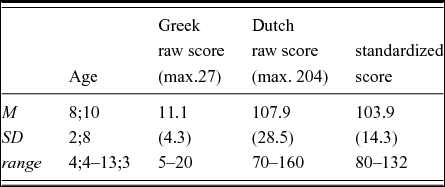
The sample consists of 21 Greek–Dutch bilingual children aged between 4;4 and 13;3 who all lived in the Netherlands at the time of testing. Seventeen children were born in the Netherlands and four were born in Greece. The participating children were recruited from a Greek Saturday school and were all simultaneous bilinguals meaning that they were either exposed to both languages from birth in a ‘one parent, one language’ situation (n = 19) or, their exposure to Dutch started within the first year of life through daycare while the home language was Greek (n = 2). None of the children had a reported history of language delay or impairment. Children's scores on standardized vocabulary tests were used to index language proficiency in each of the two languages. For Greek, children were tested on the vocabulary section of the Diagnostic Verbal IQ test (henceforth DVIQ; preschool version for children from 3;6-6;6), which is a measure of productive vocabulary knowledge developed by Stavrakaki and Tsimpli (Reference Stavrakaki and Tsimpli2000). For Dutch, we administered the PPVT-III-NL (Dunn, Dunn & Schlichting, Reference Dunn, Dunn and Schlichting2005), which measures receptive vocabulary knowledge in monolingual children up to 14 years of age. Table 1 presents the children's age and vocabulary scores.
Mean (M), standard deviation (SD) and range of age and vocabulary scores for the Greek-Dutch bilingual children.

The average age of the children was 8;10 years and their mean standard score on the PPVT-III-NL was 103.9 which shows that on average, they perform at a monolingual level in Dutch. In contrast, the mean raw score of the bilingual children on the Greek vocabulary test was 11.1 which corresponds to a lexical age below 3;5 based on the Greek monolingual normsFootnote 2. Thus, while the bilingual children's vocabulary scores in Dutch were well within the monolingual norms, their lexical age in Greek was much lower than their chronological age with a difference of more than 5 years, indicating that overall the children's dominant language was Dutch.
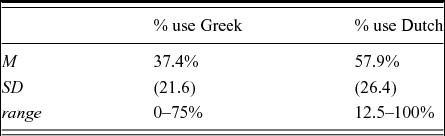
Information about children's relative exposure to the two languages at home was gathered by means of a parental questionnaire adapted from Unsworth (Reference Unsworth2008). From these questionnaires, four variables were extracted, namely 1) the language(s) spoken to the child by the mother, 2) the language(s) spoken to the child by the father, 3) the language(s) spoken between the parents and 4) the language(s) the child uses with his/her siblings. For each variable, parents reported the relative use of the two languages in percentages which were then added up to derive a measure of home language, i.e., the percentage of use of each of the two languages (Dutch and Greek) in the home environment. All four variables were equally weighted each accounting for 25% of the ‘total’ home language useFootnote 3. Table 2 shows that as a group, children had more exposure to Dutch (57.9%) than to Greek (37.4%)Footnote 4
Mean (M), standard deviation (SD) and range of % use at home for the two languages.

4.2. Gender Tasks for Dutch and for Greek
Children's knowledge of grammatical gender marking on definite determiners and attributive adjectives in Dutch and Greek was assessed with two elicited production tasks and one grammaticality judgment task. The tasks were taken from Unsworth, Argyri, Cornips, Hulk, Sorace and Tsimpli (Reference Unsworth, Argyri, Cornips, Hulk, Sorace, Tsimpli, Danis, Mesh and Sung2011) and Unsworth (Reference Unsworth2013), and were designed as part of a larger project on early child bilingualism. The general set-up of the tasks was the same in both languages. Children were presented with pictures of the noun stimuli accompanied by a series of questions (e.g., “What has big ears?”) to elicit determiner-(adjective-) noun strings which could subsequently be analysed for gender marking on determiners and adjectives. The Dutch tasks were presented on a laptop computer, while picture booklets were used for the Greek tasks.
For Dutch, determiner-noun strings were elicited in the STORY task where children were presented with a short picture story (e.g., about a boy and his birthday presents), followed by a picture of one of the target stimuli and a question targeting that same noun (e.g., “What does Leo want to play with?” child: “the guitar”). Similarly, (determiner-)adjective-noun strings were elicited in a picture description task (PDT) by showing the child pictures of the noun stimuli and asking them to complete a sentence fragment produced by the experimenter (e.g., “This is a . . .” child: “white rabbit”) or by prompting the child to describe the position of another object relative to the target noun (e.g., “The ball is in front of . . .“ child: “the white rabbit”). For each target noun, one instance of a determiner-noun string in a definite context was elicited in the STORY task, and two determiner-adjective-noun strings in definite contexts and two adjective-noun strings in indefinite contexts were elicited in the PDT.
The equivalent tasks in Greek were the Det-N task and the Det-Adj-N task. In the Det-N task, children were presented with a set showing three target nouns followed by questions about the depicted objects (e.g., “What is brown?” child: “the dog”). In the Det-Adj-N task, children were again presented with sets of target nouns, but crucially there were two instances of each target noun that differed in size and colour, therefore requiring the use of an adjective to appropriately answer the questions (e.g., “What is red?” child: “The big fish”). Consequently, each target noun in Greek was elicited once in a determiner-noun string (Det-N task) and twice in a determiner-adjective-noun string (Det-Adj-N task).
The grammaticality judgment task (GJT) took the form of a forced choice task where children had to decide between congruent and incongruent determiner-noun combinations. The Dutch task was computerized and the stimuli were pre-recorded using one male and one female voice. Items were first introduced by using an indefinite determiner, which does not carry gender information. Following this, each item was presented individually and two puppets appeared, with one puppet naming the item with a congruent determiner-noun combination, e.g., de-COM boom-COM “the tree”, while the other one used an incongruent counterpart, e.g., het-NEUT boom-COM. Children had to identify which puppet said it correctly with correct responses being counterbalanced across the two puppets. For Greek, the determiner-noun combinations were presented orally by the experimenter since no computerized version of the task was available. Moreover, instead of saying which puppet got it right, children had to tap the experimenter's left or right hand depending on whether they judged the first or the second determiner-noun combination as correct (e.g., o-MASC ilios-MASC vs. to-NEUT ilios-MASC “the sun”; i-FEM elefantas-MASC vs. o-MASC elefantas-MASC “the elefant”). The gender of the determiner in the incongruent pairs was counterbalanced as were the correct responses across the two hands.
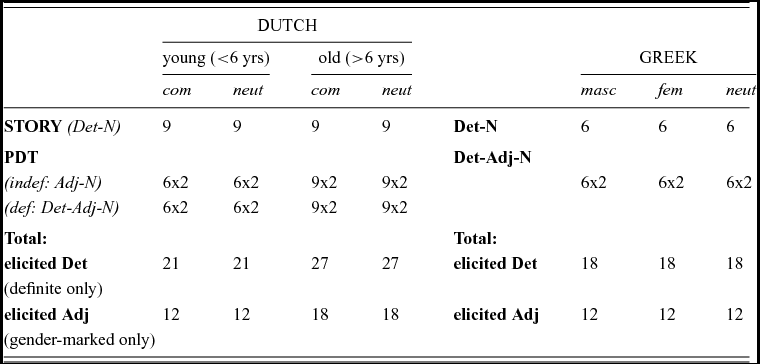
The same sets of target nouns were used across the production and judgment tasks. For Dutch, the number of target nouns was 9 for each gender, while for Greek, it was 6 per gender. In Dutch, there was a separate version of the PDT and the GJT for children below 6 years which included a subset of 6 target nouns per gender. Thus, the maximum number of elicited definite determiners per gender was 27 in Dutch (21 for younger children) and 18 in Greek. The maximum number of elicited adjectives in gender-marking contexts was 18 per gender in Dutch (12 for children below 6) and 12 per gender in Greek (see Table 3 for an overview). The number of items per gender in the GJT was 9 in Dutch (6 for younger children) and 6 in Greek. The items in the PDT and the GJT in Dutch were interspersed with 12 filler items (8 in the GJT for children below 6 years), whereby the fillers in the PDT tested different phenomena.
Number of target nouns for the production tasks in Dutch and Greek and total number of elicited determiners and adjectives in gender marking contexts.

Note. com=common; neut=neuter; masc=masculine; fem=feminine; Det=determiner; Adj=adjective; N=noun; indef=indefinite; def=definite; x2=elicited twice
4.3 Procedure
The tests were administered in two sessions, one in Dutch (45 min.) and one in Greek (30 min.) with the order counterbalanced across children and at least one week between the two sessions. The data were collected by two native speakers of Dutch and two (near-) native speakers of Greek. Each child was tested individually in a quiet room at the Greek Saturday school. The Dutch gender tasks were presented on a computer laptop in the form of PowerPoint presentations, while for the Greek production tasks picture booklets were used. The parental questionnaire was either completed in an interview session with one of the experimenters or by the parents themselves at home.
4.4 Coding
Given that there is no overt gender marking on root nouns in Dutch and for comparison with Unsworth (Reference Unsworth2013), performance was assessed in terms of gender marking on definite determiners and attributive adjectives. Although Greek nouns do have nominal suffixes that carry reliable information about gender, number and case, noun endings do not provide an unambiguous cue to gender (see Section 2). For this reason, for Greek too gender marking of determiners (and adjectives) was used to index performance on gender irrespective of the produced nominal endingFootnote 5 (e.g., to-NEUT ilio instead of o-MASC ilios-MASC was coded as incorrect use of a neuter determiner with a masculine noun).
For gender marking on determiners, the average percentage correct was calculated as the number of nouns produced with the correct determiner divided by the total number of nouns of the same gender produced with any determiner. For Dutch, responses that contained indefinite determiners were excluded (n = 12) since they do not show gender distinction, while indefinite determiners in Greek are marked for gender and were thus coded accordingly. Other non-target answers that were excluded from analysis include determiner omission in D-N elicitation contexts for both Greek (n = 145) and Dutch (n = 23). In addition, there were 10 ‘no answer’ responses in Dutch and 24 in Greek. Other responses excluded from analysis in Dutch were those containing demonstratives or non-target nouns (n = 10). Finally, for Greek, responses that contained neuter diminutives (-aki) and ‘multi-gendered’ nouns (Ralli, Reference Ralli2002) such as to skili “the dog”, to gati “the cat” were treated as non-target nouns and were excluded from analysis (n = 88).
Gender marking on adjectives was scored according to the produced adjectival inflection since both languages mark adjectives for gender (although Dutch only in indefinite contexts). For Greek, responses containing colour adjectives which do not bear gender marking (e.g., ble “blue”, mov “purple”, etc.) were excluded from analysis.
5. Results
5.1 Dutch data
Overall, children produced a definite determiner in 94.9% of total responses (95.5% for common nouns and 94.2% for neuter nouns). A paired-samples t-test showed no significant difference between children's performance across the two production tasks (PDT and STORY) for either gender (common: t(20) = −.946, p = .356; neuter: t(20) = .541, p = .595)Footnote 6. Thus, the results for the two production tasks were collapsed for subsequent analyses.
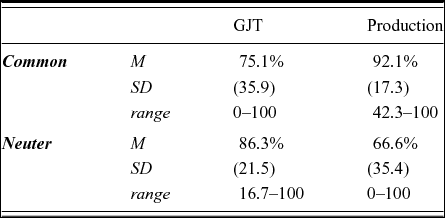
Table 4 presents the mean accuracies for neuter and common nouns in the GJT and production. A repeated measures ANOVA with task (production, judgment) and gender (common, neuter) as within-subjects factors revealed a significant interaction between task and gender (F(1,20) = 10.270, p = .004, η2p = .339). Post hoc comparisons showed significant differences between accuracy scores in judgment and production for neuter (t(20) = 2.866, p = .010, d = 0.63) as well as for common nouns (t(20) = −2.650, p = .015, d = 0.58). In production, children performed better on common than on neuter nouns (t(20) = 2.752, p = .012, d = 0.60), while for the GJT, there was no significant difference between the two genders (t(20) = −1.265, p = .221, d = 0.28).
Mean (M), standard deviation (SD) and range of accuracy on Dutch determiners for common and neuter nouns in the GJT and in production.

To investigate the factors influencing accuracy in production of neuter determiners, simple bivariate correlations between production of neuter determiners and the independent variables (age, vocabulary, % Dutch useFootnote 7 and GJT scores) were carried out. Correct production of neuter determiners significantly correlated with vocabulary (r = .432, p = .050), % Dutch use (r = .679, p = .001) and gender knowledge, i.e., scores on the GJT (r = .507, p = .029), which were then entered into a backward-elimination regression analysis. The final model (adjusted R2 = .586, F(2,18) = 15.13, p<.001) included % Dutch use and gender knowledge, with % Dutch use being the stronger predictor (% Dutch use: β = .616, p = .001; gender knowledge: β = .412, p = .011).
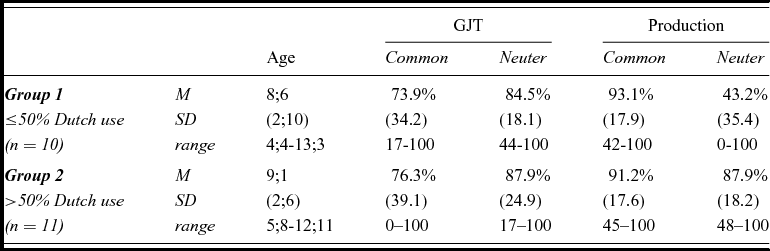
Given the predictive role of % Dutch use for performance on neuter nouns in production, the children were split into two groups depending on whether the home language was predominantly Dutch (group 2: >50%) or not (group 1: ≤50%, see Table 5). The two groups did not differ in age or vocabulary (both ps>.05). A mixed ANOVA with gender (common, neuter) and task (judgment, production) as within-subjects variable and group (1, 2) as between-subjects variable showed a significant three-way interaction (F(1,19) = 4.696, p = .043, ηp2 = .20). Separate 2x2 ANOVAs for each group showed a significant main effect of gender (F(1,9) = 5.670, p = .041, ηp2 = .39) and task (F(1,9) = 7.664, p = .022, ηp2 = .46), as well as a significant interaction between gender and task (F(1,9) = 11.536, p = .008, ηp2 = .56) for group 1, but no main effects and no interaction for group 2. Follow-up analyses for group 1 showed a significant difference between production and judgment for neuter nouns (t(9) = -4.750, p = .001, d = 1.50), but not for common nouns (t(9) = -1.795, p = .106, d = 0.57). In production, children in group 1 performed better on common than on neuter nouns (t(9) = 3.622, p = .006, d = 1.15) while for the GJT performance did not differ across genders (t(9) = 1.032, p = .329, d = 0.33).
Mean (M), standard deviation (SD) and range of age and accuracy on Dutch determiners for common and neuter nouns in the GJT and in production by group.

To summarize, the bilingual children show considerable variation as a group in their performance on Dutch gender. For the set of common nouns, children performed better on production than judgment regardless of amount of Dutch input at homeFootnote 8. In contrast, for the set of neuter nouns children with more than 50% Dutch input scored equally high across tasks, while children with less than 50% input did better on judgment than production. Regression analyses revealed that amount of input measured as exposure to Dutch at home, rather than vocabulary, age or performance on the GJT task, is the best predictor of performance in production.
5.2. Greek data
In total, 77.3% of the responses contained a determiner (neuter: 79.9%, masculine: 77.5%, and feminine: 74.6%) and were included in the analyses. This is due to a high number of determiner omissions (12.8%) as well as responses that contained diminutives and multi-gendered root nouns (7.8%). Children's performance did not differ across production tasks (neuter: t(20) = -1.708, p = .104, masculine: t(20) = -1.324, p = .203, feminine: t(20) = -1.768, p = .096), hence the scores were collapsed for subsequent analyses.
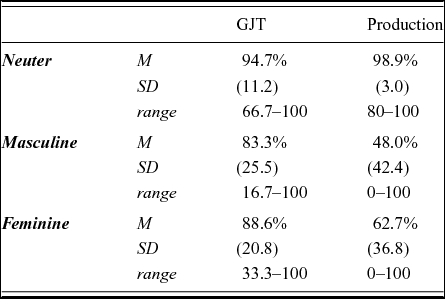
Table 6 presents the mean accuracies for each gender in the GJT and production. A repeated measures ANOVA on accuracy on determiners with gender (neuter, masculine, feminine) and task (judgment, production) as between-subjects factors revealed a main effect of gender (F(2,36) = 16.594, p<.001, ηp2 = .48) and task (F(1,18) = 18.978, p<.001, ηp2 = .51), and a significant interaction (F(2,36) = 15.099, p<.001, ηp2 = .46). Post hoc comparisons showed significant differences between masculine and neuter (t(20) = 5.599, p<.001, d = 1.22), feminine and neuter (t(20) = 4.526, p<.001, d = 0.99), as well as feminine and masculine (t(20) = -3.324, p = .003, d = 0.73) in production. In the GJT, there was a significant difference between masculine and neuter only (t(18) = 2.822, p = .011, d = 0.65). Moreover, children did significantly better in the GJT than in production for masculine (t(18) = 4.209, p = .001, d = 0.97) and feminine nouns (t(18) = 4.423, p<.001, d = 1.01) while their performance on neuter nouns did not differ significantly across the two tasks (p>.05).
Mean (M), standard deviation (SD) and range of accuracy on Greek determiners for masculine, feminine and neuter nouns in the GJT and in production.

Note. The average percentages for the GJT are based on 19 children, since two children showed a response bias and were excluded from the analysis.
Given the ceiling performance on neuter (see Table 6) and the strong correlation between accuracy on determiner production of masculine and feminine nouns (r = .891, p<.001), the scores were combined into one variable in order to find the best predictor for production of non-default gender in Greek. Simple bivariate correlations between production on masculine and feminine nouns and the independent variables age, vocabulary, % Greek use and GJT scores showed significant correlations with vocabulary (r = .841, p<.001), and gender knowledge, i.e., GJT (r = .724, p<.001). The two variables were entered into a backward-elimination regression analysis which showed that vocabulary scores were a better predictor of production of masculine and feminine (β = .641, p<.001) than GJT scores (β = .372, p = .011) (adjusted R2 = .788, F(2,16) = 34.459, p<.001).
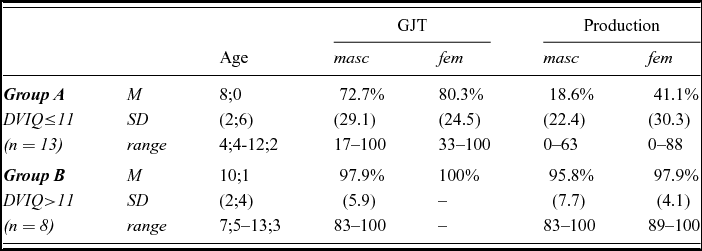
Children were again split into two groups according to the variable that best predicted performance on non-default gender, in this case vocabulary. Group A consisted of the children who scored around the group mean (M = 11.1) or below (DVIQ≤11) and group B was formed of the children who scored above the group mean (DVIQ>11, see Table 7). The two groups did not differ in age or % Greek use (both ps>.05). A mixed-ANOVA for accuracy on determiners with group as between-subjects variable and gender and task as within-subjects variables showed a significant main effect of gender (F(1,17) = 13.041, p = .002, ηp2 = .43), task (F(1,17) = 57.741, p<.001, ηp2 = .77), and group (F(1,17) = 30.608, p<.001, ηp2 = .64), as well as significant interactions between gender and group (F(1,17) = 8.150, p = .011, ηp2 = .32), and task and group (F(1,17) = 49.870, p<.001, ηp2 = .75). Separate repeated measures ANOVAs for each group revealed a main effect of gender (F(1,10) = 15.712, p = .003, ηp2 = .61) and task (F(1,10) = 77.498, p<.001, ηp2 = .89) for group A, but not for group B. Group A did better on feminine than on masculine nouns (t(10) = 3.964, p = .003, d = 1.20) and better on the GJT than on the same set of nouns in production (t(10) = 8.803, p<.001, d = 2.65), while group B was near-ceiling on both tasks for both masculine and feminine determiners.
Mean (M), standard deviation (SD) and range of accuracy on Greek determiners for masculine and feminine nouns in the GJT and in production by group.

Note. masc = masculine; fem = feminine; DVIQ = Diagnostic Verbal IQ test
To summarize, the results from the Greek data demonstrate that neuter gender is at ceiling with the vast majority of bilingual children independently of any other variables. Gender marking on determiners for feminine and masculine nouns is more vulnerable. Crucially, the most important predictor of the variance in accuracy of use of masculine and feminine nouns is Greek vocabulary. Children with higher vocabulary have mastered all three genders in both production and judgment, while children with relatively lower vocabulary scores show low accuracy in production of feminine and especially masculine nounsFootnote 9.
5.3. Correlations between performance in Dutch and Greek
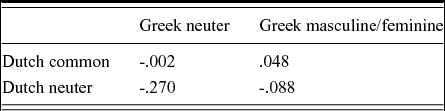
To examine any relationship between accuracy in determiner production across the two languages which would indicate CI at the second stage of gender acquisition (rule formation), we ran a correlation analysis. Results showed no correlation between overall performance in determiner production in Dutch and Greek (r = -.037, p = .876) and no correlations between performance on the individual gender values across languages (see Table 8).
Correlations (Pearson's r) between performance on the Greek and Dutch gender values.

6. Comparison between Greek–Dutch and English–Dutch bilinguals (split into age groups) and Dutch Monolinguals
6.1. Greek–Dutch vs. English–Dutch bilinguals
We next turn to possible acceleration effects that Greek may incur on the discovery of Dutch gender. For the purpose of this analysis, we split our bilingual participants into three age groups to facilitate comparison with Unsworth's (Reference Unsworth2013) English–Dutch data. Information about the age groups for the Greek–Dutch and the English–Dutch bilingual children is given in Table 9 below. Due to the small sample sizes of the Greek–Dutch age groups, no statistical tests could be carried out for comparison with the English–Dutch bilinguals. Instead, we used effect sizes (Cohen's d with 95% CI) to quantify the differences between group means. Only effect sizes of d >0.5 are reported which are commonly interpreted as medium-sized effects.
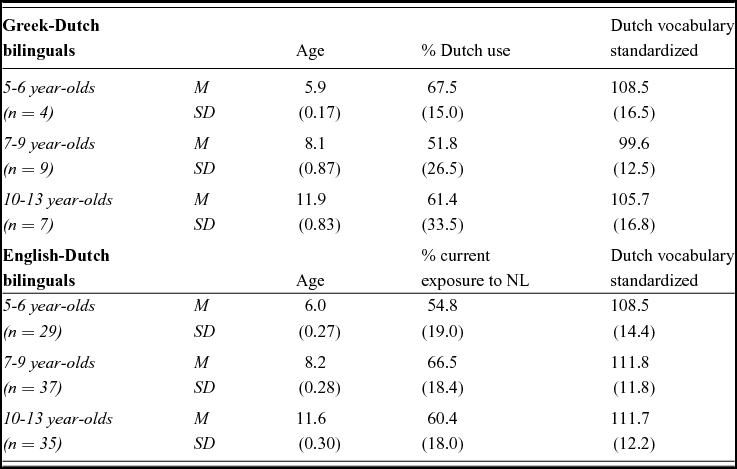
Mean (M) and standard deviation (SD) of age, vocabulary scores and % Dutch use at home/ % current exposure to NL for the three age groups of the Greek-Dutch and the English-Dutch bilingual children.

Although the Greek–Dutch and English–Dutch groups differed considerably in sample sizes, the two bilingual populations were highly comparable in terms of average age across age groups and all groups performed well within the monolingual normal range on the Dutch vocabulary test. Nevertheless, the Greek–Dutch 7–9 year-olds scored lower on Dutch vocabulary than the corresponding English–Dutch group (d = 1.02, 95% CI [0.27, 1.78]). Moreover, the table indicates that the Greek–Dutch 5–6 year-olds had more exposure to Dutch than their English–Dutch peers (d = 0.68, 95% CI [-0.37, 1.74]), while for the 7–9 year-olds the reverse pattern is found (d = 0.73, 95% CI [-0.01, 1.47]). However, the comparison is not as straightforward as with the other measures since % current exposure to Dutch used for the English–Dutch bilinguals is a more comprehensive input measure than % Dutch use at home calculated for the Greek–Dutch children of the present study, as the latter does not take into account exposure to Dutch outside the home.
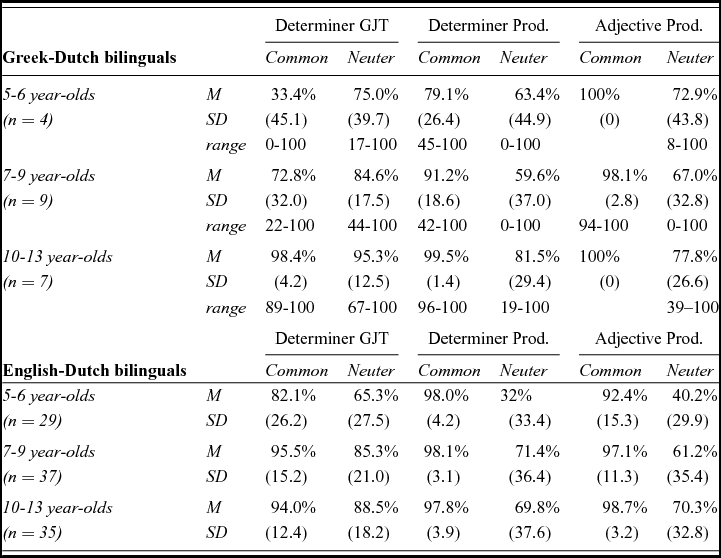
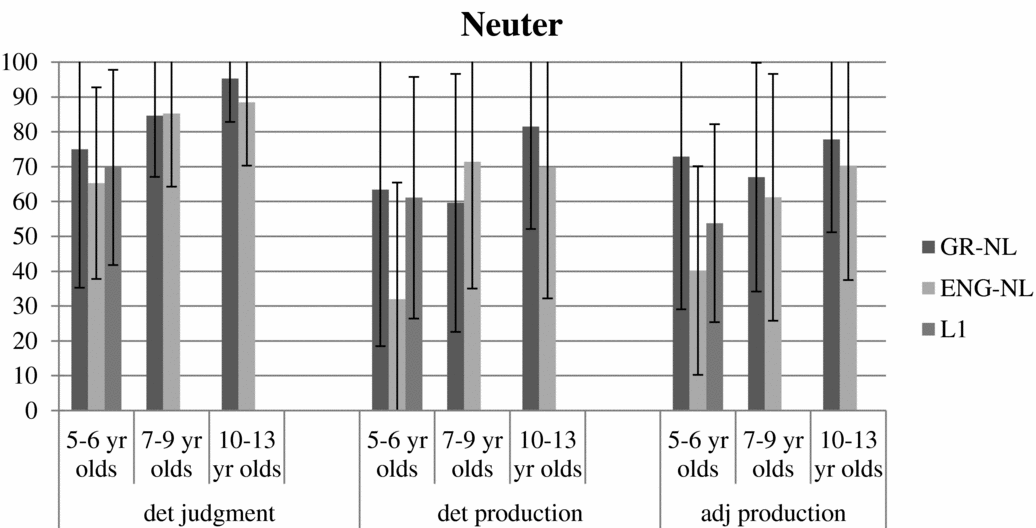
For the comparison of judgment and production of determiners and production of gender-marked adjectives in Dutch, accuracy scores were re-calculated for both populations (for the English–Dutch children, weighted means and pooled SDs were calculated for the three age groups, see Table 10). Results indicate that the Greek–Dutch 5–6 year-olds did better on production of Dutch neuter determiners (d = 0.91, 95% CI [-0.16, 1.97]) and in the production of neuter adjectives (d = 1.04, 95% CI [-0.04, 2.11]) than the English–Dutch 5–6 year-olds (see Figure 1). For common nouns, the Greek–Dutch 5–6 and 7–9 year-olds scored considerably lower than their Dutch–English peers in both judgment and production of determiners (for 5–6 year-olds GJT: d = -1.70, 95% CI [-2.83, -0.58]; production: d = -2.07, 95% CI [-3.23, -0.91] and for 7–9 year-olds GJT: d = -1.17, 95% CI [-1.94, -0.41]; production: d = -0.82, 95% CI [-1.57, −0.07]). Although none of the other comparisons yielded effect sizes of d>0.5, the Greek–Dutch bilinguals seem to have an advantage over the English–Dutch children in that the oldest group reached higher scores on neuter nouns overall than the English–Dutch, who seem to stagnate in their performance with neuter determiners around the age of 7–9 (see Figure 1).
Mean (M), standard deviation (SD) and range of accuracy for judgment and production of determiners and production of adjectives in Dutch for the three age groups of the Greek-Dutch and English-Dutch bilingual children.

Note. Prod. = production
Comparison of accuracy scores for judgment and production of neuter determiners and production of neuter adjectives in Dutch for the Greek–Dutch and English–Dutch bilingual children and the Dutch monolinguals.

6.2. Greek–Dutch bilinguals vs. Dutch monolinguals
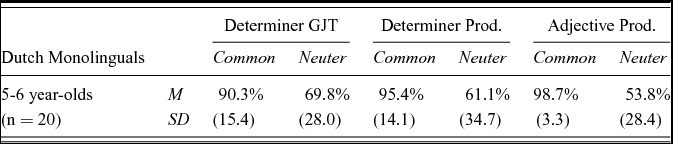
Finally, performance of the Greek–Dutch 5–6 year-olds was compared to available data from Dutch monolingual controls from Unsworth (Reference Unsworth2013) (see Table 11). The two groups did not differ in vocabulary scores in Dutch (BL: M = 108.5, SD = 16.5; ML: M = 109, SD = 10.3, p>.05). Although the bilinguals scored slightly higher than the monolinguals with neuter nouns on all three measures (see Figure 1), the comparison indicated no reliable advantage of the bilinguals over the monolinguals for judgment and production of determiners (both ds<0.5). In contrast, results for adjective production in neuter contexts point to a better performance by the bilinguals compared to the monolinguals (d = 0.62, 95% CI [-.47, 1.71]).
Mean (M) and standard deviation (SD) of accuracy scores for the 5-6-year-old Dutch monolingual controls from Unsworth (Reference Unsworth2013).

The comparison between the Greek–Dutch bilinguals with the Dutch monolinguals in the use of common nouns reveals a discrepancy in that the youngest group of monolinguals showed higher accuracies (determiner GJT d = 2.59, 95% CI [1.29, 3.89], determiner production (d = 1.00, 95% CI [-0.11, 2.11]), while results for adjective production reveal no advantage of ML over BL (d<0.5).
7. Discussion
The present study of simultaneous Greek--Dutch bilingual children offers the opportunity to investigate the possibility of crosslinguistic influence between two gender systems which differ radically in the strength of gender cues presented to the learner. Before turning to the question about CI, we first consider more general effects of bilingualism on gender acquisition in the two languages.
Our first prediction was that 1) language proficiency measured in terms of vocabulary scores will be a better predictor of Greek gender acquisition in our group of bilinguals than a more general measure of language input. Our results show that lexical abilities are indeed the best predictor for performance on gender in Greek. Children with higher lexical skills perform at ceiling with all nouns, while children with lower vocabulary scores perform rather low and still show a sharp difference between neuter on one hand, and masculine and feminine nouns on the other. Bilingual children with low lexical skills show overuse of neuter gender in the context of feminine and masculine nouns especially in production, demonstrating that they treat neuter as the default value. At the same time, they also use masculine and feminine determiners, indicating that they have discovered all three gender values and can use them accurately at least to some extent. Thus, gender discovery for these bilingual children is complete and in place as expected (with the exception of two children who scored below/at chance with feminine and masculine nouns in the GJT and only used neuter determiners in production). Although performance on masculine and feminine nouns is relatively low compared to neuter nouns, we need to emphasize that the bilingual children as a group have very low lexical abilities, scoring in the expressive vocabulary test similarly with a monolingual child as young as 3;4 or below when their group mean chronological age is 8 years. The low threshold of vocabulary skills (and language proficiency) for gender acquisition in Greek is consistent with our suggestion that in a language where gender cues are highly salient, the amount of input offered to the learner can be minimal as far as gender discovery is concerned. At the same time, lexical abilities seem to dictate accuracy in gender use for masculine and feminine nouns at the next stage, i.e., after gender values have been discovered and lexical development allows the learner to draw generalizations on syntactic and morphophonological cues of nouns and noun phrases in Greek. Given that monolingual Greek children perform quite well in all three genders around the age of 3;6, the lower performance of these bilingual children indicates a prolonged second stage of gender acquisition compared to monolingual development. In other words, it is possible that the second stage of gender acquisition during which the learner is expected to draw generalizations based on morphophonological and syntactic cues, and which is unimpeded in the monolingual learner, is prolonged in bilinguals just because of bilingualism as such.
Turning to Dutch, the prediction was that 2) a general measure of amount of input, namely % Dutch use at home, is a better predictor of performance on Dutch gender than lexical skills. This was based on the fact that monolingual children's performance on Dutch gender is delayed due to the increased requirement of input exposure which will ensure that the child unravels syntactic gender cues from the system. Our results are in line with this prediction insofar as the role of Dutch input for performance on neuter nouns is concerned. This corroborates Unsworth et al.’s (Reference Unsworth, Argyri, Cornips, Hulk, Sorace and Tsimpli2014) findings showing that input measures are the best predictors of gender use in bilingual children speaking Dutch. When bilingual children were grouped according to this factor, those with more than 50% exposure were found to score higher than 85% accuracy on neuter nouns in production indicating that bilingualism does not affect gender use in a negative way. It thus appears that the Dutch gender data demonstrate a) that gender acquisition is possible in bilingual development and b) that amount of input (which subsumes syntactic knowledge) rather than lexical skills alone, is responsible for the variation attested. Given that the group of bilingual children achieved age-appropriate scores in vocabulary, and thus does not differ from monolingual children, the results on gender accuracy indicate that as far as Dutch gender acquisition is concerned, lexical abilities and the role of the input dissociate. Note that it is unlikely that the results for Dutch are influenced by the type of vocabulary measure used (receptive vs. expressive) given that the gap between receptive and expressive vocabulary knowledge has been found to be negligible in the dominant language of bilinguals (Gibson, Peña & Bedore, Reference Gibson, Peña and Bedore2014).
With regard to the comparison of children's performance across the production and judgment tasks, we find that the less advanced groups (low vocabulary for Greek and <50% input for Dutch) do better in judgment than production with non-default gender values (masculine and feminine in Greek; neuter in Dutch), while the more advanced groups show equal performance across tasks. In Dutch, children were less accurate with common nouns in judgment than in production. According to Unsworth and Hulk (Reference Unsworth, Hulk, Costa, Castro, Lobo and Pratas2010) this marks the start of the discovery stage which leads to occasional errors in judgment with common nouns, while in production children continue to use de as a default.
Turning to the research question about CI, our next prediction was that 3) there will be no CI with regard to the second stage of gender acquisition. Our results did not show any between language correlations for accuracy on gender and thus do not appear to point to any crosslinguistic effects insofar as the second stage of gender acquisition is concerned. The question of crosslinguistic influence is still relevant, however, with regard to the first stage of gender acquisition, namely the discovery of grammatical gender as a classifying feature for nouns. Given the highly transparent gender cues in Greek, our prediction was that 4) the opacity of the Dutch gender system would not have adverse (delay) effects on Greek gender acquisition. The analyses showed that all but four children use masculine and feminine determiners in production at least to some extent indicating that they have discovered gender as a categorical feature in Greek. Given that the children's lexical age as measured by expressive vocabulary was below 3;5 we conclude that Dutch does not have a negative influence on the development of gender in Greek for these bilingual children.
Our final prediction was that 5) Greek–Dutch bilingual children will show some acceleration effects from Greek to Dutch in the first stage of gender acquisition, (i.e., gender discovery). We addressed this question by comparing English–Dutch simultaneous bilinguals and Dutch monolinguals from Unsworth's (Reference Unsworth2013) study with our bilingual group. Results indicate better performance in the younger Greek–Dutch bilinguals (5-6 year olds) as well as the oldest Greek–Dutch group (10-13 year olds) compared to the age-matched English–Dutch groups. We would like to suggest that the difference between the young monolingual children with our bilingual Greek–Dutch children is due to an earlier awareness of gender as a grammatical feature in Dutch in the bilingual children thanks to their knowledge of Greek, where they are aware of gender from very early on. The comparison with the Dutch monolinguals revealed that despite reduced input due to bilingualism, the Greek–Dutch 5–6 year-old bilinguals perform on a par with age-matched monolinguals on judgment and production of Dutch neuter nouns, while performance on adjective production in neuter context points to a possible advantage of the bilinguals over the monolinguals.
Note that the expectation was that a possible facilitation effect from Greek to Dutch would be mostly relevant to the younger group where gender discovery in Dutch could be precocious compared to the English–Dutch and the monolingual children. The results from the 10–13 year old bilingual children also show an advantage of the Greek–Dutch bilinguals in the use of neuter nouns indicating that facilitation may extend to the more likely use of neuter in production of Dutch nouns, given the ubiquitous nature of the feature in Greek in all contexts.
An, at first sight, unexpected finding arising from the comparison between the Greek–Dutch bilinguals in this study with the English–Dutch and the monolingual Dutch children from Unsworth's (Reference Unsworth2013) study concerns performance on common nouns. Although common nouns have repeatedly been shown to be unproblematic in monolingual and bilingual acquisition of Dutch, our youngest bilinguals showed lower performance in the judgment but also in the determiner production task. However, this may also be due to the influence of Greek. It has been argued that the early (correct) use of de in monolingual Dutch children is not a sign of gender knowledge, but simply the use of the default definite determiner since these children have not yet discovered that Dutch has a grammatical gender feature. As soon as the awareness of this feature arises, children begin to hesitate about de. In monolingual children, this has been found to happen around age 5–6 (Unsworth & Hulk, Reference Unsworth, Hulk, Costa, Castro, Lobo and Pratas2010). We have argued that under the influence of Greek, awareness of Dutch being a grammatical gender language is raised earlier. This early awareness predicts earlier hesitance about de being the (only) definite determiner. This is exactly what we see in the youngest bilingual Greek–Dutch children who show lower performance on de than their age-matched monolingual Dutch peers. In addition, the difference in favour of Greek–Dutch bilinguals in the 10–13 year olds is particularly interesting as it may signal a difference in the final outcomes of bilingual development in these groups. Before we speculate on the language pair being responsible for the differences attested we believe that further investigations into the type of schooling the bilinguals receive (monolingual Dutch, bilingual schooling, minority language support through Saturday schools) is necessary.
The present study is the first to investigate gender acquisition in Greek–Dutch bilingual children although the data has to be treated with caution as the numbers of Greek–Dutch bilinguals in each group is rather low. However, given the homogeneity of our bilingual sample, we believe that the results are in the right direction and can be confirmed in future studies with bilinguals of other language combinations.
Conclusions
Our study aimed to address the issue of crosslinguistic influence in gender performance in a language pair which differs greatly in the frequency and nature of gender cues for the learner: Greek and Dutch. We investigated two possibilities of crosslinguistic influence. One pertaining to acceleration or delay effects for particular gender values in the second stage of gender acquisition which follows the first stage of gender discovery. The other possibility was to investigate crosslinguistic influence in that first stage, where we expected Greek to facilitate gender discovery in Dutch. Our study pointed to crosslinguistic influence in the form of facilitation in the first stage of gender acquisition, namely the stage of gender discovery. However, in the second stage during which nouns are acquired with particular gender values, no crosslinguistic influence is found. Finally, different predictors of gender performance (vocabulary in Greek vs. input in Dutch) and different patterns of development for marked genders (faster feminine/masculine noun development in Greek vs. slower neuter noun development in Dutch) corroborate the contribution of language specific properties found in this and other studies.