INTRODUCTION
Bluetongue virus (BTV) is a non-contagious, midge-borne viral disease that affects ruminant livestock (cattle, sheep, goats, deer, etc.) with symptoms generally more severe in sheep (Mellor & Boormann Reference Mellor and Boormann1995). Bluetongue virus was first reported in Africa in the early 19th century, but it has now spread around the world covering much of the Americas, southern Asia and northern Australia. During the recent past, BTV has extended its range northwards into Europe via Mediterranean Europe (De Liberato et al. Reference De Liberato, Scavia, Lorenzetti, Scaramozzino, Amaddeo, Cardeti, Scicluna, Ferrari and Autorino2005; Savini et al. Reference Savini, Goffredo, Monaco, Di Gennaro, Cafiero, Baldi, De Santis, Meiswinkel and Caporale2005; Mehlhorn et al. Reference Mehlhorn, Walldorf, Klimpel, Jahn, Jaeger, Eschweiler, Hoffmann and Beer2007). The rapid spread of BTV across several European countries, including the southern part of the United Kingdom and countries as far north as Sweden, has increased the likelihood that the virus will also spread into Scotland. It became more urgent for policy makers to devise plans to eradicate, slow down or manage the spread of BTV in Scotland if and when BTV serotype 8 (BTV8) became established in England.
The incidence of BTV can have associated economic costs in terms of losses in productivity (e.g. weight loss, reduced milk yield, infertility and abortion). These costs can be further compounded when trade bans and movement restrictions are imposed (Roberts et al. Reference Roberts, Lucas and Bell1993). In 2007, an outbreak of the disease in France was estimated to cost £0·71 (US $1.4) billion (Tabachnick et al. Reference Tabachnick, Smartt and Connelly2008). The cost of the disease outbreak in the Netherlands was estimated at £22·1 million (€32·4 million) in 2006 and the cost of another outbreak in 2007 ranged between £112 million (€164 million) and £120 million (€175 million), using the Bank of England's annual average exchange rates for 2006 and 2007 (Velthuis et al. Reference Velthuis, Saatkamp, Mourits, De Koeijer and Elbers2010). The economic consequences of harmful animal disease incursion such as BTV have heightened the urgency of developing effective disease surveillance mechanisms, as well as prevention and mitigation options that can be deployed to avert the damage that the industry might suffer.
The key objective of any surveillance activity is ‘early detection’ of the presence of an exotic disease before damage and management costs become too severe (Kompas et al. Reference Kompas, Che and Ha2006). The Scottish Government, through its agencies, enforces a number of surveillance and control measures to detect disease early (i.e. before it spreads), and to eradicate any outbreak using the least-cost approach. Measures used to detect diseases include the use of polymerase chain reaction (PCR) and enzyme-linked immunosorbent assay (ELISA) for pre-testing of imported animals from BTV affected countries, the provision of bio-security information to farmers and other disease mitigation and eradication campaigns. However, a fundamental policy question concerns how much disease surveillance investment and prevention (cost) is procuring in terms of anticipated avoided disease outbreak damages (benefit) through mitigation or eradication options to remain disease-free. This is usually done ex ante to the potential outbreak of the disease. An ex-ante assessment can address many other types of surveillance, mitigation and eradication options, for example prevention v. control (Elbakidze & McCarl Reference Elbakidze and McCarl2006), between alternative control strategies (Kobayashi et al. Reference Kobayashi, Carpenter, Dickey and Howitt2007) and between alternative investment areas (Kobayashi et al. Reference Kobayashi, Howitt and Carpenter2009). However, in all cases it is crucially important to make a clear distinction between costs and benefits, as these will vary according to the objectives of the study and the bio-economic circumstances pertaining. For instance, Savini et al. (Reference Savini, MacLachlan, Sanchez-Vizcaino and Zientara2008) argued that BTV vaccines can be used either proactively to prevent clinical disease, or reactively to limit the expansion of BTV infection spread, or to facilitate the eradication of the virus and therefore to enhance the safe movement of susceptible animals between affected and free zones. The reactive and/or proactive use of vaccines involves both ex ante prevention (surveillance and control) costs and ex post costs of response to a potential introduction of BTV. In the current paper, the primary interest lay in an ex-ante economic assessment of alternative vaccination strategies to limit the impact of possible BTV8 incursion into Scotland.
MATERIALS AND METHODS
Models
The present study is linked with the Scottish Government strategic approach to encouraging animal health and welfare and ensuring appropriate contingency planning is ready to tackle a potential disease outbreak. As such, certain key data, parameters and terms of reference in the analysis were defined by the Scottish Government.
In this type of ex-ante cost-benefit analysis, the generation of incursion routes is the first logical step to analysing the options of BTV8 control in an economic model that utilizes inputs from an epidemiological model (a detailed description of the epidemiological model can be found in Gubbins et al. Reference Gubbins, Szmaragd, Burgin, Wilson, Volkova, Gloster and Gunn2010 and Szmaragd et al. Reference Szmaragd, Gunn and Gubbins2010). Three main potential arrival routes of BTV8 into Scotland were considered as follows:
(i) Wind-borne dispersal of vectors from south-east England, Northern Ireland or continental Europe: The risk of incursion via wind-borne midges was assessed using a 10-year data set (1998–2007) on wind speed, direction and temperature. These were used to determine the frequency of winds suitable for carrying vectors from potentially infected areas to Scotland.
(ii) Import of infected animals: The risk of introduction via the import of infected animals was examined using monthly livestock movement data for 2006 to provide the number of movements to each Scottish county by month.
(iii) Northwards spread of BTV from south-east England: The risk of northwards spread was investigated using a model for the transmission of BTV between farms. This was used to predict if and when BTV8 is likely to arrive in Scotland, following expansion from the current infected area in south-east England. Analysis of climate data (as in (i) above) was also used to assess the risk of incursion if disease foci were to arise near the Scottish border.
A full discussion of the incursion scenarios in the current paper can be found in Gubbins et al. (Reference Gubbins, Szmaragd, Burgin, Wilson, Volkova, Gloster and Gunn2010).
Subsequently, five incursion scenarios were drawn up based on the year in which it may be likely to happen, thus:
1. South-April 09 Midge (SA09M1): northwards spread of BTV from England arriving in Scotland in April 2009;
2. South-July 08 Midge (SJ08M2): northwards spread of BTV from England arriving in Scotland in July 2008;
3. South-September 08 Midge (SS08M3): northwards spread of BTV from England arriving in Scotland in September 2008;
4. Animal Import April 09 (AI09A4): import of infected animals into Scotland in April 2009; and
5. Animal Import September 08 (AI08S5): import of infected animals into Scotland in September 2008.
These incursion scenarios were the product of the modelling exercises of Gubbins et al. (Reference Gubbins, Szmaragd, Burgin, Wilson, Volkova, Gloster and Gunn2010). Although thought to be representative of the range of potential incursion threats Scotland faced, these scenarios were not mutually exclusive or collectively exhaustive, and their probability of occurrence could not be quantified. For these reasons, a single incursion event was considered in each scenario as described by Szmaragd et al. (Reference Szmaragd, Gunn and Gubbins2010) and summarized below.
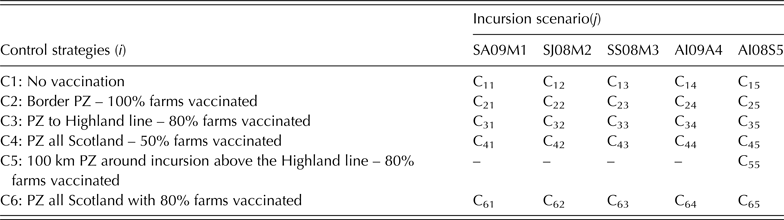
A combination of control strategies can be put in place to reduce the incidence and effects of BTV8 incursions. Six control strategies (C1–C6) were considered that differed mainly in the deployment of vaccination. Table 1 shows the 26 combinations of control strategies and incursion scenarios evaluated; where an element C ij in the matrix represents the ith control strategy applied to jth incursion scenario.
BTV8 Incursion scenarios and control options matrix

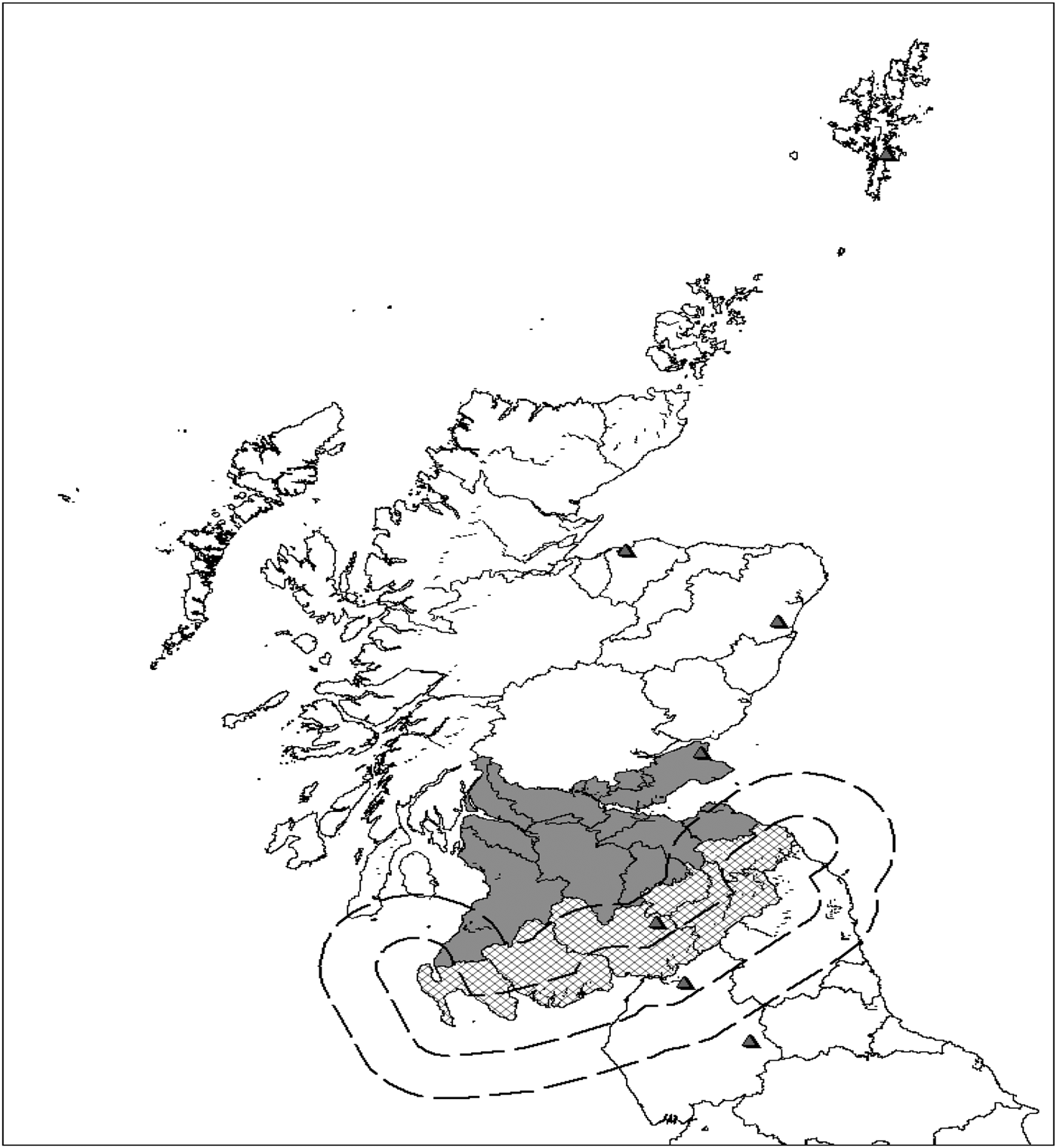
The control of an outbreak is based on the movement of animals through movement-restricted zones (Defra 2008). The control strategy (C1) included the minimum required control, i.e. movement restrictions but no vaccination, while C2 represented compulsory vaccination with 100% possible uptake against BTV8 with England–Scotland border as a protection zone (PZ) (Fig. 1).
Definition of PZs to be used for the control scenarios (C2 and C3). The inside dashed line indicates the contour of a 20 km buffer zone around the England/Scotland border, and the second outside dashed line the contour of a 50 km buffer zone. Counties indicated in grey-crossing lines will be used to define the tight PZ for vaccination in scenario C2, whereas the grey-filled counties plus the counties with grey-crossing lines pattern will represent the counties to be included within the South-Highlands-line PZ (scenario C3). The islands of Argyll and Bute are not considered with the PZ defined under C3.
In order to achieve 100% uptake of vaccination it was assumed that Government lines of communication with the industry would be activated and information on risks of infection would be disseminated to farmers and veterinary services. Strategy C3 represented a voluntary vaccination in a PZ up to the Scottish Highland line (Fig. 1), where vaccine uptake was assumed to achieve 80% uptake. Vaccination strategies C4 and C5 were also based upon voluntary vaccination, but within a PZ covering the whole of Scotland with the uptake of vaccination assumed to be 50 and 80% for each strategy, respectively. It must be noted that vaccination strategy C5 was a special case of dealing with an incursion from import in September 2008 (AI08S5), where vaccine location depended specifically on the place of incursion (i.e. localized vaccination). The sixth and final control strategy, C6, was also a compulsory vaccination programme similar in application to C3 that would be implemented when an infected animal is imported into Scotland in September north of the Scottish Highland line but where the PZ was the whole of Scotland.
The application of vaccination was implemented in two stages. The first stage application of vaccine was either as a preventive/barrier vaccination or as a reactive vaccination depending on the scenario of incursion. Preventive/barrier vaccination was implemented for incursions occurring in April 2009 (i.e. incursions SA09M1 and AI09A4). For incursions occurring either in July 2008 or September 2008 (i.e. incursions SJ08M2, SS08M3 and AI08S5), the vaccination programmes were implemented following the initial detection of an outbreak. The second stage of vaccination was an emergency vaccination campaign around infected premises, and it was assumed that vaccination was 100% effective at controlling the spread of BTV8 (Eschbaumer et al. Reference Eschbaumer, Hoffmann, König, Teifke, Gethmann, Conraths, Probst, Mettenleiter and Beer2009; Szmaragd et al. Reference Szmaragd, Gunn and Gubbins2010).
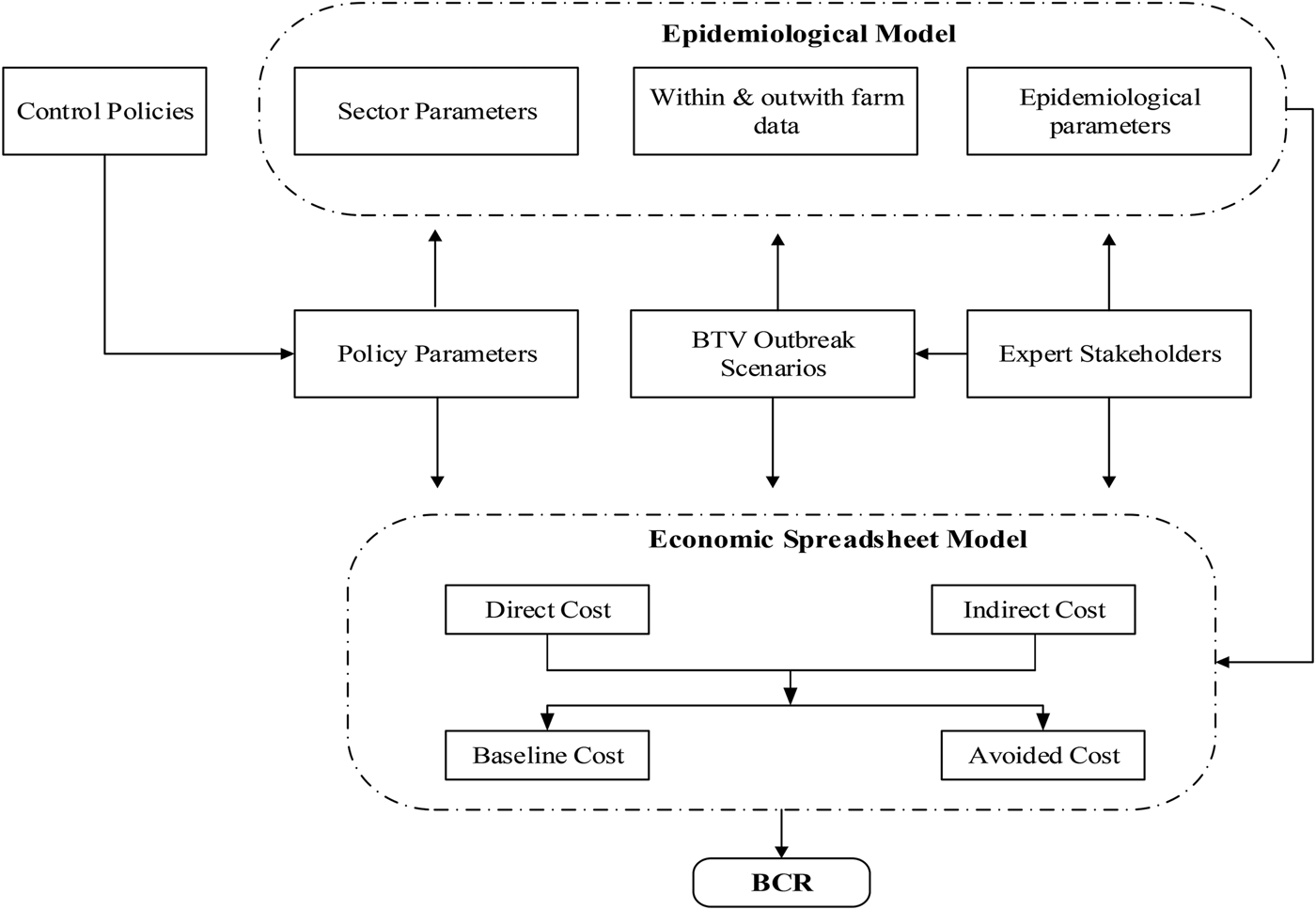
Figure 2 shows the modelling framework that was used, which consists of two main model components represented by the broken line boxes. The epidemiological model was used to simulate the spread of disease under the incursion scenarios and control strategies. The output of the epidemiological model provided inputs for an economic spreadsheet model that was used to estimate BTV8 outbreak losses. The individual model components are briefly described in the following sub-sections.
Schematic representation of the modelling framework.
Epidemiological model
The epidemiological model was designed to produce the data required by the economic model. Full details of the epidemiological model, including parameter estimation and model validation, are presented elsewhere (Gubbins et al. Reference Gubbins, Szmaragd, Burgin, Wilson, Volkova, Gloster and Gunn2010; Szmaragd et al. Reference Szmaragd, Gunn and Gubbins2010); a summary of the approaches used is provided in the current paper.
The outbreak and spread of BTV8 was assessed using a stochastic, spatial epidemiological model describing both the within- and between-farm transmission of BTV8. Transmission was modelled by a generic transmission kernel, which implicitly included both animal and vector movements. The probability of transmission depended on the distance between farms (i.e. the kernel) and the species composition of the farms. Parameters for the transmission probability were estimated using data on clinically affected holdings in northern Europe in 2006.
Once a farm acquired infection, the within-farm dynamics were simulated using a stochastic compartmental model, based on the number of cattle and sheep kept on the farm and local temperatures (Gubbins et al. Reference Gubbins, Carpenter, Baylis, Wood and Mellor2008). Parameter estimates were obtained from the published literature, using those applicable to Great Britain wherever possible. Explicit temperature dependence was included for the reciprocal of the time interval between blood meals (related to biting rate), the vector mortality rate and the extrinsic incubation period. The parameters for the transmission probability between farms were estimated using data on clinically affected holdings in northern Europe in 2006 (Albers et al. Reference Albers, Mintiens, Staubach, Gerbier, Meiswinkel, Hendrickx, Backx, Conraths, Meroc, Ducheyne, Gethmann, Heesterbeek, De Clercq, Unger, Stegeman, Mellor and Newton2007; EFSA 2007). Parameters for the within-farm dynamics of BTV were derived from the published literature, including temperature dependence wherever possible (Gubbins et al. Reference Gubbins, Carpenter, Baylis, Wood and Mellor2008). Species-specific probabilities for an animal showing overt clinical signs were estimated from OIE reports for 2007 (Szmaragd et al. Reference Szmaragd, Wilson, Carpenter, Mertens, Mellor and Gubbins2007). Policy parameters represented the vaccination strategy that should be implemented, with the vaccine assumed to be 100% effective in all animals. The sector parameters were derived from sectoral data such as animal movement data, number and distribution of livestock. An affected farm was assumed to be detected (with 100% probability) if an animal died due to BTV infection or if overt clinical signs appeared.
Vaccination was assumed to reduce the probability of transmission between vectors and hosts, with full protection achieved 14 days post vaccination (dpv) in sheep and 60 dpv in cattle. The uptake level gave the probability that a farmer in a PZ would decide to vaccinate his or her stock. If a farm was vaccinated, all cattle and sheep on that farm were assumed to be vaccinated.
Farm locations and number of sheep and cattle on the holding were obtained from June agricultural survey data for 2006, with only farms in Scotland and the four most-northerly counties of England included in the simulations. Hourly temperature records for 2006 were obtained for eight meteorological stations in northern England and Scotland (UK Meteorological Office 2009) (see Szmaragd et al. Reference Szmaragd, Wilson, Carpenter, Wood, Mellor and Gubbins2009 for locations of the stations used); each farm used the temperature records for the nearest station.
For each combination of incursion scenario and control strategy, 100 replicates of the epidemiological model were simulated with the initial conditions specified according to the incursion scenario. Only a single incursion event was considered and each replicate was run for 2 years, starting in January of the year in which the incursion occurred.
Economic model
The model used for estimating the costs and benefits of the different BTV8 control strategies draws on other attempts to categorize disease costs (McInerney Reference McInerney1996) and specifically work assessing the direct costs associated with endemic diseases of livestock in Great Britain (Bennett et al. Reference Bennett, Christiansen and Clifton-Hadley1999; Bennett Reference Bennett2003). The latter used a spreadsheet model based on the risk of livestock contracting a disease, associated costs of prevention, treatment and reduced performance. Menzies et al. (Reference Menzies, Crockford, Breck and Midtlyng2002) applied a similar methodology to estimate the direct costs of cataracts in farmed Norwegian salmon. A spreadsheet model similar to that of Bennett et al. (Reference Bennett, Christiansen and Clifton-Hadley1999) and Menzies et al. (Reference Menzies, Crockford, Breck and Midtlyng2002) was adapted and extended by Moran & Fofana (Reference Moran and Fofana2007) to account for the cost and benefits of fish disease incursion and control in the UK. Most recently Fofana & Baulcomb (Reference Fofana and Baulcomb2012) applied a similar methodology to estimate costs of salmonid diseases in the UK. Using a similar approach, spreadsheet models were constructed for the present study for BTV8 to estimate the components of costs and benefits.
Bennett et al. (Reference Bennett, Christiansen and Clifton-Hadley1999) and Bennett (Reference Bennett2003) defined the direct cost of disease as:
 $$C = (L + R) + T + P$$
where: L, the value of the loss in expected output and/or of resource wastage due to the disease; R, the increase in expenditures on non-veterinary resources (e.g. feed, farm labour, etc.) due to a disease; T, the cost of inputs used to treat disease and P, the cost of disease prevention measures.
While Bennett limited P to prophylactic measures to prevent infection occurring, in the present study P is extended to cover public disease surveillance and control costs. The term ‘direct disease costs’ used by Bennett (Reference Bennett2003) was to make it clear that there are other ‘indirect’ impacts of livestock disease (e.g. impact of disease on international trade, on retail trade, and other facets of the local economy), which are not included in the relation C = L + R + T + P. In parallel, Otte & Chilonda (Reference Otte and Chilonda2000) also defined the total cost (TC) of disease as a sum of direct and indirect production losses (L) and the control expenditure (E). Consequently, the Bennett (Reference Bennett2003) model given in Eqn (1) is modified to account for indirect cost as defined above by adding another variable, thus:
 $$TC = (L + R) + T + P + M$$
In Eqn (2) the variables L, R, T and P are as previously defined by Bennett (Reference Bennett2003), TC represents total cost, and M is indirect costs, which represent the revenue forgone through loss of markets along the value chain of livestock products.
Following McInerney et al. (Reference McInerney, Howe and Schepers1992), the components of Eqn (2) can now be separated into ex ante prevention (which is essentially surveillance and monitoring of disease), and ex post reactive disease treatment control costs. Let us assume E s denotes the sum of all ex ante surveillance and monitoring expenditures by both the private and public sectors that would be incurred in relation to early detection and elimination of any disease that might be detected. This component of the total cost in Eqn (2) are resource intensive activities which includes costs associated with ex ante active and passive veterinary treatments to maintain a healthy herd and reduce susceptibility to pathogens, culling, decontamination of premises, labour and personnel, transportation, laboratory test, sensitization of farmers via media, fixed assets, etc. This can be expressed algebraically as shown in Eqn (3):
 $$C_S = \sum\limits_{i = 1}^n {P_{is}} $$
where ΣP is is the sum of all expenditures related to P as in Eqn (2). Costs related to C s were presumed to contribute to preventing introduction and establishment of BTV8 and to enhance the preparedness to inform intervention aimed at reducing or eradicating disease during an outbreak.
The remaining components of Eqn (2) form the ex post losses and treatment expenditure of the disease, assuming surveillance and preventive measures fail to prevent an outbreak occurring. Let us denote the ex post losses, treatment and control expenditure of the disease by B t, which is the sum of R t, Mt, Tt, and L t. In other words, B t is the sum of the total value of losses incurred during an outbreak plus the expenditure related to the management and eradication of the outbreak. This value varies with the severity of outbreak and the design of reactive measures to mitigate post outbreak losses. Algebraically these post outbreak losses can be written as:
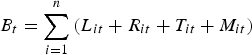 $$B_t = \sum\limits_{i = 1}^n {\left( {L_{it} + R_{it} + T_{it} + M_{it}} \right)} $$
where L it, direct costs of lost values of expected output (e.g. weight loss; milk loss; feed wastage); T it, the direct cost of inputs used to treat and eradicate the disease (e.g. veterinary cost; equipment hire; cleansing and disinfection), M it, the indirect cost associated with revenue forgone through loss of markets (e.g. export trade; fall in domestic consumer demand, etc).
To evaluate the assessment of alternative strategies aimed at reducing the impact of possible BTV8 incursion, monetary costs of the prevention and surveillance were compared with monetary benefits resulting from the alternative vaccination programs envisaged. The total benefits were expressed in terms of the avoided outbreak costs that may result under a range of vaccination scenarios in comparison to a baseline cost. Consequently, the equations developed can now be associated with the definitions of costs and benefits: C s (Eqn 3) was associated with the estimation of investment costs in surveillance and disease prevention measures and B t (Eqn 4) was associated with the estimation of benefits of BTV8 surveillance and prevention. Note that B t could be calculated for any given scenario of disease incursion and spread which would include production losses, expenditures for palliative treatment, export and response costs in case of an outbreak. Therefore, the benefits of avoiding BTV8 by implementing control and eradication measures included both output losses and expenditures that would accrue if disease occurred.
The estimated future costs and benefits occur through time. A rational decision rule needs these streams to be discounted by multiplying the costs and benefits by the discount factor 1/(1−r)n to bring to their present value equivalents; where r = 3·5% is the selected discount rate and n the time in years.
Now in the situation where there is a probability of disease incursion in any year of P r, then the expected benefit in any year as a result of having the surveillance and control program is an expectation B t × P r. In the context of a benefit-cost analysis of BTV8 the net benefit estimates of surveillance and of preventative actions (such as vaccination) can be derived as [(B t × P r) − C s], or a benefit–cost ratio as [(B t × P r)/C s]. The decision criterion requires that the derived ratio be at least equal to unity so that the benefit is no less than the cost. However, this criterion is a sufficient condition only when the policy maker is faced with a choice of either to implement an action or not to (e.g. whether to implement a vaccination policy or not) (Mclnerney Reference McInerney and Martin1991). In reality, policy makers are confronted with diverse decision-making choices with several alternative courses of action in order to maximize the benefits of the control measures to combat disease outbreak. In the case of BTV8, a range of vaccination policies and PZs were considered that could be applied under alternative incursion scenarios. Each provided a different estimate of outbreak losses avoided (benefits) to compare with surveillance and disease prevention costs.
In the current analysis, comparing baseline cost of surveillance and disease prevention activities from both the private and public sectors with the avoidable total losses of the disease that would occur without surveillance helps to provide answers to the question of what and how much surveillance and prevention measures are justified in reducing the economic losses associated with BTV8. Two levels of BTV8 outbreak persistence and two policy options for licensing of the movement of livestock to slaughter were analysed. Since the epidemiological model ran simulations for 2 years only the analysis was extended out to 5 years under two alternative options. One option was to assume that the BTV8 outbreak persisted in years 3–5 at year 2 levels, while the other disease persistence option was to assume that BTV would gradually decline to zero at the end of the simulation horizon. A license will be required to move livestock from the Restricted Zone to slaughterhouses in the disease free areas. There was assumed to be no cost for obtaining a license to slaughter as application for licenses are downloaded online at no extra cost. However, farmers would need to apply insecticide to disinfect vehicles, and slaughterhouses would impose additional costs to comply with conditions of the license, e.g. timing of slaughter, possibly removal of dung. These costs were not included in the analysis due to lack of information on these specific costs. In the case of licensing, the policy options of securing a license or of no license to move livestock to slaughter were analysed. For the case of ‘no license to slaughter’ a loss in revenue was assumed due to decrease in price of cattle (by 15%) because of a reduction in price due to ‘movement to slaughter’ delays or increased costs.
ESTIMATION OF SURVEILLANCE COSTS AND BENEFITS
Estimates of surveillance costs are significantly more deterministic than some of the outbreak cost elements. Following Moran & Fofana (Reference Moran and Fofana2007), no random elements were included in the cost estimation methodology. On the other hand, estimations of benefits are subject to increasing levels of uncertainties such as the stochastic nature of disease introduction, disease spread, population at risk, or the proportion of resources allocated to BTV treatment and other eradication efforts. As a consequence, the cost and benefit models are formulated in a way to allow rigorous sensitivity analysis using Monte Carlo simulation.
As an ex-ante analysis, the evaluation of losses was based around a set of projections for the production and prices of sheep, cattle, sheepmeat, beef, milk and cheese using autoregressive integrated moving average model (ARIMA, see Mill Reference Mill1998) over the period 2008/09 to 2012/13 using historical data. The research was carried out in 2008, when most data used in the current work, i.e. for the period 2009–2013, was unavailable. At the time of writing there are still lags in the publication of data, so the current paper relied on the forecasts generated to conduct the analysis. The ARIMA models were used because of their robustness and reduced data demands compared to multivariate structural models used for forecasting (Stockton & Glassman Reference Stockton and Glassman1987). The historical data on production and prices were obtained from the Scottish Government. The data generated for each cost and benefit items are described in the following sections. See Appendix A for details of key parameters and assumptions.
Estimations of surveillance costs in advance of the disease outbreak
The prevention of exotic disease outbreaks requires extensive monitoring and surveillance both by public bodies and individual farmers. The purpose of disease surveillance is to detect the emergence of new diseases to facilitate evidence-based decisions by Government, industry and farmers (FAWC 2012). Thus, the cost of surveillance had both public and private costs. The estimated surveillance costs are generic costs and not specific for any disease. They represent the various roles carried out in the collection of information on diseases and infections in animals from a variety of sources, which include Scottish Government funded diagnostic laboratory network operated by the Scottish Agricultural College, the Moredun Research Institute, the Animal Health Agency and the Meat Hygiene Service. Though there is a passive element to disease surveillance and control (the control for a particular disease may also imply controlling for other unintended diseases), it was essential to scale down costs for BTV8 to avoid the dangers of high overestimates. However, choosing a value to scale these costs is a matter of conjecture. In consultation with expert stakeholders, it was assumed that BTV8 surveillance expenditure in the public sector would be in the order of 2% and 0·5% of total public sector surveillance costs for sheep and cattle, respectively. The surveillance costs of BTV8 borne by private producers were identified separately from those borne by the public sector. Public sector animal disease surveillance cost data supplied by Scottish Government were recorded in financial years which run from 6th April of year-y to 5th April of year-y + 1. The financial-year data has been taken to represent calendar years, for consistency with the rest of the data; for e.g. 2008/09 was taken to be 2008. Animal disease surveillance cost data were projected from data obtained from the Scottish Government. The data set was obtained in an aggregated form and recorded in financial years; the financial-year data was taken to represent calendar year for consistency with the rest of the data. In the private sector, following Moran & Fofana (Reference Moran and Fofana2007), it was assumed that farmers’ interest in growing healthy stock is entirely profit-motivated. Therefore, it was assumed that veterinary treatment of livestock is good husbandry practice and is meant to keep all diseases at bay. All veterinary costs were considered in the private sector prior to the outbreak of BTV8 as private sector surveillance expenditure. The veterinary costs were derived from the SAC Farm Management Handbook (various years).
Movement of farm animals has been generally recognized as carrying a high risk of transferring pathogens from one region to another. Pre-testing of imported cattle and sheep provide a means of identifying potential high risks and as such can be considered as passive surveillance carried out to detect BTV8. They were included in the estimate of surveillance costs associated with BTV. The costs of pre-testing were estimated by multiplying the pre-testing fee per animal by the number of animals that were required to undergo a compulsory test (75% of international live animal imports from BTV affected countries and 100% of live animal imports from the rest of the UK).
Estimating benefits from surveillance
The estimation of benefits looked at impact by characterizing and quantifying the losses avoided. Benefits from surveillance and response to the exotic disease outbreak go well beyond the health benefits of preventing cases of morbidity, deaths and disabilities from disease. Disease outbreaks affect economic activity at all levels of the marketing chain of the farm products. The following section details the benefits from surveillance and response to disease outbreak.
Reduced milk yield, weight loss and reproductive disorders
The expected losses associated with morbidity of sick animals due to BTV8 include weight loss due to the inability of animals to feed for several days (Osburn Reference Osburn1994; Tabachnick et al. Reference Tabachnick, Smartt and Connelly2008). Such weight loss may influence milk production in dairy cattle. No attempt was made to model the impact of weight loss on milk production. Rather, weight loss was estimated separately from milk loss. Output data from the epidemiological model did not differentiate between dairy cows and other cattle. It was assumed that 5% of milk was lost due to BT infection, and the expected milk losses in dairy cows were therefore estimated by taking the product of: (1) the assumed reduction in milk production due to BTV8; (2) the number of infected cattle (3) the proportion of dairy cows in the Scottish livestock sector; (4) the average production of milk per dairy cow; and (5) the price of milk per litre.
There is no guidance in the literature about the degree of weight loss in morbid animals. Therefore, it was assumed that 9% of infected cattle would show 5–10% weight loss and 11% of infected sheep would show 10–15% weight loss (these assumptions are drawn from personal communications with experts in various countries). Weight loss was similarly estimated by taking the product of: (1) the assumed reduction in weight for cattle or sheep due to BTV infection; (2) the number of infected animals (cattle and sheep); (3) the assumed number of animals that would suffer weight loss and (5) price of the animal per head.
Reproductive disorders associated with BTV include abortion, infertility in bulls and rams and malformed lambs or calves (Osburn Reference Osburn1994). The occurrence of any of these can cause direct economic losses to livestock farmers, as well as indirect losses due to export restriction or delays in recovery of animals that survive. Loss of fertility for beef cows was assumed to be £2·7/head (Gunn et al. Reference Gunn, Stott and Humphry2004) and loss of fertility for dairy cows to be £2·50/head (Santarossa et al. Reference Santarossa, Stott, Woolliams, Brotherstone, Wall and Coffey2004). In the case of sheep, infertility losses of £0·60/head were assumed. This was based on expert estimates that BTV8 might double the risk of a morbid ewe being barren, that a normal rate of barreners was about 6/100 ewes (Conington et al. Reference Conington, Bishop, Waterhouse and Simm2004), that a barrener represented £17 loss of net revenue (Beaton et al. Reference Beaton, Catto and Kerr2007), and that morbidity rate in BTV8 infected flocks was about 0·6 (Defra 2007).
Livestock mortality and carcass disposal losses
The legal method of disposal of diseased animal carcasses is either by incineration or rendering in the UK. Incineration as the first preferred option by DEFRA was assumed to be implemented as method of carcass disposal (http://www.defra.gov.uk/foodfarm/farmanimal/diseases/atoz/svd/). Carcass disposal costs per dead animal were multiplied by the number of animal casualties due to BTV8. The costs of incineration of animal carcasses used were £75/head for cattle or £20/head for sheep (Defra 2007). It was assumed that there was no compensation to farmers for lost or culled animals.
Palliative and veterinary losses
The goal of palliative care is to relieve livestock of BTV disease symptoms. It was assumed that a 600 kg cow would require a dose of (60 ml per 600 kg bodyweight) of Alamycin la (http://www.norbrook.co.uk/products/ProductPrintable.cfm/product_Key/441/CatKey/1/Section/Veterinary_Products) and Fluxin (http://www.banamine.com/disclosure/index.html). Since sheep are the most susceptible to BTV8, it was assumed that an 80 kg sheep would require doses of Alamycin la and Fluxin for 5 and 3 days, respectively. Losses due to extra expenditure on palliative veterinary care were also considered by multiplying the number of infected animals by the price of the recommended dosage of Alamycin la and Fluxin for sheep and cattle.
Additional application of medicines and of attendant veterinary services caused by BTV imposes extra expenditure on the farmer. These additional losses due to the application of medicines and veterinary services were estimated by multiplying the average price of treatment by the population of morbid livestock. Data on treatment prices used were £3/head for sheep and £12/head for cattle derived from the SAC Farm Management Handbook (Beaton et al. Reference Beaton, Catto and Kerr2007).
The application of vaccine reactively due to the presence of BTV was estimated by multiplying the price of a dose by the appropriate population of cattle or sheep. The price information for BTV vaccine was derived from the Scottish Government as £1/dose for cattle and £0·5/dose for sheep. It was assumed that vaccination would be done by farmers themselves with close veterinary supervision to ensure compliance. The expenditure on veterinary service and certification in the process was included in the cost estimation as follows: 1st animal (£50), next nine animals (£10 each), the rest of cattle (£5 each) and the rest of sheep (£1·50 each).
Movement restrictions and extra labour requirements
Crucial to the success of control strategies is the placing of high-risk holdings and livestock production areas under animal movement restrictions, i.e. restricted movement of livestock between the Restricted Zone and the Free Areas. Effects of animal movement restrictions were incorporated into the spreadsheet model. The direct losses associated with movement restriction were modelled by assessing the effect of movement restriction at 5% of the value of the animal (Defra 2007) under each outbreak scenario where zoning regulation applies.
Farmers also face extra expenditure on labour as a consequence of a disease outbreak. The value of this extra farm labour is difficult to estimate. The value of increased labour time per farm worker will depend on the opportunity cost of the labour time (Bennett Reference Bennett2003) and on the extent and severity of the disease outbreak. Labour-related disease losses were estimated by assuming that farmers would be reliant on family-based labour to supplement farm labour at a cost of £1/h (Gunn et al. Reference Gunn, Stott and Humphry2004). The extra labour input was assumed to be 2 min per morbid sheep and 7 min per morbid cattle per day as indicated by expert opinion.
Consumer reaction and revenue loss at retail
Recent evidence suggests that humans are sero-negative towards BTVs (Hu et al. Reference Hu, Dong, Li, Chen, Liang and Liu2008). Even so, this might not be fully acknowledged by domestic consumers when an outbreak occurs. Media coverage of the outbreak alone may be sufficient to deter consumers from purchasing beef, sheep meat and other related products. The reduction in the domestic consumption of domestic products was analysed (it is likely that any reduction in domestic supply would be met by increases in imports, from other parts of Britain or other EU countries) and it was assumed that the magnitude of the change in consumption would depend on the responsiveness of demand to changes in the price of affected products. An additional assumption made was that a disease outbreak would increase domestic prices because of the shortages caused by quarantine activities, depopulation and movement restrictions in the industry. Following Moran & Fofana (Reference Moran and Fofana2007), the apparent change in consumer demand for beef and sheep meat was modelled using relevant estimates of price elasticity of demand. Price elasticities were extracted from the UK National Food Survey 2000 (Lechene Reference Lechene and Speller2000) as follows: beef −0·92 and sheep meat −1·29.
It was assumed that a BTV8 outbreak would have an instant impact on consumer demand for fresh beef and sheepmeat. This was replicated in the spreadsheet model by assuming instantaneous adjustment of consumption of fresh meat products to the news of an outbreak. This assumption may not hold for products such as cheese and milk, as there may be time delays in the change of consumer demand for these products. The lagged effect of information on food scares was approximated by Smith et al. (Reference Smith, Van Ravenswaay and Thompson1988) and Verbeke & Ward (Reference Verbeke and Ward2001) by including a lag structure to simulate variables related to media coverage of the event. The reasoning here was that consumers may react quickly to consuming fresh meat when disease breaks out but not as quickly to milk or cheese, as occurred in the bovine spongiform encephalopathy (BSE) outbreak. However, the normal expectation was adopted that a BTV8 outbreak would impact consumer confidence also in the purchase of milk and cheese, albeit at a lower rate compared to fresh meat products. As a result, it was found to be necessary to incorporate lags for change in demand for cheese and milk to mimic consumers’ reaction in the demand for these products. The lags were included into the model such that the current apparent domestic consumption depended on the previous period's level of consumption and thus accounted for time delays in purchases as news of a BTV8 outbreak spread. Estimates of apparent domestic consumption of animal products were derived by adding domestic production to imports and subtracting exports from the resultant.
International trade losses
Export trade restrictions imposed on animals and livestock products during a disease outbreak usually have the potential to cause major losses to exporters (Schoenbaum & Disney Reference Schoenbaum and Disney2003). The Scottish livestock sector is linked to sectors in the local economy and international trade through a network of input purchases and output sales. The reduction of Scottish exports caused by BTV8-related international trade restrictions will depend upon the livestock and livestock products subject to ban, the duration and the trading regions affected by these bans.
The products subject to export bans are live animal exports and germplasm. The rules of the Office international de Epizooties (OIE) and the European Union (EU) indicate that export bans are not applicable to livestock products such as milk and cheese. Data could not be found for Scottish germplasm production and live animal exports were therefore included only in the economic model. Input–output (IO) multipliers were used to quantify the domestic effect of an export ban. The IO analysis was used for assessing the impact of a change in the final demand as a result of an external stimulus to the economic system (Caskie et al. Reference Caskie, Davis and Moss1998).
The equilibrium between total supply and total demand for each sector can be captured in a single set of equations written as Y = X − AX; where Y is the vector of final demand, A the matrix of IO coefficients, X the vector of outputs. The final demand equation can be manipulated to yield a multiplier as X = (I − A)−1Y, where (I−A)−1 is the Leontief inverse matrix that can be used to simulate overall changes in sectoral outputs, such as the livestock sector, which result from changes in final demand. Following Mahul & Durand (Reference Mahul and Durand2000), final demand was defined as Y = D + E − M, where D is the vector of the domestic demand, E the vector of exports and M the vector of imports. Therefore, a change in the exports, ceteris paribus (imports and the domestic demand being unchanged) will affect sectoral output through the associated multipliers (IO multipliers were obtained from Scottish Economy Statistics; http://www.scotland.gov.uk/Topics/Statistics/Browse/Economy/Input-Output/Downloads). IO Tables for 2004 were used to measure the magnitude of the effects that an export ban would have on Scotland.
It is acknowledged that certain simplifying assumptions must be made to allow the implementation of input–output multipliers. For instance, it is impossible to capture price changes in response to changes in demand or how price changes might affect supply. This further implies that changes in demand or supply will not affect input substitution or changes in the composition of output mix. Furthermore, these multipliers tend to be large and often can significantly overestimate impacts of diseases on an economy. Despite the limitations of IO analysis, it has been used by several researchers (Caskie et al. Reference Caskie, Davis and Moss1998; Mahul & Durand Reference Mahul and Durand2000) to assess the impact of animal diseases on domestic economies due to international trade restrictions.
RESULTS
A detailed example of the cost benefit analysis (CBA) of a scenario spreadsheet can be found at http://www.scotland.gov.uk/Publications/2008/10/15102307/16 and Excel spreadsheets are available from the authors upon request. The estimated sum of discounted costs of surveillance/prevention and other activities aimed at reducing the risk of BTV 8 incursion and/or limiting the damage of any incursion in Scotland from both the private and public sector was estimated at £141 million over a 5-year period, which represented an average cost of £28 million per annum. This estimate suggests that the bulk of disease surveillance and control costs were borne by the private sector. The cost components were mainly made up of the early detection of the clinical cases of BTV8 from animal imports using PCR and ELISA testing and the veterinary costs of maintaining a healthy herd such as the use of prophylactic vaccines and medicines as passive surveillance and control costs.
A worthwhile investment in BTV8 surveillance and prevention measures should generate sufficient benefits to at least cover the investment costs; the Net Present Value (NPV: discounted or present value costs) should be positive or the present value of benefit to cost ration (BCR) should be at least equalled to one. In economic terms, the higher the values of NPV and BCR, the more attractive are the investments in disease surveillance and control.
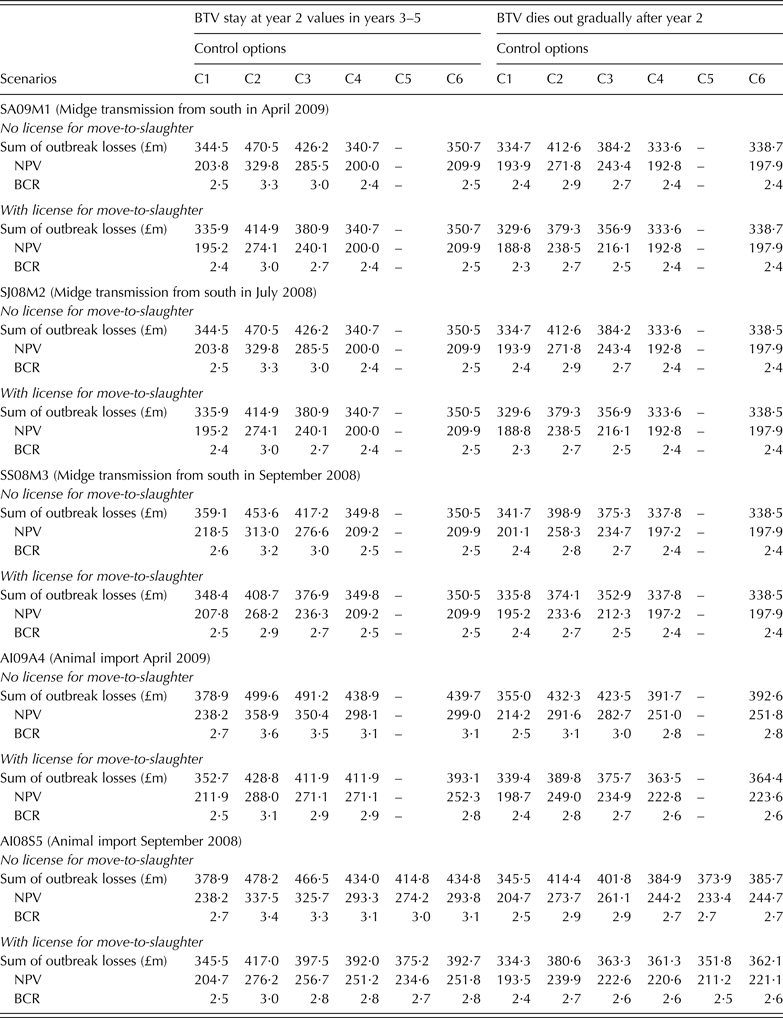
The costs and benefits generated for the various disease outbreaks from the spreadsheet model are summarized in Table 2 for within incursion scenarios.
Predicted outbreak losses under alternative control options and incursion scenarios
These indicate the best control option under each scenario that must be established for cost benefit analysis (CBA) of disease prevention. BTV, Bluetongue Virus; BCR, benefit to cost ratio.
In general, total current discounted benefits for all incursions scenario over 5 years ranged between £330 and £500 m. All the scenarios are economically viable with positive net present values and BCR indicators greater than one. However, it was apparent that the values of the indicators improved marginally when BTV8 outbreak level stayed at year 2 values in years 3–5 as compared with BTV8 dying out gradually after year 2. This suggested that the longer the duration of BTV outbreak, the more viable the current configuration of surveillance and the assumed prevention scenarios of dealing with outbreaks. Altogether; whether the disease fades out or not, control option C2 (Border PZ – 100% vaccinated) or 100% vaccination with a PZ starting at the Scottish Borders yields the highest discounted benefit and BCRs within each incursion scenario. However, as all alternative scenarios are economically justified, the economically optimal BTV mitigation option can be based on the strategy which gives the lowest total avoidable cost. Using this decision criterion corresponds with the scenario that employs 50% vaccination and all Scotland as a PZ often provides the lowest return. It can be seen that any costs that are sustained beyond this point are preventable. The fact that the indicators remain so clearly favourable under all scenarios provided evidence of the robustness of the overall conclusions drawn from the analysis.
Having explored the trajectory of BTV8 infection and the efficacy of the current surveillance and prevention arrangements, next the disease control in different policy settings of obtaining a licence for movement to slaughter within each control scenario is examined. During the disease outbreak, obtaining a license for movement to slaughter are options that government consider favourably in order to lessen the pressure within the livestock industry and associated sectors of the food chain. Licensing arrangements also act to cushion the potential effects of hardship and welfare issues that could arise due to the restrictions in place to prevent the spread of disease. In general, the returns to current surveillance depend upon the option of obtaining a license to move livestock to slaughter or not. In the policy setting of ‘with no license for move to slaughter’, control option C4 (50% vaccination with Scotland as PZ) for incursions SA09M1 (northwards spread of BTV from England arriving in April 2009) and SS08M3 (northwards spread of BTV from England arriving in September 2008) deliver the lowest return on the current surveillance while control option C1 (no vaccination) delivers the lowest return in policy setting ‘with license for move to slaughter. These options have the lowest benefits and therefore, relatively low BCR. Unlike SA09M1, the lowest return to current surveillance for SJ08M2 (northwards spread of BTV from England arriving in July 2008) depends upon the duration of the outbreak or the trajectory by which the disease persists after an outbreak as well as on the license position. Control option C4 (50% vaccination with Scotland as PZ) for incursion SJ08M2 gave lowest benefits when BTV8 lingers and causes losses equivalent to year 2 levels up to year 5. Control option C1 (no vaccination) for incursion SJ08M2 does the same when BTV8 gradually dies out after year 2 with no license to slaughter. However, control option C4 (50% vaccination with Scotland as PZ) for incursion scenario SJ08M2 remains the best vaccination strategy as the control option C1 for incursion scenario SJ08M2 is the no-vaccination option.
For scenarios AI09A4 (import of infected animals in April 2009) and AI08S5 (import of infected animals in September 2008) the lowest returns on investment also appeared to be control strategy C1 (no vaccination) for all eradication measures; and seemed not to be influenced by either license for move to slaughter or the time trajectory of the disease when an incursion occurs. The vaccination strategy with the lowest return on investment to prevent or to limit the damage caused by BTV8 outbreak is control strategy C4 (50% vaccination with Scotland as PZ) for incursion AI09A4 and control strategy C5 for incursion AI08S.
Under the assumptions of the model, control option C2 (Border PZ with 100% vaccination) is shown to be a worthwhile investment. That is, this scenario achieves an NPV of at least £195 million over the 5-year time horizon considered and respectable BCR of at least 3·0, thereby providing returns of £3·0 for every £1 invested for BTV8 outbreak persisting up to year 5. Even if BTV8 outbreak fades out gradually, control option C2 yields an NPV of at least £192 million over the 5-year time horizon and at least a BCR of 2·7 implying providing £2·7 for every £1 invested.
Risks and uncertainties analysis
The spreadsheet CBA framework can be used to explore uncertainty in the modelling assumptions. Analyses that directly address uncertainty and report a range of estimates in sensitivity analyses are most useful, because they give complete information for further analysis and interpretation by decision makers. A multivariable sensitivity analysis of the critical parameters to explore their impact on benefit-cost ratio was performed. Sensitivity analysis was done using Monte Carlo simulation with Crystal Ball version 11·1 (Decisioneering, Denver, CO). Distributions were sampled 50 000 times for the final analysis. Probability density functions for parameters were fitted to approximately match the high and low ranges found in the published studies and in our own data. Parameters measuring weight loss, milk loss, fertility loss, export multipliers for cattle and sheep and own-price elasticities for sheep meat, beef and milk was each modelled with a normal distribution. Probability of the disease outbreak was modelled using a Poisson distribution assuming one outbreak would occur within 5 years, while the discount rate was also fitted with a discrete distribution. As expected, the sensitivity analysis in all scenarios indicated that probability of an outbreak would have a significant impact on outbreak losses. This was followed by price elasticity of demand for beef. However, the ranking of the control options remained unchanged. Other parameters had no significant effect.
Whereas quantifiable risks can be taken into account by performing sensitivity analysis and specifying probability distributions, such an approach will not work for extreme uncertainty that may be inherent in the framework of the CBA. For example, the inability to quantify the likelihood of the outbreak BTV8 disease imposes extreme uncertainty on the analysis. In order to hedge against this uncertainty, a short cut-off period was used and a precautionary approach adopted in order to achieve robust results without compromising the logic of conducting an ex ante CBA. A 5-year cut-off period was adopted as the time horizon in the current analysis, even though evidence suggests that BTV is able to survive regularly between vector seasons (Saegerman et al. Reference Saegerman, Berkvens and Mellor2008). This hypothesis is supported by the recrudescence of BTV8 in countries with similar climate to Scotland such as northern France, the Netherlands, Belgium, Luxembourg, and Germany in 2007 (Saegerman et al. Reference Saegerman, Berkvens and Mellor2008). The precautionary approach involved ranking and comparing control strategies within each simulated incursion scenario. This method enabled comparisons to be made between BTV8 control strategies within incursion scenarios rather making comparison between different incursion scenarios.
DISCUSSION
The CBA used is based on the notion that only a few key parameters were varied while all others such as prices and the technology involved in the control of BTV are held constant (the method of comparative statics), for instance new technologies can emerge that are more cost effective to control disease during the time horizon the analysis is done. This assumption may be realistic when it is perceived that the risks and frequency of (predominantly contained) outbreaks to be low. But the assumption is doubtful if disease outbreaks are likely to be large in relation to other input costs. Therefore, the CBA ratios estimated must be understood to be merely indicative of the expected order of measurable benefits and costs involved. It must be made clear that they depend entirely on the assumptions underlying the calculations. Actual quantifiable costs and benefits could possibly differ from these estimates. However, the assumptions used in the current paper are believed to be, on the whole, credible for BTV incursion into Scotland.
The present study also demonstrates some of the challenges confronted in ex-ante analysis that employs a linked epidemiologic–economic modelling framework to understand disease control. The link between epidemiology and economics is now recognized as crucial in conducting economic impact assessments of animal disease control and also evaluating the preparedness to tackle exotic livestock diseases. However, the present study did not exploit mechanisms that allow actual feedbacks between epidemiological disease spread and economic models in a way that captures how disease spread and progression incentivize proactive and reactive measures to mitigate and control disease. Feedback mechanisms between epidemiological and economic models have potentially important consequences, particularly in terms of assessing the impact of alternative control programmes (Rich Reference Rich2007). However, the policy evidence offered by the current analysis uses the current understanding of disease epidemiology and the linkage to the economics and emerging complexities such as whether there is a robust climate change signal in disease movement and transmission.
According to the interdisciplinary panel, the most likely incursion scenarios are northwards spread from south-east England or import of infected animals. The risk of direct incursion of infected vectors from affected areas in south-east England or mainland Europe is very low, but not negligible and if a focus of infection were to become established in the north of England or Northern Ireland, this would pose a distinct incursion risk for Scotland. It was impossible to predict how the numbers of farm-associated midge vectors is likely to vary across Scotland on the basis of current vector surveillance data. Although this information was available, a particular challenge was identified in the need to quantify the probability of BTV8 incursion into Scotland. Since it was not possible to establish this probability; control options were therefore ranked within incursion scenario. In addition, the analysis uses a combination of sensitivity analysis, a short cut-off period and precautionary approach to account for the uncertainties relating to BTV incursions and the ranking to inform decision making depended on incursion scenario, disease persistence assumption (declines in years 3–5 or persists) and/or mitigation opportunity (license to move to slaughter or not).
Surprisingly, using the extreme epidemiological outputs made little difference to the economic assessment of alternative incursion control options based on average epidemiological outcomes. Combined with the results of the sensitivity analysis and the consistency between incursion scenarios, this was reassuring as it suggests that the choice of the control option will be more robust to the nature and extent of the incursion than might have been expected. As decisions about control options usually need to be made in advance of any incursion, and given the uncertainty that surrounds almost all aspects of this analysis, this was a welcome outcome.
The framework of the CBA was based from the outset on the assessment of the benefits of avoiding future BTV8 outbreak losses through the current (baseline) surveillance costs. However, the interests of stakeholders and scientists was in the relative costs of alternative vaccination strategies, which would probably need to be ordered and deployed in advance of a BTV8 incursion. This focused interest on a comparison between outbreak losses with and without vaccination (C1 v. all other strategies). However, lack of any estimates of the relative probabilities of BTV8 incursions into Scotland, conditional on each of the alternative control options investigated, frustrated such comparisons. Under these circumstances, a clear consistent definition within the CBA framework was a key attribute of success. Within each incursion scenario, a control strategy associated with the lowest outbreak losses emerged but still with BCR >1. In most incursion scenarios, the same control strategy delivered low or the lowest outbreak losses. This enabled useful decision support to be conveyed to Scottish Government, despite the lack of important information and differences between control strategies in the proportion of vaccination costs devoted to prevention rather than control.
However, when all alternative scenarios are justified, choice of an economically optimal intervention to control and eradicate BTV should be made using the estimated indicators in the present study, in combination with other measures of project worth (McInerney Reference McInerney and Martin1991; Tisdell Reference Tisdell1995; Howe et al. Reference Howe, Häsler and Stärk2013).
The authors acknowledge the contribution of the project expert group who provided advice and comments on the analyses: Habtu Weldegebriel, Bouda Vosogh Ahmadi, (SRUC); Beth Purse (CEH); Alison Blackwell (Advanced Pest Solutions Ltd); Philip Mellor, Peter Mertens, Anthony Wilson (IAH); John Gloster, Laura Burgin (Met Office); Steve Albon (Macaulay Institute); Iain McKendrick (BioSS); Mark Woolhouse, Victoriya Volkova (University of Edinburgh); Massimo Palmarini (University of Glasgow); Kim Willoughby (Moredun Research Institute); Keith Howe (University of Exeter). This work was funded by the Scottish Government [project CR/2007/56] and was conducted under the auspices of the Scottish Government Centre of Excellence in Epidemiology, Public Health and Disease Control (EPIC). Development of the epidemiological models was funded by the Biotechnology and Biological Sciences Research Council (grant codes: BBS/B/00603; IAH1320) and the Department for Environment, Food and Rural Affairs (grant code: SE4104). The authors gratefully acknowledge the contribution of the project steering committee.
APPENDIX
APPENDIX A. KEY PARAMETER AND ASSUMPTIONS
The evaluation of BTV control measures in different outbreak scenarios requires a combination of assumptions on economic parameters. While some of them were mentioned in the main text of the paper, some others are presented in this annex. Further details are available from the corresponding author.
Whether the assumption relates to disease losses avoided (benefits) or unavoidable surveillance costs is denoted in the assumptions column by either [B] or [C] respectively.