INTRODUCTION
For children, syntactically and semantically organized input in the form of narration is a powerful scaffold of linguistic and academic attainments, whether provided during book reading (Reese, Sparks & Leyva, Reference Reese, Sparks and Leyva2010) or parent–child conversation (Reese, Leyva, Sparks & Grolnick, Reference Reese, Leyva, Sparks and Grolnick2010). Repetition of the same narrative input over time promotes children's word-to-object mapping (Horst, Parsons & Bryan, Reference Horst, Parsons and Bryan2011). However, it is not yet known whether the learning of other word classes, such as prepositions, can be promoted by narrative presentation as well. We aim to fill this gap.
Input that is lexically rich and predictably organized by syntactic and semantic relations (Mandler & Johnston, 1977) could make different forms of narratives effective scaffolds for word learning. For example, the number of word types and tokens that parents address to their children and the length and variety of the utterances in which these words occur are positively associated with the children's vocabulary growth (Hart & Risley, Reference Hart and Risley1995; Hoff & Naigles, Reference Hoff and Naigles2002). Hoff and Naigles (Reference Hoff and Naigles2002) hypothesized that parents' utterances provide useful data to the young word learner and that longer utterances in particular provide useful syntactic cues and explicit information about the meaning of new words. Moreover, when more-familiar words frame a given less-familiar word, the child's interpretation and ultimate mapping of that word will be enhanced (Hoff & Naigles, Reference Hoff and Naigles2002). Indeed rich semantic framing boosts the encoding of new words (e.g. Capone & McGregor, Reference Capone and McGregor2005; McGregor, Reference McGregor, Addison Stone, Silliman, Ehren and Apel2004; Rohlfing, Reference Rohlfing2006), thus supporting generalization, retention and consolidation (Carey, Reference Carey2010; Rohlfing, Reference Rohlfing2006). The thematic coherence that defines many forms of narratives is likely an ideal framing of this sort. In fact, as Mandler (Reference Mandler1984) noted, in a story, lexical input is not only framed but predictably organized and its predictability aids comprehension and recall.
Narrations and proto-narrations provide specific input to children as they elaborate on jointly experienced events (Nachtigäller & Rohlfing, Reference Nachtigäller, Rohlfing and Kümmerling-Meibauer2011). We know that children recall events more readily when their mothers have provided a verbal description of those events as they unfolded than when the mothers have not (Bauer & Wewerka, Reference Bauer and Wewerka1995; Boland, Haden & Ornstein, Reference Boland, Haden and Ornstein2003; Haden, Ornstein, Rudek & Cameron, Reference Haden, Ornstein, Rudek and Cameron2009; Reese, Haden & Fivush, Reference Reese, Haden and Fivush1993). Also, mothers who want their children to accomplish a task make use of joint past events with their children (Rohlfing, Reference Rohlfing2011). They use – among other strategies – ‘bring-in strategies’ (Rohlfing, Reference Rohlfing2005; Choi & Rohlfing, Reference Choi, Rohlfing, Iwasaki, Hoji, Clancy and Sohn2010) that bear similarity with what Ornstein, Haden and Hedrick (Reference Ornstein, Haden and Hedrick2004: 382) refer to as ‘associative talk’, that is, talk relating to the child's previous experiences. For example, in a task where a horse should be put under a bridge, a mother might create a narrative context about the whole situation and explain that the horse needs to hide (Rohlfing, Reference Rohlfing2011). She thus gives additional information, in this case a motive, to the child, evoking a richer understanding of the task. Therefore, verbal input in different narrative forms could help children to learn new words because it is lexically rich, predictably organized, and conducive to bring-in strategies, all of which support comprehension in the moment and memory over time.
In this study, we were interested in the contribution of syntactically and semantically organized input as a scaffold for word learning. Our operationalization of this form of narration was motivated by Rohlfing's (Reference Rohlfing2011) research on bring-in discourse strategies found in mothers of two-year-olds. We designed three temporally and causally connected sentences. Each of the sentences related to a different narrative function: (1) information, (2) motivation and (3) consequence, resembling a structure of a narrative consisting of orientation, complication and evaluation (Labov & Waletzky, Reference Labov, Waletzky and Ihwe1973). Thus our narratives had the beginning of a simple story structure. However, they lacked a fully described outcome. We hypothesized that, by embedding the unknown (or partially known) word in a narrative context, the meaning of it should be more easily conveyed and thus better understood and remembered (Mandler & Johnson, Reference Mandler and Johnson1977).
Within this narrative structure, we presented a spatial preposition to the experimental group. We decided on this word class for two reasons: First, to our knowledge no studies have investigated whether narrative context promotes learning of prepositions. We know that, in understanding prepositions, children are guided by physical context (Clark, Reference Clark1973; Meints, Plunkett, Harris & Dimmock, Reference Meints, Plunkett, Harris and Dimmock2002; Rohlfing, Reference Rohlfing, Pütz, Niemeier and Dirven2001; Sinha, Reference Sinha, Seiler and Wannenmacher1983; Wilcox & Palermo, Reference Wilcox and Palermo1974). We reasoned that narratives might be especially suited to teaching prepositions because they provide a sort of context as well. Second, being interested in learning real words, we took advantage of the phenomenon that the preposition UNDER is acquired later than IN and ON (Clark, Reference Clark1973; Johnston & Slobin, Reference Johnston and Slobin1979; Rohlfing, Reference Rohlfing2006). We could thus assume that most two-year-old children will have – if at all – only a very weak representation of this word.
Teaching a real word to the children allowed us to consider acquisition as a gradual memory process and to go beyond the fast mapping stage. As the target word in our study is a real spatial preposition UNDER [UNTER], we assumed that children already would have heard the preposition and would have thus already built some nascent yet fragile knowledge of it. Thus, the memory trace of the word might decay over time and it might be difficult for children to recall it if the context did not provide scaffolds (Horst & Samuelson, Reference Horst and Samuelson2008). To test for decay over time, we measured children's learning at two different time-points: immediately after the training and one day later. To test the need for scaffolds, we measured children's responses in two different situations: in the familiar situation, children were scaffolded by the familiarity of the test objects — these were the same objects used during pretest or training. In the unfamiliar situation children were exposed to objects that were not familiarized via pretest or training, and thus they had to transfer their obtained knowledge when acting on these objects. We assumed that introducing the preposition UNDER within a narrative structure would help the child to encode a richer memory trace, one that was less likely to decay over time and less likely to require scaffolding. Therefore, we assumed that, compared to controls, children trained with narrative context would perform better in contexts providing less scaffolding support (i.e. with unfamiliar objects) and would demonstrate better retention of their word knowledge on a second testing than would children in the control group.
METHOD
Participants
We studied forty children aged 1;8 to 2;0. We targeted this age group because it is likely that they would have heard the preposition UNDER given how common it is but, given their age, their knowledge of the word would be nascent (McGregor, Rohlfing, Bean & Marschner, Reference McGregor, Rohlfing, Bean and Marschner2009; Rohlfing, Reference Rohlfing, Pütz, Niemeier and Dirven2001; Reference Rohlfing2005). Half of the children participated in the experimental group (EG); half in the control group (CG). All children were native learners of German and had typical language development via parent report.
The mean age of the experimental group was M=21·55 months (SD=1·67) and of the control group M=21·35 months (SD=2·11). The groups did not differ with respect to age (t(38)=0·482, p=0·63), gender (χ 2 (1, N=40)=0·102, p=0·75), maternal status of education (U=173·50, p=0·48), and level of reported productive vocabulary (according to a parent rating for two-year-olds' language skills in German, ELFRA-2, Grimm & Doil, Reference Grimm and Doil2000; t(37)=−0·60, p=0·55). Parents reported that children in the experimental group produced an average of 93·20 words (SD=72·37), whereas children in the control group produced an average of 105·53 words (SD=53·62).
In addition, we asked the parents to provide us with information about whether their children were already comprehending and producing spatial terms. We did not exclude children who were reported to produce and/or comprehend these terms from our analyses, because we wanted to test how a semantic representation might be strengthened by the experimental input. However, we considered the reported lexicon of the children in our analyses of the data. According to parents' reports, upon enrollment in the study, seven children produced and comprehended UNDER (EG: 3 children, CG: 4 children), eighteen children only comprehended UNDER (EG: 8 children, CG: 10 children), fourteen children did not comprehend or produce UNDER (EG: 9 children, CG: 5 children) and one value was missing. There was neither a significant difference between groups concerning the comprehension of UNDER (χ 2 (1, N=39)=0·78, p=0·38), nor concerning the production of UNDER (χ 2 (1, N=39)=0·01, p=0·94). Note that variations in knowledge of UNDER prior to training were expected given the large variation in vocabulary abilities at this age (Fenson, Dale, Reznick, Bates, Thal & Pethick, Reference Fenson, Dale, Reznick, Bates, Thal and Pethick1994). It was important only that children could still learn more about UNDER as it was of interest to determine whether narrative presentation aided learners across various points in the slow mapping process. A pretest ensured that learning could be compared to extant knowledge upon entry to the study.
Materials
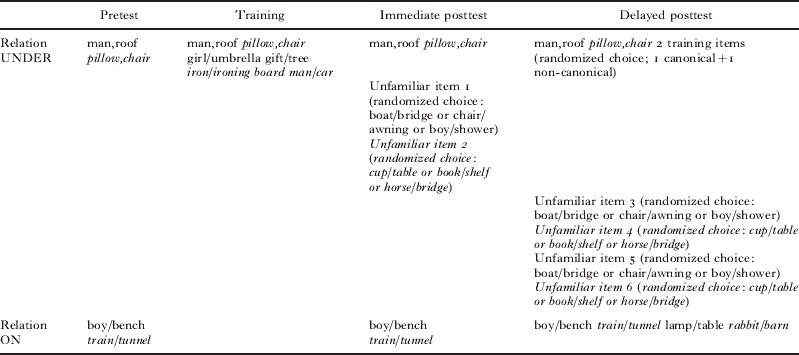
The training and testing materials were sixteen pairs of objects, the names of which are common in toddlers' lexicons. Objects were presented in pairs to the participants. It was a prerequisite that each of these object pairs enabled the creation of at least two spatial relations, that is, at least one more spatial relation than the one requested in the testing procedures was possible and plausible with these objects (see Figure 1 for pictures of the items and Table 1 for a detailed list of all items). Half of the items afforded a canonical, or customary, UNDER relationship (e.g. man UNDER roof) and the other half afforded a non-canonical function (e.g. man UNDER car where IN is the more canonical relationship). We included non-canonical relationships in the test to ensure that participants were not merely performing the action most familiar and most readily afforded by the items (Sinha, Reference Sinha, Seiler and Wannenmacher1983; Rohlfing, Reference Rohlfing, Pütz, Niemeier and Dirven2001; Reference Rohlfing2006). The classification of items into a canonical or non-canonical relationship was based on an independently conducted rating with adults: all items included in the study were rated with at least 80 percent agreement to be either canonical or non-canonical.
Pictures of all items.

List of all items for the relations UNDER and ON

note: italics indicate a non-canonical relationship.
We manipulated familiarity by exposing half of the objects to be used at the posttests to the children during pretest or training. Wilcox and Palermo (Reference Wilcox and Palermo1974) as well as Grieve, Hoogenraad and Murray (Reference Grieve, Hoogenraad and Murray1977) have pointed out that experience with objects influences the development of spatial categories. Applying this concept to our study design, at posttests, object pairs that the child had seen during pretest or training were deemed familiar; object pairs that were not seen during pretest or training were deemed unfamiliar transfer items, because children had to transfer their understanding to these objects.
Procedure
The procedure followed a pretest–posttest design with two posttests.
Pretest
The pretest provided a necessary baseline of children's performance of the spatial relations UNDER and ON [AUF]. We tested children's comprehension of the prepositions UNDER and ON in one canonical and one non-canonical set per preposition. The spatial relation ON served as a control relation as it was not trained.
Training
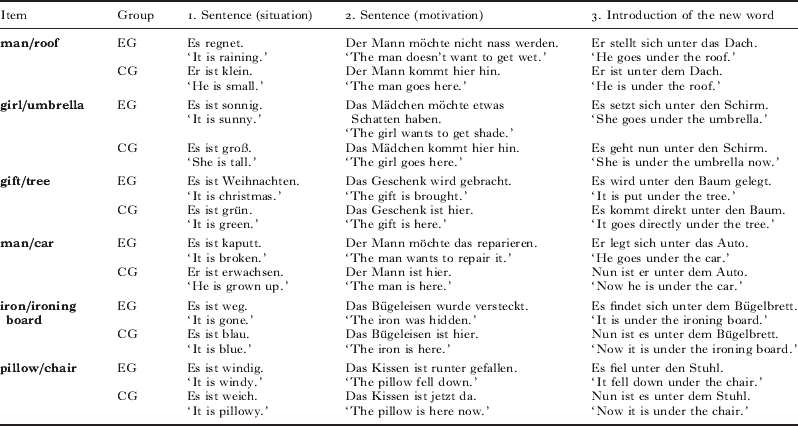
Children were trained in comprehending the preposition UNDER with six object sets, two of which were familiar from the pretest. The training differed in the control and the experimental group with regard to the semantic content of the utterances in which the preposition UNDER was embedded. As can be seen in Table 2, in the input to the experimental group, the word UNDER was embedded in a narrative context. The sentences always contained a situation introduction (e.g. ‘It is raining’), a motivation (e.g. ‘The man does not want to get wet’) and the consequence with an introduction of the preposition UNDER (e.g. ‘He goes under the roof’). In that way, a sequential structure of the input was achieved, thus providing an impression of a narrative (Nachtigäller & Rohlfing, Reference Nachtigäller, Rohlfing and Kümmerling-Meibauer2011; Nelson, Reference Nelson1996). For the control group, a similar number of words and sentences were used. However, the three sentences were not related, as they formed neither a temporal nor causal sequence (e.g. ‘He is small. The man goes here. He is under the roof’; see Table 2 for all training sentences).
Discursive input to the children during the training of UNDER in both training groups
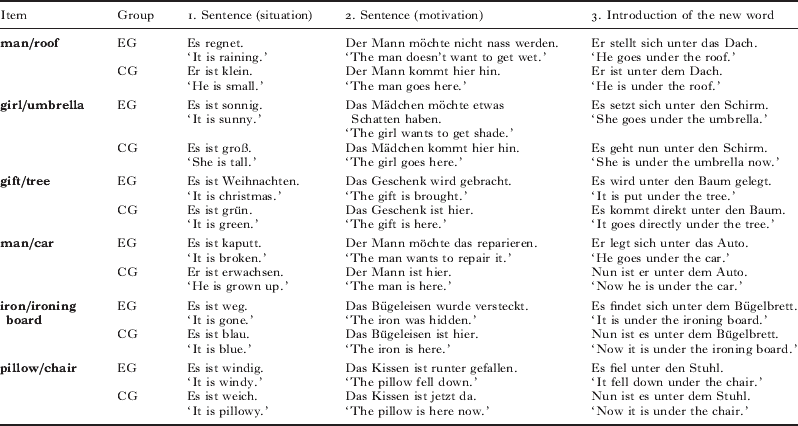
note: EG=experimental group, CG=control group.
In both conditions, the trained word was stressed by the experimenter. The action of putting one object under another was also demonstrated while the last sentence was spoken.
Posttest
The learning effect was tested by asking the child to perform UNDER (and ON) relationships at two different points in time: immediately after the training (posttest1) and again after a one-day delay (posttest2). The object sets varied in terms of familiarity: for the relation UNDER in posttest1, two sets were familiarized and two sets were unfamiliarized; posttest2 consisted of six sets of familiarized items and six unfamiliarized items. For the relation ON, we tested two familiarized sets in posttest1 and two familiarized and two unfamiliarized items in posttest2. Half of the requested relations were canonical and the other half were non-canonical.
Coding
Children's performances of the UNDER relation following the examiner's requests were coded as correct if they performed the right relation (e.g. the man was located under roof) whether or not their approach was correct (e.g. moving the man under the roof or moving the roof over the man were equally fine). This decision reflected our acknowledgment that children's fine motor skills might limit their approach. All other responses (e.g. man behind the roof) were coded as incorrect. We calculated the inter-rater reliability for a subset of the data (25%) and received a Cohen's kappa of 0·84. In all analyses below, the dependent variable is expressed as the percentage of trials performed correctly.
RESULTS
After a brief report of children's performance of the control relation ON, we present children's performance of the relation UNDER in detail with familiarized items followed by a section about children's ability to generalize their knowledge to unfamiliarized items.
Children's task performance for the untrained control relation ON
We calculated difference scores for posttest1 (performance at posttest1 minus performance at pretest) and for posttest2 (performance at posttest2 minus performance at pretest), which reveal gain in knowledge. A (2) time×(2) training group ANOVA with repeated measures on the first variable showed neither a significant main effect of time (F(1,38)=0·54, p=0·47), nor a significant main effect of training group (F(1,38)=0·17, p=0·68), nor a significant interaction of training group and time (F(1,38)=0·54, p=0·47). See Table 3 for means and standard deviations. This lack of change on the control relation ON aids our interpretation of changes in the trained relation UNDER. Specifically, any changes we observe in UNDER can be credited to the training itself. The following analysis thus focuses on children's performance when the UNDER-relation was requested.
Mean percentage and standard deviations of correct performance of ON-items at each testing time

Children's task performance for the trained relation UNDER
Learning effect with familiarized items
We first analyzed the learning effect based on children's performance with familiar items after the training session with respect to their performance during the pretest. For this, we calculated difference scores for posttest1 (performance at posttest1 minus performance at pretest) and for posttest2 (performance at posttest2 minus performance at pretest). The difference scores, thereby, reveal gain in knowledge. See Table 4 the mean percentage and standard deviation of correct performance at pretest, posttest1 and posttest2.
Mean percentage and standard deviations of correct performance of familiar UNDER-items at each testing time

To investigate the learning effect by training session, we conducted a (2) time×(2) training group ANOVA with repeated measures on the first variable. The results revealed a significant main effect of time (F(1,38)=6·86, p=0·01, Eta 2=0·15), as well as a significant main effect of training group (F(1,38)=3·97, p=0·05, Eta 2=0·09). There was no significant interaction of time and training group (F(1,38)=0·1, p=0·91). The main effect of time resulted from larger gain scores at posttest1 than posttest2 (see Figure 2). Thus, the learning gain decayed over time in both groups. Note that by posttest2 the control group, but not the experimental group, fell back to baseline, that is, they did not leave the study with improved knowledge of UNDER. Thus, the training within narrative context, but not the control training, resulted in learning as demonstrated with familiarized items.
Mean learning gain and the standard errors in performing the UNDER relation in both conditions.

Despite these findings, the examination of the standard deviations in these gain scores relative to the means suggested large individual differences within each training group at posttest1 and posttest2 (see Figure 2). Therefore, we explored the data further to determine whether some children benefited more from the narrative-based training than others.
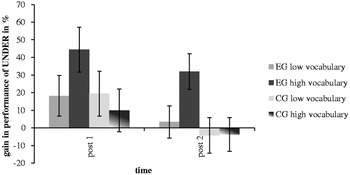
Given that the critical manipulation in this training study involved narrative presentation, one potential source of individual differences in outcome is the overall vocabulary size of the children, who, after all, would need to comprehend the words in the narratives to benefit from them. Moreover, vocabulary size is positively correlated with the amount of new word learning that children experience in lap-reading situations (Robbins & Ehri, Reference Robbins and Ehri1994), as well as their spoken word accuracy (Edwards, Beckman & Munson, Reference Edwards, Beckman and Munson2004) and reading ability (see Stanovich, Reference Stanovich1986, for the ‘Matthew effect’). Therefore, we turned to vocabulary size as a potential moderator of the training effect. Calculating correlations between productive vocabulary and the learning gain, we found that reported productive vocabulary was marginally correlated with children's comprehension of the UNDER relation at posttest2 (r=0·23, p=0·08). With the aim of looking more closely at the influence of the reported productive vocabulary on the learning process, we conducted a median split on reported vocabulary size (Md=91, n=39) to create high and low vocabulary groups within each training condition. For further analyses, we considered four groups: EG with reported low vocabulary, EG with reported high vocabulary, CG with reported low vocabulary, and CG with reported high vocabulary.
To investigate the effect of training, we conducted a (2) time×(2) training group×(2) vocabulary size ANOVA with repeated measures on the first variable. Again, the dependent variable was children's gain over pretest in performing the UNDER relation with familiarized items. The results can be seen in Figure 3. We again obtained a significant main effect of time (F(1,35)=8·66, p=0·01, Eta 2=0·20). With reduced power, the effect of training group was now marginal, (F(1,35)=3·96, p=0·055, Eta 2=0·10). There was neither a significant main effect of vocabulary size (F(1,35)=1·42, p=0·24) nor a significant interaction of training group and vocabulary size (F(1,35)=2·76, p=0·11).
Mean learning gain and the standard errors in performing the UNDER relation at posttest1 and posttest2 of all four groups.

Taking all the findings together, when tested with familiarized items, children in the experimental group showed better immediate performance as well as retention than children in the control group. Nevertheless, all children perform better at posttest1 than at posttest2. There was no indication that children's performance was influenced by their vocabulary size.
Generalization
Next we determined whether the learning of the word UNDER via familiarized object sets generalized to unfamiliarized sets. We conducted a (2) time×(2) training group ANOVA with repeated measures on the first variable for the performance of unfamiliar items of UNDER and obtained neither a main effect of time (F(1,38)=2·79, p=0·10), nor a main effect of group (F(1,38)=0·01, p=0·95), nor an interaction of time and group (F(1,38)=0·15, p=0·70). Again, we turned to vocabulary size as a potential moderator of the training effect and calculated correlations between productive vocabulary and children's performance with unfamiliarized items. We found that reported productive vocabulary was significantly correlated with children's comprehension of the UNDER relation at posttest1 (r=0·34, p=0·02) and at posttest2 (r=0·40, p=0·01). With the aim of looking more closely at the influence of the reported productive vocabulary on the generalization process, we again created high and low vocabulary groups within each training condition (Md=91, n=39). For further analyses, we considered four groups: EG with reported low vocabulary, EG with reported high vocabulary, CG with reported low vocabulary, and CG with reported high vocabulary. Then, we conducted a (2) time×(2) training group×(2) vocabulary size ANOVA with repeated measures on the first variable for the performance of unfamiliarized items of UNDER. We obtained no significant main effect of time (F(1,35)=2·94, p=0·10) and also no significant main effect of training group (F(1,35)=0·40, p=0·53). But this time, there was a significant main effect of vocabulary size (F(1,35)=8·48, p=0·01, Eta 2=0·20), showing better performance of children with high vocabulary size than low vocabulary size. There was also a significant interaction between training group and vocabulary size (F(1,35)=4·62, p=0·04, Eta 2=0·12), indicating the best performance for the experimental group with high vocabulary in comparison to the other groups. Thus, children with a reported high vocabulary level who received the training within narrative context were better at generalizing the UNDER relation to unfamiliar item sets when compared to the other groups (see Figure 4 for means and standard errors of children performing UNDER unfamiliar items correctly at both posttests).
Mean percentage and standard error of correct performance of unfamiliar items of UNDER.

DISCUSSION
This study was conducted with the goal of determining the contribution of narrative presentation as a support for preposition learning. We designed an ecologically valid input within a narrative context that allowed us to measure immediate gains in trained and generalized knowledge as well as retention of those gains. In contrast to previous studies that focus on the learning of nonce labels for object referents, the trained word in our study was the spatial preposition UNDER, which is a real word that relates to other real words that are potentially within the child's semantic network. We assumed that training a real word instead of nonce words would constitute a more effective test of our hypothesis as the acquired word can be assimilated to the existing semantic network. In our training phase, we designed semantically enriched input involving temporal and causal relationships in an attempt to support the encoding of the training words and to embed the word in the network. We tested the performance of the relation UNDER by using familiarized and unfamiliarized items. This variation tested children's ability to generalize their newly acquired knowledge about UNDER.
As predicted, we found training within a semantically meaningful narrative context to be more effective than training within unconnected speech (see Hayne & Herbert, Reference Hayne and Herbert2004, for younger children). Moreover, in the narrative condition, and only in the narrative condition, the gains over pretest were still apparent a day later. The effectiveness applied to the learning of UNDER as performed with familiarized items.
A more detailed look at individual differences revealed that children's vocabulary plays a crucial role for the effectiveness of the narrative-based training. First, overall vocabulary size played a role in children's transfer of the newly learned preposition to unfamiliarized items. That is, the training within narrative context promoted generalization specifically for children with more advanced than less advanced productive vocabulary size. The gains of children with lower levels of vocabulary development in response to the training within narrative context did not differ from those in the control training condition. In hindsight, this is not surprising. To benefit from the narratives, that is, from the semantic grounding that narratives provide, one must have the language to comprehend them. Interestingly, research on memory development describes a similar finding: children with advanced language skills whose mothers talked in a high elaborated style about an event achieved the best memory scores for details of the event (Boland et al., Reference Boland, Haden and Ornstein2003). These findings are in line with our own and suggest that older children, who by virtue of age will have more advanced vocabulary at their disposal, might benefit even more from the provided narrative context. Semantically organized input in the form of a narrative is an effective scaffold for preposition learning but, as with any scaffold, only if it is tailored to the child's zone of proximal development (Vygotsky, Reference Vygotsky1986).
Second, if, as we hypothesized, the narrative context helps the learner to place the new word into a relevant semantic network, that learner must have enough word knowledge to ensure the availability of that semantic network. The ability to generalize word knowledge thus depends strongly on knowledge the child already has. As Thom and Sandhofer (Reference Thom and Sandhofer2009) found, vocabulary size within a particular domain is a relevant factor for word learning within that domain. This finding is consistent with what Hills, Maouene, Riordan and Smith (Reference Hills, Maouene, Riordan and Smith2010) refer to as the ‘lure of associates’, a principle by which words are learned in direct proportion to the number of related words that the child knows already. Further studies should therefore investigate the contribution of narratives, full stories (with a described outcome) and other means of semantic grounding, as well as the time-point in development at which such a form of scaffolding is sensible and most effective.