In July 1914, as Germany clandestinely prepared to initiate preventive war against Russia, it simultaneously convinced the other European powers that it was earnestly working to preserve the peace. Puzzlingly, Germany took no obvious foreign policy actions that would typically be considered costly signals, for example, troop withdrawals, institutional obligations, or public statements to tie leaders’ hands. Instead, Germany's private diplomatic reassurances were deemed credible by both allies and rivals alike, all of whom had ex ante reasons to distrust German motives. What accounts for this credulous response?
This paper argues that Germany's reassurances were convincing because of the operational costs entailed in reliably concealing its policy planning and military preparations. These costs made it unlikely that a Germany that was planning for war could maintain a consistently cooperative façade without leaks to the contrary, or that it would even attempt to do so. Stated generally, when a state's policymaking process is relatively transparent, the mere absence of observed defection can constitute a credible signal of benign intentions. Ironically, this argument implies that had German policymakers enjoyed greater insulation from espionage and tighter control over their diplomatic agents in 1914, they might have been unable to convince other states of their peaceful intentions. Counterintuitively, then, a lack of bureaucratic control can be advantageous in the context of interstate reassurance because it reduces the ability and willingness of hostile senders to misrepresent their intentions as benign.
This argument follows from the premise that conducting foreign policy requires internal communication to coordinate various domestic actors. To the extent that the sender's policymaking process is transparent—that is, easily observed by outside parties—attempts to secretly pursue goals at odds with the receiver's carry costs and risks. On one hand, higher transparency means that secret activities are more likely to be discovered and opposed. But in addition, avoiding discovery under high transparency directly lowers the sender's expected payoff: it must restrict internal coordination in ways that hamper its capacity to formulate and implement policy. These direct costs of concealing noncooperative statements and activities imply that the absence of leaks is by definition a costly signal that underpins the receiver's credulity of the sender's simple verbal reassurances.
This argument is an important contribution to the literature on credible signaling. This literature has focused largely on costly signals, wherein actors signal their type by taking actions that would impose direct costs on the opposite type. A few works have shown that costless, “cheap talk” signals can be credible under some conditions. Yet none have explored how maintaining a consistently cooperative narrative—specifically, the absence of positive statements or actions conveying hostile intent—can itself be costly for dishonest hostile senders by restricting communication in ways that hamper policy implementation.
This paper presents a formal model of reassurance in which a sender has the option of exploiting a receiver openly, secretly, or not at all. Whereas open exploitation sends a noncooperative signal and genuine restraint sends a cooperative signal, secret exploitation sends a cooperative signal only probabilistically, depending on the degree of effort the sender exerts to conceal its actions. Greater concealment effort entails an efficiency cost, lessening the sender's capacity for revisionist actions. The efficiency cost required to ensure a high likelihood of secrecy increases with the sender's degree of transparency, which exacerbates the trade-offs of concealment. Correspondingly, secret defection becomes less likely under high transparency, which increases the credibility of cooperative reassurance signals. Nevertheless, credible deception is possible under intermediate degrees of transparency, whereby hostile types probabilistically succeed in concealing their defection.
Finally, when transparency is too low, the sender's reassurances are insufficiently credible to dissuade a distrustful receiver from initiating preventive conflict. This implies that a state might be too good at keeping secrets—some senders actually do best under intermediate degrees of transparency, when their cooperative signals are partially informative but still leave the receiver significantly uncertain. It is these conditions that give rise to successful deception, as occurred in July 1914.
This paper begins by situating its contributions within the literatures on credible signaling, covert action, and transparency. It then presents the model and results, deriving three core hypotheses. Finally, these hypotheses are illustrated using the case of successful German reassurance prior to WWI.
Credible Reassurance: Costly Signals and Cheap Talk
Uncertainty is a crucial driver of the security dilemma, wherein misplaced distrust can produce conflict even between states with compatible preferences.Footnote 1 Yet credible signaling to alleviate uncertainty is often hindered by pervasive incentives to misrepresent: malign states have strong incentives to dishonestly signal that they are benign in order to avoid incurring opposition.Footnote 2 If cooperative signals are likely to be sent by both benign and hostile actors, they yield little information about the sender's intentions, and the uncertainty underpinning the security dilemma remains severe.
Accordingly, a large literature on reassurance examines when and how states can credibly signal their intentions.Footnote 3 Most of this research focuses on costly signals, which derive credibility because they carry high direct costs for hostile actors but are low cost or even beneficial to benign types that share the receiver's preferences.Footnote 4 For example, a benign state can refrain from offensive military investments,Footnote 5 forgo low-cost opportunities for expansion,Footnote 6 join institutions that raise its opportunity costs of exploitation,Footnote 7 or bear costs to support the receiver's preferred rules and norms.Footnote 8
These costly signaling mechanisms all involve actions that bear direct costs for at least one type of sender. Conversely, verbal statements have been treated exclusively as costless signals, “cheap talk” signals, that have no direct effect on the actors’ payoffs.Footnote 9 Like costly signals, the credibility of cheap-talk signals hinges on disincentives associated with sending the signal for one type of actor but not the other. But unlike costly signals, those disincentives are not direct costs, but rather arise indirectly from the strategic interaction of the agents.
The most commonly cited credible cheap-talk mechanisms involve indirect costs tied to the sender's reputation. In the massive audience-costs literature, credible signals are sent through public verbal commitments to particular actions.Footnote 10 Violation of such commitments diminishes the sender's reputation with allies, adversaries, or domestic constituents, who then impose costs on the sender.Footnote 11 Indirect reputational costs also arise if reneging on verbal commitments reduces the credibility of the sender's future threats and promises.Footnote 12 Other recent works have identified conditions under which cheap talk can be credible without invoking reputation.Footnote 13
This paper introduces a novel mechanism wherein maintaining a consistently cooperative outward narrative—including verbal statements—carries a direct trade-off and is therefore a costly signal, not cheap talk. Implementation of national policy entails coordination of various subnational actors, which necessitates verbal communication. Moreover, attempting to conceal this internal communication from external observers requires sacrifices, both from monitoring and enforcing secrecy and from the resulting reduction in the efficiency of policy implementation.Footnote 14 Thus, planning and implementing policies in secret carries direct opportunity costs for dissatisfied senders of not pursuing their revisionist goals with maximum efficiency. These costs confer credibility on the absence of statements or actions conveying hostile intent, such that simple verbal reassurances will be believed even without the reputational or other indirect costs that underpin credible cheap-talk signaling mechanisms.
A pervasive assumption of the signaling literature is that senders are unitary actors whose internal decision-making processes are unobservable. Of course, states are not actually unitary, but rather aggregates of numerous subgroups, organizations, and individuals.Footnote 15 Moreover, policymaking and execution are often complex, requiring extensive coordination and communication among diverse subnational actors. The wider the scope of communication inside a state, however, the higher the likelihood it will be revealed to external observers. To effectively conceal their intentions, states therefore must curtail their internal communication, at least to some degree.
Yet as the literature on covert foreign policymaking has established, concealment can hinder policy planning and implementation, producing suboptimal outcomes.Footnote 16 There are numerous reasons for this. First, concealment entails costs of monitoring and enforcing restrictions on internal communication. But second, concealment also precludes leaders from taking conspicuous actions to pursue their objectives, such as large-scale military operations, public deterrent threats and commitments to allies, or propaganda campaigns to garner public support for policies being covertly planned.Footnote 17 This inherently limits the scope of a state's goals that can be achieved. Third, restricting communication often means that leaders cannot access the full spectrum of knowledge and resources across the government and society. This includes inadequately vetting plans and assessing trade-offs in a “marketplace of ideas,” leading to suboptimal means–ends calculations.Footnote 18 Relatedly, decision-makers pursuing secret policies often use euphemisms or “circumlocution” to obfuscate their intentions, which, as the Senate committee investigating US covert activities in the mid-1970s noted, “increases risk of misunderstanding” among policymakers.Footnote 19 In keeping with the definition of costly signals (see note 9), these efficiency trade-offs are independent of any reputational concerns or other indirect costs that arise from other states’ responses.
Abundant examples illustrate these dynamics. In planning the 1961 Bay of Pigs operation, maintaining secrecy was maddeningly difficult. As President Kennedy lamented, “Castro doesn't need agents over here. All he has to do is read our papers!”Footnote 20 Consequently, secrecy requirements obstructed rigorous evaluation of the plan's military feasibility and the likelihood it would trigger anti-Castro uprisings, with disastrous results.Footnote 21 Another example is the 1979–80 Iranian hostage crisis. Carter administration officials were unable to even discuss their full range of options for fear of leaks, yielding a botched rescue attempt and possibly costing Carter re-election.Footnote 22 The Reagan administration's covert Iran-Contra gambit five years later was plagued by miscommunication, inadequate intelligence, and lack of coordination because maintaining secrecy demanded that major parts of the bureaucracy were excluded.Footnote 23
The costliness of maintaining a consistently cooperative veneer is a function of transparency—the degree to which outside parties observe a state's internal policy choices against its will.Footnote 24 Transparency has both internal and external components. On the one hand, transparency often refers to technologies or institutional structures that allow external actors to penetrate barriers to observing the policymaking process.Footnote 25 But a state's transparency is also a function of its propensity for leaks, whereby individuals inside the policymaking process expose private communications to outsiders.Footnote 26 The argument here generalizes to both sources of transparency.Footnote 27
Our model shows that high transparency lends credibility to a state's reassurances without invoking reputation. With higher transparency, states face increasingly severe trade-offs of attempting concealment. Covert policy coordination reduces the risk that hostile activities will be observed and sanctioned, but requires states to pursue their goals with suboptimal efficiency and abandon objectives that necessitate highly visible actions.Footnote 28 As transparency increases, reliably concealing internal communication becomes more difficult and deleterious to policy outcomes, thereby raising the inherent opportunity costs for dissatisfied states of pursuing revisionist goals secretly. This implies that the simple absence of apparent defection constitutes a costly signal, and that the credibility of that signal increases with the sender's transparency.
This argument is distinct from existing work on transparency, which focuses mainly on how democratic institutions reveal information. Like audience costs, these mechanisms rely on cheap-talk signals that derive credibility from indirect costs imposed by the public.Footnote 29 The key role is played by opposition parties or independent media with an incentive to send honest signals to the domestic audience. These credible cheap-talk signals can then be observed by the democratic state's foreign adversary, yielding information about the sincerity of the democratic government's threat. By contrast, in our model concealment imposes trade-offs on the government directly, even in the absence of an opposition party or free press, because of the efficiency loss of attempting to formulate and implement foreign policy in secret. This mechanism thus generalizes beyond democracies to include myriad alternative sources of transparency identified in the literature.Footnote 30
In sum, this paper advances scholarship on credible signaling in two important ways. First, it highlights the inherent trade-offs of pursuing goals secretly, which entails restrictions on internal communication and hinders efficient policy implementation. Second, these costs imply a novel mechanism by which reassurance signals can derive credibility, which differs from prevailing cheap-talk signaling mechanisms. The following section presents a formal model which shows how the costs of these signals, and thus their credibility, increases with the sender's transparency.
The Model
The game features two players, Sender (S) and Receiver (R). Broadly, S is considering whether and how to challenge the status quo, while R is trying to anticipate S's move and determine whether it should adopt costly containment measures.
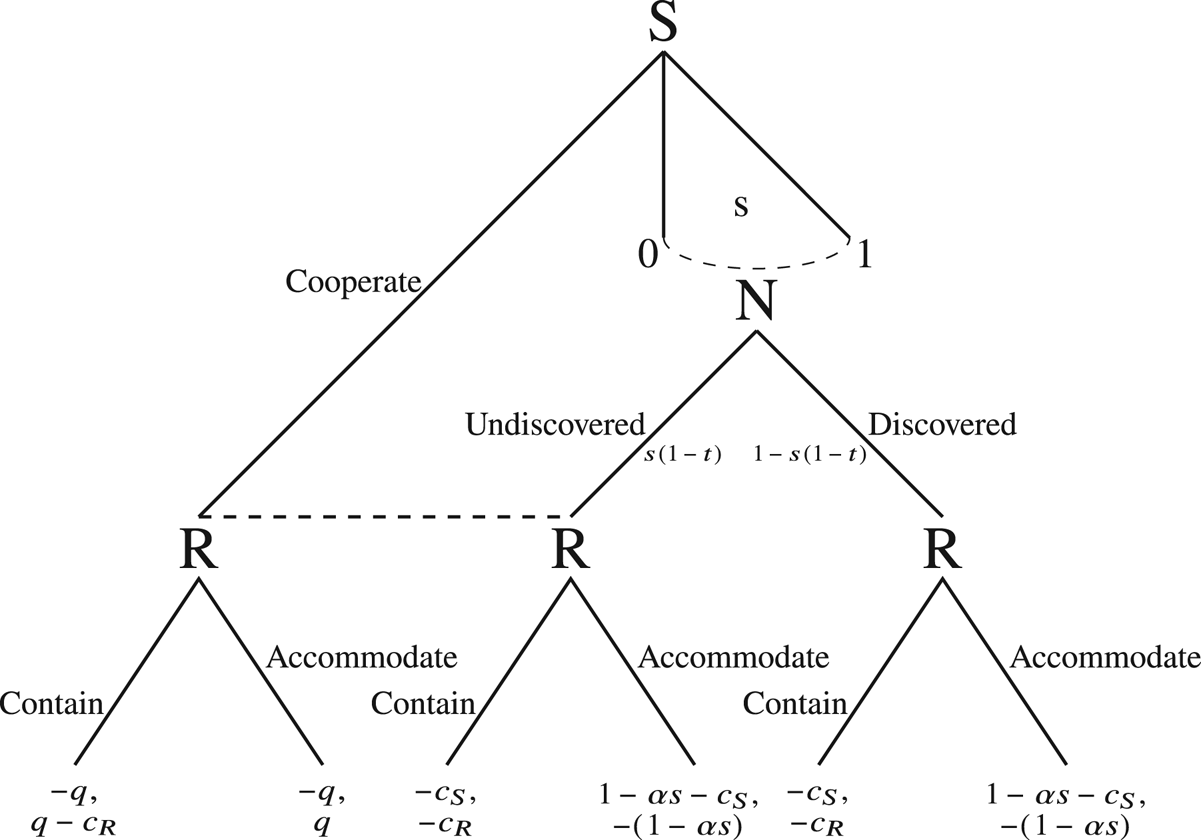
Figure 1 shows the game in extensive form. With the first move of the game, S cooperates or defects. If it defects, it also chooses a secrecy level s ∈ [0, 1]. Next, R observes either a “cooperative” or “noncooperative” signal. If S cooperated, then R must see the cooperative signal. If S defected, Nature chooses which signal R sees. Specifically, Nature sends the cooperative signal with probability s(1 − t), where s is S's chosen secrecy level and t ∈ [0, 1] is a parameter that captures the transparency of S's action.Footnote 31 Conversely, with probability 1 − s(1 − t), S's defection results in Nature sending R a noncooperative signal.Footnote 32 When t = 0, S has complete control over the revelation, while t = 1 means that defection is impossible to hide. Thus, higher transparency decreases the likelihood that defection will remain undetected, all else equal, and reduces the marginal efficacy of S's efforts at secrecy: as transparency increases S must exert greater effort to achieve a particular likelihood of successful concealment.Footnote 33 Once it observes the signal, R chooses to contain or accommodate.Footnote 34
Game tree of the interaction between sender (S) and receiver (R)—note that Nature (N) begins by drawing S's type, and R does not observe S's chosen secrecy level, s

Payoffs are as follows. If S cooperates, the status quo is preserved. We set the value of the status quo to −q for S and q for R, with q > 0 signifying that the status quo is relatively favorable to R. If S defects, it revises the status quo in its favor at some cost. We assume that cost, c S > 0, to be fixed, but the benefit depends on whether R contains or accommodates as well as S's degree of secrecy.Footnote 35
Containment imposes a cost of c R > 0 on R, but it diminishes the effect of a potential defection. If S defects and R contains, both receive a payoff of zero, which reflects a change in S's favor relative to the status quo, and both actors pay their respective costs. If S defects and R accommodates, then the status quo moves even further in S's favor, but the amount is diminished by S's level of secrecy. In particular, letting α denote the cost of secrecy, we let S's payoff for accommodated defection equal 1 − αs − c S. R receives a negative payoff of −(1 − αs) but pays no cost.
In principle, α could range between 0 and 1. To reduce workload and focus on cases where there is a nontrivial trade-off between secrecy and capability, we suppose  $\alpha \in ( {1 \over 2}, \;1) $. This is sufficient to guarantee an interior solution to S's eventual optimization problem.
Given those assumptions, the relative values of c S and q determine S's dissatisfaction with the status quo. When c S < q, S is dissatisfied in the sense that it would rather defect and be contained than live with the status quo. When c S > 1 + q, S is satisfied in the sense that it prefers the status quo outcome to anything it could achieve by defecting. In between, S is conditionally dissatisfied, with its best choice depending on how it anticipates R will act.
To capture R's uncertainty, we assume that Nature draws c S at the beginning of the interaction from a distribution with lower bound cS > 0 and upper bound  $\bar{c}_S$. We leave the distribution of c S general, other than that the distribution's cumulative distribution function F(c S) is twice continuously differentiable and strictly positive within its bounds, and denote the associated probability density function as f(c S). S observes the draw but R does not.
Equilibrium Outcomes
Taking stock, R's main task in this game is to predict whether S will defect. This is not straightforward. S's satisfaction with the status quo depends on its defection cost, which is private information. Those with high costs are very satisfied and thus unwilling to defect even if R will accommodate. Those with low costs are very dissatisfied and thus willing to defect no matter how R will respond. Those with middling costs may also be dissatisfied, but are only willing to defect if they can likely trick R into accommodating.
Hence the dilemma for R. If S will defect, then R would want to contain—assuming that the cost of implementing countermeasures is reasonable. If S will not defect, then R would not want to bear the cost of containing unnecessarily. Meanwhile, S's main task is to anticipate whether R will contain and to find the optimal trade-off between secrecy and operational effectiveness, or, alternatively, simply foregoing its goals altogether.
In the online supplement, we fully solve for an equilibrium mapping that describes optimal strategies as a function of R's cost of containment.Footnote 36 Readers interested in the technical details should examine it. Later, however, we explain the main intuition that drives three types of outcomes.
Open Defection
Suppose that R's cost of containment is large. In this case even if it were to observe a defection, it still might not wish to contain. If so, then R would not want to contain following a cooperative signal either. In turn, any type of S that wishes to defect would do so openly. Efforts to maintain secrecy would only inhibit S's ability to secure its best outcome with no offsetting benefit because R will accommodate regardless. As a result, defection in this case is widespread. The only types that fail to defect are those that are so satisfied that achieving their ideal policy outcome is not worth the cost of defection (c S > 1 + q). We define these types as “satisfied,” in the sense that it is not worthwhile for them to revise the status quo even without containment from R.Footnote 37
Misrepresentation
Suppose that R's cost of containment is not as large, but still substantial enough that R has a strong desire to avoid paying it. In this case, S engages in a form of misrepresentation, where some types attempt to defect in secret. The intuition is easiest to understand when parameters are such that there is a pure strategy equilibrium, so we focus the discussion there. Under these circumstances, cooperative signals are sufficiently persuasive that R accommodates in response, even knowing that there is some risk the signal may be misleading. Thus, R contains if and only if it observes defection.
S faces a real secrecy dilemma given this conditional response from R. If S defects openly, R will certainly observe the action and contain. This means that fewer types defect under these circumstances ( $c_S < q + {{1-t} \over {4\alpha }}$), and those that do are on average less satisfied than when R lets open defection go uncontained. Moreover, for those types of S that do defect, attempting some level of secrecy becomes attractive. Yet because too much secrecy limits how much of the asset S ultimately captures, types that wish to defect must find a middle ground, adopting an intermediate degree of secrecy.
From R's perspective, such a misrepresentation equilibrium exists when its cost of containment falls in a middle range. If the cost is too high, R would not want to contain even when it observes defection. However, the cost of containment cannot be too low. Otherwise, R would want to contain even in response to a cooperative signal, given that there is some probability in the misrepresentation parameter space that the signal is misleading.Footnote 38
Prevention
Finally, suppose that R's cost of containment is small. In this case, R contains even after observing cooperative signals. Intuitively, the downside to containment is so small that trusting the cooperative signal still presents too much risk. This puts S in a bad position. Because R is guaranteed to contain, S derives no benefit from secrecy.Footnote 39 Moreover, because S can alter the status quo to only a limited degree no matter what it does, the only types that defect are those so dissatisfied (c S < q) that contained defection still yields a better payoff than the status quo. Thus fewer and less-satisfied types defect here than in the open-defection and misrepresentation equilibrium outcomes.Footnote 40
The Costs of Secrecy and the Credibility of Reassurance
The main result of the model concerns the credibility of cooperative signals, which depends on Sender's efficiency costs of attempting to maintain secrecy. This, in turn, depends on Sender's transparency. In particular, we focus on how t changes within the misrepresentation equilibrium parameter space.Footnote 41 We begin with how often S engages in secret defection:
Remark 1: Within the misrepresentation equilibrium, Sender is less likely to engage in secret defection as transparency increases.
This result is straightforward. As transparency increases, defection becomes costlier to conceal (in terms of Sender's capacity to achieve its goals), which makes it less attractive. Under sufficiently high transparency, these costs become prohibitive, prompting Sender to abandon its goals by simply cooperating.
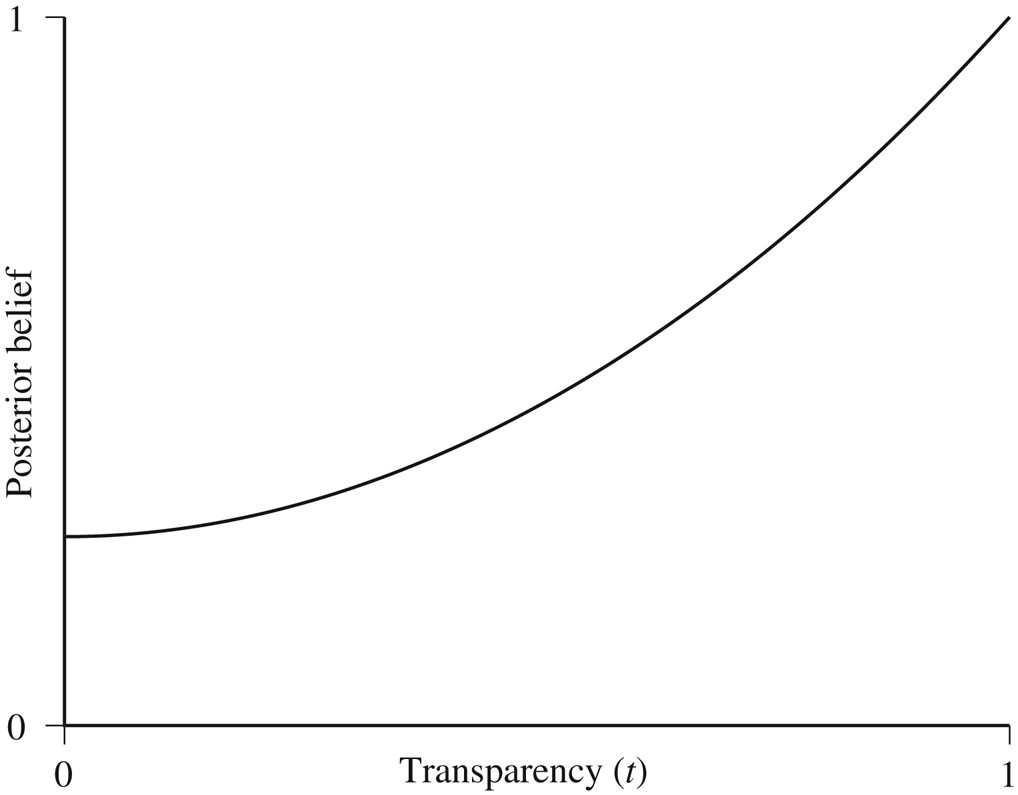
It follows from Remark 1 that cooperative reassurance signals are more credible under higher transparency. Figure 2 shows that as transparency increases within the misrepresentation equilibrium, Sender's cooperative signals prompt Receiver to form increasingly confident beliefs about Sender's satisfaction. Indeed, at the upper bound of transparency (t = 1), Receiver becomes certain that a Sender that even attempts outward reassurance is genuinely cooperating. Thus, under high transparency, the efficiency costs of secret policymaking can make simple reassurance statements highly credible. We summarize this result in the following remark:
Remark 2: Within the misrepresentation equilibrium, the credibility of Sender's cooperative signals increases with its degree of transparency.
Receiver's posterior belief that Sender has cooperated, conditional on not discovering defection, within the pure strategy misrepresentation equilibrium

A corollary to Remark 2 is that within this parameter space, dissatisfied types’ cooperative statements are more convincingly deceptive as transparency increases, as long as they are not contradicted by leaks to the contrary. Thus, higher transparency makes it more likely that deception will be discovered, but enhances its efficacy if it is not. This outcome is borne out in the credibility of German signals in our case study of the July Crisis.
Greater transparency increases the credibility of outwardly cooperative signals through two related pathways. First, as transparency increases, secret defection becomes less attractive and therefore less likely to even be attempted—dissatisfied states are more likely to simply abandon any effort to deceive and defect publicly.Footnote 42 Thus, the probability that Sender's cooperative statements are dishonest decreases. At maximum transparency, the only types of Sender that still defect are dissatisfied types that prefer contained defection to the status quo. In this case, Receiver becomes certain that if it observes a cooperative signal then S is a satisfied type that has not defected. R can thus take S's reassurances at face value.
Second, reassurance also derives credibility from high transparency because higher transparency increases the likelihood that defection will be discovered, if it has been attempted. Thus, to the extent that transparency is high, observing consistent reassurance in the absence of countervailing leaks allows R to form confident beliefs that no secret defection is occurring, and that S is a relatively satisfied type whose cooperative outward statements are genuine. R can therefore afford to treat reassurances under high transparency as credible, confident that S's duplicity will be quickly revealed if they are false.
These two mechanisms can be thought of in terms of the two components of a unitary state's cooperative signals presented earlier (note 31): official statements and unofficial leaks. Mechanism 1 is determined entirely by S's official statements, which are more likely to be sent by a genuinely cooperative S as high transparency induces dissatisfied types to defect overtly, dissuading them from even attempting reassurance. Mechanism 2 is determined by unofficial statements or activities that are conveyed to R against S's will via leaks or espionage. These also comprise a unitary S's signals, even though they may not come from its leaders.
In sum, reassurance is credible under high transparency both because cooperative signals are unlikely to be sent by dissatisfied senders in the first place, and because any dishonest reassurances are likely to be exposed by unofficial statements to the contrary.
The Sender's Transparency Sweet Spot
The previous two remarks described intuitive relationships. Nevertheless, they set the stage for a counterintuitive relationship regarding S's payoffs. The final result is that moderately high transparency benefits S by facilitating successful deception.Footnote 43
Remark 3: For sufficiently dissatisfied Senders, equilibrium payoffs are nonmonotonic, peaking with the likelihood of successful deception at an intermediate degree of transparency.
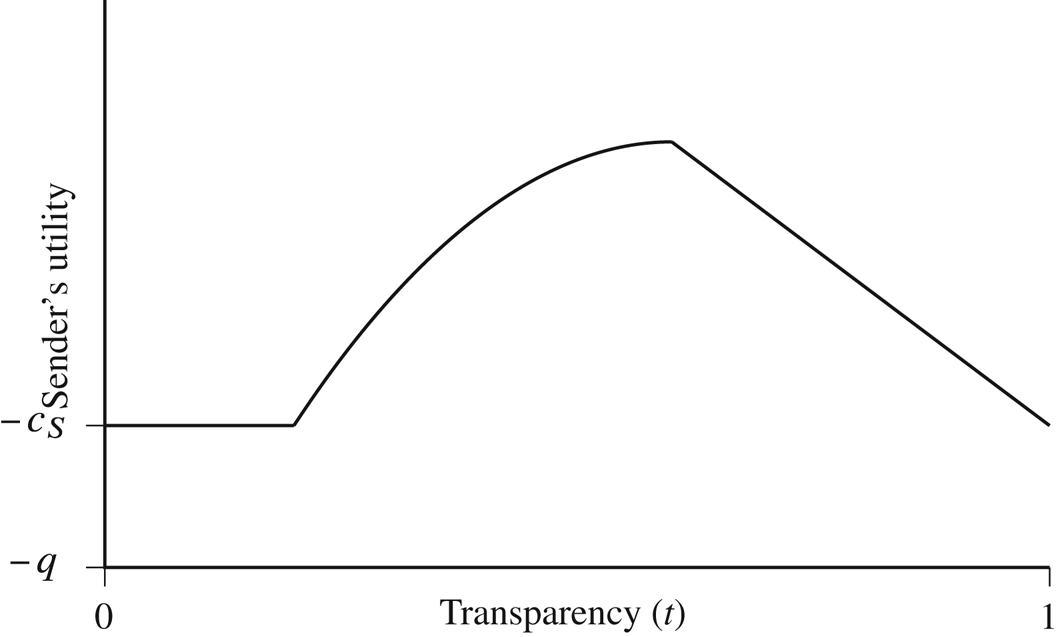
Figure 3 plots the payoff from no transparency to complete transparency for a dissatisfied type that prefers contained defection to the status quo.Footnote 44 In the lowest range, deception is impossible—R contains even in response to cooperative signals. Shifts in the degree of transparency within this range do not alter S's payoff because R remains too skeptical to back down in the face of cooperative signals.Footnote 45 Thus, S's payoff always equals the cost of defection. For sufficiently dissatisfied types (c S < q) this is an improvement over the status quo, but it is not particularly attractive.
Payoffs for a dissatisfied type of Sender as a function of t

In the middle range, transparency is high enough that R does not always contain in response to cooperative signals, but it still does so probabilistically. This is necessary to deter secret defection by moderately dissatisfied Senders—otherwise the frequency of secret defection under relatively high transparency would be unacceptably high to R. As transparency increases within this range, R relaxes its frequency of containment in response to the increasing information from cooperative signals. But this behavior is advantageous to relatively dissatisfied types such as the one depicted in Figure 3, because the reduced risk of containment in response to cooperative signals more than makes up for the increased probability of discovery under higher transparency.Footnote 46
However, the dissatisfied Sender's situation reverses in the upper range of transparency, in which R accommodates in response to cooperative signals. In this case, high transparency means that R observes defection and implements containment more often in response, with no offsetting reduction in the frequency with which R contains in response to cooperative signals. Indeed, under full transparency, the payoff converges back to what occurs under guaranteed containment.
In sum, dissatisfied Senders’ payoffs peak at the cutpoint delineating the intermediate and high ranges of transparency. This is when transparency is just high enough that Sender's cooperative signals, if successfully maintained, are sufficiently credible to forestall containment entirely by an initially distrustful Receiver. As t increases beyond that threshold, secret defection becomes marginally less beneficial because concealment becomes more likely to fail. Intermediate degrees of transparency are therefore preferable to both high transparency, where defection is likely to be discovered and countered, and low transparency, where even cooperative signals are insufficiently credible to forestall containment.Footnote 47
Together, Remarks 2 and 3 imply that lack of diplomatic discipline and susceptibility to espionage can be advantageous. Most obviously, these sources of transparency allow satisfied senders to credibly distinguish themselves by simply maintaining a cooperative façade, since dissatisfied senders would be less willing and able to do so. But even for dissatisfied types, the ability to conceal defection can be too much of a good thing if it renders reassurances noncredible and results in preventive containment. Dissatisfied senders need to be at least somewhat prone to leaks and surveillance to have any chance of successfully deceiving initially distrustful receivers.
These results are contrary to the conventional wisdom that leaks are deleterious to states’ foreign policy goals. Bureaucratic leaks reveal the sender's capabilities and tactical plans, which degrades first-mover advantages.Footnote 48 Relatedly, espionage and leaks hinder bluffing, and thus may undermine deterrence or coercive diplomacy. As Ritter notes, “negotiating in the public spotlight impedes democratic diplomats’ efforts to achieve gains in negotiations with nondemocratic opponents.”Footnote 49 Leaks can also expose lies and embarrass leaders, threatening their domestic legitimacy and freedom of action, as well as their international credibility.Footnote 50 Finally, leaks “allow ... adversaries to understand, and thereby defeat, the sources and methods the [sender] uses to obtain intelligence.”Footnote 51
The results described earlier do not contradict these prevailing arguments, but rather identify countervailing informational benefits that might accrue from susceptibility to espionage or a lack of official discipline. While the complete absence of bureaucratic control is obviously undesirable, under some circumstances—especially under high initial distrust—a limited degree of transparency might outweigh trade-offs on other dimensions. Our case study of the July Crisis identifies one instance where this was evidently true.
Empirical Illustrations
Space constraints preclude fully developed case studies of all the model's hypotheses spanning the full range of transparency. The model's core mechanisms, wherein credible deception can occur under moderate-to-high transparency, are illustrated later in a detailed case study of German reassurance of other great powers prior to World War I. However, to establish that outcomes vary according to the hypothesized mechanisms, this section first presents brief examples of the model's predictions under all parameter spaces.
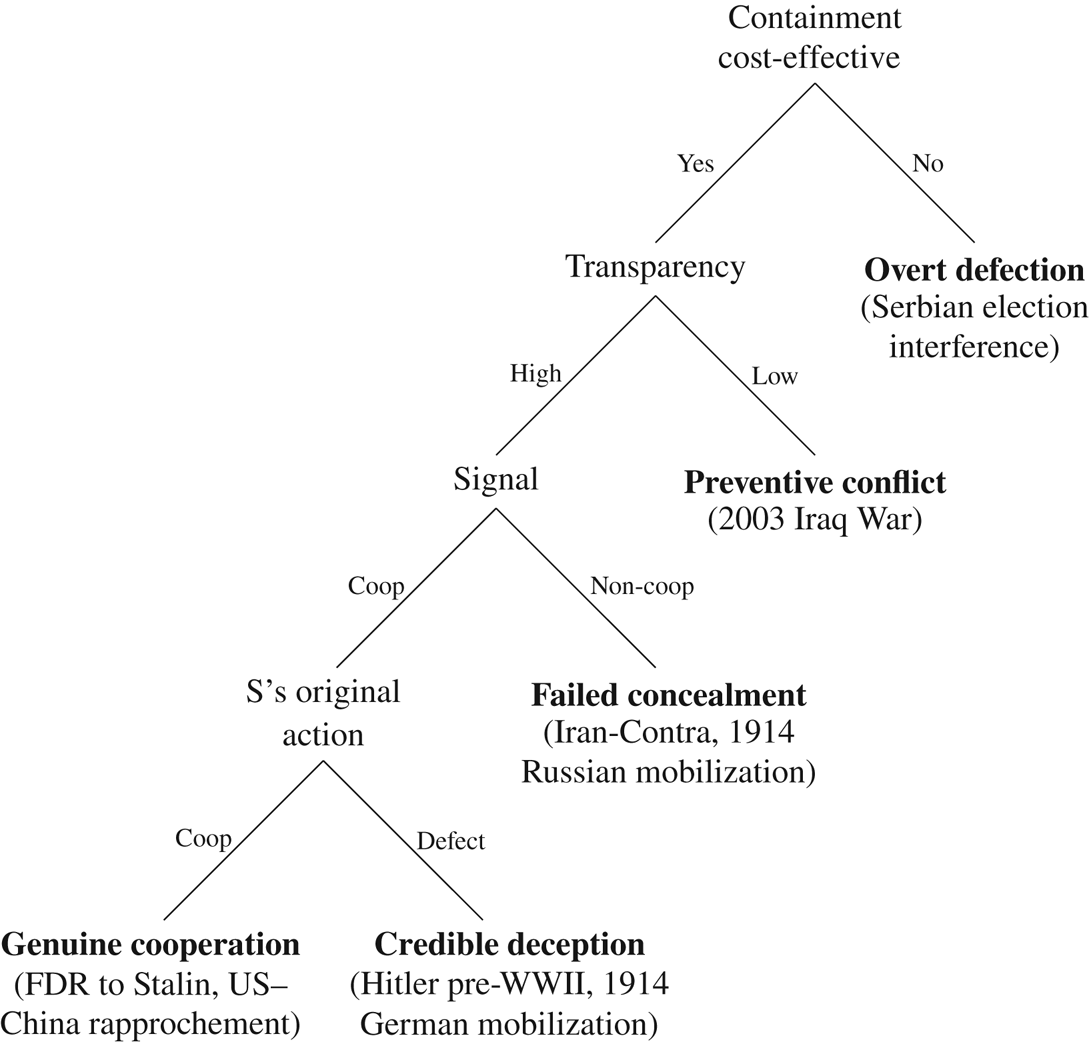
The possible outcomes are organized in Figure 4. The first question is whether Receiver has a cost-effective way to counter Sender's actions. If the answer is no, then S has no reason to conceal its behavior: doing so would only hinder its pursuit of its goals and not change R's response.
Outcomes based on the game's inputs and actions

Overt US electoral intervention in Serbia in 2000 to defeat Serbian dictator Slobodan Milǒsević illustrates this hypothesis.Footnote 52 Potential backlash from the American public and loss of US soft power with allies for violating international norms would be the equivalent of a “containment” response in the model. However, because Milǒsević was universally regarded as a war criminal and a destabilizing force, US interference to oust him was viewed sympathetically both domestically and internationally. Moreover, covert intervention would have precluded fruitful tactics such as get-out-the-vote campaigns and election monitoring.Footnote 53 Thus, despite being at odds with liberal norms, the United States and its subsidiary NGOs publicly spent roughly USD 40 million in Serbia to support Milǒsević's opposition and influence the media. There was simply not much Milǒsević or any third parties were willing and able to do to counter those efforts.
If Receiver does have viable containment options, the next relevant question is whether Sender has high or low transparency. Under low transparency cooperative signals lack credibility because concealment costs little. Thus, R contains no matter what—cooperative signals are insufficiently credible to dissuade it from doing so.
The 2003 US invasion of Iraq was such a preventive containment effort, motivated primarily to stop Iraqi dictator Saddam Hussein from developing weapons of mass destruction (WMD).Footnote 54 This was a quintessentially low-transparency environment. Saddam expelled UN weapons inspectors in 1998, on whom the United States had depended for reliable intelligence estimates.Footnote 55 Consequently, American policymakers were drawing on evidence that was indirect, unreliable, and supportive of multiple interpretations other than that Iraq had WMD.Footnote 56 Despite Saddam's firm denials that he possessed such weapons and the lack of convincing evidence to the contrary, US officials therefore retained confident prior beliefs that he did. These priors were informed by Saddam's possession of advanced WMD programs in the 1990s, his conspicuous expulsion of UN inspectors, and his past arms control violations.Footnote 57 Thus, as the model predicts, Iraq's attempted reassurance under low transparency was ineffective.
The most interesting predictions occur in the misrepresentation equilibrium, where R has viable countermeasures and transparency is relatively high. Here, concealment efforts frequently fail, but this lends credibility to those that succeed. When concealment fails, R responds to the resulting noncooperative signal with containment. However, R responds to cooperative signals by accommodating because it believes only a small subset of outwardly cooperative senders are dissatisfied. The substantive outcome in this case is either credible deception or genuine cooperation, depending on the sender's true behavior, with the former becoming less likely and the latter becoming more likely as transparency increases.
Genuine cooperation in response to verbal reassurances, even among Cold War rivals, has been facilitated by the transparency of US foreign policymaking. For instance, the transparency of US public opinion and party politics gave credence to President Franklin Roosevelt's reassurances to Soviet leader Josef Stalin that FDR was committed to making concessions over Eastern Europe at the end of World War II.Footnote 58 Likewise, the leakiness of the US foreign policy bureaucracy was instrumental in the successful reassurance underpinning US–China rapprochement in the 1970s.Footnote 59 Importantly, US cooperation toward China was open and genuine, even though the United States kept it secret domestically. From China's perspective, US reassurances were credible because the transparent bureaucracy would have revealed any American plans to defect well before they could be implemented.
There are also abundant examples of failed concealment. One is Russia's attempt to conceal its military mobilization during the 1914 July Crisis, detailed later. Another obvious concealment failure is the Iran–Contra scandal, wherein the Reagan administration was caught selling arms to Iran in exchange for the release of American hostages in Lebanon, and then using the proceeds to illegally fund an insurgency in Nicaragua.Footnote 60 This occurred under intermediate transparency, with a reasonable chance of successful concealment. As contemporary journalists noted, the scandal was only revealed by a fluke plane crash and an isolated leak from a disaffected member of Iran's Revolutionary Guard—otherwise “discovery of the Iran-contra diversion might have been deferred for years.”Footnote 61
However, if concealment is successful (which it probabilistically will be), then reassurance signals are credible, and allow a sender to deceive its receivers into believing it is satisfied. This is precisely what Germany did in the run-up to both world wars. The case study in the next section examines German deception of the other great powers prior to World War I. But in addition, the British and French thought it unlikely before 1939 that Hitler could conceal unlimited territorial ambitions and the extensive preparations necessary to pursue them—even under the tightly controlled Nazi regime—given his temperament, the constraints of German public opinion, and extensive Allied espionage. Thus, in the absence of evidence to the contrary, they remained sufficiently credulous that Hitler's aims were limited to sustain an appeasement strategy that facilitated Germany's rise well into 1939.Footnote 62 Likewise, Stalin and his generals were shocked by Germany's launch of Operation Barbarossa in June 1941, due to their expectations “that it would take several weeks for the Germans to concentrate their forces for an attack against Russia” and that “this German concentration could not be carried out secretly.”Footnote 63
Transparency, Credibility, and the July Crisis
In the 1914 July Crisis preceding World War I, Germany successfully reassured multiple key international audiences—Russia, Britain, and Austria—that its intentions were benign. Each receiver was firmly convinced that Germany was genuinely working to prevent the escalation of a local Austro–Serbian conflict over the assassination of Austrian Archduke Franz Ferdinand into a general European war involving Russia, Germany, and France. Remarkably, however, the voluminous literature on the war's origins has virtually ignored the question of why Germany's reassurances were credible. This is striking because the now-dominant (albeit oft-challenged) perspective among diplomatic historians is that Germany was misrepresenting: either its leaders desired and actively fomented preventive war against Russia,Footnote 64 or this preventive motivation made them knowingly run extreme risks that dramatically increased the likelihood of European conflict.Footnote 65
Whatever Germany's motivations, scholars widely agree that it was actively preparing for war with Russia (and Russia's ally, France) from at least the early days of the July Crisis, if not before. Moreover, it was absolutely essential for Germany to keep these preparations secret. Doing so was necessary for Germany to secure indispensable domestic support for the war effort, induce Britain to remain neutral, convince Austria to issue unacceptable demands to Serbia that would prompt Russia to mobilize in Serbia's defense, and assure Russia that it could mobilize without instigating war with Germany, so that Russia—not Germany—would be blamed for the war.Footnote 66 In terms of the model, Germany was in the parameter space supporting secret defection—that is, covertly conducting preparations for offensive war against Russia—despite relatively high transparency (as discussed later).
The theoretical mechanisms presented earlier account for the otherwise puzzling credibility of German reassurances. As will be established, Germany faced a high transparency context. This meant that German concealment necessitated substantial operational costs, and was still likely to fail. Its receivers therefore saw Germany as unlikely to even attempt to maintain a cooperative veneer (let alone succeed) if it were actually plotting a war. Consequently, Germany's consistent reassurances, coupled with the lack of countervailing leaks, were highly credible.
Puzzle
The other great powers’ credulity of Germany's benign intentions is puzzling for existing theories. Germany took virtually no cooperative foreign policy actions that would traditionally be considered costly signals, such as abandoning commitments to allies, acceding to arms control agreements, or relinquishing strategic assets. On the contrary, Germany was firmly enmeshed in the Triple Alliance, pursuing overseas colonies and a sphere of influence in the Balkans, and immersed in a sustained military expansion, including a naval race with Britain.Footnote 67 Moreover, the German press and government's public rhetoric grew increasingly anti-Russian in the weeks before the war.Footnote 68 This disconfirms the standard “audience costs” explanation, which would predict pacific promises to the domestic public that tied Germany's hands to act with restraint toward Russia.Footnote 69
Instead, Germany's only positive reassurance signals that it was negotiating in good faith were private verbal statements, which according to standard theories should have lacked credibility. The famous 5 July “blank check” assuring Austria of unconditional German support against Serbia, along with subsequent assurances to Austria that Germany would deter Russia, were all purely verbal.Footnote 70 So were German reassurances to Russia throughout the crisis that Germany would restrain Austria and ensure Serbia's integrity, and that various stages of Russian mobilization would not provoke Germany to mobilize or declare war.Footnote 71 And primary documents reveal that the British consistently believed verbal reassurances that Germany sought peace and would restrain Austria.Footnote 72
Moreover, none of the receivers had positive priors about German intent.Footnote 73 Britain and Russia each had ongoing military, economic, and colonial rivalries with Germany spanning over a decade.Footnote 74 Furthermore, both were well aware of Germany's ongoing military expansion and its pronounced anxiety about Russia's rise.Footnote 75 In March the Russian ambassador in Berlin cited “confidential information” from “various sources” that “Russia's growing strength is causing great apprehension” and that “Germany spares neither means nor energy to bring its military preparedness to the pitch of perfection.”Footnote 76 Russia thus initially held “constant suspicion of German designs,” and “a feeling of mistrust of German diplomacy and policy.”Footnote 77 Likewise, before the crisis the British “calculat[ed] that the major risk of a European war lay in the German militarists driving their country into a preventive war against Russia.”Footnote 78 How, then, given their initial distrust, did British and Russian leaders become so thoroughly credulous that Germany was acting in good faith to restrain Austria and maintain peace? And why were the Austrians so confident that Germany would deter Russia, instead of compromising Austria's aims by drawing Russia into war?
The theory presented earlier provides an obvious explanation for this puzzle. Any German preparations for war with Russia had to be carried out under high transparency, and would be difficult to conceal. It therefore seemed extremely unlikely to Germany's audiences that German leaders could secretly execute the extensive coordination within Germany and with Austria necessary for preventive war, and thus equally unlikely that they would even try. Thus, absent leaks to the contrary, Germany's reassurances were credible because its receivers recognized that maintaining them would be costly for a hostile Germany that desired war.
Germany's war preparations had at least three sources of transparency: (1) extensive foreign espionage networks and the immense scope of the operation; (2) the necessity of military coordination with Austria; and (3) the leakiness of the German press and diplomatic corps. The remainder of this section establishes each of these sources of transparency, the resulting costs of concealment for Germany, the recognition of those costs by Germany's audiences, and the credibility of Germany's reassurance signals in their eyes. This strongly implies a causal linkage between all three dimensions of German foreign policy transparency and the positive beliefs of all three receivers about German intentions, which are so puzzling for prevailing theories.
Scope of Operation
The most obvious source of German transparency was the massive scope of the operation being prepared—full-scale preventive war on two fronts in coordination with an essential ally—which, as described earlier, makes concealment inherently difficult. Germany's premobilization preparations required secret coordination of thousands of individuals and enormous movements of troops, equipment, and finances to enable rapid mobilization once war was declared. Non-coincidentally, the British ambassador to Berlin noted “extreme sensitiveness in Germany at the present time on the question of espionage,” of which “a regular system” existed among the great powers.Footnote 79 It was thus quite likely that communication regarding German military preparations would be discovered by enemy surveillance.Footnote 80 Indeed, as noted earlier, the Russians enjoyed “confidential information ... from various sources” about Germany's foreign policy attitudes.Footnote 81 Yet the most striking evidence of Germany's difficulty in concealing its military plans is that the Schlieffen Plan, Germany's top-secret contingency plan for an all-out offensive against France at the outset of any two-front war, was already well known to the Entente powers.Footnote 82
Our model predicts that in such a high-transparency context, the operational costs of reliably concealing military preparations should be high. This means that a large portion of states in Germany's position, even if relatively dissatisfied, would simply forgo revision and cooperate genuinely. Moreover, if secret operations were attempted, the other great powers would expect them to come to light. Thus, if Germany issued and sustained reassurances, with no countervailing leaks of mobilization activities, this should have been a credible signal that it genuinely sought peace.
Each of these hypotheses is borne out. Given the high-transparency context, German leaders had to go to extraordinary lengths, at great cost to operational efficiency, to conceal their war preparations. Explicit planning was restricted to a tight inner circle of chancellor Theobald von Bethmann-Hollweg (hereafter “Bethmann”), army chief of staff Helmut von Moltke, and a few top Foreign Office officials. Even Kaiser Wilhelm II (himself a prime source of leaks) was excluded.Footnote 83 Extensive military premobilization measures were taken, but only those which could be reliably concealed. According to Bethmann, any further preparation, despite its military benefits, “would not compensate for the damage which it would do in the political and ideological spheres ... At present, nothing may be done out in the open.”Footnote 84 Consequently, Germany's own military was completely unprepared when war was declared on 1 August:Footnote 85 “Important military measures had been delayed for political reasons, and given Germany's military strategy, even short delays might have had serious consequences. The two sides of [German] policy [i.e., coordination and concealment] were working at cross purposes.”Footnote 86
Improbably, Germany's premobilization measures were not leaked to the British or Russians until well after Russian mobilization had already begun.Footnote 87 Moreover, Germany's receivers recognized that concealing preparations would be difficult and costly to Germany if it actually intended war with Russia. As Trachtenberg observes, to the other European powers, Germany's apparent lack of adequate military preparations “hardly fit the picture of a German government carefully and systematically plotting a war of aggression.”Footnote 88
British and Russian failure to observe Germany's hard-to-conceal premobilization activities therefore lent credibility to Bethmann's reassurances that “militarists” did not control Germany, and that civilian leaders were actively working to save the peace.Footnote 89 French and British intelligence reported that Germany had recalled military officers on leave on 29 July, but “had done nothing more.”Footnote 90 The Russians also heard no whispers of mobilization in Germany, and noted the contrast with their own noisy activities. According to a report Russian foreign minister S.D. Sazonov received on 28 July, “as far as the German frontier, not the slightest indications were seen of military measures. But immediately after crossing the German frontier [into Russian Poland], we noticed mobilization steps being taken on a grand scale.”Footnote 91 Likewise, “news was constantly arriving about [Austria's plans for] mobilization on the Russian frontier.” According to Sazonov, the contrast with consistent German reassurances and lack of leaks of German mobilization “gave me ground to hope that this time the German Government would at last consent to use its influence in Vienna and persuade [Austrian prime minister] Berchtold to be more amenable.”Footnote 92 Furthermore, the disparity between German and Russian signals was apparent to Britain as well. Russia's best attempts to conceal premobilization efforts from Germany immediately failed, and Sazonov elected to simply reveal these preparations to the British, despite facing the same incentives to deflect war guilt and elicit British support that Germany did.Footnote 93
Thus, the absence of leaks of German mobilization under high transparency gave the British and Russians good reason to believe German reassurances that no military action against Russia was being contemplated. Russia mobilized in response to Austria's declaration of war on Serbia in part because its leaders did not imagine that Germany could have progressed so far in its premobilization efforts secretly, and thus trusted Germany's pledge to continue good-faith negotiations during a lengthy interlude while both sides mobilized.Footnote 94 Indeed, “the Russian mobilization decision was not rooted in the fear that Germany was about to mobilize first” (emphasis added).Footnote 95 Thus, the Russians clearly believed Germany's consistent assurances under high transparency that it was not undertaking offensive military preparations.
Similarly, “throughout the weeks of July,” British foreign minister Edward Grey “genuinely felt that the Germans would restrain their allies if reassured about Russian intentions” and “continued to hope that Bethmann [would] bring the Austrians to the bargaining table.”Footnote 96 As late as 1 August, Grey was so thoroughly convinced by German reassurances “that German mobilization was being forced by Russia”Footnote 97 that he briefly offered Germany not only British but also French neutrality, to prevent the Western allies from being dragged into what Grey perceived as a war of Russia's making.Footnote 98
Germany's deception ultimately achieved three of its four goals: committing Austria to war with Serbia; inducing Russia to mobilize first; and using that to deflect guilt and gain domestic support for the war. The only failure—Britain's belated declaration of war on 4 August—occurred because Germany was unable to sustain its concealment following its declaration of war on 1 August, after which its rapid mobilization gave the British “strong evidence to show that Germany really desired war.”Footnote 99 Yet Grey recognized in retrospect that he had been deceived by Germany's consistent reassurances during the crisis, “outraged at the way Germany ... while [disingenuously] continuing to negotiate have marched steadily to war.”Footnote 100
In sum, Germany's operational costs of concealing its military preparations were high. This was recognized by its receivers in Britain and Russia, who explicitly noted the contrast between the immediate leaks of Austrian and Russian mobilization measures and the complete absence of leaks of German mobilization. As the model predicts, because it was unlikely that Germany would plan and execute a secret war given the high operational costs of successful concealment, the fact that Germany even attempted reassurance, and the absence of leaks to the contrary, constituted a credible signal in the eyes of British and Russian leaders.
Coordination with Austria
Concealing military preparations against Russia required Germany to forgo indispensable military and diplomatic coordination with Austria. To have any chance of winning a two-front war, Germany needed a diversionary Austrian offensive against Russia while Germany concentrated its forces to quickly defeat France. Yet Germany also faced tough trade-offs between coordination and concealment: revealing why Austrian mobilization against Russia was necessary would almost surely have prompted Austria to compromise with Russia to avert general European war.Footnote 101 Germany therefore eschewed coordination with Austria, despite the tremendous operational costs of doing so.
In terms of our model, open German coordination with Austria for war against Russia would have sent a noncooperative signal to all three receivers. Conversely, a lack of coordination with Austria would cripple Germany's intricate military strategy, and was thus costly for a Germany that sought war. Germany's sustained insistence to the British and Russians (without contrary leaks) that it was working to restrain Austria, and to the Austrians that it was working to deter Russia, were therefore credible signals that Germany genuinely sought peace.
In issuing the infamous “blank check” of 5 July, Germany explicitly promised to deter Russian intervention in support of Austria's hard line against Serbia.Footnote 102 Bethmann then continued to confidently reassure the Austrians throughout the crisis that Germany would ensure that Russia would back down.Footnote 103 This conformed with Austria's preference for localized confrontation with Serbia that would avoid war with Russia. Despite holding weak priors about German support—since Germany had previously restrained Austria in similar crisesFootnote 104—Austrian leaders were thoroughly convinced by Germany's verbal assurances.Footnote 105 Austrian Foreign Minister Szögyény reported on 6 July that “given the accumulated assurances of German alliance loyalty and military cover,” Austria could confidently direct its military preparations exclusively toward Serbia.Footnote 106 This was precisely what the Austrians did, spurred on so enthusiastically by Germany that it was “almost embarrassing.”Footnote 107
Consequently, as Trachtenberg notes, “[Germany's] lack of military coordination with Austria [was] astounding ... Precise arrangements were not worked out during the crisis, and it was only at the last minute that Moltke asked Austria ‘to employ her main strength against Russia and not disperse it by a simultaneous offensive against Serbia.”’Footnote 108 The operational result was “disaster” in the crucial early days of the war. The majority of Austria's army, having already begun operations in Serbia, took weeks to redeploy to the Russian front, resulting in “devastating losses for the Hapsburg armies.”Footnote 109 Inability to coordinate diplomatically carried another heavy cost: Italy's failure to honor its Triple Alliance commitment. In exchange for entering the war, the Italians demanded territory from Austria. Yet because this concession would necessarily be public, Germany could not pressure Austria to make it. As Bethmann told his personal aide, Germany “cannot talk to [our allies] beforehand; it would give away everything in Petersburg.”Footnote 110
These costs to a bellicose Germany of forgoing coordination were recognized ex ante by all three receivers, who were well aware of the Schlieffen Plan and the high degree of coordination it would require with Austria.Footnote 111 They were also aware that Austrian mobilization against Russia needed to begin two weeks in advance, and before Austrian operations against Serbia precluded redeployment to the Russian front.Footnote 112 Thus, the Austrians’ observation that Germany was practically screaming at them to mobilize against only Serbia, and the detailed British and Russian intelligence reports thereof,Footnote 113 were highly credible verbal signals of Germany's peaceful intent toward Russia.Footnote 114 As Fellner points out, if Germany was anticipating war with Russia, the Germans desperately needed Austria to adopt precisely the opposite military strategy from the one they were encouraging: to the Austrians, “the promise given by German leaders [the “blank check”] meant that the Germans should have made use of all diplomatic [means] to at least delay, if not prevent, the expansion of the war.”Footnote 115
Likewise, the British and Russians believed Bethmann's verbal reassurances that, for Germany, Austrian “hostilities about to be undertaken against Servia [sic] had exclusive object of securing [Serbian concessions].”Footnote 116 The British concluded that “Germany wishes Russia to join with the other Powers in keeping the ring while Austria strangles Servia [sic],” but Bethmann otherwise “desire[d] to cooperate with England and [would] do his utmost to maintain general peace.”Footnote 117 Russian leaders also inferred that Germany was unprepared for war with Russia, and that strong signals of resolve would make Germany back down.Footnote 118 Sazonov stressed that “Germany had looked upon our [previous] concessions as so many proofs of our weakness,” and Alexander Krivoshein, the most influential Russian cabinet member, argued that “firmness, rather than conciliation, was likely to secure peace.”Footnote 119
In sum, failure to coordinate with Austria was tremendously costly for German military plans. Consequently, observation by all three audiences of German communications to Austria to mobilize against Serbia only—and no leaks of Austro–German coordination for war with Russia—constituted a credible signal that Germany was genuinely working to ensure that Austria's conflict with Serbia would remain localized.
Domestic Leaks
A final source of transparency were leaks from the German press and diplomatic corps. Although pre-World War I Germany was not fully democratic, some mechanisms of democratic transparency (legislative elections, powerful opposition parties, a semi-independent press) operated there. These various sources of leaks made it very difficult for Germany to conceal its preparations for war with Russia without incurring high costs of cutting key agents and decision makers out of the planning process. Yet as discussed earlier, Germany did indeed bear these costs, thus ensuring that Germany's press, opposition parties, and diplomats all maintained the government's narrative that Germany was working for peace. This conspicuous absence of leaks, and the obvious costs to a hostile Germany of suppressing them, made these cooperative verbal signals credible to British officials.Footnote 120
The British clearly did not imagine that German policymakers could exclude their own monarch, military, and diplomatic corps from policy planning. Thus they routinely looked to Germany's notoriously loose-lipped ambassadors for information about German intentions,Footnote 121 as well as to German newspapers, some of which had deep access to the German military and Foreign Office.Footnote 122 The ambassador to London, Karl Max von Lichnowsky, “was much too credulous and could easily be duped by the wily British,”Footnote 123 while the German ambassador to Vienna, Heinrich von Tschirschky, was so identified by the British “with extreme anti-Servian [sic] and anti-Russian feeling prevalent in Vienna that he is not likely to plead [the] cause of peace with entire sincerity.”Footnote 124 On 6 July, Lichnowsky “blurted out to Grey, without any instructions from Berlin, all he knew of his government's hair-raising policy with regard to the Sarajevo murders,”Footnote 125 that is, that “Vienna should take some measures against Servia [sic] of a rather strong character.”Footnote 126 Similarly, Tschirschky “confessed ... that he did not believe in the possibility of improved relations between Austria and Servia [sic].”Footnote 127
These indiscretions by German ambassadors, and similar ones from Austrian officials,Footnote 128 made it impossible for Germany to conceal its principled support for Austria's hard line against Serbia in the bilateral Austro–Serbian dispute, which German leaders were subsequently forced to acknowledge.Footnote 129 Yet this underscored to the British the difficulty Germany faced of containing diplomatic leaks, and rendered subsequent cooperative statements from these ambassadors credible.Footnote 130 For example, in the aforementioned conversation of 6 July, Lichnowsky reassured British diplomats that Germany would restrain Austria because, even though Germany supported Vienna's demands, “Berlin is most anxious ... as to the consequences and the effect which might be produced in Russia.” Strikingly, the (temporary) British takeaway was that “Berlin would be against strong measures against Servia [sic] being taken from Vienna,” which of course was exactly backwards.Footnote 131 Likewise, the British attributed special significance to Tschirschky's 29 July statement that the “German Government might consent to act as a mediator” with Britain, France, and Italy to avert war between Russia and Austria.Footnote 132
Verbal signals from the German press also indicated that Berlin was anxious to maintain cooperation to forestall war. For example, Britain's ambassador to Berlin reported on 11 July that German reassurances were “fully borne out by the reserved attitude of the German Press ... and by what I have been able to gather at the Imperial Foreign Office.”Footnote 133 He reiterated on 18 July that “the German press on the whole showed considerable restraint in their comments ... If there has been an exchange of views between Berlin and Vienna about the [Austrian ultimatum to] Belgrade, the result has been kept absolutely secret.”Footnote 134 This statement constitutes rare “smoking gun” evidence that the British updated their beliefs according to the hypothesized signaling mechanism. Consequently, British officials concluded that although Germany was observably “egging on the Austrians,” it must be doing so only because “the German Government [does] not believe there is any real danger of war” with Russia.Footnote 135 Even following Austria's ultimatum, the British continued to infer from the German press that German leaders would “no doubt use their influence” to ensure “that the inevitable war would be localised between Austria and Servia [sic].”Footnote 136
Summary
In July 1914, Germany successfully reassured three different audiences—Britain, Russia, and Austria—that it was working to maintain great-power peace, not preparing preventive war against Russia. We have argued that these signals were credible because they occurred under moderate-to-high transparency, where concealment was possible but unlikely. Germany's preventive war plan required difficult-to-conceal communication for military preparations and coordination with Austria. Furthermore, leaks were likely via extensive espionage operations, an independent German press, and undisciplined German diplomats. Maintaining a cooperative outward narrative therefore required stringent concealment measures that carried substantial operational costs: important decision makers were excluded, valuable premobilization measures were truncated, and essential military coordination with Austria was forgone. Moreover, these costs of concealment were explicitly recognized by Germany's audiences, who did not expect Germany to bear them to a sufficient degree to successfully conceal its activities if it were actually plotting preventive war. Thus, as the model predicts, the fact that Germany was both willing to attempt and able to maintain consistent reassurances under high transparency—avoiding any leaks to the contrary—credibly signaled its peaceful intentions to allies and adversaries alike.
Conclusion
This paper has argued that under certain conditions, the mere absence of observed defection can constitute a costly signal that credibly communicates the sender's benign intentions. This occurs when the transparency of the sender's foreign policymaking process is relatively high, such that its internal communications and activities are likely to be observed by outside actors. Because a transparent environment makes it difficult and costly for hostile senders to plan and execute exploitative policies in secret, simply maintaining a consistently cooperative veneer becomes a credible signal of benign intent.
This argument constitutes an important contribution to the literatures on both covert action and credible signaling. Within the former, it identifies a novel source of costs that helps determine when states are likely to pursue their goals covertly as opposed to openly. Specifically, avoiding discovery and punishment under high transparency requires the sender to restrict its internal coordination in ways that hamper its capacity to formulate and implement its policies.
These trade-offs constitute a novel and generalizable reassurance mechanism previously unrecognized in the costly signaling literature, which has focused on positive actions that probabilistically distinguish benign states from hostile ones. The argument here instead shows that under high transparency, simply maintaining a consistently cooperative outward narrative—including verbal statements—can impose direct costs on hostile senders, and therefore is not merely cheap talk. Thus, as illustrated in the case of the July Crisis, it is possible for a transparent sender to shape the beliefs of initially distrustful receivers by simply maintaining verbal reassurances in the absence of leaks, without taking any concrete foreign policy actions to convey benign intentions.
Supplementary Material
Supplementary material for this article is available at <https://doi.org/10.1017/S0020818322000248>.
Acknowledgments
For helpful comments on this paper the authors thank Austin Carson, Dale Copeland, Kyle Haynes, Mike Poznansky, Robert Schub, Ken Schultz, Rob Trager, Keren Yarhi-Milo, and two anonymous reviewers. Special thanks to Zach Taylor for assistance with the formal proofs.