





Impact statement
This perspective moves beyond identifying the problem of wetland sediment deficits by providing a tangible solution. We demonstrate that reclaiming material from uncontaminated dredged material stockpiles called confined disposal facilities is not only feasible but essential for large-scale coastal restoration to better protect our coastal communities. By outlining a clear path forward that addresses key hurdles in research, planning and implementation, this article provides practitioners with the strategic framework needed to turn this concept into a cornerstone of sustainable coastal management.
Key points
-
1. Over 596 million m3 of dredged material currently stockpiled is potentially available for restoration of US South Atlantic marshes.
-
2. Sediment reserves offer potential value of $10 billion annually to raise saltmarshes 1.1 m to address sea-level rise from 2000 to 2100.
-
3. Numerous challenges and hurdles must be overcome to successfully use these stockpiles for marsh restoration.
Introduction
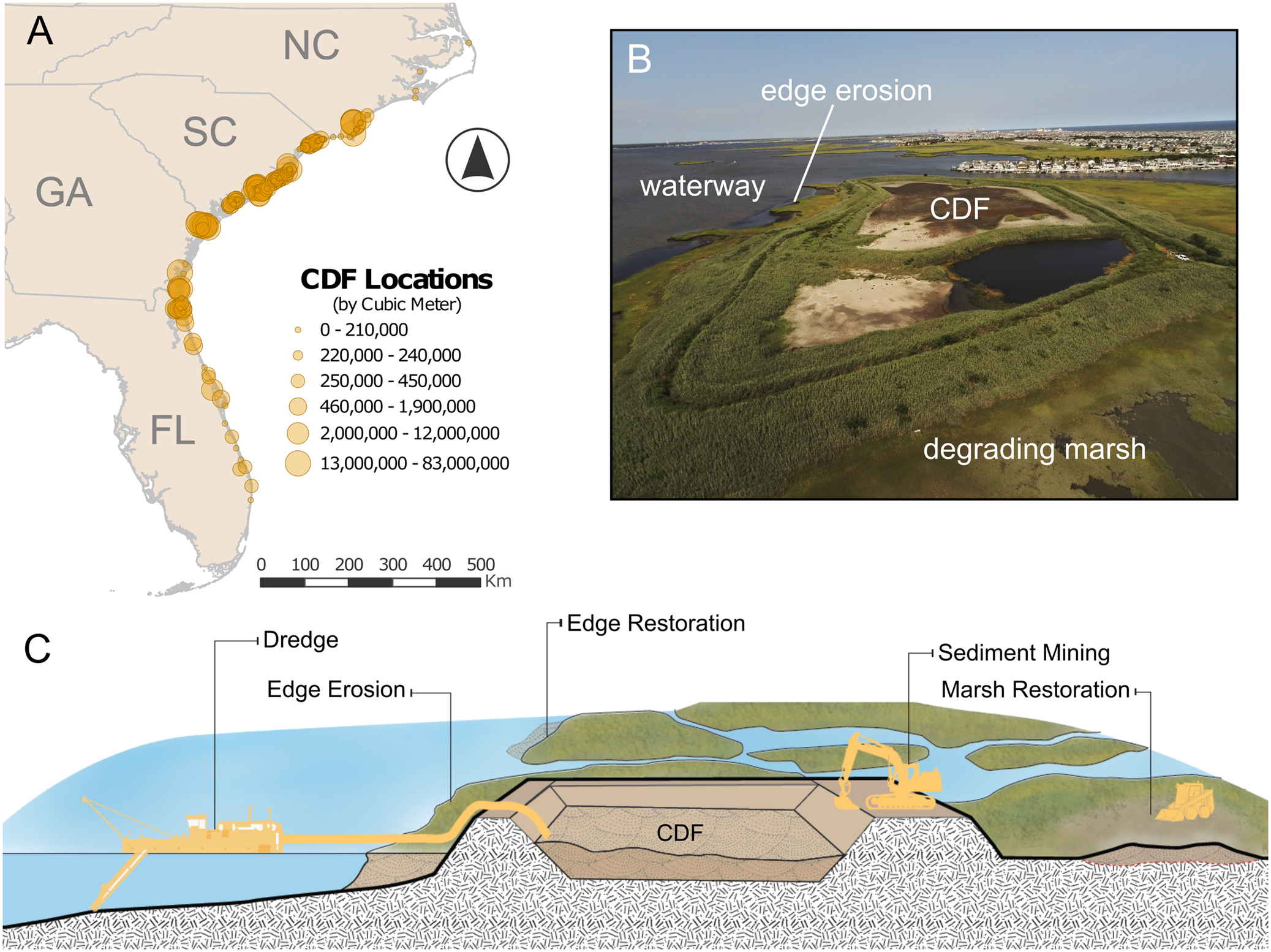
The loss of 46.6% of global saltmarsh underscores the urgent need for innovative coastal restoration strategies (Brook et al., Reference Brook, Millington-Drake, Garbutt, McGarrigle, Rodriguez and du Plessis2025; Suedel et al., Reference Suedel, McQueen, Wilkens, Saltus, Bourne, Gailani, King and Corbino2021). Traditional sediment sourcing from inland and offshore borrow areas is becoming prohibitively expensive and potentially environmentally damaging (e.g., Nairn et al., Reference Nairn, Johnson, Hardin and Michel2004). While recent guidance in the United States promoting the beneficial use of dredged material (118th Congress, 2024) is a positive step, it does not fully address the saltmarsh sediment deficit. A more comprehensive solution may lie in an often-overlooked resource: the vast stores of sediment locked away in coastal confined disposal facilities (CDFs) (Figure 1).
A) Confined disposal facilities (CDF) and volumes along the US South Atlantic coast. B) Example of a CDF located along a waterway and adjacent to a degrading marsh in coastal New Jersey, USA. Photo credit: David White/USACE. C) Conceptual diagram of CDF sediment management and beneficial re-use for saltmarsh restoration.

Figure 1. Long description
(a) Map of Confined Disposal Facility (CDF) locations and volumes along the U.S. southeast coast showing orange dots for each CDF. There are concentrations of high volume CDFs along the South Carolina coast in particular, (b) Low angle aerial photo of a CDF with earthen dikes next to a degrading marsh as indicated by ponding and edge erosion, and (c) Diagram of a dredge pumping material into a CDF (which was common practice in the late 1900s) and excavators removing material to place on a marsh for restoration (which is the solution proposed by this perspective piece).
CDFs are essentially stockpiles of dredged material that represent a sediment management solution following the passage of the Clean Water Act in 1972. CDFs are a necessary tool to maintain marine navigation. Although environmental testing would be required, most sediment in CDFs outside of highly industrialized, contaminated zones is likely suitable for coastal restoration. Many of these facilities are at or nearing capacity, which limits their future use and could compromise coastal navigation. Building new CDFs is often infeasible due to high construction and permitting costs (HDR and LMS, 2006). A more practical approach involves emptying existing CDFs and repurposing the sites as processing facilities for future sediment (Bailey et al., Reference Bailey, Estes, Schroeder, Myers, Rosati, Welp, Lee, Gwin and Averett2010), transforming them into a largely untapped “goldmine” for coastal restoration.
With this perspective piece, we aim to spur action by highlighting the strong potential of CDF sediment as a solution for coastal restoration. Using the southeast US Atlantic Intracoastal Waterway, a shallow-draft estuarine navigation channel located between offshore barrier islands and the mainland coast, as a case study, we quantify the available CDF sediment and its potential benefits to adjacent marsh environments. Next, we identify challenges to large-scale CDF mining and propose a research framework for sustainable CDF management. The insights and strategies presented here are broadly applicable to coastal regions worldwide, offering a path toward more resilient coastal environments.
Coastal restoration needs
Coastal areas are among the most densely populated in the United States, with the southeast states experiencing particularly rapid growth, now exceeding 20 million residents (NOAA Office for Coastal Management, n.d.). These communities, along with seasonal tourists, depend heavily on the services of over 400,000 ha of saltmarsh along the US southeast coast (SASMI, 2023). These marshes act as vital natural infrastructure, reducing storm surge and flooding impacts (Wamsley et al., Reference Wamsley, Cialone, Smith, Atkinson and Rosati2010; Möller et al., Reference Möller, Kudella, Rupprecht, Spencer, Paul, Van Wesenbeeck, Wolters, Jensen, Bouma, Miranda-Lange and Schimmels2014; Narayan et al., Reference Narayan, Beck, Wilson, Thomas, Guerrero, Shepard, Reguero, Franco, Ingram and Trespalacios2017; Rezaie et al., Reference Rezaie, Loerzel and Ferreira2020) and providing habitat for numerous species (Boesch and Turner, Reference Boesch and Turner1984; Rush et al., Reference Rush, Soehren, Woodrey, Graydon and Cooper2009). With an estimated ecosystem service value of $193,843 per hectare annually, the marshes of the US South Atlantic alone are worth ~$78 billion per year (Mitsch et al., Reference Mitsch, Bernal and Hernandez2015; SASMI, 2023).
Despite their immense value, these critical ecosystems are in decline due to a combination of threats, including sea-level rise, historical land claims, edge-erosion and anthropogenic disturbances (Day et al., Reference Day, Kemp, Reed, Cahoon, Boumans, Suhayda and Gambrell2011; Couvillion et al., Reference Couvillion, Beck, Schoolmaster and Fischer2017). While saltmarshes can naturally migrate inland to adapt to rising seas, this migration is often blocked by development and steep slopes (Enwright et al., Reference Enwright, Griffith and Osland2016; Molino et al., Reference Molino, Carr, Ganju and Kirwan2022). This “coastal squeeze” amplifies the impacts of vegetation loss and pond expansion, which degrade marsh function (Mariotti, Reference Mariotti2016; Cadigan et al., Reference Cadigan, Jafari, Stagg, Laurenzano, Harris, Meselhe, Dugas and Couvillion2022).
To counter these losses, solutions that increase sediment supply, such as the beneficial use of dredged material, are essential for raising marsh elevation (Ganju, Reference Ganju2019; Suedel et al., Reference Suedel, McQueen, Wilkens, Saltus, Bourne, Gailani, King and Corbino2021). Techniques like hydraulic pumping and nearshore berm placement are growing in practice (Harris et al., Reference Harris, Day, Cadigan, Jafari, Bailey and Tyler2021; Piercy et al., Reference Piercy, Welp and Mohan2023; Perkey et al., Reference Perkey, Tedesco, Fall, Huff and Chasten2024; Harris et al., Reference Harris, Shawler, Ostojic, Chasten, McGill, White, Tedesco, Bruder, Falcone, Gallegos, Stark, Grilliot and Kinney2026). However, beneficial use of dredged material during navigation maintenance events alone cannot offset the scale of marsh degradation. Additional sediment sources are desperately needed, but conventional upland and offshore sand are often prioritized for beach nourishment projects and are typically considered too costly for large-scale marsh restoration. This is why we must turn to a largely overlooked resource lying adjacent to these threatened marshes: the sediment stored in CDFs.
Prospects of the coastal restoration goldmine
While the beneficial use of dredged material is a critical first step toward restoring wetlands, annual dredging cycles cannot supply the sediment volume required to maintain marsh productivity against projected rising seas. The reclamation of material from CDFs, however, presents a transformative and sustainable solution. Wetland nourishment can utilize the full range of grain sizes found in CDFs, unlike other beneficial uses often limited to sand, such as beach nourishment.
The concept of reclaiming CDF sediment is not new, dating back to the 1970s with proposed uses like wetland creation, mine reclamation and landfill capping (Saucier, Reference Saucier1976). A series of studies in the early 2000s further developed frameworks for assessing and processing CDF material, aiming to establish a circular management system where sediment is only stored temporarily (Olin-Estes and Palermo, Reference Olin-Estes and Palermo2001; HDR and LMS, 2006; Bailey et al., Reference Bailey, Estes, Schroeder, Myers, Rosati, Welp, Lee, Gwin and Averett2010). Although limited, successful case studies—including beach nourishment, construction fill and island creation—demonstrate that removing and repurposing this material is feasible (Taylor Engineering, Inc., 2020).
This opportunityʼs scale is immense. Along the southeast US Atlantic Intracoastal Waterway alone, an estimated 596 million m3 of dredged material is stored in 164 CDFs (Figure 1a; USACE, 2024). This sediment has the potential to offset projected sea-level rise (Sweet et al., Reference Sweet, Hamlington, Kopp, Weaver, Barnard, Bekaert, Brooks, Craghan, Dusek, Frederikse, Garner, Genz, Krasting, Larour, Marcy, Marra, Obeysekera, Osler, Pendleton, Roman, Schmied, Veatch, White and Zuzak2022) for 149,000 ha of saltmarsh (37% of US Southeast Atlantic marshes) until 2050 or 54,000 ha of saltmarsh (13% of US Southeast Atlantic marshes) until 2100. If used for wetland restoration (Mitsch et al., Reference Mitsch, Bernal and Hernandez2015), the total ecosystem service value of sediment stored in CDFs is at least $48/m3 per year ($62/yd3 per year) and represents a total potential saltmarsh restoration value of $10 billion per year based on raising saltmarshes 1.1 m to address sea-level rise from 2000 to 2100. Even accounting for the need to iteratively place sediment to stay within the local tidal range, this represents an enormous potential value. Tapping into this resource is a compelling prospect, but significant planning and implementation hurdles must be overcome to make large-scale CDF mining a widespread reality for coastal restoration.
Pitfalls of the coastal restoration goldmine
While CDFs represent a potential “goldmine” for coastal restoration, mining this resource is fraught with significant pitfalls that span planning, environmental and operational domains. Like many ambitious restoration projects, these efforts can stall in the planning phase if the complexities are not proactively addressed (e.g., Abelson et al., Reference Abelson, Reed, Edgar, Smith, Kendrick, Orth, Airoldi, Silliman, Beck, Krause, Shashar, Stambler and Nelson2020).
Sediment characterization and feasibility
The first hurdle is sufficient site assessment. A project is only viable if the CDF contains sufficient sediment volume of the right type to justify the high costs of sediment extraction and relocation. However, CDFs are not uniform stockpiles. Their complex histories of receiving mixed sediments, which are often reworked for berm maintenance or dewatering, create highly heterogeneous pockets. This makes it difficult to accurately quantify the percentages of sand and fines, a critical step that dictates both the ideal beneficial use (marsh, beach or upland; Saucier, Reference Saucier1976; Bailey et al., Reference Bailey, Estes, Schroeder, Myers, Rosati, Welp, Lee, Gwin and Averett2010) and the necessary extraction equipment (Olin-Estes and Palermo, Reference Olin-Estes and Palermo2001; Olin-Estes et al., Reference Olin-Estes, Bailey, Heisey and Hofseth2002).
Environmental risks
A primary concern for CDF sediment extraction for wetland restoration is contaminant risk. While material is often tested before being placed in a CDF, the standards for confined disposal are different from those for unconfined use in saltmarshes (Bailey et al., Reference Bailey, Estes, Schroeder, Myers, Rosati, Welp, Lee, Gwin and Averett2010). Contaminant mobility can change significantly within a CDF as aerobic processes alter sediment chemistry, meaning that original pre-dredge testing required by the Clean Water Act (Schroeder et al., Reference Schroeder, Estes and Bailey2006; Schroeder et al., Reference Schroeder, Bailey, Estes and Price2008) is often insufficient (Hoeppel et al., Reference Hoeppel, Engler and Myers1978). Furthermore, large-scale placement of mixed-grain-size material could have unknown cumulative impacts on marsh biodiversity and sediment transport as colonization patterns are tightly linked to sediment properties and elevation (Stoorvogel et al., Reference Stoorvogel, Van Belzen, Temmerman, Wiesebron, Fivash, Van IJzerloo, Van De Koppel and Bouma2024; Wilburn et al., Reference Wilburn, Raper, Raposa, Gray, Mozdzer and Watson2024). While contamination in industrialized areas and their CDFs (e.g., Indiana Harbor and Canal; Ingersoll et al., Reference Ingersoll, MacDonald, Brumbaugh, Johnson, Kemble, Kunz, May, Wang, Smith, Sparks and Ireland2002) is usually well documented, material such as that found along much of the southeast US Intracoastal Waterway is not typically associated with a long industrial history where the presence of industrial contaminants is as common. As such, these sites are likely more viable and warrant detailed sampling and analysis to verify their viability. Currently, optimized guidance for characterizing and sampling CDFs for beneficial use is still lacking.
Logistical and construction risks
Coastal environments present inherent challenges, including extremely soft soils, tidal fluctuations and sensitive wildlife habitats that restrict access and working windows (Jafari et al., Reference Jafari, Harris, Cadigan, Day, Sasser, Kemp, Wigand, Freeman, Sharp, Pahl, Shaffer, Holm and Lane2019; Harris et al., Reference Harris, Ostojic, Tedesco, VanDerSys, Bailey, Shawler, Jafari and Chasten2025). The structural integrity of the CDF itself is a concern as equipment must operate on potentially unconsolidated material and steep containment slopes. Transportation methods, often the costliest component of the project, must be carefully selected to enable equipment mobilization and use over soft soils and minimize impacts on surrounding habitats. The presence of hidden debris from past dredging and construction (e.g., wood scabbing and pipeline offcuts; Bailey et al., Reference Bailey, Estes, Schroeder, Myers, Rosati, Welp, Lee, Gwin and Averett2010) can interfere with extraction machinery, causing costly delays. As with beneficial use of dredged material, adding material to wetland and subtidal surfaces leads to compaction of both the placed and underlying materials. The result is that there is not a 1:1 ratio of elevation gained to sediment placed.
Legal and financial hurdles
Overarching these technical challenges are significant administrative hurdles. Securing adequate funding is a primary obstacle. Furthermore, projects often involve multiple land parcels for extraction, transport and placement, creating a complex web of legal and liability concerns. Establishing clear ownership of the sediment itself and the authority to transfer it can also be a surprising roadblock requiring extensive time to navigate permits and agreements.
The need for adaptive management
Given that CDF reclamation is a nonroutine construction activity, many challenges are unforeseeable. This underscores the critical need for adaptive management. Continuous monitoring during and after construction is essential to ensure project objectives – such as achieving target marsh elevations, minimizing impacts on existing habitats and evaluating the need for reapplication of dredged material – are met, allowing teams to adjust their approach in real time (Harris et al., Reference Harris, Shawler, Ostojic, Chasten, McGill, White, Tedesco, Bruder, Falcone, Gallegos, Stark, Grilliot and Kinney2026).
The path forward
Forging a path forward requires a multifaceted approach that addresses challenges in research, planning and implementation. By systematically tackling these hurdles, the immense potential of CDFs can be unlocked for large-scale coastal restoration.
Ecological and sediment implications
The initial challenges are stacked toward research, particularly understanding the potential impacts of variable grain sizes on wetland biodiversity and sediment transport. While thicker sediment placements can cause initial vegetation dieback (Walters and Kirwan, Reference Walters and Kirwan2016; Raposa et al., Reference Raposa, Bradley, Chaffee, Ernst, Ferguson, Kutcher, McKinney, Miller, Rasmussen, Tymkiw and Wigand2022), studies indicate these effects are often temporary and ultimately lead to greater stability in the long-term. For the placement of dredged material in wetlands, research shows native vegetation recovery within three to four growing seasons regardless of dredged material thickness (Raposa et al., Reference Raposa, Bradley, Chaffee, Ernst, Ferguson, Kutcher, McKinney, Miller, Rasmussen, Tymkiw and Wigand2022; Raposa et al., Reference Raposa, Woolfolk, Endris, Fountain, Moore, Tyrrell, Swerida, Lerberg, Puckett, Ferner, Hollister, Burdick, Champlin, Krause, Haines, Gray, Watson and Wasson2023; Harris et al., Reference Harris, Ostojic, Tedesco, VanDerSys, Bailey, Shawler, Jafari and Chasten2025), almost immediate use by avian species (Harris et al., Reference Harris, Shawler, Ostojic, Chasten, McGill, White, Tedesco, Bruder, Falcone, Gallegos, Stark, Grilliot and Kinney2026) and multiyear recovery of infaunal communities (Posey et al., Reference Posey, Alphin and Powell1997; Fleeger et al., Reference Fleeger, Johnson, Zengel, Mendelssohn, Deis, Graham, Lin, Christman, Riggio and Pant2020). Moreover, studies point to increased plant productivity (VanZomeren et al., Reference VanZomeren, Berkowitz, Piercy and White2018) and significant long-term biodiversity gains from beneficial use projects (Suedel et al., Reference Suedel, McQueen, Wilkens, Saltus, Bourne, Gailani, King and Corbino2021). The key insight is that marsh function is controlled by a complex interplay of elevation, soil nutrients and microbial communities, not just grain size alone (Stagg and Mendelssohn, Reference Stagg and Mendelssohn2010; Jafari et al., Reference Jafari, Harris, Morris and Cadigan2024; Liu et al., Reference Liu, Fagherazzi, He, Gourgue, Bai, Liu, Miao, Hu and Cui2024). Additionally, knowing the heterogeneity of the grain size in the saltmarsh of interest would inform the importance of knowing the consistency (or lack thereof) of the grain size of the dredged material. Future research should therefore focus on how to leverage the natural sorting of mixed-grain material, which creates gradients of elevation and soil type, to strategically enhance habitat diversity for species like shorebirds and terrapins.
Planning and collaboration
Beyond research, the path forward must address significant planning-level concerns spanning stakeholder engagement, regulatory frameworks and technical requirements. For stakeholder engagement, planners can draw from successful community-informed approaches implemented in coastal Louisiana (Hemmerling et al., Reference Hemmerling, Barra, Bienn, Baustian, Jung, Meselhe, Wang and White2020). A key advantage is that CDF reclamation projects often achieve stakeholder buy-in more easily than traditional dredging; stockpiled material decouples restoration schedules from rigid navigation timelines, offering greater operational flexibility. This process can be further streamlined by sediment-match portals, such as Maryland’s “Beneficial Use: Identifying Locations for Dredge” tool (Specht, Reference Specht2019), which align the interests of sediment “brokers” (such as the US Army Corps of Engineers) with coastal restoration practitioners. These tools also help to identify and justify projects in sediment-starved marshes using remote sensing metrics like the unvegetated-to-vegetated ratio (Ganju, Reference Ganju2019).
To navigate regulatory and contaminant testing hurdles, the path forward should leverage lessons from successful wetland beneficial use of dredged material projects. New Jersey’s Seven Mile Island Innovation Lab (SMIIL), for example, reduced stakeholder concerns through pilot projects and open dialogue, demonstrating a highly collaborative, science-based approach founded on “trust, persistence, [and] proactive leadership” among diverse partners (Chasten et al., Reference Chasten, Tedesco and Kopkash2023). For contaminant testing, planners must account for potential mismatches between current sediment chemical quality of CDF material and requirements for use in wetland restoration, which may vary from state to state in the United States. In such cases, it may not be cost-effective or feasible to treat the sediment.
Practitioners can overcome physical characterization hurdles by utilizing rapid assessment methods during the planning phase. Technologies like ground-penetrating radar can characterize the distribution of sand and mud, while dynamic cone penetrometer tests assess soil strength (Gallegos et al., Reference Gallegos, Shawler, Harris, McPherran, White, Hubler and Chasten2026). These methods allow for more targeted use of costly physical sampling to confirm material chemical suitability (Estes et al., Reference Estes, Clarke and McGrath2012). However, for these rapid characterization techniques to be widely adopted, dedicated studies must continue to demonstrate their specific successes and limitations.
Finally, project teams can leverage lessons learned from beneficial use of dredged material projects to predict how soil consolidation will impact the success of using CDF sediment for wetland restoration. Numerous recent papers detail the geotechnical methods and modeling required to understand wetland consolidation (e.g., Harris et al., Reference Harris, Ostojic, Tedesco, VanDerSys, Bailey, Shawler, Jafari and Chasten2025; Zoccarato et al., Reference Zoccarato, Baldan, Gatto, Zorzan, Cosma, Da Lio, Donnici, Tosi, Minderhoud, Bergamasco and Teatini2025). For example, consolidation and surface erosion reduced original placement thicknesses by 60% at a site in coastal New Jersey (Harris et al., Reference Harris, Ostojic, Tedesco, VanDerSys, Bailey, Shawler, Jafari and Chasten2025). Developing these sorts of estimates using current best practices can increase the likelihood of project success.
Funding and implementation
In terms of implementation, funding and construction methods remain the biggest challenges. Construction methods can be tested by similarly leveraging lessons learned from SMIIL, which involved the use of early pilot projects before taking a more system-wide approach (Chasten et al., Reference Chasten, Tedesco and Kopkash2023). Additionally, implementation success will require early (pre-bid) engagement (e.g., Mehany et al., Reference Mehany, Bashettiyavar, Esmaeili and Gad2018) with marine contractors and construction experts who have experience with soft sediment removal and transportation options specific to marshes. Thankfully, sediment transportation costs, which are high for many beneficial uses of CDF sediment opportunities (HDR and LMS, 2006), should be relatively low as sediment could be directly placed or fluidized and pumped only a short distance given the proximity of most CDFs and surrounding marshes (Figure 1b, c). While funding could be the biggest hurdle, cost-sharing may split expenses and associated risks among stakeholders (federal, state, private and nonprofit conservation landowners) who value saving existing wetlands and waterway managers who need to free up capacity in CDFs. Funding for pilot projects could leverage National Fish and Wildlife Foundation funding and similar conservation grants aimed at moving projects through conceptualization, design and implementation phases.
Summary
Many coastal saltmarshes are degrading under a critical sediment deficit. This perspective proposes a practical but overlooked solution: reclaiming the vast dredged sediment “goldmine” stockpiled within CDFs. Using this material restores vital ecosystems while freeing additional capacity in CDFs for sediment unsuitable for restoration. While significant research, planning and operational hurdles exist, they are surmountable. We have outlined a strategic path for researchers and practitioners to overcome these challenges, turning a legacy liability into a key component of coastal resilience.
Open peer review
To view the open peer review materials for this article, please visit http://doi.org/10.1017/cft.2026.10046.
Data availability statement
The data referenced in text and included in Figure 1a are available from USACE (2024) and further summarized by Taylor Engineering, Inc. (2020).
Acknowledgments
The authors thank the staff of the US Army Corps of Engineers Philadelphia, Jacksonville, San Francisco and Galveston Districts and the South Atlantic Division Regional Sediment Management Center of Expertise for participation in sensing sessions, which greatly informed this commentary piece; David White and Heath Hardwood of the Interagency Airborne Technologies for Lidar, Analysis and Surveying team (formerly Joint Airborne Lidar Bathymetry Technical Center of Expertise) for aerial imagery, which appears in Figure 1b; and Steven Bailey (Engineer Research and Development Center, Coastal and Hydraulics Laboratory) for support on figure generation. Additionally, the authors thank Associate Editor Ken Krauss and two anonymous reviewers for their constructive feedback which improved this perspective piece. Artificial Intelligence (AI) was utilized solely for language polishing. Specifically, Gemini was used to improve readability and grammatical correctness. No AI was used for data generation, interpretation or the drawing of scientific conclusions. Reference herein to any specific commercial products, process or service by trade name, trademark, manufacturer or otherwise does not necessarily constitute or imply its endorsement, recommendation or favoring by the United States Government. The views and opinions of authors expressed herein do not necessarily state or reflect those of the United States Government or the US Army Corps of Engineers.
Author contribution
J.L.S.: Conceptualization; formal analysis; funding acquisition; investigation; methodology; project administration; resources; supervision; validation; visualization; writing – original draft. B.D.H.: Conceptualization; formal analysis; funding acquisition; investigation; methodology; project administration; resources; supervision; validation; visualization; writing – original draft. B.M.W.: Data curation; formal analysis; investigation; methodology; validation; visualization; writing – review and editing. S.E.B.: Investigation; methodology; supervision; validation; writing – original draft. P.R.S.: Investigation; methodology; supervision; validation; writing – review and editing.
Financial support
This study was funded by the US Army Corps of Engineers through the Dredging Operations and Environmental Research (DOER) program, Project 25-02 “Enhancing Confined Disposal Facilities Operation to Support Coastal Resiliency.”
Competing interests
All authors are employees of the US Army Corps of Engineers, Engineer Research and Development Center.

 Open access


Comments
No accompanying comment.