Previous research suggests that experiences in the family of origin and related environmental conditions influence the development of aggressive traits and behaviors (Cui, Durtschi, Donnellan, Lorenz, & Conger, Reference Cui, Durtschi, Donnellan, Lorenz and Conger2010; Dodge, Coie, & Lynam, Reference Dodge, Coie, Lynam, Damon, Lerner and Eisenberg2006; Rutter, Reference Rutter2003; Sroufe, Egeland, Carlson, & Collins, Reference Sroufe, Egeland, Carlson and Collins2005). Moreover, children and adolescents who develop an aggressive approach to dealing with social relationships and the general vicissitudes of life are at increased risk for later problems during their adult years, including unhappy or failed marriages, lower levels of educational attainment, less occupational success, involvement in antisocial or criminal behavior, and a wide range of behavioral and emotional disorders (Conger & Donnellan, Reference Conger and Donnellan2007; Cui et al., Reference Cui, Durtschi, Donnellan, Lorenz and Conger2010; Dodge et al., Reference Dodge, Coie, Lynam, Damon, Lerner and Eisenberg2006; McLeod & Kaiser, Reference McLeod and Kaiser2004). It is especially important that a tendency to approach daily life in an aggressive fashion is often a significant marker of low self-control. Individuals who are low in self-control demonstrate an inability to appropriately control emotional impulses and effectively regulate behaviors related to social, educational, and occupational involvements. For example, in a recent long-term study, Moffitt et al. (Reference Moffitt, Arseneault, Belsky, Dickson, Hancox and Harrington2011) found that low self-control during childhood predicted a wide range of social and occupational difficulties during the adult years, including increased risk for criminal behavior, substance abuse, and depression.
Thus, previous investigations have determined that characteristics of the family play a role in the development of aggressive inclinations and that these types of behaviors, and low self-control more generally, appear to jeopardize a successful transition to adulthood and to increase risk for an array of emotional and behavioral problems. In this fashion, the aggressive child or adolescent may have a profoundly negative influence on his or her future occupational and educational success and on the quality of later close relationships. These findings underscore the importance of the “influential child” in terms of life opportunities and the quality of close relationships, consistent with this Special Section in Development and Psychopathology.
In the present investigation, we build on this earlier work by evaluating the degree to which specific family characteristics predict adolescent susceptibility to aggression and, in turn, how adolescent aggressive traits influence later experiences during adulthood related to economic success and close relationships. To address these issues, we use data from a 25-year, three-generation study that followed a cohort of early adolescents (“target” adolescents) into adulthood: the Family Transitions Project (FTP; see Conger, Schofield, & Neppl, Reference Conger, Schofield and Neppl2012). Guided by the interactionist model (IM) of socioeconomic status and human development (Conger, Conger, & Martin, Reference Conger, Conger and Martin2010), we hypothesized that aggressiveness is part of a transactional process that at least partially grows out of the family environment and the socioeconomic context in which the family exists. In turn, we proposed that adolescent aggressiveness influences later development by inhibiting the ability of the adolescent to make a successful transition to adulthood, as we describe in more detail in the next section of the paper.
Our measure of aggressiveness reflects a continuum of the trait, ranging from actual violence and a tendency to get into fights with others to less violent forms of aggression such as the tendency to carry a grudge or to try to get even with others when a perceived affront has occurred. This operationalization of above-average aggressiveness is consistent with the concept of low self-control or the inability to regulate emotions. As noted, emotional dysregulation increases risk for economic difficulties, unsuccessful romantic relationships, and a wide range of emotional and behavioral problems during the adult years (e.g., Moffitt et al., Reference Moffitt, Arseneault, Belsky, Dickson, Hancox and Harrington2011). Although our measure of aggressive behavior does not specifically indicate clinical versus subclinical levels of disorder, there is little evidence to suggest an unambiguous distinction between clinical and subclinical levels for most forms of psychopathology, including externalizing disorders (Markon, Chmielewski, & Miller, Reference Markon, Chmielewski and Miller2011). For example, most studies fail to find evidence of discrete “types” of individuals with conditions related to aggression such as psychopathy (e.g., Edens, Marcus, Lilienfeld, & Poythress, Reference Edens, Marcus, Lilienfeld and Poythress2006; Marcus, John, & Edens, Reference Marcus, John and Edens2004; Murrie et al., Reference Murrie, Marcus, Douglas, Lee, Salekin and Vincent2007). A number of scholars adopt dimensional approaches to studying aggressiveness as we do in the present study (e.g., Krueger, Markon, Patrick, & Iacono, Reference Krueger, Markon, Patrick and Iacono2005). It is especially important that this approach allows us to observe a range of expression in the underlying latent continuum as it occurs in the broader community.
The IM of Socioeconomic Status and Human Development
Research since the Great Depression of the 1930s has shown that families often suffer when faced with economic hardship or low socioeconomic status (SES; e.g., Angell, Reference Angell1936). The evidence indicates that both parents and children may demonstrate increased levels of irritability, emotional instability, and interpersonal aggressiveness under conditions of economic hardship (for a review, see Conger, Conger, et al., Reference Conger, Conger and Martin2010). An a priori assumption of most research on SES, family functioning, and human development is that economic advantage or disadvantage influences families across time and has either positive or negative consequences for adults and children (e.g., Conger & Donnellan, Reference Conger and Donnellan2007; Conger et al., Reference Conger, Ebert-Wallace, Sun, Simons, McLoyd and Brody2002; Haas, Reference Haas2006). For example, economic disadvantage predicts both emotional and behavioral problems for family members (Conger, Conger, et al., Reference Conger, Conger and Martin2010). This view represents an instance of the social causation perspective, which assumes that social conditions lead to variations in health and well-being. Other theoretical models propose that the association between SES and family processes is explained by individual differences in the personal characteristics of family members that affect both their SES and their family relationships. This view represents the social selection perspective, which assumes that the traits and dispositions of individuals influence both their social circumstances and their future emotions and behaviors, perhaps reflecting underlying genetic propensities (e.g., McLeod & Kaiser, Reference McLeod and Kaiser2004; Rowe & Rodgers, Reference Rowe and Rodgers1997).
Conger and colleagues have proposed that the processes that lead to an association between SES and individual development are more complex than suggested by either the social causation or the social selection point of view (Conger & Donnellan, Reference Conger and Donnellan2007; Conger, Conger, et al., Reference Conger, Conger and Martin2010). They proposed the IM, which hypothesizes that the association between SES and human development involves an ongoing interplay between social causation and social selection. The model draws on current theories that propose that individual development involves a dynamic interaction or transaction between individual characteristics and environmental conditions that are mutually influential over time (e.g., Magnusson & Stattin Reference Magnusson, Stattin, Damon and Lerner1998; Sameroff, Reference Sameroff2010). Although preliminary empirical tests of the model using data from the FTP have provided support for the hypothesized reciprocal process between individual development and SES (e.g., Martin et al., Reference Martin, Conger, Schofield, Dogan, Widaman and Donnellan2010; Schofield et al., Reference Schofield, Martin, Conger, Neppl, Donnellan and Conger2011; Trentacosta et al., Reference Trentacosta, Neppl, Donnellan, Scaramella, Shaw and Conger2010), there remain several limitations in this previous research, some of which are addressed in the present analyses.
At this time, only data from the FTP have been used in published reports designed to evaluate specific predictions from the IM. The present report extends this earlier research in several important ways. First, as noted, the FTP is a three-generation study involving the Generation 1 (G1) parents of the cohort of Generation 2 (G2) adolescents and the oldest child (Generation 3 [G3]) of G2 after G2 reaches adulthood. In earlier studies using these data to test propositions from the IM, the research has focused on G2 and G3 personal characteristics, and G1 personality traits have been neglected (Conger, Schofield, Conger, & Neppl, Reference Conger, Schofield, Conger and Neppl2010; Martin et al., Reference Martin, Conger, Schofield, Dogan, Widaman and Donnellan2010; Schofield et al., Reference Schofield, Martin, Conger, Neppl, Donnellan and Conger2011; Trentacosta et al., Reference Trentacosta, Neppl, Donnellan, Scaramella, Shaw and Conger2010). The present report addresses this limitation by including G1 personality in these analyses and by focusing on the lives of the G1 and G2 rather than the G2 and G3 generations. This change in focus is important because it allows us to evaluate the degree to which G2 aggressiveness during adolescence influences a range of later adult outcomes. Second, none of the earlier studies examined the role of aggression in the transactional processes proposed by the IM. Rather, they focused almost exclusively on positive personality attributes of G2 and G3. Third, the earlier studies related to the IM were less comprehensive than the current investigation in terms of simultaneously evaluating the multiple pathways in the model expected to affect the development of adolescent personality, which in turn is expected to influence later adult outcomes in a process consistent with the idea of the “influential child.” We next consider specific predictions from the IM in the present study, keeping in mind that the social selection pathways in the model relate most directly to child or adolescent influences on later relationships and economic well-being.
Social Causation Pathways in the IM Leading to Adolescent Aggressiveness
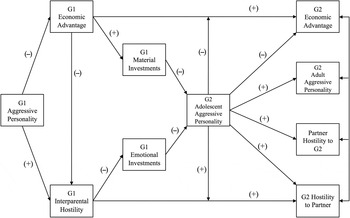
As illustrated in Figure 1, several of the hypothesized pathways in the IM relate to proposed causal influences of SES on family functioning and adolescent adjustment. In the present study we examine the development of aggressive personality traits. In Figure 1, G1 refers to the FTP parents of the adolescents followed into adulthood (G2), who are the primary focus of the current analyses. Contemporary research on proposed causal influences of SES on human development has primarily involved tests of two theoretical models: the family investment model and the family stress model. The investment model is primarily concerned with the advantages that accrue to the developing child because of family wealth and financial prosperity. The model proposes that families with greater economic resources are able to make significant financial investments in the development of their children, whereas more disadvantaged families are less able to make such investments (Bradley & Corwyn, Reference Bradley and Corwyn2002; Duncan & Magnuson, Reference Duncan, Magnuson, Bornstein and Bradley2003; Linver, Brooks-Gunn, & Kohen, Reference Linver, Brooks-Gunn and Kohen2002; Mayer, Reference Mayer1997). These investments in children involve several dimensions of family support, including (a) parent stimulation of learning both directly and through support of advanced or specialized tutoring or training; (b) the provision of adequate food, housing, clothing, and medical care; and (c) living in a more economically advantaged neighborhood that fosters a child's development of the skills and abilities that foster conventional success. In turn, these investments lead to a child and adolescent who is more likely to have the educational and financial resources that help to replicate the economic success of her parents when she reaches adulthood. Several studies have generated findings consistent with predictions from the investment model (see Conger, Conger, & Martin, Reference Conger, Conger and Martin2010; Gershoff, Aber, Raver, & Lennon, Reference Gershoff, Aber, Raver and Lennon2007).
The conceptual model of child influence.

Consistent with the investment model, the IM proposes that G1 economic advantage (i.e., higher income and economic well-being) will increase G1 material investments in G2 that in turn will be associated with less adolescent aggressiveness (see Figure 1). The proposed negative path from material investments to G2 aggressive personality reflects the investment prediction that greater levels of investment will lead to child characteristics reflecting high self-control and emotion regulation consistent with success in educational and occupational settings. That is, parental investments in the child should decrease impulsive, aggressive behaviors indicative of low self-control.
In contrast, the family stress model proposes that economic hardship primarily influences the development of children by disrupting the emotions and behaviors of parents (Conger & Elder, Reference Conger, Elder, Conger and Elder1994). Consistent with this perspective and as shown in Figure 1, the IM proposes that higher G1 economic advantage will be negatively related to G1 emotional instability as expressed through increased anger and hostility in their marital relationship as they attempt to cope with the daily difficulties created by having an income inadequate to meet their needs. In turn, these difficulties in the relationship between parents are expected to reduce emotional investments in children, including decreases in warmth and support, decreases in effective child management, and increases in hostile behaviors toward the child, as indicated by the negative path from G1 interparental hostility to G1 emotional investments. Consistent with the family stress model, the IM then indicates that emotional investments will be negatively related to adolescent aggressiveness. In particular, we proposed that low warmth and support and high hostility by parents to their children would be emulated by G2 adolescents in their relationships inside and outside the family, as reflected by aggressive personality in the present study. We assume that the connection between parenting and adolescent aggression reflects developmental processes involving social learning and attachment security or insecurity (Conger, Conger, & Martin, Reference Conger, Conger and Martin2010; Sroufe et al., Reference Sroufe, Egeland, Carlson and Collins2005). Numerous studies have reported findings consistent with these predictions from the family stress model for ethnic majority families, ethnic minority families, families living in both rural and urban settings, and families from the United States and from other countries (see Conger, Conger, & Martin, Reference Conger, Conger and Martin2010). Thus, in the present analyses we expected to find support for the noted social causation pathways derived from the family stress model in Figure 1.
Two additional social causation pathways in the IM should be noted. We predict that G1 economic advantage will be positively related to G2 economic advantage when G2 becomes an adult. This pathway derives from a number of studies that have demonstrated significant intergenerational continuity in economic status (see Bowles & Gintis, Reference Bowles and Gintis2002). Figure 1 also shows a positive pathway from G1 interparental hostility to G2 hostility toward a romantic partner during adulthood. We added this pathway to the IM because earlier research also has demonstrated intergenerational continuity in couple hostility or conflict (e.g., Amato & Booth, Reference Amato and Booth2001; Cui et al., Reference Cui, Durtschi, Donnellan, Lorenz and Conger2010). We next consider how these adolescent traits are expected to influence later G2 functioning through a process of social selection.
Social Selection Pathways in the IM: The Influential Child
In Figure 1, pathways from individual characteristics to social and economic outcomes represent predictions from a social selection perspective. In the present depiction of the IM, for example, we propose that G1 parent aggressive personality will negatively affect G1 economic advantage and exacerbate G1 interparental hostility. Consistent with the notion of a transaction between individual characteristics and social and economic circumstances, we expect that the effects of G1 aggressiveness on G2 aggressiveness will be indirect through the social causation processes just discussed and illustrated in Figure 1. The IM in Figure 1 also proposes that G2 adolescent aggressive personality will have a similar effect on economic conditions and close relationships during G2's adult years. That is, we hypothesized that the development of G2 aggressive traits during adolescence would impede economic success, promote continuity in aggressiveness, lead to hostility toward a romantic partner, and intensify partner hostility toward G2 several years later during adulthood. The inclusion of these pathways from G2 adolescent aggressiveness to later development completes the transactional process hypothesized by the IM and also captures the idea of the influential child. That is, the IM proposes that social and economic conditions in the family of origin affect the development of specific characteristics of the child or adolescent, which in turn go on to influence later social and economic conditions experienced by the child as he transitions to adulthood. The complete process represents a transaction between the environment and the individual that extends across time and generations.
As noted earlier, these hypotheses from the IM are consistent with findings from previous research, which has demonstrated that individual traits and dispositions during childhood and adolescence predict to later social, emotional, and economic outcomes, thus demonstrating the long-term implications of the influential child. Consistent with these predictions from the IM and illustrated in Figure 1, there is evidence from longitudinal studies that early emerging individual differences in a range of personality characteristics predict SES-relevant outcomes in adulthood such as income, occupational status, economic stress, and bouts of unemployment (e.g., Donnellan, Conger, McAdams, & Neppl, Reference Donnellan, Conger, McAdams and Neppl2009; Feinstein & Bynner, Reference Feinstein and Bynner2004; McLeod & Kaiser, Reference McLeod and Kaiser2004; Shiner, Masten, & Roberts, Reference Shiner, Masten and Roberts2003). Other research has shown that traits such as anger, neuroticism, conscientiousness, and agreeableness measured during adolescence predicted the quality of romantic relationships during adulthood even after controlling for SES in the family of origin (Donnellan et al., Reference Donnellan, Conger, McAdams and Neppl2009; Kim, Pears, Capaldi, & Owen, Reference Kim, Pears, Capaldi and Owen2009; Kinsfogel & Grych, Reference Kinsfogel and Grych2004). In addition, adolescent aggressiveness and low self-control have been linked to adult antisocial behavior, substance use disorders, and internalizing problems, consistent with our prediction that more aggressive adolescents will also be more aggressive adults (e.g., Conger, Conger, & Martin, Reference Conger, Conger and Martin2010; McLeod & Kaiser, Reference McLeod and Kaiser2004; Moffitt et al., Reference Moffitt, Arseneault, Belsky, Dickson, Hancox and Harrington2011). Based on the IM, we proposed that this continuity in aggressiveness will be expressed both as a general trait and in demonstrations of hostility to a romantic partner (Figure 1). Another line of research has shown that aggressive individuals often evoke similar responses from others (e.g., Anderson, Buckley, & Carnagey, Reference Anderson, Buckley and Carnagey2008), consistent with our expectation that more aggressive adolescents will tend to elicit greater hostility from their romantic partners in adulthood. Notice also that most of the G1 predictors are expected to have an indirect effect on G2 adult outcomes with G2 adolescent aggressiveness as the primary mediator.
In addition to these predicted direct effects of adolescent aggressiveness illustrated in Figure 1, we also proposed that G2 adolescent aggressiveness will interact with G1 interparental hostility to amplify the influence of G1 interparental hostility on G2's hostility toward a romantic partner in adulthood. That is, we propose that the adolescent influences adult outcomes both directly and in interaction with characteristics of the family of origin. This hypothesized interaction effect is indicated by the positive path from G2 aggressiveness in adolescence to the pathway from G1 interparental hostility to G2 hostility toward a romantic partner. Although earlier research has demonstrated continuity in relationship conflict across generations (e.g., Kim et al., Reference Kim, Pears, Capaldi and Owen2009; Kinsfogel & Grych, Reference Kinsfogel and Grych2004), to our knowledge earlier studies have not demonstrated this predicted interaction effect or mode of child influence. However, the hypothesis that aggressive personality traits would increase intergenerational continuity in relationship problems is intuitively appealing, and thus, we proposed this form of moderation in the current study. Finally, we proposed that G2 adolescent aggressiveness will interact with G1 economic advantage to affect the degree of continuity in economic circumstances across generations. As illustrated by the negative path from G2 adolescent aggression to the path connecting G1 and G2 economic advantage, we proposed that adolescents high on aggressiveness will jeopardize the benefits of having more economically advantaged parents by reducing the positive connection between G1 and G2 economic status, again illustrating child influence through moderation of family characteristics. In the current study, we test the full set of predictions from the IM as depicted in Figure 1.
Method
Participants and procedures
Data for the present study come from the FTP, a longitudinal study of youth and their families from rural Iowa. Interviews were first conducted in 1989 with 451 target youth (G2) and their parents (G1) when the target adolescent was in the seventh grade. The current study uses data during the period from 1990 through 2005, when the target youth averaged 14.09 through 29.62 years of age. Participants were drawn from an eight-county area in north-central Iowa, which had an ethnic minority population of only about 1% at that time; thus, all the participants were European Americans from primarily lower-middle and middle-class families. The families demonstrated a great deal of variability in socioeconomic status indicating that they were representative of the broader community. Moreover, more than 60% of the G2 youth met criteria for lifetime prevalence of a psychiatric disorder by their early 20s, consistent with prevalence rates for the United States as a whole (Rueter, Holm, Burzette, Kim, & Conger, Reference Rueter, Holm, Burzette, Kim and Conger2007). For example, the National Comorbidity Survey reported a national lifetime prevalence rate of almost 50% for any disorder (Kessler et al., Reference Kessler, McGonagle, Zhao, Nelson, Hughes and Eshleman1994). The National Comorbidity Survey also reported a 12-month prevalence rate of almost 30% for any disorder, comparable to the rate of 24% in the FTP. These findings suggest that these participants represent the experiences of families more generally. Additional details regarding the sample can be found in Conger and Conger (Reference Conger and Conger2002) and Conger et al. (Reference Conger, Schofield and Neppl2012).
Eligible families included a target adolescent in seventh grade living with both of his or her biological parents and with a sibling within 4 years of his or her age. Families were recruited through both public and private schools in the eight rural, Iowa counties participating in the study. Of the eligible families, 78% agreed to be interviewed. During the first year of the study, the median education for fathers and mothers was 13 years, and their respective median ages were 39 and 37 years, respectively. The average number of family members was 4.95. The seventh-grade target adolescents ranged in age from 12 to 14 years (M age = 13.17), and 52.33% of them were female. Median family income from all sources for the past year (1988) was $33,700 compared to a national median income of $33,920 for European American families in 1988. Cohort members were interviewed annually through 1995, except in 1993 when no interview took place. After the 1995 assessment, they were interviewed in alternating years, with a retention rate of almost 90% through 2005 (N = 395 in 2005). Because we were predicting interactions with a romantic partner, for the present study we focus on the 279 G2s who were married (n = 233) or cohabiting with a romantic partner (n = 46) in 2005. Additional families were added to the FTP later in adolescence; however, the information needed for the present analyses required that we focus on the original cohort.
The initial years (1989–1994) of the study focused on the target's family of origin (the target adolescent, a sibling within 4 years of the target adolescent's age, and their parents). During this period, interviewers visited each family in their home for approximately 2 hr on each of two occasions per year. Each participant received approximately $10 per hour for compensation for participation. During the first visit, each of the four family members completed a set of questionnaires focusing on individual family member characteristics, family relationships, and other aspects of the family environment such as socioeconomic status.
During the second visit, which usually occurred within 2 weeks of the first, the family members were videotaped as they engaged in several structured interaction tasks. A trained interviewer began the videotaping session by asking each individual to complete a short questionnaire designed to identify issues of concern that led to disagreements within the family (e.g., responsibility for chores, recreational activities, and use of money). The first task (Task 1) was designed in part to elicit information about parenting practices, such as child monitoring and harsh and inconsistent discipline, and lasted approximately 30 min. For this task, all four family members gathered around a table and were given a set of cards that contained general questions about family life, such as approaches to parenting, performance in school, household chores, and important family events. The family members were instructed to read the questions on the cards aloud and discuss their answers to the questions while the interviewer left the room and went to another part of the house where he or she could not hear the discussion being videotaped.
The next tasks proceeded in a similar fashion. Task 2, which lasted approximately 15 min, also involved all four family members. For this task, the interviewer selected three topics based on the questionnaires completed at the beginning of the visit. The family members were asked to discuss and to try to resolve the issue that they had identified as leading to the greatest conflict in their family. If they resolved this problem, they could go on to the second or even the third issue during the task. A third task involved sibling interactions that are not included in the present study. Task 4 focused on marital interactions and, thus, included only the G1 mother and father. This task lasted approximately 30 min and used the same discussion-card procedure as Task 1. Spouses were directed to discuss the history and current status of their relationship, enjoyable events and activities they had engaged in during the past year, areas of agreement and disagreement (e.g., parenting or finances), and their plans for the future. During this marital task, the siblings completed a questionnaire in a location where they could not hear their parents' discussion. This interactional setting was designed to elicit a range of emotions, including both positive and negative affect (see Melby & Conger, Reference Melby, Conger, Kerig and Lindahl2001, for more details).
Beginning in 1995 (the first year the targets were out of high school), the focus of the study shifted to the target's development outside the family of origin, and full assessments were conducted in alternating years. Information was added about romantic partners and marriage, higher education and employment, economic circumstances, and beginning in 1997, the target's children and parenting. Data were collected from the targets, their romantic partners, and their child (when they had partners and/or a child) following procedures similar to those described for the family of origin. During the visits, the target and participating partner (when applicable) completed a series of questionnaires on a broad array of topics, including employment and economic circumstances, mental and physical health status, family relationships, and parenting beliefs and behaviors. Targets and their romantic partners were also videotaped using similar procedures as in the family of origin assessments. In brief, targets and their romantic partner were asked to discuss the history and current status of their relationship, enjoyable events and activities they had engaged in during the past year, areas of agreement and disagreement, and plans for the future. As with the G1 marital interaction task, this task was designed to elicit a range of emotions, including both positive and negative affect.
Measures
The measures for the present analyses follow from the theoretical model provided in Figure 1. For the adolescent years, G1 aggressiveness, economic advantage, and interparental hostility were assessed in 1990. Even though G1 aggressiveness was measured in the same year as G1 economic advantage and G1 interparental hostility, we believe it is reasonable to model G1 aggressive personality as an exogenous variable. Whereas personality characteristics are quite stable during the adult years (see Donnellan, Conger, & Burzette, Reference Donnellan, Conger and Burzette2007), family economic conditions and the quality of marital relationships tend to vary across the life course (Conger, Conger, & Martin, Reference Conger, Conger and Martin2010). Thus, it seems reasonable that stable personality traits that tend to stabilize during the early adult years would predict later variations in the family economy and marital union. G1 material and emotional investments were measured in 1992, and adolescent aggressiveness was assessed in 1994. The G2 adult outcome variables were all measured in 2005, 11 years after the assessment of adolescent aggressive personality traits. This lag between adolescence and adulthood provides adequate time to evaluate the long-term significance of adolescent aggressiveness for adult functioning.
G1 and G2 economic advantage
In 1990 and 2005 three measures were used as three indicators of both the G1 and G2 economic advantage latent constructs: income to needs ratio, unmet material needs (reversed), and cannot make ends meet (reversed). The income to needs ratio is a widely used indicator of family economic health, and was created using guidelines from the US Department of Health and Human Services. The ratio indicates family income relative to the poverty line for a family of a given size. For instance, a score of 1.0 would indicate that the family is at the poverty line, a score of 2.0 indicates that family income is two times higher than the poverty line, and so forth. Family total income (which includes all wages, salaries, and other sources of income, such as self-employment income, farm net income, and supplemental security income) was divided by the US Department of Health and Human Services poverty guideline for a family of a given size to create the income to needs ratio. The G1 income to needs ratio was created using the G1 family income and poverty guidelines for 1990 and the G2 income to needs ratio was created using the G2 family income and poverty guidelines for 2005.
Unmet material needs measures the degree to which families have the resources needed for things such as a home, clothing, household items, a car, food, and medical care. The scale consists of six items (e.g., “I have enough money to afford the kind of place to live in that I should have” and “I have enough money to afford the kind of food I should have”) rated from 0 (strongly agree) to 4 (strongly disagree). The G1 measure was assessed in 1990 and is an average of G1 mother (α = 0.89) and G1 father (α = 0.89) reports of the six items. The G2 measure was assessed in 2005 and is an average of G2 target (α = 0.83) and the target's romantic partner's (α = 0.82) reports. There was substantial agreement between spouses for both the G1 and the G2 couples (r > .42). Both the G1 and the G2 measures were reverse scored (multiplied by negative 1) so that a high score indicates that the family can meet its basic material needs. The final indicator, cannot make ends meet, was measured with two items. Individuals reported whether they had difficulty paying bills each month (0 = no difficulty at all, 3 = quite a bit of difficulty or a great deal of difficulty) and whether they had money left over at the end of the month (0 = more than enough money left over, 3 = not enough to make ends meet). The G1 measure was assessed in 1990 and is an average of G1 mother (r = .69) and G1 father (r = .68) reports of the two items. The G2 measure was assessed in 2005 and is an average of G2 target (r = .69) and the target's romantic partner's (r = .63) reports. Agreement between partners on this measure was substantial (r > .55). Both the G1 and the G2 measures were reverse scored (multiplied by negative 1) so that higher scores indicate that the family can pay their bills and has surplus funds at the end of each month.
G1 interparental hostility and G2 hostility with a romantic partner
Observer scores on the G1 marital interaction task described previously (Task 4) were used to measure G1 mother's and father's interparental hostility in 1990. Observers rated verbal and nonverbal behavior by the mother and father toward each other using the Iowa Family Interaction Rating Scales (Melby & Conger, Reference Melby, Conger, Kerig and Lindahl2001). The Iowa Family Interaction Rating Scales has been utilized in a variety of cross-sectional and longitudinal studies examining diverse topics such as economic stress, parenting, adolescent development, and the quality of romantic relationships, and has acceptable reliability and validity (Melby & Conger, Reference Melby, Conger, Kerig and Lindahl2001). Observers rated mother's hostility (e.g., criticism of spouse), angry coercion (e.g., attempting to gain compliance through threats or anger), and antisocial behavior (e.g., being uncooperative and difficult) toward the father and vice versa (α = 0.77 for fathers toward mothers and α = 0.85 for mothers toward fathers). Observers also rated the mother and father warmth and supportiveness (e.g., expressions of concern and support), assertiveness (e.g., positively expressing one's point of view in a forthright manner), listener responsiveness (e.g., attending to what partner has to say), communication (e.g., clearly expressing opinions and beliefs), and prosocial behavior (e.g., being helpful and cooperative) toward each other (α = 0.81 for fathers toward mothers and α = 0.83 for mothers toward fathers), which were reversed scored to represent low levels of warmth and supportiveness.
Thus, a high score reflects couple interactions that are high in hostility or conflict and low in warmth and support. The eight scores representing high hostility and low warmth of the mother toward the father were then randomly assigned to three indicators (“parcels”) of the latent construct G1 mother's interparental hostility. Likewise, the eight scores representing high hostility and low warmth of the father toward the mother were parceled into three indicators of the G1 father's interparental hostility latent construct. Parcels offer three advantages over the use of individual items: they typically produce more stable solutions, they are less likely to share specific sources of variance that may not be of primary interest, and they reduce the likelihood of spurious correlations (Little, Cunningham, Shahar, & Widaman, Reference Little, Cunningham, Shahar and Widaman2002; Little, Rhemtulla, Gibson, & Schoemann, Reference Little, Rhemtulla, Gibson and Schoemann2013). Because the mother and father interparental hostility variables were highly correlated (r = .67, p < .001), and because later analyses demonstrated that the two latent constructs related in the same way with other variables in the model, the mother and father parcels were averaged to create a single latent variable for G1 interparental hostility.
The G2 target's hostility toward a romantic partner and the partner's hostility toward the target in 2005 were measured in the same manner using observer scores from the G2 target and romantic partner interaction task described earlier. Observers rated the target and partner's hostility, angry coercion, and antisocial behavior toward each other (α = 0.84 for targets toward partners and α = 0.87 for partners toward targets). Observers also rated the target and partner's warmth and supportiveness, assertiveness, listener responsiveness, communication, and prosocial behavior toward each other (α = 0.89 for targets toward partners and α = 0.88 for partners toward targets), which were reverse scored to represent low levels of warmth and supportiveness. The eight scores representing high hostility and low warmth of the targets toward partners were then parceled into three indicators of the latent construct target's hostility toward partner. Likewise, the eight scores representing high hostility and low warmth of the partners toward targets were parceled into three indicators of the partner's hostility toward the target latent construct. It is important to note that a completely independent group of coders rated behaviors by the G2 and G1 participants.
G1 material investments
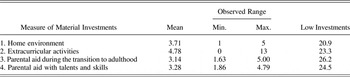
A cumulative index of G1 material investments was constructed using measures assessed in 1992, which indicate the level of resources (e.g., time and money) G1 parents devoted to their G2 adolescent. This approach is similar to the construction of cumulative risk indexes that Sameroff (Reference Sameroff1998), Sameroff, Seifer, Barocas, Zax, and Greenspan (Reference Sameroff, Seifer, Barocas, Zax and Greenspan1987), and Furstenberg, Cook, Eccles, Elder, and Sameroff (Reference Furstenberg, Cook, Eccles, Elder and Sameroff1999) have used. The index was created by dichotomizing four measures of investments (the home environment, extracurricular activities, parental aid during the transition to adulthood, and parental aid with talents and skills; described in Appendix A) so that the quarter of the sample reporting the least investments were assigned to the low investments category (coded 0) and the remaining 75% of the sample was assigned to the high investments category (coded 1). Most measures did not allow for an exact 25% and 75% split, which resulted in 20.9% to 26.2% of the sample being assigned to the low investment category across the different measures. The percentage of the sample in the low investments category for each item and information regarding each of the four measures can be found in Appendix A. These four dichotomous scores were then averaged to generate the parental investment index score for each family, which could range from 0 to1. The G1 material investments index had a mean of 0.76 with a standard deviation of 0.26. Approximately 43% of the sample fell into the high investments category on all four items, whereas about 2% of the sample was in the low investments category for all items. Because the four domains of investment were not highly intercorrelated, using dichotomies rather than quantitative scores is an appropriate approach to combining them.
G1 emotional investments
In 1992 observer scores generated from the parenting tasks described previously (Task 1 and Task 2) were used to create four indicators of the G1 emotional investments latent construct: warm parenting, hostile parenting, child management, and harsh and inconsistent discipline. The warm parenting indicator is an average of four observer ratings from Task 2 (higher scores indicate greater warmth and support) and includes the same dimensions of warmth and support described earlier for couple interactions: positive communication, prosocial behavior, warmth–support, and listener responsiveness. Observer ratings of the mother's warm parenting (α = 0.78) and the father's warm parenting (α = 0.79) were averaged to create the warm parenting indicator. The second indicator of the emotional investments construct is hostile parenting, reverse scored so that a high score indicates low hostility. This indicator is the average of observer ratings of hostility, antisocial behavior, and angry coercion of the parents toward the target adolescent demonstrated in Task 2 and involves the same behaviors described earlier for couple interactions. Observer ratings of the mother's hostile parenting (α = 0.91) and the father's hostile parenting (α = 0.88) were averaged to create the hostile parenting indicator.
The third indicator, child management, is the average of observer ratings of parents' monitoring (e.g., knowledge of child's activities outside the home), positive reinforcement (e.g., approval of desired behaviors by the child), consistent discipline (e.g., disapproval of undesired behaviors in a consistent and predictable manner), parental influence (e.g., setting standards and expectations), quality time (e.g., making time for enjoyable activities), and inductive reasoning (e.g., giving reasons for rules and expectations) rated during Task 1. A parent who demonstrates high scores on this measure knows what his or her child is doing, sets appropriate rules and standards for conduct, consistently provides positive or negative contingencies for desired and undesired behaviors, spends time with the child in pleasurable activities, and encourages the child's understanding of the social consequences of his or her behaviors. Unlike the scores for warmth and hostility, observers coded child management based both on parent–adolescent interactions during the task and on their descriptions of their interactions in their daily lives. Observer ratings of the mother's child management (α = 0.74) and the father's child management (α = 0.77) of the target adolescent were averaged to create the child management indicator. The final indicator of the emotional investments construct is the G1 parents' harsh and inconsistent discipline toward the target adolescent during Task 1. This indicator is the average of observer ratings of inconsistent discipline, harsh discipline, indulgent–permissive behavior, and encourages independence. The first three ratings were reverse scored to indicate low levels of this type of parenting. Thus, a parent who scores high on this indicator of parenting behavior will not be inconsistent or harsh in disciplinary practices, will not ignore misbehavior in a permissive fashion, and will not withdraw from the child in a fashion that fails to encourage his or her autonomy and well-being. Observer ratings of the mother's harsh and inconsistent discipline (α = 0.51) and the father's harsh and inconsistent discipline (α = 0.48) scores were averaged to create the harsh and inconsistent discipline indicator. We note that these somewhat marginal αs could jeopardize the identification of parenting effects that are actually significant. Nonetheless, these parenting behaviors are an essential part of the investments parents make in their children; thus, we retained them in the emotional investments construct.
G1 and G2 aggressive personality
G1 aggressive personality was assessed in 1990 with the NEO Five Factor Inventory Short Form (Costa & McCrae, Reference Costa and McCrae1985). G1 mothers and fathers reported on eight items from the angry hostility subfactor of the NEO (α = 0.72 for mothers and α = 0.73 for fathers). Examples of items include, “I often get angry at the way people treat me” and “I am known as hot-blooded and quick-tempered.” The eight items were randomly assigned to three indicators (“parcels”) for the G1 mother aggressive and G1 father aggressive constructs, respectively.
To avoid problems with self-reports, we used informant measures to assess G2 aggressive personality. In earlier analyses, we have shown that informant reports of personality during adolescence provide better prediction to G2 adult outcomes than do G2 self-reports, suggesting that informants may provide a more veridical account of G2 traits and dispositions during adolescence than G2 self-reports (Donnellan, Larsen-Rife, & Conger, Reference Donnellan, Larsen-Rife and Conger2005). In 1994, G1 parents reported on the G2 adolescent's personality by completing a 33-item informant report of the Multidimensional Personality Questionnaire Scale (MPQ; e.g., Harkness, Tellegen, & Waller, Reference Harkness, Tellegen and Waller1995). We used the 3 items that make up the aggression subscale to assess G2 adolescent aggressive personality. Individuals who score high on these items are willing to take advantage of others, find satisfaction in teasing or frightening others, carry a grudge, like to get into fights, and are ready to hit others when angry (α = 0.70 for mother report and α = 0.63 for father report). Mother report and father report for each of the 3 items were averaged to create the three indicators of the G2 adolescent aggression construct.
To maintain consistency across adolescence and adulthood, G2 adult aggressive personality was assessed during 2005 with romantic partner reports on the Iowa Personality Questionnaire, a reliable and well-validated personality measure designed to map onto the same dimensions as the MPQ informant report measure using a survey research format (Donnellan, Conger, & Burzette, Reference Donnellan, Conger and Burzette2005). Partners rated the targets on five items from the aggression subscale (α = 0.68). Individuals who scored high on these five items take advantage of others, carry a grudge, enjoy teasing or frightening others, are always ready for a fight, and are often ready to hit people when angry. The number of items precluded parceling; thus, the five individual items were used as indicators of the G2 adult aggression latent construct.
Results
All data analyses were conducted using Mplus 7.3 (Muthén & Muthén, Reference Muthén and Muthén1998–2014) and full information at maximum likelihood (FIML). FIML provides more consistent, less biased estimates than ad hoc procedures for dealing with missing data, such as listwise deletion, pairwise deletion, or imputation of means (Allison, Reference Allison2003; Arbuckle, Reference Arbuckle, Marcoulides and Schumacker1996). Because of the high retention rate in the study, FIML is also appropriate given the low level of missing data. The analyses begin by considering the psychometric properties of the study measures and their intercorrelations. We then proceed to empirical evaluation of predictions from the IM (Figure 1).
Descriptive statistics
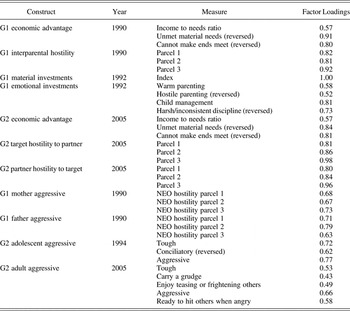
The first step in the analyses involved a confirmatory factor analysis (CFA), testing the fit of the measurement model. To evaluate the fit of the model, we used the standard chi-square index of statistical fit that is routinely provided under maximum likelihood estimation of parameters. Because the chi-square index is likely to be significant with larger sample sizes, we consider a chi-square value less than two times the degrees of freedom to indicate good fit. We also used two indices of practical fit, the root mean square error of approximation (RMSEA; Browne & Cudeck, Reference Brown, Cudeck, Bollen and Long1993) and the comparative fit index (CFI; Hu & Bentler, Reference Hu and Bentler1999). An RMSEA value less than 0.06 and a CFI value greater than 0.90 indicate acceptable model fit. The results demonstrated close fit of the data with the measurement model (χ2 = 645.828, df = 473, RMSEA = 0.036, CFI = 0.954). Table 1 provides the factor loadings from the CFA for all of the latent constructs used in the analyses. Notice that the one measure without multiple indicators, G1 material investments, has a factor loading of 1.00. All factor loadings were in the expected direction, of acceptable magnitude, and statistically significant, affirming the usefulness of the variables selected to measure our latent constructs. For example, the factor loadings for G1 interparental hostility ranged from 0.81 to 0.92.
Standardized factor loadings for latent constructs (N = 279)

Note: All loadings are statistically significant (p ≤ .05). G1, Generation 1; G2, Generation 2.
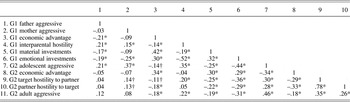
Intercorrelations among the latent variables from the CFA are provided in Table 2. Several of the correlations were consistent with IM predictions. For example, G1 economic advantage was negatively related to G1 interparental hostility (r = –.14, p < .05). In addition, during adolescence G1 material and emotional investments in G2 were negatively related G2's aggressiveness during adolescence (r = –.25 and –.44, p < .05, respectively). In turn, G2 aggressiveness during adolescence was negatively related to G2's later economic advantage (r = –.34, p < .05) and positively related to later hostility to a romantic partner (r = .30, p < .05) and partner hostility to G2 (r = .28, p < .05). Based on these promising findings, we proceeded to formal tests of predictions from the IM.
Correlations among latent variables (N = 279)

Note: G1, Generation 1; G2, Generation 2.
†p ≤ .05 (one-tailed test). *p ≤ .05 (two-tailed test).
Structural equation model evaluating predictions from the IM
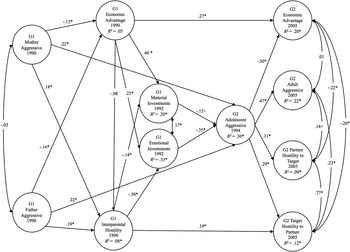
We used multiple group analyses to test for possible G2 gender differences in the structural parameters of the model. No significant gender differences were found; therefore, all analyses presented use the combined G2 sample of young women and young men. We also tested for differences in effects for mothers and fathers, for example, whether the path from G1 mother aggressive personality to G1 economic advantage was significantly different from the same path for fathers. No statistically significant differences were found; therefore, paths from these mother and father variables were constrained to equality in the final model. It should be noted that although the mother and father effects were constrained to equality, the standardized coefficients may still vary due to differences in the variances of the measures. Figure 2 provides the standardized regression estimates from the analyses. Using the same procedures described for the CFA, the structural equation model (SEM) in Figure 2 demonstrates acceptable fit with the data (RMSEA = 0.037, CFI = 0.950). The chi-square value of 692.469 with 504 degrees of freedom also suggests acceptable fit with the data. These fit statistics are based on the final model that also includes unexpected significant paths not specified in the initial predictions illustrated in Figure 1.
Standardized estimates for the full model (χ2 = 692.469, df = 504, RMSEA = 0.037, CFI = 0.950). *p ≤ .05 (two tailed), +p ≤ .05 (one tailed).

The adolescent years
Turning to the social selection pathways involving the G1 generation in the IM, we predicted that G1 aggressive personality would only have an indirect effect on G2 adolescent aggressiveness through G1 economic advantage, interparental hostility, material investments, and emotional investments (see Figure 1). This prediction is consistent with the proposition by the IM that individual characteristics affect social and economic circumstances that in turn influence individual characteristics at a later point in time. The final results suggest a much more powerful role for both father and mother personality. Even with the hypothesized social and economic mediators in the model, both mother and father aggressive personality directly predicted G2 aggressiveness 4 years later with a standardized path coefficient of .22 for both parents. In addition, as predicted, mother and father aggressiveness were directly and negatively related to economic advantage. Finally, both father and mother aggressiveness positively predicted interparental hostility.
In terms of the investment model portion of the IM, G1 economic advantage was positively related to material investments and, unexpectedly, also directly related to emotional investments. Although the zero-order correlation between material investments and G2 adolescent aggressiveness was negative and statistically significant as predicted (r = –.25, p < .05; Table 2), this path was only statistically significant (p < .05) in the final SEM using a one-tailed test, which is appropriate given that the direction of effect was predicted. Inconsistent with predictions from the IM, G1 economic advantage was not significantly related to G1 interparental hostility in the SEM. Consistent with expectations, interparental hostility was negatively related to emotional investments, and greater emotional investments were associated with lower levels of adolescent aggressiveness. It is interesting that interparental hostility was also negatively related to material investments. Simply put, the results for the adolescent portion of the SEM indicated support for several predictions from the IM; however, the findings were more complex than anticipated in the conceptual model (Figure 1).
Predicting to adulthood
As predicted and shown in Figure 2, the standardized path coefficient from G2 adolescent aggressiveness in 1994 was negatively related to G2 economic advantage 11 years later in 2005 (–.30). As expected, G2 aggressiveness during adolescence was positively related to both G2 hostility to partner and partner hostility to G2 during young adulthood. G2 aggressiveness during adolescence also demonstrated substantial stability to adulthood (.47, p < .05). The model in Figure 1 also proposed continuity in G1 and G2 economic advantage and in G1 and G2 hostility in close relationships. The findings were consistent with these expectations; the paths from G1 to G2 economic advantage and from G1 to G2 hostility were both positive and significant. Finally, the IM in Figure 1 proposed that G2 adolescent aggressiveness would moderate continuity in both of these pathways. Specifically, we expected that more aggressive adolescents would jeopardize the positive association between G1 and G2 economic advantage. We also proposed that adolescent aggressiveness would amplify continuity between G1 interparental hostility and G2 hostility to a romantic partner.
Tests for predicted interaction effects
We tested the two hypothesized interactions in a latent variable framework using Mplus 7.3, which utilizes the approach described in Klein and Moosbrugger (Reference Klein and Moosbrugger2000). This approach permits estimation of interactions between latent variables and their use as predictors within an SEM. However, this method does not produce traditional fit indices such as CFI and RMSEA, standardized regression coefficients, or estimates of R 2. For that reason, we report the results of the tested interactions and their overall impact on the SEM in Figure 2 without attempting to recreate the complete figure, which would not be directly comparable to the findings just reported.
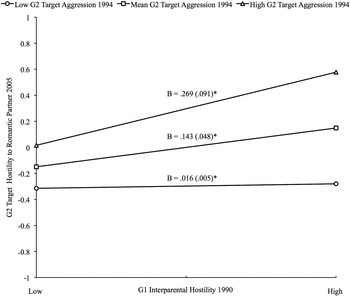
First, we tested the hypothesized moderating effect of G2 adolescent aggressiveness on the association between G1 and G2 economic advantage. To do this, we reran the complete SEM displayed in Figure 2 adding the interaction between G1 economic advantage and G2 adolescent aggressiveness predicting G2 economic advantage. This interaction term did not significantly predict G2 economic advantage. Second, we tested the prediction that adolescent aggression would amplify intergenerational continuity in hostility toward a romantic partner by including the interaction term between G1 interparental hostility and G2 adolescent aggression predicting G2 hostility to their partner in the SEM reported in Figure 2. This interaction term significantly predicted G2 hostility to a partner (unstandardized coefficient = .27, p = .004). Even with the addition of this interaction term, the direct path from G1 interparental hostility to G2 hostility to a partner remained significant, indicating both main and interaction effects in predicting G2 hostility.
Figure 3 displays the simple slopes for the links between G1 interparental hostility and G2 hostility to a partner moderated by G2 adolescent aggressiveness. As shown in Figure 3, G1 interparental hostility was significantly associated with G2 hostility to a romantic partner at low (–1 SD), mean, and high (+1 SD) levels of G2 adolescent aggression. However, the simple, unstandardized slope was much steeper when G2 demonstrated a high level of aggressiveness in 1994 (1 SD above the mean; B = 0.269) than when G2 demonstrated a low level of aggressiveness in 1994 (1 SD below the mean; B = 0.016).
Interaction between G2 target adolescent aggression (1994) and G1 interparental hostility (1990) predicting G2 target hostility to romantic partner (2005). For adolescent aggression, low and high refer to 1 SD below and above mean, respectively. For interparental hostility, low and high refer to the end points of a continuous measure, which ranges from 1 SD below to 1 SD above the mean. B = unstandardized simple slope estimate (standard error). *p ≤ .05 (two tailed).

Discussion
The present study examined hypothesized social and economic antecedents of adolescent aggressive personality and then investigated the degree to which this trait might shape economic circumstances and romantic relationships after the transition to adulthood. Simply put, the study focused on ways in which the socioeconomic environment might shape a child or adolescent's personal characteristics, which in turn were expected to then influence later development in a transactional process. We studied aggressive personality both as an important developmental outcome in its own right and as a significant marker of low self-control in general. That is, individuals who are quick to anger, carry a grudge, and are frequently ready for a fight demonstrate low impulse control and may let these volatile emotions get in the way of more deliberate and beneficial actions. This lack of self-regulation, we proposed, should jeopardize success in both the social and the economic spheres of life. The IM of SES and human development provided the specific predictions for the analyses. In particular, the IM proposes that individual characteristics are affected by social and economic experiences, and in turn, these characteristics help to shape similar experiences over time and generations (Conger, Conger, & Martin, Reference Conger, Conger and Martin2010). In the present case, we were particularly interested in how these individual differences during adolescence help to illustrate the influence of the child on later developmental outcomes. The following discussion reviews expected and unexpected findings from the study in relation to the IM, considers empirical and theoretical questions posed by the findings, and proposes future research directions in light of the limitations in the current research.
Findings related to the social causation pathways in the IM
Some of the findings were consistent with the social causation hypotheses contained within the IM. First, interparental hostility appears to exacerbate the development of adolescent aggressiveness indirectly by reducing parental emotional investments, consistent with predictions from the IM. In addition, we found evidence that interparental hostility also predicted fewer material investments in G2, suggesting an additional pathway of parental influence not previously considered in the IM. Second, G1 economic advantage predicted greater material and emotional investments by G1 parents, and both types of investments were negatively related to the development of adolescent aggressiveness. In the case of material investments, however, this relationship was statistically significant (p < .05) only with a one-tailed test, which is appropriate given that the direction of effect was predicted. The direct relationship between economic advantage and emotional investments suggests that economic advantage may directly promote effective parenting behaviors, a result that represents an extension of the investment model beyond material investments and a possible revision of the family stress model, which predicts only an indirect pathway through family dysfunctions to parenting. G1 economic advantage was negatively related to G1 interparental hostility in terms of the zero-order correlation; however, this relationship was not significant in the final SEM. Unlike previous studies of the relationship between income and family dysfunction, the present investigation included measures of relatively stable personality traits of parents in the analyses. With these additional predictors in the model, we did not find the expected direct influence of income on interparental hostility. This result may lead to a revision of the IM, or it may be that other mediators from the family stress model would be needed to show the hypothesized effects (see Conger, Conger, & Martin, Reference Conger, Conger and Martin2010).
The results also suggested social effects in terms of certain continuities from G1 to G2. First, consistent with earlier research, economic advantage was moderately stable across generations. G2 adults' financial well-being appeared to benefit directly from the economic success of their parents. Contrary to expectations, however, adolescent aggressiveness did not reduce the beneficial effect of G1 economic advantage on G2 economic advantage. Second, there was evidence for intergenerational continuity in conflict between intimates in that G1 interparental hostility directly predicted G2 hostility to a romantic partner. It is especially important that adolescent aggressiveness appears to amplify intergenerational continuity in hostility between intimates, suggesting that adolescent characteristics not only directly influence later socioeconomic conditions but also modify the impact of interparental hostility on their behaviors toward an adult romantic partner. Thus, in addition to the role played by G2 adolescent aggressiveness in predicting later economic and social circumstances, G2 children grown to adulthood also appear to carry forward these experiences with their parents.
It is also important that we had predicted that G1 personality would affect G2 adolescent personality only indirectly through economic and social pathways in the IM. However, the results of the SEM indicated direct pathways from mother and father aggressiveness to G2 adolescent aggressiveness. These direct effects could indicate a social influence; that is, when parents tend to engage in angry, aggressive, and impulsive behaviors in a variety of settings, their children may tend to emulate those behaviors through a process of social learning or they may experience decreased attachments to parents that leave them vulnerable to social and emotional problems. In contrast, these findings could reflect a genetic influence, a possibility we return to in our consideration of social selection effects.
Findings related to the social selection pathways in the IM
The social selection hypothesis proposes that both G1 and G2 aggressiveness will shape economic and social circumstances. Many of the results were consistent with this expectation. As predicted, G1 mother and father aggressive personality were negatively associated with G1 economic advantage and positively related to G1 interparental hostility. Consistent with our expectations, the results suggest that individual differences in G1 aggressive personality may jeopardize economic success and disrupt effective family functioning. A limitation in these findings, of course, is that G1 personality, economic advantage, and interparental hostility were all measured in 1990. However, as we discuss later, G2 adolescent aggressiveness was assessed 11 years prior to a similar set of outcome variables with essentially the same results as observed for G1. Thus, the findings for the second generation increase confidence in the interpretation of these results for the first generation.
Returning to the question of whether the direct pathway from G1 to G2 personality represents a simple genetic effect, the answer is not straightforward. Earlier research suggests that about 50% of aggressive behavior is heritable (Miles & Carey, Reference Miles and Carey1997; Rushton, Fulker, Neale, Nias, & Eysenck, Reference Rushton, Fulker, Neale, Nias and Eysenck1986). Thus, perhaps 50% of the variance in the direct pathways from G1 to G2 aggressiveness reflects a genetic effect. Moreover, some of the hypothesized social influences may also reflect genetic effects. For example, G1 interparental hostility and emotional investments might also be indicators of underlying genetic predispositions that result in these phenotypes and their associations with G2 aggressiveness. We believe that this latter interpretation is unlikely, however, inasmuch as earlier research has shown that observational measures of social behaviors demonstrate very little heritability (Kendler & Baker, Reference Kendler and Baker2007; Miles & Carey, Reference Miles and Carey1997; Rhee & Waldman, Reference Rhee and Waldman2002). In terms of G1 aggressiveness, we conclude that its association with G2 aggressiveness in part likely reflects a direct genetic effect and in part a social influence as noted earlier. In addition, the effect of G1 aggressive personality appears to be partially socially mediated, consistent with predictions from the IM.
Finally, G2 adolescent aggressiveness demonstrated the associations expected with adult experiences. When G2 was more aggressive during adolescence, as an adult he or she was less likely to experience economic success, more likely to have a troubled romantic relationship, and at risk for continuing to engage in aggressive actions 11 years later. Again, if one interprets aggressive traits as reflective of low self-control in general, then these findings are quite consistent with contemporary research on the negative consequences of earlier poor self-regulation on the capacity to successfully meet the multiple social and economic demands of adulthood (Moffitt et al., Reference Moffitt, Arseneault, Belsky, Dickson, Hancox and Harrington2011). These findings are consistent with the social selection hypothesis that children grown to adulthood will have a direct influence on shaping the circumstances they experience in their lives.
Study limitations
The findings from this research provide support for the basic tenants of the IM. Adolescent aggressive personality was predicted either directly or indirectly by the constellation of family characteristics proposed by the model and evaluated in the current study. The most important findings indicate that the social and economic antecedents of adolescent aggressive personality proposed by the IM likely represent part of a dynamic process in which adolescent traits go on to affect critical aspects of adult development. Despite these promising findings, certain limitations of the research must be noted. The participants were of European heritage, came from two-parent families, and grew up in the rural Midwest. Replication of the results from studies of more diverse populations will increase confidence in the present findings and in the theoretical merits of the IM. However, this limitation is tempered somewhat because portions of the model related to the economics of child and adolescent development have been replicated with participants of different ethnicities and family structures as well as with individuals and families living in urban as well as rural locations (see Conger, Conger, & Martin, Reference Conger, Conger and Martin2010).
In addition, the measures of aggressive personality varied somewhat for G1 and G2 and even between G2 adolescence and adulthood. Because G1 parents rated aggressiveness both for themselves and for the G2 adolescent, it is possible that the association between G1 and G2 aggressiveness was inflated by shared method variance, even though the two ratings were separated by 4 years. This possibility seems unlikely, however, in that the coefficient from G2 adolescent aggressiveness to G2 adult aggressiveness (.47) was substantially larger than the coefficient from G1 aggressiveness to G2 adolescent aggressiveness (.22 for mothers and fathers). This difference occurred even though the two G2 aggressiveness ratings were separated by 11 years and involved different informants during adolescence and adulthood. It is telling that both parents and romantic partners substantially agreed about the aggressiveness of G2 even though their ratings occurred 11 years apart. This finding underscores the view that these types of impulsive, undercontrolled behaviors represent an underlying trait that is observable to and likely influential for other people.
Another limitation of the present study is the focus on one point in G2's adult development. Future research should attempt to unpack the correlated findings reported here for that period in the life course. For example, does adolescent personality affect the behaviors of a romantic partner primarily through specific hostile acts toward that partner or through the tendency to be more aggressive in general during adulthood? To what extent does the association between adolescent aggressiveness and hostility by a later romantic partner represent the results of assortative mating? These types of questions represent important foci for future investigations.
Returning to the theme of the “influential child”
To summarize, there are three especially important ways in which the present results underscore the importance of child influences on adult development. First, aggressive personality traits during adolescence appear to be stable over time and to evoke the hostility of a romantic partner during the adult years, likely reducing the quality and stability of later close relationships. Second, even after controlling for parent economic advantage, G2 aggressiveness during adolescence is negatively related to the later economic advantage of G2. This suggests that adolescent aggressive personality directly jeopardizes the ability to replicate the economic success of parents, putting the aggressive child or adolescent at risk for lowered economic well-being during adulthood. Third, aggressive personality traits during adolescence appear to amplify the association between G1 interparental hostility and G2 hostility toward a romantic partner during adulthood. Again, this type of hostility in close relationships will tend to jeopardize both the quality and stability of adult romantic unions. This negative impact of child influences on adult development may be particularly troubling given that conflicted and unhappy romantic relationships are a major source of emotional and behavioral problems throughout life (Conger, Conger, & Martin, Reference Conger, Conger and Martin2010; Donnellan, Larsen-Rife, et al., Reference Donnellan, Larsen-Rife and Conger2005).
Future directions for translating research on the influential child into preventive interventions
Moreover, the promising findings from this study suggest that further research on these types of transactional or interactional processes over time and generations are worth pursuing. In addition to helping identify the possible long-term consequences of social and economic aspects of life history, the results also may have implications for efforts involving prevention or intervention related to early maladjustment. For example, the findings suggest that programs designed to reduce the aggressiveness of parents and to promote the emotional investments they make in their children should reduce risk for the development of aggressive traits and poor self-regulation more generally during childhood and adolescence. Programs designed to reduce economic difficulties at a community level would also be beneficial in the sense that greater economic well-being appears to promote important material and emotional investments in children. Perhaps most important, programs designed to enhance self-regulation or self-control and reduce aggressive, impulsive behaviors both during adolescence and adulthood might help break the negative cycle portrayed in the current findings (see Magidson, Roberts, Collado-Rodrigez, & Lejuez, Reference Magidson, Roberts, Collado-Rodriguez and Lejuez2014). The primary value of a general model like the IM rests in its identification of points in these multiple pathways of possible influence that may be targets for prevention and intervention programs. We look forward to these types of applications based on the present findings related to the influential child.
Appendix A
G1 Material Investments Index
The home environment was measured with interviewer-reported items assessing the family's living environment. Items were scored so that higher scores indicate a better environment. Interviewers reported on six items indicating how well maintained the residence was, how well it was furnished, the number of books in the home, the number of magazines or newspapers in the home, the safety of the home, and the number of items present to promote learning (e.g., computer or desks).
Extracurricular activities were assessed with target reports of the number of sports, school activities, and community activities they participated in. Scores ranged from 0 (no activities) to 13 activities during the past year.
Parental aid during the transition to adulthood was assessed with mother and father reports on four items (e.g., “I don't know how I'll be able to manage if my children need a great deal of help as they start their lives as adults” and “I am afraid that helping my children get started as adults will take all of my resources”). Items were reverse coded so that higher scores represent more parental aid during the transition to adulthood. Mother and father reports were averaged to create this measure (α = 0.70).
Parental aid with talents and skills was assessed with mother and father reports on seven items indicating how frequently the parent was involved with the target's special talents or skills (e.g., “How often have you told him/her how to get better at these skills” and “How often have you signed the target child up for classes or programs to help him/her get better at these skills”). Items were scored so that higher scores indicate more parental involvement. Mother and father reports were averaged to create this measure (α = 0.79).
Means and observed range of measures included in the material investment index and the percentage of the sample in the low material investment category