Introduction
With well over 400 described species (see http://www.diptera.org/), Helina Robineau-Desvoidy is one of the largest genera of the Muscidae (Diptera). The description of a single new species may therefore appear to be a worthless exercise, but this description is offered because the new species has a unique character that sets it apart from all other known species of the genus.
Although now placed in separate subfamilies, Helina (Phaoniinae) and Mydaea Robineau-Desvoidy (Mydaeinae) were once considered to be closely related, distinguished by the presence in Mydaea (and absence in Helina) of setulae on the upper wing surface at the base of vein R4+5. Study of the female ovipositor demonstrated that the two genera belong to separate phylogenetic lineages (Herting Reference Herting1957; Hennig Reference Hennig1965), and this has been confirmed by evidence from mitochondrial and nuclear genes (Kutty et al. Reference Kutty, Pape, Pont, Wiegmann and Meier2008).
Malloch (Reference Malloch1926) found that some Oriental species of Helina have setulae at the base of vein R4+5 on the lower wing surface, and placed them in Helinella Malloch. Emden (Reference van Emden1951, Reference van Emden1965) reduced Helinella to a subgenus of Helina, pointing out that, although this character separated the subgenus sharply from all Oriental and Afrotropical Helina, there were a number of “true” Helina in Europe that also possessed these setulae.
In his magisterial work on the Mydaeinae, Vockeroth (Reference Vockeroth1972) transferred the species of Helinella from Phaoniinae to Mydaeinae, assigning those with a weak prealar seta (including the type-species of Helinella) to an expanded Myospila Rondani and those with a strong prealar seta to a new genus, Pseudohelina Vockeroth. The European species with setulae at the base of vein R4+5 on the lower wing surface were retained in Helina, because their ovipositors were clearly of the elongated “Phaonia-type” rather than of the abbreviated “Mydaea-type”. These actions were followed in the regional Diptera catalogues that followed Vockeroth's monograph (Pont Reference Pont1977, Reference Pont1980, Reference Pont1986, Reference Pont1989).
The new species described here has setulae present at the base of vein R4+5 on the lower and upper wing surfaces, and would thus be placed in Mydaea on the basis of this character, but its general facies, a number of its other characters, and the form of the female ovipositor place it unambiguously in Helina. The form of the male cercal plate and sternite 5 suggest that it is not closely related to the other Palaearctic species of Helina with setulae at the base of vein R4+5 and with soft ventral hairs at the tip of the scutellum (Helina cilipes (Schnabl), Helina moedlingensis (Schnabl), and Helina decipiens Mihályi). The characters of the terminalia resemble those of a number of otherwise apparently unrelated Helina species such as Helina balsaci (Séguy), Helina sexmaculata (Preyssler), Helina latitarsis Ringdahl, Helina annosa (Zetterstedt), Helina deleta (Stein), and others.
It is a pleasure to name this new species after Dr. J.R. “Dick” Vockeroth, for his work on the Mydaeinae and his contributions to the Manual of Nearctic Diptera
Material and methods
The material on which this species is based is located in the Natural History Museum, London, United Kingdom (BMNH), and the Natural History Museum of Denmark, Copenhagen (ZMUC), except for two males and two females from the Moroccan Jebel Ayachi series that have been placed in the Canadian National Collection of Insects, Ottawa, Canada (CNC), the Oxford University Museum of Natural History, Oxford, United Kingdom (OUMNH), and the Zoological Museum, Moscow Lomonosov State University, Moscow, Russian Federation (ZMUM).
Morphological terminology follows McAlpine (Reference McAlpine1981), except that “postpedicel” is used for antennal flagellomere 1 (third antennal segment) (Stuckenberg Reference Stuckenberg1999).
Helina richardi sp. nov.
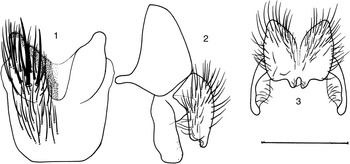
Helina richardi sp. nov., male. 1. Sternite 5 (setation shown only on left side). 2. Terminalia, lateral view (setae of epandrium omitted). 3. Cercal plate and surstyli, posterior view. Male paratype from Morocco, Jebel Ayachi, Mikdane, stream II, south of road, 13.vii.1963. Scale line = 0.5 mm.

Holotype. ♂, MOROCCO: Haut Atlas, Jebel Ayachi, River Jaffar, 800–1500 m north of source, 26.vii.1963 (A.C. Pont, Oxford University Expedition), in BMNH.
Paratypes. 32 ♂♂ 50 ♀♀. MOROCCO: same data as holotype, 3 ♀♀, BMNH; same data but 25.vii.1963, 1 ♂, BMNH, 1 ♀, CNC; same locality, 0–1500 m north of source, 7.viii.1963, 1 ♂, BMNH, 3 ♀♀, 1 OUMNH, 2 BMNH; River Jaffar, hills west of river, evergreen oak forest, 28.vii.1963, 3 ♀♀, 2 BMNH, 1 ZMUM; Mikdane, stream I, south of road, 10.vii.1963, 1 ♀, BMNH; same data, on trunks of cedar and evergreen oak, 9.vii.1963, 1 ♂, 12.vii.1963, 1 ♂ 1 ♀, 22.vii.1963, 1 ♀, all BMNH; Mikdane, stream II, south of road, 13.vii.1963, 3 ♂♂, 2 BMNH, 1 CNC, 15.vii.1963, 1 ♀, BMNH, 19.vii.1963, 1 ♂, BMNH, 3 ♀♀, BMNH, ZMUM, CNC, 5.viii.1963, 2 ♂♂, BMNH, CNC, 3 ♀♀, 2 BMNH, 1 OUMNH; Mikdane, stream II, north of road, 16.vii.1963, 1 ♂, BMNH, 19.vii.1963, 1 ♂, OUMNH; Mikdane, stream III, south of road, 17.vii.1963, 1 ♂ 1 ♀, 18.vii.1963, 1 ♀, 4.viii.1963, 4 ♀♀, all BMNH, on evergreen oak in gully 1 km west of stream, 1 ♂, BMNH; Mikdane, stream A, north of road, 29.vii.1963, 1 ♂ 3 ♀♀, evergreen oak forest, 1 ♀, all BMNH; Mikdane, Maison Forestière, swept from orchard, 2.viii.1963, 1 ♂, ZMUM, 1 ♂ 1 ♀, BMNH; Maison Forestière, light trap by west wall of orchard, sheltered, wind gusty (south), sky cloudy, 2130–2230 h, 8.viii.1963, 2 ♀♀, BMNH; Maison Forestière, cedar and evergreen oak forest, 8.vii.1963, 1 ♂, ZMUM, 1 ♀, BMNH, 9.viii.1963, 1 ♂, OUMNH, 4 ♀♀, BMNH; Moyen Atlas, near Azrou, cedar forest and meadow 5 km south of Azrou, 7.vii.1963 (A.C. Pont), 1 ♂, BMNH; Ras el Mar (= Cap de l'Eau), marsh, 14.viii.1952, 1 ♀, BMNH. SPAIN: Castilla y León, Guimara, 30.vi.1963 (A.C. Pont), 1 ♂, BMNH; Castilla y León, Ávila, 25 km west of Ávila, 1300 m, 7.vii.1995 (V. Michelsen), 1 ♂ 1 ♀, ZMUC; Extremadura, Cacares, 20 km NW Guadalupe, 11.vii.1986 (V. Michelsen), 2 ♀♀, ZMUC; Andalucía, Granada, 1 km S Pitres, 9–1000 m, 21–23.vii.2001 (V. Michelsen), 2 ♀♀, ZMUC; Andalucía, Granada, 18 km N Huéscar, 1200 m, 10.vii.1988 (V. Michelsen), 1 ♀, ZMUC; Andalucía, Granada, Juviles (S Mulhacén), 9.vii.1993 (V. Michelsen), 1 ♂ 1 ♀, ZMUC; Andalucía, Granada, 7.v.1987 (D.M. Ackland), 1 ♂, BMNH; Andalucía, Jaén, 6 km S Quesada, 1180 m, 9.vii.1988 (V. Michelsen), 5 ♂♂, ZMUC; Málaga, Ronda, 600 m, 14.vii.1975 (W. Schacht), 3 ♂♂ 3 ♀♀, BMNH. GREECE: Achaia, Mt Chelmos, above Kalavrita, 1700 m, 14–16.vii.1982 (B. Skule & S. Langemark), 1 ♀, ZMUC.
Distribution
Morocco, Spain, Greece.
Etymology
The species is named for Dr. John Richard Vockeroth, and the epithet “richardi” is a noun in the genitive case.
Diagnosis
This new species will run to the genus Mydaea in the standard keys (Hennig Reference Hennig1964; Gregor et al. Reference Gregor, Rozkošný, Barták and Vaňhara2002) and can be distinguished from all known Mydaea species by the presence of paired spots on abdominal tergites 3 and 4, or by the presence of soft fine hairs on the ventral surface of scutellum. The abdominal pattern will clearly indicate the genus Helina, and it can be distinguished from all other known Helina species by the presence of short setulae at the base of vein R4+5 on upper as well as lower wing surface.
Description
Male. Length of body, 7.0–8.5 mm. Length of wing, 6.5–8.0 mm.
Head. Ground-colour black. Holoptic. Eye virtually bare, with a few tiny scattered hairs. Fronto-orbital plate, parafacial, face, gena, and lower part of occiput silvery-white pruinose, occiput otherwise light grey. Frons at narrowest point two to three times as wide as diameter of anterior ocellus, usually wider in Spanish males, and fronto-orbital plates almost or quite contiguous on upper third of frons. Ocellar setae strong. Four to five pairs of frontal setae with a few fine interstitials, confined to lower half of frons. Scape and pedicel orange-yellow, postpedicel black except sometimes at extreme base; postpedicel 2.6 times as long as broad. Arista short-plumose, the longest combined plumosity slightly longer than width of postpedicel. Parafacial as wide as width of postpedicel. In lateral view, facial edge in line with level of profrons. Gena broad, depth below lowest eye-margin 1.6 times width of postpedicel. Palpus yellow, usually brown at tip. Mentum of proboscis dusted.
Thorax. Ground-colour black, postpronotal lobe and margin and apical part of scutellum yellow beneath the dust. Scutum densely yellowish-grey dusted, with dark dots at the bases of the setae; with a pair of narrow undusted black vittae (rarely dark brown) inside the dorsocentral rows, running from neck to level of second postsutural dorsocentral, a pair of broad presutural patches between intraalar and supraalar, and a pair of short postsutural vittae between dorsocentrals and intraalars, running from suture almost to third dorsocentral. Acrostichals 0 + 1, the presutural setulae at suture in five to six irregular rows, dorsocentrals 2 + 4, intraalars 1 + 2, supraalars 1 + 2, the posterior one short; usually three postpronotals; prealar developed, half as long as second notopleural. Pleura yellowish-grey dusted. Spiracles creamy yellow. Prosternum bare, notopleuron without setulae, proepisternal depression bare. Katepisternals 1 + 2. Meron and katepimeron bare. Scutellum yellowish-grey dusted, thinly so on the pale area, with one strong preapical, one strong lateral and one weak basal lateral seta; lateral margins bare, but ventral surface with soft pale hairs along sides and below apex.
Legs. Yellow, including most of coxae, tarsi black. Fore femur with rows of posterodorsal, posterior and dense posteroventral setae. Fore tibia with one to two submedian posterior setae, rarely absent. Fore tarsomeres 1–4 with a few fine hairs on posteroventral and anteroventral surfaces, mostly longer than tarsal depth. Mid femur without anteroventral setae, with about six strong posteroventral setae in basal half; one anterior, one anterodorsal, and three dorsal to posterior preapical setae. Mid tibia with three posterior setae. Hind femur with a complete anterodorsal row, and five preapical setae forming a dorsal “ring” on posterior to anterior surfaces; posteroventral surface bare; four to six anteroventrals in apical half, several of which are longer than femoral depth. Hind tibia without a posterodorsal, on median third with several short posterior setulae that are distinct from the ground-setulae; two anterodorsals and three to four anteroventrals; dorsal and anterodorsal preapicals strong; one anteroventral but no posteroventral apical.
Wing. Clear except for some clouding over crossveins r-m and dm-cu. Basicosta yellow, tegula orange. Vein M straight, diverging slightly from vein R4 + 5 towards wing-tip. Crossvein dm-cu oblique, weakly sinuous. Stem-vein bare. Base of vein R4 + 5 with a few setulae on both upper and lower wing surfaces, on lower surface these setulae often extending in a loose row almost or quite as far as crossvein r-m, bare on upper surface in one male. Calypters creamy white. Knob of halter white to yellow.
Abdomen. Ground-colour black. Densely yellowish-grey dusted, with black dots at the bases of the strong setae. Tergites 3 and 4 each with a pair of paramedian rounded-triangular spots, those on tergite 3 occupying over half or most of tergal length, those on tergite 4 about half or less of tergal length. Syntergite 1 + 2 and tergite 3 with some lateral marginals; tergites 4 and 5 each with a complete row of discal and marginal setae. Sternite 1 bare. Sternite 5 as in Figure 1. Terminalia as in Figures 2–3.
Female. Length of body, 7.0–8.0 mm. Length of wing, 6.5–7.5 mm. Differs from the male as follows.
Head. Dichoptic. Frons at middle 0.43 of head-width at this point. Fronto-orbital plate more grey pruinose, at middle of frons each plate 0.25 of width of frontal vitta. Frontal triangle weak but distinct, almost reaching lunule. Three to four pairs of strong inclinate frontal setae, with a few interstitials, and two pairs of strong reclinate orbital setae; fronto-orbital plate with short setulae along most of length outside the setae. Postpedicel 2.5 times as long as wide. Parafacial broader than width of postpedicel. Gena broad, depth below lowest eye-margin just over twice width of postpedicel.
Thorax. Vittae on scutum usually less distinct, brown rather than black.
Legs. Fore femur with the posteroventral setae less dense and in a single well-spaced row. Fore tibia with one to two posterior setae. Mid femur with four strong posteroventral setae. Hind femur with only two to three anteroventrals, confined to apical third, longer than femoral depth. Hind tibia with no trace of stronger setulae on posterior surface.
Wing. Crossveins often more strongly clouded. Vein R4 + 5 bare on upper surface in a few females.
Abdomen. Tergites 3 and 4 with the dark spots reduced in size and rather faint. Tergite 4 with the discal row broadly interrupted at middle; tergite 5 without marginal setae.
Ovipositor. Elongate, almost five times length of tergite 5 when measured in dorsal view. Tergites 6–8 each represented by a pair of rods, those on tergite 6 short, those on tergites 7 and 8 long; epiproct boomerang-shaped. Sternites 6 and 7 present each as a single narrow rod, sternite 8 reduced to two small posterior plates. Cerci free-lying and projecting beyond tip of ovipositor.
Habitat
In the High Atlas Mountains of Morocco the species was collected in “cedar forest”. In high summer, the area is extremely dry and the landscape is largely barren with occasional stands of cedars (Cupressaceae) and (or) evergreen oaks (Fagaceae). However, on the north slope of the Jebel Ayachi there are a number of permanent streams that issue from springs fed by snow-melt. These streams are like small oases, running through a ribbon of trees, shrubs, and ground vegetation that provide shade and a more equable temperature. These are almost the only biotopes where Muscidae can be found, and Helina richardi was rather widespread throughout this area. A general account of the area and of the entomological work carried out in 1963 can be found in a small privately printed report (Pont and Singh Reference Pont and Singh1965).
Acknowledgements
I am very grateful to Dr. Verner Michelsen (ZMUC) for the loan of material of this new species from the Natural History Museum of Denmark. I thank Dr. Bradley Sinclair for the opportunity of making a contribution to this Festschrift.