Since the 1960s, American women have made tremendous strides in the area of higher education. They have represented the majority of undergraduate students in the United States for more than thirty years; and during the 2012–13 academic year, women earned more than half of the bachelor's, master's, and doctoral degrees awarded by the nation's colleges and universities.Footnote 1 Women's prominent presence in contemporary higher education contrasts dramatically with the gender inequality that characterized educational attainment from the establishment of postsecondary education in the United States in 1636 well into the twentieth century. It also has important implications for women's first-class citizenship. In addition to providing knowledge and skills, college education yields valuable resources like income and social networks that, in turn, facilitate greater economic, social, and political inclusion in society.Footnote 2 Women's increased higher educational attainment has contributed to the progress that they have made toward full citizenship.
How do we explain the steep increase in women's higher educational attainment that began in the mid-twentieth century and has continued, unchecked, in subsequent decades? Scholars have pointed to a variety of social, economic, and political factors that have contributed to the growing rate at which women earn college degrees. For example, the decline of “domesticity”—the notion that women were best suited to the private sphere—signaled an important alteration of Americans' expectations regarding women's roles in society. As Americans began to view women as rightful participants in the public sphere, the notion that they would pursue higher education became less controversial, and women's movement into the nation's colleges and universities became increasingly aligned with revised gender roles. Along similar lines, the emergence of second-wave feminism in the 1970s represents another important social factor that contributed to women's rapid movement into higher education since the mid-twentieth century. Adopting many of the tactics of the successful Civil Rights Movement of the 1950s and 1960s, leaders of the women's rights movement demanded fair and equal treatment for women throughout society and in its institutions. The rise of this social movement placed issues related to women's equality front and center of the national agenda and prompted women to turn to higher education as a mechanism for achieving greater equality.
In addition to social changes, important economic and demographic transformations also contributed to the dramatic increase in women's higher education over the last half-century.Footnote 3 Innovations in information technology yielded an increased need for specialized office and clerical staff, and American employers often turned to women to fill these positions.Footnote 4 As women became more economically independent and more integrated into the public sphere, important demographic shifts emerged. Important changes transformed the institution of marriage as women began to marry later and divorce became increasingly common. Further, the emergence of oral contraception—“the pill,” as it is more commonly known—provided many women with greater control over family planning, thus enabling extended participation in educational pursuits as well as paid labor.Footnote 5
Political factors have also played an important role in women's rapid movement into higher education. Research has demonstrated the importance of Title IX of the 1972 Education Amendments, the landmark regulation that prohibited sex discrimination in college admissions.Footnote 6 In leveling discriminatory admissions policies that had long limited women's access to higher education, lawmakers dismantled one of the most formidable barriers to equal opportunity for women. Yet, as was the case with second-wave feminism, Title IX emerged a decade after the onset of women's increasing degree attainment in the early 1960s. In fact, the feminist movement likely benefited from this influx of women in higher education, as many of its leaders had attended college during previous decades.
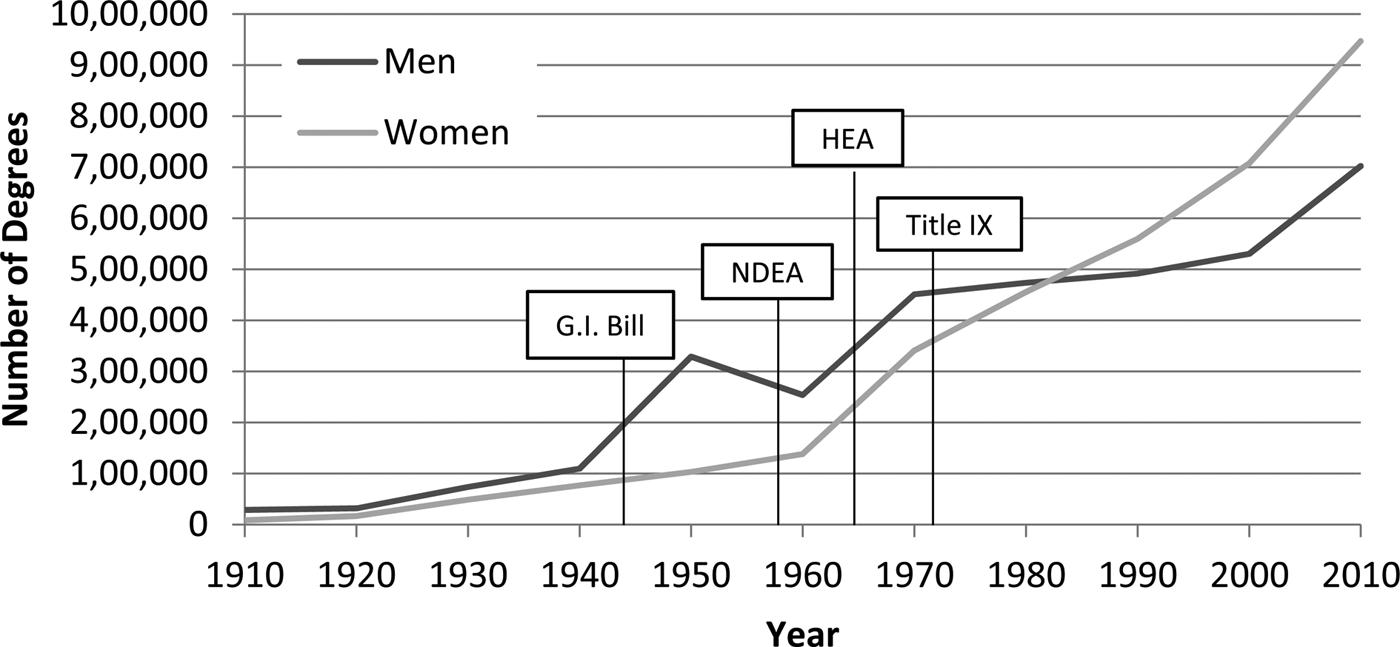
Yet, as Figure 1 shows, the onset of women's increasing bachelor's degree attainment began prior to—and thus apart from—the feminist movement; the passage of Title IX; and the social, economic, and demographic trends that the conventional wisdom emphasizes.
Bachelor's degrees conferred in the United States by gender, 1910–2010.

To more fully understand the factors that have shaped the remarkable increase in women's college degree attainment since the 1960s, we must consider the role that landmark federal student aid policies have played in promoting this trend. The National Defense Education Act (NDEA) of 1958 and the Higher Education Act (HEA) of 1965 represent landmark student aid policies that have played an unheralded role in promoting greater college degree attainment among American women. Creation of the NDEA marked the birth of need-based federal student loans, and the HEA provided additional loans and need-based grants. These policies exemplify the advantages of what Theda Skocpol terms “targeting within universalism”—designing antipoverty policies so that they extend benefits broadly across social groups, while simultaneously allocating additional benefits to low-income citizens.Footnote 7 Through a combination of means-tested and need-blind provisions, the NDEA and the HEA extended student aid in a nearly universal fashion, reaching an unprecedented proportion of the nation's college students. At the same time, they included need-based provisions that proved especially valuable to women who had been marginalized when it came to securing financial assistance for college education.
The creation of a federal commitment to college affordability for men and women was highly unlikely during the late 1950s. Historically, the federal government had exercised restraint in the area of education; and in previous decades, lawmakers' attempts to pass federal student aid programs had been thwarted by the contentious politics of race and religion. Race politics proved especially consequential to the prospect of enacting federal education programs. For Southern states, federal social policy intervention brought with it the possibility that the national government could wield powerful influence over issues like school desegregation. The specter of federal control threatened to disrupt the racial order of life in the South and, thus, evoked fierce opposition from many Southern Democrats.
Using historical analysis of primary and secondary resources, including the Congressional Record, transcripts from congressional committee and subcommittee hearings, government program reports, oral history interviews, issues of the Congressional Quarterly Weekly Report, newspaper archives, and historical poll data, I present two related case studies to demonstrate the central role that unique political contexts have played in paving the way for path-breaking policies that have promoted equal opportunity in the United States. I show how a perfect storm of political factors facilitated the successful passage of the NDEA and the HEA. By extending unprecedented financial aid to female college students, these programs helped set the stage for a dramatic increase in women's college degree attainment and a transformation of higher educational access in the United States. The creation of these programs marked a gender-neutral lowering of financial barriers limiting access to college degrees. Although they were designed as universally targeted social programs, their benefits were especially valuable for women who had been marginalized when it came to accessing financial resources for attending college. Moreover, this universal design ensured that the NDEA and the HEA enjoyed broad political support that enabled lawmakers to successfully expand access to educational opportunity for marginalized groups.
This article proceeds in five sections. The first section describes the gender dynamics of access to financial aid prior to the mid-twentieth century, highlighting the difficulty that many women faced when seeking funds to pursue postsecondary degrees. It then goes on to outline the NDEA and the HEA, providing two case studies of government student aid programs that have played an important role in expanding women's educational opportunity.
The second section highlights the theoretical significance of these cases, pointing to the lessons that we can draw from existing literature on agenda setting, policy design, and program administration. It also previews the contributions that this study makes for our understanding of American political development. For instance, these cases help to bring the role that Southern Democrats played in the development of U.S. social policy into greater focus. As Ira Katznelson aptly noted in his analysis of race politics and the New Deal, Southern Democrats “were the most important ‘veto players’ in American politics.”Footnote 8 Yet, evidence suggests that Southern Democrats played a more nuanced role in the development of the American welfare state than simply acting as inhibitors of progressive policies. In developing landmark federal higher education policies that would significantly expand equal opportunity for women and other marginalized groups, a small group of liberal Southern Democrats led the way. This study also has important implications for how we think about the progress that women have made in recent decades. Although many point to the emergence of feminism and the creation of Title IX in the 1970s as the point of departure for the strides that women have made in educational attainment, this analysis suggests that crucial contributing factors had been put in place prior to that decade. Moreover, this study demonstrates the value of a universal approach to social policymaking, offering additional support for studies that recognize the value of universally targeted programs for creating effective and politically sustainable measures to address inequality.
The article's third and fourth sections trace the politics of each program's passage, demonstrating that unique political contexts led to the creation of the NDEA in 1958 and the HEA in 1965. The final section makes the case that nondiscriminatory program administration was part-and-parcel of the NDEA's and the HEA's ability to successfully expand women's access to college degrees. In short, this study suggests that women's increasing college degree attainment has important, but frequently overlooked, public policy roots.
ADDRESSING GENDER INEQUALITY IN COLLEGE AFFORDABILITY
I know in my generation there was just simply no state or federal help for women to go [to college]. Families, I think, made the decision that if there were limited resources, that money would be spent on the boys of the family. I can remember the shock when a brother-in-law of mine, as late as the mid-sixties, said, ‘We've got to save enough money to put the two boys through college.’ I said, ‘What about Kathy?’ He said, ‘Well, she'll get married soon.’… I think that while education bills cannot be labeled as women's issues, they probably had as much or more to do with the progress that women have made than anything else.Footnote 9
—Rep. Edith Green (D-OR), 1978Historically, American women faced a number of challenges that limited their access to college degrees. Before federal student aid became widely available in the late 1950s and 1960s, meeting the cost of higher education represented one of the most formidable obstacles that women faced. For families of modest means who faced the choice of sending a son or a daughter to college, many opted to fund their son's education, reasoning that sons would reap greater benefits from the investment as future breadwinners for their families.Footnote 10 Daughters, on the other hand, were likely to leave higher education or the workforce upon marriage, thereby “wasting” their education. Economist Mabel Newcomer corroborates this observation, noting that “it is difficult to persuade parents to pay what a good education costs for their sons. It is even more difficult when it is the daughter's education that is under consideration.”Footnote 11 Not only did women have difficulty securing financial assistance from family members, but alternative sources of financial aid for women were few and far between. Many scholarships were targeted specifically toward men, and women enjoyed limited opportunities to work their way through school.
Men earned more bachelor's degrees than women well into the twentieth century, but the gender gap in degree attainment remained relatively narrow through the 1930s. The first federal program to provide women with aid for pursuing college degrees was the National Youth Administration's (NYA) work-study program, which began in 1935 and provided modest aid to male and female college students in hopes of preventing enrolled students from dropping out of college during the Great Depression. During the 1940s, the number of men earning four-year degrees increased precipitously, while the number of women earning college degrees increased at a much more modest rate. The Serviceman's Readjustment Act of 1944 (popularly known as the “G.I. Bill”) offered unprecedented support for college students, providing veterans with full tuition, fees, and a living stipend as they pursued higher education. A full 2.2 million G.I.s used the program to pursue college degrees; however, women made up a mere 3 percent of beneficiaries.Footnote 12 Because beneficiaries of the G.I. Bill were disproportionately male, the program essentially expanded higher educational access for an entire generation of American men, while doing little to promote broad-reaching higher educational attainment for the women of that generation.
In 1950, despite the fact that women had consistently received more than half of the high school diplomas awarded in the United States, they received only a quarter of all bachelor's degrees conferred.Footnote 13 Financial need continued to obstruct access to higher education for many women. U.S. lawmakers had yet to create a federal student aid program that duplicated the gender-egalitarian administration of the NYA work-study program or that extended to a large number of women financial aid approximating the generosity of the G.I. Bill benefits that had so effectively expanded higher educational access for an entire generation of American men. The 1958 creation of the NDEA, which included the first need-based federal student loans, dealt a powerful blow to financial need as a barrier to women's college degree attainment. Reflecting Congress's conviction that “the security of the Nation requires the fullest development of the mental resources and technical skills of its young men and women,” lawmakers made a formal commitment to devoting “additional effort at all levels of government” to identifying and educating the nation's talent.Footnote 14
At the heart of the NDEA was the National Defense Student Loan (NDSL) program, which provided low-interest loans to low-income college students enrolled in full-time study. It also offered loan “forgiveness” for up to 50 percent of a student's loan if she or he taught in public elementary or secondary schools. The NDEA provided undergraduate students with a maximum of $1,000 per year, up to a total of $5,000 over a college career. One year after completing or otherwise discontinuing study, students begin repayment of their loans at a fixed 3 percent rate of interest in ten equal annual installments.Footnote 15 In the program's first ten years, the NDEA provided more than $1 billion in aid to help approximately one million students pursue college education.Footnote 16
With the HEA of 1965, lawmakers reinforced their commitment to gender-egalitarian expansion of access to college. This time, they extended financial aid to an even broader pool of beneficiaries that included students from lower- and middle-income backgrounds.Footnote 17 In addition to extending the NDEA's NDSLs under the Direct Student Loan program, the HEA created three new programs: the Basic Educational Opportunity Grant for low-income students, the need-blind Guaranteed Student Loan program, and a college work-study program.Footnote 18 Educational Opportunity Grants provided up to $1,000 per year in scholarship aid to needy college students.Footnote 19
Although lawmakers did not create the NDEA or the HEA with the explicit goal of promoting equal opportunity for women, these policies inadvertently promoted this outcome. Until the creation of these landmark policies, difficulty securing financial aid from private sources and minimal access to public aid for college students represented a formidable barrier to postsecondary education for many American women. By institutionalizing unprecedented federal support to college students in the form of universally targeted, gender-neutral aid to students and by administering financial aid programs in a way that facilitated women's broad incorporation as beneficiaries, the NDEA and the HEA helped set the stage for the dramatic increase in women's college degree attainment that began in the 1960s.
EXPLAINING THE EFFECTIVENESS OF THE NATIONAL DEFENSE EDUCATION ACT AND THE HIGHER EDUCATION ACT FOR WOMEN: AGENDA SETTING, POLICY DESIGN, AND PROGRAM ADMINISTRATION
As we shall see, the effects of the NDEA and the HEA for promoting greater college degree attainment among women were rooted in each program's design, passage, and administration—key junctures in the policymaking process. Theories of agenda setting, policy design, and policy administration provide insights that prove particularly valuable to understanding the development of these policies and their effects for women's educational attainment.Footnote 20 The long-term effects generated by the NDEA and the HEA are closely related to the politics surrounding their origins. As John W. Kingdon argues, policy windows offer occasional “opportunities for action on given initiatives” that “open infrequently and do not stay open long.”Footnote 21 In the case of the NDEA, the Sputnik crisis—which shook the nation's faith in its scientific, technological, and overall educational prowess—provided such a window. Political entrepreneurs capitalized on the opportunity presented by this perceived crisis to pass previously unsuccessful programs granting broad-reaching federal support for higher education.
Seven years later, they reinforced this commitment to making college affordable for young women and men by passing the HEA. The dramatic about-face demonstrated by the passage of these programs is rooted in a policymaking context that Frank R. Baumgartner and Bryan D. Jones describe as “punctuated by bursts of activity that modify issue understandings and lead to non-incremental policy change.”Footnote 22 The United States' devastating loss in the “space race” began a chain of events that culminated in the creation of federal programming that reshaped government support for higher education as we know it. Lawmakers who supported direct federal student aid drew upon the Sputnik crisis as a focusing event that enabled them to dramatically alter the national discourse regarding appropriate government support for education. Recognizing the window of opportunity provided by the disappointing showing of the United States in the space race, policy entrepreneurs took advantage of this occasion to promote previously unsuccessful student financial aid proposals.
The NDEA's empowering effects for women were also shaped by the domestic struggle over civil rights. Central to the efforts of political entrepreneurs Sen. Lister Hill (D-AL) and Rep. Carl Elliott (D-AL) to enact a student aid program was a keen interest in directing federal resources to support education in Southern states, a region that was taxed by the strain of maintaining segregated, thus dual, school systems.Footnote 23 Their efforts had been thwarted by Southern Democrats' aversion to the prospect of federal control over education—particularly the possibility that such assistance would permit the federal government to force desegregation upon Southern states or to penalize segregated schools by withholding funds. Whenever federal lawmakers submitted proposals for federal aid to students, Southern Democrats and Republicans from all regions rejected them. Taking seriously Southern Democrats' mistrust of federal control and their fear that federal education support would ultimately force rapid desegregation in Southern schools, Hill and Elliott intentionally crafted a vague bill, omitting from their federal student aid proposal any references to race, religion, or sex when designating beneficiaries. By incorporating broad, highly generalized criteria for student loan eligibility into the NDEA, Hill and Elliott could assure liberals that the bill was inherently antidiscriminatory, while simultaneously promising Southern Democrats that the program would have little bearing on the racial composition of Southern colleges and universities.
In addition to the window of opportunity that the Sputnik crisis provided and the imperative for general framing that was necessitated by the civil rights struggle, a political context shaped by the Cold War represents a third force that promoted the passage of the NDEA and the creation of valuable resources that have done so much to expand higher educational opportunity for women. Scholars have shown that Cold War politics aided the efforts of civil rights activists by highlighting the hypocrisy of U.S. advocacy for democracy and fairness abroad, while a significant portion of the nation's own citizens were subjected to race-based discrimination.Footnote 24 Is it possible that the politics of the Cold War may have also helped American women? John Skrentny would dispute this notion. In his insightful analysis of the relationship between national security and the promotion of equal rights in the United States, Skrentny argues that the Cold War yielded few benefits on the score of women's rights. While rights for racial and ethnic minorities gained traction as a result of Soviet propaganda during the era, he argues that “the Cold War national-security policy did little for [women].”Footnote 25 For Skrentny, the benefits of the Cold War for disadvantaged groups were limited to those who experienced race-based marginalization.
Skrentny is correct in his assessment that women's rights occupied a subjugated position on the roster of U.S. priorities. In the area of employment, for example, lawmakers were repeatedly unsuccessful in proposing equal pay legislation. But, I would argue that the focus on education as a solution to the challenges that the nation faced during the Cold War yielded significant—if understated—benefits for American women in the area of higher education. While public policies expanding rights for racial and ethnic minorities were front and center during this era, the passage of the NDEA represents an important moment for women's progress. Evidence suggests that driving home the Cold War argument that harnessing all available intellectual resources—or “manpower”—was crucial for triumphing over the increasingly sophisticated Soviet Union contributed to the gender egalitarianism of the NDEA.Footnote 26 In his book See Government Grow, Gareth Davies asserts that President Lyndon Johnson's Great Society initiative marks the emergence of education policies as increasingly potent mechanisms of progressive change. “It may be useful,” he says, “to think of the Great Society, like the New Deal, not just as a set of policies, or a brief liberal moment, but as having bequeathed an era.”Footnote 27 Yet, historical evidence suggests that federal student aid programming has been a significant tool for progressive politics since the Cold War era, when lawmakers passed the NDEA. In successfully providing broad-reaching, federal support directly to young women in the form of need-based federal student loans, the NDEA expanded higher educational opportunity and offered an important precedent that informed the subsequent passage of the HEA and is, thus, likely to have contributed to the durability of education policy as a mechanism for progressive change that Davies describes.
Seven years after political entrepreneurs successfully expanded higher educational opportunity for students under the NDEA, lawmakers drew upon auspicious political circumstances to further entrench this type of aid for American college students with the passage of the HEA. Legislative proposals for federal student aid mirrored the NDEA in providing federal financial aid broadly to men and women on the basis of financial need. As a result of its broad-reaching benefits, the HEA exemplifies the fact that, as Paul Pierson notes, “public policies often create ‘spoils’ that provide a strong motivation for beneficiaries to mobilize in favor of programmatic maintenance or expansion.”Footnote 28 Lawmakers and interest groups who recognized the political value of the NDEA's broad-reaching support for higher education advocated for expanded federal support in the form of direct aid to students that would permit their middle-class constituents to benefit from the federal largesse. This locking-in of the federal government's role in providing substantial support for students pursuing higher education exemplifies the effects of path dependence, as this new relationship between the federal government and student aid beneficiaries can be described as “greatly increasing the cost of adopting once possible alternatives and inhibiting exit from a current policy path.”Footnote 29
In addition to the importance of agenda setting and policy design, policy administration represents a crucial factor in the long-term effectiveness of the NDEA and the HEA and their role in increasing the number of degrees earned by women since the 1960s. Federal student aid precedents—namely, the Depression-era work-study program and the G.I. Bill—were administered in ways that limited their capacity to significantly expand educational opportunity for women. The work-study program was kept at a modest size and supported only a small number of students. The G.I. Bill, on the other hand, was targeted in a way that benefited an overwhelmingly male population of veterans and also made it difficult for eligible female G.I.s to access benefits.
The federal work-study program was remarkably egalitarian because it provided financial support to colleges, which in turn used the funds to hire needy male and female students to on-campus jobs. However, meager appropriations and institution-level program administration undermined the program's capacity to significantly expand higher educational access for women. Central to this limitation was the fact that individual colleges and universities administered the work-study program. They created the jobs that students would perform, defined “financial need,” selected student beneficiaries, and set the amount of funds to be distributed. Because the number of needy students consistently exceeded available financial resources, institutions allocated smaller amounts of work-study aid in hopes of providing more students with funding. As a result, benefits frequently fell below the statutory maximum of $20 per month.
From 1935 through 1943, the NYA work-study program provided $100 million in federal aid to approximately 620,000 students.Footnote 30 From the work-study program's inception in 1935 through its discontinuation in 1943, its gender-egalitarian benefit distribution represented one of its most interesting features. In the 1939–40 academic year, 60 percent of beneficiaries were male, compared with 40 percent who were female. With each successive year—and with U.S. intervention in World War II—the proportion of male work-study beneficiaries diminished, while the proportion of female beneficiaries soared. By the 1942–43 academic year, 59 percent of work-study participants were young women, and 41 percent were young men.Footnote 31
Although the work-study program helped hundreds of thousands of young male and female college students during the Depression, the amount of aid provided paled in comparison to the amounts that would be allocated under subsequently enacted programs like the G.I. Bill. As the NYA noted in its 1944 report to the Federal War Manpower Commission, “the low average monthly earnings of students employed on the college work program could seldom defray the total cost of attending college.”Footnote 32 Historian Richard Reiman concurs, noting that “the effects of the NYA, apart from its symbolism, were frankly conservative. Most of these young people whose parents had never been able to afford to assist them in acquiring a college education were no more likely to attend college after 1935 than before.”Footnote 33
In 1944, following the discontinuation of the NYA's work-study program, lawmakers passed the G.I. Bill, which would ultimately provide full tuition, fees, and living stipends to more than two million veterans of the Second World War at a cost of more than $5.5 billion.Footnote 34 Because they composed only 2 percent of active duty soldiers during World War II, women were largely ineligible for G.I. Bill benefits. Fewer than 3 percent of the veterans who took advantage of G.I. Bill benefits during the postwar era were women.Footnote 35 Among this small proportion of women who took advantage of G.I. Bill benefits, many were the victims of discrimination on the part of program administrators—particularly the extension of substandard benefits to female veterans and hostile treatment by the veterans' organizations that routinely facilitated benefit use by their male counterparts.Footnote 36 In the wake of the NYA work-study program and the G.I. Bill, financial need continued to represent a significant barrier to higher education for many American women.
In contrast to these important policy precedents, the NDEA and the HEA were administered in a fashion that proved empowering for women. Moreover, they provided an unprecedented level of federal financial aid to American women. While the work-study program offered about $100 million over a decade and provided individual students with a maximum of $180 per year, the NDEA provided $47.5 million in 1956, alone and permitted individual students to borrow up to $1,000 per year. Unlike the G.I. Bill's eligibility and administrative structure that yielded an overwhelmingly male pool of beneficiaries, the NDEA and the HEA centered upon widespread eligibility and nondiscriminatory administration that facilitated the broad distribution of benefits to women as well as men. In creating these landmark programs, U.S. lawmakers dealt a forceful blow to financial need as a barrier to women's higher educational opportunity.
WHEN OPPORTUNITY KNOCKS: HOW A UNIQUE POLITICAL CONTEXT FACILITATED THE PASSAGE OF THE NATIONAL DEFENSE EDUCATION ACT
Given the longstanding tradition of state and local dominance in the area of education policy, what factors enabled lawmakers to pass the NDEA with its unprecedented federal support for college students? The prospect of institutionalizing broad-reaching federal student aid in postwar America was a dim one; and as the 85th Congress got underway in January of 1957, the probability of passing a federal student aid program seemed particularly bleak.Footnote 37 When national lawmakers considered expanding the federal role in the area of education, the topics under discussion included providing money for school construction and augmenting teachers' salaries.Footnote 38 For years, Sen. Hill and Rep. Elliott had proposed legislation that would channel federal funds toward higher education but had been unable to successfully produce a program due to political challenges. Given their Alabama roots, Hill and Elliott were unlikely champions of federal student aid. For most Southern Democrats, federal student aid was viewed as a potential mechanism for federal intrusion into the affairs of individual states, and many represented constituencies that would have been angered by the possibility that a student aid program could force integration upon Southern colleges and universities by withholding funds from institutions that were not in compliance with the Supreme Court's 1954 Brown v. Board of Education decision.
Although Hill and Elliott hailed from the South, they were nonetheless national politicians who recognized the value of federal higher education aid for their region. They also hailed from northern Alabama, a region characterized by populist politics.Footnote 39 To their minds, the benefits that could be derived from steering federal funds to their impoverished region outweighed the potential political costs of championing student aid. They wanted a broad-reaching student aid program that would provide a large number of young citizens with human capital that could yield economic gains for the South.Footnote 40
Federal support for higher education faced formidable opposition from a range of political actors, including President Dwight Eisenhower and conservative Republicans. For the president—who embraced a “God helps those who help themselves” philosophy on social policy—support for education was best left to state and local governments. Although the Eisenhower administration expressed tepid support for modest education proposals like federal aid for school construction and tax credits for families paying college expenses, it refrained from taking the initiative in the area of education. In terms of expanding higher educational opportunity for women in particular, while Eisenhower expressed concern about gender inequality in employment during his 1956 State of the Union address, he made no comment on the sizeable gender gap that characterized college degree attainment.Footnote 41
In August 1957, the President's Committee on Education Beyond High School encouraged the president to push for increased federal support for higher education in familiar forms—land grants, G.I. Bill benefits, and funding for the recently established National Science Foundation. The committee also suggested that the federal government implement a system of tax deductions to help low-income students and their families finance college education. With the exception of tax deductions, which represented a novel proposal for student aid, these recommendations reflected a strong inclination to build upon programs that were already in place. Of the financial aid policies proposed—G.I. Bill benefits and tax deductions—the latter could have promoted gender parity in higher educational attainment because the tax credits would have been granted on the basis of need, as opposed to the criterion of military service, which tended to yield an overwhelmingly male pool of beneficiaries. However, lawmakers would not seriously consider higher education tax credits until the late twentieth century.
In Congress, existing education policy proposals represented a much greater span of alternatives than the school construction and tax deduction possibilities being considered by the Eisenhower administration. In the late 1940s and early 1950s, educational reformers prioritized curriculum improvement in the areas of science and mathematics.Footnote 42 In the mid-1950s, members of Congress proposed scholarships for needy students, federal student loans, financial aid for students studying to become teachers, and the establishment of a U.S. science academy. They also presented more Eisenhower-friendly proposals for school construction and grants to the National Science Foundation. Although U.S. policymakers presented financial aid proposals that had the capacity to increase women's access to college, without fail, they became casualties of political battles over racial discrimination. An important factor in this trend was the fact that liberal reformers like Rep. Adam Clayton Powell (D-NY)—an African American representative from Harlem, New York, who was a vocal proponent of civil rights—insisted that federal aid proposals under consideration explicitly forbid racial discrimination. As a result, the programs in question typically suffered defeat at the hands of Southern Democrats.
As the president and Congress considered proposals for federal student aid in the 1940s and 1950s, interest groups were quick to weigh in on the issue. Supporters of federal student aid included the National Education Association (NEA), the AFL-CIO, and the military-defense industry.Footnote 43 The AFL-CIO established the Conference on Federal Aid to Education, which included numerous interest groups such as the American Federation of Teachers, the National Association for the Advancement of Colored People (NAACP), the National Veterans' Committee, the American Association of University Women, and the National Council of Jewish Women. Supporters of federal aid for education disagreed as to whether the government should provide general aid—which would provide schools with unrestricted financial support—or categorical aid—which would grant federal funds to the states and to local school systems for specific, predefined purposes or for select groups of students. Professional educators were stalwart supporters of general aid, while other federal aid supporters rejected the idea on the grounds that the government could not be trusted to effectively allocate federal funding.Footnote 44
The U.S. Chamber of Commerce, the National Association of Manufacturers, the American Legion, and various businessperson's and taxpayers' associations were vocal opponents of federal student aid measures.Footnote 45 These groups were particularly suspicious of categorical aid proposals, which they saw as a “Trojan horse for federal control.”Footnote 46 Historically, the threat of federal control represented perhaps the most “rhetorically and politically potent” argument inhibiting lawmakers' efforts to enact programs that would provide federal support for higher education.Footnote 47 The possibility that student aid policies could provide the federal government with an additional mechanism by which to control the states provoked the ire of Southern Democrats, who would mount the most vocal opposition to proposals for federal student aid. The objections of Southern Democrats posed a serious obstacle to passing any federal financial assistance program, let alone aid that overtly expanded college access for groups that were underrepresented in higher education, like women and racial and ethnic minorities.
Regardless of the public's support for federal aid to education in the early 1950s and despite increasingly egalitarian views toward women, Congress repeatedly rejected proposals for general aid to students on the grounds that such support would increase the federal government's control over education. As such, it was highly unlikely that lawmakers would enact federal student aid legislation during that decade.
Scaring Up Money for College: How the Politics of Crisis Promoted Unprecedented Financial Aid for Women
While the Eisenhower administration, members of Congress, and various interest groups held definite positions on the propriety of federal involvement in education, the issue failed to gain traction until October 4, 1957. On that day, the Soviet Union won the race to space in spades. By successfully launching Sputnik, the first satellite to orbit the Earth, Soviet scientists debunked Americans' belief that the United States was the most technologically advanced nation in the world.Footnote 48 In the midst of Cold War tensions, this surprising demonstration of scientific prowess was seen as a decided victory for communism and facilitated the ascent of education to the top of the nation's political agenda. As Senate staff member Stewart McClure recalls, the public panicked, and “people were fretting in the streets about ‘oh, my God, we're behind.’”Footnote 49 As Americans sought to identify the root of the nation's failure to keep pace with the Soviets, many pointed to the perceived failures of the nation's scientists, internal conflict at the Pentagon, and suboptimal prioritizing of Cold War concerns by President Eisenhower.
A disproportionate amount of criticism fell upon the nation's educational system, which citizens regarded as directly related to the nation's ability to survive in an increasingly competitive international arena. Critics pointed to shortages in school infrastructure, a chronic lack of science equipment in many high school classrooms, American students' underachievement in mathematics, perilous secondary school dropout rates, and underwhelming levels of college attendance as reasons for the nation's disappointing showing on the space science and engineering front, as well as indicators of vulnerability in the area of national security. Citizens expected the federal government to secure the nation's safety by providing support for education.Footnote 50
When the Soviet Union launched Sputnik I, Lister Hill and Carl Elliott strategically harnessed the conservative rhetoric of anticommunism and public anxiety over Soviet technological advances to promote their existing goal of achieving federal funding for education at all levels.Footnote 51 They recognized the opportunity that the Sputnik crisis presented and took great pains to develop a new proposal that would successfully clear the House and the Senate. Working with representatives from the Department of Health, Education, and Welfare (HEW), Hill and Elliott reframed their previous policy proposals into a bill that was sensitive to—and in some ways empowered by—the day's most pressing political issues. As they crafted their proposal, they understood that taking advantage of the window of opportunity provided by Sputnik required them to devise a bill that would not incite intense opposition. The NDEA's effectiveness for expanding women's access to college degrees was a function of these policy entrepreneurs' resolve to take advantage of the window of opportunity presented by the Sputnik crisis.Footnote 52
As Barbara Barksdale Clowse points out, the Sputnik crisis reflected the Zeitgeist of the Cold War, growing from an “all-inclusive ideology” characterized by “a grim rhetoric of survival.”Footnote 53 Capitalizing on Americans' surprise following the Soviet triumph and the disappointment with which they viewed the United States' comparative capabilities, Hill, Elliott, and their allies reinforced public fears regarding the nation's security in the face of Soviet scientific—and presumably militaristic—advantage. This method of securing support for federal education policy drew upon Cold War politics to achieve the arguably unrelated goal of steering federal funds toward higher education. Compared to the Soviet Union, education policy proponents argued, the United States failed to fully utilize the talents of its women. While many Soviet women obtained advanced education, worked in crucial science and engineering fields, and directly contributed to their nation's prowess in science and technology, American women obtained higher education at much lower rates than American men and were rarely employed in fields related to science and technology.
Lawmakers argued that, to compete with the Soviet Union and to protect American democracy, it was imperative that the United States take advantage of all available “manpower.” Just as “showcasing American women's political involvement had become a particularly common way to deprecate Soviet life,” educating women and drawing upon their talents in the name of democracy resonated with Cold War politics.Footnote 54 In this context, the political currency of emphasizing American women's full integration into American higher education increased the probability that lawmakers would advocate for a higher education program that would significantly expand educational access for women as well as men.Footnote 55 By successfully juxtaposing Cold War politics with the shortcomings of American education, lawmakers took advantage of the window of opportunity that the Sputnik crisis provided for expanding access to higher education.
The Politics of Enactment: Design, Deliberation, and the Passage of the National Defense Education Act
Having already convened House subcommittee hearings on the topic of education in 1957, Elliott recognized the political currency of the Sputnik launches and made plans to strategically argue that providing federal support for education in general—and higher education in particular—was crucial to ensuring the nation's security.Footnote 56 Over the December 1957 holiday season, Hill and Elliott worked to produce a federal student aid proposal that they could present to their respective legislative chambers when Congress reconvened in January of 1958. They focused on carefully tying their previous proposals for educational aid to national security in a way that would preclude both rejection by their conservative colleagues and the presidential veto.
Working closely with Elliot Richardson, associate secretary of HEW, they prioritized constructing legislation that could withstand three controversial issues that had long precluded the passage of federal education proposals—the prospect of federal control over education, maintaining the separation of church and state, and dealing with segregated schools.Footnote 57 The Hill-Elliott measure, which was strategically named the “National Defense Education Act,” authorized $1.6 billion over the course of five years to provide 40,000 merit-based scholarships to undergraduate students, federal student loans, a work-study program, and money for vocational education.Footnote 58 In addition to providing scholarships and loans to talented students pursuing higher education, the proposal also included funding for teacher-training centers and instructional equipment to enhance learning at all levels of education.Footnote 59
Understanding the political benefits of “coupling solutions to problems” and recognizing that the policy window presented by the Sputnik crisis would be “of short duration,” Carl Elliott worked to quickly and effectively tie the student aid proposal to the contemporary Cold War crisis.Footnote 60 Although the Hill-Elliott measure was framed as a temporary response to this particular crisis, they had no intention of scaling back federal aid to education once it had been enacted. As Elliott later wrote:
Although training scientists and engineers was a primary focus, we were looking far past the immediate crisis. We were looking at opening the doors of education across the board, in the humanities as well as the “hard” sciences. The crisis gave us a focal point to get our bill made into law—that's how we came up with the title the National Defense Education Act. But we realized this bill's effects would extend beyond the current climate of that time. It was education in general, from physics to philosophy, that we wanted to make available to the best young minds of this country.Footnote 61
Elliott's assertion makes clear his intent in crafting the NDEA. Hill and Elliott knowingly and purposefully took advantage of the window of opportunity provided by the Sputnik launches to promote substantial and long-lasting federal support for college students. Stewart McClure, Chief Clerk of Senator Hill's Labor, Education, and Public Welfare Committee, noted that unlike previous education proposals, the NDEA “was wrapped in the flag and safe.”Footnote 62
To create a broad-reaching federal student aid program, it was imperative that Hill and Elliott frame their education program in a way that would be agreeable to Southern Democrats. Central to this objective was preventing Rep. Powell from insisting that the federal student aid legislation include an antidiscrimination clause. The “Powell Amendments,” as these riders were known, proposed that the policies to which they were attached—typically school construction aid and military programs—prohibit benefit allocation on the basis of race, color, religion, nationality, or sex. These amendments proved especially controversial because, in addition to gaining the support of “big-city Democrats” who agreed with their central premise, they garnered the votes of conservative Republicans who wished to kill the legislation.Footnote 63 These lawmakers would strategically vote in support of the antidiscrimination amendment and then align with Southern Democrats to vote against the entire bill, arguing that the antidiscrimination amendment made the proposal disagreeable to their constituents.
To save the NDEA from such a fate, Hill and Elliott carefully structured the program in a way that was vague enough to be interpreted by liberals as inherently nondiscriminatory and by Southern Democrats as innocuous. This was done by omitting Powell's antidiscrimination amendment and offering a means test and enrollment at a U.S. institution of higher education as the only formal criteria for financial aid eligibility. Providing federal aid directly to individuals, rather than to schools, enabled Hill and Elliott to successfully avert the segregation issue. As Clowse recognizes, by awarding scholarships, states “could still practice segregation as long as their commissions made these [federal financial aid] awards without discrimination.”Footnote 64 In other words, any low-income student could feasibly receive a federal grant, but the student would still have to gain admission to an institution of higher education to utilize the award. The fact that the bill would provide federal aid to any student who met these requirements satisfied the liberals in Congress, while Southern Democrats were reassured by the enrollment criteria. While this framing did little to expand African Americans' access to segregated Southern colleges and universities in the mid-twentieth century or women's access to male-only colleges and universities, it did institutionalize racial and gender equality in college affordability.Footnote 65
Aware that Hill and Elliott were crafting a federal student aid proposal in the wake of the Sputnik crisis, Eisenhower charged Elliot Richardson of HEW with producing the proposal on behalf of the administration. The result of his efforts, the Educational Development Act of 1958, was “much more bare-bones” than the Democrats' NDEA proposal.Footnote 66 It proposed awarding 10,000 need-based scholarships to students with exceptional academic records. Although it did not require that recipients pursue higher education in any particular fields, it did target scholarships to students with solid backgrounds in science and mathematics. Sen. H. Alexander Smith (R-NJ) and Rep. Carroll D. Kearns (R-PA) presented the administration's proposal to Congress. The Smith-Kearns bill proposed a $1 billion program that centered upon modest scholarships for students and grants to the National Science Foundation. It also allocated money for the improvement of education-related statistical services and foreign language programs. As per Eisenhower's insistence, the Republican proposal emphasized the temporary, emergency-related nature of the proposed legislation.
Hill's and Elliott's central objective in proposing the NDEA was creating a universally targeted program that could help raise the intellectual level of all Americans.Footnote 67 As such, the Democrats took issue with Eisenhower's insistence that aid should be awarded on the basis of merit. Under such a system, the federal government would provide assistance to a smaller group of especially talented students instead of granting aid broadly, on the more inclusive bases of citizenship and need. Hill and Elliott adamantly objected to Eisenhower's proposal, which flew in the face of their overall goal of liberalizing access to college.
Enacting Federal Student Aid during the Era of Strong Committees
It was clear, from the outset, that the battle over federal student aid would be an intense one. On January 20, 1958, Rep. Thomas Pelly (R-WA) urged his colleagues not to allow unease over national defense to compel them to rush into federal student aid:
Meeting and outmatching Soviet technological progress is a matter requiring careful study and it may well be that shortages in engineering and scientific personnel could be overcome by making these ultimate careers more attractive. In other words, rather than by a hysterical crash program and trying by scholars to mass produce our youth into physicists and other scientific calling, that we consider other means of correcting any deficiencies.Footnote 68
Indeed, the battle over federal student aid was a bipartisan struggle that pitted conservative Republicans and Southern Democrats against liberal Democrats and more moderate Republicans.Footnote 69 In the late 1950s, the House of Representatives was the more conservative of the national legislature's two chambers, as Southern Democrats in the House tended to be more conservative than liberal Republicans in the Senate. This meant that the successful passage of the NDEA depended upon Elliott's ability to win the support of moderate Republicans in the House, a feat that would enable him to compensate for a lack of support from Southern Democrats.Footnote 70 The House of Representatives represented a crucial hurdle for federal education aid proposals, and the success or failure of the NDEA would depend largely upon that chamber's deliberations.
Because congressional committee chairs were particularly powerful during this period, committees represented decisive battlefields for social policy proposals—points at which many met their demise. When lawmakers began what would be an eight-month process of considering educational proposals on January 27, 1958, Hill and Elliott in Congress and Richardson at HEW knew that successfully clearing congressional committees represented the most challenging aspect of the legislative process for education bills. In the House, Education and Labor Committee Chair Graham Barden (D-NC)—who one Senate staff member described as a “tough, thick-necked, immutable, immoveable, rock-ribbed chairman”—proved a formidable opponent of federal aid for education, and his opposition generally meant that such proposals never survived committee deliberations.Footnote 71
Under other circumstances, complicated political and ideological issues would likely have made it impossible that either the Hill-Elliott or Smith-Kearns bills would enjoy a fate that was any different from the host of unsuccessful federal aid proposals that had been presented to Congress in the postwar era. However, members of a new guard of liberal lawmakers had joined the Education and Labor Committee—Representatives Carl Elliott (D-AL), Edith Green (D-OR), Frank Thompson (D-NJ), and Stewart Udall (D-AZ)—forming a coalition that championed the cause of federal support for education.Footnote 72 More importantly, the Sputnik crisis gave these proposals a fighting chance. It was fortuitous that lawmakers had been working to produce federal education legislation when Sputnik I launched. Their readiness to take advantage of this opportunity significantly increased the probability that an education proposal would gain passage during the 85th Congress.
Hill and Elliott used NDEA committee hearings to construct a solid case for federal student aid. They engaged a broad range of witnesses who offered testimony that pointed toward education as the solution to the nation's defense troubles. Members of Congress brought their most compelling arguments to the debate over federal student aid. For decades, the specter of federal control had effectively thwarted lawmakers' attempts to enact federal aid for higher education.Footnote 73 Opponents of federal student assistance objected to national government intervention on the grounds that such support would inappropriately involve the federal government in education—a policy area traditionally and best reserved to state and local governments.Footnote 74 Champions of federal student aid countered this argument with assurances that any federal program would be modest and temporary, and would allow the state and local governments to remain the principal arbiter on matters related to education. Opponents countered, however, that large federal programs are rarely temporary and that they tend to grow rather than being reined in, becoming increasingly unwieldy over the course of their existence. In the Senate, Strom Thurmond (D-SC) and Barry Goldwater (R-AZ) took particular issue with the Hill-Elliott proposal and raised loud objections to it. Thurmond questioned the relevance of the NDEA for promoting national security, citing the absence of a requirement that students pursue postsecondary training in disciplines directly related to defense as a glaring omission. Goldwater objected on the grounds that the federal aid proposal represented what would surely become a non-retractable, ever-expanding demand on the federal government.Footnote 75
Contention also revolved around the effect that federal involvement in education would have on the issues of race and religion in the United States. Some feared that federal support for education would blur the separation of church and state by permitting the federal government to provide funds to Catholic schools.Footnote 76 Others took issue with the possibility that the national government could use education funding to influence the nature of (de)segregation in Southern schools.Footnote 77 In the wake of the Supreme Court's landmark 1954 decision in Brown v. Board of Education, which ruled that school segregation was a direct violation of the 14th Amendment of the U.S. Constitution, congressional representatives from the South saw federal education aid as a potential tool that would allow the federal government to punish segregated schools by withholding federal funds, effectively forcing desegregation upon schools that had been integrating with “all deliberate speed.”Footnote 78
Throughout the congressional hearings for the NDEA, the topic of gender was far less contentious than that of race or religion; nevertheless, women's full and equal inclusion as beneficiaries of direct federal student aid was not a foregone conclusion. Rep. Donald W. Nicholson (R-MA) raised the question of whether educating women could be deemed a waste, pointing out that even if girls and women were to go to college, they would probably get married and “miss out on all the things [they] could do” with that education.Footnote 79 Rep. Green took issue with that logic, saying that if educating women is wasteful, “it seems to me there is a tremendous amount of waste in educating young men who go to war and are shot. That is completely wasted, is it not?”Footnote 80 HEW Secretary John A. Perkins expressed his opinion that education is never wasted and made clear the administration's position that federal aid should be targeted to women as well as men, asserting that
women usually do not attend college in the numbers which their abilities indicate they should. If a family is perhaps pressed financially and they have sons and daughters, they are apt to educate the sons before they will extend themselves to educate the daughters. Then, too, it is more difficult for ladies to work themselves through college than it is for a young man to do so.Footnote 81
He continued by addressing Nicholson's assertion that marriage frequently precludes women's ability to gain the full value on the returns of higher education saying, “There is an interesting quip, ‘You educate a man and you have educated one person; but you educate a mother and you have educated a family.’ There is some great truth to that.”Footnote 82 Hill and Elliott framed their education proposal as a general provision that would support the higher educational pursuits of both men and women. They worked to establish a tone of gender egalitarianism during committee sessions, as is evinced by Elliott's opening statement before the Special Education Subcommittee. Framing men's and women's education as a national imperative, Elliott asserted that “America is rich in native intelligence… . We need only to shape our talents, to educate with discernment to develop to the utmost the latent endowments everywhere among us, to train each boy and girl to the highest attainable degree, consistent with his or her ambition.”Footnote 83
It is interesting to note the parallels between arguments made to justify women's education during the mid-twentieth century and arguments supporting women's suffrage during the early twentieth century. Advocating for women's right to vote in 1915, Carrie Chapman Catt emphasized women's “sameness” to men—the idea that, as people, women were rightful participants in democratic governance. She also highlighted the idea that women and men differ in important ways and that women's strengths could contribute to national deficiencies related to schooling, dealing with criminals, and addressing unemployment.Footnote 84 Arguments emphasizing women's valuable differences mirror early justifications for women's education. Not only could college-educated women provide intelligent wives for the clergy, they could also perform the role of what Linda Kerber calls “Republican Motherhood”—cultivating patriotism, duty, and morality in the next generation of American citizens.Footnote 85 When lawmakers revisited the issue of educating women during NDEA deliberations, they invoked a number of the same arguments casting women's education more as a matter of pragmatism and less as a matter of individual rights.
After addressing the problems that stem from wasting intellectual talent, the discussion turned to the form that federal support should take. When lawmakers asked the HEW representatives to discuss the basis on which benefits should be allocated to students, Perkins and his colleague, Ralph C. M. Flynt, advocated for need-based scholarships. Flynt, HEW's director of Higher Education Programs, told the committee that 50 percent of young women and 46 percent of young men identified financial need as the most important barrier to obtaining higher education. Providing need-based federal aid directly to students would effectively remove this barrier for young women as well as men.Footnote 86 To drive home this point, lawmakers invited male and female undergraduates to testify before the committees. This testimony revealed the daunting challenges faced by many young women and men as they sought to fund their own postsecondary education. Some committee members were skeptical regarding the value of student loans, particularly for women who might find it difficult to repay them. Charles Brooks, executive staff assistant to Sen. Wayne Morse (D-OR), predicted that student loans would be “useless” because of the low probability that women would “avail themselves of a program that leaves them with a debt of $4,000 to $5,000 or more upon graduation.”Footnote 87 U.S. Education Commissioner Lawrence G. Derthick added that a young woman would likely avoid accepting student loans because “looking forward to marriage; she does not want to bring her husband-to-be a great debt.”Footnote 88
As lawmakers debated the necessity of federal student aid and the appropriate forms that it should take, several participants in the House and the Senate committee hearings emphasized the importance of expanding higher educational opportunities for women in light of the Soviet Union's extensive use of women in science and engineering, which contrasted with American women's meager presence in these areas.Footnote 89 Henry H. Hartly, superintendent of schools in North Bend, OR, addressed this contrast in a letter to the House Committee on Education and Labor. “I am sure you are aware,” he wrote, “that Russia considers its women in a different light than do we and that the numerical superiority of Russian scientists is achieved, in part at least, by utilizing the brains of its women. In this country, when a family has to make a choice between a college education for a son or a daughter, the son is generally favored.”Footnote 90 Bearing in mind this contrast with the Soviet Union, lawmakers emphasized the necessity of educating American women to fully utilize the nation's available brainpower. Driving home this theme, Sen. Morse insisted that “we need to watch out that we do not waste brainpower in our country. I do not think we have any right to deny to a boy and girl a college education if he or she has the mental potential to do satisfactory college work.”Footnote 91 From this perspective, national security depended on its ability to fully and effectively utilize the nation's “manpower.” The first line of defense in the post-Sputnik battle against communism, then, was to cultivate the skills and talents of every capable man, woman, and child through education.
Although their support for women's equality in higher education did not come in the form of intensive, organized lobbying by female constituents or women's groups, women were, nonetheless, important participants in the congressional hearing phase of the NDEA's consideration.Footnote 92 Mary Lasker, who was the widow of advertiser Albert Lasker and one of the richest women in the world, underwrote Elliott's early attempts to garner support for the NDEA by circulating literature to his colleagues and spreading word about the proposal in the media.Footnote 93 Moreover, a number of female witnesses who testified during congressional hearings on federal education aid provided important information that enabled the successful passage of the program.Footnote 94
While differing dramatically from the participation of women's groups during the fight for women's suffrage during the interwar period or the subsequent battle for women's rights in the late 1960s and 1970s, women's involvement in the design and enactment of the NDEA could be described as a “quiet storm.” In the context of the Cold War, where those who vocally demanded equality or political change were often labeled communist sympathizers, women expressed their interest in equality and equal opportunity via membership in mainstream groups that weighed in on policy proposals being considered by lawmakers, but rarely attempted to set a feminist agenda.Footnote 95 Thus, women generally focused on the political issues that emerged from male-dominated political institutions and drew upon the political techniques that were generally rewarded therein. When federal student aid came under consideration, for example, social activist Agnes E. Meyer adopted Cold War rhetoric in advocating for federal student aid, urging Americans to “wake up and realize that the cold war has shifted from a competition in arms to a competition in brains.”Footnote 96 All things considered, Cold War politics played an important role in shaping individual women's interest in and activity related to the NDEA in 1958. For women's groups, however, federal support for education was not embraced as a women's issue and, thus, was not a focus of their political activism.Footnote 97
While women's groups had not been actively involved in lobbying for the NDEA, they supported the bill as it made its way through the final stages of the political process. Once the bill emerged from committee deliberations, it remained captive in the House Rules Committee for a considerable length of time. On July 28, 1958, a number of groups—including the American Association of University Women, the American Federation of Teachers, Delta Kappa Gamma (honor society of women legislators), the National Association of Colored Women's Clubs, the National Council of Jewish Women, the National Council of Negro Women, the YWCA, and the United Church Women—submitted a letter to House Speaker Sam Rayburn insisting that Congress remain in session until it had successfully acted on the federal education aid bill.Footnote 98 As the legislative session moved rapidly toward adjournment, Elliott and other federal student aid supporters grew anxious. An August 11, 1958, Time editorial noted that as “the Sputnik-inspired sense of urgency” subsided, “the fair weather for the school bills [had] turned into dead calm.” As panic over the Sputnik launches cooled, and as the United States successfully launched its own satellites, Elliott recognized the necessity of acting on the NDEA before the window of opportunity provided by the Soviet triumph closed.
Going the Distance: Debating Federal Student Aid on the Floor
The momentum generated by committee hearings and the media propelled the NDEA forward as it emerged from the House Rules Committee during the first week of August and headed to the floor for consideration by the Committee of the Whole.Footnote 99 During this phase of deliberation, members of the House devoted a considerable amount of time to discussing proposed amendments. Rep. Powell successfully submitted an antidiscrimination amendment that would ensure the award of financial aid “without discrimination based on race, color, religion, national origin, or sex.”Footnote 100 In what proved a stunning blow to Elliott's and Hill's original intentions in designing the National Defense Education bill, House members voted to remove its scholarship provision during the final stages of consideration. Because the scholarship provision represented one of the most controversial items in the bill, one that faced solid opposition from conservative members of the House, Rep. Walter Judd (R-MN) managed to successfully submit an amendment striking scholarships from the bill and moving the proposed authorizations to a title providing student loans.Footnote 101 Toward the end of the NDEA's consideration in the House, Rep. Smith created further controversy by appending a loyalty oath to the bill, exemplifying what Clowse describes as the “leitmotif” of the Cold War: “an obsession with national survival.”Footnote 102 Nevertheless, on August 9, 1958, the House of Representatives voted to pass its version of the NDEA by a roll-call vote of 265–108, thus sending it to the Senate.Footnote 103
Once the bill was presented on the floor of the Senate, its consideration was relatively smooth. Unlike the House of Representatives, the Senate retained the scholarship measure that was included in the original Hill-Elliott proposal. Shortly before midnight on August 13, 1958, the Senate passed its version of the NDEA by a 62–26 roll-call vote.Footnote 104 While thirty-five Democrats and twenty-seven Republicans supported the bill, ten Democrats and sixteen Republicans voted against it. The Democrats who opposed the bill hailed primarily from the deep South, while the Republican objectors tended to represent districts in the Midwest and West.Footnote 105
In the version of the NDEA that emerged from the House and Senate conference committee, the scholarship provision and Powell's antidiscrimination amendment were high-profile casualties of the political process. Conference committee members attempted to allay the concerns of liberal Democrats by arguing that the bill was inherently nondiscriminatory. The deliberate scrapping of the antidiscrimination amendment was part of a political strategy employed by congressional proponents of federal aid who intentionally left parts of the legislation vague so as to preclude prohibitive actions on the part of conservatives—particularly Southern Democrats—who would likely have rejected the bill if they feared extensive federal control.Footnote 106 To reassure liberals in the House who had reservations about approving the conference bill absent the “Powell Amendment,” Elliott presented a letter written by HEW Associate Secretary Richardson that declared the NDEA to be “inherently antidiscriminatory.”Footnote 107
The conference committee's bill gained bipartisan support—and bipartisan opposition—in the House and the Senate. While Republicans tended to hold more conservative views, members of the Democratic Party—who represented “a conflicting mix of white Southerners, Catholics, urban blue-collar workers, and ethnic and minority groups”—were divided ideologically.Footnote 108 As consideration of the NDEA neared an end on August 23, 1958, Rep. Harry Haskell (R-DE) offered an urgent reminder to his colleagues:
The Soviet Union today has one of the most dangerous weapons in the whole world—the atheistic, scientific trained mind—and it has them in plentiful supply… . The Soviet colleges and universities graduated twice as many engineers and scientists as we did in 1956. They have more than double the number of science students in their higher educational institutions this year than we have. Tuition in colleges is free—they pay students salaries—(stipends they have named them)—there are bonuses in addition for those with high scholastic marks, particularly in science.Footnote 109
In the final legislative action on the NDEA, the House of Representatives passed the bill on August 23, 1958—the penultimate day of the 85th Congress—by a roll-call vote of 212–85. President Eisenhower signed the NDEA, PL 85-864, into law on September 2, 1958.Footnote 110 While partisanship was not an important source of division on this legislation, ideology was, as liberals and conservatives in both chambers failed to see eye to eye on this bill.Footnote 111 In addition to ideological considerations, as Clowse notes, the looming elections may have served to garner additional support for this federal student aid legislation.Footnote 112
There can be no doubt that the NDEA marked a new day for U.S. higher education policy. Following its passage, U.S. Education Commissioner Lawrence Derthick called the NDEA an act that would “open up many opportunities for increasing our vital reservoir of trained manpower, a reservoir we need to provide leaders in all fields from science to statesmanship.”Footnote 113 This case study suggests that a unique political context shaped by the Sputnik crisis, domestic race politics, and the politics of the Cold War facilitated the passage of the NDEA in 1958 and played a central role in the broad inclusion of women as program beneficiaries.
Writing four years after the program's passage, Homer D. Babbidge, Jr., and Robert Rosenzweig recognized that the distinctiveness of the NDEA lay in the fact that “the Congress of the United States had never before declared that it was a goal of national policy that ‘no student of ability will be denied an opportunity for higher education because of financial need.’”Footnote 114 The NDEA dramatically altered Americans' conceptualization of appropriate government support for education, heralding a shift in the dominant form of federal education aid from support for expanding school infrastructure and improving academic programming to assistance provided directly to students in the form of financial aid. In addition to making college affordable for thousands of American women and men, the NDEA dramatically altered the federal government's posture toward college students. It set an enduring precedent for how the government would approach the task of expanding higher educational opportunity, while providing women with unprecedented federal support for pursuing college degrees.
REINFORCING GENDER PARITY IN COLLEGE AFFORDABILITY: THE HIGHER EDUCATION ACT OF 1965
The problem of educating young people is not confined to low-income families. Middle-income families, faced with the prospect of educating more than one member of the family, are often hard pressed either to find the funds or to select which child should be educated. The case is often presented where the oldest member is enrolled in school but when his younger brothers and sisters reach college age they are unable to attend due to expenses already incurred.
—Sen. Harrison “Pete” A. Williams, Jr. (D-NJ), June 1, 1965 (Remarks from statement made during the “Higher Education Act of 1965 [H.R. 3220]” Subcommittee Hearings)If the NDEA institutionalized a new relationship between the federal government and the nation's women by making federal student aid broadly available to them, the HEA took this relationship to a new level. While the NDEA removed financial need as a barrier precluding college education for thousands of American women, the HEA reinforced federal support by providing significant amounts of federal money to further expand higher educational opportunity for the nation's young women and men. The early political development of the HEA can be traced to the 1960 presidential election, when Republican Party nominee Richard Nixon capitalized on the political currency of the NDEA, advocating for more federal student loans and the creation of a federal scholarship program.Footnote 115 Democratic Party nominee John F. Kennedy also proposed increases in federal support for higher education;Footnote 116 and shortly after taking office in 1961, President Kennedy appointed Purdue University's president, Frederick L. Hovde, as chairman of a new task-force on education.
The Hovde Commission provided the president with recommendations that included the allocation of approximately $9.4 billion for grants and loans to students between 1961 and 1965.Footnote 117 As Hugh Davis Graham notes, “the Hovde report envisioned a massive and permanent [government] role in education.”Footnote 118 In addition to the Hovde Commission, Kennedy established the President's Commission on the Status of Women, which emphasized the importance of higher education for women's socioeconomic status. In its final report to the president, the committee noted that “men and women are equally in need of continuing education, but at present women's opportunities are more limited than men's.”Footnote 119 In explaining the cause of women's limited opportunities, the report points to the fact that women are typically excluded from “the substantial arrangements for advanced training provided by businesses for their executives” as well as “the educational and training programs of the armed forces.”Footnote 120 The President's Commission on the Status of Women emphasized the importance of higher education to women's well-being and recommended that the federal government increase its efforts to promote women's college attendance.
In 1961, the Kennedy administration proposed a higher education bill that would have provided need- and merit-based federal scholarships for undergraduate students as well as institutional loans to tackle the ongoing problem of classroom shortages. By 1963, the Kennedy administration had jettisoned the student scholarship component of its higher education bill, limiting its new proposal to federal funds for school construction. In February of that year, New York Times columnist Fred Hechinger noted that the administration's proposal was distinctive because it was the first postwar education proposal that did not directly address Cold War objectives.Footnote 121 On December 16, 1963, in the wake of President Kennedy's assassination, Congress passed, and recently inaugurated President Lyndon B. Johnson signed, the Higher Education Facilities Act, which provided federal funds to support campus infrastructure.Footnote 122
The 1964 elections brought major victories for the Democratic Party. Johnson's defeat of Barry Goldwater in the presidential election and large Democratic majorities in Congress heralded the emergence of a political climate that would prove amenable to educational reform. Moving forward, the Johnson administration sought to take unprecedented action in expanding educational opportunity. Reflecting this objective, as James Hearn noted, the mid-1960s “brought the seeds of extraordinary change to federal policy in education” with lawmakers undertaking “a wide-ranging initiative in education, passing more than two-dozen acts aimed directly at American schools and colleges.”Footnote 123 Johnson intended to use this era of unified Democratic government to tackle inequality head on, emphasizing the value of higher education as a mechanism for promoting equal opportunity and combating poverty.Footnote 124 In 1964, Johnson clearly outlined his goals for education in a series of speeches and public statements. For higher education, he expressed a commitment to expanding and improving colleges and to making greater access to college a central priority for his administration.Footnote 125
Presidential Leadership and the Politics of Policy Creation
President Lyndon Johnson's forceful leadership represents perhaps the biggest factor contributing to the successful passage of the HEA and its capacity to expand gender egalitarianism in U.S. higher educational attainment. As Sally Davenport notes, the HEA reflected social policy themes that, in 1965, had recently emerged. For Johnson, college education represented a powerful antipoverty measure that offered “a means of mainstreaming the poor, not just providing minimum levels of ‘welfare.’”Footnote 126 From this perspective, federal higher education programs could potentially raise the educational attainment—and standard of living—of a significant segment of the U.S. population. The president's use of higher education policy to promote equal opportunity was heavily influenced by the precedent set by the NDEA.Footnote 127
The political context of the mid-1960s provided a “perfect storm” for Johnson's pursuit of federal legislation that would significantly expand college access. Taking advantage of sweeping Democratic victories in 1964, the president prioritized pushing a comprehensive student aid proposal through the legislature that would further the NDEA's efforts to expand college access for the nation's young men and women.Footnote 128 Johnson also benefited from the fact that, by the time the HEA came under consideration, political issues that had long-dogged proposals for federal student aid had become less contentious. The Civil Rights Act of 1964 had prohibited the transfer of federal dollars to segregated schools, thus setting a standard for subsequent programs. The NDEA's provision of financial aid directly to students rather than to institutions had settled arguments that federal student aid would jeopardize the separation of church and state. The successful passage of the NDEA in 1958 and the Civil Rights Act in 1964 provided a winning strategy for successfully passing the HEA. Furthermore, the recent passage of the Elementary and Secondary Education Act on April 11, 1965, placed education on the minds of legislators and their constituents.Footnote 129
Designing the Higher Education Act: A Unilateral Process
Fueled by Johnson's vocal commitment to passing an extensive program of support for higher education, the policy design phase of the HEA centered upon the White House and its liaisons in the Office of Education, the Bureau of the Budget, and the Treasury Department. With the goal of successfully passing legislation that would significantly expand access to higher education, the president and his administration spent much of 1964 constructing its proposal so that it could “hit Congress with a full package of legislative proposals, rush the bills through committee, and then force a floor vote before [Johnson] lost his election momentum.”Footnote 130 Throughout the process of constructing the administration's student aid proposal, President Johnson wielded “tight executive control” over the policy's design.Footnote 131 As Michael Parsons notes, “Congress would have input, but it would come after the administration had formed the policy, thus forcing Congress to respond on Johnson's terms.”Footnote 132
In adopting this hands-on approach, Johnson worked closely with his staff to construct a bill that would succeed at providing federal scholarships, a goal that had eluded Democratic lawmakers since the 1940s. Douglas Cater, a special assistant to the president, was known as the “education man” in the White House. He acted as a chief liaison for matters related to education. During the formulation of the HEA, Cater—in communication with President Johnson—was responsible for crafting the proposal that would be submitted to Congress.Footnote 133 Working closely with Education Commissioner Francis Keppel and U.S. Office of Education officials Peter Muirhead and Samuel Halperin, Cater actively sought the input of representatives from the higher education establishment, who were closely aligned with the Office of Education. Doing so ensured their political support once the proposal came under congressional consideration.Footnote 134 Cater also consulted with the Bureau of the Budget, which “determined the feasibility of the [HEA] in terms of cost and funding levels,” and the Department of the Treasury, which offered a second opinion on the feasibility of the administration's proposal and actually constructed the Guaranteed Student Loan program.Footnote 135
Taking into account the interests of actively engaged groups like the American Council on Education, the American Library Association, and the Association of Research Lobbies, all of which actively lobbied the U.S. Office of Education, the administration produced a proposal that provided support to numerous areas related to higher education. The proposed HEA included $25 million in federal support for an urban land-grant extension program that would provide financial support to urban universities; $65 million in funding for college libraries; and $30 million in aid to struggling postsecondary institutions, such as historically black colleges and universities.Footnote 136 The core of the HEA, however, was found in Title IV, which provided student financial assistance in the form of need-based scholarships, guaranteed student loans for middle-class students, extended the need-based loans established by the NDEA, and updated the work-study program by shifting its jurisdiction from the Office of Economic Opportunity to the Office of Education.Footnote 137
On January 12, 1965, Johnson delivered a special message to Congress, wherein he stressed the importance of providing equal educational opportunity for all Americans and offered a preview of the administration's higher education aid proposal, asserting that “higher education is no longer a luxury, but a necessity.”Footnote 138 During his address, Johnson emphasized the necessity of providing $130 million of federal assistance to support needy men and women who wished to attend college, saying that “loans authorized by the National Defense Education Act currently assist nearly 300,000 college students,” nonetheless, “an estimated 100,000 young people of demonstrated ability fail to go on to college because of lack of money.”Footnote 139 In addition to requesting that Congress authorize additional support for student financial aid, Johnson revealed plans to expand the scope of Americans who could benefit from federal student aid, proposing an expansion of the work-study program that would make middle-class students eligible for support.Footnote 140 On January 19, 1965, seven days after the president delivered this special education message, the Johnson administration submitted its higher education proposal to Congress, along with a letter from the president proclaiming the proposal's utmost importance to the administration.
Enacting the Higher Education Act during an Era of Democratic Control
The political context within which the HEA made its way through Congress differed greatly from that which had surrounded the NDEA seven years earlier. Unlike the NDEA, which was largely propelled by congressional initiative, the president provided the driving force behind the HEA. In Congress, a Democratic majority facilitated the bill's relatively smooth journey from subcommittee deliberations to floor consideration and, ultimately, to successful passage. Contributing to the propitious political context surrounding the passage of the HEA was the replacement of Rep. Barden—a stalwart opponent of federal education aid—with Rep. Powell as the chair of the Education and Labor Committee in the House of Representatives.
By 1965, education was viewed as a potent antipoverty mechanism. Rep. Everett Burkhalter (D-CA) expressed this view on the House floor, saying that “no matter what authority on poverty you approach you will find that education is generally accepted as one of the most powerful forces that we have at our command in the fight to give all the disadvantaged some opportunity to obtain adequate food, housing, medicine, jobs, and opportunity to escape the ranks of the poor.”Footnote 141 The probability of successfully passing the HEA was further enhanced by substantial public recognition of and concern regarding the challenges of funding higher educational opportunity. According to a poll conducted by Louis Harris & Associates in March 1965, 48 percent of Americans identified financial worries as the most challenging problem facing their children in their attempts to obtain higher education. On May 14, 1965, Sen. Harrison “Pete” Williams (D-NJ) alluded to the challenges that many talented students face in funding higher education during his remarks on the Senate floor: “In June 1961, 400,000 high school seniors who graduated in the upper half of their classes failed to continue their education. The determining factor for one-third to one-half of these young men and women was lack of financial resources.”Footnote 142
On May 30, 1965, the Johnson administration's higher education proposal was presented to Congress with Rep. Edith Green acting as chief sponsor. The bill proposed federal student loans and grants, a work-study program for undergraduates, and assistance for developing institutions, among other provisions. Soon after the bill's introduction, the Education and Labor Committee's Special Subcommittee on Education, which was chaired by Rep. Green, commenced hearings on the proposal, as did the Senate's Labor and Public Welfare Committee's Subcommittee on Education, which was chaired by Sen. Morse. In both chambers, professional organizations, academics, and student aid officers were particularly engaged in the process of providing lawmakers with information to help them determine what measures would ultimately be included in the bill that the Johnson administration had so enthusiastically endorsed. As José Chávez notes, the HEA subcommittee hearings offered higher education officials and others interested in student aid “perhaps their last opportunity for participating in the policy-making process for the HEA.”Footnote 143 Not surprisingly, the Johnson administration closely monitored congressional action at this phase of the legislative process, drawing upon active lines of communication between President Johnson and Douglas Cater at the White House and Rep. Green and Sen. Morse at the Capitol.Footnote 144
Between February 1 and May 1, 1965, the Special Education Subcommittee of the House held hearings on the HEA proposal. A broad array of lawmakers, Johnson administration officials, professional educators, university administrators, and other interest group representatives provided information and recommendations to the members of the subcommittee. On the first day of the hearings, an exchange between Anthony J. Celebrezze, secretary of HEW and Rep. John Brademas (D-IN) exemplified the gender-inclusive tone that would characterize the debate over government efforts to promote equal opportunity in higher education:
Secretary Celebrezze: At this point in our history I think we are trying to pinpoint [higher education] to the lower economic group, to the elimination of poverty. I am hopeful that as this program takes root and as these young men get out into the professional world, into the academic world—
Mr. Brademas: And women, Mr. Secretary.
Secretary Celebrezze: And women, as they get out, they, themselves, will start lifting the rest of the family up.Footnote 145
As this discussion illustrates, lawmakers were attuned to the relevance of the HEA for both women and men and intended to consider the proposed legislation in a way that fully incorporated women.Footnote 146
In addition to this women-inclusive goal of expanding access to higher education, the HEA subcommittee hearings reflected an emphasis on expanding college access for talented students, particularly those coming from low-income backgrounds. This had important implications for gender equality. During his testimony, Secretary Celebrezze presented data from the Office of Education that highlighted the fact that academically talented young women were less likely than their male counterparts to enter college within one year of completing high school.
As Table 1 illustrates, this was particularly true for students whose annual family income was less than $3,000. Among high-achieving students who fell in the 90th percentile (top 10 percent) for aptitude, 10.2 percent of male students did not enter college immediately after completing high school, whereas a full 33.1 percent of women failed to do so. For students of similar aptitude whose family income was at least $12,000 per year, the difference was not nearly as stark: 2.9 percent of highly talented male students did not move directly from high school to college, compared with 4.4 percent of similarly talented female students. Among students from low-income families who were ranked in the top 50th percentile in terms of academic aptitude, the data presented by Secretary Celebrezze showed that women were considerably less likely than men to attend college directly after high school.
Percentage of High School Graduates Who Did NOT Enter College within One Year of Completing Grade 12
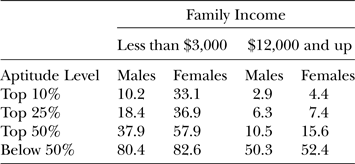
Source: “Higher Education Act of 1965 [H.R. 3220]” Subcommittee Hearings, 1965, pp. 32–39; Department of Health, Education, and Welfare, Office of Education.
For students falling in the top 25 percent of their peers in terms of aptitude, twice as many females than males (36.9 compared with 18.4) failed to enter college within one year of completing the twelfth grade. For students in the top 50 percent, 57.9 percent of women failed to enter college immediately after high school, compared with 37.9 percent of men. These data suggest that women had much to gain from a new federal student aid proposal—something that AFL-CIO representative Lawrence Rogin called a “badly needed and long-overdue mechanism that can be used by many of our youth to help overcome the otherwise prohibitively high cost of higher education.”Footnote 147
Like the debate in the House subcommittee, many witnesses who came before the Senate's Subcommittee on Education between March and June of 1965 expressed fervent support for the legislation and its significance for Johnson's Great Society initiative. Prominent voices from the administration emphasized what Office of Economic Opportunity director R. Sargent Shriver called the “birthright of opportunity.” According to Shriver, “the war on poverty is an integral part of the establishment of the Great Society. And the pursuit of excellence in education follows directly from this Nation's commitment to secure” the promise of equal opportunity. The HEA, asserted Shriver, offered a powerful step toward reclaiming this entitlement for women and men in the United States.Footnote 148
Other witnesses focused on the role of financial hardship as the central challenge to broad higher educational opportunity in the United States. U.S. Education Commissioner Francis Keppel emphasized financial disparity and the ways in which it inhibits equal access to postsecondary education. “The evidence is very strong,” he declared, “that young men and young women without family means to help them out are not going into college in numbers—and it is into the one hundred thousands—because they know they don't have the financial support.”Footnote 149 In memorable testimony before the committee, Carolyn Steele, a high school counselor, recounted the story of a student named Judy, who came from a single-parent family in Minneapolis, Minnesota. Although Judy had distinguished herself as an excellent student, graduating in the top 10 percent of her high school class, a lack of funds prevented her from pursuing her dream of going to college for psychology or prelaw after graduation. Instead, Judy was forced to take on a full-time job. She is currently enrolled in one night course and hopes to save enough money to continue her postsecondary work. Ms. Steel emphasized the difference that federal student aid would mean for students like Judy.Footnote 150
For these witnesses, the federal financial aid proposed by the HEA would provide crucial assistance that would greatly expand higher educational opportunity for American men and women. Speaking before the National Conference of Governor's Commissions on the Status of Women, Vice President Hubert Humphrey reiterated the Democratic Party's attitude that higher education represents an important mechanism for opportunity—particularly for women, whose talent too often goes to waste. He asserted that women's employment opportunities were frequently limited by a lack of education. Although women composed 51 percent of Americans graduating from high school in 1964, “when it comes to college the girls, their parents and even their teachers and counselors have some second thoughts.”Footnote 151
For the HEA—as was the case with the NDEA—federal support for education failed to incite intense mobilization on the part of women's organizations.Footnote 152 How policy issues are defined significantly influences which groups and individuals become involved in their politics.Footnote 153 As Kristin Goss and Theda Skocpol note, during the 1960s women's groups were “reluctant or unable to use their presumptively ‘different voice’” to advocate for social policy issues—such as federal support for higher education—that were important to them.Footnote 154 While women have historically been highly interested in the provision of student loans, women's organizations did not focus intensely upon the HEA of 1965 and its potential benefits for women.Footnote 155 Expanding access to higher education, especially for needy citizens, was viewed as an issue of general concern—rather than a “women's issue.” Not surprisingly, only a small handful of women's groups like the American Association of University Women expressed vocal support for the HEA in 1965. During committee deliberations, the association submitted a statement in support of the legislation. According to General Director Pauline Tompkins, the association was “impressed” by the proposed HEA and expressed enthusiastic support for its passage.Footnote 156
Although women's groups were not particularly engaged in lobbying for the HEA, historical analysis reveals that many of the men and women testifying during HEA subcommittee hearings recognized the importance of expanding higher educational access for American women. In arguing for increased federal financial support for students from low-income families, witnesses who testified in favor of the bill noted the interaction between gender and financial hardship for young people struggling to afford college. George O. McClary, president of the American School Counselor Association, noted that in large, female-headed families, “there is no money for savings which might be used for financing college. There is usually financial brinksmanship. The financial struggle is communicated to the girl in the form of ‘get yourself a husband’ and to the boy in the form of ‘be a man on your own and find yourself a job to help out.’”Footnote 157 As such, McClary expressed strong support for the scholarship provisions included in the HEA.Footnote 158
Women's access to educational resources has grown in tandem with changing social perceptions of women's roles.Footnote 159 On March 6, Sen. Pete Williams highlighted the importance of gender inclusiveness in opportunity in the United States, encouraging his colleagues to “make every effort to insure that the rising generations of young women from low-income families are properly equipped and able to meet the complex demands of our expanding industrial society.”Footnote 160 Echoing the argument that HEW Secretary Perkins offered in favor of women's full inclusion under the NDEA seven years before, Rep. Donald M. Fraser (D-MN) emphasized the benefits that educating women would yield for American families.Footnote 161 He went on to characterize the fact that many young women did not go to college as “a national waste.”Footnote 162
Others highlighted the ways in which the HEA could provide capable workers for businesses—including women, who represented an often untapped economic resource—thus providing valuable support for the U.S. economy. Dorothy McBride-Stetson notes that 1960 marked the beginning of an era in which higher education became linked with the economic status of women as well as their employment opportunities.Footnote 163 This notion is apparent in a statement submitted to the House subcommittee by the National Association of State Universities and Land-Grant Colleges, noting that the community extension portion of the proposed HEA would provide needed support for “groups that have not had adequate opportunities,” like women. The HEA would provide women who have left the labor market with training to reenter “useful professions,” such as nursing.Footnote 164
Unlike these enthusiastic supporters of the HEA, some witnesses voiced staunch opposition to the bill. Bankers' associations were particularly averse to the provisions of the HEA. Speaking on behalf of the American Bankers Association, Keith G. Cone complained that the administration's subsidized loan program posed “a very real danger” because it created “an incentive for parents to disregard their fundamental obligations to make at least a partial contribution to the education of their children”Footnote 165 A representative testifying on behalf of an interest group known as Liberty Lobby asserted that the HEA “promotes, glorifies, and finances the ideology of socialism, through its support of the ‘social worker’ approach to social and economic problems.” “As a ‘pork barrel’ bill,” he continued, “it should be rejected.”Footnote 166 The Liberty Lobby spokesman went on to suggest that the federal government should instead adopt a program that emphasized income tax credits for parents, students, and school taxpayers.
It is interesting to note that while opposition to the HEA mirrored NDEA opponents' qualms with the prospect of expanding federal control in the area of education, the note of skepticism over women's inclusion as student aid beneficiaries that colored the NDEA debate was absent from HEA deliberation. For the HEA, opponents were skeptical of the propriety of using federal funds to provide scholarships and additional loans to students. Led by Senators Abraham Ribicoff (D-CT) and Winston Prouty (R-VT), conservative members of Congress—particularly Republicans, though some Democrats shared this view—argued that proposals for tuition tax credits, which would permit students coming from middle-class backgrounds to take advantage of federal assistance for higher education, represented the only responsible mechanism for expanding access to college.
Moreover, they argued, the idea of providing federal tax credits for higher education enjoyed considerable public support. According to a Gallup poll conducted in January of 1958, when asked, “Should parents with children in college be able to deduct from their income tax the amount of money spent for tuition, board and room at college?” 81 percent of respondents agreed that families should be able to make such deductions, compared with only 13 percent who said that they should not. Democratic leaders managed to fend off attempts to make tuition tax credits a central mechanism by which the federal government provided aid for higher education by emphasizing the potential burden that such credits could place upon the government.Footnote 167 Additionally, the fact that the HEA—unlike the NDEA—made federal student loans available to students from middle-class backgrounds garnered the support of lawmakers who may have otherwise pushed for higher education tax credits.Footnote 168 Although tax credit proposals failed to gain approval by Congress in 1964, they became a staple in future debates over federal aid for higher education.
Over the course of subcommittee deliberations, lawmakers accepted a number of amendments that largely enhanced the requests made by the Johnson administration. The House subcommittee did away with library research grants, but increased the funding authorizations for community extension programming and provided increased funds for extending the Higher Education Facilities Act. It also enhanced the government's capacity to promote greater higher educational access for American women and men by expanding eligibility for Title IV scholarships to include all students in need of financial support, and not simply those from families in the lowest income brackets. The House subcommittee's revised bill did, however, depart from the administration's proposal in one major respect: It abandoned the Guaranteed Student Loan program, which provided loans to students from middle-class families.Footnote 169 Some members of the subcommittee viewed this alteration as an unresolved issue, even after they approved the HEA on May 18, thus sending it to Chairman Powell's Education and Labor Committee for consideration. The Senate's Education Subcommittee also added amendments to the proposed HEA during the hearings phase, including the addition of provisions for creating a National Advisory Council for Extension and Continuing Education, additional funds for junior colleges and developing institutions, loan forgiveness for student borrowers who entered the field of teaching, and additional scholarship funding for students from low-income families who exhibit exceptional academic achievement.Footnote 170
On August 26, 1965, the House of Representatives debated the merits of the HEA. During this debate, some lawmakers took issue with the bill's proposed scholarships. In the past, the Senate had approved scholarship provisions in proposed education legislation only to have such measures stripped from the House version of the bill. In a dramatic break with political precedent, House members rejected an amendment to jettison the scholarship proposal in the HEA by a 58–88 standing vote.Footnote 171 The House of Representatives approved the HEA by a 367–22 roll-call vote that same day.Footnote 172 The successful passage of the HEA by the House of Representatives was particularly significant because it marked the first time that the House had approved a proposal for federal scholarships for college students. Six days later, on September 1, 1965, the Senate's Labor and Public Welfare committee reported its version of the bill to the Senate; and on September 2, that chamber approved the legislation with a 79–3 roll-call vote.Footnote 173 In the Senate, only the conservative Democrats John C. Stennis (D-MS), A. Willis Robertson (D-VA), and James O. Eastland (D-MS) opposed the HEA's passage.
Once both chambers of Congress approved the HEA, their respective proposals were streamlined in a conference committee. Conference debate centered upon two items: the HEA's scholarship provision for needy students and the Teacher Corps program. Some lawmakers, such as Rep. Edith Green, objected to the entitlement format of Basic Educational Opportunity Grants, preferring instead merit-based aid for needy students. Lawmakers also disagreed about the propriety of the Teacher Corps program, which involved providing federal funds to select, train, and pay teachers who would volunteer to teach at schools in impoverished areas of the country.Footnote 174 Conservative members of the conference committee argued that such a program would require an inappropriate level of federal control over personnel in participating schools. Ultimately, although Congress authorized funding for the Teacher Corps program, it failed to appropriate funds for the program.
On October 19, 1965, a conference committee of House and Senate members filed a compromise version of the HEA that closely resembled the Senate's version of the bill, including the annual student aid appropriations set forth in the Senate bill and its provisions for amending the NDSL program.Footnote 175 Commenting on the conference bill as it returned to each chamber for final approval, Rep. Powell, chair of the Education and Labor Committee, proclaimed that “both chambers and both sides of the aisle sought compromise with one goal in mind—the enactment this year of legislation that will revitalize the tired blood of our anemic colleges and universities and pump needy students into the all too upper class main stream of academic life.”Footnote 176 On October 20, both the House and the Senate approved the conference report with a vote of 313–63 in the House and a unanimous voice vote in the Senate.Footnote 177 The HEA emerged from Congress replete with eight titles that met the requests made by President Johnson in his January 12 education message. The legislation authorized more than $800 million for higher education in fiscal year 1966, approximately $42 million for interest subsidies for student loans, and financial aid to developing institutions.Footnote 178
On November 8, 1965, President Johnson signed the HEA into law at his alma mater, Southwest Texas State College. In his signing statement, Johnson proclaimed that “in the next school year alone, 140,000 young men and women will be enrolled in college who, but for the provisions of this bill, would have never gone past high school.”Footnote 179 He went on to assert that the nation would “reap the rewards of their wiser citizenship and their greater productivity for decades to come.”Footnote 180 The HEA was immensely popular among Americans. When a December 1965 Harris Survey asked respondents whether they approved or disapproved of specific legislation passed by Congress that year, a full 89 percent indicated that they approved of the college scholarships that were created by the HEA, while only 11 percent expressed disapproval.
Building upon the NDEA, the HEA of 1965 further expanded access to postsecondary education for millions of American men and women. As was the case with the NDEA, a unique political context enabled lawmakers to create federal student aid benefits that have played a central role in women's increasing college degree attainment. While Cold War politics and the domestic struggle over civil rights catalyzed the passage of the NDEA, Johnson's forceful leadership in waging the “war on poverty” and the emphasis that his administration placed on economic opportunity fueled the creation of the HEA. In addition to the importance of political context in facilitating the passage of the HEA, its capacity to expand higher educational opportunity to women was rooted in lawmakers' decision to extend support to college students across the socioeconomic spectrum using a combination of need-blind and need-based provisions. This approach of targeting within universalism enabled lawmakers to craft a politically sustainable program that would have broad-reaching appeal, while also directing additional benefits to the neediest citizens—a significant proportion of whom were women. In the years immediately following the HEA's passage, the number of college degrees earned by women continued to increase precipitously, and sixteen years later, women surpassed men as the recipients of four-year degrees.
POLICY IN MOTION: HOW NONDISCRIMINATORY PROGRAM ADMINISTRATION FACILITATED UNPRECEDENTED GOVERNMENT SUPPORT FOR COLLEGE WOMEN
While historical analysis has demonstrated that extraordinary political contexts facilitated the creation of the NDEA and the HEA and made possible an unprecedented and ultimately non-retractable federal commitment to higher education, understanding how lawmakers helped set the stage for dramatic increases in women's college degree attainment requires that we also pay attention to each program's administration.Footnote 181 The administration of the NDEA and the HEA provided women with broad-reaching access to benefits that student aid policy precedents had not. For example, the decentralized administration of G.I. Bill benefits permitted systematic discrimination against women.Footnote 182 Many Americans did not regard the small number of women who were eligible to receive support under the G.I. Bill as rightful beneficiaries of veterans' provisions. For the small group of eligible women who did participate in the G.I. Bill program, benefits extended were typically inferior to those enjoyed by their male counterparts. Moreover, these women frequently encountered hostility from administrators working with the Veterans Administration and participating postsecondary institutions.Footnote 183
The NDEA and the HEA, on the other hand, were administered through a partnership between the federal government and postsecondary institutions that centered upon a mission to extend support to all needy students—male and female. Under each program, the federal government determined student eligibility using a standard formula to gauge financial need. It also established aid amounts and ensured that any needy student who had gained acceptance into an accredited college or university would be eligible to receive benefits. This high level of federal guidance over program administration and a widely understood mission to promote the national interest by extending aid to all eligible students helped to ensure that NDEA and the HEA benefits would be allocated in a gender-egalitarian fashion.
The path-breaking student loan provisions of the NDEA that were in effect from roughly 1959 through 1973 were administered in a way that emphasized the strong leadership and active involvement of the federal government. HEW's commissioner of education was charged with administering the NDEA, and the commissioner played a central role in overseeing its NDSL program, which provided the bulk of NDEA support for undergraduates. The federal government contributed 90 percent of the funds necessary to operate this program, while participating colleges and universities contributed the remaining 10 percent.Footnote 184 The amount of federal funding allocated to each state depended on the number of its residents who were enrolled in postsecondary education. In its fourteen years of operation, the NDEA extended approximately $1 billion to support undergraduate and graduate students attending nonprofit postsecondary institutions.
How did NDEA program participation work for individual students? To participate in the NDSL program, students had to gain admission to full-time study at a participating college or university, and once admitted, they applied for the loan through the college's financial aid office. Individual institutions received up to $250,000 per year to devote to loan awards and had the task of selecting the students who would receive aid. Within each institution, financial aid officers determined the amount of aid that each student would receive, based on the amount of funds available to their institution, the number of students applying for aid, the extent of each student's financial need, and the student's academic merit.Footnote 185
From the beginning, a considerable number of students participated in the program, with male students' use exceeding that of female students. In 1959, the NDSL program reached nearly 1,200 institutions of higher education, approving 17,317 loans for men (70 percent) for an average amount of $339 and 7,514 loans to women (30 percent) for an average amount of $318. For younger students, women took advantage of loans at particularly high rates. Among high school seniors applying for financial aid that year, men received 5,890 loan approvals (53 percent), compared with 5,243 for women (47 percent).Footnote 186 In subsequent years, the NDSL program would grow to support a greater number of students, a substantial proportion of whom were women. In 1960, for example, the program approved 78,590 loans for men (66 percent) for an average amount of $502 and 40,410 loans to women (34 percent) for an average amount of $480. That year, more than $50 million in student loans reached 115,000 students enrolled in 1,300 colleges and universities.Footnote 187
Women's active participation in the NDEA's student loan program is particularly interesting considering that many lawmakers who mulled over the nuances of program implementation predicted that women would be less amenable to the idea of borrowing money for their education than men. A 1959 article in the Fredericksburg, Virginia, Free Lance-Star quoted educators as arguing that “a woman graduate with $5,000 debt on her head is less of a marriage bargain on the market.”Footnote 188 Granted, women exhibited considerable caution when deciding to take on student loans. When asked how much debt they felt comfortable assuming, women tended to express greater hesitation than men regarding the prospect of borrowing larger amounts. While 53 percent of men reported that they would feel safe borrowing more than $2,000 for their college expenses, the proportion of women expressing this view was a more modest 40 percent.Footnote 189 Nevertheless, this caution did not stop women from actively participating in the NDEA's student loan program.
In 1962, HEW released “Student Borrowers: Their Needs and Resources,” a report by Robert C. Hall and Stanton Craigie that summarizes data gathered from all students who borrowed NDSLs from July 1 through November 1, 1960. These data reveal the extent to which the NDSL program expanded access to higher education for program beneficiaries. A full 92 percent of borrowers indicated that the NDSL was a factor in their ability to enter or continue college; 31 percent of male borrowers and 29 percent of female borrowers reported requiring aid outside family income to meet the entire cost of financing their education.Footnote 190 Moreover, 55 percent of borrowers reported that NDSL funds permitted them to work fewer hours in part-time employment while pursuing their studies, and 16 percent of borrowers said that the NDSL program enabled them to shift from attending school part-time to attending full-time.Footnote 191 The Hall and Craigie report found that 40 percent of all borrowers were women, but that the proportion of women borrowing funds from the program varied dramatically by state.
In Delaware, for example, women made up the majority of NDSL borrowers, at 58 percent. The same was true in South Carolina, where women composed 55 percent of borrowers over that period. Women were a minority of borrowers in states like Rhode Island (12 percent), New Hampshire (18 percent), Utah (18 percent), and Maine (20 percent).Footnote 192 This could have been related to the fact that states like Maine and Utah extended loans to a lower percentage of freshman borrowers than most states. Women, incidentally, were more likely to borrow from the NDSL program as freshmen than as upper-class or graduate students.Footnote 193 It was also the case that Rhode Island and New Hampshire were among the states with the lowest proportion of borrowers indicating that they intended to major in education, a discipline that boasted a high proportion of female majors.
The NDSL program provided women with valuable benefits and may even have influenced their decisions to enter college, their ability to continue their studies, how they spent their time, and their postcollege plans. Among borrowers who used NDSLs for college, 34 percent of women credited the program with enabling them to enter college as a freshman, compared with 23 percent of male borrowers.Footnote 194 In addition, 15 percent of men and 16 percent of women said that NDSLs permitted them to pursue their studies full-time.Footnote 195 The program may also have enabled women to devote less time to part-time employment, presumably giving them more time to devote to academic work. The Hall and Craigie report found that 9 percent of women devoted between sixteen and twenty-five hours per week to part-time jobs, compared with 18 percent of men.Footnote 196 Regarding future careers, 74 percent of women pursuing bachelor's degrees with NDSL funds intended to go into teaching, compared with 31 percent of their male counterparts.Footnote 197
A 1968 study of NDSL recipients in the New York metropolitan area who had recently graduated from college shed light on the program's impact on women. Among the program participants included in the study, women borrowed a median amount of $1,000, compared with $800 for men. When asked whether they had been in favor of borrowing money from the NDSL program to pay for higher education, 13 percent of men said that they had not been in favor, compared with only 4 percent of women. Researchers also asked whether the borrowers' parents had been in favor of the loan; 6 percent of men said that their parents had not been in favor of their borrowing government money for college, compared with 14 percent of women.Footnote 198
Central to the significance of the NDEA for promoting higher educational opportunity for women was the loan forgiveness provision that canceled a substantial portion of loan debt for beneficiaries who became public elementary and high school teachers. Since the nineteenth century, the teaching profession has been dominated by women at the elementary and secondary levels; and since the 1950s, women have earned more than twice the number of bachelor's degrees in education than men.Footnote 199 Of the men, 43 percent expected that a portion of their loan debt would be canceled because they planned to work as teachers, compared with a whopping 71 percent of women.Footnote 200 The fact that the NDEA's student loan program offered a unique debt forgiveness opportunity to educators proved especially important to the policy's capacity to expand women's educational opportunities.
A 1965 article in the Tuscaloosa News provides a valuable illustration of gender-egalitarian program administration that ensured women's access to the NDEA's benefits.Footnote 201 Carol Ann Bloodworth was a 24-year-old divorcee with four children, and she depended on welfare benefits for survival. In hopes of escaping poverty, she decided to pursue a college degree with the goal of becoming a schoolteacher. The availability of federal student aid played a central role in her decision to pursue a college education. She applied for an NDSL and received $300 to fund her education at Wichita State University. Bloodworth had no trouble securing NDSL funds for her education.
She did, however, run into complications with welfare program administrators who insisted that income from her student loan could make her ineligible for income support under the aid to families with dependent children program. The financial aid officials at Wichita State allowed her to have additional time before responding to the deadline for accepting their admission and student aid offer so that she could sort out her issues with the welfare program. Ultimately, the state welfare agency permitted her to accept her student loan without disrupting her family benefits, arguing that the ultimate goal of public assistance is to “help people help themselves become contributing members of society.” Her NDSL covered her tuition, books, transportation, and babysitting expenses. Given her interest in entering the teaching profession, Bloodworth expected to have at least part of her debt forgiven after graduation. Through such gender-egalitarian program administration, the NDEA provided American women with unprecedented government support as they pursued upward mobility through higher education.
From 1960 through 1967, the number of students benefiting from NDSLs increased from 24,800 to 394,300. By 1963, colleges and universities participating in the NDSL program enrolled 90 percent of full-time college students in the United States, and approximately 5 percent of students received NDSL benefits. By 1965, the NDEA had provided approximately $453 million to more than 600,000 students studying in more than 1,500 colleges and universities. By its twenty-fifth anniversary in 1984, the program had extended more than $9 billion in loans to students.Footnote 202
Administration of the HEA took the same nondiscriminatory, gender-egalitarian form that characterized NDEA administration. The HEA's Guaranteed Student Loan program reached both low-income and middle-class students, offering financial aid to anyone with family income up to $15,000.Footnote 203 The HEA's Educational Opportunity Grant program offered the first need-based grants provided by the federal government. Like the NDEA, the HEA required that students gain admission to a participating postsecondary institution and then apply for funds through the college's financial aid office. Campus-level officials selected students to receive funds and determined the amount of aid to award beneficiaries.Footnote 204 Driving the HEA's administration was the continued commitment to using federal student aid to democratize access to college degrees. This mission contributed to the program's equitable administration.
At the federal level, the HEA's student loan programs were administered by the Office of Education's Division of Student Financial Aid. As was the case with the NDEA, the federal government provided the bulk of student aid funds, while colleges and universities handled the majority of program administration. For the Guaranteed Student Loan program, private lenders provided loans to students, and the federal government subsidized them. Historical survey data suggest that the Guaranteed Student Loan and Educational Opportunity Grant programs were administered in a gender-egalitarian fashion. When asked about the extent to which eligible women students had trouble accessing the Guaranteed Student Loan program at their institution, only 3 percent of college and university representatives surveyed said that women had “considerable trouble” gaining access to benefits.Footnote 205
Five years after lawmakers passed the Guaranteed Student Loan program, women composed approximately 36 percent of program beneficiaries. A decade after the program's passage, researchers conducted a national survey of more than 3,000 college students and found that women made up 46 percent of Guaranteed Student Loan recipients and a full 55 percent of Educational Opportunity Grant recipients.Footnote 206 In 1970, the program provided $1 billion in loans to one million students; by 1980, the number reached nearly three million students at a cost of $6 billion dollars.Footnote 207 Historical data suggest that the HEA's programs have been particularly valuable to low-income and middle-class women. For example, by the early 1980s, 26 percent of low- and moderate-income women enrolled in college participated in the Pell Grant program (formerly known as the Basic Educational Opportunity Grant program), compared with 23 percent of their male counterparts.Footnote 208 In the years following the HEA's enactment, its grant and loan programs supported millions of students as they pursued college degrees. The nondiscriminatory administration of the HEA, which incorporated women as widely included beneficiaries of public support mirrored the precedent established by the NDEA.
CONCLUSION
Scholars seeking to explain the dramatic increase in women's higher educational attainment that we have seen since the mid-twentieth century have focused largely on the role that a variety of demographic, economic, social, and political factors have played in driving this trend. For students of politics, the emergence of second-wave feminism in the 1970s and the creation of Title IX in 1972 loom large as explanations for the strides that women have made in earning college degrees. Yet, as we saw at the beginning of this analysis, the rate at which women earn college degrees began to increase prior to—and thus apart from—the emergence of second-wave feminism and the passage of Title IX. This analysis suggests that the NDEA of 1958 and the HEA of 1965 provided women with valuable aid that expanded their access to college degrees and helped to set the stage for women to surpass men as the recipients of bachelor's degrees.
In examining the creation and implementation of the NDEA and the HEA, this article highlights the public policy roots of women's college degree attainment, focusing particularly on the role that unique political contexts, strategic policy design, and nondiscriminatory program administration have played in lawmakers' ability to promote equal opportunity through higher education. Although focusing narrowly on two case studies cannot yield a definitive explanation for the increase in women's educational attainment that we have seen in recent decades, this analysis prompts us to look beyond the conventional explanations for women's progress to include the landmark financial aid programs of the 1950s and 1960s.Footnote 209
It also reveals important lessons for the study of American political development. For example, a handful of relatively liberal Southern Democrats were stalwart—if unlikely—champions of the NDEA and the HEA, whose efforts were central forces driving their creation. While Northern Democrats were generally much more supportive of federal education proposals than their Southern counterparts, Sen. Lister Hill and Rep. Carl Elliott deviated from this trend. Hill and Elliott, who hailed from Alabama, subverted Cold War politics and carefully negotiated the politics of civil rights in order to pass the NDEA in the window of opportunity provided by the Sputnik crisis. Hill and Elliott demonstrated a commitment to securing federal resources for their constituents that trumped many of the concerns—including suspicion that federal education support would force desegregation on Southern schools—that prevented their counterparts from supporting such measures. Scholars have recognized Southern Democrats as powerful veto players in the development of U.S. social policy during the twentieth century. But, as these case studies have illustrated, it is important to recognize varying preferences among members of this group. For economic liberals like Hill and Elliott, the prospect of securing federal resources for their region and improving the socioeconomic status of their constituents proved a compelling reason to champion federal higher education legislation.
Examining these cases also reveals the significance of policy design for creating government programs that effectively promote equal opportunity. The considerable extent to which the NDEA and the HEA helped to expand women's access to college degrees exemplifies the value of more universally targeted policies for aiding disadvantaged groups while also achieving political durability. Granted, social programs that narrowly target benefits to the poor—such as Temporary Assistance for Needy Families (TANF) or the Supplemental Nutrition Assistance Program (SNAP)—tend to cost less than broader social programs, while efficiently allocating benefits to the neediest citizens. However, in a political context that often stigmatizes the poor, such programs frequently lack the widespread political support necessary to sustain their benefits for marginalized groups. Through a combination of need-based and need-blind student aid, the NDEA and the HEA had a sweeping, nearly universal reach that resulted in substantial support for needy college students as well as considerable political stability.
For women, the effects of this policy design proved powerful. While men had long enjoyed numerous private and public sources of financial support for their higher educational endeavors—the preponderance of family contributions, work opportunities, scholarships, and generous government support from the G.I. Bill—such sources had traditionally provided women with very little. Thus, they had a disproportionate amount to gain from the NDEA and the HEA. By providing gender-neutral financial aid, lawmakers helped to ameliorate gender inequality in access to college degrees and to the social, economic, and political benefits that they yield. This pair of case studies demonstrates how a general approach to targeting social policy benefits can prove disproportionately advantageous for members of an underprivileged group.
In examining the effect that the NDEA and the HEA have had for women's college degree attainment, we find that nondiscriminatory program administration is a crucial factor in fulfilling the promise of gender-egalitarian policy design. By centering NDEA program administration around the mission of cultivating all of the nation's available brainpower, lawmakers effectively set in motion the first broad-reaching student aid program that promoted greater college affordability for women. They also paved the way for nondiscriminatory administration of the HEA, which would further entrench the federal government in the role of expanding access to higher education for women as well as men.
With the passage of the NDEA and the HEA, lawmakers dealt a stunning blow to gender inequality in access to college degrees. Taken together, the NDEA and the HEA revolutionized college affordability for women, setting a new standard for federal involvement in higher education and helping to set the stage for stunning increases in women's higher educational attainment. Indeed, it is possible that these programs represent crucial antecedents that paved the way for the prominent victories that women achieved during the 1970s. After removing financial need as a barrier to higher educational access for women, lawmakers were able to turn their attention to leveling discriminatory admissions policies, which represented the final barrier to women's access to college degrees.
In taking seriously the role that federal higher education policies have played in women's educational achievement, this article contributes to a more comprehensive understanding of the role that lawmakers have played in determining who has access to college degrees in the United States and the citizenship-enhancing benefits that accompany these degrees. Although many think of the 1970s as the genesis of the progress that American women have made in recent decades, federal student aid policies that have made crucial contributions to women's movement toward first-class citizenship were created years before. This study suggests that the creation and administration of the NDEA and the HEA played an important role in expanding equal educational opportunity for women and may even have helped to set the stage for the victories that women achieved during the 1970s and beyond.