





Introduction
Clostridioides difficile infection (CDI) is strongly associated with antibiotic exposure, with the highest-risk conferred by “4C” antibiotics: clindamycin, amoxicillin-clavulanate, ciprofloxacin (fluoroquinolones), and cephalosporins. Reference Brown, Coburn and Hernandez1,Reference Lawes, Lopez-Lozano and Nebot2 Previous studies demonstrate that stewardship-driven reductions in 4C antibiotic use are associated with decreases in CDI. Reference Lawes, Lopez-Lozano and Nebot2 Given recent increases in amoxicillin-clavulanate prescribing in Ontario, Canada, potentially reflecting recent changes in cascade reporting practices in Ontario, we aimed to assess changes in the relative contribution of 4C antibiotics in driving outpatient CDI risk. Reference Wong, Daneman and Langford3
Methods
We conducted a population-based analysis of monthly, provincially aggregated outpatient antibiotic prescribing and CDI among the entire population in Ontario, Canada, from January 2017 to June 2024. Monthly outpatient antibiotic prescribing data were obtained from IQVIA’s Geographic Prescription Monitor database, which uses a proprietary algorithm to project 100% of antibiotic prescribing data based on approximately 74% of prescriptions dispensed by outpatient pharmacies in Ontario, Reference Wong, Daneman and Langford3 and population denominators used to calculate monthly antibiotic prescribing prevalence were derived from Statistics Canada annual population estimates for Ontario. 4 Community-associated-CDI was the first positive toxin test, hospitalization (International Classification of Disease (ICD-10) A04.7), or oral vancomycin/fidaxomicin prescription, Reference Johnson, Lavergne and Skinner5 excluding patients hospitalized in the prior 90 days. Data were derived from Ontario Laboratories Information System, Ontario Discharge Abstract Database, and Ontario Drug Benefits database via ICES, an independent, non-profit research institute whose legal status under Ontario’s health information privacy law allows it to collect and analyze health care and demographic data, without consent, for health system evaluation and improvement. 6 These data sets were linked using unique encoded identifiers and analyzed at ICES. However, outpatient antibiotic prescribing data were available only as monthly provincially aggregated estimates; individual-level antibiotic exposures could not be linked to CDI outcomes. All analyses were conducted using monthly data; prescribing and CDI rates were presented as monthly rates standardized per population.
Prescribing rates were calculated as prescriptions per 10,000 individuals (annualized from monthly data) for 9 antibiotics, including 4C and non-4C antibiotics. To account for differential C. difficile risk across antibiotics, we constructed a CDI risk-weighted prescribing index representing combined prescribing of 4C and non-4C antibiotics. Monthly prescribing rates for each antibiotic were multiplied by its corresponding published attributable risk (relative risk (RR)–1) and summed (4C antibiotic weights: clindamycin = 19.9, amoxicillin-clavulanate = 6.02, cephalosporins = 2.44, fluoroquinolones = 2.13; non-4C antibiotic weights: nitrofurantoin = 0.37, trimethoprim-sulfamethoxazole = 0.48, amoxicillin = 0.43, macrolides = 0, tetracyclines = 0.77). Reference Brown, Coburn and Hernandez1
Negative binomial models of monthly CDI counts with a log population offset and continuous time trend were fit. Population attributable risk (PAR) was measured as the proportionate reduction in CDI cases if prescribing of a given antibiotic was eliminated 7 using model predicted values. As analyses were conducted using population-level prescribing data, attributable risk estimates should be interpreted as population-level contributions, rather than individual-level effects. Sensitivity analyses assessed alternative RR weights for the prescribing index to evaluate robustness of the estimated associations and attributable risk estimates Reference Miller, Arakkal and Sewell8 and excluded the time trend to assess whether findings were robust to temporal trends in CDI incidence independent of prescribing.
Analyses were performed using R version 4.5.2 (R Foundation for Statistical Computing, Vienna, Austria), using the mgcv package for modeling.
Ethics
This study was approved by Public Health Ontario’s Ethics Review Board (#2024-021.03).
Results
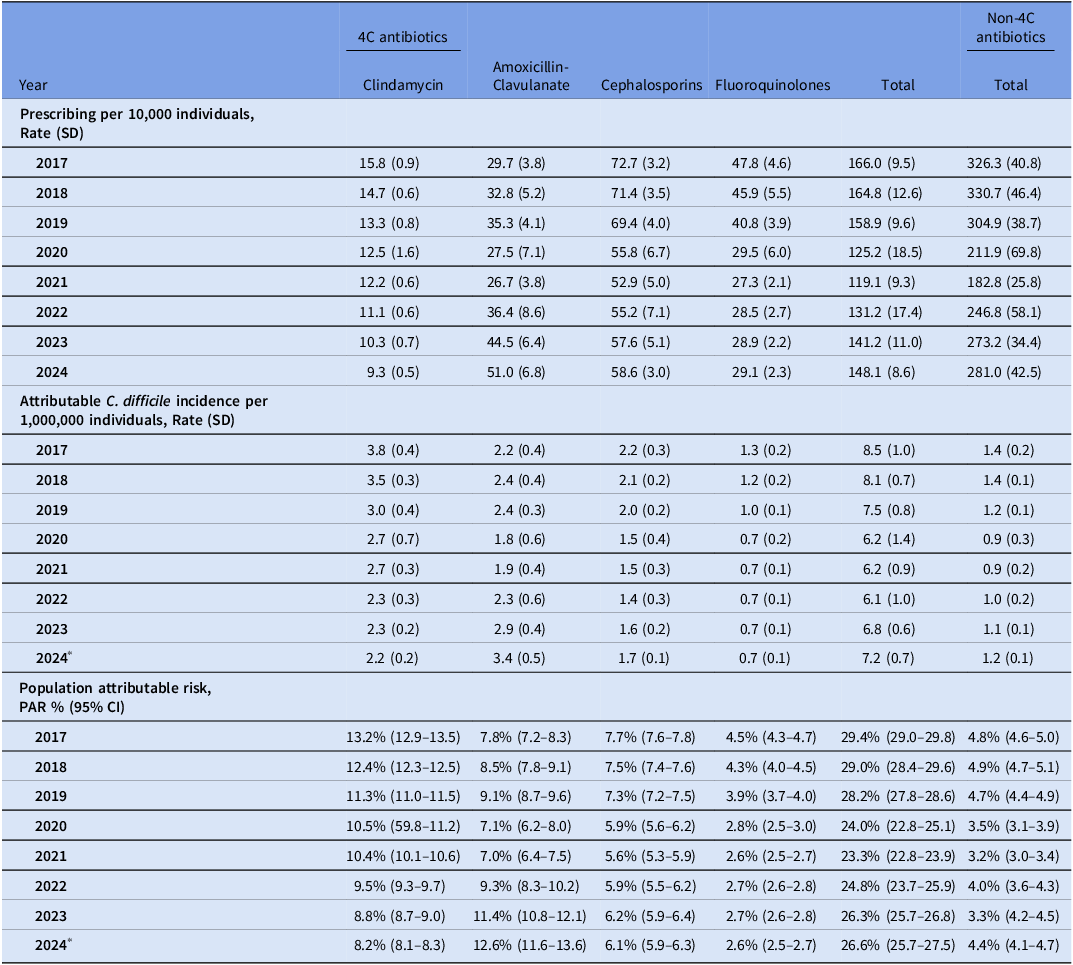
Between January 2017 and June 2024, 4C antibiotic prescribing accounted for 33.2% ± 2.5 of outpatient antibiotic use, decreasing from 166 to 148 prescriptions per 10,000 individuals. Prescribing trends declined for clindamycin (15.8 to 9.31 per 10,000; prescribing proportion: 3.1–2.0%), cephalosporins (72.7 to 58.6 per 10,000; 14.3–12.7%), and fluoroquinolones (47.8 to 29.1 per 10,000; 9.3–6.3%), while amoxicillin-clavulanate prescribing increased (29.7 to 51.0 per 10,000; 5.8–10.9%) (Table 1).
Annual antibiotic prescribing per 10,000 individuals with standard deviations (SD), annual Clostridioides difficile incidence per 1,000,000 individuals with SD, and population attributable risk (PAR %) of community-associated C. difficile infection cases with 95% confidence intervals (CI) by commonly prescribed outpatient antibiotics

Table 1. Long description
The table presents data on antibiotic prescribing rates, C. difficile incidence, and population attributable risk for various antibiotics over the years 2017 to 2024. It includes columns for different antibiotics such as Clindamycin, Amoxicillin-Clavulanate, Cephalosporins, Fluoroquinolones, and Non-4C antibiotics. The table is divided into sections for prescribing rates per 10,000 individuals, attributable C. difficile incidence per 1,000,000 individuals, and population attributable risk (PAR %) with 95% confidence intervals. Each row corresponds to a specific year and provides detailed values for each category. Notable trends include a general decline in prescribing rates for Clindamycin, Cephalosporins, and Fluoroquinolones, while Amoxicillin-Clavulanate prescribing increased. The attributable C. difficile incidence and PAR % also show variations across the years and antibiotics.
*Missing the last 6 months of C. difficile case data.
During this period, community-associated-CDI rates declined from 28.9 to 27.2 per 1,000,000 individuals, while 4C antibiotic-attributable CDI decreased from 8.5 to 7.2 per 1,000,000 individuals. Clindamycin-, cephalosporin-, and fluoroquinolone-attributable CDI decreased from 3.8 to 2.2 per 1,000,000, 2.2 to 1.7 per 1,000,000, and 1.3 to 0.7 per 1,000,000, respectively from 2017 to 2024. However, CDI attributable to amoxicillin-clavulanate increased from 2.2 to 3.4 per 1,000,000 from 2017 to 2024.
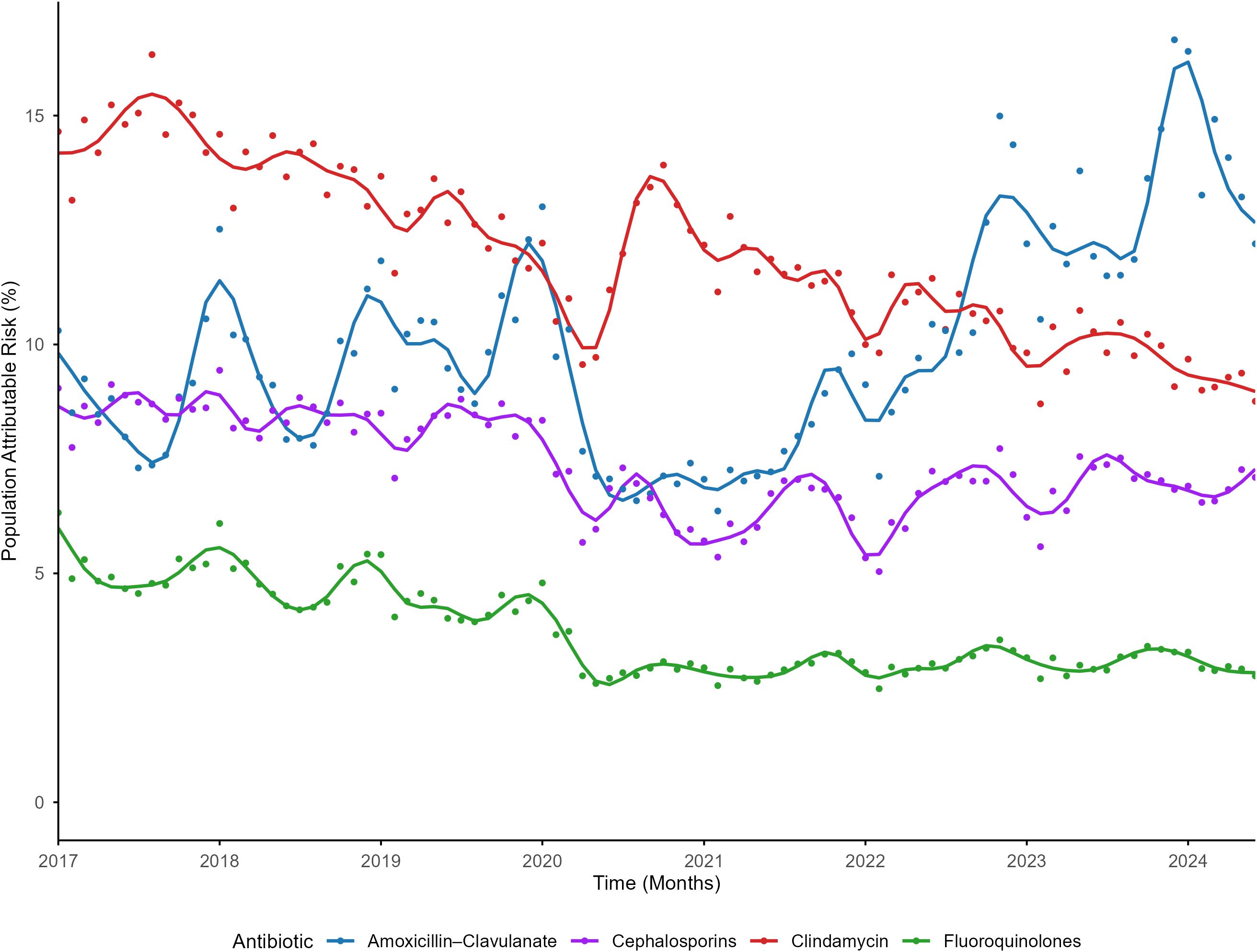
A 10% reduction in CDI risk-weighted prescribing index (including 4C and non-4C antibiotics) was associated with a 3.4% reduction in CDI (RR: 0.97, 95% CI: 0.95–0.98). Based on a counterfactual model of complete antibiotic prescribing elimination, the mean PAR of CDI was 29.0% (95% CI: 28.4–29.7). Among 4C antibiotics, the mean PAR was 26.4% (95% CI: 25.9–26.9). Within the 4C group, clindamycin-attributable PAR decreased from 13.2% (95% CI: 12.9–13.5) in 2017 to 8.2% (95% CI: 8.1–8.3) by 2024, whereas, amoxicillin-clavulanate-attributable PAR increased from 7.8% (95% CI: 7.2–8.3) in 2017 to 12.6% (95% CI: 11.6–13.6) in 2024, surpassing clindamycin as the top contributor to C. difficile by August 2022 (Figure 1).
Time series of antibiotic-specific population attributable risk (PAR) of community-associated Clostridioides difficile infection associated with commonly prescribed outpatient antibiotics in Ontario, Canada from January 2017 to June 2024. PAR estimates the proportion of total C. difficile cases due to a given antibiotic.

In sensitivity analyses, the mean PAR for 4C antibiotics was 15.7% (95% CI: 15.4–16.0) using alternative published risk estimates,Reference Miller, Arakkal and Sewell 8 and 29.3% (95% CI: 28.7–29.9) after removing the time-trend variable from the primary analysis. The relative contributions of individual antibiotics remained consistent across analyses.
Discussion
We observed a substantial shift in the antibiotics with the largest estimated contribution to community-associated-CDI. The PAR of clindamycin declined, likely reflecting guideline recommendations introduced in recent years de-emphasizing its routine use for conditions such as dental infection treatment and prophylaxis. Reference Lockhart, Tampi and Abt9 In contrast, amoxicillin-clavulanate emerged as the dominant contributor to C. difficile risk after mid-2022, likely reflecting increased outpatient prescribing following a cessation of selective reporting for amoxicillin-clavulanate at some large Ontario laboratories in scenarios where the isolate was susceptible to amoxicillin. Reference Wong, Daneman and Langford3 Our findings highlight antibiotic selection as an important stewardship target, as shifts in prescribing can substantially influence population-level contribution to CDI burden. Potential stewardship opportunities include optimizing susceptibility reporting practices and promoting use of lower-risk alternatives when clinically appropriate for common respiratory infections, such as sinusitis. Reference Wong, Daneman and Langford3,Reference Savage, Butler and Kronman10
Study limitations included population-level antibiotic exposure without individual-level antibiotic use; using a weighted rate partly addressed differences in antibiotic-associated rate. Prescribing trends may reflect temporal trends in the underlying burden of infections prompting antibiotic use, which may contribute to changes in CDI incidence. Sensitivity analyses excluding temporal adjustment demonstrated that the ranking of antibiotics remained constant. Overall antibiotic estimated contribution of CDI rates declined from 2017 through June 2024, reflecting 4C antibiotic use reductions, but rising amoxicillin-clavulanate attributable infections highlight a new potential target for stewardship efforts.
Acknowledgments
This study was supported by ICES, which is funded by an annual grant from the Ontario Ministry of Health (MOH) and the Ministry of Long-Term Care (MLTC). Parts of this material are based on data and information compiled and provided by the Ontario Ministry of Health. The analyses, conclusions, opinions, and statements expressed herein are solely those of the authors and do not reflect those of the funding or data sources; no endorsement is intended or should be inferred. This document used data adapted from the Statistics Canada Postal CodeOM Conversion File, which is based on data licensed from Canada Post Corporation, and/or data adapted from the Ontario Ministry of Health Postal Code Conversion File, which contains data copied under license from ©Canada Post Corporation and Statistics Canada. Parts of this material are based on data and/or information compiled and provided by CIHI. However, the analyses, conclusions, opinions and statements expressed in the material are those of the author(s), and not necessarily those of CIHI.
The statements, findings, conclusions, views, and opinions expressed in this report are based in part on data obtained under license from IQVIA Solutions Canada Inc. concerning the following information service(s): GPM, from: January 1st, 2017 to December 31st, 2024. All Rights Reserved. The statements, findings, conclusions, views, and opinions expressed herein are not necessarily those of IQVIA Inc. or any of its affiliated or subsidiary entities.
Author contribution
Michelle K. Wong: conceptualization, methodology, data curation, formal analysis, writing (original draft), writing (review and editing), visualization. Kevin A. Brown: conceptualization, methodology, writing (original draft), writing (review and editing), supervision. Nick Daneman, Bradley J. Langford, Valerie Leung, Kevin L. Schwartz: conceptualization, methodology, writing (review and editing). Alejandro Hernandez, Samantha Lee, Sarah Swayze: data acquisition.
Financial support
This work was supported by the Canadian Institutes of Health Research, Grant Number PJT-190208.
Competing interests
All authors declare no potential conflicts of interest.

 Open access

