

1. Introduction
In the last decade the design of foreign investment protection has significantly transformed. A new generation of bilateral and plurilateral free trade agreements (FTAs), some of which cover more than half of global gross domestic product, are currently being created. Some of these highly-publicized deals, to which the European Union (EU) is a party, such as the Canada–EU Comprehensive Economic and Trade Agreement (CETA),Footnote 1 EU–Vietnam Free Trade Agreement (EVFTA),Footnote 2 and EU–Singapore Investment Protection Agreement (ESIPA),Footnote 3 have already been negotiated. Negotiations of others, such as the EU–US Transatlantic Trade and Investment Partnership (TTIP)Footnote 4 and the modernized EU–Mexico Global Agreement (EMGA),Footnote 5 are suspended and ongoing, respectively. These agreements, once (and if) they enter into force, are expected to have a profound impact on policy areas in trade and investment. They all include provisions on protection of foreign investments, and a dispute settlement mechanism to address disputes between host states and foreign investors.
An unmistakable trend was observed in recent EU trade and investment agreements regarding introduction of permanent adjudicatory mechanisms, also called the Investment Court System (ICS), instead of arbitration. A two-tier, quasi-judicial (or, as we argue, hybrid) solution of this type has already been included in the EVFTA, ESIPA, and CETA. More recently, the EU and Mexico proposed their intention to incorporate ICS in the EMGA.Footnote 6 The same framework had earlier been forwarded by the European Commission during the TTIP negotiations.
Promotion of such mechanisms by the EU through its new FTAs has been widely publicized as a response to the criticism of investment treaty arbitration as an opaque and clandestine method of dispute resolution that does not allow for sufficient representation and acknowledgement of public interest in disputes, and this can profoundly affect public health, security, and the environment. The argument follows that the confidential nature of (investment) arbitration prevents other stakeholders, and the public in general, from having access to the details of such disputes – including but not limited to parties’ arguments, outcomes, amounts of awards, and terms of settlement (in case parties decide to settle the dispute outside arbitration). It has been further upheld that a permanent court for investment disputes would be more appropriate regarding transparency, legitimacy, and impartiality concerns.Footnote 7
This article scrutinizes the current EU response to the aforementioned concerns related to (i) transparency of investor–state dispute settlement (ISDS) proceedings, and (ii) participatory features; incorporated in the upcoming international instruments. In particular, this article examines the ‘new wave’ EU FTAs, which incorporate the ICS (EVFTA, CETA, ESIPA, and TTIP) and their provisions addressing transparency and participatory features of this new dispute settlement regime. On this basis, the article aims to assess the suitability of a permanent mechanism for resolving investment disputes in comparison with investment arbitration mechanisms. It discusses whether rules on procedural transparency and non-disputing party participation, as they are included in these new FTAs, bear the potential to address these perceived shortcomings and deficiencies in the system. In this context, this article analyses whether a court-like mechanism would provide a more transparent and participatory dispute settlement option than those instruments currently available and in force – particularly in the light of notable developments regarding transparency standards in arbitration in recent years.
2. Transparency and international investment law
Defining transparency in international law is a daunting task. Notably, this definition has appeared in several distinct, yet interconnected, frameworks in international investment law and dispute settlement. These contexts of transparency in investment law are (i) transparency in disclosure obligations; (ii) transparency in treaty negotiations;Footnote 8 and (iii) transparency in ISDS. At their core, they all relate to information access, namely, access to applicable laws and regulations, negotiation details, and instruments, or to arbitral proceedings (for information and participation purposes), documents, and awards. Although this article focuses exclusively on transparency in ISDS, distinguishing among these different manifestations is crucial.
The first framework relates to provisions on states’ disclosure obligations that aim to attest disclosure responsibilities to states regarding their laws, regulations, and policy-making processes relevant and potentially applicable to foreign investment. According to the United Nations Conference on Trade and Development (UNCTAD), ‘[t]he traditional objective of transparency provisions in international investment agreements (IIAs) has been to eliminate information costs and institutional risks faced by potential and existing foreign investors’.Footnote 9 Similar disclosure obligations are also present within international trade law, such as the General Agreement on Trade in Services (GATS), which stipulates that ‘Each Member shall publish promptly and, except in emergency situations, at the latest by the time of their entry into force, all relevant measures of general application which pertain to or affect the operation of [GATS].’Footnote 10 In addition to states’ disclosure obligations, some international instruments prescribe disclosure obligations for foreign investors. The United Nations Convention against Corruption, and some IIAs, such as the Azerbaijan–Croatia BIT, are notable examples.Footnote 11
The second framework relates to transparency in the negotiations of IIAs. As has been asserted in recent years, international and multinational investment and trade negotiations have been conducted ‘behind closed doors’.Footnote 12 Particularly since the failure of the Anti-Counterfeiting Trade Agreement and preceding criticisms and calls from civil society regarding opaque negotiations of these deals, the EU has taken notable steps towards making negotiation documents available to the public.Footnote 13 Over the last five years a variety of observations have been made regarding whether these initiatives are sufficient. For instance, in 2014, the European Ombudsman Emily O’Reilly noted the following:
The EU institutions have made a considerable effort to promote transparency and public participation concerning TTIP. I agree that not all negotiating documents can be published at this stage, there needs to be room to negotiate. However, concerns have been raised about key documents not being disclosed, about delays, and about the alleged granting of privileged access to TTIP documents to certain stakeholders. Given the significant public interest and the potential impact of TTIP on the lives of citizens, I am urging both these EU institutions to step up their proactive transparency policy.Footnote 14
Representatives of civil society have suggested that the availability of the following stemmed from ‘basic transparency requirements’: (i) the text of the EU’s negotiating mandate; (ii) the initial position papers; (iii) any further papers submitted by the European Union (EU) in the course of the negotiations that detail or explain the position of the EU; and (iv) draft and final versions of individual chapters.Footnote 15 The TTIP’s future is uncertain but these concerns are not limited to a single agreement. Similar concerns were raised in the context of other trade negotiations, such as the CETA. At the time of writing of this article, the EU Commission continues to allow public access to a variety of important documents, such as full texts of trade agreements and various interpretative agreements between parties, with strong emphasis on the right to regulate, environmental and labour protection, and so forth.Footnote 16
The third context, in which this article focuses exclusively, relates to transparency in ISDS proceedings. Two factors are notable in this regard: transparency in access to the proceedings of disputes, and admission of non-disputing third-party stakeholders’ participation and submissions to proceedings (amicus curiae submissions). They respectively reflect the traditional distinction, drawn by the commentators, between the spheres of procedural confidentiality sensu stricto (non-disclosure of information about the proceedings to its non-participants), and privacy (not admitting third parties to pending proceedings; which together with the former sphere presents confidentiality sensu largo).Footnote 17
Traditional procedural rules applicable to the current ISDS framework, predominantly founded upon rules for commercial arbitration, do not presuppose confidentiality both sensu stricto and sensu largo. However, as explained in detail below in Section 4, they are generally silent on this matter. Therefore, they do not explicitly support transparency, and the widespread procedural practice has largely been based on confidentiality and privacy of proceedings. This presupposition causes friction between the business-centric commercial arbitration rules and the public interest manifestly present in ISDS.Footnote 18 The following sections address these issues in depth.
3. Transparency and proposals of court-like mechanisms for investment dispute resolution: Rationales, advantages and challenges
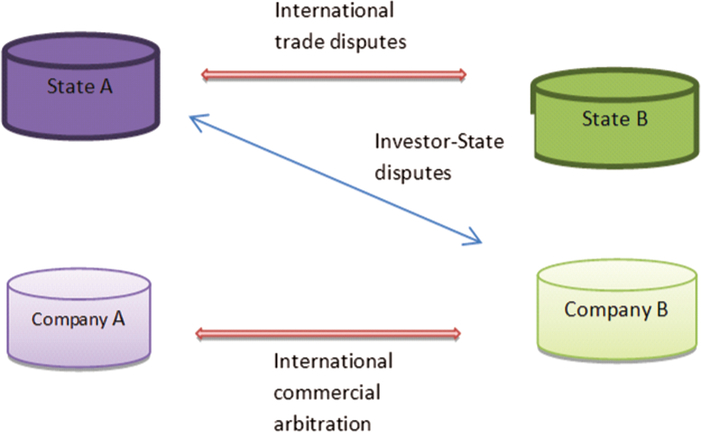
As alluded to above, types of mechanisms, used in and postulated for the resolution of investor–state disputes, have been intensely scrutinized and revisited. There are several reasons for this increased review. First, involvement of commercial actors in parallel relations – driving trade, investment, and commercial disputes – has resulted in an increase in the use of arbitration mechanisms and venues in resolution of trade disputes (as in the Softwood Lumber and Tobacco Plain Packaging arbitrations).Footnote 19 Another notable phenomenon is forum-shopping,Footnote 20 which occurs within the three specific fields of international economic law (namely, investment, trade, and commercial law). Forum-shopping also occurs across these fields (i.e., by seeking protection of the same interests via trade, investment, and commercial dispute resolution) (Figure 1).
Parties to international economic law disputes.Footnote 21

The possibility of the presence of public interest in ostensibly purely commercial disputes has also been increasingly noticed and addressed by jurisprudence.Footnote 22 The related issue of the access of the general public to information about the resolution of such disputes, the outcomes of which affect them, in the context of the traditionally opaque character of commercial arbitration, has been raised. Combined with strong enforceability guarantees under Section 6 of the International Centre for Settlement of Investment Disputes (ICSID) Convention and highly limited grounds for domestic courts’ review regarding the substance of arbitral awards under the 1958 New York Convention on the Recognition and Enforcement of Foreign Arbitral Awards (New York Convention), transparency concerns can be observed among the key impetus of the proposals for change of the dominant mechanisms for addressing investment (and occasionally also commercial) disputes.
Contextual differences between purely commercial disputes and investment disputes with high stakes in the public interest have only become apparent since the proliferation of investor–state disputes in the early 2000s. According to the Organisation for Economic Co-operation and Development (OECD), the ‘policy of confidentiality serves to expedite arbitrations and protect the confidentiality of information and reputation’.Footnote 23 One may, indeed, find it less controversial to uphold confidentiality of proceedings as an essential requirement in a purely commercial dispute with little or no public interest at stake. In disputes concerning the treatment of a foreign investor by its host state, however, especially if the investor is conducting a large-scale public service, confidentiality becomes harder to justify vis-à-vis a ‘concerned’ public demanding easier access to information.
Policymakers have recognized, particularly since the mid-2000s, that investor–state disputes have unique features that may be incompatible with the rules governing confidentiality of proceedings originally designed for commercial cases. Investor–state disputes require specifically tailored rules to strike a balance between protected business secrets of foreign investors and state secrets and the need to inform the public. This is especially crucial when a particular dispute might have, inter alia, environmental and/or health-related consequences for the public.Footnote 24 Vattenfall v. Germany, a dispute between the Swedish energy company and the German government concerning Germany’s decision to opt-out of nuclear energy by 2023 due to public concerns,Footnote 25 and Philip Morris v. Australia and Philip Morris v. Uruguay, that is, two disputes concerning Philip Morris’s claims against the said states’ initiatives concerning tobacco plain packagingFootnote 26 illustrate the manner in which public interest may play a different role in investment disputes than in commercial arbitration.
Consequently, to address the outlined discrepancy, several diverse initiatives have been undertaken, with alternative models of investment dispute resolution forwarded. Transparency has recently been investigated within the framework of the so-called ICS proposals in a series of new EU agreements pending finalization. As subsequently discussed in detail, these proposals vary regarding origin (academic or policy-related), level of detail and intended scope of subject-matter application (to invest, or trade and invest, or investment and commercial controversies), and jurisdiction (universal or regional versus local, treaty-specific ones). Their common trait is the promotion of a judicialized mechanism of addressing investment disputes, exposed to public scrutiny, with an embedded appeal option. The aim of such initiatives is the replacement of the arbitration-based ISDS with a permanent, international judicial authority (or authorities). In the opinion of their proponents implementation of such proposals would lead to increased transparency, consolidation, and centralization of the dispute settlement system.Footnote 27 Another advantage would be the reduction of conflicts of interest of the adjudicators and institutional strengthening of their impartiality (this is regarding arbitrators currently deciding cases on ad hoc panels who can also represent parties as counsel in other investment disputes).Footnote 28
A prominent example of an advanced policy project of this type, which was officially forwarded in treaty negotiations and widely publicized, is the European Commission’s proposal of introducing a permanent ICS for the disputes related to the TTIP. This policy was announced after public consultations of the TTIP, followed by the European Parliament’s critical opinion on ad hoc arbitration panels. As stated by the EU trade commissioner Cecilia Malmström, the existing system ‘suffers from a fundamental lack of trust’.Footnote 29 The Commission has, therefore, provided an alternative in the proposal of Chapter II on ‘Investment’ of the TTIP.Footnote 30 This alternative was approved by the European Commission in September 2015 and made available for discussion with the European Parliament and member states (MS) in the Council.
The project’s objective is to implement a two-instance dispute resolution mechanism with a first instance tribunal and a permanent Appeal Tribunal; notably, the latter has been empowered to review awards regarding errors of law and manifest errors in the assessment of facts. Among other notable signs of the judicialization of investment dispute resolution in the recommended mechanism is the introduction of a personal qualifications census (analogical to the WTO Appellate Body and many international courts) and tenure. Moreover, it has been expressly and officially stated that the project aims to exclude forum-shopping and initiation of multiple or parallel proceedings.Footnote 31 This elaborate and highly publicized proposal (notwithstanding its current disputable political viability) has not materialized in a conceptual void and was preceded by other EU initiatives aiming to introduce a permanent, quasi-judicial mechanism in the resolution of investment disputes. As discussed in detail in Section 6, the first successfully implemented initiative of this type was the EVFTA, the negotiations of which have been successfully concluded. Its text was published on February 2016 (and its legal review is ongoing as of July 2018).Footnote 32 A similar stance regarding investment dispute resolution was adopted in the CETA, which entered into force provisionally on 21 September 2017;Footnote 33 as well as the ESIPA.
All the above mentioned agreements introduce a two-tier model of addressing investment disputes strikingly similar to the one proposed in the TTIP. While the TTIP proposal operated with the terms ‘court’ and ‘judges’ (although limited with the First Instance Tribunal), the FTAs with Vietnam and Canada (as well as the ESIPA) do not offer such a symbolic change of nomenclature. Whereas some components of the system promoted in these agreements and in TTIP (e.g., tenure, nomination, code of conduct, and prohibition of combining the adjudicatory role with that of a counsel) could be considered as a shift towards judicialization of the field, others continue to strongly support the extant arbitration regime (e.g., inter alia, reliance on the ICSID and New York Conventions’ regulatory framework for enforcement of awards, procedural standards, and the absence of a permanent secretariat).
Rather than introducing an international ICS, the ‘European model’ is observed to offer a hybrid solution that combines judicial and arbitration-inspired elements. An important novelty is the establishment of a permanent appellate body instead of the domestic courts, whose authority is limited to reviewing awards most commonly under the New York Convention. This novelty marks a shift from the domestic review of awards towards a self-contained, autonomous system which also extends further beyond available annulment procedures, for instance, under the ICSID system.Footnote 34 Some commentators have argued that this would be inconsistent with promotion of the new mechanism as more publicly accountable. According to Levesque, ‘[a] question remains, however, as to whether the removal of any set-aside possibility in domestic court would endanger the balance achieved between the autonomy of arbitration and the duty of control by States at the time of enforcement’.Footnote 35 The judicialization effects of the proposed mechanism are, thus, observed to be limited and, in some spheres, debatable.
Establishment of a permanent appellate body has been an object of doctrinal discussion as well.Footnote 36 Some commentators have also argued in favour of very broad subject matter jurisdiction of a body, which should encompass a review of awards issued in investment and commercial cases, in which public interest is involved. In the opinion of Fan Kun, such a solution would enhance the role of arbitrators as ‘guardians of the public good’Footnote 37 and not merely a casu ad casum adjudicators of specific disputes. These awards would also provide institutional safeguards for proper balancing of private and public interests in arbitration. As subsequently discussed in detail, this and similar doctrinal proposals have encountered a cautious reception from the arbitration community and international policy-makers. This being said, various options of the institutional reform of the ISDS regime (including self-contained judicial systems as well as appellate body models) have also been explored by UNCITRAL Working Group III, which has been formally entrusted with the task of seeking multilaterally acceptable solutions in this area since 2017.Footnote 38
The introduction of an international, permanent appellate body is observed to be in accord with the theory of growing autonomization and consolidation of arbitration as a transnational order.Footnote 39 Among other advantages, building a coherent body of case law and uniformization of transnational principles regarding public interest are notable. The current institutional and procedural landscape of investment arbitration is highly dispersed and fragmented. Establishment of a body empowered to review awards would boost the processes of consolidation of adjudicatory trends (now present largely sua sponte due to the persuasive authority of reasoning adopted in previous awards).Footnote 40
The current fragmentation and opaque character of the field with multiple competing fora and ad hoc appointment of adjudicators has been demonstrated to be convenient for commercial and public stakeholders in many respects. This is true in particular for disputes that states (and businesses) may opt-in for confidentiality due to public controversy or backlash. Furthermore, the history of negotiations of the 2014 United Nations Convention on Transparency in Treaty-based Investor-State Arbitration (the Mauritius Convention) and the UNCITRAL Rules on Transparency in Treaty-based Investor-State Arbitration (UNCITRAL Transparency Rules)Footnote 41 show that states can be reluctant to adopt standards patterned after judicialized, relatively institutionalized dispute settlement mechanisms. The proceedings of UNCITRAL Working Group III, dedicated specifically to the options for ISDS reform, will bring further tests to political feasibility of reaching an international consensus on such matters.
The possibility of the use of a framework similar (or identical) to the Mauritius Convention, to serve as a regulatory basis for establishment of a court-type mechanism in the form of a (first instance) permanent dispute settlement body and/or an appeal mechanism for ISDS, has already been scrutinized in this context.Footnote 42 As subsequently explained in detail, the EU intends to incorporate these rules in newly negotiated FTAs. Notably, the retroactive, pre-2014 application of the UNCITRAL Transparency Rules of the existing BIT/IIA framework is in accordance with the Mauritius Convention.Footnote 43 This issue is further discussed in the context of transparency and participatory aspects of investment dispute resolution in the following section.
The suggested introduction of court-type mechanisms into investment dispute resolution can manage practical verification based on actual preferences of the stakeholders. As arbitral mechanisms are currently frequently selected in economic disputes, due to their closed and confidential character, a formal opening of the system might result in further forum-shopping explorations and limited use of new solutions.Footnote 44 Prominent members of the arbitration community have voiced their disagreement with this shift towards a public interest paradigm, including the judicialization and institutionalization. The shift away from arbitration has also been described as the ‘state repossession’ of the regime.Footnote 45 One could argue that establishment of judicialized and institutionalized dispute settlement alternatives and policy-related provisions (such as the right to regulate) are different, yet complementary, components of the same ICS project which presupposes the inefficiency of the arbitration-based dispute settlement. Therefore, it is not surprising that pro-arbitration commentators often refer to the unceasing popularity of arbitration, and its highly functional design and efficiency to oppose judicialization, increased policy space for states, and transparency.Footnote 46 This situation could succinctly be referred to as an if it ain’t broke, don’t fix it approach.
The critics of adopting judicial mechanisms for investment dispute resolution have also asserted that such solutions suffer from deficits in representativeness, which would be, paradoxically, secured to a higher degree in arbitration.Footnote 47 In arbitration, adjudicators are appointed by all parties (including investors) and the private character of the selection processes has led some commentators to question their independence.Footnote 48 However, as argued by the proponents of judicialized court-type models, their implementation would diminish proper representation of commercial actors (who would not have direct influence on appointments of the members of the tribunal) and secure, primarily and as suggested one-sidedly, an institutional support for the interests of the states.Footnote 49
The discussion of the significance of court-type mechanisms for investment disputes must also encompass jurisdictional issues. Their separate embedment in the FTAs will result in multiplication of fora with the scope of adjudicatory authority limited, respectively, to those agreements. In practice, proliferation of such solutions might lead to a multiplication of existing venues. This phenomenon might further complicate, instead of simplify, an already fragmented field. Such criticized phenomena, for example, forum-shopping and parallel proceedings, might gain yet another layer of available institutional options. A factor which might also work as a game-changer, due to its economic impact and sheer volume of trade covered, are the mega-regional agreements. In the case of trade agreements of such critical global significance, a plethora of existing ad hoc mechanisms provided for in FTAs and BITs may be replaced with new, consolidated dispute resolution systems. This being said, new concerns have been voiced (on the occasion of the TPP negotiations and signing) that the parallel existence of such consolidated regimes with ‘competing Appellate Bodies’, administrations, and the separate, disconnected bodies of case law might lead to new forms of fragmentation.Footnote 50 Finally, a separate possibility would be an introduction of regional or universal institutions, the promotion of which would require enormous political will and effort.Footnote 51
As alluded to, a significant and contentious object of the discussion on the advantages and disadvantages of quasi-judicial mechanisms in investment disputes is the issue of transparency. These considerations have been clearly and explicitly raised by proponents of such solutions as key factors influencing their formulation (as in the case of the proposals forwarded within the examined European FTAs). The following section focuses on this aspect of resolution of investment controversies.
4. Transparency and participation standards in ISDS – past initiatives, recent developments
Pursuant to the existing ISDS framework, arbitration proceedings are not ipso facto confidential. Some of the most commonly used rules of procedure do not provide guidance on this issue and leave it to the discretion of the tribunal.Footnote 52 Confidentiality sensu stricto (non-disclosure of information regarding arbitration to non-participants of the proceedings) and privacy (not admitting the presence of third parties at the proceedings)Footnote 53 have often been assumed to be incorporated features of arbitration.Footnote 54 While the dominant practice was one of privacy and confidentiality, these factors have not been a formal requirement. The absence of relevant explicit standards (in investment and commercial arbitration) or, in other words, the ‘regulatory void’, was criticized for creating a state of legal and procedural uncertainty.Footnote 55
However, a distinction must be made between the ICSID and non-ICSID frameworks on the basis of confidentiality requirements and obligations of arbitrators and tribunal assistants. According to ICSID Arbitration Rules, tribunal members and assistants must keep confidential ‘all information coming to [their] knowledge as a result of [their] participation in [the] proceeding[s], as well as the contents of any award made by the Tribunal’.Footnote 56 The same obligation is also true for deliberations.Footnote 57 Such obligation does not exist under non-ICSID fora and rules.
The trend towards formulating such standards thus emerged in the conditions of general awareness of the arbitration community of the necessity of achieving a proper balance between transparency and confidentiality in specific disputes. As Florentino P. Feliciano observed, in recent years, transparency has become an increasingly important consideration:
It is thus clear that confidentiality and transparency are both values in international arbitration. It is equally clear they are also competing values which need to be accommodated and adjusted to the other in each specific case. It also seems clear that confidentiality tends to be a “wasting asset” and may be [of] declining utility.Footnote 58
Notably, the evolution of jurisprudence towards explicit acknowledgement of the possibility of resigning from confidentiality of arbitral proceedings (and expression of public interest exception in this regard) first occurred in the context of commercial, not investment, arbitration.Footnote 59 A series of procedural initiatives in investment disputes then followed. Arbitration under the ICSID Convention, which established the ICSID, initially contained no explicit reference that enabled the submission of amicus curiae briefs.Footnote 60
As already mentioned, the UNCITRAL Arbitration Rules did not offer guidance as to the aspects of transparency, either. In practice, the authority shifted towards the arbitral tribunals to make relevant decisions. Under such conditions it was not surprising that arbitral jurisprudence played an innovative role in this regard. In the NAFTA Methanex award, the tribunal explicated that ‘the receipt of written submissions from a non-party third person does not necessarily offend the philosophy of international arbitration involving states and non-state parties’.Footnote 61
A similar approach was adopted by an ICSID Tribunal in Suez/Vivendi,Footnote 62 where it was stated for the first time that this forum has the authority to accept amicus curiae briefs. A further step was taken by another ICSID Tribunal in Biwater Gauff,Footnote 63 where the scope of powers of the tribunal regarding transparency was explored in detail. In this case the tribunal embarked on a complex task of balancing such relevant, procedural values and providing space to justified interests of non-disputing party stakeholders; acknowledgement of significant material facts, not presented in the parties’ submissions; procedural efficiency; and preventing unnecessary procedural burdens for the disputants.Footnote 64
After weighing all the considerations the tribunal eventually accepted amicus curiae submissions. They described this submission as a ‘useful contribution’ in introducing new perspectives and expert knowledge and bearing influence on the proceedings. The admission of amicus curiae briefs had to meet criteria, including a demand for a submission of a joint memorial by the five petitioners, limited in length, and up to 50 pages.Footnote 65
Regarding treaty-making practices, transparency issues first came to prominence in the North American context. The United States and Canada Model BITs of 2004 were the first texts to introduce explicit transparency provisions, which granted access to the public regarding hearings and documents.Footnote 66 The more recent 2012 US Model BIT contains an identical provision to the 2004 version.Footnote 67 According to US Model BITs, the respondent shall make available to the public the following documents: (i) notices of intent; (ii) notices of arbitration; (iii) pleadings, memorials, and briefs; (iv) minutes or transcripts of hearings of the tribunal where available; and (v) orders, awards, and decisions of the tribunal.Footnote 68 Furthermore, the hearings shall be conducted in a manner open to the public. Regarding a party desiring to use protected information in a hearing, they shall inform the arbitral tribunal and the tribunal is to ‘make appropriate arrangements to protect the information from disclosure’.Footnote 69
The Canadian Model BIT contains similar language to the US Model BITs. One notable addition is that the Model BIT includes a provision that explicitly allows the tribunal to hold portions of hearings in camera.Footnote 70 ‘All documents submitted to, or issued by, the Tribunal shall be publicly available’, unless agreed otherwise by the parties and ‘subject to deletion of confidential information’. In addition, all aforementioned model BITs include provisions allowing amicus curiae submissions. Relevant changes to the ICSID Rules in 2006 followed, including detailed amicus curiae provisions, leading to a consolidation of transparency standards of this institution.Footnote 71
The next key development in this regard was the adoption of the 2014 UNCITRAL Rules on Transparency in Treaty-based Investor-State Arbitration (UNCITRAL Transparency Rules). The instrument was characterized as aiming to accomplish the following:
To include the public interest in investment disputes … Disclosure at the very outset of proceedings of some information allows the public to be aware of these proceedings. The public may request some detailed information. The Rules establish rights of third persons and non-disputing States to submit their views. The hearings are generally held in public. However, these rights are limited by exceptions. Insofar as the Rules function properly, the repository acts as an information custodian.Footnote 72
The scope of application of the UNCITRAL Transparency Rules has generally been limited to UNCITRAL arbitrations commenced under treaties that concluded after 1 April 2014 (unless the parties to a specific, uncovered dispute or a treaty explicitly agree on their application). The majority of IIAs, thus, remain outside the scope of automatic application of the rules. An initiative to broaden this scope has been the Mauritius Convention, mentioned in the preceding section.Footnote 73 The Convention, signed by 23 statesFootnote 74 at the time of writing, entered into force on 18 October 2017, following ratification by the first three signatories; Canada, Switzerland, and Mauritius.Footnote 75 The Convention embodies an agreement of the signatories to have the UNCITRAL Transparency Rules be applicable in all cases (e.g., proceedings not conducted under the UNCITRAL Arbitration Rules) commenced under all investment treaties to which they are party and pre-date April 2014. States acceding to the Convention retain the right to opt out from its application regarding specific treaties or arbitrations conducted under specific sets of procedural rules other than the UNCITRAL Arbitration Rules. As illustrated subsequently, the UNCITRAL Transparency Rules form the backbone of many new-wave FTAs.
Finally, in August 2018, the ICSID Secretariat published its proposals for amendments to its Rules.Footnote 76 They are arguably minor modifications to the existing rules as amended in 2006. They include the disclosure obligation ‘on parties to disclose whether they have third-party funding’, some clarifications on the publication of the Convention awards; and amendments on the participation of non-disputing parties, including a tribunal’s discretion to decide that a non-disputing party may ‘contribute to the increased cost attributable to their participation’.Footnote 77
Recent developments regarding transparency in investment arbitration, thus, demonstrate a notable range of initiatives aimed at introduction, formulation, and consolidation of standards in this regard. From this perspective, proposals to introduce court-like mechanisms for resolution of investment disputes, and introduction of more explicitly expressed and stronger rules regarding transparency and third-party participation in dispute settlement proceedings, are observed to be complementary initiatives. In this context, this article reviews a comparative scrutiny of provisions contained in several new-wave EU FTAs to improve the comprehension of the ‘new generation’ responses to the perceived shortcomings and relevant issues, generally outlined in the previous sections, in the current system.
5. Transparency and participation rules in new-wave FTAs
On 7 July 2010 the European Commission prepared a communication entitled ‘Towards a comprehensive European international investment policy’ and laid forth its investment policy goals.Footnote 78 Among its many assertive objectives, the Commission counted problem regarding transparency of the dispute settlement proceedings among the ‘main challenges’ to overcome. The Commission noted the following:
In line with the EU’s approach in the WTO, the EU should ensure that [ISDS] is conducted in a transparent manner (including requests for arbitration, submissions, open hearings, amicus curiae briefs and publication of awards)Footnote 79
The necessity for further transparency in new IIAs and FTAs has been repeatedly highlighted thereafter. For instance, in an official factsheet regarding the investment protection provisions in CETA, the Commission asserted that ‘full transparency in investment dispute settlement proceedings’ is a crucial aspect of the newly introduced dispute settlement mechanism.
This section will discuss the rules regarding transparency and participation incorporated in the new generation EU FTAs: CETA, EVFTA, the EU TTIP proposal, and ESIPA. After outlining each provision in these new FTAs, the article analyses whether provisions contained in these new generation instruments address the concerns related to transparency and participation and, by extension, bolster the perceived legitimacy of the ISDS mechanism. The following analysis is conducted in accordance with two broad parameters in parallel with the aforementioned discussion: (i) Do new rules on transparency and participation respond to policy objectives as expressed by the EU?; and (ii) more specifically, do new rules strike a balance between confidentiality and transparency?
5.1 CETA
Article 8.36 of the final CETA, titled ‘Transparency of Proceedings’, is the primary provision in this respect. The Article begins by noting that ‘[t]he UNCITRAL Transparency Rules, as modified by this Chapter, shall apply in connection with proceedings under this Section’.Footnote 80 The subsequent paragraphs, in reference to various provisions under the UNCITRAL Rules, delineate the procedural transparency requirements for future disputes.
Article 8.36(2) states that, in addition to the documents specified under Article 3(1) of the UNCITRAL Transparency Rules:Footnote 81
The request for consultations, the notice requesting a determination of the respondent, the notice of determination of the respondent, the agreement to mediate, the notice of intent to challenge a Member of the Tribunal, the decision on challenge to a Member of the Tribunal and the request for consolidation shall be included in the list of documents to be made available to the public …Footnote 82
The provision adds to the UNCITRAL Transparency Rules to capture the documents relevant (and unique) within the EU context, according to which the determination of the respondent could either point to an MS or the EU.Footnote 83 Article 8.36(3) expands UNCITRAL Transparency Rules Article 3(2), which ensures the publicity of expert reports and witness statements, to cover the exhibits presented in cases. This Article further notes that they shall be made public ‘upon request by any person to the arbitral tribunal’.Footnote 84 Article 8.36(4) states that the documents listed under paragraph 2 of the same Article shall be made available ‘in a timely manner’ and ‘prior to the constitution of the Tribunal’ tasked to resolve the dispute. Article 2 of the UNCITRAL Transparency Rules (to which CETA Art. 8.36(4) refers) counts ‘information regarding the name of the disputing parties, the economic sector involved and the treaty under which the claim is being made’ among documents to be made public and excludes ‘confidential or protected information’ from its scope.Footnote 85
Article 8.36(5) states that the hearings ‘shall be open to the public’,Footnote 86 and further maintains that it is the tribunals’ duty, in consultation with the disputing parties, to ‘appropriate logistical arrangements to facilitate public access to such hearings’. Parts of the proceedings can be conducted in private, should the tribunal consider that ‘there is a need to protect confidential or protected information’.Footnote 87 The final paragraph, 8.36(6), reiterates a respondent’s domestic law duties regarding publicizing documents related to such disputes.
As for the aforementioned confidential or protected information and pursuant to Article 8.36(1), which refers to the UNCITRAL Transparency Rules in their entirety, the elaborations under Article 7 of the UNCITRAL Transparency Rules on ‘exceptions to transparency’ will apply.Footnote 88 The Article counts (i) confidential business information, (ii) information protected under the relevant treaty, (iii) information excluded under domestic law, and (iv) information which may impede law enforcement.Footnote 89 Although Article 7 further states that the determination of whether information is confidential or protected rests with the tribunal tasked to resolve the dispute, it includes a self-judging essential security interests (ESI) provision which bears the risk of critically reducing arbitral discretion in assessment of such information.Footnote 90
Finally, prospective concerns regarding the integrity of the arbitral process have been addressed under Article 7(7) of the UNCITRAL Transparency Rules:
The arbitral tribunal may, on its own initiative or upon the application of a disputing party, after consultation with the disputing parties where practicable, take appropriate measures to restrain or delay the publication of information where such publication would jeopardise the integrity of the arbitral process because it could hamper the collection or production of evidence, lead to the intimidation of witnesses, lawyers acting for disputing parties or members of the arbitral tribunal, or in comparably exceptional circumstances.Footnote 91
Article 8.38 of CETA concerns the participation of non-disputing parties to a dispute.Footnote 92 Similar to Article 8.36 and other provisions under the same Chapter, Article 8.38 applies in conjunction with the UNCITRAL Transparency Rules and, in particular, Article 4 (Submission by a third person)Footnote 93 and Article 5 (Submission by a non-disputing Party to the treaty).Footnote 94 Relevant provisions of the UNCITRAL Transparency Rules prescribe the method and procedure for such submissions, including the method regarding the determination of eligibility of third persons and non-disputing parties based on, inter alia, their connections with the disputing parties, and the interest they may have regarding the dispute. Pursuant to Article 4, the Tribunal shall assess whether the requesting third person or non-disputing party has ‘significant interest in the arbitral proceedings’,Footnote 95 and whether the submission would present an added value beyond that which provided by the disputing parties in determination of a factual or legal issue.
Pursuant to Article 3.38 per se, the documents which shall be presented to the non-disputing parties are divided into two groups. The first group, articulated under Article 3.38(1)(a), contains a list of documents that the respondent shall present even without the request of the non-disputing parties. Article 3.38(1)(b) contains a list of documents that shall be presented upon request. The list of mandatory documents includes (i) a request for consultations, (ii) a notice requesting a determination of the respondent, (iii) a notice of determination of the respondent, (iv) a claim submitted pursuant to Article 8.23 (on submission of a claim to a tribunal), (v) a request for consolidation, and (vi) any other documents appended to such documents.Footnote 96 Documents to be made available by request, inter alia, include the pleadings by the disputing parties, minutes or transcripts of hearings, and orders, awards, and decisions by the tribunals.Footnote 97
5.2 EU–Vietnam FTA (EVFTA)
Under Section 3 (Resolution of Investment Disputes) Article 20, and similar to CETA Article 3.36, EVFTA states that the UNCITRAL Transparency Rules shall apply to disputes under this treaty.Footnote 98
The subsequent paragraphs should be read in connection with these rules. Similar to Article 8.36(2) in CETA, Article 20(2) in EVFTA adds, inter alia, the request for consultations and the notice of challenge against an arbitrator, and the decision on such a challenge to the list provided under Article 3(1) of the UNCITRAL Transparency Rules.
Paragraph three allows parties to further extend the documents specified under Article 3(1) and (2) and states that they may also include ‘exhibits when the respondent so agrees’.Footnote 99 Article 20(6) foresees a review procedure with regards to paragraph 3 and states that, upon request of either party, Article 3(3) of the UNCITRAL Transparency Rules may replace paragraph 3 following the review to be conducted by the Trade Committee to be established pursuant to EVFTA. Notably, Article 20(3) of EVFTA and Article 3(3) of the UNCITRAL Transparency Rules contain virtually the same language except for their final sentences. Article 20(3) of EVFTA states that exhibits may be included, the the UNCITRAL Transparency Rules reads, ‘This may include, for example, making such documents available at a specified site.’Footnote 100
Article 20(4) obliges parties to the treaty to ‘promptly transmit [the documents] to the non-disputing party and make them publicly available, subject to the redaction of confidential or protected information’. This paragraph refers to a footnote, which expressly refers to ‘classified government information’ in addition to documents specified under the UNCITRAL Transparency Rules.Footnote 101 Article 20(7) prohibits the disclosure to non-disputing parties or to the public of ‘any protected information where the disputing party that provided the information clearly designates it as such’.Footnote 102
Article 25 of EVFTA concerns non-disputing parties and documents to be made available to them. Similar to CETA, EVFTA distinguishes the documents to be made available automatically and on request. The first group includes requests for consultations, determination of the respondent party (regarding the EU and its MS), and the submission of claims. Documents to be made available on request include ‘any documents that are made available to the public in accordance with Article 20 (Transparency of Proceedings)’.Footnote 103
5.3 TTIP proposal text
Finally, an examination of provisions on transparency and third-party participation contained in the TTIP proposal of the EU is necessary. Although it is not a negotiated text (and its viability is in question), it is illustrative in the sense that it demonstrates a text prepared exclusively by the EU. This is particularly important in the absence of an official EU Model IIA text. Furthermore, it surely hints at what the final, negotiated text of the TTIP could have looked like vis-à-vis other negotiated texts aforementioned.
Article 18 of Section 3 of the TTIP proposal is titled ‘Transparency’, and it contains parallel language to that of CETA and EVFTA to a large extent. First, the TTIP proposal also adopts the UNCITRAL Transparency Rules and similarly qualifies and modifies its provisions in line with its paragraphs.Footnote 104 Although Article 18(2) is nearly identical to Article 8.36(2) of CETA, it includes ‘all documents submitted to and issued by the Appeal Tribunal’ in the list.Footnote 105 Article 18(3), a provision which mirrors Article 36(3) of CETA, explicitly considers exhibits to be included in the documents to be made public. Paragraph 4, which states that the documents shall be made available in a timely manner, is very similar to CETA Article 8.36(4). However, unlike the CETA text, the TTIP provision does not require that this must be completed prior to the constitution of the tribunal.
The TTIP proposal, under its Article 22, regulates non-disputing parties and documents to be made available to them. Its provisions significantly resemble the CETA with minor modifications.Footnote 106
5.4 EU–Singapore Investment Protection Agreement (ESIPA)
As the latest addition to publicly available treaty texts, ESIPA contains provisions that are more detailed than the first three FTAs. Articles 3.16 and 3.17 of the ESIPA text, entitled ‘Transparency of Proceedings’ and ‘The Non-Disputing Party to the Agreement’, are relevant provisions.Footnote 107 Article 3.16 directs the reader to Annex 8, entitled ‘Rules on Public Access to Documents, Hearings and the Possibility of Third Persons to Make Submissions’.Footnote 108
Arguably, one structural difference between ESIPA and the other three FTAs examined here is that neither Articles 3.16 and 3.17 nor Annex 8 contain any references to the UNICTRAL Transparency Rules per se. Instead, ESIPA is observed to compile its own set of rules greatly inspired by the UNICTRAL framework, and this is observed to be the principal reason for its lengthy provisions.
Article 1(1) of Annex 8 details the documents to be made available to non-disputing third persons and its contents largely resemble the other FTAs. Notably, two features stand out. First, unlike CETA, ESIPA does not distinguish between documents that shall be automatically made available and those that shall be made available upon request – the text simply states that all documents shall be made available. Second, Article 1(1) is observed to merge the provisions on public access to documents and information and access by non-disputing parties. Article 1 states that the documents and information that shall be made available to a non-disputing party shall also be made available to the general public, regardless of whether they have any significant interest in the dispute or not. Identical to the UNCITRAL Transparency Rules, Article 5 of Annex 8 states that ‘[t]he Secretary-General of the United Nations, through the UNCITRAL Secretariat, shall act as repository and shall make available to the public information pursuant to this Annex’.Footnote 109
Similar to other new generation FTAs, Article 2 of Annex 8 states that hearings shall be public.Footnote 110 Regarding third-party submissions, Article 3 of ESIPA Annex 8 borrows largely from Article 4 of the UNICTRAL Transparency Rules.Footnote 111
One other difference with the earlier new generation FTAs is Article 3(5) of Annex 8. Pursuant to this provision, ‘[t]he Tribunal shall ensure that such submissions do not disrupt or unduly burden the proceedings, or unfairly prejudice any disputing party’.Footnote 112 This provision is identical to Article 4(5) of the UNICTRAL Transparency Rules, however, ESIPA is the only new generation treaty to directly incorporate this provision to the treaty text itself.
Although Article 3.17 of ESIPA is near-identical to Article 5 of the UNICTRAL Transparency Rules, the former removes one paragraph from the latter: ‘The arbitral tribunal, after consultation with the disputing parties, may allow submissions on further matters within the scope of the dispute from a non-disputing Party to the treaty.’Footnote 113 Given the absence of an explicit reference to the UNICTRAL Transparency Rules, the ESIPA framework does not allow further submissions in this context, unlike other new EU instruments.
Finally, although Article 4 of Annex 8 shares certain provisionsFootnote 114 with Article 7 of the UNCITRAL Transparency Rules, Article 4 of Annex 8 on confidential information foresees several additional procedures with regard to (i) submission of information and notification of confidential or protected information; (ii) objection to reduction of information from submitted documents; and (iii) objection to publication of allegedly protected information.Footnote 115
5.5 Assessing the new framework: Are the new provisions sufficient?
What is immediately noticeable for all four FTA/IIAs examined is the explicit or implied adoption of the UNCITRAL Transparency Rules as the foundation for principles regarding transparency and third-party participation. The adoption, modification, or extension of these rules vis-à-vis earlier generation FTAs and BITs, which form the core of international protection of foreign investment, grant considerable leeway for the realization of objectives to bolster transparency and promote third-party participation. The elaborateness of the rules, when compared with Chapter 11 of NAFTA (which, under its Annex 1137.4, simply states that its parties may make an award public)Footnote 116 is unmistakable. As for many BITs currently in force, many do not contain any rules on transparency or third-party participation. Finally, the new FTAs all indicate that the hearings of cases shall be public.
Several qualifications are notable. All texts, pursuant to Article 7 of the UNCITRAL Transparency Rules (or Art. 4 of Annex 8 of ESIPA), protect confidential and/or sensitive information from being made public in an attempt to strike a balance between providing ample access to information and retaining private information, such as business secrets and information, which may impede arbitral proceedings. Although neither the UNCITRAL Transparency Rules nor the FTAs specify what type of information could have such an impeding effect, at least in principle, we believe that such an attempt at balancing private (confidentiality) and public (transparency) interests in this regard may be desirable for all parties. In any case, when compared to previous IIA provisions regarding transparency and admission of amicus curiae submissions, new framework significantly improves the current silence of the ISDS regime.
The new framework also allows for the EU to realise, and mutually enhance, its various objectives concerning the legitimization of the ISDS regime. One such relationship arguably exists between transparency and consistent application of treaty provisions. Reliance on the new UNCITRAL Transparency Rules, complemented by tailored modifications vis-à-vis the parties of specific FTAs (e.g., the determination of the respondent party; EU or MS), is a crucial step towards the establishment of a uniform set of standards governing transparency and third-party participation in investment disputes. In addition, access to information on how such determinations are made can affect the overall consistent interpretation and application of FTAs. We could assert that, given its direct impact on citizens (as, inter alia, tax-payers), whether the EU or an MS will be the respondent (and how such determination is made) is a question of great importance to the public. Although there are provisions in the new FTAs addressing this issue, they provide limited guidance.Footnote 117 It is essential that the EU makes this decision in a consistent manner in future FTA-based disputes, with a clearly prescribed procedure and in accordance with due process. Of equal importance is that it facilitates, primarily through public access, academic, political, and societal examination of this largely unexplored conundrum.
As for the non-disputing party participation and amicus curiae submissions, the new FTA framework arguably attempts to balance transparency and procedural economy. Article 3.38 CETA and Articles 4 and 5 of the UNICTRAL Transparency Rules conjointly prescribe that a tribunal may allow submissions from third parties. This discretionary language allows the tribunal to assess the suitability and necessity of such submissions. The use of ‘shall’, instead of ‘may’ (or another phrase to the similar effect), would have compelled a tribunal to accept every amicus curiae submission. Such an imbalance would bear the risk of exposing the proceedings to many unchecked submissions. Instead, the tribunal has the power to filter out unhelpful or frivolous submissions, among those intended to possibly hinder the effective and timely resolution of the dispute at hand.
The UNICTRAL Transparency Rules further prescribe the criteria according to which a tribunal is to use its discretion. As aforementioned, the tribunal is instructed to apply a two-tier test, to examine whether the third party has ‘significant interest in the arbitral proceedings’ and whether the submission ‘would assist the arbitral tribunal in determination of a factual or legal issue related to the arbitral proceedings’.Footnote 118 This test arguably provides sufficient guidance and legal basis to a tribunal to base its assessment in international law while allowing for an ad hoc assessment of ‘significance’ of a case to a third party and the helpfulness of a particular submission to that specific case.
One note of caution regarding the framework of the new FTAs (and the UNICTRAL Transparency Rules by extension) is the self-judging ESI rule as prescribed by Article 7(5) of the UNCITRAL Transparency Rules.Footnote 119 The provision states that states are not obliged to make available ‘information the disclosure of which it considers to be contrary to its essential security interests’.Footnote 120 Although it is important to preserve confidential information for investors and for respondent states, this provision could allow host states to withhold information crucial to the resolution of a dispute under the guise of ‘security interests’. This provision, therefore, removes the adjudicatory discretion of tribunals (without prejudice to the good faith scrutiny to be conducted by adjudicators vis-à-vis states’ assertions) when determining whether a particular piece of information should be disclosed to public.
6. Conclusion
If we could pick one conundrum as the most prevalent and topical regarding international mechanisms established to protect and promote businesses, it would be their relation and interaction with the public interest.Footnote 121 There are several means to observe this relationship: one perspective would be to look directly to the substantial principles which are the impetus for the system, including the extent to which the public good is considered when framing these principles. This article addressed the second and, maybe less apparent but no less important, procedural perspective that affects the substantial impact of these FTAs. The foregoing analysis scrutinized the so-called new-wave remedies which have been prescribed to amend the preceding instruments and through which the international community has had the chance to observe the shortcomings of the system. A plethora of studies have shown that ISDS directly and drastically affects public interest. In democratic societies, issues concerning public interest arguably call for public participation, exposure, and accountability.
Proposals to introduce quasi-judicial mechanisms for resolution of investment disputes have, therefore, been largely legitimized as a step towards securing transparency, general access to information relevant to the public, and increased participatory procedural standards. These proposals have been presented as a reaction to the current status quo of arbitration, opacity being one of its key features. Based on this reasoning, the policymakers who shape the ISDS regime have gradually identified these shortcomings. In this context, public participation and access to documents and information are two primary issues addressed under the examined provisions in the new-wave FTAs.
The examined EU FTAs and the UNCITRAL Transparency Rules upon which the former’s provisions are based are solid and assertive steps towards establishing a balance between confidentiality and transparency. This new framework could also consolidate general rules and principles of transparency and participation in investment disputes beyond the EU IIAs. The extension of the UNCITRAL framework to pre-2014 IIAs through the Mauritius Convention strengthens this assertion: signatories include EU and non-EU countries. This is, however, contingent upon more states opting in to the UNICTRAL framework, thereby making this initiative truly global. In line with the conceptualization of court-like permanent adjudicatory bodies, transparency and third-party participation are critical components of such an autonomization (and institutionalization) process. Given that a permanent court structure, vis-à-vis ad hoc arbitration, has been perceived to be far more suitable to settle such economic disputes with high public stakes, transparency and third-party participation form fundamental features of this grand project of legitimization. Such willingness of policymakers can only help rebuild and solidify this legitimacy.
ISDS, which has been built on and virtually driven by international investment arbitration, will not disappear instantaneously with the entry into force of these FTAs. By contrast, the prospective system largely borrows and learns from decades-long arbitral practice to construct a hybrid dispute settlement mechanism. These are the first signals of a multifaceted awareness of policymakers, the business community, and the public. The concerns and the remedies regarding transparency and bolstering public participation are but a few indicators of this process of recalibration and readjustment towards a less controversial, more stable, predictable, reliable, and coherent body of adjudicatory institutions and of law.