



LEARNING OBJECTIVES
After reading this article you will be able to:
• describe the concept of EPAs and their use in assessing competencies in clinical training
• recognise the characteristics of EPAs that have been used in postgraduate psychiatric training
• appreciate how EPAs could fit into postgraduate psychiatric training in the UK.
Entrustable professional activities (EPAs) are an innovative approach to assessing curricular mandated competencies in medical education. The concept was introduced by ten Cate (Reference ten Cate2005) and has become increasingly popular in the medical education field worldwide. Countries such as Canada (Royal College of Physicians and Surgeons of Canada 2020), New Zealand and Australia (Jurd Reference Jurd, de Beer and Aimer2015) and the Netherlands (Wisman-Zwarter Reference Wisman-Zwarter, van der Schaaf and ten Cate2016) have successfully adopted and implemented EPAs in their curricula for several medical specialties. In the UK, specialties such as ophthalmology and anaesthetics use EPAs for assessment. The Royal College of Ophthalmologists (2016) has now included EPAs as one of its assessment tools for trainees. A summative EPA-based curriculum guidance has been adopted for assessment of trainees’ progress by the Royal College of Anaesthetists (2021). Its workbooks for initial assessment of competence (IAC) in anaesthesia list the types of evidence that inform the entrustment decision, including supervised learning events (SLEs), personal activities, personal reflections and a logbook of cases.
There is relatively little written about EPAs as an assessment and training tool in the literature on postgraduate psychiatric education in the UK. A paper in the BJPsych Bulletin a few years ago made the case for EPAs in psychiatric training (O'Leary Reference O'Leary, Al-Taiar and Brown2016) but there have been no studies exploring this further. The Royal College of Psychiatrists (RCPsych) has recently carried out a comprehensive review of its assessment strategy and has identified EPAs as an option for future consideration in psychiatric training (RCPsych 2023). In this article we give an overview of the EPA concept and the terminology associated with it, review how EPAs have been used in psychiatric training in other countries and discuss what EPAs might look like within the UK's new psychiatry curriculum.
Competencies, capabilities and workplace-based assessment
Competency-based medical education (CBME) has been the norm for postgraduate medical training across the world for a few decades (Frank Reference Frank, Snell and Cate2010). This approach aims to guide trainees to achieve curricular outcomes by focusing on achieving defined competencies rather than by solely relying on duration of training and high-stakes examinations. Workplace-based assessments (WPBAs) have been developed to formatively assess the ‘does’ level of Miller's pyramid (Miller Reference Miller1990). However, the widespread adoption of the WPBA approach has also highlighted some drawbacks. These include purpose confusion, time constraints, untrained supervisors, the lack of synchronicity with training needs, and dissatisfaction with the amount and quality of feedback received (ten Cate Reference ten Cate and Scheele2007, Reference ten Cate and Taylor2021; Cho Reference Cho, Parry and Wade2014; O'Leary Reference O'Leary, Al-Taiar and Brown2016; Prentice Reference Prentice, Benson and Kirkpatrick2020; Hung Reference Hung, Jibson and Sadhu2021; Martin Reference Martin, Blissett and Johnston2023).
The General Medical Council (GMC) regulates medical education in the UK by setting out standards for training, as well as assuring the quality of medical education. In the Generic Professional Capabilities Framework (General Medical Council 2017a) and Excellence by Design (General Medical Council 2017b) it sets out the principles and standards that should guide the development of medical education curricula by medical schools and medical Royal colleges. The learning outcomes are described as a set of knowledge, skills, capabilities, behaviours and expected levels of performance that trainees need to demonstrate by the end of a period of training.
The RCPsych has revised its curricula for psychiatry training (www.rcpsych.ac.uk/training/curricula-and-guidance) to align them with the GMC's standards as set out in Excellence by Design, setting out high level outcomes (HLOs) and key capabilities. It also conducted a comprehensive assessment strategy review recently and included WPBAs within its remit (RCPsych 2023). This review was informed by focus groups and quantitative surveys of a wide range of stakeholders. The results of this consultation exercise noted several limitations of the WPBA approach, some of which included variability in thresholds and assessment grades awarded by different supervisors and lack of specific, personalised and timely feedback. One of the recommendations of the review is to consider EPAs as a method of assessment, in line with the model adopted by the Royal Australian and New Zealand College of Psychiatrists (RANZCP).
EPAs in medical education and training
Definition
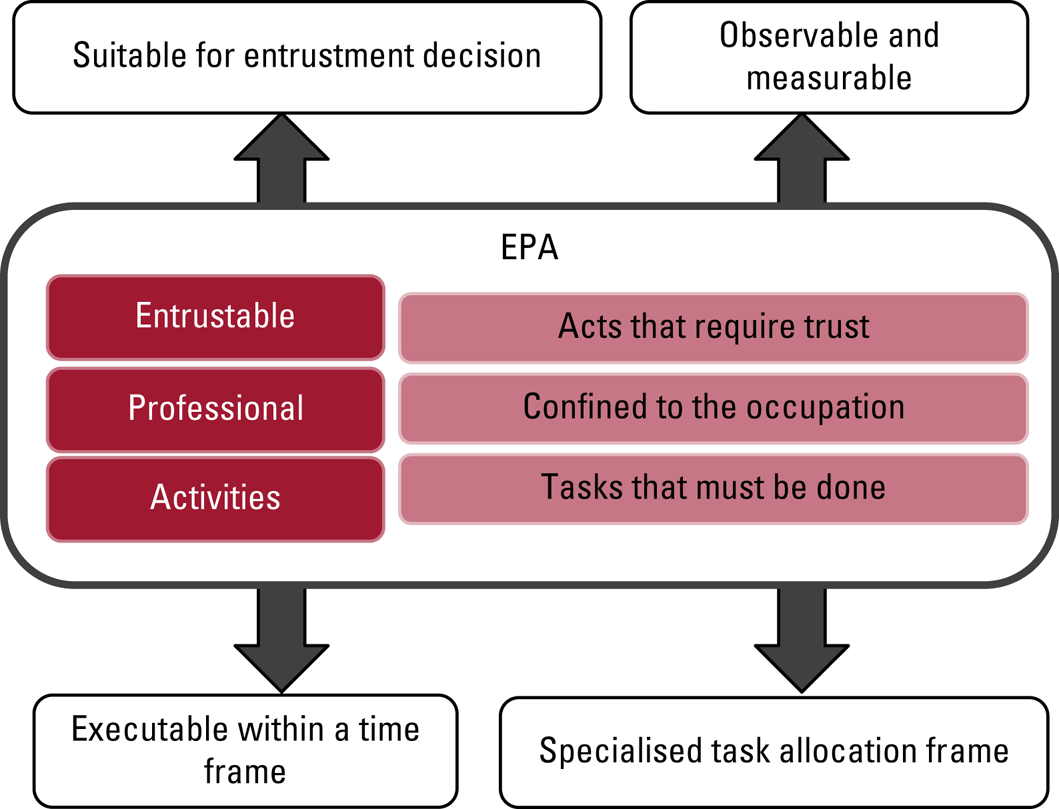
An entrustable professional activity (EPA) has been defined as ‘a unit of professional practice that may be entrusted to a learner to execute tasks (critical specialized activities) unsupervised once he or she has demonstrated the required competence’ (ten Cate Reference ten Cate2005, Reference ten Cate and Scheele2007). To expand on this definition: (a) it is a method of trainee assessment by the trainee's supervisor; (b) entrustment is given when the supervisor acknowledges that the trainee has sufficient knowledge and supervised experience to carry out a task independently; (c) it can only assess medical specialised tasks, i.e. tasks that require training and are relevant to the trainee's specialty, and (d) it is objective, observable and measurable in a given time frame (ten Cate Reference ten Cate and Scheele2007). The characteristics of EPAs are portrayed in Fig. 1.
Characteristics of entrustable professional activities (EPAs) as described by ten Cate & Scheele (Reference ten Cate and Scheele2007).

The outcome of the EPA is a summative entrustment decision on whether the trainee can be entrusted with the activity being assessed (and if so, to what extent). It should be noted that the term ‘entrustment’ rather than trust is used, as it refers to the readiness of a trainee to perform a task independently (‘Can I entrust this activity to my trainee without direct supervision?’), whereas trust could be considered a characteristic of the person carrying out the activity (‘Is my trainee trustworthy?’).
An EPA is seen as consistent with how supervisors think in day-to-day clinical practice and is compatible with the GMC's guidance as set out in both the General Professional Capabilities Framework and Excellence by Design (General Medical Council 2017a, 2017b). It allows supervisors to make credible and robust assessments of trainees’ capabilities and behaviours as measured against the expectations set out by the curriculum. More importantly, supervisors will be able to ascertain trainees’ readiness for safe, effective and independent clinical practice. When supervisors allocate a clinical task to a trainee, they are in fact having to decide whether to be with the trainee while the task is being carried out, to be available for a discussion afterwards or to let the trainee do it totally unsupervised. An EPA makes this process explicit. This involves a shift from the supervisor assessing how the trainee has performed in the task being observed to assessing their readiness to carry out the task unsupervised in the future.
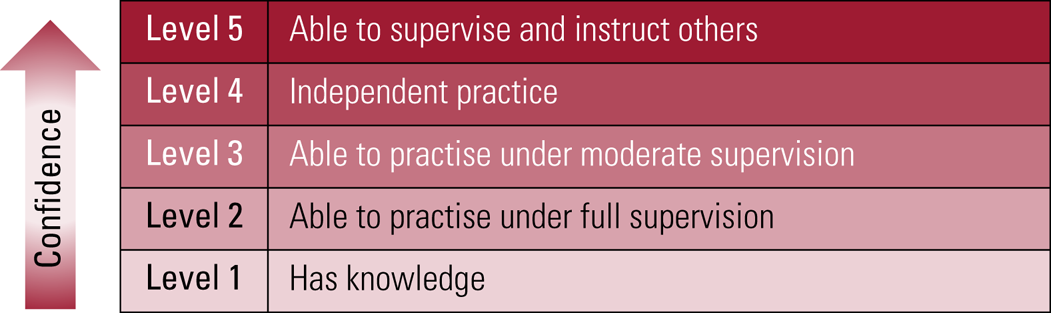
To further aid the summative process, ten Cate and colleagues propose entrustment scales with five levels of confidence – based on Miller's pyramid of professional competence (ten Cate Reference ten Cate and Taylor2021). They have illustrated this using examples of EPAs in obstetrics and gynaecology, with the expected levels of confidence (on an entrustment scale) rated against the number of years of training progression (ten Cate Reference ten Cate and Scheele2007). For example, ‘the care of complicated pregnancies’ was identified as an EPA. A trainee at the beginning of their training should be able to demonstrate level 1 of confidence and progress to level 3 in their second year, level 4 in their fourth year, and level 5 at the end of their training in year 6. The entrustment scale is illustrated in Fig. 2.
An entrustment scale, based on ten Cate et al (Reference ten Cate, Carraccio and Damodaran2021).

Making the entrustment decision
An entrustment-focused assessment differs from a performance-focused assessment. In the former the assessor needs to think ahead to how the trainee might perform in a situation where there is no one to observe or help. The assessor also relies on a broader evidence base to reach an entrustment decision – this might include multiple WPBAs, longitudinal observations in the workplace and multisource feedback. Research shows that many factors contribute to how supervisors make an entrustment decision. Cho et al (Reference Cho, Parry and Wade2014) showed that there are trainee factors (such as communication skills, perceived confidence), supervisor factors (such as approachability, ability to delegate, their own experience of training), task-related and systemic factors (such as clinical workload, case complexity, comorbidity, the task setting, staff mix, urgency of the task, and so on). Entrusting a task to a trainee with minimal or no supervision involves trust between the supervisor and the trainee, and this also depends on the time spent together and the strength of the supervisory relationship.
ten Cate & Chen (Reference ten Cate and Chen2020) have synthesised the research on trainee-related factors that contribute to entrustment decisions and summarised the framework using a mnemonic – ‘A RICH’ entrustment decision takes into account the trainee's:
• agency, indicating a proactive attitude towards work, team, safety and personal development
• reliability, denoting consistent, predictable and conscientious behaviour driven by a sense of accountability and responsibility
• integrity, characterised by truthfulness, benevolence and patent-centredness
• capability, referring to the trainee's ability to perform a task in a variety of settings and within appropriate time frames
• humility, i.e. their awareness of their limitations and their ability to ask for help and to learn from mistakes and feedback.
It is important for trainees to be aware of these attributes (which supervisors are looking for) and for supervisors to be explicit about these in their feedback.
Advantages of an EPA-based curriculum
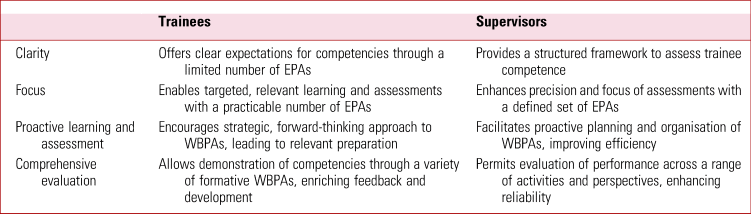
ten Cate & Scheele (Reference ten Cate and Scheele2007) recommend the adoption of EPA-based curricula as these offer clear pathways to assessing and achieving competencies. This translates into several benefits for both trainees and supervisors that are outlined in Table 1. Mapping competencies to EPAs makes assessments more focused and clinically grounded. A large number of competencies can be condensed into a smaller and manageable number of EPAs, allowing for streamlining of the learning and evaluation process, leading to more meaningful and targeted educational experiences.
Benefits to trainees and supervisors provided by adoption of entrustable professional activities (EPAs) in training curricula

TABLE 1 Long description
A table with two columns and four rows comparing the benefits of adopting entrustable professional activities (EPAs) in training curricula for trainees and supervisors. The columns are labeled 'Trainees' and 'Supervisors'. Row 1: Clarity. Trainees: Offers clear expectations for competencies through a limited number of EPAs. Supervisors: Provides a structured framework to assess trainee competence. Row 2: Focus. Trainees: Enables targeted, relevant learning and assessments with a practicable number of EPAs. Supervisors: Enhances precision and focus of assessments with a defined set of EPAs. Row 3: Proactive learning and assessment. Trainees: Encourages strategic, forward-thinking approach to WBPAs, leading to relevant preparation. Supervisors: Facilitates proactive planning and organisation of WBPAs, improving efficiency. Row 4: Comprehensive evaluation. Trainees: Allows demonstration of competencies through a variety of formative WBPAs, enriching feedback and development. Supervisors: Permits evaluation of performance across a range of activities and perspectives, enhancing reliability.
WPBA, workplace-based assessment.
For trainees, EPAs encourage a forward-looking approach to training. Instead of trying to impose a WPBA framework on clinical experiences, and then mapping these to curriculum competencies post hoc, trainees can proactively align their clinical learning activities with predefined EPAs, thus enhancing the reliability of their training experiences. This also promotes strategic planning and organisation in their learning, thus increasing the efficiency and relevance of their preparation.
For supervisors, EPAs offer a clear, structured framework for assessing trainees’ ‘real life’ competence, thus reducing ambiguity and enhancing the validity of learning and assessments. Supervisors are better equipped to evaluate performance across a range of activities and from multiple perspectives. Additionally, the prospective nature of EPAs allows for proactive planning and organisation of WBPAs and other learning experiences, fostering a more efficient supervisory process. Finally, as EPAs are broader clinical constructs that allow multiple competencies to be mapped to them, they can include a range of WPBAs, thus having more value as summative assessments, as a single specialised activity can be assessed from multiple perspectives: case-based discussions, reflections, observation of clinical skills, multi-source feedback, etc. (Jurd Reference Jurd, de Beer and Aimer2015; ten Cate Reference ten Cate and Taylor2021).
A critical perspective of an EPA-based curriculum
Although EPAs have clear advantages, as outlined above, some authors have highlighted potential risks with EPAs too. Ross (Reference Ross2015), while critiquing the EPA concept, described risks of ‘reductionism’ and ‘distortion’. Complex clinical activities are not easily amenable to be split into constituent measurable components of an EPA, and reductionistic attempts at identifying measurable objectives risk losing sight of the overarching aims (and essence) of the assessment itself. Distortion refers to the risk of losing important skills by shifting the curriculum towards easily defined or easily measurable outcomes. In his view, trainers and trainees may focus on achieving minimal competence rather than excellence. There is also a risk that once a trainee has been deemed competent and signed off, the trainee might be reluctant to seek supervision for difficult cases and the trainer might also not see the need for supervision for that activity, thereby endangering patient safety. Furthermore, literature on EPAs suggests that there is diversity in how they are interpreted and applied, leading to concept confusion, thus affecting their practical implementation (ten Cate Reference ten Cate and Taylor2021).
A review of EPAs in psychiatric training
In this section we review the published literature on EPAs in postgraduate psychiatric training. Most of the work on this subject comprises conceptual pieces, mainly focusing on the process of identifying relevant EPAs and simplifying existing curricula. Empirical research designs have not been employed so far to compare EPA-based and non-EPA-based curricula and analyse their impact using longitudinal outcomes. However, from the publications available so far, EPA-based curricula have been acknowledged as a satisfactory method of curriculum delivery (Weiss Reference Weiss, Ozdoba and Carroll2016; Young Reference Young, Hasser and Hung2018; Pinilla Reference Pinilla, Lenouvel and Strik2020; Hung Reference Hung, Jibson and Sadhu2021) with the potential for improving assessment in postgraduate psychiatry (Young Reference Young, Hasser and Hung2018, Reference Young and McClure2020).
Characteristics of EPAs in psychiatry
The literature shows variability in the form, type and number of EPAs used in psychiatry postgraduate training.
In this context, the form mainly refers to the summative assessment remit of an EPA. Two main types of EPA have been described based on their ‘form’: (a) a ‘broad-form’ EPA has a broader remit of assessment – for example, ‘Performing psychiatric assessments and providing differential diagnoses and management plans for children and youth’ (Royal College of Physicians and Surgeons of Canada 2020) or ‘Manage psychiatric patients longitudinally’ (Young Reference Young, Hasser and Hung2018) and (b) a ‘narrow-form’ EPA has a more narrow remit, such as ‘Use of antipsychotic medication in patients with psychosis’ (RANZCP 2012) or ‘Ability to do a risk assessment’ or ‘Ability to formulate a management plan for panic disorder’ (Chauhan Reference Chauhan, Chatterjee and Prakash2022).
Tied to the form of the EPAs is the number of EPAs required to fulfil the curriculum needs. If EPAs are broadly stated, between 10 and 20 appear to be satisfactory for curriculum needs. In contrast, if the EPAs are narrower, a larger number would be required, varying between 40 and 170 narrow EPAs. Clearly, a balance needs to be struck between the structure and number of EPAs that will be required to fulfil a particular curriculum. To reduce assessment burden, it is possible that some curricula may mandate a smaller number of representative narrow EPAs, as similar competencies may underpin different clinical tasks.
Finally, a distinction has been drawn between those EPAs that are considered an essential (and therefore mandatory) part of the curriculum and those that are desirable (and therefore optional). Different terminology is used to describe this, depending on authors: (a) mandatory versus elective EPAs (RANZCP 2012), (b) essential versus non-essential (Young Reference Young, Hasser and Hung2018), (c) true EPAs versus EPA-like activities (Weiss Reference Weiss, Ozdoba and Carroll2016) and (d) vital versus essential versus desirable EPAs (Chauhan Reference Chauhan, Chatterjee and Prakash2022). Clinically relevant activities are usually considered mandatory (‘Performing psychiatric assessments and providing differential diagnoses and management plans for children and youth’), essential (‘Manage involuntary commitment and treatment’) or vital (‘Life-saving or common medication or interventions’), whereas hard to assess activities such as ‘Engaging in lifelong learning’, ‘Demonstrating professional behaviour’ and ‘Advocating for individual patients’ have been described as ‘EPA-like’ (Weiss Reference Weiss, Ozdoba and Carroll2016). The RANZCP (2012) mandates EPAs in certain subspecialties; for example, by the end of stage 2 of training, trainees must be entrusted with two addiction psychiatry EPAs and two old age psychiatry EPAs. Curiously, Young et al (Reference Young, Hasser and Hung2018) found psychotherapy-related activities such as ‘Provide CBT therapy’ non-essential; however, they acknowledge that more research is needed on the topic.
Constructing EPAs in psychiatry
Various strategies have been employed to construct valid EPAs. The most common method involves putting together a committee comprising both faculty members and junior doctors, and the method with most validity in developing EPAs is reported to be the Delphi method (Stone Fish Reference Stone Fish, Busby, Sprenkle and Piercy2005). We give a summary of these methods here.
Weiss et al (Reference Weiss, Ozdoba and Carroll2016) established a milestones committee and tasked members to individually arrive at 5–10 EPAs after being educated on the concept. The proposed EPAs were then discussed by the committee to arrive at a final number. This approach produced 15 broad EPAs. The committee found the experience challenging, especially in differentiating what constituted an EPA from other training milestones that did not meet the criteria for an EPA but were still mandated and considered essential. They decided to retain the latter and called them non-EPA activities.
Chauhan et al (Reference Chauhan, Chatterjee and Prakash2022) used a similar method but broke down the process in five structured phases: divergent thinking, convergent thinking, deconstruction, internal peer review, and finalisation, a process that took 5 months.
Young et al (Reference Young, Hasser and Hung2018) used a Delphi approach to develop EPAs. The process consisted of three steps: an initial (individual) step, a refining step (group discussion and input from EPA experts) and a finalising step (by using two rounds of the Delphi survey). This type of Delphi approach has been used in other specialties as well and is reported to be the preferred strategy for developing valid EPAs (Wisman-Zwarter Reference Wisman-Zwarter, van der Schaaf and ten Cate2016).
Boyce et al (Reference Boyce, Spratt and Davies2011) employed a different method. They started by surveying their faculty members for their opinions on what could be potential EPA topics. The faculty members were then asked to rate these on their clinical importance. The survey showed an increase in supervisors’ confidence in using EPAs for trainee assessments.
Finally, Hung et al (Reference Hung, Jibson and Sadhu2021) proposed a step-by-step implementation guide for EPAs in postgraduate psychiatry curricula. The steps were: making the case for EPAs; choosing suitable topics; developing and adapting EPAs and entrustment scales; implementation in an iterative fashion; and evaluation of its impact on trainees, on the training programme and on faculty members' development.
Advantages of EPAs in psychiatry
EPAs have been suggested as a useful aid to simplify or add structure to curricula by trimming competencies that are irrelevant, too granular or too abstract and connecting remaining ones to a specialised activity that is considered core for psychiatry (ten Cate Reference ten Cate and Scheele2007; Young Reference Young and McClure2020; Hung Reference Hung, Jibson and Sadhu2021). Another advantage of EPAs is their adaptability to a diverse range of settings and needs, from different specialties (Leipzig Reference Leipzig, Sauvigné and Granville2014; Schultz Reference Schultz, Griffiths and Lacasse2015; Wisman-Zwarter Reference Wisman-Zwarter, van der Schaaf and ten Cate2016) to different training schemes within psychiatry (Weiss Reference Weiss, Ozdoba and Carroll2016; Young Reference Young, Hasser and Hung2018; Chauhan Reference Chauhan, Chatterjee and Prakash2022). An EPA-based psychiatry curriculum has been implemented in training programmes in Canada (Royal College of Physicians and Surgeons of Canada 2020) and Australia and New Zealand (Jurd Reference Jurd, de Beer and Aimer2015), thus demonstrating that the concept of EPAs is translatable into clinical training and practice on the ground. A number of advantages have been reported from these countries, including that EPAs added structure to supervision, made it easier to track progress and improved mechanisms for useful feedback. Liu et al (Reference Liu, Jiang and Qi2021) and Englander & Carraccio (Reference Englander and Carraccio2014) found that EPAs were associated with better engagement with learning, increased confidence and preparedness in trainees across different specialties.
On a slightly different note, potential benefits of researching EPAs in psychiatry have been proposed. Pinilla et al (Reference Pinilla, Lenouvel and Strik2020) felt that psychiatry EPAs can guide other specialties in understanding, defining and mapping communication competencies, which have historically been difficult to assess.
Assessment tools for EPAs in psychiatry
In the literature search for this article in 2023, we did not come across any established entrustment tools for EPAs in psychiatry training. The Psychopharmacotherapy-Structured Clinical Observation (P-SCO) checklist has been proposed as a validated EPA assessment tool (Young Reference Young, Frank and Holmboe2021) but is specific to psychopharmacology. A mobile app is currently being developed and piloted to generate entrustment scores and to provide meaningful feedback (Young Reference Young and McClure2020).
The RANZCP assesses EPAs by integrating pre-existing WPBAs with the entrustment decision. A minimum of three formative WPBAs are used to feed into a summative EPA decision (Jurd Reference Jurd, de Beer and Aimer2015). These are reviewed by the trainee, the supervisor and the training programme director. The Royal College of Psychiatrists in Canada follows a similar model. Boyce et al (Reference Boyce, Spratt and Davies2011) proposed the use of an indicative question to help the examiner reach an entrustment decision. Examples of such indicative questions are: ‘Is the use of this medication evidence-based?’ and ‘What plan is there to assess outcome?’. As things stand, all current applications of EPAs in postgraduate psychiatry are summative in their remit.
Some authors have suggested a possible formative role for EPAs in postgraduate education (Weiss Reference Weiss, Ozdoba and Carroll2016; Young Reference Young, Frank and Holmboe2021) but the literature and evidence for their practicability and validity is scarce. Formative psychiatry EPAs have been researched and validated more at undergraduate level (Holzhausen Reference Holzhausen, Maaz and März2019; Pinilla Reference Pinilla, Lenouvel and Cantisani2021).
EPAs in postgraduate psychiatric training in the UK
Where would EPAs fit?
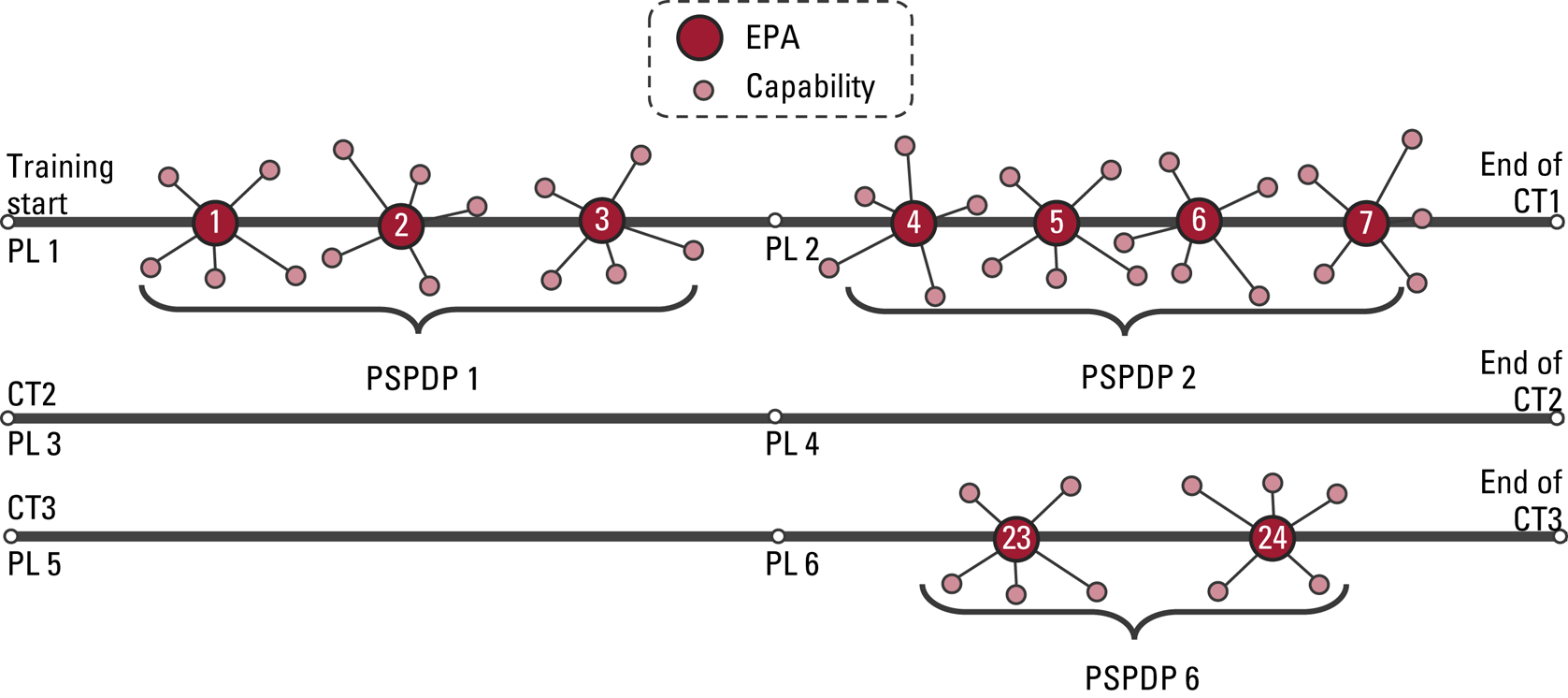
One of the features of the new curricula introduced by the RCPsych is the placement-specific personal developmental plan (PSPDP). This is both flexible and personalised, encouraging trainers and trainees to set activities for key capabilities at the start of each placement (RCPsych 2024). The incorporation of EPAs within the PSPDP can offer a structured approach to monitoring curricular progress (Fig. 3).
Hub and spoke model showing entrustable professional activities (EPAs) within the curricular framework. The hub represents an EPA and the spokes are capabilities assessed by the EPA (the key capabilities already included within the curriculum). PSPDP, placement-specific personal developmental plan; PL, placement; CT, core trainee year.

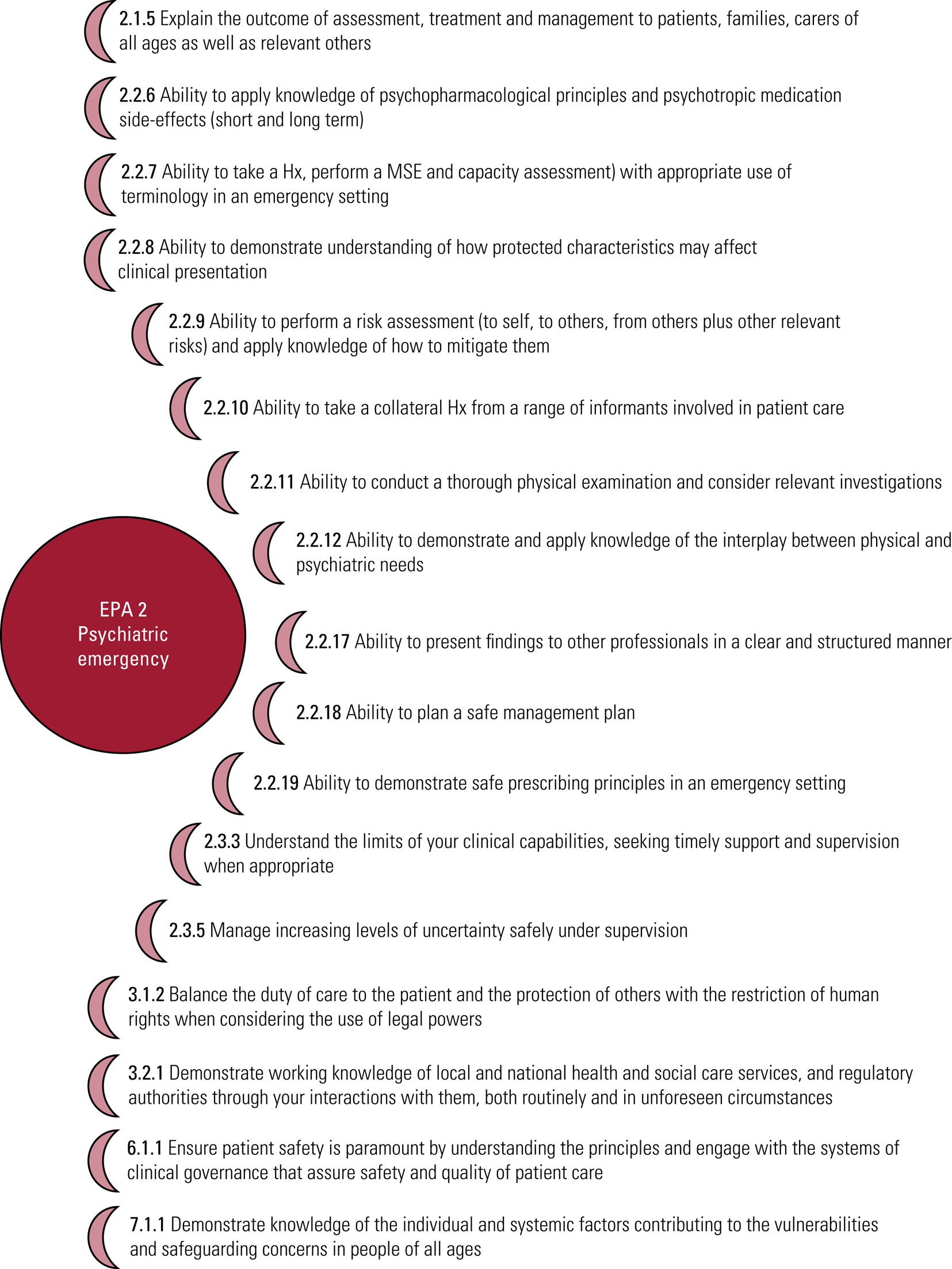
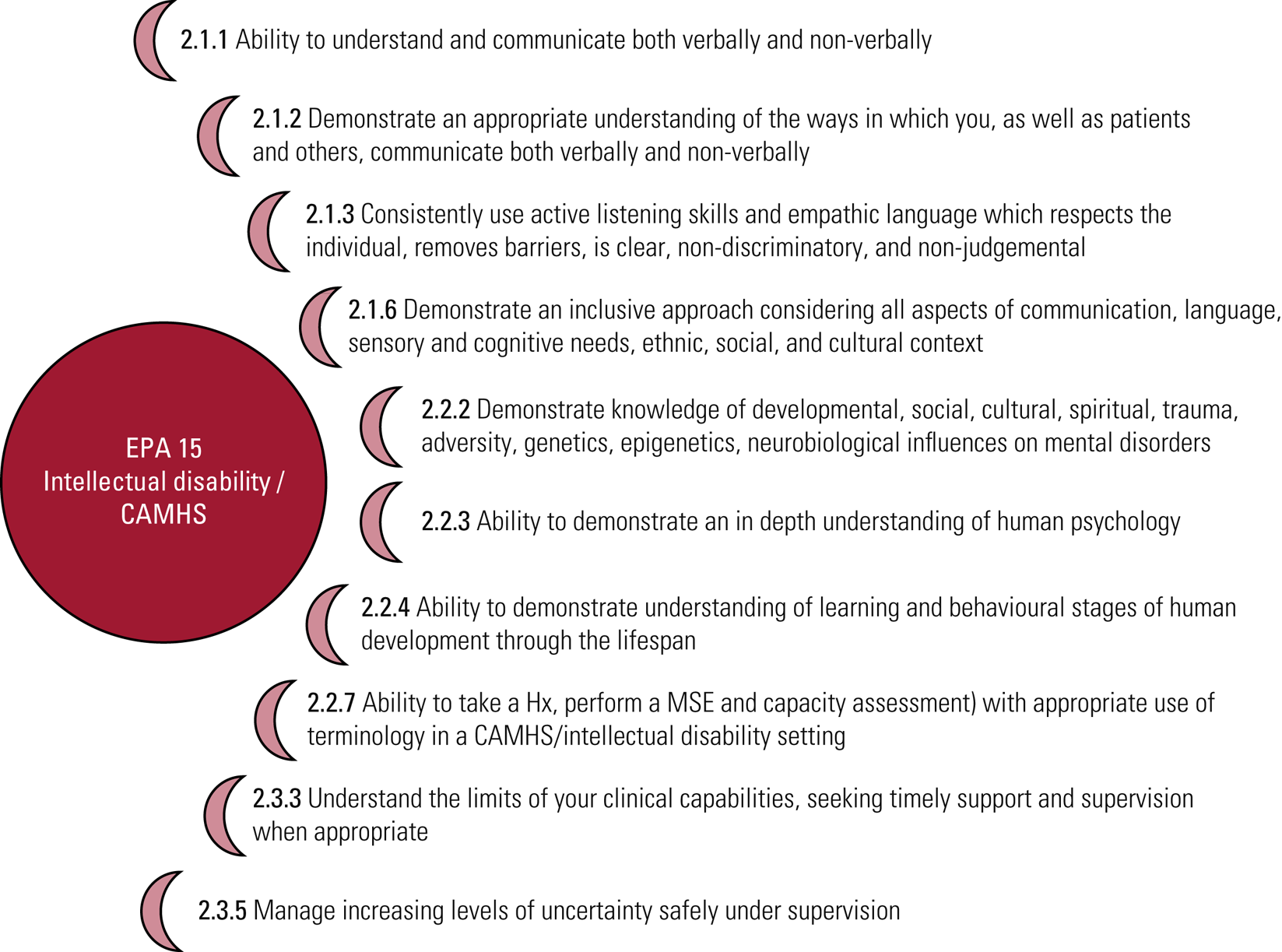
In the following sections, we use the core training curriculum in psychiatry (RCPsych 2022) to illustrate how EPAs could be embedded within training. During the 3-year core training programme, trainees engage in six clinical placements (of 6 months each), each placement requiring its own PSPDP. For this illustration, we have included, within a given PSPDP, a selection of pertinent EPAs that can be tailored to the specific placement and its unique context. Each EPA encompasses a set of associated key capabilities, which may either span across the entire HLOs framework (Fig. 4) or align more closely with a specific HLO (Fig. 5). This variation in capability alignment depends on the nature of the individual EPA. We envisage that the number of EPAs would need to be such that they do not massively increase the assessment burden of supervisors and trainees, and that the number of WPBAs required is not too different from current requirements.

Hypothetical EPA 15 (Box 1) with capabilities linked to the core psychiatry curriculum. The item numbers (e.g. 2.1.1) refer to the key capabilities linked to the high level outcomes (HLOs) in the core curriculum. CAMHS, child and adolescent mental health services; Hx, history; MSE, mental state examination.

This assumes the existence of an RCPsych-ratified catalogue of psychiatry EPAs to build the PSPDP. EPAs will need to follow a gradient of difficulty and be synchronous with the trainee's ability and level. Ideally, at the beginning of training, the curriculum should drive the acquisition of basic patient assessment and management skills and then escalate into more advanced skills, such as leadership and research. For example, leadership skills might not be considered essential for a core trainee (making it a non-mandatory EPA), but a higher trainee would be expected to demonstrate leadership in their daily practice (thus it becomes a mandatory EPA).
What would EPAs look like?
To better demonstrate this concept, let us imagine the journey of Dr T, a fictitious psychiatry core trainee. Two scenarios have been prepared to illustrate their experience. For this exercise, the list of EPAs featured in Box 1, chosen from the hypothetical catalogue of psychiatry EPAs, serves as the reference. The catalogue allows supervisors and trainees to collaboratively select a set of EPAs, aligning them with the trainee's prior performance, stage in training and, notably, the opportunities offered by the placement. This customised selection of EPAs ensures that the trainee's learning experience is both personally meaningful and professionally enriching.
Entrustable professional activities (EPAs) based on the core psychiatry curriculum
The following EPAs, from a hypothetical catalogue of ratified EPAs, were set for a core trainee's placements on an adult in-patient ward and in child and adolescent mental health and intellectual disability services (also known as learning disability services in the UK):
-
EPA 1 The trainee demonstrates the ability to perform a psychiatric assessment well
-
EPA 2 The trainee demonstrates the ability to manage a psychiatry emergency well
-
EPA 3 The trainee demonstrates the ability to formulate a management plan for uncomplicated mood and anxiety pathologies well
-
EPA 4 The trainee demonstrates the ability to communicate with stakeholders and within the MDT well
-
EPA 5 The trainee demonstrates the ability to formulate a management plan for complex psychiatric disorders well
-
EPA 6 The trainee demonstrates the ability to formulate a management plan for uncomplicated psychotic disorders well
-
EPA 7 The trainee demonstrates the ability to apply research knowledge well
-
EPA 15 The trainee demonstrates the ability to perform an in-depth biopsychosocial assessment in CAMHS/intellectual disability setting well
-
EPA 16 The trainee demonstrates the ability to formulate a biopsychosocial management plan in the CAMHS/intellectual disability setting well
-
EPA 17 The trainee demonstrates the ability to provide psychodynamic therapy well
-
EPA 18 The trainee demonstrates the ability to conduct a service QI well
-
EPA 25 The trainee demonstrates the ability to chair an MDT well
-
EPA 36 The trainee demonstrates the ability to lead a discharge planning meeting well
-
EPA 40 The trainee demonstrates the ability to apply principles of mental capacity legislation in practice
-
EPA 50 The trainee demonstrates the ability to apply basic research principles to practice.
MDT, multidisciplinary team; CAMHS, child and adolescent mental health services; QI, quality improvement.
In the first scenario, we have Dr T, starting their first placement, on an adult in-patient ward. EPAs 1, 2 and 3 were agreed on in their first supervision, with the potential of adding more EPAs later during their placement, based on their progress. Periodic progress checks will guide which EPAs stay, are moved forward or added. A visual representation of EPA 2 is portrayed in Fig. 4.
Moving on to Dr T's final placement, in the third year of core training (CT3), in a children's intellectual disability service, a plan for his sixth PSPDP is proposed, knowing that child and adolescent mental health services (CAMHS) and intellectual disability settings are good for practising and achieving advanced communication skills in psychiatry. To assess these skills, EPA 15 and EPA 16 were agreed on. EPA 15 is exemplified in Fig. 5.
Use of EPAs to guide trainee progression
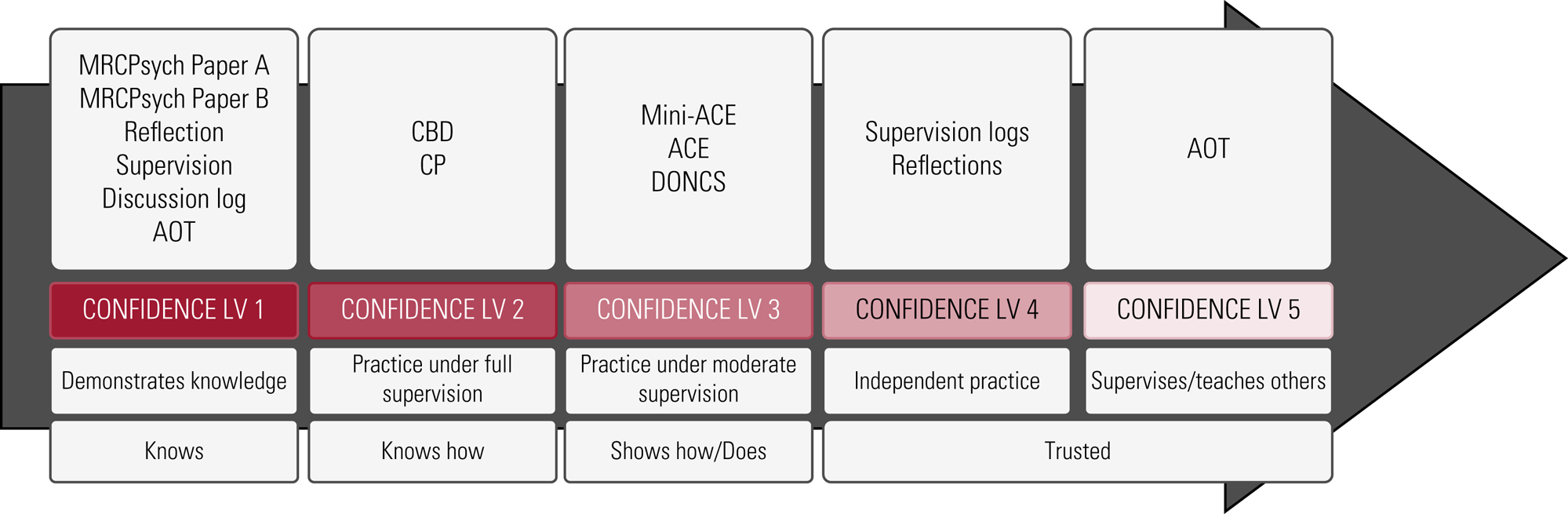
If EPAs are selected and included in the PSPDP right from the beginning, both the trainee and trainer will be able to plan how to best achieve the agreed EPAs and, more importantly, agree on how to demonstrate them (which and how many WPBAs would be necessary). Figure 6 portrays a possibility of assessing EPAs by integrating existing WPBAs with the entrustment scale. Dr T's progress will be used to explain further.
A possible array of workplace-based assessments and other educational tools to use to inform the entrustment decision. AOT, assessment of teaching; LV, level; CBD, case-based discussion; CP, case presentation; ACE, assessment of clinical expertise; mini-ACE, mini-assessed clinical encounter; DONCS, direct observation of non-clinical skills; CPD, continuing professional development.

Dr T is their fourth post in core training in a home treatment team (HTT) placement and decides with their supervisor to choose EPA 36, regarding leading a discharge planning meeting well. Dr T agreed with the supervisor to approach this skill in a stepwise manner.
First, Dr T will need to demonstrate theoretical knowledge (‘knows’) of the trust's and team's policies regarding discharging patients from the HTT to other community mental health teams and the important ethical frameworks around it. Dr T can demonstrate this by explaining their understanding in a guided conversation during supervision or/and by reflecting on a recent case they have been involved in. After the supervisor is satisfied with the level of knowledge, they ask Dr T to prepare a case-based discussion (‘knows how’) of a case in which they actively participated in the discharge planning process. If the supervisor is satisfied with Dr T's ability to translate the theory into practice, then they can offer the opportunity for Dr T to demonstrate their practical skills (‘shows how/does’). For example, Dr T might lead a discharge planning meeting observed by the supervisor. Only when the supervisor is confident that Dr T consistently demonstrates the skills and competencies will Dr T be entrusted with independent practice. If at any of these stages, Dr T stumbles, the WPBA decided on can be repeated, with feedback and support from the supervisor, until the skill is achieved.
When should EPAs be assessed?
Ideally, individual WPBAs (in the current form) or other formative supervised learning experiences (SLEs) will be first assessed by the clinical supervisor or other qualified professionals throughout the 6-month placements. These will feed into the agreed EPAs, and the entrustment decision, along with supporting comments, will be made by the named clinical supervisor who does the end of placement psychiatric supervisor report. In addition to the prescribed WPBAs, other evidence, such as feedback from multidisciplinary colleagues, might also contribute to the entrustment decision. The EPAs achieved during the posts will be reviewed by the educational supervisor at the end of each post. The role of the educational supervisor would be to review the EPAs achieved (in relation to the overall curriculum) and the feedback, comments and recommendations made by the clinical supervisor. This should inform a plan of further development. Finally, the number of EPAs, the number and quality of WPBAs, and comments/recommendations of the clinical supervisor and educational supervisor would be reviewed by the annual review of competency progression (ARCP) panel for signing off the final summative decision. This would preserve the current relationship between the clinical supervisor, educational supervisor and ARCP panel.
Proposal for implementation
The RCPsych has included EPAs as a potential assessment strategy (in line with the model adopted by the RANZCP) in its Assessment Strategy Review (RCPsych 2023). It has recommended the setting up of a working group to explore this option further with input from trainers with expertise and experience. EPAs are essentially premised on being summative assessments, with various components feeding into the entrustment decision. The RCPsych is considering introduction of EPAs as part of its formative assessment review. This raises the question about how formative assessments such as SLEs relate to EPAs and the summative entrustment decision. It is unclear at the time of writing this article whether the working group will recommend a thorough overhaul of the current assessment system or add entrustment scales to existing WPBAs.
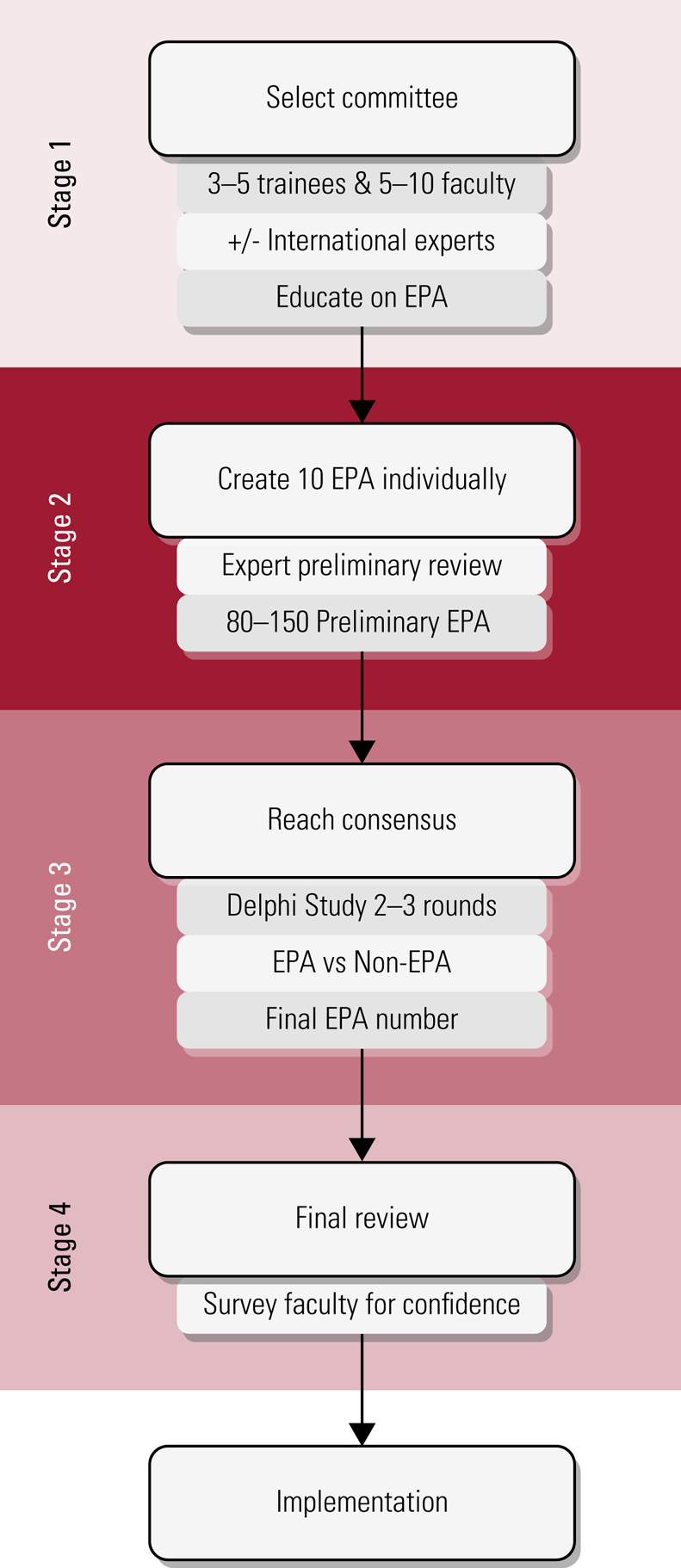
If it is decided to further explore EPAs as an assessment approach for curricular achievement, we suggest an implementation schedule as outlined in the Fig. 7. This will initially involve identifying a range of EPAs by a committee of psychiatric educators and trainee representatives in consultation with international experts. A validated research methodology such as the Delphi method could be used in the next stage to achieve consensus and to select the final number, form and essentiality (mandatory versus optional) of EPAs. This could be followed by a consultation exercise with educators and/or trainees and plans could be further refined (alongside the development of the relevant tools in the electronic portfolio). A piloting exercise would help assess the usefulness, reliability and validity of the approach before it could be considered for a wider roll out. We envisage that this process might take a couple of years.
Creation and implementation of entrustable professional activities (EPAs) in psychiatry.

Conclusions
Literature suggests that EPA-based curricula are a positive development in the delivery of a ‘real life’ competency-based medical education. EPA-based curricula offer an opportunity to simplify and structure the curriculum, streamline its implementation in practice, track trainee progress through summative entrustment decisions and make training more relevant to day-to-day clinical practice. They can potentially tackle some drawbacks of the current WPBA-based system, such as the perceived lack of educational value, dissatisfaction with feedback, purpose confusion and asynchronicity with training needs. Importantly, an EPA-based assessment strategy aligns itself well with the RCPsych's new curricula and the GMC's requirement that curricula and assessments provide robust and credible assurances that trainees have demonstrated the required knowledge, skills, capabilities, behaviours and levels of performance that are expected of safe and effective doctors.
As research on the construction, value and use of EPAs in psychiatry is very limited, more work is needed to demonstrate that introduction of EPAs improves the quality of training. Consideration also needs to be given to how to best integrate EPAs into the existing training structures and assessment frameworks without increasing assessment burden for trainees and workload for supervisors. If EPAs were to be considered for implementation in UK postgraduate psychiatric training, we would hope that it would be preceded by widespread consultation and meticulous planning, building on a research-driven evidence base. We have, in this article, summarised what is currently known about EPAs in general (and psychiatry in particular) and introduced a model of an EPA-based psychiatry curriculum. We hope this will stimulate research, conversations and debate on how to shape psychiatry training for the next generation of psychiatrists in the UK and how to answer the question: are EPAs the assessment tool for tomorrow's psychiatrists?
Data availability
Data availability is not applicable to this article as no new data were created or analysed in this article.
Author contributions
V.D. and G.R. conceived the idea of the article. I.V. performed the literature search and wrote the first draft of the paper. V.D. and G.R. made further contributions to developing the idea and editing the final version.
Funding
This research received no specific grant from any funding agency, commercial or not-for-profit sectors.
Declaration of interest
None.
MCQs
Select the single best option for each question stem
1 Entrustable professional activities (EPAs) are:
a a method of trainee assessment based on supervisor trust and the demonstration of required competence
b an alternative to workplace-based assessments in medical training
c a set of competencies required for postgraduate medical training
d an assessment tool exclusively used in undergraduate curricula
e a standardised test format for evaluating practical skills.
2 The potential benefits of implementing EPAs in postgraduate psychiatry assessment include:
a increased complexity and granularity of competencies being assessed
b improved feedback mechanisms for trainees
c expansion of the number of workplace-based assessments
d enhanced focus on theoretical knowledge over practical skills
e creation of a regulatory framework for licensing healthcare professionals.
3 The best approach to constructing valid EPAs is considered to be:
a a faculty survey
b a milestones committee
c the Delphi method
d the task force approach
e a randomised controlled trial.
4 As regards the relationship between EPAs and competencies in the context of medical education:
a EPAs are broader constructs that encompass multiple competencies
b EPAs are narrower and more specific than competencies
c EPAs are unrelated to competencies
d EPAs and competencies are synonymous and can be used interchangeably
e EPAs and competencies have the same purpose but are labelled differently.
5 One example of a narrow-form EPA in psychiatric training is:
a the ability to take history from a new patient in an out-patient clinic
b the ability to construct a biopsychosocial formulation of a patient
c the ability to carry out a mental state examination
d the ability to safely initiate clozapine in a patient with treatment-resistant schizophrenia
e the ability to formulate a management plan for a patient.
MCQ answers
1 a 2 b 3 c 4 a 5 d



eLetters
No eLetters have been published for this article.