Healthcare-associated infections (HAIs) are a significant cause of morbidity and mortality in the United States. A 2011 multistate point-prevalence survey recorded an estimated 722,000 HAIs in 648,000 hospitalized patients resulting in ~75,000 patient deaths.Reference Magill, Edwards and Bamberg 1 Prevention efforts have recently focused on the role of the physical environment in the transmission of pathogens causing HAIs. High-touch, noncritical hospital surfaces (eg, bed rails, overbed tables, and IV poles) are commonly contaminated with pathogens, and many have been linked to outbreaks in hospitals and long-term care facilities (LTCFs).Reference Boyce 2 – Reference Dancer, White and Robertson 12
Most published studies assessing microbial contamination on environmental surfaces in healthcare facilities have been qualitative, reporting only the proportion of positive samples.Reference Clabots, Johnson, Olson, Peterson and Gerding 3 – Reference Aygun, Demirkiran and Utku 5 , Reference Dubberke, Reske and Noble-Wang 9 , Reference Sexton, Clarke, O’Neill, Dillane and Humphreys 10 , Reference Carling, Beheren, Kimc and Woods 13 The few studies reporting quantitative results focus either on the amount of overall contamination or contamination by specific pathogens, usually not both.Reference Pfeiffer, Wittig, Dunkelberg and Werner 14 – Reference Claro, O’Reilly, Daniels and Humphreys 21 Microbial bioburden (MB), when reported, is only from individual surfaces, such as bed rails, or is reported in relation to cleaning method or product efficacy testing.Reference Claro, O’Reilly, Daniels and Humphreys 21 – Reference Boyce, Havill, Dumigan, Golebiewski, Balogun and Rizvani 26 These studies can be difficult to compare because they often use different sampling methodologies or reporting units.Reference Frabetti, Vandini, Balboni, Triolo and Mazzacane 15 , Reference Oie and Kamiya 17 , Reference Moore, Muzslay and Wilson 19 – Reference Schmidt, Anderson, Attaway, Fairey, Kennedy and Salgado 22 , Reference Suzuki, Namba, Matsuura and Horisawa 27
The lack of consistent quantitative contamination data makes it difficult to correlate bioburden reductions when assessing cleaning procedures or disinfection products. Current CDC guidelines contain no recommended standard MB levels.Reference Sehulster and Chinn 28 More than a decade ago, benchmark standards were proposed for high-touch surfaces in UK hospitals to correlate cleanliness and MB.Reference Dancer 29 , Reference Malik, Cooper and Griffith 30 These standards of <5.0 colony-forming units (CFU)/cm2 or <2.5 CFU/cm2 are of limited use because the dip-slide sampling method must be used, which limits the sampling to flat surfaces of <12 cm2.Reference Dancer, White and Robertson 12 , Reference Dancer 29 – Reference White, Dancer, Robertson and McDonald 33 Without knowing the true MB on hospital environmental surfaces, it can be difficult to assess achievable bioburden concentrations that will impact patient safety. The main objectives of our study were to use standardized, large-area (>1,000 cm2), sponge-wipe sampling and laboratory processing procedures to determine typical MB (overall bacterial and specific multidrug-resistant organisms [MDROs]) on high-touch, noncritical, healthcare environmental surfaces after routine or terminal room cleaning across a number of facilities.
METHODS
Study Design
This prospective study was conducted between January 2011 and July 2013 in 9 acute-care hospitals and 2 LTCFs in 4 states. Rooms of patients on contact precautions for MDROs (eg, methicillin-resistant Staphylococcus aureus (MRSA), vancomycin-resistant enterococci (VRE), Acinetobacter baumannii, Klebsiella pneumoniae, and Clostridium difficile) were sampled after either routine or terminal cleaning.
Environmental Sampling
Samples were collected using environmental sponge-wipes (3M Sponge-Stick with neutralizing buffer; 3M, St. Paul, MN). To best evaluate contamination of the room as a whole, a preliminary study was performed to identify high-touch sites that could be combined as composite samples. Up to 12 high-touch sites (surface area ≤1 m2) were sampled in patient rooms from 9 healthcare facilities. Each site included IV pump and/or pole, television remote, overbed table, telephone, door handles, call bell, bed rails, supply cart, bathroom hand rail, and toilet handle.
Based on the preliminary data, we developed 3 composites that included items common in the patient rooms of all participant hospitals and LTCFs. The sites sampled as part of each composite were assigned based on a maximum total sampling surface area of 2,258.06 cm2 per composite and were composed of 1 large surface-area site (bed rails or overbed table) and 2–3 smaller sites. One sponge wipe was used for each composite. Sites were assigned as follows: composite 1 (C1) included bed rails, television remote, call button, and telephone; composite 2 (C2) included overbed table, IV pole, and inside room door handle; and composite 3 (C3) included either the portable commode (grab bars and seat), bedpan (bathroom door handle, toilet flush handle, rinse spout handle, and seat), or bathroom (door handle, flush handle, and grab bar) in rooms of patients with C. difficile. Bathroom sites were included for C. difficile contact precaution rooms to increase the chance of recovering C. difficile.
The healthcare facilities notified samplers when MDRO contact precaution rooms occupied by patients diagnosed with the specificed MDR infections were available for sampling. Samples were collected as soon as possible after routine or terminal cleaning and rooms were of similar design on the same unit or ward. “Routine” was defined as the daily cleaning procedure for patient rooms, and samples were collected when patients were out of the rooms. “Terminal” referred to the cleaning and disinfection procedures that occurred after patients were discharged. Routine and terminal cleaning procedures varied by facility. The exact surface area sampled was recorded for each composite, along with cleaning products used, cleaning and sampling times, and specific patient clinical factors (ie, acute diarrhea, presence of catheters, open wounds, dialysis, etc). For each facility, up to 20 routinely cleaned and 10 terminally cleaned rooms were sampled. Field blank samples were collected before and after sampling each room. Samples were shipped to the Centers for Disease Control and Prevention (CDC) for processing on the day of collection when possible.
Sample Processing and Culture Methods
All samples were processed immediately upon receipt at the CDC. Sponge wipes were expressed in 90 mL phosphate-buffered saline containing 0.02% Tween 80 (PBST) using a stomacher. The eluate was then concentrated by centrifugation. The pellets were resuspended in PBST and cultured. To recover and quantify target MDROs, aliquots were cultured on CHROMagar VRE (CHROMagar, Becton Dickinson, San Jose, CA) for VRE, mannitol salt agar (Becton Dickinson) for S. aureus, MacConkey agar (Becton Dickinson) for K. pneumoniae, MDR-Acinetobacter agar (Hardy Diagnostics, Santa Maria, CA) for A. baumannii, and cycloserine cefoxitin fructose agar with horse blood and taurocholate (Anaerobe Systems, Morgan Hill, CA) for C. difficile. Total aerobic (tryptic soy agar with 5% sheep’s blood; Becton Dickinson) and total anaerobic counts (anaerobic blood agar; PathCon Laboratories, Norcross, GA) were determined. All media were inoculated in duplicate and incubated as appropriate. Broth enrichment was used to recover low levels of target MDROs; tryptic soy broth (Becton Dickinson) was used for Gram-negative bacteria; tryptic soy broth with 6.5% NaCl (Becton Dickinson) was used for MRSA and VRE; and cycloserine cefoxitin fructose broth was used for C. difficile.Reference Nerandzic and Donskey 34 Broth cultures were subsequently subcultured on selective media as described above.
Bacterial Identification and Antibiotic Resistance Testing
Identification of suspect bacteria was confirmed using conventional biochemical methods (Vitek 2; bioMeriuex, Marcy-l’Étoile, France). C. difficile identification and presence of toxin genes were confirmed by polymerase chain reaction.Reference Persson, Torpdahl and Olsen 35 Antimicrobial susceptibility testing was performed on confirmed isolates using standard protocols (disk diffusion or broth microdilution). 36 MDR-A. baumannii isolates were defined using the 3-class-resistant definition.Reference Kallen, Hidron, Patel and Srinivasan 37 K. pneumoniae isolates were considered resistant if they were positive for extended-spectrum β-lactamase (ESBL) by broth microdilution, New Delhi metallo-β-lactamase (bla NDM-1), or carbapenemase (bla KPC) by polymerase chain reaction. 36 , 38
Data Analysis
For the preliminary study, the mean, standard deviation, and distribution (median and empirical distribution function (EDF) using nonparametric Brown-Mood and Kuiper tests) of overall aerobic MB per area sampled (CFU/100 cm2) for each individual site were compared to develop the composite sampling strategy.
Descriptive statistics for overall MB per area sampled and each MDRO were calculated for the main sampling study composites and rooms using univariate analysis. Samples that were only broth positive were assigned a value of 1 CFU in order to be included in the analysis. Overall MB for each sample was calculated from the maximum aerobic or anaerobic colony counts, and total room MB was determined by summing C1 and C2 MB; C3 was not included due to the low number of samples collected. Total room MB was log normalized and compared using the Student t test (P≤.05). SAS statistical software, version 9.3 (SAS Institute, Cary NC) was utilized.
RESULTS
Preliminary Study
Data from the preliminary study of 102 samples from 13 routine cleaned rooms revealed that surfaces with the highest mean bacteria were the room door handles (7,546 CFU/100 cm2), telephone (2,350 CFU/100 cm2), and remote/call button (1, 353 CFU/100 cm2; Online Supplementary Table S1). There was a ~50-fold variation in overall mean aerobic bacteria across the sites, and although MDROs were recovered from several sites, the sites with the greatest bioburden (door handles) yielded no MDROs. The overbed table was the most common MDRO-positive site (53.9%). The number of MDRO-positive sites ranged from 0.0 to 80.0% per room (Online Supplementary Table S2); however, the number of sites sampled per room varied from 4 to 9 sites.
Main Study
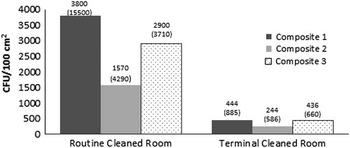
During the main study, 375 composite samples were received. After excluding 15 samples due to insufficient information, 360 samples were analyzed. More composites were received from routine cleaned rooms (C1s, 113; C2s, 113; C3s, 16; total=242) than from terminal cleaned rooms (C1s, 53; C2s, 53; C3s, 12; total=118). The MB mean and range of composites from routine cleaned rooms (2,700 CFU/100 cm2; ≤1–130,000 CFU/100 cm2) was notably higher than that of composites from terminal cleaned rooms (353 CFU/100 cm2; ≤1–4,300 CFU/100 cm2; Table 1). C1s from routine cleaned rooms had the highest mean MB (3,800 CFU/100 cm2), while C2s from terminal cleaned rooms had the lowest bioburden (244 CFU/100 cm2; Fig. 1).
Microbial bioburden by composite type from routine and terminal cleaned rooms; mean (standard deviation), routine cleaned composites C1 and C2 (n=113 each), composite 3 (n=16); terminal cleaned composites C1 and C2 (n=53 each) and composite C3 (n=12); CFU, colony-forming units.

Overall Microbial and Individual MDRO Bioburden Detected in Composite Samples From Routine Cleaned (n=242) and Terminal Cleaned Rooms (n=118)

NOTE. MDRO, multidrug-resistant organism; MRSA, methicillin-resistant Staphylococcus aureus; MB, microbial burden; VRE, vancomycin-resistant enterococci; MDR, multidrug resistant; CFU, colony-forming units; SD, standard deviation.
For each MDRO, recovery from routine cleaned room composites was markedly higher than from terminal cleaned room composites (Table 2). When assessing only the MDRO-positive samples, the highest mean MDRO bioburden was K. pneumoniae from routine cleaned room composites (1,284 CFU/100 cm2) and the lowest was A. baumannii (0.66 CFU/100 cm2) from terminal cleaned room composites (Table 2).
Individual MDRO Bioburden Detected in MDRO-Positive Samples from Routine Cleaned and Terminal Cleaned Rooms

NOTE. MDRO, multidrug-resistant organism; MRSA, methicillin-resistant Staphylococcus aureus; VRE, vancomycin-resistant enterococci; MDR, multidrug resistant; CFU, colony-forming units; n; number of composites positive for MDRO; SD, standard deviation.
a All were extended-spectrum β-lactamase positive (ESBL+).
b One sample was carbapenemase (bla KPC) positive and 1 was ESBL+.
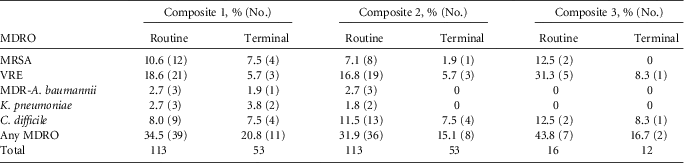
MDROs were recovered from 33.9% of composites from routine cleaned rooms with the highest recovery for any MDRO from C3 (43.8%) followed by C1 (34.5%) and C2 (31.9%; Table 3). VRE was the most frequently recovered MDRO from all 3 composites from routine cleaned rooms (18.6% of C1s; 16.8% of C2s; 31.3% of C3s). All 5 target MDROs were recovered from C1s and C2s, but only MRSA, VRE and C. difficile were recovered from C3s. In total, 24 isolates of C. difficile were recovered; however, 50% were recovered from non–C. difficile rooms. Most C. difficile isolates were recovered from C1s (38%) or C2s (54%), very few were recovered from C3s (8%). The 2 isolates recovered from C3s were from C. difficile isolation rooms. In total, 6 A. baumannii isolates were MDR and 6 K. pneumoniae isolates were ESBL producers.
Percent of Composites Positive for Given MDRO from Routine Cleaned and Terminal Cleaned Rooms

NOTE. MDRO, multidrug-resistant organism; MRSA, methicillin-resistant Staphylococcus aureus; VRE, vancomycin-resistant enterococci; MDR, multidrug resistant.
Composites from terminal cleaned rooms were less frequently MDRO positive (17.8%), with the highest recovery from C1s (20.8%), then C3s (16.7%) and C2s (15.1%; Table 3). The individual MDRO recovery was low (<8.3%), and no individual MDRO was consistently recovered. All 5 MDROs were recovered from C1s, but A. baumannii and K. pneumoniae were not recovered from C2s, along with MRSA from C3s. In total, 9 C. difficile isolates were recovered, and 50% were recovered from C. difficile isolation rooms. Only 1 room was positive for C. difficile from a C3 alone; 1 A. baumannii isolate was MDR, 1 K. pneumoniae isolate was an ESBL producer; and another was a carbapenemase producer.
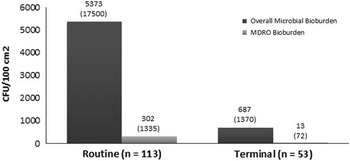
For room-level evaluations of MB and MDRO bioburden, 166 rooms were assessed (113 routine cleaned rooms and 53 terminal cleaned rooms). In routine cleaned rooms, the mean MB (5,373 CFU/100 cm2) and mean MDRO bioburden (302 CFU/100 cm2) were almost 8 and 24 times higher, respectively, than in terminal cleaned rooms (687 and 13 CFU/100 cm2; Figure 2). There was a significant difference between routine and terminal cleaned rooms for recovery of log10 MB (P=.0002).
Overall microbial bioburden and multidrug-resistant organism (MDRO) bioburden for routine and terminal cleaned rooms (composites 1 and 2 summed); mean (standard deviation); CFU, colony-forming units.

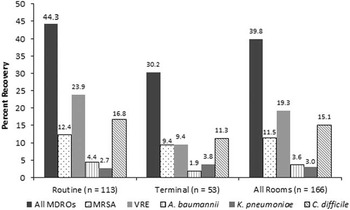
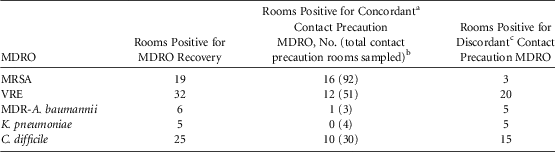
MDROs were recovered from 39.8% of rooms (75.8% routine; 24.2% terminal) (Fig. 3). Almost 45% of routine cleaned rooms and 30% of terminal cleaned rooms were positive for an MDRO. MRSA was the most common contact precaution-room type sampled (79%); however, VRE was the predominantly recovered MDRO from all rooms (19.3%) and from routine cleaned rooms (23.9%); C. difficile was the predominantly recovered MDRO from terminal cleaned rooms (11.3%). For all MDROs, except MRSA, more rooms were positive for a discordant MDRO than concordant contact precaution MDRO (Table 4). VRE was recovered more often from discordant contact precaution rooms (n=20) than from concordant VRE contact precaution rooms (n=12), and all 5 rooms positive for K. pneumoniae were discordant contact precaution rooms. Multiple MDRO types were recovered from 11 rooms.
Percent recovery of each target multidrug-resistant organism (MDRO) and all MDROs from routine cleaned, terminal cleaned, and all rooms.

Summary of MDRO Recovery From Contact Precaution Rooms

NOTE. MDRO, multidrug-resistant organism; MRSA, methicillin-resistant Staphylococcus aureus; VRE, vancomycin-resistant enterococci; MDR, multidrug resistant.
a MDRO(s) recovered by sampling that matched the patient’s diagnosis which required contact precautions.
b In total, 23 patients were on contact precautions for multiple MDROs.
c MDRO(s) recovered by sampling from room that did not match the MDRO causing the patient to be on contact precautions.
DISCUSSION
We developed a composite sponge-wipe, large-surface-area sampling plan to determine typical bacterial bioburden levels in MDRO contact precaution rooms after routine or terminal cleaning. We found that the mean MB collected from surfaces was 2,700 CFU/100 cm2 in routine cleaned rooms and 353 CFU/100 cm2 in terminal cleaned rooms. These results present a broad but not representative cross section of current levels of contamination across these facilities.
When we assessed bioburden by composite type, we found that surfaces sampled as part of C1 (ie, bed rails, TV remote, call button, and telephone), which were usually closest to the patient, were often the most contaminated, which is consistent with other studies.Reference Dancer, White and Robertson 12 , Reference Moore, Muzslay and Wilson 19 , Reference Schmidt, Anderson, Attaway, Fairey, Kennedy and Salgado 22 – Reference Attaway, Fairey, Steed, Salgado, Michels and Schmidt 24 Similar MB was reported by Schmidt et alReference Schmidt, Attaway, Fairey, Steed, Michels and Salgado 23 on plastic bed rails after cleaning (1,112–5,198 CFU/100 cm2). However, while C1s had the highest MB in samples from routine and terminal cleaned rooms, C2s and C3s were within the same magnitude (log10).
When we combined C1s and C2s to determine overall room bioburden, routine cleaned rooms were ~8 times more contaminated than terminal cleaned rooms. This difference is significant and was expected because terminal cleaning procedures are often more thorough and use more efficacious cleaning/disinfection products (eg, bleach or hydrogen peroxide vapor) than routine cleaning procedures. In addition, previous research on cleaned bed rails has shown that bacterial counts can rebound within a few hours of cleaning during ongoing patient care.Reference Attaway, Fairey, Steed, Salgado, Michels and Schmidt 24 In our study, the time between cleaning and sampling varied for both routine and terminal cleaned rooms.
In this study, we also attempted to determine the bioburden levels of 5 target MDROs. We found that ~40% of the rooms sampled were positive for any MDRO, the majority of which were routine cleaned. Overall, mean MDRO bioburden was low for each target organism; however, even the presence of low amounts of any MDRO on surfaces in patient rooms is cause for concern. While we cannot directly compare MDRO recovery from this study to other published research because facilities and regions have their own unique microbiome, these results do show that MRSA, VRE, and C. difficile are more often found on these heathcare surfaces than A. baumannii and K. pneumoniae. We also found that recovered MDROs often were discordant with the MDRO requiring contact precautions and that many rooms were positive for MDROs different than those for which patients were isolated or for additional MDROs (Table 4). The presence of MDROs other than those for which patients were isolated may be due to undetected carriage of the current patient, contamination carried in by healthcare workers, visitors, etc, or residual contamination from prior occupants.Reference McDonald and Arduino 39 Many HAI-pathogens, such as, MRSA,VRE, C. difficile, and A. baumannii, can persist in a viable infectious state on environmental surfaces for days to months.Reference Boyce 2 , Reference Rutala and Weber 40
This study has some limitations. Our methods may underestimate total room MB and MDRO bioburden density in the rooms due to the variability of surface characteristics, microorganisms, and sampling efficiency. Additional sources of variablilty that we were unable to measure include the heterogeneity of surface contamination, and differing cleaning methods and cleaning intensities among facilities. Despite the increased labor in processing, we chose to use a large-surface-area sampling strategy to overcome the lack of surface homogeneity and to increase our sensitivity for detecting MDROs, especially in the terminal cleaned rooms. Although the relationships among sampled area, the distribution of sampled area across different sites, and sensitivity of MDRO detection are not fully known, sampling multiple sites did result in increased MDRO detection, as seen in the preliminary study (S1 and S2). Also, during the main study, collecting 2 composite samples increased not only the amount of bioburden recovered but also the percentage of MDRO-positive rooms compared to that expected if we had limited sampling to C1 or C2 sites (data not shown). In addition, we do not know what exact site the MDROs were recovered from due to the composite sampling strategy, and these results only provide a snapshot of room bioburden because the rooms were only sampled once. Another limitation is that we did not assess cleaning protocols or adherence to them in the rooms, so we cannot know whether these items/rooms were cleaned properly or thoroughly. However, with the large number of rooms sampled, the effect of a few badly cleaned rooms would be minimized on the overall mean MB.
It will be important to determine how these levels of microbial contamination relate to the risk of the patient acquiring an MDRO. These data provide a first step in determining the MB of common hospital surfaces, which may help to develop standards for adequacy of cleaning and disinfection methods on healthcare surfaces and provides a framework for studies using the evidentiary hierarchy for environmental infection control to increase patient safety by cleaning and disinfection.Reference McDonald and Arduino 39 These results could be used to help parameterize models describing the role of environmental surface contamination in transmission. Future areas of investigation include the significance of cleaning type, cleaning products, and other variables on MB and risk of MDRO recovery. In addition, future studies should evaluate whether other sampling methods that are less labor intensive yield comparable bioburden or MDRO recovery as the sponge-wipe method.
ACKNOWLEDGMENTS
We would like to thank Bette Jensen, David Lonsway, Hollis Houston, Jordan Zambrana, K.Allison Perry, Lydia Anderson, Sarah Gilbert, and Tatiana Travis for their laboratory assistance. We would like to recognize Alice Guh, Brandi Limbago, Taranisia MacCannell, William Rutala, David Weber, and John Boyce for initial discussions regarding study design and methods. Infection control practitioners at the various healthcare facilities are acknowledged for accessing medical records and identifying rooms for sampling. Epidemiologists at the Illinois, Vermont, and Maryland state health departments are also recognized for facilitating recruitment of healthcare facilities to participate in the project. In addition, we would like to recognize Karin Hodge, Koela Ray and Burton Wilcke Jr. for their assistance with collecting samples.
Financial support: This study was funded by the Department of Health and Human Services Office of Disease Prevention and Health Promotion. Kerri A. Thom was supported by the National Institute of Health Career Development (grant no. 1K23AI082450-01A1).
Potential conflicts of interest: All authors report no conflicts of interest relevant to this article.
The findings and conclusions in this report are those of the authors and do not necessarily represent the official position of the Centers for Disease Control and Prevention.
SUPPLEMENTARY MATERIAL
To view supplementary material for this article, please visit http://dx.doi.org/10.1017/ice.2016.198.