“…we must come together to prevent, and detect, and fight every kind of biological danger—whether it’s a pandemic like H1N1, or a terrorist threat, or a treatable disease.” President Barack Obama, 2011 1
A critical need exists for agencies across the African continent to develop disaster preparedness and response plans.Reference Aliyu 2 - 6 In an increasingly interconnected global society, the consequences of disease outbreaks and other catastrophic events in any part of the world reverberate quickly across continents. Strengthening linked public health and whole-of-government response systems in vulnerable regions can help to mitigate or even prevent these threats. The World Health Organization (WHO) has also emphasized the crucial nature of strengthening emergency medical care systems.Reference Razzak and Kellermann 7 - 10 The concept of “health security,” or the protection from health threats, has recently been recognized as one of the most critical international security issues—particularly in light of the recent Ebola and Zika virus outbreaks.Reference Heymann, Chen and Takemi 11 Twenty-five percent of global nonconflict emergencies, and 44% of deaths related to these emergencies, occur in developing countries with restricted ability to prepare for and respond to such types of emergencies. 12 In addition, according to the recent Sendai Framework for Disaster Risk Reduction, “effective disaster risk management contributes to sustainable development.” 13
In response to these increasing global health security concerns, efforts to build capacity in infectious disease and all-hazards disaster preparedness and response among developing and developed countries alike are of urgent, if not emergent, priority. For the first time in history, increasing global health security has been named one of the 8 key priorities in the United States’ National Security Strategy. 14 The Global Health Security Agenda (GHSA), a collaborative effort by nations, international organizations, and civil society established in 2014, supports progress toward achieving compliance with the WHO’s International Health Regulations and a number of other measures designed to promote global health security. 15 - 17 The GHSA advocates for completion of a country self-assessment, an external assessment, and implementation of 11 “action packages” to achieve specific indicators of preparedness and response capability. Had the aims of the GHSA been fully implemented in the nations of West Africa, the outcome of the Ebola outbreak would likely have been much less drastic.Reference Gostin, Waxman and Foege 18
With respect to the priorities established by the GHSA, and in response to lessons learned from the Ebola outbreak, the Economic Community of West African States (ECOWAS), in collaboration with the Kofi Annan Peacekeeping Training Centre and the National Disaster Management Organization of the Republic of Ghana, convened representatives from the governments of ECOWAS Member States and Cameroon to participate in the West Africa Disaster Preparedness Initiative (WADPI) training opportunities.
The WADPI effort was funded by the US Department of Defense’s Africa Command (USAFRICOM) and was implemented by the Center for Global Health Engagement (CGHE) of the Uniformed Services University of the Health Sciences and the US Air Forces in Europe - Air Forces Africa (USAFE-AFAFRICA). The intent of WADPI was to build upon the lessons learned from the Ebola response effort to strengthen national capacities among 12 West African partner nations (PNs) to better implement an all-hazards, whole-of-government approach to disaster preparedness and response management. 19 Recognizing the need for a collaborative process for such an endeavor, implementing partners included leadership and subject matter expert teams from PNs, as well as representatives from the US Centers for Disease Control and Prevention, US Department of Health and Human Services (Assistant Secretary for Preparedness and Response), Defense Threat Reduction Agency’s Chemical Biological Radiological and Nuclear Preparedness Program, and the Defense Institute for Medical Operations. 20 , 21
METHODS
The overall structure of WADPI included a 3-week training session for each PN participant, to include joint development of a national Ebola-specific Preparedness and Response Plan and Emergency Operations Center (EOC) standard operating procedure (SOP), generation of a nation-specific Disaster Management Capabilities Analysis (DMCA), and finally, a participant and stakeholder conference summarizing the results and lessons learned. Additionally, one country (Liberia) conducted its own disaster preparedness and response exercise supported by the WADPI implementing partners.
From 13 July through 20 November 2015, 3-week training sessions were held for each participating country. Participating nations in the training sessions included Benin, Burkina Faso, Cameroon, Cote d’Ivoire, The Gambia, Ghana, Guinea-Bissau, Liberia, Mali, Nigeria, Senegal, and Togo. The training sessions included selected government civilian and military representatives from various ministries and agencies of each PN, with a key focus on individuals closely involved with disaster or disease outbreak response operations. A key emphasis was placed on fostering inter-ministerial and inter-governmental collaboration and communication within the countries and across the West African region.
Awareness training included the topics listed below, as appropriate to each country:
-
∙ Review and validation of national disaster preparedness and response plans;
-
∙ Review and validation of national EOC SOPs;
-
∙ EOC software platform “boot camp”;
-
∙ EOC operations, Incident Command Systems, and strategic communications training;
-
∙ Ebola awareness and first responder training;
-
∙ Health and nonhealth basic first responder training;
-
∙ Integrated one-health surveillance and early warning scenarios;
-
∙ EOC management and Incident Command structure;
-
∙ Logistics, security, and communication during disaster response;
-
∙ Development and design of tabletop exercises and team building;
-
∙ Critical infrastructure and hazard mapping;
As a follow-up to these training sessions, WADPI facilitated in-country engagements with each of the PNs to assist their respective national representatives in the application of WADPI lessons learned and train-the-trainer concepts upon return home. Each PN was encouraged and assisted to create a 3–5-year Disaster Management Strategic Work Plan for their national all-hazards capacity.
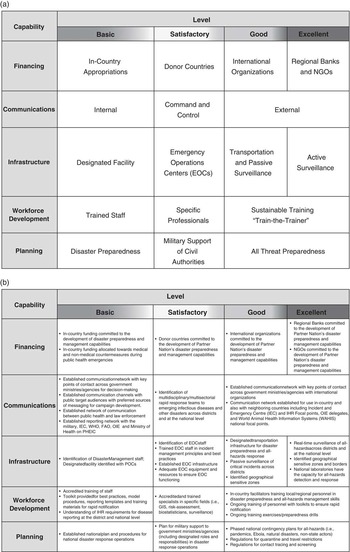
As a part of WADPI, each country also underwent a DMCA devised by CGHE from multiple data sets for whole-of-government preparedness systems. The DMCA collected data and country-specific relevant information from 3 sources: (1) a thorough literature review of assorted data sets, (2) an anonymous self-assessment survey, and (3) information obtained through in-person interviews of key informants, such as disaster management agency leadership and military leadership. The objectives of the DMCA were to help improve disaster management capabilities, to include preparedness and response strategies/systems, and to identify strengths and gaps within the following areas: planning, workforce development, financing, communications, and infrastructure. An overview of the topics contained in the DMCA are in Figure 1.
Disaster Management Capability Analysis Topic and Grading Criteria. Abbreviations: EOC, Emergency Operation Center; FAO, Food and Agriculture Organization; IEC, Incident and Emergency Centre; IHR, International Health Regulations (2005); NGO, nongovernmental organization; OIE, World Organization for Animal Health; PHEIC, Public Health Emergencies of International Concern; POC, Point of Contact; WAHIS, World Animal Health Information Systems; WHO, World Health Organization.

The topic areas for the DMCA, in greater detail, were as follows:
-
A. Planning: Support the development of disaster contingency plans to include national all-hazards and disease-specific plans that designate roles and responsibilities for civilian and military entities alike during disaster response operations. Identify gaps in existing disaster preparedness capabilities and work toward development of a roadmap for filling those gaps utilizing both internal and external resources.
-
B. Workforce Development: Promote accredited training of disaster management staff and specialists (ie, GIS, risk-assessment analysts) including sustainable train-the-trainer programs. Conduct preparedness drills at the district and national levels to exercise disaster preparedness and response contingency plans.
-
C. Financing: Advance in-country, donor countries’, international organizations’, regional banks’, and nongovernmental organizations’ commitment for funding local, national, and regional disaster management capacity building activities.
-
D. Communications: Identify and foster use of critical communication linkages and reporting networks within the national government, disseminate key information to the general public, and maintain open channels of communication between PNs and their relevant regional and international stakeholders to strengthen coordination efforts for effective disaster management. Develop national and regional multi-sectorial communication plans within PN ministries and agencies, including the military, as well as among neighboring countries and regional multilateral institutions (ie, ECOWAS) for rapid response to disaster emergencies.
-
E. Infrastructure: Support the establishment of an in-country designated facility housing a national disaster management agency to include a functioning EOC, adequate logistical capabilities, as well as passive and active disease surveillance networks for rapid response to critical incidents at both the district and national levels.
The DMCA process was broken into multiple stages, including an initial literature review and an onsite self-evaluation. During self-evaluation, countries were asked to provide their views on existing capabilities in addition to the draft write-ups developed by the CGHE team.
Study team members then conducted interviews of key informants during awareness training at the Kofi Annan Peacekeeping Training Centre in Accra, Ghana, to collect additional information about each of the 5 identified capability areas. Areas of focus and criteria for evaluation are outlined in Figure 1 (list of criteria used in the DMCA). Each of the topic areas was rated as excellent, good, satisfactory, basic, or below basic. To be awarded a particular rating, participating countries had to attain all of the accomplishments in each of the categories before progressing to the next higher rating. A detailed description of the rating categories is provided in the table footnotes in the Results section. The final report for each PN includes a matrix of capability assessments, as well as report narratives identifying existing capacities, gaps, and challenges. The results of the assessment are intended to help guide disaster management implementation work in each PN in the long term.
RESULTS
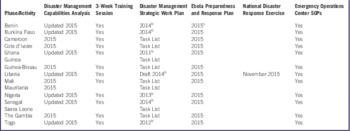
Over 800 people from 12 PNs were trained between 13 July and 20 November 2015. Participating nations included Benin, Burkina Faso, Cameroon, Cote d’Ivoire, The Gambia, Ghana, Guinea-Bissau, Liberia, Mali, Nigeria, Senegal, and Togo. In total, all 12 countries initiated or updated their DMCA, completed or revised a national Ebola Preparedness and Response Plan, and generated or reviewed a list of key tasks for their Disaster Management Strategic Work Plan. One country (Liberia) held a national to county-level disaster response exercise, and ECOWAS held its own independent tabletop exercise involving representatives from its participating member states and ECOWAS headquarters to test the lessons learned through WADPI (Table 1).
WADPI Accomplishments: 2015Footnote a

a Abbreviations: SOP, standard operating procedures; WADPI, West Africa Disaster Preparedness Initiative.
b Previously accomplished under the Disaster Preparedness Program (DPP).
c Updated; previously accomplished under the DPP.
Participants from PNs were 84% men and 16% women. Civilian personnel made up 88% of participants, and 12% of participants were military personnel. Facilitators for WADPI training consisted of predominantly personnel from African PNs, the majority of whom were previously engaged through steady-state Disaster Preparedness Program activities during the preceding 7 years. A complete summary of the Disaster Preparedness Program activities has been generated separately, which provided a basic framework and network of relationships for the current WADPI efforts (US Africa Command Disaster Preparedness Program, unpublished data, February 28, 2016).
In surveys administered during the bilateral engagements with each country, participants also made a number of recommendations for “next steps” in preparedness capacity building, such as development of a regional ECOWAS disaster plan, mobilizing resources to support member states’ national disaster management agencies, supporting the conduct of national risk mapping, and selecting liaison officers in all member states for more effective communication and coordination, among other recommendations.
WADPI data analysis culminated with the writing of after action reports for each of the 12 PNs. After action reports incorporated observations, challenges, and recommendations from both instructors and participants in the hope of assisting PNs to identify their needs moving forward. The after action reports also helped to provide WADPI implementing partners with the data needed to ensure any future training iterations or potential continuation of Disaster Preparedness Program/WADPI programming are optimized. These reports include the detailed DMCA for each PN designed to identify baseline capacities and areas to improve upon. In addition, each PN formulated and shared a prioritized Disaster Management Strategic Work Plan project list delineating its respective needs, capabilities, and areas for improvement.
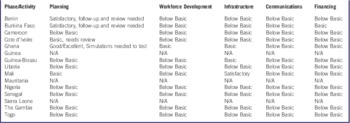
Highlights of the DMCAs are presented in Table 2. One of the countries assessed (Ghana) earned a “good/excellent” rating in the capability area of planning. Three nations (Benin, Burkina Faso, and Mali) earned a “satisfactory” rating in one of the capability areas. Five nations earned a “basic” rating in one or more of the capability areas (Burkina Faso, Cote d’Ivoire, Ghana, Guinea-Bissau, and Mali.) The remainder of the nations earned “below basic” capability ratings in all of the capability areas.
Disaster Management Capabilities Assessment (DMCA) Results: 2015Footnote a

a Results are current as of the time of the assessment, in June-August 2015.
Criteria for “Below Basic” Level: not all Basic Level indicators achieved.
Criteria for “Basic” Level: All required indicators at Basic Level achieved.
Criteria for “Satisfactory” Level: All Basic Level and all “Satisfactory” Level indicators met.
Criteria for “Good” Level: All previous level and all “Good” Level indicators met.
Criteria for “Excellent” Level: All previous level and all “Excellent” Level indicators met.
DISCUSSION
The efforts undertaken through WADPI may arguably be unprecedented in terms of their comprehensive nature and the scope and scale of preparedness training focus areas. Inter-ministerial participants and leaders from 12 nations united in a common goal to strengthen national and subregional capacities in disaster management and to implement an all-hazards, whole-of-government approach to disaster preparedness and response management. This effort intended to bolster a continuing regional collaboration and to enhance communication and coordination between ECOWAS member states, and beyond, in disaster preparedness and response.
In the aftermath of the Ebola outbreak, it was clear that the time for such a robust effort had indeed arrived, particularly given the extensive loss of life and the overall risk to global health security that such an outbreak presented to the international community. The collective response to Ebola in West Africa has been criticized as “too little, too late,” and the WHO has advocated for urgent change in rebuilding and strengthening both national and international emergency preparedness and response in the region.Reference Sanders, Sengupta and Scott 22 Across West Africa, a realization has emerged that the Ebola crisis has provided an unprecedented opportunity to achieve progress on long-standing weaknesses in health systems.Reference Nyarko, Goldfrank, Ogedegbe, Soghoian, de-Graft Aikins and d-Graft Aikins 23
Additionally, the WADPI efforts are in direct support of one of the tasks in the United Nations’ Sustainable Development Goal 3, “Strengthen the capacity of all countries, in particular developing countries, for early warning, risk reduction and management of national and global health risks.” 24 The WADPI efforts are further significant in that they directly support a number of the Global Targets identified in the Sendai Framework for Disaster Risk Reduction. These targets include “Substantially increase the number of countries with national and local disaster risk reduction strategies by 2020” and “Substantially enhance international cooperation to developing countries through adequate and sustainable support to complement their national actions for implementation of the present Framework by 2030.”Reference Sanders, Sengupta and Scott 22 The WADPI efforts are also notable in that they are supportive of the priorities and “action packages” identified by the GHSA. It is clear that the work undertaken by WADPI is well integrated with existing key international guidance and has served to support progress toward these critical and high-priority areas. The work of WADPI not only provides critical assistance in disaster preparedness and response, but also enhances the overall health and development of populations across West Africa.
Some of the major strengths in participating countries included Ghana’s planning capacity. A 2014 cholera outbreak had already spurred Ghanaian government authorities to action in the realm of planning for infectious disease outbreak, in addition to fears about the Ebola crisis.Reference Nyarko, Goldfrank, Ogedegbe, Soghoian, de-Graft Aikins and d-Graft Aikins 23 Ghana’s leadership role as host for major WADPI activities and prior experience in hospital surveys on disaster preparedness also laid the groundwork for some of its successes in planning.Reference Norman, Aikins, Binka and Nyarko 25
Ghana’s National Disaster Management Organization has identified potential disasters and the associated risks of each, allowing the program to better tailor resource needs, requests, and priorities to specific emergency management situations. Their planning program has also created an integrated approach for risk reduction and takes into account international best practices for hazard monitoring, risk assessment, and forecasting. Ghana’s armed forces have a unit specifically designated for disaster response activities. Ghana has also identified 13 hazards within its National Disaster Plan: fire, pest and insect infestation, disease and epidemics, hydro-meteorological hazards, geological hazards, nuclear and radiological hazards, ethnic conflict, war, aviation and maritime accidents, pollution of water bodies, industrial accidents, structural collapse, and oil spillage. Regulations for quarantine and travel restrictions for Ebola virus disease are in place, among many other strengths. Planning is still needed that is applicable to regional and district levels, as well as simulations and exercises to test the plans, surveillance tools, and a full risk and hazard vulnerability assessment.
Benin and Burkina Faso also demonstrated “satisfactory” planning capacity. Benin has a range of preparedness plans, including those for pandemic influenza and for military support to civil authorities. It was unclear if any preparedness drills had been conducted to test the contingency plans, however. Benin has started to develop an SOP for implementing exit screening in the event of a confirmed Ebola case and has begun to equip points of entry with immediate access to equipment and supplies. Benin has completed contact tracing guidelines and SOPs and has disseminated them to the national and subnational level and has trained subdistrict and community level staff on contact tracing. Burkina Faso has completed a national Pandemic Preparedness and Response Plan, and has ensured that contingency plans are in place at designated points of entry, as well as SOPs to safely identify, manage, and refer suspect cases from points of entry to designated hospitals or isolation facilities. The Burkina Faso government has also identified trained teams to detect, assess, and correctly manage potential Ebola cases, among many other planning accomplishments.
The nation of Mali achieved a “satisfactory” rating in infrastructure, having established a national EOC that is supported by UNICEF, WHO, the International Organization for Migration, the International Federation of Red Cross and Red Crescent Societies, and other international organizations, although there are still some improvements to be made. Some work has also been accomplished toward the establishment of EOC personnel at the district and regional level for coordination and management. Coherent plans and procedures for coordination and incident management to include liaison between the health EOC and national disaster management structures have been accomplished as well.
The capability area of communications appeared problematic in all of the participating nations; no individual nation achieved a rating greater than “below basic.” Financing and workforce development also appeared to be areas needing improvement, with only one nation in each of these categories attaining higher than a “below basic” rating.
Although a number of areas for improvement were identified in the DMCAs, there were importantly also numerous areas of strengths that are not completely reflected in the very basic outline of information in Table 2. Many of the nations interviewed for the DMCAs had significant accomplishments in each of the capability areas (basic/satisfactory/excellent, etc), but may not have achieved all of the required activities to earn the next highest “rating” in that particular area. Thus, the relatively stringent grading scheme of the WADPI DMCA’s does not entirely reflect all of the strengths of the participating nations. For example, the nation of Mali has accomplished many of the objectives in the next higher category of “good” in the evaluation category of Infrastructure, but since all objectives were not met, the highest rating according to the DMCA schema that could be obtained in the category was “satisfactory.” A further analysis of each country’s strengths and weaknesses in greater detail will be provided in future reports and analyses of these efforts.
To consolidate the lessons learned during the WADPI training and assessment efforts, in November 2015, WADPI coordinated a 2-week, exhaustive exercise focused on interoperability of national and county-level disaster management entities in Liberia. Further, ECOWAS conducted a separate exercise in November involving its member states to improve and enhance the lessons learned from the WADPI training collectively for their subregion of responsibility. Given the many accomplishments of WADPI, ECOWAS is now positioned to take a lead role in this initiative with the hope of creating an opportunity for this regional entity to undertake longer-term sustainable engagements with PNs and to promote regional collaboration.
Limitations
One limitation of this study was that the assessment process predominantly consisted of data generated from interviews. However, the interview data gathered were generally believable, given that most nations did not fare entirely well in most assessment areas; if bias among the interviewees existed, it may arguably not have been significant. There was also limited availability of open-source data for the teams involved in DMCA data collection. Some authors have criticized the involvement of militaries or security agendas in communicable disease assistance measures, arguing that such efforts interfere or dominate what should be purely a humanitarian action.Reference Calain and Abu Sa’Da 26 Acknowledging this point, it is important to appreciate the necessity of “humanitarian space” when dictated by international law. One may also note that security interests have driven global health engagement for decades. Even the WHO and Médecins Sans Frontières have acknowledged that security interests may have a significant role to play in preventing and managing future epidemics—while carefully following the dictates of international law and treaties.Reference Calain 27 , 28 Militaries also bring significant resources and infrastructure to assist in emergency situations.
Owing to the robust and comprehensive nature of the data collected for this effort, a detailed description of each country’s strengths and weaknesses is not feasible in a single article. As a result, a number of future reports of each participating country’s attainments and gaps in preparedness are planned based on the information gathered from the above activities. The situation of each country that participated in these efforts is constantly evolving, and the above report is only a “snapshot” of their current state in time as of the collection of the data and the writing of this report. Further, efforts to refine and improve preparedness in each of the PNs is ongoing.
CONCLUSION
The sizable benefits of WADPI training and engagements included establishment of Ebola response plans in 12 West African nations, the training of over 800 personnel, development of operating procedures for national-level EOCs, and perhaps most uniquely, involvement of ECOWAS to begin assuming a regional leadership role to further manage and facilitate a “way forward” for the initiatives begun by WADPI. WADPI served to strengthen the health and stability of the nations involved and has provided a framework and example for disaster management development initiatives throughout the African continent and globally. With regard to the tenets of the GHSA, the WADPI programming enhanced health security across an entire subregion of the African continent, having focused on activities that expanded workforce capacities and improved national-level emergency management systems. Applying the knowledge and skills acquired through the WADPI training, PNs will now arguably have the ability to demonstrate improved interoperability of preparedness and response systems, particularly as they relate to inter-ministerial roles and responsibilities in future large-scale crises. As well, plans for further development to address newly recognized gaps are now in place, pursuant to ongoing investment in capacity building.
Although more than 10 years have passed since the development of the Hyogo Framework for Action, disasters continue to erode efforts to achieve sustainable development. 29 , Reference Mochizuki, Mechler, Hochrainer-Stigler, Keating and Williges 30 Initiatives such as WADPI can work to reverse this trend, to strengthen overall global health security, and serve as a bridge and facilitator of such sustainable development in some of the world’s most vulnerable nations.
Acknowledgments
Overseas Humanitarian, Disaster, and Civic Aid (OHDACA) Funding.