/l/-vocalization, a process by which a lateral approximant [l] is replaced by a vowel or glide, is a common phenomenon in the languages of the world. Most often, the substituting vowel is a high back vowel [u] or high front vowel [i]. Depending on the language and/or dialect, /l/-vocalization is phonologically conditioned, sensitive to sociolinguistic constraints, and can be witnessed synchronically and developmentally. It is, for example, widely reported in child-language (e.g., Gnanadesikan, Reference Gnanadesikan, Kager, Pater and Zonneveld2004; Pater, Reference Pater1997; Smith, Reference Smith1973; Stampe, Reference Stampe1979). Synchronically it can be found in a wide range of the world's languages, including Germanic languages such as Dutch (cf. Jongkind & van Reenen, Reference Jongkind, van Reenen and Timuska2007; van Reenen & Jongkind, Reference van Reenen and Jongkind2000), English (United States, cf. Ash, Reference Ash1982; Durian, Reference Durian2008; McElhinny, Reference McElhinny1999; England, cf. Johnson & Britain, Reference Johnson and Britain2007; Trudgill, Reference Trudgill1986; Wells, Reference Wells1982; Wright, Reference Wright1989; Scotland, cf. Stuart-Smith, Timmins, & Tweedie, Reference Stuart-Smith, Timmins and Tweedie2006; Timmins, Tweedie, & Stuart-Smith, Reference Timmins, Tweedie and Stuart-Smith2004; Australia and New Zealand, cf. Borowsky, Reference Borowsky, Blair and Collins2001; Borowsky & Horvath, Reference Borowsky, Horvath, Hinskens, van Hout and Wetzels1997; Horvath & Horvath, Reference Horvath and Horvath1997, Reference Horvath and Horvath2001, Reference Horvath and Horvath2002, Reference Horvath and Horvath2003), and dialects of German. The largest geographically contiguous area of vocalization in German is found in western Swiss German (cf. Christen, Reference Christen1988, Reference Christen2001; Haas, Reference Haas and Bausinger1973, Reference Haas, Besch, Knoop, Putschke and Wiegand1983; Matter & Ender, Reference Matter and Ender2006). By means of a large-scale multilocality investigation, the current study aims to determine whether the vocalization of /l/ to [u] in Swiss German (SwG) shows evidence of ongoing change in progress.
Switzerland boasts a diverse linguistic landscape with four national languages and, in the German-speaking part, a diglossic situation with Standard German as the H variety and numerous SwG dialects serving the role of L varieties: Standard German is used predominantly in writing and SwG dialects in speaking (cf. Werlen, Reference Werlen2004). SwG dialects are, nevertheless, prestige varieties in Switzerland and are met with high approval in society (cf. Christen, Reference Christen, Anders, Hundt and Lasch2010; Hotzenköcherle, Reference Hotzenköcherle, Bigler and Schläpfer1984; Sieber & Sitta, Reference Sieber and Sitta1986). SwG is spoken on an everyday basis by roughly 4.5 million speakers (about 65% of the Swiss population, cf. Bundesamt für Statistik, 2005). Standard German is used mainly in the written form. SwG dialects are commonly associated with the corresponding canton (i.e., administrative region), of which there are 19 where SwG is spoken.
There is a long-standing tradition of dialectological research in Switzerland. The Linguistic Atlas of German-Speaking Switzerland (Sprachatlas der deutschen Schweiz, 1962–2003, SDS for short), one of the most significant works on SwG dialectology, documents the daily use of SwG dialects in the middle of the 20th century. Data for the SDS were mainly collected in the 1950s, covering phonetic, phonological, morphological, and lexical variation in well over 500 communities of German-speaking Switzerland (cf. Hotzenköcherle, Reference Hotzenköcherle1962). Among other features, the SDS includes the most recent large-scale geographical study of the vocalization of /l/ to [u], a phenomenon typically associated with Bernese SwG (i.e., western Switzerland). The German word Salz ‘salt’, for example, is articulated as [ ɑ
 ts] in an area encircling the northern part of the Canton of Bern, southern Solothurn, southwestern Aargau, most of Luzern, and the eastern part of the Canton of Fribourg (cf. Figure 3, area colored in light gray). Aside from the SDS, research on /l/-vocalization to date has focused on isolated individual locations or regions. It is reported, however, that /l/-vocalization is subject to change in progress and seems to be expanding geographically toward the west, the southeast, as well as central Switzerland (cf. Christen, Reference Christen1988, Reference Christen2001; Haas, Reference Haas, Besch, Knoop, Putschke and Wiegand1983, Reference Haas, Schindler and Untermann1989; Matter & Ender, Reference Matter and Ender2006; Piller, Reference Piller1997).
What is the geographical distribution of /l/-vocalization today? Will we soon be hearing [ɑts] in Zürich (i.e., eastern Switzerland)? We conducted a large-scale multilocality study to assess the articulation of /l/ in 10 words covering five different phonological contexts. Data were collected in 20 localities situated relatively near to and around the region of vocalization indicated by the SDS. If /l/-vocalization has had the hypothesized success in SwG dialects, we would expect it to potentially expand in all directions, and we thus chose our research sites to reflect this.
Variability of the rule
Previous research on /l/-vocalization in SwG reports that this variable rule is conditioned by the phonological context in which the /l/ occurs, as well as the regional origins and socioeconomic status of the speaker (cf. Christen, Reference Christen2001).
Phonological context
There are different phonological contexts in which /l/ can be vocalized to [u] in SwG (cf. Haas, Reference Haas, Besch, Knoop, Putschke and Wiegand1983).
1. /l/ following a vowel and preceding a consonant: VLC, for example, in ‘salt’ Salz [
 ɑts]
2. /l/ following a vowel and preceding a word boundary: VL#, for example, in ‘valley’ Tal [tɑː
]3. /l/ following a consonant: syllabic /l/, for example, in ‘bird’ Vogel [ˈ
ɔu]4. intervocalic and geminated /l/: VLLV, for example, in ‘plate’ Teller [ˈtæ
ər]5. /l/ between two vowels: VLV, for example, in ‘sole’ Sohle [ˈ
ɔə]6. /l/ following a word boundary (with a possible consonant onset) and preceding a vowel: #(C)LV, for example, in ‘believe’ glauben [ˈ
ɔə]


Haas (Reference Haas, Besch, Knoop, Putschke and Wiegand1983) proposed that this list forms an implicational scale (Rickford, Reference Rickford, Chambers, Trudgill and Schilling-Estes2002), one that reflects different stages of the change in progress (cf. Christen, Reference Christen1988). If a dialect applies vocalization variably, people are more likely to vocalize in the contexts higher in the scale, and less in contexts lower in the scale. Different studies report somewhat different scales. In Interlaken, for example, vocalization is only reported in context 1 (VLC, cf. Matter & Ender, Reference Matter and Ender2006), whereas other dialects allegedly only vocalize in contexts 1 to 3; context 5 (VLV) applies to restricted areas only, and context 6 (#(C)LV) seems no longer to be operative (albeit attested in Baumgartner, Reference Baumgartner1940).
Geographical distribution
Diachronically, Baumgartner (Reference Baumgartner1940:74) hypothesizes that /l/-vocalization in SwG dialects geographically originated in the Emmental, evidence of which has been attested before the 18th century (cf. Christen, Reference Christen1988:13–14). /l/-vocalization seems to have expanded beyond the Emmental from the 19th century onward (cf. Haas, Reference Haas and Bausinger1973), spreading from the countryside of the Cantons of Bern and Aargau to the towns, especially to the city of Bern, where it was successfully adopted in the 20th century. From there, it allegedly spread further. The strong linguistic influence of Bern on the surrounding regions and on towns like Thun, Burgdorf, Biel/Bienne, and even beyond cantonal borders (Fribourg, Solothurn, Aarau, Olten, Luzern) is attested in Baumgartner (Reference Baumgartner1940:101) and corroborated by Siebenhaar (Reference Siebenhaar and Krefeld2008). Consequently, for some of these localities, a sound change in the articulation of /l/ is the result. This linguistic influence of Bern collides, however, with the linguistic influence of Basel in the north and Zürich in the east: /l/-vocalization is a phenomenon found particularly in western dialects. Synchronically, both the SDS and more recent studies highlight the juxtaposition of vocalized, lateral, as well as velarized variants of /l/ within individual locations, individual speakers, and individual phonological contexts, as potential predictors of sound change in apparent time (Labov, Reference Labov1972). Current studies have documented different frequencies of vocalization in areas outside the region attested by the SDS, namely in the Cantons of Luzern (cf. Christen, Reference Christen1988), Fribourg (cf. Piller, Reference Piller1997), Nidwalden, Uri (cf. Christen, Reference Christen2001), as well as in Spiez in the Canton of Bern (cf. Flury, Reference Flury2002; Matter & Ender, Reference Matter and Ender2006).
Social distribution
According to Baumgartner (Reference Baumgartner1940), Haas (Reference Haas and Bausinger1973), and Siebenhaar (Reference Siebenhaar, Siebenhaar and Stäheli2000), /l/-vocalization shows social differentiation. Vocalized /l/ has been described as a variant used by urban speakers from lower socioeconomic classes or by rural speakers. In the cities, vocalized /l/ used to be perceived as unaesthetic, rural, and urban lower class. In the countryside, on the other hand, lateral /l/ was perceived as affected and belonging to the urban higher classes (cf. Haas, Reference Haas and Bausinger1973). Baumgartner (Reference Baumgartner1940:21) pointed out, however, that this distribution was unstable. Speakers from higher socioeconomic classes abandoned their realizations of /l/ and vocalized when conversing with people from lower socioeconomic classes. In addition, he noted a change in the social distribution of the vocalized variant in the city of Bern: around 1880 to 1890, only a few children were reported to vocalize /l/, whereas by 1940, most middle-class children in Bern did so. More recently, Haas (Reference Haas, Besch, Knoop, Putschke and Wiegand1983) suggested that the lateral /l/ is still, nevertheless, perceived as more cultivated. Age also plays a role in the distribution of vocalized variants: /l/-vocalization seems to predominate among younger informants, who are socially and geographically more mobile (cf. Haas, Reference Haas and Bausinger1973; Matter & Ender, Reference Matter and Ender2006). This, too, points toward sound change in apparent time (cf. Haas, Reference Haas, Schindler and Untermann1989; Labov, Reference Labov1994; Matter & Ender, Reference Matter and Ender2006). The opposite seems to be the case in Christen's (Reference Christen1988) rural community, in which younger speakers from Knutwil vocalize less than older people do. Her urban data from Luzern, however, do not pattern analogously.
Reasons for the diffusion of /l/-vocalization in Swiss German
Aside from phonological, geographical, and social constraints, other reasons have been proposed for the changes in /l/-vocalization in SwG dialects. These include the use of /l/-vocalization as an identity marker, sociological and cultural factors, and causes encompassing ease of production and perceptual salience.
Some might argue that /l/-vocalization could be expanding because the use of vocalized variants may serve as a means to signal greater linguistic distance from Standard German (cf. Christen, Reference Christen2001). Therefore, /l/-vocalization might, in this scenario, represent a marker of dialectal identity.
From a sociological and cultural viewpoint, the literature has proposed a range of other factors allegedly contributing to the diffusion of /l/-vocalization. These include, first, claims that increased personal mobility in Switzerland may have contributed to its spread (cf. Baumgartner, Reference Baumgartner1940; Wolfensberger, Reference Wolfensberger1967). A second reportedly influential factor is the emergence of radio and television media (cf. Christen, Reference Christen1998) with a high proportion of programs broadcast in SwG dialects (Siebenhaar & Wyler, Reference Siebenhaar and Wyler1997). Bernese SwG enjoys highly positive connotations across Switzerland (Ris, Reference Ris1979; Werlen, Reference Werlen and Werlen1985) and television broadcasts in dialect more often than not feature natives of this variety, thereby both legitimizing it and presenting it in a highly favorable way.
Other argumentation comes from the angle of speech production and perception. It has been claimed, for example, within the framework of natural phonology, that the vocalization of /l/ to [u] is promoted by the fact that [u] is very close to velarized /l/ in terms of its articulation (cf. Christen, Reference Christen1988:7–9; Dieth, Reference Dieth1950:197; Grammont, Reference Grammont1933; Haas, Reference Haas, Besch, Knoop, Putschke and Wiegand1983). Velarized /l/ is considered a preliminary stage toward complete vocalization to [u]. This is likely to be the case in SwG dialects, where the SDS shows this preliminary velarization stage in a number of places surrounding the area of vocalization (see Velarization by location; cf. Christen, Reference Christen1988; Haas, Reference Haas, Besch, Knoop, Putschke and Wiegand1983; Ohala, Reference Ohala, Bruck, Fox and Galy1974). Aside from these claims about the role of speech production, sound change may also be triggered for speech perception reasons. Velarized /l/ and [u] are perceptually very similar, too. Ohala (Reference Ohala, Bruck, Fox and Galy1974) shows that lateral and velarized /l/ are very close to [u] when plotted in the F1/F2 space; this in turn may lead to misperceptions on the part of the listener (cf. von Essen, Reference von Essen, Abercrombie, Fry, MacCarthy, Scott and Trim1964), misperceptions that may subsequently trigger misproductions. If these misproductions are then incorporated into the grammar of the community, we have sound change in the making.
Predictions
In the introduction, it was stated that /l/-vocalization may theoretically spread in all directions equally. Given the preceding literature review, however, we formulate the following predictions:
• Considering far-reaching geographical mobility in Switzerland, we expect vocalized forms to be adopted in communities where people travel to and from Bern or to and from regions where /l/-vocalization has been longest established (cf. North, Reference North and Viereck1985). This would affect the Bernese Oberland, for instance, which has become popular for people working in Bern as an attractive place with cheaper rent.
• There are, however, other strong cultural and economic (and thus also linguistic, cf. Ris, Reference Ris1979) centers in Switzerland. One may assume that /l/-vocalization expands in all directions until it reaches a “linguistic radius” stemming from metropolitan areas such as Zürich or Basel (cf. Ris, Reference Ris1979; Siebenhaar, Reference Siebenhaar, Siebenhaar and Stäheli2000; see Trudgill, Reference Trudgill1974, for a similar claim about the limits of diffusion in British English).
• In localities where the SDS reported velarized /l/, we predict sound change to move faster. This would typically affect central Switzerland and the Bernese Oberland.
Methodological rationale
In the present study, we worked with a methodological framework similar to that applied in rapid anonymous surveys (cf. Dodsworth, Reference Dodsworth2005; Durian, Reference Durian2007, Reference Durian2008; Labov, Reference Labov1972; Starks, Reference Starks, Paradis, Vincent, Deshaies and Laforest1998). We collected data from 689 subjects in 20 different localities situated just beyond the borders of the historically recorded /l/-vocalizing area (cf. SDS). Participants were presented with phrases to complete or pictures to label—both of which contained the target tokens in a range of different phonological environments, enabling us to thereby test for linguistic constraints on vocalization. The analysis is based on on-the-spot auditory coding and relies partially on subjective assessments of the additional characteristics of the speakers (age and sex). This method, which is similar to that used in Horvath and Horvath's (Reference Horvath and Horvath1997, Reference Horvath and Horvath2001, Reference Horvath and Horvath2002, Reference Horvath and Horvath2003) work on the vocalization of /l/ in Australian and New Zealand English, therefore, allows for a quick and anonymous elicitation of the distribution of the variant in question.
A caveat worth noting in the context of our perceptual coding is that /l/-vocalization is a challenging variable to measure consistently because coding decisions tend to vary among multiple coders (cf. Hall-Lew & Fix, Reference Hall-Lew and Fix2012; McElhinny, Reference McElhinny1999). An alternative would be to complement the auditory analysis with acoustic analyses. However, acoustic measures are typically not used because velarized /l/, which can readily vocalize, is difficult to distinguish from a back rounded vowel using acoustic measurements alone (cf. Hall-Lew & Fix, Reference Hall-Lew and Fix2012; Ohala, Reference Ohala, Bruck, Fox and Galy1974). For illustration purposes, Figure 1 presents spectrograms of a typical /l/-vocalizer articulating the word Salz ‘salt’ in three different realizations (panels A, B, and C): [l], [ƚ], and [u]. Panels D and E show full realizations of the vowel [u] as in tuusche ‘to swap’ and [ʊ] as in tusche ‘swapped’, which are both phonemic in many western SwG dialects.
Realizations of [sɑlts] (A), [sɑɫts] (B), [sɑts] (C), [tuːʃə] (D), and [tʊʃə] (E).

Figure 1 indicates that the lateral articulation in panel A exhibits a much higher F2 (1868 Hz) than its velarized variant in panel B (860 Hz); this trend has also been confirmed in a cross-language study by Recasens (Reference Recasens2012). Furthermore, vocalized /l/ (panel C) is acoustically very similar (F2 = 825 Hz) to its velarized variant (panel B) (F2 = 860 Hz); both variants feature a drop in F2 compared to the lateral articulation (panel A). Only the formant transitions in the vocalized variant (panel C) seem to be more abrupt than in the velarized variant (panel B). Also, vocalized /l/ (panel C) is acoustically very similar to [u] (panel D) (F2 = 820 Hz) and [ʊ] (panel E) (F2 = 974 Hz).
Localities
The localities where data were elicited were primarily motivated by the data in the SDS. Localities that were already captured as vocalizing in the SDS were not resampled. Localities in areas that the SDS had shown were vulnerable to change—because of their proximity to vocalizing areas—were deliberately selected. We intentionally selected more localities in central Switzerland (i.e., Altdorf, Freienbach, Glarus, Hünenberg, Luzern, Sarnen, Schwyz, Stans, and Zug) because SDS maps that captured /l/ quality showed extensive velarization in this area (these maps are: Himmel ‘sky’, syllabic /l/, SDS vol. II, map 150; Kelle ‘ladle’, VLLV, SDS vol. II, map 197; Strääl ‘comb’, VL#, SDS vol. II, map 149; and Teller ‘plate’, VLLV, SDS vol. II, map 198). Central Swiss localities velarize in nearly all of the words covered by the SDS maps documenting /l/-realization. It should be noted that the SDS did not cover Interlaken and Baden, which is why we worked with the localities in closest proximity, that is, Unterseen for Interlaken and Birmenstorf for Baden.
Subjects
As regards the subjects, the study, as is the case with most rapid anonymous surveys, aims at capturing a snapshot of the current linguistic situation, regardless of whether the speakers have lived in one specific location for their entire life, whether their parents have lived in that locality without having moved, etc. The subjects were merely asked if they spoke the local dialect. If they answered yes, we proceeded with the survey; if they said no, we informed them that we could not continue with the survey, bade farewell to them, and subsequently approached other subjects. We chose subjects from different age groups, because the potential synchronic coexistence of different variants of a variable in different age groups might point toward (diachronic) sound change in apparent time (cf. Gauchat, Reference Gauchat1905; Labov, Reference Labov1994).
Tokens
The criteria for the selection of tokens were primarily based on the ones used in the studies by Matter and Ender (Reference Matter and Ender2006) and Christen (Reference Christen2001), which allows for direct cross-comparisons of the results. Five different phonological contexts were investigated. A further criterion for token selection was previous inclusion in the SDS, thus allowing for comparative analyses in real time. At this point, it should be noted that we were not able, in the current study, to fully explore every potential phonological constraint on the vocalization of /l/. A systematic analysis of the influence of specific preceding or following vowels or consonants might have yielded further insights concerning the favoring or hindering contexts of vocalization (cf. Christen, Reference Christen1988; Horvath & Horvath, Reference Horvath and Horvath2003; Johnson & Britain, Reference Johnson and Britain2007; McElhinny, Reference McElhinny1999). Christen (Reference Christen1988:7) claimed that preceding [o] or following alveolar consonants particularly favor phonological contexts for /l/-vocalization in SwG, for instance.
MATERIALS AND METHODS
Localities
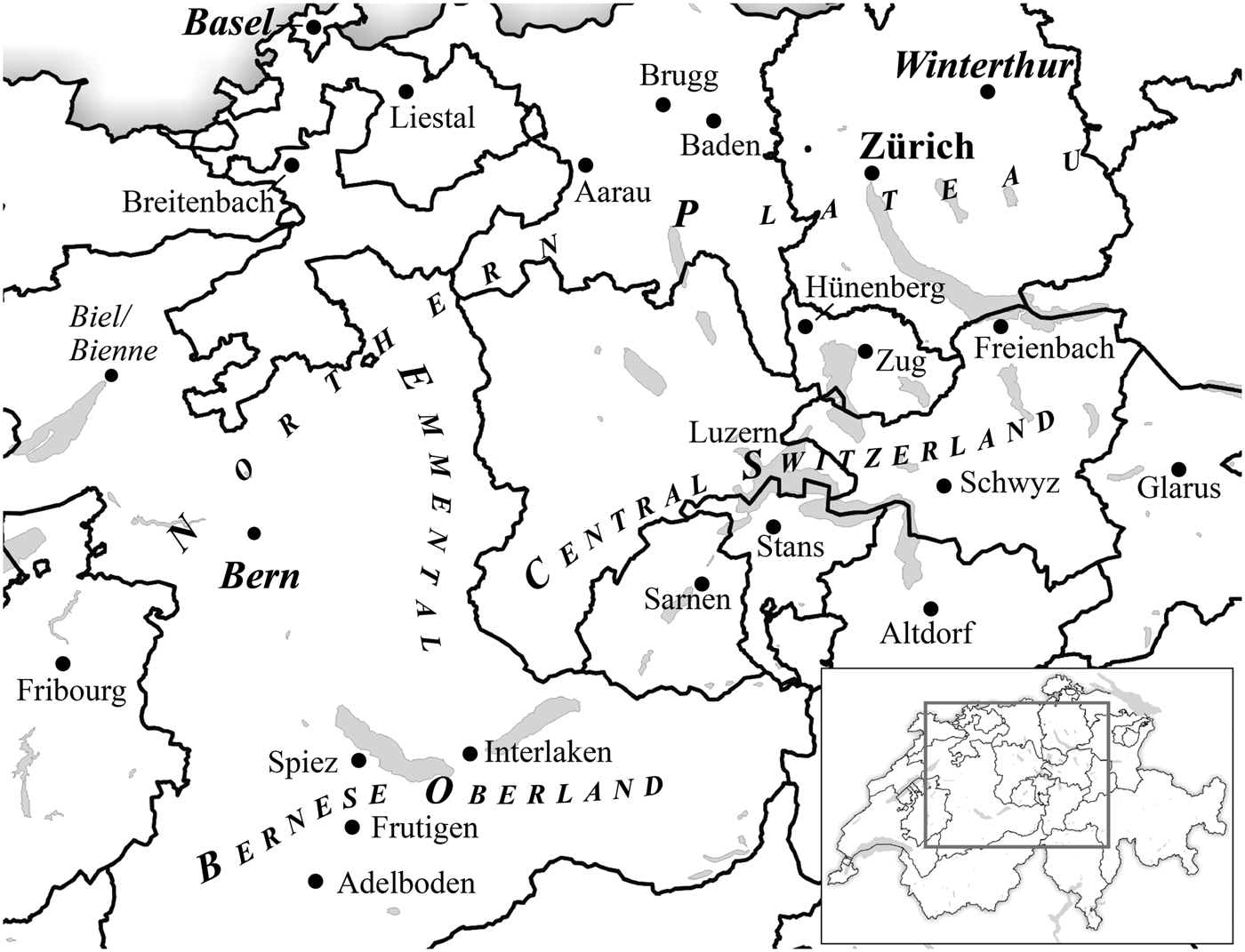
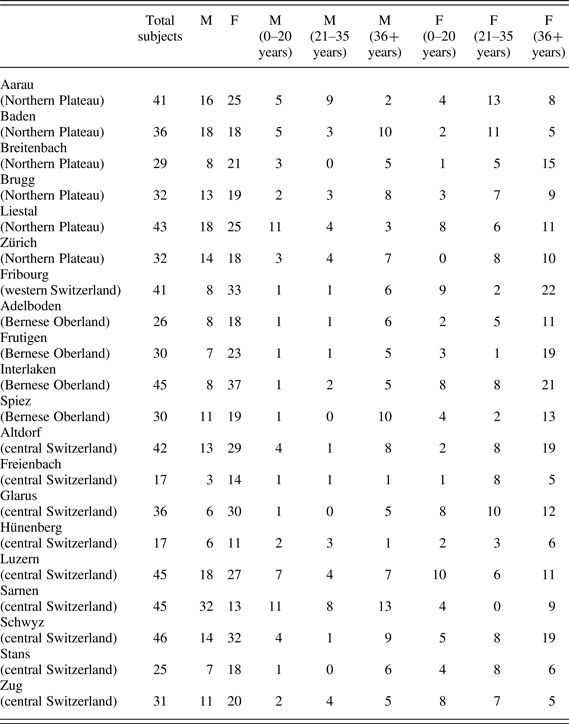
Table 1 illustrates the number of speakers by locality, gender (M = male, F = female), and age. Note that the city of Fribourg is bilingual: about one third of the inhabitants speak German, and two thirds speak French. The map shown in Figure 2 displays the localities in which we elicited data, corresponding to Table 1. Cities with over 30,000 inhabitants that were not included in our sample appear in italics. Cities with over 100,000 inhabitants appear in bold. Regions as described throughout the present study are printed in small capitals.
Map displaying the localities presented in Table 1.
Number of speakers by locality (ordered by region), gender, and age
Data elicitation
Eight phonetically trained researchers (first and second authors included) took part in the data collection process. Three of the researchers vocalize themselves to a high degree. One researcher only vocalizes for certain words and phonological contexts. It has previously been reported that listeners' dialects as well as their associations with the dialect they are coding can have a significant influence on their perception of speech (cf. Hay & Drager, Reference Hay and Drager2010). To avoid such effects, we had our coders collect data in those regions where they originally came from. All coders participated in a training session where lateral, velar, and vocalized variants of all tokens used in the study were produced by all coders and subsequently assessed until mutual consensus was reached.
Local grocery stores were sought out, in front of which the field workers approached passers-by with the questionnaire (see Appendix). If the candidates fulfilled the requirements, that is, they claimed to speak the local dialect, the field workers proceeded with the questionnaire. The subjects were asked to provide the missing word at the end of the sample phrase that was delivered to them orally in SwG. This missing word was the token in question (see Appendix and example (1) below). The sample phrases were spontaneously articulated in SwG by the field workers.
(1) Auf einem Esstisch hat es normalerweise Pfeffer und . . . ? (Salz)
‘On a dinner table one usually finds pepper and . . . ?’ (‘salt’)
For 4 of the 10 tokens, we resorted to pictures that depicted the target tokens, because we felt the item may be too abstract to elicit consistently with sample phrases. The subjects were asked to name the object in the picture (see Appendix) and the field workers noted down whether the articulation was lateral, velarized, or vocalized.
Subjects
In the present study, we elicited data from 689 subjects (450 females, 239 males). Age was estimated based on the following categories: up to 20 years (n = 155), 21 to 35 (n = 178), 36 to 64 (n = 235), and 65+ (n = 121).
Phonological contexts
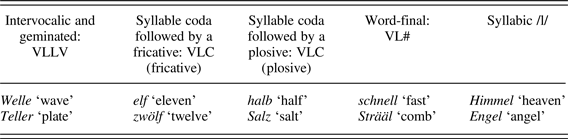
/l/s in the following phonological contexts were elicited (two tokens per phonological context), see Table 2. The intervocalic and geminated, syllable coda with fricative, syllable coda with plosive, and word-final tokens are partially based on Matter and Ender (Reference Matter and Ender2006), the tokens for syllabic /l/ are partially adopted from Christen (Reference Christen2001). A total of 6890 occurrences of the target variable were collected (689 subjects × 10 tokens).
Elicited tokens according to phonological context (two tokens per context)
RESULTS
Vocalization by location
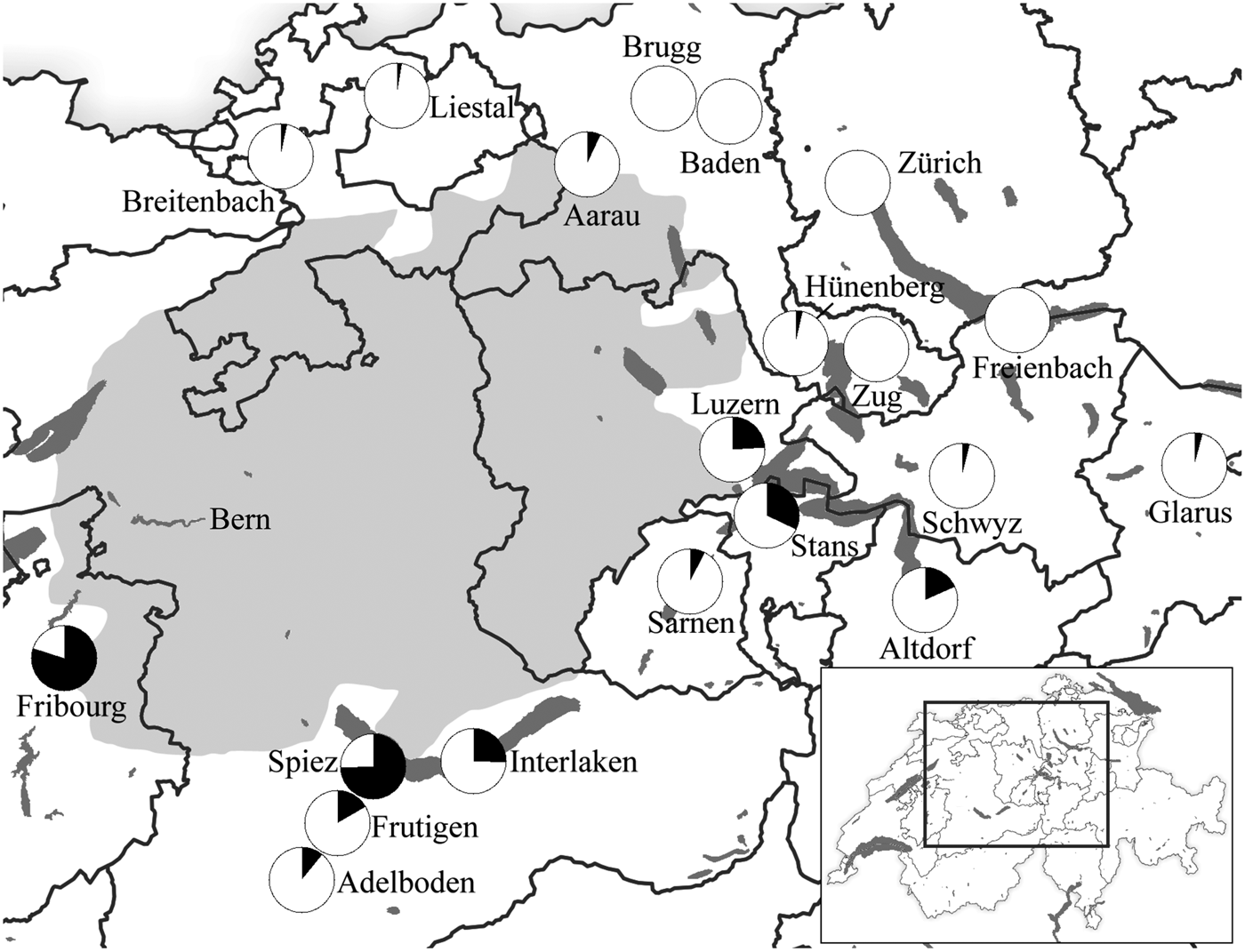
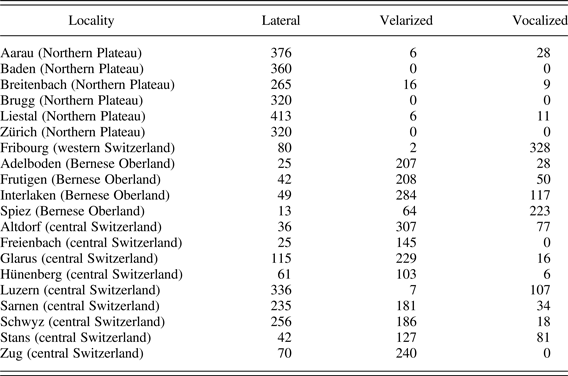
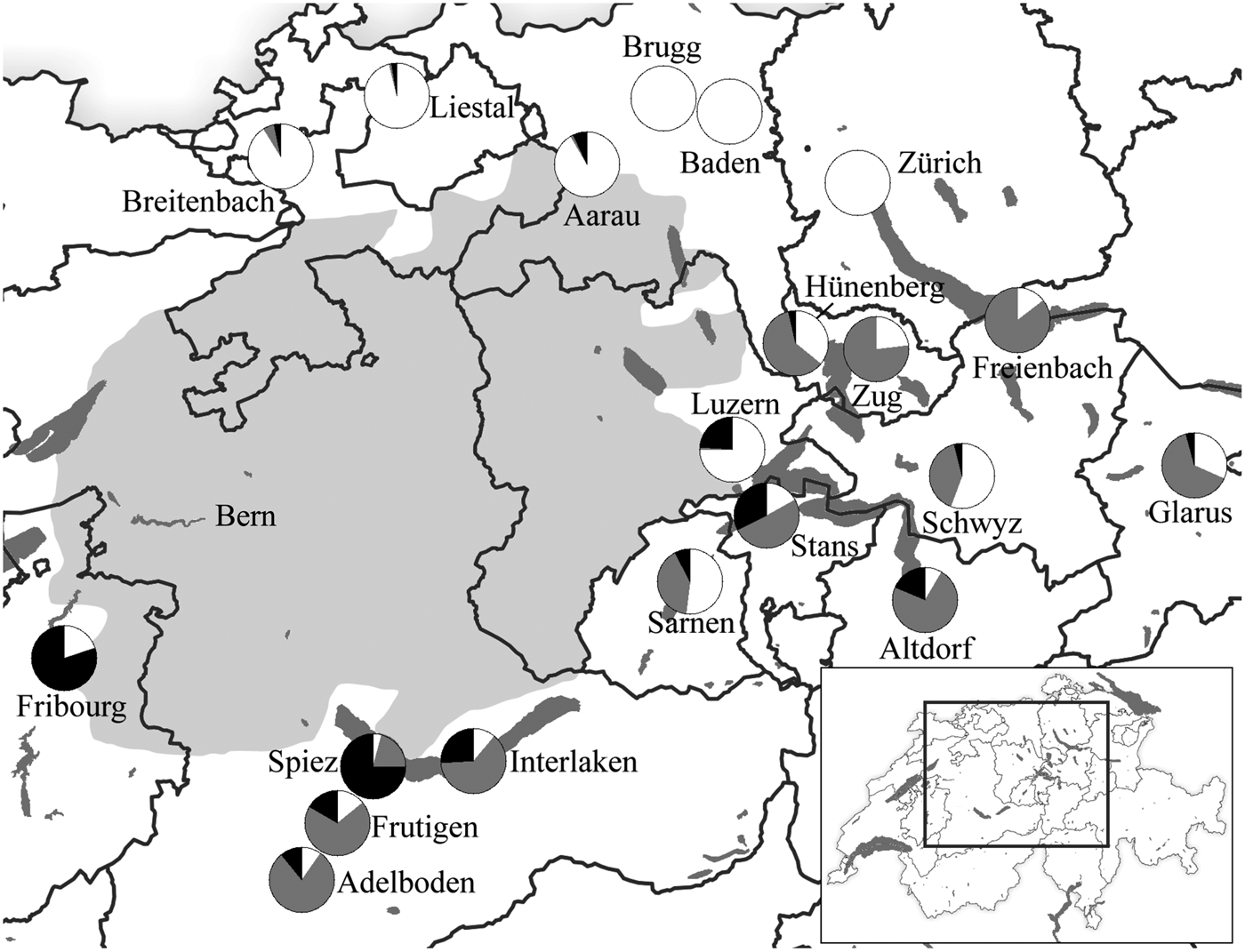
Table 3 presents the raw scores for each locality based on the total number of occurrences of lateral, velarized, and vocalized realizations in the data. Based on the data presented in Table 3, Figure 3 depicts the distribution of /l/-vocalization by location for each of the 20 localities. There are two levels—vocalized (black) and nonvocalized (white)—and the latter category includes all lateral and velarized articulations per locality.
/l/-vocalization by location. Each circle depicts one of the 20 localities of elicitation. Black indicates vocalization in the current study, white indicates nonvocalized realizations. The large light gray area around Bern indicates the area of vocalization in the position VLC (plosive) according to the SDS (i.e., as elicited in the 1940s and 1950s; cf. SDS vol. II, map 66, ‘salt’).
Lateral, velarized, and vocalized realizations for each locality, ordered by region (10 tokens per subject)
The results reported here are interesting for a number of reasons. According to the SDS, any locality outside the demarcated light gray area (i.e., nearly all of the selected 20 localities of the current study) was documented as nonvocalized, in other words, lateral or velar. Fribourg showed vocalization in the SDS maps for ‘salt’ and ‘milk’ but in no other SDS maps that captured /l/-realization. The study at hand shows a different picture: almost no change has taken place in the Northern Plateau (with the exception of a few vocalized tokens in Aarau, 7%). A number of central Swiss localities (Stans: 32%; Luzern: 24%; Altdorf: 18%; Sarnen: 7.5%) indicate evidence for sound change in progress. The most convincing evidence is found in the Bernese Oberland, with Spiez now vocalizing 75%, Interlaken 26%, Frutigen 17%, and Adelboden 11%. In Western Switzerland (i.e., Fribourg), the change seems to be close to completion (80%).
Vocalization by phonological context
Based on the data shown in Table 3, Table 4 compares the distribution of /l/-realizations across phonological contexts; results from all 20 locations and 689 subjects are pooled. Table 4 reveals that VLC (plosive), VLC (fricative), and syllabic /l/ overall show nearly identical degrees of vocalization (n = 273, 268, and 265, respectively). Vocalized /l/s are found most frequently in syllables that end with a plosive (20%; halb ‘half’, Salz ‘salt’) or with a fricative (19%; elf ‘eleven’, zwölf ‘twelve’) and in syllabic /l/s (19%; Himmel ‘sky’, Engel ‘angel’). Vocalization is second least frequent in nonsyllabic /l/s in word-final position (15%; schnell ‘fast’, Strääl ‘comb’). Intervocalic and geminated contexts (8%; Welle ‘wave’, Teller ‘plate’) are least favored for /l/ to [u] vocalization. It is, furthermore, interesting to observe that the degree of velarization by phonological context is nearly analogous in its ranking to that of vocalization: with VLC (plosive) and VLC (fricative) showing the greatest number of velarized tokens (492 and 490, respectively) and VLLV as well as VL# contexts exhibiting fewest velarizations (442 and 439, respectively). From this distribution, we derive the following implicational scale of /l/-vocalization according to phonological context—likelihood of vocalization in descending order:
1. VLC (plosive)
2. VLC (fricative)
3. Syllabic /l/
4. VL#
5. VLLV
This constraint pattern will be discussed in more detail in the Discussion section.
Realization of /l/ across phonological contexts
Note: Values in parentheses are counts.
Vocalization by phonological context and location
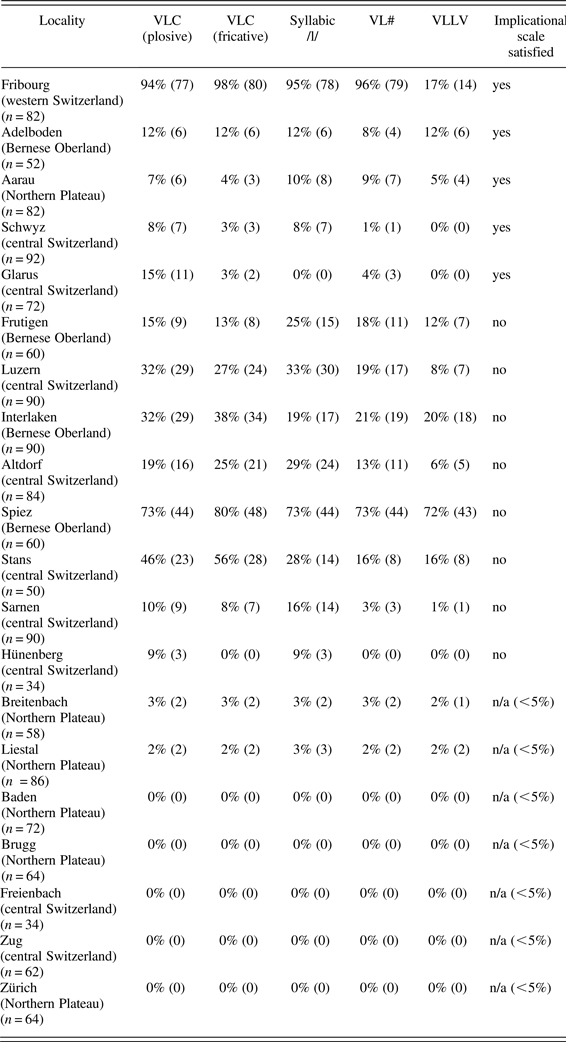
Here, we further analyze vocalization by context and location. The data shown in parentheses in Table 5 represent the raw number of vocalized tokens across phonological contexts (horizontal) and localities (vertical). Based on these absolute values, we calculated the relative number of vocalized tokens across phonological contexts, also shown in Table 5 (nonbracketed numbers). One way of assessing the extent to which constraint hierarchies on vocalization apply consistently and universally across the localities under investigation is by means of an implicational scale. Such a scale, in this case, therefore, enables us both to test the generality of the VLC (plosive) > VLC (fricative) > syllabic /l/ > VL# > VLLV hierarchy and to highlight in which localities and in which phonological environments this hierarchy does or does not hold. The implicational scale given in Table 5 was constructed according to the following principlesFootnote 1: Degrees of vocalization that are below 5% are disregarded from the implicational scaling. To allow for some minor deviations among the precise percentage figures in Table 5, we decided to work with a 5% tolerance level. We examined each cell and compared it with the cell to its left. Only if the proportion of vocalization in the cell being examined was more than 5 percentage points higher than the cell to its left do we consider the implicational scale presented in Vocalization by phonological context to have been violated.Footnote 2
Vocalized /l/-tokens across phonological contexts (horizontal) and localities (vertical)
Note: In parentheses: absolute numbers of vocalized /l/-tokens across phonological contexts (horizontal) and localities (vertical). These numbers exclude velarized tokens. Not in parentheses: Relative numbers of vocalized /l/-tokens across phonological contexts (horizontal) and localities (vertical). Localities are ordered according to their satisfaction of the earlier proposed implicational scale. Percentage values below 5% were disregarded from violation testing. Differences greater than 5% violate the implicational scale.
We find strong evidence in the implicational scaling that regions differ as to their preference for vocalization depending on the phonological context (cf. Table 5). The overall hierarchy holds true for five localities (Fribourg, Adelboden, Aarau, Schwyz, and Glarus). For eight other localities, we find a deviation from the proposed implicational scale (Frutigen, Luzern, Interlaken, Altdorf, Spiez, Stans, Sarnen, Hünenberg). For most central Swiss localities (except for Glarus and Stans), we found that syllabic /l/ was the context most favorable for vocalization, whereas in many other localities syllabic /l/ exhibits a nearly equal proportion of vocalizations to those found in VLC (plosive) contexts. Results further revealed that for Bernese Oberland localities, there is little evidence that vocalization is more prominent in VLC (plosive) contexts than in VLC (fricative) contexts. Moreover, the data from Adelboden suggest that phonological context does not necessarily have an effect on the change in progress. Overall, we observe that VLLV is almost consistently (except for Aarau, Interlaken, and Adelboden) the context least favorable to vocalization for those that vocalize more than at the 5% level.
Vocalization by age
Further analyses revealed an effect of age in the articulation of /l/. We performed a chi-square test of independence to test for differences in the relative proportions of vocalized and nonvocalized realizations between three pooled age groups (up to 20, 21 to 35, and 36+ years). The test revealed significant differences between the three age groups (χ 2(20, 689) = 43.3, p = .002). The youngest speaker group vocalizes less than the speaker groups for ages 21 to 35 and 36+ years. Moreover, in Fribourg, all age groups seem to pattern analogously (nearly fully vocalized), which may point to the fact that the described sound change has essentially been completed in this area.
Velarization by location
The distribution of velarized variants, as an intermediate stage to vocalization, is depicted in Figure 4. Figure 4 shows that lateral variants are overall most common (50%, n = 3439), followed by velarized (34%, n = 2318), and vocalized variants (16%, n = 1133) (cf. Table 4) (three levels: vocalized [black], velarized [dark gray], lateral [white]). Table 4 shows that these relative proportions are present in all of the five phonological contexts investigated. The results obtained show that velarization is present from the Bernese Alps through to central Switzerland. We find the following distribution: Freienbach velarizes the most (85%), followed by Adelboden (80%), Zug (77%), Altdorf (73%), and Frutigen (70%). We do not find velarization in the Northern Plateau and western Switzerland.
Velarization by location. Black indicates vocalization, dark gray velarization, and white lateral articulation.
DISCUSSION
The results of the present study indicate that /l/-vocalization in SwG shows evidence of diffusion. In this section, the major findings of the present study are placed in a broader sociolinguistic and geolinguistic context. Based on this discussion, possible causes for this sound change in progress are addressed.
Vocalization by location
The results indicated that it is primarily three regions that exhibit vocalization to different degrees: western Switzerland (Fribourg), the Bernese Oberland (Spiez, Interlaken, Frutigen, Adelboden), and central Switzerland (Altdorf, Glarus, Hünenberg, Luzern, Sarnen, Schwyz, Stans). The Northern Plateau shows almost no vocalized tokens. Let us look at these regions in more detail.
Western Switzerland (Fribourg)
In Fribourg, the change is close to completion (overall degree of vocalization: 80%). This is an astonishing finding, because, according to the SDS, Fribourg did not exhibit vocalized variants except in the map for the words ‘salt’ (SDS vol. II, map 66), shown in Figure 3 (the light gray area) and ‘milk’ (SDS vol. I, map 165). In the other SDS maps, which also cover realizations of /l/ (Himmel ‘sky,’ SDS vol. II, map 150; Kelle ‘ladle,’ SDS vol. II, map 197; Strääl ‘comb,’ SDS vol. II, map 149; and Teller ‘plate,’ SDS vol. II, map 198), subjects from Fribourg either used a lateral (Teller) or velarized realization (Himmel, Strääl). A more recent study shows a similar trend; Piller (Reference Piller1997) reported extensive vocalization in Fribourg: roughly 50% of her subjects vocalized.
Bernese Oberland
Our current data from the Bernese Oberland shows that /l/-vocalization has primarily spread to this region: Spiez (75% vocalization), Interlaken (26%), Frutigen (17%), and Adelboden (11%). Here, the change is most apparent. A comparison of these findings with the SDS data is quite telling: the more velarized the variants documented in the SDS for these localities, the higher the degree of vocalization of these localities in our data. Interlaken is peculiar in this respect, however, as it shows all lateral realizations—no velarizations—in the SDS maps. Our data report a vocalization score of 26%. Mass tourism may explain this phenomenon. Today, Interlaken is one of the most popular tourist destinations in Switzerland and is a focal point for local retail and transport services for the eastern Bernese Oberland. When the SDS was compiled, however, Interlaken was a comparatively secluded place. Once mass tourism began, Interlaken became more attractive to work in—it also now has excellent train connections to Bern—thus, many people from the surroundings might have brought their Bern-flavored vocalizing dialect to Interlaken. It may well be that the German-speaking inhabitants of Fribourg and the inhabitants of the Bernese Oberland orientate themselves linguistically toward Bernese SwG, which is known to be a dialect with high prestige (Ris, Reference Ris and Hugger1992; Werlen, Reference Werlen and Werlen1985) exerting a powerful influence on neighboring dialects (Siebenhaar, Reference Siebenhaar and Krefeld2008).
Central Switzerland
In central Switzerland, hardly any of the localities of elicitation in the SDS showed vocalization among speakers born around 1900. It is only in Hünenberg that we find instances of vocalization for Himmel. In all other localities (Altdorf, Glarus, Luzern, Sarnen, Schwyz, Stans), velarized variants clearly dominate. According to our data, there seems to be a trend toward vocalization in central Switzerland also, albeit to a smaller degree than in the Bernese Oberland, as some of these velarized variants are now vocalized. The finding that vocalization has expanded toward central Switzerland is not new; Christen (Reference Christen2001) found vocalization for Altdorf as well as for Wolfenschiessen (south of Stans). The latter is reported to exhibit particularly distinctive levels of vocalization, on average 76% in VLC, VL#, syllabic /l/, as well as VLLV contexts. Christen's (Reference Christen2001) one speaker from Altdorf showed 16% vocalization for all of these phonological contexts. In rural Luzern, and in the city itself, Christen (Reference Christen1988) reported 84% and 28% vocalizations, respectively. The vocalized tokens in our data for Stans are not as frequent as the ones reported by Christen (Reference Christen2001), though the ones for the city of Luzern as well as those for Altdorf are largely in line with her findings.
The Northern Plateau
A further interesting finding is that in Switzerland's Northern Plateau (from Breitenbach to Freienbach), we find virtually no vocalization at all. So while our findings indicate that /l/-vocalization is diffusing, it only seems to be making progress toward the west, the south, and southeast. Isoglosses in the Plateau seem to be very stable. Only in Aarau do we encounter the odd token of vocalization—Aarau lies in the zone of vulnerability according to the SDS (particularly on the ‘salt’ map, cf. SDS vol. II, map 66). Thus, the global conclusion postulated by Christen (Reference Christen2001), that /l/-vocalization is expanding in German-speaking Switzerland, needs to be qualified. It is spreading, but only to certain areas. /l/-vocalization seems to be absent in the Northern Plateau and particularly in the Cantons of Aargau and Zürich. This contrasting geolinguistic pattern may be explained by the fact that the culturally and economically leading centers in German-speaking Switzerland, Bern, Basel, and Zürich, have a considerable linguistic impact on their respective hinterlands too. In the case of this particular linguistic variable, Bern diverges markedly, from the other two cities, leaving a sharp isogloss separating the zone of influence of Bern from that of Basel and Zürich (cf. Baumgartner, Reference Baumgartner1940; Ris, Reference Ris1979; Siebenhaar, Reference Siebenhaar and Krefeld2008). Note that the SDS, surprisingly, documented velarized variants for some of the Plateau localities: Aarau, Baden, Breitenbach, Brugg, Liestal—though not for Zürich. Our data do not reflect this realization at all (see Velarization by location).
At this point we are not in a position to state conclusively why—for these localities—we obtain this discrepancy between velarized realizations reported in the SDS and lateral realizations in the present rapid anonymous study. The velarized variants reported in the SDS for western Switzerland, the Bernese Oberland, and for central Switzerland and their relative increase in vocalization in the present data suggest that velarization is a precursor to vocalization. The data for Aarau, Baden, Breitenbach, Brugg, and Liestal reported in the SDS seem to be anomalous in this respect, however.
Summary
/l/-vocalization originated in the Emmental, in the rural area between Bern and Luzern. Today it is a robust and salient characteristic of the nation's capital city, as well as its hinterland. Despite originally being relatively stigmatized in urban areas, it was diffused to Bern by servants and traders traveling to the city markets and by migrants who worked as domestic staff for rich Bernese families (cf. Baumgartner, Reference Baumgartner1940). From these mobile working-class speakers from the Emmental, vocalization diffused to Bernese speakers of higher social classes. Having spread westward to Bern, it also spread eastward toward the city of Luzern in central Switzerland—Bern and Luzern are connected to each other by the valleys of the Emmental and the Entlebuch.
By the beginning of the 20th century, as evidenced by the SDS, vocalization was well entrenched at least among traditional dialect speakers in both Bern and its hinterland—the dominant cultural hearth of western German-speaking Switzerland. Subsequent surveys (e.g., Siebenhaar, Reference Siebenhaar and Krefeld2008) have demonstrated the ongoing linguistic, social, and geographical penetration of this cultural hearth in this area.
In our contemporary data, we can now observe wavelike diffusion from this cultural hearth—Bern—in two directions: toward Fribourg, to the west (to the point where it reaches the linguistic border with French-speaking Switzerland) where change is nearly completed, and toward the Bernese Oberland, a more mountainous area to the south. Locations in the south feature less vocalization, the further they are from Bern. Excellent public transport and road networks as well as cheaper housing have made this region particularly attractive for those who commute to work in Bern. This is especially true for Spiez. Our findings also point to some diffusion from Luzern and nearby Stans in central Switzerland (to Altdorf, Glarus, Hünenberg, Sarnen, Schwyz). Vocalization does not, however, seem to be spreading toward the northern or eastern parts of German-speaking Switzerland. We assume here that vocalization has reached, and been hindered by, the zones of linguistic influence of the cities of Basel and Zürich.
We have, then, a convincing case of initial contra-hierarchical linguistic diffusion—the diffusion of a linguistic innovation from rural to urban rather than the usual reverse. Although there have been many studies highlighting the urban hierarchical nature of linguistic innovation diffusion (e.g., Kerswill, Reference Kerswill, Britain and Cheshire2003; Labov, Reference Labov, Britain and Cheshire2003; Trudgill, Reference Trudgill1974, Reference Trudgill1983), whereby innovations spread from cities to other cities, and down through a hierarchy of ever smaller settlements, few studies show this process operating in the reverse direction. Perhaps the best described is Bailey, Wikle, Tillery, and Sand's (Reference Bailey, Wikle, Tillery and Sand1993) (see also Wikle & Bailey, Reference Wikle and Bailey1997) examination of the diffusion of fixin' to (‘getting ready to’, ‘be about to’) in Oklahoma in the United States. They showed that among respondents born before 1945, it is in three noncontiguous rural areas where fixin' to is used most. Among those born after World War II, fixin' to use has increased everywhere and the sharp rural-urban differences of the earlier generation have become less marked, but the geolinguistic patterns nevertheless still show a clear contra-hierarchical trend—the less populated areas have most instances of fixin' to (Bailey et al., Reference Bailey, Wikle, Tillery and Sand1993:373). Wikle and Bailey (Reference Wikle and Bailey1997:9) proposed demographic explanations for the direction of this spread—rural to urban migrations in the post–World War I period, and an identity-based use of local rural forms reacting to the arrival of migrants from outside the region. The diffusion of /l/-vocalization to Bern from the Emmental took place a century before the similar contra-hierarchical diffusion of fixin' to in Oklahoma. The longer term outcome in both cases of diffusion, however, is that the formerly rural variant has come to dominate both city and country in the region (cf. Bailey et al., Reference Bailey, Wikle, Tillery and Sand1993:373, Figure 12).
Vocalization in and around Bern is now spreading further, suggesting that the kind of cultural hearth diffusion proposed by Horvath and Horvath (Reference Horvath and Horvath1997, Reference Horvath and Horvath2003) for vocalization in Australian English is also in play here. They propose such a model because the diffusion of vocalization in Australia does not follow the perhaps expected urban hierarchy (with Sydney and/or Melbourne leading, and the rest of the country following behind), but first established itself in both urban (Adelaide) and more rural parts (Mount Gambier) of South Australia, away from the supposedly more dynamic east coast of Victoria and New South Wales, before diffusing beyond. Horvath and Horvath (Reference Horvath and Horvath1997:120) suggested that South Australia is not a peripheral area, but label it one of “the most slowly growing parts of the older core.” Their data show that more rural Mount Gambier has slightly higher levels of vocalization than urban Adelaide does (Reference Horvath and Horvath2003:147). Our findings with respect to vocalization around Bern seem to very closely match the pattern found in Australia—the regional (urban and rural) embedding, within a geoculturally cohesive (but not necessarily demographically dominant) area, of a linguistic innovation that then expands beyond its original cultural hearth.
Vocalization by phonological context
To recapitulate, we obtained the following implicational scale of vocalization in our data:
1. VLC (plosive)
2. VLC (fricative)
3. Syllabic /l/
4. VL#
5. VLLV
Descriptive statistics revealed that the three most prominent contexts for vocalization VLC (plosive), VLC (fricative), and syllabic /l/ showed nearly identical degrees of vocalization. This scale is virtually identical to the one proposed by Haas (Reference Haas, Besch, Knoop, Putschke and Wiegand1983). He suggested that most vocalizations are found following a vowel and before a consonant (as in 1 and 2 of our scale)—the same trend is also reported by Piller (Reference Piller1997) for Fribourg and by Christen (Reference Christen2001) for Uri. Syllabic /l/-vocalization (as in 3 of our scale) occurs somewhat less frequently, whereas vocalizations in word-final positions (as in 4 of our scale) are even less frequent in our data. In Haas' (Reference Haas, Besch, Knoop, Putschke and Wiegand1983) implicational scale, however, vocalizations in VL# positions are more frequent than those in syllabic /l/ positions. Finally, our scale is congruent with that of Haas (Reference Haas, Besch, Knoop, Putschke and Wiegand1983), in that /l/ is vocalized least often in intervocalic and geminated contexts.
Vocalization by phonological context and location
Our results indicate that the regions differ in their degree of vocalization depending on which phonological context is being considered and our data, in accordance with Christen's findings (Reference Christen1988, Reference Christen2001), show that the scale postulated by Haas (Reference Haas, Besch, Knoop, Putschke and Wiegand1983) does not apply everywhere. Christen (Reference Christen2001) found the same constraint hierarchy as Haas (Reference Haas, Besch, Knoop, Putschke and Wiegand1983) for the dialect of Altdorf. Yet, her scale follows a different pattern for Nidwalden (VLC, VLLV, syllabic /l/, VL#), with yet a different pattern for the city of Luzern (with syllabic /l/ favoring vocalization most, followed by VLC, VL#, and VLLV) (Christen, Reference Christen1988). In the current study, the highest vocalization scores are obtained in VLC contexts for the majority of the localities, which is in line with the scale proposed by Haas (Reference Haas, Besch, Knoop, Putschke and Wiegand1983) and results by Christen (Reference Christen2001) for Uri and Nidwalden and by Matter and Ender (Reference Matter and Ender2006) for Spiez and Interlaken. It seems as though the VLC context is a particularly favorable one for vocalization in SwG.
Our data further show, however, that syllabic /l/ contexts reach comparatively high vocalization scores in central Switzerland, where syllabic /l/ often displays the same vocalization values as VLC contexts do. The finding that syllabic /l/ shows the highest vocalization scores in some localities in central Switzerland is in accordance with Christen's research (1988) in Luzern and Knutwil, and with the SDS, where vocalized syllabic /l/ covered the largest geographical area (cf. Christen, Reference Christen2001). Matter and Ender (Reference Matter and Ender2006) reported fewer vocalizations for syllabic /l/ than for VLC (fricative) contexts but more than for VLC (plosive). This may be the reason why our general implicational scale (see Vocalization by phonological context) deviates from that postulated by Haas (Reference Haas, Besch, Knoop, Putschke and Wiegand1983): syllabic /l/ seems to be particularly favored in central Swiss localities.Footnote 3 Several explanations can be brought forward for the instability of /l/ in this phonological context: first of all, syllabic /l/ has been shown to yield most occurrences of velarized /l/ in the SDS (vol. II, map 150; cf. Christen, Reference Christen1988:198–199). Second, Christen (Reference Christen1988:199) mentioned the articulatorily “weak” position of word-final syllabic /l/, compared to other occurrences of /l/. She argued that /l/-vocalization in syllabic /l/s is more salient than in other contexts. If syllabic /l/s are vocalized, the resulting syllable bears only [u] in its nucleus. In all of the other phonological contexts, except VLLV, however, the resulting [u] becomes part of a diphthong. Intervocalic and geminated /l/ is the phonological context least favored for vocalization in almost all localities that have been investigated. This is consistent with data from Christen (Reference Christen2001) for Luzern and Knutwil and Uri. However, in Nidwalden, the VLLV contexts show surprisingly high vocalization scores, being ranked second in the scale put forth by Christen (Reference Christen2001).
Aside from geographical reasons for these differences in scales, there may also be a partially methodological explanation. The different studies on /l/-vocalization in SwG dialects used different methods. Christen's (Reference Christen2001) study, for instance, is a single speaker study for the data from Altdorf. Matter and Ender (Reference Matter and Ender2006), as well as the present investigation, examined a large number of speakers in the context of a rapid anonymous survey, with the numbers of speakers greatly varying nevertheless between the two studies. Haas (Reference Haas, Besch, Knoop, Putschke and Wiegand1983) did not indicate, unfortunately, on what data he based his hierarchization.
But the dialectological literature tells us that we should not necessarily even expect to find similar constraint hierarchies in operation in cases of diffusion such as this. It has long been noted that diffusing linguistic innovations morph as they spread (e.g., Britain, Reference Britain2005, Reference Britain and Hickey2010; Trudgill, Reference Trudgill1986): (i) socially, by being differently sociologically embedded in the destination from in the source (witness, for example, the diffusion of the glottalization of /t/ from the Southeast of England, where it tends to be used most in informal styles and among working-class speakers, to Cardiff in Wales, where highest rates are found among middle-class women in more formal speech styles) (Mees & Collins, Reference Mees, Collins, Foulkes and Docherty1999); (ii) attitudinally, through evolutions in how innovations are evaluated; and (iii), importantly, linguistically, as innovations embed themselves into local grammars that often differ from one place to another. Labov (Reference Labov2007) showed how the diffusion of the complex New York system of short /a/ tensing to Northern New Jersey, Albany, Cincinnati, and New Orleans has led to subtle yet significant and, what is more, different changes in each. Importantly for our work here, two studies of /l/ vocalization from accents of English similarly show distinct constraint hierarchies emerging in different places. Horvath and Horvath (Reference Horvath and Horvath2003:157) found a subtle difference between Australian and New Zealand Englishes in vocalization levels in contexts of syllabic /l/. In Australian English, they found that a preceding labial in such contexts (e.g., in the word bubble) was the least favoring context for vocalization, whereas in New Zealand this was the most favorable environment, with levels of vocalization higher than where there was a preceding dorsal (e.g., pickle) or coronal (e.g., middle). Johnson and Britain (Reference Johnson and Britain2007), examining /l/ vocalization in Southern British English, not only showed how certain varieties have resisted vocalization because of the state of the preinnovation phonological system (e.g., in east Norfolk where /l/ has been “clear” in all phonological environments until very recently), but also, as in the Southern Hemisphere case described in Horvath and Horvath (Reference Horvath and Horvath2003), how different linguistic constraints operate in the different places that have adopted vocalization of /l/. Some places in Southern England, for example, strongly resist prevocalic vocalization, others permit it, although at lower rates than in other phonological environments (Johnson & Britain, Reference Johnson and Britain2007:310–311).
In our data we can see a variety of regional constraint hierarchies in operation. It must be noted that several of the locations in our study have relatively low levels of vocalization, and in these locations the range between most and least favorable environments is relatively small. But to the west, in Fribourg, for example, we see that while vocalization levels in most phonological environments are very high, there is a strong disfavoring of vocalization in intervocalic contexts. It is worth noting that Fribourg does not use a geminate in the word Welle, which is relatively uncharacteristic for a western SwG dialect. This in turn affects syllabification; /l/ then forms the onset of the second syllable and is therefore less likely to vocalize. However, Fribourg does use a (nonvocalized) geminate in Teller. To the south of Bern, and separated from Fribourg by both the Fribourgian pre-Alps and the Bernese Alps, the constraint patterns are somewhat different—the range between most and least favorable environments for vocalization is much smaller, and, on the whole and with the notable exception of Frutigen, VLC environments tend to favor vocalization. In central Switzerland, it is notable that vocalization in contexts of syllabic /l/ appears to be more favorably ranked as a conditioning environment than elsewhere—in Luzern, Sarnen, Hünenberg, Altdorf, and Schwyz it is the most favoring environment of all (though not in Stans and Glarus).
Nevertheless, further work is required to fully unpick the complex set of contextual constraints on vocalization in Swiss German.Footnote 4
Vocalization by age
Findings showed an age effect for /l/-vocalization. Overall results indicate that older people tend to vocalize more than younger people do. This finding is not intuitively sound: /l/-vocalization represents a novel sound change in these locations and one would expect younger participants to have adopted the sound change to a greater degree than older speakers, which according to Labov (Reference Labov1972) would be evidence for sound change in apparent time. This trend also is not consistent with the findings in Matter and Ender (Reference Matter and Ender2006) who showed that the younger the participants, the higher the degree of vocalization. Henzen (Reference Henzen1927), who described the dialect of the Sensebezirk (located between Bern and Fribourg), noted, too, that it is predominantly younger speakers who vocalize, whereas middle-aged and older speakers velarize their /l/s. This trend for the Sensebezirk was confirmed with more recent data by Piller (Reference Piller1997). The data in Christen (Reference Christen1988:131, 203–205) for Knutwil, (though not for Luzern), however, do show the same pattern as in our study; younger people vocalize less often.
If we look at the geographical patterning of the vocalization by age, we can determine the following pattern. Whereas in the south the discrepancies between the age groups do not seem very distinct or consistent, it is in central Switzerland where the middle and the oldest age group vocalize much more. It is also in central Switzerland where the SDS documented significantly more velarized forms than in the Bernese Oberland. The attested sound change may thus be older in central Switzerland than in the Bernese Oberland, which may explain why older people tend to vocalize more in central Switzerland.
Velarization
Velarization is present in numerous localities surrounding the area that the SDS shows as vocalizing. Our results revealed distinct velarization for Freienbach, Adelboden, Zug, Altdorf, and Frutigen. In these areas, at least two thirds of all tokens were velarized in our study. For Freienbach, Zug, and Altdorf, this finding is consistent with the data presented in the SDS, which also reports, for the most part, velarized variants for these localities. For the Bernese Oberland localities Adelboden and Frutigen, however, we observe a higher degree of velarization than the one documented in the SDS. The finding that—for every phonological context investigated—lateral realizations are most common followed by velarized and vocalized variants (cf. Table 4), is further evidence that velarization is a preliminary stage en route to vocalization. This points toward sound change in apparent time (cf. Labov, Reference Labov1972) and suggests that vocalization may well be the next step for the velarizing speakers in the preceding locations.
CONCLUSIONS AND OUTLOOK
By means of a rapid and anonymous survey, this study set out to find evidence for the diffusion of /l/-vocalization in SwG. One of the most significant findings to emerge from this study is that /l/-vocalization, having contra-hierarchically spread from rural Emmental to urban Bern and establishing itself robustly within the Bernese “cultural hearth,” is now spreading further in a wavelike fashion, particularly to the southwest, the south, and the southeast of German-speaking Switzerland, while appearing to be absent in the Northern Plateau. It was also shown that the degree of vocalization is contingent on the phonological context, which in turn interacts with the specific location under investigation, as Trudgill (Reference Trudgill1986) and Labov (Reference Labov2007) predicted in cases of dialect diffusion. The findings further suggest an effect for age on the degree of vocalization, with older people tending to vocalize more than younger people do, especially in central Switzerland. Finally, velarization, a preliminary stage en route to complete vocalization, was reported in the SDS for nearly all vocalizing localities (except for Interlaken); thus velarization is a frequent forerunner for vocalization.
Taken together, these findings only in part match the predictions made in the introduction. The omnipresence of oral and visual media in dialectal form, particularly in Bernese SwG (cf. Siebenhaar & Wyler, Reference Siebenhaar and Wyler1997), the strong desire to be maximally distinct from Standard German (cf. Christen, Reference Christen2001), the positive connotations associated with Bernese SwG (cf. Werlen, Reference Werlen and Werlen1985), as well as reasons grounded in speech articulatory and speech perception theory, led us to the hypothesis that /l/-vocalization had the potential to diffuse in all directions of German-speaking Switzerland. The results showed, however, that /l/-vocalization is spreading only to the southwest, the south, and the southeast into central Switzerland. Isoglosses in the Northern Plateau seem to remain stable. This finding corroborates the perseverance of what has been termed the Brünig-Napf-Reuss line—a long-standing linguistic but also cultural boundary between eastern and western Switzerland (Weiss, Reference Weiss1947; see Britain, Reference Britain, Watt and Llamas2014, for a discussion of the persistence of a similar boundary in Southern England). As mentioned earlier, there are other strong cultural and economic (and hence also linguistic) centers, aside from Bern, in Switzerland. /l/-vocalization appears to have expanded geographically across Bern's zone of influence until it reached that of Zürich in the east and that of Basel in the north and is, thus, at the boundary between the two, a case of arrested development (cf. Ris, Reference Ris1979). Time will tell whether, given the linguistic factors favoring vocalization, this Bernese innovation will ultimately be able to expand further beyond its current sphere of cultural influence.
APPENDIX
List of sample phrases for the elicitation of /l/ (a to f)
a. Surfen tut man auf einer . . . ? (Welle)
‘One does surfing on a . . . ? (wave)’
b. and c. Zählen Sie bitte von 10 bis 15! (zehn, elf, zwölf, dreizehn, vierzehn, fünfzehn)
‘Please count from 10 to 15! (ten, eleven, twelve, thirteen, fourteen, fifteen)’
d. Auf einem Esstisch hat's normalerweise Pfeffer und . . . ? (Salz)
‘On a dinner table one usually finds pepper and . . . ? (salt)’
e. Das Gegenteil von langsam? (schnell)
‘The opposite of slow? (fast)’
f. Das, was man hier oben sieht (in den Himmel zeigen) ist der . . . ? (Himmel)
‘This, what you see up here (point to the sky), is the . . . ? (sky)’
List of sample phrases with objects to be named from pictures (g to j)
g. Was ist das? (Engel)
‘What is this?’ (Show the picture of the angel.)
h. Was ist das? (Teller)
‘What is this?’ (Show the picture of the plate.)
i. Wie spät ist es hier? (halb elf)
‘What's the time here?’ (Show the picture of the clock.) (‘half past ten’)
j. Was ist das? (Strähl)
‘What is this?’ (Show the picture of the comb.)