1. Introduction
The development of tools that allow researchers to measure or intervene on phenomena is a crucial aspect of experimental practice across the natural sciences (Hacking Reference Hacking1983; Rheinberger Reference Rheinberger1997; Chang Reference Chang2004; Sullivan Reference Sullivan2009). But despite its centrality to the epistemology of experiment, most discussions of scientific change have emphasized theory change over technological change (Kuhn Reference Kuhn1970; Laudan Reference Laudan1977; Thagard Reference Thagard1992; Dellsen Reference Dellsén2018; but see Baird and Faust Reference Baird and Thomas1990).
Recently, Bickle (Reference Bickle2016, Reference Bickle2018) has taken issue with this emphasis and argued that tool development is a crucial driver of change in neuroscience. Bickle claims that tool-driven revolutions in neuroscience do not fit Kuhn’s theory-centered model of scientific revolutions (Bickle Reference Bickle2016, 2), that neuroscientists developed experiment tools relatively independently of theories (Bickle Reference Bickle2018, 1073), and that tool development “comes first”; it is the determining factor that shapes subsequent concept formation and other theorizing (Reference Bickleibid., 1077). A similar and more general view is defended by physicist Freeman Dyson, who argues that “in almost every branch of science … there has been a preponderance of tool-driven revolutions” (Dyson Reference Dyson1997, 51). Such tool-driven revolutions occur independently of concept-driven (Kuhnian) revolutions (Reference Dysonibid., 50; Dyson Reference Dyson1999, 13; Reference Dyson2012, 1426).
Bickle and Dyson suggest that tool-driven change primarily occurs independently from conceptual change. In this article, I look at cases from neuroscience to suggest an alternative view: tool development and concept formation are often intertwined during episodes of tool-driven change. Unlike Dyson (Reference Dyson1997) and Bickle (Reference Bickle2016), I am interested in episodes of scientific change regardless of whether they constitute scientific revolutions or are part of “normal” science.
To elaborate on the role that tools play in scientific change, I analyze how scientists use them in exploratory experiments. A defining negative characteristic of exploratory experiments is that they do not aim to test hypotheses—statements that are derived from a model or body of theoretical knowledge about the domain of inquiry (Giere et al. Reference Giere, Bickle and Mauldin2006, 26). Exploratory experiments use various strategies, such as varying many experimental parameters (Steinle Reference Steinle1997), combining experimental techniques (Burian Reference Burian1997), or applying high-throughput instruments (Franklin Reference Franklin2005). There is no agreed-upon positive characteristic that makes all these experimental strategies exploratory (Elliot Reference Elliot2007). Yet, philosophers of science concur that one important—though not the only—outcome of successful exploratory experiments is the formation of novel concepts (Steinle Reference Steinle1997; Feest Reference Feest, Steinle and Feest2012; Haueis Reference Haueis2014). Newly formed concepts constitute scientific change if they allow researchers to describe new discoveries and when they have a lasting epistemic impact on a field of inquiry.
In this article, I use case studies from neuroscience to develop an account of how researchers use exploratory experiments to form new concepts. On my exploratory concept formation account—hereafter the ECF account—scientists use experimental conditions and develop tools to operationally define the meaning and tentatively fix the reference of a concept. My account also provides normative resources to specify when exploratory concept formation succeeds or fails. Such normative resources are necessary to understand when newly formed concepts describe new discoveries appropriately and when they drive change by having a lasting epistemic impact on scientific practice.
While the ECF account includes tool development as an important element of change in neuroscience, it goes beyond the independence of tool development from conceptual change emphasized by Bickle (Reference Bickle2016, Reference Bickle2018). I instead argue that in many experiments that changed the course of neuroscience (including most of Bickle’s own examples), tool development and exploratory concept formation are intertwined. In my view, there is a common set of normative principles that governs when exploratory concept formation and tool development succeed (rather than fail) to initiate scientific change.
Although I focus on neuroscience, I think the ECF account can be extended to other disciplines where researchers form novel concepts by introducing operational definitions and experiment tools, such as molecular biology (Rheinberger Reference Rheinberger1997), physics (Chang Reference Chang2004), and cognitive psychology (Feest Reference Feest, Steinle and Feest2012). Applied to neuroscientific cases, the ECF account suggests a distinction between the role of new scientific concepts and existing theories that elucidates why tools rather than theories help scientists form novel concepts in exploratory experiments.Footnote 1 This distinction is relevant to the general debate about scientific change. While concept formation is often seen as belonging primarily to theory-driven change (Kuhn Reference Kuhn1970; Thagard Reference Thagard1992), the ECF account implies that concept formation also plays a crucial role in tool-driven change. The ECF account thereby enhances our general understanding of concept formation in experimental practice beyond existing accounts of tool-driven change (Rheinberger Reference Rheinberger1997; Chang Reference Chang2004).
This article proceeds by introducing the ECF account through two important cases of change in neuroscience: the formation of “bug detector” in electrophysiology and of “default mode” in neuroimaging (see section 2). Because neuroscientists had to develop new tools to operationally define these terms, concept formation and tool development are intertwined in individual exploratory experiments, which are part of larger tool-concept cycles (see section 3). These and other cases of tool development raise the question when an experiment succeeds rather than fails to initiate scientific change. I answer this question by sketching two normative principles of exploratory concept formation. These principles coincide with the characteristics of successful tool development in neuroscientific practice (see section 4).
2. The exploratory origin of concepts in neuroscience
2.1 The ECF account
According to the ECF account, researchers form a concept in an exploratory experiment by following the steps displayed in Table 1. I use these steps to analyze cases of exploratory concept formation in neuroscience, and as part of my answer to the normative question when experiments succeed or fail to initiate scientific change (see section 4.1).
Three steps of concept formation in the ECF account
| (C1) Meaning | (C2) Significance | (C3) Reference |
|---|---|---|
| Use experimental conditions to form operational definition | Compare experimental conditions to real-world conditions | Use tools to tentatively fix reference to entity or activity |
Experimental conditions in (C1) refer to the material and technical setup that allows scientists to measure or intervene in an experimental system (Rheinberger Reference Rheinberger1997, 29). In neuroscience, such conditions include stimulus or response variables used to produce or measure activities of neural entities (Sullivan Reference Sullivan2009, 509). These conditions are used to operationally define concepts that characterize the investigated entities or activities.
To assess the significance of an operational definition (C2), researchers compare experimental conditions to real-world conditions outside the laboratory. Neuroscientists are particularly concerned with functional significance, that is whether a concept adequately describes neural activity during unconstrained behavior of the organism. Generally, a concept is significant if it allows scientists to achieve an epistemic goal, such as describing, classifying, or explaining the entities or activities to which the concept refers (Haueis Reference Haueis2021).
Finally, tools are needed to set up the experimental conditions (C1) and to fix the reference of the concept (C3). The formation of “bug detector” and “default mode” were intertwined with the development of single-cell recordings of neuron’s receptive field properties and neuroimaging of functional brain activity. Both are tools that successfully changed neuroscientific practice (Bickle Reference Bickle2016, 2).Footnote 2 The introduction of “bug detector” in electrophysiology and of “default mode” in neuroimaging are thus important cases to understand tool-driven change in neuroscience. I focus on these cases to investigate the relationship between concept formation and tool development in neuroscience (see section 3.1).
Importantly, experiment tools involve both material devices and instructions of how to use them to achieve a specific experimental result (Colaço Reference Colaço2018, 8). Single-cell recording, for instance, instructs how researchers use microelectrodes to find a stimulus parameter that operationally defines a neuron’s “receptive field.” Thus, developing tools includes building material devices and specifying instructions of how to use them correctly. Providing such instructions is an important function of concepts in experimental practice (Feest Reference Feest, Steinle and Feest2012; Haueis Reference Haueis2021). The need for both devices and instructions thus suggests common norms of tool development and concept formation (see section 4.2).
The ECF account can be applied to different types of experiments discussed by philosophers of neuroscience. Some experiments identify previously unknown phenomenon (Silva et al. Reference Silva, Landreth and Bickle2014, 28–30, call these identity experiments). Other experiments stimulate a neural system to observe activities of entities within that system (Craver Reference Craver2007, 147, calls these activation experiments). Yet others excite or inhibit activities of entities to observe changes of the neural system (Reference Craveribid. calls these interference and stimulation experiments, respectively). This article applies the ECF account to an identity experiment (Raichle et al. Reference Raichle, Ann Mary MacLeod, Snyder, Powers and Shulman2001) and an activation experiment (Lettvin et al. Reference Lettvin, Humberto Maturana, McCulloch and Pitts1959). An example of exploratory concept formation using interference and stimulation experiments is “central pattern generator” (Wilson Reference Wilson1961), which is analyzed in Haueis (Reference Haueis2017, ch. 3). Rather than being restricted to one kind of experiment, exploratory concept formation seems widespread in neuroscientific practice.
2.2 The exploratory origin of “bug detector”
The formation of “bug detector” in the highly influential article “What the frog’s eye tells the frog’s brain” (Lettvin et al. Reference Lettvin, Humberto Maturana, McCulloch and Pitts1959) is regarded to be a major advance in understanding the neurophysiology of perception (Martin Reference Martin1994). This case presents a clear example of exploratory concept formation, and tool development played a prominent role in this episode of scientific change.
Lettvin et al. chose an exploratory strategy because they took the existing conceptual framework to be unreliable to formulate hypotheses about optic nerve function. Previously, electrophysiologists used small light spots as stimuli, which assumes that visual neurons respond to light-intensity changes in points of the visual field (Barlow Reference Barlow1953a, Reference Barlow1953b). But this assumption is anatomically implausible in the frog optic nerve and thus, “the laws found by using small spots of light on the retina may be true and yet, in a sense, be misleading” (Lettvin et al. Reference Lettvin, Humberto Maturana, McCulloch and Pitts1959, 1942).
Rather than falsifying previous theoretical hypotheses, the researchers sought to explore what stimuli are appropriate to understand what the frog nerve does:
We should present the frog with as wide a range of visible stimuli as we could, not only spots of light but things he would be disposed to eat, other things from which he would flee, sundry geometrical figures, stationary and moving about, etc. From the variety of stimuli we should then try to discover what common features were abstracted by whatever groups of fibers we could find in the optic nerve. (Lettvin et al. Reference Lettvin, Humberto Maturana, McCulloch and Pitts1959, 1942)
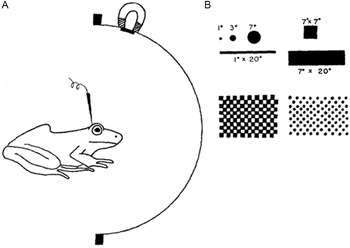
To explore optic nerve activity, the researchers placed microelectrodes in individual optic nerve fibers. For stimulation they used a dull black disk and other objects that could be moved with a magnet behind an aluminum hemisphere.
The experimental conditions shown in Figure 1 allowed the researchers to operationally define four fiber types: (i) sustained contrast detectors, (ii) convexity detectors, (iii) moving edge detectors, and (vi) net dimming detectors.
Experimental setup (A) and exemplary stimuli (B) used by Lettvin et al. (Reference Lettvin, Humberto Maturana, McCulloch and Pitts1959).
Adapted from Maturana et al. (Reference Maturana, Lettvin, McCulloch and Pitts1960). Permission to reprint granted by Rockefeller University Press.

“Convexity detector” operationally defines the bug detector concept. Lettvin et al. formed this operational definition by following the exploratory strategy of parameter variation (cf. Steinle Reference Steinle1997, S70). First, they varied many stimulus parameters, for example, size, shape, velocity, trajectory, and overall illumination intensity. Second, they distinguished indispensable from modifying parameters. Convexity was indispensable to excite type (ii) fibers whereas nonconvex shapes produced no response. By contrast, size was a modifying parameter: Convex stimuli smaller than 1° produced responses in some but not other contexts (Lettvin et al. Reference Lettvin, Humberto Maturana, McCulloch and Pitts1959, Fig. 3e–f). Third, the researchers formulated stable empirical rules about stimulus-response relationships. An exemplary rule would be that if a convex object enters the receptive field of a convexity detector, then it will fire as long as the object stays within the receptive field (cf. Reference Lettvin, Humberto Maturana, McCulloch and Pittsibid., 1945).
Fourth, the researchers searched for appropriate concepts to describe the entities in terms of the indispensable parameters (see section 4.1). Concepts like ON cells, ON-OFF cells, or OFF cells (Hartline Reference Hartline1938; Barlow Reference Barlow1953a, Reference Barlow1953b) were inappropriate to describe groups (i), (iii), and (iv) because light intensity changes were not indispensable to drive their responses. Because group (ii) fibers were previously unknown, “convexity detector” constituted a novel concept formed in this exploratory experiment. Fifth, the published reports contained the minimal experimental conditions for eliciting invariant responses from the four fiber types (Maturana et al. Reference Maturana, Lettvin, McCulloch and Pitts1960, 161; Lettvin et al. Reference Lettvin, Humberto Maturana, McCulloch, Pitts and Walter1961, 763). Because Lettvin et al. operationally defined “convexity detector” in terms of these experimental conditions, their experiment implements step (C1) of the ECF account.
The researchers next assessed the functional significance of their operational definitions. They compared the experimental conditions to real-world conditions in which convex shape detection is behaviorally relevant. For example, when a fly-sized object was moved in front of a photograph depicting a frog’s habitat, convexity detectors responded strongly, but remained silent when the photograph was moved. Lettvin et al. also assessed whether two other experimental conditions diminished ecological validity: (a) covering the frog with moist gauze to ensure a bodily rest position and (b) using the anesthetic tubocurarine to stabilize neural recordings. Condition (a) does not diminish ecologically validity because frogs stay in a bodily rest position in a moist environment when detecting food (Ewert Reference Ewert1987). Condition (b) preserves at least qualitative validity. Although tubocurarine diminishes responses to visual stimuli, the frogs did “move and feed like normal animals” after the experiments (Maturana et al. Reference Maturana, Lettvin, McCulloch and Pitts1960, 133). The experimental conditions therefore license the inference that convexity detectors process information relevant to catching prey. The functional significance of convexity detectors as “bug perceivers” (Lettvin et al. Reference Lettvin, Humberto Maturana, McCulloch and Pitts1959, 1951) thus implements step (C2) of the ECF account.
To set up the experimental conditions and fix the reference of “bug detector,” Lettvin et al. developed novel tools and applied them to the optic nerve. Their experiment paper appeared alongside a technical paper on platinum black-tipped microelectrodes (Gesteland et al. Reference Gesteland, Howland, Lettvin and Pitts1959). Because platinum black has a large surface, it “burns onto itself a shell of very adherent stuff” when used in cell tissue (Reference Gesteland, Howland, Lettvin and Pittsibid., 1859). To resolve this problem, the researchers added gelatin to the acid bath when plating the platinum black onto the microelectrode tip. Without developing that tool, they would have been unable to record triphasic transients as derivatives of spikes in the optic nerve fibers.
Besides microelectrodes, Lettvin’s collaborator Maturana (Reference Maturana1959) used electron microscopy to show that the number of fibers was previously underestimated by a factor of 30. He also reported a new kind of small unmyelinated fiber. Because it was unknown which stimuli would drive these entities, Lettvin et al. could not restrict variation to stimuli expected to drive the frog analogues to ON, OFF, and ON-OFF cells (Barlow Reference Barlow1953b). The combined use of platinum black-tipped microelectrodes and electron microscopy thus fixed the reference of “bug detector” to small unmyelinated fibers, which implements (C3) of the ECF account.
2.3 The exploratory origin of the “default mode” of brain function
The formation of “default mode” in a widely cited paper by Raichle et al. (Reference Raichle, Ann Mary MacLeod, Snyder, Powers and Shulman2001) initiated a major shift in how neuroimaging researchers investigate and understand functional brain networks (Biswal Reference Biswal2012). This case expands our perspective on what kinds of tools successfully drive change in neuroscience and how they interact with concepts to reshape a discipline over longer periods of time.
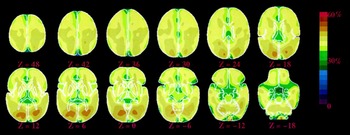
The Raichle group engaged in exploratory concept formation because they lacked an appropriate definition of a baseline in neuroimaging experiments. Such a baseline was necessary to understand why a consistent set of areas surprisingly showed a decrease instead of an expected increase during a task (Shulman et al. Reference Shulman, Fiez, Maurizio Corbetta, Buckner, Miezin and Petersen1997). To define a baseline for neuroimaging Raichle et al. (Reference Raichle, Ann Mary MacLeod, Snyder, Powers and Shulman2001) introduced the oxygen extraction fraction (OEF), which refers to the amount of available oxygen in the arteries that is used by a brain area. The researchers used Positron Emission Tomography (PET) to show that the OEF during the experimental resting state remains uniform throughout the entire brain (Figure 2).
PET images showing that percentage of available oxygen delivered is relatively constant across the brain during the resting state (subject is lying awake in the scanner, eyes closed). Adapted from Raichle et al. (Reference Raichle, Ann Mary MacLeod, Snyder, Powers and Shulman2001). Copyright (2001) National Academy of Sciences, U.S.A.

This experiment implements step (C1) of the ECF account because the uniform OEF at rest is an experimental condition that operationally defines the default mode of brain function. This concept describes the “equilibrium … between the local metabolic requirements necessary to sustain a long-term modal level of neural activity and the level of blood flow in that region” (Raichle et al. Reference Raichle, Ann Mary MacLeod, Snyder, Powers and Shulman2001, 677f.). To define this equilibrium experimentally, the researchers divided the OEF value in each local area by the global mean OEF value of a subjects’ brain. If this local-to-global OEF ratio equals 1 in all brain areas, then one can ascribe the default mode concept to a given brain at rest.
The experiment furthermore implements step (C2) of the ECF account. The Raichle group evaluated the significance of “default mode” by discussing how the equilibrium between blood flow and oxygen use enables normal brain function outside the laboratory. In cerebrovascular diseases the OEF deviates strongly from uniform values observed at rest (Gusnard and Raichle Reference Gusnard and Raichle2001; Iadecola Reference Iadecola2004). This disturbance suggests that in healthy human brains, a homeostatic mechanism maintains equilibrium between blood flow and oxygen. Thus, the equilibrium cannot be specific to the experimental resting state. Rather, it is “characteristic of all areas of the [healthy] brain at all times” (Raichle and Snyder Reference Raichle and Snyder2007, 1088). The researchers thus inferred that the operationally defined “default mode” is significant to describe healthy human brain function outside laboratory conditions.
There are three differences to the bug detector case that make the default mode case interesting for a philosophical account of exploratory concept formation. First, unlike the instruments used by Lettvin et al., PET imaging lacks the precision to fix the reference of “default mode” to an activity within the homeostatic mechanism maintaining blood flow and oxygen extraction in equilibrium. Therefore, the experiment does not successfully implement step (C3) of the ECF account. This suggests that not all exploratory experiments are equally successful in forming a novel concept that appropriately describes a new discovery. Judging such cases requires normative principles to determine when concept formation succeeds or fails (see section 4.1).
Second, the default mode case highlights that exploratory concept formation can result from an interplay of analysis techniques and material devices. Raichle et al.’s experiment combined an old tool (PET imaging) with the OEF, a known analysis technique to study brain metabolism. What was novel was the use of the OEF to define a baseline for cognitive neuroimaging experiments. Existing accounts of tool-driven change (Dyson Reference Dyson1999; Bickle Reference Bickle2016) entail two reasons to count novel uses of analysis techniques as cases of tool development. The first reason is that novel uses of material devices count as tool development. Gene targeting, for example, was originally developed by developmental biologists, but its use to study memory phenomena is a case of tool development in neuroscience (Bickle Reference Bickle2016). This point generalizes because many tools (e.g., electron microscopy) can be used to study many different phenomena. What matters is that researchers correctly follow the instructions that govern a particular use of the tool. These instructions are both crucial for exploratory experimentation (Colaço Reference Colaço2018) and for tool-driven change in a particular discipline.
The second reason is that, like novel material devices, novel analysis techniques drive discovery. An example from outside neuroscience is the astronomer Alexander Wolsczan, who discovered so-called exoplanets and pulsar planets by combining an old radio telescope with a novel computer program that analyzed irregular and weak radio wave pulses (Dyson Reference Dyson1999, 22f.). Besides important differences between material devices and analysis techniques, the aforementioned similarities are reasons to count analysis techniques as tools on which the formation of novel concepts depends.Footnote 3 According to the ECF account, both analysis and experimental techniques can fuel tool-driven change by providing instruments and instructions on how to study unknown properties of entities and activities.
Third, the historical context of the Raichle study reveals how exploratory concept formation promotes the convergence of two investigative pathways onto a common entity (Burian Reference Burian1997). Unbeknownst to cognitive neuroscientists working with PET at Washington University St. Louis, neurophysicists at Medical College Wisconsin also used the experimental resting state to study the signal of functional magnetic resonance imaging (fMRI). They found that this signal contained systematic low-frequency fluctuations (<0.1 Hz) and used the concept of “functional connectivity” to describe the temporal correlation of these fluctuations in the motor cortex (Biswal et al. Reference Biswal, Zerrin Yetkin, Haughton and Hyde1995). In 2003, the two pathways converged when Greicius et al. (Reference Greicius, Ben Krasnow and Menon2003) discovered the default mode network, a set of areas in which fMRI activity is highly correlated at low frequencies.
There are crucial differences between “default mode” and “default mode network,” which I discuss in section 4.2. For now, it is crucial that the convergence of investigative pathways onto the default mode network created a novel subfield in neuroimaging: resting state functional connectivity studies (Biswal Reference Biswal2012). This subfield fundamentally changed neuroimaging by providing researchers with novel tools and concepts to study the network organization of the brain. The ECF account thus acknowledges that concept formation happens within, but also reshapes a larger problem agenda composed of interrelated empirical and conceptual questions (Love Reference Love2008). The “default mode” arose within and reshaped the research agenda of finding increases brain activity related to cognitive tasks and helped shift the research focus from single areas to brainwide networks and their endogenous activity. I further explicate this agenda-setting aspect when discussing the open-endedness of concepts in section 4.1.
3. Exploratory concept formation and tool-driven scientific change
3.1 The interdependence of tool development and concept formation
The ECF account stresses that forming novel concepts is part of tool-driven scientific change. In this respect I follow accounts that stress that tools play a crucial role in concept formation (Rheinberger Reference Rheinberger1997; Chang Reference Chang2004; Bickle Reference Bickle2016, Reference Bickle2018). In this section, I discuss how the ECF account differs from and complements these accounts, first with regard to tool development and concept formation in neuroscience, and second with regard to our general understanding of the epistemology of experimentation.
The ECF account implies that tool development and concept formation can be part of the same process in exploratory experiments. The Lettvin group developed platinum black-tipped microelectrodes and applied them to the frog optic nerve to operationally define “convexity detectors,” and used electron microscopy to fix the reference of this concept to small unmyelinated fibers. The Raichle group applied the OEF to human resting state brain activity to find a quantitative baseline that operationally defined a “default mode” of brain function. Such operational definitions are grounded by the experimental conditions necessary to produce an effect that is indicative of the entity or activity to be described (Steinle Reference Steinle1997; Sullivan Reference Sullivan2009; Feest Reference Feest2011, Reference Feest, Steinle and Feest2012; Haueis Reference Haueis2014). If setting up these experimental conditions requires new tools, then tool development and the exploratory formation of concepts are part of the same experimental process.
The ECF account adds a distinction between concepts and theories to debates on exploratory experiments and tool development. The role of theories in exploratory experiments is justificatory because they allow researchers to apply an experimental technique to a particular feature of a target system (Colaço Reference Colaço2018).Footnote 4 To use theories in this way, researchers must hold the concepts in which the theory is formulated fixed. For example, when Lettvin et al. (Reference Lettvin, Humberto Maturana, McCulloch and Pitts1959) used microelectrodes to record action potentials from axons in the optic tectum, they held the meaning and reference of “axon” and “action potential” fixed.
By contrast, the role of novel concepts in exploratory experiments is to disclose previously unknown entities or activities or solve problems not characterized by the available theories (Arabatzis and Nersessian Reference Arabatzis, Nersessian, Arabatzis, Renn and Simões2015; Steinle Reference Steinle and Levine2016). To use concepts in this way, researchers actively modify their meaning and reference through operational definitions and tool use in exploratory experiments (Feest Reference Feest, Steinle and Feest2012; Haueis Reference Haueis2014). For example, “bug detector” discloses the function of small unmyelinated axons, which were discovered using electron microscopy and whose function was operationally defined by their response to convex stimuli used in microelectrode recordings. It is the tools that drive the formation of concepts to characterize unknown entities or activities, rather than the theories that direct the application of experimental techniques to known features of the target system.
The difference between the justificatory role of existing theories and the disclosing function of novel concepts is of general relevance because it is not captured by existing accounts of scientific change. Consider first Bickle’s account of tool-driven change in neuroscience, which does not discuss exploratory concept formation and which emphasizes the independence of tool development from theoretical activity. Bickle (Reference Bickle2016, n5) admits that his focus on cases of tool-development during relative conceptual stability “might be occluding the discussion of conceptual revolutions” and that “concept development in neurobiology … might better match Kuhn’s account of paradigm shift and anomalies.” Like Dyson (Reference Dyson1997, Reference Dyson2012), Bickle (Reference Bickle2016) puts concept formation and (Kuhnian) theory-driven change on one side and contrasts it with the tool development and (un-Kuhnian) tool-driven change on the other. Because Bickle does not explicitly address conceptual development and dialectically emphasizes the independence of tool development from theory-driven change, his account leaves open what role concept formation plays in episodes of tool-driven change. The ECF account fills this lacuna because it shows that neuroscientists use newly developed tools and newly formed concepts together to discover and describe previously unknown entities and activities in their domain of inquiry.
The distinction between the role of theories and concepts also points out why exploratory concept formation does not fit accounts of theory-driven change in science. These accounts tie concept formation to theoretical change because they assume that the meaning of concepts is determined by their position within a larger theory (Kuhn Reference Kuhn1970, 162f.; Laudan Reference Laudan1977, 48). For Kuhn (Reference Kuhn1970, 29f.), exploratory experiments articulate the paradigm theory because they help scientists to “choose among alternative ways of applying the paradigm to the new area of interest.” This overlooks that, in experimental practice, concepts can acquire their meaning outside their theoretical contexts when researchers apply them to unexpected phenomena (Arabatzis and Nersessian Reference Arabatzis, Nersessian, Arabatzis, Renn and Simões2015).
This is also true for neuroscience. For example, “bug detector” acquired its meaning outside the theoretical framework which assumed that visual neurons transmit light changes in a point-by-point fashion. This assumption was unreliable to explore which stimuli drive previously unknown fibers in the optic nerve. Similarly, “default mode” acquired its meaning outside a framework which assumed that brain areas use more energy during tasks than during rest. This framework did not allow neuroscientists to understand task-induced decreases in neuroimaging experiments. Instead of using existing theories, the Lettvin and Raichle groups used experimental conditions and tools to determine the meaning and reference of “bug detector” and “default mode.” The ECF account elucidates why exploratory concept formation, at least in neuroscience, is part of tool-driven change and why this process is distinct from theory-driven change.
The ECF account provides a notion of concept formation that fits the details of neuroscientific practice. Yet it also reveals general features of concept formation that are not prominent in previous accounts of tool-driven change in the physical and life sciences, such as Rheinberger (Reference Rheinberger1997) and Chang (Reference Chang2004). First, the notion of significance captured by step (C2) of the ECF account is not captured by Rheinberger’s account of concept formation as material inscription (Rheinberger Reference Rheinberger1997, 110–13).Footnote 5 Both accounts agree that life scientists use tools to generate material traces that indicate properties of entities or activities within an experimental system. In Lettvin’s experimental system, for instance, electrical discharges are material traces that indicate functional properties of small unmyelinated fibers. Like Rheinberger, the ECF account defines a concept as novel if it characterizes a “spatiotemporal cognitive singularity” within an experimental system (Reference Rheinbergeribid., 23). The formation of “bug detector,” for example, resulted from a unique combination of experimental stimuli, instruments, and technical conditions to detect hitherto unknown activities of optic nerve fibers (see section 3.2).
In contrast to the ECF account, however, Rheinberger claims that the significance of such material traces “ultimately derives from their potential to become, sooner or later, integral parts of future technical conditions” (Rheinberger Reference Rheinberger1997, 33). The process of material inscription thus has no significance beyond further tool development within experimental systems (Reference Rheinbergeribid., 109). This internal notion of significance, however, does not capture that experimental practice also develops by moving from operational to functional definitions of concepts (e.g., moving from “convexity detector” to “bug detector”; see also Rheinberger Reference Rheinberger1997, 154, 189). In the behavioral and brain sciences, one approach to functional definitions determines whether a concept describes a behavior that occurs outside the laboratory (Shamay-Tsoory and Mendelsohn Reference Shamay-Tsoory and Avi Mendelsohn2019). The ECF account captures this feature by positing that the significance of tool-driven concept formation includes the concept’s significance beyond the laboratory.
Second, the ECF account highlights the role of convergent investigative pathways that is not included in Chang’s account of epistemic iteration (Chang Reference Chang2004). In epistemic iteration, successive stages of knowledge build upon another to enhance the achievement of epistemic goals (Reference Changibid., 45). Chang’s case of the formation and refinement of “temperature” demonstrates that the development of both tools and concepts plays a crucial role in epistemic iteration. Chang’s account thus captures how Lettvin et al. and Raichle et al. built on but also corrected knowledge systems derived from previous experiments (Hartline Reference Hartline1938; Barlow Reference Barlow1953a, Reference Barlow1953b; Shulman et al. Reference Shulman, Fiez, Maurizio Corbetta, Buckner, Miezin and Petersen1997) when forming “bug detector” and “default mode.”
The ECF account additionally highlights how exploratory experiments from different investigative pathways shape scientific change beyond iterative self-correction in each pathway. Convergent pathways can result in novel concepts (“default mode network”) and establish new disciplines such as functional connectivity studies in neuroscience (section 3.3) or modern cell biology (Bechtel Reference Bechtel1993). Once we zoom out beyond individual experiments or pathways, we see that tool development and concept formation form interactive cycles. The ECF account adds the role of interactive tool-concept cycles from multiple convergent pathways to Chang’s account of iterative self-correction within an investigative pathway. The existence of interactive tool-concept cycles suggests that episodes of tool-driven change do not start with tool development which then shape subsequent concept formation. Rather, each of these processes has important conceptual and technological preconditions.
3.2 Objections and replies
This section addresses three objections against the ECF account.Footnote 6 The first objection holds that the prehistory of “bug detector” shows that tool development and concept formation are not intertwined in this case. Ethologists had already introduced the concept of an innate release mechanism that allows organisms to immediately and automatically recognize complex stimuli (Tinbergen Reference Tinbergen1948). In neuroscience, Barlow (Reference Barlow1953b, 86f.) already discussed “fly detectors” and identified them with on-off units in the frog optic nerve. The introduction of “innate release mechanism” and “fly detector” occurred separately from the development of tools used by Lettvin et al. (Reference Lettvin, Humberto Maturana, McCulloch and Pitts1959).
My response to this objection first points out that Barlow’s paper discussing “fly detectors” appeared alongside a paper on technical issues when recording in the frog retina (Barlow Reference Barlow1953a). This suggests that like Lettvin et al., Barlow seems to have developed tools and concepts together. More importantly, despite the similarity in name between “fly detector” and “bug detector,” the ECF account shows that the novelty of “bug detector” lies in the unique experimental conditions used to form it. Barlow used small light spots and insulated platinum electrodes on an excised frog retina when identifying on-off units as fly detectors. By contrast, Lettvin et al. used small black discs and platinum black microelectrodes in awake frogs to identify convexity as an indispensable parameter, and electron microscopy to identify small unmyelinated axons in the optic nerve. These conditions, together with Lettvin’s skill to record neural activity from awake animals, resulted in a cognitive spatiotemporal singularity within the experimental system: the discovery of bug detectors. Despite its novelty, “bug detector” also iteratively corrected “fly detector” because Barlow failed to identify indispensable stimulus parameters and did not know that unmyelinated axons exist in the frog optic nerve. This indicates that “bug detector” was a more successful case of exploratory concept formation than “fly detector” (see section 4.1).
The second objection holds that the cases from section 2 only show that the development of some kinds of tools in neuroscience—single-unit recording and neuroimaging—depended on concept formation. In other cases, such as gene targeting and optogenetics—tool development was epistemically independent from concept formation (Bickle Reference Bickle2016).
I certainly do not claim that all cases of tool development depend on concept formation. Yet I want to use the case of gene targeting to show why the role of concept formation is more widespread than Bickle’s account of tool development suggests. Gene targeting works by knocking out a gene for a specific protein product. Bickle assumes that this tool was introduced to the neuroscience of memory during a period of conceptual stability. The idea that memory is connected to plastic changes of the synapses “dominated theorizing and experimental research … for more than a century” (Bickle Reference Bickle2016, 5n5). By contrast, gene targeting was a novel tool because it could manipulate long-term changes to synaptic activity without disrupting synaptic function, which previous experimental techniques were unable to accomplish. Bickle thus construes the introduction of gene targeting by Silva et al. (Reference Silva, Charles and Wang1992a, Reference Silva, Paylor, Jeanne Wehner and Tonegawa1992b) as independent of concept formation.
This diagnosis is only partially correct, however. The Silva experiments also combined concepts with exploratory origins from two converging investigative pathways. In the first pathway, electrophysiologists introduced “long-term-potentiation” to describe strengthened postsynaptic activity that occurred after presynaptic neurons were stimulated with high-voltage inputs. This phenomenon became linked to learning and memory mechanisms when researchers integrated tools from neuroanatomy and electrophysiology with biophysical models of memory (Craver Reference Craver2003, 170–79). In the second pathway, molecular biologists discovered that the enzyme called “Ca2+calmodulin-dependent protein kinase II” (CAMKII) is capable of autophosphorylation and is located at the synapse (Kennedy Reference Kennedy1983). The biophysical model of Lisman (Reference Lisman1985) conceptualized such enzymes as molecular switches capable of storing long-term information despite molecular turnover.
Both pathways converged when Silva et al. (Reference Silva, Charles and Wang1992a, Reference Silva, Paylor, Jeanne Wehner and Tonegawa1992b) confirmed the hypothesis that CAMKII mutant mice are both deficient in LTP and spatial memory performance. While gene targeting made confirmation possible, the researchers would have been unable to formulate this hypothesis without the terms “LTP” and “CAMKII” which describe the entities and activities they were investigating. By relying on concepts from the two pathways, the Silva experiments were part of an interactive tool-concept cycle. Like Greicius et al. (Reference Greicius, Ben Krasnow and Menon2003), Silva et al. combined tools and concepts from multiple investigative pathways, which led to the novel subfield of molecular and cellular cognition (Bickle Reference Bickle2016). The ECF account acknowledges the role of tools in this episode while also capturing the conceptual preconditions for their use in neuroscience.
The third objection holds that even if concept and tools are intertwined in tool-driven change, the tools are developed prior to the concepts being formed. My response to this objection is that such priority claims point out a possible regress. Take the concept “ion channel,” which Bickle (Reference Bickle2018, 1074) claims depended on developing the patch clamp in the 1970s and 1980s. As Bickle acknowledges, however, Hodgkin and Huxley’s model (Reference Hodgkin and Huxley1952) already proposed the ion channel concept prior to the patch clamp. Yet he insists that Hodgkin and Huxley’s model in turn depended on Kenneth Cole’s development of the voltage clamp (Bickle Reference Bickle2018, n7). One can sense a regress looming here. Cole’s work in turn relied on the Kelvin cable equation, which conceptualizes nerve conduction as a voltage-based phenomenon (Cole Reference Cole1983, 314).
Rather than pointing to a priority of either concepts or tools in initiating neuroscientific change, the ion channel case supports the thesis that concept formation and tool development are intertwined. Cole used the voltage clamp to refine the concept “action potential” by discovering that threshold-free currents are responsible for the characteristic shape of action potentials. And Hodgkin and Huxley did not simply apply, but substantially improved Cole’s voltage clamp design (Hodgkin et al. Reference Hodgkin, Huxley and Katz1952), which was necessary to describe the action potential in terms of independent electrochemical gradients at the membrane (Hodgkin and Huxley Reference Hodgkin and Huxley1952). Bickle is right that later tool development like the patch clamp was necessary to fix the reference of “ion channel.” Yet I claim that the regress—although not worrisome by itself—shows that neither tools nor concepts have priority in episodes of tool-driven scientific change.
4. Norms of exploratory concept formation and tool development
In the previous section I argued that when it comes to the history of neuroscience (and comparable cases in other disciplines), exploratory concept formation and tool development can be reconstructed as interdependent processes. But novel concepts and tools are outcomes of successful experiments, which raises the normative question of what distinguishes these success cases from failures. Specifically, when does an experiment result in a concept that is appropriate and has a long-lasting epistemic impact? And when does a new tool successfully change (neuro)scientific practice?
To answer these questions, I introduce two norms that distinguish successful from failed cases of exploratory concept formation (see section 4.1).Footnote 7 These norms coincide with how Bickle characterizes successful cases of tool development in neuroscience (see section 4.2). The result is a picture of tool-driven change in which concept formation and tool development are (at least partly) governed by the same normative principles.
4.1 Two norms of exploratory concept formation: anchoring causes and open-endedness
One goal of exploratory concept formation is to generate concepts that appropriately describe the experimental effect in question (Steinle Reference Steinle1997, Reference Steinle and Levine2016). In neuroscience, one way to assess a concept as appropriate or inappropriate is to ask whether it identifies an anchoring cause in the mechanism that researchers aim to investigate. A cause—understood here as the activity within, or an input/output to a mechanism—is anchoring if it is characteristic of the whole mechanism. For example, “convexity detector” identifies an anchoring cause because the activity of detecting convex moving objects is characteristic of the prey-catching mechanism in frogs and toads (Ewert Reference Ewert1987). An anchoring cause allows researchers to tentatively describe that mechanism in terms of a small number of entities and activities that can be manipulated experimentally.
Based on steps (C1)–(C3) of the ECF account, I propose that a concept successfully identifies an anchoring cause if researchers (AC1) operationally define it based on the right experimental conditions, (AC2) correctly evaluate its functional significance by comparing experimental to real-world conditions and (AC3) use tools precise enough to fix its reference to an entity whose activity is characteristic of the mechanism. For example, Lettvin et al. fulfilled (AC1) by distinguishing large and small responses with microelectrode recordings to identify indispensable stimulus parameters that drive optic nerve fibers. For (AC2) the researchers compared experimental to real-world conditions to infer that detecting convex shapes is operative in the prey-catching mechanism. This inference is justified if researchers identify the right experimental conditions in (AC1). Barlow’s earlier inference about fly detectors, for instance, was unjustified because light intensity changes are not indispensable to drive small unmyelinated fibers. Finally, (AC3) electron microscopes and microelectrodes are precise enough to identify unmyelinated axons in the optic nerve, whose electrical responses to convex objects are characteristic of the prey-catching mechanism.
Some concepts formed via exploratory experiments only partially succeed to identify anchoring causes. For example, the experiment by Raichle et al. (Reference Raichle, Ann Mary MacLeod, Snyder, Powers and Shulman2001) implements (AC1) by operationally defining “default mode” in terms of the equilibrium between blood flow and oxygen use during rest. This experimental condition identifies an anchoring cause that is characteristic of the mechanism of cerebrovascular autoregulation, which maintains constant blood flow despite changes in arterial pressure (Iadecola Reference Iadecola2004). The Raichle study also implements (AC2) because the researchers inferred from the disturbance of the OEF in brains with cerebrovascular diseases that the activities that maintain blood flow and oxygen use must be operative in normal, healthy human brains outside the laboratory (Gusnard and Raichle Reference Gusnard and Raichle2001, 687f.). The Raichle study, however, fails to implement (AC3) because PET imaging is not precise enough to image astrocytic end feet, which control vessel diameter such that blood flow matches the oxygen needed to fuel baseline neural activity (Iadecola Reference Iadecola2004). Because the formation of the default mode concept implements (AC1) and (AC2) but not (AC3), the Raichle group was less successful in identifying an anchoring cause than the Lettvin group.
If an experiment does not implement (AC1)–(AC3), the resulting concept fails to pick out an anchoring cause. For example, “default mode network” (Greicius et al. Reference Greicius, Ben Krasnow and Menon2003) fails (AC1) because defining the areas it picks out in terms of the uniform OEF does not distinguish them from the rest of the brain (Klein Reference Klein2014). “Default mode network” also does not capture the (AC2) functional significance of these particular areas because the “default mode is characteristic of all brain areas at all times” (Raichle and Snyder Reference Raichle and Snyder2007, 1088). What is characteristic of the Shulman/Greicius areas is that they deactivate during goal-oriented tasks, which implies the “presence of sustained information processing” during rest (Gusnard and Raichle Reference Gusnard and Raichle2001, 689). The default mode concept does not capture this sense of functional activity because it describes the brain in terms of metabolism and flow of energy, and not in terms of cognition and information processing. Thus, “default mode network” fails to identify an anchoring cause that is characteristic of the information processing mechanism(s) in areas that deactivate during goal-oriented tasks.
Besides identifying anchoring causes, new concepts should also have a wider epistemic significance:
Concepts and classifications—the very language used to deal with a certain field—determine on a fundamental level the development of the thinking and acting within that field. Any more specific theory necessarily makes use of those concepts and classifications. (Steinle Reference Steinle1997, S72)
For concepts to fulfill this role, they must be open-ended. A concept is open-ended if it is (O1) applicable beyond the context in which it was formed and is (O2) adaptable to empirical details that differ from that context.
One way to implement (O1) is to show that the initial concept is an instance of a more general concept. For example, “bug detector” is an instance of “feature detector,” which describes sensory neurons that respond to perceptually significant events. This general concept (O2) is adaptable to any cause that elicits the largest response in those neurons. Consequently, electrophysiologists discovered a wide array of different feature detectors (Martin Reference Martin1994). Barlow (Reference Barlow1972) directly drew on Lettvin et al. when developing the feature detector concept as part of his single neuron doctrine of perceptual psychology. Because of its open-ended applicability, the bug detector concept shaped the acting and thinking of electrophysiologists, set the agenda for later theory building, and cemented the role of single-unit recordings as the primary electrophysiology tool to investigate cognitive brain functions.
In contrast to “bug detector,” the open-endedness of the default mode concept is limited. One problem is that its operational definition is limited to PET recordings. Consequently, the notion of a physiological baseline cannot be directly applied to fMRI experiments (Raichle and Snyder Reference Raichle and Snyder2007, 1086). The default mode concept describes the relationship between metabolism and electric neural activity. But in systems neuroscience, many researchers study the role of ongoing electric activity in behavior and cognition without considering the role of metabolism (Haueis Reference Haueis2018).
While “default mode” partially succeeds in identifying an anchoring cause, it so far fails to be open-ended. By contrast, “default mode network” (Greicius et al. Reference Greicius, Ben Krasnow and Menon2003) fails to identify an anchoring cause but succeeds in being open-ended. This system can be detected in task conditions related to different cognitive functions (e.g., mind-wandering, autobiographical memory, internally oriented attention) and many different neurological and mental disorders (e.g., Alzheimer’s, autism, anxiety, depression, and schizophrenia; Broyd et al. Reference Broyd Samantha, Charmaine Demanuele, Helps, James and Sonuga-Barke2008). It also has influenced theorizing about hierarchical information processing in the brain (Margulies et al. Reference Margulies, Ghosh, Alexandros Goulas, Huntenburg, Georg Langs, Eickhoff, Xavier Castellanos, Petrides, Jefferies and Smallwood2016). Yet there is no agreed-upon functional description that explains why this system can be detected in these different contexts. This lack illustrates that researchers have so far failed to identify anchoring causes that characterize the information processing mechanism(s) operative in this set of areas.
4.2 How norms of concept formation coincide with successful tool development
The normative principles of anchoring causes and open-endedness coincide with characteristics of successful tool development in neuroscience. According to Bickle (Reference Bickle2016), successful tool development proceeds by using initial hook experiments that respond to a motivating problem, and second-phase hook experiments that foster the wider dissemination of the tool in the scientific field. For gene targeting, for example, the motivating problem was whether (a) this tool is applicable to mammalian nervous systems and whether it (b) fulfils the experimental demand to block LTP without disrupting synaptic function. Initial hook experiments like Silva et al. (Reference Silva, Charles and Wang1992a, Reference Silva, Paylor, Jeanne Wehner and Tonegawa1992b) responded to this problem by applying gene targeting to a specific entity in a restricted population (α–CaMKII protein in mice) to address a specific phenomenon in a targeted field of inquiry (LTP in spatial memory research).
In other words, successful initial hook experiments identify an anchoring cause. They identify an activity that is poorly understood or unknown before the development of the tools, and which is characteristic of a mechanism investigated (see section 4.1). This not only true for the bug detector and default mode case but also for development of optogenetics, in which experimenters identified hypocretin producing neurons as an anchoring cause in the mechanism underlying sleep-wake transitions (Bickle Reference Bickle2016, 11). In other words, initial hook experiments are successful in part because they develop tools that allow researchers to manipulate and control anchoring causes, just as exploratory experiments are successful in part because they form concepts that appropriately describe causes which are characteristic of a mechanism.
Second-phase hook experiments establish that the newly invented tool is applicable to a variety of experimental contexts. For example, experiments that selectively inhibited the CREB protein established that gene targeting is widely applicable. It showed that gene targeting can be used to manipulate entities that are operative in many different neurocognitive mechanisms and that its spatial and temporal specificity is adaptable to the causal details of these mechanisms (Reference Bickleibid., 7). Similarly, later experiments showed that optogenetics is widely applicable, for example to mechanisms underlying memory storage (Robins Reference Robins2018). In other words, second-phase hook experiments establish the open-endedness of a newly developed tool. They show that it is applicable beyond the initial experimental context in which it was introduced, and adaptable to the empirical details that differ from that context (see section 4.1). It therefore seems that the normative principle of open-endedness specifies when new concepts and new tools achieve a wider and long-lasting epistemic significance in experimental practices such as neuroscience.
While the norms of concept formation and tool development are the same at a certain level of abstraction, there are different ways these norms are instantiated in concrete cases. Gene targeting and the bug detector concept both identify anchoring causes. But the former was developed when crucial details about the spatial memory mechanism were already known, whereas the latter was formed when no sketch of the prey-catching mechanism was available. The bug detector concept became open-ended when it was generalized into the feature detector concept (Barlow Reference Barlow1972). By contrast, gene targeting became open-ended when it became differentiated into several subtechniques (Bickle Reference Bickle2016). An adequate account of tool-driven change should recognize both these specific differences alongside the shared general norms of concept formation and tool development.
Although I focused on neuroscience here, I think that anchoring causes and open-endedness may be common norms of concept formation and tool development in other disciplines. Chang’s (Reference Chang2004) case study, for example, stresses that researchers both formed “temperature” and developed thermometers to measure specific thermal phenomena such as boiling points appropriately (anchoring cause), and to make these concepts and tools applicable to a wide range of contexts (open-endedness). Similarly, Rheinberger (Reference Rheinberger1997, 30) shows how the technique of synthesizing amino acids and the formation of “messenger RNA” helped molecular biologists to appropriately describe characteristics of protein synthesis in particular model organisms (anchoring cause) and to study other phenomena such as the function of ribosomes (open-endedness). These examples suggest that the interdependence of exploratory concept formation and tool development may be a more widespread feature of tool-driven change in the physical and the life sciences.
I think what emerges from all this is a view of tool-driven change in which successful exploratory concept formation and tool development is beholden to the same normative principles. New concepts and new tools advance scientific understanding when they allow researchers to appropriately describe new discoveries. Successful tools and concepts are furthermore applicable to a wider range of distinct but related phenomena (Haueis Reference Haueis2021). While I argued for a common set of norms governing exploratory concept formation and tool development, I suspect that there are also additional norms that only govern one of these processes. Two norms that only apply to exploratory concept formation is that parameter variation should exhaust the parameter space as much as possible (Rheinberger Reference Rheinberger1997, 78), and that researchers should conceptualize the investigated objects and phenomena on their own terms rather than using preconceived notions to describe the results (Haueis Reference Haueis2014, Reference Haueis2017). Similarly, there may be distinct norms that only govern successful tool development.
5. Conclusion
In this article, I analyzed the role of tools in scientific change by studying how developing tools and forming concepts are intertwined in exploratory experimentation. The ECF account shows that tools and experimental conditions are crucial to the operational definition, functional significance, and reference of concepts formed in individual exploratory experiments. Such experiments are also parts of interactive tool-concept cycles, rather than instances of independent tool development. While I focused on neuroscience, the ECF account agrees with philosophers of physics (Chang Reference Chang2004; Steinle Reference Steinle and Levine2016) and molecular biology (Rheinberger Reference Rheinberger1997) that important episodes of change in the history of science are characterized by the codependence of tool development and concept formation.
The ECF account also supports previous writers like Baird and Faust (Reference Baird and Thomas1990), Dyson (Reference Dyson2012), and Bickle (Reference Bickle2016) who insist that tool-driven change is easily overlooked by accounts that focus primarily on theory-driven change in science. I elaborated on the role of tools in scientific change by arguing that in exploratory experiments, neuroscientists use tools to form concepts outside their theoretical context. To truly understand scientific change, philosophers of science should acknowledge that “the progress of science requires both new concepts and new tools” (Dyson Reference Dyson1999, 14). My account supports this view by introducing common norms that distinguish successful from failed cases of exploratory concept formation and tool development in neuroscientific research. Insofar as my conclusions generalize beyond neuroscience, they suggest that the interaction between tools and concepts should be at the core of any normative account by which we evaluate their utility in scientific practice.
Acknowledgments
Thanks to three reviewers, Alkistis Elliot-Graves, Carl Craver, Robert Frühstückl, Anna Hoehl, Bryce Huebner, Marie Kaiser, David Lambert, Javier Suarez Diaz, Edouard Machery, Sarah Robins, María Ferreira Ruiz, Morgan Thompson, Rose Trappes, Saana Jukola, and audiences at the Tools in Neuroscience Workshop Pensacola Beach (September 2019) and the NeuroTech Conference at University of Pittsburgh (January 2020) for comments and feedback that greatly improved the structure and argument of the paper.