1. INTRODUCTION
In September 1517, the aldermen of Mechelen fined Barbara Van Steynmolen for publicly accussing the mayor of dispensing arbitrary justice. According to their verdict, she had shouted: ‘You only do justice to those you want to have justice.’ Furthermore, she had charged that ‘force and roughness’ guided the mayor, and ‘he did not do right to anyone’.Footnote 1 Van Steynmolen was not the only woman in Mechelen to publicly insult officials. For instance, in August 1471, the aldermen penalised the wife of Jan Ruelens with a fine for speaking ‘bad, sharp, and unreasonable words regarding the magistrates’.Footnote 2 Historians usually consider such acts of verbal deviancy as criminal acts of unruly citizens, though it is clear that both women were punished by the aldermen because verbal abuse undermined the latter's authority. Therefore we consider both examples not just as disorderly behaviour, but also as political acts that reveal women's intentions to change urban leaders’ judgements and perhaps also their behaviour. Indeed, as Van Steynmolen refused to abide by the sentence, she also let the aldermen and bystanders know that she thought her reason for doing so was worthy and legitimate.
It might surprise medievalists to see dissident women at work in late medieval Mechelen, because the tendency has been to assume that political space in medieval cities was reserved for men. Traditionally, historians have regarded the world of medieval politics, legal rights and obligations as the exclusive domain of men, while women were, by their roles as wives and mothers, restricted to domestic space and the household.Footnote 3 Furthermore, scholars have argued that women increasingly lost economic opportunities during the later Middle Ages. As the fifteenth century came to a close, they could pursue only minor roles in the urban economy.Footnote 4 Politically, medievalists have shown that women were not represented in urban institutions, they were rarely involved in violent revolt, nor did they participate in the well-studied guild revolts, which were led by (male) guild leaders.Footnote 5 Occasionally, scholars have glimpsed women participating in urban riots, in England, for example, but they have never been able to explain why women did so. Scholars have dismissed these riotous women as exceptions to the wider European pattern.Footnote 6 However, early modernists would not be astonished by women's political speech acts. In radical contrast to the gendered pattern of social conflict medievalists affirm, early modern scholars have established that women were heavily involved in rioting from the sixteenth century onwards,Footnote 7 though it must be said that most scholars still regard female participation in food riots and similar demonstrations as an expression of women's domestic role.Footnote 8 However, others have suggested that the prominence of women in riots showed that they were expected to contribute to the public discussions of political matters.Footnote 9
The interpretative discrepancy between medievalists and early modernists involves two issues. The first is that early modernists see women as self-assured actors in political protest, while the medievalists claim that women were gradually banned from politics and public space in general. The second is a lack of clarity about women's reasons for participation in political protest. To address these two issues, a study of women's public interventions and speech acts, such as the ones quoted above, during the transitional age of the fifteenth and early sixteenth centuries will illuminate women's purposes for uttering contentious words in public. Three decades of work on scolding and gender have demonstrated that authorities were always concerned about controlling unruly speech by ordinary people, especially women, because governors feared disruption of the public order.Footnote 10 In her study of gender and speech crime in late medieval England, Sandy Bardsley argued that anxieties about maintaining the traditional patriarchal hierarchy forced men to criminalise women's inappropriate speech.Footnote 11 Mary-Catherine Bodden stated that the relatively favourable juridical status of women in fourteenth-century England frightened men, who reacted by increasing their prohibitions on free speech and activity for women, as a method of reinforcing male dominance.Footnote 12 In contrast to both views, others argue that men punishing women for disruptive speech were not driven primarily by this ‘conservative’ desire to maintain proper gender relations. For instance, Janka Rodziewicz states that maintaining the peace in fourteenth-century Great Yarmouth was more important for city fathers than maintaining gender roles when the latter punished citizens for unruly speech.Footnote 13 Ellen Kittell also considers the potential threat of sedition caused by female slander as the main motivation for aldermen in their prosecution of undisciplined tongues. She explains the increase in prosecutions for slander in fourteenth-century Ypres as the effect of a contraction in the local economy and the assumption by the central authorities (namely the Flemish count) of control over local and communal justice.Footnote 14
Our study of the unruly voices of Barbara Van Steynmolen and her fellow townsfolk (both men and women) also contends that conservative gender concerns did not drive the punishment of female illicit speech. It shows that women were punished for their seditious speech acts not so much because of patriarchal sentiments on the part of the urban authorities, but because they, like verbally disorderly men, transgressed certain political boundaries by engaging in protest. Indeed, more than scholarship has ever assumed, we argue that, although proportionally fewer women than men were prosecuted for contentious speech, women participated in public debates on political issues. In other words, we suggest that both sexes constantly spread contentious ideas that were responsible for outbursts of violence at specific moments. Traditional research has generally highlighted male subversion, because these studies of political turmoil have concentrated on physical violence, mostly perpetrated by men. As scholars have observed, the spotlight that medieval chronicles shone on the aggressive behaviour of rebels tended to eclipse non-violent dissent of citizens.Footnote 15 Analysis of these biased sources has failed to turn up evidence of female contention. Our second point is to reassess peaceful contention by urban commoners and thereby shed light on political thinking ‘from below’, rather than simply adding women to the history of medieval rebellion. Therefore ‘sedition’ and ‘contention’ in this article refer to the strife in debate, the struggle of making a claim, and the main points to be argued during protest. In this way, we give agency to the verbal methods citizens used as they tried to change decisions made by authorities.Footnote 16 In sum, we argue that urban leaders did not punish women because their seditious words criticised male hierarchy. Rather, leaders were afraid because these women were contesting their authority to govern. As a result, this article analyses the political beliefs held by male and female citizens to elucidate their motivations for contention and the mentalities they shared. We argue that late medieval commoners maintained a sophisticated set of ideas about how a city should be governed that both sexes disseminated to a wider audience by talking about them and shouting them at their rulers when the occasion demanded.
2. VERBAL ABUSES IN LATE MEDIEVAL BRABANTINE CITIES
Traditionally, historians have used the framework designed by the contemporary theorists James Scott and Gayatri Spivak to describe peaceful forms of protest, such as murmurs, gossip, and other forms of hidden resistance, which Scott calls the ‘weapons of the weak’.Footnote 17 For instance, Spivak speaks of the ‘subaltern’, a word used by Antonio Gramsci to describe marginal groups in society who lack access to citizenship. Such a black-and-white distinction between the powerful and the powerless is not compatible with medieval reality, since many commoners had a say in politics and the authorities had less control over their fellow citizens than in later centuries. Indeed, medieval commoners had more public options for political activity than the types of clandestine action available to the groups Scott and Spivak studied. Commoners were citizens with political rights, who contributed financially to the collectivity, even though they sometimes lacked an institutional voice in the government of their community.Footnote 18 They collectively agitated against misrule on a regular basis, attempting to change institutions and governmental practices in medieval Europe and beyond.Footnote 19 Though always risky, contentious speech was a regular feature of daily politics in late medieval urban centres.Footnote 20 As a result, citizen protest was frequently open, enabling historians to study these utterances of public protest.
Did women participate in these debates, or should they be considered ‘the weak’ or the ‘subaltern’? Political space in the late medieval city was highly gendered; places of government (such as city halls and guild houses) were explicitly and institutionally male. Less gendered were the public streets, where men and women could ‘claim the word’ – to paraphrase Michel de Certeau's prise de la parole.Footnote 21 Our evidence shows that while urban politics was ‘men's business’ in medieval Europe, its gendering was, like that of work, multilayered and complex. For some time, gender historians have avoided constructing a binary opposition between male and female culture, concentrating instead on showing how female relations of power are best understood through women's connections with men.Footnote 22 Instead of viewing the unruly behaviour of women such as Barbara Van Steynmolen as the private crime of an individual woman against a mayor, we consider such incidents as part of a public repertoire of contention shared by all commoners. This article features a quantitative study of these actions in order to contextualise medieval (fe)male contention and point out the differences in the repertoires of men and women. In contrast to prevailing historiography, we consider individual protesting women to be less exceptional; their actions seem to have complemented those of men. Of course, social boundaries or personal restrictions made it more difficult for women to utter seditious speech. Nevertheless, it is our hypothesis that both men and women were in a position to spread political ideas; this article establishes the extent to which they actually did so.
Due to the fragmentary preservation of sources, this article focuses on the criminal records of three cities situated in the duchy of Brabant – Antwerp, Mechelen and Leuven – with the aim of quantifying and qualifying expressions of contentious ideas, uttered by both men and women. The duchy of Brabant was a hotbed of turmoil in which citizens regularly expressed their dissatisfaction with the aldermen's decisions.Footnote 23 In this period, Leuven, Antwerp and Mechelen were medium-sized towns, although Antwerp grew to become the main port of the Low Countries by the end of the century. While Leuven and Antwerp belonged to the duchy of Brabant, Mechelen remained an independent fief, though in the fifteenth century the duke of Brabant was also its lord. After 1430, the dukes of Burgundy (and then after 1482, the Habsburg dynasty) took over Brabant, extending the rule they already exercised over Mechelen and the county of Flanders. Each of the cities was governed by a wealthy oligarchic elite that punished seditious utterances harshly, thereby offering us the sources necessary to study these expressions. Furthermore, legal historians have argued that urban legislation was more advantageous to women in the Low Countries than elsewhere (for example, daughters and sons enjoyed equal inheritance rights) and even speak of ‘an egalitarian trend’.Footnote 24 Moreover, the intense degree of commercialism in this region and the dominance of the nuclear family facilitated a significant participation by women in the late medieval urban economy.Footnote 25 The nuclear family was the core unit of the household economy in the Low Countries. As a consequence, daughters often enjoyed the same basic level of education as sons in this highly urbanised region.Footnote 26 In southern Europe, despite variations across regions and social groups, the extended family was more common and women did not hold the same favourable inheritance rights as their northern counterparts, but instead received a dowry upon marriage. As these women held stronger ties with their broader family and had less access to property, they entered the public and economic sphere to a lesser extent.Footnote 27 Women's relatively favourable position in the Low Countries, however, resulted in their participation in public life, which makes this region an interesting case for studying female deviant speech.
While the main sources for traditional research on revolts have been chronicles and charters (that is, sources that tend to highlight violence), we give priority to the analysis of documents with evidence about the daily practices of sedition, particularly the contentious speech of citizens, which can be found in sentence books and bailiff accounts. This methodological choice helped us to uncover everyday resistance and the vitality of contentious thoughts in late medieval times. Although punishments for verbal offences fell under the jurisdiction of the urban authorities (the schepenen or aldermen), there is also evidence about penalties in the accounts of the bailiff, the local representative of the duke. Although both the bailiff and the aldermen were responsible for punishing crime, each had different responsibilities. The bailiff's tasks were to track criminals, collect evidence and make sure that convicted criminals carried out their sentences, while the aldermen were responsible for actually pronouncing official judgements, which was outside the jurisdiction of the bailiff.Footnote 28 The urban registers and sentence books thus contain final verdicts of repression by the aldermen, whereas the bailiff's accounts list the costs for punishing perpetrators of verbal crimes and the fines they had to pay. The series of fifteenth-century accounts of the Leuven bailiff is complete, but the registers of the town's aldermen, called Dbedevaertboeck, only survive for the period between 1399 and 1422, and list all criminals condemned to a pilgrimage by the Leuven aldermen. The verdicts of the Mechelen aldermen exist for 1440 through 1550, while Antwerp has several records with final judgements dating from the fifteenth century in the so-called Correctieboeck.Footnote 29 Analysis of these sources reveals how often verbal abuses were criminalised, and why.
3. PUNISHMENT OF DEVIANT SPEECH
The supervision of unruly language was a political act aimed at controlling and conditioning the behaviour of the people.Footnote 30 Language is always a function of power, just as power relations define what types of speech are allowed.Footnote 31 Malicious speech acts were generally penalised with a fine or forced pilgrimage, common punishments in the late medieval Low Countries.Footnote 32 The Mechelen custom, for example, prescribed a fine of three pounds for those ‘who spoke to a judge, the burgomaster or the aldermen with unworthy, dishonourable, or threatening words’.Footnote 33 Though the authorities in Brabant also intervened in private quarrels, especially when these got out of hand, their primary focus was to control public speech. Insults against aldermen, guild officials and the lord were punished more severely. Those who ‘spoke unworthily, abusively, or threateningly to judges, the master of the commune, or the aldermen’ had to pay 21 pounds according to the Mechelen custom. In his late fifteenth-century compilation of Brabantine customs, the Antwerp jurist Willem van der Tannerijen added that speech acts involving judges, bishops, bailiffs, or mayors were ‘atrocious and more cruel’ (‘atrocex ende wreder’) than those expressed in private. Therefore these acts were punished both by civil and criminal law.Footnote 34
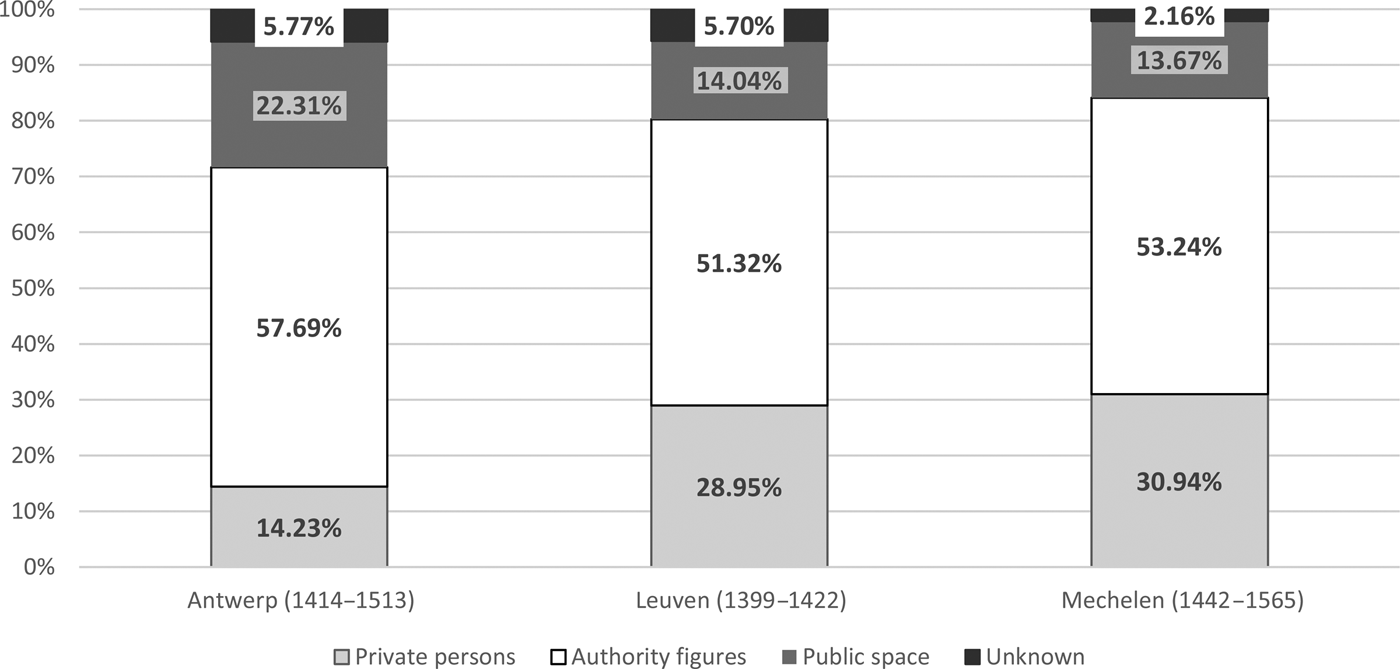
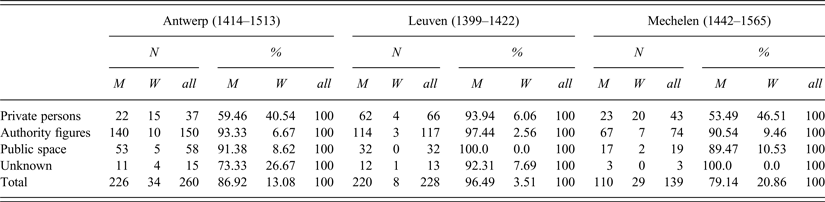
Most cases, both local and territorial, concerned verbal deviancy uttered in public – a ‘case’ refers here to one punished individual, and not to a verdict, because sometimes several individuals were punished for the same verbal assault. For instance, Table 1 shows that from the 260 cases judged by the Antwerp aldermen only 14 per cent concerned a discussion involving no public personae. We call this category ‘private persons’ because it concerns offences used in private quarrels. In 1429, for example, Coppen Meerman insulted his mother, and, 20 years later, Magriete Beelaerts was punished for verbally assaulting her neighbours.Footnote 35 Though these verbal assaults could take place within the public space of a street, they were not a potential danger to public order or the authority of the city fathers. Therefore such private quarrels were likely resolved by the so-called ‘peace’ or ‘public kiss’ (‘vrede’ or ‘zoen’) between the parties, an informal peace settlement which did not involve the aldermen.Footnote 36 The majority of cases they adjudicated involved ‘dangerous talk’ (‘quade worde’) in public. Our figures distinguish two categories: (1) words shouted at or about specific aldermen, local officers, clerics, etc., in the category labelled ‘authority figures’; and (2) words of a seditious nature shouted in the public space but not addressed to a particular person (called ‘public space’ in the table). We use the practical definition of public space, ‘a place routinely accessible to the community’, in the words of Ellen Kittell.Footnote 37 Shouting seditious words in such places was also a serious crime, because, as Van der Tannerijen wrote, verbal injuries happening ‘in front of judges’ or ‘in public, namely in presence of many good men’ were more offensive.Footnote 38 Evidence shows that judicial officials intervened in these cases because they feared that the insults would lead to commotion and disorder. According to our figures, offences concerning specific officials were more numerous than offenses of deviant speech in public. For instance, in Antwerp, as Figure 1 demonstrates, 58 per cent of the cases concerned offences against a public official. Together, however, 80 per cent of all cases dealt with by the aldermen in this city concerned public contention. The ‘Unknown’ category consists of cases that only give the name of the perpetrator and his or her penalty, without providing circumstantial information. The Antwerp Correctieboeck, for example, only states that Gheerken Van Den Mere had to undertake a pilgrimage ‘because he spoke indecent words’.Footnote 39
Persons punished for deviant speech by the urban aldermen of Antwerp, Leuven and Mechelen (1399–1556). Sources: FAA, Correctieboeken, no. 234; CAL, Oud archief, no. 584; CAM, Judicature des échevins, no. 1.

Numbers and percentages of men and women punished for deviant speech by the urban aldermen of Antwerp, Leuven and Mechelen in the fifteenth century

Sources: Felixarchief, Antwerp (FAA), Correctieboeken, no. 234; City Archives of Leuven (CAL), Oud archief, no. 584; City Archives of Mechelen (CAM), Judicature des échevins, no. 1.
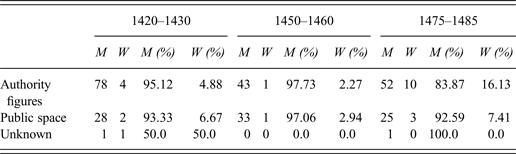
Two patterns distinguish men from women. Far more men than women were punished, and women were more likely than men to be punished for speech against private persons. However, the number of women penalised for private crimes is more or less similar to that of men, because only 13 per cent in Antwerp, 21 per cent in Mechelen, and 3.5 per cent of the cases judged by the authorities in Leuven dealt with women. We suspect that women's crimes in Brabant were underreported in the late medieval period, as has been noted in other studies of public deviancy in the medieval Low Countries.Footnote 40 A probable reason for the difference in figures is the high invisible or ‘dark figure of crime’ undetectable by the historian. There were alternative venues, such as ‘public kisses’, which were oral settlements of conflicts, and neighbourhood judges (‘vinders’), who were responsible for punishing verbal deviancy but did not write down their verdicts. The small number of women in the Leuven sentence book, for instance, does not mean that women were not there. Compared to Mechelen and Antwerp, the Leuven bailiff accounts are rather extensive and contain a higher percentage of such cases. The number of women punished for public crimes is virtually the same as in other cities if one takes the punishments of the Leuven bailiff into account. Eight per cent of the acts of seditious speech in his accounts include women. From 1475 and 1485 one woman per year was punished for disruptive talk in public, for example (see Table 2), and these figures are just the tip of the iceberg. In 1398, the Antwerp aldermen punished Griete Vossards for speaking improperly and followed this judgement with a warning against ‘those who spoke against justice’; anyone who committed such crime, whether man or woman, rich or poor, would be punished as an example whenever this occurred.Footnote 41 Likewise, a 1361 Mechelen ordinance explicitly forbade male and female fullers from causing an ‘evil commotion in town’, be it ‘with words or with deeds’.Footnote 42 Such clauses strongly suggest that there were more women speaking rebellious language than the sources record.
The number of men and women punished for deviant speech in public in the accounts of the bailiff in Leuven in the fifteenth century
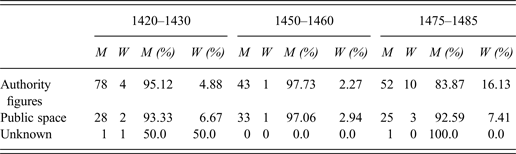
Source: State Archives Brussels (SAB), Brussels, Chambre des Comptes, nos. 12654, 12655, 12656, 12658, 12659.
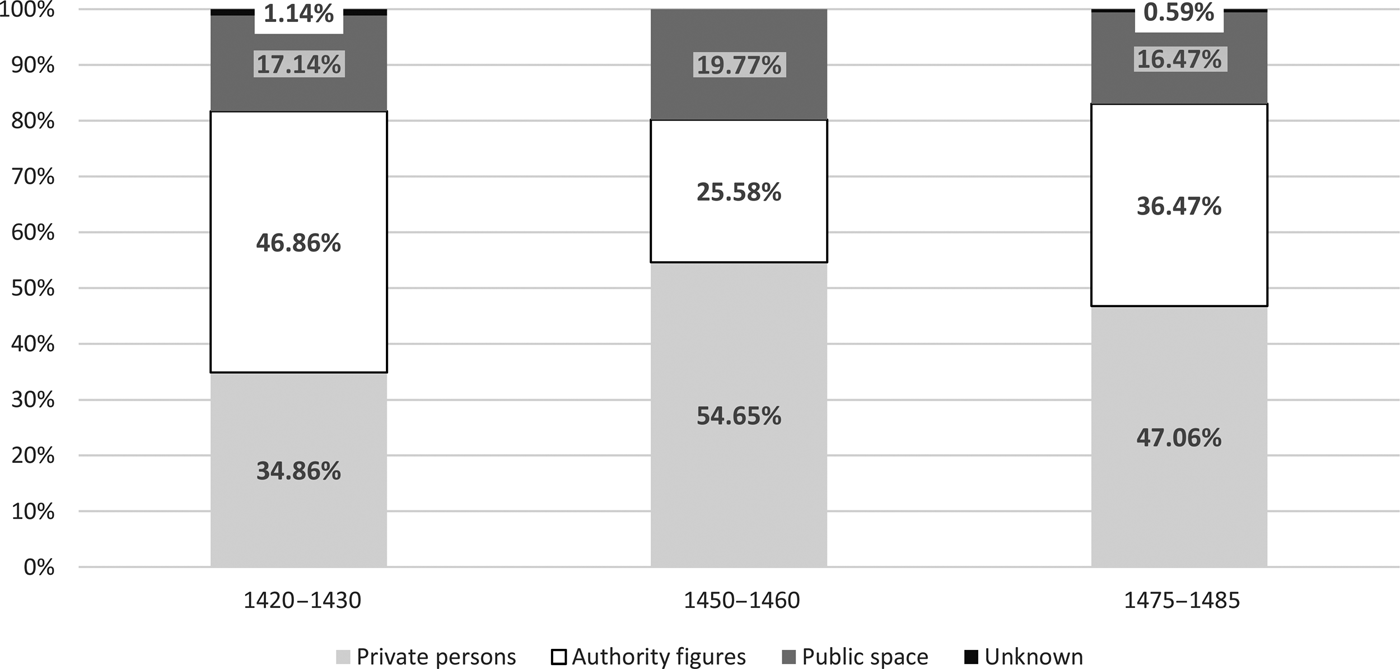
Table 1 shows few women verbally challenging the authorities or uttering seditious words in front of good men. Disorderly words were not a distinctly female weapon because both men and women shouted at their superiors. Although direct confrontation between an alderman and a woman, as in the case of Barbara Van Steynmoelen from Mechelen, was more the exception than the rule, the aldermen could be insulted by women. There was no change over time in these patterns. The figures for Leuven in Table 2 show a small increase in the number of seditious women in the late 1470s, but this was clearly related to the uprising of the craft guilds in 1477. The commotion taking place in almost every city in the Low Countries at that time makes all the figures in this cohort slightly higher.Footnote 43 Generally, women were uttering seditious speech as much (or better: as little) at the beginning as at the end of the fifteenth century. Changes in women's access to economic opportunities had no effect on their use of rowdy language to disrupt public order. Our figures do not indicate that women engaged either more or less in public debates on political matters over time at the end of the Middle Ages. Neither the growing power of the central authorities (the dukes of Brabant and Burgundy) nor the economic changes in the history of these cities seem to have influenced the number of men and women participating in public debates about the policies of the aldermen. Rather they point out continuity; both men and women criticised the authorities, especially at moments of official weakness (such as in 1477). Furthermore, Figure 2 shows that the objects of disruptive speech remained more or less the same across the fifteenth century. Just as in the early modern period, women in fifteenth-century Brabant sometimes expressed their opinions in public. However, physical appearance in rebellions was rare. The only examples in Leuven are three women banished for participating in a craft guild revolt in 1361, and a woman publicly punished because she had sworn ‘many bad oaths’ during the revolt of 1477.Footnote 44 In Mechelen, 17 women were punished in 1531 for ‘bad and illicit meetings, commotion and mutiny’ in town.Footnote 45 Unfortunately the document that informs us of the 1531 event does not mention what motivated these women to start an uproar.Footnote 46 However, these examples show that women, albeit sporadically, could participate in urban sedition. It is, of course, not surprising that the number of men was higher in violent revolts; as Barbara Hanawalt has argued, there was a tendency for men to be more involved in criminal situations that resulted in violence, such as tavern brawls.Footnote 47
Persons punished for deviant speech in the accounts of the bailiff of Leuven in the fifteenth century. Source: SAB, Chambre des Comptes, nos. 12654, 12655, 12656, 12658, 12659.

4. INJURIOUS WORDS OF WOMEN
At whom did these people shout, and why were these words so offensive? According to jurist Willem van der Tanerijen, speech became injurious when the offender attacked the honour of his adversary, such as when (s)he claimed ‘you are a thief or a false traitor’.Footnote 48 A close examination of the seditious speech by women punished in Antwerp reveals that Van der Tanerijen found his inspiration from actual practice, because a wide range of public actions were considered injurious. We have to question whether it is possible to recapture the ‘true’ voices of the past, because it can be argued that the sayings of ordinary people were noted down by clerks who might have standardised or even changed their form and contents. Although we approached these sources critically, it little undermined our confidence that the depositions recorded in the sources broadly represent what condemned people said. As Jeremy Goldberg has shown, judicial documents (such as our bailiff accounts) can be used to reconstruct women's voices because they reproduced the punishable speech of the victims as evidence in a trial.Footnote 49 Even though the perpetrator might not have exactly uttered the recorded words, those words likely corresponded to what was said, and certainly to what was dangerous about the ‘illicit talking’. We can never access past speech directly, but we are sure that people were punished because they had used seditious speech that echo what historians still find in the sources.
From the ‘authority figures’ category in Table 1, two women were punished for dishonouring a local official. Lise Van den Dale lied to the aldermen in 1438, and in 1437, the other, Katelyne van Bierbeke, spoke ‘unreasonable words’ (‘onredelike woerde’) to ‘the city of Antwerp’ and the leaders of her craft guild.Footnote 50 Other women agitated against a verdict pronounced by the aldermen. In 1428, innkeeper Lijsbeth Lambrecht was sent on a forced pilgrimage to Maastricht, because she had ‘spoken unreasonably about a verdict of the aldermen’.Footnote 51 Some years later Lijsbeth Biscop was sent to the same city for similar reasons, but also because she had raised a clenched fist to the aldermen while shouting ‘malicious and fierce words’ after she was sentenced.Footnote 52 Another woman had even hit one of the officials responsible for quality control of (presumably) textile goods.Footnote 53 In all of these cases, verbal and physical aggression of women dishonoured an official. Although these cases centred on quarrels that were personal in the sense that two people were involved in a fight, the offender was harshly punished due to an aggravating circumstance, the position of the victim and the office he held.
A second aggravating circumstance concerned the public character of the uttered words. We regard public insults and rebellious cries as ‘perlocutory’ speech acts, a sociolinguistic term for speech performances that bring about important public effects, in this case seditious mobilisation or dissemination of ideas.Footnote 54 The ‘evil words’ not only undermined the authority and position of the men in question, but could also cause uproar and collective turmoil in the city. For that reason the verdict of the aldermen and the duke's local official had to punish these people, who they considered publicly subversive. In November 1450, for instance, Katlijn Goblijns was banished from Mechelen because she had ‘publicly sung songs about the Grey Friars’.Footnote 55 Such a public speech act could not be tolerated by the aldermen because it was harmful to all Franciscans. When Lijsbet van Nec insulted the vice chancellor of the university of Leuven in 1485 in the presence of the university board, not only the man himself but also the ‘judgement’ of the vice chancellor was ‘embarrassed and belittled’, to paraphrase the verdict.Footnote 56 Likewise, several women were punished severely because they had publicly insulted the burgomaster of the same town.Footnote 57 In these cases, the civic authority of important men in their offices was at stake. As a result, the public punishment of these women was intended to set an example to their fellow citizens in order to prevent collective agitation.
What made injurious words of women rebellious or dangerous? Obviously the women quoted intended to dishonour those whom they offended, though these women did more than just attack the honour of an official. Of course, the reputation and status of the offended person were at stake when he was subjected to insults such as ‘traitor’, ‘thief’, and ‘bad alderman’.Footnote 58 Beyond this, historians have perhaps underestimated the political effects these words had when subjects expressed them in public in front of men on duty. Indeed, allegations of unfair and arbitrary justice could incite others. The aldermen were demonstrably afraid that these people might have been taken seriously by bystanders and witnesses, who would then spread the unruly words further. Some sources stated explicitly that a man had spoken ‘bad words that could lead to great uproar and turmoil’.Footnote 59 Words of women, such as those of Barbara Van Steynmoelen quoted at the beginning of this article, were clearly not dismissed as naive shouts of outlaws, but seen as seditious statements by full citizens who were criticising the integrity and even the authority of the aldermen. Women did not take part in the urban decision-making process, yet their citizenship was the route for full participation in urban public life.Footnote 60 Contentious speech of citizens was therefore offensive, whatever the sex of the speaker. As the examples in the following paragraph demonstrate, men were also punished when they shouted similar things to men in power. Disorderly speech acts were a genuine threat to the authorities because citizens spoke the words to damage the authority of urban rulers. During their inauguration ceremonies, the aldermen had sworn to be honest and fair judges for all citizens.Footnote 61 When one of those citizens, male or female, publicly questioned the honour and, above all, the sincerity of these men, their government was endangered.
5. CONTENTIOUS THOUGHT
Social criticism motivated citizens to express discontent, even though popular expressions did not always conform to a consistent ideology.Footnote 62 English historians have already shown that citizens used ‘disobedient speech’ as a non-violent weapon to defend the fundamental rights of citizenship, such as personal freedoms and property rights.Footnote 63 We argue that citizens not only guarded the correct maintenance of these rights by using their right to speak but that they also constantly uttered their beliefs on how a city should be governed. Principles such as fair justice, transparency in decision-making, and rights of political participation seem to have inspired Van Steynmolen and her fellow citizens to raise their voices. In their view, the use of violence was justified, and consequently preached to bystanders, when they felt that one of their governors went against these principles.
Above all, seditious expressions were retributive, as rebellious crowds wanted to punish rulers who had done wrong in their eyes primarily because the mob was frustrated and angry.Footnote 64 ‘Filthy thief’, shouted the wife of Michiel Speelbouts in Mechelen in 1441 to a civil servant who was about to confiscate her goods (the reason was not clear).Footnote 65 The anonymous woman was angry and used her anger to incite bystanders with the aim of finding support, or perhaps even provoking unrest. Some years later the Antwerp carpenter Jan Huelpijl went even further by threatening to ‘stick the deacon [of his craft guild] to death in a quarrel concerning the welfare of the city’. Jan was angry for an unknown reason that drove him to threaten a severe act of retribution.Footnote 66 Motivated by the desire for revenge for the harm they thought had been done to them, men and women sought a punishment they might commonly use themselves. This was certainly the case when Jan's fellow citizen Willem de Haze shouted on 27 May 1452 that he ‘wanted this city to be in just as bad a state as Flanders’, referring to the uproar in the neighbouring county. On that day troops of the city of Ghent besieged the city of Bruges, which had remained loyal to the count of Flanders during the Ghent rebellion that had already lasted for several years. Willem added that the ‘unrest in his town had taken too long to start’, and therefore he wished ‘that it would start this evening’.Footnote 67 The angry Willem clearly wanted to trigger a commotion in his home town by inciting others to share his discontent.
Yet we also might view these citizens as moral agents eager to change the political behaviour of the ruling elite. Townsmen had a certain concept of ‘good government’ in mind, which included the idea that rulers should be incorruptible. Shouts and cries denounced a ruler to the public as the opposite of the ‘good governor’, as they held up a mirror of ‘bad and treacherous government’. In 1438, for example, when Jan Aerts publicly claimed that an ordinance promulgated by the city of Antwerp was ‘evil and false’ (‘quaet ende valsch’), he was openly undermining the legitimacy of the ordinance.Footnote 68 Implicitly he was also claiming that the urban rulers had done a bad job and betrayed their oaths to be good governors. Likewise, Willem De Ledersnijder shouted ‘traitors’ (‘verraders’) to servants of the Leuven bailiff in 1496, just as his fellow citizen, a woman named Jacomine Claus, shouted to the aldermen that they were all ‘traitors’ some years later.Footnote 69 In 1507 an Antwerp couple, Heyn de Hane and his wife, Heilwijck Fauven, were punished for declaring to the aldermen that ‘they had given a bad and false verdict’.Footnote 70 All these people were not only trying to destroy their opponents’ political careers by attacking their honour, they were also spreading the message that they desired to replace the officials with better rulers who would fulfill their duty properly. Barbara Van Steynmolen's words, which open this article, might be read from this perspective. When she implied by her expression that the officer was incompetent, she was actually impugning his integrity. Male and female retributive speech had the same goal in this context: these people were calling for better governors.
Such acts of disorderly speech were not intended to launch a large revolt, though they did mean to be contentious; they spread the message that their governors had committed injustice to the people. After they determined the quality of the fish she was selling in the market, in 1423, Machtilde Poerloecx cried out to the officials of the Leuven fishermen's guild that they ‘stank’, because she thought they had done their job ‘badly’. The aldermen sent her on a forced pilgrimage to Milan.Footnote 71 Machtilde was obviously angry about the officials’ judgement, but she might also have wanted the officials themselves to be summoned, because – in her eyes – they had done an improper job. Similarly, in 1409 Jan van der Eycken of Antwerp was sent on a pilgrimage to Rocamadour for saying that the leader of the tailor's guild should be judged. Apparently disagreeing with the leader's verdict, Jan said: ‘Next year, you will receive a punishment.’Footnote 72 While evaluation of these cases is tentative because there is little information about the exact circumstances and allegations, most of the unruly language seems to refer to the accountability of rulers. This is also indicated by the frequent, explicit statements in the sources that officials were scolded ‘because of their public duty (om zijn dienst wille)’, not because of private rivalry.Footnote 73 Jan van der Moect publicly charged the secretary of the city of Antwerp with perjury in a case involving Jan. Claiming that the secretary had altered the words of the aldermen's verdict when writing it down, Jan stated the secretary had ‘damaged his oath and honour’.Footnote 74 An investigation by the aldermen found that Jan's charge was false, and therefore he was punished. Beyond the question of whether or not the aldermen were judging properly, it is clear that Jan used arguments about perjury, abuse of power, and accountability of rulers to convince others of his case. Although we lack complete information, the case summary offers clues to the thoughts of common people. These examples make clear that male and female offenders were not only making personal attacks, but accusing their leaders by deploying concepts of good government.
Studies of craftsmen's petitions in urban centres in other areas of late medieval Western Europe have demonstrated that artisans placed the principles of accountability, political integrity and punishment for abuses of power high on their agendas.Footnote 75 These petitions were generally composed by the leaders of the craft guilds, master artisans and the more prosperous members of these corporations. Our study suggests that such values were shared by many individuals (independently of their social position and gender) and formed a political concept emerging from what we could define as everyday political consciousness. Impartial justice was one of these universal ideas that made up the ‘moral economy’ of a crowd, referring to the well-known framework of E. P. Thompson, but was also a fundamental political belief of citizens who wanted to be judged reasonably by their governors.Footnote 76 For instance, the furious Mechelen burgher Jan Kerman shouted at the aldermen in 1449 that they had judged a certain man ‘out of hatred and malice’ (uut hate ende nyde), and that they had ‘falsely put seals on documents’.Footnote 77 In urban politics, these people argued, there was no place for such ‘thieves’ and ‘traitors’ who should be removed from office, rather than being allowed to govern a town. Deviant shouts cried out for a remedy, based on principles that were at the core of urban political thought. These were that aldermen ought to govern a town in the interests of all citizens, and they should be accountable for their deeds. If they were not, men and women were happy to remind them of that notion. In addition to fair justice, honest taxation was a major concern of the citizens. In one example from 1482, Joos van Zumpst of Antwerp was penalised for contesting the city's indirect taxes (‘acxzijse’ in his words) in several places. These taxes stemmed from the city's obligation to pay for wars waged by the ducal regent, Maximilian of Austria. But Joos explicitly claimed that the city was not collecting money for that goal because, as he shouted, ‘there will be no trek [of troops] nor expenses to cover, they [the rulers] will take the money into their own hands’. In addition, he warned the aldermen that there would be a new uprising in the city – as had happened in 1477 – and, this time, the craftsmen would not halt their revolt as they had done before. Very interestingly, he explained his unruliness with the allegation that ‘we are already as poor as we might ever become’.Footnote 78 In sum, the speech acts of these people echoed ideas of a fair, honest and reasonable government. Perhaps the behaviour of the victims of repression was not as ‘noble’ as these ideas were, and in some cases they undoubtedly misused such principles to justify illegitimate violence, but it is certain that beliefs in ‘good government’, some of which still feed political action today, already circulated in the medieval town.
Last but not least, it is worth looking into the gendered aspect of this kind of political speech from a comparative geographical and chronological perspective. Our evidence suggests that – despite the quantitative differences – women used the same language as men. Since the intended victim and the purpose of seditious talk were the same for men and women in Brabant, the absence of a distinction in their patterns of speech is not surprising. These findings differ significantly from those of a study of late medieval Bologna, where, according to Trevor Dean, women's insults were less complex and less powerful than those of men.Footnote 79 Moreover, Dean concluded that women always insulted horizontally within their own ‘social group’ whereas men could cross hierarchical boundaries and thus also insult officials. In Brabant neither pattern appeared. Possibly, this difference is due to the fact that women in the Low Countries were more likely to perform legal and economic acts in public space than were Italian women. For instance, the number of female criminals in Florence dropped in the course of the later Middle Ages because women were increasingly pushed out of the public sphere.Footnote 80 However, several examples of women taking part in uprisings in late medieval southern France and northern Italy show that they were frequently engaging in insurrectional acts elsewhere in the south.Footnote 81 While it goes beyond the scope of this article to compare findings from different regions in any depth, we encourage scholars to search for seditious women in other archives and to reconsider the motives for their verbal deviance. As women from the Low Countries had more juridical rights and economic opportunities, they were probably more likely to ‘commit’ verbal assaults and to receive a punishment than women in southern Europe who were more restricted to the private sphere. After all, abusive verbal disagreement with public authorities could only be dangerous if it were contagious, that is, if it were expressed in places where people could meet, talk and argue. Several studies have concluded that women were more meek and submissive in public, while other studies have suggested that women publicly policed behaviour with speech, especially arrogating the right to enforce morality through gossip, insult and even physical confrontation.Footnote 82 Indeed, the content of the speech acts of men and women in Brabant shows that women were also policing behaviour there. Women were clearly not acting as housewives during these occasions, nor were they criticising gender relations in late medieval Brabant. When women voiced complaints about the alleged misbehaviour of untrustworthy governors, the issue was more with the use of power than the men who wielded it.
6. CONCLUSION
‘An evil tongue breaks a leg; it won't cure it’, as the Antwerp city clerk and famous chronicler Jan van Boendale already knew in the fourteenth century.Footnote 83 Perhaps the clerk had been a victim of the ‘sins of the tongue’ himself, because this article has shown that local officials in late medieval Antwerp were regularly confronted with the incurable effects of insubordinate speech from their fellow citizens. In contrast to the assumptions of many medievalists, women were among those outspoken citizens. Indeed, analysis of the utterances of sharp-tongued men and women in the three fifteenth-century cities offers an alternative approach for examining the relationship between gender and politics, by describing how women's experiences varied in late medieval towns (for example, they could participate in contention), while their status remained essentially the same (they could not lead a guild revolt). Furthermore, our evidence demonstrates that both men and women were able to spread seditious words, most often in hidden places, but certainly also in public. Men subverted order by speech far more often than women did, but women were not absent from the records of punishments for contentious speech. These sources demonstrate that men and women shared and spread ideas about abuse of power and misgovernment by using deviant speech. Through time and space commoners of both sexes distributed political ideas that the authorities thought were subversive, just as both men and women were responsible for spreading economic knowledge, cultural ideas and religious beliefs.
In short, we argue that the continuity and intensity of political discord in Brabant came from the fact that women from the commons were included in, and not excluded from, discussions about how a city should be governed. Indeed, commoner men and women held similar ideas about issues of (mis)government and abuses of power, and both sexes expressed them regularly in public. It is possible that women were involved in such public issues to a greater extent in the late medieval Low Countries than elsewhere because they had more juridical rights and economic opportunities in this region than in many other parts of Europe. However, it is also possible that historians have underestimated the capacity women had to intervene in public debates on governance before 1500. Research on twentieth-century female contention has shown that women were more likely to mobilise contention in regions where they enjoyed a greater amount of economic wealth and higher education.Footnote 84 Likewise, our study suggests that instead of confirming the assumption that there was an overt chronological distinction in the political history of female contention, historians are likely to find contentious women in all periods in those regions in which they held a favourable social position such as the late medieval Low Countries. Whatever answers to the resulting questions historians may find, we have demonstrated that historians can use contentious utterances to study changing political beliefs of people of any sex. Reflections on women and speech must be included in studies of urban unrest, rather than dismissing women's words as mere gendered responses to private matters. We hope that our argument about shared forms of popular protest by men and women will promote further research into the realities of female power in pre-modern Europe and urban popular politics in general.
ACKNOWLEDGEMENTS
We thank Andrea Bardyn, Shennan Hutton and the anonymous reviewers for their valuable suggestions.