Introduction
Childhood adversity or adverse childhood experiences (ACEs) refer to experiences that involve threat (e.g., child maltreatment, exposure to community violence) and deprivation (e.g., parental separation) that occur before adulthood and are likely to require significant adaptation by a child (McLaughlin, Reference McLaughlin2016). It is well-established that exposure to childhood adversity is associated with numerous negative outcomes, including poor physical and mental health, school performance, behavioral problems, and premature mortality (Kalmakis & Chandler, Reference Kalmakis and Chandler2015; McLaughlin & Lambert, Reference McLaughlin and Lambert2017), thus posing a great challenge to public health. Further, childhood adversity is highly prevalent, such that approximately half of children in the United States are exposed to adversity with the majority experiencing multiple types of adversity (Grummitt et al., Reference Grummitt, Kreski, Kim, Platt, Keyes and McLaughlin2021). These rates are disproportionately higher among families experiencing economic disadvantage (Suglia et al., Reference Suglia, Saelee, Guzmán, Elsenburg, Clark, Link and Koenen2022).
Because childhood adversity is multidimensional in terms of kind, severity, developmental timing, and duration of exposure, it has shown to be a challenging effort to capture the complexity of the influence of childhood adversity on later outcomes. One approach that has shown to be promising is the use of person-centered statistical methods (e.g., latent profile analysis; LPA) to identify unique patterns of childhood adversity, then analyze the impact of these patterns on distal outcomes. Further, given that timing of adversity has been shown to carry important implications for development, examining patterns of childhood adversity during sensitive periods (e.g., early childhood) may be especially important to understand how the unique combinations of childhood adversity impact development and inform prevention and policies. In the current study, we attempt to address these gaps by utilizing LPA with multidimensional measures of early adversity and examine how latent profile membership predicted adolescent psychosocial and behavioral outcomes at ages 14 and 17.
Early childhood adversity
Because there is significant brain plasticity in early childhood, which increases vulnerability to environmental effects, this period is often regarded as a sensitive window (Grasso et al., Reference Grasso, Ford and Briggs-Gowan2013). The genetic predispositions that influence developing brain architecture and long-term health can bear a persistent imprint from early experiences and environmental factors (Shonkoff et al., 2012). The developing brain is vulnerable to prolonged and severe stress, which can result in a hyperactive hypothalamic–pituitary–adrenal (HPA) axis and amygdala, decreased activity in the hippocampus, changes in brain networks involving cognitive and affective functions, and other irregularities in brain functioning (Gee, Reference Gee2021). Recent study has found a sensitive period from birth to 5 years old for the impact of stress and adversity on hippocampal volume in adolescence, which may impact stress-related mental and physical health outcomes (Humphreys et al., Reference Humphreys, King, Sacchet, Camacho, Colich, Ordaz and Gotlib2019). Therefore, exposure to early childhood adversity can change individuals’ developmental trajectories and confers great risks to a broad range of negative consequences in adolescence and adulthood.
A systematic review (Grummitt et al., Reference Grummitt, Kreski, Kim, Platt, Keyes and McLaughlin2021) found that childhood adversity accounted for approximately 439,072 deaths annually in the United States, representing 15% of total US mortality in 2019. Childhood adversity contributes to unhealthy behaviors such as smoking, illicit drug use, and physical inactivity. Research has shown that exposure to early childhood adversity is associated with physical and mental health issues and violent and antisocial behaviors in both adolescence (Benjet et al., Reference Benjet, Borges and Medina-Mora2010; Brown & Shillington, Reference Brown and Shillington2017; Oh et al., Reference Oh, Jerman, Silvério Marques, Koita, Purewal Boparai, Burke Harris and Bucci2018) and adulthood (Kalmakis & Chandler, Reference Kalmakis and Chandler2015; McLaughlin & Lambert, Reference McLaughlin and Lambert2017; Roos et al., Reference Roos, Afifi, Martin, Pietrzak, Tsai and Sareen2016). Though early childhood as a sensitive period is associated with vulnerability, especially when children are exposed to adversity, this period also presents opportunities for promoting resilience and delivering effective interventions. Ultimately, early childhood adversity is preventable and examining patterns of early childhood adversity has great implications for not only prevention and treatment but also changes in policies that prevent adversity from occurring in the first place.
A bioecological model of childhood adversity and protection
The bioecological model of development posits that development is driven by an ongoing, inextricable interaction between biology and ecology (i.e., social and physical environment), starting from the perinatal period and lasting through infancy, childhood, and beyond (Shonkoff et al., 2012). Childhood adversity is a multidimensional construct that occurs within different environments (e.g., parental neglect and neighborhood violence), which makes it important to study through an ecological perspective. Most prior research on childhood adversity and its association with later outcomes has been focused on the individual (e.g., physical injuries) and family (e.g., maternal depression) levels in isolation. To understand how elements at higher levels of ecology may contribute to the association between childhood adversity and later outcomes, it is critical to examine the function of neighborhoods where children grow up. However, the role of the neighborhood environment has been understudied, which limits the impact of research on childhood adversity in terms of potential cost-benefit, social justice, and mitigation of health disparities (Karatekin et al., Reference Karatekin, Mason, Riegelman, Bakker, Hunt, Gresham, Corcoran and Barnes2022). The neighborhood’s influence on development is consistent with multi-level theories of health, such as the socio-ecological model (McLeroy et al., Reference McLeroy, Bibeau, Steckler and Glanz1988; Shonkoff et al., 2012), and extensive empirical research that demonstrates neighborhood effects in childhood adversity research (Schroeder et al., Reference Schroeder, Dumenci, Sarwer, Noll, Henry, Suglia, Forke and Wheeler2022; Skiendzielewski et al., Reference Skiendzielewski, Forke, Sarwer, Noll, Wheeler, Henry and Schroeder2022). For example, children and adolescents who grow up in socioeconomically deprived neighborhoods are more likely to have low birth weight, experience childhood injury, and be exposed to child maltreatment and are more susceptible to negative outcomes, including poor physical and mental health, low quality of life, delinquency, and behavioral problems (Minh et al., Reference Minh, Muhajarine, Janus, Brownell and Guhn2017; Visser et al., Reference Visser, Bolt, Finkenauer, Jonker, Weinberg and Stevens2021; van Vuuren et al., Reference van Vuuren, Reijneveld, van der Wal and Verhoeff2014).
While long-term impacts of childhood adversity are well-established, less is known regarding how unique combinations of childhood adversity impact development. This gap in the literature stems from how childhood adversity has often been defined and assessed. Historically, researchers have adopted either specificity or cumulative risk approachs (see Grummitt et al., Reference Grummitt, Kreski, Kim, Platt, Keyes and McLaughlin2021; Smith & Pollak, Reference Smith and Pollak2021). The specificity model focuses on individual types of adversities, such as physical abuse, sexual abuse, neglect, and parental divorce in isolation. There are significant limitations of this model, including failure to account for the co-occurrence of adversity, and that different types of adversity may carry different implications for later development (Bayly et al., Reference Bayly, Hung and Cooper2022). To account for co-occurrence of different adversities, the cumulative risk model has been introduced. Researchers adopting this approach count the number of adverse events experienced by the child to create a risk score regardless of the type, severity of exposure, or chronicity (Smith & Pollak, Reference Smith and Pollak2021). The cumulative risk model is limited in that the assumption is made that discrete forms of adversity have additive effects on outcomes and the effect of each form of adversity is equal (Evans et al., Reference Evans, Li and Whipple2013), which has been shown to not always be the case (Thompson et al., Reference Thompson, Kingree and Lamis2019). An alternative approach, taken in the current study, is to identify unique combinations of childhood adversity using LPA and examine how experiencing these combinations of adversity impacts development (Ballard et al., Reference Ballard, Van Eck, Musci, Hart, Storr, Breslau and Wilcox2015).
Multilevel protective factors
Even though ACEs are highly prevalent and multidimensional, their detrimental effects can potentially be mitigated through various protective factors at different levels of influence. For example, the child-parent relationship plays a pivotal role in offering a sense of security, stability, and emotional support especially to children who have experienced ACEs (Herbers et al., Reference Herbers, Cutuli, Monn, Narayan and Masten2014). A nurturing and supportive parental figure can create a safe environment where children can form secure attachments and develop healthy coping mechanisms to navigate the challenges posed by ACEs (Murphy et al., Reference Murphy, Steele, Dube, Bate, Bonuck, Meissner and Steele2014; Ranson & Urichuk, Reference Ranson and Urichuk2008). In addition, children’s self-regulation skills can serve as another significant protective factor against the negative impact of ACEs. When children possess the ability to regulate their emotions, thoughts, and behaviors effectively, they can better manage stress, ultimately promoting resilience in the face of adversity (Aspinwall, Reference Aspinwall, Brewer and Hewstone2004; Bakker et al., Reference Bakker, Ormel, Verhulst and Oldehinkel2011; Daniel et al., Reference Daniel, Abdel-Baki and Hall2020). By recognizing and harnessing the power of these protective factors, professionals, caregivers, and society as a whole can work collaboratively to support children who have experienced ACEs, fostering their well-being and facilitating their path toward healing and growth.
Current study
Existing approaches studying the impact of childhood adversity have notable limitations. The specificity model, which focuses on one type of adversity at a time, fails to account for the co-occurrence and differential impacts of various adversities. The cumulative risk model, which sums all exposures together, assumes additive effects and equal impact of all forms of adversity, which is not always the case. Both approaches ignore the multidimensionality of childhood adversity, as well as the developmental timing and duration of exposure, and typically focus on one level of adversity, either individual or family, without considering broader ecological contexts. In addition, many studies have ignored protective factors that could inform interventions and have been restricted to certain populations, relying on retrospective reports from adults, which can introduce recall bias.
The current study aims to bridge gaps in the literature by examining patterns of childhood adversity and examining how these patterns relate to adolescent outcomes. First, LPA was used to identify different combinations of early childhood adversity and protective factors (i.e., parent-child relationship quality and children’s self-regulation). LPA, a data-driven approach, facilitates the identification of distinct groups within a data set based on observed patterns. This method allowed for the examination of how different types of adversity exposures clustered across early childhood, offering a nuanced alternative to summing all exposures or examining the impact of a single type of adversity in isolation. Second, given that exposure to adversity during sensitive periods can result in detrimental consequences for children, the current study focuses on adversity exposure during early childhood (i.e., from birth to 5 years old; Humphreys et al., Reference Humphreys, King, Sacchet, Camacho, Colich, Ordaz and Gotlib2019). Third, we incorporated neighborhood deprivation as a distal form of childhood adversity along with other proximal indicators of individual- and family-level adversities into the model for a more comprehensive and bioecological view of adversity to inform prevention, treatment, and policy reform. Fourth, we examined the impact of combinations of early childhood adversity on developmental outcomes in middle and late adolescence (at ages of 14 and 17). A wide variety of psychological and behavioral outcomes in adolescence were explored for a transdiagnostic perspective on the relationship of childhood adversity and later outcomes. Fifth, we used a large-scale national birth cohort study to examine unique patterns, which ensured results of the current study were relatively generalizable to the broader population. By addressing these objectives, the study contributes to existing knowledge by providing a more refined and nuanced understanding of the complexity of childhood adversity. The findings will have practical implications for prevention, treatment, and policy reform. Identifying specific patterns of adversity and their developmental impacts can inform targeted, timely, and cost-effective interventions and policies aimed at mitigating the negative consequences of early childhood adversity, ultimately promoting resilience and improving long-term outcomes for affected children.
Method
Participants
All study procedures were approved by the authors’ University Institutional Review Board. Data came from the Millennium Cohort Study (MCS, University College London, 2023). MCS is a birth cohort study from the United Kingdom, with the sample coming from all births in a 12-month period beginning in September 2000 for England and Wales and 3 months later in Scotland and Northern Ireland. Included participants were living in the United Kingdom at 9 months of age and whose families were eligible to receive Child Benefit at that age. The study aimed to reflect the United Kingdom’s increasing diversity and included oversampling from econoically deprived backgrounds and areas with high ethnic minority concentrations. Children living in selected electoral wards were identified using the Child Benefit register, and Health Visitors helped recruit families who moved into the areas during the study period. MCS has followed participants through eight data collection sweeps from when participants were 9 months old to age 23 with the goal of aiding our understanding of physical, social-emotional, cognitive, and behavioral development (Plewis et al., Reference Plewis, Calderwood, Hawkes, Hughes and Joshi2007). In the current study, data comes from sweeps 1 – 3 (when participants were 9 months, 3 years old, and 5 years old) and sweeps 6 and 7 (when participants were 14 and 17 years old).
At sweep 1, data was collected from 18,818 participants. At sweep 2, 1,389 families were added to the sample as they were deemed to have been eligible for participation at sweep 1 but excluded from sweep 1 as the study team did not have their addresses in time to collect data. Over time, families dropped out of the study due to a variety of factors including death, emigration, and permanent refusal with attrition occurring from each subsequent time point (72% of eligible families responded at sweep 7). We used data from all participants who provided responses on our variables of interest at any sweep used in the current study (i.e., 1, 2, 3, 6, 7; N = 19,444). Children were fairly evenly split between male (51.4%) and female (48.6%) and were predominantly White (82%). Seven percent of children were Pakistani or Bangladeshi, 4% Black or Black British, 3% Biracial, and 3% Indian. These race and ethnicity demographic statistics were consistent with the demographics of the United Kingdom at the time of data collection owing to the birth cohort data collection design. To account for missing data, all analyses were weighted using an overall longitudinal sample weight, which was calculated using multiple imputation to predict non-response and adjusted results to account for attrition and differential response patterns (Plewis et al., Reference Plewis, Calderwood, Hawkes, Hughes and Joshi2007).
Measures
LPA indicators
LPA indicators were selected to capture adverse experiences and protective factors at the individual, family, and neighborhood levels and were collected via parent report when the child was 9 months, 3 years old, and 5 years old.
Individual-level indicators
Children’s independence/self-regulation and emotion dysregulation were collected via the Child Social Behaviour Questionnaire and informed by the Effective Provision of Pre-school Education (EPPE; Sammons et al., Reference Sammons, Sylva, Melhuish, Siraj-Blatchford, Taggart, Elliot and Marsh2004) and the Effective Pre-school Provision in Northern Ireland Project (EPPNI; Melhuish et al., Reference Melhuish, Quinn, Hanna, Sylva, Sammons, Siraj-Blatchford and Taggart2004) projects, as well as the adaptive social behavior inventory (ASBI). When the child was 3 and 5 years old, the “primary” parent (approximately 98% were the child’s mother) rated on a 3-point scale how true a given statement was for their child (1 = not true; 2 = somewhat true; 3 = certainly true). Independence/self-regulation was captured with five items (e.g., “child likes to work things out for self” and “child persists in the face of difficult tasks”). Emotion dysregulation was also captured with five items on the same scale (e.g., “child shows mood swings” and “child is easily frustrated”). Scores on items were averaged to create a score for both independence/self-regulation (3 years old: M = 2.46, SD = .35, α = .58; 5 years old: M = 2.52, SD = .35, α = .59) and emotion dysregulation (3 years old: M = 1.88, SD = .45, α = .63; 3 years old: M = 1.73, SD = .46, α = .66).
Family-level indicators
Family-level indicators included the primary parents’ anxiety and depressive symptoms when the child was 9 months and 3 and 5 years of age, mothers’ drinking when pregnant with child, parents’ heavy episodic drinking when child was 3 and 5, and parent-child relationship quality when child was 3 (both conflict and closeness).
Anxiety and depressive symptoms
Parents’ anxiety and depression were captured at sweep 1 (i.e., when the child was 9 months) with nine items from the Malaise Inventory (Rutter, et al., Reference Rutter, Tizard and Whitmore1970). Responses are given as “yes” or “no,” and sample items include “do you feel tired most of the time?” and “do you often feel miserable or depressed?” (M = 1.70, SD = 1.79, α = .72). When the child was 3 and 5 years old, parents completed the six-item Kessler (K6) scale (Kessler et al., Reference Kessler, Green, Gruber, Sampson, Bromet, Cuitan and Zaslavsky2010). Parents were prompted by the interviewer to think about how they’ve felt the past 30 days and rate how often they experienced a statement (e.g., “how often did you feel hopeless?”; “how often did you feel so depressed that nothing could cheer you up?”) on a 5-point scale (0 = none of the time; 4 = all of the time). Scores were then totaled across all items (3 years old: M = 3.28, SD = 3.76, α = .88; 5 years old: M = 3.20, SD = 3.85, α = .88).
Parents drinking behaviors
When the child was 9 months old, mothers’ reported frequency of alcohol consumption when pregnant on a 7-point scale (0 = never; 6 = every day; M = .55; SD = 1.04). At sweeps 2 and 3, parents reported how frequently they consumed alcohol (i.e., “which of these best describes how often you usually drink alcohol”). Responses were given on a 7-point scale ranging from “0” (never) to “6” (every day; 3 years old: M = 2.01, SD = 1.55; 5 years old: M = 2.07, SD = 1.57).
Parent-child relationship quality
Parent-child conflict and closeness were both captured via parent report when the child was 3 years old using the Child-Parent Relationship Scale Short Form (Pianta, Reference Pianta1992a) which was adapted from the Student-Teacher Relationship Scale (Pianta, Reference Pianta1992b). Responses were given on a 5-point scale and closeness was captured with seven items (e.g., “I share an affectionate, warm relationship with child,” “when I praise child, he/she beams with pride) and conflict was captured with eight items (e.g., “dealing with child drains my energy,” “child and I always seem to be struggling with each other”). Scores were summed to create an overall measure of closeness (M = 33.51, SD = 2.46, α = .70) and conflict (M = 17.14, SD = 5.91, α = .77).
Neighborhood -level indicator
At sweeps 1, 2, and 3, UK deciles of neighborhood deprivation were calculated using the index of multiple deprivation (IMD). The IMD is a measure of multiple distinct types of deprivation, including indicators of income, employment, health, education, housing, living environment, and crime, in a small area (e.g., neighborhood, Lloyd et al., Reference Lloyd, Norman and McLennan2023). Because the MCS oversampled children from deprived backgrounds, more families fell within the most deprived decile (17.5% at sweep 1) than the least deprived decile (7.3% at sweep 1) and mean scores were slightly below 5 (sweep 1: M = 4.58, SD = 2.92; sweep 2: M = 4.98, SD = 2.98; sweep 3: M = 4.88, SD = 2.97).
Dependent variables
Our dependent variables were selected to capture adolescent psychosocial and behavioral challenges at age 14 (sweep 6) and age 17 (sweep 7). Psychosocial outcomes included depressive symptoms, emotional symptoms, peer problems, and hyperactivity and inattention. Behavioral outcomes included smoking, heavy episodic drinking, and antisocial behaviors.
Psychosocial outcomes
Emotional symptoms, peer problems, and hyperactivity/inattention at ages 14 and 17 were assessed with parents’ completion of the Strengths and Difficulties Questionnaire (SDQ; Goodman, Reference Goodman1997). The SDQ asks parents to rate how true a given statement is for their child on a 3-point scale (0 =not true; 1 = somewhat true; 2 = certainly true). All subscales consist of five items, and total scores are calculated. Sample items for the emotional symptoms subscale include “my child often seems worried” and “my child is often unhappy.” Sample items for the peer problems subscale include “my child tends to play alone” and “my child is picked on or bullied by other children.” Sample items for the hyperactivity/inattention subscale include “my child is easily distracted” and “my child is restless, overactive, cannot stay still” (14 years old: emotional symptoms M = 2.05, SD = 2.14, α = .72; peer problems M = 1.74, SD = 1.82, α = .62; hyperactivity/inattention M = 2.99, SD = 2.40, α = .78; 17 years old: emotional symptoms M = 2.04, SD = 2.24, α = .76; peer problems M = 1.77, SD = 1.79, α = .61; hyperactivity/inattention M = 2.49, SD = 2.27, α = .77).
Behavioral outcomes
A categorical smoking variable was created at ages 14 and 17, by taking adolescent responses to two questions that asked on a Likert scale the frequency they smoked cigarettes (1= I have never smoked cigarettes; 6 = I usually smoke more than six cigarettes a week) or electronic cigarettes (1= I’ve never used or tried electronic cigarettes; 4 = I smoke e-cigarettes every day). If the participant reported never smoking cigarettes or only ever trying cigarettes once and reported never using electronic cigarettes, they were coded as “0” (i.e., not a smoker; 83.4% of 14-year-olds, SD = .37, and 66.9% of 17-year-olds, SD = .47). If the participant reported trying cigarettes more than once or using electronic cigarettes, they were coded as “1” (i.e., a smoker; 16.6% of 14-year-olds and 33.1% of 17-year-olds).
Adolescents self-reported their drinking behaviors as both ages 14 and 17. Adolescents were asked on a 5-point Likert scale “how many times have you had five or more alcoholic drinks at a time in the last 12 months?” (1=never; 5 = 10 or more times). Responses were dichotomized to separate adolescents who had engaged in heavy episodic drinking in the past 12 months (coded as “1”) and those who had not (coded as “0”; at age 14, 8.3% of adolescents reported heavy episodic drinking in the past 12 months compared to 91.7% who did not, SD = .28; at age 17, 52.0% of adolescents reported heavy episodic drinking in the past 12 months compared to 48.0% who did not, SD = .50).
Adolescents also self-reported on six antisocial behaviors (e.g., “have you pushed or shoved/hit/slapped/ punched someone?”; “have you taken something from a shop without paying for it?”) in the past 12 months at ages 14 and 17. Responses were either “no” (scored as “0”) or “yes” (scored as “1”). Responses were then totaled across the six items (14-year-olds: M = .41, SD = .71; 17-year-olds: M = .30, SD = .57).
Plan for analysis
Our analysis plan consisted of two steps. First, we conducted LPA with the aforementioned indicators and selected a model based on model fit indices, as well as the size, distinctiveness, and interpretability of the profiles. Second, participants were weighted to the various latent profiles and weighted regressions were conducted using the approach introduced by Bolck et al. (Reference Bolck, Croon and Hagenaars2004; BCH) to examine how latent profile membership predicted our dependent variables when participants were 14 and 17 years old. The BCH approach is a bias-adjusted approach, where participants’ probabilities of profile membership is weighted based on the inverse of classification errors (Bakk & Vermunt, Reference Bakk and Vermunt2016). Simulation studies have indicated that the BCH approach is less biased than other mixture modeling methods and is an appropriate method for examining the impact of latent profile membership on distal outcomes (Bakk & Vermunt, Reference Bakk and Vermunt2016). All analyses were conducted with Latent Gold 5.1 (Vermunt & Magidson, Reference Vermunt and Magidson2016), weighted with a longitudinal weight to adjust for attrition and non-response bias, and models were run with 1,000 random start values.
Results
Model selection
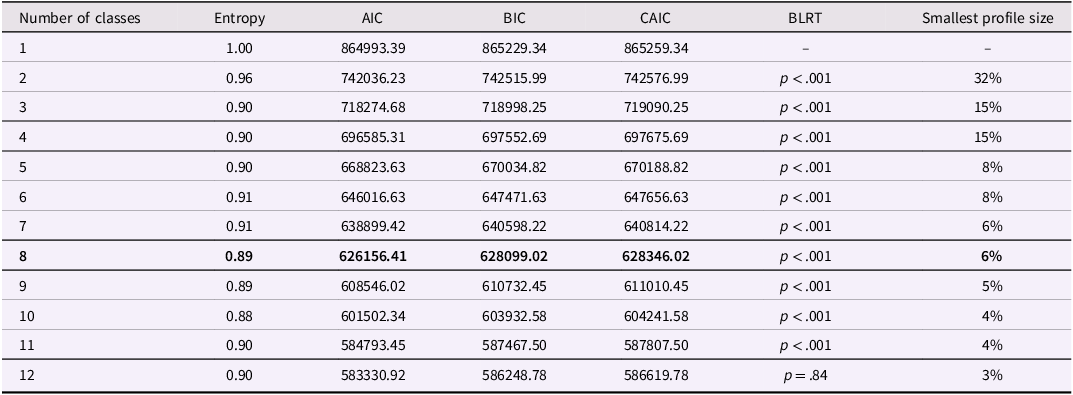
LPA models were run with 1–12 latent profile solutions. LPA model fit was assessed using Bayesian information criterion (BIC), Akaike information criterion (AIC), and consistent AIC (CAIC), and bootstrap likelihood ratio tests (BLRT) were conducted to assess improvements in model fit. In addition, we considered profile size and interpretability when selecting our final LPA model (Lanza et al., Reference Lanza, Flaherty, Collins, Schinka and Velicer2003). Table 1 includes fit indices for all profile solutions. Fit indices continued to improve throughout the models, and BLRT results indicated a statistically significant improvement in fit through the 11-profile model. When assessing profile size, the 10, 11, and 12 profile solutions produced profiles that consisted of less than 5% of the sample, raising concerns for power when examining the impact of profile membership on adolescent outcomes. The eight and nine profile solutions were very similar in terms of fit and sizes of the profiles; however, the eight profiles produced by the eight-profile solution seemed to be more distinct and well differentiated than the nine-profile solution. The nine-profile solution provided an additional profile that was very similar to one profile in the eight-profile solution with the only difference being a slightly different neighborhood deprivation mean score (i.e., deprivation decile in one profile was 6.67 at 9 months and 7.09 in the other profile). Because of the distinctness in profiles produced with the eight-profile solution, ease of profile interpretability, and the comparability of fit indices of the profile solutions, we elected to select the more parsimonious eight-profile solution as our LPA model.
Fit indices for models one through twelve

Note: The eight-profile model was selected.
Selected model – eight latent subgroups of adversity
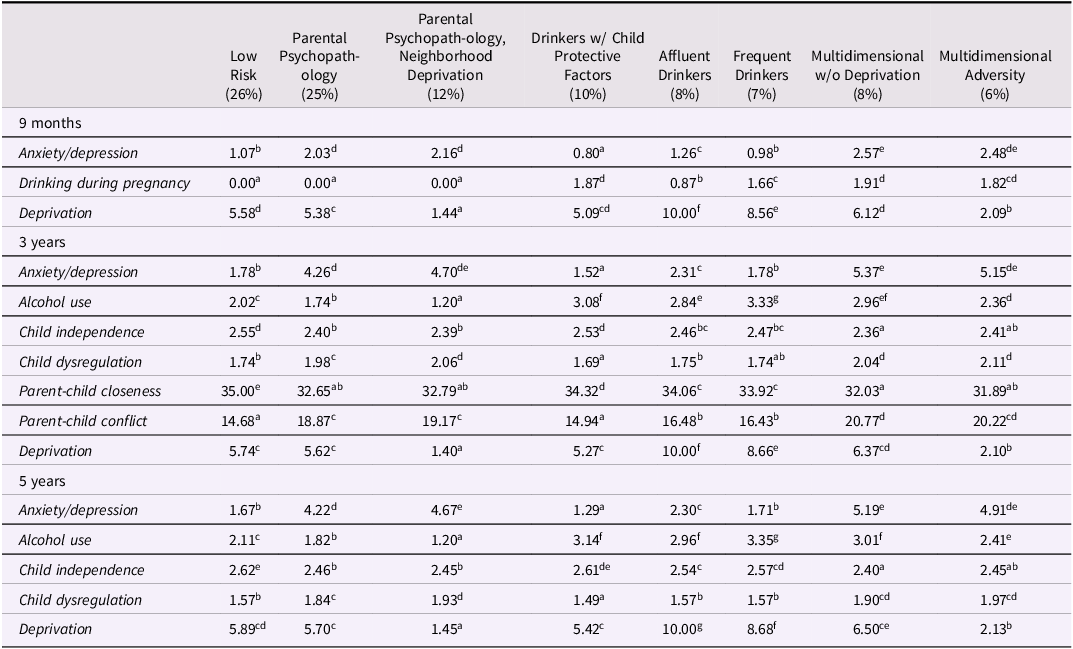
Latent profiles were named based on their unique patterns of adversity and protective factors and included: Low Risk (26% of the sample; Table 2), Parental Psychopathology (25%), Parental Psychopathology and Neighborhood Deprivation (12%), Drinkers with Child Protective Factors (10%), Affluent Drinkers (7%), Frequent Drinkers (7%), Multidimensional Adversity without Deprivation (8%), and Multidimensional Adversity (6%). The Low Risk profile demonstrated a lack of adversity, had close and non-conflictual parent-child relationships, and children had high levels of self-regulation at 3 and 5 years old. The Parental Psychopathology and Parental Psychopathology and Neighborhood Deprivation profiles were similar in their elevated levels of parental anxiety and depressive symptoms but differed dramatically in the mean score of decile deprivation. Three profiles were characterized by more frequent drinking both in pregnancy and when the child was 3 and 5 years old, but average or low mean scores on other indicators of adversity. The first of these profiles, Drinkers with Child Protective Factors, had higher levels of drinking but close, non-conflictual parent-child relationships and high child self-regulation. The Affluent Drinkers profile also had high levels of drinking across time points but had higher scores on the decile deprivation score than all other profiles. Parents from the Frequent Drinkers profile had significantly higher scores than all other profiles in how frequently they drank when their children were 3 and 5 years old. Finally, two profiles demonstrated an accumulation of adversity across dimensions, but differed from one another in neighborhood deprivation. Families from the Multidimensional Adversity without Deprivation profile were likely to fall into a higher decile (ranged from 6.12–6.50 across time points), whereas families from the Multidimensional Adversity profile had the second lowest score on neighborhood deprivation decile (ranged from 2.09–2.13).
Eight latent profiles of multidimensional childhood adversity
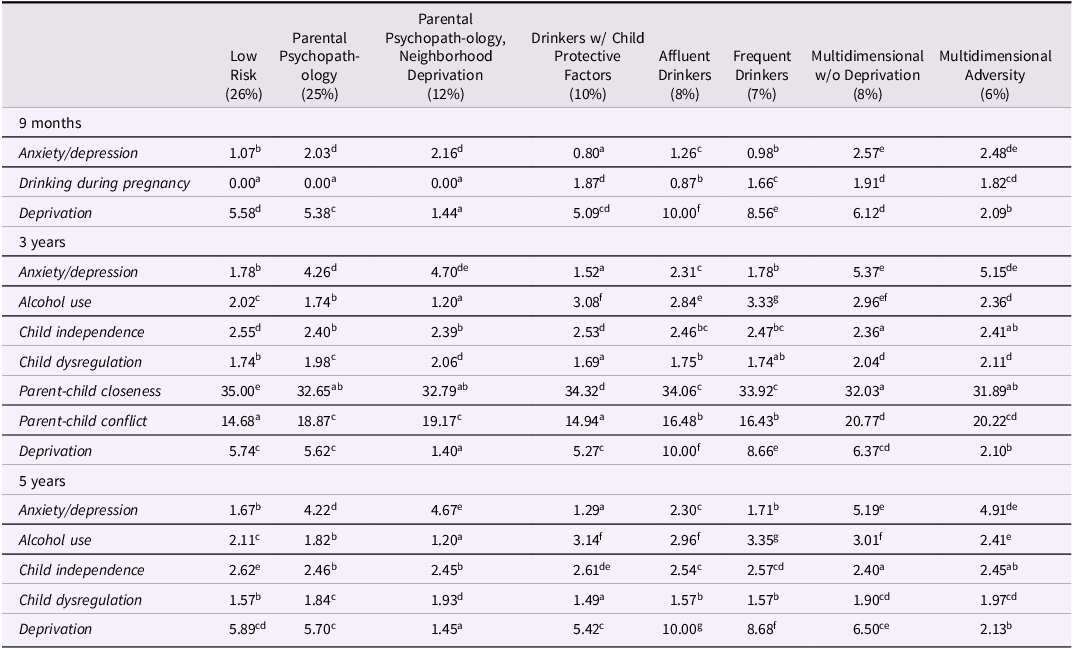
Note: Profile means with differing subscript letters differ significantly (e.g., if both profiles have an “a” in their subscript they do not differ; p < .05).
Adolescent outcomes
Participants were weighted to the eight latent profiles, and weighted regressions were conducted using the BCH approach with profile membership predicting adolescent outcomes with the Low Risk profile as the reference group and child’s sex and race and ethnicity included as covariates. In all analyses, latent profile was a significant predictor of our adolescent outcomes (all p < .001) indicating that profiles differed significantly from one another on adolescent psychosocial and behavioral challenges (14-year-old emotional symptoms: Wald = 442.75, peer problems: Wald = 462.34, hyperactivity/inattention: Wald = 623.22, smoking: Wald = 71.46, heavy episodic drinking: Wald = 20.19, antisocial behaviors: Wald = 39.35; 17-year-old emotional symptoms: Wald = 60.10, peer problems: Wald = 246.09, hyperactivity/inattention: Wald = 44.83, smoking: Wald = 38.07, heavy episodic drinking: Wald = 108.18, antisocial behaviors: Wald = 10.10).
Psychosocial outcomes
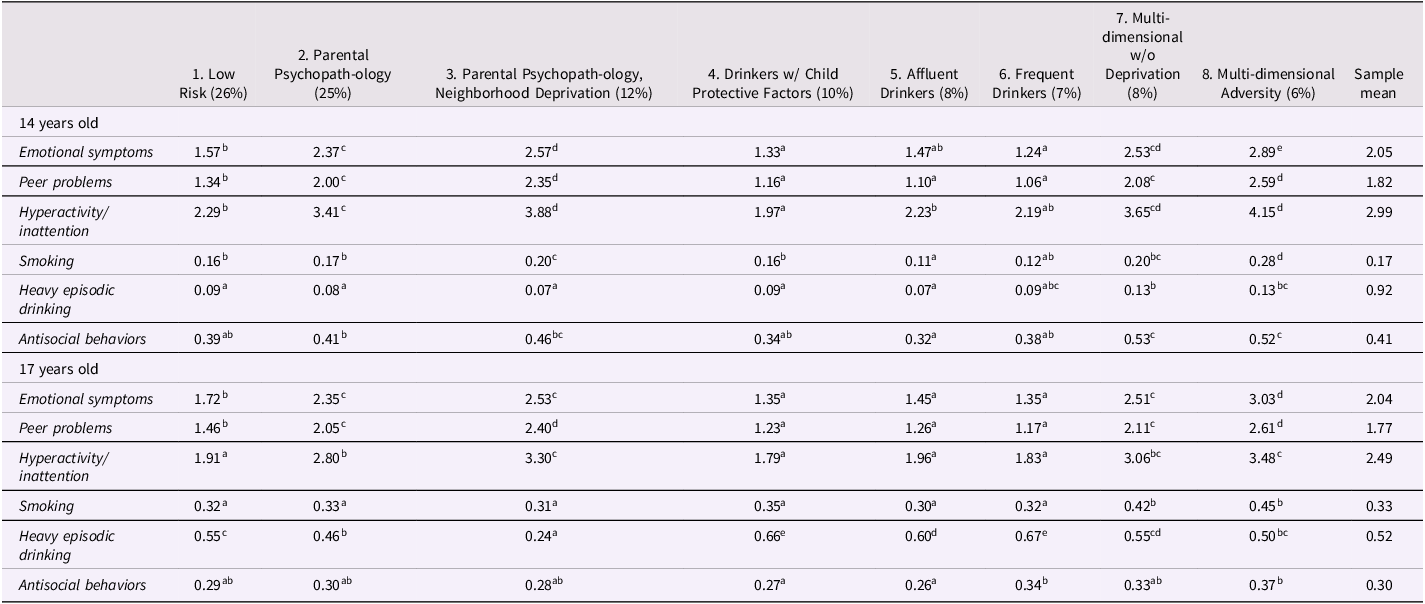
At age 14, the highest mean scores on emotional symptoms, peer problems, and hyperactivity/inattention fell within the Multidimensional Adversity profile, followed by Parental Psychopathology and Neighborhood Deprivation, and Multidimensional Adversity without Deprivation profiles (Table 3; differing subscript letters indicate profiles differed significantly from one another). All three of these profiles had significantly higher scores on emotional symptoms, peer problems, and hyperactivity/inattention than all other profiles. In addition, the Multidimensional Adversity profile had significantly higher rates of emotional symptoms than adolescents from the Parental Psychopathology and Neighborhood Deprivation, and Multidimensional Adversity without Deprivation (which were statistically comparable to one another) and the Multidimensional Adversity and Parental Psychopathology and Neighborhood Deprivation profiles had significantly higher levels of peer problems than the Multidimensional Adversity without Deprivation profile. After these three profiles, the highest rates of emotional symptoms, peer problems, and hyperactivity/inattention at age 14 fell within the Parental Psychopathology profile, which was statistically comparable to scores in the Multidimensional Adversity without Deprivation profile.
Latent profile means on adolescent psychosocial and behavioral outcomes
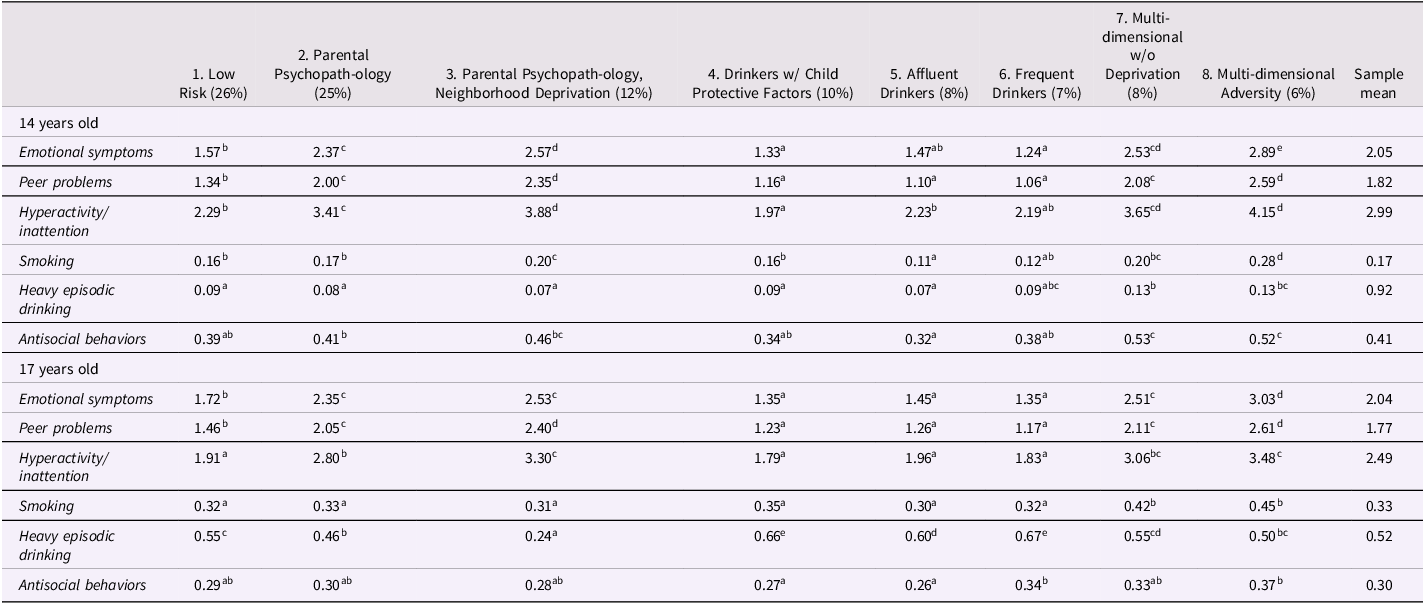
Note: Profile means with differing subscript letters differ significantly (e.g., if both profiles have an “a” in their subscript they do not differ; p < .05); higher mean scores indicate higher levels of the outcome (e.g., higher mean antisocial behavior score indicates participant engages in more antisocial behaviors).
As was the case at age 14, the Multidimensional Adversity profile had the highest mean scores on emotional symptoms, peer problems, and hyperactivity/inattention at age 17 followed by the Parental Psychopathology and Neighborhood Deprivation, Multidimensional Adversity without Deprivation, and Parental Pathology profiles (Table 3). Adolescents from the Multidimensional Adversity profile had significantly higher scores on emotional symptoms at age 17 than adolescents from all other profiles. Seventeen-year-olds from the Parental Psychopathology and Neighborhood Deprivation, Multidimensional Adversity without Deprivation, and Parental Pathology profiles did not differ significantly from one another and had significantly higher emotional symptoms scores than all other profiles. Adolescents from the Multidimensional Adversity and Parental Psychopathology and Neighborhood Deprivation profiles had significantly more peer problems at age 17 compared to all other profiles (these profiles had statistically comparable means), followed by the Multidimensional Adversity without Deprivation and Parental Pathology profiles, which did not differ from one another and had significantly more peer problem than the remaining profiles. At age 17, adolescents from the Parental Psychopathology and Neighborhood Deprivation, Multidimensional Adversity without Deprivation, and Multidimensional Adversity profiles had comparable scores on hyperactivity/inattention and were significantly higher than nearly all other profiles (the only exception was a non-significant difference between the Parental Psychopathology and Multidimensional Adversity without Deprivation profiles).
Behavioral outcomes
At age 14, approximately 28% of the Multidimensional Adversity profile reported smoking, which was significantly higher than all other profiles (Table 3). This was followed by the Parental Psychopathology and Parental Psychopathology and Neighborhood Deprivation profiles (both 20%). The lowest rates of smoking fell in the Affluent Drinkers (11%) and Frequent Drinkers (8%) profiles. The highest rates of heavy episodic drinking fell in both multidimensional risk profiles (both 13% and significantly higher than all other profiles) with the lowest rates falling in the Parental Psychopathology and Parental Psychopathology and Neighborhood Deprivation and Affluent Drinkers profiles (both 7%). Finally, the mean score of antisocial behaviors was greatest in the Multidimensional Adversity without Deprivation and Multidimensional Adversity profiles (significantly higher than nearly every other profile), followed by the Parental Psychopathology and Neighborhood Deprivation and Parental Psychopathology profiles.
At age 17, the highest rates of smoking once again fell in the Multidimensional Adversity profile (45%; Table 3) but this profile no longer differed significantly from the Multidimensional Adversity without Deprivation profile (42%; multidimensional profiles were significantly higher than all other profiles). All other profiles demonstrated a fairly comparable level of smoking (i.e., profiles ranged in smoking rates from 30%–35% with few significant differences). The three “drinking” profiles had the greatest likelihood of adolescent heavy episodic drinking at age 17, with 67% reporting heavy episodic drinking in the Frequent Drinkers profile, 66% in the Drinkers with Child Protective Factors profile, and 60% in the Affluent Drinkers profile. By far, the lowest rates of heavy episodic drinking fell within the Parental Psychopathology and Neighborhood Deprivation profile (24%). Finally, the highest mean scores of antisocial behaviors fell within the Multidimensional Adversity, Frequent Drinkers, Multidimensional Adversity without Deprivation, and Parental Psychopathology profiles which did not differ significantly from one another.
Discussion
Utilizing data from a UK birth cohort study, our research investigates the complex interplay of early childhood adversity and protective factors, specifically focusing on parent-child relationships and child self-regulation. Adopting a bioecological approach to examining early childhood adversity through the incorporation of neighborhood deprivation as a distal form of adversity, along with protective factors, served a dual purpose. First, it enabled the presentation of a more comprehensive representation of how early childhood adversity and protective factors cluster together. Second, it facilitated the differentiation of groups with similar adversity profiles. For example, the inclusion of a neighborhood deprivation indicator proved invaluable in distinguishing different subgroups of children experiencing adversity. It was particularly effective in differentiating those within parental psychopathology profiles, parental drinking profiles, and multidimensional adversity profiles. These distinctions provide critical insights into tailoring interventions and policies aimed at children with specific early life experiences. Beyond characterizing these profiles in early childhood, we extended our analysis to investigate their associations with psychosocial and behavioral outcomes in middle and late adolescence. Our goal with these analyses was to generate relevant information that can aid in the development of early prevention programs and policy changes that support children with distinct profiles, ultimately improving their long-term well-being.
Unpacking unique models of adversity
The cumulative risk model posits that the accumulation of multiple risk factors has a more detrimental effect on child development than any single risk factor alone (Smith & Pollak, Reference Smith and Pollak2021). This model is supported by our findings that increased exposure to various forms of early adversity correlates with higher risks of negative outcomes in adolescence, including psychosocial and behavioral problems. Evidently, children characterized by the Low Risk profile exhibited significantly lower risks for psychosocial and behavioral problems during both middle and late adolescence. In contrast, children with multidimensional risk profiles demonstrated the highest risk for psychosocial and behavioral problems in these developmental stages. Our identification of unique combinations of adversity profiles supports the cumulative risk model by highlighting the compounded impact of multiple adversities. This underscores the importance of considering the quantity and variety of adverse experiences when assessing long-term developmental outcomes. However, it is important to note that the cumulative risk model did not tell the complete story. Our results revealed that specific early childhood adversity combinations had unique impacts on outcomes during adolescence. For instance, children exposed to parental psychopathology were particularly vulnerable to developing psychosocial issues in middle adolescence, and these effects persisted into late adolescence. This aligns with prior studies highlighting that parental psychopathology significantly increases the risk of internalizing and externalizing problems in children (Connell & Goodman, Reference Connell and Goodman2002; Xerxa et al., Reference Xerxa, Rescorla, van der Ende, Hillegers, Verhulst and Tiemeier2021; Zhang et al., Reference Zhang, Lee, White and Qiu2020). Various mechanisms can explain this intergenerational transmission of psychopathology, including genetic contributions, modeling of maladaptive affect, cognition, and behavior by parents, and an increased likelihood of exposure to environmental stressors (Goodman et al., Reference Goodman, Brand, Hersen and Gross2008; Goodman & Gotlib, Reference Goodman and Gotlib1999).
Children with profiles characterized by elevated risk of parental alcohol use (i.e., Drinkers with Child Protective Factors, Frequent Drinkers, Affluent Drinkers, Multidimensional Adversity without Deprivation, Multidimensional Adversity) showed increased risk for heavy episodic drinking in both middle and late adolescence. Heavy episodic drinking represents a pressing public health concern and has been linked to a bevy of long-term negative outcomes including alcohol dependence (Silins et al., Reference Silins, Horwood, Najman, Patton, Toumbourou, Olsson, Hutchinson, Degenhardt, Fergusson, Becker, Boden, Borschmann, Plotnikova, Youssef, Tait, Clare, Hall and Mattick2018), substance use disorder (Fortier et al., Reference Fortier, Whitworth, Fonda, Currao, Beck, Levin, Esterman, Milberg and McGlinchey2021), depression and anxiety (Berg et al., Reference Berg, Kiviruusu, Lintonen and Huurre2019), cancer, and cardiovascular disease (WHO, 2018). Several potential pathways have been proposed to explain the association between parental alcohol use and adolescent drinking behaviors. In addition to genetic factors, parents with alcohol misuse may exhibit more inconsistent parenting behavior, lower levels of parental monitoring, and provide less support to their children (King et al., Reference King, Keyes, Malone, Elkins, Legrand, Iacono and McGue2009; Saraceno et al., Reference Saraceno, Munafó, Heron, Craddock and Van Den Bree2009). These factors can lead adolescents to seek support from their peers. Affiliation with deviant peer groups can result in early initiation of alcohol consumption and alcohol misuse (Yoon et al., Reference Yoon, Snyder and Yoon2020). Moreover, the alcohol expectancy theory suggests that parental alcohol misuse can serve as a model for shaping children’s alcohol expectancies (i.e., beliefs about the effects of alcohol consumption) and behaviors when they are exposed to alcohol. These expectancies can be reinforced once alcohol is consumed, promoting continued drinking behavior (Campbell & Oei, Reference Campbell and Oei2010; Montes et al., Reference Montes, Witkiewitz, Andersson, Fossos-Wong, Pace, Berglund and Larimer2017; Stephenson et al., Reference Stephenson, Heron, Bountress, Hickman, Kendler and Edwards2023).
Neighborhood deprivation as an indicator of risk
The bioecological model of development emphasizes the interaction between biological and ecological systems in human development (Shonkoff et al., 2012). This model underscores the necessity of considering multiple levels of influence, from the immediate family environment to broader societal factors. In our study, the incorporation of neighborhood deprivation as a distal form of adversity aligns with the bioecological model, demonstrating the multi-level influences on child development. This approach provides a comprehensive understanding of how early childhood adversities, occurring at different ecological levels, interact and contribute to developmental outcomes. Neighborhood deprivation did not appear to play a significant role in heavy episodic drinking as rates of drinking were comparable between the Parental Psychopathology and Neighborhood Deprivation and Parental Psychopathology profiles (Parental Psychopathology was statistically higher at age 17), and the same was true of the Multidimensional without Deprivation and Multidimensional Adversity profiles. In addition, children with three profiles characterized by an elevated risk of parental alcohol use (Drinkers with Child Protective Factors, Frequent Drinkers, Affluent Drinkers) all lived in less deprived or even the most affluent neighborhoods and they experienced significantly higher levels of heavy episodic drinking at the age of 17. This is consistent with existing research (Auld, Reference Auld2005; Costa-Font et al., Reference Costa-Font, Hernández-Quevedo and Jiménez-Rubio2014; Lewer et al., Reference Lewer, Meier, Beard, Boniface and Kaner2016), which suggests that higher socioeconomic status groups are more likely to report exceeding the lowest thresholds of regular heavy or high-intensity drinking.
Contrary to the association between drinking behaviors and neighborhood deprivation, children with profiles characterized by neighborhood deprivation (i.e., Parental Psychopathology with Neighborhood Deprivation and Multidimensional Adversity) were more likely to experiencesmoking behaviors than children within other profiles at the age of 14. This is consistent with existing findings that smoking appears to be disproportionately concentrated among the relatively poor (Auld, Reference Auld2005; Costa-Font et al., Reference Costa-Font, Hernández-Quevedo and Jiménez-Rubio2014). However, the effect of neighborhood deprivation on smoking somewhat attenuated at the age of 17, with children from other profiles increasing the likelihood of smoking and leveling or surpassing smoking probabilities of adolescents from the Parental Psychopathology with Neighborhood Deprivation profile. At both ages 14 and 17, adolescents from both multidimensional adversity profiles (i.e., those who did and did not experience neighborhood deprivation) reported elevated risk for adolescent smoking compared to their peers from other profiles increasing their risk for addiction and the development of numerous health challenges including cardiovascular disease (Ding et al., Reference Ding, Sang, Chen, Ballew, Kalbaugh, Salameh and Matsushita2019) and lung cancer (de Groot et al., Reference de Groot, Wu, Carter and Munden2018). When taken in concert, these results indicate that neighborhood deprivation may be more relevant for smoking in mid-adolescence (i.e., around age 14), but sustained risk for smoking falls within subgroups of adolescents experiencing an accumulation of adversity independent of neighborhood deprivation.
Protective factors
The inclusion of children’s self-regulation and parent-child relationships in our analyses not only allowed us to generate a better understanding of how adversity and protective factors can cluster together but also allowed us to also examine if protective factors can potentially offset the risk of specific adversity profiles. Consistent with previous findings (Branje et al., Reference Branje, Hale, Frijns and Meeus2010; Brody & Ge, Reference Brody and Ge2001; Zeman et al., Reference Zeman, Cassano, Perry-Parrish and Stegall2006), our results suggest that children’s self-regulation skills and parent-child relationship quality during early childhood are important factors that may reduce risk of the development of psychosocial issues during adolescence; adolescents with better self-regulation and closer, less conflictual parent-child relationships in early childhood (i.e., those from the Low Risk, Drinkers with Child Protective Factors, Affluent Drinkers, Frequent Drinkers) had better psychosocial outcomes in adolescence than adolescents from profiles with poorer self-regulation skills and less close, more conflictual parent-child relationships. This is meaningful as it indicates that while parental drinking has been shown to increase the risk for adolescent depression (e.g., Ohannessian, Reference Ohannessian2011), it can be offset through individual (i.e., self-regulation skills) and family-level (parent-child relationship quality) protective factors. This would also be consistent with previous studies that have suggested that it is not parental drinking per se that leads to adolescent internalizing challenges, but instead what often accompanies parental drinking (e.g., increased family conflict, poor adolescent-parent communication, adolescent drinking; Finan, et al., Reference Finan, Schulz, Gordon and Ohannessian2015; Ohannessian, Reference Ohannessian2011). Adolescents from the Drinkers with Child Protective Factors had surprisingly comparable psychosocial outcomes to adolescents from both the Affluent Drinkers and Frequent Drinkers profiles. These findings also appear to be in contrast with established research linking better early childhood self-regulation and higher-quality parent-child relationships with fewer psychosocial challenges later in life (e.g., Ranson & Urichuk, Reference Ranson and Urichuk2008; Robson et al., Reference Robson, Allen and Howard2020). While future study is warranted to unpack these results to a greater extent, it may be the case that once a certain threshold of self-regulation and parent-child relationship quality is met, there is no additional protective benefit beyond that threshold. All three parental drinking profiles had better child self-regulation and higher-quality parent-child relationships when compared to the multidimensional adversity profiles (which also had elevated rates of parental drinking in early childhood and pregnancy) as well as better psychosocial outcomes in adolescence. One possible explanation would be that while parental alcohol use in early childhood does incur greater risk for adolescent psychosocial challenges, this can be offset with above average children’s self-regulation and/or close, non-conflictual relationships but there is no additional benefit of high self-regulation, high closeness, and low conflict for psychosocial problems prevention. This may also explain why associations between parental drinking and adolescent psychosocial outcomes are inconsistent with some studies finding positive associations and others not (see Wickersham et al., Reference Wickersham, Leightley, Archer and Fear2020). It may be that only when parental drinking is combined with poor child self-regulation and low rates of parent-child closeness and high rates of parent-child conflict adolescents develop psychosocial problems.
Clinical and policy implications
Our study benefits from a nationally representative birth cohort, which enhances the generalizability of our findings, especially within the context of the United Kingdom and carries several important clinical implications. Firstly, results support the cumulative risk model, highlighting the need for a comprehensive approach to preventing childhood adversities. While individual and family-level interventions are crucial, it’s equally important to recognize that childhood adversities operate at multiple levels and interact with each other. Neighborhood deprivation plays a significant role in child development. Therefore, policies aimed at addressing neighborhood deprivation, such as interventions related to education, housing, living conditions, and crime, should be developed and implemented (Lloyd et al., Reference Lloyd, Norman and McLennan2023). The IMD can be utilized to identify areas in need and allocate resources effectively. Specific recommendations include investing in schools located in deprived neighborhoods to improve educational outcomes and provide support services for children and families. Additionally, developing affordable housing projects and improving living conditions can reduce the impact of poor housing on child development. Implementing community crime prevention programs can create safer environments, while enhancing access to healthcare services, including mental health support, can address health disparities in deprived neighborhoods. Understanding how neighborhood deprivation interacts with other adversities is also important to ensure effective prevention efforts and ensure all children receive the support they need.
Secondly, our findings reveal the unique impact of specific early childhood adverse events on adolescent outcomes. Parental psychopathology, for instance, has a distinct influence on adolescent psychosocial well-being. This underscores the importance of targeting prevention programs not only at children exposed toparental psychopathology to address their mental health and social functioning but also at parents with mental health issues. The developers of intervention programs should consider both parents’ and children’s psychopathology as well as parenting behaviors. A transdiagnostic approach, such as focusing on emotion regulation, can be especially beneficial for those dealing with psychosocial difficulties. For example, interventions like Cognitive Behavioral Therapy and Parent Management Training have been shown to be effective in reducing symptoms of parental depression and anxiety while simultaneously improving parenting practices and child outcomes (Everett et al., Reference Everett, Martin and Zalewski2021; Maliken & Katz, Reference Maliken and Katz2013). Similarly, parental drinking behaviors have a unique impact on adolescent heavy episodic drinking. Given that parents can model alcohol use behaviors and shape their children’s alcohol expectancies, early family-focused prevention of adolescent drinking is highly recommended (Bauman et al., Reference Bauman, Ennett, Foshee, Pemberton, King and Koch2002; Schor, Reference Schor1996). These prevention programs can be expanded to include not only education on the risks of alcohol use but also strategies for improving family dynamics and communication. Parents with heavy alcohol use can benefit from these prevention programs by receiving social support, resources, and education. Moreover, interventions should include components that help parents develop additional sources of social support and socialization for their children and adolescents. In addition, our results indicate that children living in deprived neighborhoods are more likely to initiate smoking early. As family-focused prevention has proven effective in addressing adolescent smoking behavior (Bauman et al., Reference Bauman, Ennett, Foshee, Pemberton, King and Koch2002), prevention programs in deprived neighborhoods, including psychoeducation and early screening for smoking behavior, can be effective. These programs should be complemented by broader policies aimed at improving neighborhood conditions, such as enhancing access to quality education, healthcare, and recreational facilities. These unique impacts also emphasize the importance of clinicians incorporating behavioral and emotional problem screenings as part of developmental checkups during annual visits (American Academy of Pediatrics, 2022).
Finally, it is essential to recognize that child self-regulation and the quality of the parent-child relationship during early childhood serve as important protective factors. Therefore, prevention programs should emphasize building strength and fostering resilience by enhancing child self-regulation skills and parent-child relationships. A wide range of interventions, including curriculum-based, mindfulness and yoga, family-based, exercise-based, and social and personal skills interventions, have been identified as effective in improving self-regulation in children and adolescents (see Pandey et al., Reference Pandey, Hale, Das, Goddings, Blakemore and Viner2018; Wyatt Kaminski et al., Reference Wyatt Kaminski, Valle, Filene and Boyle2008). For example, family-based interventions that include components such as parent training and parent-child interaction therapy can significantly improve self-regulation skills and parent-child relationships. Programs like Parent-Child Interaction Therapy have shown success in fostering these skills and relationships. Furthermore, school-based interventions that incorporate self-regulation training into the curriculum, such as the PATHS (Promoting Alternative Thinking Strategies) curriculum, can also be highly effective. These programs often include activities that help children practice self-regulation skills, such as mindfulness exercises, emotional regulation strategies, and problem-solving tasks. In addition, integrating physical activities and exercise programs, such as martial arts or high-intensity interval training, can enhance self-regulation by promoting physical health and mental well-being. Policy recommendations should focus on supporting these interventions through funding and resources. This includes providing training for educators and parents, creating community centers that offer family-based programs, and incorporating self-regulation training into early childhood education standards. By implementing these comprehensive strategies, we can build resilience in children and improve their long-term outcomes.
Limitations and future directions
The current study has a number of limitations that if addressed by future research can further aid our understanding of how unique combinations of childhood adversity lead to adolescent psychosocial and behavioral problems. First, while we attempted to select indicators of adversity and protection across multiple levels (e.g., individual, family, neighborhood), the chosen indicators are not an all-encompassing list of relevant adversities and protective factors occurring in early childhood. Future studies are still needed to continue to build our understanding of how different types of childhood adversity cluster together and predict adolescent psychosocial and behavioral problems. LPA models with different adversity measures (e.g., child maltreatment, parental incarceration) and protective factors (e.g., access to high-quality childcare, family cohesion) would produce different subgroups and may carry different implications for adolescent development. Similarly, while we included a variety of adolescent internalizing and externalizing outcomes, this was in no way was an exhaustive list.
While it may not be possible to include all measures of childhood adversity and relevant protective factors in a single LPA model (as well as adolescent outcomes), continuing to implement person-centered approaches with multiple adversities and protective factors predicting longitudinal outcomes will help build a more comprehensive understanding of how adversities accumulate within and across levels and what protective factors have the potential to offset risks. Second, while our LPA model and variability in outcomes provide support both for a cumulative model of adversity (e.g., between the Low Risk and Multidimensional Adversity profiles) and domain-specific adversities (e.g., adolescents with parents who drink being more at risk for heavy episodic drinking), we do not know the underlying causes of these adversities. For example, there may be unmeasured adversities (e.g., parental stress, parents’ own experiences with adversity) that are driving the latent profiles that would help explain why our LPA indicators clustered together in the current study. Third, while the longitudinal nature of the study is a strength, it is important to note that 9 years passed between our final set of LPA indicators and the first time point of adolescent outcomes. Naturally, a great deal has likely happened to families in the study. Families move, parents get divorced, children change schools, and child participants likely experienced different adversities and protective factors over time that may have impacted our results in undiscovered ways. For example, parents who struggled with alcohol use or depression when their children were in early childhood may have received support and are not facing the same struggles while their children are adolescents. Conducting LPA in adolescence and examining concurrent adolescent psychosocial and behavioral outcomes could generate stronger associations between subgroup membership and outcomes and help articulate differences in experiencing unique combinations of adversity early in life compared to in adolescence. Similarly, including life transitions and support services into statistical models may help clarify associations between early adversity and adolescent outcomes. Finally, while we can speculate on the mechanisms that led from latent profile membership in early childhood to a given outcome in adolescence (e.g., association with deviant peers leading to adolescent heavy episodic drinking), we did not examine these mechanisms through mediational models. Future work can build on the current study by testing relevant mediating variables (e.g., parental monitoring) at key time points to identify meaningful indirect effects from profile membership to adolescent outcomes. These models would be meaningful in helping to understand paths from early adversity to adolescent internalizing and externalizing behaviors.
Conclusion
This study uncovers distinct patterns of early childhood adversities and protective factors, shedding light on their influence on adolescent psychosocial and behavioral outcomes. The cumulative risk model is substantiated, emphasizing the necessity for tailored interventions and policies. Specific adversities, such as parental psychopathology and alcohol use, demonstrate unique impacts, and neighborhood deprivation also plays a significant role. These results highlight the importance of comprehensive prevention strategies that span multiple levels, from individual to community, to effectively support young children experiencing both cumulative and domain-specific adversity. By reinforcing the main takeaways, this study advances our understanding of early adversity and provides crucial insights for designing preventive interventions and policies. The implications are clear: targeted, multi-faceted approaches are essential to mitigate the long-term psychosocial and behavioral problems that can arise from early adverse experiences. This research offers a roadmap for clinicians, policymakers, and intervention developers to create robust support systems that promote resilience and well-being in children and adolescents affected by adversity.
Data availability
Millennium Cohort Study is available via the UK Data Archive. Further information about the study is found at https://cls.ucl.ac.uk/cls-studies/millennium-cohort-study/.
Acknowledgments
We would like to thank all individuals who participated in the UK Millennium Cohort Study for their valuable contribution to the study as well as all the study team members for their tremendous efforts in collecting and managing the data. The data presented here were provided by the UK Data Service.
Funding statement
ZZZ was funded through a T32 Fellowship from the National Institute of Child Health and Human Development [T32HD101390]. The content is solely the responsibility of the authors and does not necessarily represent the official views of the above funding sources.
Competing interests
None.