Latin American governments have increasingly turned to participation as a means of addressing the challenges posed by rising crime and insecurity for democratic rule and state capacity. In such contexts, citizens express decreasing support for democracy (Carreras Reference Verdú2013), decreasing trust in government and state institutions (Cruz Reference Alpert and Dunham2015), and decreasing trust in their own communities (Caldeira Reference Piotti2000; Dammert and Malone Reference Amengual2003). This article probes a subset of the policies enacted by leaders throughout Latin America to respond to citizen demands to improve security provision. Latin American leaders have pursued a range of security policies with the hope of building state capacity in security provision (Dammert and Bailey Reference Alves2005; Macaulay Reference Gallagher2012). Under what conditions do politicians enact reform that creates institutionalized spaces for community participation in policing and security?
This article argues that politicians choose participatory security strategically to serve a range of political interests. Participatory mechanisms allow politicians to disaggregate and decentralize societal discontent, acting as a “safety valve” to manage pressure for reform by improving the image of embattled politicians or police forces. Citizens may also be recruited to assist police in low-resource settings or to hold police accountable. This article argues that leaders are likely to turn to participatory institutions under two structural conditions: fractious police-society relations or low police capacity and resources. This variation in politicians’ objectives, in turn, leads to differences in institutional design.
This analysis seeks to elucidate the conditions that lead politicians to incorporate citizens in the provision of security, and why they may choose to do so in different ways. It draws on interview and archival evidence from police reform processes on two different administrative levels that have constitutional jurisdiction over policing: Buenos Aires Province, Argentina; São Paulo State, Brazil; and Colombia. It uses process tracing to investigate the origins of three types of participatory institutions and probe the strategic considerations that lead politicians to adopt particular models of participatory security.
The Puzzle of Participatory Security
Participatory security—institutionalized state spaces for community input, identification of problems, and generation of solutions regarding local security—varies widely in objectives, citizens’ powers, and state actors’ obligations. Participants in São Paulo’s community security councils (CONSEGs) were told that they were the “eyes and ears of the police” (González Reference Davis2016) and that their role was to “help” the police, not tell them what to do.Footnote 1 Accordingly, conseguianos routinely provided information that helped police repress unauthorized street parties (Anonymous 1, 2012). In contrast, the former minister of security of Buenos Aires Province detailed how “the oversight powers that we conferred to the community regarding the performance and functioning of their police forces” extended even to shaping decisions over police promotions (Arslanian Reference Arslanian2011).
The adoption of participatory security is puzzling from a number of perspectives. Police forces throughout Latin America are highly militarized institutions that have long considered crime prevention to be the sole domain of the police. As with any bureaucracy (Lipsky Reference Fuentes2010), police are protective of their “turf,” and their organizational culture can lead to resistance to intervention by “outsiders” (Alpert and Dunham Reference Arriola2004; Goldstein Reference Dammert and Malone1977). Accordingly, introducing a mechanism that brings society into local decisionmaking about security may generate considerable resistance among the police.
Participatory security is also puzzling because it may diminish politicians’ control over police. Politicians routinely deploy police to advance their objectives, whether it is to repress adversaries (Saín Reference Marwell2006) or to benefit favored constituencies (Holland Reference Eaton2015; Wilkinson Reference Restrepo Riaza2004). In exchange, politicians grant police “greater autonomy than other agencies of government that exercise much less authority” (Goldstein Reference Dammert and Malone1977, 134). Creating formal, routinized spaces where citizens engage with police officials introduces an additional principal actor to whom police must respond, probably disrupting this exchange relationship. How can we understand the adoption of participatory institutions in the context of a bureaucracy that may be especially inhospitable and capable of exercising effective resistance to it? Moreover, how can we explain variation in institutional design?
Scholars of participatory institutions and police reform emphasize the role of societal actors. Whether it is expressed through organized civil society, mobilization, or mass public opinion, “societal accountability” can be an important lever of policy change (Peruzzotti and Smulovitz Reference Lemoine2000). For instance, civil society pressure helped drive the emergence of participatory budgeting (Albert 2016). Scholars have also shown how civil society organizations (Fuentes Reference Chevigny2005) and outrage over police malfeasance (Hinton Reference Dewey2006; Ungar Reference Phillips and Trone2002), can shift politicians’ incentives toward or away from police reforms (Eaton Reference Barcellos2008).
Civil society mobilization, however, cannot explain the specific choice of participatory security. Participatory security is more likely to be a top-down policy response to politicians’ strategic incentives than the direct result of a bottom-up demand. As the case studies show, societal mobilization was a key catalyst for police reform in general, but there was little societal demand for participatory security in particular.
Civil society actors specializing in security may even avoid participatory security because it entails a complex entanglement with the state. A lawyer-activist with the Coordinadora Contra la Represión Policial e Institucional (CORREPI), an anti–police-brutality group, was emphatic about why they shunned Buenos Aires Province’s participatory forums: “We believe that these institutions of citizen participation, co-administration by the community and civil society organizations in the production of security policies are forms of co-optation and legitimizing repressive policies” (Verdú Reference Verdú2011). Other civil society actors in Buenos Aires similarly avoided participating. The Ministry of Security’s director of participatory security even had difficulty recruiting societal activists and security experts to participate in the forums and to staff her office.
Instead, organizations choose different modes of engagement with the state, depending on internal dynamics, such as membership-building strategies (Marwell Reference Goldfrank and Schneider2004), or, as with CORREPI, ideology. Studying sectorwide categorizations such as civil society strength or whether “pro-order” or “pro–civil rights” coalitions predominate (Fuentes Reference Chevigny2005) may be too blurry a lens for understanding how organizations engage with participatory security.
The participatory democracy literature offers other potential explanations for the adoption of participatory security. Scholars have demonstrated, for instance, how the emergence of participatory institutions in Latin America results from the broader political context, including the onset of expansive policy reforms that mobilize broad reform coalitions (Mayka Reference Goldstein2013), and party competition and ideology (Goldfrank and Schneider Reference Dammert and Bailey2006). Yet participatory security has emerged both as part of broader reform (as in Colombia and Buenos Aires Province) and as a single, one-off policy change (as in São Paulo State). Competition and ideology do little to account for participatory security, which has been adopted by governments of various ideologies (Venezuela and Colombia), and under weak (São Paulo) and robust competition (Colombia and Buenos Aires).
This article builds on rich scholarship on policy and contestation at the nexus of state and society, as both struggle to address security challenges. Scholars have shown how societal actors help overcome deficiencies in the judicial response to crimes (Gallagher Reference Cruz2017) and police violence (Brinks Reference Perelman2008), ensure police compliance with local security policies when mayors lack jurisdiction over police (Moncada Reference Hinton2009), or build networks with criminal and state actors to cope with violence (Arias Reference Bresser-Pereira2006). In contrast to these informal modes of engaging security institutions, this article explores why politicians sometimes create formal spaces for citizens to shape state security policies.
This question is of particular relevance today, as participatory security becomes part of a foreign aid agenda focused on the “resilience” of communities ravaged by violence (Davis Reference Arslanian2012; Shirk et al. Reference Moncada2014). Through an analysis of institutional origins, this study provides a framework for future research on policy, security, and “resilience.” As participatory security is adopted in new contexts and in light of new security challenges, it is worth asking how these participatory institutions interact with complex realities, such as the growth of organized crime, which challenges the state’s monopoly on violence. This analysis also invites questions about what the origins of different participatory models, which vary in their degree of inclusiveness, tell us about how to address security challenges amid other forms of social inequality and exclusion in the region.
The study also contributes to research that probes politicians’ incentives to explain policy change in response to violence. Flom and Post (Reference Camacho2016) show how politicians’ incentives to avoid societal blame can explain both the stability of criminal justice policy and the volatility of police reform. It also examines counterintuitive policy choices, elucidating the incentives underlying a policy that may contravene politicians’ interests.
This article also contributes to the participatory democracy literature by showing how a normatively appealing response to the crime and violence afflicting Latin Americans is actually a strategic choice by politicians to decentralize societal discontent. It shows how two structural conditions, bureaucratic capacity and resources and the bureaucracy’s relationship to society, can shape institutional design. This framework may be useful for understanding variation in participatory institutions in other policy areas.
Why Leaders Adopt Participatory Security
As with participatory budgeting (Goldfrank and Schneider Reference Dammert and Bailey2006), politicians’ incentives are key drivers of the adoption of participatory security. Participatory security entails the risks of police resistance and disrupting politicians’ control over the police. But when politicians face broad pressure to reform the police, participation is a strategic choice that allows them to solve three political problems. Procedurally, for politicians and police facing broad societal outrage, participatory security provides a “safety valve” to manage pressure and discontent. Substantively, participation can help politicians address fractious police-society relations and compensate for low capacity and resources.
Participation also can function as a safety valve for politicians facing pressure to enact police reform. All reforms present a host of challenges and may yield benefits only in the medium or long term. Yet leaders need a mechanism in the short term to address broad outrage over the police force they ostensibly control. Participatory security can provide such a mechanism by bringing societal critics into an institutionalized space to channel grievances through the state rather than outside it. Crucially, it also decentralizes grievances to local police stations rather than to the mayor, governor, or president.
Due to the costs of police reform, arguably, politicians are most likely to make use of the safety valve that participation provides when they face one of two structural problems: fractious police-society relations or low police capacity and resources. “Police-society relations” refers to the degree of trust in police—including the level of discretion and benefit of the doubt granted to police—and perceptions of police competence among most of society. Police capacity and resources are material, human, and financial, along with organizational specialization and territorial coverage.
These conditions are conducive to an urgent political problem for politicians, that of “legal cynicism.” Where police are distrusted and viewed as incapable of protecting citizens from crime, citizens are less likely to believe in the legitimacy of the law and social norms (Sampson and Bartusch Reference Mayka1998). This not only poses problems for order and governability; it can also undermine citizens’ confidence in the broader political system (Carreras Reference Verdú2013; Cruz Reference Alpert and Dunham2015). Leaders will therefore seek remedies to mitigate these problems.
When police-society relations are fractious, the police may not be trusted to carry out needed reforms on their own. Community participation may therefore be used to improve the police’s image and rebuild societal trust in the short term. This reasoning rests on the principle of procedural justice, whereby “procedures are viewed as fairer when they vest process control or voice in those affected by a decision” (Lind and Tyler Reference Fraga1988, 208). Such reasoning was a key driver of citizen oversight mechanisms adopted in police forces throughout the United States following widespread allegations of misconduct, in order to rebuild societal trust (Department of Justice n.d.; Phillips and Trone Reference Lemoine2002). More generally, scholars have understood participatory institutions as a means of addressing eroding citizen trust in traditional representative institutions (Selee and Peruzzotti Reference Mingardi2009).
Participation may also appeal to politicians in settings with low police capacity and resources, recruiting citizens as “fire alarms” (McCubbins and Schwartz Reference González1984) to help police identify and address problems. In this view, communities—through citizens’ local knowledge, networks, and information—become a resource that can be leveraged to overcome resource and capacity deficiencies. The former director of community relations at the Ministry of Security of Buenos Aires justified the need for community participation in security in precisely these terms: “Developing countries like ours don’t have sufficient resources, so that requires us to have an entire system of association with communities that allows us … to implement our policies” (Sánchez Reference Sánchez2011).
A Typology of Participatory Security
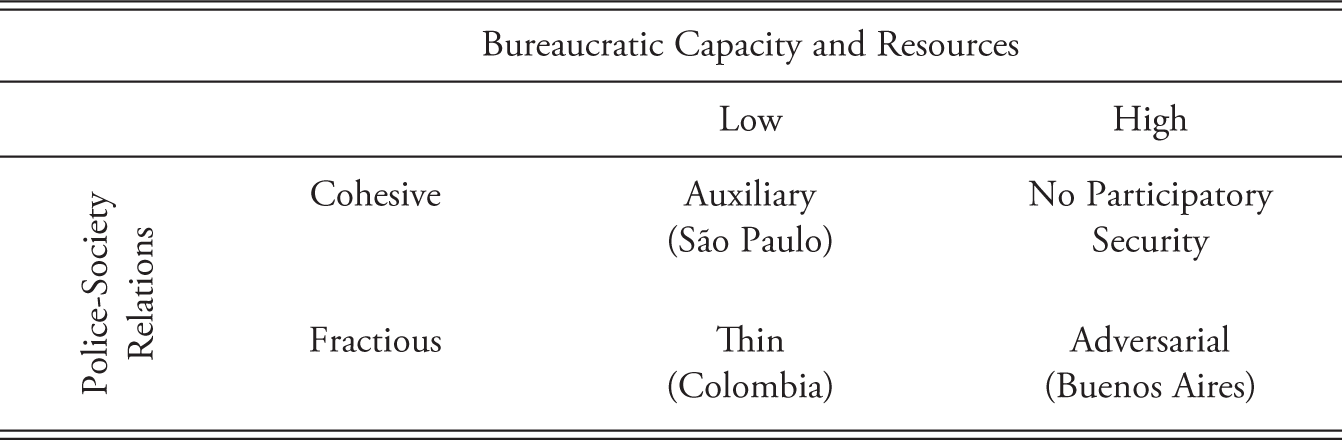
The interaction of these two variables will pose different problems for politicians, which may be best addressed by different participatory mechanisms. This study proposes a typology of participatory security, summarized in figure 1, based on the interaction of police-society relations and police capacity and resources. Depending on whether police-society relations are fractious or cohesive and whether police capacity and resources are low or high, we are likely to observe one of three types of participatory security—thin, auxiliary, or adversarial—or no participatory security. Participatory security differs along three dimensions of institutional design: inclusiveness of participation, authority granted to societal actors, and obligations imposed on police or state actors.
The Institutional Design of Participatory Security

Where relations are fractious, police are distrusted and viewed as incompetent by society, and will probably be suspicious of efforts to bring citizens into previously internal processes. Police may seek to limit participation and to ensure that societal actors are not granted meaningful authority to control police behavior. Where police-society relations are largely cohesive—most of society trusts police and views police as competent—police will expect to face supportive audiences, making formal restrictions on participation less likely. Oversight authority may also be unlikely because citizen oversight mechanisms for police are typically adopted to rebuild societal trust. If most of society trusts the police, politicians have little incentive to cede even minimal control over the police through formal institutions that allow societal actors to hold police accountable.
The institutional design of participatory security will also depend on police capacity and resources. As argued above, when politicians face widespread pressure to reform the police, participation can be an attractive option for compensating for low capacity and resources. Where resources and capacity are high, however, politicians are unlikely to view such “fire alarms” as necessary. Police capacity and resources, however, may shape reformers’ assessments of the police’s ability to respond to societal demands. Participation generates expectations of state responsiveness; if such expectations are unmet, more societal discontent may follow. If police lack adequate resources and capacity to meet societal demands, politicians may seek, in turn, to impose few obligations on police and limit the tools available to citizens to enforce their demands.
Fractious police-society relations and low capacity and resources provide the strongest incentives to adopt participatory security. Because these two conditions may push design choices in opposite directions, the model that is chosen will depend on whether one, both, or neither condition holds. When police-society relations are fractious and police capacity and resources are low, thin participatory security is likely, as occurred during Colombia’s 1993 police reform. This model restricts participation, imposes few obligations on police, and grants little authority to citizens. Though fractious relations provide an incentive for participation and oversight, they also generate police pressure to restrict participation and limit the authority of citizens they view as hostile. Low capacity and resources may similarly lead politicians to limit citizens’ ability to enforce demands.
Alternatively, where police-society relations are cohesive but police capacity and resources are low, auxiliary participatory security is more likely. Like the thin model, the auxiliary form has few obligations for police and little authority granted to societal actors to enforce their demands, due to the lack of adequate resources and capacity to meet those demands. However, it is also broadly participatory, because politicians have an incentive to compensate for low capacity and resources by expanding participation, and police actors have little incentive to restrict participation if they enjoy overall societal trust. This model resembles São Paulo State’s CONSEGs, adopted in 1985.
Under fractious police-society relations and high police capacity and resources, leaders will probably choose adversarial participatory security. These two conditions describe a setting in which oversight is most desirable and is actually possible. Citizen oversight is a political solution for addressing discontent when society broadly loses trust in police and “becomes uncomfortable with law enforcement policing itself and may want more involvement in the process” (U.S. Department of Justice n.d., 3). As with thin participatory security, which also emerges under fractious relations, the police may exert pressure to restrict participation. However, this model imposes obligations on the police and grants oversight authority to citizens, since the police have the capacity and resources to meet societal demands. This form is characterized as adversarial because it positions citizens as a check on police through formal accountability mechanisms, which is what occurred with Buenos Aires Province’s neighborhood security forums, created in 1998.
Where police-society relations are cohesive and police capacity and resources are high, citizens may informally serve as an information resource for police and may even hold police accountable. But politicians have little incentive to create formal participatory security institutions in this context, since citizens may actually trust the police to “police itself,” and high-capacity police may have little need for a system of citizen fire alarms.
The following sections discuss the reform of the police of Buenos Aires Province, the military and civil police of São Paulo State, and the Colombian National Police. The methodological choice of two subnational cases within federal countries and one unitary country aims to achieve congruence between the police force and the political-administrative unit that controls it. Given the research question at the center of this analysis, the appropriate unit of analysis is the political-administrative level where politicians make decisions about police reform. This case selection also allows for greater generalizability of the argument under different institutional configurations. The analysis shows that the argument holds even in federal contexts, despite competition between different levels of government that may undermine police reform (Davis Reference Arias2006; Eaton Reference Barcellos2008). Substantively, the selected cases adopted participatory security in the 1980s and 1990s. Focusing on these “early adopters” minimizes potential confounders, such as foreign aid.
Reining in the Maldita Policía: Adversarial Participation in Buenos Aires Province
By the time Law 12.154 was passed, in August 1998, to reform the police of Buenos Aires Province, the police had come to be known as la maldita policía (Noticias 1996) due to extensive corruption, extralegal violence, and involvement in criminal activity. The highly ambitious reform overhauled education and training, increased functional specialization, created structures for greater civilian oversight of the police and security policy, and eliminated the police’s militarized and centralized command structure.
The law created foros vecinales de seguridad (neighborhood security forums) in each police precinct to “promote effective community participation in the design, implementation, and oversight of public security policies” (Art. 11). It granted citizens a broad set of authorities, including evaluating police performance, making proposals and requesting reports from local police, and collaborating in the implementation of local security plans (Art. 16). A related law (12.155) imposed obligations for police to “receive suggestions and proposals from, and provide reports” to the foros (Art. 14[j]).
These foros were a notable departure from prereform conditions; namely, “the absence of any mode or instance for community participation or intervention in public security issues” (Saín Reference Macaulay and Francis2002, 66). Participation, however, was limited to representatives of “nongovernmental community organizations and entities with recognized social participation” (Art. 14). These characteristics—restricted participation, societal oversight authority, and obligations for police—make the foros an adversarial model, since this form is designed to use societal actors as a countervailing force for holding police accountable. This approach was particularly attractive to reformers in Buenos Aires Province, due to the dramatically fractious relationship between police and society leading up to the reform and to the provincial police’s relatively high levels of capacity and resources.
Police-Society Relations
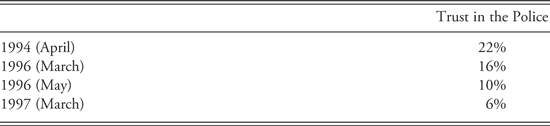
As table 1 illustrates, police-society relations in Buenos Aires Province were defined by distrust, with just 6 percent of respondents expressing trust in police before the reform. But police-society relations were fractious in many dimensions. Alberto Piotti, a former secretary of security, recalled hearing from officers that “my children hide my role as a police officer. Not for security reasons, but because of shame” (Piotti Reference Piotti2011). Society’s broad distrust of police even complicated the implementation of participatory security. Martha Arriola, the architect of the foros, noted that “when we began working with the community we first had to raise awareness about participation. Not even invite, simply raise awareness... we couldn’t even invite people because no one dared to participate” (Arriola Reference Arriola2011).
Societal Trust of the Police in Buenos Aires Province (1994–1997)

Responses to “Do you think [the police] are very trustworthy, trustworthy, barely trustworthy, not trustworthy?” “Trust police” combines “very trustworthy” and “trustworthy.”
Source: Surveys conducted by Estudio Graciela Romer y Asociados in the Greater Buenos Aires region. Survey data accessed via the Latin American Databank, Roper Center Public Opinion Archives, University of Connecticut.
Even sectors of organized civil society from the “pro–civil rights” coalition (Fuentes Reference Chevigny2005), which succeeded in mobilizing pressure for police reform, largely avoided the new participatory structures. Arriola, for instance, had difficulty recruiting civil society security experts to work in the Undersecretariat of Community Participation, due to their attitudes toward the provincial police: “Even putting together a team [to work here] was difficult, because no one wanted to work at the Ministry of Security, which was in the old police headquarters; no one wanted to set foot in the same building where the old police headquarters used to be.” Indeed, a lawyer-activist with CORREPI, the anti–police-brutality organization, was unequivocal in her rejection of the foros, which would bring citizens face to face with police: “we cannot sit down with the enemy to discuss [these things]. What are we going to say? ‘Give me 110 [volts] instead of 220 when you apply the picana [electric shock torture device]? Beat me with a softer billy club?’” (Verdú Reference Verdú2011). Police-society relations had eroded to such an extent that they were an obstacle to getting buy-in for participatory security from organized civil society.
The fractious relationship between police and much of society was also evidenced by perceptions of police incompetence and involvement in crime. According to a 1998 survey, only 37 percent of crime victims reported the crime to the police. Of those who did not report the crime, 30 percent said they did not report it because they did not believe the police would find the perpetrators, and 26 percent said the provincial police did not pay attention to people’s reports. Moreover, nearly a quarter of respondents associated police officers with crime, and 27 percent reported being more afraid of the police than of criminals (Fraga Reference Carreras1998).
Police Capacity and Resources
While Latin America does not have many high-capacity, high-resource police forces, the Bonaerense is relatively high in both. The distinction drawn by Taylor (Reference Paley2011) between routine (formal) and exceptional (discretionary, possibly extralegal) tasks is helpful in understanding this force’s bureaucratic capacity. The provincial police certainly has faced deficiencies and poor performance in its formal, routine role of crime prevention. But it is also characterized by a “perverse capacity,” demonstrating high levels of organization and efficiency in performing exceptional, generally extralegal, tasks (Dewey Reference Baiocchi, Heller and Silva2012). Luis Lugones, former civilian overseer of the provincial police, detailed this perverse capacity.
Some police commanders managed structures linked to a certain crime; for example, car theft or drug trafficking. There were police units dedicated to each issue and the commanders... turned [these units] into their own hunting reserve, their own fiefdom. The same thing happened with territorial jurisdictions. (Lugones Reference Lugones2011)
Thus, while the provincial police showed a high degree of territorial coverage and functional specialization, with distinct units focused on the most common or resonant crimes, police officials used this capacity not to prevent high-impact crimes but to facilitate and benefit from them.
The provincial police also can be characterized as high resource, particularly relative to the other police studied here. By the mid-1990s, the police of Buenos Aires Province had 36 police officers per 10,000 inhabitants, far more in relative terms than the Colombian and São Paulo police forces. Similarly, during the administration of Governor Eduardo Duhalde (1991–99), the provincial police received 7 to 10 percent of the provincial budget.Footnote 2
Indeed, instead of facing a lack of resources, the police force misallocated and misused its resources. During the reform period, a civilian security analyst found that thousands of officers were assigned to custodial duties instead of to crime prevention and that vehicles and other resources were “unused or poorly used” (Sigal et al. 1998, 86). With more than 47,000 members, the provincial police was also advantaged compared to other state agencies, such that the police compensated for those agencies’ limited resources and capacity. For instance, police routinely performed judicial and penitentiary duties, such as the investigation of crimes and the custody and transport of detainees (Saín Reference Macaulay and Francis2002, 95).
The Choice of Adversarial Participatory Security
Buenos Aires Province thus had fractious police-society relations and relatively high capacity and resources, which is why the reform process explicitly sought to employ citizens as a form of oversight. Lugones, a provincial legislator and leader of the civilian intervention with the police, emphasized that reformers sought to “find forms in which civil society could oversee the operations of the police” (2011). The foros achieved this in practice through a set of formal mechanisms that used citizens as a check on police. For instance, the foros’ surveys of police performance were used by the Ministry of Security in making promotion decisions, and “crime maps” created by the foros served as alternative sources of information about crime to assess police effectiveness during performance management meetings (Arslanian Reference Lugones2008, 221). Using societal actors to hold police accountable in these ways fulfilled the institutional objective of the foros, but also imperiled their durability by generating resistance within the police (González Reference Davis2016).
The province’s system of foros had other objectives, of course, including improving the police’s image. Arriola, former undersecretary of community participation in the ministry, said one objective of the foros was that police officers, “by taking the hand of their communities, could recover the prestige that they had lost” (2011). But a key motivator of participatory security was the need for greater oversight of police, not only by civilian experts but by civil society as well. Alberto Binder, one of the architects of the reform, explained the objective underlying societal participation.
If one of the fundamental aspects of the reform is to reduce the police’s autonomy and start a [civilian] governance of the police, we had to do so on two fronts. A group of 30, 40, or 50 civilians would not have been enough to establish adequate oversight of security policy by the Ministry [of Security]. [In order to do so], we also had to confront the police with community oversight at the same time. Both were basic tools of the civilian governance of security. (Binder Reference Binder2011)
While reform leaders saw participatory security as a way to solve the political problem facing the institution, organizations from the “pro–civil rights” coalition, such as CORREPI, were not invested in this approach. The Centro de Estudios Legales y Sociales (CELS), a prominent rights organization that was involved in the broader reform, was similarly disengaged. The coordinator of the group’s security and institutional violence unit told me that CELS did not work much on the foros (Perelman Reference Perelman2011). Indeed, CELS’s annual reports from 1998 and 2000 analyzing the reforms had just two sentences on the foros. While Argentina has a robust cadre of civil society organizations working on policing issues, participatory security did not result from the demands of civil society, as this was not a cause it chose to champion.
Auxiliary Participation as a Compromise in São Paulo State
In 1983, São Paulo State Governor André Franco Montoro, the state’s first democratically elected governor after two decades of military rule, sought to reform the military police and civil police, two violent and corrupt agencies complicit in the abuses of the dictatorship (Barcellos Reference Pardo Rueda1992). He removed corrupt officers, strengthened internal oversight, and sought to reduce police killings (Chevigny Reference Adorno1995, 153), but he quickly abandoned his plan because of strong police and societal opposition (Mingardi Reference González1992).
In 1985, Montoro created the Community Security Councils (CONSEGs) on the premise that “the participation of the public in cooperation with the police can contribute positively to achieving [order and security]” (Decree 23.455). The CONSEGs emerged from an encounter in Los Angeles between then–secretary of security Michel Temer, an LAPD captain, and a local resident. The police captain explained to Temer,
“I had to introduce you to [the resident] because he is part of the local security council in the neighborhood where I work, where I should currently be performing my duties, and so he may not understand why I’m at a café during happy hour at this time when I should be working in the neighborhood.” I thought, how interesting! [I asked,] “but how can he hold you accountable for that?” He says, “we have monthly meetings... and in the meeting he’s going to ask [why I’m not at work].”... I returned to São Paulo enthused with the idea. (Temer Reference Temer2012)Footnote 3
The advent of participatory security in São Paulo was thus a top-down response to the failure of deeper reforms. But despite its serendipitous origins, its institutional design was a strategic response to police-society relations and police capacity and resources.
São Paulo’s CONSEGs align with what I call auxiliary participatory security, defined by highly inclusive participation, little authority granted to societal actors, and few requirements placed on police officials. A few characteristics of their design are worth highlighting. The CONSEGs are open to any person residing or working in the local police district. Each CONSEG has an executive board composed of community members, but it has no formal authority to ensure police compliance with citizens’ demands. The only formal police obligation is that local commanders attend CONSEG meetings and submit meeting minutes to the Secretariat of Public Security.Footnote 4
Police Capacity and Resources
At the time of the transition to democracy, São Paulo’s military and civil police were characterized by low resources and low capacity. When Montoro took office, he did so “in the context of the biggest economic crisis experienced by Brazil in the last half-century, a crisis that has projected in a particularly adverse form in our state.”Footnote 5 These dire economic conditions were reflected in the state’s police forces. Indeed, a lieutenant colonel with the military police I interviewed spoke of the 1980s as “periods of misery, extremely poor indeed, such that [at times] we didn’t even have ammunition” (Anonymous 2, 2012).
São Paulo’s police forces lacked human and material resources in many respects. During the Montoro administration, there were approximately 21 military police officers and 7 civil police officers per 10,000 inhabitants, compared to 36 officers per 10,000 in Buenos Aires Province. Moreover, the police forces had just 1 police car per 10,000 inhabitants between 1983 and 1987. Meanwhile, between 1981 and 1984, only 1 percent of the state budget was designated for the police (this increased to 7 percent after 1985).Footnote 6
Police-Society Relations
Police forces in São Paulo, despite their low resources and capacity, enjoyed relatively cohesive relations with society. While relations were not without their tensions and divisions, during the period under analysis, citizens granted São Paulo’s police much greater benefit of the doubt and discretion than the other police forces studied here, and gave more positive evaluations. This study draws on data from a series of surveys from the 1990s to illustrate the degree of trust and discretion granted by societal actors.Footnote 7 Ideally, these data would precede the adoption of the CONSEGs, but such data are not available. As such, the discussion of these surveys is intended to be suggestive rather than definitive.
In contrast to the Buenos Aires provincial police’s seeming race to the bottom in terms of public trust, São Paulo citizens’ evaluations of their police were quite favorable. A 1990 survey on “political culture” asked citizens to assess the police on a five-point scale, from “very good” to “very bad.”Footnote 8 Whereas the Bonaerense was seen as untrustworthy by 92 percent of citizens, the São Paulo police was seen as “bad” or “very bad” by 41 percent of survey respondents. Meanwhile, 26 percent thought the police was “good” or “very good,” and 30 percent rated the police as “average.” While these are far from stellar approval ratings, they suggest a more cohesive relationship than the other cases studied here.
Citizens’ perceptions of competence, and the level of discretion granted to police, provide a fuller picture of police-society relations. According to a 1995 survey from Datafolha about the image of the police, 75 percent of citizens thought the police was effective at preventing and fighting crime.Footnote 9 Citizens also granted police considerable discretion in the use of force. When asked about the level of violence used by military police (PM), 44 percent said the PM was “more violent than it should be,” 35 percent said the PM was “violent to the right degree,” and 19 percent said the PM was “less violent than it should be.”
The São Paulo case lays bare the complexity inherent in police-society relations. Police are never without stalwart societal supporters, even where overall relations are fractious. Similarly, distrust and hostility toward police can be found in settings where relations are relatively cohesive. Surveys therefore mask the disparities that characterize police-society relations in São Paulo, and Brazil more broadly. Brazilians face great inequities in their relationship to state institutions generally (Fischer Reference Caldeira2008; Telles Reference Pardo Rueda2004) and coercive institutions in particular (Brinks Reference Perelman2008; Pinheiro et al. Reference Lind and Tyler1991), depending on characteristics such as race and class. I explore the implications of these disparities for preference formation, police reform, and democratic citizenship elsewhere (González Reference Davis2017). But it is worth noting the tension inherent in the relatively high approval of police among populations that bear the brunt of police violence in Brazil, a “paradox” examined at length by Caldeira (Reference Sánchez2002). The positive evaluations of the police by three-quarters of the population of the city of São Paulo certainly cut across race and class.
This paradox was also clear in patterns of civil society mobilization. Mingardi (Reference González1992) documents mobilization not only by business groups that opposed Montoro’s police reform efforts (115) but also by residents of the city’s low-income periphery who marched with banners proclaiming “down with human rights” (116). Indeed, Montoro administration officials reported “daily” visits from groups of citizens expressing opposition to Montoro’s reforms, which included removing the ROTA—the “police that kills” (Barcellos Reference Pardo Rueda1992)—from the periferia (Caldeira Reference Piotti2000, 171). Among them, Luiz Carlos Bresser-Pereira, Montoro’s secretary of government, noted,
Here in São Paulo, people from the periferia wanted more security, they wanted police... police on the streets. The history of [the police], that they were repressive, that they killed, all of that could be true, and it was true. But the concrete fact is that for them, the police was the meaning of security.... I remember a meeting where a community leader from a low-income neighborhood... [said] he was worried about the safety of his kids when they came home at night, and the only guarantee he had was the police. (Bresser-Pereira Reference Bresser-Pereira2012)
Montoro therefore rolled back his attempts to reduce police violence and corruption in the face of societal pressure that favored greater police autonomy and violence (Caldeira Reference Piotti2000; Chevigny Reference Adorno1995). Despite the troubling contradictions therein, the police of São Paulo State enjoyed relatively positive evaluations from most of society at the time of the CONSEGs’ creation. To speak of cohesive police-society relations in São Paulo during the 1980s and 1990s does not obscure the broader problems of disparities, police violence, and insecurity. The fact that most of society held these views is central to these broader problems and crucial to understanding why they are so difficult to solve.
The Choice of Auxiliary Participatory Security
The CONSEGs were perhaps an instance of political learning for Montoro. Following strong resistance from police, citizens, and the political opposition (Mingardi Reference González1992), Montoro rolled back his reform efforts and appointed Temer as his third secretary of security in nine months. In an interview, Temer recounted his more conciliatory tone: “I was able to really unify the two police forces. I achieved a good rapport with them.... I preached a lot about democracy, but democracy without radicalism, without any of that which would touch the police” (2012). The CONSEGs emerged in this context, and may be understood as a compromise, intended to promote “democracy without radicalism.”
But while participatory security followed the failure of other efforts to reform violent and corrupt police, the police’s low capacity and resources and relatively cohesive relationship to society were key drivers of its implementation and design. Because police officials knew they were trusted by a majority in society—which, in fact, mobilized in their favor to oppose Montoro’s reforms—they did not exert pressure to limit participation. With public meetings and inclusive participation, the CONSEGs were intended to open up a space for as many citizens as possible to attend and offer valuable information about local conditions so that police could distribute scarce resources more efficiently. But the CONSEGs did not have any authority to hold police accountable for how those resources were distributed (or anything else). Thus, the coordinator of the CONSEGs quoted above frequently reminded CONSEG leaders that “your role is help the police, not try to tell it what to do.” Indeed, according to Temer, this is how the CONSEGs were intended to function.
The person who participated [in the CONSEGs] came to understand, and the commanders of the military police and the civil police explained, [the police’s] difficulties. The people who participated would request this or that, and many times, I remember that many of the police cars that were sent to this or that neighborhood were done so based on those [CONSEG] meetings. (Temer Reference Temer2012)
This is a key difference between the models adopted in São Paulo and Colombia. The former sought broad participation, wherein communities could be leveraged as a resource to compensate for low capacity and resources, rather than the token participation in Colombia’s system. I argue that this difference emerged because, though both police forces had low capacity and resources, São Paulo’s police enjoyed relatively cohesive relations with society while Colombia’s was considerably more fractious.
While the analysis presented here is a story about institutional origins, we must ask how the CONSEGs, which continue to operate in most of the state to this day, interact with the increasing complexity of security challenges in São Paulo (Adorno Reference Adorno2013), including a powerful criminal organization that contests the state’s monopoly on violence (Willis Reference Rich2015). Moreover, we must also ask about the implications of participatory security for citizenship in a context in which race, class, and geography continue to determine relationships to the state and access to protection (Alves Reference Arslanian2013), such that marginalized populations in violent communities may seek to create their own participatory security spaces, often with glaring contradictions (Feltran Reference Caldeira2010).
Broad Reform and Thin Participatory Security in Colombia
Colombia’s National Police underwent comprehensive reform in the early 1990s, after more than a decade of rapid institutional decay. The National Police’s structure, territorial and functional specialization, educational system, recruitment standards, oversight mechanisms, hierarchy, and command structures came under strict scrutiny and underwent extensive changes through Law 62/1993. As in Buenos Aires, participatory security was an important component of the transformative policy package.
In the Colombian case, however, two conditions, fractious police-society relations and low police capacity and resources, led to the adoption of thin participatory security. I classify the participatory institution that emerged from Colombia’s 1993 reform, the National System for Citizen Participation in Security, as thin because it was characterized by institutional features that limited citizen participation, gave little authority to societal actors, and placed few restrictions or requirements on the police.
Colombia’s 1993 police reform law created “a national system of citizen participation that is institutionalized and decentralized with the objective of strengthening relations between the citizen and the Institution” (Law 62/1993, Art. 25). The National System of Citizen Participation was to consist of a series of commissions at the national, departmental, and local levels. The commissions were to be composed of the executive, police authorities, and—in a fairly tokenistic approach—a single representative from each of various social groups, including unions, business, indigenous and black communities, universities, and rural sectors, among others. The commissions had a broad set of functions: propose policies to improve crime prevention, promote citizen participation with the police, develop educational programs for the police, promote ethics and democratic values among the police, receive and channel citizen complaints about the police, promote the well-being of police officers, and suggest transparency policies (Art. 28).
Despite its broad mandate, the system of commissions can be characterized as thin. While the commissions invite societal participation, such participation is highly restricted, since it only allows for one representative from each of various broadly defined societal sectors. Furthermore, even though the majority of the commissions would, by design, be composed of societal actors, Law 62 gives no formal authority to the societal members of the commissions to exercise oversight of the police or enforce societal demands. In contrast, other members of the commissions are given formal authority over the police by other sections of Law 62; for example, mayors and governors can demand periodic reports and receive tools to influence promotions and other processes as a means of holding police accountable (Art. 16). Societal actors are provided no such instruments. Furthermore, whereas the law establishes clear obligations for police commanders in relation to mayors and governors (Art. 17), the law’s provisions make no formal requirements of police compliance with these participatory commissions.
The design of participatory security in Colombia thus placed important constraints on both the degree of oversight and the degree of support that citizens could provide to the police, and is therefore characterized as thin. This was the result of the fractious nature of police-society relations and the National Police’s low capacity and resources.
Police-Society Relations
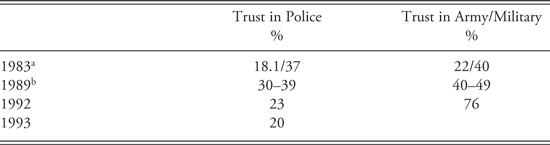
Police-society relations in Colombia in the 1980s and early 1990s were characterized by considerable distance between police and their communities, which were manifested as distrust, confrontation, and human rights violations; the perception that police were involved in crime; and the perception that police were inefficient and incompetent in protecting citizens from crime. As table 2 demonstrates, confidence levels in the National Police had been in steady decline since the 1980s. By 1993, only 20 percent of respondents expressed trust in the police. As Rafael Pardo, the minister of defense at the time, put it, the National Police “was coming from a generation of distrust, a perception of corruption, a lack of professionalism, [and] low internal morale” (Pardo Reference Pardo Rueda2012). Colombian citizens, then, were aware of the deficiencies plaguing the police.
Levels of Trust in the Colombian National Police and Military

a 18–25 years of age/above 25 years of age
b Data provided in ranges only. Responses to “Please tell me if you trust [the police]: Yes/No.”
Source: Lemoine Reference Lemoine1986, Reference Lemoine1993, Reference Lemoine1997
Another survey, conducted in 1992 in Medellín, asked respondents what they felt when in the presence of police; 41 percent said they felt “distrust and fear” (Restrepo Riaza et al. Reference Lipsky1994, 53). Citizens interviewed by the president’s Consultative Commission to Reform the Police expressed similar sentiments, telling commissioners that “police are as feared as the wrongdoer” (Presidencia de la República 1994). Many of these citizens denounced police involvement in crime, from robbery and assault to mafias and sicariato (hired killings). Some added that reports of crimes committed by police officers “fell on deaf ears,” while others feared retaliation. One commissioner wrote that citizens’ main complaint was police inefficiency in protecting them from crime (Camacho Reference Temer1993, 3).
Police Capacity and Resources
Citizens’ perceptions of police inefficiency coincided with the dire reality facing the National Police. By the early 1990s, the police force lacked sufficient training, capacity, and resources to address deteriorating urban security conditions, powerful drug cartels, and an internal armed conflict. Despite these urgent security challenges, only 2.5 to 3.5 percent of the country’s budget was dedicated to the National Police in the years before the reform (1990–93).Footnote 10
Furthermore, Colombia had just 26 police officers per 10,000 inhabitants. In contrast, Peru, which also faced an internal armed conflict during this period, had 35 officers per 10,000 inhabitants (Llorente Reference Galdeano Cruz1997, 24). Scholars and security experts also emphasize the lack of specialized skills for prevention and urban security (Camacho Reference Temer1993, 6) and the low salaries and precarious working conditions of most police officers (Restrepo Riaza et al. Reference Lipsky1994, 66). Meanwhile, news reports at the time documented the police’s unresponsiveness to reported crimes and their lack of resources, even quoting officers who had to “panhandle” for gas for their patrol cars (El Tiempo 1991, 1992).
According to the accounts of security officials at the time, the police’s protracted battle against drug cartels strained its resources and its capacity to perform its basic functions. Former minister of defense Rafael Pardo acknowledged that even intense recruitment efforts merely produced “a larger police force, without a sufficient command structure, [that was] more costly budgetwise, less well equipped per person, with less territorial coverage, and offering, in general, less security” (Pardo Rueda Reference Lemoine1996, 339).
An additional dimension of the police’s capacity was its low level of specialization, as reflected in its organizational structure. One of the few specialized units within the National Police, a judicial police created in the 1960s, was not made permanent until the 1991 Constitution. But even this rare specialized unit was highly deficient. A survey of judges in Antioquia Department asked them to evaluate the police’s performance in its judicial police role. More than three-quarters of the respondents said the police did not perform its functions or did so insufficiently (Restrepo Riaza et al. Reference Lipsky1994, 59).
The Choice of Thin Participatory Security
The inclusion of thin participatory security in the reform process was meant to address a problem that was a key object of concern for government officials and the members of the reform commission: abysmal police-society relations. In a speech to hundreds of officers shortly before the reform process began, Minister of Security Rafael Pardo emphasized the deterioration of societal opinion of the police.
It is not necessary to go out into the streets to interview citizens to know what they think of the police. You, who, on a daily basis, interact with the people in the cities and the countryside, know the situation all too well... no one suffers the discredit that characterizes the institution today more than you. (Presidencia de la República 1994, 22)
Meanwhile, in his remarks inaugurating the Consultative Commission, President César Gaviria emphasized the need for police to “find greater confidence and support among the citizenry” (Presidencia de la República 1994, 13) and declared that “the national government and all of Colombian society want and seek a Police that is firm in legitimacy and citizen support” (16).
But the adoption of participatory security was more a response to the needs of the national government than to the demands of society. Colombia’s police reform process entailed considerable civil society involvement through the Consultative Commission, which convened a diverse range of political and societal sectors to develop a reform proposal (Decree 591/1993) and traveled extensively around the country to collect testimonies from ordinary citizens. Yet the adoption of participatory security did not appear to emerge as a demand from civil society. According to María Victoria Llorente, an adviser to the Ministry of Defense at the time, “[The National System of Citizen Participation] originates from a notion that police should be responsive to the citizenry, that it has to connect with the needs of the citizenry... [but] the citizenry never demanded it. The mayors weren’t interested in it, nobody was interested in it” (Llorente Reference Llorente2012).
The system of thin participatory security adopted in Colombia in 1993 thus appears to have been a mechanism devised to solve a political problem, the police’s tarnished image. The police’s astonishingly low capacity and resources, meanwhile, probably constrained reformers’ expectations about the ability of the police force to meet societal demands, which may be why there was little emphasis on broadening participation, granting authority to societal actors, or imposing obligations on police officials. Indeed, this expansive system of participation was never even put into practice at all (Llorente Reference Galdeano Cruz1997). Whereas reformers in Buenos Aires Province and São Paulo State relied on the sound implementation of their respective participatory institutions to provide oversight of or assistance to police, leaders in Colombia perhaps achieved the short-term benefit provided by the safety valve of participatory security and saw little need to actually put this new institution into practice.
Conclusions
Participatory security is a normatively appealing institutional innovation that brings democratic processes to a bureaucracy typically plagued by authoritarian legacies and undemocratic practices. But it is also a policy choice driven by political incentives, based more on the need to solve a political problem than to address an urgent condition afflicting citizens and communities throughout Latin America. Participatory security entails contradictions (Paley Reference Jamal2001) and raises many questions about its implications for democratic citizenship and institutions. Depending on the gap between formal design and actual practice, participatory security has the potential to be highly transformative or largely cosmetic. Although identifying the conditions under which one or the other prevails is beyond the scope of this article, some initial questions offer avenues for future research.
On the one hand, while politicians create these institutions somewhat opportunistically, organized civil society and ordinary citizens may still utilize the institutions to improve state performance and responsiveness. The literature on participatory institutions has identified a range of positive outcomes for civil society, ordinary citizens, and state institutions. Scholars of comparative politics have long found that “state-society synergy” (Evans Reference Brinks1996) can help state agencies perform their functions, such as bolstering bureaucrats’ attempts to enforce labor regulations (Amengual Reference Binder2014) and providing oversight of local politicians to ensure faithful implementation of health policies (Rich Reference Llorente2013). Participatory institutions can also have a positive impact on civil society, shifting organized civil society away from clientelistic practices (Baiocchi et al. Reference Llorente2008). Are such outcomes possible in a policy area as fraught as security and a bureaucracy as powerful as the police?
On the other hand, it is also important to investigate how participatory security relates to other state and societal responses to crime and violence, particularly since it has become part of the policy packages recommended by international donors for building “community resilience” in violent contexts (Davis Reference Arslanian2012). Participatory security certainly represents a different institutional response to crime and violence from other common approaches in Latin America, including mano dura, “penal populism” reforms, and the trend toward militarization of security. Nevertheless, scholars have shown that social trust and social networks can reinforce authoritarian practices (Jamal Reference Evans2009; Satyanath et al. Reference McCubbins and Schwartz2017).
Thus, even as participatory security creates new spaces for the practice of citizenship as a means of reducing violence, crime, and fear, it may well serve as a “form of co-optation and legitimizing repressive policies,” as Verdú warns. It is important to assess the conditions under which participatory security fosters “resilience” or legitimates repression. This is particularly urgent in the case of São Paulo, where police enjoyed fairly cohesive relations with society despite the high levels of criminal and police violence to which its most marginalized citizens were subject. As Galdeano Cruz (2009) suggests, participatory security in São Paulo largely reproduces these patterns.
These different implications of participatory security call for greater nuance in the study of participatory democracy. Further research is needed to identify the conditions in which the laudable objectives of participatory security institutions can be achieved and those in which they are rendered cosmetic or repressive by social and political realities.