Implications
Halophytic forages are increasingly important for the livestock industry because saline land is increasing. Grazing halophytes could decrease productivity in ruminants because of the high salt intake. However, pregnant ewes adapt to high dietary salt through alterations in water intake and hormonal changes. Here we report that high-salt intake during pregnancy altered the foetal development of thirst and hormonal systems controlling salt and water balance. An increased capacity to manage high salt may improve performance when grazing halophytic plants, thereby offering potential to increase the profitability of grazing systems on saline land.
Introduction
Foetal programming is an adaptive response to stimuli or insult experienced during the foetal or perinatal life that is translated into long-term or permanent changes in the structure or function of the body (Martin-Gronert and Ozanne, Reference Martin-Gronert and Ozanne2006). Prenatal growth is sensitive to the direct and indirect effects of maternal dietary intake from the earliest stages of embryonic life (Wallace, Reference Wallace2000) and manipulation of maternal dietary intake can lead to behavioural (e.g. diet selection and intake; Curtis et al., Reference Curtis, Krause, Wong and Contreras2004) and physiological (e.g. renal function and the renin-angiotensin system; Arguelles et al., Reference Arguelles, Lopez-Sela, Brime, Costales and Vijande1996) changes of the offspring later in life. The renin–angiotensin system (RAS) is responsible for the maintenance of water and salt balance, with aldosterone controlling sodium retention and arginine vasopressin (AVP) controlling water reabsorption by the kidney.
In a previous study, we demonstrated that exposure to salt during pregnancy did not compromise the capacity of ewes to reproduce, but the consequences for their offspring were not known (Digby et al., Reference Digby, Masters, Blache, Blackberry, Hynd and Revell2008). Feeding diets with a high salt content to rats and cattle, during pregnancy or postnatally, has altered feeding behaviour of the offspring. In rats, increased acceptance of salty drinking water and an increase in the voluntary consumption of salty food have been found in offspring born to dams exposed to high salt (3% NaCl) during gestation and lactation (Curtis et al., Reference Curtis, Krause, Wong and Contreras2004) and in offspring whose tongues were exposed to a sodium chloride-enriched milk formula (85 mmol/l NaCl) during 7 to 8 days of postnatal development (Smriga et al., Reference Smriga, Kameishi and Torii2002). In cattle, calves born to dams receiving supplementary sodium (70 g NaCl per day) during the last 2 months of pregnancy had a higher appetite for sodium (Mohamed and Phillips, Reference Mohamed and Phillips2003).
In rats, an increase in salt appetite of offspring can be induced by extracellular dehydration during pregnancy (Nicolaidis et al., Reference Nicolaidis, Galaverna and Metzler1990). In this study (Nicolaidis et al., Reference Nicolaidis, Galaverna and Metzler1990), the dietary intake of the mother was not manipulated and the pups were not exposed pre- and/or postnatally to salt, so it is likely that the change in salt appetite was due to an alteration in the RAS. In rats, offspring whose mothers were exposed to 8% NaCl through gestation until weaning had an increase in angiotensin II, higher blood pressure and lower responsiveness of blood pressure to salt intake (da Silva et al., Reference da Silva, de Noronha, de Oliveira, Malheiros and Heimann2003) and they had an increased sensitivity to angiotensin II (Arguelles et al., Reference Arguelles, Lopez-Sela, Brime, Costales and Vijande1996). The origin of these alterations is thought to be due to a programming of the sensitivity of the RAS, mainly an up-regulation of the angiotensin II receptors in the foetus in response to low activity of the RAS in the mother (Arguelles et al., Reference Arguelles, Lopez-Sela, Brime, Costales and Vijande1996; Butler et al., Reference Butler, Pak, Midgely and Nemati2002). In pregnant ewes, aldosterone concentration is decreased nearly two-fold by consumption of a 13% NaCl diet (Digby et al., Reference Digby, Masters, Blache, Blackberry, Hynd and Revell2008) suggesting that the RAS of the lamb foetus could also be affected via endocrine changes of the pregnant ewe.
Furthermore, high salt consumption has been shown to regulate energy partitioning in sheep (Blache et al., Reference Blache, Grandison, Masters, Dynes, Blackberry and Martin2007) including a direct effect on insulin concentrations. We have recently found that high salt feeding during pregnancy is associated with changes in the circulating concentrations of insulin, leptin and thyroid hormones in the pregnant ewe (Digby et al., Reference Digby, Masters, Blache, Blackberry, Hynd and Revell2008). These changes may have effects on the offspring; for example, in rats a mild deficiency of insulin in the mother during pregnancy leads to insulin-resistant offspring (Ryan et al., Reference Ryan, Liu, Bell, Finegood and Crawford1995) and alterations in maternal thyroid hormone concentrations can affect birth weight (Spencer and Robinson, Reference Spencer and Robinson1993).
In this study, the first aim was to determine if lambs born to ewes that ingest a diet containing high concentrations of salt during pregnancy have an increased dietary preference for salt after they have been weaned. The second aim was to determine if high salt intake during pregnancy induces a programming of the RAS in their lambs. We tested the salt and water balance by exposing the weaned lambs to oral salt and water challenges and quantified their responses in water intake, urinary output and plasma concentrations of AVP and aldosterone. The third aim was to test the effect of high salt intake during pregnancy on the secretion of insulin and leptin in the weaned lambs.
Material and methods
Experimental design
We used two groups of lambs born to ewes fed either a high-salt (13% NaCl) diet during pregnancy (S lambs; n = 12) or control lambs born to ewes fed a conventional, low-salt (0.5% NaCl) diet from conception through to parturition (C lambs; n = 12). These animals were the offspring from a previous experiment reported by Digby et al. (Reference Digby, Masters, Blache, Blackberry, Hynd and Revell2008). The weights of the C and S lambs were not different at birth (4.81 ± 0.15 and 4.90 ± 0.17) and at weaning (35.17 ± 0.48 and 33.62 ± 0.62). The treatment diet was formulated to contain 13% NaCl to mimic the concentration of salt in a saltbush-based diet (Norman et al., Reference Norman, Dynes and Masters2002; Thomas et al., Reference Thomas, Norman, Rintoul, Wilnot and Master2006) and the control feed was the same composition but without the added salt. Digby et al. (Reference Digby, Masters, Blache, Blackberry, Hynd and Revell2008) describes the maternal diets and ewe management, and data on maternal hormone concentrations. From two weeks after birth until weaning, lambs and ewes grazed pastures. At 8 weeks of age, lambs were weaned and moved into individual pens in the Livestock Research Centre, The University of Adelaide, Roseworthy Campus. The University of Adelaide’s Animal Ethics Committee approved the experiments.
Experiment 1: preference test
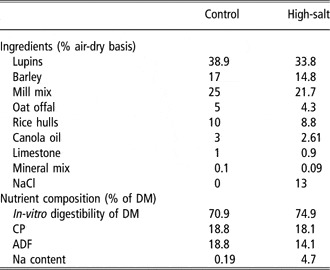
Seven days prior to commencing the preference test, the weaned lambs, aged 9 to 10 weeks, were fed 1 kg of lucerne chaff and 500 g of the control diet per day (Table 1). Prior to each preference test animals were not fasted. During the preference tests, two feeds (high salt and control) were offered ad libitum simultaneously to quantify their preferences for dietary salt. Both feeds were pelleted and based on barley and lupin grain, and their ingredient composition and nutrient specifications are shown in Table 1. The feeds were prepared by a commercial manufacturer (Lauckes, Murray Bridge, South Australia), analysed for nutritive value (Feedtest®, Hamilton, Victoria, Australia) and sodium concentration by inductively coupled plasma atomic emission spectrometry (Dahlquist and Knoll, Reference Dahlquist and Knoll1978) using a Spectro CIROS ICPAES machine (Waite Analytical Services, The University of Adelaide).
Ingredient composition and nutrient specifications of the high-salt and control diet

DM = dry matter.
Short-term preferences
Lambs were offered the high-salt feed and control feed (2 kg dry matter (DM)) simultaneously in adjacent feeders for 5 min at 0800 h, after which the uneaten feed was weighed and the intake of each was calculated. The preference for the high-salt diet was determined as a percentage of the total amount of feed consumed. After the preference test, the feed was taken away for 1 h before a second preference test was conducted, and this was repeated four times per day and over 3 days. The position of the high-salt feed and control feed were alternated between left and right for each test. At the end of each day, all lambs received 500 g lucerne chaff and 500 g control pellets overnight.
Longer-term preferences
One week after the completion of the short-term preference test, for four consecutive days, lambs were offered the high-salt and control feeds (4 kg DM) continuously in adjacent feeders for 24 h and, after each day at 0800 h, the feed was weighed and the amount of each feed consumed was calculated. The preference for the high-salt diet was determined as a percentage of the total amount of feed consumed expressed on a daily basis. The position of the high-salt feed and control feed were alternated between left and right each day.
Experiment 2: oral salt challenge
One week after the completion of the long-term preference test, 12 lambs (6 C lambs and 6 S lambs) were selected for the oral salt challenge. After Experiment 1 and during Experiment 2, lambs were fed 1 kg of lucerne and 500 g of sheep pellets each day (8.5% CP; 8.5 MJ ME/kg; J.T. Johnson and Sons, Kapunda, South Australia). The lambs were provided with 3 days adaptation period to metabolism crates. Then three of the lambs in each group were given an oral dose of 40 g NaCl, 25% w/v solution in 160 ml of distilled water, using a drenching gun, whilst the other lambs received a dose of deionised water of equal volume at 0700 h. A dose of 40 g NaCl was selected to represent approximately 20% of the maximum daily intake of salt in feed that is tolerated by adult sheep (Masters et al., Reference Masters, Rintoul, Dynes, Pearce and Norman2005). Thus, the single dose constitutes a challenge within the range encountered by animals on halophytic forages (Masters et al., Reference Masters, Rintoul, Dynes, Pearce and Norman2005). On the second day, the treatments were switched, so those that had received the oral salt dose received the water (control) dose, and vice versa, and the same sampling protocol was followed. These 2 days of testing were repeated the following week with the second group of 12 lambs, such that a total of 24 lambs (12 C and 12 S) were tested.
Every 2 h for 10 h, and at 23 h after the oral salt or water challenge, urine output and water intake was determined. A 10 ml sample of urine at each time point was taken and frozen for later analysis of sodium concentration by inductively coupled plasma atomic emission spectrometry (Dahlquist and Knoll, Reference Dahlquist and Knoll1978) using a Spectro CIROS ICPAES machine (Waite Analytical Services). Samples were digested with nitric acid and finished with hydrochloric acid as described by McQuaker et al. (Reference McQuaker, Brown and Kluckner1979). The intra-assay coefficient of variation for sodium concentration was 2.88%.
Blood samples (9 ml) were taken using indwelling jugular catheters and collected in ethylenediaminetetraacetic acid-coated tubes approximately 5 min before the oral dose was given, and 4, 8 and 23 h after the oral salt dose for hormone analysis (AVP, aldosterone, leptin and insulin). Blood samples were immediately centrifuged after collection at 1106 × g for 15 min, and the plasma was split across three eppendorf tubes and stored at −20°C until analysis.
Hormone assays
Concentration of AVP in the plasma was measured using a double-antibody radioimmunoassay as described by Digby et al. (Reference Digby, Masters, Blache, Blackberry, Hynd and Revell2008). The assay included six replicates of three control samples containing 9.2, 24.5 and 80.8 pg/ml, which were used to estimate coefficients of variation of 6.1%, 4.6% and 4.1% intra-assay variation and of 6.2%, 4.6% and 4.2% for inter-assay variation.
Concentration of aldosterone in plasma was measured using a modified radioimmunoassay described previously by James and Wilson (Reference James and Wilson1976) and validated by Digby et al. (Reference Digby, Masters, Blache, Blackberry, Hynd and Revell2008). The assay included six replicates of three control samples containing 95.2, 145.3 and 380.2 pg/ml, which were used to estimate coefficients of variation of 6.1%, 7.0% and 6.7% for intra-assay variation and of 5.6%, 3.9% and 5.2% for the inter-assay variation.
Plasma leptin was measured in duplicate by a double-antibody radioimmunoassay (Blache et al., Reference Blache, Tellam, Chagas, Blackberry, Vercoe and Martin2000). All samples were processed in a single assay and the limit of detection was 0.06 ng/ml. The assay included six replicates of three control samples containing 0.43, 0.98 and 1.68 ng/ml, which were used to estimate the intra-assay coefficients of variation of 6.1%, 6.0% and 6.5%.
Plasma insulin was assayed in duplicate by a double-antibody radioimmunoassay (Tindal et al., Reference Tindal, Knaggs, Hart and Blake1978) that had been validated for sheep plasma in our laboratory (Miller et al., Reference Miller, Blache and Martin1995). All samples were processed in a single assay and the limit of detection was 0.78 μU/ml. Six replicates of three control samples containing 2.45, 3.63 and 8.70 μU/ml were included in the assay and were used to estimate the intra-assay coefficients of variation of 7.5%, 2.2% and 3.5%.
Data analysis
The data were analysed using GenStat 8th Edition. A mixed model for balanced groups was used with lambs, days and time (0, 2, 6, 8, 10 and 23) as random effects, time being nested in days and days being nested in lambs, and foetal origin, challenge (salt or water) and order (which dose was given first) as fixed effects. Days and time were treated as repeated measures and the uneven interval of sampling was modelled by the statistical package. Interactions that were not significant were removed from the model. Plasma AVP concentrations, urinary output, water intake and sodium excretion required square root transformation and plasma aldosterone concentrations required log transformation to meet the assumptions of the model; outliers (±2 s.d.) were excluded. For all hormones, the area under the curve was calculated by interpolation. Data presented in tables and figures are untransformed values, even though the statistical analysis may have required transformation as described above. All values presented are means ± s.e.
Results
Preference tests
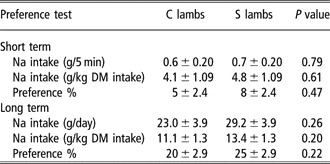
During the short-term preference test, the voluntary sodium intake over 5 min did not differ (P > 0.05) between the C or S lambs (mean for C offspring 4.0 ± 1.1 g Na/kg DM intake (DMI), S lambs: 4.8 ± 1.1 g Na/kg DMI; Table 2). Similarly, during the longer-term preference test, the voluntary sodium intake over 24 h did not differ (P > 0.05) between groups, although all animals selected a higher salt intake than they did during the short-term tests and both selected against the high-salt diet (C lambs: 11.1 ± 1.3 g Na/kg DMI, S lambs: 13.4 ± 1.3 g Na/kg DMI; Table 2).
Sodium intake and preference for a high-salt feed (expressed as a percentage of total feed intake) for C and S lambs during short and long-term preference tests

DM = dry matter.
Salt challenge
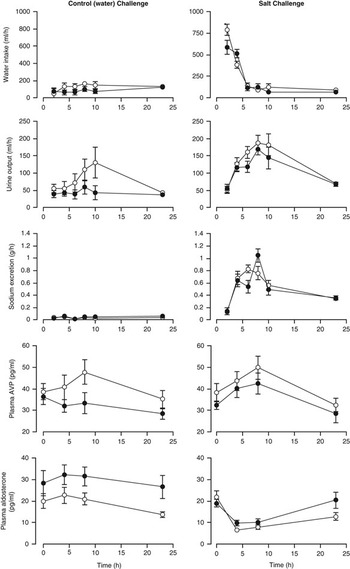
There was a significant interaction between the foetal origin of the lambs (i.e. between C and S lambs), dose (salt v. water) and time for water intake (P = 0.037; Figure 1). Water intake was high for both C and S lambs when administered a salt dose (P < 0.001) but did not significantly change following the water dose. During the first 2 h after the salt dose, C lambs had a higher water intake by approximately 200 ml/h compared to the S lambs (Figure 1). Over the following 2 h, the C lambs dropped their water intake from approximately 800 to 400 ml/h, but the drop in water consumption was smaller in the S lambs, from 600 to 500 ml/h (the change in water intake from 2 h to 4 h in C lambs was: 405 ± 97 ml, S lambs: 77 ± 121 ml; P = 0.045). From 6 h onwards, water consumption of both groups was the same. There was no difference in water consumption between C and S lambs when administered a water dose. There was no interaction between foetal origin and dose for total water consumed over the 23 h (P = 0.94) and no effect of foetal origin (C lambs: 3.6 ± 0.2 l, S lambs: 3.0 ± 0.2 l; P = 0.155); however there was an effect of dose (water: 2.7 ± 0.2 l, salt: 4.0 ± 0.2 l; P = 0.002).
Average water intake, urinary output and rate of sodium excretion, and plasma aldosterone and arginine vasopressin (AVP) concentrations over time for lambs born to ewes fed a high-salt diet (S offspring) or a control diet during pregnancy (C offspring), receiving either an oral dose of water or salt (mean ± s.e.). Open circles: C offspring; closed circles: S lambs. Asterisks denote three-way interactions.

There was a significant interaction between foetal origin and time for urinary output (P = 0.037), whereby there was a greater increase in C lambs than S lambs following either the salt or water dose (Figure 1). There was also a significant interaction between dose (salt v. water) and time (P < 0.001); the urinary output increased more after the salt dose than the water dose (Figure 1). There was no interaction between foetal origin and dose for total urinary output over the 23 h (P = 0.51) and no effect of foetal origin (C lambs: 1.9 ± 0.1 l, S lambs: 1.5 ± 0.1 l; P = 0.086); however there was an effect of dose (water: 1.2 ± 0.1 l, salt: 2.2 ± 0.1 l; P < 0.001).
There was an interaction between dose (salt v. water) and time for sodium excretion (P < 0.001), whereby it increased up to eight-fold for those receiving the salt dose but did not change for those receiving the water dose (Figure 1). There was no interaction between foetal origin and dose for total sodium excretion over the 23 h (of sodium after a salt dose; P = 0.676) and no effect of foetal origin (C lambs: 5.86 ± 0.28 g, S lambs: 5.59 ± 0.28 g; P = 0.5); however there was an effect of dose (water: 1.0 ± 0.3 g, salt: 10.4 ± 0.3 g; P < 0.001).
There was a significant interaction between foetal origin and time for AVP concentration (P = 0.029) whereby there was a greater increase in C lambs at 8 h than S lambs following either the salt or water dose (Figure 1) and S lambs had a significantly lower AVP at 23 h. There was also a significant interaction (P = 0.046) between dose and time for plasma AVP concentrations where AVP, pooled across the two offspring groups (C and S lambs), increased following the oral salt challenge, peaking 8 h after the administration of the salt load but not after the water dose was given. Overall, there was a significant effect of foetal origin (P = 0.014) where S lambs had a lower overall mean AVP concentration than C lambs (C lambs: 40.80 ± 1.54 pg/ml, S lambs: 34.29 ± 1.51 pg/ml). There was no interaction between foetal origin and dose for the area under the curve (P = 0.618) and no effect of foetal origin (P = 0.656) and dose (P = 0.325).
Irrespective of the nature of the challenge (water or salt), the plasma concentration of aldosterone over the following 23 h was higher in the S lambs than in the C lambs (P = 0.013; Figure 1). There was an interaction between dose and time (P < 0.001), whereby aldosterone decreased following the salt dose but not the water dose. Administration of the salt dose reduced aldosterone concentration in both groups, although the magnitude of the decline tended to be greater in the S lambs than in the C lambs (68 v. 50%, but not significant, P = 0.110). There was no interaction between foetal origin and dose for area under the curve (P = 0.119); however there was a main effect of foetal origin (P = 0.002) and dose (P < 0.001). The area under the curve for aldosterone was greater for S lambs (506.09 ± 38.93 pg/ml) than for C lambs (322.57 ± 37.27 pg/ml) and greater in response to the water dose (550.89 ± 38.11 pg/ml) than to the salt dose (277.75 ± 38.11 pg/ml).
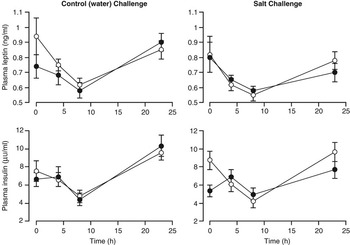
There was no effect of foetal origin on plasma concentrations of leptin and insulin (Figure 2). There was an effect of time after dose on concentrations of both hormones in both C and S lambs (P = 0.001), regardless of dose (water or salt). Leptin concentration decreased within the first 8 h (0.8 to 0.5 ng/ml), then increased back to the baseline values by 23 h for both C and S lambs administered either a salt or water challenge (0.8 ng/ml; Figure 2). Insulin concentrations, although not significantly different for dose, decreased during the first 8 h (7 μU/ml to 4.5 μU/ml) after the water dose, and then increased to above baseline levels by 23 h for both C and S lambs (10 μU/ml; Figure 2). After a salt challenge, insulin concentrations of S lambs remained constant (approximately 6 μU/ml) for the first 8 h and then increased to above baseline levels by 23 h (7.5 μU/ml), whilst C lambs decreased over the first 8 h (8.5 μU/ml to 4 μU/ml) and then increased back to baseline levels (9.5 μU/ml). There was no interaction between foetal origin and dose for leptin or insulin for area under the curve (P = 0.915; 0.528) and no effect of foetal origin (P = 0.936; 0.912) and dose (P = 0.341; 0.686).
Plasma leptin and insulin concentrations over time for lambs born to ewes fed a high-salt diet (S offspring) or a control diet during pregnancy (C offspring), receiving either an oral dose of water or salt (mean ± s.e.). Open circles: C offspring; closed circles: S lambs.

Discussion
Lambs born to ewes fed high salt during pregnancy did not differ in their preferences for dietary salt, but they did differ in their physiological responses to an oral salt challenge. These differences in the lambs may reflect a specific alteration in the endocrine regulation of water and salt balance, as changes in the concentrations of metabolic hormones such as insulin and leptin were not affected by maternal salt diet from conception through to parturition.
Weaned lambs whose mothers ingested a high-salt diet during pregnancy did not show any difference in the feeding behaviour when offered a choice between a control- and high-salt feed, in comparison with non-exposed lambs. These results are surprising because (i) rat offspring born to mothers consuming high salt during gestation and/or during early postnatal development have shown an increased preference for salt (Smriga et al., Reference Smriga, Kameishi and Torii2002; Curtis et al., Reference Curtis, Krause, Wong and Contreras2004) and (ii) in sheep, postnatal responses to a flavour can be influenced by prenatal exposure to this flavour via maternal ingestion (Simitzis et al., Reference Simitzis, Deligeorgis, Bizelis and Fegeros2008). The ewes in the current study were fed a high-salt diet during pregnancy only, and not after parturition, and this may partly explain the difference in the development of taste preferences postnatally. In rats, salt preference is increased if the pups are exposed to salt during the postnatal period (Smriga et al., Reference Smriga, Kameishi and Torii2002; Curtis et al., Reference Curtis, Krause, Wong and Contreras2004). Mistretta and Bradley (Reference Mistretta and Bradley1983) showed that young taste bud cells do not have the same salt response characteristics as mature cells, and a changing neural substrate underlies development of salt taste function, both pre- and postnatally. Therefore the absence of preference for salt by the offspring may be due to the termination of feeding the high-salt diet immediately at birth. It is also possible that foetal programming of dietary salt preferences do not occur as strongly in sheep as it does in rats or cattle. Given the capacity of sheep to survive in arid regions (Zygoyiannis, Reference Zygoyiannis2006; Webley, Reference Webley2007), their regulation of salt and water balance may be geared towards coping with salt loads or water shortages. Indeed, both the C and S lambs in the current experiment consumed over 10 g Na/kg DM, a quantity well above the recommended daily intake of salt of 0.7 g Na/kg DM for sheep (Australian Standing Committee on Agriculture and Resource Management, 1990).
Our results suggest two types of foetal programming by prenatal exposure to salt. First a programming of the thirst threshold illustrated by the difference in the intake of water over the first 4 h after receiving an oral dose. The thirst threshold is not fixed for an individual, but can change in response to physiological state or dehydration. For example, during pregnancy, a decreased threshold stimulates an increase in water intake and dilution of body fluids (Lindheimer et al., Reference Lindheimer, Barron and Davison1989) that are necessary to maintain pregnancy. The control of thirst is affected by sodium balance, possibly mediated via endogenous angiotensin II (Gordon et al., Reference Gordon, Majzoub, Williams and Gordon1997). Therefore, any change in angiotensin II or other components of RAS in S lambs in the current work may be manifested in an altered thirst threshold. However, in the longer term, water and salt balance did not differ between C and S lambs because the total water intake, urinary output and sodium excretion over the 23 h after a single oral dose of salt was the same for both groups of lambs. The existence and the role of the programmed thirst threshold during salt exposure via feed and/or drink should be clarified.
Second, the secretion of hormones controlling salt and water balance seems to be programmed differently in S lambs. Aldosterone concentration had a greater area under the curve for S lambs compared to C lambs regardless of the nature of the dose. In rats, the sensitivity of the RAS can be programmed in response to low activity of RAS in the mother during pregnancy (Arguelles et al., Reference Arguelles, Lopez-Sela, Brime, Costales and Vijande1996; Butler et al., Reference Butler, Pak, Midgely and Nemati2002). A similar programming may have happened in our lambs for aldosterone, because aldosterone was reduced in the ewes fed high salt during pregnancy. The response in aldosterone in the S lambs is consistent with the responses in kidney angiotensin II found in rats exposed to perinatal salt overload (da Silva et al., Reference da Silva, de Noronha, de Oliveira, Malheiros and Heimann2003). Furthermore, the plasma concentration of AVP in S lambs was lower compared to C lambs regardless of the dose, suggesting that the sensitivity of the kidney to changes in osmotic pressure was reduced in the S lambs. An altered responsiveness of AVP in offspring was also found by Desai et al. (Reference Desai, Guerra, Wang and Ross2003), who showed that lambs born to ewes with a high plasma tonicity (because of dehydration rather than salt ingestion) from day 110 of gestation through to parturition, had a higher basal plasma osmolality compared to controls. In addition, following an intravenous challenge of salt at 23 days of age, these lambs (Desai et al., Reference Desai, Guerra, Wang and Ross2003) exhibited a significantly higher plasma osmolality threshold for AVP secretion. The combined results of Desai et al. (Reference Desai, Guerra, Wang and Ross2003) and the current study suggest that AVP threshold is altered in offspring in response to changes in water balance or salt ingestion during pregnancy.
We could speculate that the S lambs may have a slight advantage over the C lambs in achieving the same control of salt and water balance because the response in aldosterone was blunted and their thirst threshold was higher after an oral salt load. These two adaptive responses in S lambs could decrease their allostatic load, allostatic system giving the capacity to organisms to respond to both physiological and environmental changes, such as water balance and salt overload (McEwen and Wingfield, Reference McEwen and Wingfield2007). In fact, lambs that are born to mothers fed saltbush during pregnancy and that are grazing saltbush gained more body tissue and grew more wool than lambs not prenatally exposed to saltbush (Chadwick et al., Reference Chadwick, Vercoe, Williams and Revell2009).
It seems that the ingestion of salt by the mother during pregnancy induced a specific foetal programming of the renal system because no effects on hormones controlling appetite and metabolism (leptin and insulin) were detected during the water or salt challenges, at least when assessed by hormone concentrations. This is despite the ingestion of a high-salt diet during pregnancy affecting the plasma concentration of insulin and leptin in the mother (Digby et al., Reference Digby, Masters, Blache, Blackberry, Hynd and Revell2008). Effects may have been detected using dynamic tests of glucose–insulin homeostasis, but this was beyond the scope of the current study. In another experiment model, using an altered level of nutrient intake during pregnancy, it has been demonstrated that the secretion of metabolic hormones can be modified in the offspring of underfed ewes (Ford et al., Reference Ford, Hess, Schwope, Nijland, Gilbert, Vonnahme, Means, Han and Nathanielsz2007; Luther et al., Reference Luther, Aitken, Milne, Matsuzaki, Reynolds, Redmer and Wallace2007). However, our data reported here suggest that changes in maternal insulin and leptin associated with salt intake during pregnancy do not translate to consistent changes in her offspring. The pattern of change in insulin after administration of an oral salt challenge was not different from that which occurred after a water dose. This appears to differ from Blache et al. (Reference Blache, Grandison, Masters, Dynes, Blackberry and Martin2007) who found that wethers fed a diet containing 20% NaCl had decreased concentrations of plasma insulin. Yet in the current study, plasma insulin was up to one-third lower in S lambs at time zero of the oral challenges, perhaps indicating some effect of salt ingestion during pregnancy on the baseline concentration of insulin in weaned offspring.
In summary, offspring born to ewes that ingest high amounts of salt during pregnancy are programmed to have an altered thirst threshold and blunted response to aldosterone in response to an oral salt challenge. This adaptive response may be particularly useful, for example, when grazing herbivores are fed halophytic forages adapted to saline soils. In such cases, the ingestion of dietary salt typically limits feed intake and productivity (Masters et al., Reference Masters, Rintoul, Dynes, Pearce and Norman2005). Any adaptation to ingested salt is likely to arise from changes in the mother’s RAS (da Silva et al., Reference da Silva, de Noronha, de Oliveira, Malheiros and Heimann2003) that may induce epigenetic changes in the offspring’s genes encoding hormones and enzymes of the RAS. It would also be important to show that modifications of the RAS are still present later in life, because increased salt preferences in rats can diminish with age (Midkiff and Bernstein, Reference Midkiff and Bernstein1983). Any shift in the set points of the regulatory system controlling thirst should be confirmed following prolonged exposure to salty food or salty water. Furthermore, changes in kidney size, nephrons number and gene expression of the components of the RAS may play a role in the adaptations and we are investigating some of these aspects in current studies.
Acknowledgements
This work was supported by an Australian Postgraduate Award, CSIRO Livestock Industries and Future Farm Industries Co-operative Research Centre (formerly CRC for Plant-based Management of Dryland Salinity). We would like to express our gratitude to Julian Taylor at Biometrics SA, University of Adelaide, for the statistical analysis and Margaret Blackberry (University of Western Australia) for hormone analysis.