War, and mass warfare in particular, matters. The mass wars of the twentieth century were associated with a dramatic drop in the belligerents’ top income shares (Piketty Reference Piketty2001; Atkinson and Piketty Reference Atkinson and Piketty2007), and a shift towards more progressive tax systems (Scheve and Stasavage Reference Scheve and Stasavage2010, Reference Scheve and Stasavage2012). Further, many have argued that mass warfare spawned the era of the welfare state (Titmuss Reference Titmuss1950, Reference Titmuss and Titmuss1958). In a longer perspective, wars prompted states to build bureaucratic capacity (Tilly Reference Tilly and Tilly1975, Reference Tilly1990; Besley and Persson Reference Besley and Persson2009; and Gennaioli and Voth Reference Gennaioli and Voth2011). Given mass warfare's importance to all these economic outcomes, and its more obvious destructiveness, it makes sense to ask what factors over time have driven army size. One tradition among historians and economic historians suggests that over the centuries, the nature and scale of warfare has depended critically upon technology. Armies evolved with the introduction of the iron stirrup, use of gunpowder technology, or the invention of new styles of fortification (Hoffman Reference Hoffman2011; Roberts Reference Roberts1956; White Reference White1962; Bean Reference Bean1973). While scholars in this tradition have focused heavily on the early modern period, we suggest that a similar focus on technological change may help us explain mass warfare over a more recent era. We argue that changes in communications and transport technology, and in particular the invention of the railroad, were the most important factors in ushering in an era of mass warfare. In the last half century, further innovation in communications and transport technologies permit the delivery of explosive force at a great distance, and that has made it less necessary and less desirable to mobilize a mass army. The implication then is that the era of the mass army was a bounded period defined by a specific state of technology.
Military historians have long pointed to the importance of the railroad to military mobilization, but this argument has yet to be systematically tested.Footnote 1 Though it would hardly be surprising to find that railroads mattered, we still need to establish just how much they mattered. We follow the work of military historians in suggesting that prior to the invention of the railroad, large armies faced a fundamental problem of logistics. While soldiers could transport themselves, their supplies had to be carried. Armies could, of course, forage, but army size was then constrained by the agricultural productivity of the land across which an army marched. The adoption of the railroad allowed states to transport men, munitions, and food in such quantities and with such speed that mass armies representing as much as 10 percent of a society's total population suddenly became feasible.
While descriptions of military mobilization over the long run generally refer to a secular trend towards increasing army size, any satisfactory explanation, or explanations, ought to also be able to account for the more recent trend away from mass armies. We suggest that in recent decades developments in transport technology have greatly reduced incentives for states to mobilize mass armies. The inventions of the Industrial Revolution made it possible to move men and their supplies with unprecedented speed. More recent innovations have made it possible to deliver explosive force remotely with unprecedented effectiveness. Our empirical tests also examine several alternative hypotheses. The most prominent of these is that the French Revolution and the invention of the concept of “the nation in arms” constituted a structural break. After this date, or so its proponents would suggest, it was possible to mobilize armies on a scale previously thought unimaginable.Footnote 2
To test our argument, as well as alternative explanations, we have compiled a new data set that records army sizes, levels of military mobilization (army size/total population), and recruitment methods for thirteen great powers over the period from 1600 to 2000. We adopt the classification of great powers first proposed by Jack Levy (Reference Levy1983). Our army size data derives from the Correlates of War data set for the period since 1815. For the period between 1600 and 1815 we have constructed measures of army size by referring to a wide range of historical sources (see the Online Appendix). When combined with available estimates of population, these also allow us to construct mobilization levels for this period.
To test our hypothesis about the impact of shifts in communications and transport technology, we deploy an indirect test and then a more direct test.
The indirect test uses a pooled regression that includes country-fixed effects. We regress either military size or military mobilization on an indicator variable that takes a value of 1 beginning in 1859, the first year that railways were used in a major way in combat, as well as on an indicator variable that takes a value of 1 beginning in 1970, a threshold year in the development of cruise missile technology. Finally, the regressions also include an indicator variable that takes a value of 1 beginning in 1789. This tests the alternative hypothesis that the invention of the idea of “the nation in arms” led to an increase in army size and mobilization levels. Consistent with our core hypothesis, 1859 was associated with a large and statistically significant shift upward in military size and military mobilization, whereas the year 1970 was associated with a shift downward in both of these variables. In contrast, there is no statistical evidence in our pooled regressions that the year 1789 was associated with a shift upward in either army sizes or levels of mobilization.
In the more direct test of our hypothesis, we augment the previously described regressions by including a variable measuring the number of kilometers of railway existing in a given country in a given year and a variable indicating whether or not a country has acquired cruise missiles in a given year, irrespective of whether they have actually been used. We also add control variables for population, GDP per capita, nationalism, political regime, and state institutions. We model unobserved time effects through either a common or country-specific linear time trend. We find that the extent of a country's railway network is significantly positively correlated with the magnitude of its military mobilization while the presence of cruise missiles is significantly negatively correlated with mobilization. Importantly, when these variables are introduced into the regression, our indicator variables for post-1859 and post-1970 years are no longer statistically significant, and each coefficient drops substantially in magnitude. These results are robust to changes in the covariate profile, operationalization of key variables, and functional form assumptions. For the railroad results, we also show that the estimates are robust to expanding the sample beyond great power countries and to changing the sample period. We also explore difference-in-difference comparisons within a country by looking at differences in navy and army growth in the United Kingdom before and after railroads became widely used for military purposes. Taken together, these analyses provide strong evidence for the importance of the railroad in ushering in the era of the mass army. Though our results for cruise missiles are subject to more caveats, they are nonetheless consistent with the view that communications and technology advances in the second half of the twentieth century led countries to field substantially smaller forces.
The observed correlation between railroad networks and army size is not definitive evidence of causality. An alternative might be that states that wanted to have large armies also built extensive railroad networks directly, or they subsidized the private sector to do so. If this was the case then it would imply that in a regression of army size (or mobilization) on railroad network size, we would overestimate the true effect of the latter on the former. In what follows, however, we present evidence from Dan Bogart (Reference Bogart2009) to show that the coefficients on the measures we use for kilometers of railway are unlikely to be biased in this manner. The key reason is that governments that anticipated military conflict tended to nationalize railways, influence their management, and influence choices of where to locate railway lines, but with a few notable exceptions, governments did not build more kilometers of railway in anticipation of conflict. This provides a further important reason for using our railroad kilometers measure as opposed to an alternative variable that might also take into account further characteristics of a railroad network, such as its organization and degree of centralized control. We should acknowledge, however, that we have no such assurance of plausible exogeneity for our cruise missile tests.
In addition to our pooled analyses, we also discuss the history of French mobilization in greater depth. We focus on France because its history has had undue influence on the thinking of many scholars about the evolution of mass armies and their political determinants. Our discussion of France suggests that even in this case, the magnitude of the influence of the French Revolution and Napoleonic era on army size and mobilization was relatively small. The era of the mass army was instead a late nineteenth- and twentieth-century phenomenon that coincided with and depended on the technological innovations of the Industrial Revolution.
TECHNOLOGY AND THE MASS ARMY
What factors have led the great powers to field mass armies? Since we are examining a long stretch of history, there are undoubtedly many. We emphasize changes in technologies for transport and communications as the key to the evolution of army size. In the first instance, fielding a mass army depends on the ability of a state to recruit a sufficiently large set of individuals. It also depends on two further factors. First, a state must have the ability to deploy those troops and to keep them supplied. Second, a state that can recruit and field a mass army must also prefer this military strategy to one with fewer soldiers. In what follows we will argue that prior to the invention of the railroad, it was physically impossible for states to field mass armies. Even had it been possible to raise, transport, and support armies of this size, before the invention of the telegraph, it would have been extremely difficult to exercise command. The inventions of the Industrial Revolution allowed some states for the first time to field armies representing up to 10 percent of their total population. We also argue that over recent decades, further developments in transport and communications technology have pushed in the opposite direction. As was recognized (and feared) by Soviet military planners as early as the 1970s, in an environment where weapons can be targeted remotely and with increased precision, a mass army may be increasingly obsolete. The impact of transport and communications technologies on the size of military forces is likely most important in major conflicts against powerful adversaries in which states should be expected to maximize their war effort.
A First Revolution: Transporting Men by Railway
Prior to the adoption of the railway for military purposes, a state seeking to recruit a mass army faced very significant obstacles in putting it in the field. This section draws on the studies by Edwin Pratt (Reference Pratt1916), Martin van Creveld (Reference van Creveld1977, Reference van Creveld1989), John Westwood (Reference Westwood1980), Marie-Joseph Fischer (Reference Fischer1925), J. F. C. Fuller (Reference Fuller1998), and Christian Wolmar (Reference Wolmar2010). While the soldiers of a mass army could march to the field of battle, once there they needed to be commanded by some means. In addition, the army required that its munitions be transported. Finally, a mass army—men and horses—had to be fed. Armies had most often met this last requirement by foraging. But this strategy depended upon the carrying capacity of the land in question. Over time improvements in productivity raised the number of calories that could be extracted from a typical plot of agricultural land, but there remained serious limitations on the ability of a very large army, numbering in the hundreds of thousands, to either feed off the land or bring supplies from the rear via wagon. Napoleon's armies were famous for moving quickly. One of the reasons they had to move quickly was that otherwise they would have starved after exhausting all nearby resources (Creveld Reference van Creveld1977). Prior to the invention of the railway, a mass army would have starved in short order.
Although railways were used in the Crimean War, the authoritative account by Pratt (Reference Pratt1916, p. 9) suggests that the first time they were used in a significant manner was by France during the Italian campaign of 1859. Subsequently, railways played a crucial role in both the American Civil War and the Franco-Prussian War, and of course in World War I. An observation from 1918 sums up the importance of the railway.
What Napoleon would have done if the railroad and motor-truck had been in existence in his day appalls the imagination. His battles were fought with armies which today seem trifling—sixty-two thousand men at Austerlitz; not many more than that at Waterloo. It does not seem to be generally realized that the real reason for the scope of battles nowadays is simply the locomotive. Foch and Hindenburg count their troops by the millions, where Napoleon and Blucher counted theirs by ten thousands, because the steam engine has made it possible to transport and feed a hundred men today as easily as one man a hundred years ago. The new style of warfare is essentially a product, not of trenches, or machine guns, or artillery, but of railroads (Bellows Reference Bellows1918).Footnote 3
The substantial increase in army size during the second half of the nineteenth century was made possible by railroads but it was also made substantially more desirable by the development of the telegraph and widespread use of breech-loading rifles in major power wars. Later still, the internal combustion engine radically changed how the wars of the first half of the twentieth century were fought. However, in many ways, this innovation, as important as it was, simply amplified the effects of the railroad: moving and supplying large armies became even easier. Thus, our focus on railroads and technologies for remote delivery highlights just the two most important technological innovations influencing the use of mass armies. Our larger argument puts technological change at the forefront of understanding long run trends in the format of military force.
A Second Revolution: Remote Delivery of Explosive Force
Although late nineteenth century advances in transport and communications technologies produced the mass army there is no fundamental reason for each new innovation to lead to the mobilization of ever greater numbers of individuals. Indeed if improvements in transport can make it easier to move soldiers to the field of battle, they can also make it easier to deliver and target explosive force from areas distant from any actual field of battle. In recent decades, and in particular since 1970 many new technologies have emerged that can allow remote delivery of explosive force and often with great precision. These depended on innovations including the gyroscope, the radar, the laser, and the satellite.Footnote 4 What are the implications of remote delivery of explosive force for levels of mobilization? To quote Major Leonard Litton of the U.S. Air Force, in this era of new weaponry:
It is no longer required to bring forces into the same geographical area to bring their effects to bear on the same target and, in fact, on the modern battlefield it may be dangerous as well (Litton Reference Litton2000, p. 3).
In other words, technology may have made the mass army obsolete. Interestingly, it was actually Soviet military planners who first highlighted this possibility. Starting in the late 1970s Soviet planners grew fearful that the principal Soviet war plan which involved quickly pushing a mass army westwards across the European continent had become worthless because of U.S. advances in precision weapons (Murray and Knox Reference Murray, Knox, Knox and Murray2001).
Predicted Effects of the Two Revolutions
The argument above has two key parts.Footnote 5 First, it suggests that the Industrial Revolution's advances in transport technology allowed states to mobilize mass armies on a scale not previously possible. If so, then, in absolute terms we should find that armies grew larger in size as countries developed railroad networks to transport both men and the materials to keep them supplied. Second, we should also find that as railroad networks expanded, countries were able to mobilize a larger fraction of their overall population.
The argument above also supposes that more recent advances in transport technology have pushed states in the opposite direction by facilitating the remote delivery of explosive force. If so we should find that as countries gained access to new technologies allowing them to deliver explosive force at a distance and with precision, then armies shrank in size. Similarly, the arrival of precision weapons should lead to lower levels of mobilization.
ALTERNATIVE AND COMPLEMENTARY EXPLANATIONS
There are several alternative and complementary explanations for army mobilization to ours. The first of these involves state capacity. The need to raise revenues is a constraint that has without a doubt influenced the size of armies that states can mobilize. The effectiveness of countries in raising revenue is primarily determined by their wealth and by the transactions costs that rulers face in raising revenue. A major part of the rise of armies thus involves the development of effective bureaucratic institutions. It is difficult to measure the effectiveness of bureaucratic institutions of this sort on a comparative basis and particularly over such a long time period. We rely on two strategies, one assumes that state capacity is correlated with per capita income, a point made abundantly clear by Timothy Besley and Torsten Persson (Reference Besley and Persson2011), the other uses the ability of a state to conduct a national census as a proxy for bureaucratic capacity.
A second alternative hypothesis involves the role of political rights and their association with both the willingness of citizens to fight and the ability of a state to finance a war. Historically, mobilization of a significant share of a country's population for war has often occurred in a context where those who fight are granted new rights that place them on an equal footing with other groups in society. At first glance, the equalization of rights has seemed to be a powerful force in enabling states to raise large armies and mobilize a significant share of their populations to fight. In France in the 1790s those who fought were serving a nation in which privileges long held by nobles had recently been abolished. Similarly, a handful of countries adopted universal suffrage in the context of World War I. In our empirical analysis, we focus on examining the impact of the extension of voting rights and competitive elections on army size, rates of citizen mobilization, and methods of recruitment.
A final alternative or complementary explanation for mobilization involves the role of nationalism. Those who emphasize the importance of nationalism refer to the French Revolution as a key watershed. By inventing the idea of the nation in arms, the French revolutionaries, it is said, ushered in an era where conflict took on a new intensity and scale. The idea that the French Revolution was a structural break provides one feasible, although certainly imperfect, way of examining the nationalism hypothesis. We can do so first of all by looking at all of the powers in our sample and examining whether both army sizes and levels of mobilization noticeably increased after 1789, and if so by how much. The idea here would be that while France pioneered the use of nationalism, other European powers were soon obliged to follow suit.Footnote 6 A second, admittedly imperfect, way of examining the nationalism hypothesis is to examine the partial correlations between a proxy for nationalism and our dependent variables. Keith Darden (forthcoming) argues that modern states find it difficult to instill national loyalties until the introduction of mass schooling. It takes a literate population educated by the state for countries to develop strong nationalist identities that influence political behavior. We investigate this hypothesis by using literacy rates as a proxy for nationalism.Footnote 7
If we fail to find evidence that literacy influenced army sizes or mobilization ratios, we will still want to consider the possibility of an interaction effect between literacy and our railroad track measures. It may have been the case that nationalism constituted a powerful force for motivating citizens, but until the invention of the railroad there was a technologically imposed ceiling on the size of an army that could actually be fielded and supplied. It may have been the case, as suggested by Fuller (Reference Fuller1998) with reference to the railroad's inventor, “Thus it came about that the genius of George Stephenson (1781–1848) gave life to the Clausewitzian theory of the nation in arms.”Footnote 8
WAR MOBILIZATION IN GREAT POWER STATES, 1600–2000
To assess what factors determine the scale of warfare and the extent of citizen participation in war, we have constructed a data set recording the size of the military and the extent of population mobilization for great power states from 1600 to 2000. We adopt Levy's (Reference Levy1983) identification of 13 great powers between 1600 and 2000. He defined them as “a state that plays a major role in international politics with respect to security-related issues” (p. 16).
The key variable in the data set is Military Size: the number of troops (in thousands) the national government has available for use against foreign adversaries. This definition does not include reserve troops, colonial troops, civil defense units, and domestic police forces. A common problem with statistics on the size of the military is that states have an incentive to inflate them. We tried to use numbers that reflect “actual” or “effective” forces rather than “paper” forces wherever possible (for further details and sources, see the Online Appendix). We also constructed Military Mobilization: it is equal to military size divided by total population and thus evaluates the extent to which citizens in these countries are mobilized for war. It is important to keep in mind a few basic patterns in our data. First, annual data is generally available only for observations after the resolution of the Napoleonic Wars in 1815. Secondly, the incidence of war is greater in earlier periods than later periods.Footnote 9 Third, these two facts interact. Thus military size and mobilization are more likely to be observed in war years in the seventeenth and eighteenth centuries than latter. Given these patterns, as well as our substantive interest in war mobilization as opposed to the size of peacetime armies, in our statistical tests, we focus our attention on years in which these states are engaged in conflicts.Footnote 10
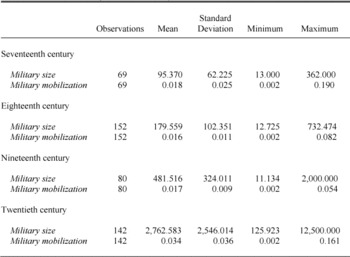
MILITARY SIZE (IN THOUSANDS) AND MOBILIZATION BY CENTURY

Notes:
This table reports descriptive statistics for Military Size and Military Mobilization for each in year in which a great power in our sample is at war.
Table 1 reports descriptive statistics for Military Size and Military Mobilization for war years by century (country graphs can be found in the Online Appendix). The table shows the most striking feature of our data: mass mobilized warfare reached an entirely new scale in the twentieth century. The average for military size almost doubles from the seventeenth to the eighteenth century; it almost triples from the eighteenth to the nineteenth century and then increases by a factor of 5.7 from the nineteenth to the twentieth century. The averages for Military Mobilization are perhaps even more striking in highlighting the uniqueness of the twentieth century. The seventeenth-, eighteenth-, and nineteenth-century average mobilization levels are not that different from each other but average mobilization doubles from 0.017 in the nineteenth century to 0.034 in the twentieth century. Further examination of the data suggests that, unsurprisingly, World War I and World War II drive the patterns. Although one might be worried that differences across centuries in the propensity to fight wars account for those results, for military size, the maximum values of the variable increase at quite similar rates as the averages (increasing by a factor of 2.02, 2.72, and 6.25 across each century).
At first glance, the maximum values for military mobilization rates appear to follow a different pattern, but this is not very informative. Indeed the figure that is out of place is the maximum of 0.19 for Military Mobilization in the seventeenth century, it comes from Sweden in 1632 and it is a true outlier for the century (the next closest value is 0.056). That said, there is a clear pattern of high mobilization rates with relatively small armies for small states like Sweden and the Netherlands in seventeenth century and even somewhat larger states such as Prussia in the middle of the eighteenth century. Nevertheless, Sweden 1632 is the only data point in the top twenty mobilization rates that is not from the twentieth century. This descriptive evidence is suggestive of a clear break in the size of military forces and the extent of citizen participation in the twentieth century, a pattern we will probe in much greater detail below.
EVALUATING EXPLANATIONS FOR PATTERNS OF WAR MOBILIZATION
The data presented previously on military size and mobilization indicate significant variation in military forces both over time and across great powers. In this section, we evaluate our argument that the introduction of new transport and communication technologies has been the major factor determining the use of mass armies. We also discuss the evidence in light of the main alternative explanations emphasized in the literature.
Military Size and Mobilization: An Indirect Test
Were key dates associated with various arguments correlated with changes in levels of military size and the extent of mobilization? First, we investigate whether two key dates associated with innovations in transport and communication technology are significantly correlated with changes in observed levels of mobilization. For railways, we set the date at 1859, the year proposed by Pratt (Reference Pratt1916) in which railways were first used in a significant way in military conflict. There are a number of plausible alternative dates for innovations which dramatically improved the remote delivery of explosive force. We chose to focus on precision-guided weapons and picked 1970 which corresponds to the development of modern cruise missiles. Although the United States developed an early version of a cruise missile in 1954 and the USSR did so in 1956,Footnote 11 it was not until the late 1960s that fully operational and effective cruise missiles were a viable option to military planners.Footnote 12 We also considered intercontinental ballistic missiles (ICBM), these first became operational in 1957, and the results discussed below are quite similar using this date rather than 1970.
As a second test, we look for evidence that the French Revolution was a structural break consistent with the nationalism hypothesis by examining whether army size and levels of mobilization noticeably increased after 1789, and if so by how much.Footnote 13
We constructed three indicator variables, D1789, D1859, and D1970, equal to 0 for all years before the year indicated and equal to 1 thereafter. The sample is all 443 country years for which we have data on military size and a great power country is at war. Great powers differ in important ways that may influence their propensity to raise a large army or to mobilize a significant proportion of their population. Some of these differences are relatively fixed, having to do with the historical origins of the state's formation or its salient geographic features. To control for these determinants, we include country-fixed effects. Note further that our initial analysis conditions on countries being in the sample of great powers. To the extent that great power status is determined by unobservables correlated with these break points or other variables of interest, the results will not give good estimates of the correlates of military size and mobilization for all types of countries. It might in particular be the case that great powers had other features that favored the development of mass armies. That said, some of our analyses will control for the most obvious measures determining great power status, such as size and wealth, and we will present additional results from a larger sample of countries. Moreover, we are primarily interested in the question of the size of the military for the central states of the international system. Our initial evaluation of the role of these potential structural breaks is simply fixed effects regressions with Military Size and Military Mobilization as the dependent variables and the three indicator variables as the only independent variables.
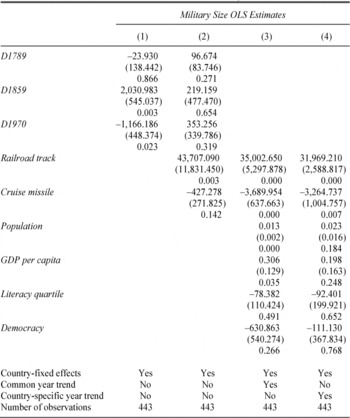
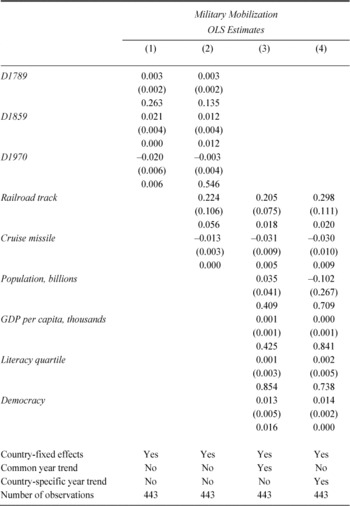
Table 2 (column 1) provides the estimates for Military Size and Table 3 (column 1) reports results for Military Mobilization.Footnote 14 Starting with Military Size (Table 2), the coefficient estimate for D1789 is −23.930 and not statistically significant. The same holds for Military Mobilization (see Table 3). There is little evidence associated with a structural break in the adoption of larger armies at the time of the French Revolution or Napoleonic Wars. This is inconsistent with the nationalism hypothesis and reflects the fact that European powers had already mobilized relatively large armies for major conflicts in the eighteenth century. Alternatively, it may indicate that only France was able to successfully construct a nationalist ideology conducive to raising significantly larger armies than in previous periods. We evaluate the French case in greater detail in the next section. Finally, this test is indirect and it may be that the conservative governments that followed 1815 no longer relied on nationalism to mobilize troops and so the coefficient for D1789 is not a good indicator of the impact of nationalism. We present a more direct test below.
Turning to the potential break point for the influence of railroads, the coefficient estimate in column 1 of Table 2 for D1859 is 2,031 with a standard error of 545. This estimate suggests that the great powers fielded armies which were on average 2 million men larger after 1859. Similarly the estimate in column 1 of Table 3 for D1859 is 0.021 with a standard error of 0.004. This indicates that population mobilization was a full two percentage points higher on average during this period. To put this in context, Table 1 indicates that the average mobilization level for the eighteenth century was 0.016 and so a 0.021 difference is a more than doubling of mobilization rates. These estimates clearly suggest an important structural break in military size and mobilization, the timing of which coincides with major expansion of the railroads and the adoption of rail transport for moving troops and military supplies.
Finally, the coefficient estimates for D1970 in column 1 of both Table 2 and Table 3 are negative and substantively and statistically significant. The estimate in the Military Mobilization regression is comparable in magnitude to that for D1859 and the estimate for Military Size is also quite large. This suggests that the extent of mobilization after 1970 returned to levels that looked quite similar to those before 1859. This is consistent with the hypothesized negative effect of precision weapons. This evidence, however, should be interpreted cautiously because in addition to it being simply based on the timing of mobilization changes, there are a limited number of wars involving great powers after 1970. Nevertheless, the descriptive evidence for both Military Size and Military Mobilization is broadly consistent with our argument that the most substantial innovations in the use of mass warfare were made possible by critical changes in transport and communications technology.Footnote 15
MILITARY SIZE IN GREAT POWER WARS, 1600–2000

Notes:
The table reports the results of pooled-time-series-cross-sectional OLS regressions for the variable Military Size. The table reports the coefficient estimate, robust standard error clustered on country (in parentheses), and corresponding p-value.
Military Size and Mobilization: A Direct Test
The evidence that we have presented so far is essentially indirect. To more directly test the importance of transport technology, we constructed the variable Railroad Track equal to the length of railroad track available to the public in each country.Footnote 16 Ideally, we might prefer a measure that would indicate in a precise manner how both the extent and organization of a nation's railway network increased the maximum army size that could be sustained, by facilitating the movement of men and the supplies they need. However, even if such information was readily available for all of our sample countries, it is likely that including it would introduce a bias into our estimates. Why would this be the case? We know from the extensive work by Bogart (Reference Bogart2009) that governments subject to external military threats tended to increase central state control and ownership of railway networks. However, he shows, based on an extensive cross-country sample for the period between 1860 and 1912, that governments that nationalized their railways subsequently tended to build less track than states where the rail network remained in private hands. We also know from Bogart's work that the great majority of rail networks during this period remained privately owned.Footnote 17 At a minimum, this evidence suggests that the coefficients on our Railroad Track measure will not be subject to an upward bias attributable to the anticipation of conflict.Footnote 18 Finally, we should note that in unreported specifications, we find qualitatively similar results using a measure, Railroad Track Area, equal to railroad track kilometers divided by land area.Footnote 19
MILITARY MOBILIZATION IN GREAT POWER WARS, 1600–2000

Notes:
The table reports the results of pooled-time-series-cross-sectional OLS regressions for the variable Military Mobilization. The table reports the coefficient estimate, robust standard error clustered on country (in parentheses), and corresponding p-value.
In addition to our railroad track variable, to more directly test the importance of the expansion of the remote delivery of explosive force, we constructed the variable Cruise Missile which is equal to 0 for each year before a country acquires a cruise missile and 1 for each year after acquisition.Footnote 20 We also find qualitatively similar results using a measure indicating the acquisition of nuclear weapons and another variable measuring the estimated count of nuclear warheads.Footnote 21
Column 2 of Tables 2 and 3, reports the results for fixed-effects regressions which are the exact same specification discussed for column 1 with the addition of the variables Railroad Track and Cruise Missile. It is worth noting that inclusion of country-fixed effects will control for any fixed component of country size. Starting with Table 2, the coefficient estimate for Railroad Track is equal to 43,707 with a standard error of 11,831 which indicates that if a country increases its rail network by a thousand kilometers, it would on average increase the size of its army during war time by about forty-four thousand troops. The standard deviation of Railroad Track is about 79 thousand kilometers, and so a standard deviation increase in the length of track is associated with an increase in troop size of over 3 million troops. This estimate is consistent with our claim that railroads played a decisive role in the transition to truly mass armies. Importantly, once Railroad Track is included in the regression, the estimate for D1859 is much smaller and no longer statistically significant. This is consistent with the idea that the likely reason for the structural break in the series for 1859 was the increasing use of railroads in warfare. The estimates in column 2 of Table 3 indicate a qualitatively similar story for Military Mobilization.
The coefficient estimates for Cruise Missile are negative in column 2 of Tables 2 and 3 which is consistent with the hypothesis that the capacity to deliver explosive force remotely made large armies less desirable. Importantly, it is also the case that the estimate for D1970 is substantially attenuated and no longer statistically significant. The coefficient estimate for Cruise Missile is only marginally statistically significant for Military Size, but the estimate for Military Mobilization is equal to −0.013 with a standard error of 0.003. This result suggests that great powers mobilized over 1 percent less of their populations after developing cruise missiles. Obviously, it is not likely that this full difference is solely attributable to the impact of cruise missiles. These same states were developing a wide range of weapons that expanded their ability to deliver force at a distance—including nuclear weapons. Nonetheless, it is clear that the timing of these innovations is associated with a significant reduction in army size and mobilization.
The estimates in columns 3 and 4 in Tables 2 and 3 explore robustness by adding additional control variables to the specifications in columns 2 and 3. Our discussion of alternative arguments about the determinants of army size and the extent of population mobilization emphasized three other factors.
First, countries with greater fiscal capacity in terms of wealth and efficient institutions for taxation, are, all else equal, more likely to field large armies. We used GDP per capita as one proxy for a state's fiscal capacity.Footnote 22 In unreported specifications, we also used a dummy variable Census recording whether a state had carried out a national census to more directly proxy for administrative capacity (see the Online Appendix for coding details). To explore the connection between political rights and army mobilization we first constructed the variable Democracy, set equal to one if the legislature is elected in free multi-party elections, if the executive is directly or indirectly elected in popular elections and is responsible either directly to voters or to a legislature elected according to the first condition, and finally if at least 50 percent of adult males have the right to vote.Footnote 23 In unreported specifications we also included two variables concerning prerogatives of representative assemblies. The dummy variable Taxes takes a value of 1 if a state has a representative assembly that has the authority to consent to or refuse new taxation. The dummy variable Spending takes a value of 1 if a state has a representative assembly with the authority to exert control over expenditure decisions.Footnote 24
Third, building on the idea that states found it difficult to instill national loyalties until the introduction of mass schooling, we use literacy rates as a proxy for nationalism. The variable Literacy Quartile is coded from 1 to 4 indicating what quartile of the adult population can read. The coding and sources for this variable can be found in the Online Appendix. In addition to the above controls, we also add a control for the size of a country's total population. Finally, these specifications include either a common or country-specific linear year trend.
The results reported in columns 3 and 4 of Table 2 show that adding control variables produces relatively little change in our estimates of the coefficient for Railroad Track. In contrast, the addition of controls does result in a substantial change in the estimated coefficients for our Cruise Missile variable. In both columns 3 and 4, the coefficient on Cruise Missile is now statistically significant, negative, and also much larger than in the specifications without the controls. Unreported specifications that added the Census, Taxesand Spending variables to the specification produced similar results.
Columns 3 and 4 of Table 3, which reflect the addition of control variables to our mobilization regressions, show a very similar pattern to that observed in the previous table. The control variables have little impact on our coefficient estimates for Railroad Track. However, the addition of the control variables results in a substantially larger negative coefficient for our Cruise Missile variable. Once again, unreported specifications that used alternative measures for our key independent variables (Railroad Track Area and nuclear weapons) and alternative measures of our control variables (Census, Taxes and Spending) produce quite similar results.
The estimates for the control variables are somewhat sensitive to specification choices. For example, in Table 2, Population and GDP per Capita are positive and statistically significant in the specification with common year trend but not in the specification with country-specific trends. Two results for the control variables stand out. First, there is no evidence of a positive partial correlation between Literacy Quartile and either dependent variable. This complements our evidence on the lack of a break point in either series near 1789 and is consistent with our claim that nationalism on its own may not have played as central role in bringing about the era of mass warfare as is often argued. We also pursued another possibility that is complementary to our emphasis on transportation and communication technologies. It may be the case that nationalism played a role in making citizens willing to fight but that until the railroad and other technologies allowed mass armies to be supplied, nationalism only had a limited effect. We added an interaction term for Railroad Track and Literacy Quartile to the specifications in columns 3 and 4 of Tables 2 and 3 with the expectation that the coefficient for this interaction would be positive. Our estimates for this interaction coefficient were positive in all four specifications and statistically significant in all cases except for the specification with Military Mobilization as the dependent variable and country-specific time trends. It seems that once railroad penetration was high, nationalism, as measured by literacy rates, had a more positive effect on mobilization.Footnote 25 We further calculated the marginal effect of literacy at different values of railroad development and found that at high levels of railroad development literacy has a positive and statistically significant marginal effect on Military Size and Military Mobilization. Such an effect is consistent with our argument that although nationalism made it easier for states to recruit large armies, the advent of the railroad technologies was required to sustain such mass armies.
Second, we find some evidence that expanding political rights facilitates mobilizing populations for war. Our democracy variable is not correlated with Military Size but is positively correlated with Military Mobilization. Moreover, in unreported specifications, we find some evidence that both our Taxes and Spending variables are positively correlated with Military Size and Military Mobilization.Footnote 26
Our discussion of the results so far has included mention of a number of robustness checks that focus on alternative measures of our independent variables. We also explored the robustness of the results in a number of other ways. First, we reestimated our main specifications for Military Size in log-levels. This specification may be less sensitive to potential outlier observations. Our main estimates for railroad Railroad Track and Cruise Missile are qualitatively the same for these specifications. Second, we reestimated our main specifications for both dependent variables with year-fixed effects. This specification has the advantage of controlling for common shocks, but given the small number of countries and conflicts in our data in any given year, we do not have a lot of data for this specification. We find that the Railroad Track estimate for Military Size is robust to this specification but not our other key coefficient estimates. Third, we added control variables for other technologies that may have played a role in allowing states to field larger armies. Specifically, we added controls for the number of telegrams and the number of steam and motor ships in a country in a given year.Footnote 27 All of our main results are qualitatively similar in these specifications, and the estimates for these variables were mixed with the expected positive coefficient significant in some specifications. Fourth, we reestimated our regressions for alternative samples. We were concerned that cases with high numbers of foreign soldiers—the Netherlands, Spain, and Sweden prior to 1660—might be driving our results, and so we dropped these from the analysis. We were also concerned that either World War I or the combination of World War I and World War II might be driving the results, and dropped these years as well. We also considered the possibility that Prussia/Germany and Russia/USSR were cases for which the potential endogeneity of railroad development might be of strongest concern, and so we dropped these countries individually and together. Our main findings are unchanged for analyses dropping the high foreign soldier cases or eliminating Prussia/Germany or Russia/USSR.Footnote 28 Similarly, dropping World War I era years from the analysis has no impact on the pattern of estimates. Dropping both World War I and World War II conflicts, however, is consequential. The coefficient estimates for Railroad Track are positive and generally statistically significant, though smaller in magnitude, across specifications,Footnote 29 but the partial correlations between Cruise Missile and our dependent variables disappear. These results are broadly consistent with our argument, but it should be recognized that the era of mass mobilization that we seek to explain is best exemplified by the two world wars of the first half of the twentieth century and our evidence is less compelling if they are excluded. Finally, we added a control variable for the extent of mobilization by neighboring great powers to account for the possibility that army size varied in reaction to the behavior of actual or potential enemies. The coefficients estimates for Railroad Track are positive and statistically significant across all of these specifications. The estimates for Cruise Missile are negative in all specifications with the caveat that the estimates are only marginally statistically significant in the Military Mobilization specifications. While it is the case that the neighbor mobilization measures are also significantly positively correlated with mobilization and that the inclusion of this variable somewhat attenuates the magnitude of our key coefficient estimates, it is not necessarily the case that this suggests a weaker role for the technology factors emphasized in this article. States certainly react to each other but the higher (lower) mobilization rates that they are reacting to are in part chosen because of the very technological factors that we emphasize in this article.
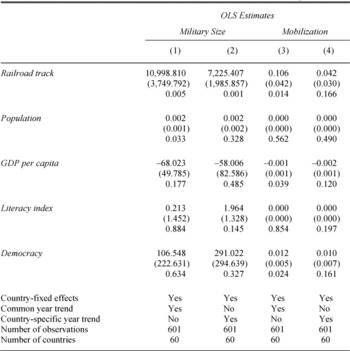
Another potential concern with our analysis is that the process by which countries are selected into the great power sample might bias our estimates of the role of transport and communication technologies in determining the extent of military mobilization. To address this possibility, we conducted an alternative analysis for the period 1816–2000 including 60 different countries.Footnote 30 We were able to estimate the same specifications for this sample as those featured in our main analysis with the exception of a measure for precision weapons. Table 4 reports the results for our main specifications. The key result is that the coefficient estimates for Railroad Track are positive and statistically significant for this sample as well.Footnote 31
MILITARY SIZE AND MILITARY MOBILIZATION: EXPANDED SAMPLE, 1816–2000

Sources:
The table reports the results of pooled-time-series-cross-sectional OLS regressions for the variable Military Size and Military Mobilization on a large cross-section of countries with interstate conflicts for 1816 to 2000. The table reports the coefficient estimate, robust standard error clustered on country (in parentheses), and corresponding p-value.
Finally, our analysis has established a robust partial correlation between railroad penetration, precision weapon development, and military mobilization. We have further discussed why the historical pattern of railroad development makes it unlikely that this correlation is driven by states building railroads to pursue their military objectives. That said, it is still possible that there are unobserved factors that led countries during the course of the late nineteenth and early twentieth century to both build railroads and field larger armies. One approach to addressing this concern is to focus on differences in the growth in a single country in army and navy sizes during this period. Our interpretation of any such differences is that they are attributed to the availability of the railroad to move and supply soldiers. This difference-in-differences strategy controls for all unobserved factors which influenced the growth of army and navy sizes similarly over time. It also controls for differences in the specific intensity of the conflicts being compared as long as those differences influenced army and navy participation similarly. Specifically, we have data on army and navy size for the United Kingdom during the Napoleonic War and during World War I.Footnote 32 The simple difference-in-differences in army and navy size between these two conflicts is 3,369,733. To put it slightly differently, while the number of sailors in the navy increased a bit more than 150 percent, the growth in the size of the army was 1,231 percent.Footnote 33 Even the peacetime difference between these two periods was substantial. The difference-in-differences in army and navy size for 1791—prior to the beginning of the Revolutionary and Napoleonic Wars—and 1913—prior to World War I—is 101,033. Our interpretation of this differential growth pattern in army and navy sizes is that it is largely due to the ability of railroads to move and supply soldiers, though admittedly any technological or other factors that differentially affected the usefulness of army and naval forces in these conflicts could account for the disparity.
Overall, the results of our analyses in Tables 2, 3, and 4 provide firm support for our core argument; one revolution in technology, the railroad, made the era of the mass army possible while a second revolution involving remote delivery of explosive force helped bring this era to a close. The results for the railroad are particularly strong and robust to consideration of a wide variety of factors that might bias our inference.Footnote 34
MILITARY MOBILIZATION IN FRANCE
Beyond our pooled analysis we chose to do a more in-depth investigation of France because of its putative role in the advent of the mass army. Yet even there, the era of the mass army was largely a late nineteenth- and twentieth-century phenomenon that coincided with and depended on the technological innovations of the Industrial Revolution.
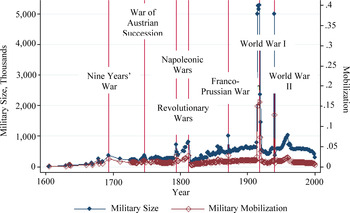
Figure 1 presents our variables Military Size and Military Mobilization for France and highlights the peak mobilization years for many of its most important conflicts over the last four centuries. The first thing to notice about the graph is that the seventeenth century is a time of dramatic growth in the size of the French army and the extent of mobilization. In our data, the French army reached 362,000 men during the Nine Years’ War with a mobilization rate of almost 2 percent. As John Lynn (Reference Lynn and Blanning2000, p. 568) puts it, “Henri IV felt it necessary to assemble no more than 55,000 troops in preparation for his stillborn campaign of 1610, [while] his grandson Louis XIV required a force of nearly 400,000 during the Nine Years’ War (1689–1698).” Lynn, Geoffrey Parker (Reference Parker1976), and others have noted this roughly eightfold increase in the size of the French army during seventeenth-century wars. While the determinants of this increase are varied, it is interesting to note that Parker emphasizes, among other factors, the role of transportation. “It was not possible to move large concentrations of troops at speed before the seventeenth century because there were no roads outside Italy which were capable of carrying a large army, its supply train, and its artillery” (1976, pp. 209–10).Footnote 35 Although this is not the transportation revolution that we emphasize in this article, it is consonant with our emphasis on how the requirements necessary to move and supply armies limited the size of armies.
MILITARY MOBILIZATION IN FRANCE, 1600–2000

The size of the French military varied throughout the many conflicts of the eighteenth century but prior to the French Revolution it did not significantly surpass the scale reached at the end of seventeenth century. Nonetheless, throughout the eighteenth-century France fielded armies that regularly exceeded two hundred thousand in number and when needed surpassed three hundred thousand. The high point for eighteenth-century army size in our data is 364,086 during the War of Austrian Succession.
This eighteenth-century experience provides the context for interpreting the changes in military size associated with the French Revolution and Napoleonic Wars. As Figure 1 indicates, army size and mobilization did increase with the French Revolution. Our data suggest that France's revolutionary army included 732,474 soldiers in 1794 or 0.027 of the population. In our data, this increase represents almost precisely a doubling of army size from the previous high point of 1747. Given population growth, the increase in mobilization was a more modest 60 percent. Later in the revolutionary period, mobilization rates returned to lower levels that were not at all unusual in the eighteenth century (0.017 in 1795, 0.015 in 1796, and 0.014 in 1797). Although our data are not complete for the Napoleonic period, here larger armies and higher mobilization rates were sustained over several years. Army size in our data ranged from 504,220 in 1806 to 800,000 in 1812 with mobilization rates exceeding 2 percent in four of the six years for which we have estimates, with a peak of 0.027 in 1812.Footnote 36 But again, the magnitude of these increases is more modest than is commonly assumed. They were also modest in comparison to the increases that France experienced in the seventeenth century and would experience in later periods. Peak Napoleonic army size was 2.2 times larger than 1747 and peak Napoleonic mobilization was 1.6 times larger than 1747. Our results regarding the magnitude of the revolutionary and Napoleonic mobilizations may seem surprising in light of received wisdom among political scientists. In fact, our conclusions fall very much in line with recent French historical work regarding the levée en masse in particular. Annie Crepin (2009, pp. 106–07) suggests that the levée en masse produced an army that was larger but in the end not that different in scale from the armies raised by Louis XIV toward the end of his reign.Footnote 37
What happened after the Napoleonic era? While there was debate on the subject, we dispose of clear evidence showing that from a very early date some astute French observers recognized that the military use of the railroad would transform the nature of warfare. For two examples of this belief, see Michel Chevalier (Reference Chevalier1841) and Felix Renouard de Sainte-Croix (Reference Renouard de Sainte-Croix1837). We also have clear evidence that after the defeat suffered in the Franco-Prussian War, French observers suggested that Prussia's superior rail system had allowed for the Prussian army to mobilize more quickly and in substantially greater numbers than was the case for the French. For examples of this view, see both Francois-Prosper Jacquemin (Reference Jacquemin1872) and Charles Tomyar (Reference Tomyar1882).
By 1914, with an extensive rail system, France was in a position to mobilize a much larger fraction of its population than ever before. The most striking feature of Figure 1 is the size of the military and levels of mobilization during World War I and more briefly during World War II. Although these mobilizations, which involved over five million soldiers and over 15 percent of the population, were foreshadowed by France's substantial mobilization in the Franco-Prussian War, the scale of the world wars set them apart from France's previous mobilizations including those during the revolutionary and Napoleonic period. In our data, military size in 1918 was 6.6 times larger than in 1812, the peak year of the revolutionary and Napoleonic period. The same multiple for mobilization was 6.0. Even in the French case, it is the late nineteenth and early twentieth century that brings mass warfare involving millions of soldiers to the fore. While the Revolution probably facilitated the ability of the French state to recruit a large army, it was only once the railroads and other innovations in transportation and communication were present that mass warfare became a reality.
Finally, Figure 1 also shows the decrease in army size and mobilization in the late twentieth century. This is of course clearest with the break after 1945. However, even taking just the comparison between the Algerian War and subsequent conflicts, we see a much lower level of mobilization This is all consistent with our argument that innovations in precision weapons made raising mass armies less desirable, although other factors could explain the data.
CONCLUSION
We know relatively little about the factors that have induced and allowed states to field mass armies. The many plausible theories include the emergence of nationalism, changes in political regime, or finally technological change. But systematic tests of these arguments have been lacking, and a primary reason for this is that the data constraints for considering changes in military force over the long run are very considerable. In this article, we have attempted a systematic examination of the factors that produced the era of the mass army and which have subsequently led to its demise. This question is important both as a topic in itself, as well as for those interested in understanding the wide variety of important economic and political development outcomes—such as income inequality, progressive taxation, and welfare state development—that have been associated with mass warfare.
Many scholars tend to focus on the importance of political factors when seeking to explain the arrival of the era of the mass army. Nationalism, it is said, provided the motivation necessary for the masses to fight, and the extension of citizenship and democratic rights had a similar effect. But if having motivated soldiers is a necessary condition to fielding a mass army, it is certainly not a sufficient one. Fielding a mass army also depends on having the ability to keep it adequately supplied. In addition, governments must actually want to field a mass army as opposed to opting for some other format of military force. We have argued that over the last two centuries these factors depended on the evolution of transportation and communications technology. The railroad and the telegraph made it possible for the first time to field and command armies numbering in the millions. Today, governments could keep a mass army supplied if they wanted to, but further advances in transport and communications technologies have arguably given them less incentive to field one in the first place.
We have tested our argument regarding communications and transport technology using a new data set that provides a more extensive view of army sizes, mobilization levels, and recruitment methods among major powers than has previously been possible. Our results regarding the importance of the railroad are quite strong and robust to a number of different types of observable and unobservable confounding factors. Our results regarding cruise missile technology are subject to a greater number of caveats, but they are still consistent with the proposition that the ability to remotely deliver explosive force with precision has been associated with a dramatic reduction in army sizes. Overall, the empirical evidence presented in this article confirms our argument that changes in transport technology were the critical factor in ushering in the era of the mass army and in leading to its subsequent demise.