




No CrossRef data available.
Article contents
Cognitive impairment in relapsing and primary progressive multiple sclerosis: Mostly a matter of speed
Published online by Cambridge University Press: 01 November 2004
Abstract
Based on the assumption that cognitive impairment in MS is consistent with subcortical dementia, a battery of neuropsychological tests was assembled that included measures of executive function (Tower of London and Wisconsin Card Sorting Test), verbal learning and memory (a paired associates learning test), and speeded information processing (Stroop Color Word Interference Test). The battery was administered to patients with relapsing and primary progressive MS and to healthy controls. Differences between patients and controls occurred on several of the measures. However, when differences with respect to fatigue and depression were statistically controlled, the only differences that remained significant involved measures relating to the speed of information processing. Patients performed more slowly than controls, with the disparity being greater for relapsing patients than for those with primary progressive disease. The slowing was evident on measures of automatic as well as controlled processing and regardless of whether speed was an explicit feature of successful performance or recorded unobstrusively while the patient concentrated on planning a correct solution to a problem. Parallels were noted between cognitive slowing associated with MS and that of normal aging. (JINS, 2004, 10, 948–956.)
Information
- Type
- Research Article
- Information
- Journal of the International Neuropsychological Society , Volume 10 , Issue 7 , November 2004 , pp. 948 - 956
- Copyright
- © 2004 The International Neuropsychological Society
INTRODUCTION
The cognitive deficits found in MS often seem as diverse as the sensory and motor symptoms characterizing this disease (Ryan et al., 1996). The concept of subcortical dementia (Cummings & Benson, 1984) has been used to impose some order on this diversity. As a subcortical dementia, the cognitive impairment associated with MS would be mainly characterized by (1) deficits in executive functions such as planning, abstraction, and strategic problem-solving, (2) memory deficits centering more on retrieval than on encoding and storage processes, and (3) deficits in attention and overall information processing speed (Caltagirone et al., 1991; Filley et al., 1989; Fischer et al., 1994; Rao, 1996; Ryan et al., 1996).
Impairments have in fact been reported in all these domains. Patients with MS have been shown to perform more poorly than healthy controls on common measures of executive function (Arnett et al., 1994, 1997; Beatty & Monson, 1996; Foong et al., 1997; Heaton et al., 1985; Rao et al., 1987; Ryan et al., 1996). Memory deficits are also common in multiple sclerosis (see reviews by Rao et al., 1993; Thornton & Raz, 1997), although the contention that these involve problems of retrieval rather than encoding and storage has been questioned (Beatty et al., 1988; Carroll et al., 1984; DeLuca et al., 1994, 1998). Slowing in the speed of information processing has also been demonstrated across a variety of measures (Archibald & Fisk, 2000; Beatty et al., 1988; Kujala et al., 1994; Laatu et al., 1999; Litvan et al., 1988; Paul et al., 1998; Pujol et al., 2001; Rao et al., 1989; Ryan et al., 1996; Scarrabelotti & Carroll, 1999; Vitkovitch et al., 2002).
When studying the impact of MS on cognitive functioning, investigators must take into consideration the significant levels of depression that patients often are experiencing. Arnett and his colleagues in particular have demonstrated that depression makes a substantial contribution to the deficits observed in MS patients on measures of executive function (Arnett et al., 2001) and speeded information processing (Arnett et al., 1999). Fatigue is also a common symptom of MS, though its impact on patients' cognitive performance is less clearly established. We could find no differences in performance when a battery of cognitive measures was administered during a period of greatest fatigue and a period of least fatigue in patients' days (Parmenter et al., 2003). However, Krupp and Elkins (2000) found patients' scores on a variety of cognitive measures declined after engaging in a lengthy continuous performance task, while those of controls improved. Studies such as those by Arnett and Krupp highlight the need to distinguish the impact of depression and fatigue from that of the neurological disease itself, and this tactic was adopted in the present study.
Finally, patients with MS do not constitute a uniform group, and therefore studies featuring a simple comparison between MS patients and healthy controls can be deceptive. Recent investigations have permitted consideration of different subtypes of MS based upon disease course; the common practice has been either to focus on the single subtype of relapsing–remitting MS or to distinguish between relapsing and chronic progressive patients. In the latter instance, the usual finding is that patients with chronic progressive MS have more pronounced impairment than those with relapsing disease, with differences observed in executive function (Heaton et al., 1985; Rao et al., 1987), memory (Beatty et al., 1988; Rao et al., 1984) and speeded information processing (De Sonneville et al., 2002). However, rather than constituting a uniform category, chronic progressive MS itself combines patients with primary progressive and secondary progressive disease. These groups differ not only in the course of their disease, but also in pathology and MRI findings (Comi et al., 1995; Filippi et al., 1995; Foong et al., 2000; Revesz et al., 1994) and perhaps cognitive impairment. One study (Comi et al., 1995) reported impairment in 53% of a sample of secondary progressive patients, compared to only 7% of primary progressive patients.
In the present study, we compared relapsing and primary progressive patients, along with a sample of healthy controls. The exclusion of patients with secondary progressive MS avoids several problems. By definition, such patients have a prior history of relapsing disease that has subsequently converted to a progressive course. They are thus in a more advanced stage of MS, one that might be expected to manifest greater cognitive impairment. Further complications arise from the likelihood the conversion to secondary progressive status may now be delayed by drugs currently available to treat MS. Patients with primary progressive MS have no prior history of relapsing disease, and therefore a comparison between relapsing and primary progressive patients does not necessarily entail a difference in chronicity. Relative to relapsing MS, primary progressive disease is typically diagnosed at an older age, with greater equality between genders; physical disability tends to progress more rapidly and eventuate in a more severe outcome; and MRI studies indicate less inflammation and fewer lesions, especially in cerebral areas. To our knowledge, the present study is the first to focus on a comparison of relapsing and primary progressive patients in terms of cognitive functioning.
METHODS
Research Participants
Seventy-one patients (48 females, 23 males) with clinically definite MS (McDonald et al., 2001) were recruited during the course of their regular appointments in the MS Clinic. All patients had been under the care of the same neurologist (Sharon G. Lynch) for at least 1 year. Those with a history of drug or alcohol abuse, premorbid psychiatric disorders or mental retardation, traumatic head injury, or neurological disorders other than MS were excluded. Likewise, patients deemed too intellectually impaired to comprehend the instructions for the cognitive tests or the questionnaires were excluded. During the course of the clinic appointment, each patient was administered the Expanded Disability Status Scale (EDSS: Kurtzke, 1983). The patients ranged in age from 23 to 74 (M = 46.7). Length of illness ranged from 1 to 37 years (M = 8.7), and EDSS scores ranged from 1.5 to 7.0 (M = 4.3). The sample consisted of patients with relapsing (31 females, 8 males) or primary progressive (17 females, 15 males) disease. The subgroups were comparable with respect to disability (t < 1), although relapsing patients had significantly longer length of illness than primary progressive patients (M = 10.8 vs. 6.1; t = 3.0; df =68; p = .004) and thus less rapidly progressing disability.
A healthy control group consisting of 40 subjects (25 females, 15 males) free of chronic medical conditions was recruited through newspaper ads, posters, and contacts with personnel at the medical center. This control group ranged in age from 23 to 57 (M = 44.9).
Education level was rated on a 6-point scale, with 1 = did not finish high school, 2 = completed high school, 3 = completed some college credit, 4= completed 4 year college degree, 5 = completed some graduate work, and 6 = completed advanced degree (e.g., masters, doctorate). The ratings ranged from 1 to 6 (M = 3.6) for patients and from 2 to 6 (M = 4.1) for the controls.
Measures
The Tower of London
The Tower of London (TOL; Krikorian et al., 1994) is a test of planning and strategic problem solving, which was computerized for the present study. In the upper portion of the monitor, the computer displayed three colored disks and three pegs of varying lengths which could hold either one, two, or all three of the disks. The disks were in a starting arrangement on the pegs, which was the same for all problems. In the bottom portion of the screen, the computer displayed a model with the disks in a different arrangement. The subject's task was to move the disks in the upper display so they matched the arrangement in the bottom display. Twelve problems were presented, graduated in difficulty from those requiring two moves to those requiring five moves. At the beginning of each problem, the subject was told the number of moves permitted to solve the problem. Subjects were allowed three attempts to solve each problem in the specified number of moves and were awarded 3 points for a correct solution on the first attempt, 2 points (second attempt), 1 point (third attempt), or no points. The TOL point score was the sum of the points across the 12 problems. The computer also measured the length of time between the initial presentation of each problem and the subject's first move—regardless of whether the subject succeeded in solving the problem during this initial attempt. This “initial planning time” was recorded for each problem on the TOL, and mean initial planning times were computed separately for 2-, 3-, 4-, and 5-move problems.
The Wisconsin Card Sorting Test
The Wisconsin Card Sorting Test (WCST; Heaton, 1981) is a concept formation test consisting of 128 cards that can be sorted according to color, shape, or number. A computerized version of the WCST was used in the present study. The computer displayed a row of four reference cards on the top of the screen, presented individual cards for the patient to match to the reference cards, and provided feedback as to whether the placement of the card was “right” or “wrong.” After 10 consecutive correct responses, the operable concept was switched. The computer tallied the number of cards sorted, the total number of errors, and the percentage of perseverative errors committed during the test.
The Stroop Color-Word Interference Test
A computerized version of the Stroop Color-Word Interference Test (Stroop, 1935) was used in the present study consisting of three 60-s trials during which the subject first read color words (word reading), then named the color of a row of four X's (color naming), and finally, named the color of the letters of color words (color-word naming). In the color-word naming trial, all the stimuli were incongruent (e.g., the word “GREEN” printed in blue letters). A brief, eight-stimulus practice set was presented before the start of each trial. The stimulus appeared in the center of the computer screen. The subject gave a verbal response to the stimulus (i.e., read the word or named the color), and the experimenter pressed the space bar to display the next stimulus. The computer timed the trial and recorded the number of stimuli completed during the trial. In addition to the word reading, color naming, and color-word naming scores, a score reflecting resistance to interference was derived by subtracting a “predicted” color-word naming score from the actual score, as recommended by Golden (1994). Because the number of errors committed was very small for all subjects, errors were not analyzed in this study.
The Paired Associates Learning Test (PALT)
The PALT was designed for the present study to assess both immediate recall and delayed recognition memory for verbal stimuli. The test began with the computer displaying a randomized sequence of eight related (e.g., “APPLE–WORM”) and eight unrelated (e.g., “GLASSES–BUS”) word pairs. Subjects were then shown one word from each pair and asked to recall the word with which it was paired. This procedure was repeated two times. The computer recorded the number of related and unrelated words correctly recalled. After the second trial, the Stroop was administered to interpose a delay prior to the recognition phase of the PALT. Subjects were then shown a randomized sequence of 32 words from the original word pairs and 32 foils. The computer recorded the number of words correctly recognized during this delayed recognition phase.
Self-report Questionnaires
Subjects' levels of fatigue and depression during the preceding week were assessed using the Fatigue Severity Scale (FSS: Krupp et al., 1989) and the Center for Epidemiologic Studies–Depression Scale (CES–D; Radloff, 1977).
Procedure
This study was approved by the Human Subjects Committee of the University of Kansas Medical Center. While the patient was in the clinic, a research assistant explained the study and obtained informed consent. Subjects were tested during a subsequent appointment conducted either in the clinic or in the subject's home. During this session, the subject completed the fatigue (FSS) and depression (CES–D) questionnaires and was then administered the battery of cognitive measures in a fixed sequence consisting of the TOL, immediate recall portion of the PALT, Stroop, delayed recognition portion of the PALT, and WCST. The testing session lasted between 1 and 2 hr.
RESULTS
Table 1 presents the means and standard deviations for the two groups of MS patients and the healthy controls on all measures. A near significant difference was found between the groups in terms of gender (χ2 = 5.7, df = 2, p = .057), largely because the relapsing groups differed from the primary progressive group (χ2 = 4.4, df = 1, p = .035). Significant differences were found on each of the other variables in Table 1: age (F = 4.3, df = 2, 107, p = .02); education level (F = 4.4, df = 2, 108, p = .01); depression (F = 12.2, df = 2, 107, p < .001); fatigue (F = 61.6, df = 2, 107, p < .001). Pair-wise comparisons revealed that primary progressive patients were significantly older than either the relapsing patients or the controls; they also had a lower education level than the controls. The two groups of MS patients did not differ in depression, but both had higher depression scores than the controls. Both groups also had higher fatigue scores than controls, with the relapsing patients reporting greater fatigue than the primary progressive patients.
Comparison of MS patients and healthy controls on covariate and cognitive measures

Because group differences such as these could affect the outcome on the cognitive measures, we applied two analysis of covariance models to the cognitive measures. In the first, gender, age, and education level were entered as covariates. In the second, depression and fatigue scores were also entered as additional covariates. The use of two separate covariance models made it easier to comprehend the present results in relation to previous studies. In both instances, a multivariate analysis was first applied to the full array of 12 cognitive measures, followed by separate univariate analyses applied to each measure.
When gender, age, and education level were statistically controlled, the multivariate analysis revealed significant differences between groups on the full array of cognitive measures (F = 3.1, df = 24, 172, p < .001, Wilks's λ = .43). Univariate analyses revealed significant differences on seven of these measures: initial planning time (F = 21.2, df = 2, 103, p < .001, η2 = .29) on the TOL, word reading (F = 32.7, df = 2, 104, p < .001, η2 = .39), color naming (F = 28.5, df = 2, 104, p < .001, η2 = .35), color-word naming (F = 26.4, df = 2, 104, p < .001, η2 = .34), and resistance to interference (F = 6.1, df = 2, 104, p = .003, η2 = .10) on the Stroop, recall of unrelated items (F = 4.0, df = 2, 102, p = .022, η2 = .07) and delayed recognition (F = 4.3, df = 2, 102, p = .017, η2 = .08) on the PALT. Paired comparisons conducted on these seven measures revealed that both groups of patients performed more poorly than controls on all measures except the delayed recognition scores. On this measure, only the primary progressive patients scored significantly lower than the controls. In addition, relapsing patients performed more poorly than primary progressive patients in terms of initial planning times on the TOL and word reading, color naming, and color-word naming scores on the Stroop. No differences were found on any of the principal measures of executive function (i.e., the point score on the TOL or the scores derived from the WCST).
The analyses were repeated with depression and fatigue now included as additional covariates. Under this second covariance model, the multivariate analysis applied to all 12 cognitive measures was again significant (F = 2.2, df = 24, 164, p = .002, Wilks's λ = .58). However, the only measures that continued to show significant differences between groups were initial planning time on the TOL (F = 14.5, df = 2, 99, p < .001, η2 = .23), and word reading (F = 9.8, df = 2, 100, p < .001, η2 = .16), color naming (F = 8.3, df = 2, 100, p < .001, η2 = .14), and color-word naming (F = 6.3, df = 2, 100, p = .003, η2 = .11) on the Stroop. Both groups of patients performed more poorly than controls on all these measures. In addition, relapsing patients had slower planning times on the TOL and lower word reading scores on the Stroop compared to primary progressive patients.
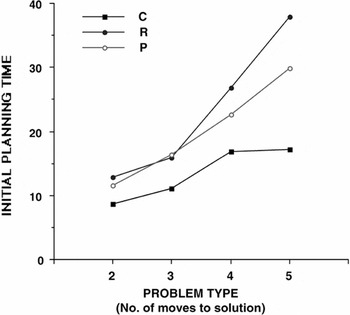
Again using the second covariance model, 3 (group) × 4 (problem type) analysis of covariance was performed on the initial planning times for two-, three-, four-, and five-move problems on the TOL. Main effects were significant for group (F= 15.1, df = 2, 99, p < .001) and problem type (F = 6.6, df = 3, 297, p < .001), and there was a significant Group × Problem Type interaction (F = 4.0, df = 6, 297, p = .001). This interaction is plotted in Figure 1. All subjects used longer initial planning times as they attempted increasingly complex problems. However, the slope of this increase was significantly greater for the two groups of patients than for the controls, so differences between patients and controls became greater with more complex problems.

Initial planning times averaged across two-, three-, four-, and five-move problems on the Tower of London for relapsing (R), primary progressive (P), and control (C) subjects.
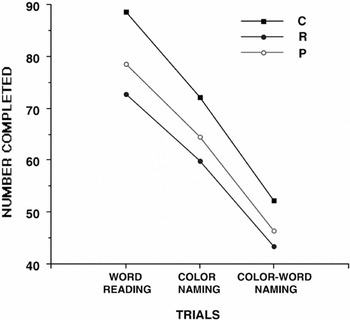
A similar 3 (group) × 3 (trial) analysis of covariance was performed on the scores for the three trials of the Stroop. Main effects were significant for group (F= 9.8, df = 2, 100, p < .001) and trial (F = 16.1, df = 2, 200, p < .001), and again, the Group × Trial interaction was also significant (F = 2.6, df = 4, 200, p = .035). This interaction is plotted in Figure 2. All subjects completed fewer items as the trials advanced from word reading to color naming and then to color-word naming. However, the largest difference between the groups occurred on the word reading task and the smallest difference occurred on the color-word naming task. Therefore, the decline in performance across the three trials was greater for the controls than for the patients.

Number of items completed in 60 s on the word reading, color naming, and color-word naming trials of the Stroop for relapsing (R), primary progressive (P), and control (C) subjects.
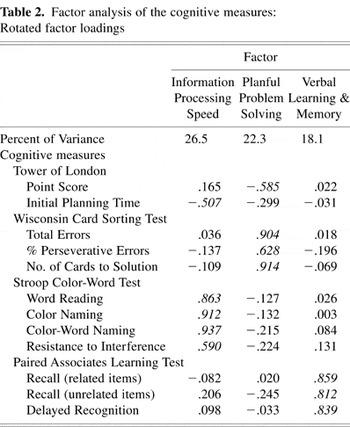
We subjected the array of cognitive measures to a factor analysis using a varimax rotation applied to factors with eigenvalues greater than 1. This analysis produced a three-factor solution accounting for 67% of the variance. The interpretation of these factors is based on the factor loading matrix presented in Table 2. The first factor, accounting for 26% of the variance, has loadings on the initial planning times from the TOL and on all four measures derived from the Stroop. This factor was interpreted as Speeded Information Processing. The second factor (22% of the variance) has loadings on the point score from the TOL and on all three measures derived from the WCST, and was interpreted as Planful Problem Solving. The third factor (18% of the variance) has loadings on the three measures derived from the PALT and was interpreted as Verbal Learning And Memory.
Factor analysis of the cognitive measures: Rotated factor loadings

Factor scores were computed for the three factors using the regression method and then analyzed in accordance with the second covariance model. The only significant difference occurred on the first factor (F = 14.2, df = 2, 93, p < .001.) Both groups of patients achieved lower scores than the controls, and relapsing patients had lower scores than primary progressive patients on this factor. Age was a significant covariate in this analysis (F = 5.9, df = 1, 93, p = .017), as it was in the analysis of each of the separate measures loading on this factor. Whereas no differences between groups were found on the other two factor scores, several covariates were significant. For the second factor, involving planful problem solving, the significant covariates were age (p = .012), education level (p = .018), and depression (p = .001). For the third factor, involving verbal learning and memory, the only significant covariate was gender (p = .014).
Finally, relationships were examined between the cognitive measures and disease-related variables for the patient sample. The scores on each of the three trials of the Stroop were significantly correlated with both EDSS scores (word reading: r = −.51; color naming: r = −.46; color-word naming: r = −.34; all ps < .005) and length of illness (word reading: r = −.29; color naming: r = −.41; color-word naming: r = −.30; all ps < .02). Partial correlations remained significant after fatigue and depression scores were removed from the relationship. With one isolated exception (i.e., recall of unrelated items on the PALT), all other cognitive measures were unrelated to disability or length of illness.
DISCUSSION
With the variance attributable to gender, age, and education level removed, differences were found on a number of cognitive measures. However, when the variance attributable to fatigue and depression was also removed, only the measures that loaded on the speeded information processing factor continued to reflect differences between patients and controls. These differences appeared to be more pronounced in relapsing than in primary progressive patients.
On the initial presentation of each problem on the TOL, MS patients took a longer time before making their first overt move. During this interval, subjects are typically rehearsing the sequence of moves that would result in a solution. The interaction depicted in Figure 1 shows the disparity between patients and controls grew as the problems required more moves to solution, a result consistent with the notion that patients' covert rehearsal of each move may have occurred more slowly.
Individuals with impaired executive functioning might be expected to bypass much of this strategic rehearsal and impulsively begin moving the disks. The MS patients performed in quite the opposite fashion. Furthermore, while requiring longer planning times on the TOL, their solutions were as accurate as those of controls; no differences were observed in point scores. Demaree et al. (1999) reported a similar result using a modified version of the Paced Auditory Serial Addition Test. When allowed adequate time to process the requisite information, patients' performance was again as accurate as that of healthy controls, leading these investigators to conclude that the deficit was largely confined to processing speed.
Other investigators have distinguished between planning time and execution time on the TOL (i.e., the time spent on each trial before as opposed to after initiating the first move). Arnett et al. (1997) examined “time to first move” and “time per move,” and reported significant differences between MS patients and controls on both measures. On the other hand, Foong et al. (1997) reported no differences between MS patients and controls on either planning time or execution time. However, these latter investigators attempted to “correct” their measures by subtracting values for “motor initiation” and “motor execution” time. The correction values were obtained by having the subject re-enact their prior performance, mimicking their earlier sequence of moves as these were replayed by the computer. Our approach to avoiding confounds stemming from motor impairment was to have the examiner manipulate the disks in response to the subject's verbal commands. The measure obtained under these conditions, confined to planning time, and recorded only during the initial presentation of each of the 12 problems composing the TOL, appears to be a more refined index of cognitive slowing—one that reveals substantial differences between patients and controls.
Patients also performed more slowly than controls on each of the three trials of the Stroop. A fourth measure reflecting subjects' ability to avoid distraction posed by the incongruity between words and colors was no longer significant after controlling for depression and fatigue. The differences observed on the Stroop therefore seems to entail simply the speed with which patients and controls could process a succession of visual stimuli and supply the appropriate verbal response to each. As shown in Figure 2, this disparity in performance is now greater for the “simpler” trials, a result that appears to contradict the interation found on the TOL. However, the simpler trials are those that afford subjects an opportunity to process larger numbers of items in the time allotted. If patients are slower in processing each item, the disparity is likely to be amplified on these trials, just as the disparity is amplified on the more complex problems of the TOL—those involving a larger number of steps to solution.
Previous investigators (De Sonneville et al., 2002; Kujala et al., 1994; Paul et al., 1998) have raised the distinction between automatic and controlled processing in considering MS-related deficits in information processing speed. While impaired on controlled processing tasks, patients are said to show little or no impairment on automatic processing tasks requiring minimal concentration (Paul et al., 1998; Scarrabelotti & Carroll, 1999). In the present study, however, performance was slowed on the more automatic word reading and color naming tasks as well as the more controlled processing trial involving Stroop stimuli themselves. Other investigators (Kujala et al., 1995; Pujol et al., 2001; Vitkovitch et al., 2002) have also reported this outcome on the preliminary trials of the Stroop.
Whereas planning times on the TOL were recorded during a period of silent contemplation, the Stroop measures were obtained when the subject was engaged in a task laden with sensory and motor features. It is therefore plausible to argue that the difference between patients and controls on the Stroop reflects problems beyond that of a slowing in the speed of information processing. The fact that patients' disability status was significantly related to the Stroop measures, but not to those of the TOL, lends support to such an argument. Furthermore, the particular functional system on the EDSS most highly related to the Stroop measures was the brainstem component, and ratings on this component are indeed influenced by several sensory and motor abilities. The ones that would seem to be most relevant to performance on the Stroop are nystagmus, eye movement difficulties, and dysarthria.
Patients in this study were not screened for any of these potentially complicating factors. However, based on the physician's notes pertaining to the EDSS obtained for most of the patients, we were able to subclassify patients according to whether they evidenced these symptoms. Only 3 patients were noted to have any evidence of dysarthria (rated as mild in 2 and signs only in the 3rd), and their average scores on the three trials of the Stroop were similar to the overall means for all patients. Nystagmus and eye movement difficulties were more common—present in 38% of the patients. Furthermore, those evidencing such problems had lower scores on all three trials of the Stroop, although none of these differences was significant.
We believe that the speed of information processing is a major determinant of the scores on each trial of the Stroop and that its contribution accounts for the fact that these scores loaded on the same factor as those for initial planning times on the TOL. Beyond this assertion, it is not possible to determine from the present data the extent to which sensory and motor problems may have also influenced patients' performance on the Stroop. However, various parameters of the Stroop task could be varied in ways that might allow the contribution of these more peripheral problems to be determined. For example, varying the number of colors used on the Stroop or having the subject read a set of unique words instead of four words repeated numerous times over the course of the task might be used to indicate the contribution of dysarthria. Similarly, varying the position of the stimuli on the monitor could be useful in reflecting the contribution of nystagmus and eye movement problems.
It is also important to consider the question of whether “to covary or not to covary.” The necessity of controlling for differences with respect to factors such as gender, age, and education is obvious: such factors are extraneous to the disease. However, both fatigue and depression are integral features of MS. Fatigue is a common symptom of MS—organic to the disease itself. Depression is sometimes viewed in a similarly “organic” fashion. To the extent that this is true, equating samples of patients and controls on measures of fatigue and depression risks the removal of some of the effects of the disease itself.
The extent to which this issue impacted the outcome of the present study is gauged by the covariate factors for fatigue and depression. Fatigue was not a significant covariate in any of the analyses. Depression was a significant covariate in two analyses—involving the number of errors and the number of cards to solution on the WCST. The outcome for neither of these variables is altered by including or excluding depression as a covariate. Differences between patients and controls on these variables were nonsignificant in either instance.
The one covariate that was significant in a number of the analyses was age. Age-related declines in performance occurred on the initial planning times from the TOL, on all four measures derived from the Stroop, and on the scores for the speeded information processing factor. This finding raises the issue of whether the essential impact of MS on cognitive performance is similar to that seen in aging. Kail (1997, 1998) has illustrated this similarity in a compelling fashion, using Brinley (1965) plots to show that the regression between MS patients and controls in terms of performance across a number of tasks involving speeded information processing is similar to the regression of older subjects' performance on that of younger subjects. The association is further supported on a neurological front through the demonstration that much of the impact of aging on the primate nervous system centers on white matter and includes loss of myelin and microscopic inclusions occurring within oligodendricytes (Peters, 2002). As Miller (1994) has argued, the most direct impact of reductions in the myelination of axons resulting either from aging or disease would likely entail decline in the speed and efficiency of signal processing.
ACKNOWLEDGMENTS
Funding for this research was provided by Grant TMP 7592-00 from Teva Neuroscience LLC to co-principal investigators, D.R.D. and S.G.L.
References
REFERENCES
Archibald, C.J. &
Fisk, J.D.
(2000).
Information processing efficiency in patients with multiple
sclerosis.
Journal of Clinical and Experimental Neuropsychology,
22,
686–701.CrossRefGoogle Scholar
Arnett, P.A.,
Higginson, C.I., &
Randolph, J.J.
(2001).
Depression in multiple sclerosis: Relationship to planning ability.
Journal of the International Neuropsychological Society,
7,
665–674.CrossRefGoogle Scholar
Arnett, P.A.,
Higginson, C.I.,
Voss, W.D.,
Wright, B.,
Bender, W.I.,
Wurst, J.M., &
Tippin, J.M.
(1999).
Depressed mood in multiple sclerosis: Relationship to
capacity-demanding memory and attentional functioning.
Neuropsychology,
13,
434–446.CrossRefGoogle Scholar
Arnett, P.A.,
Rao, S.M.,
Bernardin, L.,
Grafman, J.,
Yetkin, F.Z., &
Lobeck, L.
(1994).
Relationship between frontal lobe lesions and Wisconsin Card
Sorting Test performance in patients with multiple sclerosis.
Neurology,
44,
420–425.CrossRefGoogle Scholar
Arnett, P.A.,
Rao, S.M.,
Grafman, J.,
Bernardin, L.,
Lucetta, T.,
Binder, J.R., &
Lobeck, L.
(1997).
Executive functions in multiple sclerosis: An analysis of temporal
ordering, semantic encoding, and planning abilities.
Neuropsychology,
11,
535–544.Google Scholar
Beatty, W.W.,
Goodkin, D.E.,
Monson, N.,
Beatty, P.A., &
Hertsgaard, D.
(1988).
Anterograde and retrograde amnesia in patients with chronic
progressive multiple sclerosis.
Archives of Neurology,
45,
611–619.Google Scholar
Beatty, W.W. &
Monson, N.
(1996).
Problem solving by patients with multiple sclerosis: Comparison of
performance on the Wisconsin and California Card Sorting Tests.
Journal of the International Neuropsychological Society,
2,
134–140.CrossRefGoogle Scholar
Brinley, J.F.
(1965).
Cognitive sets, speed and accuracy of performance in the elderly.
In
A.T. Welford &
J.E. Birrens (Eds.),
Behavior, aging, and the nervous system (pp.
114–149).
Springfield, IL:
Thomas.
Caltagirone, C.,
Carlesimo, G.A.,
Fadda, L., &
Roncacci, S.
(1991).
Cognitive function in multiple sclerosis: A subcortical pattern of
neuropsychological impairment?
Behavioural Neurology,
4,
129–141.Google Scholar
Carroll, M.,
Gates, R., &
Roldan, F.
(1984).
Memory impairment in multiple sclerosis.
Neuropsychologia,
22,
297–302.CrossRefGoogle Scholar
Comi, G.,
Filippi, M.,
Martinelli, V.,
Campi, A.,
Rodegher, M.,
Sirabian, G., &
Canal, N.
(1995).
Brain MRI correlates of cognitive impairment in primary and
secondary progressive multiple sclerosis.
Journal of the Neurological Sciences,
132,
222–227.Google Scholar
Cummings, J.L. &
Benson, D.F.
(1984).
Subcortical dementia: Review of an emerging concept.
Archives of Neurology,
41,
874–879.Google Scholar
DeLuca, J.,
Barbieri-Berger, S., &
Johnson, S.K.
(1994).
The nature of memory impairment in multiple sclerosis: Acquisition
versus retrieval.
Journal of Clinical and Experimental Neuropsychology,
18,
56–62.Google Scholar
DeLuca, J.,
Gaudino, E.A.,
Diamond, B.J.,
Christodoulou, C., &
Engel, R.A.
(1998).
Acquisition and storage deficits in multiple sclerosis.
Journal of Clinical and Experimental Neuropsychology,
20,
376–390.Google Scholar
Demaree, H.A.,
DeLuca, J.,
Gaudino, E.A., &
Diamond, B.J.
(1999).
Speed of information processing as a key deficit in multiple
sclerosis: Implications for rehabilitation.
Journal of Neurology, Neurosurgery, and Psychiatry,
67,
661–663.CrossRefGoogle Scholar
De Sonneville, L.M.J.,
Boringa, J.B.,
Reuling, I.E.W.,
Lazeron, R.H.C.,
Adèr, H.J., &
Polman, C.H.
(2002).
Information processing characteristics in subtypes of multiple
sclerosis.
Neuropsychologia,
40,
1751–1765.Google Scholar
Filippi, M.,
Campi, V.,
Martinelli, V.,
Rodegher, M.,
Scotti, G.,
Canal, N., &
Comi, G.
(1995).
A brain MRI study of different types of chronic progressive
multiple sclerosis.
Acta Neurologica Scandinavica,
91,
231–233.Google Scholar
Filley, C.M.,
Heaton, R.K.,
Nelson, L.M.,
Burks J.S., &Franklin G.M.
(1989).
A comparison of dementia in Alzheimer's disease and multiple
sclerosis.
Archives of Neurology,
46,
157–161.CrossRefGoogle Scholar
Fischer, J.S.,
Foley, F.W.,
Aikens, J.E.,
Ericson, G.D.,
Rao, S.M., &
Shindell, S.
(1994).
What do we really know about cognitive dysfunction, affective
disorders, and stress in multiple sclerosis? A practitioners
guide.
Journal of Neurologic Rehabilitation,
8,
151–164.Google Scholar
Foong, J.,
Rozewicz, L.,
Chong, W.K.,
Thompson, A.J.,
Miller, D.H., &
Ron, M.A.
(2000).
A comparison of neuropsychological deficits in primary and
secondary progressive multiple sclerosis.
Journal of Neurology,
247,
97–101.Google Scholar
Foong, J.,
Rozewicz, L.,
Quaghebeur, G.,
Davie, C.A.,
Kartsounis, L.D.,
Thompson, A.J.,
Miller, D.H., &
Ron, M.A.
(1997).
Executive function in multiple sclerosis: The role of frontal lobe
pathology.
Brain,
120,
15–26.Google Scholar
Golden, C.J.
(1994).
The Stroop Color and Word Test: A manual for clinical and
experimental uses.
Wood Dale, IL:
Stoelting Company.
Heaton, R.K.
(1981).
Wisconsin Card Sorting Test manual.
Odessa, FL:
Psychological Assessment Resources, Inc.
Heaton, R.K.,
Nelson, L.M.,
Thompson, D.S.,
Burks, J.S., &
Franklin, G.M.
(1985).
Neuropsychological findings in relapsing-remitting and chronic
progressive multiple sclerosis.
Journal of Consulting and Clinical Psychology,
53,
103–110.Google Scholar
Kail, R.
(1997).
The neural noise hypothesis: Evidence from processing speed in
adults with multiple sclerosis.
Aging, Neuropsychology, and Cognition,
4,
157–165.CrossRefGoogle Scholar
Kail, R.
(1998).
Speed of information processing in patients with multiple
sclerosis.
Journal of Clinical and Experimental Neuropsychology,
20,
98–106.CrossRefGoogle Scholar
Krikorian, R.,
Bartok, J., &
Gay, N.
(1994).
Tower of London procedure: A standard method and developmental
data.
Journal of Clinical and Experimental Neuropsychology,
16,
840–850.CrossRefGoogle Scholar
Krupp, L.B. &
Elkins, L.E.
(2000).
Fatigue and declines in cognitive functioning in multiple
sclerosis.
Neurology,
55,
934–939.CrossRefGoogle Scholar
Krupp, L.B.,
LaRocca, N.G.,
Muir-Nash, J., &
Steinberg, A.D.
(1989).
The fatigue severity scale: Application to patients with multiple
sclerosis and systemic lupus erythematosus.
Archives of Neurology,
46,
1121–1123.Google Scholar
Kujala, P.,
Portin, R.,
Revonsuo, A., &
Ruutiainen, J.
(1994).
Automatic and controlled information processing in multiple
sclerosis.
Brain,
117,
1115–1126.Google Scholar
Kujala, P.,
Portin, R.,
Revonsuo, A., &
Ruutiainen, J.
(1995).
Attention related performance in two cognitively different subtypes
of patients with multiple sclerosis.
Journal of Neurology, Neurosurgery, and Psychiatry,
59,
77–82.Google Scholar
Kurtzke, J.F.
(1983).
Rating neurologic impairment in multiple sclerosis: An expanded
disability status scale (EDSS).
Neurology,
33,
1444–1452.CrossRefGoogle Scholar
Laatu, S.,
Hämäläinen, P.,
Revensuo, A.,
Portin, R., &
Ruutiainen, J.
(1999).
Semantic memory deficit in multiple sclerosis: Impaired
understanding of conceptual meanings.
Journal of the Neurological Sciences,
162,
152–161.CrossRefGoogle Scholar
Litvan, I.,
Grafman, J.,
Vendrell, P., &
Martinez, J.M.
(1988).
Slowed information processing speed in multiple sclerosis.
Archives of Neurology,
45,
281–285.CrossRefGoogle Scholar
McDonald, W.I.,
Compston, A.,
Edan, G.,
Goodkin, D.,
Hartung, H.P.,
Lublin, F.D.,
McFarland, H.F.,
Paty, D.W.,
Polman, C.H.,
Reingold, S.C.,
Sandberg-Wollheim, M.,
Sibley, W.,
Thompson, A.,
van den Noort, S.,
Weinshenker, B.Y., &
Wolinsky, J.S.
(2001).
International Panel on the Diagnosis of Multiple Sclerosis.
Annals of Neurology,
50,
121–127.CrossRefGoogle Scholar
Miller, E.M.
(1994).
Intelligence and brain myelination: A hypothesis.
Personality and Individual Differences,
17,
803–832.CrossRefGoogle Scholar
Parmenter, B.A.,
Denney, D.R., &
Lynch, S.G.
(2003).
The cognitive performance of patients with multiple sclerosis
during periods of high and low fatigue.
Multiple Sclerosis,
9,
111–118Google Scholar
Paul, R.H.,
Beatty, W.W.,
Schneider, R.,
Blanco, C., &
Hames, K.
(1998).
Impairments of attention in individuals with multiple sclerosis.
Multiple Sclerosis,
4,
433–439.CrossRefGoogle Scholar
Peters, A.
(2002).
Structural changes that occur during normal aging of primate
cerebral hemispheres.
Neuroscience and Biobehavioral Reviews,
26,
733–741.Google Scholar
Pujol, J.,
Vendrell, P.,
Deus, J.,
Junque, C.,
Bello, J.,
Marti-Vilalta, J.L., &
Capdevila, A.
(2001).
The effect of medial frontal and posterior parietal demyelinating
lesions on stroop interferences.
Neuroimage,
13,
68–75.Google Scholar
Radloff, L.
(1977).
The CES–D scale: A self-report depression scale for research
in the general population.
Applied Psychological Measurement,
1,
385–401.CrossRefGoogle Scholar
Rao, S.M.
(1996).
White matter disease and dementia.
Brain and Cognition,
31,
250–268.CrossRefGoogle Scholar
Rao, S.M.,
Grafman, J.,
DiGiulio, D.,
Mittenberg, W.,
Bernardin, L.,
Leo, G.J.,
Luchetta, T., &
Univerzagt, F.
(1993).
Memory dysfunction in multiple sclerosis: Its relation to working
memory, semantic encoding, and implicit memory.
Neuropsychology,
7,
364–374.Google Scholar
Rao, S.M.,
Hammeke, T.A.,
McQuillen, M.P.,
Khatri, B.O., &
Lloyd, D.
(1984).
Memory disturbance in chronic progressive multiple sclerosis.
Archives of Neurology,
41,
625–631.CrossRefGoogle Scholar
Rao, S.M.,
Hammeke, T.A., &
Speech, T.J.
(1987).
Wisconsin card sorting test performance in relapsing-remitting and
chronic progressive multiple sclerosis.
Journal of Consulting and Clinical Psychology,
55,
263–265.CrossRefGoogle Scholar
Rao, S.M.,
St. Aubin-Faubert, P., &
Leo, G.S.
(1989).
Information processing speed in patients with multiple sclerosis.
Journal of Clinical and Experimental Neuropsychology,
11,
471–477.Google Scholar
Revesz, T.,
Kidd, D.,
Thompson, A.J.,
Barnard, R.O., &
McDonald, W.I.
(1994).
A comparison of the pathology of primary and secondary progressive
multiple sclerosis.
Brain,
117,
756–765.Google Scholar
Ryan, L.,
Clark, C.M.,
Klonoff, H.,
Li, D., &
Paty, D.
(1996).
Patterns of cognitive impairment in relapsing-remitting multiple
sclerosis and their relationship to neuropathology on magnetic
resonance images.
Neuropsychology,
10,
176–193.CrossRefGoogle Scholar
Scarrabelotti, M. &
Carroll, M.
(1999).
Memory dissociation and metamemory in multiple sclerosis.
Neuropsychologia,
37,
1335–1350.Google Scholar
Stroop, J.R.
(1935).
Studies of interference in serial verbal reactions.
Journal of Experimental Psychology,
18,
643–662.Google Scholar
Thornton, A.E. &
Raz, N.
(1997).
Memory impairment in multiple sclerosis: A quantitative review.
Neuropsychology,
11,
357–366.CrossRefGoogle Scholar
Vitkovitch, M.,
Bishop, S.,
Dancey, C., &
Richards, A.
(2002).
Stroop interference and negative priming in patients with multiple
sclerosis.
Neuropsychologia,
40,
1560–1576.Google Scholar

Comparison of MS patients and healthy controls on covariate and cognitive measures
Initial planning times averaged across two-, three-, four-, and five-move problems on the Tower of London for relapsing (R), primary progressive (P), and control (C) subjects.
Number of items completed in 60 s on the word reading, color naming, and color-word naming trials of the Stroop for relapsing (R), primary progressive (P), and control (C) subjects.
Factor analysis of the cognitive measures: Rotated factor loadings
 You have
Access
- 86
- Cited by