A wide variety of tree species are traditionally grown in different agroecological zones in India. In northern India, common cottonwood, eucalyptus (Eucalyptus tereticornis Sm.), and melia (Melia composita Willd.) are widely grown as block and boundary plantations in agricultural fields. Common cottonwood is a fast growing, short rotation tree species that is attractive to the wood-based industry and farmers. Its wood is light, homogenous, and odorless; it is suitable for match splints, plywood, plyboard, packing cases, sporting goods, light construction timber, pencils, etc. It grows under a wide range of temperatures (6 to 45 C) and on well-drained sandy loam soils as a monocrop or with agricultural crops. In northern India (Punjab, Haryana, West Uttar Pradesh), common cottonwood–based agroforestry is practiced on 312,000 ha (Singh and Kumar Reference Singh and Kumar2014). Common cottonwood stem cuttings (15 to 20 cm long) are grown in nurseries for 10 to 12 months, and then entire transplants (ETPs) are transplanted into production fields. Common cottonwood nurseries are an important commercial enterprise in India; 20 to 30 million common cottonwood ETPs are transplanted by 40,000 to 60,000 farmers in a year in northern India, and up to 45 million ETPs in the country as a whole (Dhiman and Gandhi Reference Dhiman and Gandhi2011). The 50-cm2 spacing between stem cuttings and the long duration for tree growth makes this phase of ETP production vulnerable to competition from weeds (Vasic et al Reference Vasic, Konstantinovic and Orlovic2007). Stem cuttings are planted in winter (January and February) and the main growth occurs from spring through early autumn (March to October). During this period, weeds grow quickly (Dhiman and Gandhi Reference Dhiman and Gandhi2011), suppress growth, reduce the quality of common cottonwood plants, and make the plants more prone to diseases and pests (Parfitt et al. Reference Parfitt, Clay, Arnold and Foulkes1992). Effective weed management is therefore essential to produce quality common cottonwood nursery stock.
Several methods of weed control are adopted in forestry plantations (George and Brennan Reference George and Brennan2002; McCarthy et al. Reference McCarthy, Bentsen, Willoughby and Balandier2011). While mechanical weeding is effective, it is time consuming and requires repeated application. Further, deep cultivation may injure the roots of nursery plants, making them more prone to attack by diseases, and may increase the density of perennial weeds (Vasic et al. Reference Vasic, Orlovic and Galic2009). Mulches, both organic and polyethylene, are another important weed control method for reducing weed-seed germination and hindering weed seedling establishment. Green et al. (Reference Green, Kruger and Stanosz2003) suggested poly mulch as an effective weed management option in common cottonwood, while Singh et al. (Reference Singh, Sud and Pal2014) advocated for an integrated weed control strategy of low-density polyethylene sheets between rows and mowing within rows to control weeds. Ramakrishna et al. (Reference Ramakrishna, Tamb, Wani and Dinh2006) observed improved weed control using rice straw mulch compared to bare soil. Presently, the common cottonwood nursery growers are shifting to chemicals for weed control, due to labor shortages and high wages (Fortier and Messier Reference Fortier and Messier2006; Sixto et al. Reference Sixto, Grau and García-Baudín2001; Wagner et al. Reference Wagner, Newton, Cole, Miller and Shiver2004). Common cottonwood seedlings are highly susceptible to certain herbicides (Buhler et al. Reference Buhler, Netzer, Riemenschneider and Hartzler1998). Previous studies have shown that pendimethalin (Altland et al. Reference Altland, Gilliam and Wehtje2003), imazaquin, and oxyfluorfen (Miller and Bloese Reference Miller and Bloese2002) are safe, while atrazine and metribuzin are not safe (Dhiman and Gandhi Reference Dhiman and Gandhi2011; Vasic et al. Reference Vasic, Orlovic, Pap, Kovacevic, Drekic and Poljakovi2015), for use in common cottonwood nurseries. Currently, no herbicide is registered for use in common cottonwood nursery plantations in India. However, herbicide alone will not be able to provide long-time control of weeds in common cottonwood nurseries owing to its slow canopy development and wide spacing. The development of an integrated program that achieves long-term weed management is currently lacking for common cottonwood nursery plantations, and will be helpful for nursery growers in the subtropical conditions of northern India. In this context, the present study was planned.
Material and Methods
Description of the Experiment
Field experiments were conducted in 2014 and 2015 at research farms of the Department of Forestry and Natural Resources, Punjab Agricultural University at Ludhiana (30°45′N, 75°40′E) and in 2015 at Bathinda (30°20′N, 74°95′E). The experimental soil (loamy sand) at Ludhiana had a pH of 8.1, electrical conductivity (EC) of 0.14 ds m−1, and organic carbon content of 0.27%, while soil at Bathinda was sandy loam with a pH of 8.0, EC of 0.14 ds m−1, and organic carbon content of 0.39%. Bathinda is classified as an arid zone, having <90 d growing period (period in days during a year when precipitation exceeds half the potential evapotranspiration), while Ludhiana is between a semiarid and subhumid zone, with a growing period of >90 d. The experimental field at Ludhiana received 656 and 736 mm rainfall in 2014 and 2015, respectively, and 709 mm was received at Bathinda in 2015. The mean monthly relative humidity ranged from 44% to 80% in 2014 and from 49% to 77% in 2015 at Ludhiana and from 46% to 85% in 2015 at Bathinda. The mean monthly maximum and minimum temperatures at Ludhiana (2014) were 40.6 C and 6.9 C, respectively; the corresponding values were higher at Bathinda (41.2 and 6.6 C) than at Ludhiana (39.6 and 7.1 C) in 2015. The experimental field at Ludhiana had been under common cottonwood nursery plantation, while the field at Bathinda had been under cotton–wheat rotation since 2012.
The experiment was established in a randomized complete block design with four replications at Ludhiana (2014, 2015) and Bathinda (2015). Nine weed control treatments included 1) pendimethalin 1.0 kg ha−1, 2) alachlor 2.5 kg ha−1, 3) paddy straw mulch (straw collected after threshing of paddy crop; PSM) 6.25 t ha−1 (mulch height 3.5 cm), 4) pendimethalin 1.0 kg ha−1 plus PSM 6.25 t ha−1, 5) alachlor 2.5 kg ha−1 plus PSM 6.25 t ha−1, 6) strip plastic mulch (black plastic mulch strips, 120 cm wide and 25 microns thick, cut into suitable width to place between the row spaces), 7) solid plastic mulch (black plastic mulch with holes made for common cottonwood plants), 8) hand weeded, and 9) unweeded check. Stem cuttings (20 cm long and 2 to 3 cm thick) of the common cottonwood clone L 48/89 were soaked in fresh water for 24 h and planted 15 cm deep keeping one bud above the soil at 50 cm2 spacing in a nursery field on February 24, 2014, and February 27, 2015, at Ludhiana and on February 20, 2015, at Bathinda. The area of each plot was 2.5 m by 3.0 m, and each plot contained 24 common cottonwood plants. Fields were irrigated by the conventional flood method to a depth of 7 cm immediately after planting and then to a 5 cm depth on a 7 to 10 d interval for the next 2 months and additionally depending on local weather conditions. The nursery field was fertilized with 125 kg N, 150 kg P2O5, and 75 kg K2O ha−1, with the full amount of P and K and half the N broadcast at the time of planting and the remaining N side-dressed one month later. Herbicides were applied over the top of nonsprouted common cottonwood cuttings within 2 d of planting at proper soil moisture conditions using a flat-fan nozzle boom with a spray volume of 500 L ha−1. PSM was spread uniformly immediately after application of herbicides. The black plastic mulch was laid within 2 d of planting. In the plastic mulch with holes treatment, the mulch covered all the field spaces except the common cottonwood plants. A total of 6 hand-weedings were conducted per season at both sites. Common cottonwood trees were lifted at 10 months after transplanting, in December of both years.
Data Collection
Weed density and aboveground biomass were recorded by species from two representative sites within each plot by using a quadrat of 50 cm by 50 cm at 60 and 90 d after planting (DAP) in 2014 and 2015. The weed samples were dried at 70 C for 72 h prior to weighing, and the aboveground biomass was recorded. The height and diameter of 10 representative common cottonwood plants from each plot were measured at 90 DAP and at harvesting in December (270 DAP). The height of the main shoot of common cottonwood plants was recorded from the ground level to the apex of the leading shoot. The diameter of the collar region of common cottonwood plants was measured using a digital caliper. At harvest, roots, leaves, and the main stem from 10 representative plants were separately collected, sun-dried for 10 d, and then oven dried at 70±2 C until constant dry weight was attained during 2015 at both sites. Dry biomass of roots, leaves, and main stem were expressed as t ha−1.
Statistical Analysis
All data were subjected to analysis of variance (ANOVA) using statistical analysis software (SAS 9.2, Cary, North Carolina 27513). Where the ANOVA indicated that treatment effects were significant, means were separated at P ≤ 0.05 with Duncan’s multiple range test. Weed density and biomass data were square-root transformed before performing ANOVA to normalize the distribution of residuals.
Results and Discussion
Weed Density
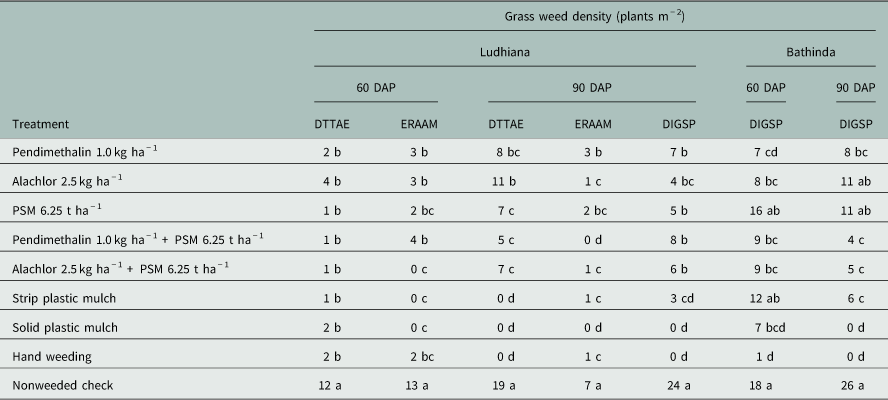
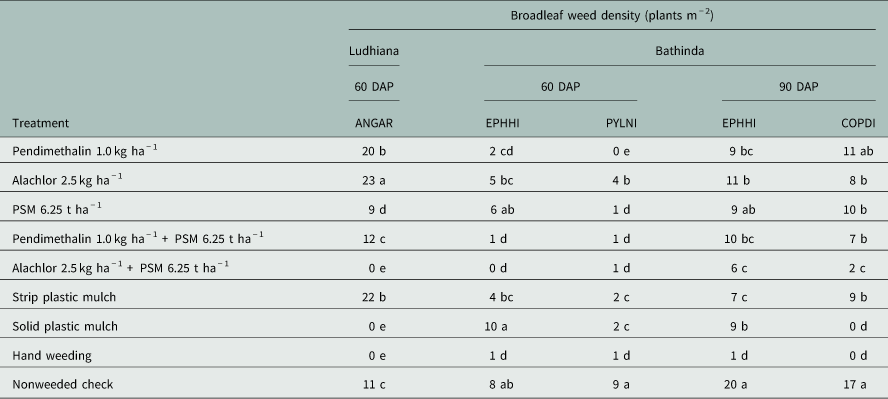
The major weed flora in the common cottonwood nursery fields consisted of three grass weed species—crowfootgrass, feather lovegrass, and southern crabgrass; and four broadleaf weeds species—scarlet pimpernel, garden spurge, niruri, and lesser swinecress (Tables 1 and 2). Variations in cropping history seem to be responsible for variation in weed species at both locations, although all the weed species were representative of the major weed flora of northern India. Among grass weeds, data on feather lovegrass were recorded at 60 DAP and those on southern crabgrass were recorded at 90 DAP at Ludhiana, while southern crabgrass was the only grass weed species recorded at Bathinda. Among broadleaf weeds, scarlet pimpernel was the only species recorded at 60 DAP at Ludhiana, and at Bathinda three weeds, garden spurge (60 to 90 DAP), niruri (60 DAP), and lesser swinecress (90 DAP), were recorded.
Effects of weed control treatments on density of grass weeds at Ludhiana and Bathinda in 2015.Footnote a , Footnote b

a Data were square-root transformed before analysis; however, back-transformed actual mean values are presented based on the interpretation from the transformed values. Means within a column followed by different letters are significantly different at P < 0.05.
b Abbreviations: DAP, days after planting; DTTAE, Dactyloctenium aegyptium; ERAAM, Eragrostis tenella; DIGSP, Digitaria ciliaris; PSM, paddy straw mulch.
Effects of weed control treatments on density of broadleaf weeds at Ludhiana and Bathinda in 2015.Footnote a , Footnote b

a Data were square-root transformed before analysis; however, back-transformed actual mean values are presented based on the interpretation from the transformed values. Means within a column followed by different letters are significantly different at P<0.05.
b Abbreviations: DAP, days after planting; ANGAR, Anagallis arvensis; EPHHI, Euphorbia hirta; PYLNI, Phyllanthus niruri; COPDI, Coronopus didymus; PSM, paddy straw mulch.
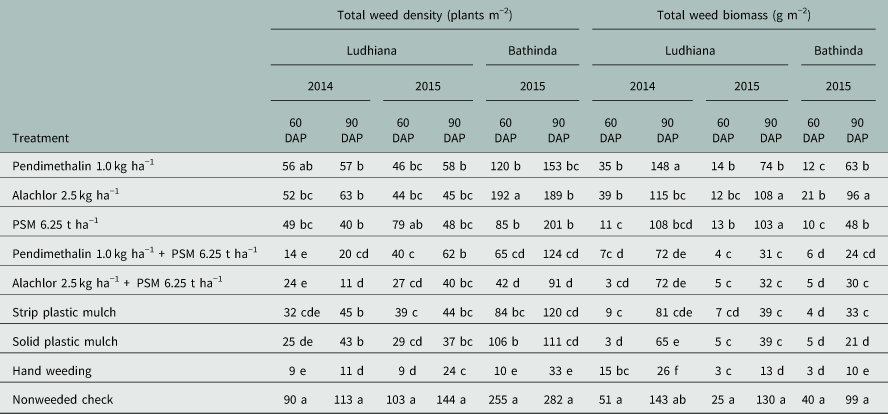
The PRE herbicides and mulch treatments, used alone or in combination, gave effective control of most of the weeds up to 60 DAP. The differences became more pronounced at 90 DAP, when combinations of herbicides plus PSM or plastic mulch treatments were more effective than either herbicide or PSM applied alone. Pendimethalin and alachlor control primarily grass weed species, and these herbicides in previous work reduced grass weed density until 60 DAP (Altland et al. Reference Altland, Gilliam and Wehtje2003). The poor control of weeds at 90 DAP under the sole herbicide treatment is likely due to herbicide degradation over time (Patakioutas and Albanis Reference Patakioutas and Albanis2002; Shaner Reference Shaner2012). The persistence of pendimethalin and alachlor varies from 35 to 50 and 30 to 45 d, respectively, depending on the rate applied as well as rainfall, temperature, soil disturbance, etc. (Janaki et al. Reference Janaki, Chinnusamy, Sakthivel and Nithya2015). Bajwa et al. (Reference Bajwa, Minhas, Brar and Bal1991) reported that under north Indian conditions, PRE herbicides like diuron and pendimethalin remain effective up to 40 to 60 d. At Ludhiana, all treatments reduced crowfootgrass, feather lovegrass, and total weed density compared to weedy check at 60 DAP in both years, except total weed density under pendimethalin in 2014 and PSM in 2015 (P<0.05) (Tables 1 and 3). Herbicide plus PSM reduced density of scarlet pimpernel compared to the herbicides applied alone. Solid plastic mulch gave complete control of grass weeds (P<0.05). At 90 DAP, pendimethalin or alachlor plus PSM and plastic mulch treatments had lower densities of crowfootgrass, feather lovegrass, southern crabgrass, and total weeds compared to sole application of herbicide or PSM and weedy check in both years (P<0.05) (Tables 1 and 3). At Bathinda also, these treatments gave similar results for grass, broadleaf, and total weed density at 60 to 90 DAP (Tables 1, 2, and 3). While both herbicides are effective on selected small-seeded broadleaf weed species (Dixon and Clay, Reference Dixon and Clay2004), control of scarlet pimpernel was poor in these treatments, although that species completed its life cycle and dried up quickly. The density of southern crabgrass, lesser swinecress, or garden spurge under herbicide or PSM alone was similar to that of the weedy check at 60 or 90 DAP (P>0.05). The integration of herbicide plus PSM recorded lower total weed density than did plastic mulch treatments in 2014 (P<0.05) and similar density in 2015 (P>0.05).
Effect of weed control treatments on total weed density and biomass in common cottonwood nurseries during 2014 and 2015 at Ludhiana and during 2015 at Bathinda.Footnote a , Footnote b

a Data were square-root transformed before analysis; however, back-transformed actual mean values are presented based on the interpretation from the transformed values. Means within a column followed by different letters are significantly different at P<0.05.
b Abbreviation: DAP, days after planting; PSM, paddy straw mulch.
Weed Biomass
At Ludhiana, all the weed control treatments recorded lower weed biomass than the unweeded check in both years at 60 and 90 DAP (P<0.05). The integration of herbicides plus PSM and both plastic mulch treatments had lower weed biomass than either herbicide or PSM used alone (P<0.05). At Bathinda, integrated weed control treatments and use of plastic mulch alone recorded lower weed biomass than nonweeded check at 60 and 90 DAP (P<0.05) (Table 3). PSM alone gave fair control of grass and broadleaf weeds through 60 DAP, after which weed seedlings were able to emerge through open spaces in PSM and accumulate appreciable biomass between 60 and 90 DAP. PSM has been shown to reduce weed seed germination and suppress the growth of emerged weeds by blocking light (Mohanty et al. Reference Mohanty, Sonkar and Marathe2002). The greater efficacy of herbicide plus PSM indicated a complementary effect, whereby PRE herbicides delayed weed emergence from uncovered soil, while PSM delayed seed germination and reduced weed density and biomass to a larger extent than either herbicide or PSM applied alone. Multiple studies have shown that straw mulch is effective in suppressing weed growth and reducing the need for POST herbicides, although Chalker-Scott (Reference Chalker-Scott2007) and Chen et al. (Reference Chen, Strahan and Bracy2013) reported a variable effect on the crop yield. Buhler et al. (Reference Buhler, Netzer, Riemenschneider and Hartzler1998) further stated that successful weed control strategies should be based on a combination of chemical and nonchemical measures, although both pendimethalin and alachlor initially provided effective weed control in common cottonwood ETP production. Similarly, a thicker application of PSM should be evaluated to determine if weed control could be improved beyond the effectiveness of the 3.5-cm thickness of PSM treatments with and without herbicides used in this study. In plastic mulch treatments, weeds were able to emerge only through the intra-row spaces or where holes were made in the mulch. The plastic mulch with holes was therefore more effective than when it was spread between rows. Plastic mulches were also able to suppress weed growth longer than these treatments, as herbicide and PSM degraded with time while plastic mulch sheets remained intact. Biodegradable mulches should be tested in future studies in common cottonwood nurseries.
Growth and Development of Common Cottonwood Plants
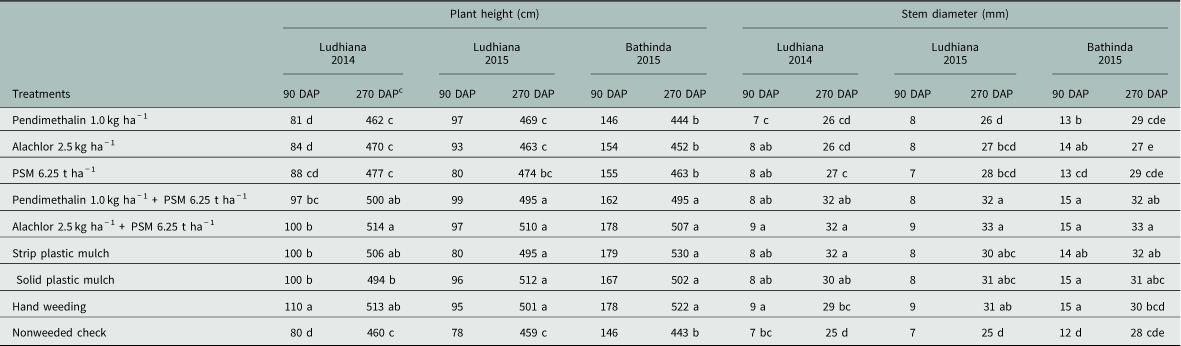
At 90 DAP, common cottonwood plants grew 11% to 16% taller under plastic mulch, hand weeding, and herbicide plus PSM compared to herbicide or PSM alone and nonweeded plots in 2014 at Ludhiana (P<0.05) (Table 4). At 90 DAP in 2015, however, common cottonwood height was similar across all treatments at both locations (P>0.05). At 270 DAP, the height of common cottonwood plants treated with pendimethalin, alachlor, and PSM alone was similar to that in nonweeded check plots at both locations (P>0.05). The integration of herbicide plus PSM and both plastic mulch treatments and hand weeding increased common cottonwood height by 20% to 28% compared with herbicide or PSM alone at both locations (P<0.05). The effect of weed control treatments on common cottonwood stem diameter were similar to that recorded for plant height. Trees grown under the best treatments were 11% to 19% taller and had 20% to 28% greater stem diameter at 270 DAP than those in nonweeded check plots at both sites.
Effect of weed control treatments on height and diameter of common cottonwood nursery plants at 90 and 270 DAP during 2014 and 2015 at Ludhiana and during 2015 at Bathinda.Footnote a , Footnote b

a Means within a column and treatment factor followed by different letters are significantly different at P<0.05.
b Abbreviation: DAP, days after planting; PSM, paddy straw mulch.
c At harvest.
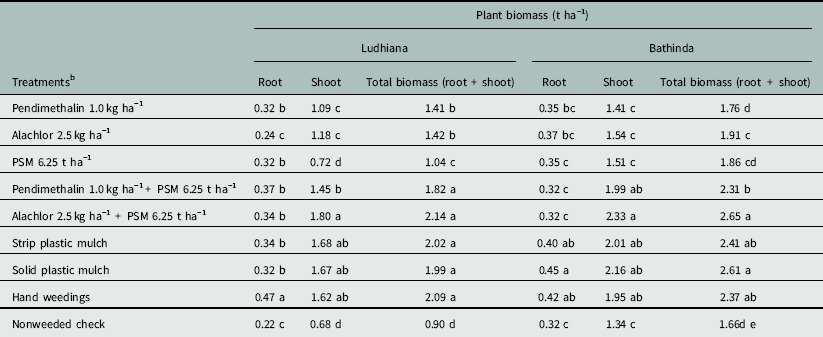
In 2015, common cottonwood plants under the hand weeding treatment at Ludhiana and under the solid plastic mulch treatment at Bathinda accumulated the highest root biomass (Table 5). Root biomass under strip plastic mulch or in hand-weeded plots was similar to solid plastic mulch at Bathinda (P>0.05). The integration of alachlor plus PSM, strip plastic mulch, or solid plastic mulch resulted in similar common cottonwood shoot biomass as that produced in hand-weeded plots, and greater total biomass (root plus shoot) than that of trees treated with herbicides or PSM alone or in trees in nonweeded check plots at both locations (P<0.05) (Table 5). The treatment combinations of pendimethalin or alachlor with PSM and both plastic mulch treatments reduced weed density and biomass; hence, common cottonwood grew taller, their stems were thicker, and their roots and aboveground biomass were similar to those of trees in hand-weeded plots. Hansen and Netzer (Reference Hansen and Netzer1985) reported that half the mortality of common cottonwood rooted cuttings and poor quality of surviving plants occurred when weeds were not suppressed at an early stage. In this study, there was no plant mortality, although weeds adversely affected growth and development in proportion to the level of weed competition. For example, compared to the hand-weeding treatment, weed competition in nonweeded check plots reduced plant height (8% to 15%), diameter (6% to 18%), and aboveground biomass (21% to 58%) of common cottonwood nursery plants across the two locations. These data confirm results reported by Marino and Gross (Reference Marino and Gross1998) and Sixto et al. (Reference Sixto, Grau and García-Baudín2001).
Effect of different weed control methods on differentiation of biomass of common cottonwood nursery plants at Ludhiana and Bathinda in 2015.Footnote a

a Means within a column followed by different letters are significantly different at P<0.05.
bAbbreviation: PSM, paddy straw mulch.
In conclusion, the integrated use of pendimethalin at 1.0 kg ha−1 or alachlor at 2.5 kg ha−1 and paddy straw mulch at 6.25 t ha−1, or uniform spreading of plastic mulch alone within nursery rows or in the whole field after punching holes for common cottonwood stem cuttings could be adopted for effective control of weeds in common cottonwood nursery plantations. The outcome of this study may prove to be valuable for future herbicide registrations in common cottonwood production throughout the world.
Acknowledgment
The authors acknowledge the financial assistance of the Indian Council of Agricultural Research (ICAR) through the All India Coordinated Research Project on Agroforestry to the department.